Version Control in Online Software Repositories
E. Rowland Watkins
School of Electronics & Computer Science University of Southampton
UK, SO17 1BJ
Denis A. Nicole
School of Electronics & Computer Science University of Southampton
UK, SO17 1BJ
Abstract— Software version control repositories provide a uniform and stable interface to manage documents and their version histories. Unfortunately, Open Source systems, for example, CVS, Subversion, and GNU Arch are not well suited to highly collaborative environments and fail to track semantic changes in repositories. We introduce document provenance as our Description Logic framework to track the semantic changes in software repositories and draw interesting results about their historic behaviour using a rule-based inference engine. To support the use of this framework, we have developed our own online collaborative tool, leveraging the fluency of the modern WikiWikiWeb.
Keywords: Cryptography, Online Collaboration, Semantic Web, Version Control, WikiWikiWeb
I. INTRODUCTION
Current Open Source version control repositories, such as CVS [1], Subversion [2] and GNU Arch [3], pro-vide a framework for tracking evolving documents and grouping them into projects and releases. Unfortunately, they lack the reasoning capability necessary to make intelligent inferences over the content and to audit its evolution.
The modern Wiki provides a very natural text-based environment for shared discussion and for the evolution of partially formed ideas. This is in sharp contrast to the strict version orientation required in source code control tools such as CVS. Within our work, we are trying to explore the value of mixing the Wiki’s informality for discussions about structure and implementation with CVS’s rigour in ensuring that consistent builds can be achieved. We further inform this process by providing inference tools which make it easy to deduce patterns of activity in the codebase and by requiring authentication which ensure continued individual accountability.
We thus bring together three ideas; the Semantic Web [4], the new freedoms of the WikiWikiWeb [5], and XML Digital Signature-based document signing with
public-key validation [6], to deliver an online collabo-rative tool that can provide intelligent software manage-ment to address the limitations of earlier version control systems and help software developers build an organic grasp of their software engineering process. We have leveraged existing popular Resource Description Frame-work (RDF)-based ontologies, to introduce a minimal set of extensions to track the provenance of documents. Using our ontology as a description logic (DL), we have enhanced the JSPWiki [7] implementation to track online resources kept in a WebDAV [8] repository and more importantly, added an inference mechanism to allow useful deductions to be made about the evolution of project files.
Reusing existing ontologies as far as possible is important because defining a new ontology does not help in shared understanding across domains; by lever-aging existing work, the semantic content of our sys-tem is immediately accessible to tools built for pre-existing ontologies. It also becomes straightforward to federate information from our system with other knowledge scattered over the Semantic Grid [9]. We have therefore taken advantage of Dublin Core [10], Friend of a Friend (FOAF) [11], and Description of a Project (DOAP) [12] to promote ontology extension.
We use Named Graphs [13] to label RDF trees that allow us to create relations between graphs, and hence make provenance statements. We have built a small Java applet to facilitate secure signing of the metadata in a browser environment, including hashes of source files. This can digitally sign RDF [14] and store the result in a Named Graph, and thus validate inputs and detect corruption in the knowledge-base. We can also use digital signatures to promote developer accountability in the software project.
The WikiWikiWeb interface makes for simple an-notation of developer ideas. The system automatically generates a single Wiki page per file (Class); these can easily link to and from pages devoted to more generic ideas. The automatic page provides hyperlinks between packages and classes to support routine navigation. This and other information is automatically parsed from Java source codes.
The rest of this paper provides a overview of our online collaborative tool and its advantages over simple version controlled systems. Section II describes our de-scription logic framework, realized as an OWL ontology. Section III goes on to outline our tool’s architecture and implementation. Section IV gives an account of our system in action with some sample inferences. We discuss related work in V.
II. ONTOLOGY DESIGNOVERVIEW
Software version control repositories like CVS man-age the changes made to documents over time. CVS uses a bespoke metadata format to record the author, description and version of a document which cannot readily be shared externally. CVS uses a form of delta versioning [16] which holds the information for all file versions and their metadata contained within the same file. A well-known consequent restriction of CVS is its assumption of long-lived file names and particu-larly directory structures. The assumption can interact badly with modern practices such as Extreme Program-ming [17], where semantically simple refactorings can have complex syntactic implications on files and direc-tory hierarchies.
Another immediate problem with older tools such as CVS is that they keep the history metadata and delta versioning [16] information together in the same logical structure. The Delta-V [18] Working Group addressed this problem by separating the history and version meta-data. Subversion [2] also improves on this problem, introducing a relational database to store metadata. To further develop this and leverage the rich tools of the Semantic Web we introduce document provenance, a Description Logic (DL) [19] framework based on open standards which can be used for semantic version control and validation.
A. Document Provenance
[image:2.612.318.559.51.200.2]Document provenance is an abstract and somewhat ill-defined concept that associates authenticity with a docu-ment, based on work done by Buneman [20], Goble [21], and Szomszor et al. [22]. The term implicitly assumes
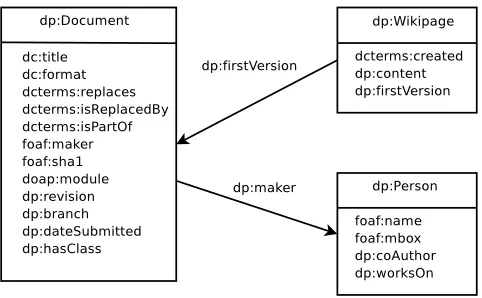
Fig. 1. Document Provenance Ontology
that provenance should be bound to information at the level of documents (URIs) rather than, for example, that of websites (as is achieved by HTTPS authentication) or of individual rows in a database; if we consider JavaTMsource code, the natural document unit is a class; these are usually kept in separate files. Hence, the code unit we map onto a document is intended to be the smallest natural source object that should be updated as an entity.
We have defined document provenance as a DL frame-work using RDF and OWL to develop an ontology to describe the evolving documents. While we can leverage existing ontologies, we believe that we need to introduce small extensions for semantic version control. Figure 1 shows the three new classes we have created which themselves inherit from FOAF and DOAP as well as importing properties from Dublin Core.
Our use of existing ontologies is important because simply defining a new ontology does not help in shared understanding across domains. This concern was voiced by Guus Schreiber [23], who stated “Good ontologies are used in applications. They represent some form of consensus in a community. . . creating my own ontology is a misappropriation of the term. Ontology is about shared understanding” [24].
III. IMPLEMENTATION
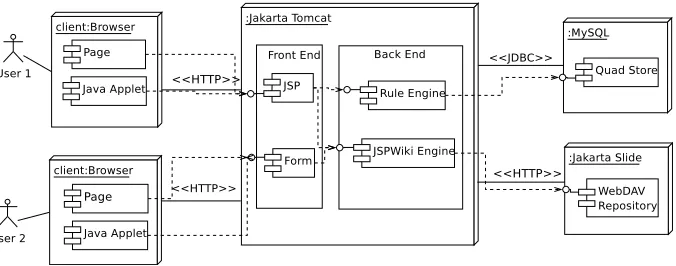
Fig. 2. Online Collaboration Tool Architecture.
Figure 2 shows the top level architecture of our online collaborative tool. Our architecture is split into three main portions: the client browser, the Jakarta Tomcat application server, and the RDBMS and WebDAV server. Both on the client and server side, we use the Jena Semantic Web framework and its Named Graph ex-tension library, NG4J. We use NG4J extensively for manipulating RDF, Named Graphs and RDF digital signatures. Cryptographic support has come from the Bouncy Castle [25] JCE provider and the XML Signing of Named Graphs allows us to restrict inferences to chosen trust domains.
A. Client Side
The client side uses standard web browser capable of executing a JavaTMapplet. Developers select their source code to upload; the applets job is to generate metadata based on those files and cryptographically sign. Note that, in this architecture, the integrity of the repository is vested in the individually signed graphs of metadata; the repository contents may freely be duplicated to protect against loss of the primary site and core trust is vested only in individual authors, not in the repository itself.
B. Server Side
The server side is a generic J2EE web application hosting an enhanced instance of JSPWiki. The server processes requests from the client, accepting verified and signed commits as they arrive from the client, and providing the Wiki interface and inference query support. All semantic content is stored within a Named Graph quad store1held by a MySQL RDBMS, while all source code is in a WebDAV repository.
The new server-generated metadata created as a result of Description Logic inference on the server is, of course,
1
The Named Graph’s URI is the first element of the quad.
only as trustworthy as the set of author metadata from which it is inferred and also the server itself. The inference interface allows this metadata provenance to be tracked through the Named Graphs.
Wikipages are stored as plaintext files, which give developers the opportunity to discuss design issues, post news, link diagrams, and make announcements.
As an additional benefit besides the adherence to the MVC pattern, keeping the quad store and document storage mechanism separate from the Wiki means we can easily provide alternative access to the source codebase using Web or Grid Services [26]. These can be used to support automatic build and installation of named releases onto Grid hosts.
C. Semantic Inferences
Not only does the Jena provide a comprehensive API to manipulate RDF and ontologies, it also features a stable rule-based reasoner. Convenience reasoners sup-port RDFS and OWL entailments, while a generic rea-soner lets developers define their own rules. The generic reasoner has both forward (RETE algorithm [27]) and backward (Logic Programming) engines.
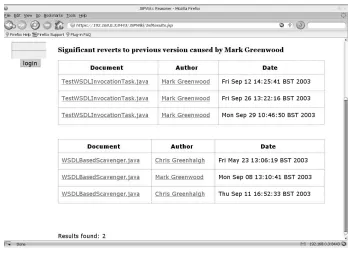
Fig. 3. Significant Reverts to previous versions.
IV. EVALUATION
Our tools are primarily designed to support the man-agement and execution of ongoing software development projects. We can, however, evaluate the effectiveness of the semantic components by bulk loading the code repositories of existing projects and drawing interesting results about their historic behaviour. We took several well known UK e-Science and international grid projects and deposited their CVS repositories into our quad store. These projects included MyGrid’s [29] Taverna, and the UNICORE [30] grid project.
Rather than upload each version individually, we wrote a small application similar to the applet used in the client web browser to bulk import all project version histories. Each project was given a DOAP description and all developers found at the project’s SourceForge webpage were given a synthetic FOAF description and a local PKCS #12 digital certificate. This has given us a quad store holding over 27000 Named Graphs or just over half a million quads to query. In terms of raw storage, the ratio of semantic content to source code is just over 2:1.
Each of the projects loaded is written in Java; we mined important class, package and import information and added it to the metadata about each class as we would with a normal author commit. This forms the basis of navigation in the Wiki. Lists of imports link to other
classes in the repository, leveraging the intuitive interface of the Wiki.
A. Example Inferences
For our online collaborative tool to be useful to the developer community, inferences should be able to solve complex queries that are difficult or beyond the scope of simple relational database queries.
• Find all occurrences where a developer reverts the changes made by another developer.
• Find all cases where a developer modifies a file which is not part of their usual responsibility. • A defect has been found in a class which may
affect various projects, packages and classes: find all projects, packages and classes related to this class by import, by author group, or by time of modification.
• As a routine practice, we can also use metadata to revalidate the authenticity and validity of a set of project files.
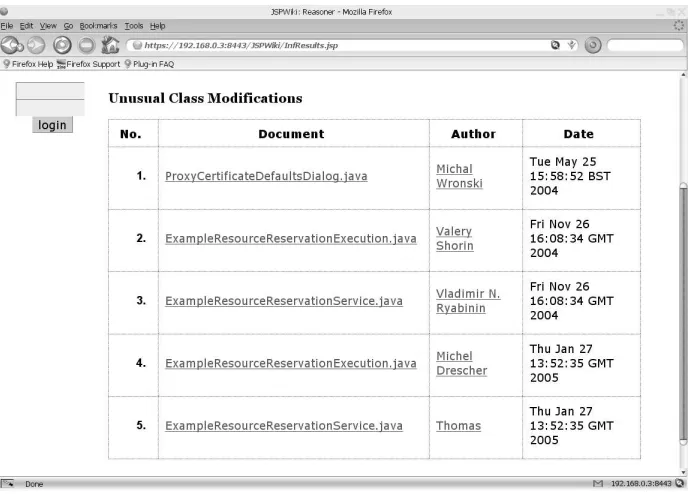
Fig. 4. Unusual Modifications to Classes.
feel for the degree to which the developer is using the repository as a scratchpad.
Figure 3 shows results when searching for significant reverts to UNICORE by a particular user. The top result is a self-revert and the second case, which might be more problematic, is a revert performed by the author of the previous version. In the codebase we examined, such reverts are infrequent.
The second inference investigates the possibility that a developer is roving outside their area of expertise. This might mean they have inadvertently introduced defects. This may also be a signal to the development community that communication needs to be improved. Figure 4 shows the results for unusual modification of classes of the entire UNICORE repository.
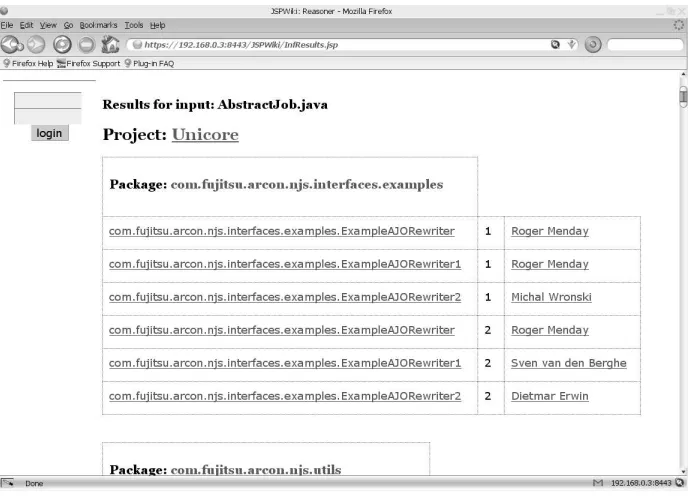
The third inference is useful in giving a detailed view of the impact of a defect. By pin-pointing which products are affected, warnings can be sent to users and developers. Figure 5 shows a small part of a large list of dependents for the class AbstractJob.java, a core com-ponent of UNICORE’s AbstractJobObject framework.
B. Performance
The inferences outlined above have been executed using Jena’s forward RETE rule engine. The backward logic rule engine is more responsive for simple inter-active queries, but the forward engine performs better across broad inferences on the code base. As an example,
the three queries used above took 13s, 14s and 61s respectively on a AMD K7 workstation with 1GB of memory, using the SunTMJavaTM1.5 JVM.
V. RELATEDWORK
Companies are starting to use Wikis as a means to encourage knowledge sharing and general collabora-tion [31], [32], [33] and we are enthusiastic about the mix of the freedoms of the Wiki for brainstorming coupled with the accountability associated with a validated web repository. While several Wiki implementations exist that support version control (JSPWiki can track wikipage versions), few if any have facilities similar to CVS, Subversion, or GNU Arch. Other Wikis go so far as to include Semantic content [34], but without the use of Named Graphs, digital signatures, or inference rules.
Similarly, little work has been done with regard to digital signatures in RDF. While at least two C14N algorithms exist for RDF [14], [35], only one has been implemented, which we use in our system.
VI. CONCLUSION
Fig. 5. List of Packages and Classes Affected by the Defective Class, AbstractJob.java.
based on popular ontologies. Using our extension set as a Description Logic, we then enhanced a basic Wiki with semantic content that described documents and their relations to different versions. We then created a cryptographic validation mechanism based on digital signatures for RDF.
Developers have the ability not only to actively collab-orate in a centralized location, but also gain a greater un-derstanding of the software engineering process through querying of the underlying knowledge-base.
Future work in this area will include exposing the NG4J quad store with web and grid services [36], which will allow external entities to make their own inferences and gain new understanding.
We will also be using the repository for live develop-ment of the WSeSS managed programme component of the UK Open Middleware Infrastructure Institute[37].
REFERENCES
[1] Karl Fogel and Moshe Bar. Open Source Development with CVS. Paraglyph Press, third edition, July 2003.
http://cvsbook.red-bean.com/OSDevWithCVS 3E.pdf.
[2] Ben Collins-Sussman, Brian W. Fitzpatrick, and C. Michael Pilato. Version Control with Subversion. O’Reilly Media, first edition, June 2004.
[3] Nick Moffitt. Revision Control with Arch: Introduction to Arch.
Linux Journal, Nov 2004.
http://www.linuxjournal.com/article/7671.
[4] T. Berners-Lee, J. Hendler, and O. Lassila. The Semantic Web.
Scientific American, page 2837, May 2001.
[5] Bo Leuf and Ward Cunningham. The Wiki Way. Addison-Wesley Longman, March 2001.
[6] Mark Bartel, John Boyer, Barb Fox, Brian LaMacchia, and Ed Simon. Xml-signature syntax and processing. http://www.w3.org/TR/xmldsig-core/.
[7] Janne Jalkanen. JSPWiki - a JSP-based WikiWiki clone. http://www.jspwiki.org/.
[8] E. James Whitehead, Jr. and Yaron Y. Goland. Web-DAV: A network protocol for remote collaborative authoring on the Web. In Proc. of the Sixth European Conf. on Computer Supported Cooperative Work (ECSCW’99), Copen-hagen, Denmark, September 12-16, 1999, pages 291–310. http://citeseer.nj.nec.com/whitehead99webdav.html.
[9] D De Roure, N R Jennings, and N R Shadbolt. The semantic grid: Past, present, and future.Proc. IEEE, 93:669–681, March 2005.
[10] K. Watanabe. Introduction of dublin core metadata.Journal of Information Processing and Management, 43, 2001.
[11] Libby Miller and Dan Brickley. SWAD-Europe Deliverable 3.16: Final Workshop Report. IST Project IST-2001-34732, (2004). A report of the 1st Workshop on Friend of a Friend, Social Networking and the Semantic Web, 1-2 September 2004, Galway, Ireland.
[12] Edd Dumbill. Decentralizing Software Project Registries with DOAP. InXML 2004, 2004.
[13] Jeremy J. Carroll, Christian Bizer, Patrick Hayes, and Patrick Stickler. Named Graphs, Provenance and Trust. InWWW2005, 2005.
[14] Jeremy Carroll. Signing RDF Graphs. In 2nd ISWC, volume 2870 of LNCS, July 2003.
http://www.hpl.hp.com/techreports/2003/HPL-2003-142.pdf. [15] Chris Bizer, Richard Cyganiak, and Rowland Watkins.
NG4J-Named Graphs API for Jena. 2005.
http://web.mit.edu/ghudson/thoughts/file-versioning.
[17] Kent Black. Extreme Programming Explained : Embrace Change. Addison-Wesley Professional, 2004.
[18] Sunghun Kim, Kai Pan, Elias Sinderson, and E. James White-head Jr. Architecture and Data Model of a WebDAV-based Collaborative System. In International Symposium on Collaborative Technologies and Systems (CTS ’04), 2004. http://www.cse.ucsc.edu/ hunkim/papers/catacomb-CTS04.pdf. [19] Franz Baader, Diego Calvanese, Deborah Mcguinness, Daniele
Nardi, and Peter Patel-Schneider.The Description Logic Hand-book: Theory, Implementation and Applications. Cambridge University Press, 2003.
[20] Peter Buneman, Sanjeev Khanna, and Wang-Chiew Tan. Data Provenance. May 2001.
http://db.cis.upenn.edu/Research/provenance.html.
[21] Carole Goble. Position Statement: Musings on Provenance, Workflow and (Semantic Web) Annotations for Bioinformatics, September 2002. Published at [38].
[22] Martin Szomszor and Luc Moreau. Recording and Reasoning over Data Provenance in Web and Grid Services. In Interna-tional Conference on Ontologies, Databases and Applications of SEmantics (ODBASE’03), volume 2888 ofLecture Notes in Computer Science, Catania, Sicily, Italy, nov 2003.
http://www.ecs.soton.ac.uk/˜lavm/papers/odbase03.ps.gz. [23] Berliner XML Tage 2004. http://www.berliner-xmltage.de/. [24] Richard Cyganiak. Guus Schreiber on Semantic Web best
practices, October 2004. http://dowhatimean.net/2004/10/guus-schreiber-on-semantic-web-best-practices.
[25] The Legion of the Bouncy Castle. Bouncy Castle Crypto APIs, 2004. http://www.bouncycastle.org/.
[26] Malcolm Atkinson, David DeRoure, Alistair Dunlop, Geoffrey Fox, Peter Henderson, Tony Hey, Norman Paton, Steven New-house, Savas Parastatidis, Anne Trefethen, and Paul Watson. Web service grids: An evolutionary approach.Concurrency and Computation: Practice and Experience, 17:377389, Feb 2005. [27] C.L Forgy. RETE: A fast algorithm for the many pattern/many
object pattern match problem. 1982.
[28] Libby Miller, Andy Seaborne, and Alberto Reggiori. Three Implementations of SquishQL, a Simple RDF Query Language. InISWC, 2002.
[29] R. Stevens, A. Robinson, and C.A. Goble. myGrid: Personalised Bioinformatics on the Information Grid. In11th International Conference on Intelligent Systems in Molecular Biology, vol-ume 19, pages i302 – i304, 2003.
[30] Dirk Breuer, Dietmar Erwin, Daniel Mallmann, Roger Men-day, Mathilde Romberg, Volker Sander, Bernd Schuller, and Philipp Wieder. Scientific Computing with UNICORE. InNIC Symposium 2004, Proceedings, Dietrich Wolf, Gernot M¨unster, Manfred Kremer (Editors), John von Neumann Institute for Computing, J¨ulich, NIC Series, volume 20, pages 429–440, 2003.
[31] Ross Mayfield. Ross Mayfield’s Weblog: Col-laborative Proposal Development, September 2003. http://ross.typepad.com/blog/2003/09/collaborative p.html. [32] Jon Udell. Year of the enterprise Wiki: Lightweight
Web collaboration gets down to business, Dec 2004. http://www.infoworld.com/article/04/12/30/01FEtoycollab 1.html.
[33] Business Week Online. Championing a Wiki World, Oct 2004. http://www.businessweek.com/technology/content/oct2004/ tc$20041019 0375 $tc$182$.htm.
[34] Roberto Tazzoli, Paolo Castagna, and Stefano Emilio Cam-panini. Towards a Semantic Wiki Wiki Web. In Poster Track, 3rd International Semantic Web Conference (ISWC2004), Nov 2004. http://iswc2004.semanticweb.org/posters/PID-LPSVVIIZ-1090243438.pdf.
[35] Craig Sayers and Alan H. Karp. Computing the digest of an rdf graph. Technical report, Nov 2003.
http://www.hpl.hp.com/techreports/2003/HPL-2003-235.pdf. [36] Malcolm Atkinson, David DeRoure, Alistair Dunlop, Geoffrey
Fox, Peter Henderson, Tony Hey, Norman Paton, Steven New-house, Savas Parastatidis, Anne Trefethen, Paul Watson, and Jim Webber. Web Service Grids: An Evolutionary Approach. 2004.
http://www.omii.ac.uk/paper web service grids.pdf. [37] The omii product roadmap–version 2. 2004.
http://www.omii.ac.uk/OMIIRoadmapV2.pdf.
[38] Data Provenance/Derivation Workshop Position Papers and Talks, October 2002.