T
H E
DESIGN AN D I M P L E M E N T A T I O N 0 F A S T R U C T U R E D P R O G R A M M I N G L A N G U A G E W I T H F E W A R B I T R A R Y R E S T R I C T I O N ST H E C O M P I L A T I O N P H A S E
A dissertation presented by
N O L A M. S I M P S O N
In partial fulfilment of the requirements for the degree of
Master of Science in Computer Science at
Massey University
ABSTRACT
This thesis outlines the design and implementation of a structured teaching language with particular emphasis on the
compilation phase. This language, which has been called MUSSEL (~assey ~niversity ~tructured ~tudent _!:anguage) is intended for instruction of first year Computer Science students. In this
respect it is a language which is as free as possible from arbitrary syntactic restrictions and is in a form that the student should find both easy and natural to write, with a minimum incidence of programming
er~~-It is evident that the language a student uses profolIDdly influences the way he develops his techniques and habits of construction of algorithms. MUSSEL has been designed with this influence in mind and has been deliberately designed as a
structured language i.e. the language reflects the basic structure of programs, so that algorithms can be refined and expressed
naturally in it. In this sense MUSSEL aims to teach the student programming as a constructive intellectual discipline rather than
just as a tool to cornrnlIDicate with the computer.
ACKNOWLEDGEMENTS
In being able to present this thesis, I wish to offer sincere thanks to the following people.
To my supervisors, Professor G. Tate and R.W. Doran for their help, guidance and forbearance.
To Peter Gibbons, with whom I worked for many long hours in discussing the design and implementation of MUSSEL.
To the Mathematics Secretary, Mrs. I.M. Cornish for her kindness, tolerance and competence in typing the script.
Finally to the Staff of both the Computer Unit and Mathematics Department for their constant reminders during the past six months, that my thesis was due for completion.
I would also like to acknowledge the fact that changing my name has not been exactly conducive to completing this thesis within the respective time limit.
Massey University June, 1973,
rn~IBR 1
CHAPTER 2 2.1 2.2 2.3 2.4 2.5 2.6 2.7 2.8 2.9 2.10 2.11 2.12 2.13 2.14 2.14.1 2.14.2 2.14.3 2.15 2.16 CHAPTER 3
3.1 3.2 3.3 3.4
TABLE OF CONTENTS
PAGE INTRODUCTION - A STRUCTURED LANGUAGE FOR
STRUCTURED PROGRAMMING 1
A DESCRIPTION OF THE MUSSEL LANGUAGE 6
Admissible characters 6
Constants 6
Operators 7
Names 8
Variables 8
Arrays and Subscripted Variables 8
Assignment Instructions 9
Program Structuring 10
Conditional Groups 10
Loops 12
Procedures 15
Recursion 16
Dynamic Arrays 17
Input/Output 17
Input 17
Output 18
Printer Controls 21
Conclusion 22
An Example 24
METHOD OF IMPLEMENTING MUSSEL 26
Introduction 26
The Compilation Phase 28
The Intermediate Language 28
CHAPTER 4 4.1 4.2 4.2.1 4.3 4.3.1 4.3.2 4. 3. 3 4.3.4 4. 3. 5 4.3.6 4.3.7 4.3.8 4.3.9
PAGE THE DESIGN OF THE COMPILATION PHASE 30
Introduction 30
Main Control and Input Module 30
Control Cards 31
Parsing and Intermediate Language generation 33
The Lexical Analysis 33
Indentation 36
Symbol Table 38
Symbol Table Look Up 40
Reserved Word Table 43
Syntax of MUSSEL 43
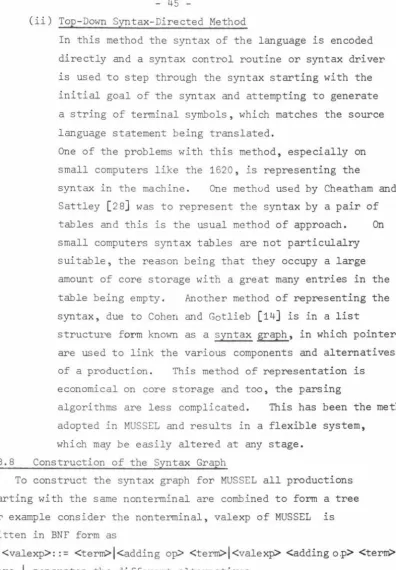
Method of Parsing MUSSEL 44
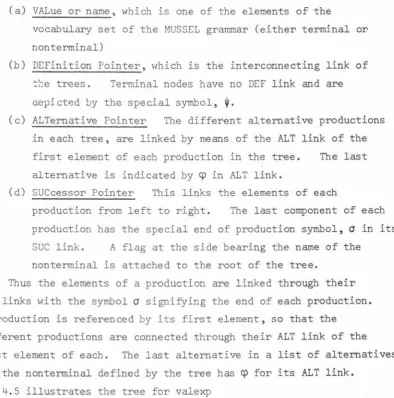
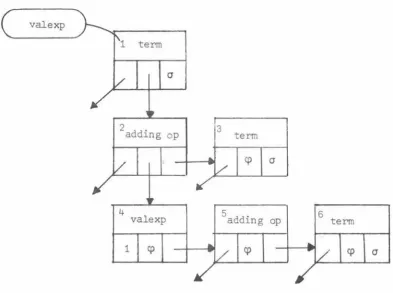
Construction of the Syntax Graph 45 Representation of the Syntax Graph 48 in the Computer
4.3.10 Syntax Control Routine 4.3.11 Semantic Routines 4.3.12 Error Diagnostics
48 49 50 51 4.4 Interface Module
CHAPTER 5 FUTURE DEVELOPMENTS OF THE MUSSEL SYSTEM 5.1 Compilation Time Error Messages
5.2 Execution-time Error Checking and Messages 5,3
5.4 5. 5_ 5.6
Symbol Table Dump at Execution Time Tracing a Program During Execution Compile-time Error Diagnostics Other Developments
LIST OF FIGURES
Fig 2.1 Structure Diagram for Example 2.16 between pp 24-25 Fig 4.1 Storage Layout During Parsing and Intermediate
Language generation between pp 33-34 Fig 4.2 Symbol Table during compilation
Phase between
PP
38-39Fig 4.3 Inserting Name into Symbol Table between pp 40-41 Fig 4.4 Searching For name in Symbol Table between pp 41-42 Fig 4.5 The tree for the nonterminal valexp
of MUSSEL between pp 46-47
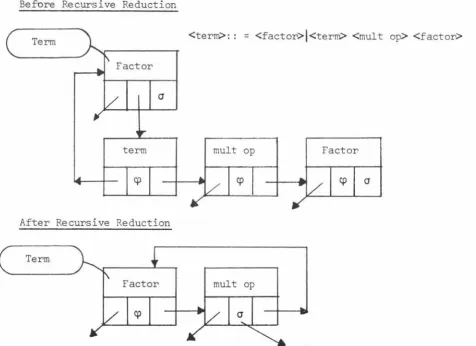
Fig 4.6 Example illustrating Recursive
CHAPTER 1
INTRODUCTION - A STRUCTURED LANGUAGE FOR STRUCTURED PROGRAMMING.
It has been common practice when introducing programming
to students for the first time, to furnish them with the details
and idiosyncrasies of a given programming language, mostly FORTRAN
or BASIC, and then by means of examples attempt to teach students how to write programs in the particular language.
As a result it is not surprising if the student after this
course is hardly an effective programmer, and often has not even
been taught a basis on which to further develop his capabilities.
After all, he has only been subjected to what Wirth [6] has
called a "computer appreciation course" or maybe a "disappreciation
course"
It should be recognised that programming is a more difficult subject than is normally estimated and that the real art of
programming is firstly construction of algorithms, and this
has in the past normally been left to the in.tuition of the student alone. Increasing the complexity of the problems used
as examples, merely increases the demands and strain on the students intuition, but not further his capability to control and check his
intuition by reason - he may even be misguided into believing that
the essence of programming is concocting ad-hoc ideas and tricks
to solve given problems.
The only effective solution to this dilemma is to extend
the education in programming to that of construction of algorithms.
Up to the present time there exists neither an established
theory on this subject or any well-based methods, as these are
2
-In an attempt to overcome this failure in programming education Dijkstra (3) and later Wirth (6) have proposed a structured approach to programming and algorithm development. Their method is in effect a process of analysing an algorithm into smaller and smaller independent component parts until it has been broken down into basic elementary instructions. Dijkstra
used this approach initially to prove the correctness of prograrraning, but has since advocated its use as a general method and maintains programming efficiency is stepped up by a significant factor.
Wirth [8] developed his own language PASCAL, and in a paper [6] describes how he uses it in the structured approach to programming. PASCAL is a very highly structured language the sequencing being expressed without goto statements and it also deals with structured data. In his paper Wirth shows how to develop in parallel a program and the structure of the data on which it is to operate.
Using his approach, program development can be achieved provided a teacher had at his disposal any suitable structured language, but, unfortunately many teachers do not have such a
language available, or if they do have one e.g. PL/1, Algol, it may not be possible to use it because the compiler is too slow or the error diagnostics are bad for a beginning student.
Up to the present time, this has been the situation at Massey University where the only student language available has been FORTRAN. FORTRAN of course is an unstructured language
i.e. the sequence of execution of basic instructions by the computer has to be laid out explicitly with goto or similar statements.
- 3
-In attempting to teach structured programming to students Doran [10], [11], [12] has devised what he has called "Structure Diagrams" , as a notation to replace flow diagrams for the
description of algorithms. The basic idea behind producing a structure diagram is to successively divide an algorithm into smaller and smaller subalgorithms. The notation used, follows the structure of Wirth's language PASCAL, and in fact closely resembles the parse trees in his language. The process of successively dividing an algorithm has been called by Dijkstra "refining an algorithm". In a structure diagram this refinement of an algorithm is represented pictorially by a "tree", the nodes of which are boxes essentially containing statements of
subalgorithms. Since the algorithms represented may be recursive these diagrams are really 'lists' not 'trees'.
This method of formulating algorithms has proved to be very effective, but there was no language available, which was suitable or compatible with these ideas. Algol is a structured language, although not sufficiently so, and also it is not the easiest language to introduce to beginning students.
To overcome this difficulty it was decided to design a new language called MUSSEL, which would be compatible with the ideas on structured programming and yet simple enough for the average student to be able to grasp it quickly and naturally. Of course, a
- 4
-To summarise, MUSSEL has been designed and implemented with the following principal objectives in view:
(i) To design a language with the structure and syntax to resemble very closely the form of Doran's Structure Diagrams, so that programs written in the language may expressed in a systematic, precise and appropriate way.
be
(ii) To design a language which will enable programming to be taught from basic concepts which are clearly and naturally reflected in the language.
(iii) To make a language available with a syntax which is as natural as possible for a student to use, and also with as
few arbitrary restrictions as possible.
(iv) To illustrate that a language with a rich set of program structuring facilities can be implemented on a small computer and be reasonably efficient for student use.
(v) To provide a framework, which due to its systematic structure, can be at a later date adapted to the various needs for which it has been designed, for example a
compiler system for first year computer science students, with a large set of error checking facilities and
- 5
CHAPTER 2
A DESCRIPTION OF THE MUSSEL LANGUAGE
2.1 Admissible characters
MUSSEL uses a basic character set consisting of the 26 upper case letters of the alphabet A through Z, the digits O through 9, and the special characters +-:':/!:. ,b( )$.
2.2 Constants
There are 3 types of constants in MUSSEL. (i) Numbers
These may be either real or integer, the latter being written without a decimal point or exponent.
examples: 5 -3000 278.3496 +1.0 -6.SE-7 1E10 ,00463E44 All numbers are represented internally by MUSSEL as a 7 digit mantissa (with the implied decimal point to the right) accompanied by a 2 digit exponenti Under this
representation, integers are treated essentially as a subset of the reals and are distinguished internally by a zero exponent. The range of integers therefore is from -9999999 to +9999999, while reals may range from+ 1E-99 to
+ 9999999E99.
(ii) Booleans
These may be written as TRUE or FALSE, or in the
abbreviated forms Tor F. Internally they are represented by the digits 1 and O respectively.
(iii) Strings
A string in MUSSEL consists of zero or more characters from the basic character set, excluding the record mark. Constants are enclosed between exclamation(!) marks.
Similar to the convention adopted in PL/I, each exclamation mark itself in a string is represented by 2 such marks.
-- 7 -examples: !THIS IS A STRING!
! ! (null string)
' ' ' ' (single exclamation mark) ! ! ! QUOTE!!! (represents ! QUOTE!) 2.3 Operators
The 4 types of operators used in MUSSEL expressions are as follows:
(i) Arithmetic
These include +, - , i':, / , • / . ( integer divide), and ih', (exponentiation).
(ii) Logical
Used within conditional e·xpressions, these include .AND., . OR. , and . NOT.
(iii) Relational
Written as in FORTRAN IV, these include .LT., .LE., .EQ., .NE., .GE., and .GT., being equivalent to the
relational operators<~;=~> as used in ALGOL. (iv) String
Strings may be concatenated by the use of the operator .CAT. Other common string manipulations may be performed by the use of library functions.
The above operators have the following precedence:
Operator Priority
.OR. 1
.AND. 2
.NOT.
. LT. . LE. . EQ. . NE. . GE. . GT. .CAT.
+
-:
': I . I.
NEG(NEG indicates unary minus)
- 8 -2.4 Names
These are used in MUSSEL to identify variables, labels, procedures and functions. Although a name clearly should be as short as possible, in many languages it is often hard to find a good mnemonic to satisfy the restricted length requirements. For this reason MUSSEL has imposed no such restrictions, allowing names to be of any length, consisting of a letter followed by a string of letters and/or digits.
examples: I SUM U124R902 VERYVERYVERYLONGNAME 2. 5 Variables
All main variables used in a MUSSEL program must be reserved at the head of the program.
example: RESERVE X,SUM,MEAN,VARIANCE
The form of this instruction indicates clearly to students the process of setting aside storage space for variables. Another nice feature for the student is the absence, unlike FORTRAN, PL/I, ALGOL and COBOL, of explicit type declarations. Each variable's type is set implicitly through an assignment instruction and hence does not remain static throughout a program. The implementation of this is not a great drawback as MUSSEL, being an interpretive
system, can easily check the types of variables during the execution phase.
2.6 Arrays and subscripted variables
Arrays in MUSSEL may be 1 or 2 dimensional only, which
although restrictive is considered adequate for student requirements. Although the system does provide for dynamic arrays (see procedures), main arrays, like outer block arrays in ALGOL, must have constant bounds.
example: RESERVE A(1:60,2:10), B(-1:1), (C,D,E(-4:4,0:5)) Subscripts in MUSSEL, like ALGOL and PL/I, may be any
arithmetic expression with the convention that non-integral values are rounded to the nearest integer.
2.7
- 9
-Assignment Instructions
It is unfortunate that most languages, including FORTRAN
and PL/I, use the equal(=) sign to specify the assignment operation. example: I= 1+1
The criticism here of course is that the meaning of this
sign contrasts with its meaning in algebra. FORTRAN has the further disadvantage of not catering for multiple assignments.
To emphasise the assymmetry of the assignment relationship, ALGOL in fact replaces the equal sign by I •
.
-1-
but even here thenew operator resembles closely the equal sign. A further criticism of ALGOL is that the multiple assignment, although evaluated quite unambiguously according to the rules in the ALGOL report, is in a form which may cause trouble to students.
For these reasons MUSSEL has an assignment instruction of the form
SET ... loc ... TO exp
Analogous to the MOVE verb format in COBOL, this form expresses multiple assignments in a natural way and emphasizes quite clearly the operation of replacing the contents of a location
(or locations) by the value of an expression. examples: SET I TO I+1
SET A,B,C TO 0
10
-2.8 Program structuring
Apart from procedures, which are discussed below, program
structuring in MUSSEL is achieved through the use of instruction
groups. These are equivalent to compound statements in ALGOL and
similar to DO groups in PL/I i.e. they are optionally labelled
sets of instructions grouped between the instruction parentheses
DO and END, each group being treated syntactically as a single instruction. The absence (without procedures) of a more complex
structure, such as the block in ALGOL, simplifies the structuring
of ~USSEL a great deal. All main variables are reserved at the head of a program and are, together with labels, global to the whole of
that program. In this way a student is able to structure and
display his program clearly (indenting 5 colurrms per group) without
having to master the more involved variable scope problem·present in ALGOL.
2.9 Conditional Groups
A variety of conditional instruction groups is provided in
MUSSEL. The IF-group, of the form
(i) IF condexp THEN simple instruction
or (ii) IF condexp
THEN instruction
corresponds to similar IF-THEN statements in ALGOL and PL/I.
FORTRAN IV's logical IF statement corresponds to form (i) only.
examples: IF X.GT.Y .OR. A.LT.B THEN SET F TO 1 IF N .GE. M
THEN DO
END
SET MEAN TO SUM/M
- 11
-MUSSEL's conditional group, of the form DO IF condexp
THEN instruction ELSE instruction END
corresponds to similar IF-THEN-ELSE statements in ALGOL, PL/I and COBOL, while the rather unnatural arithmetic IF statement is its counterpart in FORTRAN.
example: DO IF I .EQ. 0 THEN DO
SET
s
TO N+K SET p TO P+S ENDELSE DO
SET
s
TO N-K SET p TO P-S ENDEND
A feature of MUSSEL which is unavailable in the 4 mentioned languages is the general choice group. The use of this feature avoids the complicated nesting of conditional groups in some programs which would thereby obscure the simple structure of the progY'am.
Exam;:ile: DO CHOICE OF
IF TEMP .LT. 0 THEN SET STATE TO ! FREEZING! ! !
IF TEMP .LT. 10 THEN SET STATE TO ! COLD!
IF TEMP .LT. 15 THEN SET STATE TO !COOL! IF TEMP .LT. 25 THEN SET STATE TO !MILD! IF TEMP . LT. 30 THEN SET STATE TO !WARM! IF TEMP .LT. 50 THEN SET STATE TO !HOT! ELSE SET STATE TO !BOILING!!!
END
12
-Another feature is the CASE group which has its counterpart
in Burroughs' ALGOL. This is MUSSEL's equivalent of the computed
GO TO in FORTRAN, PL/I and COBOL, and the switch in ALGOL.
may be seen from the following simple decoding example:
DO CASE N OF
END
SET STUDENT TO !FRESHER!
SET STUDENT TO !2ND YEAR! SET STUDENT TO !3RD YEAR! SET STUDENT TO !4TH YEAR!
Its use
An advantage in MUSSEL however is that by the insertion of
bounds, the index need not necessarily range from 1.
example: DO CASE OPCODE IN (22,26)
2.10
SET OP TO !SUBTRACT!
SET OP TO !MULTIPLY!
SET OP TO ! COMPARE! SET OP TO ! TRANSMIT SET OP TO !TRANSMIT END
Loops
The repeated group, of the form DO REPEAT (control)
... instruction .•.
END
OF
DIGIT!
FIELD!
provides for extensive looping facilities in MUSSEL. The variety
of controls available correspond essentially to the PERFORM verb available in COBOL.
examples: (i) DO REPEAT FOR I FROM FIRST TO LAST BY STEP
END
(ii)DO REPEAT FOR STRING SET TO !IT'S!,!AN! ,!EXAMPLE!
- 13
-The forms displayed above essentially correspond to those available in ALGOL (with its 'for' statement) and PL/I (with its
'DO variable= iteration list' statement), with the additional freedom of allowing set list elements in form (ii) to be of any type. (Note - FORTRAN's DO statement corresponds to form (i) above with the restriction that all controlling variables be positive at run time). As is allowed in these 3 languages, the STEP in form (i) may be omitted if 1.
also to be omitted.
Additionally MUSSEL allows the test value
exanples: (iii) DO REPEAT FOR I FROM 12~'=K~'n':2
END
(iv) DO REPEAT FOR I FROM 1 TO 100
END
(v) DO REPEAT FOR I FROM N./.4 BY 2*C(U,V)
END
As in PL/I, the controlling expressions in the above forms ( i), (iii), (iv) and (v) are all called by value rather than by
name if the loop is regarded as a procedure i.e. the expressions
are evaluated and the results stacked on entry to the loop at run time and are thus unaffected by any changes within the loop. This both simplifies the implementation and avoids some nasty features
of ALGOL.
MUSSEL also provides for iteration without indexing a
14
-examples: (vi) DO REPEAT READ X
IF X .EQ. 9999 THEN EXIT SET SUM TO SUM+X
END
(vii) DO REPEAT UNTIL p .EQ. Q
END
(viii) DO REPEAT WHILE X .NE. 0
END
The last form only is available in PL/I.
Another feature of MUSSEL, unavailable in ALGOL, PL/I, or FORTRAN, but available using the PERFORM verb in COBOL, is the
'REPEAT valexp TIMES' loop. example: DO REPEAT N TIMES
READ X
SET SUM TO SUM+X
SET SUMSQUARES TO SUMSQUARES+x~·,x END
Where REPEAT groups are nested, the word EXIT specifies an exit from the innermost loop. If an exit from another loop is required, then the appropriate label must be specified also. example: OUTLOOP: DO REPEAT FOR I FROM 1 TOM
DO REPEAT FOR J FROM 1 TON IF B(I ,J) . EQ. 0
THEN DO
SET STATE TO '?ERROR! EXIT FROM OUTLOOP END
SET A(I,J) TO A(I,J)/B(I,J) END
- 15
-It is important to note that MUSSEL has no equivalent of the GO TO statement of other languages. The reason for the absence of this unconditional branch instruction is to preserve the structure of a program. In this way a student is encouraged to refine his program achieving transfer of control by means of conditional groups and EXIT instructions, or through the use of procedures and functions.
2.11 Procedures
As there are no explicit type declarations in MUSSEL, procedures and ftmctions have similar declaration forms. These must be placed at the head of a program, immediately following the main variable reservations, and are of the following general
form:-DEFINE procedure name (ON formal parameter list) AS DO
END example:
(RESERVE local variable list) ... instruction ••.
DEFINE SWAP ON A,B AS DO
END
RESERVE HOLD SET HOLD TO A SET A TO B SET B TO HOLD
A function value assignment in MUSSEL is accomplished by use of the VALUE IS instruction.
example:
VALUE IS X**N/FACTORIAL(N)
The form of this instruction indicates to students the special nature of this assignment.
The MUSSEL translator distinguishes procedures and f1.mctions by their manner of call.
EXECUTE statement.
- 16 -examples: EXECUTE SWAP(A,B)
EXECUTE TRANSPOSE(A,N) EXECUTE P
A function call on the other hand is indicated by the appearance of the function name (and actual parameters, if any) in an expression, as in most other languages.
examples: SET NIBBLE TO SUBSTRING(WORD,1,4) SET Y TO F(A**2,B*C)
Parameters in MUSSEL may be expressions or procedure names and are called by reference, as in PL/I. In particular, whole arrays may be altered by passing across array names as parameters to procedures. This has the additional advantage that space in a procedure need only be reserved for the array word address, rather than the array elements themselves.
As in ALGOL, the scope of variables reserved within a procedure does not extend beyond that procedure. However, variables reserved in the main program are global to all procedures, and any procedure may call any other, including itself. There is just one restriction -procedure declarations may not be nested. The purpose of this is to preserve the simple structure of the language. The block structure is essentially 2-level, as opposed to the multi-level structure of ALGOL which may be difficult for the novice programmer to comprehend.
2 .12 Recursion
It is well known that recursion plays a powerful and essential role in the processing of many data structures. There are many areas (e.g. list processing) in which to program iteratively, rather than recursively, would be quite awkward, if not impossible in
- 17
-For these reasons, recursion is considered an essential
facility in MUSSEL. By programming in the language, a student may be introduced to the recursive way of thinking at an early stage and will thereby be in a position to weigh the respective merits of iterative and recursive programming.
2.13 Dynamic Arrays
These are reserved locally to a procedure. Botmd expressions must be arithmetic, consisting of main variables and/or parameters to the procedure. As is the case with subscript expressions, the convention is that non-integral botmd values are rotmded to the nearest integer.
examples: RESERVE A(1:N),(B,C(BOT:TOP)),D(O:1*J/K,L:E(U,V))
These rules are similar to those applying to bound expressions
in ALGOL. In FORTRAN IV however, where dynamic arrays are permitted in subprograms, subscripts and bounds must be (restricted) integer expressions ranging up from 1.
2.14 Input/ Output
In FORTRAN input/output, in particular the FORMAT statement,
has long been a major bug for students. For example, a recent
analysis of 511 first year student programs at Massey revealed that
in fact nearly 30% of all programming errors were linked with the formatting of I/O. Yet this is an area, we believe, which should not concern the student unduly at an early stage in his programming career
-initially there are more ftmdamental concepts for him to grasp. For this reason MUSSEL has endeavoured not only to simplify I/0 as much as
possible for the novice, but also to allow him at a later stage to format his output in a clear and natural manner.
2.14.1 Input
MUSSEL has a simple tmformatted stream input with data being separated on cards by a blank or a comma. String constants have the
additional delimiter'!'. Arrays are read in row-wise by the
spec-ification of the array name.
18
-2.14.2 Output
For the novice programmer, MUSSEL provides a standard formatted output. Here again arrays are output row-wise by specifying the array name in the PRINT list.
example: PRINT X,Y,Z
At a later stage however the student may optionally include a PICTURE specification with his output data, similar to the forms used in COBOL and PL/I. Although this may appear to be a primitive form of specification, we believe it will aid the student in
visualising exactly how his O/P will appear on the printed page. Characters used in the MUSSEL picture specification are as
follows:-*
The position indicated will contain an alphanumeric character. With a number, however, leading zeros will be automatically suppressed tlllless otherwise specified.B: A blank is inserted in the position indicated. Those used specifically with numeric data are as follows
:-A decimal point will be printed in the position indicated. A comma is printed in this position if there is a printed digit to the left; otherwise a blank is printed.
9 A zero will not be suppressed in this position.
S If this character is placed at the head of a picture, the sign(+ or-) will be floated up to and printed at the head of the number concerned. Otherwise the sign of the number will be printed in the position indicated. Similar to S, except that the sign is printed only if the number is less than zero. Otherwise a blank is printed.
19 -In addition the following rules
apply:-(i) Replication of the characters '*', 'B', and 191 may be specified by a bracketted integer following the character concerned.
example: :':(4).:':(2) means:':,'::':,•:.,'::':
(ii) The association of a picture with a variable remains optional, the output being in standard format if a picture is omitted. (iii) Unlike COBOL, the picture accompanies the variable name
concerned in a PRINT list, and is of the form (PIC= picture). example: PRINT A, B ( PIC=:'::b':. :'d:), C ( PI C=S:'::b':. :'::':ES99)
(iv) Whole arrays may be output by specifying the array name and a single picture only. Each element is then printed out according to the picture with a standard 5 spaces between elements.
example: RES A(O:M,O:N)
PRINT A(PIC=****·***)
(v) Character strings are left justified (or left adjusted) under a PICTURE specification i.e. if necessary a string is extended with blanks on the right or truncated on the right to the specified field width.
examples: Internal Strin~ PIC= OutEut HEADING :': ( 7) HEADING HEADING :':( 10) HEADINGbbb HEADING :':(4) HEAD
-
20-examples: Boolean Value PIC= Out;eut
TRUE none TRUEb
FALSE none FALSE
TRUE "': T
FALSE ~': F
TRUE ~•: "': "': "': TRUE
FALSE }': -:,': ';,': "': FALS
TRUE 1: ( 10) TRUEbbbbbb FALSE ;':( 10) FALSEbbbbb
(vii) With pictures specifying numeric data no more than one of each of the characters . and Eis allowed per picture. examples:
Internal Representation Mantissa
00012 34
-0012345
Exponent 00
-03
PIC=
S'i.':';,':';,':';,':""':. ';,':ES99
;':l':999999
Output
1234
bbbb1234
bb+123.4E+01
bb001234
bb12.
345-b12. 3
1234.5E-b2 It can be seen that the PIC specification used in MUSSEL differs in a number of ways from that used in COBOL and PL/I. The main reason for these changes and simplifications are as
follows:-(i) As MUSSEL is intended primarily as a student language, it is felt
that a cheque protection character (e.g.
*
in COBOL) would not be used often enough to justify its inclusion in the picturespecification. This leaves the asterisk as a reasonable
cbaracter to use to specify an alphameric position in a picture. If however it should be required as a cheque character, then this
could quite easily be programmed into the output by use of string processing subroutines. In a similar way the$ character,
- 21
-(ii) MUSSEL uses the picture specification to edit output only. The character 'V', specifying an implied decimal point, is therefore not required.
(iii) We believe it is more natural to have leading zeros in a
number automatically suppressed unless otherwise specified. (iv) We believe it is important that a picture correspond as
closely as possible to the intended printed O/P. For this
reason insertion of the sign of a number is not automatically
implied in MUSSEL. A student using the language must
specifically ask for the sign to be appended by the use of Sor
-and if this is not done, then the sign will be omitted.
(v) MUSSEL does not, as in COBOL, use the picture specification
to define a variable's type.
2.14.3 Printer Controls
The following are used in
MUSSEL:-NEWPAGE - skip to newpage
NEWLINE - skip to newline
NEWLINE(N) - skip N lines
SPACE - shift one space to right
SPACE(N) - shift N spaces to right TAB(N) - shift to (N+1)th. column
example: PRINT NEWPAGE,TAB(30),!HEADING! ,NEWLINE,TAB(30),!*******!,
NEWLINE(2),TAB(28),!X= !X(PIC=***·**)
The output with X containing 339.56 is as
follows:-... 30 spaces ... HEADING
- 22
-2.15 Conclusion
What can one say about the design of MUSSEL in comparison
with the other four languages FORTRAN, Algol, PL/1 and COBOL?
(i) It is more structured than any of the above languages.
There is no provision in MUSSEL for unconditional
transfer statements akin to the goto's in the other
languages. This means algorithms have to be refined
down to the basic statements. In this respect it can
be compared with Wirth's highly structured language
PASCAL [8], which only has a certain type of instruction
for terminating loops, similar to MUSSEL.
It can be said, with justification that where a
student learns to program in a language which has
provision for unconditional transfer statements, he is
more than likely going to make excessive use of such
statements, thus hiding the meaning of his program and
at the same time teaching him bad programming habits.
(Dijkstra [4
J
has stated that a programmers efficiencycan be measured inversely to the number of gotos he uses.
It has been proved that students, who are taught without
this facility, never miss them and learn good prograrraning
habits from the start.
(ii) MUSSEL has no explicit type declarations as the other
languages have. This is a good feature in a teaching
language, because students should not be unduly worried
with such matters when learning to program initially.
Wirth's language EULER is also a typeless language and
like MUSSEL has been implemented as an interpretive
system. The elimination of type declaration is not a
serious drawback in a interpretive system and it could
be said that type declarations appear in other languages
as a facility to aid the compiler writer rather than as
- 23 -2.15 cont'd
(iii) The Input/Output facilities have been kept simple and unsophisticated with the addition of a much simpler PICTURE specification than either COBOL or PL/1. Languages that have been designed specifically for teaching purposes, such as CORC [25], have taken into account the difficulty beginning students experience in getting their data read into the computer and producing their results in a readable form, but, they have made no provision for students to have at their disposal any added facilities , so that they may dictate how their printed results are to appear. By introducing the PICTURE into MUSSEL, we have given them this provision and it will be beneficial to them later when they start to program in other languages.
(iv) MUSSEL, through its REPEAT groups and general CHOICE groups, provides a richer set of program structuring than is provided for in FORTRAN,
-
~-2,16 AN EXAMPLE
The following example (a simplified version of that used in Henderson and Snowdon (13]) illustrates just how easily a MUSSEL program follows from a structure diagram.
Problem
A program is required to process a stream of telegrams. This stream is available as a sequence of words. Each telegram is de-limited by the word !ZZZZ!. The stream of telegrams itself is terminated by the occurrence of the empty telegram i.e. the null word!!. Each telegram is to be processed to determine the number of chargeable words and to check for occurrences of overlength words. The words !ZZZZ! and !STOP! are not chargeable and words of more than 12 letters are considered overlength. The result of the
processing is to be a neat listing of the telegrams, each accompanied by the word count and a message indicating the occurrence of an
WORDCOUNT - 0
Print Heading
Initialize
OVERLENGTH
- FALSE
Read
WORD
OUTA:
Process Telegram
Repeat
Repeat
Print WORD
___J
,
,''
. ~ " ~
-Print WORDCOUNT
Exit from OUTA
If OVERLENGTH
Print !CHECK!
F:ig 2 .1 - Structure Diagram
Exit
No
Operation
WORDCOUNT
- WORDCOUNT +
For Telegram Processing Example
! f:,',END OF JOB**!
I I
If
LENGTH(WORD) > 12
OVERLENGTH
- 2 5 -The program
#NAME BROWN,CHARLES K.
~•·PROGRAM TO PROCESS STREAM OF TELEGRAMS ~':
DO
RESERVE WORDCOUNT ,OVERLENGTE, WORD
PRINT NEWPAGE,TAB(30),!TELEGRAM ANALYSIS!,
NEWLINE,TAB(30),!***********************! ,NEWLINE(3) OUTA: Du REPEAT
END
SET WORDCOUNT TO 0
SET OVERLENGTH TO FALSE DO REPEAT
READ WORD
DO CHOICE OF
IF WORD .EQ. ' ' THEN EXIT FROM OUTA
IF WORD . EQ. ! ZZZZ! THEN DO
PRINT NEWLINE,!WORDCOUNT
WORDCOUNT(PIC=***) IF OVERLENGTH
= I
.
'
THEN PRINT SPACE(5),!**CHECK**!
EXIT
END
IF WORD .NE. !STOP!
THEN·DO
END
END
SET WORDCOUNT TO WORDCOUNT+1
IF LF.NGTH(WORD) .GT. 12
THEN SET OVERLENGTH TO TRUE
PRINT WORD, SPACE END
END OUTA
26
-CHAPTER 3
THE METHOD OF IMPLEMENTING MUSSEL
3.1 Introduction
Having designed the language MUSSEL we were then presented
with the problem of how to implement it on a computer. At
Massey University two computers are available, namely the
IBM 1130 Computer and the IBM 1620, Model 2 Computer. The 1130,
although a more modern machine than the 1620, has a limited
character set available on the line-printer and also its
character handling capabilities are not as good as on the 1620,
so it was decided to implement MUSSEL on the 1620.
There were two basic objectives to be considered in the
implementation, these are as follows:
(i) Implementation to be as machine independent as
possible.
(ii) The implementation must have the ability to incorporate
satisfactory error detection and error diagnostics.
With regard to the first of these objectives - the
implementation on the 1620 is a short term neasure only, and the
ideal of machine independence has its limitations. For example
the character set available is limited so that on another
computer one would take advantage of extra characters being
available. Also the 1620 is a variable word length decimal
computer, which differs from the majority of computers in
existence today. Thus, in detail, many features of the 1620
- - -- -- - - -- - - -- -- - - -- -- - -- - -
-- 27
-To attain the second objective, 1·iUSSEL has been implemented as an interpretive system i .e. the source language is translated into an internal form,called the Intermediate Language, during the Compilation Phase, and then this internal form of the program is interpreted by the Interpretive Phase.
The reasons influencing this type of implementation are the needs in an educational environment to have a system that provides
(i) fast compilation time
(ii) good diagnostic facilities,
both at compilation time and execution time.
A interpretive system can achieve both of these requirements. An interpreter of course, is much slower in execution than an equivalent language program, thus, it should not be used in general in a production environment, but for student programs the execution time is a trivial matter, so this is not a great drawback. One of the main advantages of an interpreter over a compiler is the ease of providing debugging facilities to the programmer. For example, it is fairly simple to implement an interpretation-time subroutine which, given the address X of a
symbol table entry, prints the associated source program identifier together with its current value. Also whenever an interpretation -time error occurs it would be possible to print each symbol table entry with its corresponding value when the error occurred. This dump of the symbol table is of course, a symbolic one at the source
program level . This type of dump is possible, but, more difficult
7-C i~~lement in a conventional compiler. By the insertion of a
line number operator within the internal representation of the source la.,.6uage it is possible to give the source language line where an
error has occurred at execution time,and with a little extra effort the
- 28
3.2 The Compilation Phase This nhase is like the first
part of a multi-pass compiler.
3.3
The internal form of the source language, which is
produced during this phase is called the Intermediate Language
and is essentially a'Reversed Polish1form of the original source
program. Two listings of the program are given at this time
-the first corresponds exactly to -the submitted program, except
the line number has been prefixed to each statement in the source
program. The second listing is an amended form if necessary with
correct indentation of statements and error messages. The
recogniser itself is syntax-directed, top-down and uses a syntax graph with links to the associated language productions.
being designed as a teaching language must have good error
MUSSEL
diagnostics. Because of the time factor i t has not been possible
at this stage to implement other than simple error diagnostics,
but later the parsing algorithm will have to be altered to cope
with these added facilities. Using a top-down method for parsing
it is difficult to keep track of exactly where an error has
occurred - this is more precisely pin-pointed using a bottom-up
method, so it is conceivable that this may have to be introduced
in order to effect good error detection later.
The Intermediate Language
The Intermediate Language (see Appendix C) produced by the compiler is
similar to that used by Randell and Russell [1J being essentially
'Reverse Polish' notation consisting of a set of operations which
the Interpreter obeys. The Intermediate Language of MUSSEL is,however
much simpler than that adopted by Randell and Russel l since MUSSEL
is of ~ simpler structure than Algol. Because MUSSEL has no
specification for type it is not necessary to introduce type
3.4
- - - -- -- -- - - -- - -
-- 29
-The Interpretive Phase
The Interpreter phase in MUSSEL,which has been fully
described in P.B. Gibbon's M.Sc. Thesis, entitled: "The Design and Implementation of a Structured Programming Language with Few
Arbitrary Restrictions - the Interpretive Phase" ,uses an execution
- 30
-CHAPTER 4
THE DESIGN OF THE COMPILATION PHASE
4.1 Introduction
The task of the Compilation phase is to convert the MUSSEL
source text into Intermediate Language operations , which are then
obeyed interpretively by the Interpretive phase.
The Intermediate Language generated in this phase, makes no
attempt to be machine dependent it is merely a string of
operators and operand references, in an augmented "Reversed Polish"
notation, which is sufficient for the Interpretive phase to
efficiently analyse and completely process (see Appendix C).
4.2
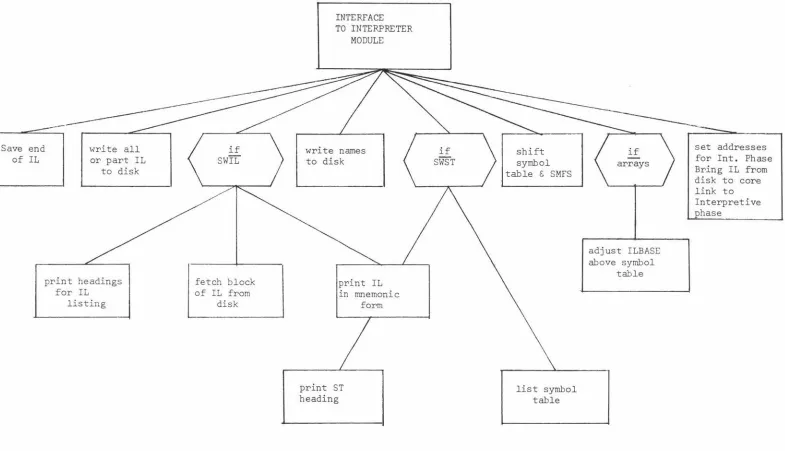
The Compilation phase consists of three distinct modules
(i) The Main Control and Input Module.
(ii) The Parsing and Intermediate Language Generation
Module
(iii) The Interface Module.
The Main Control and Input Module
Since MUSSEL is to be used primarily as a teaching language,
then any implementation of the language must be designed to run
in a Batch Mode i.e. every usual run of the System will consist
of a stack of programs to be run one after the other.
The Main Control and Input Module has three main functions to perform.
(i) To initialize System for the start of a new Batch Run
(ii) Control flow of jobs through the System
(iii) Provide Input to the Parsing and Intermediate
Language Generation module.
At the commencement of a new batch run, the System is
initialized and the Controller asks for and accepts the date. This
date is stored for the duration of the run, and it appears at the
- 31
-4.2.2. Control Cards: To Control the flow of jobs through the
system it is necessary for each job to have control cards, before it, these consist of
( i) name card This is punched with #NAME in the first 5 columns of the card, followed by the students name, which may be punched anywhere in the remaining 75 columns of the card. This card is a signal to the Control module that a new job is on its way. On reading a name card the Controller sets up the system for a new job and extracts the students name for appending to the program listings later and then goes back to read another card.
(ii) code card This is punched with $CODE in the first 5 columns of the card. This control card is included optionally, with the program if the student requires a listing of the Intermediate Language, after it has been generated in the Parsing and Intermediate Language Generation module. The Controller on detecting this card in the job stream, sets a switch, which will be tested later at the commencment of the Interface module. (iii) symbol table card This is punched with $XREF in the
first 5 columns. This control card is included as an option to have the Symbol Table listed at the conclusion of the Interpretive phase, or during it if an error should occur. Likewise, as with the code card, the controller on detecting this card in the job stream, sets a switch, which will be tested in the Interpretive phase. (iv) data card This is punched with #DATA in the first 5
- 32
-(v) end of batch card This card is punched with four
record marks (t) in the first four columns of the card.
This card signifies the end of a batch run and the
Control module on detecting it types a message on the
console typewriter, indicating the end of the batch run,
and also at this time user statistics could be listed. 4.2.3 Input Section: Besides controlling the flow of jobs through the system, this is also responsible for providing the Input
to the Parsing and Intermediate Language Generation Module.
The source program is read from cards, the superfluous blanks
are trimmed off the end and an internal end of line character inserted
where applicable. The punching codes for the characters
i,
!
and: are converted to their internal line-printer representation and a line number is associated with each source line, provided it is not acontinuation of a previous line. The amended source text is then listed exactly as punched, and written off to disk for input to the
Parsing and Intermediate Language Generation Module. The general
flow of this Main Control and Input Module is included in Appendix E. This module could have been extended to include a lexical analysis
of the source text i.e. it could have been designed to scan the
characters of the source program from left to right and build the actual symbols of the program i.e. identifiers, reserved words,
numbers to their internal representation, character symbols
e.g. **,+etc. The reason this method was not adopted was, because it was necessary to have a copy of the original source text available,
both at the actual syntactic analysis time, and later at the
interpretive stage for meaningful error messages to be produced. It
was therefore decided to do the lexical analysis in the Parsing module
via a subroutine called SCANS, this subroutine is called by the
syntax analyser, whenever it needs a new symbol.
Omitting the lexical analysis at this stage, has made the
- 33
-4.3 The Parsing and Intermediate Language Generation
This module performs all the real hard work of the Compilation phase. Both the lexical analysis and syntactic analysis have to be performed at this stage, together with the semantic actions when a construct in the Source Language is recognised. The semantic actions consist of checking for semantic correctness, storing information in the Symbol table or output of Intermediate Language operations and parameters into the Intermediate Language stream, for example when a RESERVE instruction is recognised a semantic routine will check the identifiers in the RESERVE 'list' to make sure they have not been used before and if not will add them to the Symbol Table with their attributes (if any).
The general layout of core during this phase is depicted in Fig 4.1.
4.3.1 The Lexical Analysis The lexical analysis is performed by routine called SCANS. This routine is called by the Syntax Analyser everytime it needs a new Symbol. When it is called SCANS recognises the next source language Symbol and passes it to the Syntax Analyser. In this way, it is not necessary for the whole of the internal form of the Source program to be in core at the same time, as would have been the case if the lexical analysis had been performed in the Main Control and Input Module. The Symbols in MUSSEL fall into one of the following classes:
( i) identifiers
(ii) reserved words - D0,END,CH0ICE,CASE etc.
(iii) numbers - no distinction is made between real numbers or integer numbers.
(iv) single character delimiters (+,-,(,),/,:,! ~*,.,)
( v) double character delimiters ~•::':
39999
28350
25800
25500
25000
2402
0
NAME AREA
holds names of variables, arrays, procedures, pointers to here in symbol Table.
Floating Boundary STACK WORK AREA
(For Syntax and Semantics)
'
~~/\/t
STORAGE MAPPING FUNCTIONS FOR ARRAYS
SYMBOL TABLE AREA {2550 positions)
LOCAL SYMBOL TABLE AREA
INTERMEDIATE LANGUAGE AREA
(500 positions, when filled written to disk)
(/)
µ.:j
z
H GE-<
z:=>
HO
....:i pc:; H
p.. ::s
0
u
MONITOR AREA
u
+-'
- 34
-The SCANS routine has encoded within it many routines for resolving
the various source symbols. These routines are:
(i) CDC Routine This routine gets the next character,CHAR from a
source language record and performs the following functions.
(a) Ignore blank characters - this is handled by a routine to get
next non blank character,CCCH,which uses the CDC routine.
(b) Obtain the source character and make it available to the routine
requesting it within SCANS.
(c) Prints a source language line on picking up the internal end
of line character (1)
(d) Keeps track of where in the source text the compiler is
operating by means of CPTR.
(e) On detecting the end of a source record, prints it and
auto-matically fetches the next record and updates CPTR.
(ii) GNS Routine This routine picks up the next symbol in the source
text, which, may be a reserved word,number,operator,identifier etc.
Each type of symbol in the language has a special routine to process
it, Thus, GNS by means of the CDC routine picks up enough
characters to resolve which type of symbol it is and then turns
control over to the special routine for that symbol to be processed.
These special routines are:
(a) ALF Routine GNS having detected the first character of a
symbol as being a letter, turns control over to the ALF routine,
which, initializes the name holding area, NACC to blanks and then
by means of the CDC routine builds up the name character by
character, until detecting an end of name character (i.e. a
character other than a letter or a digit).
As mentioned previously MUSSEL imposes no restrictions on
the length of any name - for this reason the ALF routine has to
keep a record of the length of the name as it is accumulated.
Provision is made in NACC to hold a name up to 25 characters
- 35
-first 25 characters are moved into the name holding area at the top of core, NACC is set back to blanks and the rest of the name accumulated.
(b) NUM Routine This routine picks up a number and converts it to its internal representation.
MUSSEL makes no distinction in representing integer numbers and real numbers. Integer numbers are distinguished from the reals by having a zero exponent. Numbers are represented internally by a seven digit mantissa and a 2 digit exponent, with the decimal point being implied to the right of the mantissa as opposed to the usual representation, where the decimal point is implied to the left of the mantissa. Thus the integer 5 is represented
-
-internally as 000000500 and 27.6998 as 027699804 The function of the NUM routine is then to
( a) Initialize the number holding area, NUMB to zero
(b) accumulate the number in NUMB digit by digit.
(c) deal with decimal point occurring within number.
(d) deal with exponent (E) occurring within number
(e) detect illegally large numbers.
(f) distinguish between real and integer numbers. ( g) detect end of number.
(c) GOP Routine The function of this routine is to resolve operators, such as + ,- ,~•: ,/, also the multiple operator ~•:~•: for exponentiation. The relational, logical and string operators are all depicted by delimiting them on either side by a decimal point viz .NE. ,.NOT. ,.CAT.etc.
( c)cont' d
- 36
-Each operators hierarchy number is obtained via
table look-up, and this together with a pointer
to the operating holding area is returned for
generation later into the Intermediate Language
stream.
The SCANS routine, thus furnishes to the syntax analyser an
internal representation of each symbol in -U.e '3ource language,
together with a pointer to the actual symbol itself. This is more
efficient than returning the variable length strings of actual
symbols to the syntax analyser.
4.3.2 Indentation A programmer writing in MUSSEL must indent his
source text correctly according to precise indentation rules. The
reasons for making these conventions in MUSSEL quite explicit and
precise is that indentation can be closely linked to the flow of
control and therefore becomes a guide to
(i) the program writer as to whether he or she has handled control sequencing correctly and as intended.
(ii) to the reader of a program as to how the sequence control may be understood. Indentation in MUSSEL is readily accomplished due to the absence of goto's in the language and the absence of labels except on the head of instruction groups with the special mechanism available via the EXIT FR0M instruction of terminating execution of such a group. If this were not so the subordination of text may not be as clear.
are
We hope that the rewards for enforcing these rules
(a) that the program will be more likely to be correct
because conditions must be considered carefully. (b) The structure of the source text will reflect the
flow of control at execution time, thus making the
program more readable. The general flow of the
program will be indicated on the least indented lines and detailed flow is shown by the lines in between. In fact the structure of the text is a mirror of the
structure diagram, which, was drawn in developing
[image:44.571.130.541.380.769.2]37
-Also having set down precise rules for indentation, has enabled the indenting to be checked and performed automatically where necessary during the Parsing and Intermediate Language generation phase. Thus the listing of the source text in this phase is correctly structured regardless of the way it was actually punched onto cards.
The goals for introducing an indentation convention were (i) Changes of level of indentation should coincide with
important and recognisable constructions in the algorithm. (ii) Avoid needless indentation as this only results in
crowding of the algorithm to the right.
(iii) The rules should be simple and easy to carry out.
In MUSSEL we have achieved these goals by setting down the following indentation rules.
(a) At the occurrence of each D0 which signifies the start of an instruction group, indent by five spaces to the right.
(b) At the occurrence of each END, which signifies the finish of an instruction group, indent five spaces to the left.
As was stated previously, in MUSSEL the only instruction that may be labelled are the D0's, being the head of an instruction group.
This means that if the first instruction in a MUSSEL program is labelled then the label must appear on the previous line, likewise all labels that will not fit in the space available, viz.
PR0GRAMSTART: D0
RESERVE X,Y,Z
DEFINE A 0N C,D,E AS PR0C:D0
RESERVE L,M,N
END PR0C
- 38
-In the conditional groups of instructions a
D0
may be prefixed by THEN or ELSE and the indentation by 5 still holds.For example.
4.3.3
D0 IF I.EQ.O THEN D0
SETS T0 N+K
SET P T0 P+S END
ELSE D~
END
SETS T0 N-K
SET P T0 P-S
END
Symbol Table
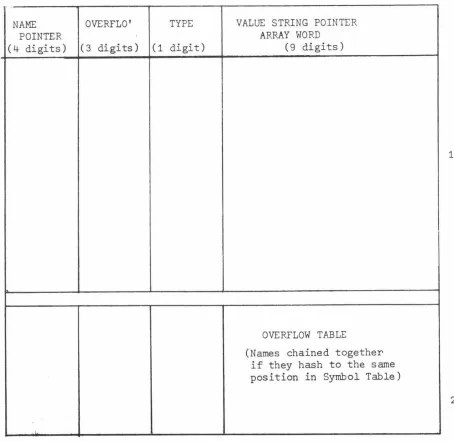
The Symbol Table during the compilation phase is organised as depicted in Fig 4.2. Each position in the table occupies seventeen digits made up as follows:
( i) Name Pointer This occupies four digits and represents a pointer, relative to a base address, to the actual name of the identifier which is stored in the name area at the top end of core storage - see Fig 4.1.
(ii) Overflo' This occupies three digits and represents a pointer (if any) chaining names together in the event of them hashing to the same position in the Symbol Table. Details of this procedure will be referred to later under Symbol Table Look Up.
( i i i ) ~ Occupies one digit and holds the type of the
NAME OVERFLO' TYPE VALUE STRING POINTER
POINTER ARRAY WORD
(4 digits) ( 3 digits) (1 digit) (9 digits)
130
OVERFLOW TABLE
(Names chained together
if they hash to the same
position in Symbol Table)
20
[image:47.835.133.587.47.489.2](iv)
- 39
-reserved at the head of the main program (type code= 4),
All other identifiers have a type code of zero.
Value, String Pointer, Array Word Occupies nine digits
and is the area used to hold the value of a variable during
the interpretive phase. During the compilation phase this
area is zero except for the positions in the table occupied
by main program array identifiers, procedure names and labels.
For main array identifiers during compilation the array word
is stored in this area and is of the following form:
DEEEESSSS
where D signifies the dimenstion of the array, which is
either O for one dimensional arrays and 1 for two dimensional
arrays.
element.
EEEE signifies relative address of the first array
This is added to the Symbol Table base address to
give an absolute address for the first array element.
SSSS signifies the relative address of the storage mapping
function for the array. These storage mapping functions are
stored immediately following the Symbol Table as indicated
in Fig 4.1.
Because arrays can only be 1 or 2 dimensional in MUSSEL,
the storage management is greatly simplified, and the storage
mapping functions may be one of the following two forms:
(a) one dimensional storage mapping function
LLLLUUUU
t t
lower subscript upper subscript
bound bound.
(b) two dimensional storage mapping function
L1L1L1L1U1U1U1U1L2L2L2L2U2U2U2U2XCCC
t t t t t
1st lower 1st
U
-L
upper lower upper 2 2+1
2nd 2nd
bound(U
4.3.4
- - - -- -- - - -- -
40
-For Procedure names this 9 digit area contains the procedure address word, which contains a pointer to the start of the Intermediate Language corresponding to the procedure body, and a pointer to the first local name held in name area.
For labels this 9 digit area contains a pointer to the Intermediate Language stream where the exit from that loop is contained.
There are one hundred and fifty positions allocated for the Symbol Table in the present implementation, and of these one hundred and thirty of these positions represent the Symbol Table proper and the remaining twenty positions represent the Overflow Portion of the table.
Symbol Table Look Up
Of vital importance to the efficiency of the compiler is the method adapted for accessing the Symbol Table, as this table must be looked up on each reference to any identifier in the program. In MUSSEL the technique used for Symbol Table Look Up is called the "hashing" or "key" transformation method. Here the search key,
which for Symbol table access is the name of an identifier is converted or hashed into a direct address into the table. This address is then used to locate or place the proper data item. There are a great many variations and many possible schemes, which may be adopted using this method. The one chosen for use in MUSSEL is the division-remainder method, which operates as follows:
First choose a number close to the number of table positions needed, in MUSSEL's case the number is 130. Next use this number as a divisor to extract a quotient and a remainder from the original key (name). The remainder is the transformed key i.e. the transformed key becomes the original key modulo the chosen number of table positions. i.e. h(N) = N mod M
where N is the original, M the table size and h(N) the hashed function.
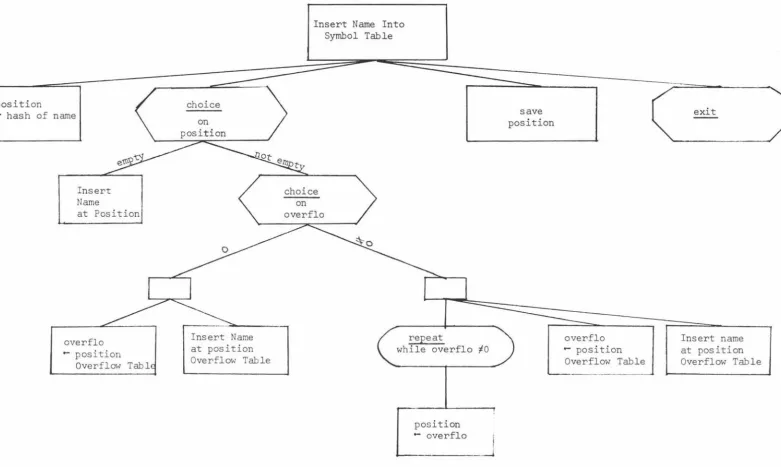
Insert Name Into Symbol Table
....---===::::;---=--=-=----~---
~r---=--=.,--~==--position
I
- hash of nameInsert
Name
(
at Position
overflo
- position
Overflow Tabl
Fig 4. 3
choice
)
onposition
Insert Name
at position
Overflow Table
choice on overflo
Inserting Name into Symbol Table.
repeat
while overflo #0
position
- overflo
__J
save position
overflo - position
Overflow Table
exit
Insert name at position
[image:50.841.41.823.20.487.2]