Ontological User Profiling in Recommender
Systems
STUART E. MIDDLETON, NIGEL R. SHADBOLT AND DAVID C. DE ROURE Intelligence, Agents, Multimedia Group, University of Southampton
________________________________________________________________________
We explore a novel ontological approach to user profiling within recommender systems, working on the problem of recommending on-line academic research papers. Our two experimental systems, Quickstep and Foxtrot, create user profiles from unobtrusively monitored behaviour and relevance feedback, representing the profiles in terms of a research paper topic ontology. A novel profile visualization approach is taken to acquire profile feedback. Research papers are classified using ontological classes and collaborative recommendation algorithms used to recommend papers seen by similar people on their current topics of interest. Two small-scale experiments, with 24 subjects over 3 months, and a large-scale experiment, with 260 subjects over an academic year, are conducted to evaluate different aspects of our approach. Ontological inference is shown to improve user profiling, external ontological knowledge used to successfully bootstrap a recommender system and profile visualization employed to improve profiling accuracy. The overall performance of our ontological recommender systems are also presented and favourably compared to other systems in the literature.
Categories and Subject Descriptors: I.2.6 [Artificial Intelligence]: Learning - Knowledge acquisition; I.2.11 [Artificial Intelligence]: Distributed Artificial Intelligence -Intelligent agents; H.3.3 [Information Storage and Retrieval]: Information Search and Retrieval -Information filtering, Relevance feedback
General Terms: Algorithms, Measurement, Design, Experimentation
Additional Key Words and Phrases: Agent, Machine learning, Ontology, Personalization, Recommender systems, User profiling, User modelling
________________________________________________________________________
1. INTRODUCTION
The mass of content available on the World-Wide Web raises important questions over its effective use. The web is largely unstructured, with pages authored by many people on a diverse range of topics, making simple browsing too time consuming to be practical. Web page filtering has thus become necessary for most web users.
Search engines are effective at filtering pages that match explicit queries. Unfortunately, people find articulating what they want explicitly difficult, especially if forced to use a limited vocabulary such as keywords. As such search queries are often ________________________________________________________________________ This research was supported by EPSRC studentship award number 99308831 and the Interdisciplinary Research Collaboration In Advanced Knowledge Technologies (AKT) project GR/N15764/01.
Authors' addresses: Intelligence, Agents, Multimedia Group, Department of Electronics and Computer Science, University of Southampton, Southampton, SO17 1BJ, UK
Authors’ email: {sem99r,nrs,dder}@ecs.soton.ac.uk. Submitted 3/10/02, Revision 6/4/03, Final revision 29/9/03
Permission to make digital/hard copy of part of this work for personal or classroom use is granted without fee provided that the copies are not made or distributed for profit or commercial advantage, the copyright notice, the title of the publication, and its date of appear, and notice is given that copying is by permission of the ACM, Inc. To copy otherwise, to republish, to post on servers, or to redistribute to lists, requires prior specific permission and/or a fee.
poorly formulated, and result in large lists of search results that contain only a handful of useful pages.
The semantic web offers the potential for help, allowing more intelligent search queries based on web pages marked up with semantic metadata. Semantic web technology is, however, very dependant on the degree to which authors annotate their web pages, and automatic web page annotation is still in its infancy. Annotation requires selflessness in authors because the annotations provided will only help other people searching their web pages. Because of this, the vast majority of web pages are not annotated, and in the foreseeable future will remain so. The semantic web can thus only be of limited benefit to the problem of effective searching.
Recommender systems go some way to addressing these issues. We present a novel ontological approach to user profiling within recommender systems. Two recommender systems are build, called Quickstep and Foxtrot, and three experiments conducted to evaluate different aspects of their performance. Quickstep uses ontological inference to improve profiling accuracy and integrates an external ontology for profile bootstrapping. Foxtrot enhances the Quickstep system by employing the novel idea of visualizing user profiles to acquire direct profile feedback.
This section discusses our chosen problem domain and our general approach to ontological recommendation, along with related work. In section 2 we describe the Quickstep recommender system and an experiment to show how inference can improve user profiling and hence recommendation accuracy. Section 3 details an integration between the Quickstep recommender system and an external ontology, along with an experiment to demonstrate its effectiveness at bootstrapping profiles. In section 4 the Foxtrot recommender system is described, with an experiment to demonstrate how profile visualization can be used to acquire feedback and hence improve profile accuracy. Lastly, in section 5 we bring this work together, collating the evidence found to support ontological to user profiling within recommender systems, and discuss future work.
1.1 Recommender systems
cases text classification accuracy exceeding human capability has been demonstrated [Larkey 1998].
Obtaining sufficient examples is difficult however, especially when trying to obtain negative examples. The problem with asking people for examples is that the cost, in terms of time and effort, of providing the examples generally outweighs the reward people will eventually receive. Negative examples are particularly unrewarding, since there could be many irrelevant items to any typical query.
Unobtrusive monitoring provides positive examples of what the user is looking for, without interfering with the users normal work activity. Heuristics can also be applied to infer negative examples from observed behaviour, although generally with less confidence. This idea has led to content-based recommender systems, which unobtrusively watch user behaviour and recommend new items that correlate with a user’s profile.
Another way to recommend items is based on the ratings provided by other people who have liked the item before. Collaborative recommender systems do this by asking people to rate items explicitly and then recommend new items that similar users have rated highly. An issue with collaborative filtering is that there is no direct reward for providing examples since they only help other people. This leads to initial difficulties in obtaining a sufficient number of ratings for the system to be useful, a problem known as the cold-start problem [Maltz and Ehrlich 1995].
Hybrid systems, attempting to combine the advantages of content-based and collaborative recommender systems, have proved popular to-date. The feedback required for content-based recommendation is shared, allowing collaborative recommendation as well.
1.2 User profiling
User profiling is typically either knowledge-based or behaviour-based. Knowledge-based approaches engineer static models of users and dynamically match users to the closest model. Questionnaires and interviews are often employed to obtain this user knowledge. Behaviour-based approaches use the user’s behaviour as a model, commonly using machine-learning techniques to discover useful patterns in the behaviour. Behavioural logging is employed to obtain the data necessary from which to extract patterns. [Kobsa 1993] provides a good survey of user modelling techniques.
interest in respect to the binary model. There are a lot of effective machine learning algorithms based on two classes. A binary profile does not, however, lend itself to sharing examples of interest or integrating any domain knowledge that might be available. [Sebastiani 2002] provides a good survey of current machine learning techniques.
1.3 Ontologies
An ontology is a conceptualisation of a domain into a human-understandable, but machine-readable format consisting of entities, attributes, relationships, and axioms [Guarino and Giaretta 1995]. Ontologies can provide a rich conceptualisation of the working domain of an organisation, representing the main concepts and relationships of the work activities. These relationships could represent isolated information such as an employee’s home phone number, or they could represent an activity such as authoring a document, or attending a conference.
We use the term ontology to refer to the classification structure and instances within a knowledge base.
1.4 Problem domain
The web is increasingly becoming the primary source of research papers to the modern researcher. With millions of research papers available over the web from thousands of web sites, finding the right papers and being informed of newly available papers is a problematic task. Browsing this many web sites is too time consuming and search queries are only fully effective if an explicit search query can be formulated for what you need. All too often papers are missed.
We address the problem of recommending on-line research papers to the academic staff and students at the University of Southampton. Academics need to search for explicit research papers and be kept up-to-date on their own research areas when new papers are published. We examine an ontological recommender system approach to support these two activities. Unobtrusive monitoring methods are preferred because researchers have their normal work to perform and would not welcome interruptions from a new system. Very high accuracy on recommendations is not required since users will have the option to simply ignore poor recommendations.
real world setting. Similar problems are seen in the agent domain where, as Nwana [Nwana 1996] argues, it has yet to be conclusively demonstrated that people really benefit from agent-based information systems.
This is why a real problem has been chosen upon which to evaluate our work.
1.5 Related work
Group Lens [Konstan et al. 1997] is an example of a collaborative filter, recommending newsgroup articles based on a Pearson-r correlation of other users’ ratings. Fab [Balabanović and Shoham 1997] is a content-based recommender, recommending web pages based on a nearest-neighbour algorithm working with each individual user’s set of positive examples. The Quickstep and Foxtrot systems are hybrid recommender systems, combining both these types of approach.
Personal web-based agents such as NewsDude and Daily Learner [Billsus and Pazzani 2000], Personal WebWatcher [Mladenić 1996] and NewsWeeder [Lang 1995] build profiles from observed user behaviour. These systems filter news stories/web pages and recommend unseen ones based on content, using k-Nearest Neighbour, naïve Bayes and TF-IDF machine learning techniques. Individual sets of positive and negative examples are maintained for each user’s profile. In contrast, by using an ontology to represent user profiles we pool these limited training examples, sharing between users examples of each class.
Ontologies are used to improve content-based search, as seen in OntoSeek [Guarino et al. 1999]. Users of OntoSeek navigate the ontology in order to formulate queries. Ontologies are also used to automatically construct knowledge bases from web pages, such as in Web-KB [Craven et al. 1998]. Web-KB takes manually labelled examples of domain concepts and applies machine-learning techniques to classify new web pages. Both systems do not, however, capture dynamic information such as user interests.
Digital libraries classify and store research papers, such as CiteSeer [Bollacker et al. 1998]. Typically such libraries are manually created and manually categorized. While our systems are digital libraries, the content is dynamically and autonomously updated from the browsing behaviour of its users.
Of note is that very few systems in the recommender system literature perform user trials using real users. To test classifier accuracy, most use either labelled benchmark document collections, such as Reuters news feed collection, or logged user data, such as Usenet logs.
1.6 Overview of approach
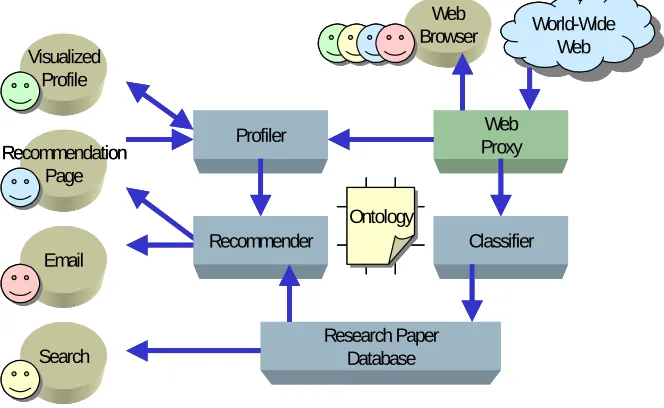
Our ontological approach to recommender systems uses a hybrid recommender system, employing both collaborative and content-based recommendation techniques and representing user profiles in ontological terms. Two experimental systems have been built that follow this approach, called Quickstep and Foxtrot. Quickstep is a recommender system for a set of researchers within a computer science laboratory, while Foxtrot is a searchable database and recommender system for a computer science department. Figure 1 shows the generic structure of our ontological recommender systems.
Web Proxy Profiler
Classifier Recommender
Research Paper Database Search
Recommendation Page
World-Wide Web World-Wide
Web Web
Browser Visualized
Profile
Ontology Ontology
Web Proxy Profiler
Classifier Recommender
Research Paper Database Search
Recommendation Page
World-Wide Web World-Wide
Web Web
Browser Visualized
Profile
[image:6.504.84.416.284.488.2]Ontology Ontology
Fig. 1. Our ontological approach to recommender systems
A web proxy is used to unobtrusively monitor each user’s web browsing, adding new research papers to the central database as users discover them. The research paper database thus acts as a pool of shared knowledge, available to all users via search and recommendation. The database of research papers is classified using a research paper topic ontology and a set of training examples.
of direct profile feedback, providing an additional source of information from which profiles can be computed.
Recommendations are compiled daily using collaborative filtering techniques to find sets of interesting papers. These papers are then constrained to match the top topics of interest within the content-based profiles. The papers left are used to create the recommendations.
Users can view their recommendations via a web page or weekly email message, look at and comment on visualizations of their profile via a web page or just search the research paper database for specific papers of interest. Quickstep, the earlier system, supports only web page recommendation while Foxtrot supports all the interface features.
1.7 Empirical evaluation
This paper describes three experiments performed using our two recommender systems. The first uses the Quickstep system to measure the effectiveness of using ontological inference in user profiling. Two 1.5 month trials were run using 24 members from the IAM research laboratory, comparing use of ontological profiles and inference to that of using unstructured profiles.
The second experiment integrated the Quickstep system with an external personnel and publication ontology. This experiment measured how effectively an external ontology can bootstrap a recommender system to reduce the recommender system cold-start problem. Behaviour logs from the previous experiment were used as the basis for this evaluation.
The third experiment took the Foxtrot recommender system and measures its overall effectiveness and the performance increase obtained when profiles are visualized and profile feedback acquired. A trial was run using 260 staff and students from the computer science department of the University of Southampton for an academic year, comparing performance of those subjects who provided profile feedback to those who did not.
2. ONTOLOGICAL USER PROFILING AND PROFILE INFERENCE
2.1 Overview of the Quickstep recommender system
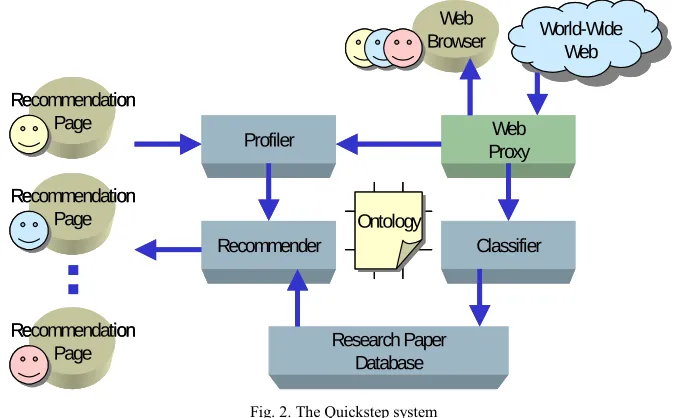
Quickstep unobtrusively monitors user browsing behaviour via a web proxy, logging each URL browsed during normal work activity. A machine-learning algorithm classifies browsed URLs overnight, using classes within a research paper topic ontology, and saves each classified paper in a central paper store. Explicit relevance feedback and browsed topics form the basis of the interest profile for each user. Is-a relationships within the research paper topic ontology are also exploited to infer general interests when specific topics are observed.
[image:8.504.88.425.316.525.2]Each day a set of recommendations is computed, based on correlations between user interest profiles and classified paper topics. These recommendations are accessible to users via a web page. Any feedback offered on these recommendations is recorded when the user looks at them. Users can provide new examples of topics and correct paper classifications where wrong. In this way the training set improves over time as well as the profiles. Web Proxy Profiler Classifier Recommender Research Paper Database Recommendation Page World-Wide Web World-Wide Web Web Browser Ontology Ontology Recommendation Page Recommendation Page Web Proxy Profiler Classifier Recommender Research Paper Database Recommendation Page World-Wide Web World-Wide Web Web Browser Ontology Ontology Recommendation Page Recommendation Page
Fig. 2. The Quickstep system
2.2 Approach of the Quickstep recommender system
The Quickstep system uses a java-based web proxy, which records time-stamped URLs for each user. This proxy could handle about 30 users. The system ran on a Solaris platform and was mostly written in Java.
2.2.1 Ontology
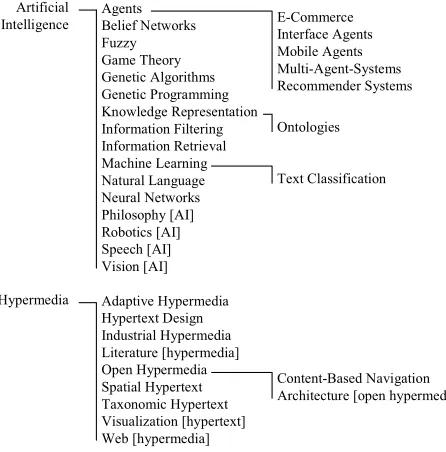
route for system integration with other external ontologies in the future. Our simple ontology holds is-a relationships between research paper topics, and has 27 classes; for the second trial this ontology was extended to 32 classes. Figure 3 shows a section from the ontology. Pre-trial interviews formed the basis of which additional topics would be added to the ontology to customize it for the target researchers. An expert review by two domain experts validated the ontology for correctness before use in our experiment.
Artificial Intelligence
Hypermedia
E-Commerce Interface Agents Mobile Agents Multi-Agent-Systems Recommender Systems Agents
Belief Networks Fuzzy Game Theory Genetic Algorithms Genetic Programming Knowledge Representation Information Filtering Information Retrieval Machine Learning Natural Language Neural Networks Philosophy [AI] Robotics [AI] Speech [AI] Vision [AI]
Text Classification Ontologies
Adaptive Hypermedia Hypertext Design Industrial Hypermedia Literature [hypermedia] Open Hypermedia Spatial Hypertext Taxonomic Hypertext Visualization [hypertext] Web [hypermedia]
[image:9.504.145.368.179.405.2]Content-Based Navigation Architecture [open hypermedia]
Fig. 3. Section from the Quickstep research paper topic ontology
2.2.2 Research paper representation
Most on-line research papers are in HTML, PS or PDF formats, with many papers being compressed. We support all these formats for maximum coverage in our problem domain, converting the papers to plain text and using this text to create the term vectors. Unusual or corrupt formats are ignored. Several heuristics are used to determine if the research papers are converted to text correctly and look like a typical research paper with terms such as ‘abstract’ and ‘references’. In the later experiments, term vectors for papers had around 15,000 dimensions after dimensionality reduction.
2.2.3 Classifier
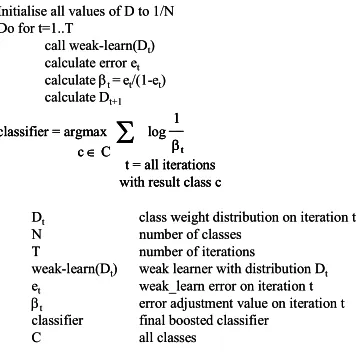
Research papers in the central database are classified by an IBk [Aha et al. 1991] classifier, which is boosted by the AdaBoostM1 [Freund and Schapire 1996] algorithm. The IBk classifier is a k-Nearest Neighbour type classifier that uses example documents, called a training set, added to a term-vector space. Example documents in the training set are manually labelled using the class names within the research paper topic ontology. Figure 4 shows the basic k-Nearest Neighbour algorithm. The closeness of an unclassified vector to its neighbour vectors within the term-vector space determines its classification.
w(da,db) =
√
____________
Σ
j = 1..T (tja– tjb)2
w(da,db) kNN distance between document a and b da,db document vectors
T number of terms in document set tja weight of term j document a
Fig. 4. k-Nearest Neighbour algorithm
Classifiers like k-Nearest Neighbour allow more training examples to be added to their term-vector space without the need to re-build the entire classifier. They also degrade well, so even when incorrect the class returned is normally in the right “neighbourhood” and so at least partially relevant. This makes k-Nearest Neighbour a robust choice of algorithm for research paper classification.
Initialise all values of D to 1/N Do for t=1..T
call weak-learn(Dt)
calculate error et
calculate βt = et/(1-et)
calculate Dt+1
Dt class weight distribution on iteration t
N number of classes T number of iterations
weak-learn(Dt) weak learner with distribution Dt
et weak_learn error on iteration t
βt error adjustment value on iteration t
classifier final boosted classifier C all classes
classifier = argmax
Σ
logt = all iterations with result class c c ∈C βt
1 __ Initialise all values of D to 1/N Do for t=1..T
call weak-learn(Dt)
calculate error et
calculate βt = et/(1-et)
calculate Dt+1
Dt class weight distribution on iteration t
N number of classes T number of iterations
weak-learn(Dt) weak learner with distribution Dt
et weak_learn error on iteration t
βt error adjustment value on iteration t
classifier final boosted classifier C all classes
classifier = argmax
Σ
logt = all iterations with result class c c ∈C βt
1 __ classifier = argmax
Σ
logt = all iterations with result class c c ∈C βt
1 __
βt
[image:11.504.164.344.74.252.2]1 __
Fig. 5. AdaBoostM1 boosting algorithm
AdaBoostM1 has been shown to improve the performance of weak learner algorithms [Freund and Schapire 1996], particularly for the stronger learning algorithms like k-Nearest Neighbour. It is thus a sensible choice to boost our IBk classifier.
Other types of classifier were considered, including the naïve Bayes classifier and the C4.5 decision tree, and informal tests run to evaluate their performance. The boosted IBk classifier was found to give superior performance for this domain.
2.2.4 Web page interface
Fig. 6. Quickstep’s web-based interface
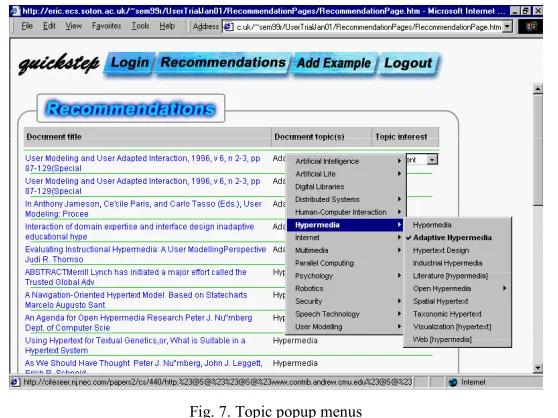
Clicking on the topic and selecting a new one from a popup menu can change the topic of each paper, should the user feel the classification is incorrect. In the experiment later the ontology group has a hierarchical popup menu, and the flat list group has a single level popup menu. Figure 7 shows the hierarchical popup menu.
Fig. 7. Topic popup menus
New examples can be added via the interface, with users providing a paper URL and a topic label. These are added to the groups training set, allowing users to teach the system new topics or improve classification of old ones.
[image:12.504.122.401.350.559.2]2.2.5 Profiler
Interest profiles are computed daily by correlating previously browsed research papers with their classification. User profiles thus hold a set of topics and interest values in these topics for each day of the trial. User feedback also adjusts the interest of topics within the profile and a time decay function weights recently seen papers as being more important than older ones. Ontological relationships between topics of interest are used to infer other topics of interest, which might not have been browsed explicitly; an instance of an interest value for a specific class adds 50% of its value to the super-class. Figure 8 shows the profiling algorithm.
∑
n 1..no of instancesInterest value(n) / days old(n) Topic interest =
Event interest values
Paper browsed = 1
Recommendation followed = 2 Topic rated interesting = 10 Topic rated not interesting = -10 Interest value for
super-class per instance = 50% of sub-class
∑
n1..no of instances
Interest value(n) / days old(n) Topic interest =
Event interest values
Paper browsed = 1
Recommendation followed = 2 Topic rated interesting = 10 Topic rated not interesting = -10 Interest value for
super-class per instance = 50% of sub-class
Fig. 8. Profiling algorithm
Profile feedback details a level of interest in a topic over a period of time. The user defines the exact level and duration of interests when they draw interest bars onto the time/interest graph via the profile interface. The profiling algorithm automatically adjusts the daily profiles to match any topic interest levels declared via profile feedback.
Event interest values were chosen to favour explicit feedback over implicit, and the 50% value used to represent the reduction in confidence you get the further from the direct observation you are.
Other profiling algorithms exist such as slicing and curve fitting, but the time-decay function appeared in informal tests to produce a good result; we found it to be a robust function for finding current interests.
2.2.6 Recommender
Recommendation confidence =classification confidence * topic interest value
Fig. 9. Quickstep recommendation algorithm
The classification confidence is computed from the AdaBoostM1 algorithm’s class probability value for a paper, a value between 0 and 1.
2.3 Evaluation of ontological inference in user profiling
We used the Quickstep recommender system to compare subjects whose profiles were computed using ontological inference with subjects whose profiles did not use ontological inference. The experiment took place over a 3-month period in the IAM laboratory using 24 computer science researchers. An overall evaluation of the Quickstep recommender system was also performed. The Quickstep recommender system and this experiment are published in more detail in [Middleton et al. 2001].
2.3.1 Experimental design
Two identical trials were conducted, the first with 14 subjects and the second with 24 subjects, both over 1.5 months. Some interface improvements were made for the second trial and 5 more ontological classes were added.
Subjects were divided into two groups, one using an ontological approach to user profiling with a topic ontology and the other using a flat, unstructured list of topics. Both groups had their own separate training set of examples, which diverged from the bootstrap training set as the trial progressed when users corrected the classification of papers and hence provided new examples. The classifier algorithm was identical for both groups; only the training set changed.
The system interface used by both groups was identical, except for the popup menu for choosing paper topics. The ontology group had a hierarchical menu that used the topic ontology; the flat list group had a single level menu.
The system recorded each time the user declared an interest in a topic by selecting it “interesting” or “not interesting”, jumped to a recommended paper or corrected the topic of a recommended paper. These feedback events were date stamped and recorded in a log file for later analysis, along with a log of all recommendations made.
2.3.2 Experimental results
defined as either “no comment” or “interesting” topics. The cumulative frequency figures for good topics are presented in figure 10 as a ratio of the total number of topics recommended.
0.7 0.75 0.8 0.85 0.9 0.95 1
0 5 10 15 20 25 30 35 40 45 50
Number of days into trial
Good t
opic
s /
to
ta
l t
opic
s
Trial 2, Ontology
Trial 2, Flat list Trial 1, Ontology
[image:15.504.90.430.130.225.2]Trial 1, Flat list
Fig. 10. Ratio of good topics / total topics
The two ontological groups have a 7% and 15% higher topic acceptance. In addition to this trend, the first trial ratios are about 10% lower than the second trial ratios.
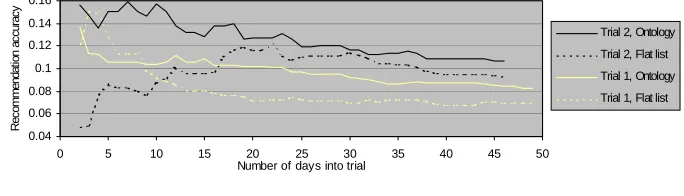
A jump is where the user jumps to a recommended paper by opening it via the web browser. Jumps are correlated with topic interest feedback, so a good jump is a jump to a paper on a good topic. Recommendation accuracy is the ratio of good jumps to recommendations, and is an indication of the quality of the recommendations being made as well as the accuracy of the profile. Figure 11 shows the recommendation accuracy results.
0.04 0.06 0.08 0.1 0.12 0.14 0.16
0 5 10 15 20 25 30 35 40 45 50
Number of days into trial
R
ec
om
m
endat
ion ac
cu
rac
y
Trial 2, Ontology
Trial 2, Flat list Trial 1, Ontology Trial 1, Flat list
Fig. 11. Recommendation accuracy
There is a small 1% improvement in recommendation accuracy by the ontology group. Both trials show between 8-10% of recommendations leading to good jumps.
[image:15.504.88.430.389.487.2]Table I. Quickstep classifier accuracy and coverage
Accuracy Coverage Classes Examples Terms
Trial 1 Ontology 0.48 0.90 27 157 15897
Trial 1 Flat list 0.52 1.00 25 162 16311
Trial 2 Ontology 0.46 0.89 32 208 17601
Trial 2 Flat list 0.46 0.97 32 212 16798
2.3.3 Discussion
From the experimental data of both trials, several suggestive trends are apparent. The initial ratios of good topics were lower than the final ratios, reflecting the time it takes for enough log information to be accumulated to let the profiles settle down. The ontology users were 7-15% happier overall with the topics suggested to them.
A hypothesis for the ontology group’s apparently superior performance is that the is-a hierarchy produces a rounder, more complete profile by including general super class topics when a specific topic is browsed by a user. This in turn helps the profile to acquire a broad range of interests, rather than just latching onto one correct topic.
The first trial showed fewer good topics than the second trial with a 10% difference seen by both groups. This is probably because of interface improvements made for the second trial, where the topic feedback interface was made less confusing. Subjects were sometimes rating interesting topics as not interesting if the paper quality was poor. Since there are more poor quality papers than good quality ones, this introduced a bias to not interesting topic feedback resulting in a lower overall ratio.
About 10% of recommendations led to good jumps. Since 10 recommendations were given to the users at a time, on average one good jump was made from each set of recommendations received. As with the topic feedback, the ontology group again was marginally superior but only by a 1% margin; this trend is promising but not statistically significant even though it appears in both trials. This smaller difference is probably due to people having time to follow only 1 or 2 recommendations. Thus, although the ontology group had more good topics, only the top topic of the three recommended was really be looked at; the result was a smaller difference between the good jumps made and the good topics seen.
These results are not statistically significant due to the sample size. Nevertheless, the trend in the data appears to be encouraging.
2.4 Conclusions
browsed. This increased the accuracy of the profiles, and hence usefulness of the recommendations.
Very few systems in the recommender system literature perform user trials using real users, making direct comparison difficult. Most use either labelled benchmark document collections to test classifier accuracy or logged user data taken from sources such as newsgroups. NewsWeeder reports a 40-60% classification accuracy with real users, while Personal WebWatcher [Mladenić 1996] reports a 60-90% classification accuracy using benchmark data. Quickstep’s classifier is on the low side with 40-50% accuracy, but this appears much better when the number of classes used in classification is taken into account and the potential this allows for improving profiling via inference and profile feedback.
The Daily Learner [Billsus and Pazzani 2000] system recommends news stories via a wireless hand held receiver. They used a k-NN algorithm for short-term profiles and a naïve Bayes algorithm for longer-term profiles. Over a 10-day trial, involving 300 users, they reported a precision of 33%, recall 29%, for the top 4 recommendations based on recording which stories were selected by users to read. This provided a small increase in performance compared to a edited news service, Yahoo! news.
The Entrée [Burke 2000] restaurant recommender system, which uses a knowledge-based approach to recommendation, reports a recommendation accuracy of 38%, for 15 item profiles, to 70%, for 5 item profiles, based on analysis of historically logged user activity of a web site.
An informal result was seen in the nearest neighbour classifier’s robustness. Even when it made a mistake, 50-60% of the time in fact, the class it chose was normally in the correct area. For example, for an “interface agent” paper the classification would more likely be “agent” than “human computer interaction”. The users liked this as it showed the system was at least making a reasonable attempt at classification, even if it was getting things wrong.
3. BOOTSTRAPPING USING AN EXTERNAL ONTOLOGY
it, thus reducing the cold-start problem, a problem inherent to all recommender systems. Details of this work have been published in [Middleton et al. 2002].
3.1 Integrating an external ontology with the Quickstep recommender system One difficult problem commonly faced by recommender systems is the cold-start problem [Maltz and Ehrlich 1995], where recommendations are required for new items or users for whom little or no information has yet been acquired. Poor performance resulting from a cold-start can deter user uptake of a recommender system. This effect is thus self-destructive, as the recommender never achieves good performance since users never use it for long enough. We examine two types of cold-start problem.
The new-system cold-start problem is where there are no initial ratings by users, and hence no profiles of users. In this situation most recommender systems have no basis on which to recommend, and hence perform very poorly.
The new-user cold-start problem is where the system has been running for a while and a set of user profiles and ratings exist, but no information is available about a new user. Most recommender systems perform poorly in this situation too.
Collaborative recommender systems fail to help in cold-start situations, since they cannot discover similar user behaviour because there is not enough previously logged behaviour data upon which to base any correlations. Content-based and hybrid recommender systems perform a little better since they need just a few examples of user interest in order to find similar items.
External ontological sources of knowledge complement well the behavioural information held within the recommender systems, by providing initial knowledge about users and their domains of interest. Of particular interest to our academic problem domain is knowledge about departmental publications, the projects a researcher has worked on and the position a researcher has within the department. It should thus be possible to bootstrap the initial learning phase of a recommender system with such knowledge, easing the cold-start problem.
In return for any bootstrap information the recommender system could provide details of dynamic user interests to the ontology. This would reduce the effort involved in acquiring and maintaining knowledge of people’s research interests. To this end we investigate the integration of Quickstep, a web-based recommender system, and an external ontology built from a publication database and personnel database.
3.2 Approach to integrating the external ontology
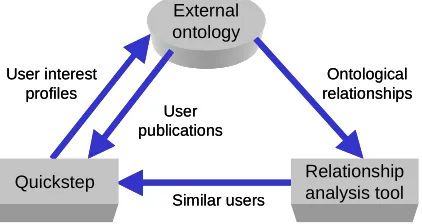
system, and after the cold-start is over the user profiles held within the recommender system are sent to the external ontology as an additional knowledge source. Figure 12 shows the integrated system.
The synergy of this relationship is fully explored in [Middleton et al. 2002].
A relationship analysis tool, Ontocopi [Alani et al. 2003], is used to uncover each user’s communities of practice by applying a set of ontology-based network analysis techniques that examine the connectivity of instances in the knowledge base with respect to the type, density, and weight of these connections. Ontocopi applies an expansion algorithm that generates the community of practice for a selected instance by identifying the set of close instances and ranking them according to the weight of their relationships. It applies a breadth-first spreading activation search, traversing the semantic relationships between instances until a defined threshold is reached. Semantic distance is thus used to indicate similarity between users.
The external ontology used in this work was designed to represent the academic domain, and was developed by Southampton’s Advanced Knowledge Technologies (AKT) project team [O’Hara et al. 2001]. It models people, projects, papers, events and research interests. The ontology itself is implemented in Protégé 2000 [Eriksson et al. 1999], a graphical tool for developing knowledge-based systems. It is populated with information extracted automatically from a departmental personnel database and publication database. The ontology consists of around 80 classes, 40 slots, over 13000 instances and is focused on people, projects, and publications.
External ontology
User interest profiles
User publications
Ontological relationships
Similar users
Quickstep Relationship
analysis tool External
ontology
User interest profiles
User publications
Ontological relationships
Similar users
Quickstep Relationship
[image:19.504.155.366.439.551.2]analysis tool
Fig. 12. Integration of Quickstep and an external ontology
3.2.1 Bootstrapping algorithms
initial profile algorithm. As in the Quickstep profiling algorithm, fractional interest in a topic super-classes is inferred when a specific topic is added.
∑
n 1.. publications belonging to class t1 / publication age(n) topic interest(t) =
t = <research paper topic>
new-system initial profile = (t, topic interest(t))*
∑
n 1.. publications belonging to class t1 / publication age(n) topic interest(t) =
t = <research paper topic>
[image:20.504.140.353.317.400.2]new-system initial profile = (t, topic interest(t))*
Fig. 13. New-system initial profile algorithm
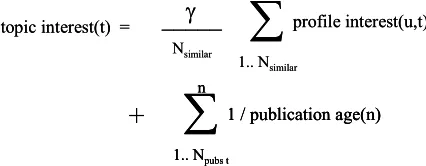
When the recommender system is up and running and a new user is added, the ontology provides the historical publication list for the new user and the relationship analysis tool provides a ranked list of similar users. The initial profile of the new user is formed from a correlation between historical publications and any similar user profiles. This algorithm is detailed in figure 14, and addresses the new-user cold-start problem.
t = research paper topic u = user
γ= weighting constant >= 0 Nsimilar= number of similar users
Npubs t= number of publications belonging to class t confidence = confidence in user similarity
topic interest(t) =
∑
n 1.. Npubs t1 / publication age(n)
+
∑
u1.. Nsimilar
profile interest(u,t)
_____
Nsimilar
γ
profile interest(u,t) = interest of user u in topic t * confidence new-user initial profile = (t, topic interest(t))*
t = research paper topic u = user
γ= weighting constant >= 0 Nsimilar= number of similar users
Npubs t= number of publications belonging to class t confidence = confidence in user similarity
topic interest(t) =
∑
n 1.. Npubs t1 / publication age(n)
∑
n 1.. Npubs t1 / publication age(n)
+
∑
u1.. Nsimilar
profile interest(u,t)
_____
Nsimilar
γ
profile interest(u,t) = interest of user u in topic t * confidence new-user initial profile = (t, topic interest(t))*
Fig. 14. New-user initial profile algorithm
3.3 Experiment to evaluate bootstrapping performance
3.3.1 Experimental design
Subjects were selected from those who participated in the previous Quickstep experiment and had entries within the external ontology. We selected nine subjects in total, with each subject typically having one or two publications.
The URL browsing logs of these users, extracted from the 3 months of browsing behaviour recorded during the Quickstep trials, were broken up into weekly log entries. Seven weeks of browsing behaviour were taken from the start of the Quickstep trials, and an empty log created to simulate the very start of the trial where no behaviour has yet been recorded.
Eight iterations of the integrated system were thus run, the first simulating the start of the trial and others simulating the following weeks 1 to 7. Interest profiles were recorded after each iteration. Two complete runs were made, one with the ‘new-system initial profiling’ algorithm and a control run with no bootstrapping. The control run without the ‘new-system initial profiling’ algorithm started with blank profiles for each of its users. An additional iteration was run to evaluate the effectiveness of the ‘new-user initial profile’ algorithm.
In order to evaluate the algorithms effect on the cold-start problem, all recorded profiles were compared to the benchmark week 7 profile. This allowed measurement of how quickly profiles converge to the stable state existing after a reasonable amount of behaviour data has been accumulated. The quicker the profiles move to this state the quicker they will have overcome the cold-start. Week 7 was chosen as the cut-off point of our analysis since after about 7 weeks of use the behaviour data gathered by Quickstep dominated the user profiles and the cold-start was over.
3.3.2 Experimental results
Two measurements were made when comparing profiles to the benchmark week 7 profile. The first, profile precision, measures how many topics were mentioned in both the current profile and benchmark profile. Profile precision is an indication of how quickly the profile is converging to the final state, and thus how quickly the effects of the cold-start are overcome. The second, profile error rate, measures how many topics appear in the current profile that do not appear within the benchmark profile. Profile error rate is an indication of the errors introduced by the two bootstrapping algorithms. Figure 15 describes these metrics.
Ncorrect Number of user topics that appear in current
profile and benchmark profile
Nmissing Number of user topics that appear in benchmark
profile but not in current profile
Nincorrect Number of user topics that appear in current
profile but not in benchmark profile
Nusers Total number of users
profile error rate = ______________________ Ncorrect + Nincorrect+ Nmissing
Nincorrect
profile precision =
Ncorrect + Nmissing
Ncorrect
_____________ Nusers
1 _____
∑
1.. Nusers user
Nusers
1 _____
∑
1.. Nusers user
Ncorrect Number of user topics that appear in current
profile and benchmark profile
Nmissing Number of user topics that appear in benchmark
profile but not in current profile
Nincorrect Number of user topics that appear in current
profile but not in benchmark profile
Nusers Total number of users
profile error rate = ______________________ Ncorrect + Nincorrect+ Nmissing
Nincorrect
______________________ Ncorrect + Nincorrect+ Nmissing
Nincorrect
profile precision =
Ncorrect + Nmissing
Ncorrect
_____________ Ncorrect + Nmissing
Ncorrect
Ncorrect + Nmissing
Ncorrect _____________ Nusers 1 _____ Nusers 1 _____
∑
1.. Nusers user Nusers 1 _____ Nusers 1 _____
∑
[image:22.504.164.358.72.222.2]1.. Nusers user
Fig. 15. Bootstrapping evaluation metrics
The results of our experiment are detailed in figure 16. The new-user results consist of a single iteration, so appear on the graph as a single point.
At the start, week 0, no browsing behaviour log data is available to the system so the profiles without bootstrapping are empty. The new-system algorithm, however, can bootstrap the initial user profiles and achieves a reasonable precision of 0.35 and a low error rate of 0.06. We found that the new-system profiles accurately captured interests users had a year or so ago, but tended to miss current interests. This is because publications are generally not available for up-to-date interests.
As expected, once the weekly behaviour logs become available to the system the profiles adjust accordingly, moving away from the initial bootstrapping. On week 7 the profiles fully converge to the benchmark profile, the cold-start being over. This is the reason the precision graph converges at week 7. Bootstrapping is most effective during week one, where no information about users is available and when the users are most likely to stop using the system due to poor performance.
Profile precision relative to benchmark profile
0 0.25 0.5 0.75 1
0 1 2 3 4 5 6 7
Week
Pr
e
c
is
io
n
new-system bootstrap
no bootstrap
[image:23.504.116.405.81.234.2]new-user bootstrap
Fig. 16. Bootstrapping profile precision
3.3.3 Discussion
The new-system algorithm produced profiles with a low error rate and a reasonable precision of 0.35. This reflects the fact that previous publications are a good indication of users current interests, and so can produce a good starting point for a bootstrap profile. Where the new-system algorithm fails is for more recent interests, which make up the remaining 65% of the topics in the final benchmark profile. To discover these more recent interests, it is possible that the new-system algorithm could be extended to take some of the other information available within the ontology into account, such as the projects a user is working on. To what degree these relationships will help is difficult to predict however, since the ontology itself has great difficulty in acquiring knowledge of recent interests.
For the purposes of this experiment, those users who had some entries within the external ontology were selected. There were some users who had not entered their publications into the ontology or who had yet to publish their work. For these users there is little information within the ontology, making any new-system initial profiles of little use. In a larger scale system, more sources of information would be needed from the ontology to build the new-system profiles. This would allow some redundancy, and hence improve robustness in the realistic situation where information is sparsely available.
3.4 Related work
The cold-start problem is discussed by [Claypool et al 1999] who examines a hybrid approach to recommendation, using a content-based overlap coefficient technique coupled with a collaborative Pearson-r approach that takes over when sufficient ratings have been acquired. The hybrid concept is also adopted by [Melville et. al 2002] with a content-boosted approach, where pseudo ratings are generated by a naïve Bayes classifier to supplement real ratings. There is still a need to acquire initial examines of content, however, before recommendation can occur.
Some metrics for measuring recommendation performance are suggested by [Schein et. Al 2002], along with a discussion of the cold-start problem. They apply a CROC curve based metric on a naïve Bayes classifier.
Several heuristic-based item selection strategies are compared by [Rashid et al. 2002] using the Movie Lens dataset. Focus is given to reducing user effort during sign-up as well as recommendation accuracy.
3.5 Conclusions
Cold-starts in recommender systems are a significant problem. If initial recommendations are inaccurate, user confidence in the recommender system may drop with the result that users give up on the system and thus not enough usage data is gathered to ever overcome the cold-start.
This experiment suggests that using an ontology to bootstrap user profiles can significantly reduce the impact of the recommender system cold-start problem. It is particularly useful for the new-system cold-start problem, where the alternative is to start with no information at all.
A question still remains as to just how good an initial profile must be to fully overcome the effects of the cold-start problem. If initial recommendations are poor users will not use the recommender system and hence it will never get a chance to improve. We have shown that improvements can be made to initial profiles, but further empirical evaluation would be needed to evaluate exactly how much improvement is needed before the system is “good enough” for users to give it a chance.
4. THE FOXTROT RECOMMENDER SYSTEM
department, allowing researchers to search the database of research papers in addition to receiving recommendations. A large-scale experiment was run to evaluate the overall approach, and to compare the recommendation performance of subjects who provided profile feedback to the performance of those subjects who just provided relevance feedback.
4.1 Overview of the Foxtrot recommender system
Foxtrot is an evolution of the Quickstep system, and fully follows the architecture shown earlier in figure 1. Foxtrot differs from Quickstep in the following ways. The number of interfaces supported is increased, providing a research paper search interface, profile visualization and feedback facility and email notification support. A static research paper ontology with many more classes is used, along with increased dimensionality reduction to cope with the increase in classes and hence term dimensions. The profiler takes profile feedback into account allowing users control over their own profiles. Lastly, a more collaborative recommendation algorithm is employed, talking into account the profiles of other similar users when deciding what to recommend.
4.2 Approach of the Foxtrot recommender system
The Foxtrot system used a Squid proxy, which can handle hundreds of users across the whole computer science department at the University of Southampton. Each user ran an Identd server so the Squid proxy could identify their usernames, and a modified Squid logging function was used to record time-stamped URLs for each user. The system ran on a dedicated LINUX platform and like Quickstep was mostly written in Java.
Since Foxtrot is an evolution of the Quickstep system, only the processes that changed are detailed. All other processes, for example the classifier, work in the way described for the Quickstep system.
4.2.1 Research paper topic ontology
Human-Computer Interaction
Data Structures Algorthms & Theory Information Retrieval Databases Networking Encryption & Compression Operating Systems Hardware & Architecture Programming
E-Commerce Interface Agents Mobile Agents Multi-Agent-Systems Recommender Systems Agents
Data Mining Expert Systems Games and Search Knowledge Representation Machine Learning Natural Language Processing Planning
Robotics Speech Theorem Proving Vision & Pattern Recognition
Case-Based [machine learning] Genetic Algorithms Neural Networks Probabilistic Methods Reinforcement Learning Rule Learning Theory [machine learning] Artificial Intelligence
[image:26.504.147.364.72.228.2]Cooperative [hci] Hypermedia Multimedia Graphics & Virtual Reality Interface Design Wearable Computers User Modelling
Fig. 17. Section from the Foxtrot research paper topic ontology
Labelled examples of research papers were manually added to the classifier training set, many taken from the results of the Quickstep trial and papers downloaded from the CORA system. There were a total of 97 classes and 714 training examples. The ontology remained fixed throughout the Foxtrot trial, but could in theory be updated as time goes on to reflect changes in the research domain. We decided not to allow users to add classes to the ontology since with a large number of users there are bound to be classification mistakes, and these could adversely effect the classification accuracy. For every ontological class a set of 5-10 example papers was provided at the start of the trial.
4.2.2 Research paper representation
Research papers are represented as term vectors, just as in the Quickstep system. Because of the increased number of classes an additional dimensionality reduction technique is employed to keep the number of terms within the vectors manageable. Each class was constrained to have only its top 50 terms, ranked by document frequency; the union of each classes most discriminating terms was thus used for term vectors. In the Foxtrot experiment, term vectors had 1152 dimensions.
4.2.3 Interface
Fig. 18. Foxtrot’s recommendation and search interface
Search results are returned in the area below the edit boxes, showing the details of each research paper found. Two sets of radio buttons appear below each search result to allow users to provide relevance and quality feedback if they so desire. When users first go to the Foxtrot web page their daily recommendations are automatically presented in the search result area. In this way, users can choose to read the recommendations or just enter a search query and use the system normally.
Fig. 19. Foxtrot’s profile visualization interface
[image:28.504.142.380.384.541.2]In addition to the Foxtrot web page, a weekly email notification feature was added 3 months from the end of the trial. This provided a weekly email stating the top 3 recommendations from the current set of 9 recommendations. Users could then jump to these papers or load the Foxtrot web page and review all 9 recommendations. Figure 20 shows the email notification message.
Fig. 20. Foxtrot’s email notification interface
4.2.4 Recommendation agent
recommended papers. Previously read papers were not recommended twice and if more than three papers were available for a topic they were ranked by average quality rating.
(Ib(t) – Ib)2 _
Σ
topics t
(Ia(t) – Ia)2 _
Σ
topics t *
(Ib(t) – Ib) _
Σ
topics t
(Ia(t) – I_a)*
Pearson r coefficientab=
√
Ia(t) = User a’s interest in topic t
Ia = User a’s mean interest value over all topics
Pearson r coefficientab= similarity of user a’s profile to user b’s profile
Recommended papers = papers on user’s current interests ∩papers read by similar user’s
3 papers recommended on the 3 most interesting topics, totalling 9 papers per day If more than 3 papers meet above criteria, papers ranked by quality rating _
(Ib(t) – Ib)2 _
Σ
topics t
(Ia(t) – Ia)2 _
Σ
topics t * (Ib(t) – Ib)2
_ (Ib(t) – Ib)2
_
Σ
topics tΣ
topics t(Ia(t) – Ia)2 _ (Ia(t) – Ia)2
_
Σ
topics tΣ
topics t *(Ib(t) – Ib) _
Σ
topics t
(Ia(t) – I_a)* (Ib(t) – Ib) _ (Ib(t) – Ib)
_
Σ
topics tΣ
topics t(Ia(t) – I_a) (Ia(t) – I_a)*
Pearson r coefficientab=
√
Ia(t) = User a’s interest in topic t
Ia = User a’s mean interest value over all topics
Pearson r coefficientab= similarity of user a’s profile to user b’s profile
Recommended papers = papers on user’s current interests ∩papers read by similar user’s
[image:29.504.144.374.113.206.2]3 papers recommended on the 3 most interesting topics, totalling 9 papers per day If more than 3 papers meet above criteria, papers ranked by quality rating _
Fig. 21. Foxtrot’s recommendation algorithm
4.3 Experiment to evaluate profile visualization and feedback
Our third experiment used the Foxtrot recommender system to compare subjects who could visualize their profiles and provide profile feedback with subjects who could only use traditional relevance feedback. Profile visualization and feedback is only possible because profiles are represented using an ontology, which contains concepts users can understand. This experiment took place over an academic year with 260 staff and students of the computer science department at the University of Southampton. An overall evaluation of the Foxtrot recommender system was also performed.
4.3.1 Experimental design
The experimental trial took place over the academic year 2002, starting in November and ending in July. Of the 260 subjects registered to use the system, 103 used the web page, and of these 37 subjects used the system 3 or more times; this makes the uptake rate 14% All 260 subjects used the web proxy and hence their browsing was recorded and daily profiles built. As such 260 subjects contributed, by way of the web proxy monitoring their web browsing, to the growth of the research paper database but there were only 37 active users during the experiment. By the end of the trial the research paper database had grown from 6,000 to 15,792 documents as a result of subject web browsing.
Towards the end of the trial an additional email feature was added to the recommender system. This email feature sent out weekly emails to all users who had used the system at least once, detailing the top three papers in their current recommendation set. Email notification was started in May and ran for the remaining 3 months of the trial.
The feedback data obtained from the trial occurs at irregular time intervals, based on when subjects looked at recommendations or browsed the web. For ease of analysis data is collated into weekly figures by summing interactions throughout each week. Group data is computed by summing the weekly contribution of each subject within a group. Figure 22 shows the metrics measured.
<future papers> = browsed/jumped papers in the 4 weeks after profile <papers> = browsed/jumped papers over duration of profile (normally 1 day) <top topics> = top 3 topics of profile
Predicted profile accuracy = No of <future papers> matching <top topics> No of <future papers>
Profile accuracy = No of <papers> matching <top topics> No of <papers>
Web page rec accuracy = No of recommended papers browsed or jumped to No of recommended papers
Email rec accuracy = No of emailed papers browsed or jumped to No of emailed papers
Jumps to recommendations = No of jumps to recommended papers No of jumps
Jumps to profile topics = No of jumps to papers matching <top topics> No of jumps
Fig. 22. Measured metrics
4.3.2 Experimental results
Web page and email recommendation accuracy
0 0.01 0.02 0.03 0.04 0.05 0.06
1 3 5 7 9 11 13 15 17 19 21 23 25 27 29 31 33 35
Weeks
Profile feedback [w eb page] Relevance feedback [w eb page]
Profile feedback [email] Relevance feedback [email]
Final week 95% confidence intervals
[image:31.504.118.406.84.309.2]Profile [web page] 0.043 Relevance [web page] 0.0028 Profile [email] 0.018 Relevance [email] 0.011
Fig. 23. Web page and email recommendation accuracy
The small number of subjects within the ‘profile feedback’ group accounts for the larger confidence intervals. While not statistically significant, there is an apparent trend for more accurate recommendation when using profile feedback, especially in the early weeks. Email recommendations appeared to be preferred by the ‘relevance feedback’ group, slightly out performing the ‘profile feedback’ group.
The above results compare the profile feedback users with relevance feedback users. To show that the profile feedback user group was not “self selected”, containing only the active users, figure 24 shows the original grouping’s accuracy figures for only active users; active users are defined as those who used the system three or more times. There were 16 active users in the relevance feedback group and 21 active users in profile feedback group. The profile feedback group’s recommendation accuracy is still higher, though not by as much since the results are averaged in the profile feedback group between those who did provide a profile and those that only used relevance feedback.
Web page rec accuracy for active users & original groups
0 0.01 0.02 0.03 0.04 0.05 0.06
1 3 5 7 9 11 13 15 17 19 21 23 25 27 29 31 33 35
Weeks
Original relevance f eedback group Original prof ile feedback group
Final week 95% confidence intervals
[image:32.504.109.417.82.294.2]Original profile feedback group 0.018 Original relevance feedback group 0.005
Fig. 24. Web page recommender accuracy for original group’s active subjects
The ‘profile feedback’ group made a greater proportion of jumps to recommendations than the ‘relevance feedback’ group; this trend is statistically significant. A similar trend is seen in jumps to papers on top profile topics, but is less clear.
Jumps to recommendations and profile topics
0 0.1 0.2 0.3 0.4 0.5 0.6
1 3 5 7 9 11 13 15 17 19 21 23 25 27 29 31 33 35
Weeks
Profile feedback [topic] Relevance feedback [topic]
Profile feedback [rec] Relevance feedback [rec]
Final week 95% confidence intervals
Profile [topic] 0.27 Relevance [topic] 0.041 Profile [rec] 0.14 Relevance [rec] 0.039
Fig. 25. Jumps to recommendations and profile topics
[image:32.504.120.405.369.590.2]accuracy measures the number of papers jumped to or browsed that match the top 3 profile topics in a 4 week period after the profile was created. This measures the ability of a profile to predict subject interests. Metrics are measured for every profile computed over the period of the trial, providing a view on how the quality of the profiles varies over the length of the trial. Figure 26 shows the figures for the profile metrics.
While not statistically significant, there is a trend for the ‘profile feedback’ group to have profiles that are better at predicting future browsing interests. This trend is not reflected in the daily profile accuracy figures however, where the two groups are similar. This would appear to show that the two groups are profiling slightly different interest sets, with the ‘profile feedback’ interests of a longer-term nature.
Profile accuracy and profile predictive accuracy
0 0.1 0.2 0.3 0.4 0.5
1 3 5 7 9 11 13 15 17 19 21 23 25 27 29 31 33 35
Weeks
Profile feedback [profile] Relevance feedback [profile]
Profile feedback [predictive] Relevance feedback [predictive]
Final week 95% confidence intervals
[image:33.504.117.409.257.482.2]Profile [profile] 0.23 Relevance [profile] 0.036 Profile [predictive] 0.23 Relevance [predictive] 0.036
Fig. 26. Profile accuracy and profile predictive accuracy
Table II. Classifier accuracy and coverage
Accuracy Coverage Classes Examples Terms
Classifier 0.42 1.00 97 714 1152
A post trial questionnaire was sent out via email to every subject who used the system at least once. Table III shows the results of this survey, completed by 13 subjects. It shows that the search facility was most useful to the subjects, with the recommendation facility being only partially used. This is borne out by the relatively small amount of feedback provided by users during the trial. The most positive comments were from those users who were interested in general papers in an area, such as PhD students performing a literature review. The more negative comments came from those subjects wanting papers on very specific topics of much finer granularity than the research topic ontology offered.
Table III. Foxtrot post trial questionnaire results
Question 1 2 3 4 5 Mean
How useful did you find the Foxtrot database? 4 2 5 2 2.38
How much did you use the recommendation facility? 7 5 1 1.62
How accurate were the recommended topics? 3 3 2 3 1 2.67
How useful were the recommended papers? 4 2 4 2 2.5
4.3.3 Discussion
The ‘profile feedback’ group outperformed the ‘relevance feedback’ group for most of the metrics, and the experimental data revealed several trends.
Web page recommendations, and jumps to those recommendations, were better for the ‘profile feedback’ group, especially early on in the first few weeks after registering. This is probably because the ‘profile feedback’ users tended to draw interest profiles when they first registered with the system, and only update them occasionally afterwards. This has the effect that the profiles are most accurate early on and become out-dated as time goes by. This aging effect on the profile accuracy is shown by the ‘profile feedback’ group performance gradually falling towards that of the ‘relevance feedback’ group. One interesting observation is that the initial performance enhancement gained using profile feedback appears to help overcome the cold-start problem, a problem inherent to all recommender systems.
time period; in our case nobody regularly checked for recommendations more than once a week.
The overall recommendation accuracy was about 1%, or 2-5% for the profile feedback group. This may appear low, especially when compared to other recommendation systems such as Quickstep, but it reflects the nature of the recommendation service offered. Users had the choice to simply ignore recommendations if they did not help to achieve their current work goal. This optional nature of the system assisted system uptake and acceptance on a wide scale.
The profile accuracy of both groups was similar, but there was a significant difference between the accuracy of profile predictions. This reflects the different types of interests held in the profiles of the two groups. The ‘profile feedback’ group’s profiles appeared to be longer term, based on knowledge of the users general research interests provided via the profile interface. The ‘relevance feedback’ profiles were based solely on the browsing behaviour of the users current task, hence contained shorter-term interests. Perhaps a combination of profile feedback-based longer-term profiles and behaviour-based short-term profiles would be most successful.
The overall profile accuracy was around 30%, reflecting the difficulty of predicting user interests in a real multi-task environment. Integrating some knowledge of which task the user is performing would allow access to some of the other 70% of their research interests. These interests were in the profile but did not make it to the top 3 topics of current interest.
Profile feedback users tended to regularly check recommendations for about a week or two after drawing a profile. This appeared to be because users had acquired a conceptual model of how the system worked, and wanted to keep checking to see if it had done what they expected. If a profile was required to be drawn before registering on the system, this behaviour pattern could be exploited to increase system uptake and gain some early feedback. This may in turn increase initial profile accuracy and would certainly leave users with a better understanding of how the system worked, beneficial for both gaining user trust and encouraging effective use of the system.
would not be able to trace usernames to network account names, and hence real people. The key to this one-way encryption was destroyed after the trial finished. Finally, in accordance with the UK’s data protection act the trial was for purely research purposes. A commercial system would likely need written consent from each subject under UK law.
A post-hoc power analysis was considered after the initial experimental analysis was completed, but not performed after consultation with a statistics expert due to reservations about its value. Post analysis of the data collected would also be problematic due to the encrypted nature of the user identifiers, and lack of easy correlations between the various logged data sources other than those that were pre-planned into the experimental design.
4.4 Conclusions
This experiment shows that profile visualization and profile feedback can significantly improve the profiling accuracy and the recommendation process. Our ontological approach makes this possible because user profiles are represented in terms the users can understand.
The previous section on Quickstep compared performance to reported systems in the literature, and points out the lack of published experimental results for systems with real users. As such the Quickstep system is an ideal candidate for result comparison.
The Quickstep [Middleton et al. 2001] system had a recommendation accuracy of about 10% with real users, while Foxtrot manages a 2-5% recommendation accuracy, reflecting the different types of subjects involved in the two experiments. The Quickstep subjects were willing researchers taken from a computer science laboratory, while the Foxtrot subjects were staff and students of a large department who would only be willing to use the system if it was perceived to offer direct benefits to their work. A recommendation accuracy of 5% means that on average 1 in 2 sets of recommendations contained a paper that was downloaded, while 10% means on average every set of recommendations contains a downloaded paper. While initially appearing low, this result is good when the problem domain is taken into account; most systems in the literature do not attempt such a hard and realistic problem.