A DEVELOPMENT OF WIRELESS POWER TRANSFER USING CAPACITIVE METHOD FOR MOUSE CHARGING APPLICATION
MUHAMMAD ZULFIKRI BIN RAHKINOOR
This Report Is Submitted In Partial Fulfillment of Requirement for the Bachelor Degree of Electronic Engineering (Industrial Electronic)
Faculty of Electronic Engineering and Computer Engineering Universiti Teknikal Malaysia Melaka
II
D
rr•D
O;iIll
"I hereby declare that this report is the result of my own work except for the quotes
as cited in the references."
Signature
Author :MUHAMMAD ZULFIRI BIN RAHKINOOR
IV
"I hereby declared that I have read and in my opinion this report is sufficient in terms of scope and quality for the award of Bachelor of Electronic Engineering (Industrial
Electronic) With Honors."
Signature
Supervisor's Name :Dr.
Date
Dedicated to my mother, my father, my siblings and also my colleagues and friends
who had supporting me through thick and thin.
VI
ACKNOWLEDGEMENT
Bismillahirrahmanirrahim, thanks and praise to Allah, because of His grace
and mercy, I have managed to perform this project properly. I would like to use this
opportunity to express my utmost gratitude to my project supervisor, Dr. Mohd
Shakir Bin Md Saat for his willingness to spend his time to give advice, guidance
and consultation whenever I needed. His endless support is one of many reasons I
managed to finish this project in the given time.
I would like to share my gratitude and thanks to my beloved family
especially to my parents for their never ending love, encouragement and support that
push my spirit towards the limit.
I would also like to express my appreciation and gratitude towards Universiti
Teknikal Malaysia Melaka for giving me chance to undergo this Final Year Project
as partial fulfillment of requirement for the Bachelor Degree of Electronic
Engineering (Industrial Electronic) by the provision of facilities and equipment from
the university helps me to perform my project and research to be much easier. This
VII
ABSTRACT
Wireless power transfer (WPT) is a technology that implements the
non-contact power transmjssion within a distance. Because of its ability to make a
contactless power transmission, WPT enhances the flexibility movement of the
devices. There are three types of wireless power transfer which are inductive power
transfer method (IPT), capacitive power transfer method (CPT), and acoustic power
transfer method (APT). among of this three methods of wireless power transfer, the
capacitive power transfer method got advantages on the confining the electric field
between coupled plates, does not affected with the metal interference, and does not
have coil heating effect. Therefore we focused on the capacitive power transfer to
develop the mouse charging system. This project aims to develop wireless mouse
charging system using capacitive based method. Capacitive power transfer will
enable the power transmission from the mouse-pad to the wireless mouse. There is
no battery required to make the wireless mouse to operate. To be more specific, a
high efficiency Class-E converter is designed to be used to convert the DC source
into AC. The compensation circuit of resonant tank also been designed in this project
to improve the efficiency of whole operating circuit. The performances analysis of
the developed prototype is discussed and the future . recommendation of this
technique is also presented.
Keywords: Wireless Power Transfer (WPT), Capacitive Power Transfer (CPT),
viii
ABSTRAK
Pemindahan kuasa tanpa wayar (WPT) adalah satu teknologi yang
menjalankan operasi penghantaran kuasa dalam jarak tanpa ada sebarang sentuhan.
Dengan keupayaannya untuk membuat penghantaran kuasa tanpa sentuhan, WPT
dapat meningkatkan fleksibiliti pergerakan sesuatu alat peranti. Terdapat tiga jenis
pemindahan kuasa tanpa wayar iaitu kaedah pemindahan kuasa secara beraruh (IPT),
kaedah pemindahan kuasa secara berkemuatan (CPT), dan kaedah pemindahan kuasa
secara bunyi (APT). Antara ini tiga kaedah pemindahan tenaga tanpa wayar, kaedah
pemindahan kuasa secara berkemuatan mempunyai kelebihan untuk mengurung
medan elektrik di antara plat. Selain itu, ia tidak terjejas dengan gangguan halangan
logam, dan tidak mempunyai kesan pemanasan pada gegelung peraruh. Justeru, kami memfokuskan kepada pemindahan kuasa secara berkemuatan untuk membangunkan
sistem pengecasan tetikus tanpa wayar. Projek ini bertujuan untuk merekacipta
sistem pengecasan tetikus tanpa wayar menggunakan kaedah pemindahan kuasa
secara berkemuatan. Dengan ini, tetikus tanpa wayar boleh digunakan tanpa penggunaaan bateri. Secara terperincinya, penukar Kelas-E berkecekapan tinggi
direka bagi menukarkan sumber DC kepada A C. Litar pampasan tangki salunan juga telah direka bentuk dalam projek ini untuk meningkatkan kecekapan operasi
ix
TABLE OF CONTENTS
CHAPTER TITLE PAGE
PROJECT TITLE
DECLARATION OF PSM II REPORT ii
DECLARATION iii
SUPERVISOR APPROVAL iv
DEDICATION v
ACKNOWLEDGEMENT vi
ABSTRACT vii
ABSTRAK viii
CONTENTS ix
LIST OF TABLE xii
LIST OF FIGURE xiii
LIST OF ABBREVIATIONS XV
LIST OF APPENDICES xvi
I INTRODUCTION 1
1.1 Project Background 1
1.2 Project Overview 3
X
1.4 Problem Statement 5
1.5 Objectives 6
1.6 Scope OfWork 6
1. 7 Project Planning 8
1.8 Thesis Outline 10
II LITERATURE REVIEW 11
2.1 Background Study of Wireless Power Transfer 11
(WPT)
2.2 Wireless Power Transfer Technologies 14
2.3 Class E ACIDC Converter 19
2.4 Zero Voltage Switching (ZVS) 22
m
METHODOLOGY 243.1 Workflow for The Project 25
3.1.1 Literature Reviews 26
3.1.2 Conceptual Design of Low Power Wireless 26
Mouse Charging Prototype
3.1.3 Design Class E Converter 27
3.1.4 Design of Capacitive Plate for Wireless Power 30
Transmission
3.1.5 Design of Rectifier 32
3.1.6 Installation of Designed Circuit Onto Wireless 33
Mouse and Mouse Pad
3.1.7 Circuit Correction and Adjustment 33
3.1.8 Performance Testing and Troubleshooting 34
IV
v
RESULT AND DISCUSSION 35
4.1 Class E Converter 36
4.1.1 Pulse Width Modulation and MOSFET Driver 38
Circuit
4.1.2 Zero Voltage Switching
4.2 Capacitive Plate
4.3 Rectifier Circuit
4.4 Financial Expenses
CONCLUSION AND RECOMMENDATION
5.1 Conclusion
5.2 Recommendation
REFERENCES
APPENDIX A
APPENDIXB
42
45
49
50
52
53
55
57
60
XII
LIST OFT ABLES
TABLE TITLE PAGE
1.1 Gantt Chart 9
4.1 Calculated Value Component 36
4.2 Assumed Parameter 36
4.3 Gap Distance From Transmitter To The Receiver 47
4.4 Misalignment Positioning Between Transmitter And 48
Receiver
XIII
LIST OF FIGURES
FIGURE TITLE PAGE
1.1 Wireless Power Transfer Classification 2
1.2 Fully Aligned And Coupled Situation 7
1.3 Misaligned Situation 7
1.4 Conceptual Design Of Wireless Mouse Charging Prototype 8
2.1 Highly Resonant Wireless Power Transfer Use To Charging 13
A Smart Phone
2.2 Capacitive Power Transfer With Bipolar Configuration 15
2.3 Capacitive Power Transfer With Unipolar Configuration 15
2.4 Structure Of Typical CPT System 16
2.5 Magnetic Field Coupling 17
2.6 Structure Of IPT 18
2.7 The Structure Of APT 19
2.8 Class-E Converter Circuit 20
2.9 Class-E Converter Equivalent Circuit 20
2.10 Switching Losses 22
2.11 Zero Voltage Switching 23
3.1 Flowchart Of The Project 26
3.2 Simulation Of The Class-E Converter 28
3.3 Capacitive Plate Placing 30
3.4 Connection Of The Transmitter Plate 1 And Transmitter 31
Plate 2
XIV
4.1 Transmitter Circuit 37
4.2 SK40C Starter Kit 38
4.3 Pwm Sample Coding 39
4.4 PWM Signal 40
4.5 Experimental Generating PWM 40
4.6 Schematic Of MOSFET Driver Circuit 41
4.7 Amplified PWM Signal 42
4.8 Simulation Result For ZVS 43
4.9 Experimental Result For ZVS Condition 44
4.10 Output Voltage From Class E Converter 45
4.11 Transmitter Plate 46
4.12 Receiver Plate 46
4.13 Efficiency Of The Whole Circuit Versus The Gap Distance 47
Between Transmitter And Receiver
4.14 Efficiency Of The Whole Circuit Versus The Misalignment 47
Distance Between Transmitter And Receiver
4.15 Rectifier Schematic Design 49
4.16 Final Prototype 50
WPT CPT IPT APT MOSFET
zvs
LIST OF ABBREVIATIONS
Wireless Power Transfer Capacitive Power Transfer Inductive Power Transfer Acoustic Power Transfer
Metal Oxide Semiconductor Field Effect Transistor Zero Voltage Switching
INDEX
A B
LIST OF APPENDICES
TITLE
TC4422 DATA SHEET
POWER MOSFET DATA SHEET
PAGE
60 74
CHAPTER I
INTRODUCTION
In this chapter, wireless power transfer (WPT) will be discussed and the types
of the techniques of WPT will be explained. A summary and the aim of this project
will also be presented and discussed in this section.
1.1 Project Background
Wireless Power Transfer also known as WPT or wireless energy transmission
is a power transmission process of electrical energy from the power source to the
electrical consuming device without using any discrete manmade conductor [1]. This
technology has been used widely in order to transfer the electrical energy from the
source to the electrical devices by eliminating the usage of the wires and any
connectors. This type of power transmission can cover from the low power
application such as home appliances up to the high power industrial system. Wireless
2
powering 25 fluorescent lamps on the street by using the power source without any
wires. Wireless power transfer has been divided into several techniques based on
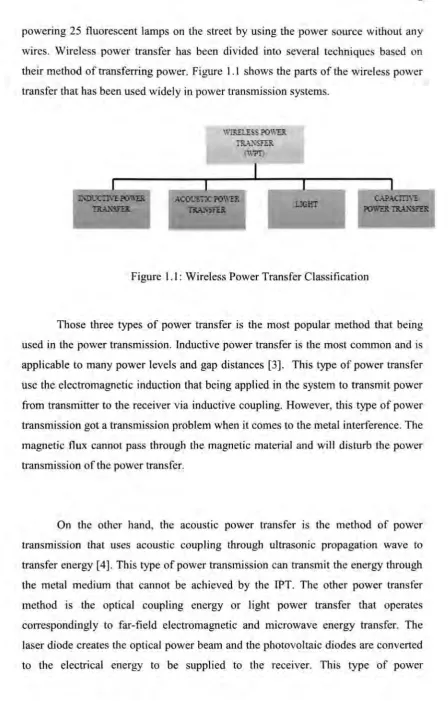
their method of transferring power. Figure 1.1 shows the parts of the wireless power
transfer that has been used widely in power transmission systems.
I INDUCTIVE POV.U
TRANSFElt
WIRELESS POWER
TR.~'\SITR
~:~.m
I
ACOUSTIC PO\\U
TRANSFEi.
I
ILIGHT CAPACJTIVE
[image:18.554.61.510.37.739.2]POWER TRANSFER
Figure 1.1: Wireless Power Transfer Classification
Those three types of power transfer is the most popular method that being
used in the power transmission. Inductive power transfer is the most common and is
applicable to many power levels and gap distances [3]. This type of power transfer
use the electromagnetic induction that being applied in the system to transmit power
from transmitter to the receiver via inductive coupling. However, this type of power
transmission got a transmission problem when it comes to the metal interference. The
magnetic flux cannot pass through the magnetic material and will disturb the power
transmission of the power transfer.
On the other hand, the acoustic power transfer is the method of power
transmission that uses acoustic coupling through ultrasonic propagation wave to
transfer energy [ 4]. This type of power transmission can transmit the energy through
the metal medium that cannot be achieved by the TPT. The other power transfer
method is the optical coupling energy or light power transfer that operates
correspondingly to far-field electromagnetic and microwave energy transfer. The
laser diode creates the optical power beam and the photovoltaic diodes are converted
3
transmission can transmit large amount of energy but the efficiency will be dropped
due to the light diffraction when it operates in a long distance [5].
Although the inductive power transfer being the most popular wireless power
transmission method, the APT and CPT have advantages over the IPT weakness. The
APT has a capability to transform energy over a large distance and be able to sustain
competency across a conductive propagation medium [5]. However, APT got
disadvantages when it cannot reach the high transmission efficiency because it has
large acoustic impedance mismatch of transmitter and receiver. The capacitive power
transfer has ability of metal penetration and coil heating effect that might reduce the
efficiency of the system. Hence, the CPT approach will be used in this project due to
its advantages. The basic operating principles of CPT will be discussed in the
following chapter.
1.2 Project Overview
The capacitive method has been selected to be implementing in this project
due to its advantages over IPT and APT. It has ability to overcome the metal
interference problem that IPT cannot go through. However, the efficiency of the of
the system will decreased when the transmitter plate and the receiver plate is
misaligned. This is because the misaligned of the transmitter and the receiver will
limit the amount of the energy that can be transfer from the power source to the load.
This problem is just like the problem that encountering .the APT system. The APT
system got a problem which is related to the mismatch impedance matching. Because
of that, the efficiency of the system would be decrease due to the large amount of
mismatch impedance matching. Compared these two power transfer system,
capacitive power transfer is more suitable than acoustic power transfer to be
implemented because of its flexibility of movement. This project aims to develop a
wireless mouse charging application by using capacitive method. This capacitive
4
wireless power transmission will be conduct in this system from the mouse-pad to
the wireless mouse. This power transmission system will eliminate the usage of the
battery on the wireless mouse. To be more specific, a converter with high efficiency
is designed at the transmitter part to convert DC supply to AC supply. Meanwhile a
compensation circuit is designed to improve the efficiency of the whole system. A
mouse prototype is being developed in order to prove the proposed method. At the
end of this project, a prototype of wireless mouse charging using capacitive method
is developed and the analysis of the efficiency performance is completed.
1.3 Motivation
Computer mouse has went through an evolution years by years from the
bigger in size become smaller, from the ordinary computer mouse to the tailless
computer mouse and wireless mouse. The wireless mouse is more preferable by the
using due to its convenient to be use because of the flexibility of the movement.
From the evolution of this ordinary mouse, we can see that the wires usage has been
eliminated by implementing the WPT on this system. This wireless mouse it the
battery-powered electronic device which is only can be operated when the battery
power is still available. Usually, this battery-powered electronic device comes with
its own charger and batteries. The usage of the battery actually can increase the
electronic waste issue and can be harmful to the environment. This is because battery
is made up from the chemical substances which is dangerous and can cause poisons.
Most of the wireless mouse is powered by using the battery. The usage of the battery
can cause a few problem such as inconvenient battery replacement, battery cost
replacement and the battery disposal that might be harm to the environmental
surrounding. Therefore, this project is proposed and wi11 be developed based on the
CPT method. The usage of the battery is the wireless mouse will be replaced with the
capacitive plates that designed based on the consideration that will affect the power
transmission efficiency. The consideration while developing the prototype is being
5
commercialized since it has advantage in opposing the replacement on the ordinary
wireless mouse.
1.4 Problem Statement
Nowadays we are often to use technologies to ease our daily life. Most of the
electronic appliances are equipped with the battery to make it mobile and can be
carried to everywhere such as wireless mouse and wireless keyboard for personal
computer. Wireless power transfer has been introduced to overcome the problem
encountered with the usage of the battery. Battery got a life-span. It need to be
replaced or recharge to ensure that some of the electronic device operation can be
undergoing without any power failure. Wireless power transfer has been divided into
several techniques. The most popular technique that has been used is inductive power
transfer. This IPT method use the magnetic field that has been created by using coil
that induced current in another coupled coil to help the power can be transferred
wirelessly. But there are problem with this type of power transfer. It must deal with
the coil heating problem that can reduce the efficiency of the charging application.
The other problem that might effects the efficiency of the system is the metal
interference between coupled coils. This interference will disturb the magnetic flux
and will reduce the range of the wireless power transfer. Meanwhile acoustic power
transfer is the new technique for the wireless power transmission. This transmission
use the sound wave propagates to transmit power to the source. This type of
transmission is suitable to be used in long range transmission. It is inconvenient to be
implementing this system to wireless mouse charging system application due to its
range of transmission. Furthermore, APT has a problem to deal with the impedance
mismatch. This problem can affect the efficiency of the power transfer. So that, the
capacitive power transfer is more preferable to be used in this system due to its
advantages in overcome the IPT and APT limitation. Some of the electronic devices
have come with their own charger to recharge the battery when it is out of power.
This is not being a big issue about the battery disposal when it is no longer can be
6
use of the battery can be eliminated. Sometimes, the devices that use the
rechargeable battery need to be recharge at its charging station. At that time the
device cannot be used in order to make the device is fully recharged. That's means
the transmitter on the charger and the receiver at the device need to be fully aligned
in order to make a successful power charging. This will limit the flexibility of the
movement of that device. Therefore, a wireless mouse charging system has been
proposed for this project. Since the any computer mouse need to be close with the
mouse-pad, capacitive power transfer is being chosen because of it can transmit a
power in a short range. CPT also can overcome the problem with the coil heating
effect and alignment problem that can affect the efficiency performance. CPT use the
power that being created from the electric field between two plates. The development
of wireless mouse charging system will focus on the short range power transfer. It
will be able to charge the mouse while the mouse is being used. It will be on the
charging mode as long as the mouse is placed on the mouse-pad.
1.5 Objectives
a) To develop a wireless mouse charging prototype usmg capacitive power
transfer method.
b) To design a class E converter to improve the efficiency ofwhole circuit.
c) To analyze the efficiency performance of the developed prototype.
1.6 Scope of Work
This wireless mouse charging system prototype is designed in the small scale
low power consumption model that can operate up to 5V power supply. This
prototype only can be used in the short range power transmission which is make the
mouse only can operate within a gap between transmitter and receiver. The
mouse-pad will be act as the transmitter that which contain 17cm x 17cm big copper plate
7
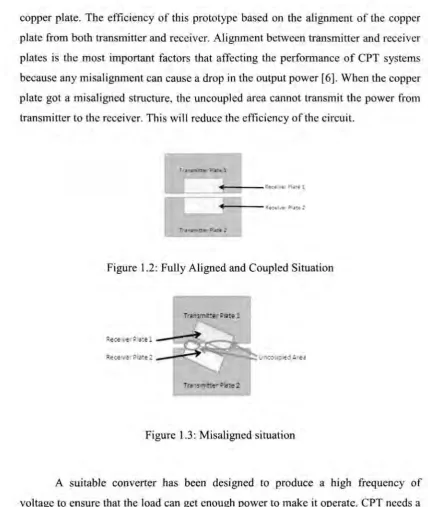
copper plate. The efficiency of this prototype based on the alignment of the copper
plate from both transmitter and receiver. Alignment between transmitter and receiver
plates is the most important factors that affecting the performance of CPT systems
because any misalignment can cause a drop in the output power (6]. When the copper
plate got a misaligned structure, the uncoupled area cannot transmit the power from
transmitter to the receiver. This will reduce the efficiency of the circuit.
Figure 1.2: Fully Aligned and Coupled Situation
Tra'1S1l!tter :> te 1
Receiver P\ate
ncoupled rea
Figure 1.3: Misaligned situation
A suitable converter bas been designed to produce a high frequency of
voltage to ensure that the load can get enough power to make it operate. CPT needs a
high frequency voltage to drive the electric field coupler. A converter is needed to
convert the DC supply into AC supply so that it can flow through the electric field
coupler. The class-£ converter is most suitable converter because it has low
switching losses with high frequency output. A compensation circuit is designed on
the transmitter and receiver part in order to encounter the power loss during charging
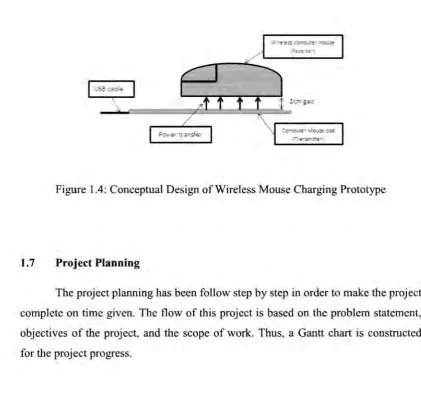
problem. The conceptual design of the prototype is shown in Figure 1.4. Based on
the figure below, the mouse-pad will be attached to the transmitting plate. A DC
[image:23.554.62.491.50.558.2]8
primary circuit. Then the high frequency converter will convert that DC voltage into
AC voltage in order to be transferred to the receiving part. That AC voltage will flow
through the capacitive coupling. The receiver plate is attached to the wireless mouse
that act secondary pick-up.
Wre .'.!ss con--put.er maus: p~ceverJ
[image:24.554.63.485.140.535.2]Cor'flput~r M.o-vse peel lra-~SP't:tterl
Figure 1.4: Conceptual Design of Wireless Mouse Charging Prototype
1.7 Project Planning
The project planning has been follow step by step in order to make the project
complete on time given. The flow of this project is based on the problem statement,
objectives of the project, and the scope of work. Thus, a Gantt chart is constructed