The Resilient Engineer
Keynote Lecture at the World Engineering Education Forum 2015 Florence, Italy
Professor Barry G Clarke, University of Leeds, UK ([email protected])
Abstract
An increase in the magnitude and frequency of extreme events together with increases in urbanisation and population are testing the resilience of the social and economic infrastructure; that is the built environment. Over the years improvements in technology and changes to regulations have improved the performance of the built environment. This has raised community’s expectations but also lowered their resilience because of the success of the engineering profession to produce increasingly robust but complex systems. This is not sustainable because of the extreme events and because the increased resources required to create a resilient environment is contributing to climate change; a major cause of extreme events. Engineering is core to a resilient society and the role of the engineer has to change to help create a community that is able to cope with extreme events in an environment that is becoming more harmful. Achieving this means a fundamental shift in engineering education because the role of
the engineer and engineering tools are changing. The 21st century engineer can no longer rely on the
education that delivered the 20th century built environment. The 21st century engineer has to be resilient
to cope with the pace of change that includes a shift in design placing more emphasis on outcomes and a shift in engaging society to help communities become more resilient.
1. Introduction
Some 60 years ago the River Arno in Florence rose, burst its banks and caused significant damage to its heritage. Yet, through the efforts of many people, including engineers, the city was restored to its former glory as one of the finest renaissance cities in the world. Florence, like many cities, coped with an extreme event and continues to evolve and adapt to cope with political, social, economic, environmental and technical change. It is that change and the impact on engineering education that is the focus of this paper since the pace of change is accelerating which requires a different approach to engineering and therefore a different approach to educating engineers.
2. Background
Modern engineering emerged during the 18th century at the time when the scientific method was being
applied to engineering products and processes; international trade was developing requiring better transport networks; and financial models were creating richer societies. The French Laboratoire Central des Ponts et Chaussées (1716) and the UK Smeatonian Society (1771) are examples of bodies set up to support civil engineering at the time of the first Industrial Revolution (1760 – 1820) the era that heralded the introduction of machines for manufacturing. By the time of the second Industrial Revolution (1840) which saw the development of the steel and chemical industries, civil engineers were transforming people’s lives through infrastructure by improving transport, water supply and energy from fossil fuels. It was technological change, as demonstrated by the first and second industrial revolutions, that drove step changes in society and since then: - automotive and electrical (1900s), aviation (1950s) and computing (1980s) led to further step changes. All of these revolutions changed the way engineers worked and introduced new forms of engineering.
It was at the end of the first industrial revolution, in 1829, that the world took off (Dugan and Dugan, 2000), when a civil engineer built the first passenger train that went from Manchester to Liverpool in NW England. Before that, most people travelled no further than 15 miles from their homes
If 1829 was the year the world took off, 1945 was the year the world accelerated (Figure 1). Population, energy and material use and GDP started to accelerate placing greater demands on engineers to provide the economy and social infrastructure (collectively known as the built environment) and products and process that underpin society’s health, wealth and wellbeing. In geological terms, this was the start of the current anthropogenic era when the world’s future depends on us as never before.
A low carbon economy is now developing to reduce the effects of climate change which means a shift in energy mix across the globe. New financial models are being created to rebalance economies. Countries are creating their own national infrastructure plans to deliver investment for growth. However, populations continue to grow around the world placing greater demands on the Earth’s depleting resources. In 1850, 50% of the UK population lived in cities; now 50% of the world lives in cities. In 1988 some 10 million people lived in five cities in the Pearl River Delta. There are now 42 million people are living in one city (Figure 2). Urbanisation demands more infrastructure to allow cites to function.
Yet there are 19 million refugees; 1 billion people lack access to roads; 1 in 5 children do not have access to safe, clean drinking water; 2.3 billion people have no reliable source of energy; 2.4 billion people lack sanitation facilities and 4 billion people are without modern communication services.
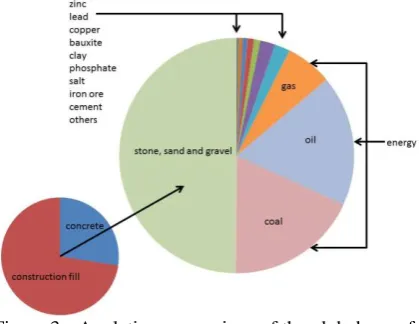
The world needs a secure supply of energy, food, water and minerals to survive. 45% of the minerals extracted from the ground are fossil fuels (Figure 3); 50% of the minerals extracted from the ground are used in construction to create the built environment. The global construction industry is worth $4.2 trillion, employs 100m people and represents 10% of the global GDP. It consumes 50% of the world’s mineral resources, 45% of the global energy, 40% of the water and 70% of the timber.
The world has entered the age of artificial intelligence; a consequence of the increasing power of computers. Since the River Arno
Figure 1 The increase in population, GDP and use of energy and materials showing the change that took place in about 1945 (after Krausmann et al, 2009)
Figure 2 Urbanisation around the Pearl River Delta showing the increase from 10m in 1988 to 42m in 2014 (after)
[image:2.595.79.331.79.243.2] [image:2.595.84.459.387.502.2] [image:2.595.83.293.572.734.2]
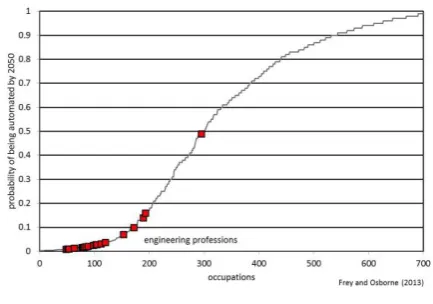
flooded in 1966 the use of computers have increased such that the number of instructions carried out every second has increased from 5 thousand to 5 billion and in 20 years the number of internet users has grown to 3 billion (Figure 4). The rise in computing power has also led to an increase in artificial intelligence, which means that many jobs that exist today will disappear in 20 years’ time (Figure 5). The more labour intensive and hazardous jobs will be replaced by autonomous machines thus creating a safer society. It will mean new types of jobs and for engineers, new ways of working. This is the
dawn of a new revolution which will lead to a step change in society.
The pioneering engineers of the 19th Century led the way with their belief that they could bring
change and create a better way of life; that was their legacy to us. Engineers of today have a
responsibility to address the emerging global challenges to create a resilient society. This is an energy dependent, resource intensive world and with the planet’s population predicted to reach nearly 10 billion in the next 40 years - the challenge of developing the sustainable global infrastructure that is so vitally needed to support this growth and ensure the wealth, health and wellbeing of society is
immense. This is the challenge engineers face.
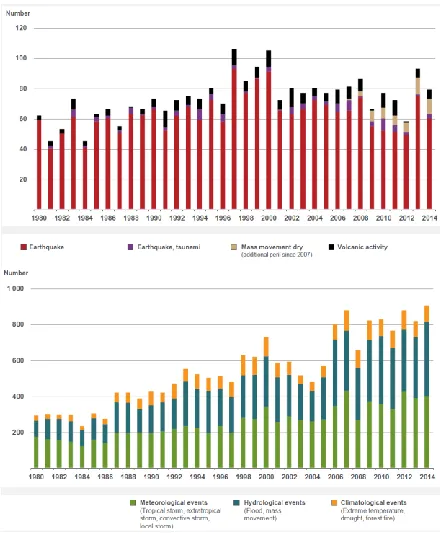
It is not just about resources. The effect of climate change, urbanisation and the increase in natural disasters means that human loss is increasing (Figure 6). The number of climate related events is increasing to nearly 1000 per year and the magnitude of those events is increasing; while the number of geophysical disasters remains about 80 a year (Figure 7). In economic terms, these disasters are placing cities at increasing risk. Figure 8 shows the value of days lost relative to the national economy compared to the global index for European and Asian cities and the number of people affected. It shows that most European cities are prone to flooding and storm damage. But the number of people affected by natural disasters is much greater in Asia.
3. Future Prospects
The pace of change is accelerating; natural hazards are increasing and their impact is increasing; populations are expanding and moving to cities; energy, water and resource demand are increasing. This is not sustainable and, increasingly, societies are not resilient. The digital revolution is creating new ways of working; environmental changes are threatening our survival.
Figure 4 Growth in computing power expressed in terms of millions of instructions per second and the growth in the use of the internet
[image:3.595.85.514.157.299.2] [image:3.595.82.299.478.630.2]
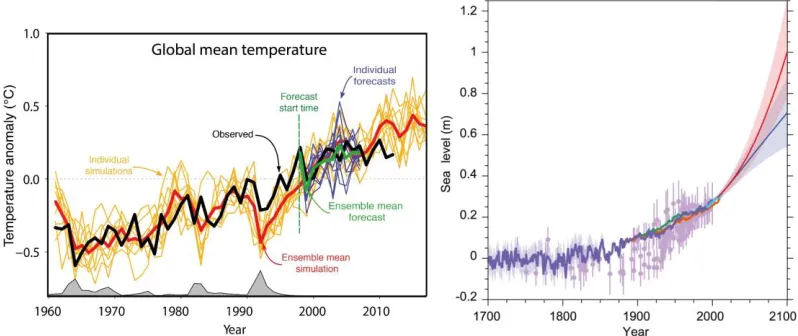
Climate change is predicted to increase the average temperature (Figure 9) and this will be accompanied by greater storms, more intense rainfall, higher winds; all of which impact on infrastructure. Existing infrastructure may not be able to cope as it is now. Sea levels will rise and, given that most urban conurbations lie near to water, more and more cities will be at risk of flooding. This cannot be stopped but communities can be made less vulnerable and more resilient with engineering support.
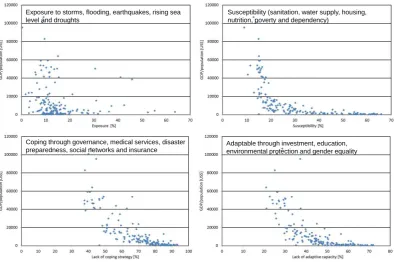
It is possible to assess how successful communities are at coping with the future. Figure 10 show the GDP/head of population as an indicator of a country’s economic and social power plotted against their level of exposure to disasters, their susceptibility, their ability to cope and their ability to adapt. This demonstrates that more economically successful countries are better able to cope and adapt even though the level of exposure to natural disasters is the same as other countries.
4. Engineering Design
Thirty seven hundred years ago, the first building code was laid down by Hammurabi which required buildings to be stable. Ssome 2000 years ago, Vitruvius issued his 10 scrolls on architecture (15 BC) which was a collection of statements on current practice which required buildings to be stable, useful and aesthetic. Those statements remain as valid today as they did then. There is now a shift from the ‘rational age’ of engineering to an age where the systems approach will dominate. Figure 11 shows the national infrastructure as a series of silos yet Figure 12 shows that the national infrastructure is an interdependent network.
Codified design, the basis of the construction industry, is no longer the limiting threshold as changes now underway are placing existing infrastructure under threat. It is based on historical evidence using the scientific method and aims to produce a safe solution using partial factors to allow for uncertainty. However, the pace of change now exceeds the ability to update codes to take into account that change. Continuing to update codes is not sustainable because of increase in use of resources. They produce uneconomic design because of a tendency to overdesign; it is not an engineering solution.
There are other design methods in different engineering sectors and different industries which may apply to infrastructure.
Optimisation which produces the best solution for a set of design variables, objective
functions and constraints though, in the case of infrastructure, the constraints are unknown because of its design life; the uncertainty of the environment and workmanship.
Probabilistic design which is similar to optimisation but reduces the effect of random variability to improve quality and reliability.
Figure 6 Human cost of natural disasters
[image:4.595.79.298.79.208.2] [image:4.595.80.300.421.688.2]
Design for resilience which reduces vulnerability and susceptibility to extreme events, involves users as a design objective and produces robust, durable and flexible solutions but increases resource use and cost. Adaptive design allows infrastructure to be adapted to changes in technology, regulations and user requirements and cope with environmental change but builds in redundancy leading to increased capital costs. Risk based design takes account of known and possible hazards assigning different factors to take into account the level of uncertainty and potential damage.
Ideally designs will be sustainable, which means they will be resource efficient, economic to operate, future proof structures and be based a mix of probabilistic optimisation, resilience and adaptive design, taking a systems and risk based approach with community engagement to respond to predictable events and reduce vulnerability to unexpected events. In future, engineers will have to engage in ethical debate that impact on society’s lifelines because they will have to help communities cope and adapt to increased environmental impact and make less use of resources.
5. Engineering Education
The construction industry is in a real dilemma as society demands more technology, unlimited access to resources and freedom to roam; yet the world is facing the threat of climate change, depletion in resources and increased population. The graduates of today are going to have to cope with these changes.
Figure 9 Predicted changes in temperature and sea level due to climate change
[image:5.595.84.499.171.275.2] [image:5.595.83.482.442.610.2]
Inglis (1941) took the view that engineers were shaping the world. Engineers have always been shaping the future of the world. The problem now faced is that the world no longer has the resources to deliver what the world wants. We are entering the third age of building in which resource matters and the threat of death is real. The concept of carbon critical design is one example of a paradigm shift taking place that will influence
engineering education. The world of learning is also changing. Students now have their own connection to the world of knowledge through the internet. Lectures are no longer necessary to impart information; they are there to guide students. It is no longer necessary to be present at the lecture; the best teaching talent from across the world can be used. Students no longer look to academics for knowledge. They have access to a range of networks; peer learning is the norm; on line interactive lectures are emerging; knowledge is available 24/7 and it is global; and learning is becoming personalised. Academics are once again mentors.
UNESCO (2010) has suggested that there will be a transformational shift in education as we embrace the holistic approach to design which will demand greater emphasis on application and the
Figure 10 The exposure, susceptibility of communities and their ability to cope and adapt expressed in terms of the GDP per head of population (after United Nations University, 2015)
Exposure to storms, flooding, earthquakes, rising sea level and droughts
Susceptibility (sanitation, water supply, housing, nutrition, poverty and dependency)
Coping through governance, medical services, disaster preparedness, social networks and insurance
Adaptable through investment, education, environmental protection and gender equality
Figure 11 National critical infrastructure
government
water food finance health
emergency comms energy transport
ambulance telecomms electricity highways
police post oil rail
fire broadcast gas aviation
coastguard ports
[image:6.595.85.480.91.353.2] [image:6.595.79.302.553.713.2]
role of users. It is clear that there will be a shift in academic skills not only as mentors and assessors but in their experience of engineering systems. The UK Royal Academy of Engineering stated that engineers will be experts of world-class standing, who can operate and manage across technical or organisational boundaries providing creativity, innovation and leadership (RAEng, 2010). A review of Australian engineering education in 2008 (ACED 2008) came to the conclusion that engineers will either be advancing and applying engineering science and technology; or project management and systems integration. ASCE (2008) vision is that civil engineers are ‘entrusted by society as leaders in creating a sustainable world and enhancing the global quality of life’.
6. Conclusions
The pace of change is now so rapid that what is learnt today is out of date within years or possibly months. The world of knowledge is increasing at an exponential rate. Therefore, engineering education has to change. It is no longer feasible to produce graduates that industry wants today because those wants are evolving rapidly. Therefore:-
• Graduates need to be equipped with the skills to cope with the future and, importantly, shift
from being absorbers of knowledge to producers of knowledge.
• They will have to develop a habit of mind that enables problems to be solved when solutions
are not obvious; an ability to learn; and an ability to identify hazards and assess risk
• Engineers will have to take a leadership role in society as they face ethical challenges
associated with resource depletion and scarcity, poverty alleviation, climate change, urbanisation and society’s expectations.
• They will have to embrace transformational change to deal with change and uncertainty
Despite all the concerns graduates do deliver. But the pace of change and the change in the practice of engineering means that graduates have to be prepared for lifelong learning to cope with change.
• There has to be a partnership between academia, industry, students and society.
• There has to be a mix of practical training, peer learning and formal education with formal
education becoming more personalised and interactive.
7. References
ACED (2008) Addressing the supply and quality of engineering graduates for the new century, The Carrick Institute, Strawberry Hills, NSW, Australia
ASCE (2008) Civil Engineering Body of Knowledge for the 21st Century; Preparing the Civil Engineering for the Future, American Society of Civil Engineers, Virginia
Clarke, B G, Middleton, C and Rogers C D F (2016) The future of geotechnical and structural engineering research, Civil Engineering, Institution of Civil Engineers, London
Dugan, S and Dugan, D (2000) The Day the World Took Off - the Roots of the Industrial Revolution, Channel 4, London, UK
Frey, C B and Osborne, M A (2013) The future of employment: how susceptible are jobs to computerisation? University of Oxford
Inglis, C E (1941) Presidential Address, Institution of Civil Engineers, London
Krausmann, F, Gingrich, S, Eisenmenger, N, Erb, K-H, Haberl, H and Fischer-Kowalski, M (2009) Growth in global materials use, GDP and population during the 20th
Century, Institute of Social Ecology, Faculty of Interdisciplinary Studies, Alpen Adria Universität, Klagenfurt, Graz Wien. Austria
Munich Re (2015) Geophysical loss events worldwide 1980 – 2014, Munich Re Munich Re (2015) Loss events worldwide 1980 – 2014, Munich Re
RAEng (2010) Engineering graduates for industry, Royal Academy of Engineers, London Swiss Re (2014)
UNESCO (2010) Engineering: Issues, Challenges and Opportunities for Development, UNESCO Publishing, Paris