This is a repository copy of A review on selective laser sintering/melting (SLS/SLM) of aluminium alloy powders: Processing, microstructure, and properties.
White Rose Research Online URL for this paper: http://eprints.whiterose.ac.uk/90338/
Version: Accepted Version
Article:
Olakanmi, EO, Cochrane, RF and Dalgarno, KW (2015) A review on selective laser sintering/melting (SLS/SLM) of aluminium alloy powders: Processing, microstructure, and properties. Progress in Materials Science, 74. 401 - 477. ISSN 0079-6425
https://doi.org/10.1016/j.pmatsci.2015.03.002
© 2015, Elsevier. Licensed under the Creative Commons Attribution-NonCommercial-NoDerivatives 4.0 International http://creativecommons.org/licenses/by-nc-nd/4.0/
[email protected] https://eprints.whiterose.ac.uk/
Reuse
Unless indicated otherwise, fulltext items are protected by copyright with all rights reserved. The copyright exception in section 29 of the Copyright, Designs and Patents Act 1988 allows the making of a single copy solely for the purpose of non-commercial research or private study within the limits of fair dealing. The publisher or other rights-holder may allow further reproduction and re-use of this version - refer to the White Rose Research Online record for this item. Where records identify the publisher as the copyright holder, users can verify any specific terms of use on the publisher’s website.
Takedown
If you consider content in White Rose Research Online to be in breach of UK law, please notify us by
1
Number of manuscript folios: One hundred and ninety-two (192) pages.
Number of figures: Sixty-two (62).
Number of tables: Ten (10).
Short running title: A review on selective laser sintering/melting (SLS/SLM) of aluminium
alloy powders: Processing, microstructure, and properties.
Name of the corresponding author: Dr. Eyitayo Olatunde Olakanmi
Full mailing address: 58A, Second Avenue, Westdene, Johannesburg 2092, South Africa.
2
A review on selective laser sintering/melting (SLS/SLM) of aluminium alloy powders:
Processing, microstructure, and properties
E. O. Olakanmia, b; R. F. Cochranea; K. W. Dalgarnoc
a
Institute for Materials Research, University of Leeds, United Kingdom.
b
Department of Mechanical Engineering, Federal University of Technology, Minna. Niger
State. Nigeria.
c
School of Mechanical and Systems Engineering, Newcastle University, Newcastle upon
3
A review on selective laser sintering/melting (SLS/SLM) of aluminium alloy powders:
Processing, microstructure, and properties
Abstract
Manufacturing businesses aiming to deliver their new customised products more quickly and
gain more consumer markets for their products will increasingly employ selective laser
sintering/melting (SLS/SLM) for fabricating high quality, low cost, repeatable, and reliable
aluminium alloy powdered parts for automotive, aerospace, and aircraft applications. However,
aluminium powder is known to be uniquely bedevilled with the tenacious surface oxide film
which is difficult to avoid during SLS/SLM processing. The tenacity of the surface oxide film
inhibits metallurgical bonding across the layers during SLS/SLM processing and this
consequently leads to initiation of spheroidisation by Marangoni convection. Due to the paucity
of publications on SLS/SLM processing of aluminium alloy powders, we review the current state
of research and progress from different perspectives of the SLS/SLM, powder metallurgy (P/M)
sintering, and pulsed electric current sintering (PECS) of ferrous, non-ferrous alloys, and
composite powders as well as laser welding of aluminium alloys in order to provide a basis for
follow-on- research that leads to the development of high productivity, SLS/SLM processing of
aluminium alloy powders. Moreover, both P/M sintering and PECS of aluminium alloys are
evaluated and related to the SLS process with a view to gaining useful insights especially in the
aspects of liquid phase sintering (LPS) of aluminium alloys; application of LPS to SLS process;
alloying effect in disrupting the surface oxide film of aluminium alloys; and designing of
4
properties, and different types of lasers with their effects on the processing and densification of
aluminium alloys are considered. The microstructure and metallurgical defects associated with
SLS/SLM processed parts are also elucidated by highlighting the mechanism of their formation,
the main influencing factors, and the remedial measures. Mechanical properties such as hardness,
tensile, and fatigue strength of SLS/SLM processed parts are reported. The final part of this
paper summarises findings from this review and outlines the trend for future research in the
SLS/SLM processing of aluminium alloy powders.
Keywords: Selective laser sintering/melting (SLS/SLM); Liquid phase sintering (LPS);
Spheroidisation; Powder Metallurgy (P/M); Microstructural evolution, Mechanical
properties.
Outline
1. Introduction
2. Variants of SLS/SLM Processing of Aluminium Alloys
3. Relevance of Powder Metallurgy, and Pulsed Electric Current Sintering (PECS) to SLS
Process of Aluminium Alloys
3.1 Powder Metallurgy (P/M) Liquid Phase Sintering (LPS)
3.2 Application of Liquid Phase Sintering (LPS) to SLS Process
3.3 Oxide Disruption in Pulsed Electric Current Sintering (PECS) Processed Aluminium
5 3.4 Alloy Design for SLS Process
4. Effects of Processing Parameters and Powder Properties on the SLS/SLM Processing and
Densification of Powders
4.1 SLS/SLM Processing Windows of Aluminium Alloy Powders
4.2 Effects of SLS/SLM and Powder Parameters on the Densification Mechanism
4.2.1 Scan Line Spacing, Scanning Speed, Laser Power, Layer Thickness, and Energy
Density on Densification
4.2.2 Effects of Scanning Strategy on the Densification Mechanism
4.2.3 Effects of SLS/SLM Atmospheres on the Densification Mechanism
4.3 Effects of Powder Properties on the Densification of Mechanism
4.3.1 Effect of Particle Size and Distribution on the Densification Mechanism
4.3.2 Effect of Particle Shape on the Densification Mechanism
4.2.3 Effect of Alloying Addition and Oxidic Constitution on the Densification
Mechanism
4.4 Effects of Laser Types on the Processing and Densification of Metal Powders
5. Microstructure and Metallurgical Defects in SLS/SLM Fabricated Parts
5.1 Microstructure of SLS/SLM Fabricated Parts
6
5.1.2 Effects of Processing Conditions on the Microstructure of SLS/SLM Fabricated
Parts
5.1.3 Effects of Powder Properties on the Microstructure of SLS/SLM Processed
Components
5.1.3.1 Effect of Particle Size on the Microstructure of SLS Processed Components
5.1.3.2 Effect of Alloying on the Microstructure of SLS Fabricated Components
5.2 Metallurgical Defects in SLS/SLM Processed Aluminium Alloy Parts
5.2.1 Porosity
5.2.2 Cracking
5.2.3 Oxide Inclusions
5.2.4 Loss of Alloying Elements
6. Mechanical Properties of SLS/SLM Fabricated Parts
6.1 Hardness and Wear Resistance
6.2 Tensile Strength
6.3 Fatigue Strength
7. Perspectives on SLS/SLM Processing of Aluminium Alloy Powders
8. Future Research Interests
9. Conclusions
8
1. Introduction
Aluminium (Al) alloys; the second most used metal surpassed only by steel; are categorised
into heat treatable, non-heat treatable and casting alloys [1-4]. Commercial heat treatable Al
alloys are 2000 (Al-Cu or Al-Cu-Mg), 6000 (Al-Mg-Si), and 7000 (Al-Zn-Mg) series alloys
whose strength and other properties are enhanced by various heat treatment processes whereas
non-heat-treatable Al alloys include 1000, 3000, 4000 containing only Si, and 5000 series alloys
which are strengthened by mechanical deformation processes [1-4]. They are increasingly
employed in automotive, aerospace, and aircraft applications because of their recyclability,
excellent strength-to-weight ratio, thermal and electrical conductivity, corrosion resistance,
formability, and attractive appearance.
Engineering parts made in aluminium alloys have been fabricated by traditional
manufacturing processes such as casting, forging, extrusion, and powder metallurgy (P/M).
However, these traditional manufacturing processes have resulted in parts having coarse grain
structures with the attendant poor mechanical properties as a consequence of low cooling rates
associated with these processes [5, 6]. Moreover, the adoption of tooling for making Al alloy
parts through these traditional manufacturing routes increases the cost of production and the lead
time. Therefore, for manufacturing businesses engaging in the fabrication of aluminium parts and
aiming to deliver their new customised products more quickly and gain more consumer markets
for their products, selective laser sintering/melting (SLS/SLM) has become a promising
manufacturing route for such businesses. This is because SLS/SLM, a layer manufacturing (LM)
9
the design and production cycle; and promises to revolutionise the traditional manufacturing
processes by engendering significant time and cost savings [7, 8].
(A)
(B)
Fig. 1. (A) A layered manufacturing (LM) paradigm (B) Generic fixturing [9].
SLS/SLM creates 3-D parts through the application of laser energy to powder beds via the 3-D
CAD description of the part geometry from which it derives a 2-D stack of layers which
represent the part (Fig. 1A). Each layer is then created by scanning a laser spot over the required
[image:10.612.87.475.156.501.2]10
lamina. By spreading a further layer of powder on top of the previously processed layer and
repeating the scanning process; subsequent layers are created and simultaneously bonded to
already existing layers until such time as the entire stack of 2-D layers has been created and
bonded together to form the geometry described by the original 3-D CAD solid model (Fig. 1B).
Functional graded materials [10], rapid tooling [6, 11] and satellite technology [12] have been
identified as promising areas for the application of SLS/SLM; Calignano et al. [13] fabricated
mechanisms for machine and robotic designs via SLS; Das and co-investigators [14, 15]
demonstrated the feasibility of fabricating components for defence applications by the selective
laser sintering/hot isostatic pressing (SLS/HIP) technique; Stoodley et al. [11], Hayashi et al.
[17], Hollander et al. [18], Kanazawa et al. [19] and Wauthle et al. [20] employed SLS/SLM to
process implants for medical purposes while Vasquez et al. [21] recently developed new SLS
materials for snowboarding applications. Ardila et al. [22] and Seyda et al. [23] also highlighted
another important advantage of SLS/SLM in that it allows an efficient use of the material, due to
the possibility to recycle and reuse un-melted metal powder. They established that after recycling
powders between 12 to 14 times, there were no significant changes in powder and test parts
properties (Fig. 2), hence, validating powder recycling methodology for its use in SLS/SLM
manufacturing. Other outstanding ecological performing indicators of SLS/SLM process include
reduction in emissions because fewer raw materials need to be produced, design for light-weight
structuring with a weight reduction and design for performance and indirect usage of toxic
11
(A) (B)
Fig. 2. Results from (A) porosity and (B) Charpy impact measurements performed over
manufactured samples. Each point represents the average % porosity or impact energy
determined for six samples fabricated in five particular iterations. Red bars indicate standard
deviation from the average values of porosity and impact energy. The dashed line represents an
average porosity or impact energy obtained from these five values [22].
With the expected rapid development and improvement in process capabilities of SLS/SLM in
the next decade, these examples buttress the fact that SLS/SLM remains the technology of the
future as human lives continue to depend upon the quality and ease of use of its products in the
manufacturing, transportation, medicine, sports and electronics sectors.
However, the main drawbacks of SLS/SLM techniques are poor surface quality, and
dimensional accuracy, as well as material properties (microstructure and mechanical strength)
that do not meet the pre-requisite for industrial applications. To address these demerits,
post-processing treatments like polishing, painting, heat-treatment, and furnace-infiltration e.t.c. have
been employed [26]. Again, these post-processing treatments also introduce the burden of
elongating the production cycle and increasing the cost of production. Meanwhile, investigation
12
dimensional accuracy, and mechanical strength of SLS/SLM fabricated parts is also being
undertaken with a view to eliminating these post-processing steps in order to shorten the lead
time and reduce production costs.
Recently, SLS/SLM processing of aluminium alloy powders and their composites [24, 27-43, 45]
has been undertaken with a view to gaining an understanding of laser processability.
Furthermore, in similarity to laser welding of aluminium alloys, the effectiveness of SLS/SLM
processing had been found to be a function of physical properties (Table 1) such as low
absorptivity to the laser beam, tenacious oxide films, low boiling point elements, high thermal
conductivity, high co-efficient of thermal expansion, relatively wide solidification temperature
ranges, high solidification shrinkage, a tendency to form low melting constituents, low viscosity,
and high solubility of hydrogen in liquid state [4, 30, 31, 32, 44, 45]. Meanwhile, in similarity to
other metallic powders, SLS/SLM of aluminium alloy powders can be bedevilled with
complications such as balling, porosity, layer distortion, cracking, poor dimensional accuracy
and surface roughness, and loss of alloying elements [45]. These complications occur because of
the oxide contamination; development of non-uniform thermal gradients across the processed
parts; Marangoni convection which inhibits successful melt pool to substrate bonding in SLM or
inter-particulate bonding in SLS across the layers; and high power density employed for
SLS/SLM processing [8, 45-47]. It had also been established that these difficulties result in
components with undesirable microstructures giving rise to poor physical and mechanical
13
Table 1
Properties of pure and alloyed aluminium at its melting point [44]
Properties (Unit) Pure Al
Ionisation energy (Ev) 6
Specific heat (J/kg/K) 1080
Specific heat of fusion (J/kg) 4 x 10⁵
Melting point (K) 933
Boiling point (K) 2603
Viscosity (kg/m/s) 0.0013
Surface tension (N/m) 0.84
Thermal conductivity (W/m/K) 94.03
Thermal diffusivity (M2/s) 3.65 x 10⁻⁵
Expansion co-efficient (1/K) 24 x 10-6
Density (kg/m3) 2385
Elastic modulus (N/m3) 7.1 x 10¹⁰
The focus of this review is to understand the variants of SLS/SLM process, as applicable to
aluminium alloys, in order to establish the science base of SLS/SLM process for their reliable
fabrication of parts. Available literature on conventional powder metallurgy (P/M) sintering, and
pulsed electric current sintering (PECS) of aluminium and its alloys are also evaluated and
related to the SLS process with a view to gaining useful insights especially in the aspects of
14
alloying effect in disrupting the surface oxide film of aluminium alloys; and designing of
aluminium alloy suitable for the SLS/SLM process. Moreover, SLS/SLM processing parameters,
including the process and the laser type; as well as the material-related variables; and their
effects on the processing and densification of SLS/SLM fabricated parts are presented with a
view to gaining an understanding of how to mitigate the deleterious effect of oxidation and
ensuring good wetting and successful layer-by-layer consolidation of SLS/SLM processing of
aluminium alloys.
Due to the paucity of publications on SLS/SLM processing of aluminium alloy powders,
we review the current state of research and progress mainly from the perspectives of the
SLS/SLM of ferrous (e.g. alloyed steels), non-ferrous alloys (e.g. titanium alloys), and composite
powders. Meanwhile, ferrous, non-ferrous, and aluminium alloy powders are being considered
together in this review because they are very reactive and form very stable oxides. Therefore,
they all require the use of high vacuum or high-purity inert gas atmosphere for their processing.
It is expected that insights to be gained from how SLS/SLM processing and material parameters
promote mechanism of oxide disruption for achieving good microstructural and mechanical
properties in ferrous, and non-ferrous powders could be helpful in understanding the disruption
mechanism of aluminium oxides as well as the effect of processing and material parameters
during laser processing. Thereafter, metallurgical microstructures, and processing defects found
in SLS/SLM fabricated parts are discussed. The mechanical properties of SLS/SLM processed
15
the field of SLS/SLM processing of metallic and composite powders as related to aluminium
alloy powders, and outlines the trend for future research.
2 Variants of SLS/SLM Processing of Aluminium Alloys
It was initially thought that the ease of manufacture by low cost conventional techniques
such as casting and machining had made the application of SLS/SLM to aluminium alloys
unattractive [48]. However, other reasons why there had not been much progress reported in the
SLS/SLM of aluminium alloy powders include:
the problem of the oxide film present on the surface of the metal powder, the
thermodynamic stability of aluminium sesquioxide making it difficult to remove
or avoid, and
the relatively low melting point of aluminium which makes it difficult to find a
suitable lower melting point binder material that belongs to the group of light
metals in order to generate sufficient amount of liquid phase for binary liquid
phase SLS processing.
In order to gain the basic understanding of SLS/SLM of aluminium alloy powders with a view to
overcoming these challenges, the variants of SLS/SLM processing of aluminium alloy powders
16
According to Kruth et al. [49], variants of SLS/SLM are indirect SLS which incorporates
polymeric binding and debinding stages followed by infiltration; binary liquid phase SLS or
direct SLS which combines a structural material remaining solid throughout the process and a
binder material being liquefied with the structural and binder materials occurring in the form of
coated grains, composite grains, and separate grains; partial melting SLS which occurs in a
mixture of different powders (multiple phases) having no distinct binder and structural materials,
bimodal powders, or single phase material; SLM which is able to achieve full melting in single
component, single material powder; single component, alloyed powder particles; and fusing
powder mixture; and laser initiated chemically binding mechanisms. It is pertinent to note that
each SLS/SLM binding or consolidation mechanism culminates in the formation of final parts
having significantly different microstructure upon comparison with the starting material via the
manipulation of the SLS/SLM process parameters and the original powder properties presented
in Table 2.
An extensive search through the available literature reveals the reservation associated with use of
terminologies for describing SLS/SLM among researchers. For example, Uzunsoy & Chang [51]
agreed with Simchi et al. [52] in regarding indirect SLS as sintering the base metal powder
mixed with a polymeric binder with a low energy laser beam to produce a green part. After the
sintering stage, the polymer is debinded and post-processed via infiltration in a furnace with a
17
Table 2
SLS/SLM process parameters and material variables influencing the processing and densification mechanism of fabricated parts [50].
SLS/SLM Processing Parameters Material properties
Laser power Viscosity
Scan rates Surface tension
Atmospheric control Particle size and distribution
Gas flow Particle shape
Heaters (bed temperature) Absorptivity/reflectivity
Laser type Thermal conductivity
Scan radius Specific heat
Scan vector length Emissivity
Scan spacing Melting temperature.
Thickness of layers Component ratio
Machine (specific type) Chemical composition.
Sercombe & Schaffer [53] also demonstrated indirect SLS of aluminium alloys (Fig. 3)
involving the formation of an unconstrained, resin-bonded aluminium powder part, covering the
part in a magnesium/alumina blanket, burnout of the resin, partial transformation of the
aluminium into a rigid aluminium nitride skeleton by reaction with nitrogen atmosphere and the
subsequent infiltration with a second aluminium alloy. Prior to post-processing, the parts
obtained were characterised with low tensile strength as a consequence of the absence of any
18
(A) (B) (C)
Fig. 3. The microstructural development in indirect SLS of aluminium alloys. (A) green part
(nylon binder in black, not visible); (B) aluminium nitride skeleton surrounding the aluminium
grains; (C) infiltrated part [53].
As noted earlier on, coated grain, composite grain, and separate grain variants have been
described as binary liquid phase SLS or direct SLS (Fig. 4). This involves the use of a powder
blend consisting of two or more immiscible alloys of different melting point. In coated grains, a
structural material is coated with the low melting point binder phase such that the binder material
is preferentially melted by the impinging laser beam and eventually binds the structural particles
together (Fig. 4A). Composite grains [39] are obtained via mechanically alloying consisting of
the binder and the structural material within each individual powder grain with powder particles
19
(A) (B) (C)
Fig. 4. Variants of binary liquid phase SLS or direct SLS (A) coated grains, (B) composite
grains, and (C) separate grains [54].
The separate grain variant of the binary liquid phase SLS or direct SLS consists of blends of the
larger particle sized structural material of higher melting point and the smaller particle sized
lower melting point binder material (Fig. 4C). The binder particles are preferentially melted in
order to bind the high melting point structural particles together. The preferential binder melting
may be counteracted by higher reflectivity or lower laser absorption of the metallic binder
material as compared to the structural material) with the combination of small binder particles
and larger structural particles providing the benefit of better packing with small pores thereby
favouring fast spreading of the molten binder via capillary forces and fast rearrangement of the
particles [47]. Laoui et al. [55] employed a separate grain variant of the binary liquid phase SLS
in which a mixture of ceramic particles (WC) remained solid throughout the production cycle
and the metal particles (Co) were melted by the laser beam. Parts obtained via binary liquid
phase SLS could not attain full density because adequate quantity of liquid phase for filling up
the inter-particulate pores could not be formed (Fig. 5A). Consequently, post-infiltration of
porous green parts with a low melting point material was incorporated into the process in order
20
(A) (B)
Fig. 5. LPS of WC-Co powder mixture; (A) before infiltration (grey portion: non-molten WC
particle, white portion: molten Co, dark portion: porosity); (B) after infiltration with low melting
point material (copper) [55].
Furthermore, partial melting variant of SLS also occurs in a mixture of different powders
(multiple phases) having no distinct binder and structural materials; bimodal or multimodal
powders; and single phase material [28, 29]. The partial melting variant of SLS was established
in bimodal hypoeutectic Al-Si powders by blending the low melting point binder +45-75 m
AlSi12 powder with higher melting point structural pure aluminium powders with varying
particle size distribution, component ratio, and chemical composition [29]. Partial melting SLS
occurred with the melting of the large sized binder AlSi12 particles which bound together the
smaller sized particles of the structural components. The low melting point AlSi12 powders
improved the energy efficiency of the partial melting SLS process when added to pure
aluminium powder because it lowers the melting point of pure aluminium, thus requiring lower
laser energy density. Furthermore, the addition of 9wt%Si is thought to have reduced the surface
tension of the melt, thereby resulting in improved wetting behaviour. Because all the SLS
21
could not be described as “full melting” or SLM; hence, the name “LPS or partial melting” or
SLS is preferred.
Dewidar et al. [56], while agreeing with Simchi and co-investigators [52] as well as
Uzunsoy & Chang [51] on the definition of indirect SLS, approached SLM by directly heating a
base-metal powder particles with the laser beam and thereafter infiltrated it with a lower melting
point alloy in order to enhance the mechanical properties of the components. In assessing the
work of Dewidar et al. [56], it may be argued that full melting was not achieved since infiltration
of the porous SLS processed part with with a lower melting point alloy was carried out to
achieve full densification. Rather, the study of Dewidar et al. [56] could only be described as
direct SLS since partial melting must have been attained due to the choice of low laser power
and low scanning speeds used during processing. Analysis of the cited literature on the SLS
variants confirms that the amount of available liquid phase in the sintering pool controls the
densification mechanism and the resultant microstructure of the SLS processed parts by altering
the thermo-kinetic and thermocapillary properties such as viscosity, wettability, and rheological
properties.
However, in agreement with Tang et al. [57]; Kruth et al. [49] described SLM as sintering
the metal powder directly by the high-energy laser beam to achieve 100% density in a single step
as opposed to direct or indirect SLS. A study of various SLM literature shows that it requires
22
formation in the melt pool that cause poor surface quality [47]. Meanwhile, apart from the
properties of a material system, the choice of process parameters and the types of lasers used for
consolidation could also determine whether SLS or SLM would be obtained for a typical
material system. This could be attributed to the duration of the laser-material interaction which
controls the degree of consolidation that may be obtained in a material system. High laser powers
combined with low scanning rates would generate SLM whereas; high or low laser powers
coupled with higher scanning rates would result in SLS. For instance, Olakanmi [40, 45] scanned
single layers of Al, Al–Mg and Al–Si powders with a CO2 laser (600µ m beam diameter) by
using combinations of laser powers and scanning speeds. The outcome of the study revealed that
energy densities in the range of 12 to 16J/mm2 were found to be the threshold below which SLS
(at 100 – 240 mm/s and 50 – 150 W) was predominant and above which SLM (at 50 – 150 mm/s
and 100 – 240 W) occurred. In contrast, Louvis et al. [27] obtained SLM for aluminium alloys by
reducing the laser power required and increasing the laser scanning rates, while still producing
components with a high relative density when they employed MCP realiser fibre laser.
Furthermore, Burchibender et al. [24] achieved increased high build rate application of selective
laser melting (SLM) of aluminium by using a new prototype machine tool including a 1 kW fibre
laser and a multi-beam system.
Laser-induced in-situ chemical reactions have also been employed to fabricate Al/Fe2O3
and Al/TiO2/B4C metal matrix composites (MMCs) [31, 32, 43]. In this process, the laser ignites
and provides sufficient thermal energy to overcome the activation energy barrier of the reactants
23
compounds. In addition, this technique is preferred to the two-component powder method as a
result of its inherent benefits in giving rise to fine and uniform distribution of compounds,
improved consolidation and the release of exothermic energy that promotes the SLS/SLM
response of the reactants [31, 32, 43]. In-situ chemical reaction synthesis combined with SLM
opens a new door of opportunity to extend the capabilities of binary liquid phase SLS to process
high melting point ceramic and intermetallic materials. There exists an optimal blending ratio of
constituent materials in the newly developed MMCs and an optimal set of processing parameters
for which the release of large amount of thermal energy and the in-situ chemical reaction are
controllable with the attendant benefits of reducing the price and running expenditure of an SLM
machine, thereby widening its versatility. Composite fabrication via SLS/SLM combined with
in-situ chemical reaction processing is gaining wide acceptance because the processing speed is
fast, the technology is simple, the time and energy of the preparation are saved and
manufacturing cost is low.
Although, SLM employs a laser beam to consolidate metallic powders in an attempt to
achieve 100% density (SLM) in one step, its demerit include the occurrence of balling which
inhibits inter-particulate melting as a consequence of the presence of the surface oxide film on
the surface of powder particles which prevent wettability of the liquid metal with its solid form
due to the initiation of Marangoni convection [47, 49]. Another setback to SLM is the occurrence
of part distortion or layer delamination due to high temperature gradients [47, 49]. In assessing
the different approaches of SLS/SLM elucidated earlier on in this section, it is clear that some
24
to Dalgarno & Wright [58], the desire to process materials using direct SLS/SLM approach is
because such materials may be difficult and expensive to process conventionally. Moreover, the
feasibility of fabricating aluminium alloy parts in direct SLS/SLM will make realisable the
benefits of time saving, and cost reduction over the indirect SLS with a polymer binder by not
requiring de-binding and post-processing steps. Although, the possibility of fabricating parts in
SLS/SLM depends on fundamental material issues, the processing conditions which allow direct
SLS/SLM, and the size of the component which is to be fabricated; however; indirect SLS with a
polymer binder is likely to continue to offer the processing of widest range of materials, because
it concentrates on only using laser scanning to generate shape, with a wide range of subsequent
processes available to generate strength and consolidate the part [58]. Moreover, binary phase
SLS appears promising for the processing of composites being one of the methods to build near
net shape parts of 3D complexity. From the point of view of the quality of part produced, the
main drawback of the technique resides in the inherent high level of residual porosity which
requires a post treatment such as re-sintering or infiltration. Additionally, the surface finish
obtained is rougher compared to parts obtained by powder compaction. Future work needs to
concentrate on developing a better understanding of processes such as SLS/SLM-induced in-situ
chemical reactions in producing nanocrystalline aluminium alloy-ceramic composites with a
25
3 Relevance of Powder Metallurgy, and Pulsed Electric Current Sintering (PECS) to SLS
Process of Aluminium Alloys
At present, very little work has been reported on the SLS/SLM of aluminium alloy parts.
This section will only relate conventional powder metallurgy (P/M) and pulsed electric-current
sintering (PECS) of aluminium alloy powders to the SLS process, with a view to gaining relevant
insights into liquid phase sintering (LPS) of aluminium alloys; application of LPS to the SLS
process; alloying effects in disrupting the surface oxide film of aluminium alloys; and designing
of aluminium alloys suitable for the SLS/SLM process.
3.1 Powder Metallurgy (P/M) Liquid Phase Sintering (LPS)
The adoption of liquid phase sintering (LPS) in the SLS processing has the benefits of low
sintering temperature, fast densification, homogenisation, high final densities, and
microstructures that often possess improved mechanical and physical properties. With regards to
SLS, an essential requirement for the effective liquid phase sintering is the transient wetting
liquid (formation of sufficient liquid phase within short durations varying between 0.5 to 5ms)
which promotes metallurgical bonding or inter-particulate melting across the layers of sintered
components. German [59] considered the schematic binary phase diagram shown in Fig. 6 and
26
(1)The additive A should have a lower melting point than the base B. The alternative is a
low melting point eutectic which does not form liquid phase on spontaneous heating.
(2)The solubility of the additive A in the base B should be low for the additive to remain
segregated to particle boundaries. This increases the liquid + solid range and the volume of
liquid for a given amount of the second added component.
(3) The base should be soluble in the liquid and it should also have a high diffusivity in the
liquid in order to ensure high rates of mass transport and therefore rapid sintering.
Fig. 6. Phase diagram of an ideal system for LPS [60].
27
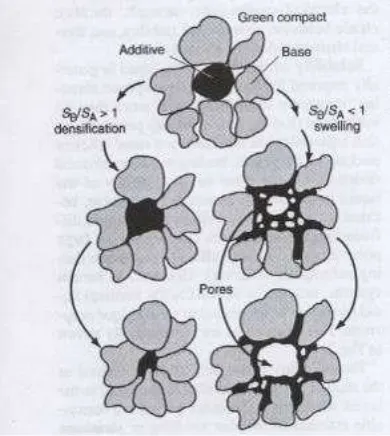
Fig 7. A schematic diagram contrasting the effects of solubility on densification or swelling
during LPS [60].
Solubility of the solid in the liquid is a necessary pre-requisite for successful LPS with
regard to systems having more than 65vol% solid [60]. Solubility promotes re-precipitation and
increased efficiency in particle arrangement thereby leading to increased sintered density. As
noted earlier on, solubility of the liquid in the solid is not preferred due to swelling as the liquid
which diffuses into the solid grains leads to formation of porosity which is difficult to remove
upon subsequent sintering. Fig. 7 suggests that transient liquid phase can be controlled to
produce desirable properties as exemplified in Cu-Sn and Cu-Zn systems. The solubility
parameter (S), which determines whether swelling or shrinkage occurs during LPS, is the ratio of
the solid solubility (SB) in the liquid to the liquid solubility in the solid (SA). Table 3 presents the
28
Table 3
Solubility effects on densification in LPS [60].
Base Additive Solubility ratio,
(at.%)
Behaviour
Al Zn 0.004 Swell
Cu Al 0.1 Swell
Cu Ti 4 Shrink
Fe B 7 shrink
Fe Cu 0.07 Swell
W Fe 5 Shrink
In regards to SLS processing, the actual amount of dimensional change is a function of the
processing conditions. Phase diagrams are useful in identifying solubility parameters and other
features that promotes LPS [60]. A study of an ideal phase diagram for LPS (Fig. 6) reveals that
a deep eutectic is preferred due to significant reduction in sintering temperature with the
formation of liquid phase. The formation of intermediate compound is generally unfavourable.
High-temperature phases can reduce diffusion rates, while brittle intermetallic phases that form
[image:29.612.230.381.498.616.2]during cooling can degrade mechanical properties.
Fig. 8. Typical microstructure of a LPS system with the phase diagram characteristics shown in
29
Furthermore, a phase diagram reveals the tendency of alloying elements and impurities to
segregate to the interfaces with a downward sloping liquidus and solidus indicating a propensity
for solute segregation and lower surface energies [60]. Therefore, a sintering temperature just
above the eutectic temperature is optimal for a composition in the L + region. A typical LPS
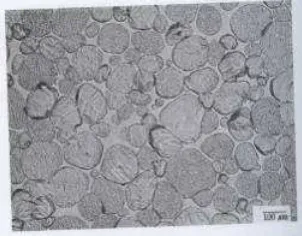
microstructure is shown in Fig. 8 which consists of relatively large, rounded grains suspended in
a liquid matrix, with the degree of grain contact governed by the dihedral angle. In a system that
lacks solubility of the solid in the liquid phase, a rigid skeletal structure is expected with
densification controlled by solid state diffusion. Use of extremely fine starting powders or
segregating activators that promote solid-state sintering in the presence of the liquid ensures high
sintered densities are obtained.
Schaffer and co-workers [61] examined the behaviour of a number of likely candidate
alloys and discovered that Al-Sn, which follows very closely the ideal characteristics described
in Fig. 6, had a much more desirable sintering response than either Al-Cu or Al-Zn, both of
which have at least one ideal characteristic. On this premise, they designed the Al–Sn–Mg
system for uncompacted sintering and were able to achieve near full theoretical density.
However, the tensile strength of the Al–Sn system was poor because tin could not provide much
strengthening whereas Mg addition in the Al–Sn–Mg system improved tensile strength. This
confirms the potency of Mg in disrupting the surface oxide film of aluminium, thus, promoting
metal/metal bonding. Meanwhile, it is hereby speculated that the addition of tin could have
30
P/M aluminium alloys can be improved without recourse to hot working or master alloy
powders if their design is based on an understanding of the underlying sintering processes and
the characteristics of an ideal liquid phase sintering system [61]. However, this idea can be
applied to the design of suitable aluminium alloys for the fabrication of parts in SLS process with
a view to ensuring that the oxide phase of the aluminium powders is disrupted in order to make
allowance for effective inter-particle bonding/melting across the layers so as to achieve the
production of full density parts. This entails the determination of the appropriate chemical
composition of aluminium alloys that make allowance in their thermal cycle for the transient
nature of the adequate liquid phase during SLS in addition to the alloying elements contained in
them effectively disrupting the surface oxide of the aluminium powder. Furthermore, designing
such SLS processable aluminium alloys necessitates that the mechanism of disruption of their
surface oxide film need to be understood. Therefore, an investigation is necessary to ascertain if
alloys of the same composition as those employed in the press and sinter technique could give
equivalent or a better sintering response during SLS without the application of hot working
processes. If this is not the case, alloys that would give desirable response to SLS need to be
designed.
3.2 The Application of Liquid Phase Sintering (LPS) to SLS Process
According to Agarwala et al. [50], the most applicable of all the binding mechanisms to
SLS is the liquid phase sintering/partial melting (LPS) which incorporates the melting of the
31
components of the system. Moreover, the improvement obtained in the mechanical and
microstructural properties of SLS processed components depends on the success or otherwise of
the LPS with regard to the amount of liquid phase present. Powder properties such as the size
distribution and shape of the powder particles, as well as particle arrangement play an important
role in determining the ideal SLS liquid phase condition. If the processing and powder
parameters are poorly controlled, difficulties such as balling, microstructural agglomeration,
layer delamination and porosity are bound to be encountered during the SLS of metals due to the
initiation of Marangoni convection, and uneven thermal gradient on the powder bed. These
problems may also arise as a result of improper arrangement of the powder particles on the
sintering bed. While the role of component ratio of binder material in the SLS of metals will be
presented in this section, the roles of processing parameters as well as powder properties will be
discussed in Section 4.2.1.
An appropriate choice of the amount (measured in weight percentage) of binder materials
(which represents the amount of liquid phase formed if complete melting of the binder is
assumed) has been shown to overcome some of the SLS challenges highlighted in the preceding
paragraph. Gu & Shen [62-65] demonstrated that there exist optimal component ratios; for each
of WC-Co particulate reinforcing Cu matrix composites; multi-component Cu-based metal
powder; and sub-micron W-Cu / micron Cu powder mixture systems. At the binder’s optimal
component weight ratio, high densification and homogeneous sintered microstructure are
obtainable as a consequence of favourable viscosity of liquid-solid mixture and the sufficient
32
falls below its optimal component weight ratio for each of these systems, severe particulate
aggregation occurs due to limited liquid formation and the resulting high liquid viscosity due to
high solid fraction and reduced Marangoni effect.
Fig. 9. Optical images of the polished sections of the laser sintered multi-component Cu-based
metal powder with varying contents (wt%) of binder CuSn in the samples (a) 20 (b) 35 (c) 50
and (d) 65 [63].
With the binder content increasing beyond its optimal component ratio, the laser sintered
densities of the parts made in each of these powder systems deteriorates because of the initiation
of the balling phenomenon and uneven thermal gradient. Experimental evidence has revealed
that the fractional amount of liquid phase yielding optimal densification and homogeneous
microstructure (Fig. 9) for the SLS of various powder systems are as shown in Table 4. In
33
amount for SLS, for which a pore-free microstructure is obtainable, is complex and significantly
influenced by chemical composition and component ratio which in turn is affected by the
packing density of the blended powder bed as well as the viscosity of the laser sintered powders
powder systems.
Table 4
Fractional amount of liquid phase generated in various SLS processed metal systems.
Material Binder material Fractional
liquid phase.
Ref. No.
Multi-component Cu-based metal powder
CuSn 0.5 [63]
Sub-micron WC-Cop / Cu bulk metal matrix composites
Cu 0.7 [64]
Sub-micron W-Cu / micron Cu powder mixture
Micron Cu powder 0.6 [65]
Fe-Cu system Cu 0.3 [66]
It is now evident that the fraction of liquid phase available in the sintering pool of SLS of metals
determines the densification and microstructure of the laser processed parts by influencing the
thermo-kinetic and thermocapillary properties such as viscosity, wettability and rheological
characteristics [50]. Table 4 suggests that provided appropriate SLS processing parameters are
used, the optimal liquid fraction existing at the binder‘s optimum component ratio is dependent
on the energy gain of the powder and is partly controlled by the weight fraction of the binder in
34
3.3 Oxide Disruption in Pulsed Electric Current Sintering (PECS) Processed Aluminium Alloy
Powders
Xie et al. [67] studied the behaviour of oxide films at the interface between pure Al
powdered particles in pulse electric-current sintering (PECS) and its effect on the properties of
the sintered specimens. It was shown that the occurrence of direct metal/metal bonding interfaces
increases the mechanical properties of the sintered aluminium powder whereas the metal oxide
film layer/metal bonding interfaces produced contrary effect on its mechanical properties. This
finding established that by increasing the loading pressure at high sintering temperatures, or
increasing the sintering temperature under loading pressure, the breakdown of the oxide film was
promoted. Moreover, Xie et al. [68] investigated the reduction mechanism of the surface oxide
film and microstructure of interfaces between powder particles in Al-Mg alloy specimens
sintered by pulse electric-current (PECS) process. They established that nano-sized crystalline
precipitates, which may be MgAl2O4, MgO, or both, were formed by the reduction reaction by
magnesium and were observed in all of the Al-Mg alloy specimens which they studied. They
attributed the type of crystalline precipitates formed to the variation in the Mg content in the
alloy powder and the sintering temperature.
Furthermore, Liu et al. [69] showed that particle shape seems to be a significant factor
controlling the P/M sintering response of uncompacted aluminium powder. In addition, they
suggested that the differential thermal expansion between the aluminium particle and its oxide
35
consequence of powder morphology. It was elucidated that the oxide shell in irregularly shaped
particles tend to crack and heal more frequently than in smooth, spherical shaped particles
because of the tendency of the irregular particles to scavenge more oxygen during heating than
spherical particles. It was also posited that this eventually resulted in greater weight gain
observed in the sintered irregular powder particles than the spherical particles due to outer layers
made from irregular particles providing a more effective autogenous gettering zone than outer
layers made up of spherical particles. Therefore, it can be inferred that the sintering mechanism
of aluminium powders can differ on the basis of the sintering technique adopted, chemical
composition, and particle surface morphology. Moreover, it is evident from the cited literature
that oxide cleanliness is important in order to achieve inter-particulate bonding if parts having
structural integrity will be fabricated via SLS/SLM. Therefore, a mechanism elucidating the
reduction of the surface oxide film during SLS/SLM processing of aluminium powders need to
be proposed as well as the associated factors that aid or inhibit its occurrence in practice.
3.4 Alloying Design for the SLS Process
To fabricate components using the binary liquid phase SLS process, sintering from a low
green density to a high final density is required. To achieve this aim, the use of additives that
promote the formation of liquid phase and improve wettability is a simple and inexpensive
technique that is feasible. Many researchers have expended significant efforts in attempting to
increase densification by improving the wettability in SLS. Among numerous approaches
36
alloying additions. This section is devoted to a review of the literature on the use of fluxing
agents and alloying additions to enhance the densification mechanism in SLS processed
powders.
Fluxing agents which are used in brazing and soldering can improve wetting effectively
during sintering due to their ability to de-oxidise and reduce the surface tension of the
solid-liquid-vapour interface [70]. Agarwala et al. [50] examined the role of phosphorus in SLS of
bronze (Cu-10wt%Sn)-nickel powder. They were able to determine an optimum processing
window for which a density of around 70% was obtained without any significant balling or
spheroidisation. Zhu et al. [71] found the formation of Cu2O in a copper-based powder
(Cu-40%wtSCuP) to be sensitive to the scan spacing as a consequence of a lack of Cu3P protection
under the re-heating condition if a small scan spacing was used. Moreover, they discovered that
atomic diffusion was the densification mechanism at fast scan speed and high scan spacing
whereas solute-reprecipitation was noted to be the predominant mechanism for densification at
low scan rates and small scan spacings. Although, Zhu and co-workers [71] did not elaborate on
the role of Cu3P in improving wetting between sintered layers and enhancement of densification,
Zhu et al. [70] investigated the influence of varying contents of brazing flux on the wettability
and densification in the direct laser sintering of Cu-based metallic powder (Cu-40%wt.SCuP).
Their findings revealed that small amount of flux increased the densification and sinterability. A
large amount of flux additive had a negative effect, however, with balling taking place and a
residual covering of flux on the surface leading to a deterioration of adhesion between the
37
On the basis of the characteristics of phase diagrams of ideal sintering systems, alloying
elements have been used to enhance the sintering behaviour of metallic systems (see Fig. 6 in
Section 3.1). In these systems, the mechanism of enhancement is the formation of eutectic liquid
phase and, since the solubility of the additive in the structural metallic component is low, the
liquid remains segregated to particle boundaries. Sercombe [72] added boron to maraging steels
with the aim of producing high hardness rapid tooling. His findings showed that the reaction of
0.4% boron with the alloying elements in the maraging steel resulted in the formation of Mo- and
Ti- rich borides, thereby providing a liquid phase for enhanced sintering to produce a near full
density component. Chen et al. [73] also found that the inclusion of titanium in steel samples
improved the bonding of the sample to the substrate and reduced the extreme hardness of the
material. A search of the literature on the effect of alloying elements on the densification
mechanisms of SLS processed aluminium powders has yielded no result. Hence, in order to gain
an understanding of the role that alloying additions play in the sintering/melting of aluminium
powders, results from conventional powder metallurgy must be considered.
It is an established fact that trace elements facilitate the sintering of aluminium and its
alloys by the formation of liquid phase. This initiates a change from the solid state to liquid
phase sintering with corresponding increase in sintering rates. Sercombe & Schaffer [74, 75] had
observed that trace additions (0.1 wt%) of Sn, Pb, Bi, and Sb enhanced densification during
sintering of aluminium alloys and dramatically improved their tensile properties. This
observation could be attributed to the high vacancy binding energy of the trace elements used as
38
0.07wt% lead, tin, or indium promotes sintering in an Al-Zn-Mg-Cu alloy. They stated that the
sintering enhancement was as a result of the segregation of the micro-alloying additions to the
liquid-vapour interface thereby lowering the effective surface tension of the oxides. McPhee et
al. [77] discovered that the segregation of iron into the inter-granular liquid pools retards the
liquid film migration rate in aluminium alloys while alloys with low iron levels develop few
intergranular pools and have higher sintered densities. Delgardo et al. [78] examined the effect of
the second liquid phase coming from the addition of eutectic Al-Si on the super solidus liquid
phase sintering (pre-alloyed powder) and liquid phase sintering (pre-mixed powders) of Al-Cu
2XXX series. Their result showed an improvement in AA2014
(Al-4.4wt%Cu-0.7wt%.Si-0.4wt%Mg) densification and mechanical properties but the product was noted to have been
bedevilled with porous microstructure while Alumix 123
(Al-4.4%wt.Cu-0.6%wt.Si-0.5%wt.Mg) densification and microstructure improved by having lower amount of porosity but
had lower bending strength. MacAskill et al. [79] studied the effects of magnesium and tin on the
sintering response of air atomized aluminum powder by considering nature of the raw powders
and their concentrations. MacAskill and co-investigators [79] established that magnesium
additions improved the sintering response of the aluminum powder and increased the propensity
for reaction with gaseous nitrogen while tin dampened this effect. They concluded that the most
desirable sintering response was obtained for Al–1.5Sn–1.5Mg alloy. Moreover, Gökçe et al.
[80] reported on the sintering kinetics of aluminum powder pre-mixed with copper and
magnesium powders at both macro- and micro-level respectively with a view to producing light
and strong Al-based powder metallurgy alloys. They discovered that high strength Al-based
39
elemental Al5Cu and Al5Cu0.5Mg compositions with the transverse rupture strength value after
sintering of the base Al powder increasing five times from 84 MPa to 466 MPa.
The foregoing discussion shows that the sintering mechanism of various aluminium alloys
differ depending on specific micro-alloying elements and, sometimes, the bulk alloy
composition. The insight gained from the powder metallurgy (P/M) studies on the effect of trace
elements on the densification of aluminium alloys could be useful in the SLS/SLM processing of
aluminium alloys. This could be applied by investigating the effect of alloying elements on the
sintering mechanisms of various aluminium alloys under the SLS/SLM processing conditions.
This investigation is very important because the SLS/SLM processing technique differs
significantly from the conventional sintering process. Furthermore, from the available literature,
no in-situ-deoxidiser or fluxing agents has been developed for aluminium alloys such that it
could promote wettability between the various layers thus improving densification. The
requirement for such an in-situ-deoxidiser or fluxing agent should be such that it would not leave
any residue on the layers which could impair the coherence of the layers of the components
40
4 Effects of Processing Parameters and Powder Properties on the SLS/SLM Processing and
Densification of Powders
Metallic powders have a higher degree of contamination by moisture, organics, adsorbed
gases, oxide and nitride films on particle surfaces due to their much higher surface area per unit
volume when compared to cast or wrought components [46]. These contaminants not only inhibit
successful wetting, which promotes interlayer bonding and densification of the melted powder,
but also degrade the mechanical properties and part geometry of the consolidated component
during SLM [46]. SLM of metals is considered to be far more difficult than the laser sintering of
polymers, direct or indirect SLS of metals because of the oxidation, balling and uneven thermal
gradients across the layers which may cause poor interlayer bonding, low density, weak strength
and rough surface of the SLM processed part [8, 46, 57, 81]. For this reason, findings from
several studies have described SLS/SLM as a very complicated process, and suggested that
several parameters influence the densification mechanism and the attendant microstructural
features of materials processed by SLS/SLM. The main process parameters that determine the
processing as well as the quality characteristics of a component fabricated by SLS/SLM
technique are as listed in the first column of Table 2 whereas the characteristics of powder
material which are of special concern are listed in its second column.
In an attempt to mitigate the deleterious effect of oxidation as well as ensuring good
wetting and successful layer- by-layer consolidation in direct laser sintering of metals, various
41
neon, and nitrogen which renders the oxidation process inactive or slows it down; disruption of
the surface oxide film by alloying addition; determining the optimal processing parameters that
allows minimal balling; re-melting of the underlying substrate in order to break down the surface
contaminants to ensure a clean surface at the atomic level between the solid and the liquid; and
incorporation of fluxing additives [5, 45, 46, 61, 71, 76, 81-85]. The objective of this section is to
determine from the available literature, the possible effects of the SLS/SLM parameters and
powder properties on the processing and densification phenomena of components produced from
aluminium alloys. Where literature on SLS/SLM processing of aluminium alloy powders are not
readily available to elucidate their SLS/SLM response, studies on ferrous (e.g. steel, iron) and
non-ferrous (e.g. titanium e.t.c.) powders have been employed to achieve the aim of this section.
As noted earlier on, these alloyed powders are being considered together in this section because
they are very reactive and form very stable oxides. Therefore, they all require the use of high
vacuum or high-purity inert gas atmosphere for their processing. It is expected that insights to be
gained from how processing and material parameters promote mechanism of oxide disruption for
achieving good microstructural and mechanical properties in these powders could be helpful in
understanding the disruption mechanisms of aluminium oxides as well as how processing and
materials parameters favour this during laser processing.
4.1 SLS/SLM Processing Windows of Aluminium Alloy Powders
In order to gain an in-depth understanding of the consolidation behaviour of SLS/SLM
42
construction of continuous surfaces devoid of balling phenomenon in order to build multiple
layers must be established. The processing windows for pure- Al, pre- alloyed Al-Mg, and
AlSi12 powders were investigated by employing laser power and scanning speeds in the range of
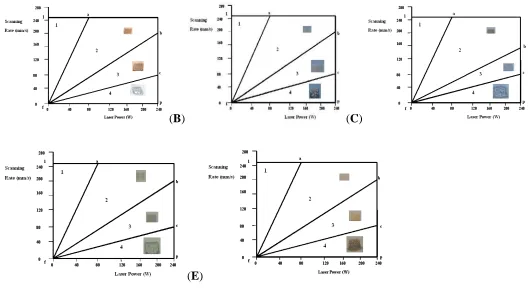
20-240W and 20-250mms-1 respectively at a constant scan spacing of 0.1mm [40, 45]. Four
regions of behaviour identified for all powders were: no marking, partial marking, good
consolidation, and excessive balling (Fig. 10). The processing windows (Fig. 10A to E) show
similar trends for all powders investigated, although, there were differences in the location of
boundaries of the different regions between powders. The region of partial marking, even though
coherently bonded, was characterised by the occurrence of very low strength single layer
samples which could not be held by hand without fracture occurring; whereas the region of good
consolidation consists of coherently bonded layers having high strength which enables the
samples to be held by hand. The area of good consolidation should be a favourable region for the
construction of multiple layers in SLS/SLM while the region of excessive balling which is
undesirable is characterised by the formation of large size melt pools which hinder the
43
(A) (B) (C)
(D) (E)
[image:44.792.89.617.70.361.2]1: No marking; 2: Partial Marking; 3: Good Consolidation 4: Excessive Balling
Fig. 10. Processing window for single layer parts made in (A) air atomised pure aluminium (AL-1) (B) gas atomised pure aluminium
2) (C) water atomised Al-5.6Mg 3) (D) water atomised Al- 6Mg 4) and (E) gas atomised Al-12Si AL-5 powders
(AL-5) (Note: Reciprocals of slopes f-a, f-b, and f-c, were computed and multiplied by the reciprocal of scan spacing (0.1 mm) in order to
obtain the applied energy density). Processing conditions are laser powers (20-240W), scan rates (20-250mms-1), and scan spacing
44
1: No marking; 2: Partial Marking; 3: Good Consolidation 4: Excessive Balling
Fig. 11. Relationship between the various regions of processing map and the surface morphology
of SLS/SLM processed aluminium powder at a laser power of 150 W, scan spacing of 0.1 mm,
and varying scanning rates [40].
Fig. 11 depicts the relationship between the various regions of processing map and the surface
morphology at a laser power of 150 W, scan spacing of 0.1 mm, and varying scanning rates for
aluminium alloy powders when its single layer coupons were produced on the powder bed
substrate. At scanning rates below 80mm/s, the pores appeared to be large in size and the
inter-agglomerates were fully dense as the laser increases. This corresponds to the excessive balling
region of the processing map. Further increment in the range of scanning rates between 80mm/s
to 150 mm/s when laser power varies between 120 W to 240 W, resulted in formation of fairly
dense structures consisting of small closed pores (region of minimal balling). As the laser power
45
appeared smooth, but less dense while it was characterised with lateral pores (region of partial
marking). These observations conform to the discoveries made by Niu & Chang [5] in their
studies on the SLS of M2 high speed steels. An observation of the surface morphology of
SLS/SLM processed samples revealed that the agglomerates were no longer seen in samples
AL-1, AL-2, AL-3, and AL-4 powders, but were replaced by a continuous skeleton structure.
However, a fairly dense structure with closed pores whereas a relatively smooth and almost fully
dense sintered surface was obtained for AL-5. This indicates that pre-alloyed elements in the
aluminium powders influence the evolution of the nature of its surface morphology during
SLS/SLM processing.
Moreover, the existence of the observed regions in the processing windows with the associated
surface morphologies could be attributed to the following reasons:
The existence of the region of “no marking” (Fig. 10) is affected by the extremely short
duration of laser-material interaction/lowest energy density (less than 3.2 J/mm2) which
permits no inter-particulate bonding to take place due to the adoption of scanning
velocities above 50mm/s at laser powers less than 80W during SLS process.
The formation of the “partial marking” region (Fig. 10) in which the morphology of laser
sintered surfaces is characterised by a network of agglomerates with a large amount of
small, open, and deep pores (Fig. 11) could be explained by the generation of lower
energy density (3.3 to 10 J/mm2) resulting from the adoption of laser powers ranging
46
leads to the generation of inadequate liquid phase that consequently produce low
inter-particulate bonding evident in Fig. 11.
The attainment of the region designated “good consolidation” (Fig. 10) which is
characterised by almost or fairly (i.e. 60 to 80%) dense structures consisting of closed
pores (Fig. 11) could be ascribed to the adoption of higher energy densities in the range
of 12 to less than 30 J/mm2 which leads to the formation of adequate amount of liquid
phase that promotes full melting. This outcome is in agreement with findings from Khan
& Dickens [86]. The energy densities resulting in the formation of “good consolidation
region” are derivable from laser power ranging between 100 to 240 W and scan rates
varying between 80 mm/s to 200 mm/s. It is believed that energy densities in the range of
12 to less than 30 J/mm2 increase the powder bed temperature, while reducing the
viscosity of molten pool of the SLM processed powders, thereby facilitating more
efficient densification with the solid powdered particles as elucidated by Khan & Dickens
[86].
Furthermore, the occurrence of rough and 100% dense structures (Fig. 11) associated
with the region of “excessive balling” (Fig. 10) could be ascribed to the highest range of
energy densities resulting from the combined effect of higher laser powers at the lower
scan rates (80 mm/s or less). Similar to findings from Zhang et al. [87], energy densities
from 30 J/mm2 or more generated at this instance is believed to have led to the formation
47
From the foregoing discussion, an energy density in the range of 12 to 16 J/mm2 was found
to be the threshold below which SLS was predominant and above which SLM of aluminium
powders occurred. This implies that the occurrence of various regions (Fig. 10) in the SLS/SLM
processing window as well as the attendant microstructure is dependent on the laser energy
density (see Eq. (1)) that generates a varying amount of liquid phase for inter-particulate
bonding/melting, rather than laser power or scanning rate in isolation.
P uh (1)
where is the specific laser energy input, P is the laser power (W), u is the scan rate (mm/s);
and h is the scan spacing (mm).
Finally, the four regions identified in Olakanmi’s [40] study are similar to the regions reported
for direct SLS/SLM processing maps studies on gold, and Mg-9Al powders by Khan and
Dickens [86]; and Zhang et al. [87] respectively.
Further comparison of the SLS/SLM processing windows for AL1, AL-2, AL-4 and AL-5
(Fig. 10A, B, D, and E) reveals that they are all identical as exemplified by the occurrence of the
region of good consolidation for all the powders when scanning rates were varied between 80
mm/s to 200 mm/s when laser power in the range of 100 to 240 W were applied. This behaviour
could be attributed to the powders’ tapping densities (Fig. 12) which are similar to one another
and influence their thermal conductivities. Although, oxide content (Table 5) in AL-1 (15.9wt %)
is higher than that of AL-2 (6.5wt %), AL-4 (4.6wt%), and AL-5 (2.8wt%) while the powder
48
the oxide contents of pure aluminium powders AL-1, AL-2, AL-4, and AL-5 appear to have little
or no effect on the nature of processing maps obtained for them. The processing map for AL-3
(Fig. 10C) reveals significant differences in its features when compared with other powdered
samples as illustrated in the processing condition for the region of good consolidation: scan rates
varying between 80 mm/s to 150 mm/s for AL-3 at the instance when the applied laser power
was between 120 to 240W. A cursory look through the powder properties shows substantial
differences in the powder densities, but similar oxide and magnesium contents (Table 5) for
AL-3 and AL-4 powders (Fig. 12). Since the differences in oxide contents of the powders have little
or no influence on the processing maps of powders, it may be suggested that the similarity in the
oxide and magnesium contents of AL-3 and AL-4 has little or no influence of their processing
[image:49.612.114.485.394.641.2]maps.
Fig. 12. Apparent, Tapping, and Bed densities of the aluminium powders [40].
![Fig. 1. (A) A layered manufacturing (LM) paradigm (B) Generic fixturing [9].](https://thumb-us.123doks.com/thumbv2/123dok_us/7901064.187982/10.612.87.475.156.501/fig-layered-manufacturing-lm-paradigm-generic-fixturing.webp)
![Fig. 12. Apparent, Tapping, and Bed densities of the aluminium powders [40].](https://thumb-us.123doks.com/thumbv2/123dok_us/7901064.187982/49.612.114.485.394.641/fig-apparent-tapping-bed-densities-aluminium-powders.webp)