coalitional games.
White Rose Research Online URL for this paper: http://eprints.whiterose.ac.uk/89670/
Version: Accepted Version
Article:
Bauso, D. and Notarstefano, G. (2015) Distributed $n$-player approachability and consensus in coalitional games. IEEE Transactions on Automatic Control, 60 (11). pp. 3107-3112. ISSN 0018-9286
https://doi.org/10.1109/TAC.2015.2411873
[email protected] https://eprints.whiterose.ac.uk/ Reuse
Unless indicated otherwise, fulltext items are protected by copyright with all rights reserved. The copyright exception in section 29 of the Copyright, Designs and Patents Act 1988 allows the making of a single copy solely for the purpose of non-commercial research or private study within the limits of fair dealing. The publisher or other rights-holder may allow further reproduction and re-use of this version - refer to the White Rose Research Online record for this item. Where records identify the publisher as the copyright holder, users can verify any specific terms of use on the publisher’s website.
Takedown
If you consider content in White Rose Research Online to be in breach of UK law, please notify us by
Distributed
n
-player approachability and
consensus
in coalitional games
Dario Bauso and Giuseppe Notarstefano
Abstract
We study a distributed allocation process where, repeatedly in time, every player renegotiates past
allocations with neighbors and allocates new revenues. The average allocations evolve according to
a doubly (over time and space) averaging algorithm. We study conditions under which the average
allocations reach consensus to any point within a predefined target set even in the presence of
adversarial disturbances. Motivations arise in the context of coalitional games with transferable
utilities (TU) where the target set is any set of allocations that make the grand coalitions stable.
I. INTRODUCTION
We consider a two-step distributed allocation process where at every time players first
renegotiate their past allocations and second generate a new revenue and allocate it. The
time-averaged allocations evolve according to a doubly (over time and space) averaging
A preliminary conference version of this paper has appeared as [1]. The current paper includes, in addition: i) more
detailed and revised proofs of the main results, ii) analysis of adversarial disturbances; iii) analysis of the connections with
approachability theory in its strategic version for two-player repeated games, and iii) numerical studies. The work of D.
Bauso was supported by the 2012 “Research Fellow” Program of the Dipartimento di Matematica, Universit`a di Trento and
by PRIN 20103S5RN3 “Robust decision making in markets and organizations, 2013-2016”. The second author wants to
thank J. Hendrickx for the helpful discussion on the proof of Theorem 2.
D. Bauso is with Dipartimento di Ingegneria Chimica, Gestionale, Informatica e Meccanica, Universit`a di Palermo, Italy,
email:[email protected]. D. Bauso is currently academic visitor at the Department of Engineering Science, University
of Oxford, UK.
G. Notarstefano is with Department of Engineering, Universit`a del Salento (University of Lecce), Via per Monteroni,
73100, Lecce, [email protected]
dynamics. The goal is to let all allocations reach consensus to any value in a predefined set
even in the presence of an adversarial disturbance.
Motivations. The problem arises in the context of dynamic coalitional games with Transfer-able Utilities (TU games) [8]. A coalitional TU game consists in a set of players, who can
form coalitions, and a characteristic function that provides a value for each coalition. The
predefined set introduced above can be thought of as (but it is not limited to) the core of
the game. This is the set of imputations under which no coalition has a value greater than
the sum of its members’ payoffs. Therefore, no coalition has incentive to leave the grand
coalition and receive a larger payoff.
Highlights of contributions.We analyze conditions under which the average allocations: (i)
approach the set X (Theorem 1), (ii) reach consensus, in which case we also compute the
consensus value (Theorem 2), and (iii) are robust against disturbances (Theorem 3).
Related literature. Coalitional games with transferable utilities (TU) were first introduced by von Neumann and Morgenstern [14]. Here, a main issue is to study whether the core is
an “approachable” set, and which allocation processes can drive the “complaint vector” to
that set. Approachability theory was developed by Blackwell in the early ’56, [2], and is
captured in the well known Blackwell’s Theorem. The geometric (approachability) principle
that lies behind the Blackwell’s Theorem is among the fundamentals in allocation processes in
coalitional games [7]. The discrete-time dynamics analyzed in the paper follows the rules of
a typical consensus dynamics (see, e.g., [11] and references therein). among multiple agents,
where an underlying communication graph for the agents and balancing weights have been
used with some variations to reach an agreement on common decision variable in [10], [9],
[11], [13], [12], [4] for distributed multi-agent optimization.
The paper is organized as follows. In Section, II, we formulate the problem and discuss
motivations and main assumptions. In Section III, we illustrate the main results. In Section
IV we provide numerical illustrations. Finally, in Section V, we provide concluding remarks
and future directions.
Notation. We view vectors as columns. For a vectorx, we use[x]j to denote itsjth coordinate
component. We letx′ denote the transpose of a vectorx, andkxk denote its Euclidean norm.
Ann×nmatrixA is row-stochastic if the matrix has nonnegative entriesai
j and
Pn
j=1aij = 1
for all i = 1, . . . , n. For a matrix A, we use ai
is doubly stochastic if bothA and its transposeA′ are row-stochastic. Given two setsU and
S, we write U ⊂S to denote that U is a proper subset of S. We use |S| for the cardinality
of a given finite set S. We write PX[x] to denote the projection of a vector x on a set X,
and we write dist(x, X) for the distance from x toX, i.e., PX[x] = arg miny∈Xkx−yk and
dist(x, X) = kx−PX[x]k, respectively. Given a function of time x(·) : N → R, we denote
by x¯(t) its average up to time t, i.e., x¯(t) := 1t Pt
τ=1x(τ).
II. DISTRIBUTED REWARD ALLOCATION ALGORITHM
Every player in a set N = {1, . . . , n} is characterized by an average allocation vector
ˆ
xi(t+1)∈Rn. At every time he renegotiates withneighborsall past allocations and generates
a new allocation vector xi(t+ 1). The time-averaged allocation xˆi(t) evolves as follows:
ˆ
xi(t+ 1) =
t t+ 1
" n X
j=1
aij(t)ˆxj(t)
#
+ 1
t+ 1xi(t+ 1), (1)
whereai = (ai
1, . . . , ain)′ is a vector of nonnegative weights consistent with the sparsity of the
communication graph G(t) = (N,E(t)). A link (j, i)∈ E(t) exists if player j is a neighbor
of player i at time t, i.e. if player i renegotiates allocations with player j at time t.
Problem. Our goal is to study under what conditions all allocation vectors converge to a unique value and this value belongs to a predefined set X: for all i, j ∈V,
ˆ
xi(t) = ˆxj(t)∈X, for t→ ∞. (2)
In the sequel, we rewrite equation (1) in the compact form:
ˆ
xi(t+ 1) =
t
t+ 1wi(t) + 1
t+ 1xi(t+ 1), (3)
where wi(t) is the space average defined as
wi(t) =
" n X
j=1
ai
j(t)ˆxj(t)
#
. (4)
A. Motivations
The set X introduced above can be thought of as the core of a coalitional game with
Transferable Utilities (TU game).
A coalitional TU game is defined by a pair < N, η >, where N ={1, . . . , n} is a set of
η determines the value η(S) assigned to each coalition S ⊂N, withη(∅) = 0. We let ηS be
the value η(S) of the characteristic function η associated with a nonempty coalition S ⊆N.
Given a TU game < N, η >, let C(η) be the core of the game,
C(η) = (
x∈Rn
X
j∈N
[x]j =ηN,
X
j∈S
[x]j ≥ηS for all nonempty S⊂N
)
.
Essentially, the core of the game is the set of all allocations that make the grand coalition
stable with respect to all subcoalitions. Condition P
j∈N[x]j = ηN is also called efficiency
condition. ConditionP
j∈S[x]j ≥ηS for all nonempty S ⊂N is referred to as “stability with
respect to subcoalitions”, since it guarantees that the total amount given to the members of a
coalition exceeds the value of the coalition itself.
B. Main assumptions
Following [11] (see also [8]) we can make the following assumptions on the information
structure. We let A(t) be the weight matrix with entries ai
j(t).
Assumption 1: Each matrix A(t) is doubly stochastic with positive diagonal. Furthermore,
there exists a scalar α >0 such that ai
j(t)≥α whenever aij(t)>0.
At any time, the instantaneous graph G(t) need not be connected. However, for the proper
behavior of the process, the union of the graphsG(t) over a period of time is assumed to be
connected.
Assumption 2: There exists an integer Q≥1 such that the graph
N,S(t+1)Q−1
τ=tQ E(τ)
is
strongly connected for every t ≥0.
It is worth noting that the above assumptions are fairly standard in the distributed
computa-tion literature. In particular, the joint strong connectivity is the weakest possible assumpcomputa-tion to
guarantee persistent circulation of the information through the graph. The double stochasticity
of the matrix A(t) is a common assumption to guarantee average consensus.
LetX ⊂Rn be the core set of the game. A common assumption in approachability theory
is that both the core set is convex and bounded, and the payoff (or loss) vectors generated at
each time are bounded. Thus, following [2], [5], we borrow and adapt such an assumption
wi(t) ˆ
xi(t+ 1)
xi(t+ 1)
X
H−
H+
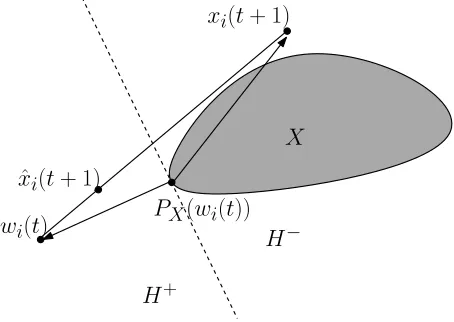
[image:6.612.193.420.82.243.2]PX(wi(t))
Fig. 1. Approachability principle.
Assumption 3: The core set X is nonempty.
Notice that a nonempty core is a convex and compact set.
The next assumption indicates how the new reward vector has to be generated in order to
obtain approachability.
Assumption 4: For each i ∈ N the new reward vector xi(·) is bounded, i.e., there exists
L >0 s.t.∀t≥0kxi(t+ 1)k ≤L, and satisfies the following inequality, for a scalar negative
number, φ <0,
(wi(t)−PX(wi(t)))′(xi(t+ 1)−PX(wi(t))≤φ <0.
From a geometric standpoint, Assumption 4 requires that, given the two half-spaces identified
by the supporting hyperplane of X through PX(wi(t)), the new reward vector xi(t+ 1) lies
in the half-space not containing wi(t).
III. MAIN RESULTS
Next, we provide the main results of the paper. Namely, we prove that the average
allo-cations: (i) approach the set X (Theorem 1), (ii) reachconsensus (Theorem 2), and (iii) are
robust against disturbances (Theorem 3).
A. Approachability and consensus
Before stating the first theorem, we need to introduce two lemmas. The next lemma
establishes that the space averaging step in (1) reduces the total distance (i.e. the sum of
Lemma 1: Let Assumption 1 hold. Then the total distance fromX decreases when
replac-ing the allocations xˆi(t) by their space averages wi(t), i.e., n
X
i=1
dist(wi(t), X)≤ n
X
i=1
dist(ˆxi(t), X).
As a preliminary step to the next result, observe that, from the definition of dist(·, X) and
from (1) and (4), it holds
dist(ˆxi(t+ 1), X)2 =kxˆi(t+ 1)−PX[ˆxi(t+ 1)]k2
≤ kxˆi(t+ 1)−PX[wi(t)]k2
= t
t+ 1wi(t) + 1
t+ 1xi(t+ 1)−PX[wi(t)] 2 = t
t+ 1(wi(t)−PX[wi(t)])
+ 1
t+ 1(xi(t+ 1)−PX[wi(t)]) 2 = t t+ 1
2
kwi(t)−PX[wi(t)]k2
+
1 t+ 1
2
kxi(t+ 1)−PX[wi(t)]k2
+ 2t
(t+ 1)2(wi(t)−PX[wi(t)])
′(x
i(t+ 1)−PX[wi(t)]).
(5)
The following lemma states that, under the approachability assumption, the distance of
each single estimate from X decreases with respect to the one of the spatial average when
applying the time averaging step.
Lemma 2: Let Assumptions 3-4 hold. Then, there exists a positive integer scalar, ˜t > 0,
such that for allt ≥˜t >0 the distance of each single xˆi(t+ 1) decreases in comparison with
the distance of wi(t), i.e.,
dist(ˆxi(t+ 1), X)<dist(wi(t), X), ∀i= 1, . . . , n
We are now ready to state the first main result.
Theorem 1: Let Assumptions 1-4 hold. Then all average allocations approach set X, i.e.,
lim
t→∞
n
X
i=1
Next, let us introduce the barycenter of respectively the estimates and the reward vectors
ˆ xb(t) :=
1 n
n
X
i=1
ˆ
xi(t) and xb(t) :=
1 n
n
X
i=1
xi(t).
Consistently, let us denote as x¯b(t) the time average of the barycenter, i.e.
¯ xb(t) =
1 t+ 1
t
X
τ=0
xb(τ).
The following lemma establishes that the barycenter of the estimates evolves as the time
average x¯b(t) of the barycenter of the reward vectors generated by the players.
Lemma 3: The barycenter of the local allocations xˆb(t) coincides at each time t with the
time-average of the barycenter of the generated reward vectors x¯b(t).
The following theorem establishes that all allocations converge to x¯b(t), which in the limit
must belong to X according to Theorem 1.
Theorem 2: (Consensus to the barycenter time-average) Let Assumptions 1-4 hold. Then,
all players reach consensus on the time-average of the barycenter of the reward vectors
generated by each player, x¯b(t), i.e.,
lim
t→∞kxˆi(t)−x¯b(t)k= 0 ∀i= 1, . . . , n.
Summarizing the two main results, we have proven that asymptotically all the players’
allocations converge to the time-average of the barycenter of the generated reward vectors
and that this vector lies in the core of the game.
B. Adversarial disturbance
Here we analyze the case where, for each player i∈N, the input xi(·) is the payoff of a
repeated two-player game between playeri(Playeri1) and an (external) adversary (Player i2).
With some slight abuse of notation we denote S1 and S2 the finite set of actions of players
i1 and i2 respectively.
The instantaneous payoff xi(t) at time t is given by a function φi : S1 × S2 → Rn as
follows:
xi(t) = φ(j(t), k(t)),
wherej(t)∈S1 andk(t)∈S2. We extendxi to the set of mixed actions pairs,∆(S1)×∆(S2),
∆(S2) for player i1 and i2 at time t, the expected payoff is
Exi(t) = X
j∈S1
X
k∈S2
pj(t)qk(t)φ(j, k).
For simplicity the one-shot vector-payoff game (S1, S2, xi) is denoted by Gi.
Letλ ∈Rn. Denote byhλ, G
ii the zero-sum one-shot game whose set of players and their
action sets are as in the game Gi, and the payoff that player 2 pays to player 1 is λ′φ(j, k)
for every (j, k)∈S1×S2.
The resulting zero-sum game is described by the matrix
Φλ = [λ′φ(j, k)]j∈S1,k∈S2.
As a zero-sum one-shot game, the game hλ, Gii has a value, denoted
vλ := min
p∈∆S1
max
q∈∆S2
p′Φλq= max
q∈∆S2
min
p∈∆S1
p′Φλq.
For every mixed actionp∈∆(S1)denoteD1(p)the set of all payoffs that might be realized
when player i1 plays the mixed action p:
D1(p) = {xi(p, q) : q∈∆(S2)}.
If vλ ≥0 (resp. vλ >0), then there is a mixed action p∈∆(S1) such that D1(p) is a subset
of the closed half space {x∈Rn: λ′x≥0} (resp. half space {x∈Rm: λ′x >0}).
Let us introduce next the counterpart of Assumption 4 in this new worst-case setting.
Assumption 5: For any wi(t) ∈ Rn, there exists a mixed strategy p(t + 1) ∈ ∆(S1) for
Player i1 such that, for all mixed strategy q(t+ 1) ∈ ∆(S2) of Player i2, the new reward
vector xi(·) is bounded, i.e. there exists L >0 s.t. ∀t ≥0kxi(t+ 1)k ≤L, and satisfies
(wi(t)−PX(wi(t)))′(Exi(t+ 1)−PX(wi(t))≤φ <0,
where Exi(t+ 1) =P
j∈S1
P
k∈S2pj(t+ 1)qk(t+ 1)φ(j, k).
The above condition is among the foundations of approachability theory as it guarantees that
the average payoff T1 PT−1
t=0 xi(t) converges almost surely to X (see, e.g., [2] and also [5],
chapter 7). Here we adapt the above condition to the multi-agent and distributed scenario
under study.
Corollary 3.1 (see [2], Corollary 2): Any convex setX ⊂Rn is approachable if and only
Next we show that if the approachability condition expressed above holds true, thendist(ˆxi, X)
tends to zero for any X. We write w.p.1 to mean “with probability 1”.
Theorem 3: Let Assumptions 1-3 and 5 hold. Then all average allocations approach setX,
i.e.,
lim
t→∞
n
X
i=1
dist(ˆxi(t), X) = 0, w.p.1.
We conclude this section by observing that Theorem 2 still holds and therefore all
play-ers’ estimates reach consensus on the time-average of the barycenter of the reward vectors
generated by each player.
IV. SIMULATIONS
We illustrate the results in a game with four players, N = {1, . . . ,4}, communicating
according to a fixed undirected cycle graph. That is, G(t) = (N,E) where E ={(i, j)| j =
i+ 1, i∈ {1, . . . n−1}or(i, j) = (n,1)}.
We set η{1} = . . .= η{4} = 2, η{1,2} = 5, η{3,4} = 5, η{1,2,3} = 7 and ηN = 10 (ηS is the
value of coalition S). That is, each player expects to receive at least a reward of 2 which
is its value as a singleton coalition. But, for example, players 1 and 2 expect to be more
valuable if they form a coalition as well as 3and 4. Consistently, the core of the game is the
polyhedral set given by
C(η) = nx∈R4
x1+x2+x3+x4 = 10,
x1+x2+x3 ≥7, x1+x2 ≥5,
x3+x4 ≥5, x1 ≥2, . . . , x4 ≥2 o
.
We initialize the assignments assuming each player assign itself the entire reward. That
is, denoting bi ∈ Rn the i-th canonical vector (so that, e.g., b1 = [1 0 . . . 0]′), we set ˆ
xi(0) = 10bi for all i ∈ {1, . . . , n}. At every iteration t ∈ N, each player chooses the
new reward vector xi(t+ 1) according to the approachability principle. In particular, we set
xi(t+ 1) =PX[wi(t)] +α(PX[wi(t)]−wi(t)) +v⊤, where α is a random number uniformly
distributed in [0,1] and v⊤ a random vector belonging to the hyperplane tangent to the core
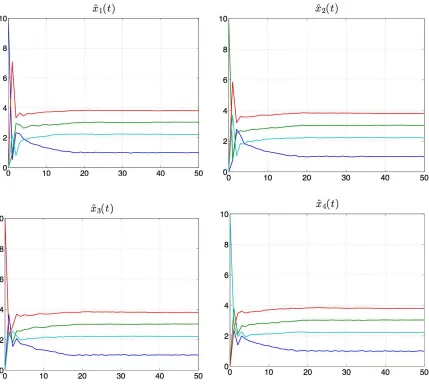
at PX[wi(t)]with coordinates uniformly chosen in [0,1]. The temporal evolution of the local
estimates of the average reward vector is depicted in Figure 2. As expected the local estimates
Fig. 2. Local average reward vectors
V. CONCLUSIONS
We have analyzed convergence conditions of a distributed allocation process arising in the
context of TU games. Future directions include the extension of our results to population
games with mean-field interactions, and averaging algorithms driven by Brownian motions.
REFERENCES
[1] D. Bauso and G. Notarstefano. Distributedn-player approachability via time and space average consensus. In3rd
IFAC Workshop on Distributed Estimation and Control in Networked Systems, pages 198–203, Santa Barbara, CA,
USA, Sept 2012.
[3] Vincent D Blondel, Julien M Hendrickx, Alex Olshevsky, and John N Tsitsiklis. Convergence in multiagent
coordination, consensus, and flocking. In44th IEEE Conf. on Decision and Control, 2005, pages 2996–3000, 2005.
[4] M. B¨urger, G. Notarstefano, F. Allg¨ower, and F. Bullo. A distributed simplex algorithm for degenerate linear programs
and multi-agent assignments. Automatica, 48(9):2298–2304, Sept 2012.
[5] N. Cesa-Bianchi and G. Lugosi. Prediction, Learning, and Games. Cambridge University Press, 2006.
[6] Julien M Hendrickx. Graphs and networks for the analysis of autonomous agent systems. PhD thesis, Ecole
Polytechnique, 2008.
[7] E. Lehrer. Allocation processes in cooperative games. International J. of Game Theory, 31:341–351, 2002.
[8] A. Nedi´c and D. Bauso. Dynamic coalitional tu games: Distributed bargaining among players’ neighbors.IEEE Trans.
Autom. Control, 58(6):1363–1376, 2013.
[9] A. Nedi´c, A. Olshevsky, A. Ozdaglar, and J.N. Tsitsiklis. On distributed averaging algorithms and quantization effects.
IEEE Trans. Autom. Control, 54(11):2506–2517, 2009.
[10] A. Nedi´c and A. Ozdaglar. Distributed subgradient methods for multi-agent optimization.IEEE Trans. Autom. Control,
54(1):48–61, 2009.
[11] A. Nedi´c, A. Ozdaglar, and P.A. Parrilo. Constrained consensus and optimization in multi-agent networks.IEEE Trans.
Autom. Control, 55(4):922–938, 2010.
[12] G. Notarstefano and F. Bullo. Distributed abstract optimization via constraints consensus: Theory and applications.
IEEE Trans. on Automatic Control, 56(10):2247–2261, October 2011.
[13] S. Sundhar Ram, A. Nedi´c, and V.V. Veeravalli. Incremental stochastic subgradient algorithms for convex optimization.
SIAM Journal on Optimization, 20(2):691–717, 2009.
[14] J. von Neumann and O. Morgenstern. Theory of Games and Economic Behavior. Princeton Univ. Press, 1944.
APPENDIX
Proof of Lemma 1
By convexity of the distance function dist(·, X) and from (4) we have
dist(wi(t), X)≤ n
X
j=1
aij(t)dist(ˆxj(t), X).
Summing over i= 1, . . . , n both sides of the above inequality we obtain
n
X
i=1
dist(wi(t), X)≤ n
X
i=1
n
X
j=1
ai
j(t)dist(ˆxj(t), X)
=
n
X
j=1
n
X
i=1
ai
j(t)
!
dist(ˆxj(t), X) = n
X
j=1
dist(ˆxj(t), X),
where the last equality follows from the stochasticity ofA(t)in Assumption 1. This concludes
Proof of Lemma 2
Rearranging equation (5) we obtain
kxˆi(t+ 1)−PX[ˆxi(t+ 1)]k2
− t 2
(t+ 1)2kwi(t)−PX[wi(t)]k 2 ≤
1
(t+ 1)2kxi(t+ 1)−PX[wi(t)]k 2
+ 2t
(t+ 1)2(wi(t)−PX[wi(t)])
′(x
i(t+ 1)−PX[wi(t)]).
(6)
Note that the left hand side in (6) approximates dist(ˆxi(t + 1), X)2 − dist(wi(t), X)2 for
increasing t and also that for all t the left hand side upper bounds such a difference, i.e.,
dist(ˆxi(t+ 1), X)2 −dist(wi(t), X)2
≤dist(ˆxi(t+ 1), X)2−
t2
(t+ 1)2dist(wi(t), X) 2 ∀t.
It remains to note that there exists a great enough scalar integer ˜t such that the left hand
side in (6) is negative for all t ≥ ˜t. From the boundedness of set X and of vectors xi(t),
there exists M >0 such that kxi(t+ 1)−PX[wi(t)]k2 < M. Thus, we have
dist(ˆxi(t+ 1), X)2−dist(wi(t), X)2
≤dist(ˆxi(t+ 1), X)2−
t2
(t+ 1)2dist(wi(t), X) 2
≤ 1
(t+ 1)2 kxi(t+ 1)−PX[wi(t)]k 2
+2t(wi(t)−PX[wi(t)])′(xi(t+ 1)−PX[wi(t)])
≤ 1
(t+ 1)2(M + 2tφ)<0
(7)
Proof of Theorem 1
Recall from (5) that
kxˆi(t+ 1)−PX[ˆxi(t+ 1)]k2 ≤
t t+ 1
2
kwi(t)−PX[wi(t)]k2
+
1 t+ 1
2
kxi(t+ 1)−PX[wi(t)]k2
+2 t
(t+ 1)2(wi(t)−PX[wi(t)])
′(x
i(t+ 1)−PX[wi(t)]).
From Lemma 1 and rearranging the above inequality, we have
n
X
i=1
(t+ 1)2kxˆi(t+ 1)−PX[ˆxi(t+ 1)]k2
−t2kxˆ
i(t)−PX[ˆxi(t)]k2
≤
n
X
i=1
h
kxi(t+ 1)−PX[wi(t)]k2
+2t(wi(t)−PX[wi(t)])′(xi(t+ 1)−PX[wi(t)])
i
≤
n
X
i=1
kxi(t+ 1)−PX[wi(t)]k2 ,
where the last inequality is due to Assumption 4. Summing over t= 0, . . . , τ−1, and noting
that kxi(t+ 1)−PX[wi(t)]k is bounded (from Assumption 3), so that the right hand side is
upper bounded by some M > 0, we obtain
n
X
i=1
τ2kxˆi(τ)−PX[ˆxi(τ)]k2 ≤M τ
from which kxˆi(τ)− PX[ˆxi(τ)]k2 ≤ Mτ , and therefore limτ→∞kxˆi(τ)−PX[ˆxi(τ)]k2 = 0,
which concludes the proof.
Proof of Lemma 3
To prove the statement observe that x¯b(0) = ˆxb(0) =xb(0). Thus, we prove that x¯b(t) and
ˆ
xb(t) satisfy the same dynamics. By definition of time-average, x¯b(t) satisfies the dynamics
¯
xb(t+ 1) =
t
t+ 1x¯b(t) + 1
The dynamics of xˆb(t) is 1 n n X i=1 ˆ
xi(t+ 1) =
1 n
h t
t+ 1
n X i=1 n X j=1
aij(t)ˆxj(t)
+ 1
t+ 1
n
X
i=1
xi(t+ 1)
i
.
Exchanging the sum signs
ˆ
xb(t+ 1) =
1 n
t t+ 1
n X j=1 n X i=1 ai
j(t)ˆxj(t) +
1
t+ 1xb(t+ 1),
and, by Assumption 1 (A(t) is doubly stochastic),
ˆ
xb(t+ 1) =
1 n
t t+ 1
n
X
j=1
ˆ xj(t) +
1
t+ 1xb(t+ 1)
= t
t+ 1xˆb(t) + 1
t+ 1xb(t+ 1),
which is the same dynamics as (8), thus concluding the proof.
Proof of Theorem 2
Using the previous lemma we can show thatxˆi(t) converges to xˆb(t). Let us introduce the
error of the estimate xˆi(t) from the barycenter, i.e. ˆei(t) = ˆxi(t)−xˆb(t). The error dynamics
is given by
ˆ
ei(t+ 1) =
t t+ 1
" n X
j=1
ai
j(t)ˆej(t) +
n
X
j=1
ai
jxˆb(t)
#
+ 1
t+ 1ei(t+ 1) + 1
t+ 1xb(t+ 1)
− t
t+ 1xˆb(t)− 1
t+ 1xb(t+ 1),
where ei(t) = xi(t)−xb(t). Thus
ˆ
ei(t+ 1) =
t t+ 1
n
X
j=1
ai
j(t)ˆej(t)
+ 1
t+ 1ei(t+ 1).
Multiplying both sides by (t+ 1) and taking t inside the sum,
(t+ 1)ˆei(t+ 1) = n
X
j=1
Defining zˆi(t) = teˆi(t), we have
ˆ
zi(t+ 1) = n
X
j=1
aij(t)ˆzj(t) +ei(t+ 1).
In vector form the above equation turns to be
ˆ
z(t+ 1) = A(t)⊗In
ˆ
z(t) +e(t+ 1), (9)
with zˆ(t) = [z1(t) . . . zn(t)]′, eˆ(t) = [e1(t) . . . en(t)]′, In the identity matrix of dimension
n and ⊗ the Kronecker product. Notice that denoting [ˆz]ℓ =
[ˆz1]ℓ . . . [ˆzn]ℓ
and [e]ℓ =
[e1]ℓ . . . [en]ℓ
, ℓ ∈ {1, . . . , n}, the dynamics of each [ˆz]ℓ is given by
[ˆz]ℓ(t+ 1) =A(t)[ˆz]ℓ(t) + [e]ℓ(t+ 1). (10)
Thus, we can simply work on each component separately. Slightly abusing notation we neglect
the subscript of [ˆz]ℓ and [e]ℓ, and write zˆ(t) and e(t).
It is worth noting that the driven system (10), and so (9), is not
bounded-input-bounded-state stable (when a general input signal is allowed). That is, for general initial condition and
input signal the state trajectory may diverge. We show that for the special initial condition
(zˆ(t) = 0 by construction) and class of input signals (1′e(t+ 1) = 0 by definition) under
consideration, the state trajectories of (9) are bounded.
First, let us observe that, multiplying both sides of (9) by the vector1′ = [1 . . . 1], we get
1′zˆ(t+ 1) =1′A(t)ˆz(t) +1′e(t+ 1)
=1′zˆ(t).
(11)
Since zˆ(0) = 0 by construction, it holds 1′zˆ(t) = 0 for all t∈N. That is, zˆ(t) is orthogonal
to the vector 1 for all t.
Next, we show that the trajectory zˆ(·) is bounded. Following [3], let P ∈ R(n−1)×n be a
matrix defining an orthogonal projection onto the space orthogonal to span{1}. It holds that
P1= 0 and kP xk2 =kxk2 if x′1 = 0. Thus, from equation (11) we have that kPzˆ(t)k2 =
kzˆ(t)k2 for allt. Therefore, proving boundedness of zˆ(·)is equivalent to showing that Pzˆ(·)
is bounded. For a given P, associated to any A(t) satisfying Assumption 1, there exists A¯(t)
satisfyingP A(t) = ¯A(t)P. The spectrum ofA¯(t)is the spectrum of A(t)after removing the
eigenvalue 1. Multiplying both sides of equation (9) by P, we get
Pzˆ(t+ 1) =P A(t)ˆz(t) +P e(t+ 1)
= ¯A(t)Pzˆ(t) +P e(t+ 1).
Under Assumptions 1 and 2, the undriven dynamics y(t + 1) = ¯A(t)y(t) is uniformly
exponentially stable, i.e., ||y(t)|| < Cρt||y(0)|| with C and ρ < 1 independent of y(0) and
depending only on n, Q and α (see Theorem 9.2 and Corollary 9.1 in [6]). Thus, the state
trajectories of (12) are bounded for any bounded signal P e(t+ 1) with 1′e(t) = 0. Since
1′e(t) = 0 for all t, we have kP e(t)k2 = ke(t)k2 for all t, which is bounded. The proof
follows by recalling that kPzˆ(t)k2 =kzˆ(t)k2 and that zˆ(t) =tˆe(t).
Proof of Theorem 3
From (5), invoking Lemma 1 and using Assumption 5 we have
n
X
i=1
(t+ 1)2kxˆi(t+ 1)−PX[ˆxi(t+ 1)]k2
−t2kxˆi(t)−PX[ˆxi(t)]k2
≤
n
X
i=1
h
kxi(t+ 1)−PX[wi(t)]k2
+2t(wi(t)−PX[wi(t)])′(xi(t+ 1)−Exi(t+ 1))
i
,
Summing over t = 0, . . . , τ −1, and noting that kxi(t+ 1)−PX[wi(t)]k is upper bounded
(from Assumption 3) by some M > 0, we obtain
n
X
i=1
kxˆi(τ)−PX[ˆxi(τ)]k2
≤ M
τ +
1 τ
τ−1
X
t=0
n
X
i=1
Ki
tkxi(t+ 1)−Exi(t+ 1)k
where Ki
t = τ12tkwi(t)−PX[wi(t)]k. Now, using kxi(t+ 1)k ≤ L∀t ≥0 from Assumption
5 and from (3) and (4) we have that wi(t) is bounded which in turn implies that kwi(t)−
PX[wi(t)]kis bounded. Then, the second term in the right-hand side is an average of bounded
zero-mean martingale differences, and therefore the Hoeffding-Azuma inequality (together
with the Borel-Cantelli lemma) immediately implies that
lim
τ→∞
n
X
i=0
kxˆi(τ)−PX[ˆxi(τ)]k2 = 0