promoting access to White Rose research papers
White Rose Research Online
[email protected]
Universities of Leeds, Sheffield and York
http://eprints.whiterose.ac.uk/
This is a copy of the final published version of a paper published via gold open access
in
Chemistry- A European Journal
.
This open access article is distributed under the terms of the Creative Commons
Attribution Licence (
http://creativecommons.org/licenses/by/3.0
), which permits
unrestricted use, distribution, and reproduction in any medium, provided the
original work is properly cited.
White Rose Research Online URL for this paper:
http://eprints.whiterose.ac.uk/83927
Published paper
Bachollet, S.P.J.T., Vivat, J.F., Cocker, D.C., Adams, H. and Harrity, J.P.A. (2014)
Development of a Mild and Versatile Directed Cycloaddition Approach to Pyridines.
Chemistry - A European Journal, 20 (40). 12889 - 12893. Doi:
&
Cycloaddition
Development of a Mild and Versatile Directed Cycloaddition
Approach to Pyridines
Sylvestre P. J. T. Bachollet, Jrme F. Vivat
†, Dean C. Cocker, Harry Adams, and Joseph
P. A. Harrity*
[a]In memory of Jrme F. Vivat
Abstract:The aza-Diels–Alder cycloaddition of 1,2,4-triazines with alkynes offers a rapid and convenient method for the synthesis of highly substituted pyridines, but often requires harsh conditions and long reaction times. The present study offers a solution to these limitations by use of a temporary tether established by a Lewis acid–base complexation of in situ generated alkynylboranes and triazines bearing a Lewis
basic donor. The cycloaddition reactions take place within
20 min at 408C and provide direct access to a broad range
of pyridines with complete and predictable regiocontrol. The carbon boron bond can be further functionalised by cross-coupling allowing further functionality to be introduced after cycloaddition.
Introduction
Pyridines are a fundamentally important class of aromatic
mol-ecules.[1]They are present in many bioactive compounds and
they play a key role in a number of biological processes. From a synthetic viewpoint, the ready quaternisation of the basic pyridine ring limits the functionalisation of this aromatic system by electrophilic substitution processes. Ring substitu-tion is, therefore, often dictated by the availability of a halide substituent, or related group that allows elaboration by substi-tution or transition-metal-catalysed coupling. An alternative approach to pyridines is by means of ring synthesis and
a number of approaches are now established.[2]In this regard,
the inverse electron demand aza-Diels–Alder reaction of tri-azines constitutes a useful and much studied method, however this process has largely focused on the use of enamine dieno-philes as alkyne surrogates because alkynes themselves only
participate in [4+2] cycloadditions with triazines under very
harsh conditions. Moreover, such processes are often poorly
re-gioselective and are relatively low yielding.[3]
With regard to inverse electron demand aza-Diels–Alder re-actions, we have recently become interested in the use of di-rected cycloadditions for the mild and regiocontrolled
synthe-sis of aromatic and heteroaromatic compounds.[4] Central to
our design was the use of an alkyne bearing a Lewis acid ac-ceptor that would promote pre-association with a diene bear-ing a complementary Lewis base (Scheme 1). The resultbear-ing complex would provide a platform for rate enhancements in the ensuing cycloaddition, and this rate enhancement was ex-emplified by the reaction of tetrazines with in situ generated alkynyldifluoroboranes at ambient temperatures.
In considering an appropriate alkyne-substituted Lewis acid, boron-based acceptors are of particular interest as they deliver organoboron products of potential value for further organic
synthesis.[5]We report herein the employment of this concept
in a mild and versatile route to pyridine boronic acid deriva-tives by means of directed triazine cycloadditions.
Scheme 1.Directed cycloaddition reactions. [a]S. P. J. T. Bachollet, Dr. J. F. Vivat, D. C. Cocker, H. Adams, Prof. J. P. A. Harrity
Department of Chemistry University of Sheffield Brook Hill, Sheffield, S3 7HF (UK) E-mail: [email protected]
[†] Deceased November 24th, 2011
Supporting information for this article is available on the WWW under http://dx.doi.org/10.1002/chem.201403916.
2014 The Authors. Published by Wiley-VCH Verlag GmbH & Co. KGaA. This is an open access article under the terms of the Creative Commons At-tribution License, which permits use, disAt-tribution and reproduction in any medium, provided the original work is properly cited.
Results and Discussion
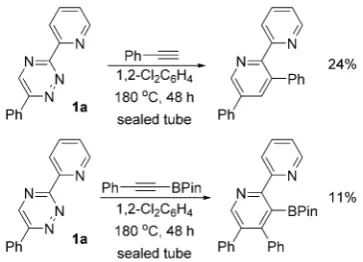
To establish a typical reactivity profile for non-activated tri-azines and alkynes, we opted to explore the cycloaddition re-actions of readily available alkynes and triazine. Indeed, we
found that triazine1 awas particularly reluctant to undergo
ef-ficient reaction with phenylacetylene, providing the corre-sponding product in low yield after prolonged heating, albeit
with high regiocontrol.[6]Moreover, we attempted a similar
re-action with an alkynylboronate and found that this approach generated the corresponding pyridine boronic acid derivative, again in very low yield, but with high regioselectivity (Scheme 2).[7]
The poor reactivity of diene 1 a with alkynes made it an
ideal choice for evaluating the potential of our proposed di-rected cycloaddition, and we set out to explore the reaction of
this compound with alkynytrifluoroborate 2 a, our results are
depicted in Table 1. Fluorophilic Lewis acids are known to transform alkynyltrifluoroborate salts into the corresponding
difluoroboranes,[8, 9]and so we employed BF
3·OEt2to promote
formation of our BF2-appended alkyne in situ. Remarkably,
simply stirring this Lewis acid and substrate combination in
CH2Cl2 at room temperature provided the desired cycloadduct
(entry 1). The yield could be improved by increasing the tem-perature and the concentration of alkynydifluoroborane
(en-tries 2 and 3). Finally, TMSCl was also found to be a competent
fluorophile, albeit slightly less effective than BF3·OEt2 in this
case (entry 4). Confirmation of the Lewis acid–base interaction
between the pyridyl and BF2 substituents in the product, as
well as the regioselectivity, was confirmed by X-ray crystallog-raphy. Figure 1 shows the expected tetrahedral geometry around the B atom.
A minor side product observed in the cycloadditions of1 a
and2 awas the product of direct acetylide addition at the
het-eroaromatic ring. This compound was isolated in 12 % yield under the optimal conditions (Table 1, entry 3), and its
struc-ture was also verified by X-ray crystallography (Figure 2).[10]
Notwithstanding the propensity for competing direct addi-tion processes, the optimal condiaddi-tions of the cycloaddiaddi-tion were found to be quite general across a small selection of
al-kynes, allowing the corresponding pyridines 5–7to be
gener-ated in moderate to high yield (Figure 3).
[image:3.595.78.260.239.370.2]Scheme 2.Triazine cycloaddition reactions of alkynes. Pin=pinacol.
Table 1.Directed cycloaddition of1and alkynyltrifluoroborates.[a]
[image:3.595.363.490.277.400.2] [image:3.595.310.544.447.581.2] [image:3.595.45.295.573.730.2]Entry Lewis acid[a]
[(equiv)]
T
[8C]
t
[min]
Yield3
[%]
1 BF3·OEt2(2) 25 16 h 29
2 BF3·OEt2(2) 40 10 43
3 BF3·OEt2(3) 40 10 84
4 Me3SiCl (3) 40 10 73
[a] A 1:1 stoichiometry of Lewis acid and alkyne was used in all cases.
Figure 1.X-ray crystal structure representation of3, H atoms omitted for clarity.
Figure 2.X-ray crystal structure representation of4.
Figure 3.Pyridine products from the directed cycloaddition of1 a. Condi-tions:1 a(1 equiv), alkyne (3 equiv) and BF3·OEt2(3 equiv) heated at 408C in
CH2Cl2for 10 min.
Having established reaction conditions for the mild
cycload-dition of triazine1 awith alkynyltrifluoroborates, we set out to
explore the scope of this chemistry for the preparation of bi-pyridyldifluoroboranes, our results are shown in Table 2. We
began by employing an isomer of triazine 1 a and were
pleased to find that pyridines 8 and 9 were formed in high
yield (entries 1 and 2). Expanding to more heavily substituted triazines provided the opportunity to access fully substituted pyridines under mild conditions (entries 3–6). This approach is completely regioselective because of the nature of the direct-ed reaction; therefore, this approach represents a powerful method for assembling highly functionalised products with en-tirely predictable regiocontrol. Finally, less heavily substituted
pyridines can also be accessed by this strategy, compounds14
and15were both prepared from triazine1 ein good yield.
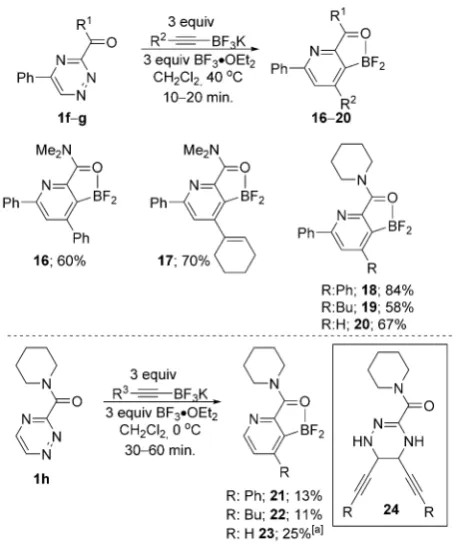
Having had broad success with pyridyl directing groups, we decided to establish whether other Lewis bases could direct the cycloaddition reaction. Indeed, we were pleased to find that amides also functioned as competent directing groups,
providing access to pyridines 16–20 in good overall yield
(Scheme 3). Interestingly, the less substituted triazine substrate
1 hwas significantly less efficient, providing poor yields of the
corresponding pyridines even when the reaction was conduct-ed at low temperature. In this case, the crude mixtures were relatively complex, but the major side product in each case,
24, appeared to result from alkyne addition to the ring.[11]
A further issue that we wished to clarify was the importance of the positioning of the directing group. In principle, the Lewis basic donor could also be incor-porated at the 6-position of the triazine giving rise to isomeric pyridine products. As shown in Scheme 4, the cycloaddition of
25 was found to proceed in
good yield, although the
reac-tion required a longer time
period and returned a small
amount of starting triazine 25
(10 %). We also prepared27to
probe the effect of having two competing directing groups on reaction regiochemistry. Interest-ingly, the reaction proceeded with high selectivity to provide
28 a, albeit in modest yield,[12]
and <5 % of regioisomer 28 b
(as judged by LC-MS analysis). This preliminary data suggest that substrates bearing a direct-ing group at the 3-position are optimal, but that the inclusion of directing groups at C6 are viable. Further studies aimed at understanding the scope of di-Table 2.Directed cycloaddition of triazines and alkynyltrifluoroborates.
Entry Triazine Alkyne (R2
[image:4.595.313.540.444.718.2]) Product Lewis acid[a]
[(equiv)]
Yield3 a
[%]
1 Ph;2 a Me3SiCl (3) R=Ph; 75 (8)
2 Me3SiCl (3) R=C6H9; 83 (9)
3 Ph;2 a BF3·OEt2(3) R=Ph; 72 (10)
4 BF3·OEt2(3) R=C6H9; 76 (11)
5 Ph;2 a BF3·OEt2(3) R=Ph; 82 (12)
6 Bu ;2 c BF3·OEt2(3) R=Bu ; 62 (13)
7 Ph;2 a BF3·OEt2(3) R=Ph; 50 (14)
8 Bu ;2 c Me3SiCl (3) R=Bu ; 62 (15)
Scheme 3.Alternative directing groups. [a] The reaction was conducted at 408C for 20 min.
recting-group positioning are currently being pursued. Although the main objective of this study was to demon-strate that the directed cycloaddition could deliver faster reac-tions than the traditional aza-Diels–Alder process, we recog-nised the potential value of the products that are armed with a carbon boron bond. We decided to explore the Pd-catalysed
cross coupling of two representative difluoroboranes, 9 and
17, which contain multiple functionality and a hindered
borane unit. In the event, both reactions required some opti-misation, but delivered the corresponding biaryl products in acceptable yields (Scheme 5).
Conclusion
We have developed a mild and regiocontrolled method for the synthesis of highly substituted pyridines by means of a Lewis base directed cycloaddition of triazines and in situ generated alkynylboranes. This method proceeds with a range of alkynes and triazines, although it appears to be advantageous to have the Lewis base directing group at C3 of the diene
cycloaddi-tion partner. As well as providing a convenient means for gen-erating bipyridines, this method is compatible with amide di-recting groups and the presence of the carbon boron bond allows further functionalisation to take place through cross-coupling reactions.
Experimental Section
General procedure for the cycloaddition of alkynyltrifluoro-borates and triazines
Synthesis of 3: A solution of 6-phenyl-3-(2-pyridyl)-1,2,4-triazine
1 a (50 mg, 0.21 mmol) and potassium (phenylethynyl)trifluorobo-rate 2 a (132 mg, 0.64 mmol) in CH2Cl2 (2 mL) was treated with
BF3·OEt2 (55mL, 0.64 mmol). The reaction was stirred for 10 min
and then quenched with brine (10 mL). The mixture was extracted with CH2Cl2(3 15 mL) and the extract dried over MgSO4, filtered
and the solvent evaporated. The residue was purified chromato-graphically over silica gel (gradient; starting with petroleum ether, ending with ethyl acetate) to afford 3-(difluoroboryl)-4,5-diphenyl-2,2’-bipyridine 3 (63 mg, 84 %) as a colourless solid. M.p 225– 2268C. 1
H NMR (400 MHz, CDCl3):d=7.18–7.22 (2 H, m), 7.25–7.33
(6 H, m), 7.35–7.40 (2 H, m), 7.61–7.67 (1 H, m), 8.26 (1 H, td,J=7.5, 1.5 Hz), 8.40 (1 H, d,J=8.0), 8.59 (1 H, d,J=5.5 Hz), 8.67 ppm (1 H, s);13
C NMR (100.6 MHz, CDCl3):d=118.9, 125.0, 127.4, 127.7, 127.8,
127.9, 128.2, 129.8, 129.9, 138.2, 138.5, 141.4, 144.1, 151.7, 151.9, 154.6, 154.9 ppm; 19
F NMR (235.1 MHz, CDCl3): d= 156.4 ppm;
FTIR:n˜=3058 (w), 2925 (w), 1626 (s), 1578 (m), 1555 (m), 1489 (s), 1452 (m), 1433 (s), 1158 (m), 1131 (s), 1100 (s), 1007 (m), 910 (m) cm 1
. HRMS: (ESI) m/z calcd for C22H15 11
BF2N2Na: 379.1194
[M+Na+
], found 379.1204.
Acknowledgements
This work was supported by The University of Sheffield, the EPSRC and the FP7 Marie Curie Actions of the European Com-mission via the ITN ECHONET Network (MCITN-2012–316379).
Keywords: boranes · cycloadditions · pyridines ·
regioselectivity·triazines
[1] G. Jones,Comprehensive Heterocyclic Chemistry II Vol. 5(Eds: A. Katritzky, C. W. Rees, E. F. V. Scriven), Pergamon, Oxford,1996, 167.
[2] a) J. A. Varela, C. Sa,Chem. Rev.2003,103, 3787; b) G. D. Henry, Tetrahe-dron2004,60, 6043 ; c) M. D. Hill,Chem. Eur. J.2010,16, 12052. [3] a) D. L. Boger,Tetrahedron1983,39, 2869 ; b) S. A. Raw, R. J. K. Taylor,
Adv. Heterocycl. Chem. 2010, 100, 75; c) R. A. A. Foster, M. C. Willis,
Chem. Soc. Rev.2013,42, 63.
[4] a) J. F. Vivat, H. Adams, J. P. A. Harrity,Org. Lett. 2010,12, 160; b) J. D. Kirkham, R. J. Butlin, J. P. A. Harrity, Angew. Chem. 2012, 124, 6508;
Angew. Chem. Int. Ed.2012,51, 6402; c) D. F. Crpin, J. P. A. Harrity,Org. Lett.2013,15, 4222.
[5] D. G. Hall,Boronic Acids, Wiley-VCH, Weinheim,2005.
[6] The high selectivity observed in the reaction of1 awith phenylacety-lene mirrors that observed by Ziessel and co-workers : S. Diring, P. Re-tailleau, R. Ziessel,J. Org. Chem.2007,72, 10181.
[7] For related [4+2] cycloaddition reactions of alkynylboronates, see: a) G. Hilt, K. I. Smolko,Angew. Chem.2003,115, 2901;Angew. Chem. Int. Ed.
2003, 42, 2795 ; b) M. D. Helm, J. E. Moore, A. Plant, J. P. A. Harrity,
Angew. Chem. 2005, 117, 3957;Angew. Chem. Int. Ed. 2005,44, 3889; c) J. E. Moore, M. York, J. P. A. Harrity,Synlett2005, 860; d) P. M. Delaney, J. E. Moore, J. P. A. Harrity,Chem. Commun.2006, 3323; e) D. L. Browne,
Scheme 4.Incorporation of a directing group at C6.
Scheme 5.Reactions of cycloadducts. RuPHOS= 2-dicyclohexylphosphino-2’,6’-diisopropoxybiphenyl, DME=1,2-dimethoxyethane.
J. F. Vivat, A. Plant, E. Gomez-Bengoa, J. P. A. Harrity,J. Am. Chem. Soc.
2009,131, 7762.
[8] E. Vedejs, R. W. Chapman, S. C. Fields, S. Lin, M. R. Schrimpf, J. Org. Chem.1995,60, 3020.
[9] Alkynyl difluoroboranes are subject to rapid and reversible dispropor-tionation to dialkynyl fluoroboranes and trialkynylboranes, which can all undergo cycloaddition. Nonetheless, these products can all converge to the corresponding difluoroboranes products following further dis-proportionation. For a discussion, see: D. F. P. Crpin, J. P. A. Harrity, J. Jiang, A. J. H. M. Meijer, A.-C. M. A. Nassoy, P. Raubo,J. Am. Chem. Soc.
2014,136, 8642.
[10] For related nucleophilic addition reactions to triazines, see: a) S. Konno, S. Ohba, M. Sagi, M. Yamanka,Chem. Pharm. Bull.1987,35, 1378; b) L.
Ye, M. J. Haddadin, M. W. Lodewyk, A. J. Ferreira, J. C. Fettinger, D. J. Tan-tillo, M. J. Kurth,Org. Lett.2010,12, 164.
[11] Compound 24, R=Ph was characterised by 1H, 13C NMR and HRMS
analysis, whereas R=Bu was tentatively characterised by1
H NMR and HRMS analysis only.
[12] CCDC-1005645 (4), 1005646 (17), 1005647 (3) and 1005648 (28 a) con-tains the supplementary crystallographic data for this paper. These data can be obtained free of charge from The Cambridge Crystallographic Data Centre via www.ccdc.cam.ac.uk/data_request/cif.
Received: June 11, 2014
Published online on August 21, 2014