This is a repository copy of Increasing water-use efficiency directly through genetic manipulation of stomatal density.
White Rose Research Online URL for this paper: http://eprints.whiterose.ac.uk/90225/
Version: Accepted Version
Article:
Franks, P.J., Doheny-Adams, T. W., Britton-Harper, Z.J. et al. (1 more author) (2015) Increasing water-use efficiency directly through genetic manipulation of stomatal density. New Phytologist, 207 (1). 188 - 195. ISSN 0028-646X
https://doi.org/10.1111/nph.13347
This is the peer reviewed version of the following article: Franks, P.J., W Doheny-Adams, T., Britton-Harper, Z.J. and Gray, J.E. (2015) Increasing water-use efficiency directly through genetic manipulation of stomatal density. New Phytologist, 207 (1). 188 - 195, which has been published in final form at http://dx.doi.org/10.1111/nph.13347. This article may be used for non-commercial purposes in accordance with Wiley Terms and
Conditions for Self-Archiving."
[email protected] https://eprints.whiterose.ac.uk/
Reuse
Items deposited in White Rose Research Online are protected by copyright, with all rights reserved unless indicated otherwise. They may be downloaded and/or printed for private study, or other acts as permitted by national copyright laws. The publisher or other rights holders may allow further reproduction and re-use of the full text version. This is indicated by the licence information on the White Rose Research Online record for the item.
Takedown
If you consider content in White Rose Research Online to be in breach of UK law, please notify us by
Increasing water use efficiency directly through genetic
1
manipulation of stomatal density.
2
3
Peter J. Franks1, Timothy Doheny-Adams2,3, Zoe J. Britton-Harper1, Julie E. Gray2
4
5
1
Faculty of Agriculture and Environment, University of Sydney, Sydney, NSW 2006, Australia 6
2 Department of Molecular Biology and Biotechnology, University of Sheffield, Sheffield S10 2TN,
7
UK 8
3 Current address: Department of Biology, University of York, York YO10 5DD, UK
9
10
11
12
Author for correspondence: Peter Franks
13
Phone: +61 2 86271051
14
e-mail: [email protected]
15
Running title: Genetic improvement of water use efficiency
16
17
18
19
Total words: 3372
20
Figures: 7 (including 2 colour)
21
22
Summary 24
25
Improving crop water-use efficiency (WUE) is a critical priority for regions
26
facing increased drought or diminished groundwater resources. Despite new
27
tools for manipulating stomatal development, engineering plants with high
28
WUE remains a challenge.
29
30
We used Arabidopsis epidermal patterning factor (EPF) mutants exhibiting
31
altered stomatal density to test if WUE can be improved directly by
32
manipulation of the genes controlling stomatal density. Specifically, we tested
33
whether constitutive overexpression of EPF2 reduced stomatal density and
34
maximum stomatal conductance, gw(max), sufficiently to increase WUE. 35
36
We found that reduction of gw(max) via reduced stomatal density in the EPF2 37
overexpressing plants (EPF2OE) increased both instantaneous and long-term
38
WUE without significantly altering photosynthetic capacity. Conversely,
39
plants lacking both EPF1 and EPF2 expression (epf1epf2) exhibited higher
40
stomatal density, higher gw(max) and lower instantaneous WUE, as well as 41
lower (but not significantly so) long-term WUE.
42
43
Targeted genetic modification of stomatal conductance such as in EPF2OE is
44
a viable approach for engineering higher WUE in crops, particularly in future
45
high-CO2 atmospheres. 46
47
Key words:
48
water-use efficiency; 13
C; stomata; Arabidopsis; crops; CO2, Epidermal Patterning 49
Factor; genetically modified
Introduction 51
Increased water use efficiency (WUE; the ratio of the rates of CO2 assimilation to 52
transpiration, A/E) can improve productivity and reduce water stress under drier
53
environmental conditions (Slatyer, 1964; Sinclair et al., 1984; Han et al., 2013). In the
54
short term, plants increase WUE by reducing stomatal apertures and therefore E, but
55
often under prolonged water deficit plants also produce leaves with reduced
56
maximum stomatal conductance (gw(max)) via altered stomatal density (D) and/or size 57
(S) (Gindel, 1969; Franks et al., 2009; Doheny-Adams et al., 2012). It is unclear why
58
plants undergo this developmental response to drought in addition to simply reducing
59
stomatal aperture, but it has been suggested that when conditions promote a long-term
60
reduction in the average operating stomatal conductance, production of new leaves
61
with reduced gw(max) maintains more favourable mechanical and energetic conditions 62
for stomatal control (Franks et al., 2009; Franks et al., 2012). This specific adaptation
63
of gw(max) for improved WUE may represent a model for genetic manipulation of 64
WUE. Here, using Arabidopsis epidermal patterning factor (EPF) mutants exhibiting
65
altered stomatal density, we show that WUE can be improved directly by
66
manipulation of the genes controlling the development of stomata to reduce gw(max). 67
The epidermal patterning factors are a family of eleven related small, secreted
68
peptides, several of which regulate the number of stomata formed on Arabidopsis
69
leaves. They are characterized by at least six conserved cysteine residues towards
70
their C-terminus and all studied so far are processed at their non-conserved
N-71
terminal end (Ohki et al., 2011; Torii, 2012). Manipulating the expression level of
72
these genes has proved to be a powerful tool to modify stomatal density and
73
patterning. Lack of EPF1, which is normally expressed in guard cells of young
74
stomata and their precursors, results in an increase in stomatal density and clustering
75
on the leaf epidermis (Hara et al., 2007). EPF2 is expressed at slightly earlier stages
76
of stomatal development than EPF1, in stomatal precursors known as meristemoids
77
and guard mother cells. Lack of EPF2 results in higher stomatal and precursor cell
78
densities but clustering of stomata remains rare (Hara et al., 2009; Hunt & Gray,
79
2009). Although constitutively over-expressing either EPF1 or EPF2 results in
80
similar phenotypes with dramatically reduced numbers of stomata, the two gene
81
products appear to act independently; the double mutant epf1epf2 displays an additive
82
phenotype with approximately twice the density of stomata as Col-0 controls, together
with a low level of stomatal pairing and additional precursor cells (Hunt & Gray,
84
2009; Dow et al., 2014b). In plants genetically manipulated to constitutively
over-85
express EPF1 or EPF2 (EPF1OE and EPF2OE), the leaves have very few stomata
86
(Hara et al., 2009).
87
A subtilisin peptidase STOMATAL DENSITY AND DISTRIBUTION 1
88
(SDD1) was the first genetic component identified as regulating stomatal
89
development (Berger & Altmann 2000), but it achieves this by a mechanism which
90
remains unknown, and that appears to act independently of the EPF peptides and their
91
receptors (Hunt & Gray, 2009; Hunt et al., 2010). Plants lacking SDD1 expression
92
have increased stomatal density (sdd1-1; approximately 250% of C24 background)
93
and a low level of stomatal pairing. The stomatal conductance of sdd1 plants was
94
consistently higher than that of control plants (following growth at three different
95
light intensities) particularly when measured at higher light intensities (Schlüter et al.,
96
2003). However, photosynthetic assimilation rates, although higher, were not
97
significantly increased in the high D plants except in an experiment following transfer
98
to a higher light intensity before analysis. When sdd1 plants (with inherently high D)
99
were grown at 120 mmol m-2 s-1 and then shifted for 2 d to high light conditions
100
(500mmol m-2 s-1) their maximal photosynthetic capacity was increased by 30% in
101
comparison to wild-type controls, although their conductance was not significantly
102
increased (Schlüter et al., 2003). These pioneering experiments suggested that plants
103
manipulated to have substantially increased D have correspondingly increased levels
104
of stomatal conductance. If allowed to biochemically acclimate to higher light
105
intensity (i.e. typical saturation intensities) these plants may potentially exhibit
106
enhanced CO2 assimilation without loss of WUE. 107
We have previously reported that the manipulation of stomatal density through
108
alteration of EPF gene expression leads to altered E (Doheny-Adams et al., 2012).
109
Across a range of EPF mutants with stomatal densities ranging from approximately
110
20% to 325% of Col-0 controls, there was a negative correlation between the
111
predicted maximum stomatal conductance to water vapour (gw(max)) and leaf 112
temperature, suggesting plants with reduced gw(max) operated with lower stomatal 113
conductance and E. These changes in D and E translated to differences in growth, but
114
in this case only when D and E were reduced relative to Col-0. For EPF2OE plants,
115
with substantially reduced D and E, leaf rosettes were larger, particularly when water
availability was limited. However, for plants such epf1epf2 exhibiting increased D
117
and gw(max), we did not identify any conditions under which the growth of plants was 118
improved. It is not known why the growth rate of plants with low D was enhanced but
119
it may have resulted from a combination of lower metabolic cost of developing and
120
operating fewer stomata, higher A at the elevated leaf temperature, or improved water
121
status from a reduction in E (Doheny-Adams et al., 2012).
122
Recently several other reports have explored the effects of altering D on
123
stomatal conductance. Using plants with manipulated levels of STOMAGEN, a
124
secretory peptide promoting stomatal development, (Tanaka et al., 2013) showed that
125
plants with increased D (ST-OX; 372% of Col-0 wild-type) have increased E and
126
stomatal conductance, and at high light intensities also have increased A. The same
127
study reported no significant differences in E or A in plants with reduced D
(ST-128
RNAi; 32% of Col-0). No significant differences were reported in WUE from
129
gravimetric analyses, but importantly, the trend suggested a negative correlation with
130
D.
131
Using a range of Arabidopsis stomatal development mutants with no, or low
132
levels of stomatal clustering including epf1 and epf1epf2, (Dow et al., 2014a) reported
133
a strong correlation between gw(max) determined from anatomy (via measurements of S 134
and D) and gw(max) from gas exchange measurements. This proved that the 135
developmental changes in S and D translated to a shift in the operational range of
136
stomatal conductance. If these shifts in gw(max) were uncoupled from photosynthetic 137
biochemistry then WUE should increase with declining gw(max). However, in that 138
study, a significant increase in WUE was only observed with mutants exhibiting high
139
stomatal clustering, an abnormal condition resulting from disruption of stomatal
140
spacing control.
141
Despite these new genetic tools for manipulating D and gw(max), there is no 142
clear evidence of a significant enhancement of WUE via an engineered reduction in
143
gw(max). Our goal in this study was to compare the instantaneous and long-term WUE 144
of Arabidopsis efp1epf2 (high-D) and EPF2OE (low-D) mutants relative to Col-0
145
control plants. Our hypothesis is that the developmental changes in EPF2OE reduce
146
gw(max) and thereby shift the operating stomatal conductance to a lower state; if the 147
will remain unchanged when leaves are grown under typical saturating light
149
conditions, resulting in higher WUE.
150
Materials and Methods 151
Plant Growth
152
Plants were Arabidopsis thaliana Col-0 background and have been described
153
previously (Hunt & Gray, 2009; Hunt et al., 2010). Two separate experiments were
154
performed under different growth environments: (1) plants grown in a greenhouse
155
(University of Sydney) in full natural sunlight (high-light) and (2) plants grown in a
156
controlled environment chamber (Conviron model BDR16; University of Sheffield)
157
with photosynthetically active radiation (PAR) set at 200 mol m-2
s-1 (low light).
158
Other conditions were similar across the two experiments: plants well-watered at all
159
times; commercial compost soil in 100 ml pots; ambient CO2 450ppm in growth 160
chamber and 390 in greenhouse; 9 hours day length; 22ºC/16 ºC day/night
161
temperature. Seeds were stratified at 4 ºC in distilled water for 72 hours. Plant
162
positioning was altered weekly. Measurements were performed on the largest mature
163
rosette leaves at the initiation of the floral bolt. All measurements were performed on
164
the greenhouse-grown plants (carbon isotope analysis, stomatal anatomy and leaf gas
165
exchange), whereas only carbon isotope analysis was performed on the
chamber-166
grown plants. The main goal was to compare the physiological attributes of the
167
genotypes under high, natural light (greenhouse conditions). The additional
168
measurements on plants grown under low-light in a growth chamber were to test if the
169
pattern of carbon isotope discrimination, indicative of WUE, was consistent across
170
greenhouse and growth-chamber environments.
171
Leaf gas exchange measurements
172
Steady state leaf gas exchange parameters (CO2 assimilation rate A, transpiration rate 173
E and stomatal conductance to water vapour, gw) were measured with a portable, 174
open-flow photosynthesis monitor incorporating an infrared gas analyser (IRGA)
175
(model 6400, Li-COR, Lincoln, NE). CO2 was removed from external air using soda 176
lime and mixed with pure CO2 to control leaf cuvette air CO2 concentration (ca). 177
Conditions in the cuvette were maintained at ca = 390 ppm, corresponding to ambient 178
leaf-to-air water vapour pressure difference. One mature leaf (remaining attached to
180
the rosette) was clamped inside the leaf cuvette and A and gw were allowed to 181
stabilize under the controlled conditions (minimum 45 minutes). At this stage the
182
operating CO2 assimilation rate and stomatal conductance, A(op) and gw(op), were 183
recorded, together with E and the ratio of leaf internal to ambient CO2 concentration, 184
ci/ca. Instantaneous WUE was calculated as A(op)/E. The relationship between A and 185
ci was then determined by adjusting the IRGA reference CO2 concentration 186
incrementally in the following order: 200, 100, 50, 600, 1000, 1200, 1600, 1000 ppm.
187
Using the tool developed KP Tu (www.landflux.org) and following (Ethier &
188
Livingston, 2004) the C3 photosynthesis model of (Farquhar et al., 1980) was fitted to 189
the A vs ci relationship to obtain the maximum velocity of Rubisco for carboxylation 190
(Vcmax) and the potential rate of electron transport under saturating light, Jmax. To 191
ensure full hydration during gas exchange experiments the base of the pot was placed
192
in 5–10 mm deionised water for the duration of the measurements. At least three
193
plants of each genotype were analysed for each experiment.
194
Stomatal size, density and gw(max)
195
For each leaf in which gas exchange was measured, approximately 0.5 cm2 of
196
epidermis was dissected from the abaxial and adaxial surfaces of the leaf, mounted in
197
water on a glass microscope slide and examined at 400 times magnification using a
198
light microscope. Stomatal size (S, m2) was calculated as guard cell length guard 199
cell pair width; stomatal density (D, mm-2) was calculated as number of stomata per
200
0.140 mm2 field of view. For each epidermal peel, 20 stomata were sampled for size
201
and ten 0.140 mm2 fields were sampled for density. Maximum stomatal conductance
202
to water vapour, gw(max), was calculated using the basic diffusion equation (Franks and 203
Beerling, 2009):
204
, [1]
where constants d and v are, respectively, the diffusivity of H2O in air and the molar 206
volume of air, D is stomatal density and amax is the average maximum stomatal pore 207
area, which in Arabidopsis approximates a circle with diameter equal to the stomatal
208
pore length p, i.e. amax = p2/4. The quantity gw(max) is the anatomically-determined 209
maximum possible stomatal conductance which sets the theoretical range over which
210
gw(op) can be controlled. 211
Carbon Isotope Analysis
212
Four mature leaves from each plant were dried overnight at 75 °C and ground to
213
powder. The ratio of 13C to 12C was measured with a continuous flow mass
214
spectrometer (ANCA GSL 20-20, Sercon PDZ Europa, Sercon Ltd., Cheshire, UKfor
215
Experiment 1 and Thermo Finnigan Delta V IRMS, Finnigan MAT GmbH,
216
Barkhausenstr, Germany for Experiment 2). The carbon isotope composition of leaf
217
tissue (13
Cleaf, in per mil, ‰ ) was calculated as (Farquhar et al., 1989): 218
219
[2]
220
221
where Rsample and Rstandard are the 13C/12C ratios of the leaf tissue and the V-PDB 222
standard, respectively. 13Cleaf was then converted to leaf carbon isotope 223
discrimination leaf(‰) using (Farquhar & Richards, 1984): 224
225
[3]
226
227
with 13
Cair and 13Cleaf in units of ‰. Because air in the greenhouse was well-mixed 228
with outside ambient air the 13
Cair for greenhouse-grown plants was taken as -8.2 ‰ 229
(Carbon Dioxide Information Analysis Centre (CDIAC), Oak Ridge National
230
Laboratory, Oak Ridge, USA; ftp://ftp.cmdl.noaa.gov/ccg/co2c13). For the
chamber plants, 13Cair was measured as -10.4 ‰ using the method in Fletcher et al. 232
(2006).
233
234
Statistical analysis
235
All statistical analyses were carried using OriginPro software (OriginLab Corp.,
236
Northampton, MA, USA). Significant difference between means (0.05 level) was
237
determined using one- and two-way analysis of variance (ANOVA) and post-hoc
238
mean comparison tests (Tukey and Scheffe multiple comparisons).
239
Results 240
Constitutive overexpression of EPF2 led to higher time-integrated WUE irrespective
241
of growth irradiance, as indicated by significantly lower leaf 13C in the EPF2OE
242
genotype grown under both high and low light intensity (Fig. 1). The double mutant
243
epf1epf2, with characteristically higher stomatal density, showed lower WUE (higher
244
leaf 13
C) than the Col-0 control, but the means were not significantly different (Fig.
245
1). Within each genotype, plants grown under low light had significantly lower WUE
246
(higher leaf 13
C) than those grown under high light.
247
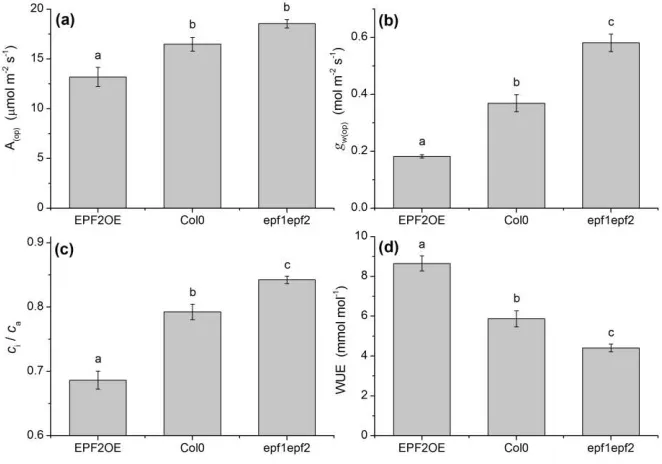
Instantaneous leaf gas exchange data reflect the pattern observed in leaf 13 C.
248
The operating CO2 assimilation rate (Aop) was significantly lower in EPF2OE 249
compared to Col-0 (Fig. 2a), but the greater relative reduction in operating stomatal
250
conductance (gw(op)) (Fig. 2b) and lower operating ci/ca (Fig. 2c) explain the 251
significantly higher instantaneous WUE in EPF2OE (Fig. 2d). Remarkably, potential
252
rate of photosynthesis at any given leaf intercellular CO2 concentration is virtually the 253
same in each genotype (Fig. 3) despite different operating points (see arrows in Fig.
254
3) on account of differences in stomatal conductance. Further evidence of unaltered
255
photosynthetic potential in the genetically modified plants is confirmed by the lack of
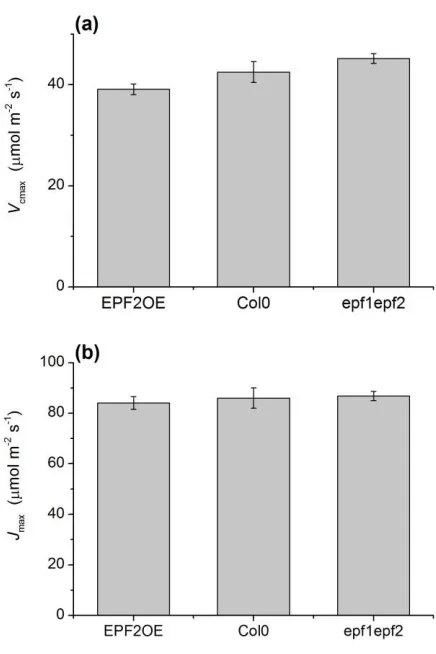
256
any significant differences in Vcmax and Jmax (Fig 4). These results indicate that the 257
genetically altered stomatal density in EPF2OE and epf1epf2 is decoupled from
258
photosynthetic biochemistry.
259
The genetic modification of stomatal density appears to be inextricably
260
accompanied by a qualitatively similar but opposite change in stomatal size, as
observed in natural systems (Franks & Beerling, 2009; Franks et al., 2009) and
262
studies of genetically modified Arabidopsis (Doheny-Adams et al., 2012; Dow et al.,
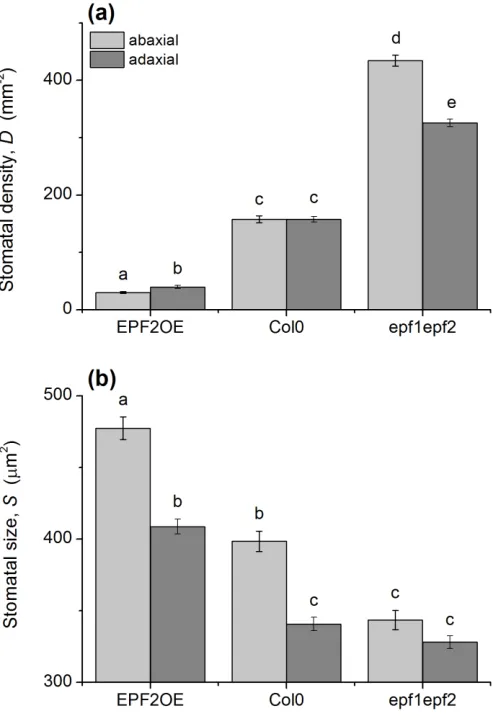
263
2014b). On both abaxial and adaxial leaf surfaces, EPF2OE showed significantly
264
lower stomatal density and larger stomatal size, while epf1epf2 showed significantly
265
higher stomatal density and smaller stomatal size, compared to the Col-0 control (Fig.
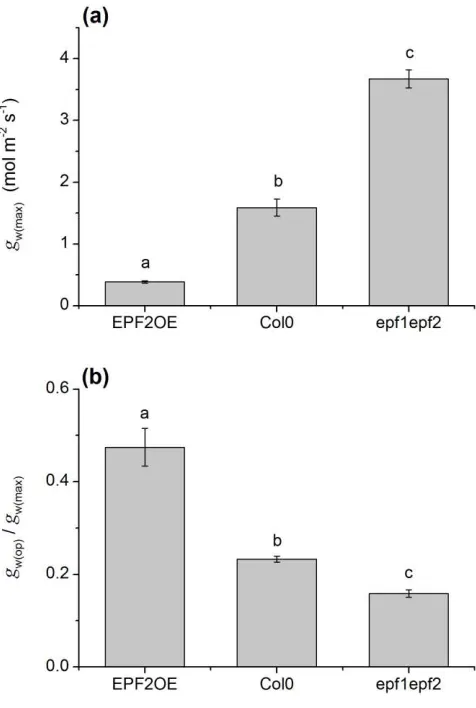
266
5a,b). These differences translate into substantially lower maximum stomatal
267
conductance (gw(max)) in EPF2OE and substantially higher gw(max) in epf1epf2 relative 268
to Col-0 (Fig. 6a), consistent with the pattern observed in stomatal operating point,
269
gw(op) (Fig. 2b). Altered gw(max) appeared to affect the relative stomatal operating 270
point, defined as the ratio gw(op)/gw(max). Lower gw(max) in EPF2OE was associated 271
with significantly higher gw(op)/gw(max), while higher gw(max) in epf1epf2 was associated 272
with lower gw(op)/gw(max) (Fig. 6b). The integrated relationship between S, D and 273
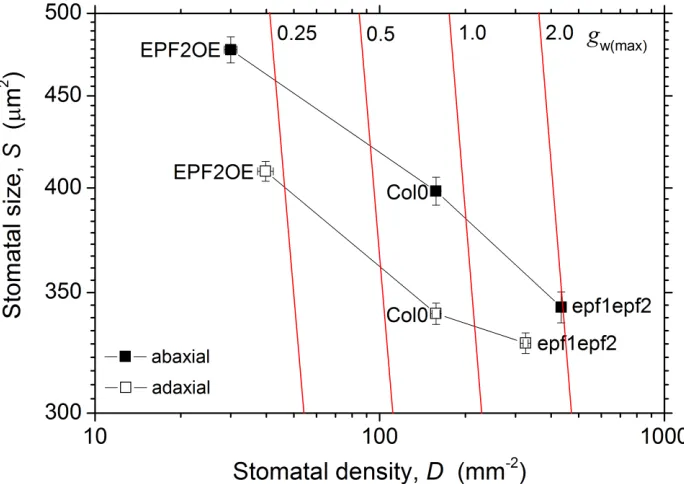
gw(max), as affected by the modification of genes acting directly on stomatal 274
development, is shown in Fig. 7. For both the abaxial and adaxial leaf surfaces, S
275
varies inversely with D (Fig. 7, black lines), with significantly lower gw(max) in 276
EPF2OE achieved through larger S and lower D, and higher gw(max) in epf1ep2 277
achieved through smaller S and higher D.
278
Discussion 279
Direct reduction of gw(max) through genetic modification of EPF gene expression 280
increased WUE without significantly altering photosynthetic capacity, confirming our
281
main hypothesis. Relative to the Col-0 control, both the EPF2OE and epf1epf2
282
mutants exhibited significantly altered stomatal densities and sizes (Fig 5a,b) that
283
changed gw(max) (Fig. 6a) and consequently shifted the stomatal conductance operating 284
point, gw(op) (Fig. 2b). The accompanying shift in WUE, which is significantly higher 285
for the low-D EPF2OE mutant, and lower for the high-D epf1epf2 mutant, is evident
286
when measured instantaneously for standard conditions (Fig 2d) and also when
287
inferred over the long-term functioning of leaves from leaf 13C (Fig. 1). The
288
targeting of stomatal development through these EPF gene modifications could be a
289
powerful tool for manipulating WUE in Arabidopsis and potentially other plant
290
species.
291
Apart from reported differences in plant size (Doheny-Adams et al., 2012), the
292
retention of photosynthetic capacity and normal reproductive function in the EPF
mutants stands in contrast to other potential methods of genetically modifying WUE
294
via altered stomatal density. Loss-of-function mutations in the mitogen-activated
295
protein kinase (MAPK) kinase gene YODA result in plants with high stomatal density
296
but a dwarfed stature with defective and sterile inflorescences (Bergmann et al.,
297
2004). Mutations in the ERECTA gene influence WUE (Masle et al., 2005) but also
298
confer multiple phenotypic changes in inflorescences, fruits and leaves (Torii et al.,
299
1996; van Zanten et al., 2009). Loss-of-function ERECTA mutants exhibit lower
300
WUE due to both increased stomatal conductance (through increased D) and reduced
301
biochemical capacity for photosynthesis (Masle et al., 2005). Our results show that
302
mutations in the EPF gene can achieve both increases and decreases in WUE, via
303
altered stomatal properties, without altering photosynthetic biochemistry (Fig. 3, 4).
304
The shift in the relative stomatal conductance operating point, gw(op)/gw(max), in 305
both the EPF2OE and epf1epf2 mutants (Fig. 6b) indicates a partial physiological
306
counteraction of genetically altered gw(max). Thus, EPF2OE, with inherently lower 307
gw(max) compared to Col-0, operates at close to 50% of gw(max), while epf1epf2, with 308
inherently higher gw(max) operates at just below 20% of gw(max). A similar pattern of 309
higher gw(op)/gw(max) in low-D Arabidopsis mutants is evident in the results of (Dow et 310
al., 2014a). Previous work has shown that in typical environmental conditions plants
311
tend to operate at around 20% of gw(max) (Franks et al., 2011; Dow et al., 2014a), in 312
the region of greatest stomatal sensitivity and mechanical efficiency per unit guard
313
cell pressure (Franks et al., 2012). However, under atypical conditions which
314
promote wider stomatal apertures, such as the need to counteract CO2 starvation at 315
low atmospheric CO2, gw(op)/gw(max) can be much higher (Dow et al., 2014a). 316
Similarly, the higher gw(op)/gw(max) in EPF2OE plants helps to maintain photosynthesis 317
closer to optimum, but in doing so stomata must operate sub-optimally from a
318
mechanical perspective. When exposed to high atmospheric CO2 concentration, low-319
D (and therefore low-gw(max)) Arabidopsis mutants operate closer to 20% of gw(max) 320
(Dow et al., 2014a).
321
The two primary morphological characteristics determining gw(max) are 322
stomatal size (S, which strongly determines maximum stomatal aperture, amax) and 323
density (D) (Franks and Beerling, 2009; Franks et al. 2009). For any given gw(max) 324
there is in theory an infinite number of S/D combinations. The four lines in Fig 7 are
325
as described in Franks and Beerling, 2009. These lines are overlaid on the actual
327
gw(max) data points to show how genetic modification of stomatal density (and 328
associated changes in stomatal size) moves gw(max) on the surface represented by 329
stomatal size versus density. Thus, in EPF2OE mutants, lower gw(max) on both the 330
abaxial and adaxial leaf surfaces is due to fewer and larger stomata, while in epf1epf2
331
mutants the opposite trend is seen.
332
The significant reduction in gw(op) and gw(max) with conservation of Jmax in 333
EPF2OE plants as a result of their genetic modification resembles the generally
334
observed natural adaptation of plants to growth under elevated atmospheric CO2 335
concentration (Ainsworth & Rogers, 2007; Franks et al., 2013). This translates to
336
reduced rates of transpiration per unit CO2 assimilation and therefore increased WUE. 337
EPF2OE plants may therefore be regarded as genetically pre-adapted to future
high-338
CO2 atmospheres. There is potential for application of this technology to improve 339
WUE in crops under future high-CO2 scenarios, particularly those that may exhibit 340
limited natural capacity for adaptation to high atmospheric CO2 concentration. 341
Improving WUE in EPF2OE by genetically altering stomatal density requires
342
the natural physiological coupling between stomatal conductance and photosynthetic
343
capacity to be broken. Within and across plant species, and under a variety of
344
conditions, there is a strong correlation between gw(op) and Aop which tends to 345
conserve the relative gradient for CO2 diffusion into the leaf (Wong et al., 1979; Field 346
& Mooney, 1986; Hetherington & Woodward, 2003). This suggests that stomatal
347
development and function is normally closely coordinated with the biochemical
348
capacity for photosynthesis across developmental and evolutionary timescales. The
349
strength of this coupling is further evident in crop breeding where selection for higher
350
productivity is usually accompanied by higher stomatal conductance and lower WUE
351
(French & Schulz, 1984; Fischer et al., 1998; Condon et al., 2004). Disruption of this
352
correlation has been shown in transgenic plants which maintain normal stomatal
353
conductance despite an impaired photosynthetic mechanism (Quick et al., 1991; von
354
Caemmerer et al., 2004). In these cases, impaired photosynthesis results in reduced
355
WUE, but breaking the stomatal/photosynthesis connection in this way provided early
356
indications that stomata could be similarly targeted for manipulation, independently
357
of photosynthetic capacity, to change WUE. Our results with EPF2OE are consistent
358
concentrations and in regions of diminishing water supply, targeted genetic
360
modification of stomatal conductance such as in EPF2OE is a viable approach for
361
improving WUE in crops.
362
Acknowledgements 363
We thank Svetlana Ryazanova for technical support. This work was supported by
364
funding from the Australian Research Council (PJF) and the Worldwide Universities
365
Network (PJF, JEG).
366
367
References 368
Ainsworth EA, Rogers A. 2007. The response of photosynthesis and stomatal
369
conductance to rising [CO2]: mechanisms and environmental interactions. 370
Plant Cell and Environment 30: 258-270.
371
Bergmann DC, Lukowitz W, Somerville CR. 2004. Stomatal development and pattern
372
controlled by a MAPKK kinase. Science 304: 1494-1497.
373
Condon AG, Richards RA, Rebetzke GJ, Farquhar GD. 2004. Breeding for high
374
water-use efficiency. Journal of Experimental Botany 54: 2447–2460.
375
Doheny-Adams T, Hunt L, Franks PJ, Beerling DJ, Gray JE. 2012. Genetic
376
manipulation of stomatal density influences stomatal size, plant growth and
377
tolerance to restricted water supply across a growth CO2 gradient. 378
Philosophical Transactions of Royal Society of London, B 367: 547-555.
379
Dow GJ, Bergmann DC, Berry JA. 2014a. An integrated model of stomatal
380
development and leaf physiology. New Phytologist 210: 1218-1226.
381
Dow GJ, Berry JA, Bergmann DC. 2014b. The physiological importance of
382
developmental mechanisms that enforce proper stomatal spacing in
383
Arabidopsis thaliana. New Phytologist 201: 1205-1217.
384
Ethier GL, Livingston NJ. 2004. On the need to incorporate sensitivity to CO2 transfer 385
conductance into the Farquhar–von Caemmerer–Berry leaf photosynthesis
386
model. Plant, Cell and Environment 27: 137-153.
387
Farquhar GD, Ehleringer JR, Hubick KT. 1989. Carbon isotope discrimination and
388
photosynthesis. Annual Review of Plant Physiology Plant Molecular Biology
389
40: 503-537.
Farquhar GD, Richards RA. 1984. Isotopic composition of plant carbon correlates
391
with water-use-efficiency of wheat genotypes. Australian Journal of Plant
392
Physiology 11: 539-552.
393
Farquhar GD, von Caemmerer S, Berry JA. 1980. A biochemical model of
394
photosynthetic CO2 assimilation in leaves of C3 plants. Planta 149: 78-90. 395
Field C, Mooney HA 1986. The photosynthesis-nitrogen relationship in wild plants.
396
In: Givnish TJ ed. On the economy of plant form and function. Cambridge:
397
Cambridge University Press, 25-55.
398
Fischer RA, Rees D, Sayre KD, Lu ZM, Condon AG, Saavedra AL. 1998. Wheat
399
yield progress associated with higher stomatal conductance and photosynthetic
400
rate, and cooler canopies. Crop Science 38: 1467-1475.
401
Fletcher BJ, Brentnall SJ, Quick WP, Beerling DJ. 2006. BRYOCARB: A
process-402
based model of thallose liverwort carbon isotope fractionation in response to
403
CO2, O2, light and temperature. Geochimica et Cosmochimica Acta 70: 5676-404
5691.
405
Franks PJ, Adams MA, Amthor JS, Barbour MM, Berry JA, Ellsworth DS, Farquhar
406
GD, Ghannoum O, Lloyd J, McDowell N, et al. 2013. Sensitivity of plants to
407
changing atmospheric CO2 concentration: From the geological past to the next 408
century. New Phytologist 197: 1077-1094.
409
Franks PJ, Beerling DJ. 2009. Maximum leaf conductance driven by CO2 effects on 410
stomatal size and density over geologic time. Proceedings of the National
411
Academy of Sciences of the United States of America 106: 10343-10347.
412
Franks PJ, Drake PL, Beerling DJ. 2009. Plasticity in maximum stomatal conductance
413
constrained by negative correlation between stomatal size and density: An
414
analysis using Eucalyptus globulus. Plant, Cell, and Environment 32:
1737-415
1748.
416
Franks PJ, Leitch IJ, Ruszala EM, Hetherington AM, Beerling DJ. 2012.
417
Physiological framework for adaptation of stomata to CO2 from glacial to 418
future concentrations. Phil. Trans. R. Soc. B, 367: 537-546.
419
French RJ, Schulz JE. 1984. Water use efficiency of wheat in a Mediterranean-type
420
environment. I The relation between yield, water use and climate. Australian
421
Journal of Agricultural Research 35: 743-764.
422
Gindel I. 1969. Stomatal number and size as related to soil moisture in tree
423
xerophytes in Israel. Ecology 50: 263-267.
Han X, Tang S, An Y, Zheng D-C, Xia X-L, Yin W-L. 2013. Overexpression of the
425
poplar NF-YB7 transcription factor confers drought tolerance and improves
426
water-use efficiency in Arabidopsis. Journal of Experimental Botany 64:
427
4589-4601.
428
Hara K, Kajita R, Torii KU, Bergmann DC, Kakimoto T. 2007. The secretory peptide
429
gene EPF1 enforces the stomatal one-cell-spacing rule. Genes & Development
430
21: 1720-1725.
431
Hara K, Yokoo T, Kajita R, Onishi T, Yahata S, Peterson KM, Torii KU, Kakimoto
432
T. 2009. Epidermal cell density is autoregulated via a secretory peptide,
433
EPIDERMAL PATTERNING FACTOR 2 in Arabidopsis leaves. Plant and
434
Cell Physiology 50: 1019-1031.
435
Hetherington AM, Woodward FI. 2003. The role of stomata in sensing and driving
436
environmental change. Nature 424: 901-908.
437
Hunt L, Bailey KJ, Gray JE. 2010. The signalling peptide EPFL9 is a positive
438
regulator of stomatal development. New Phytologist 186: 609-614.
439
Hunt L, Gray JE. 2009. The signaling peptide EPF2 controls asymmetric cell
440
divisions during stomatal development. Current Biology 19: 864-869.
441
Masle J, Gilmore SR, Farquhar GD. 2005. The ERECTA gene regulates plant
442
transpiration efficiency in Arabidopsis. Nature 436: 866-870.
443
Ohki S, Takeuchi M, Mori M. 2011. The NMR structure of stomagen reveals the
444
basis of stomatal density regulation by plant peptide hormones. Nature
445
Communications 2:512.
446
Quick WP, Schurr U, Scheibe R, Schulze E-D, Rodermel SR, Bogorad L, Stitt M.
447
1991. Decreased ribulose-1,5-bisphosphate carboxylase-oxygenase in
448
transgenic tobacco transformed with “antisense” rbcS. I. Impact on
449
photosynthesis in ambient growth conditions. Planta 183: 542-554.
450
Schlüter U, Muschak M, Berger D, Altmann T. 2003. Photosynthetic performance of
451
an Arabidopsis mutant with elevated stomatal density (sdd1-1) under different
452
light regimes. Journal of Experimental Botany 54: 867-874.
453
Sinclair TR, Tanner CB, Bennett JM. 1984. Water-use efficiency in crop production.
454
Bioscience 34: 36-40.
455
Slatyer RO. 1964. Efficiency of water utilization by arid zone vegetation. Annals of
456
Arid Zone 3: 1-12.
Tanaka Y, Sugano SS, Shimada T, Hara-Nishimura I. 2013. Enhancement of leaf
458
photosynthetic capacity through increased stomatal density in Arabidopsis.
459
New Phytologist 198: 757-764.
460
Torii KU. 2012. Mix-and-match: ligand-receptor pairs in stomatal development and
461
beyond. Trends in Plant Science 17: 711-719.
462
Torii KU, Mitsukawa N, Oosumi T, Matsuura Y, Yokoyama R, Whittier RF, Komeda
463
Y. 1996. The Arabidopsis ERECTA gene encodes a putative receptor protein
464
kinase with extracellular leucine-rich repeats. The Plant Cell 8: 735-746.
465
van Zanten M, Snoek LB, Proveniers MCG, Peeters AJM. 2009. The many functions
466
of ERECTA. Trends in Plant Science 14: 214-218.
467
von Caemmerer S, Lawson T, Oxborough K, Baker NR, Andrews TJ, Raines CA.
468
2004. Stomatal conductance does not correlate with photosynthetic capacity in
469
transgenic tobacco with reduced amounts of Rubisco. Journal of Experimental
470
Botany 55: 1157-1166.
471
Wong SC, Cowan IR, Farquhar GD. 1979. Stomatal conductance correlates with
472
photosynthetic capacity. Nature 282: 424-426.
473
474
Figure legends 476
477
Figure 1. Higher WUE from constitutive overexpression of EPF2. Lower leaf tissue 478
13
C in EPF2OE mutants relative to Col-0 wild type plants confirms that they
479
typically operate with lower ci/ca and higher WUE. Different letters between 480
genotypes of the same light treatment, and between light treatments of the same
481
genotype, indicate the means are significantly different (0.05 level). Plants grown
482
under photosynthesis-saturating sunlight (‘highlight’) showed significantly lower leaf
483
13
C and hence higher WUE than plants growing in controlled environment chambers
484
under fluorescent light (‘low light’).
485
Figure 2. Higher instantaneous WUE in EPF2OE under typical high-light 486
conditions. (a) operating CO2 assimilation rate, A(op), (b) operating stomatal 487
conductance to water vapour, gw(op), (c) ratio of leaf intercellular to ambient CO2 488
concentration, ci/ca, and (d) water-use efficiency, WUE, as A(op)/E, for the EPF2OE, 489
Col-0 and epf1epf2 Arabidopsis thaliana genotypes. Different letters above standard
490
error bars indicate the means are significantly different.
491
Figure 3. Photosynthetic biochemistry not significantly affected in either of the EPF 492
mutants. Shown is CO2 assimilation rate versus leaf intercellular CO2 concentration 493
for the EPF2OE, Col-0 and epf1epf2 Arabidopsis thaliana genotypes. Individual data
494
points represent mean and standard error for three–five plants. Blue, black and red
495
arrows indicate the operating point, as determined by stomatal conductance, for
496
epf1epf2, Col-0 and EPF2OE, respectively, at 400 ppm CO2 and saturating light. 497
Similar photosynthetic biochemistry but lower operating stomatal conductance in
498
EPF2OE mutants (see Fig. 2b) results in higher WUE.
499
Figure 4. No significant differences in photosynthetic potential. (a), maximum 500
velocity of Rubisco for carboxylation (Vcmax) and (b) the potential rate of electron 501
transport under saturating light, Jmax, do not differ significantly (0.05 level) across the 502
three genotypes EPF2OE, Col-0 and epf1epf2.
503
Figure 5. Altered stomatal density (a) and size (b) in EPF2OE and epf1epf2 504
Arabidopsis thaliana mutants. Significantly lower density and larger stomatal size in
505
EPF2OE contributes to lower maximum stomatal conductance (see Fig. 6a).
Different letters above standard error bars indicate the means are significantly
507
different.
508
Figure 6. Lower maximum stomatal conductance in EPF2OE. (a) Maximum 509
stomatal conductance to water vapour, gw(max), calculated from stomatal size and 510
density, and (b) the ratio of the operating stomatal conductance to maximum stomatal
511
conductance, gw(op)/gw(max), for the EPF2OE, Col-0 and epf1epf2 Arabidopsis thaliana 512
genotypes. Different letters above standard error bars indicate the means are
513
significantly different.
514
Figure 7. Shift in maximum stomatal conductance via coordinated changes in 515
stomatal size and density. Black lines connect genotypes from lowest to highest
516
stomatal density (EPF2OE is genetically modified for low stomatal density; epf1epf2
517
is genetically modified for high stomatal density relative to Col-0 control). Red lines
518
indicate combinations of S and D giving constant maximum stomatal conductance to
519
water vapour, gw(max). Increasing gw(max) on both abaxial and adaxial leaf surfaces 520
follows the classical negative log-log relationship between S and D.
521
FIGURES 523
524
Figure 1. Higher WUE from constitutive overexpression of EPF2. Lower leaf tissue 525
13
C in EPF2OE mutants relative to Col-0 wild type plants confirms that they
526
typically operate with lower ci/ca and higher WUE. Different letters between 527
genotypes of the same light treatment, and between light treatments of the same
528
genotype, indicate the means are significantly different (0.05 level). Plants grown
529
under photosynthesis-saturating sunlight (‘high light’) showed significantly lower leaf
530
13
C and hence higher WUE than plants growing in controlled environment chambers
531
under fluorescent light (‘low light’).
532
534
[image:21.595.126.457.127.359.2]535
Figure 2. Higher instantaneous WUE in EPF2OE under typical high-light 536
conditions. (a) operating CO2 assimilation rate, A(op), (b) operating stomatal 537
conductance to water vapour, gw(op), (c) ratio of leaf intercellular to ambient CO2 538
concentration, ci/ca, and (d) water-use efficiency, WUE, as A(op)/E, for the EPF2OE, 539
Col-0 and epf1epf2 Arabidopsis thaliana genotypes. Different letters above standard
540
error bars indicate the means are significantly different.
541
543
544
[image:22.595.101.396.116.335.2]545
Figure 3. Photosynthetic biochemistry not significantly affected in either of the EPF 546
mutants. Shown is CO2 assimilation rate versus leaf intercellular CO2 concentration 547
for the EPF2OE, Col-0 and epf1epf2 Arabidopsis thaliana genotypes. Individual data
548
points represent mean and standard error for three–five plants. Blue, black and red
549
arrows indicate the operating point, as determined by stomatal conductance, for
550
epf1epf2, Col-0 and EPF2OE, respectively, at 400 ppm CO2 and saturating light. 551
Similar photosynthetic biochemistry but lower operating stomatal conductance in
552
EPF2OE mutants (see Fig. 2b) results in higher WUE.
553
555
556
[image:23.595.131.349.104.431.2]557
Figure 4. No significant differences in photosynthetic potential. (a), maximum 558
velocity of Rubisco for carboxylation (Vcmax) and (b) the potential rate of electron 559
transport under saturating light, Jmax, do not differ significantly (0.05 level) across the 560
three genotypes EPF2OE, Col-0 and epf1epf2.
561
563
[image:24.595.137.383.112.474.2]564
Figure 5. Altered stomatal density (a) and size (b) in EPF2OE and epf1epf2 565
Arabidopsis thaliana mutants. Significantly lower density and larger stomatal size in
566
EPF2OE contributes to lower maximum stomatal conductance (see Fig. 6a).
567
Different letters above standard error bars within a genotype, and within
568
corresponding leaf surfaces (abaxial or adaxial) between genotypes, indicate the
569
means are significantly different.
570
572
573
[image:25.595.136.374.140.494.2]574
Figure 6. Lower maximum stomatal conductance in EPF2OE. (a) Maximum 575
stomatal conductance to water vapour, gw(max), calculated from stomatal size and 576
density, and (b) the ratio of the operating stomatal conductance to maximum stomatal
577
conductance, gw(op)/gw(max), for the EPF2OE, Col-0 and epf1epf2 Arabidopsis thaliana 578
genotypes. Different letters above standard error bars indicate the means are
579
significantly different.
580
582
583
[image:26.595.100.442.123.365.2]584
Figure 7. Shift in maximum stomatal conductance via coordinated changes in 585
stomatal size and density. Black lines connect genotypes from lowest to highest
586
stomatal density (EPF2OE is genetically modified for low stomatal density; epf1epf2
587
is genetically modified for high stomatal density relative to Col-0 control). Red lines
588
indicate combinations of S and D giving constant maximum stomatal conductance to
589
water vapour, gw(max). Increasing gw(max) on both abaxial and adaxial leaf surfaces 590
follows the classical negative log-log relationship between S and D.
591
592