This is a repository copy of Subgradient-Based Markov Chain Monte Carlo Particle
Methods for Discrete-Time Nonlinear Filtering.
White Rose Research Online URL for this paper:
http://eprints.whiterose.ac.uk/91024/
Version: Accepted Version
Article:
Carmi, A.Y., Mihaylova, L. and Septier, F. (2015) Subgradient-Based Markov Chain Monte
Carlo Particle Methods for Discrete-Time Nonlinear Filtering. Signal Processing. ISSN
0165-1684
https://doi.org/10.1016/j.sigpro.2015.10.015
[email protected] https://eprints.whiterose.ac.uk/
Reuse
Unless indicated otherwise, fulltext items are protected by copyright with all rights reserved. The copyright exception in section 29 of the Copyright, Designs and Patents Act 1988 allows the making of a single copy solely for the purpose of non-commercial research or private study within the limits of fair dealing. The publisher or other rights-holder may allow further reproduction and re-use of this version - refer to the White Rose Research Online record for this item. Where records identify the publisher as the copyright holder, users can verify any specific terms of use on the publisher’s website.
Takedown
If you consider content in White Rose Research Online to be in breach of UK law, please notify us by
Subgradient-Based Markov Chain Monte Carlo Particle
Methods for Discrete-Time Nonlinear Filtering
Avishy Y. Carmi∗, Lyudmila Mihaylova∗∗ and Fran¸cois Septier§
∗Department of Mechanical Engineering, Ben-Gurion University of the Negev, Israel
∗∗Automatic Control and Systems Engineering, University of Sheffield, United Kingdom Corresponding author
§Institut Mines Tlcom / T´el´ecom Lille, CRIStAL UMR CNRS 9189, France
Email: [email protected], [email protected], [email protected]
Abstract
This work shows how a carefully designed instrumental distribution can improve the
per-formance of a Markov chain Monte Carlo (MCMC) filter for systems with a high state
dimension. We propose a special subgradient-based kernel from which candidate moves are
drawn. This facilitates the implementation of the filtering algorithm in high dimensional
settings using a remarkably small number of particles. We demonstrate our approach in
solving a nonlinear non-Gaussian high-dimensional problem in comparison with a recently
developed block particle filter and over a dynamic compressed sensing (l1 constrained)
al-gorithm. The results show high estimation accuracy.
1. Introduction
Over the past decade we have witnessed an immense rise in the complexity of inference
tasks, primarily owing to recent advancements in computation power and ever increasing
performance expectations. Filtering algorithms nowadays confront the curse of
dimensional-ity in many real world high dimensional applications which include, among others, multiple
object and crowd tracking [1], learning algorithms, and reasoning in multi-agent systems. In
many typical problems in these domains and alike, even the most conservative restrictions
on the underlying spatio-temporal complexities would not alleviate the dimensionality issue.
A thoughtful study of the class of sequential Monte Carlo methods, otherwise known as
particle filters (PFs), has shown that it is the well-known importance sampling technique
which renders most state-of-the-art PF schemes inadequate for reasoning in complex high
dimensional settings [2]. Recently, various approaches have been proposed for overcoming
this downfall. These account for MCMC methods [3, 4], population PFs and log-homotopy
particle filters have been proposed by representing complex probability density functions
(pdfs) with a product of independent pdfs [6, 7, 8].
In this work we derive an efficient version of a genuine and simple MCMC particle filtering
algorithm of which several variants appeared in the literature. In particular, our proposed
methodology endows the plain MCMC filtering algorithm with an informative instrumental
density from which new moves are generated. As part of this, the local subgradient of the
likelihood is exploited for potentially steering the produced chain to highly probable regions
of the exploration space. This approach possesses an advantage over the prevalent particle
refinement technique which utilizes a Metropolis-within-Gibbs stage for making conditional
draws - a stage which has been conjectured to deteriorate the chain mixing time [3]. We
demonstrate the potential of our approach in complex settings involving nonlinear state
dynamics.
The rest of the paper is organised in the following way. Section 2 presents the problem
formulation. Section 3 describes a few existing MCMC filtering techniques for high
dimen-sional systems. Section 4 describes a new subgradient-based sampling approach for filtering
in potentially high dimensional state spaces. A few illustrative examples of the proposed
approach are provided in Section 5. Finally, Section 6 summarises the results.
2. General Particle Filtering Framework
Consider the problem of estimating the state of a dynamic system:
xk =f(xk−1,vk−1), (1a)
zk=h(xk,rk), (1b)
wherexk ∈Rnx is the unknown system state vector,z
k∈Rnz is the observed measurement
vector andf(.) andh(.) are the process and measurement functions, respectively. The above
equations are driven byvk andrk which stand for the process and observation noises.
According to Bayes rule, the state filtering pdf p(xk|z1:k) of the state vector xk given
the measurement historyz1:k={z1, . . . ,zk} may be written as
p(xk|z1:k) =
p(zk|xk)p(xk|z1:k−1)
p(zk|z1:k−1)
, (2)
the Chapman-Kolmogorov equation
p(xk|z1:k−1) =
∫
Rnx
p(xk|xk−1)p(xk−1|z1:k−1)dxk. (3)
The evaluation of the right hand side of (2) involves integration which can be avoided in
the particle filtering approach by approximating the filtering pdfp(xk|z1:k) with a set of
particles x(0:i)k, i= 1, . . . , N and their corresponding weights wk(i) [9]. Then the posterior
density can be written as follows
p(x0:k|z1:k) = N ∑ i=1
w(ki)δ(x0:k−x(0:i)k), (4)
whereδ(.) is the Dirac delta function, and the weights are normalised such that∑ iw
(i)
k = 1.
Each pair{x(0:i)k, wk(i)} characterises the belief that the system is in statex(0:i)k. An estimate
of the variable of interest is obtained by the weighted sum of particles. Two major stages
can be distinguished: prediction and update. During prediction, each particle is modified
according to the state model, including the addition of random noise in order to simulate the
effect of the noise on the state. In the update stage, each particle’s weight is re-evaluated
based on the new data. A resampling procedure introduces variety in the particles by
eliminating those with small weights and replicating the particles with larger weights such
that the approximation in (4) still holds. This paper proposes a resample-move scheme
which is presented in details as Algorithms 1 and 2.
3. High Dimensional Particle Schemes
The importance sampling approach, which essentially forms the core of every PF
al-gorithm, becomes prohibitively inefficient in high dimensions [2]. Over the past decade
this caveat has motivated the derivation of far more sophisticated particle schemes, most of
which rely on MCMC techniques [3, 4, 10]. The main purpose of this paper is to corroborate
and extend a single promising direction in this regard. We demonstrate the strong potential
of a class of genuine MCMC-based particle algorithms.
3.1. Sequential MCMC Filtering
The following sequential filtering scheme is closely related to the inference algorithms
presented in [10, 11] (see also [4]). Suppose that at timek−1 there areNsamples{x(ki−)1}N i=1
target distribution). A new set of samples{x(ki)}N
i=1 representing p(xk | z1:k) can be then
simulated using a tailored Metropolis Hastings (MH) scheme.
The MH algorithm generates samples from an aperiodic and irreducible Markov chain
with a predetermined (possibly unnormalised) stationary distribution. This is a constructive
method which specifies the Markov transition kernel by means of acceptance probabilities
based on the preceding time outcome. Setting the stationary density as the joint filtering
pdfp(xk,xk−1|z1:k) (the marginal of which is the desired filtering pdfp(xk|z1:k)), a new
set of samples from this distribution can be obtained after the MH burn-in period. This
procedure is described next.
First, we simulate a samplex′
k from the joint pdfp(xk,xk−1|z1:k−1) by drawing
x′k∼p(xk |x′k−1), (5)
wherex′
k−1 is uniformly drawn from the empirical approximation ofp(xk−1|z1:k−1) given
by
ˆ
p(xk−1|z1:k−1) =N−1
N ∑ i=1
δ(x(ki−)1−xk−1). (6)
This samplex′
k is accepted or rejected using the following Metropolis rule.
Let (x(ki),x(ki−)1) be a sample from the realised chain of which the stationary distribution
is the joint filtering pdf. The MH algorithm accepts the new candidate pair (x′
k,x′k−1) as
the next realisation from the chain with probability
α= min{1, p(zk|x′k)/p(zk |x(ki)) }
, (7)
that is,
(x(ki+1),x(ki−+1)1 ) =
(x′k,x′k−1), ifu≤α
(x(ki),xk(i−)1), otherwise
(8)
with the uniform random variableu∼U[0,1]. The above sampling scheme may be inefficient
in exploring the sample space as the underlying proposal density of a well behaved system
(i.e., of which the process noise is of low intensity) introduces relatively small moves. This
drawback can be alleviated by a secondary Metropolis-within-Gibbs refinement stage [10,
4. Subgradient-Based Efficient Sampling
The efficiency of MCMC samplers, which mainly refers to the mixing properties of the
produced chain, is prominently affected by the proposal density from which the candidate
moves are drawn. Good proposals facilitate the exploration of the sample space and in
particular of high probability regions irrespectively of the initial conditions. The mixing
problem is partially alleviated in both [10] and [11] where Metropolis within Gibbs
refine-ment stages are incorporated into the basic MCMC scheme. This approach has proved itself
viable for various multi object tracking applications.
In this work we investigate a rather different type of proposal in which the (sub)gradient
information of the likelihood is taken into account. As it would be demonstrated in the
en-suing this unique proposal facilitates the application of MCMC filtering in high dimensional
state spaces (as far as particle filtering is concerned) using a remarkably small number of
particles. The idea consists of constructing a proposal out of set of improved samples using
the joint propagated pdf p(xk,xk−1 | z1:k−1). Thus, the obtained samples from (5) are
pushed towards high probability regions based on the (sub)gradient of the likelihood
¯
x(ki)=x′k(i)−λ(i)logp(zk|x
′
k
(i)
)
∥t(i)∥2 2
t(i), i= 1, . . . , N, (9)
where∥.∥2 denotes the Euclidean norm, the relaxation parameterλ(i)∼pλ is sampled for
everyifrom some prescribedsteering distributionpλ(e.g., uniform), andt(i):=∂logp(zk |
xk)/∂xk is the associated subgradient with respect toxk, computed atx′(ki). This technique
is essentially related to the acclaimed iterative convex optimisation method known as
subgra-dient projection [12]. Having the set of improved and propagated particles,{x¯(ki),x′k(−i)1}N i=1,
a regularised proposal is constructed in the following manner
q(¯yk)∝ N ∑ i=1
N(¯yk |y¯(ki), σ2), y¯k= [¯xTk,x
′T k−1]T, y¯
(i)
k = [(¯x
(i)
k )T,(x
′(i)
k−1)T]T, (10)
where N(·) and σ denote the normal distribution and a roughening intensity parameter,
respectively. A MH procedure is then carried out in a fashion similar to (8). This time,
however, the acceptance probability of a new candidate pair (¯xk,x′k−1)∼q(¯yk), is given by
α= min
{
1, p(zk |x¯k)ˆp(¯xk,x
′
k−1|z1:k−1)q(y(ki))
p(zk|x(ki))ˆp(x
(i)
k ,x
(i)
k−1|z1:k−1)q(¯yk) }
, (11)
where ¯yk) = [xTk,xTk−1
]T
z1:k−1) is the density of the move.
4.1. Setting Proposal and Steering Distributions
In the above scheme the proposal distributionq(¯yk) is obtained prior to the application of
the MH stage. This computationally excessive, albeit necessary, step is used in conjunction
with the MH for producing a reversible chain that will ultimately converge to the prescribed
stationary distribution. An efficient alternative for computingq(¯yk) is by replacing (10)
with a single Gaussian of which the statistical moments correspond to the sample mean and
covariance of the population{y¯(ki)}N
i=1. A pseudo-code of this variant of the MCMC particle
filter is provided in Algorithm 1.
An approach that is likely to have an improved MH acceptance rate relies on using two
distinct proposals ql(¯yk), l = 1,2 each of which involves a different steering distribution
pl
λ(λ). The new moves are then sampled from each of these two proposals in an
alternat-ing fashion. This approach, which is provided here without a theoretical justification, is
summarised in Algorithm 2.
Algorithm 1MCMC Particle Filtering Algorithm
1: Given previous time samplesx′(i)
k−1, i= 1, . . . , N perform the following steps.
2: Drawx′
k
(i)
∼p(xk |x
′(i)
k−1), i= 1, . . . , N.
3: Use (9) for producing ¯x(i)
k , i= 1, . . . , N. The set{x′k
(i)
,x′k(−i)1}N
i=1simulates ˆp(xk,xk−1| z1:k−1), whereas{y¯k(i)}Ni=1, y¯
(i)
k = [(¯x
(i)
k )T,(x
′(i)
k−1)T]T simulatesq(¯yk) =N(¯yk|µk,Σk),
with meanµk and covarianceΣk where
µk =N−1 N ∑ i=1
¯
y(ki), Σk=N−1 N ∑ i=1
[
¯
y(ki)−µk ] [
¯
y(ki)−µk ]T
4: fori=1, . . . ,N+NBurn−indo 5: Draw (¯xk,xk−1)∼q(¯yk).
6: Accept the new move as a sample in the chain x(i)
k = ¯xk with probabilityαgiven in
(11).
7: end for
8: Retain onlyN samplesx(i)
k subsequent to the end of the burn-in period.
Algorithm 2Alternate Steering MCMC
1: Simulateq1(¯yk) andq2(¯yk) using two distinct steering distributionsp1
λ andp2λ,
respec-tively.
2: fori=1, . . . ,N+NBurn−indo
3: Draw (¯xk,xk−1)∼q(¯yk) whereq(¯yk) =q1(¯yk) if (i mod 2) = 1, andq(¯yk) =q2(¯yk),
otherwise.
4: Accept the new move as a sample in the chain x(i)
k = ¯xk with probabilityαgiven in
(11).
5: end for
6: Retain onlyN samplesx(i)
5. Illustrative Examples
In the following examples we compare the performance of a few nonlinear filtering
algo-rithms applied to systems withnx= 100 states. The filters refer to an Extended Kalman
Fil-ter (EKF), the compressed sensing Kalman filFil-ter (CSKF) of [13], and the proposed MCMC
particle filtering algorithm. The MCMC schemes use no more than 3000 particles and
1000 burn-in samples. The steering distributionsp1
λ andp2λare set asU[−6,6] andU[0,6],
respectively. The non alternating MCMC scheme usesλ∼p1
λ.
In the first example we consider a system model, which is an extension of the wide spread
example from [9]
xjk =xjk−1+ 25
∑nx
i=1xik−1
1 +(∑nx
i=1xik−1
)2+ cos(1.2k) +v j
k−1 (12a)
zjk=
(
xjk) 2
20 +r
j
k, j= 1, . . . , nx (12b)
where the superscript j denotes the jth element in the vector. The noises vjk and rjk are
assumed to be Gaussian with unit covariance matrices. All other related parameters are
set as in [9]. The residual resampling algorithm [14] is applied here. This is a two step
procedure making use of sampling-importance-resampling (SIR) scheme.
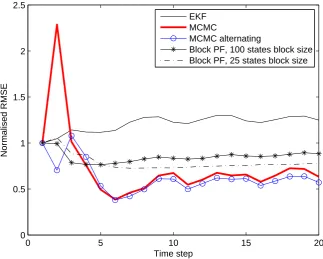
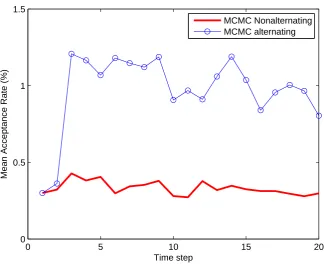
The performance of the EKF and of both MCMC variants, namely, the alternate steering
MCMC (alternating) and the non-alternating, is shown in Figures 1 and 2. The normalised
RMSE, defined asE[∥xˆk−xk∥2/∥xk∥2]1/2, is approximated based on 50 Monte Carlo
runs and is shown in Fig. 1. Figure 2 presents the mean acceptance rate of both MCMC
variants. Figure 2 demonstrates the superiority of the alternating MCMC filtering approach
in terms of estimation accuracy and sampling efficiency (i.e., improved acceptance rate). A
comparison with the block PF developed in [8] is also presented. The block PF splits the high
dimensional state vector into low-dimensional state vectors and calculate likelihoods over
these low dimensional state sub-vectors. The block PF is implemented with the same number
N = 3000 of particles as in the proposed MCMC filters and respectively with blocks with
state sub-vectors, with sizes, respectively, 25 and 100. The results are shown on Figure 1.
Figure 1 demonstrates the outperformance of the sub-gradient MCMC algorithms compared
with the block PF of Rebeschini and the EKF. The block PF [8] calculates independent
likelihoods over blocks of smaller state sub-spaces. However since the subgradient MCMC
filter uses the latest measurements and moves the particles towards more likely regions, the
In our last example we demonstrate the performance of the non-alternating MCMC
ap-proach in solving a dynamic compressed sensing problem [13]. The system model is similar
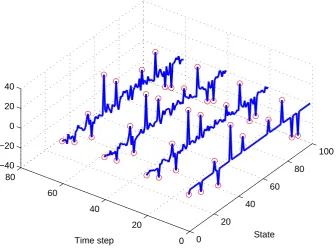
to the one considered in [13] with nx = 100 states out of which only 10 are either
non-vanishing or non-compressible (i.e., the state process is sparse/compressible). The signal
itself becomes corrupted over time and its corresponding complexity in the sense of
sparse-ness rises (see illustration in Fig. 3). At each time step the observations are generated from
zk =Hxk+rk. The system and measurement noise covariances are unit matrices and the
sensing matrix is in the form: H= [sign(z(1), . . . ,sign(z(nz))] where sign(z(i)) denotes the
sign function of theith element ofzk (i.e. sign(zk(i)) = 1 ifzk(i)>0) and sign(zk(i)) =−1
otherwise. The likelihood function of the MCMC algorithm is given as
p(zk|xk)∝exp{−0.5∥zk−Hxk ∥22−β∥xk∥1} (13)
withβ= 100.
The performance shown in Figures 3 and 4 demonstrates the viability of the MCMC
approach in solving the compressed sensing problem. The estimation errors of both the
CSKF and the MCMC nearly coincide from a certain compressibility level (the increased
complexity is manifested by the positive slope of the estimation error lines). The estimation
accuracy of a conventional Kalman filter is also depicted showing its uselessness for such a
6. Conclusions
This paper presents a Markov chain Monte Carlo approach for high dimensional
nonlin-ear filtering. The new algorithm utilises an improved proposal distribution that essentially
incorporates the latest measurement and subgradient information of the underlying
likeli-hood function. This proposal is then used for generating candidate moves in high probability
regions of the sample space. The alternating MCMC scheme with the steering distribution
accelerates the generation of new samples and has a much higher success rate than the
MCMC filter with nonalternating sampling rate. The subgradient MCMC algorithm is
shown to outperform the block PF [8] which subdivides the whole state vector into blocks
with smaller dimensions and calculates individual likelihoods for each block. The numerical
study demonstrates the potential of the new filtering scheme for high dimensional nonlinear
state estimation.
Acknowledgements. We acknowledge the support from the UK Engineering and Physical
Sci-ences Research Council (EPSRC) via the Bayesian Tracking and Reasoning over Time (BTaRoT)
grant EP/K021516/1 and EC Seventh Framework Programme [FP7 2013-2017] TRAcking in
com-pleX sensor systems (TRAX) Grant agreement no.: 607400.
References
[1] L. Mihaylova, A. Y. Carmi, F. Septier, A. Gning, S. K. Pang, S. Godsill, Overview
of Bayesian sequential Monte Carlo methods for group and extended object tracking,
Digital Signal Processing 25 (1) (2014) 1 – 16.
[2] F. Daum, J. Huang, Curse of Dimensionality and Particle Filters, in: IEEE Aerospace
Conf., 2003, pp. 1979–1993.
[3] C. Andrieu, A. Doucet, R. Holenstein, Particle Markov chain Monte Carlo methods,
Journal of the Royal Statistical Society: Series B (Statistical Methodology) 74 (3)
(2010) 269–342.
[4] C. Berzuini, G. Nicola, W. R. Gilks, C. Larizza, Dynamic Conditional Independence
Models and Markov Chain Monte Carlo Methods, J. Amer. Statist. Assoc. 92 (440)
(1997) 1403–1412.
[5] F. Daum, J. Huang, Particle flow for nonlinear filters with log-homotopy, in: SPIE
[6] P. Djuric, M. F. Bugallo, Particle filtering for high-dimensional systems, in: Proc.
IEEE Int. Workshop on Computational Advances in Multi-Sensor Adaptive Processing
(CAMSAP), 2013, pp. 352–355.
[7] L. Mihaylova, A. Hegyi, A. Gning, R. Boel, Parallelized particle and Gaussian sum
particle filters for large scale freeway traffic systems, IEEE Transactions on Intelligent
Transportation Systems 13 (1) (2012) 36–48.
[8] P. Rebeschini, R. van Handel, Can local particle filters beat the curse of dimensionality?,
Annals of Applied Probability, 2015, 25 (5) (2015) 2809–2866.
[9] M. S. Arulampalam, S. Maskell, N. Gordon, T. Clapp, A tutorial on particle filters for
online nonlinear/non-Gaussian Bayesian tracking, IEEE Trans. on Signal Proc. 50 (2)
(2002) 174–188.
[10] S. K. Pang, J. Li, S. J. Godsill, Detection and tracking of coordinated groups, IEEE
Transactions on Aerospace and Electronic Systems 47 (1) (2011) 472 – 502.
[11] A. Carmi, F. Septier, S. J. Godsill, The Gaussian mixture MCMC particle algorithm
for dynamic cluster tracking, Automatica 48 (2012) 2454–2467.
[12] N. Z. Shor, Minimization Methods for Non-differentiable Functions, Springer-Verlag,
1985.
[13] A. Carmi, P. Gurfil, D. Kanevsky, Methods for sparse signal recovery using Kalman
fil-tering with embedded pseudo-measurement norms and quasi-norms, IEEE Transactions
on Signal Processing 58 (4) (2010) 2405–2409.
[14] J. Liu, R. Chen, Sequential Monte Carlo methods for dynamic systems, Journal of the
0 5 10 15 20 0
0.5 1 1.5 2 2.5
Time step
Normalised RMSE
EKF MCMC
MCMC alternating
[image:12.595.163.487.141.400.2]Block PF, 100 states block size Block PF, 25 states block size
Figure 1. The RMSE based on 50 Monte Carlo runs, 3000 particles of the
0 5 10 15 20 0
0.5 1 1.5
Time step
Mean Acceptance Rate (%)
[image:13.595.163.488.137.401.2]MCMC Nonalternating MCMC alternating
0 20
40 60
80 100
0 20
40 60
80 −40 −20 0 20 40
[image:14.595.170.507.145.395.2]State Time step
0
10
20
30
40
50
60
70
80
0.1
0.2
0.3
0.4
0.5
0.6
0.7
0.8
0.9
1
Time step
Normalized RMSE
MCMC, 2000 particles
Kalman Filter
[image:15.595.163.489.327.585.2]CSKF
Figure 4. The normalised RMSEs of the Kalman filter, the CSKF, and the