• No results found

Antimicrobial Activity of Leaf Extract of Lawsonia inermis (Henna) Against Some Selected Bacteria

N/A
N/A
Protected

Academic year: 2020

Share "Antimicrobial Activity of Leaf Extract of Lawsonia inermis (Henna) Against Some Selected Bacteria"

Copied!
7
0
0

Loading.... (view fulltext now)

Full text

(1)

Antimicrobial Activity ofEthanolic Leaf Extract of

Lawsonia inermis

(Henna)

Against Some Selected Bacteria

$OL\X,VD<XVXI$,VD,EUDKLP0XKDPPDG+DGL]D%XQX*RQL)DWLPD8VPDQ/

1

Department of Biotechnology, Lovely Professional University, Punjab – India

2

Department of Science Laboratory Technology, Ramat Polytechnic Maiduguri,

Borno State – Nigeria

ABSTRACT

The emerging resistance of pathogenic microorganisms against the currently available

antimicrobial agent in the market demands the exploration of new antimicrobial agent .Lawsonia

inermis (Henna) a very useful medicinal plant that has been adopted by many cultures in Africa,

Asia and Latin America as source for certain illness, the leaves are very popular natural dye to

color hand, finger, nails and hair. However, the antimicrobial activity of leaf extract of Lawsonia

inermis was investigated against some selected bacteria including: Staphylococcus aureus,

Bacillus subtilis, Corynebacterium specie, Escherichia coli, klebsiella pneumoniae, and

Pseudomonas aeruginosa using standard method of sample collection and analysis. However,

Salmonella and Streptococcus pyogenes develop resistance against all concentrations of the

extract.The extract showed highest activity with Bacillus subtitlis with zone of inhibition of

17mm; this is followed by Pseudomonas aeruginosa with zone of inhibition of 14mm. lowest

activity was observed in Corynebacterium with zone of inhibition of 7mm at 300mg/ml

respectively. The plant extract revealed maximum effect on Baccilus subtilis with inhibitory

concentration of 150mg/ml and minimum effect in staphylococcus aureus and Corynebacterium

specie with 300mg/ml and zone of inhibition of 7mm respectively. Several works including that

of Sharma has showed similar results. The outcome of this analysis showed that L. inermis could

be design for treatment of some infectious agents.

GSJ: Volume 7, Issue 3, March 2019, Online: ISSN 2320-9186

(2)

INTRODUCTION

The emerging resistance of pathogenic microorganisms against the currently available

antimicrobial agent in the market demands the exploration of the new antimicrobial agent. The

use of the natural medicinal plant as a substitute is the paramount area of research to overcome

the drug resistance of infectious agent. A scientist has not made enough on the evaluation of

thesafety of medicinal plant yet; however, most regarded as safe and is already used as food or

food additive without perceived side effect (Newman, 2000).

Lawsonia inermisis a scientific name of a tall shrub plant commonly known as Henna, or mehndi

tree is a flowering plant, having a height of 5 meters, natural to subtropical and tropical regions

of the world including South Asia, Africa, and Oases of Sahara Desert and even in Northern

regions of Australia. Leaves of henna plant are Oval-shaped and smooth. Leaves have a length of

2-3cm with 1-2 cm width. Henna shrubs are highly branched and possess greyish brown barks.

Main chemical constituents of henna are Lawson (2-hydroxynaphthoquinone) mucilage,

Mannite, gallic acid, and tannic acid. Henna is known to be utilized as a cosmetic agent for

dyeing hair, nails as well as skin (Pathirana et al, 1992; Cown, 2009). Studies has shown that L.

inermis have bioactive free radical (Philip et al, 2011)

Medicinal plants are prospective renewable natural resources and are generally considered to

play a favorable role in the improvement of human health care. Medicinal plants are known as

nature’s best gift to cure some of diseases of men and animals. There are about 121 clinically

useful prescription drugs that are worldwide derived from higher plants out of which about 70

percent of them came to the attention of pharmaceutical houses because of their use in traditional

medicine (Abelson, 1990).

In the earlier period, medicinal plants were used intensively in ethnic medicine for the

management of various disorders. Today, it is estimated that about 80% of people in developing

countries rely on traditional medicines for their primary health care. Traditional medicines are

GSJ© 2019

(3)

becoming popular, due to high toxicity and undesirable effect of conventional medicament. This

has led to a sudden increase in the number of green industries in the drug market. Several plant

species are used by various indigenous systems such as Siddha, Ayurveda, Unani and Allopathic

for the treatment of different ailments. (Farnsworket al., 1985).

Henna grows better in tropical savannah and tropical arid zones, in latitude between 15o and

25oN and S, produces highest dye content in between temperature 35 to 45oc.the optimal soil

temperature ranges for germination are 25 to 30oc.

The seeds of henna have been reported to possess deodorant action and are used in most cases of

gynecological disorder such as Menorrhagia, vaginal discharge and leucorrhoea (Newman et al.,

2000). The leaves of Lawsonia inermis with these of Hibiscus rosa-sinensis, Eclipta prostrata

and seeds of Abrus precatorius when they are taken in equal quantities and ground into a paste

which is soaked in sesame oil for five days is used as hair oil by the tribes of Andra Pradesh. The

powdered roasted seed is mixed with gingelly oil to make a paste which is used for the treatment

of ringworm. A concoction of the leaves is used for aseptic cleaning of wounds and healing

(Kumariet al., 2011). Flowers are used in cephalalgia, burning sensation, sardiopathy, anemia,

insomnia and fever. A seed, flowers, leaves and, roots are used in ayurvedic medicinal systems

in the management of a range of disease. Leaves on the other hand are valuable for the treatment

(4)

METHODOLOGY

SAMPLE COLLECTION

The sample (Lawsonia inermis) were purchased from Monday Market, Nigeria and was

confirmed by the Herbarium unit of the University of Maiduguri. This was ground into the

powder using pestle and mortar immediately the sample was taken to the laboratory for

extraction. The organisms were collected from a clinical case at the University of Maiduguri

Teaching Hospital, Nigeria.

EXTARCTION

Soxhlet extraction apparatus was employed, 500g of powdered seed was used in a Soxhlet

apparatus and boiled in respective solvents of ethanol for 30 minutes and extracted for 3h. After

extraction, the solvents were removed by rotary vacuum evaporator at 40ºC and dried in a

vacuum oven for 2h. (Udaya and Sankar, 1989)

DETERMINATION OF AN ANTI-BACTERIA ACTIVITY

The anti-Bacterial activity was determined using the disc diffusion method. A disc of blotting

paper of 6mm was impregnated with Lawsonia inermi’s leave extract and place on plate of

sensitivity testing agar uniformly inoculated with the test organism and place in an incubator for

24 hours. The extracted diffuse from the disc into the medium. Organism sensitive to extract are

inhibited at a distance from the disc whereas resistant strains show no zone of inhibition or grow

up to the edge of the disc (Monica, 2006).

MINIMUM INHIBITORY CONCENTRATION (M.I.C)

The leaf extract was made to obtain 50mg/ml 100mg/ml, 150mg/ml, 200mg/ml, 250mg/ml,

300mg/ml, 350mg/ml 400mg/ml, 450mg/ m and 500mg/ml. The various concentrations of

extract was further impregnated into the 6mm disc and place on growth testing medium, it was

incubated at 37oc for 24 hours, and zone of inhibition was read in millimeter (mm).

The minimum concentration that shows activity was taken as the MIC (Monica, 2006).

GSJ© 2019

(5)

RESULT PRESENTATION

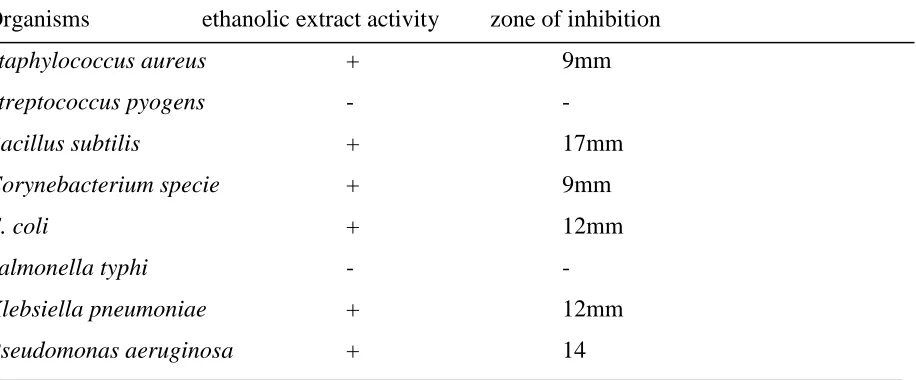
Antimicrobial activity of ethanolic extract of lawsonia inermis against some bacterial isolates

Table 1: Antimicrobial Activity.

Organisms ethanolic extract activity zone of inhibition

Staphylococcus aureus + 9mm

Streptococcus pyogens - -

Bacillus subtilis + 17mm

Corynebacterium specie + 9mm

E. coli + 12mm

Salmonella typhi - -

Klebsiella pneumoniae + 12mm

Pseudomonas aeruginosa + 14

(6)

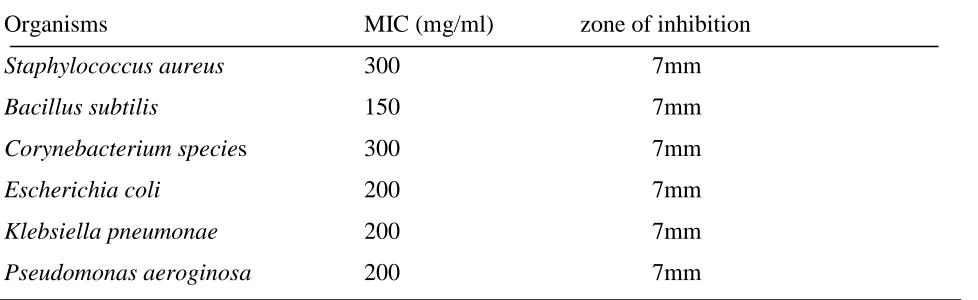
TABLE 2: MINIMUM INHIBITORY CONCENTRATION (M.I.C)

Organisms MIC (mg/ml) zone of inhibition

Staphylococcus aureus 300 7mm

Bacillus subtilis 150 7mm

Corynebacterium species 300 7mm

Escherichia coli 200 7mm

Klebsiella pneumonae 200 7mm

Pseudomonas aeroginosa 200 7mm

DISCUSSION

The results obtained from the antimicrobial activity of Lawsonia inermis by ethanol extract

shows activity against six (6) out of eight (8) organisms that were analyzed, i.e.,Staphylococcus

aureus, Bacillus subtilis, Corynebacterium specie, Escherichia coli Klebsiella pnuemoniae, and

Pseudomonas aeruginosa. However, Salmonella and Streptococcus pyogenes develop resistance

against all concentrations of the extract.

The extract showed the highest activity with Bacillus subtitlis with a zone of inhibition of 17mm,

this is followed by Pseudomonas aeruginosa with azone of inhibition of 14 mm, lowest activities

was observed in Corynebacterium and Staphylococcus aureus with a zone of inhibition of 9mm

at the same concentrations respectively. The plant extract revealed the maximum effect on

Bacillus subtilis with the activity of 150mg/ml and minimum effect in Staphylococcus aureus

and Corynebacterium species with a concentration of 300mg/ml and zone of inhibition of 7mm

respectively.

The results of this research work conform the work of (Sharma et al.,1995), states that Lawsonia

inermis have anti-bacteria activity against both gram-negative and gram-positive bacteria.

Similarly, Bhuvaneswari (2002), discovered that Lawsonia inermis has activity against

Staphylococcus aureus and Escherichia coli Klebsiella pnuemoniae.

GSJ© 2019

(7)

REFERENCE

Abelson P.H, 1990, med. Plant Sci 247,513.

Bhuvaneswari, K., Gnana, p.s., Kumnuvilla A, and appala, R.A,

Intibitoratiory- concentrations of lawsonia inermis dry prowder for urinanry pathogens.

Indian J.pharmacol. 34..260-3 Aug. 2002. In article.

Cown, M.M, 2009, plant products as antimicrobial agents. Cline. Microbial

Rev. 2(4): 564-482.

Farnswork,N.R., O.Akoerle, A.S Bingel and soejar DD Guo 2.1985.

Medical plants in therapy, World, Health Organization (63 (6),965-98.

Monicah, C. (2006). District Laboratory Practice in Tropical Countries, second edition, part two, Cambridge University Press, 132 - 142

Newman, D.J. Gragge G.M and sander, K.M, “The influence of natural

products, upon drug discovery’’ Nat, prod. Rep. 17.215-234 Jnue. 200. In article crosspet

pubmed.

Pathirama, C, Jensen P.R and finical, W, titration let, 33 (50). 7663-

7666. Dec. 1992 in article crosses Ref.

Prajapati N.D, Purohit S.S., Sharma AK, Kumar T. A hand book of medicinal plants: A

complete source book. India: Agrobios; 2007. p. 308-309.

Philip JP, Madhumitha G, Mar SA. Free radical scavenging and reducing power of Lawsonia

inermis L. seeds. Asian Pac J Trop Med 2011; 4(6): 457-461.

Sharma, V.K.G.D: Shanks, A.J. Oloo, G.M. Aleman, C.ohrt, F.W. Klotz, D. Braitman and

J. Horton, 1995. Tuberculostatic activity of henna lawsonia inermis linnl, Tubercle,

71:293-5.

Udaya Sankar, K., 1989. Studies on physico-chemical characteristic of essential oil of pepper

(Piper nigrum L.) obtained by supercritical carbon dioxide. J. Sci. Food. Agric., 48:

Figure

Table 1: Antimicrobial Activity.
TABLE 2: MINIMUM INHIBITORY CONCENTRATION (M.I.C)

References

Related documents

This indicates a need for future studies to continue in a carefully phased approach; using methods to improve reten- tion, as discussed above, that have been effective in other

Five participants liked this technique (the same ones that liked techniques 14 and 15). One nurse and three experts disliked this technique. The nurse‟s explanation was the same

Ombitasvir plus paritapre- vir plus ritonavir with or without ribavirin in treatment-naive and treatment-experienced patients with genotype 4 chronic hepatitis C virus

Dima Grigoriev and Ilia Ponomarenko [2] have recently proposed a public key cryptosystem which takes an arbitrary finite group, given in terms of generators and relations, as

According to the investigations done, out of 1000 symptomatic female patients, 50 (5%) were found posi- tive for T. vaginalis infection by all methods done collectively. The

Our work demonstrated that tranilast-assisted therapy inhibited intractable 4T1/3T3 mixed cells, detached CAFs (d-CAFs), and three-dimensional (3D) mixed tumor spheres

Using the 2dFGRS we explore the higher-order clustering properties of local galaxies to quantify both (i) the linear and non-linear bias of the distribution relative to the under-

anomaly detection based approach to detect HTTP-based C&amp;C traffic using.. statistical features based on client generated HTTP request packets and