WORKING DOCUMENT FOR AN EXCHANGE OF VIEUWS ON THE EVALUATION AND APPLICATION
OF THE NEW E.R.D.F. REGULATION
COM(86) 203 final
COM(86) 203 final
I. INTRODUCTION
ON THE EVALUATION AND APPLICATION OF THE NEW E.R.D.F. REGULATION
In a common declaration adopted at the end of the conciliation on 19 June 1984 following the reform of the European Regional Development Fund (ERDF) "the Council, the Commission, and the European Parliament, noting the emphasis on the Community nature of the new Regional Fund, consider that a~praisal and implementation of the pririciples contained in the ne~ Regulation must be the subject of an exchange of views at Least once a year".
The aim of this exchange of views is to allow the three institutions to examine the results achieved,· and the difficulties encountered in implementing the principal novel features of Council Regulation (EEC) No. 1787/84
t
which on 1 January 1985 replaced Council Regulation (EEC) No. 7241752•The Commission is reminded that the proposals for the new Regulation were derived from the principles developed in the "report and proposals on the means of increasing the effectiveness of the structural funds of the Community" established on the instructions of the European Council at Stuttgart3•
The principles established in the new Regulation are hereinafter examined in the light of resources available for implementing them, the results achieved, and the difficulties which have been encountered.
~OJ
n° L 169 of 28.6.1984, p. 1 3oJ n° L 73 of 21.3.1975, p. 11. The coordination of regional policies Cart. 1
&
2)a) The coordination of national regional policies with Community regional policy, bearing in mind other Community policies and financial instruments, contributes to securing a higher degree of integration of the economies of the Member States, and ensures a more balanced distribution of economic activity throughout the territory of the Community. Particular emphasis has been put upon the coordination of transfrontier regional development actions.
b) The means by which this coordination is implemented are as follows:
- The regiahal development programmes are sent to the Commission by the Member States, and are prepared in accordance with a common plan, setting out the objectives and the operational means for achieving the development of a region. The programmes are examined by the Commission, with the participation of the regional policy committee. This examination Looks at their coherence with the policies and objectives of the Community, which assures that the various aspects of Community policy are taken into consideration during the elaboration at national and regional level of development policies.
The report on the socio-economic situation in the regions is established periodically by the Commission4• It is on the basis of this report that the Commission, as and when necessary, makes proposals relating to the direction and priorities of Community regional policy.
-The regional impact analysis of the principal common policies and essential measures which the Commission is proposing to the Council. This will allow better account to be taken of the regional di.mension implicit in the matters to be dealt with bearing in mind the proper objectives of each of these policies. This will strengthen the consistent treatment of sectoral policies and regional policy.
Moreover, the Commission's examination under art. 92 et seq. of the Treaty· of general regional aid schemes, constitutes an essential element of the coordination of national regional
l. . 5
po 1c1es
c) The results achieved, and problems encountered by the implementation of this coordination can be summed up as follows:
- In so far as concerns the regional development programmes the most important achievement in 1985 was the scrutiny of the programmes sent in by Spain and Portugal. These programmes, which cover the period 1986-1990, were approved in a positive opinion of the Regional Policy Committee. This enabled the two applicant countries to receive EROF assistance from the beginning of 1986. Further the Commission has had also to examine adjustments in the regional programmes submitted by Oenmark, Greece, Italy and the United Kingdom.
The Commission is presently preparing the third periodic report on the situation and the socio-economic evolution of the Regions. This will be published at the end of this year.
5
In accordance with article 2.3(b) of the Regulation Member States must provide the Commission with reports on their progress in achieving the objectives of the regional development programmes. The Commission notes with regret that this obligation has been honoured more in the breach than in the observance in 1985. The Commission hopes that Member States will comply more fully with their obligations in the future.
Finally, the Member States are in the course of preparing the Regional Development Programmes, called 'the third generation programmes'. Only Greece, in 1985, presented its new programme covering the period 1986-90. The Commission attaches particular importance to this new set of programmes and particularly to the more precise definition of development priorities within them.
- The third periodic report will be the first after the entry into force of the new Regulation. It must be emphasised that both its content and its quality are totally dependent upon the av~ilability and the comparability, at the regional level, of the ,relevant statistical information. The Commission will take appropriate action with the Member States with this objective in view.
-The Regional impact assessment of Community policies induced the Commission to take into account, particularly in its
'greenbook'6 on the results of its reflection on the perspectives for the common agricultural policy, the need to temper the coresponsibility measures in the light of structural situations, so as to allow it to take better account of
6
regional differences. On the other hand the analyses undertaken in relation to declining industrial sectors <steel, shipbuilding, textiles) and fisheries has permitted the Commission in 1985 to take certain decisions on specific community measures ("non quota") for the benefit of zones affected by developments in these sectors. Finally, studies in the area of new information technology and energy policy have resulted in the Commission making a proposal to the Council for two Community programmes, namely "STAR" and "VALOREN"7
- In spite of the above mentioned measures, the means for evaluating the extent to which the Fund has effectively contributed to the reduction of disparities between the Member States, and between regions remain inadequate.
7
2. Atlocation of ERDF resources
a) "Fourchette" system (art. 4)
The old system of fixed quotas for each Member State was considered to be both unsatisfactory, and difficult to reconcile with the need for a higher degree of selectivity, and an enlargement of the scope of the Commission for the evaluation of ERDF assistance. The new regulation therefore provides for a "fourchette" system for the allocation of these resources. This means that for each Member State a Lower and an upper Limit of the extent to which it can benefit from the ERDF is established. These Limits apply to a three year period. The total sum of the lower Limits awarded to each Member State Leaves an unaLlocated margin of 11.37X of the total ERDF budget.
The Lower Limit thus provides each Member State with a mini mum guarantee, provided always that it submits a sufficient volume of applications which comply with the conditions set out in the Regulation. The 'margin' is designed to permit the Commission in the· exercise of its power of evaluation, and in applying the criteria and priorities provided in the regulation, to give practical emphasis to the interest of the Community itself in interventions of the rund.
b) Prior evaluation of applications (art. 7, 11 and 21)
With a view to strengthening and intensifying the prior evaluation of applications received, the Commission reviewed and developed the method to be applied to assess the Community interest in an application in the light of the criteria and priorities provided within the Regulation. This· demanding method, established by the Commission was the subject of prolonged and detaiLed discussion with the Member States particularly within the ERDF Committee. This method has created a certain reticence on the part of member states, who judge excessive certain information requested by the Commission.
The method of appreciation has been progressively put into
operati~n, and the Commission intends to reexamine it in the near
future in the light of experience gained.
In dealing with large infrastructure investments of 15 million ECU and above, the Commission has required the Member States on the basis of art. 22.3, to submit for each such infrastructure project, the results of an appropriate evaluation of its socio-economic benefits, and for each such industrial project, the results of an appropriate profitability assessment.
Thet-e ana lyses, pt'ovi ded by the member states, have been a determining factor in +he assessment of requests for grants, for the aforementioned investments. In effect, the grants have only been approved in cases where the results of the evaluations have shown significant socio-economic profitability.
Thus, in the course of the first year of the implementation of the new regulation,
has been made, in
it is noticeable that significant progress the Commission's view, in refining the selection of measures.
c) Use of resources
In spite of the increased rigour of the prior evaluation of application conducted by the Commission, almost the whole of the
8
available budget was committed (more than 99 per cent) • Nevertheless, some Member States did not reach their lower limit in the course of this first year. For others, on the contrary, this limit was passed by an appreciable margin.
It is of course to be clearly understood that decisions taken in
1985 in no way prejudge the way in which the margin for the period 1985-1987 will eventually be allocated. The use of this margin will be made by taking into account the Community interest in applications submitted by the Member States having regard to the priorities and criteria provided by the Regulation.
d) Advances Cart. 30 and 31)
Under the original ERDF regulation, the national and regional authorities concerned were obliged to provide funds ·in advance for the whole investment including the part to be financed by ERDF. On this account the incentive and catalytic effect of ERDF finance was very significantly reduced. Since then new
provisions have been included in the ERDF regulation to allow for advance payments within the limit of the available budget. This provision will particularly help those states and organisations in difficult financial circumstances.
The first use of this possibility has already been made in 1985 <in the order of 50 million ECU): It is proposed to emphasise the further use of this possibility in 1986, but this runs the risk of being affected in the future .by budgetary problems. The Lack of use of the possibility of advances in 1985 is essentially due to the fact that scarcely 75% of commitments had been made in December. It has therefore not been possible to make payments on these commitments before the end of the year.
The countries which have been able to benefit from advances are Ireland, Greece and France, for infrastructure projects.
e) Industrial, craft and tourist investments
In 1985 there was a susceptible increase in the level of ERDF resources allocated to productive investments. The actual figures were 17X of Fund resources in 1985, against 14X in 1984 and 11% in 1983.
fhe Com~ission i~tends to cont~nue to encourag~ Member States -~ increase, as far a~ possible, the level of ERDF resource for industry, craft and tourist investments with a view to reaching the target 30% provided in article 35.
f) Territorial allocation of ERDF resources
The allocation of ERDF resources between Member States in 1985 showed an increase in the Level of Fund grant awarded to priority regions: 60% as against 53% in 1984 (see Annex Table 2). The allocation of grant as between Member States in 1985 is shown in the Annex at Table 3.9
For the first time this allocation of fund resources was accompanied by an increase in the impact of the financial assistance offered by ERDF because of the increase in the rate of grant introduced by the new regulation: therefore, the level of Community participation can now reach SSX of public expenditure in the case of a national programme of community interest and certain projects.
In spite of the fact that a part of the resources of the ERDF can now be used in the form of programmes, the number of projects under examination remains as high as in 1984. This, combined with the considerable increase in the workload of the Commission resulting from the strengthening of the prior evaluation of applications, has emphasised in an even more acute fashion the problem that this evaluation poses in terms of available manpower resources.
Another element which resulted in a greatly increased workload in 1985 was the examination of applications from Spain and Portugal. The quality of these applications combined with excellent cooperation with these two countries resutted in the successful preparation of a significant number of decisions for 1986.
g) Complementarity
In quantitative terms it is true that in the different Member States, ERDF finance is effectively added to national public finance, with a view to increasing the avai table global budget for activities in regional development policies. ·Effectively, even with the Limited budgetary means avaiLabLe, the efforts being made do seem to be maintaining, even increasing the Level of productive investments as well as investments in infrastructure. This can only be explained by the fact that ERDF resources are being added to national resources.
3. Programme financing (art. 6 to 14, 25 and 26)
prior to the 1984 reform ER D F assistance was not available for programme financing, except for the relativly modest amounts allocated to the specific 11non quota" community measures. The new
regulation has opened up the possibility of cofinancing programmes with the Member States concerned with a view to improving the impact of ERDF assistance. It is in the context of a programme, that one can more effectively reconciLe Community priorities with national priorities, and organise within a programme contract measures designed to achieve common targets.
These multi-annual programmes may take the form of:
- Community programmes, undertaken on the initiative of the Commission, whose framework is adopted by the Council as a specific regulation on the basis of a qualified majority vote, and whose detail is established by the Member State concerned in collaboration with the Commission, which subsequently approves and cofinances the programme;
- National programmes of community interest, undertaken on the initiative of a member state and adopted in agreement with the Commission.
The Regulation provides that at least 20X of the credits available to the ERDF should be used in the form of programmes, by the end of the third year following the entry into force of the regulation, that is to say in 1987. The Commission Likewise intends to allocate 15X of ERDF resources in the form of Community programmes by the end of the fifth year following the adoption of the regulation.
a) Community programmes
The Commission is proposing to the CounciL the adoption of the first two Community programmes covering the development, in certain less propserous regions of the community, of better access to advanced telecommunication services (the STAR programme>10 and the exploitation of indigenous energy potential
11
amounting to 700 miLl ion ECU of ERDF grant is proposed for the STAR programme and 355 million ECU for the VALOREN programme.
b) National programmes of Community interest
The Comission received ten applications for programme cofinance from the United Kingdom and one from France.
The Commission is aware of the difficulties encountered by the majority of the Member States in formulating and submitting programmes to it. The Commission believes that these difficulties are due in part to a lack of experience in this matter in the national and regional administrations concerned. However, the Commission considers that the first programmes adopted by the Community in respect of the United Kingdom will prove to be a useful precedent for the adoption of similar programmes in other member states.
Of the 11 programmes presented, 3 were accepted in 1985. The other programmes proposed were not accepted for Commission decision either because the Commisson did not consider them to be programmes in the terms of the regulation, or because they still needed to be completed or amended.
In spite of certain start-up difficulties, it proved possible to adopt National programmes of Community interest representing a total Community contribution of 290 million ECU.
Of this amount, which constitutes the total package of these programmes, 133.98 million ECU have been committed (see Annex Table 3). This amount is still far from the 20X target which the Commission wants to reach by the third year of application of the new regulation.
4. Indigenous Potential (art. 15, 16 and 27)
The development of small and medium sized enterprises within the backward and declining industrial regions is of primary importance. The development is difficult to achieve in the first place because of the weakness of the general industrial fabric of the regions concerned, and in the second because of the absence, or inadequacy of all the service and other structures which these entreprises need.
It is on account of these factors that the Regulation makes specific provision for facilitating the development of the indigenous potential of the regions by making it possible to grant ERDF assistance for a series of measures in favour of small and medium sized enterprises in the industry, craft, tourist, and service sector. The ERDF may participate either in the context of a programme, or in a consistent set of indiviual projects designed to:
make available to these enterprises those services which will increase their activity and give them access to new technologies, by financing for example enterprise and innovation centres;
faciLitate their access to capital markets, by assisting them in the better presentation of their plans for finance.
In spite of the importance of these provisions for the regions no application for finance on the basis of Article 15 was received in 1985.
From 1980 onwards the Commission began to experiment with the 'integrated approach' which was designed to increase regional development action by the integration of several different activities at the level of Community financial instruments and to exploit every possible interactive combination for their use;. at the level of cooperation between Community instances, national, regional, and Local administrations and finally, at the level of the investments and actions themselves which should constitute an organic whole.
Beginning in 1980 with the integrated operations in Naples (Italy) and Belfast (United Kingdom), the Western Isles programme (United Kingdom), Lozere (France) and South East Belgium, this approach found its ultimate and most important form in the integrated mediterranean programmes (IMP).
During the second half of 1985 the Commission received a draft IMP concerning Crete and the draft outLine of an IMP concerning the French mediterranean regions. These projects have been the subject of the first meetings between the services of the Commission and the national and regional authorities concerned.
The measures which will be retained as eligible for ERDF aid will in prir.ciple be financed using the method for national programmes of Community interest, provided for in Regulation EEC 1787/84 relative to this Fund. A significant part of the measures eligible for financing by the ERDF should relate to actions in favour of small and
'
medium sized enterprises in the industry, craft and tourism sectors, and on the improvement of the infrastructure Linked with the development of these activities.
In order to facilitate the elaboration and application of the integrated approach a number of preparatory studies were cofinanceci by the Commission. New studies were decided in 1985, bringing up to approximately 30 the number of studies undertaken. Several of these were completed in 1985 notably in France, the United Kingdom, HolLand, and Belgium. In general these studies resulted in a proposal for a multi annual plan for integrated actions, as was the case for example with the National programme of Community interest covering the Glasgow area (United Kingdom).
·Following preparatory studies, a number of integrated approaches will be decided in 1986 concerning regions in difficulty. The decisions will be based on a commission communication which will specify the content and methods of integrated approaches.
Towards the end of 1985 the French Government requested the Commission to grant aid preparatory studies for operations in Lorraine, Nord-pas-de-Calais, Tarn-Aveyron, Arriege, Auvergne, and Limousin. Prior to the final approval of these programmes certain priority elements within them were the subject of decisions in 1985.
The Dutch Government also presented in 1986 a request for finance for an integrated operation following the preparatory study.
Naturally, in the course of 1985 both the integrated operations in Naples and Belfast were actively continued.
In fact the Commission considers that the integrated approach is the most appropriate method for effectively dealing with the problems posed by the Lagging development, of these regions and their slow conversion to alternative industrial activity.
6. Dialogue with the Member States and Local and Regional authorities
a) The new Regulation envisages
principle of dialogue between
in a number of instances the the Commission and the Member States. In so far as concerns the local and regional authorities, Articles 1.3, 2.3(a), 11.1, and 15.2 of the new regulation provide for their association to a greater or lesser extent in the application of the different dispositions of the Regulation.
b) The results achieved and the problems encountered up until now in the framework of this dialogue between the Commission and the responsible authorities can be summed up as follows:
- In so far as concerns the Member States, the dialogue has two objectives:
to achieve through the examination of the regional development programmes common priorities and objectives for the intervention of the Fund,
In so far as concerns the individual regions of the Community, the Commission attaches particular importance to contact with their authorities, not only in terms of project promotion, but also in relation to the more general problems concerning regional development. There have, on this account been several hundred meetings in Brussels in 1985 as well as on the ground in the regions themselves.
III. CONCLUSIONS
Even though Regulation,
this is the first year of the application of the new which means that it has been a period of both 'start up' and learning for all concerned, it is nevertheless possible to formulate a number of conclusions.
The Community character of EROF interventions has been strengthened by the "fourchette11 system of allocations, which has increased, as indicated above, the possibility for the Commission to make a selection among the applications submitted.
At the same time the new system for the prior evaluation of applications by the Commission has reinforced the selection of applications for
finance~ On the other hand the examination and adoption of the first
National programmes of Community interest, and the presentation of Community programmes permitted both a clearer view of the notion of a programme, and its advantages, in spite of the difficulties resulting from the novelty of this approach. The principal advantages of the programme approach are the combined application of different measures for a period of several years on the part of both the Commmunity and the Member State, and the increase in contact with all the authorities concerned both national and regional. This increase corresponds precisely to the wishes expressed by the tnree institutions in their common declaration.
Finally, it is becoming more and more evident that the appLication of the ERDF regulation demands a high degree of cooperation and attention by the Services of the Commission and those of the Member States. Only to the extent that the latter conceive Community regional policy, and the management of the ERDF, as a combined operation, and give their whole hearted support to providing without delay the facts and information required, will it be possible to develop the principles enunciated above.
The Commission believes that the work achieved and the actions undertaken in the course of this first year, have shown that the new ~egulation
constitutes a firm point of departure for developping and strengthening the Community character of regional policy.
TABLE 1 (*)
Assistance applied for in 1984 and 1985 by Member State ERDF support measures
(in Mio Ecus)
I
MemberState 1984 1985
I
B OK D GR F IRL I L NL UK COM
EUR 10
49,11 23,23 138,72 269,58 373,48 168,38 1035,83 4,73 35,98 837,80 2936,84
(*) Provisional figures for 1985.
TABLE 2
78,68 16,55 140,92 556,85 464,50 223,71 2599,44 0,00 18,05 1198,44 0,04 5297,18
Assistance granted to pr1or1ty regions in 1984 AND 1985 ERDF support measures
(in Mio Ecus) Priority
Regions 1984 1985
IMezzogiorno 723,81 830,58
!Greece 261,47 409,46
!Ireland 159,12 153,11
!Northern Ireland 34,66 39,38
ID.O.M.(France) 44,64 41,78
I
I Total 1223,70 1474,31
I
I EUR 10 2320,94 2457,11
[image:22.612.140.532.119.334.2] [image:22.612.133.537.414.606.2]Amounts committed 1985 (by Member State)
( Mio l
Member Industry, service Infra structure Studies Nat. programmes Tota I
State and craft of c. 1.
Nat. cur. ECU Nat. cur. ECU Nat. cur. ECU Nat. cur. ECU Nat. cur. ECU
B 238.83 5. 32 845.20. 18.84 11 . 21 0.25 - - 1 095.24 24.41
OK 23.07 2.89 82.46 10.31
-
--
-
105.53 13.20D 114.59 51.93 47.70 21.62 - -
-
- 162.29 73.55CR
-
-
53.61* 409.46 - --
- 53.61* 409.46F 193.66 28.78 1 697.61 252.27 -
-
194.02 28.83 2 085.29 309.88IRL 27.26 38.17 82.10 114.94 - -
-
- 109.36 153. 11I 292.92* 194.79 1 015.45* 675.30 1 .42* 0.95 -
-
1 309.79* 871.04L
-
--
- --
-
-
--NL 24.41 9.84 17.75 7.16 0.19 0.08
-
-
42.35 17.08UK 50.84 86.26 231.71 393.18 0.44 0.75 61.97 105. 15 344.96 585.34
commun.
-
--
- - 0.04-
-
- 0.04EUR 10 - 417.98 - 1 903.08 - 2.07
-
133.98 - 2 457.11*Thousand mil lions
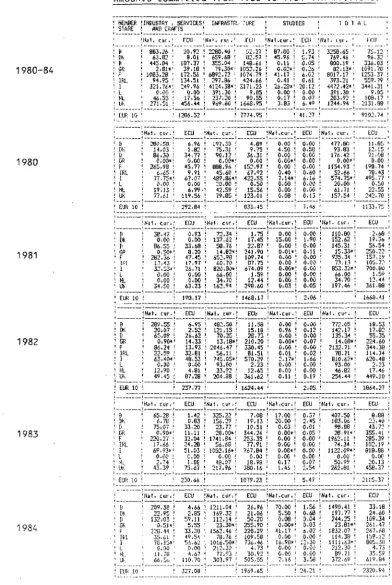
Amounts committed from 1980 to 1984 (in millions)
! hEhBER ! !H!IUSTRY , SEF:VICES' INFRASffiL· . :URE STUDIES T 0 1 A L
! STATE ! AIID CRAFTS ! .
I---~---_ .. ---I--·---- ·---·· _ --- _ ~ -·- --- ··---. ··- __ -- I ... --- . ··-.
----~Hdi. cur.~ fCII 'NAI, ru1, 1 ru1 !N.tl.cur.~ [t:U ~tl.:tf, t.ur. ~ 11:11
-•---· --•---•---· ····----· ·---•- ---~---·-··-· ·-·--- ~
---863.26 ~ 20,92 ~ 2~80,40 ! ~~2.27 ! 97,00 ~ 1.93 3258,65 I 7'5 t'l
63,02! 8,01 I 659,69! 02,57 I -45,96! :;,7~ 769,46 I 96:35
445.04 ! 187.37 ' 355.04 ! !48.6! o. 11 ! o.os 900.!9 ' 336.03
1980-84 2o811j~ 39,18 I 79,30~: 1052.2~ 0,02*! Q,~6 82.1311: 1091.70
! JOB3.2B 172.56 '6892,72' 1074.79 41.17' 6.02 9017.17 ' 1253.37 94.95 ' 134.51 ' :097.86 ! 424.66 ! 0.41 ' 0.61 393.21 ' 55?. 79
32~:~g·: c4z:~: 4nu~·! 317~:~~: 2t~g·: 2~:~~: 4m:~~·: 344~:l~'
•16.55 ' 17.56 ' 23/,20 ' 90.55 0.17 ' 0.07 2~3.92 ' IOB.l7 '
271.~1 ~ 4~6.44 969.60 ' l66G.95 3.83 ~ 6.49 1244.94 ' 2131.99 '
! ---~---I---!---!---! ---•---~ ---! ---1
I [Uf.: 10 ~ ~ )206,52 I ! 7774,95 ~ ! 41.~7 ~ I 9}•).:,74 ~
' • . • , _____ ---· _ -·-- ---·· ______________ • --- _ --··--- ____ --- -··--··- __ --- --- --- r
~Nat. cur.~ ECU ~Nat. cur.! ECU ~Hat.cur.! ECU !NC!oi. cur. ! ECIJ ! ---~ --•---!-·---! ---! --- :-··---! ---·--!- ·---··--~ ---·--I I B 28~1.~(] ~ 6.96 ~ l97~JO! 4.89! 0.(}0! o.oo! 477.BC I 1l.B5 I
[\1\ 14.03 ~ t.a~ ~ 75.31 ~ 9.75 • 4.50! o.se! 9J.e3 ~ 1::!.1s •
[1 86.3i) ~ 34.77 90.12! 36.31 o.oo! o.oo! J71 .. 42! 7],1.'9 ~ 1980 GR 0.00•~ 0.00 O.OO•! ~.00 O.OO•! 0.00! 0.00>! 0.00'
F 265.98 !· 45.77' 888.96! 1~~.97 ~ 0.00! 0.00' 1154.93! 190.74' !RL /...6$ ! 9.91 ' 45.60 ! 67.~2 ' 0.40 ! Q,60 ! 52.b6 ' 79.43 ~
I 77.7S"~! 67.07 499.8014! 42:?.ss 7.t4~t~ 6.16' 574.75"'1 49s.·n t
L v.oo ~ o.oo ~o.oo ! o.so o.oo ! o.oo 2o.oo ! o.~o
I NL 19;1~ ~ 6.99-! 42.59! 15.56! o.oo! o.oc.- 6L7J ! 22.55 I
! UK . i7.£.1 • 119.56·! 79.85 1 1n.ot ' o.oa • Q.13! 157.54 • :042.70!
~----·----'---I---~---' ---~---1 ---'--- '---'
~ EUR 10 ~ ~ 292.84 ! ~ 83:3.45 ~ - (,•l6 ~ I 11]3.75 ~
I--- •• . ---·---·-"
~ ---~ ---:
---
·---. ---·~Na1, cur.~ ECU ~Nat. cur,! ECU !Nat.cu1·,~ ECU 'HaL cur. ~ EC.U
~ ---~ ---! ---! ---! ----·----! ---~ ---! ---! ---r : r,K
!
3g:~:
8:~:
d~:I~:
~u~:
~g:&&:
t~s:
!§~:~~ : ~u~:
I [1 I 86.55 ~ l3.68 I 5EJ,76 ! 22.87 I o.oo ~ C·.OO ! 145.31 ! 56.54 !
1981 1 GP o.~.V•! s.2o ! t4.B2~1• 241 .9o ! o.o1•~ o.u ! JS.33t~! ~.)).~~ F 262.36 ~ 47 ... 5 I 65~.90 ~ 109.74 ~ O.<iO! o.oo ~ 935.34 I 1'57.1':-' I
}f:[ 1.'?,113 ~ \7,97 1 60,70! 07,75 1 0.00! Q,(ll) 1 j~,l] 1 lQ:_i,7;•
1 3~.~3•1 20.11 I B2V.GV~o! 674.09 • o.oo·~ o.co I s~J.32"! 7oo.ou
! l o.oo ! o.oo ! 66.00 ! !.59 o.oo! Q,()() 66.()() ! 1.59 ' ! HL 0.00 ! 0.00 ! 34.70 ! 12.44 . 0.00 ! Q,OV . 34.70 ! !~.~· !
1 tJl\ ! 34,~.()! 63,23! 162,94 ! 2qS,60 1 lj,QJ! Q,Q$ 1 197,46 1
]61,09 1 1 ---I---'--- I ---1---~---1 ---I--- I--- I ; EUR 10 ; : 190.17 ; ; w.a.11 ! ; 2.06 ; ; 1668.~1 '
--- --- ---4 ---4·---l
1 - - - ' - - - . - - - ' - - - · - - - '
!~fat. cur.! ECU !Nat. cur.! ECU ~Nat.cur.! ECU !Nttt. cur. ! ECU -I ---I--- 1---1--- 1--- -I ---1 ---I---I--- I I B ~ 28'),55 ! 6.95 ! 48.:!.~ ! 11.58 i o.oo ~ o.vv i 772.05 ~ 18.53 !
1982
;
~:
~:&~:
2~:~~1~~:ig
:
~u~ &:~t:
g:~.
m:u :
M:~~:
! GR o.9o•• 14.33 !3.18•! 210.20 o.oo•• o.07 1 14.00•' 224.60 • 'F 96.24 ! 13.93 2046.47! 330.45 o.oo! o.oo I 2132.71 ' 3~4.30'
! !RL 22.59! 32.8! ! 56.11 ! 81.51 0.01 ! 0.02 70.71 ! 114.34 .
~ 1 63.40•• 4B.53 ! 745.05•! 570.29 :!,17i*~ t.66 . 810.62•! 620 ... 8 !
' L 0.00 ! 0.00 ' 93,00 ! 2.23 0.00 ! 0.00 ' 93.00 ~ ~.:OJ '
fll 12.90 ~ 4.81 ! 33.92 ! 12.1.s • o.oo ! o.oo 46.a2 ! 17.46 ' ! Ui\ ! 49,45! 87.28! 204,80! 361.62! 0.1! ~ Q.19 . 254.44 ' 449,]0!
1---I--- I---I ---•---~---'---1--- ~---1
! EUR 10 ! i 237.n ! ! 1624.44 ~ i 2.05.! ~ 186-4.:;!7 !
--- 4---I
~ ---~ ---! --- , ________________ ~ ---:
1Na1. cur.' ECU !Nat, cur.! £CU 1Nat.car.! ECU ~Hat. cur. 1 ECU .
l ---I---'---1--- I--- I ---1 ---I--- I--- I ! B i 6S.2e ! t.42 ~ 32s.22 ! 1.oo ~ 11.00 ! o.37 ! o~o?.so ! e.BB i ! t~ t-.n~! o.aJ ! IS0.:!9! H'.J3 • 2o.oo ~ 2.4s! JB3.o6 ~ ~:! • .t~V
! [1 75.07 ! 33.20 ! 23.77 ~ 1Q.S1 I 0.03 ~ 0.01 99.BB ~ -43.7'2 !
I Gf.: {l,90M! 11.11 I 28,001\o! 344,2~ I 0,00Jt~ Q,Q5 I 28,91«1 355,-11 I
F 220.27 ! 32.04 ! !74!,84 ! 253.35 0,00 ! 0.00 ' 1962.11 295.39
1983
IRL Ji.66 ! 24.28 ' 56.68 ! 77.91 o.ov ! o.oo I 74.34 102.19 '
l 69.93•' 51.03 ' !052.16•! 767,84 O.OO•' 0.00 ' Jl22.09• 9!B.8B '
L O.OC ~ 0.00 ! Q,liO ! 0.00 0.00 ' 0.00 ' 0.00 0.00 ' d~ 4~:r~
:
k~~ :oi~:~r:
3~:r~Ul :
g:g~:
2~t~r 4§U~:-_______ r ---~---~---'---~---~ ---1 ---' ---~
EUR 10 ~ . ! 230.66 ! ! 1879.23 ~ ~ 5,4·1 ~ : 211S.J7 ~
I--- ---1
-- - - . - - - t - - - · - - - · - - - ' - - - .
~ ~Ha1. cur,~ ECU !Nat. cur.! ECU !Nat.cur.! ECU !N.sf. cur. ! ECU !
I - - - _ _ _ I ----1----' ---•---~---1---•---1 ---·
; [I ; 209,3B; 4,66 . 121!,04; 2/,,96; 70,00; 1.56; 1490,4! ; 33.18;
' DK 22.95' 2.85 . !69.32! 21.06! 5.50! 0.68' 197.77! 24.60!
• D 132.03: 59.1! ~ 112,14! so.2o o.oe! o.o4! 244.25! !09.34 1
1984 Gf.; 0,5J*! s.ss 1 23.3""*~ 255.90 o.OO~! 0.03 • 23,81~1 26t.Jj7 r
'F DU.44 ! 33.30' 1562.46! 228.29 H.l1' 6.02! 1832.07! 267,o0 '
- I Jt;L 35.61 ! !9.5.~: 78.76 ~ 109.58! o.oo ~ 0,(\Q! 114.38 ~ 1~9.12 ~
• I ;e.15•' •• &.6 ... loto.sow( 73&.46 ~ 16.90*' 1'2.30! 1111.63rt! eo~.JH 1
~ L o.oo ~ o.oo 212.30 ! 4. 73 ' o.oo ! 0.0(,.' I 212.30 ! ~L 73 !
• HL !LIB r 4.67! 77.93! '30.~2 1 0,00 1 0.00 1 99,71 ! 35.59 U!·. ~ 66,5r~ ' 110.70 1 30),97 ~ 5(15.55! ~.16 ~ 3.58! 372.69 ~ 619.B4.
~ ---~---I---~---!---~----·---!---I---I---!
~ Ellf.: 10 ' ! 327.08 ~ ! 1969.65 ! ! ~4.~1 ~ 2320,91• !
j - - - _ _ _ _ _ _ _ _ _ _ 4 _ _ _ _ _ _ _ _ _ _ _ 1
[image:24.612.104.496.78.663.2]