KNOWLEDGE REGARDING BIRTH PROCESS AMONG
ANTENATAL MOTHERS IN PRIMARY HEALTH CENTRE
AT POOVANTHI.
Reg.No: 301221752
A DISSERTATION SUBMITTED TO THE TAMILNADU DR.M.G.R. MEDICAL UNIVERSITY, CHENNAI, IN PARTIAL FULFILLMENT OF
THEREQUIREMENT FOR THE DEGREE OF MASTER OF SCIENCE IN NURSING
This is to certified that the dissertation entitled “EFFECTIVENESS OF VIDEO ASSISTED TEACHING ON KNOWLEDGE REGARDING BIRTH PROCESS AMONG ANTENATAL MOTHERS IN PRIMARY HEALTH CENTRE AT POOVANTHI” is submitted to the faculty of Nursing, The Tamilnadu Dr. M.G.R Medical University, Chennai by Mrs.P.Kalaiyarasi in partial fulfillment of the requirement for the degree of Master of Science in Nursing. It is the bonafide work done by her and the conclusions are her own. It is further certified that this dissertation or any part thereof has not formed the basis for award of any degree, diploma or any titles.
Prof.G.Thilagavathy,M.Sc(N),MBA,Ph.D,
Principal& Head of the Department of Community Health Nursing, RASS Academy College of Nursing,
KNOWLEDGE REGARDING BIRTH PROCESS AMONG ANTENATAL MOTHERS IN PRIMARY HEALTH CENTRE AT
POOVANTHI.
APPROVED BY THE DISSERTATION COMMITTEE ON OCTOBER 2012
1. RESEARCH GUIDE : _____________________________________ Prof.G.THILAGAVATHY,M.Sc(N),MBA,Ph.D,
Principal& HOD of Community Health Nursing,
RASS Academy College of Nursing,
Poovanthi,Sivagangai Dist-630611.
2. CLINICAL GUIDE : ______________________________________ Ms.J.AMALA NAMBIKKAI,M.Sc(N),
HOD of Obestrics & Gynaecological Nursing, RASS Academy College of Nursing,
Poovanthi,Sivagangai Dist
. 3. MEDICAL EXPERT : ______________________________________ Dr.SAETHU RAMU, MBBS, DGO,
Block Medical Officer, Primary Health Centre,
Poovanthi.
A DISSERTATION SUBMITTED TO THE TAMILNADU DR.M.G.R. MEDICAL UNIVERSITY, CHENNAI, IN PARTIAL FULFILMENT OF THE
Praise and Glory to the Lord Almighty who is the source of strength and inspiration in every path of my life and the foundation for knowledge and wisdom.
I would like to extend my sincere thanks to Mr.C.Ravisankar, chairman, RASSAcademy college of Nursing, Poovanthi for his support and for providing the required facilities for the successful completion of this study.
I extent my heartfelt and sincere thanks to my research guide Prof.G.Thilagavathi, M.sc(N), MBA, Ph.D, Principal, RASS Academy college of Nursing, Poovanthi for a deniable work, interest, cheerful approach, always with never ending willingness to provide expert guidance and suggestion to mould this study to the present form.
I sincerely express my warmest thanks to my guide Asso.Prof.R.Sutha, M.Sc(N), HOD of Midwifery & Obstetrics, Asso.Prof.PremaSathyamoorthy, M.Sc(N), MBA,HOD of Child Health Nursing and Asso.Prof.J.AmalaNambikkai,M.Sc(N), HOD of Obstetrics &Gynecological Nursing, RASS Academy College of Nursing, Poovanthi for her expert opinion, guidance, hard work, effort, interest and valuable suggestions and untiring help to mould this study in successful way.
I extend my heartfelt and sincere thanks to my medical guide My deep sense of gratitude to Dr.Saethu Ramu, MBBS, DGO., for her help, valuable guidance and encouragement which enabled me to accomplish this task.
I extend my warmest thanks to Mrs.UmmulHapipa, M.Sc(N).,Vice-Principal, RASS Academy college of Nursing for her expert guidance, valuable suggestion to bring this study in successful way.
Associate Professor in Tamil for her effort and expert opinion in editing the study and help to complete this study.
My Sincere thanks Dr.Varadharajan,M.Sc.,M.Phil.,M.Ed.,Ph.D(Edn)., Professor of Psychology, RASS Academy College of Nursing, Poovanthi. for his help in the statistical analysis of the data which is core of the study.
I immensely thankful to Mr.Balamurugan, MBBS.,Mrs.Marilakshmi, Mrs.Nithya, Mrs.Saranya, Mis.jothi., Nursing staff, Primary health centre for their support,co-operation, help to make this study as success.
I extended my special thanks to all ante-natal mothers who participated in the study.
I am thankful to Mrs.Brindha, M.Sc.,M.Li.Sc.,M.Phil., Librarian, RASS Academy College of Nursing, for extending helpful support throughout the project.
I would like extend my thanks to Mr.Yasar of software programmer who was kind enough to spend precious time in preparing video for this study into a effective way.
I express my sincere thanks to Swathe computer centre, okkur, for their kind co-operation in typing and printing this project.
I express my sincere thanks to my beloved Parents, Brother and my Family members for their blessings, support and encouragement in my research.
I would like to acknowledge the efforts of my friends and classmates for their encouragement and support all through my ups and downs during my study.
CHAPTER TITLE PAGENO
ABSTRACT
1
I INTRODUCTION 1
Need for the Study 3
Statement of the Problem 6
Objectives of the Study 6
Operational definitions 6
Hypotheses 7
Assumptions 7
Limitations 7
Conceptual Framework 7
II REVIEW OF LITERATURE 10
III METHODOLOGY 18
Research Approach 18
Research Design 18
Setting of the Study 19
Study Population 19
Sample of the Study 19
Sample Size 19
Sampling Technique 19
Sampling criteria 19
Research tool and technique 20
Content Validity 21
Reliability 21
Pilot Study 21
Method used for data collection 21
Statistical Analysis 22
IV DATA ANALYSIS AND INTERPRETATION 23
V DISCUSSION,SUMMARY, CONCLUSION, 34
IMPLICATIONS& RECOMMENDATIONS
REFERENCES 40
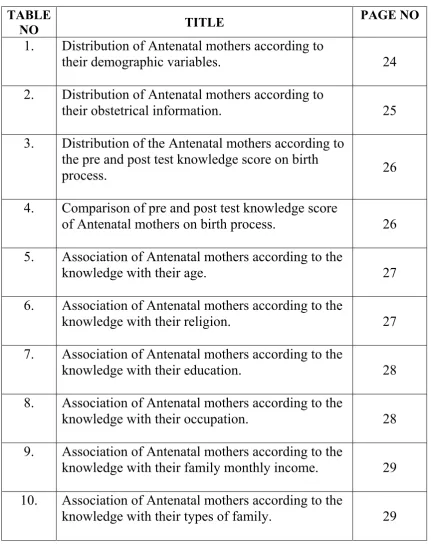
TABLE
NO TITLE
PAGE NO
1.
Distribution of Antenatal mothers according to
their demographic variables.
24
2.
Distribution of Antenatal mothers according to
their obstetrical information.
25
3.
Distribution of the Antenatal mothers according to
the pre and post test knowledge score on birth
process.
26
4.
Comparison of pre and post test knowledge score
of Antenatal mothers on birth process.
26
5.
Association of Antenatal mothers according to the
knowledge with their age.
27
6.
Association of Antenatal mothers according to the
knowledge with their religion.
27
7.
Association of Antenatal mothers according to the
knowledge with their education.
28
8.
Association of Antenatal mothers according to the
knowledge with their occupation.
28
9.
Association of Antenatal mothers according to the
knowledge with their family monthly income.
29
10.
Association of Antenatal mothers according to the
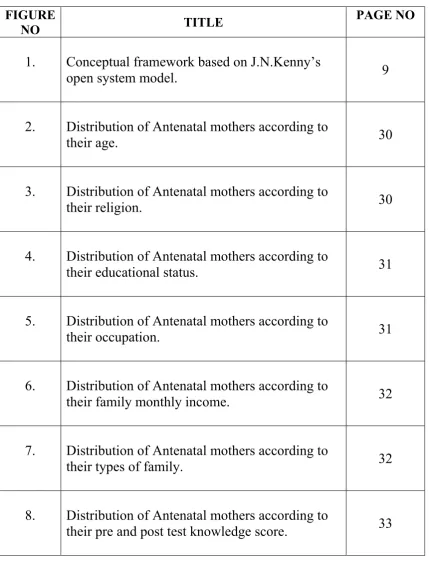
[image:7.595.101.533.94.645.2]FIGURE
NO TITLE
PAGE NO
1.
Conceptual framework based on J.N.Kenny’s
open system model.
9
2.
Distribution of Antenatal mothers according to
their age.
30
3.
Distribution of Antenatal mothers according to
their religion.
30
4.
Distribution of Antenatal mothers according to
their educational status.
31
5.
Distribution of Antenatal mothers according to
their occupation.
31
6.
Distribution of Antenatal mothers according to
their family monthly income.
32
7.
Distribution of Antenatal mothers according to
their types of family.
32
8.
Distribution of Antenatal mothers according to
APPENDIX NO TITLE
I
Semi-structured questionnaire to assess the knowledge
on birth process-English.
II
Semi-structured questionnaire to assess the knowledge
on birth process-Tamil.
III
Health teaching-Lesson plan on birth process - English
IV
Information on birth process - Tamil
V
Copy of letter seeking permission to conduct the study
VI
Copies of certification of content validity
VII
List of experts consulted for content validity
Introduction
Bringing a baby into the world is one of the most blissful periods in any mother’s life, as it brings delight and happiness to the entire family. However, many
women find this period quite stressful, feel tearful, depressed and even hesitate to acknowledge that after going through labor and giving birth, their feelings are not as
positive as expected.
Statement of the problem
Effectiveness of video assisted teaching on knowledge regarding birth process among antenatal mothers in primary health centre at poovanthi.
Aim
Find out effectiveness of video assisted teaching programme on knowledge regarding birth process.
Design
The design used was the pre experimental-one group pretest and post test design
Settings
The study was conducted in primary health centre, poovanthi. Methods
Using purposive sampling.100 antenatal mothers were administered video assisted teaching on knowledge regarding birth process.
Results
The results shown there was a significant difference in knowledge on birth process before and after video assisted teaching among antenatal mothers.
Conclusion
CHAPTER I
INTRODUCTION
The wisdom and compassion a woman can intuitively experience
in childbirth can make her a source of healing and understanding for other
women” -Stephen gaskin
Pregnancy- a new dimension in a women’s life, a state of poise and grace is one of the greatest experience in life. Pregnancy should normally soil smoothly, without any problems, as it is a marvel. Whatever nature does, it is always with certain method and order. (Shanthi.S, Venkatachalapathi, 2007)
Aristotle 384-322B.C. was the first man who urged care of the mind of women delivering a baby. There is no another occasion what is celebrated with so much joy and relief than the safe birth of a healthy child. (Gandhimathi M, Kamala S, 2007)
A Mother, even though she has born earlier in this world, she is perceiving experience of the rebirth by giving a childbirth. The wonder of the motherhood is the enjoyable journey that is felt only by mother after given birth (Karpagavalli.G, Judie.A, 2008)
Birth is inextricably relation to gender, women give birth, and this confers a particular role within society for women, based on the culture in which they live. The role of motherhood is grounded in historical and societal influences, and an understanding of women cultural identities enables midwives to give support through the transition from women to mother (Davies, 2000)
Child birth is an experience in a woman’s life that holds the power to transform her forever. Passing through these powerful gates in her own way remembering all the generations of women who talk with her she is never alone. (Suzanne arms,2007)
first act of motherhood. Labour process starts with the onset of regular uterine activity associated with effacement and dilatation of the cervix and descent of the presenting part through the cervix.
WAG, 2006 says that the pregnancy and child birth are natural events but also have a great social and emotional significance, particularly for those who are experiencing this for the first time. The prospect of transition of parenthood can bring a great joy and excitement but also bring anxiety of the birth process and the responsibility that parenthood brings the challenges of health care providers is to minimize the risk for mother and baby, ensure that the pregnancy and childbirth is satisfying one, and support the family in adapting the changes needed to love and nurture a new member of the family
Malathi.D, Judie.A, 2008 conveys that the child birth is one of the greatest events in every woman’s life. Having hard fantasies about pregnancy and motherhood, when confronted with the reality, many of them doubt their ability to cope with this great event in their lives. At this time, the mothers need lot of help for the realization and acceptance of child birth as a normal physiological phenomenon. Realization of this need by the obstetricians led to the development of psychosomatic methods of preparation for child birth
NEED FOR STUDY:
As per the census of India in 2011, birth rate is 20.6 births/1000 populations and death rate is 6.4 deaths/1000 population, it indicates that there is rapid increase in India’s population. The fertility rate in India is 2.72 children born/woman. Out of 1000 mothers, 1300 mothers undergo prolonged labour. With this there are many complications expected for both mother and baby, associated with prolonged labour. Hence it is necessary to prevent the prolonged labour and shorten the duration of labour by means of improving the health teaching among mothers.
Rao kamini, 2011, says the pregnant women become more focused about labour and birth of a child as they approach the final phase of pregnancy. They become eager to plan the events for the delivery and the postpartum period. Midwives and maternity nurses play a vital role in helping pregnant women overcome their fear and anxieties about labour and child birth. Various educational programmes and methods have been designed to help pregnant women and both the parents in general, to know the different aspects of labour and delivery. These programmes aim to alleviate the fear and help new parents to cope with the child birth in positive manner.
During pregnancy there was a general belief that fears of labor and delivery creates tension, which in turn leads to pain to overcome the physiological, psychological and family problems, the couples can go for child birth preparation classes. It is the vital role that couples are to be equipped for the challenges of modern day parenting (Cher tock, 1961)
Bakshi R, et.al, 2008 said Fear related to pregnancy and childbirth is very common in women. These fear and anxiety have individual variation. It’s more intense in primigravidae than multigravidae. The anticipation of labour will probably evoke a degree of anxiety in first time mothers. Women with increased tokophobia can have increased psychological morbidity during both antepartum and postpartum period. A variable number of 20% to 78% of pregnant women report fear associated with the pregnancy and childbirth. However 13% of nongravid women report fear of childbirth sufficient to postpone or avoid pregnancy. Management in terms of proper childbirth education and counseling should be implemented. Pregnant women commonly worry about the pain they will experience during labour and childbirth. A wide variety of childbirth preparation methods can provide ways to help the women cope with the discomfort of labour.
In England published a book named “Natural child birth “which was based on many years of observations of his patient’s giving birth. In his book he emphasized that most of the pain that the women experienced was caused by fear due to lack of knowledge. Grandly dick (1933)
The aim of antenatal education is to provide information about the child birth process and choices available for labor, infant feeding options and opportunity to meet the another women in the same situation which will facilitate to form a new relationships supportive networks (Spiby, 1999).
Holloway. A, 2011, says Childbirth is a subjective and multidimensional experience. No single specific technique or combination of interventions can help all women, or even the same women throughout the entire labour experience. Therefore, it can be difficult to learn all of these techniques through reading books and watching videos alone.face to face childbirth preparation sessions can provide a more through education to help future parents increase their confidence and learn strategies to reduce stress and anxiety and to manage the pain during the children event.
booklets, flipbooks, models, posters, motion picture have an advantage above all. Learning through video has been long lasting impression as it compels and holds the attention of the viewer. The individual watching the video imitates the behavior and try to be competent in performing it. This is based on principle of learning by doing which is congruent with the Chinese proverb ‘what I hear I forget, what I see I remember, what I do I know.’
Prenatal education are build women’s confidence in their own ability to give birth, to provide knowledge about normal birth and to develop individualized birth plans that provide a road map for keeping birth as normal as possible even if complications occur. (Romano.M, Judith.A, 2007)
A child birth preparation classes usually covers changes in the body during pregnancy, coping abilities during labor, presence of support person and some information on new born care. (Malathi.D, Judie.A, 2008)
Lumely.J, Brown.S,(1993) conducted the attenders and nonattenders at childbirth education classes in Australia. The study assessed the association between attendance at childbirth preparation classes and the health behaviors, birth events, satisfaction with care and later emotional well being of women having their first child. In this study response was 71.4 percent (790|1107).Classes were attended by 245(83.9%) of 292 primiparous women. It identifies only one of five measures of satisfaction with care was less favorable in non attenders.
STATEMENT OF THE PROBLEM
Effectiveness of video assisted teaching on knowledge regarding birth process among antenatal mothers in primary health centre at poovanthi.
OBJECTIVES
Assess the pre test knowledge regarding birth process among antenatal mothers.
Assess the effectiveness of video assisted teaching on knowledge regarding birth process.
Associate the pretest scores with their selected demographical variables
OPERATIONAL DEFINITIONS:
EFFECTIVENESS:
Refers to the extent in which video assisted teaching programme will achieve the desired effect in imparting knowledge regarding birth process in terms of differences between pre-test and post test score assessed by semi structured knowledge questionnaire.
VIDEO – ASSISTED TEACHING:
Refers to a teaching material developed for enhancing knowledge regarding birth process among antenatal mothers.
KNOWLEDGE:
Refers to the information regarding birth process among antenatal mothers as measured by semi structured knowledge questionnaire.
BIRTH PROCESS:
ANTENATAL MOTHERS:
Refers to women who are not given birth first time irrespective number of gestation at last trimester of her pregnancy.
HYPOTHESES:
H1: Mother shows significant difference between pretest and post test of the knowledge scores of antenatal mothers regarding birth process.
H2: Mother shows significant association between the knowledge scores and their selected demographic variables of mothers.
ASSUMPTION:
Video assisted teaching provides opportunity for learning and better understanding about birth process.
Improvements in knowledge make the mother cope up with the birth process.
LIMITATIONS:
Antenatal mothers in primary health centre at poovanthi. Antenatal mothers who are in above 32 weeks of gestation.
CONCEPTUAL FRAME WORK:
The study was based on J.N.Kenny’s open system model, 1990. A system consist of a set of interacting components within a boundary those fitters the type and rate of exchange with the environment. All living system is open. In that there is a continuous exchange of matter, energy and information. In open system, there are varying degrees of interaction with the environment, from which the system receives input and output in the form of matter, energy and information.
In this present study these concepts are explained as below. INPUT:
Based on J.W.Kenny’s open system model, input can be a matter, energy and information that enter in to the system from the environment through its boundaries.
In this study input consist of demographic data of antenatal mothers such as age, religion, education, occupation, monthly income of the family, type of family, source of information and assessing existing knowledge on birth process among antenatal mothers.
THROUGHPUT:
Through put is the operation phase or manipulation and activity phase. It is the process that allows the input to be changed. So that it is useful to the system.
In this study throughput is the construction of video assisted teaching on birth process.
OUTPUT:
Output is any information that leaves the system and enters the environment through system boundaries. It refers to the ultimate results, which are expected following programme implementation.
In this study output refers to the knowledge gained by antenatal mothers on birth process. It will also see whether the knowledge o antenatal mothers on birth process is varying with demographic variables. After processing the input, the system return output to the environment, in the form of change in behavior. If there is adequate knowledge, it helps to mother develop improved coping strategies and reduce the anxiety in birth process. Inadequate knowledge leads to poor coping strategies in birth process among antenatal mothers.
FEEDBACK:
Feedback is the result of throughput, it allows the systems to maintain its interval function, it is the process whereby the input of the system is rectified as part of the input of the same system.
‐‐‐‐‐‐‐‐‐‐‐‐‐‐
Figure 1: Schematic representation of conceptual frame work based on J.N.Kenny’s Open system model
Not done in this study
INPUT
THROUGHPUT
OUTPUT
Age
Religion
Education
Mother occupation
Family income
Types of family
Source of
information
Obstetrical
information
Assess the pre
test level of
knowledge
regarding birth
process
Implementing
video assisted
teaching on
knowledge
regarding birth
BACKGROUND
INFORMATION
OF
ANTENATAL
MOTHERS
Inadequate knowledge
Gain in knowledge
Assess the post test
level of knowledge
regarding birth
[image:19.595.91.783.149.494.2]CHAPTER –II
REVIEW OF LITERATURE
The extensive review was made to strengthen the present study in order to lay down the foundation, which helps to reveal the prevailing situation of the similar studies in different areas. Existing studies and information are often indispensable in helping the investigator to focus on a particular problem and to formulate suitable research process.
The literature are organized under the following headings. I. Studies related to the mothers knowledge on birth process.
II. Studies related to the importance of antenatal education classes on birth process. III. Studies related to the effectiveness of video assisted teaching on birth process.
I. Studies related to knowledge on birth process:
Manju S, Sudhanshu S, (2012) conducted a qualitative study on knowledge, attitude and belief of pregnant women towards safe motherhood in jaipur,india.100 pregnant women were selected through systematic purposive sampling technique. Data were collected through structured questionnaire. The study depicts there is no significant difference between three different age groups (p=.647).knowledge of safe mothering differed significantly across parity (p=.001), no significant difference in knowledge between the three different groups for education (p=.063).Findings from this study suggest that need for targeted health education using various educational method for rural women. The study also suggests regular individual counseling of pregnant women can seek to bridge the knowledge of pregnant women regarding safe motherhood.
Gayathri.KV,Sudha.A,Metgud.MC.(2010) conducted a quasi-experimental study to evaluate the effectiveness of planned teaching program on knowledge and reducing anxiety labour among 60 primigravidae mother in selected hospitals,belgaum. Samples were selected through purposive sampling technique. This study result shows that knowledge score mean difference in experimental group was 16.8 and in control group it was 0.6.The anxiety score mean difference was 37.6 in experimental group and in control group it was 0.16.The study identified planned teaching programme helpes in gaining knowledge and reducing anxiety about labour in primigravidae.
Malathi D, judie A, (2008) conducted a study on assessment of knowledge and attitude on child birth preparation and factors promoting and depromoting the utility of service among 100 primigravida mothers in Chennai. Samples were selected through non probability convenience sampling technique. The analysis reveals that among primigravida mothers, the overall mean score of knowledge is 7.84 and the overall mean score of attitude is 2.28 .It clearly indicates positive correlation exist between knowledge and attitude(r=0.29) which is significant at<0.05 level. This study concludes that the primigravida mothers attending the child birth preparation classes will have an adequate level of knowledge and favourable attitude towards child birth preparation.
Ibach.F,Dyer.RA,Fawcus.S,Dyer.SJ,(2007) conducted a qualitative study to analyze knowledge and expectations of labour among primigravida women in public health sector in Cape Town, Africa.30 samples black African are selected. . Data was collected through an open-ended interview guide. The findings revealed that patients were poorly informed about the process and pain of labour .Most women appeared highly motivated concerning their ability to cope with labour. Study concluded that those mothers were poorly prepared for the experience of delivery. Antenatal programmes should incorporate sensitive education concerning the process and pain of labour and the methods available to alleviate pain.
Bester MB, Nolte AG, (1992) conducted a descriptive study on knowledge and expectation of child birth in primigravidas in johanneburg. primigravida mothers are selected by survey method. From this research it is clear that the respondents had insufficient knowledge of childbirth and handling of pain during childbirth. This insufficient knowledge can mainly be attributed to the poor attendance of antenatal preparation classes, inadequate professional counseling and the mother of the primigravida as the primary source of information on childbirth.
II. Studies related to importance of antenatal education classes.
Artieta-pinedo I,Paz-Pascual C,(2010) conducted a prospective observational study to the benefits of antenatal education for the childbirth process among 616 pregnant nulliparous women in spain. The study result shows that spanish women who had attended antenatal education classes experienced less anxiety during birth than those who had not(Hospital anxiety and depression scale score adjusted difference=-1.5,95% confidence interval =-0.1 to 3.0),whereas the opposite was found for immigrant women(adjusted difference =2.4;95% confidence interval=-0.6 to 5.4;antenatal education x nationality interaction,(p=o2).no dose response relationship was found between antenatal education and anxiety, and no benefits were seen for the other variables.
birth preparedness planning was poor even though these mothers had good perceptions about preparedness. Obtaining the basic safe birth supplies was literally taken has having birth preparedness plan by most antenatal mothers.
Lee LY, Holroyd E, (2009) evaluating the effect of childbirth education class on their labour experience among pregnant women in Hong Kong, China. Two-phase study was adopted. In Phase One, 40 Chinese women were selected through random sampling technique, in phase two, 40 original women were selected through purposive sampling technique. The study result shows that the participants expressed overall satisfaction with the class. The study supports using a mixed method approach to evaluate client education activity and highlights the importance of cultivating positive coping measures among the Chinese women after attending childbirth education class when facing childbirth related anxiety.
Serçekuş P, Okumuş H. (2009) a qualitative study was conducted fear associated with childbirth among 19 nulliparous women in Turkey. Data was gathered
through semi structured interviews and analyzed by using the content analysis method. The findings revealed women’s fear were related to labour pain, birth related problems and procedures, attitudes of health care personnel and sexuality. The study considering the potential for negative findings caused by fear, and the likelihood of requesting a caesarean section, it is important for health professionals who provide antenatal care to explore fear related to childbirth. The development and evaluation of formal childbirth education is also recommended.
Multiso SM,Quershi Z,Kinuthia J.(2006) conducted a descriptive cross sectional study on birth preparedness among antenatal clients in Nairobi.394 systematic sampling was used for this study. The study result shows that over 60% of the respondents were counselled by health workers on various elements of birth
Robert A, Neena khadka,et al,(2003-2004) conducted a birth preparedness programmes (BPP) among pregnant women in Siraha,Nepal.162 were directly exposed to BPP materials while pregnant. This study result shows a composite index of seven indictors that measure knowledge of respondents, use of health services, and preparation for emergencies increased from 33% at baseline to 54% at endline (P=0.001).Five key newborn practices increased by19to29% from baseline to endline (p values ranged from 0.000 to 0.06).The BPP can positively influence knowledge and intermediate health outcomes, such as household practices and use of some health services.
Gibbins J, Thomson AM. (2001) conducted a qualitative study of Women's expectations and experiences of childbirth in England. Eight pregnant women are selected. The women all wanted to take an active part in their labour and the feeling of being 'in control' was the main finding and the 'essence' of this study. This was achieved through support from partners, the positive attitudes of the midwives caring for them during pregnancy and labour, information given during pregnancy and labour and being able to make and be included in decision making during labour.
Spiby H, Henderson B, et al. (1999) conducted a Strategies for coping with labour in England. 121 nulliparous women are selected. The findings of this study of a group of well-prepared women raise questions about the correct components of antenatal classes and how midwives and birth companions can be involved optimally in this aspect of a woman's labour. The study concluded that further research is required to determine how women can best be helped to cope with the experience of labour.
Slade P,Macpherson SA,et al.(1993) conducted a study on expectations, experiences and satisfaction with labour among 81 primiparous women in westernbank, uk. The study findings shows that positive emotional expectations were strong predictors of positive emotional experiences and unrelated to negative emotional expectations. Expectations in general were positively related to experience but the strength of the association was weak. Personal satisfaction (i.e. satisfaction with self) in labour was strongly associated with the ability to control panic and other aspects of personal control. This study concluded that attenders and non-attenders at antenatal preparation classes shows no significant differences in their experiences or personal satisfaction levels. Possible explanations for this absence of impact are discussed together with issues concerning the relevance of psychological theory to midwifery practice and the need for greater integration.
III. Studies related to effectiveness of video assisted teaching.
Kirandeep Kaur,Avinash Kaur Rana,Shalini Gainder(2013)done a quasi experimental study to assess the effect of video on breathing exercises during labour on pain perception and duration of labour among primigravida mothers in india.40 mothers are selected purposely. The study result shown the assessment of pain perception at the latent,early and late active phases of first stage of labour was statistical significant difference among experimental and control group(p<0.01).statistical significant difference(p<0.01) was also observed in the duration of first stage of labour with mean duration in experimental group as compared to control group. The mean duration of second stage of labour was also significantly less(p<0.01).The study concluded that the practice of breathing exercises during labour help to reduce pain perception and duration of first and second stage of labour.
mean percentage in the post test 24.13%.And in experimental group the mean percentage of knowledge in the pretest 20.73% , and mean percentage in the post test was 33.1% .The results revealed that the gain of knowledge score was statistically significant(t=9.11 p<0.05).The significant difference between pre test and post test knowledge score in control group was(t=10.84 p<0.05).the significance of difference between pre test and post test knowledge score in experimental group was t=12.62 p<0.05.Therfore,it was concluded that the structured information education and communication programme(SIECP) was effective in improving the knowledge of primigravidae mothers and their spouses regarding birth preparedness.
Seyedeh Fatemeh,Mazloomeh Hamzehkhani,et al.(2012) conducted a study to evaluate the effect of educational software on self efficacy of pregnant women to cope with labor in Iran.150 pregnant women were selected through random sample, data was collected through childbirth self efficacy questionnaire(CBSEI) was used which measures the outcome expectancy of the first and second stages of labor separately. After the intervention result shown the control groups were 607,604\20±16\630 and 394,392\51±16\758,respectively.There was a statistical difference between the two groups(p=0.001).Also statistically significant differences existed in the median of outcome expectancy and self efficacy expectancy after intervention in both stages of labour between the two groups(p=0.001).The study concludes the educational software program significantly increased self efficacy of Iranian pregnant women to cope with labour. Despite lack of educational childbirth classes in iran, the use of this method is recommended.
CHAPTER III
RESEARCH METHODOLOGY
This chapter deals with the methods adopted by the researcher to find out the effectiveness of video assisted teaching on knowledge regarding birth process. It deals research approach, research design, the setting, population, sample size, sampling technique, development cum description of tool, validity, reliability, pilot study, and procedure for data collection and plan for data analysis.
Research Approach
Evaluatory approach used to conduct the study. It aimed to evaluate the effectivenesss of video assisted teaching on knowledge regarding birth process
Research Design
Pre experimental-one group pre test post test design is adopted for this study.
O1 X O2
O1 pre test assessment of knowledge.
X video assisted teaching
O2 post test assessment of knowledge. VARIABLES UNDER THE STUDY
i) Independent Variables:
Video assisted teaching rendered by the researcher to the antenatal
mothers on birth process.
ii) Dependent Variables:
Setting of the study
The study was conducted in antenatal OPD of primary health centre in poovanthi. Approximately 400to 500 antenatal mothers are attended in antenatal clinic per month among them 200 to 300 mothers are primi gravida mothers.
Study Population
Study population comprise of antenatal mothers in their last trimester who are visiting antenatal OPD.
Sample
Antenatal mothers who fulfil the inclusion criteria will be consider as a sample.
Sampling size
Sample size consists of 100 primi gravida mothers.
Sampling Technique
Non probability-purposive sampling technique was used for this study.
Criteria for sample selection
The samples are selected based on the following inclusion and exclusion criteria.
Inclusion criteria: The study includes,
1. Antenatal mothers in their last trimester who are willing to participate in the study.
2. Antenatal mothers who speak read and write Tamil.
3. Antenatal mothers who are available during data collection period.
Exclusion criteria: The study excludes,
1. Antenatal mothers who are at risk. 2. Multi gravida mothers.
3. Mothers who are in birth process.
Research Tool and Technique
The instruments used in this research study consist of four sections.
Section A: It comprised of demographic variables such as name, age, educational status, occupation, monthly income, obstetrical history and information about birth process.
Section B: It comprised obstetrical score which includes gravida, para, and abortion. Section C: It comprised of semi structured questionnaire to assess the mothers knowledge regarding birth process. It was edited as per the blueprint and different content area. It consist of 30 multiple choice questions. Fact ideal had four choices out of which one was correct answers and the remaining there were wrong answers.
A score value of ‘one’ was allotted to each correct response. ‘Zero’ was rewarded for the wrong response. Thus there were 30 maximum obtainable scores. The level of knowledge was graded based on percentage of scores obtained.
Part I: It consist of first stage of labour (included 17 questions)
Part II: It consist of second stage of labour (included 8 questions)
Part III: It consist of third stage and fourth stage of labour (included 5 questions)
Section D: It comprised video assisted teaching on knowledge regarding birth process among antenatal mothers. The content on birth process was selected through literature
search and in consultation with experts. The content of the video assisted teaching was organised well by the following headings.
Meaning of labour
Duration of labour process
The signs and symptoms of labour the preparation for admission to the hospital
First stage of labour
Second stage of labour
Third stage of labour
CONTENT VALIDITY
Assessment tool was evaluated by five experts from the field of Nursing and
Medicine for content validity. Suggestions were considered and appropriate changes
were done and to made the tool to be valid.
RELIABILITY
The data were collected from 10 samples to find out the reliability. The split
half method was used to establish the reliability of the tool and the reliability value of
the tool was r=0.84, hence the questionnaire was found to be reliable.
PILOT STUDY
Pilot study was conducted in kalayarmangalam primary health centre for the
period of one week on ten antenatal mothers in order to test the feasibility, relevance
and practicability of the study. Results show that the study was feasible to carry out
the study.
DATA COLLECTION PROCEDURE:
The investigator met the head of the institution in order to establish support
and co-operation to conduct the study successfully. The formal prior permission was
obtained from the Medical director of primary health centre, Poovanthi for main
study. The investigator introduced herself to the antenatal mothers and established
rapport with them. The study was conducted for period of one month. The
investigator selected the sample that fulfilled the inclusion criteria. The informed
consent was obtained. Appropriate orientation had given to the subjects about of the
aim of the study, nature of questionnaire and adequate care was taken for protecting
the subjects from potential risk including maintaining confidentially, security and
done to assess the mother knowledge through semi structured questionnaire .The
video assisted teaching was administered. The post test of study was carried out seven
days later, using same tool as the pre test. Collected data was then tabulated and
analysed.
STATISTICAL ANALYSIS.
Collected data was analyzed by using descriptive and inferential statistics.
Descriptive statistics (Mean, Frequency, Standard deviation) were used to describe
the knowledge. Inferential statistics were used to determine the association between
knowledge and demographic variables. Computed statistical evidences are
CHAPTER IV
DATA ANALYSIS AND INTERPRETATION
This chapter deals with the description of the samples, analysis and
interpretation of the collected data. The collected data is tabulated and described as follows.
Section I: Distribution of the antenatal mothers according to their demographic variables and obstetrical information.
Section II: Distribution of the antenatal mother according to the pretest and post test knowledge score on birth process.
Section II: Comparison off pretest and post test knowledge score of antenatal mother on birth process.
Section IV: Association of antenatal mothers pretest knowledge score with their selected demographic variables
SECTION – I
Table 1Distribution of Antenatal mothers according to demographic variables.
n=100
S.NO Demographic variables Mother
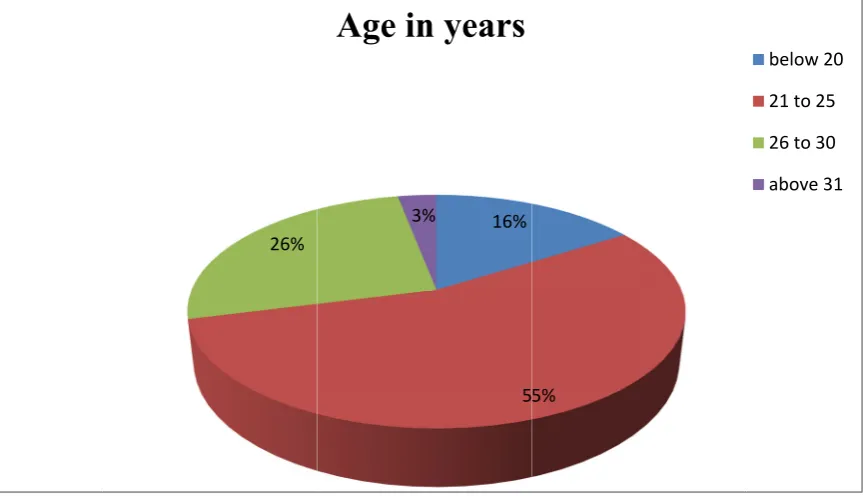
1 Age in years f %
Below 20 16 16
21 to 25 55 55
26 to 30 26 26
Above 31 03 03
2 Religion
Hindu 95 95
Christian 03 03
Muslim 02 02
Others 0 0
3 Educational status
Illiterate 09 09
Primary level 23 23
Higher secondary level 58 58 Graduate and above 06 06 4 Occupation
House wife 43 43
Daily wage earner 51 51 Private| government sector 03 03
Business 03 03
5 Family income
Below 3,000 28 28
3,001 to 5,000 57 57
5,001 to 10,000 11 11
Above 10,000 04 04
6 Types of family
Nuclear family 48 48
Joint family 52 52
Regarding family monthly income, among 28(28%) have up to Rs.3000, 57(57%) have between Rs3001-5000, 11(11%) have Rs5001-10, 000, 4(4%) have more than income of Rs10, 000.Regarding type of family, among 100, 48(48%) belongs to nuclear family, 52(52%) belongs to joint family.
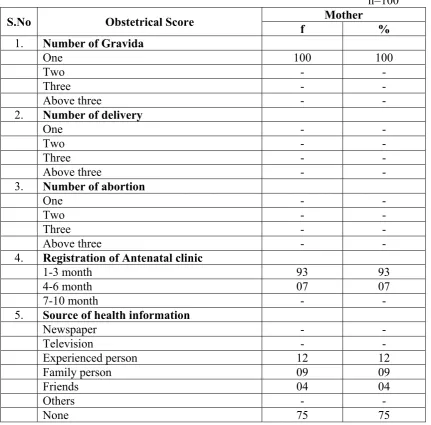
Table 2 Distribution of Antenatal mothers according to their Obstetrical information
n=100
S.No Obstetrical Score f % Mother
1. Number of Gravida
One 100 100
Two - -
Three - -
Above three - -
2. Number of delivery
One - -
Two - -
Three - -
Above three - -
3. Number of abortion
One - -
Two - -
Three - -
Above three - -
4. Registration of Antenatal clinic
1-3 month 93 93
4-6 month 07 07
7-10 month - -
5. Source of health information
Newspaper - -
Television - -
Experienced person 12 12
Family person 09 09
Friends 04 04
Others - -
None 75 75
health information, 12 (12%) receives information from experienced person, 9 (9%) knows from family persons, 4 (4%) are from friends, and 75 (75%) are not yet received any information on birth process from above said sources.
SECTION II
Table 3 Distribution of Ante natal mothers according to the pretest and post test level of knowledge on birth process.
[image:36.595.107.527.251.387.2]n=100
Table 3 shows out of 100 Antenatal mothers, pre test knowledge score only37 % mother are having good score, 59% are having average score, and 4% are having poor score. Post test knowledge score 82% are having excellent score, 18% are having good score.
[image:36.595.103.531.602.668.2]SECTION III
Table 4Comparison of pretest and post test level of knowledge of Antenatal mothers
n =100 S.No. Level of knowledge Mean SD ‘t’ value
1. Pretest 13.31
3.73 8.458
2. Post test 25.41
The above table shows knowledge score on birth process. When focusing post test mean scored are high compared to the pre test mean score in knowledge. The results proven that the programme rendered by the researcher was effective.
S.No. Level of knowledge
Pretest Post test
f % f %
1 Excellent - - 82 82
2. Good 37 37 18 18
3. Average 59 59 - -
SECTION IV
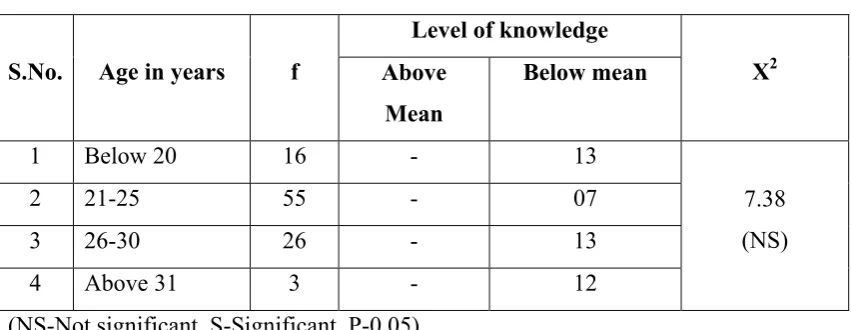
Table 5.aAssociation of Antenatal mothers knowledge score with their age n=100
S.No. Age in years f
Level of knowledge
X2 Above
Mean
Below mean
1 Below 20 16 - 13
7.38 (NS)
2 21-25 55 - 07
3 26-30 26 - 13
4 Above 31 3 - 12
(NS-Not significant, S-Significant, P-0.05)
The above table depicts the association of Antenatal mothers knowledge on birth process with their age, the calculated value of chi-square (7.38) was less than the table value at 005 level 0f significance. So there was no significant association exist between the ages of mothers.
Table 5. Association of Antenatal mother knowledge score with their religion n=100
S.No Religion f Level of knowledge X2 Above mean Below mean
1. Hindu 95 - 13
1.31 (NS)
2. Christian 3 19 -
3. Muslim 2 - 10
4. Others 0 - -
(NS-Not significant, S-significant, P-0.05)
[image:37.595.102.530.458.603.2]Table 5.cAssociation of Ante natal mothers knowledge score with their education
n=100
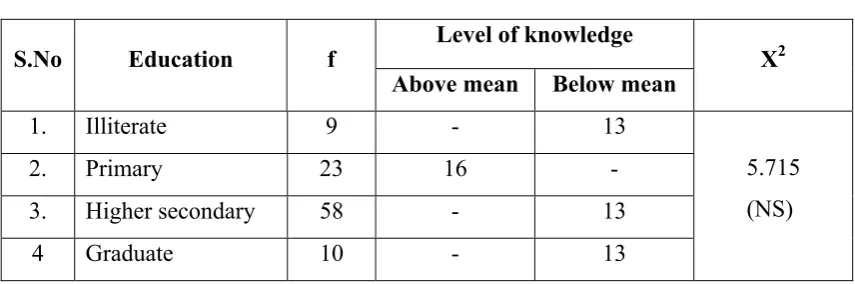
S.No Education f Level of knowledge X2 Above mean Below mean
1. Illiterate 9 - 13
5.715 (NS)
2. Primary 23 16 -
3. Higher secondary 58 - 13
4 Graduate 10 - 13
The above table depicts the association of Antenatal mothers knowledge on birth process with their education status. The calculated value of chi-square (5.715) was less than the table value at 0.05 level of significance. So there was no significant association exist between the educational statuses of mothers.
Table 5.d Association of Antenatal mothers knowledge score with their
Family monthly income n=100
S.No Family income f
Level of knowledge X2 Above mean Below mean
6.37 (NS)
1. Below 3000 28 - 13
2. 3000 to 5000 57 14 -
3. 5000 to10,000 11 - 05
4. Above 10,000 04 - 03
[image:38.595.104.531.435.579.2]
Table 5 .e Association of Antenatal mothers knowledge score with mother occupation
n=100
S.No Mother occupation f Level of knowledge
X2 Above mean Below mean
1 House wife 43 - 12
2.996 (NS)
2 Daily wage earner 51 37 -
3 Working 3 - 12
4 Business 3 - 19
The above table depicts the association of knowledge regarding mother occupation calculated value of chi-square (2.996) was less than the table value at 0.05 level of significant. So there was no association exist between the mother occupation.
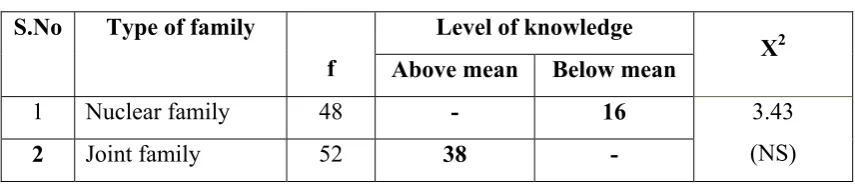
Table5.f Association of Ante natal mothers knowledge score with Types of family n=100
S.No Type of family
f
Level of knowledge
X2 Above mean Below mean
1 Nuclear family 48 - 16 3.43
(NS)
2 Joint family 52 38 -
F
Fig
[image:40.595.110.542.78.326.2]
Figure 1: D
gure 2: Dist
Distribution
tribution of
26%
3
n ofmother
fmother ac
3%
Age in
95% 3% 2%
Reli
r according ccording to 16% 5 %n years
%igion
g to their ag
o their relig
5%
ge group
gions statuss
below 20 21 to 25 26 to 30 above 31
[image:40.595.112.543.412.671.2]Fi Figur 0 10 20 30 40 50 60 70 80 90 100 0% 10% 20% 30% 40% 50% 60% 70% 80% 90% 100%
igure 3: Dist
re 4: Distri
9 23 58 10
43 51 3 3 tribution of
bution ofm
f mother acc
mother acco
Educati
Occup
cording to th
ording to th
onal
sta
ation
heir educatio heir motheatus
graduate secondary primary le illetrate
onal status
er occupatio
and above y level evel
Business Working Daily wage House wife
[image:41.595.115.488.72.327.2]
Figure Fig 0 10 20 30 40 50 60 70 80 90 100 2 40 60 80 100 5: Distribu
gure 6: Dist
28 57 11 4 0% 0% 0% 0% 0% 0% Nucle fami 4
ution ofmo
tribution of
F
am
ear
ly Joint fam
48 52
other accor
fmother ac
mily
mon
mily 2
Types
ding to the
ccording to
nthly
inc
of fam
ir family m
o their type
come
ily
monthly inc
es of family
>Rs
Rs 5 Rs 3 < Rs
Nu
Joi
come
y
10,000 ,000‐10,000 ,000‐5,000
3,000
uclear family
nt family
[image:42.595.111.540.385.641.2]
Figure 0 10 20 30 40 50 60 70 80 90 100
e 6: Distrib
Pre test 37 59 4
Pr
bution ofm
re
test
‐
p
mother acco knowledg
Post test 82
18
post
tes
rding to th ge score
Co
st
know
heir pre test
olumn1
wledge
sc
t and post t
[image:43.595.110.555.68.380.2]CHAPTER V
DISCUSSION, SUMMARY, CONCLUSION, IMPLICATION,
RECOMMENDATION
Certain levels of fear and anxiety about childbirth are expected, especially among first-time pregnant mothers. However, problems arise when these feelings negatively impact a woman's decisions and perceptions about the birth process. Although millions of women give birth each year, there are limited data to document the development of maternal confidence for labor and fear of labor throughout the period of gestation.
Throughout gestation, a woman is confronted with numerous powerful external factors which may exert influence over her decisions regarding medical intervention. Healthcare providers, insurance companies, childbirth educators, family, friends and the media. Yet, internal influences cannot be ignored. Positively, studies investigating maternal confidence for labor have found evidence supporting the idea that increased confidence for labor reduces a woman’s perceived pain during delivery. It is unknown how and when these feelings of confidence develop, or fail to develop, during gestation. Thus, the unresolved issue of maternal self-confidence remains: How do we empower women to have the confidence to take control of their own birth and decrease their fear which may, in turn, decrease their need for pain relief and increase their satisfaction with labor.
The first Objective was to assess the pre test knowledge regarding birth process among antenatal mothers.
Antenatal mothers pre test knowledge score on knowledge regarding birth process, 37% mothers were having good ,59% mothers were having average,4% mothers were having poor.post test knowledge score of the mother82% mothers were having excellent,18% were having good.
The second objective was to assess the effectiveness of video assisted teaching on knowledge regarding birth process.
Mothers shown improved knowledge after video assisted teaching programme on knowledge regarding birth process.37% of mother had good knowledge score and 59% mothers had average knowledge score in pre test improved to82% excellent score respectively.4% had poor knowledge score in pre test improved to18% good score in respectively. Hence formulate H1 was accepted. This shows that there is
significant improvement in knowledge score on birth process after administering video assisted teaching programme. Through the study the researcher personally found that the video assisted teaching was effective in improving knowledge of antenatal mothers on birth process.
The third objective was to associate the pretest scores with their selected demographical variables.
Summary
The study was conducted to evaluate the effectiveness of video assisted teaching on knowledge regarding birth process among antenatal mothers, poovanthi.
The objectives of the study were
Assess the pre test knowledge regarding birth process among antenatal mothers.
Assess the effectiveness of video assisted teaching on knowledge regarding birth process.
Associate the pretest scores with their selected demographical variables.
The study tested and proved the hypotheses H1 that there is a significant
improvement in the pre test and post test knowledge of mother receives video assisted teaching.H2 that there is a no significant relationship that exists between the
knowledge score on birth process among antenatal mothers.
The study was based on J.N.Kenny’s open model;evoluatory approach used to conduct the study. The research design adopted for the present study was pre experimental in nature. Purposive random sampling technique was used for selection of samples. The data was collected for a period of one month from the mother of primary health centre. The investigator rendered given video assisted teaching on birth process. Then they were assessed to test knowledge after a week with the structured questionnaire.
Based on the objectives and hypotheses, the data were analyzed using both descriptive and inferential statistics.
Major findings of the study:
Out of 100 antenatal mothers, Regarding age 16% belongs to below 20 years of age, 55% belongs to 21 to25years of age, and 26% belongs to26 to 30years of age.
Regarding religion, among 100, 95% belongs to Hindu family, 3% belongs to
Regarding mother’s educational status, among 100, 9% had illiterate, 23%
had primary education, 58% had higher secondary, and 10% had Graduate.
Regarding mother occupation, among 100, 43% belongs to house wife, 51%
belongs to daily wage earner, 33% belongs to private and government
sector,3% belongs to business.
Regarding family monthly income in Rs, 28% have up to Rs.3,000,57% have
between Rs3,001-5,000,11% have Rs5,001-10,000,4% have more than
Rs10,000.
Regarding types of family, 48% belongs to nuclear family,52% belongs to joint family.
Regarding registration of antenatal clinic, 93% had registered 1-3 month, 7% had registered 4-6 months.
Regarding source of information, 12% got information from experienced person, 9% got information from family persons, 4% got information from friends, and 75% not get any information from any source.
Antenatal mothers pre test knowledge score on birth process 37% of mother were having good score,59% of mother were having average score and 4% of mother were having poor score.post test knowledge score of the mother 82% were having excellent score,18% were having good score. The hypotheses H1
was accepted that the mother shows significant improvement in knowledge score.
Conclusion
The following conclusions are drawn from the study,
H1: Antenatal mother shows significant difference between pretest and post test
of the knowledge scores of antenatal mothers receive video assisted teaching on birth process.
Antenatal mothers pretest knowledge score on birth process 37% of mother were having good score,59% of mother were having average score and 4% of mother were having poor score.post test knowledge score of the mother 82% were having excellent score,18% were having good score. Hence H1is accepted.
H2: Antenatal mothers shows significant association between the knowledge
scores and selected demographic variables of mothers.
There was no significant association exist between Antenatal mothers knowledge on birth process with their selected demographic variables. Hence H2 is rejected.
Implications
The present study findings have several implications in hospital settings, nursing practice, nursing education, nursing research and nursing administration.
Nursing Practice
Nurses must require adequate knowledge that would help to impart and
improve the knowledge of antenatal mothers regarding birth process.
The findings of the study enlighten the fact that administration of video
assisted teaching can be used to reduce the mothers fear and anxiety and
Nursing Education
Video can be used by the student to imparting knowledge on birth process to the Antenatal primi mothers in both urban and rural while giving health education.
Nurse educator can prepare the nursing students a in order to give importance of teaching programme on birth process by using different educational and teaching Aids.
Nursing Research
The findings of the present study are helpful for the nursing professionals and nursing teachers to conduct further studies to find out the effectiveness of various methods of providing education on improving the knowledge of regarding birth process among antenatal mothers.
Nursing Administration
Nurse administrator should take interest in motivating the nursing personnel to improve their professional knowledge, skill by attending the workshops, health conference, seminars and training programme on birth process.
Nurse administrator should arrange regular in-service education programme to the health care worker giving skill in teaching Antenatal mothers on birth process in both hospital and community settings.
Recommendations
A similar study can be conducted using large population to generalize the findings.
A comparative study can be done to assess the knowledge regarding birth process in primi and multipara.
A further study can be conducted to assess the Antenatal mothers knowledge and attitude towards birth process in urban and rural areas.
REFERENCES:
1. Bakshi R, Mehta A, Mehta A, Sharma B. Tokophobia: Fear of pregnancy and childbirth. The Internet journal Of Gynecology and Obstetrics[serialonline]. 2008 [cited2010Nov22]; 10(1). Available from:http://www.ispub.com 2. Basavanthappa, B.T. (1998). Nursing Research.Banglore: Jaypee Brothers. 3. Bennet, V.R., & Brown, L.K. (1997). Myles Text Book For Midwives.
Philadelphia: ELBS Churchill living tone.
4. Bester, MB.et al., (1992).knowledge and expectation of child birth in primigravidas15 (4):12-5.Retrived from: http://www.ispub.com
5. Burroughs. A,& Gloria. L.(2001). Maternity Nursing An Introductory Text. Philadelphia: W.B. Sanders Company.
6. C.P Thresyamma(1999). A guide to midwifery.(1stedu).keralla. 7. Child birthSS breathing technique, Available from
http://www.youtube.com/watch?v=6QXb0vzuwWs
8. Child birth education available from http://www.pregnancy familyeducation.com
9. Childbirth stages, Availale from:
www.babycenter.in
10.Dutta, D. (2004). Text Book Of Obstetrics Including Perinatology and Contraception. Calcutta: New Central Book Agency (P) Ltd.
11.Gandhimathi,M. Kamala,S.(2007). Effect of selected nursing intervention on primi gravid mothers admitted in labour ward. The Indian Journal of Hollistic nursing, volume 3.
12.Gayathri,KV.et al.,(2010).Effectiveness of planned teaching program on knowledge and reducing anxiety about labour among primigravidae in selected hospitals of belgum,Karnataka. The journal of South Asian federation of
obstetrics and gynaecology. 2(2):163-168.Retrived from:http://www.ispub.com 13.Gupta, S.P. (2000). Statistical Method. New Delhi: Sultan Chand & Sons. 14.Handerson, C., & Jones, K. (1997). Essential midwifery. London: Mosby
Publication.
15.Handfield, B.Bell,R. Do child birth classes influence decision making about labour and post partum issues. 22:153-60. Retrived
16.Holloway, A. Kurniawan, S.(2011). The Prepared Partner: can a video game
teach labor and child birth support technique. Retrived from www.springer .com
17.Ibach,F. et al.,(2007).knowledge and expectations of labour among primigravid women in the public health sector.97(6):461-4.Retrived from:http://www.ispub.com
18.Importance of child birth education available from http://www.marchofedimes.com
19.Indian population statistics Availablefrom: http://www. indaonlinepages. com/population /india.html
20.Khwairakpa, Memita Devi.(2011). Knowledge of antenatal mothers preparing for safe delivery. The journal of Nightingale nursing times.
21.Kirandeep Kaur, et al., (2013). Effect of video on Breathing exercises during labour on pain perception and duration of labour among primi gravida mothers. The journal of Nursing and Midwifery research.
22.Lee, LY. Holroyd, E. (2009). Evaluating the effect of childbirth education class. 56(3):361-8.Retrived from :http://www.ispub.com
23.Lowdermilk, Perry. S.E., &Bobak, I.M. (1999). Maternity Nursing. London: Mosby Publication.
24.Lumley, J.Brown,S.(1993).Attenders and non attenders at childbirth education classes in australia.20(3):123-30.Retrived from :http://www.ispub.com
25.Malata, A.et al., (2007).Development and evaluation of a child birth education programme for Malawian women. 60(1):67-78.
26.Malathi,D.Judie,A.(2008).Assessment of knowledge and attitude on child birth preparation and factors promoting and depromoting the utility of service among primi gravida mothers. The Indian Journal of Hollistic nursing, vol. 4. 27.Mutiso,SM.et al.,(2008).Birth preparedness among antenatal
clients.85(6):275-83.Retrived from: http://www.ispub.com
28.Raile, M.A., &Marriner, A.T. (1997). Nursing Theory Utilization and Application. Philadelphia: Mosby Publication.
30.Sercekus,P.Okkumus,H.(2009). Fears associated with child birth among nulliparous women in Turkey. 25(2):155-62.
31.Spiby,H.et al., Strategies for coping with labour. 29(2):388-94. 32.Stages of labour, available from http://www.childbirthclass.com
33.Tomay, A.M., &Alligood, R.M (2002). Nursing theorists and Their Work. St Louis: Mosby Publication.
APPENDIX: I
Section A
Semi-structured questions on knowledge regarding birth process
Instructions:
please answer the questions in order and put tick into the
specific responses
DEMOGRAPHIC DATA
1. Sample no: 2. Age in years:
a) Below 20 years ( )
b) 21-25 years ( )
c) 26-30 years ( )
d) Above 31 years ( )
3. Religion:
a) Hindu ( )
b) Christian ( )
c) Muslim ( )
d) Others ( )
4. Educational qualification:
a) Illiterate ( )
b) Primary level ( )
c) Higher secondary school ( )
5. Mother occupation:
a) House wife ( )
b) Daily wage earner ( )
c) Private sector|Government sector ( )
d) Business ( )
6. Monthly income of the family:
a) <Rs 3000 ( )
b) Rs 3001 – Rs 5000 ( )
c) Rs 5001 – Rs 10000 ( )
d) Above Rs 10000 ( )
7. Types of family:
a) Nuclear ( )
SECTION-B
OBTETRICAL HISTORY:
8. Obstetrical score:
a)Gravida : (a) 0,(b) 1,(c) 2,(d) 3, (e) above 3 ( )
b)Para : (a) 0,(b) 1,(c) 2,(d) 3, (e) above 3 ( )
c)Abortion : (a) 0,(b) 1,(c) 2, (d) 3, (e) above 3 ( )
9. Time of registration of antenatal clinic:
a) During first trimester ( )
b) During second trimester ( )
c) During third trimester ( )
10. Source of information about birth process:
a) News paper ( )
b) Television ( )
c) Experienced person ( )
d) Family guidance ( )
e) Friends ( )
f) Other ( )
SECTION-C
Questionnaire to assess the knowledge regarding birth process:
First stage of labour 1. What is meant by labour?
a) Fetus, placenta and membranes are delivered completely through the vagina ( )
b) Delivered of fetus and placenta ( )
c) Delivered of fetus ( )
d) Don’t know ( )
2. What are the changes take place before onset of labour?
a) Frequency of micturition ( )
b) Show ( )
c) Regular pain ( )
d) Don’t know ( )
3 What is meant by lightening?
a) Delivery of fetus ( )
b) Allows the fetal head to descend ( )
c) Softening of the cervix ( )
d) Don’t know ( )
4. What is true labour ?
a) Presence of regular rhythmic pain from back to abdomen ( ) b) Presence of irregular pain at the adomen ( )
c) Presence of Headache ( )
5. When the mother getting ready to go for hospital ?
a) Pain felt at the back ( )
b) Pain felt at back and abdomen ( )
c) Pain felt in legs ( )
d) Don’t know ( )
6. How many stages occur in labour?
a) Two stages ( )
b) Four stages ( )
c) Five stages ( )
d) Don’t know ( )
7. What is the first stage of labour?
a) From the time of uterine contraction to till the complete dilatation of the cervix ( )
b) From the time of the rupture of membranes to till the complete dilatation of the
Externals. ( )
c) From the dilatation of cervix to till the delivery of the fetus ( )
d) Don’t know ( )
8. How many hours needed to complete the first stage of labour among primi mothers?
a) Between 12 -14 hours ( )
b) 6-8 hours ( )
c) 15 hours ( )
9. What are the events takes place during first stage of labour?
a) Delivery of the fetus ( )
b) Lower uterine segment expand and allows the fetal head to descend( )
c) Irregular uterine contraction ( )
d) Don’t know ( )
10. What is the symptom of first stage of labour?
a) Bloody mucoid vaginal discharge ( )
b) Vaginal bleeding ( )
c) Infected foul, smelly vaginal discharge ( )
d) Don’t know ( )
11. How the mother experienced during the time of rupture of membranes?
a) Uterine contraction with gushing out of fluid from the uterus ( )
b) Severe fever ( )
c) Severe pain in abdomen ( )
d) Don’t know ( )
12 What action to be taken after the rupture of membranes?
a) Rest and relax for few minutes ( )
b) Refer to hospital immediately ( )
c) Stay at home ( )
d) Don’t know ( )
13. How to enhance the m