A STUDY TO ASSESS THE EFFECTIVENESS OF VIDEO MODULE TEACHING PROGRAMME ON KNOWLEDGE REGARDING CARDIO PULMONARY RESUSCITATION AMONG UNDER GRADUATE STUDENTS IN SELECTED
COLLEGE,CHENNAI
M.SC (NURSING) DEGREE EXAMINATION BRANCH –I MEDICAL SURGICAL NURSING
COLLEGE OF NURSING
MADRAS MEDICAL COLLEGE, CHENNAI – 03.
A dissertation submitted to
THE TAMILNADU DR.M.G.R. MEDICAL UNIVERSITY, CHENNAI – 600032.
In partial fulfillment of requirements for the degree of award of MASTER OF SCIENCE IN NURSING
A STUDY TO ASSESS THE EFFECTIVENESS OF VIDEO MODULE TEACHING PROGRAMME ON KNOWLEDGE REGARDING
CARDIO PULMONARY RESUSCITATION AMONG UNDER GRADUATE STUDENTS IN SELECTED COLLEGE,CHENNAI
Examination : M.Sc (Nursing) Degree Examination Examination month and year : _________________ _____
Branch & Course : I-Medical Surgical Nursing
Register No :
Institution : MADRAS MEDICAL COLLEGE,
COLLEGE OF NURSING.
Sd: ________________ Sd: ________________
Internal Examiner External Examiner
Date: _____________ Date: _____________
This is to certify that this dissertation titled “.A STUDY TO ASSESS THE EFFECTIVENESS OF VIDEO MODULE TEACHING PROGRAMME ON KNOWLEDGE REGARDING CARDIO PULMONARY RESUSCITATION AMONG UNDER GRADUATE STUDENTS IN SELECTED COLLEGE, CHENNAI” is a bonafide work done by A.Thadeu james, II year M.Sc Nursing student, College of Nursing, Madras Medical College, Chennai. Submitted to the Tamil Nadu DR.M.G.R. Medical University, Chennai in a partial fulfillment of the University rules and regulations towards the award of degree of Master of Science in Nursing, Branch-I Medical Surgical Nursing, under our guidance and supervision during the academic period from 2015 – 2017.
Dr. V.Kumari M.Sc(N) Ph.D, Dr.R.Narayana Babu, M.D., D.Ch
Principal, Dean,
College of Nursing, Madras Medical College, Madras Medical College, Chennai-03.
TEACHING PROGRAMME ON KNOWLEDGE REGARDING CARDIOPULMONARY RESUSCITATION AMONG UNDER GRADUATE STUDENTS IN SELECTED COLLEGE,CHENNAI
Approved by Dissertation Committee on 12.07.2016 Nursing Research Guide
_______________ Dr.V. Kumari, M.Sc.,(N).,Ph.D.,
Principal,
College of Nursing, Madras Medical College, Chennai-600 003.
Clinical Speciality Guide
____________ Mrs.DominicArockiamary,MSc(N)
Reader and Head of the Department,
Department of Medical & Surgical Nursing, College of Nursing,
Madras Medical College, Chennai- 600 003.
Medical Guide
_____________ Dr.S.Mayil Vahanan, MD..
Director and Professor
Institute of Internal Medicine
Madras Medical College and RGGGH Chennai-03
A dissertation submitted to
THE TAMILNADU DR. M.G.R. MEDICAL UNIVERSITY CHENNAI- 600 032.
In partial fulfilment of the requirement for the degree of award of MASTER OF SCIENCE IN NURSING
“It is glory of God to conceal things, but the glory of king is
to search thing out”.
God delight in concealing things scientist delight in discovering things for bestowing his blessings upon me leading and guiding me throughout this period of Research.
Nothing concrete can be achieved without an optimal inspiration during the course of work. There are several hands and hearts behind this work, I would like to express my gratitude. Great and mighty is our Lord our God, to whom all thanks and praise for all wisdom, knowledge, guidance and strength throughout this work.
I wish to express my sincere thanks to DR.R.Narayana Babu, M.D., D.Ch, Dean, Madras Medical College, Chennai, for providing necessary facilities and extending support to conduct this study.
I wish to express my sincere thanks to Dr.Sudhasesaiyan, M.D., Vice principal, Madras Medical College, Chennai, for providing necessary facilities and extending support to conduct this study
I express my heartfelt thanks to Dr.V.Kumari M.Sc(N).,Ph.D., Principal, College of Nursing, Madras Medical College, Chennai. The success of my work is created to her excellent guidance, support, constant encouragement and valuable suggestions helped in the fruitful outcome of this study.
Reader, Head of the Department, College of Nursing, Madras Medical College,Chennai. Mrs.V.K.R.Periyar Selvi., M.Sc(N) Lecturer, and Mrs.C.V.S.Umalakshmi M.Sc(N), Lecturer, college of Nursing, Mr.Murugananthan,MSc (N), Lecturer, College of nursing, Madras Medical College, Chennai, for their valuable support and assistance during this study.
It is my great pleasure and privilege to express my deep sense of gratitude to all the faculty members of College of Nursing, Madras Medical College, Chennai, for the support and assistance given by them in all possible manners to complete this study.
I render my deep sense of gratitude to Dr.S.Mayil Vahanan MD., Director and Professor, Institute of Internal medicine Madras Medical College RGGGH Chennai 03, for helping me in constructing the tools for the study and completing my study in a successful manner.
I am extremely thankful to Mr.Venkatesan,M.Sc.,M.Phil, Research Officer(statistics) Director of Medical Education, Chennai. For suggestion and guidance on statistical analysis.
It is my immense pleasure and privilege to express my gratitude to Mrs.Lizy Sonia, MSc(N), Vice principal, and Mrs.A.Merlin, M.Sc(N), Lecturer, Medical Surgical Nursing, Apollo college of Nursing, Chennai-95 for validating this tool.
Zoology Dept, Sir PT Thiyaga raja govt Arts and Science college, Chennai- , has given a permission and encouraged me to do this study.
I extend my thanks to Mr.Ravi, B.A,B.L.I.Sc., Librarian, College of Nursing, Madras Medical College, Chennai for his co-operation and assistance which built the sound knowledge for this study.
A word of appreciation to Mrs.D.Saraswathy, M.A. B.Ed., B.T. Assistant (English), JTC Boys Hr., Sec., School, Chennai for her valuable editorial support.
My sincere thanks to Mrs A.Mariyathresa, M.A., B.Ed., B.T. Assistant (Tamil), JTC Boys Hr., Sec., School, Chennai for his editorial support.
I extend my thanks to my parents Father Mr.Arockia samy(late), and to my motherMrs Arockia mary(late) they are great motivator.
I extend my thanks to my wife Mrs.M.Nayagamary and elder son Mr.T.Sebastin Marshal, he is the man behind my Success and to my younger sonMr.T.Aaron Antony,he is a great motivator.
“ FOCUS ON THE ABILITY AND NOT ON THE DISABILITY” TITLE
TO ASSESS THE EFFECTIVENESS OF VIDEO MODULE TEACHING PROGRAMME ON KNOWLEDGE REGARDING CARDIO PULMONARY RESUSCITATION AMONG UNDER GRADUATE STUDENTS IN SELECTED COLLEGES, CHENNAI
Need for the study
Heart disease is the world’s largest killer, claiming 17.5 million lives every year. About every 29 seconds, an Indian dies of heart problem. As many as 20,000 new heart patients develop everyday in India, six core Indians suffer from heart disease and 30 percent more are at high risk. The risk of sudden cardiac death from coronary artery disease in adults is estimated to be 1 per 1,000 adults 35 years of age and older per year. About 75 percent to 80 percent of all out-of-hospital cardiac arrests happen at home. Hence, giving skill training to the graduate students to perform CPR can make the difference between life and death for a victim.
Objectives
To assess the exiting level of knowledge regarding cardio pulmonary resuscitation among under graduate students in selected colleges.
To find out the relationship between pretest and posttest knowledge score regarding CPR among under graduate students.
Video module teaching programme. Effectiveness, knowledge ,cardio pulmonary resuscitation
hypotheses
On the basis of the objectives the following hypotheses have been formulated:
H1: There will be a significant difference between pretest and posttest knowledge score regarding cardio pulmonary resuscitation.
H2: There will be a significant association between the knowledge with selected demographic variables of the under graduate students (such as age, sex, religion, previous information regarding cardio pulmonary resuscitation)
CONCEPTUAL FRAME WORK
Conceptual framework for the study was based on the open system theory of J.W.Kenny’s. Research design used for this study was one group pretest and posttest design.
Findings
Major findings of the study were regarding the effectiveness of video module teaching on the level of Knowledge. The obtained’ value is 20.66 .Hence the null hypothesis was rejected.
graduate students regardingCardiopulmonary Resuscitation with their demographic variables such as age,sex,’ previous knowledge, group studied in XII(P>0.05). The stated hypothesis was accepted.
Based on the findings, the implication and recommendations were drawn.
RESEARCH METHODOLOGY
Research approach : Quantitative approach
Duration of the study : 4 weeks( from 21\11\2016 to 18\12\2016)
Study setting : Sir PT Thiyagaraja Arts and Science College, Chennai.
Study Design : Pre Experimental One group pre-test post test design
Study population : Under Graduate Students
Sample size : 60 Samples
Sample technique : Purposive sampling
Tool : Structured questionnaire
Intervention : Video module teaching program SELECTED VARIABLES
Independent variable : Video module Teaching Programme. Dependent variable : Knowledge on cardio pulmonary
information regarding cardio pulmonary resuscitation, Source of information. Data Collection Procedure:
After getting approval from the ethical committee, Madras Medical College, Chennai, formal permission was obtained from the Principal Sir PT Thiyaga Raja Arts and Science College HOD concerned department. The data collection was done for the period of 4 weeks. 60 Under Graduate Students were selected by purposive sampling technique. Pre-assessment was done in that using knowledge assessment tool. Video module teaching programme was given to the under Graduate students and post assessment was conducted using the same tool, after 7 days.
Data Analysis:
The data were analyzed using descriptive statistics like mean, standard deviation, percentage and frequency. Inferential statistics like chi- square test paired and unpaired‘t’ test.
Study Result:
Over all pretest knowledge is 41.2% and after structured teaching programme, overall posttest knowledge is 82.5%.Degree students gaining knowledge score is 41.3%.
Knowledge regarding cardio pulmonary resuscitation after video module teaching programme shows a significant (p=0.001) result when compared to the pretest knowledge and hence hypothesis was proved. This shows the effectiveness of video module teaching programme is improving the knowledge for under graduate students.
Conclusion
CHAPTER CONTENTS PAGE NO
I INTRODUCTION
1.1 Need for the study 1.2 Statement of the problem 1.3 Objectives of the study 1.4 Operational definition 1.5 Assumption
1.6 Hypothesis
1.7 Delimitation of the study
1 3 4 4 5 6 6 6
II REVIEW OF LITERATURE
2.1 Literature related headings of CPR 2.2 Literature related to incidence and prevalence of cardiac arrest
2.3 Literature related to knowledge on CPR 2.4 Literature related to structured teaching program on CPR
2.5 Literature related to CPR Training 2.6 Literature related to importance of CPR 2.7 Conceptual Framework
7 8 9 10 14 15 16 17
III RESEARCH METHODOLOGY
3.1 Research Approach 3.2 Duration of the study 3:3 Setting of the study 3.4 study design
3.5 Study population 3.6 Sample size
NO 3.7 Criteria for selection of samples
3.8 Sampling technique 3.9 Research variables 3.10 Description of the tool 3.11 Data collection procedure 3.12 Content validity of the tool 3.13 Pilot study
3.14 Reliability
3.15 Production of human subject 3.16 Data analysis
3.17 Schematic presentation of the study
23 23 23 24 25 26 27 29 29 29 30
IV DATA ANALYSIS AND INTERPRETATION
4.1 Organization of the data 4.2 Statistical analysis
31 32 33
V SUMMARY OF THE STUDY RESULTS
5.1 Major findings of the study
47 48
VI 6.1 DISCUSSION 50
VII CONCLUSION &RECOMMANDATIONS
TABLE
NO TITLE
4.1 Frequency and percentage distributions according to the demographic variables
4.2
Area wise Distribution of mean, Standard deviation and mean percentage of pretest knowledge scores of under graduate students in selected college chennai.
4.3 Domainwise percentage of pretest level ofknowledge of under graduate students in selected college chennai.
4.4
Area wise comparison of mean, standard deviation and mean percentage of pretest knowledge scores of under graduate students in selected college chennai.
4.5
Area wise comparison of mean, standard deviation and mean percentage of post test knowledge scores of under graduate students in selected college chennai.
4.6 Domainwise percentage of post test level of knowledge score of under graduate students in selected college chennai.
4.7 Post test level of knowledge score of under graduate students in selected college chennai.
4.8 Comparison of pretest and post test knowledge score of under graduate students in selected college chennai.
4.9 Comparison of overall pretest and post test knowledge score of under graduate students in selected college chennai.
NO
Cardio Pulmonary Cerebral Resuscitation among under graduate students in selected college chennai.
4.11 Percentage of knowledge gain in pretest and post test 4.12 Domain wise percentage of knowledge gain
4.13 The association between pretest level of knowledge score with people demographic variables.
4.14 The association between post test level of knowledge score with people demographic variables.
FIGURE
NO TITLE
1. Conceptual Framework
2. Schematic representation of the study design
3. Simple bar diagram showing age distribution of under graduate students in selected college chennai.
4. Simple bar diagram showing gender distribution of under graduate students in selected college chennai.
5. Pie diagram showing educational status of under graduate students in selected college chennai.
6. Doughnut diagram showing designation of under graduate students in selected college chennai.
7. Simple bar diagram showing working experience of under graduate students in selected college chennai.
8. Simple bar diagram showing of previous knowledge on CPR of under graduate students in selected college chennai.
9. Simple bar diagram showing source of knowledge of under graduate students in selected college chennai.
10. Simple bar diagram showing pretest level of knowledge score of under graduate students in selected college chennai.
11. Simple bar diagram showing post test level of knowledge score of under graduate students in selected college chennai.
NO
13. Multiple bar diagram showing pretest and post test knowledge of under graduate students in selected college chennai..
14. Multiple bar diagram showing each domain wise pretest and post test percentage of knowledge score of under graduate students in selected college chennai.
15. Multiple bar diagram showing each domain wise percentage of knowledge gain of under graduate students in selected college chennai.
16. Multiple bar diagram showing association between post test level of knowledge score and age distributation of under graduate students in selected college chennai.
17. Multiple bar diagram showing association between post test level of knowledge score and educational status of under graduate students in selected college chennai.
18. Multiple bar diagram showing association between post test level of knowledge score of under graduate students in selected college chennai.
Sl No Title
1. Certificate approval by Institutional Ethics Committee 2. Certificate of content validity
3. Letter seeking permission for conducting the study 4. Study tool English
5. Structured teaching module English 6. Blue print of structured questionnaire 7. Informed consent form Tamil
8. Coding Sheet
A-B-C Airway – Breathing – Compressions ACLS Advanced Cardiac Life Support AHA American Heart Association ALS Advanced Life Support
APLS Advanced Paediatric Life Support BCLS Basic Cardiac Life Support BLS Basic Life Support
C-A-B Compressions – Airway – Breathing CAD Coronary Artery Disease
CPCR Cardio Pulmonary Cerebral Resuscitation CPR Cardio Pulmonary Resuscitation
EMS Emergency Medical Service EMT Emergency Medical Technician ERC European Resuscitation Council
ILCOR International Liaison Committee on Resuscitation PTP Planned Teaching Programme
CHAPTER- I
CHAPTER-I
INTRODUCTION
“Intelligence Without Ambition is a Bird Without Wings”
– Solonar
The heart is the center of cardiovascular system and it is vitally responsible for just about everything that gives body life ranging from the transportation of oxygen to the success of the immune system. However, the foods we eat and the amount of activity choose to take part in dramatically affect the overall health of the heart and the many other tissues that make up cardiovascular system.
The heart is a muscular organ about the size of a closed fist that `functions as the body’s circulatory pump. It takes in deoxygenated blood through the veins and delivers it to the lungs for oxygenation before pumping it into the various arteries (which provide oxygen and nutrients to body tissues by transporting the blood throughout the body).
Each year, a number of persons suffer with an accident or illness, severe enough to stop their breathing and leads to respiratory arrest. In a small number of these cases, it will even stop their heart beating and leads to cardiac arrest. Sudden cardiac arrest is a major cause of death in developed countries. Sudden death occurs when heartbeat and breathing stops.
CPR can consist of many different things, but the initial, vital part is Basic Life Support (BLS).Cardio means “of the heart” and pulmonary means “of the lungs”. Resuscitation is a medical word that means “to revive” or bring back to life. Sometimes cardio pulmonary resuscitation (CPR) can help a person who has stopped breathing, and whose heart may have stopped beating, to stay alive. Despite advances in cardiopulmonary resuscitation (CPR) methods, including the introduction of the automatic electrical defibrillator (AED) and therapeutic hypothermia, only about 10 % of adult out-of-hospital cardiac arrest (OHCA) victims survive to hospital discharge, and the majority of survivors have moderate to severe cognitive deficits 3 months after resuscitation.
Resuscitation from cardiac arrest is the ultimate whole body ischemia-reperfusion (I/R) injury affecting multiple organ systems including brain and heart. In most cases, defibrillation and other means of advanced life support are not immediately available. In urban settings it takes an average of nearly ten minutes for professional help to arrive. During this time victims can only rely upon CPR provided by educated bystanders. Therefore a substantial burden of responsibility lies on the shoulders of educators who need to pass on their knowledge and skills of CPR to their trainees in a way simple enough to be remembered and recalled rapidly in a highly stressful moment. It has been shown that correctly performed bystander CPR may positively influence short and long- term survival of cardiac arrest victim.
pinching the nose and breathing into the victim’s mouth, and then giving chest compressions. This approach was causing significant delays in starting chest compressions, which are essential for keeping oxygen-rich blood circulating through the body. Changing the sequence from A-B-C to C-A-B for adults and children allows all rescuers to begin chest compressions right away.
People who handle emergencies such as police officers, firefighters, paramedics, doctors and nurses are all trained to do CPR. Many other teens and adults like lifeguards, teachers, child care workers, and may be even your mom or dad know how to do CPR too. Many people may think you need to get a degree to get a healthcare job, but the truth is many jobs simply require applicants to be CPR and First Aid certified Courses to receive certification in CPR and First Aid are offered at colleges, technical schools, and Red Cross facilities across the country. This makes getting certified easy and very accessible to anyone. People can get both certifications as young as 16 years of age. This means they can start getting credible.
1.1 NEED FOR THE STUDY
CPR is a rescue procedure to be used when the heart and lungs have stopped working. There is a wide variation in the reported incidence and outcome for out of hospital cardiac arrest. These differences are due to definition and ascertainment of cardiac arrest as well as differences in treatment after its onset.
86.7% (44-89%), moderate impairment in 10.2% (8.5-44%) and severe impairment in 3.1% (2-36%) of survivors from a cohort of 1679 pooled patients. Although, survival from prehospital arrest is diminished in geriatric groups, those who survive often have good functional recovery.
Heart disease is the world’s largest killer, claiming 17.5 million lives every year. About every 29 seconds, an Indian dies of heart problem. As many as 20,000 new heart patients develop everyday in India, six core Indians suffer from heart disease and 30 percent more are at high risk. The risk of sudden cardiac death from coronary artery disease in adults is estimated to be 1 per 1,000 adults 35 years of age and older per year. About 75 percent to 80 percent of all out-of-hospital cardiac arrests happen at home. Hence, being trained to perform CPR can make the difference between life and death for a victim.hence thr researcher decided to assess the effectiveness of the video module teaching programme among cardio pulmonary resuscitation.
1.2 Statement of the problem
“A study to assess the effectiveness of video module teaching programme on knowledge regarding cardio pulmonary resuscitation among under graduate students in selected college, Chennai”.
1.3 Objectives
To find out the association between knowledge regarding cardio pulmonary resuscitation among under graduate students with selected socio demographic variables.
1.4 Operational definition
Assess: It is the organized, systematic and continuous process of collecting data from the under graduate students regarding cardio pulmonary resuscitation.
Effectiveness: It refers to the extent to which the video module teaching programme on cardio pulmonary resuscitation has improved the knowledge of students after the implementation of the video module teaching programme as evidenced by the differences in the pretest and posttest.
Video module Teaching Programme: It refers to systematically developed Instruction designed to provide information regarding cardio pulmonary resuscitation to under graduate students.
Cardio pulmonary resuscitation: it is a technique used to restore and maintain breathing and circulation in cardiac arrest victims.
Knowledge: The sum of what is known regarding cardio pulmonary resuscitation.
1.5 Assumption
Most of the degree student may have some knowledge regarding cardio pulmonary resuscitation.
There will be enhancement in the knowledge of the degree students after administration of STP.
1.6 Hypothesis
H1: There will be a significant difference between pretest and post test knowledge score regarding cardio pulmonary resuscitation.
H2: There will be a significant association between the knowledge with
selected demographic variables of the degree students (such as age, sex, religion, previous information regarding cardio pulmonary resuscitation). 1.7 Delimitations
The study was conducted to those who were, Available during data collection period In the age group of 19-21 yrs.
CHAPTER-II
CHAPTER-II
REVIEW OF LITERATURE
2.1 Literature related to study
Review of literature is a key step in research process. Nursing research may be considered a continuous process in which knowledge gained from earlier studies is an integral part of research in general. One of the most satisfying aspects of the literature review is the contribution it makes to the new knowledge, insight and general scholarship of the researchers. ‘A literature review is a complication of resources that provide the ground work for future study.’
Review of literature is defined as a broad, comprehensive, in depth, systematic and critical review of scholarly publications, unpublished scholarly print materials, audio visual materials and personal communications.
2.1.1 The literature reviewed has been presented under the following headings:
2.1.2 Studies related to incidence and prevalence of cardiac arrest 2.1.3 Studies related to knowledge on CPR
2.1.4-Studies related to structured teaching program in CPR incidence and prevalence of cardiac arrest
international scope and periodic update there has been improvement in survival rates in out-of-hospital cardiac arrests for patients who did not received early defibrillation. Instituting the new cardio cerebral resuscitation protocol for managing pre-hospital cardiac arrest
Result:
improved survival of adult patients with witnessed cardiac arrest and an initially shock able rhythm. Murthy Tvs and Bhavna Hooda, September 16 2015
Dr. Shankar.H (2015) The study conducted related to cardiac arrest and CPR. The study shows that the sudden cardiac arrest in the hospital setup can be anticipated at any time. Are be prepared to handle such an event around us? We are experienced in our emergency department.
Result :The patients were successfully resuscitated and went home after few days walking their own without any neurological deficits. Dr. Shankar.H (2015)
Benjamin. Abella S et al (2014) conducted a study on quality of cardiopulmonary resuscitation during in hospital cardiac arrest. The main objective of this study is to measure multiple parameters of in-hospital CPR quality and to determine compliance with published American Heart Association and international guidelines. The sample consisted of 67 patients who were experienced in-hospital cardiac arrest at the University Of Chicago Hospitals, Chicago.
Eisenberg MS, Becker LJ, et al. 2013. Conduct a prospective study Getting a handle on the number of sudden cardiac arrests is a bit trickier. If one looks only at death certificates the figure is 456,000 per year. I think a more realistic figure is 155,000, the number of sudden deaths in which emergency medical services are called and attempt to resuscitate the individual. This lower figure gives a more realistic picture of the number of persons who are potentially "resuscitatable" from cardiac arrest Eisenberg MS, Becker LJ, et al. 2013.
Singh Ranbir L and Team in Rims Hospital, Manipur.(2012) conducted cohart study of 32 children with near drowning, admitted in RIMS Hospital, Manipur during January 2007 to December 2008 revealed that near drowning accounted for 0.29% of total pediatric hospital admissions.
Result: cardiopulmonary resuscitation (CPR) at the scene of rescue and appropriate respiratory and cardiovascular support on arrival, 31 (96.9%) cases had intact survival and only 1 (3.1%) had mild neurological sequelae at the time of discharge. There was no mortality. Singh Ranbir L and Team in Rims Hospital, Manipur.(2012)
Vanderschmidt H, Burnap TK, Jhwaites J.K 2012 Sep; 13(9) study conducted by evaluation of a cardio pulmonary resuscitation use for secondary schools. The objective of this study was to test the feasibility of teaching secondary school students to perform cardio pulmonary resuscitation fifty five percent of the practice group in the initial test and 31 percent of the retention studies were able to perform the skills.
Studies related to knowledge on CPR
Resuscitation is a technique used by professional health care staff, as well as members of the public. It is essential for all health care professionals to be able to perform basic life support, and training for staff who is commonly involved with resuscitation attempts must take place on a regular basis. If a cardiac arrest occurs in the community, the patient must be moved onto a hard surface and placed on his or her back. Quickly make the environment appropriate for performing life-saving procedures. This could mean moving chairs or tables.
Tom Sirmons, August 2, 2011, A wealth of recent research reaches the same conclusion: those who suffer cardiac arrest are far more likely to survive long-term if a bystander immediately begins proper CPR. That’s especially true when emergency medical personnel are unable reach the scene within eight minutes. BUT - considering that brain damage from lack of blood flow begins as soon as four minutes after heart failure, the need for CPR administration is vital, in the truest sense of that word, no matter how good you think EMT response-time is in your area. And there’s more: If you learned CPR five or more years ago, you are almost certain to apply it incorrectly. Granted, survival rates are higher even among those who receive outdated CPR, but the American Heart Association now stresses that maintaining blood flow to the organs is more important than trying to restore breathing via mouth- to-mouth resuscitation.
suffering from cardiopulmonary arrest in their practice, but none -of them mentioned any fatality, because CPA.
Result:The level of knowledge was significantly higher among faculty dental practitioner compared with local dental practitioner. In addition a positive linear correlation was found between educational level and knowledge level. Vanderschmidt H, Burnap TK, Jhwaites J.K 2012 Sep; 13(9)
Malekk J, Kurzova A, Berankova M and Knor J, 2010 September 20, conducted study regarding the knowledge level of CPR in secondary school students of non-medical specialization in the Czech Republic. The aim was constant attention given to the education in CPR mainly among adolescents. Results demonstrated that in spite of the effort to increase the level of knowledge in CPR in Laymen, the actual level of knowledge is low and more frequent repetition of courses should be considered. In the future, we shall evaluate the effectiveness of new educational film. Malekk J, Kurzova A, Berankova M and Knor J, 2010 September 20,
Losert H et al (2009) conducted a observational study on quality of cardiopulmonary resuscitation among 95 highly trained staff nurses in an emergency department of the tertiary care hospital, Austria. The findings of this study was highly trained professionals in an emergency department can achieve appropriate chest compression rates during CPR with a low hands-off ratio. Increased attention must be paid in all situations to the avoidance of hyperventilation.
their co-habitants. According to the answers given by the patients, 46% of the patients and 33% of the co-habitants had attended a CPR course at some time. Younger persons were more often willing to undergo training than older persons. Of those patients who had previously attended a course or who were willing to undergo training, 72% were prepared to do so together with their co-habitant. The main outcome was the two-thirds of the patients did not believe that their co-habitant had taken part in CPR training. More than half of these would like their co-habitant to attend such a course. Seventy-two percent were willing to participate in CPR instruction together with their habitant. Major obstacles to CPR training were doubts concerning the co-habitant's willingness or physical ability and their own medical status.
Nursing Times, October, 2009, conducted a studyIn the hospital environment, remove the headboard from the bed and adjust the mattress, so it is suitable for performing chest compressions, and move the cardiac arrest trolley next to the patient's bed. These procedures should take a very short time when you work effectively as a team. The advanced life support stage continues until resuscitation efforts are terminated or the patient is transferred to intensive care. Good basic life support and defibrillation are the top priority. There is no robust data to show that drugs used in cardiac resuscitation alter long-term outcomes (Resuscitation Council UK, 2002).Performing basic life support. Nursing Times, October, 2009,
of new approaches to improve this first stage in the chain of survival are warranted.
Sanders AB, Kern KB, and Berg RA (2007) conducted a study by on survival and neurological outcome alter cardio pulmonary resuscitation with four different chest compressions ventilation ratios. The objective was to determine 24 hours survival and neurological outcome. The result shows that there was no statistically significant difference in 24 hours survival among 4 groups. There were significant differences in 24 hour Neurological function, as elevated by using the swine cerebral performance category scale. Sanders AB, Kern KB, and Berg RA (2007)
Celenza T, Gennat, Brien D, 2007 November, conducted a study on community competence in CPR. The aim of this study was to determine community application of CPR skills in an emergency and to assess the value of training programmes in raising community competence. Telephone survey was conducted, the population was chosen randomly. Sub sample performed a practical demonstration of CPR skills using manikin as the victim, performance was assessed by two observers using pre-determined criteria. Celenza T, Gennat, Brien D, 2007 November,
their views in their medical records. Results indicated that the 80% patients, 99% of health care professionals want to be involved in CPR decision making and many want some form of advance directives. Lan H Kerridge et al (2007) studies related to structured teaching program in cpr
Resuscitation Council (UK) Both ventilation and compressions are important for victims of cardiac arrest when the oxygen stores become depleted: about 2 - 4 min after collapse from ventricular fibrillation (VF), and immediately after collapse for victims of asphyxial arrest. Previous guidelines tried to take into account the difference in causation, and recommended that victims of identifiable asphyxia (drowning; trauma; intoxication) and children should receive 1 min of CPR before the lone rescuer left the victim to get help. But most cases of sudden cardiac arrest out of hospital occur in adults and are of cardiac origin due to VF (even though many of these will have changed to a non-shockable rhythm by the time of the first rhythm analysis). These additional recommendations, therefore, added to the complexity of the guidelines whilst applying to only a minority of victims. Many children do not receive resuscitation because potential rescuers fear causingharm. This fear is unfounded; it is far better to use the adult BLS sequence for resuscitation of a child than to do nothing. For ease of teaching and retention, laypeople.
according to the set standard (90-110/min). Students tended to perform CC at a faster rate as 90% of students were achieving a rate between 90120/min. No student was performing CC under 90/min.50% of students achieved, on average, the correct ventilation volume according to the accepted standard (500 - 800mls). While 84% of students were delivering ventilations with an open airway, 40% of students were delivering ventilations in excess of the standard. This study shows that school children have the capacity to acquire CPR/AED skills from a three hour programme in BLS. Consistent with previous studies, students also had greater confidence in their ability to perform CPR/AED skills and a greater willingness to intervene in an emergency situation after training (Vaillancourt, 2008, Donohoe et al. 2006).The results of this study show that students performed quality CC at an acceptable standard. They had greater difficulty performing adequate ventilations, with problems inflating in excess of the standard. This supports existing evidence that delivering ventilations is a difficult skill for lay people and argues that it would be reasonable to simplify CPR procedures and concentrate lay rescuers’ energy on CC (Sanders and Ewy, 2005, Kellum, 2007). Chest compression-only CPR has also the added advantage of eliminating mouth-to-mouth contact and associated risk of contracting infection, which was identified as the greatest barrier to performing CPR in this study.
Shanta Chandrasekaran, Sathish Kumar, 2010, A cross-sectional study was conducted by assessing the responses to 20 selected basic questions regarding Basic Life Support, among students of nursing colleges in Tamilnadu, India to study the awareness of Basic Life Support (BLS), in nursing colleges. After excluding the incomplete response forms the data was analysed on 1,054 responders. The results were analysed using an answer key prepared with the use of the Advanced Cardiac
Life Support manual. Out of 1,054 responders no one among them had complete knowledge on BLS. Only 2 out of (0.19%) had secured 80 - 89% marks, 10 out of (0.95%) had secured 70 - 79% marks, 40 of (4.08%) had secured 60 - 69% marks and 105 (9.96%) had secured 50 - 59% marks. A majority of them that is 894 (84.82%) had secured less than 50% marks. Awareness of BLS among students in nursing colleges is very poor and teaching is required.
information about CPR. You Tube may have a potential role in video assisted learning of CPR and as a source of information for CPR in emergency.
Anil Kumar Parashar, February 2006 A study was conducted regarding the effectiveness of planned teaching programme (PTP) on knowledge and practice of Basic Life Support among high school students in Bangalore. The research design used for the study was quasi-experimental design. The sample consisted of 40 rural high school students. The study was conducted in rural high school of Mangalore and the subjects were selected through simple random sampling technique. The study showed that majority (87.5%) of the students had inadequate knowledge and (100%) had poor practice. The planned teaching programme facilitated them to update their knowledge and practice related to Basic Life Support. Hence, the planned teaching programme is an effective teaching strategy to improve knowledge and practice of sample on BLS.
2.2 Conceptual framework
conceptual framework provides closed description of variables suggesting ways or method to conduct the study and guiding the interpretation, evaluation and integration of study finding stated that (Wood and Harber, 1994).
In the present study, degree students considered as a system with the elements with variable factors related knowledge regarding CPR, which interacted with the students in determining their knowledge.
Input
According to the theorist input refers to energy, matter and
information. all system must receive varying type and amounts of
information from the environment. in this system the input was to
maintain its homeostasis. in this study the information related cpr.
Elements which has,
Closed ended questionnaire STP on CPR
Throughout
According to Kenny through put refers to the process by which the system process inputs and release on output.
In the present study the throughput considering out processing of inputs which are pre and post test regarding the knowledge of CPR
Output and feedback
In this study the output is the post test knowledge score of students which are divided into 5 groups such as very poor, poor, average, good and excellent.
Dr.J.W.Kenny’s Open System Model
Demographic Variables Input Throughput Output
Age sex Educational Status Previous knowledge on CPR Source of Information Closed ended questionnaire.
Video module teaching programme.
IncludesAnatom y and physiology of hearts and lungs.
Importance of CPCR Steps of CPCR
Post Test Knowledge Score on CPR among
under graduate studentsin Sir PT Thiyagaraja govt Arts
and science college Inadequate
Adequate
Moderate
Pre Test The students under go VideomoduleTeaching Programme
Post Test
Y-X = E (Y- Post Sources, X-Pretest Scores, E-Effectiveness of Video module Teaching Programme.
T- Test between pretest and post test score
CHAPTER-III
RESEARCH
CHAPTER-III
RESEARCH METHODOLOGY
The methodology of research indicates the general pattern of organizing the procedure for gathering valid and valuable data for the purpose of investigation. The methodology of this study includes the research approach, research design, setting of the study, population sample and sampling technique, development of tool, data collection procedure and plan for data analysis.
3.1 Research approach
Research design refers to the researchers overall plan for obtaining answer to the research questions and it spells out the strategies that the research depots to develop information that is adequate, accurate objective and interpretable. (Polit and Hungler, 2002)
The design selected for the present study was Pre experimental design and approach in which one group pretest and posttest design ..
3.2 Duration of the study
The study was conducted for the period of 4 weeks (From
21/11/2016 to 18/12/2016)
3.3 Setting of the study
3.4 Study design
O1 x O2
The symbols used are
Knowledge of CPR before implementing structured teaching programme.
X - Structured teaching programme regarding CPR
Knowledge of CPR after implementing structured teaching programme E - Effectiveness of structured teaching programme
Table 3.4
GROUP PRETEST INTERVENTION POSTTEST
Experimentalgroup O1 X O2
3.5 Study Population
Population refers to the aggregate or totally of those conforming to a set of specification. (polit and Beck,2006)
The population of this study was under graduate students. 3.6 Sample Size
Sampling refers to the process of selecting the portion of population to represent the entire population. (Polit and Hungler, 2002)
Sample size
Sample is subset of the population selected for a particular study and the number of sample are the subjects.(Burns N,2001)
The sample size was 60 students in a selected college, chennai. 3.7 Sampling criterion
3.7.1 Inclusion criteria
This study was conducted for the student who were, Under graduate students
Studying III year B.Sc(zoology) in SirPTThiyagarajaGovt Arts and Science College, Tondaiarpet,
Age between (19-21)
Able to read English and /or tamil 3.7.2 Exclusion criteria
Not willing to participate
Not available during the time of data collections 3.8 Sampling technique
Sampling technique refers to the process of selecting a portion of the population to represent the entire population.(Polit and Beck,2007)
Purposive sampling technique is a judgment sampling that involves the conscious selection from the research of certain subjects of element to include the study.(Denise F Polit,2004)
3.9 Research Variables
Variables are concepts at different levels of abstraction that are concisely defined to promote their measurements and manipulation within a study (polit&Beck 2008)[31][32].
Independent variable: Video module teaching programme Dependent variables: Knowledge of the students among
cardio pulmonary resuscitation
Influencing variable: Age, sex, , education, occupation, type of family, previous knowledge, information through.
3.10 Development and Description of the Tool
The following tools was used for the present
study-Video module teaching programme regarding CPR among under graduate students.
Questionnaire to assess the knowledge regarding CPR among under graduate students.
The steps used for preparing tool
Review of related literature:
3.10.1 PREPARATION OF TOOL A) Lesson plan
It consists of preface, physiology of heart, indications of CPR, importance of CPR, steps in CPR and complications of CPR.
B) Questionnaire
It was prepared to assess the knowledge of degree students regarding CPR.
Consultation with guide and research committee
The blue prints were given to the experts in research committee .The research guide and committee members were consulted before finalizing the tool.
Preparation of the final draft
Final draft of the tool was prepared after consulting with the expert and research committee.
3.10.2 DESCRIPTION OF THE TOOL Construction of Questionnaire
The questionnaire consists of 2 parts. Part A:
It consists of demographic characteristics such as age, sex, , Type of family, Residential area, Religion, previous knowledge of CPR.
Part B
the score of ‘Zero’. There for 30 items there was 30 maximum obtainable score.
Scoring Procedure
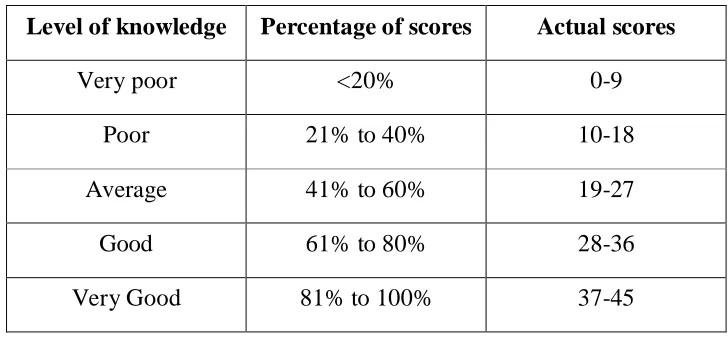
To assess the level of knowledge of students, the score was grouped into item like very poor, poor, average, good and very good based on knowledge scores.
[image:49.612.146.510.297.466.2]Scoring procedure
Table: Scoring the level of knowledge
Level of knowledge Percentage of scores Actual scores
Very poor <20% 0-9
Poor 21% to 40% 10-18
Average 41% to 60% 19-27
Good 61% to 80% 28-36
Very Good 81% to 100% 37-45
3.11 CONTENT VALIDITY
After construction of questionnaire for the study on “ A Study to assess the effectiveness of video module teaching programme on knowledge regarding Cardio Pulmonary Resuscitation among under graduate students in selected college chennai”, it was tested for its validity and reliability.
knowledge regarding Cardio Pulmonary Resuscitation among under graduate students in selected college at Chennai.
3.12. RELIABILITY OF THE RESEARCH TOOL
After pilot study, reliability of the tool was assessed by using Test-retest reliability method and its correlation coefficient r –value was 0.84(knowledge). This correlation coefficient is very high and it is good tool for evaluate the effectiveness of video module teaching programme on knowledge regarding Cardio Pulmonary Resuscitation among under graduate students in selected college chennai
3.13 PILOT STUDY
A pilot study was conducted in the same under graduate students in selected college at Chennai to test the feasibility of the study. Formal permission was obtained from the principal Sir PT Thiyagaraja govt arts and science college chennai The pilot study was conducted for a period of one day at Sir PT Thiyagaraja govt arts and science college chennai Based on the inclusion criteria, under graduate students were selected by Purposive sampling techniques. List of under graduate students were selected from Sir PT Thiyagaraja govt arts and science college chennai itself then ten samples were chosen from it. After a self introduction, the investigator explained the nature of the study to the samples. A pre-test was given to the pre experimental group. After a pre-test, in pre experimental group, module teaching teaching programme was provided to 10 members through LCD (PowerPoint ) and CPR demonstration was demonstrated by the investigator regarding all the aspects of CPR procedure, and how to give CPR to the clients.
3.14 ETHICAL CONSIDERATION
Prior to the data collection written permission was obtained from the Principal, College of Nursing, Madras Medical College, Chennai – 03.
3.15 DATA COLLECTION PROCEDURE 3.15.1 Period of data collection
Period of data collection is one month. During this period, the investigator collected both pre test, teaching with video module teaching programme and then post test.
3.15.2 Stages of data collection
The data was collected in following three steps: a) Pre-test
Pretest was conducted among under graduate students who are studying in Sir PT Thiyagaraja govt arts and science college by giving questionnaire to assess the knowledge on CPR, before implementation ofvideo moduleTeaching.
b) Implementation of video assisted structure teaching
Immediately after pretest, Video assisted structure teaching was given to the same undergraduat students in selected college CPR.
c) Post test
3.16 INTERVENTION PROTOCOL
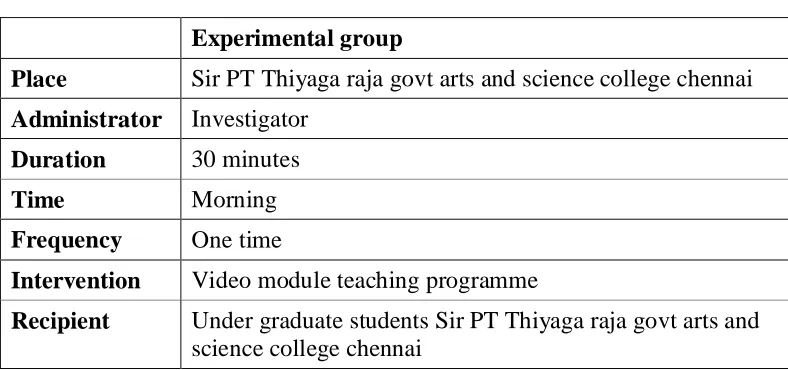
Table 3.16 intervention protocol Experimental group
Place Sir PT Thiyaga raja govt arts and science college chennai Administrator Investigator
Duration 30 minutes
Time Morning
Frequency One time
Intervention Video module teaching programme
Recipient Under graduate students Sir PT Thiyaga raja govt arts and science college chennai
3.17 Data entry and Data Analysis
The collected data was arranged in master sheet (coding sheet) spss version has been applied
Data Analysis
The collected data was analyzed by using descriptive statistics such as percentage, mean, & Standard Deviation. The collected data was presented in the form of tables and figures.
Protection of Human Subject
3.18 SCHEMATIC PRESENTATION OF THE STUDY
Target Population
Under graduate students Sir PT Thiyaga rajaGovt arts and science college
Accessible Population
Sir PT Thiyaga rajaGovt arts and science college
Demographic Variables
Age, sex, education, Previous Knowledge on CPR, Source of Information
Sample & Sample Size
60 under graduate students Sir PT Thiyaga raja govt artsand science college
Sampling Technique Purposive Sampling Technique
Data Collection
Pretest without intervention
Test Score
Post test intervention Video module Structured Teaching
Analysis and Interpretation
CHAPTER-IV
CHAPTER-IV
DATA ANALYSIS AND INTERPRETATION
“All great truths are simple in final analysis and easily understood: if they are not, they are not great truths”
– Napoleon Hill
The term “analyses” refers to the computation of certain measures along with searching for patterns of relationship that exists among data groups. (Kothari .C.R., 2004).
During analyses, the emphasis is on identifying themes and patterns in the data. Interpretation may focus on the usefulness of the findings for the clinical practice or may toward theorizing (Burns Nancy and Grove .S.K., 2007).
This chapter deals with analyses and interpretation of the information collected from 60 degree students who were studied in Sir PT Thiagaraja Govt Arts and Science College, Chennai. The present study was designed to assess the effectiveness of structured teaching programme on Cardio Pulmonary Resuscitation among degree students. Collected data was tabulated, analysed and interpreted using descriptive and inferential statistics. OBJECTIVES OF THE STUDY
To assess the knowledge level regarding cardio pulmonary resuscitation among degree students in a selected college. Chennai
To find out the association between knowledge regarding cardio pulmonary resuscitation among degree students with their selected socio demographic variables.
4.1 ORGANIZATION OF FINDINGS:
Section I: - Descriptive analysis of demographic variables.
Section II: - Assessment of knowledge of degree students regarding CPR prior to implementation of STP.
Section III:- Comparison of pre-test and post-test knowledge scores of the degree students regarding CPR. Area wise comparison of mean, standard deviation and mean percentage of pre and post-test knowledge scores of degree students regarding CPR. Section IV:- Association between the knowledge and their selected
demographic variables HYPOTHESIS
H1: There will be a significant difference between pre-test and
post-test knowledge score regarding cardio pulmonary resuscitation.
H2: There will be a significant association between the knowledge
SECTION I: - DESCRIPTIVE ANALYSIS OF DEMOGRAPHIC VARIABLES
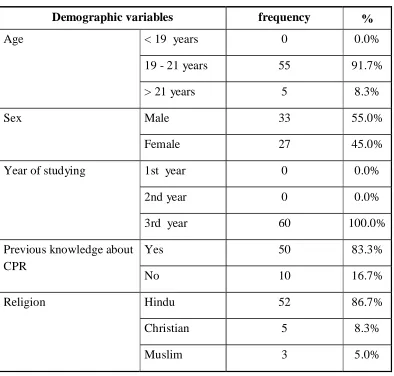
[image:57.612.117.511.220.596.2]This section deals with the percentage distributions of the selected demographic variables of the degree students.
Table 1: Demographic Profile ( N: 60)
Demographic variables frequency %
Age < 19 years 0 0.0%
19 - 21 years 55 91.7%
> 21 years 5 8.3%
Sex Male 33 55.0%
Female 27 45.0%
Year of studying 1st year 0 0.0%
2nd year 0 0.0%
3rd year 60 100.0%
Previous knowledge about CPR
Yes 50 83.3%
No 10 16.7%
Religion Hindu 52 86.7%
Christian 5 8.3%
Muslim 3 5.0%
OBJECTIVE-1:TO ASSESS THE KNOWLEDGE LEVEL REGARDING CARDIO PULMONARY RESUSCITATION AMONG DEGREE STUDENTS IN SELECTED COLLEGES
Table-2: Student Pretest Knowledge Score
Domains Maximum score Mean SD %
Anatomy and physiology
3
1.72 0.78
57.3%
Meaning of CPR 4 1.48 0.60 37.0%
Before procedure 6 2.73 1.06 45.5%
During procedure 10 5.15 1.34 51.5%
After procedure 7 3.00 1.22 42.9%
Total 30 14.08 2.42 46.9%
The above tables reveals each domain wise students pre-test percentage of knowledge score regarding CPR before Video Module Teaching. They are having more score inAnatomy and physiology (57.3%) and minimum score in Meaning of CPR (37.0%). Overall they are having 46.9% of score.
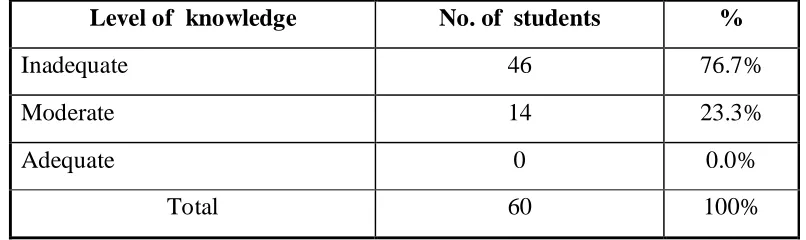
Table-3: Pretest Level of Knolwedge Score
Level of knowledge No. of students %
Inadequate 46 76.7%
Moderate 14 23.3%
Adequate 0 0.0%
[image:58.612.110.513.561.681.2]The above table reveals thestudents pre-test level of knowledge score before the administration of Video Module Teaching. 76.7% of them are having inadequate level of knowledge score, 23.3% of them are having moderate level of knowledge score and none of them are having Adequate level of knowledge score.
SCORE INTERPRETATION
Minimum score = 1 Maximum score =2 questions= 36 Total score=72
Grade Score % of score
Inadequate 0 – 15 0% - 50%
Moderate 16 – 22 51% - 75%
Adequate 23 – 30 76% - 100%
OBJECTIVE-2: TO EVALUATE THE EFFECTIVENESS OF STRUCTURED TEACHING PROGRAMME ON KNOWLEDGE REGARDING CARDIO PULMONARY RESUSCITATION AMONG DEGREE STUDENTS IN SELECTED COLLEGES.
Table-4: Students Posttest Knowledge Score
Domains Maximum score Mean SD %
Anatomyand physiology
3
2.57 .56
85.7%
Meaning of CPR 4 3.27 .78 81.8%
Before procedure 6 4.70 1.08 78.3%
During procedure 10 8.08 1.31 80.8%
After procedure 7 5.42 .96 77.4%
Total 30 24.04 2.24 80.2%
The above table reveals each domain wise students post-test percentage of knowledge score regarding CPR after Video Module Teaching. They are having more score in Anatomy and physiology (85.7%) and minimum score in steps in CPR (77.4%). Overall they are having 80.2% of score. The above table compares pre test and post test mean score .
ConsideringMeaningof CPR ,in pre-test, clients are having 1.32 score where as in post test they are having 1.90 score , so the difference is 0.58. This difference between pre test and post test is large and it is statistically significant.
Considering during procedure ,in pre-test , clients are having 1.38 score where as in post-test they are having 2.38 score , so the difference is 1.00. This difference between pre test and post test is large and it is statistically significant.
Considering after procedure ,in pre-test , clients are having 1.16 score where as in post-test they are having 1.74 score , so the difference is 0.58. This difference between pre test and post test is large and it is statistically significant.
[image:64.612.131.495.337.478.2]Statistical significance was calculated by using student’s paired ‘t’test. Table 5: Posttest Level of Knolwedge Score
Level of knowledge No. of students %
Inadequate 0 0.0%
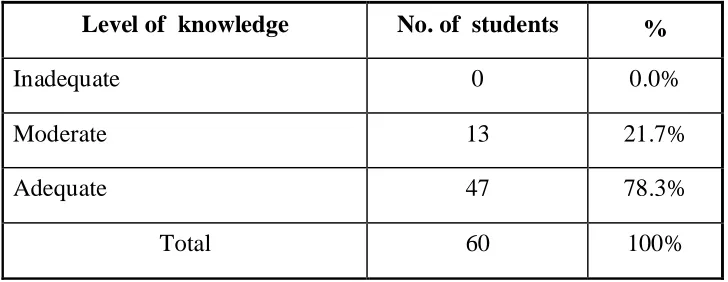
Moderate 13 21.7%
Adequate 47 78.3%
Total 60 100%
Table 6: Comparison of Pretest and Posttest Knowledge Abilty Score Knowledge on Test Mean Difference
Student’s paired t-test Pretest Posttest
Mean SD Mean SD
Anatomy and
physiology 1.72 0.78 2.57 .56 0.85
t=6.77 P=0.001***
significant Meaningof
CPR 1.48 0.60 3.27 .78 1.79
t=13.67, P=0.001***
significant Before
procedure 2.73 1.06 4.70 1.08 1.97
t=11.70, P=0.001***
significant During
procedure 5.15 1.34 8.08 1.31 2.93
t=12.05, P=0.001***
significant After
procedure 3.00 1.22 5.42 .96 2.42
t=12.98, P=0.001***
significant *** very high significant at P 0.001
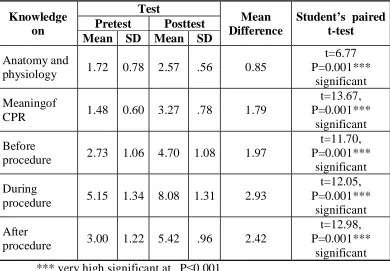
Table no.6 compares pretest and posttest mean knowledge score.
[image:65.612.118.508.317.588.2]Considering Meaningof CPR , in pretest, students are having 1.48 score where as in posttest they are having 3.27 score , so the difference is 1.79. This difference between pretest and posttest is large and it is statistically significant
ConsideringBefore procedure aspects , in pretest, students are having 2.73 score where as in posttest they are having 4.70 score , so the difference is 1.97 This difference between pretest and posttest is large and it is statistically significant
ConsideringDuring procedure aspects , in pretest, students are having 5.15 score where as in posttest they are having 8.08 score , so the difference is 2.93 This difference between pretest and posttest is large and it is statistically significant
[image:66.612.115.512.485.597.2]Considering After procedure aspects , in pretest, students are having 3.00 score where as in posttest they are having 5.42 score , so the difference is 2.42 This difference between pretest and posttest is large and it is statistically significant
Table 7: Comparison of Overall Pre and Posttest Knowledge Score
No. of students
knowledge score Mean ± SD
Mean
Difference Student’s paired t-test Pre-test 60 14.08± 2.42
9.96
t=27.17 P=0.001***
DF =59 significant Post-test 60 24.04±1.91
DF= Degrees of Freedom *** very high significant at P 0.001
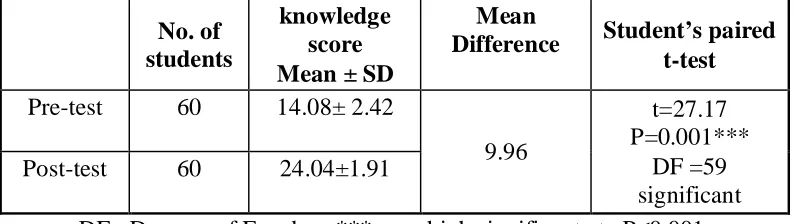
Considering overall knowledge score, in pretest, students are having 14.08 score where as in posttest they are having 24.03 score, so the difference is 9.96. The difference between pretest and posttest score is large and it is statistically significant. Differences between pretest and posttest score was analyzed using students paired t-test.
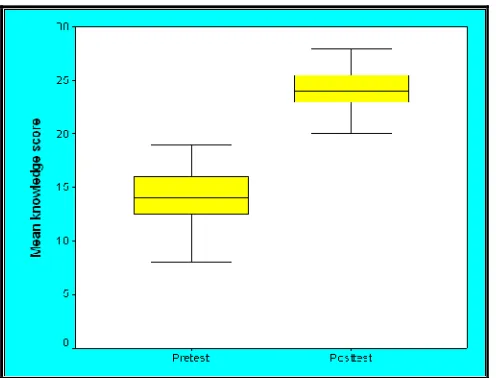
[image:67.612.116.510.510.674.2]Fig:9: Box-plot Compares the pretest and posttest knowledge score among students on CPR, before and after administration of Video Module Teaching.
Table 8: Pretest and Posttest Level of Knowledge Score
Level of knowledge score
Test
Extended McNemar’s test
Pretest Posttest
n % n %
Inadequate 46 76.7% 0 0.0%
2=53.07p=0.001*** DF= 2 significant
Moderate 14 23.3% 13 21.7%
Adequate 0 0.0% 47 78.3%
Total 60 100% 60 100%
Table 8 compares the pre test and post test knowledge score regarding CPR before and after Video Module Teaching
In pretest, 76.7% of them are having inadequate level of knowledge score, 23.3% of them are having moderate level of knowledge score and none of them are having Adequate level of knowledge score.
In posttest, None of them are having inadequate level of knowledge score, 21.7% of them are having moderate level of knowledge score and 78.3% of them are having adequate level of knowledge score.
[image:68.612.137.492.347.547.2]Statistically there is a significant difference between pre and post test knowledge score. It was confirmed using extended McNemar’s test
Table 9: Percentage of Knowledge Gain Score
Max score
knowledge score Mean ± SD
Mean Difference in knowledge score
with 95% Confidence
interval
Percentage of knowledge gain score with 95% Confidence interval Pretest 30 14.08± 2.42
The above table reveals the same domain On an average, students are gained 33.2% of knowledge score after administration of Video Module Teaching. Differences between pretest and posttest score was analysed using mean difference with 95% confidence interval and proportion with 95% Confidence interval. This 32.9% knowledge gain score shows the effectiveness of Video Module Teaching.
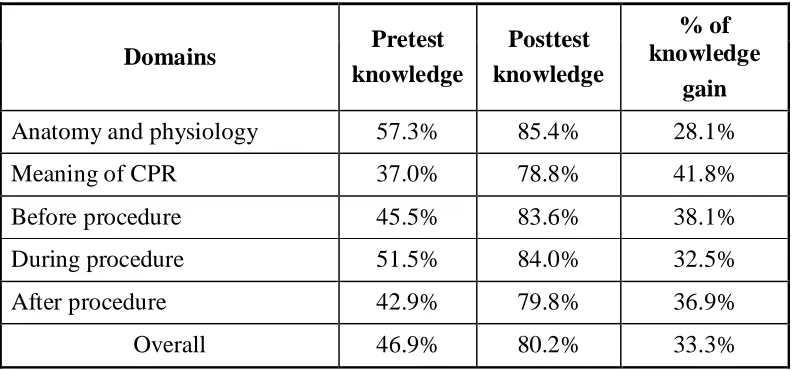
Table-10: Effectiveness of Video Module Teaching
Domains Pretest knowledge Posttest knowledge % of knowledge gain
Anatomy and physiology 57.3% 85.4% 28.1%
Meaning of CPR 37.0% 78.8% 41.8%
Before procedure 45.5% 83.6% 38.1%
During procedure 51.5% 84.0% 32.5%
After procedure 42.9% 79.8% 36.9%
Overall 46.9% 80.2% 33.3%
The above table reveals each domain wise percentage of knowledge gain.
In Anatomy and physiology, students are gained 28.1% of knowledge. InMeaning of CPR, students are gained41.1% of knowledge.
In Before procedure aspects, students are gained38.1% of knowledge score.
In During procedure aspects, students are gained32.5% of knowledge score.
In After procedure aspects, students are gained36.9% of knowledge score.
OBJECTIVE-5: TO FIND OUT THE ASSOCIATION BETWEEN
KNOWLEDGE REGARDING CARDIO PULMONARY
[image:71.612.117.532.220.552.2]RESUSCITATION AMONG DEGREE STUDENTS WITH SELECTED SOCIO DEMOGRAPHIC VARIABLES
Table 11: Association Between Pretest Level of Knowledge Score and Students Demographic Variables
Demographic variables
Pretest level of knowledge score
Total Chi square test Inadequate Moderate
N % N %
Age 19 - 21 years 43 78.2% 12 21.8% 55 2=0.84 p=0.36 DF=1 NS > 21 years 3 60.0% 2 40.0% 5
Sex Male 24 72.7% 9 27.3% 33 2=2.74 p=0.10
DF=1 NS
Female 22 81.5% 5 19.5% 27
Education Undergraduate
46 76.7% 14 23.3% 60 2=0.00 p=1.00 DF=1 NS Year of
studying
3rd year
46 76.7% 14 23.3% 60 2=0.00 p=1.00 DF=1 NS Previous
knowledge about CPR
Yes 37 74.0% 13 26.0% 50
2=1.19p=0.27 DF=1 NS
No 9 90.0% 1 10.0% 10
Religion Hindu 42 80.8% 10 19.2% 52
2=4.41 p=0.11 DF=2 NS
Christian 3 60.0% 2 40.0% 5
Muslim 1 33.3% 2 66.7% 3
Table 12: Association Between Post-Test Level of Knowledge Score and Students Demographic Variables
Demographic variables
Post-test level of knowledge score
Total Chi square test Moderate Adequate
N % N %
Age 19 - 21 years 10 18.2% 45 81.8% 55 2=4.72 p=0.03* DF=1 S > 21 years 3 60.0% 2 40.0% 5
Sex Male 11 33.3% 22 66.7% 33 2=6.52
p=0.01** DF=1 S Female
2 7.4% 25 92.6% 27 Education Undergraduate
13 21.7% 47 78.3% 60
2=0.00 p=1.00 DF=1 NS Year of
studying
3rd year
13 21.7% 47 78.3% 60
2=0.00 p=1.00 DF=1 NS Previous knowledge about CPR
Yes 8 16.0% 42 84.0% 50
2=5.67 p=0.02* DF=1 S
No 5 50.0% 5 50.0% 10
Religion Hindu 12 23.1% 40 76.9% 52 2=4.41
p=0.11 DF=2 NS
Christian 1 20.0% 4 80.0% 5
Muslim 3 100.0% 3
DF= Degrees of Freedom Not significant P> 0.05 NS= Not significant. * significant at P 0.05 ** high significant at P 0.01
Table 13:Association Between Knowledge Gain Score and Students Demographic Variables
Demographic
variables n
Knowledge gain score
Oneway ANOVA F-test/ t-Test Pretest Posttest Knowledge gain score= posttest-pretest Mean SD Mean SD Mean SD
Age 19 - 21 years 55 13.20 2.44 24.48 1.91 11.28 2.40 t=1.97 P=0.05*
S > 21 years
5 13.80 2.05 22.84 2.07 9.04 2.88
Sex Male 33 13.94 2.38 23.29 1.83 9.35 2.87 t=2.05 P=0.05*
S Female
27 14.26 2.51 25.13 2.00 10.87 2.84
Education Undergraduate
60 14.08 2.42 24.03 1.91 9.95 2.84
t=1.95 P=0.06 NS Year of
studying
3rd year
60 14.08 2.42 24.03 1.91 9.95 2.84
t=1.95 P=0.06 NS Previous knowledge about CPR
Yes 50 14.20 2.52 25.16 1.95 10.96 2.96
t=2.07 P=0.05*
S No
10 13.50 1.84 22.40 1.65 8.90 2.28
Religion Hindu 52 13.85 2.37 23.92 1.94 10.07 2.70 F=2.98 P=0.06
NS Christian 5 15.00 2.35 23.60 2.30 8.60 3.13
Muslim 3 16.67 2.31 23.33 .58 6.67 2.89
CHAPTER-V
CHAPTER-V
SUMMARY OF THE STUDY FINDINGS
The aim of the present study was to assess the effectiveness of structured teaching programme on Cardiopulmonary Resuscitation among degree students in a selected college at . The study was conducted by using pre experimental design. Sample size was 60 degree students selected by purposive sampling technique.
The effectiveness of structured teaching programme was evaluated by questionnaire.
The responses were analyzed through descriptive statistics (mean, frequency, percentage and standard deviation) and inferential statistics (paired ‘t’ test.)
objectives of the study were
To assess the knowledge level regarding cardio pulmonary resuscitation among degree students in a selected college
To evaluate the effectiveness of structured teaching programme on knowledge regarding cardio pulmonary resuscitation among degree students in a selected college.
5.1 Major findings of the study
A) Findings of the demographic variables
The study findings revealed that (01)02% of students had Very poor knowledge, (26)52% of students had poor knowledge, (22)44% of students had average knowledge and the remaining (01)02% had good knowledge. B) Pretest level of knowledge score regarding video module teaching
The study findings revealed that comparison of overall mean, SD and mean percentage of pre and post test knowledge scores shows that over all pre test mean score was 18.6+_4.14 which is 41.33%whereas in post test the mean score was 35.8+3.5 which is 79.5% revealing the difference of 38.17% shows the effectiveness ofSTP.
C) Posttest percentage of knowledge score regarding cardio pulmonary resuscitation among under graduate students
The study findings revealed that association between the level of hemoglobin and their selected demographic variables. It was interpreted that there was significant association found between knowledge scores of degree students regarding Cardiopulmonary Resuscitation with their demographic variables such as Source of information (P<0.05).