
Rochester Institute of Technology
RIT Scholar Works
Theses
7-12-2019
Methodology for the Integration of
Optomechanical System Software Models with a
Radiative Transfer Image Simulation Model
Keegan S. McCoy
Methodology for the Integration of Optomechanical System Software
Models with a Radiative Transfer Image Simulation Model
by
Keegan S. McCoy
B.S. in Electrical Engineering, The Pennsylvania State University, 2012 B.S. in Astronomy and Astrophysics, The Pennsylvania State University, 2012
M.S. in Electrical Engineering, The Pennsylvania State University, 2012
A dissertation submitted in partial fulfillment of the requirements for the degree of Doctor of Philosophy in the Chester F. Carlson Center for Imaging Science
College of Science
Rochester Institute of Technology
July 12, 2019
Signature of the Author
Accepted by
CHESTER F. CARLSON CENTER FOR IMAGING SCIENCE COLLEGE OF SCIENCE
ROCHESTER INSTITUTE OF TECHNOLOGY ROCHESTER, NEW YORK
CERTIFICATE OF APPROVAL
Ph.D. DEGREE DISSERTATION
The Ph.D. Degree Dissertation of Keegan S. McCoy has been examined and approved by the dissertation committee as satisfactory for the
dissertation required for the Ph.D. degree in Imaging Science
Dr. John Kerekes, Dissertation Advisor
Dr. Alan Raisanen, External Chair
Dr. Michael Gartley
Dr. Scott Rohrbach
Date
Methodology for the Integration of Optomechanical System Software
Models with a Radiative Transfer Image Simulation Model
by
Keegan S. McCoy
Submitted to the
Chester F. Carlson Center for Imaging Science in partial fulfillment of the requirements
for the Doctor of Philosophy Degree at the Rochester Institute of Technology
Abstract
Stray light, any unwanted radiation that reaches the focal plane of an optical system,
re-duces image contrast, creates false signals or obscures faint ones, and ultimately degrades
radiometric accuracy. These detrimental effects can have a profound impact on the
us-ability of collected Earth-observing remote sensing data, which must be radiometrically
calibrated to be useful for scientific applications. Understanding the full impact of stray
light on data scientific utility is of particular concern for lower cost, more compact imaging
systems, which inherently provide fewer opportunities for stray light control. To address
these concerns, this research presents a general methodology for integrating point spread
function (PSF) and stray light performance data from optomechanical system models in
optical engineering software with a radiative transfer image simulation model. This
in-tegration method effectively emulates the PSF and stray light performance of a detailed
system model within a high-fidelity scene, thus producing realistic simulated imagery. This
novel capability enables system trade studies and sensitivity analyses to be conducted on
parameters of interest, particularly those that influence stray light, by analyzing their
quan-titative impact on user applications when imaging realistic operational scenes. For Earth
iv
science applications, this method is useful in assessing the impact of stray light performance
on retrieving surface temperature, ocean color products such as chlorophyll concentration or
dissolved organic matter, etc. The knowledge gained from this model integration also
pro-vides insight into how specific stray light requirements translate to user application impact,
which can be leveraged in writing more informed stray light requirements.
In addition to detailing the methodology’s radiometric framework, we describe the
col-lection of necessary raytrace data from an optomechanical system model (in this case,
using FRED Optical Engineering Software), and present PSF and stray light component
validation tests through imaging Digital Imaging and Remote Sensing Image Generation
(DIRSIG) model test scenes. We then demonstrate the integration method’s ability to
pro-duce quantitative metrics to assess the impact of stray light-focused system trade studies
on user applications using a Cassegrain telescope model and a stray light-stressing coastal
scene under various system and scene conditions. This case study showcases the stray light
images and other detailed performance data produced by the integration method that take
into account both a system’s stray light susceptibility and a scene’s at-aperture radiance
profile to determine the stray light contribution of specific system components or stray
light paths. The innovative contributions provided by this work represent substantial
im-provements over current stray light modeling and simulation techniques, where the scene
image formation is decoupled from the physical system stray light modeling, and can aid
in the design of future Earth-observing imaging systems. This work ultimately establishes
an integrated-systems approach that combines the effects of scene content and the
optome-chanical components, resulting in a more realistic and higher fidelity system performance
v
DISCLAIMER
vi
The light shines in the darkness,
and the darkness has not overcome it.
Acknowledgements
First and foremost, I would like to thank God for standing by me not just during my time
in this rigorous Ph.D. program, but throughout my entire life. You provide me with the
strength to meet all of life’s challenges and I pray that I can continue to use the talents that
you have provided me for your glory. Though a doctorate degree is the pinnacle of academic
achievement, the more I learn about you and the world you have created, the more humble
I become.
I would like to thank my wife for her incredible amount of love and support. Though my
Ph.D. diploma has my name on it, you have been just as integral a part of the effort. Being
a military spouse is not easy in general, but this is especially true during a time-intensive
Ph.D. program in which we experienced life-altering changes, both joyful and tragic. You
have been a steady presence throughout it all and I look forward to sharing more of life’s
many adventures with you as we move on from our time in Rochester. I also apologize for
teaching you more about stray light and optical system modeling and simulation than you
probably ever care to know.
I would like to thank my parents, grandparents, and the rest of my family for their love
and encouragement not only during this Ph.D. program, but from the moment I was born.
I have been truly blessed to have all of you in my life. I thank you for fostering a love
of learning in me from a young age and believing in me every step of the way along my
academic journey. I would also like to thank my mother-in-law for her faith in me and I
hope that I have made you proud.
I would like to thank the U.S. Air Force and RIT for the opportunity to pursue a
doc-torate degree. I am truly appreciative and have learned a great deal through the experience,
only a portion of which you see here in this dissertation. I am also thankful for those Air
Force officers who provided valuable mentorship regarding their times at RIT and helped
viii
make this experience a reality.
I would like to thank Dr. John Kerekes, my Ph.D. advisor, for all of his guidance and
support over the past few years. I appreciate your trust in me and for helping me to learn
the ropes as a Ph.D. student researcher. Thank you to my dissertation committee members,
Dr. Alan Raisanen, Dr. Mike Gartley, and Dr. Scott Rohrbach, for agreeing to serve on my
commitee and for providing knowledgable feedback along the way. A special thanks goes
out to Dr. Gartley for his creation of the “LA” DIRSIG scene used in the work presented
here.
I would like to thank my fellow Air Force students and all of my friends here in Rochester.
You have provided a community of support during these challenging times and I look forward
to staying in touch.
I would like to thank the DIRSIG team of Dr. Scott Brown, Dr. Adam Goodenough,
Dr. Rolando Raque˜no, and Jared Van Cor for their knowledge and support with using the
DIRSIG model. This have been an exciting project to work on and I am glad that my
contributions have helped expand DIRSIG’s impressive capabilities.
I would like to thank Ryan Irvin of Photon Engineering for his amazing level of support
in helping me to learn how to use FRED Optical Engineering Software and in developing
the integration method presented here. You have been an absolutely essential team member
and this work would not have been possible without you. However, I may or may not be
finished with my somewhat regular 2 a.m. e-mails to you.
I would like to thank Dr. Ray Ohl of the NASA Goddard Space Filght Center for his
mentorship, both during my intership at Goddard in the summer of 2009 and ever since. You
have played a key role in guiding my career through the Air Force and this Ph.D. program. I
also thank you for recommending the use of FRED in this research project, which prompted
ix
studies.
Finally, I would like to thank Rich Pfisterer, Dr. Jim Fienup and his graduate students,
To my wife and daughters.
Contents
List of Figures xvii
List of Tables xxxi
1 Introduction 1
1.1 CONTEXT . . . 1
1.2 OBJECTIVES . . . 11
1.3 DISSERTATION LAYOUT . . . 11
1.3.1 Chapter 2: Background . . . 11
1.3.2 Chapter 3: Integration Methodology (Objective 1) . . . 12
1.3.3 Chapter 4: Point Spread Function Component Validation (Objectives 1 & 2) . . . 12
1.3.4 Chapter 5: Stray Light Component Validation (Objectives 1 & 3) . 13 1.3.5 Chapter 6: System Trade Study Demonstration (Objectives 1, 4, & 5) 13 1.3.6 Chapter 7: Summary and Conclusions . . . 13
1.4 NOVEL CONTRIBUTIONS . . . 13
xii CONTENTS
2 Background 15
2.1 RADIOMETRIC TERMS . . . 15
2.1.1 Radiant Energy . . . 16
2.1.2 Radiant Flux . . . 16
2.1.3 Irradiance . . . 17
2.1.4 Radiant Intensity . . . 17
2.1.5 Radiance . . . 18
2.2 STRAY LIGHT . . . 19
2.2.1 Stray Light Paths . . . 21
2.2.2 Critical and Illuminated Surfaces . . . 22
2.2.3 In-Field and Out-of-Field Stray Light . . . 24
2.2.4 Stray Light Mechanisms . . . 24
2.2.5 Bidirectional Scattering Distribution Function (BSDF) . . . 26
2.2.6 Stray Light Radiative Transfer Equation . . . 28
2.2.7 Stray Light as Noise . . . 31
2.2.8 Causes of Stray Light . . . 31
2.2.9 Stray Light Metrics . . . 39
2.2.10 Stray Light Requirements . . . 43
2.2.11 Critical Step in Design Process . . . 48
2.2.12 Stray Light Analysis . . . 48
2.2.13 Optical Engineering Software Programs . . . 52
2.3 LINEAR SYSTEMS THEORY . . . 54
2.3.1 Linearity . . . 54
CONTENTS xiii
2.3.3 Shift-Invariance . . . 57
2.3.4 Linear Shift-Invariant and Linear Shift-Variant Systems . . . 57
2.3.5 Modulation Transfer Function (MTF) . . . 58
2.4 MODELING AND SIMULATION OF OPTOMECHANICAL SYSTEMS . 59 2.4.1 Overview of PSF and Stray Light Modeling Efforts . . . 62
2.4.2 Digital Imaging and Remote Sensing Image Generation (DIRSIG) Model . . . 72
2.5 CONCLUSIONS . . . 78
3 Integration Methodology 81 3.1 INTRODUCTION . . . 81
3.2 INTEGRATION METHODOLOGY FRAMEWORK . . . 84
3.2.1 PSF Component Radiance to Irradiance Conversion . . . 85
3.2.2 Integration Method Component Radiometry . . . 87
3.3 STRAY LIGHT ANGULAR SUSCEPTIBILITY MAP (ASM) . . . 92
3.3.1 Capture a Stray Light ASM . . . 93
3.3.2 Stray Light ASM Analysis . . . 99
3.3.3 Shift-Variant Stray Light ASMs . . . 104
3.4 INTEGRATION METHOD VALIDATION TESTS . . . 107
3.5 CONCLUSIONS . . . 110
4 Point Spread Function Component Validation 113 4.1 INTRODUCTION . . . 113
4.2 CAPTURE SYSTEM PSF . . . 115
xiv CONTENTS
4.3.1 2-D RECT Function PSF Validation Test . . . 119
4.3.2 Cassegrain PSF Validation Test . . . 122
4.3.3 Evaluation Metrics . . . 123
4.4 RESULTS . . . 126
4.4.1 2-D RECT Function PSF Validation Test Results . . . 126
4.4.2 Cassegrain PSF Validation Test Results . . . 133
4.4.3 PSF Importance Sampling and the Law of Large Numbers . . . 142
4.5 SUMMARY AND CONCLUSIONS . . . 144
5 Stray Light Component Validation 147 5.1 INTRODUCTION . . . 147
5.2 METHODOLOGY . . . 149
5.3 RESULTS . . . 159
5.4 SUMMARY AND CONCLUSIONS . . . 169
6 System Trade Study Demonstration 171 6.1 METHODOLOGY . . . 173
6.1.1 System Stray Light Performance Conditions . . . 173
6.1.2 DIRSIG Scene and Conditions . . . 176
6.1.3 Nominal Irradiance Images . . . 182
6.1.4 Cassegrain Shift-Variant Stray Light ASMs . . . 183
6.1.5 DIRSIG ERM . . . 186
6.1.6 Stray Light Radiant Flux Contribution Maps . . . 186
6.1.7 Stray Light Irradiance Images . . . 188
CONTENTS xv
6.1.9 Percent Stray Light Images . . . 189
6.1.10 Contrast Reduction . . . 190
6.2 RESULTS . . . 191
6.2.1 Nominal Irradiance Images . . . 191
6.2.2 Cassegrain Shift-Variant Stray Light ASMs . . . 192
6.2.3 DIRSIG ERMs . . . 201
6.2.4 Stray Light Irradiance Images . . . 202
6.2.5 Stray Light Radiant Flux Contribution Maps . . . 211
6.2.6 Combined Nominal and Stray Light Irradiance Images . . . 214
6.2.7 Percent Stray Light Images . . . 216
6.2.8 System Trade Study Analysis . . . 222
6.2.9 Contrast Reduction . . . 226
6.3 CONCLUSIONS . . . 229
7 Summary and Conclusions 235 7.1 CONCLUSIONS . . . 238
7.2 FUTURE WORK . . . 241
List of Figures
1.1 Landsat program timeline with the operational on-orbit duration of each
mission [7]. . . 3
1.2 Integrating an optomechanical system model from optical engineering
soft-ware with a radiative transfer image simulation model combines the unique
benefits of each type of model in creating the complete imaging chain. . . . 10
2.1 Example of a second-order stray light path [17]. . . 22
2.2 Optical system with critical and illuminated surfaces labeled [17]. . . 23
2.3 Off-axis source scatters off a critical baffle surface and to the detector (left).
With vanes included, the light can now only reach the detector via multiple
scattering, which greatly attenuates the stray light power (right) [67]. . . . 23
2.4 Specular reflection and refraction at an interface between two media [17]. . 25
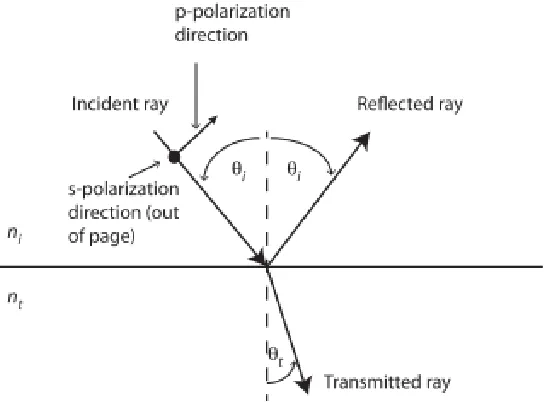
2.5 Incident and reflected angles used in describing a surface’s bidirectional
scat-tering distribution function (BSDF) [17]. . . 27
2.6 Geometry for scattering from a source area to a collector area [67]. . . 28
xviii LIST OF FIGURES
2.7 Mircoscope image of surface roughness on a fused silica surface due to
grind-ing and polishgrind-ing. The image is approximately 10 µm across, with an RMS surface roughness of 5 ˚A [76]. . . 32
2.8 Vectors used in the Harvey-Shack scatter model [80]. . . 33
2.9 Example Harvey-Shack scatter model curve with L = 0.01, b0 = 0.1, and
S = −1.5. Assuming λ = 0.55 µm, these parameters correspond to an approximate surface roughness ofσRM S= 14.7 ˚A [81]. . . 35
2.10 Number of particles of diameter≥Dv. Daccording to IEST-STD-CC1246D for CLs 200, 400, and 600 [17]. . . 37
2.11 Example of how dendrites can be used to trap light. The angles of incidence
are defined according to the macroscopic surface normal and not the variable
dendrite profile. [17]. . . 39
2.12 Setup used for a veiling glare test [17]. . . 42
2.13 Stray light systems engineering flowchart illustrating the necessary steps from
stray light requirements definition to final system build and model
valida-tion [17]. . . 44
2.14 Strengths and weakness of the build-and-test v. model-and-predict methods
for stray light analysis [68]. . . 52
2.15 Image of a bar target (a) without stray light and (b) with stray light. Stray
light acts to reduce the contrast of the bar target. [17]. . . 59
2.16 DIRSIG simulation of the Port of Tacoma, WA imaged with a 2-D framing
LIST OF FIGURES xix
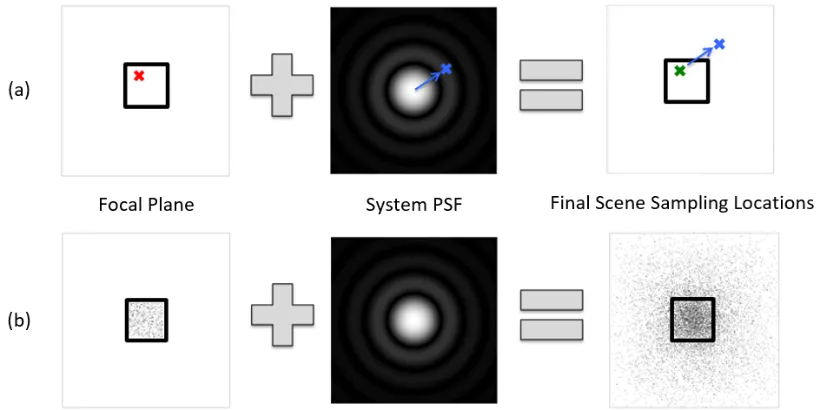
2.17 The 2-step PSF importance sampling process combines a single random pixel
location with a single random PSF offset: (a) One initial and final ray
sam-pling location. (b) Numerous initial and final ray samsam-pling locations. . . 77
2.18 DIRSIG image of a resolution test target and a helicopter with rotating rotor
blades: (a) No Gaussian PSF or time integration. (b) With a Gaussian PSF
and time integration. . . 78
3.1 Integrating optical engineering software programs with a radiative transfer
image simulation model combines the unique benefits of each type of sofware. 83
3.2 Integration method flowchart illustrating how system PSF and stray light
performance data collected from an optomechanical system model in optical
engineering software (blue steps) can be used to image a scene using a
ra-diative transfer image simulation model (orange steps) to produce simulated
output imagery. . . 83
3.3 As detailed by the integration method’s underlying radiometry, the stray light
contributions reaching the focal plane of an optical system are inherently a
product of the system’s stray light susceptibility and the scene’s at-aperture
radiance profile. . . 90
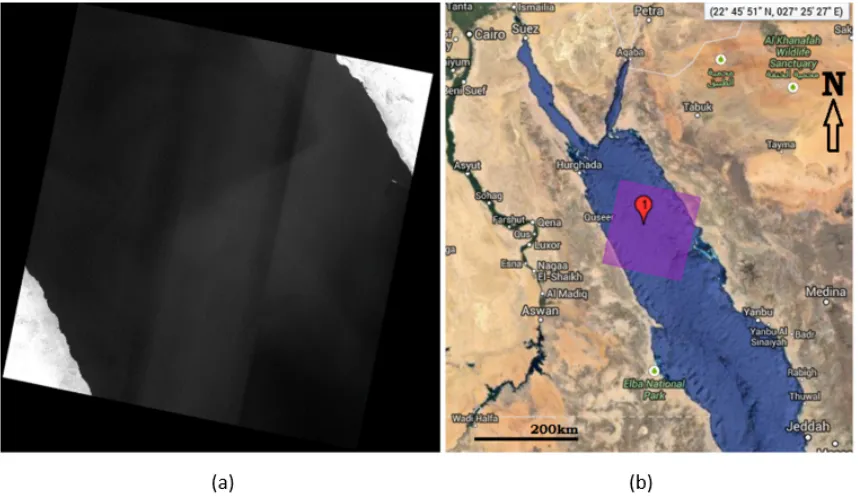
3.4 (a) TIRS band 11 (11.50–12.51 µm) image of the Red Sea with image inten-sity ranging from 8.5 to 11.5 W/m2/sr/µm. Far-field stray light leads to a banding effect that is evident in the across-track direction between the three
FPAs. (b) Map from USGS Earth Explorer showing the extent of the scene.
xx LIST OF FIGURES
3.5 Cassegrain telescope FRED model with a flat black paint scatter model (TIS
= 2% at normal incidence) assigned to the mechanical surfaces (labeled in
black). A Harvey-Shack scatter model (b0 = 0.1, L = 0.01, and S =−1.5) and Mie scatter model representing particulate contamination (CL400) have
been assigned to the optical surfaces (labeled in blue). . . 94
3.6 Reverse raytrace using the Cassegrain telescope model along with the stray
light ASM coordinate system. The system’s stray light susceptibility data is
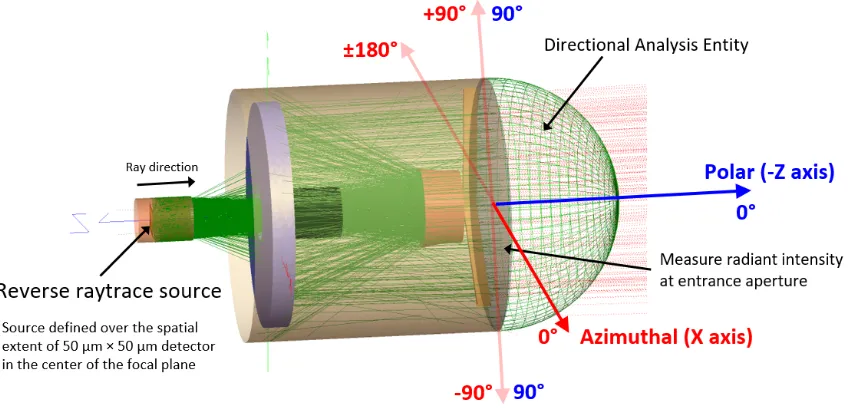
captured at the entrance aperture as a radiant intensity profile by the DAE.
These data are then converted to stray light radiant flux per grid element by
multiplying by each DAE grid element’s solid angle. . . 96
3.7 Scatter model importance sampling demonstration. (a) Scatter rays into
the full hemisphere. (b) Scatter rays towards a detector. The latter case
produces greatly improved radiometric results due to the increased numbers
of rays scattered to the surface of interest [17]. . . 98
3.8 (a) Cassegrain system stray light ASM at 1° × 1° resolution (log of radiant
flux). (b) Visualization of the Cassegrain stray light ASM on the entrance
aperture DAE grid in FRED (log of radiant intensity). Azimuthal angle
LIST OF FIGURES xxi
3.9 Visualization of the Cassegrain telescope’s highest susceptibility stray light
path. In the forward direction, these rays enter the Cassegrain telescope’s
entrance aperture and scatter off of the primary mirror baffle’s inner wall
directly to the detector. In our reverse raytrace, this stray light path is
solely responsible for 46.9% of the total stray light radiant flux captured by
the detector’s stray light ASM. . . 102
3.10 Validation levels for end-to-end system modeling and simulation. Work
sup-porting the 2nd level of validation is presented in this dissertation, whereas
the 1st and 3rd levels have system and scene dependencies and are therefore
left to the users of this integration method. . . 108
4.1 Cassegrain telescope FRED model. The optical surfaces are labeled in blue
and the mechanical surfaces are labeled in black [60]. . . 116
4.2 Forward raytrace to capture the Cassegrain telescope’s on-axis PSF [60]. . . 117
4.3 Irradiance plot of the Cassegrain system on-axis PSF at λ = 0.55 µm (log scale). The black box denotes the spatial extent of a 9-µm FPA pixel [60]. . 117 4.4 System setup for the PSF validation tests. . . 119
4.5 Ideal result and DIRSIG output images for the 2-D RECT function PSF
validation test: (a) Ideal result. (b) 250 sampling rays per FPA pixel. (c)
500 sampling rays per FPA pixel. (d) 1,000 sampling rays per FPA pixel. (e)
10,000 sampling rays per FPA pixel. (f) 100,000 sampling rays per FPA pixel.128
4.6 Difference image between the ideal result and the DIRSIG image with 10,000
xxii LIST OF FIGURES
4.7 2-D correlation coefficient between the ideal result and the DIRSIG images
for each test case of the 2-D RECT function PSF validation test. The data
points indicate the mean value of the ten simulations conducted for each test
case, with the error bars extending plus or minus one standard deviation. . 130
4.8 RMSE in 2-D correlation coefficent v. number of DIRSIG sampling rays for
the 2-D RECT function PSF validation test. . . 131
4.9 Irradiance ratio for each test case of the 2-D RECT function PSF validation
test. The data points indicate the mean value of the ten simulations
con-ducted for each test case, with the error bars extending plus or minus one
standard deviation. . . 132
4.10 RMSE of the irradiance ratio v. number of DIRSIG sampling rays for the
2-D RECT function PSF validation test. . . 133
4.11 Ideal result and DIRSIG output images for the Cassegrain PSF validation
test (log scales): (a) FRED Cassegrain PSF. (b) 500 sampling rays per FPA
pixel. (c) 2,500 sampling rays per FPA pixel. (d) 10,000 sampling rays per
FPA pixel. (e) 25,000 sampling rays per FPA pixel. (f) 100,000 sampling
rays per FPA pixel. . . 135
4.12 2-D correlation coefficient between the FRED Cassegrain PSF and the DIRSIG
images for the Cassegrain PSF validation test. The data points indicate the
mean value of the ten simulations conducted for each test case, with the error
bars extending one standard deviation in each direction. . . 137
4.13 2-D correlation coefficent RMSE v. number of DIRSIG sampling rays for the
LIST OF FIGURES xxiii
4.14 Irradiance ratio for each test case of the Cassegrain PSF validation test. The
data points indicate the mean value of the ten simulations conducted for each
test case, with the error bars extending plus or minus one standard deviation. 140
4.15 RMSE of the irradiance ratio v. number of DIRSIG sampling rays for the
Cassegrain PSF validation test. . . 141
5.1 Simple FRED setup of two parallel aligned square surfaces for use in the
first stray light validation test. A source placed directly above the source
area illuminates the Lambertian source surface, scattering rays towards the
collector. The scatter radiant flux captured by the collector during a series
of FRED raytraces can then be compared to the analytically calculated value. 150
5.2 Integration method stray light radiant flux contribution equation in graphical
form: (top) Cassegrain stray light ASM converted to radiant flux. (middle)
0.10° circle target source ERM from DIRSIG integrated over the detector’s
spectral bandpass. (bottom) Stray light radiant flux contribution map. The
summation of the stray light radiant flux contribution map provides the
de-tector’s total stray light radiant flux. . . 167
6.1 Different scatter models applied to the Cassegrain telescope’s optical and
mechanical surfaces to represent various stray light performance conditions. 174
6.2 DIRSIG “LA scene” covering 450×375 km of central and southern California.177 6.3 Wide-area view of the DIRSIG LA scene with lower-resolution Earth
back-ground and inset outlining the LA scene location. . . 178
6.4 DIRSIG LA scene with Santa Barbara scene location within the Cassegrain
xxiv LIST OF FIGURES
6.5 LA scene with Earth background for the different combinations of DIRSIG
scene conditions (common log scales of spectral radiance at λ = 0.55µm). The very small black box near the center of each scene marks the Cassegrain
telescope’s nominal FOV over Santa Barbara, CA. (a) 1 Aug 2019 at 1:15
p.m. PDT with wind speed = 2.5 m/s W to E. (b) 1 Aug 2019 at 1:15 p.m.
PDT with wind speed = 7.5 m/s W to E. (c) 1 Aug 2019 at 11:30 a.m. PDT
with wind speed = 7.5 m/s W to E. (d) 1 Apr 2019 at 1:15 p.m. PDT with
wind speed = 7.5 m/s W to E. . . 182
6.6 Face-on view of the Cassegrain FPA detailing the pixel numbering scheme
used in FRED for capturing the shift-variant stray light ASMs. This is
necessary to keep track of which stray light ASM was collected for each FPA
pixel. . . 185
6.7 Block diagram of the integration method’s stray light radiant flux
contribu-tion equacontribu-tion. The ERM of a scene is multiplied solid angle grid
element-by-solid angle grid element with a detector element’s stray light ASM for a
given set of system stray light susceptibility conditions to produce the
de-tector element’s stray light radiant flux contribution map. The summation
of the stray light radiant flux contributions for each solid angle grid element
across the contribution map provides the detector element’s total stray light
LIST OF FIGURES xxv
6.8 Nominal irradiance images for Harvey-Shack mirror surface roughness (σRM S =
14.7 ˚A) and CL400 particulate contamination (common irradiance scale). (a) 1 Aug 2019 at 1:15 p.m. PDT with wind speed = 2.5 m/s. (b) 1 Aug 2019
at 1:15 p.m. PDT with wind speed = 7.5 m/s. (c) 1 Aug 2019 at 11:30 a.m.
PDT with wind speed = 7.5 m/s. (d) 1 Apr 2019 at 1:15 p.m. with wind
speed = 7.5 m/s. . . 192
6.9 Cassegrain telescope stray light ASMs for a pixel near the center of the
FPA (x356 y356) with system stray light susceptibility conditions including
Harvey-Shack mirror surface roughness (σRM S = 14.7 ˚A), CL400 particulate
contamination, and flat black paint TIS = 2% (common log of radiant flux
scale). (a) 10 million initial rays. (b) 100 million initial rays. The greater
number of rays traced in the latter case has reduced the statistical noise of
the system stray light susceptibility data. . . 194
6.10 Cassegrain telescope stray light ASMs for a pixel in the center of the FPA
(x356 y356) with varying system stray light susceptibility conditions:
(com-mon log of radiant flux scale). All of the system conditions have Harvey-Shack
mirror surface roughness (σRM S = 14.7 ˚A) included. (a) CL400 particulate
contamination and flat black paint TIS = 2%. (b) CL400 particulate
contam-ination and flat black paint TIS = 1%. (c) CL600 particulate contamcontam-ination
xxvi LIST OF FIGURES
6.11 Cassegrain telescope shift-variant stray light ASMs for various pixels across
the FPA (common log of radiant flux scale). The system stray light
suscep-tibility conditions include Harvey-Shack mirror surface roughness (σRM S =
14.7 ˚A), CL400 particulate contamination, and flat black paint TIS = 2%. All FPA pixel locations are based on viewing the FPA face on in the FRED
model (y-axis pointing up, x-axis pointing to the left). (a) top left corner
(pixel x5 y5). (b) top right (pixel x716 y5). (c) center (pixel x356 y356). (d)
bottom left (pixel x5 y716). (e) bottom right (pixel x716 y716). . . 200
6.12 DIRSIG ERMs for the different scene conditions (common log of spectral
radiance scale). The black circles at the top center of each plot marks the
Santa Barbara scene location for reference. (a) 1 Aug 2019 at 1:15 p.m. PDT
with wind speed = 2.5 m/s. (b) 1 Aug 2019 at 1:15 p.m. PDT with wind
speed = 7.5 m/s. (c) 1 Aug 2019 at 11:30 a.m. PDT with wind speed = 7.5
LIST OF FIGURES xxvii
6.13 Illustration of how the azimuthal angles where different FPA pixels have
their highest stray light susceptibility map to the scene. The scene shown
is 1 Aug 2019 at 1:15 p.m. with wind speed = 2.5 m/s plotted on a linear
spectral radiance scale. (a) The orange arrows mark the azimuthal angle of
highest susceptibility for the labeled FPA corner pixels. The red arrows map
the Cassegrain telescope’s stray light ASM azimuthal angles to the scene
(polar angle θ= 0° points directly into the page). The very small black box in the center of the scene outlines the Cassegrain telescope’s nominal FOV
over Santa Barbara, CA. (b) Face-on view of the Cassegrain FPA within
the FRED model with the corner pixel locations labeled and scene cardinal
directions mapped to the FPA. . . 204
6.14 Orientation of the Cassegrain FPA within the FRED model to the DIRSIG
FPA used to produce the nominal, stray light, and combined final output
images. The Cassegrain FPA must be flipped vertically to match the DIRSIG
FPA. As detailed by the cardinal directions, this specific orientation of the
DIRSIG FPA was chosen so that north in the Santa Barbara scene points up,
xxviii LIST OF FIGURES
6.15 Stray light irradiance images for the 1 Aug 2019 at 1:15 p.m. PDT, wind
speed = 2.5 m/s scene with different system stray light susceptibility
con-ditions. Note that every image has a different irradiance scaling to best
highlight its unique distribution. All system stray light susceptibility
condi-tions include Harvey-Shack mirror surface roughness (σRM S = 14.7 ˚A). (a)
Large-area view of the scene for 1 Aug 2019 at 1:15 p.m. PDT with wind
speed = 2.5 m/s for reference. The small black box in the center of the scene
outlines the Cassegrain telescope’s FOV. (b) No particulate contamination,
flat black paint TIS = 2%. (c) CL400, flat black paint TIS = 1%. (d) CL400,
flat black paint TIS = 2%. (e) CL600, flat black paint TIS = 1%. (f) CL600,
flat black paint TIS = 2%. . . 207
6.16 Stray light irradiance images for the stray light susceptibility conditions with
Harvey-Shack mirror surface roughness (σRM S = 14.7 ˚A), CL400 particulate
contamination, and flat black paint TIS = 2% for each of the different scene
conditions. Note that every image has a different irradiance scaling to best
highlight its unique distribution. (a) 1 Aug 2019 at 1:15 p.m. PDT, wind
speed = 2.5 m/s. (b) 1 Aug 2019 at 1:15 p.m. PDT, wind speed = 7.5 m/s.
(c) 1 Aug 2019 at 11:30 a.m. PDT, wind speed = 7.5 m/s. (d) 1 Apr 2019
LIST OF FIGURES xxix
6.17 Stray light radiant flux contribution maps for the 1 Aug 2019 at 1:15 p.m.
PDT, wind speed = 2.5 m/s scene and system stray light susceptibility
condi-tions with Harvey-Shack mirror surface roughness (σRM S = 14.7 ˚A), CL400
particulate contamination, and flat black paint TIS = 2% (common log of
radiant flux scales). The summation of these stray light radiant flux
con-tribution maps provides the total stray light radiant flux for the given FPA
pixel. (a) Pixel x5 y5 (bottom left of DIRSIG Cassegrain FPA) (b) Pixel
x716 y716 (top right of DIRSIG Cassegrain FPA). . . 212
6.18 The nominal (top left) and stray light (top right) images for a given set
of system stray light susceptibility and scene conditions are added together
to form the final output image (bottom center). This example is for the 1
Aug 2019 at 1:15 p.m. PDT, wind speed = 2.5 m/s scene and system stray
light susceptibility conditions with Harvey-Shack mirror surface roughness
(σRM S = 14.7 ˚A), CL400 particulate contamination, and flat black paint
TIS = 2%. Note that the nominal and final output images are plotted on the
same irradiance scale. . . 216
6.19 Percent stray light images for the 1 Aug 2019 at 1:15 p.m. PDT, wind speed
= 2.5 m/s scene with different system stray light susceptibility conditions
(common percent stray light scaling). All system stray light susceptibility
conditions include Harvey-Shack mirror surface roughness (σRM S = 14.7 ˚A).
(a) No particulate contamination, flat black paint TIS = 2%. (b) CL400, flat
black paint TIS = 1%. (c) CL400, flat black paint TIS = 2%. (d) CL600,
xxx LIST OF FIGURES
6.20 Percent stray light images for the system stray light susceptibility conditions
with Harvey-Shack mirror surface roughness (σRM S = 14.7 ˚A), CL400
par-ticulate contamination, and flat black paint TIS = 1% across the different
scene conditions. Note that every image has a different irradiance scaling to
best highlight its unique distribution. (a) 1 Aug 2019 at 1:15 p.m. PDT,
wind speed = 2.5 m/s. (b) 1 Aug 2019 at 1:15 p.m. PDT, wind speed = 7.5
m/s. (c) 1 Aug 2019 at 11:30 a.m. PDT, wind speed = 7.5 m/s. (d) 1 Apr
2019 at 1:15 p.m. PDT, wind speed = 7.5 m/s. . . 222
6.21 Ideal Cassegrain telescope final output image and the final output images
(nominal + stray light image) of 1 Aug 2019 at 1:15 p.m. PDT, wind speed
= 2.5 m/s scene under different stray light susceptibility conditions
(com-mon irradiance scale). All system stray light susceptibility conditions include
Harvey-Shack mirror surface roughness (σ= 14.7 ˚A). Note that every image has the same irradiance scaling to best highlight the contrast reduction
com-pared to the ideal image. (a) Ideal Cassegrain system. (b) No particulates,
BP TIS = 2%. (c) CL400, BP TIS = 1%. (d) CL400, BP TIS = 2%. (e)
List of Tables
3.1 Cassegrain telescope designed optical path in the forward direction (object
space to focal plane). . . 95
3.2 Percentage of the total stray light radiant flux on the detector’s stray light
ASM from first-order stray light paths including significant scattering
sur-faces. The surfaces listed are where the single scattering event took place in
each case. Since many unique first-order stray light paths can share the same
scatter surface, these percentages are the summation of all first-order stray
light paths for each scatter surface. . . 102
4.1 Number of DIRSIG sampling rays per FPA pixel tested for the PSF validation
tests. . . 124
xxxii LIST OF TABLES
5.1 Comparison between the collector scatter radiant flux analytical calculation
and the FRED raytrace results for the source-collector test setup. The FRED
raytrace results display the mean and standard deviation of the collector
scatter radiant flux across the twenty raytraces conducted. The difference
from analytical indicates the percentage difference between the mean raytrace
collector scatter radiant flux and the analytically calculated value. . . 160
5.2 Comparison between the detector scatter radiant flux for the original
ana-lytical calcluation, FRED forward raytraces, and FRED reverse raytraces.
The FRED raytrace results display the mean and standard deviation of the
detector scatter radiant flux across the twenty raytraces conducted in each
case. . . 162
5.3 Comparison of the mirror GCFs in the original Peterson analytical equation
and the corrected GCFs from FRED for the detector as seen by each mirror. 163
5.4 Comparison of the system transmittances at each mirror used in the
orig-inal Peterson analytical equation and the corrected system transmittances
from FRED taking into account projection effects from the target source and
mechanical components. . . 163
5.5 Comparison between the detector scatter radiant flux for the original and
corrected analytical calcluations and the FRED forward raytrace. The FRED
raytrace results display the mean and standard deviation of the detector
LIST OF TABLES xxxiii
5.6 Comparison between the FRED forward and reverse raytrace results and
the integration method applied to the simplified Cassegrain telescope and
circular target source imaging scenario. Each set of results display the mean
and standard deviation of the detector scatter radiant flux across the twenty
raytraces conducted in each case. . . 168
6.1 Different combinations of stray light performance conditions. All cases
in-clude the same Harvey-Shack scatter model (b0 = 0.1, L = 0.01, and S =
−1.5; σRM S = 14.7 ˚A) for optical surface roughness. The flat black paint
TIS percentages refer to the value at normal incidence. . . 175
6.2 Different combinations of DIRSIG scene conditions. All times of day are
listed in Pacific Daylight Time (PDT). . . 181
6.3 The Cassegrain telescope G#’s for different optical surface conditions. Note
that these G#’s are all calculated for the center of the focal plane. The
Harvey-Shack scatter model includes b0 = 0.1, L = 0.01, and S = −1.5, which corresponds to σRM S = 14.7 ˚A atλ= 0.55µm. . . 191
6.4 Total stray light (SL) radiant flux and pixel percent stray light for a pixel
(x356 y356) near the center of the Cassegrain telescope’s FPA under different
system stray light susceptibility conditions. “BP” refers to the flat black paint
scatter model assigned to the mechanical components and the TIS values are
for normal incidence. All of the system conditions include Harvey-Shack
xxxiv LIST OF TABLES
6.5 Mean irradiance values for the stray light images of the 1 Aug 2019 at 1:15
p.m. PDT, wind speed = 2.5 m/s scene with different system stray light
susceptibility conditions. . . 208
6.6 Mean of the irradiance values for the stray light images with Harvey-Shack
mirror surface roughness (σRM S = 14.7 ˚A), CL400 particulate contamination,
and flat black paint TIS = 2% for each of the different scene conditions. . . 211
6.7 Percentage of the total stray light irradiance for pixel x5 y5 that originates
from sources within the given polar angle ranges in object space. These data
are for the 1 Aug 2019 at 1:15 p.m. PDT, wind speed = 2.5 m/s scene
and system stray light susceptibility conditions with Harvey-Shack mirror
surface roughness (σRM S = 14.7 ˚A), CL400 particulate contamination, and
flat black paint TIS = 2%. The components causing scatter are the major
scatter contributors for each polar angle range. . . 214
6.8 Percentage of the total stray light irradiance for pixel x716 y716 that
origi-nates from sources within the given polar angle ranges in object space. These
data are for the 1 Aug 2019 at 1:15 p.m. PDT, wind speed = 2.5 m/s scene
and system stray light susceptibility conditions with Harvey-Shack mirror
surface roughness (σRM S = 14.7 ˚A), CL400 particulate contamination, and
flat black paint TIS = 2%. The components causing scatter are the major
scatter contributors for each polar angle range. . . 214
6.9 Mean percent stray light values for the land and water pixels across all
LIST OF TABLES xxxv
6.10 Contrast values and reductions from the ideal images to final output images
(nominal + stray light images) across every combination of system stray light
susceptibility and scene conditions. All of the system stray light susceptibility
Chapter 1
Introduction
1.1
CONTEXT
Since its very formation, the Earth has been a dynamic world of change. Natural forces
have dramatically altered the landscape, with rivers and glaciers slowly etching away valleys
and canyons, tectonic plates colliding to form towering mountain ranges and triggering
jarring earthquakes, volcanoes spewing forth lava to create new land, and both wind and
precipitation eroding and weathering the surface. Biological forces have also played a role,
as animals and plants combine to form complex and diverse ecosystems that evolve over
time. We as humans have altered the Earth in dramatic ways by building sprawling cities,
planting fields of crops, cutting down forests, diverting water resources to barren lands, and
polluting the environment.
Collecting data to monitor and analyze these global changes has been an arduous manual
task for much of human history. As transportation and communication evolved, more
information could be gathered and shared about our ever-changing world. The dawn of
2 CHAPTER 1. INTRODUCTION
flight greatly improved our ability to capture global change information via remote sensing,
the acquisition of information about objects or phenomena without coming into physical
contact with the target. Medium-to-high resolution Earth imagery from low-flying aircraft
could be collected and pieced together to produce aerial views that no human had ever
seen before. However, it was the advent of satellites that truly revolutionized our capability
to collect detailed information about the entire Earth. Satellites present many advantages
for remote sensing, including synoptic views (“big-picture” views of large areas), periodic
revisits of specific ground locations, and the ability to collect data quickly, over inaccessible
areas, and simultaneously at different wavelengths and modalities using a single platform.
Although much of the nascent United States space program focused on manned missions,
the concept of an Earth-orbiting satellite to monitor natural resources was first advocated by
the Department of the Interior and the U.S. Geological Survey (USGS) in the early 1960s [1].
On July 23, 1972, the National Aeronautics and Space Administration (NASA) launched the
Earth Resources Technology Satellite (ERTS), the first satellite with the expressed intent
to study and monitor the Earth’s landmasses [2]. Once a duplicate ERTS was launched in
1975, the two satellites were renamed Landsat 1 and Landsat 2. A total of seven successful
Landsat missions have collected some six million multispectral images of the Earth over
the past forty-seven years, establishing Landsat as the longest running, space-based Earth
observation program [3]. Figure 1.1 shows the operational lifetime for each mission, clearly
detailing the fact that at least one Landsat satellite has been active at any given time
since the program’s first launch. Although instrument advancements have led to better
radiometry, improved spatial resolution, and the addition of new spectral bands over the
course of the Landsat program’s lifetime, its core visible and near-infrared (NIR) spectral
1.1. CONTEXT 3
temporal record of the Earth that has made Landsat so essential for conducting global
change research; maintaining and extending this historical record into the future remains
a key priority of the program. Although only a brief overview of the Landsat program’s
history is provided here, more extensive historical details and the characteristics of specific
missions have been chronicled elsewhere [1, 4–6].
Figure 1.1: Landsat program timeline with the operational on-orbit duration of each mis-sion [7].
The world has undergone significant change over the Landsat program’s roughly
half-century lifetime, particularly from the growth of the world population and economy. There
are numerous scientific, economic, and humanitarian applications that benefit from
Land-sat’s imagery documenting these global changes, including agriculture, forestry, geology,
re-gional planning, disaster relief, natural resource monitoring, climate research, and land use
and cover analysis [8–10]. Although there are increasing numbers of international and
com-mercial moderate-resolution Earth-orbiting satellites, Landsat remains the so-called “gold
standard” of land remote sensing for its unique ability to meet the following five criteria [1]:
4 CHAPTER 1. INTRODUCTION
change, yet sufficiently coarse to allow for seasonal coverage of the globe.
2. Landsat provides spectral coverage in the visible and NIR, with additional bands in
the short-wave infrared (SWIR) and thermal-infrared regions.
3. Landsat data is calibrated to science-quality at-sensor radiance and reflectance, so
long-term changes in the land can be separated from varying trends in instrument
performance.
4. Landsat collects data from all over the globe, providing seasonal coverage of all land
masses.
5. Landsat data is freely available and open to distribution.
Landsat 8, the most recent addition to the program, launched in February 2013; Landsat
9, a successor satellite, is currently under development and slated for a tentative launch
date in December 2020 [11]. In an effort to maintain the almost half-century record of
data continuity, NASA and the USGS have already initiated technology and requirement
studies for a future Landsat 10 to launch later in the 2020s [12]. Whereas Landsat 9 will
largely replicate its Landsat 8 predecessor, NASA and the USGS are investigating
long-term mission architectures and technological innovations that will enhance the imaging
capabilities of Landsat 10 and beyond [12].
Some of the Landsat 10 mission architecture options include launching constellations of
satellites with more compact, lower cost designs, which could provide improved temporal
coverage of the Earth, a priority for future Landsat systems [12]. Throughout the Landsat
program’s history, advancements in focal plane array (FPA) technology have led to an
1.1. CONTEXT 5
and enabling overall system miniaturization and reduced cost [13]. In recent years, the
emergence of freeform optical components, which contain optical surfaces that have no
rotational symmetry about any axis, has vastly expanded the toolbox of optical designers.
Freeform optics allow for improved image quality and reduced aberrations while using fewer
overall optical components that are reduced in size, thus offering the potential for cost
savings [14–16]. Despite the mission benefits, compact instrument designs also increase the
number of overlapping optical paths and reduce opportunities for controlling stray light,
such as inserting baffles.
In a simplistic sense, stray light is defined as any unwanted radiation that reaches the
focal plane of an optical system. Stray light occurs because it is not possible to perfectly
control every ray of light that enters a system and direct it to the proper location on the
focal plane [17]. Stray light can be created by a number of mechanisms, including surface
roughness due to material properties or as a result of manufacturing techniques, ghost
reflections from light rays that reflect off of lens surfaces, diffraction from apertures,
self-emission of optical components in thermal systems, or atmospheric scattering. Control of
this unwanted stray light is important in scenarios where one is observing faint objects near
bright sources, when high radiometric precision or contrast is required, when imaging with
infrared camera systems susceptible to thermal self-emission, or when making multispectral
or hyperspectral measurements that can result in spectral crosstalk [17]. Stray light is a
particular concern for the Landsat program and its myriad scientific applications, which
rely upon radiometrically calibrated data [18]. Stray light acts as a form of optical noise
that obscures the desired signal, degrading scientific accuracy and potentially preventing
meaningful analysis altogether [19].
6 CHAPTER 1. INTRODUCTION
unique to the Landsat program. The U.S. Department of Defense (DoD) has conducted
studies on the resiliency benefits of satellite disaggregation, distributing the capabilities of
larger satellites into multiple smaller spacecraft, to preserve the United States’ operational
advantage in space [20,21]. The past decade has also witnessed the proliferation of cubesats
and nanosats, as space agencies, militaries, universities, and commercial companies across
the world are interested in small satellites for a wide range of applications. The design
constraints inherent in these compact systems lead to tighter systems engineering
trade-offs, underscoring the need to better understand the quantitative linkage between stray
light performance and impact to user applications.
Current stray light research is largely deficient in clearly relating system stray light
requirements and performance to user application impact. Much of the stray light literature
analyzes the pre-mission stray light performance of a specific optomechanical system [18,
22–28], provides an assessment of how well a system’s operational stray light performance
matches its predicted performance [29–31], or introduces post-processing methods to correct
for stray light in imagery [30,32–37]. The pre-mission and operational assessments generally
focus on stray light requirement verification rather than validating that a system’s stray
light performance is acceptable for user applications. This indicates an implicit trust that
a system’s stray light requirements have been properly defined, i.e. that the system will
satisfy user expectations if its stray light performance meets the requirements.
However, stray light performance depends on many different optomechanical design
parameters, thus complicating the task of drafting suitable stray light requirements for a
specific system and its range of user applications. As a result, stray light requirements are
often based on historical requirements from similar previous missions rather than explicitly
1.1. CONTEXT 7
manner runs the risk of overestimating the level of stray light performance truly needed for
a system, leading to additional costs and delays building in the performance margin. At
worst, the new system’s design or user applications may be inherently more susceptible to
stray light and the heritage-derived requirements will not be sufficient, resulting in possible
redesign of the entire system or risking a dissatisfied user community. In fact, in the
worst case scenario, it may not even be possible for the new system to meet more strict
heritage-derived stray light requirements while meeting all other system requirements. The
practice of simply using more stringent heritage-derived stray light requirements and over
engineering a system’s stray light performance with sufficient margin is less feasible in the
future as systems push theoretical and manufacturing limits (e.g. compact systems using
freeform optics) [38]. It is evident that a method is needed to set stray light requirements
based upon a clear quantitative linkage to the acceptable levels of stray light for user
applications.
Beyond the challenge of stray light requirement definition and justification, a significant
amount of stray light-related research focuses on characterizing a system’s point spread
function (PSF) through direct measurement [39–41], image analysis [1, 42–47], or
mathe-matical modeling [36, 46, 48–52]. The characterization of a system’s stray light performance
through PSFs is intrinsically limited to near-field stray light, which originates from sources
in or near a detector element’s instantaneous field of view (IFOV), while ignoring far-field
stray light originating from sources farther beyond the IFOV. Focusing on near-field stray
light therefore almost entirely excludes stray light from sources outside of a system’s field
of view (FOV), which can scatter off mechanical components or optical component surface
roughness and particulate contamination or undergo ghost reflections, thus resulting in
8 CHAPTER 1. INTRODUCTION
presented that include out-of-FOV stray light sources for astronomical applications [53–56],
but these have been applied to more restricted operational scenarios and scenes of
inter-est. Other methods have used out-of-FOV stray light source mapping in conjunction with
empirical weightings for post-processing stray light correction [57, 58].
The need remains to incorporate a system’s comprehensive susceptibility to stray light
(i.e. near-field and far-field) in a predictive assessment of its Earth-observing performance
imaging a scene of interest under a range of operational scenarios. With a sufficient solution,
system trade studies and sensitivity analyses could then be conducted to quantitatively link
detailed design parameters influencing an Earth-observing system’s stray light performance
to their impact on user applications. This problem is not only limited to stray light, as there
is a general systems engineering need to analyze the impact of specific optomechanical design
parameters on user applications and to draft informed system requirements that minimize
negative impact while optimizing cost.
In summary, the current state of stray light analysis for imaging systems is deficient in
the following respects:
Existing stray light analyses focus more on stray light requirement verification rather
than validating that stray light levels meet user application needs.
Existing stray light requirements lack sufficient quantitative justification traceable to
user applications.
Existing modeling and simulation techniques are inadequate to conduct end-to-end
stray light-focused system trade studies or sensitivity analyses that quantitatively
link system design parameters or decisions to user application impact when imaging
1.1. CONTEXT 9
From these deficiencies, it is apparent that an end-to-end stray light modeling and
simula-tion capability is needed, where optomechanical design trade studies can be explored using
system software models and the resulting user application impact of each system condition
assessed on realistic operational scenes. This capability would lead to more informed
sys-tem design decisions and the writing of stray light and syssys-tem requirements with a direct
understanding of user impact. Additionally, this capability would aid in testing stray light
correction algorithms pre-mission, so that decisions could be made to either change the
system design for improved stray light performance or to correct for the observed levels of
stray light via post-processing.
The Digital Imaging and Remote Sensing (DIRS) Laboratory at the Rochester Institute
of Technology (RIT) has a decades-long history of partnering with NASA and the USGS
in researching technical areas of interest for the Landsat program. To address the needs
presented here, we have developed a novel modeling and simulation-based methodology to
integrate optomechanical system software models with a radiative transfer image simulation
model that incorporates the rest of the imaging chain [59]. This capability enables users to
assess the PSF and stray light performance of optomechanical system software models on
high-fidelity simulations imitating realistic operational scenes [60]. The methodology first
characterizes a system’s PSF and stray light susceptibility through the collection of raytrace
data from a 3-D computer-aided design (CAD) optomechanical system model using optical
engineering software. This process is greatly enhanced by using optical engineering
soft-ware’s new graphical processing unit (GPU) raytracing capabilities. These raytrace data
are then integrated with a radiative transfer image simulation model to simulate the
imag-ing of a complex, highly-realistic scene description and evaluate the system’s operational
10 CHAPTER 1. INTRODUCTION
software integration.
Figure 1.2: Integrating an optomechanical system model from optical engineering software with a radiative transfer image simulation model combines the unique benefits of each type of model in creating the complete imaging chain.
In the work presented here, we use FRED Optical Engineering Software [61] by
Pho-ton Engineering and the Digital Imaging and Remote Sensing Image Generation (DIRSIG)
model [62], a physics-based scene creation and image and data simulation model
devel-oped at RIT, to validate and demonstrate the software integration method. However, our
integration method generalizesto any optical engineering software program capable of
col-lecting the necessary PSF and stray light raytrace data andto any radiative transfer image
simulation model that can create physics-based scenes and incorporate the captured PSF
and stray light performance data. Although stray light is the impetus for this research,
the integration methodology is versatile and can be used to investigate other parameters
of interest, including image quality, the effects of aberrations and distortions, tolerancing
and alignment of optical and mechanical components, or degradation expected during a
1.2. OBJECTIVES 11
1.2
OBJECTIVES
We have defined a set of research objectives to address the needs and shortcomings of current
stray light analysis, modeling and simulation capabilities, and requirement definition.
Objective 1: Demonstrate a general methodology for integrating optomechanical
sys-tem software models with a radiative transfer image simulation model.
Objective 2: Validate the integration method’s capability to accurately incorporate
point spread function (PSF) performance data from an optomechanical system
soft-ware model.
Objective 3: Validate the integration method’s capability to accurately incorporate
stray light performance data from an optomechanical system software model.
Objective 4: Demonstrate the integration method’s system trade study capability
using various system stray light susceptibility and scene conditions.
Objective 5: Demonstrate how the integration method can be used to produce
quan-titative metrics that are useful in determining the impact of stray light on user
appli-cations.
1.3
DISSERTATION LAYOUT
1.3.1 Chapter 2: Background
This chapter provides an introduction to stray light, including its fundamental mechanisms,
causes, and metrics, as well as the primary methods to analyze system stray light
12 CHAPTER 1. INTRODUCTION
analysis within the system design process is emphasized and the capabilities of modern
optical engineering software programs are reviewed. An overview of linear systems theory
is provided to introduce necessary details regarding system imaging performance. Finally,
previous efforts to model and simulate imaging system performance are discussed, focusing
on those modeling stray light or using DIRSIG.
1.3.2 Chapter 3: Integration Methodology (Objective 1)
This chapter provides an overview of the integration method’s basic radiometric framework,
including a mathematical explanation of the PSF and stray light components. These two
components are then discussed in terms of the specific data that must be collected from
an optomechanical system software model to incorporate their contributions into the
in-tegration method. The collection and analysis of stray light performance data from an
optomechanical system software model is demonstrated in order to better illustrate this key
component of the integration method.
1.3.3 Chapter 4: Point Spread Function Component Validation (Objec-tives 1 & 2)
This chapter covers the details of the integration method’s PSF component, including how
PSF data can be collected from an optomechanical system software model. Two tests are
presented to validate a method for using PSF data to image a scene within a radiative
transfer image simulation model and to validate the successful incorporation of PSF data
from an optomechanical system software model with a radiative transfer image simulation
1.4. NOVEL CONTRIBUTIONS 13
1.3.4 Chapter 5: Stray Light Component Validation (Objectives 1 & 3)
This chapter includes several tests to validate the stray light radiometry of an optical
engineering software program and the integration method itself. This provides confidence
to users of the integration method that the stray light component can produce accurate
stray light radiometry for an arbitrary system and scene.
1.3.5 Chapter 6: System Trade Study Demonstration (Objectives 1, 4, & 5)
This chapter presents an in-depth demonstration of the integration method’s capability to
perform a stray light-focused system trade study. This case study is performed using a
Cassegrain telescope model and a coastal scene of southern California. Quantitative stray
light metrics are presented and discussed in detail to provide insights into the application
of the integration method for an arbitrary system and scene.
1.3.6 Chapter 7: Summary and Conclusions
This chapter summarizes the research motivation and objectives, the work that has been
performed and its innovative contributions, presents final conclusions, and recommends
future work.
1.4
NOVEL CONTRIBUTIONS
The novel contributions of this research include the following items:
Development and validation of a general methodology for the integration of
14 CHAPTER 1. INTRODUCTION
Validation of an importance sampling-based approach for emulating PSF convolution
in-the-loop of a simulation performed using a radiative transfer image simulation
model.
Development and validation of a method to estimate the stray light irradiance of each
detector element across the focal plane given an optomechanical imaging system’s
shift-variant stray light susceptibility and a scene’s at-aperture radiance profile.
Demonstration of optical engineering software’s GPU raytracing capability to
col-lect detailed shift-variant system stray light susceptibility data for use in conducting
system trade studies.
Introduction of simulated stray light irradiance images that include stray light
contri-butions from all of object space for any combination of system stray light susceptibility
and scene conditions.
Introduction of detailed performance data that take into account both a system’s stray
light susceptibility and a scene’s at-aperture radiance profile to determine the stray
light contribution of specific components, ray paths, or scene elements.
Demonstration of the integration method’s capability to perform stray light-focused
system trade studies using stray light-stressing remote sensing scenes in order to
Chapter 2
Background
This chapter is provided as a more in-depth examination of the fundamentals of stray light,
linear systems theory, and the modeling and simulation of imaging systems.
2.1
RADIOMETRIC TERMS
It is important to define a few radiometric terms before delving into the discussion on
stray light. The definitions presented here are consistent with internationally recognized
standards [63], and these terms will be used throughout the background discussion and
subsequent chapters. International System of Units (SI) measurements are listed in brackets
[ ] for these quantities.
16 CHAPTER 2. BACKGROUND
2.1.1 Radiant Energy
The energy of a single photon of light,q, is given by
q=hν= hc
λ [joules,J], (2.1)
whereh≈6.626×10⁻³⁴J·s is Planck’s constant,νis the photon’s frequency,c≈2.998×10⁸ m/s is the speed of light, andλis the photon’s wavelength [m]. It is apparent from Eq. 2.1 that shorter wavelength photons carry more energy than lower wavelength photons.
The total energy,Q, of a beam of light is a summation of the number of photons at each wavelength, calculated according to
Q=Xqi =
X
i
nihν=
X
i
nihc
λi
[J], (2.2)
whereni is the number of photons at each wavelength,λi.
2.1.2 Radiant Flux
It is often more useful to consider the rate at which energy impinges on a surface rather
than the total energy deposited. The radiant flux, or power (Φ), is the energy flow to or
from a surface and is the first derivative of the radiant energy with respect to time (t), i.e.,
Φ = dQ
2.1. RADIOMETRIC TERMS 17
2.1.3 Irradiance
In imaging systems, we are typically interested in the amount of radiant flux that is received
by a certain area (e.g. a detector). This quantity is named irradiance (E) and is defined as
E = dΦ
dA [W· m
−2]. (2.4)
Although Eq. 2.4 is written as a differential quantity, it is important to note that irradiance
can vary across a surface and therefore has an implicit spatial dependence, i.e. E(x, y). The total radiant flux on a surface can be calculated by integrating the irradiance distribution
over the surface area according to
Φ =
Z
Area
E(x, y) dA [W]. (2.5)
If a source is not pointing directly nadir, but is tilted by an angle, θ, relative to the receiving object, then the projected area of the object must be used instead. This introduces
a cosθ factor, as given by
Eθ =E0cosθ [W· m−2]. (2.6)
where Eθ is the irradiance on the projected surface and E0 is the irradiance if the source were perpendicular to the surface. The irradiance over the projected area will necessarily
be reduced, since the same incident radiant flux is spread over a larger area.
2.1.4 Radiant Intensity
Although irradiance details the amount of radiant flux per unit area, it provides no angular
18 CHAPTER 2. BACKGROUND
of radiant flux with no spatial description. The angular dependence is described in terms of
solid angle, which has units of steradians (sr), and is given by dΩ = dA/r2[mm22 = sr], where
dA can be thought of as the differential area projected onto a spherical surface of radiusr. Radiant intensity is therefore defined as
I = dΦ
dΩ [W· sr
−1]. (2.7)
2.1.5 Radiance
Radiance is a more complex quantity than those previously described, combining the spatial
and angular dependencies of radiant flux into one term. Radiance is the flux per unit area
per unit solid angle and is given by
L=L(x, y, θ, φ) = d 2Φ
cosθdAcosσdΩ [W·m
−2· sr−1], (2.8)
where θ and φ are the polar and azimuthal angles relative to the normal to the plane, respectively, and the cosθ and cosσ factors are included to account for area projection effects of both the source and collector, respectively. Radiance is often used in radiometry
due to its invariance over distance, assuming no transmission losses.
The radiant flux of a source with radiance Lis calculated by integrating over both area and solid angle, i.e.
Φ =
Z
A
Z
Ω
L(x, y, θ, φ) cosθdAcosσdΩ [W]. (2.9)
As with all of the other quantities defined in this section, radiance can have a spectral
2.2. STRAY LIGHT 19
evaluated at a specific wavelength is given by
Lλ=
dL(x, y, θ, φ)
dλ =
d3Φ
cosθdAcosσdΩ dλ [W·m
−2· sr−1· µm−1]. (2.10) Here we have deviated from strict usage of SI units to write the spectral radiance’s
wave-length dependence in terms of microns, µm. This is done because in optics wavelength is often measured in microns and this form more clearly expresses that distinction.
2.2
STRAY LIGHT
Stray light can be simply defined as unwanted radiation that reaches the focal plane of
an optical system [17]. Stray light can affect optical systems used for a wide variety of
applications, including astronomical and terrestrial remote sensing, medical imaging,
head-mounted displays, and illumination. There are a number of general imaging scenarios that
are particularly susceptible to stray light and its adverse effects. For example, stray light
can be a significant problem when imaging high contrast scenes containing faint targets
with bright sources nearby, as the stray light will reduce the image’s contrast ratio, obscure
the target signal, and possibly create false signals [64]. In remote sensing, this situation can
occur when imaging areas of low reflectance (e.g. coastal water areas or boreal forest) that
are adjacent to areas of high reflectance (e.g. bright beaches or snow), or when clouds are
in or near the system’s field of view (FOV) [18].
As is the case with the Landsat program, stray light is a particular concern when
high-accuracy radiometric measurements are required, especially if the stray light is not
well characterized and therefore cannot be easily compensated for through post-processing
20 CHAPTER 2. BACKGROUND
the measured surface radiances represent the true Earth radiance. Stray light acts as a form
of optical noise that obscures the actual Earth signal, thus leading to degraded scientific
accuracy. In fact, the imagery may be completely unusable for certain scientific applications
if the stray light contributions are a significant percentage of the measured radiances. Stray
light can also cause adverse effects in high-energy laser systems, where even small amounts
of stray light can dama
![Figure 2.5: Incident and reflected angles used in describing a surface’s bidirectional scat-tering distribution function (BSDF) [17].](https://thumb-us.123doks.com/thumbv2/123dok_us/31078.2469/64.612.167.447.228.432/figure-incident-reected-describing-surface-bidirectional-distribution-function.webp)
![Figure 2.10: Number of particles of diameter ≥ D v. D according to IEST-STD-CC1246Dfor CLs 200, 400, and 600 [17].](https://thumb-us.123doks.com/thumbv2/123dok_us/31078.2469/74.612.128.478.224.556/figure-number-particles-diameter-according-iest-std-dfor.webp)
![Figure 2.12: Setup used for a veiling glare test [17].](https://thumb-us.123doks.com/thumbv2/123dok_us/31078.2469/79.612.175.446.92.299/figure-setup-used-for-a-veiling-glare-test.webp)
![Figure 2.13: Stray light systems engineering flowchart illustrating the necessary steps fromstray light requirements definition to final system build and model validation [17].](https://thumb-us.123doks.com/thumbv2/123dok_us/31078.2469/81.612.140.481.94.517/engineering-owchart-illustrating-necessary-fromstray-requirements-denition-validation.webp)
![Figure 2.16: DIRSIG simulation of the Port of Tacoma, WA imaged with a 2-D framingarray on a commercial small satellite [149].](https://thumb-us.123doks.com/thumbv2/123dok_us/31078.2469/111.612.93.523.89.333/figure-dirsig-simulation-tacoma-imaged-framingarray-commercial-satellite.webp)
![Figure 3.7: Scatter model importance sampling demonstration. (a) Scatter rays into thefull hemisphere.(b) Scatter rays towards a detector.The latter case produces greatlyimproved radiometric results due to the increased numbers of rays scattered to the surfaceof interest [17].](https://thumb-us.123doks.com/thumbv2/123dok_us/31078.2469/135.612.113.492.236.462/importance-demonstration-hemisphere-greatlyimproved-radiometric-increased-scattered-surfaceof.webp)
