EUROPEAN ECONOMIC COMMUNITY EUROPEAN ATOMIC ENERGY COMMUNITY
COMMISSION
Report on the Development
of the Social Situation
in the Communities in
1977
(Published in conjunction with the
'Eleventh General Report
on the Activities
of the European Communities'
in accordance with Article 122
of the EEC Treaty)
This publication is also available in the following languages:
DA ISBN 92-825-0025-X DE ISBN 92-825-0026-8 FR ISBN 92-825-0028-4 IT ISBN 92-825-0029-2 NL ISBN 92-825-0030-6
A bibliographical slip can be found at the end of this volume
©
Copyright ECSC/EEC/EAEC, Brussels and Luxembourg, 1978Printed in Belgium
Reproduction authorized, in whole or in part, provided the source is acknowledged
A - General and political Introduction
B - Outline of activities by the Institutions of the European Communities In the social field In 1977
C - Development of the social situation In 1977
Chapter I - Employment (including migrant workers) Chapter II - Vocational training
Chapter Ill - Industrial relations
Chapter IV - Working conditions and labour law Chapter V - Wages, incomes and asset formation Chapter VI - Housing
Chapter VII - Family affairs
Chapter VIII - Social welfare services Chapter IX - Social security
Chapter X - Safety, hygiene and health protection at work Chapter XI - Health protection
D - Statistical survey
Index of Tables In the text
Index of key words
Summary of contents
SOCIAL REP. 1977
5
17
39 41 61 75 95 109 125 135 145
155 167 1n
185 189
The following currency abbreviations are being used In all language versions of the General Report and of the other reports published In conjunction with it.
BFR Belgische frank I franc beige LFR Franc luxembourgeols DKR Dansk krone
FF Franc fran~tais
DM = Deutsche Mark LIT Lira italiana
HFL = Nederlandse gulden (Hollandse florljn) UKL = Pound sterling
IRL Irish pound
EUC European unit of account USD United States dollar
1. The economic revival heralded by favourable signs in the last quarter of 197 6 was not substantiated by events in 1977-in fact, only a modest growth was evidenced in demand and production. The expected acceleration in the economic growth rate did not materialize, and consequently the growth of gross domestic product has only been around 2% for the whole year.
This slowdown in the growth rate can be traced to the slackening of external demand-which had shown signs of reviving during the previous year-and above all to the weakening in intra-Community trade. Broadly speaking, therefore, it was not possible to raise the level of capacity utilization in industry and there was insufficient increase in economic activity to absorb the growing number of young people entering the labour market for the first time.
2. . Throughout the year, with the exception of the period from April to June, the total number of registered unemployed in the nine member countries fluctuated between 51/z and 6 million; for a brief period (during the second quarter) the figure fell to 51;4 -51/z million. At the end of December 1977 there were approximately 6 million unemployed (representing an unemployment rate of nearly 6%, a figure never previously reached since the establishment of the Community.
The employment situation was further aggravated during the period under review by the increasing diffiCttlties faced by certain industries. This was particularly true of the steel industry, which was affected by the low propensity to invest displayed by certain major. steel-consuming industries and by increased foreign competition. Other sectors in diffi-culty include the textile and clothing industries which have for some time been exposed· to growing competition from non-member countries: half a million jobs have been lost in this sector in the space of a few years. Finally, mention should also be made of the coal industry, where pithead stocks again increased as a result of the shift in demand towards other fuels.
3. Another matter for concern is youth unemployment, which further increased from an already high level in autumn 1977 on account of the unusually large number of young people leaving school at that time. According to the October 'Communication to the Council by the Commission on youth employment', the number of young people un-employed rose by more than 200 000 between 1976 and 1977, to reach almost 2 million; young people under the age of 25 therefore represent nearly 40% of all unemployed persons. The increase might possibly have been even more marked if the Member States had not over the past two years stepped up their efforts as regards measures aimed at
creating openings for young job seekers. ·
Women-especially young women-were the most seriously affected by unemployment during the period under review. In some Member States, the number of women un-employed is already higher in absolute terms than the corresponding figure for men.
4. In view of this situation, the Commission made the re-establishment of full em-ployment the prime objective, not merely of its social policy, but of its activities as a whole. This can be seen from the efforts undertaken in the context of Community short-and medium-term economic policy, the action to improve the situation of certain in-creasingly threatened sectors of activity or groups of workers (notably in the conduct of the long and difficult negotiations with the textile- and clothing-exporting countries out-side the Community) and the efforts-aimed especially at certain undertakings-to rationalize the iron and steel industry.
5. As regards social policy in the strict sense, the Commission concentrated its efforts on improving the coordination of national employment policies, refining the instruments used for employment analysis and forecasting, making the most effective possible use of the various financial instruments at its disposal for the promotion of employment in the Community-with particular emphasis on those regions and sectors of activity most seriously threatened by unemployment-and on measures to promote the vocational preparation and employment of young people.
The senior employment officials of the Member States met three times in the course of the year; the discussions were mainly concerned with the economic situation and labour market outlook, but the meetings also considered questions relating to the rise in youth unemployment and Community activities in the vocational training field-notably the draft Recommendation on vocational preparation for young people.1
In the context of its programme of research and action on the development of the labour market, which was the subject of its Communication of 16 April 1975,2 the Commission
also launched an initial series of more than twenty studies designed to improve under-standing of certain areas of the European labour market, structural unemployment, employ-ment prospects in certain sectors, the developemploy-ment of vocational training systems, etc.
6. The Commission devoted particular attention to the previously mentioned problem of rising unemployment among young people and women.
On 6 July 1977 it adopted a Recommendation on vocational preparation for young people who are unemployed or threatened by unemployment,3 with a view to
encourag-1 Point 6 of this Report. 2 Social Report 1976, point 3.
a OJ L 180 of 20.7.1977.
GENERAL AND POUTICAL INTRODUCTION 9
ing Member States to introduce measures likely to promote the integration of these young people into working life. In response to a request from the Council at its meeting of 28 and 29 June 1977, the Commission also forwarded to the Council a communication on youth employment containing a series of suggestions aimed at promoting the em-ployment of young people by increased Community action in this field.
Following a request from the Council at its meeting of 28 June 1977, the Commission also presented a proposal to extend aid from the European Social Fund under Article 4 of the Council Decision of 1 February 1971 on the reform of the Fund to include measures aimed at promoting the employment of women. This proposal was considered by the Ministers of Social Affairs on 28 October and formally adopted by the Council on 20 December 1977.!
7. The Standing Committee on Employment met twice in the course of the year under
review.
(i) At its eleventh meeting on 5 May 1977, the Committee discussed two questions in particular-the employment outlook up to 1980 and the review of the rules govern-ing the tasks and operations of the European Social Fund; it also took note of a Communication by the Commission on the coordination of the Community's .financial instruments, drafted with a view to drawing up an overall policy to cover all the instruments for the provision of aid for structural measures. As regards the employment situation, the Committee considered two types of measures to combat unemployment: work sharing and employment premiums.
(ii) The twelfth meeting, held on 24 November, was devoted exclusively to the problem of youth unemployment; the Committee used as a basis for its discussions the Commission communication on youth employment presented to the Council in October and containing four specific suggestions for action to promote the employ-ment of young people. According to the conclusions drawn by the Chairman follow-ing detailed discussion of the problem, the Committee felt that particular priority should be given to providing aid from the Social Fund, which should be given adequate financial resources, for operations to strengthen the links between post-school education and work. It also felt that the Commission should present proposals on new Community aids designed to encourage the creation of jobs, in particular through employment premiums and aid for activities in the public interest, and urged the Commission to step up aid and cooperation between the Member States in developing their labour market institutions.
1 Point 10 of this Report.
8. The Tripartite Conference in Luxembourg on 27 June 1977, which brought to-gether representatives of the Governments of the Member States (Ministers of Economic and Financial Affairs, Ministers of Social Affairs and Employment) and representatives of the employers' and workers' organizations, was entirely dominated by problems stemming from the persistently high level of unemployment and the concern to secure sound and lasting economic growth. The Conference was based on the discussion of a Commission working paper entitled 'Growth, stability and employment: stocktaking and prospects' in which the Commission described the situation and developments since the previous conference, analysed the nature of the problems, set out the principles for action which it felt might be agreed, indicated the questions remaining to be answered and very briefly outlined some conclusions.
Following a very thorough discussion, during which the Commission's working paper was well received by the delegates, the Chairman, at the end of the debates, called on the organizations participating to investigate the following four themes:
(i) work sharing;
('ii) employment in the tertiary sector (including the public sector) ;
(iii) the international environment, the competitiveness of European industry and em-ployment;
(iv) the right conditions to ensure employment-creating growth and, tn particular, to promote investment.
9. The Ministers of Employment and Social Affairs of the Member States met in Council on two occasions during 1977. At these two meetings discussion centered on the proposals presented by the Commission in March in connection with the review of the rules governing the tasks and operations of the European Social Fund.
At the meeting held in Luxembourg on 28 June 1977, the Ministers reached agreement on a number of questions of principle regarding the future tasks and operation of the European Social Fund, notably on the precise scope of each type of intervention provided for in Articles 4 and 5 of the basic Decision and on possible differentiation in the extent to which the Fund was to participate in financing projects.
In addition, two Directives were adopted at the meeting:
(i) a Council Directive on the education of the children of migrant workers;1
(ii) a Council Directive on the approximation of the laws, regulations and administra-tive provisions of the Member States relating to the provision of safety signs at places of work. 2
1 Directive 77/486/EEC of 25 July 1977: OJ L 199 of 6.8.1977.
t Directive 77/576/EEC of 25 July 1977: OJ L 229 of 7.9.1977.
GENERAL AND POLITICAL INTRODUCTION 11
The purpose of the first Directive is to ensure that children of workers who are na-tionals of another Member State receive free tuition to facilitate their initial reception; it also provides that Member States shall, in cooperation with the country of origin, take appropriate measures to promote the teaching of the language and culture of that country.
The second of the Directives lays down certruin principles and technical specifications, to be applied in the Member States from 1 January 1981 at the latest with a view to harmonizing safety signs at places of work.
The Council also took note at this meeting of a Commission progress report on the creation of the European Trade Union Institute and stressed the importance it attached to the setting-up of this Institute.
Finally, the Council took note of a Commission communication on general guidelines for future social policy.
10. At the meeting held in Luxembourg on 28 October, the Ministers of Employment and Social Affairs adopted common guidelines which have enabled the review of the rules governing the tasks and operations of the European Social Fund to be completed. The final texts were adopted on 20 December 1977-in the form of three Regulations and four Decisions~and came into force on 1 January 1978.1
The aims of the review were:
(i) to concentrate aid from the Fund more effectively on the Community's most acute problem;
(ii) to make aid available, taking into account changing needs, for other employment policy measures in addition to those relating to retraining and to settlement of workers;
('iii) to rationalize management procedures for the granting and payment of aid.
Thus, the new provisions have, amongst other things, expanded the range of measures eligible for aid from the Fund to include those aimed at facilitating the occupational and geographical mobility of women and extended the duration of the Funds' powers to provide aid under Article 4 in favour of young unemployed persons, workers leaving agriculture, persons employed in the textile and clothing industries and migrant wor-kers. At least 50% of the Fund's available appropriations are reserved for operations under Article 5 of the 1971 Decision carried out in Community development regions.
It has also been decided to raise the rate of intervention to 55% for operations in
1 OJ L 337 of 21.12.1977.
specific regions suffering from especially severe problems. In addition, administrative and financial procedures have been simplified.
Finally, the Ministers agreed in principle on the creation of new categories of aid to promote employment and therefore asked the Commission to present suitable proposals regarding aid for young unemployed persons.
In connection with the problems of youth employment, the Council held a preliminary debate on the basis of a Commission communication whose suggestions for action in this respect centred on new aid measures designed to encourage the creation of jobs and make it easier for young people to find employment and increased Community action in the field of post-school training. Following the discussions, the Commission was asked to prepare specific proposals following the guidelines agreed by the Council, on Community aid for programmes designed to promote youth employment. The Commission was also encouraged to work out measures in the context of the Social Fund aimed at strengthen-ing the link between post-school trainstrengthen-ing and employment for young people and to step up the level of assistance and cooperation between the Member States in developing their institutions with a view to achieving optimum balance between supply and demand on the labour market.
The meeting of 28 October also dealt with the question of amending Regulations (EEC) No 1408/71 and (EEC) No 574/72 on the application of social security schemes to migrant workers so as to improve the situation of members of migrants' families living in a Member State other than that in which the worker is domiciled, particularly as.· regards sickness insurance and maternity benefits.
To ensure that action under the programme of pilot schemes and studies to combat poverty1 set in motion by the Decision of 22 July 1975 would continue, with financial
assistance from the Community, beyond the two years originally laid down, the Council approved an amendment to this Decision enabling the Community to continue financing current projects until 1980 and providing, under specified conditions, for the possibility of introducing new projects-particularly substitute projects.
Finally, the Council also took note at this meeting of three reports:
(i) the fifth report on the activities of the European Social Fund during the 19?5 financial year;
(ii) the first report of the Advisory Committee on Safety, Hygiene and Health Pro-tection at Work;
(iii) a report by the Commission on the European programme of pilot schemes to combat poverty.
1 OJ L 199 of 30.7.197~.
GENERAL AND POLITICAL INTRODUCTION 13
11. On 13 December 1977, the Ministers
of
Health of the nine Member States held a meeting with Commission representatives for the first time at Community level.There were four items on the agenda:
(i) Economic aspects of health. The Ministers described the situation in their respective countries and outlined major policy decisions which had been-Or would be-taken with a view to curbing the rise in health expenditure. They also stated the importance they attached to the studies now being prepared on this subject by the Commission and expressed the wish that these be continued and the results present-ed without delay. In a different connection, the Commission announcpresent-ed that it was looking into the desirability and feasibility of introducing a Community health record card.
(ii) Health education. The Ministers held a gen~ral discussion on health education policies, with particular reference to tobacco addiction and abuse of stimulants. They requested the Commission to compile basic documentation ·on the action taken by Member States in this field and draw up suggestions for Community measures.
(iii) Measures to combat certain contagious diseases. There was an exchange of views on this question, concentrating on the problem of vaccination. The Commission was asked to look into ways of improving the exchange of information and coopera-tion in this field between Member States.
(iv) Mutual assistance in the event of disasters. The Ministers took note of the docu-mentation presented by the Commission and asked that it continue its work in this area.
..
**
'12. The course of social policy at Community level over the coming months must be determined in the light of the present situation and outlook. The principal aim must undoubtedly be the re-establishment of full employment and not only the resources of social policy but also those available in the context of other policies, especially economic and structural policies, should be devoted to attaining this objective. The adaptation and strengthening of these policies necessitated by the profound changes taking place in the patterns of world trade will have an even greater impact on the structure of employment in the Community and, in consequence, on social policy at national and Community level.
However, efforts to re-establish full and stable employment in a period of modest economic growth must not be allowed to obscure the need to maintain efforts to achieve social progress in accordance with· the Treaty establishing the European Economic Com-munity. The Commission will therefore work towards the gradual reduction of the most serious inequalities within the Community and progress in the field of living and work-ing conditions, whilst takwork-ing account of new needs to which society gives expression.
With a view to achieving a broad consensus on these objectives, extensive consultations at Community level between the various participants in the economic and social process are essential for the pursuit of the Commission's policy of increasing the involvement of the two sides of industry in the economic and social decisions of the Community.
13. As regards employment, Community policies must, in the present circumstances, be aimed at achieving a positive balance in the number of jobs available both by preven-tive action (particularly to avoid precipitate dismissals) and by action to create jobs.
Additional jobs could be created in a number of dynamic sectors of activity-e.g. in advanced technology industries and services-and in sectors where there are new requi-rements or existing needs are inadequately covered (education, health, social services and others) .
Job creation must be accompanied by an active labour market and vocational training policy aimed especially at those groups of workers currently most vulnerable. The Com-mission has recently put before the Council a proposal on aid for the creation of jobs [or young people.
As regards the labour market, to strengthen at all levels the coherence of employment policy, the Commission will make every effort to intensify aid and cooperation between the Member States in developing their institutions concerned with optimizing the balance between supply and demand, especially through the exchange of national officials and assistance for reforms currently taking place.
In response to the Tripartite Conference of June 1977, the Commission will, in close collaboration with the two sides of industry and the national Governments, work out a systematic approach to the economic and social problems linked to employment, con-centrating on the study of the four themes listed under point 8 above.
14. The Commission is convinced of the necessity to reduce income inequalities and therefore intends to intensify its research for improving income structures, particularly by more extensive coordination at Conununity level in favour of low-wage earners.
In addition, it will publish a Green Paper in the near future on the promotion of an asset formation policy for workers and other relatively low income groups.
15. The Commission is aware of the need to ensure that the development of wage and non-wage incomes, both within the individual Member States and at Community level, is compatible with the requirements of growth and therefore considers that it should promote action aimed essentially at improving the qualitative aspects of working conditions. With this in mind, it intends:
GENERAL Al\'D POLITICAL INTRODUCTION 15
(i) to forward to the Council a proposal for a Directive on night work together with a memorandum on shift work;
(ii) to put before the Council proposals designed to implement the 'Action programme of the European Communities on health and safety at work', forwarded to the Council at the end of 1977,1 as soon as the latter has examined it;
(iii) to consider what action may be called for in the light of discussions within the Standing Committee on Employment and at the next Tripartite Conference on the question of work sharing.
16. In the field of social protection, both for workers and for the population as a whole, the fixing of common minimum standards, taking into account the Community's level of development and the most urgent needs, is one of the actions most likely to increase public awareness of this question. The Commission will therefore:
(i) forward to the Council in the course of 1978 a proposal for a Directive on the protection of employees in the event of the bankruptcy of their employer;
(ii) endeavour to work towards the fixing of common minimum standards of social protection against the major risks ;2
(iii) intensify consultation between those responsible for social security at national level with a view to setting common priorities for the development of social security in the Member States;
(iv) continue work on the implementation of pilot schemes and studies to combat poverty;
(v) forward to the Coundl the second European social budget describing medium-term trends in social expenditure and its financing in the Member States.
On the basis of the conclusions adopted by the Council and the representatives of the Governments of the Member States meeting in the Council on 13 December with regard to health matters, the Commission will:
(i) draw up specific suggesnons for action by the Member States in the field of health expenditure;
(ii) make communications to the Council on possible action at Community level in the .field of health information and education, on Community action to combat certain contagious diseases and on the desirability and feasibility of introducing a Com-munity health record card.
1 OJ C 9 of 11.1.1978.
2 See Action Programme 1978, Chapter D, III, p. 26 (Doc. COM/78/52 final).
17. As part of the efforts to bring about greater participation by the economic and social forces of the Member States in the Community's economic and social decisions, the Standing Committee on Employment intends to speed up its rate of work. Thus, two meetings are already planned for the first half of 1978 to study, in more detail, possible ways of creating additional jobs by improving the distribution of available work, and to seek means of increasing the number of additional jobs created in the tertiary sector, including the public sector.
Similarly, the Economic Policy Committee will investigate together with the two sides of industry, the relationship between investment and employment and problems con-nected with the international environment, growth and the sectoral changes taking place in the Community.
Apart from this, the Commission will also extend its activities with a view to the organiz-ation of sectoral tripartite conferences bringing together governments and the two sides of industry to consider the economic and social problems of certain sectors particularly affected by the crisis, such as shipbuilding and the steel industry.
In addition, it considers that meetings between the two sides of industry in the major industries should be promoted at Community level as these can make an important contribution to solving current employment problems.
Finally, new impetus should be given to activities aimed at improving worker consulta-tion and participaconsulta-tion at the level of the undertaking. With this in mind, the Commis-sion plans to make a proposal to the Council designed to make it an obligation for groups of undertakings to regularly inform and consult their staff or staff representatives.
8 - Outline of activities
by
the institutions
of the European Communities in the social
field in 1977
18. Employment was one of the overriding preoccupations in 1977. The main concern has been to coordinate Community action and to mobilize funds. This is the spirit in which the discussions of the Standing Committee on Employment were prepared, and also those of the Council meetings on social affairs, the European Council and the Tri-partite Conference. The theme of the TriTri-partite Conference was in fact: 'growth, stability and employment'}
These efforts are characterized by the concern with giving Commrmity coherence to the manifold aspects of the instruments of employment policy. This policy has given rise to the important initiative represented by the improvement in the rules of operation of the European Social Fund;' the adoption of a Recommendation from the Commission on vocational preparation for young people who are unemployed or threatened by unem-ployment;3 and the presentation to the Council of a number of suggestions to promote the employment of young people."
Apart from its specific intervention in the field of employment, the Community's social policy was marked by a desire to pursue its activity in the wide field of improvement in living and working conditions, social welfare and health. Here it is necessary to stress the importance of the first meeting of the Ministers of Hea!th.5 The desire to strengthen
coJ/aboration with the two sides of industry was atso prominent.
Employment
Tripartite Conference on Employment and the Standing Committee on Employment
19. A third Tripartite Conference brought together at Luxembourg on 27 June the representatives of the Community·level employers' and workers' organizations and of the Council and the Commission. 6 Discussions centred on the new instruments for dealing
1 Bull. EC 6·1977, points 1.1.2 to 1.1.7. 2 Bull. EC 3·1977, points 1.3.1 to 1.3.6. s Bull. EC 7/8·1977, point 2.1.40.
4 Bull. EC 10-1977, points 1.4.1 to 1.4.10; Supplement 4/77 · Bull. EC. 5 Bull. EC 12-1977, points 1.5.1 to 1.5.4.
s Bull. EC 6-1977, points 1.1.2 to 1.1. 7.
20 B - OUTLINE SURVEY
with the problems of unemployment and inflation. The Conference evinced a broad measure of consensus on these problems, but a number of factors remain which have to be better understood if the Community is to attain its objectives. It was agreed that the Commission should concentrate more particularly on dealing with the following points: the duration of working time, the role of the tertiary sector, the international environ-ment and the relationship between investenviron-ment and employenviron-ment. The desire was expressed that the Commission should undertake, together with all the participants in the Confer-ence, the preparation of another Conference in 1978 and, finally, that the two sides of industry should be mo.re closely associated, at a general level, with the Commission's work in the field of employment.
The Standing Committee on Employment met on 5 May1 and discussed employment
prospects up to 1980, work-sharing and employment premiums, the revision of the European Social Fund and the coordination of the Community's financial instruments. At its meeting on 24 November the Committee dealt mainly with the employment of young people. z
Labour market policy
20. Twenty-five studies were undertaken as part of the research programme for improv-ing knowledge of the labour market. This programme makes use of a wide range of national research activities: marginal employment, compartmentalization of the labour market, structural unemployment, modification of training schemes, tre~ds in employ-ment by sector,
The Commission further developed its role as a centre for the exchange of information between Member States, through the organization of meetings of the heads of national employment services. These meetings have also facilitated coordination of the attitudes of the Member States within other international organizations (ILO, OECD, etc.). They have also served as a preliminary discussion stage for the work of the Standing Commit-tee on Employment and the Tripartite Conference.
Employment of young people
21. Unemployment among the under twenty-fives continued to rise. During the summer it was estimated that these young people accounted for more than 37% of the total number of unemployed, and the figure rose in the autumn when more young people arrived on the labour market in search of their first job. In this field, therefore, the
1 Bull. EC 5-1977, point 2.1.27.
2 Bull. EC 11-1977, point 2.1.52.
Commission continued to have recourse to the aid of the Social Fund. On 6 July the Commission adopted a Recommendation to the Member States on vocational preparation for young people who are unemployed or threatened by unemployment.1
A study was undertaken on job creation measures, at national level, in order to ascertain the most effective means of reducing unemployment among young people.
Following the request made by the European Council in June2 the Commission sent a
memorandum to the Council setting out its suggestions for joint action to combat youth unemployment and summing up the range of measures already taken by the Member States. In October the CouncilS examined this memorandum and asked the Commission to draw up more detailed proposals for Community aid for programmes to promote the employment of young people in the Member States and for Community measures to strengthen the link between post-school training and employment.
Finally, the Commission completed a study on the objectives to be pursued in the area of vocational training; this study was attached to a text prepared by members of the Advisory Committee for Vocational Training.
Employment of women
22. In order to speed up implementation of the principle of equal treatment for men and women workers, as laid down by the Council Directive of 9 February 1976,4 the
Commission consulted the representatives of the Governments of the Member States and the two sides of industry regarding the advisability of a new Community instrument to help improve the vocational training of women. This measure5 embodies the work of
the seminar on the subject which the Commission held in 1975 and of the seminar organized in September by the European Centre for the Development of Vocational Training on equality of opportunity in vocational training.
Action taken with a view to modifying attitudes in regard to women working resulted in 1977 in the production, in all the Community languages of the film 'Equal Chances, Equal Opportunities.6
It has begun to be distributed widely, more than 20 000 people have already seen it on the occasion of meetings and discussions, and it has been shown on various television channels.
1 OJ L 180 of 20.7.1977; Bull. EC 7/8-1977, point 2.1.40.
2 Bull. EC 6-1977, points 1.1.11 and 1.1.12. a Bull. EC 10-1977, points 1.4.1 to 1.4.10. 4 OJ L 39 of 14.2.1976.
5 Bull. EC 11-1975, point 2.2.10; Social Report 1975, points 20 and 29.
a Bull. EC 2-1977, point 2.1.18.
22 B - OUTLINE SURVEY
Vocational training
23. In May the Advisory Committee for Vocational Training adopted guidelines for implementation of the common vocational training policy.1 These guidelines are to serve
as a basis for the Community's operations in this field.
As regards the approximation of training levels, the Committee took note in November of the results of work on the possibilities of new methods of application to be introduced in this field.
A study on trammg and further vocational training for staff engaged in vocational guidance was completed.
The examination of apprenticeship in the Community countries was also completed. 2
The results of this will enable direction to be given to measures which are suitable for developing the training of apprentices.
Efforts made under the joint programme for the exchange of young workers, parti-cularly of young workers living in a rural environment, were taken further.3 These
exchanges increased by about 40%. In order to improve their operation, pilot schemes were put into effect, comprising guidance courses and language courses, administrative assistance and the provision of grants. A start was made on writing out a second joint programme.
The European Centre for the Development of Vocational Training, which was officially opened in March 1977,4 is implementing the priorities in its programme: training and employment of young people, vocational training for women, setting-up of a documenta-tion and informadocumenta-tion service, establishment of a research programme.
Free movement 0'1 workers
24. In accordance with the Regulation of 15 October 19685 and with the action
programme to help migrant workers and their families," the Commission established i~ Member States a network of people responsible for the SEDOC system (European international vacancy clearance system) and began the first run-throughs of the system,
1 Bull. EC 5·1977, point 2.1.19.
z Social Report 1975, point 29.
s Social Report 1976, point 23. 4 Bull. EC 3·1977, point 2.1.45.
5 OJ L 257 of 19.10.1968. 6 S\J.pplement 3/76 - Bull. EC.
which should result in pilot schemes which will have the effect of ensuring that a clearer picture of job opportunities is provided in certain occupations on the labour markets of Member States.
The Commission stepped up its efforts to promote cooperation between employment bodies specializing in the field of free movement, in particular by the extension of training courses for officials of placement services held in other Member States. The exchange of employment officers has continued between Italy on the one hand, and Belgium and the Federal Republic of Germany on the other.
Readaptation of workers in ECSC industries 1
25. The amounts made available in 1977 to assist workers in the ECSO industries remained at the same level as in 1976, despite the increasingly serious difficulties which have arisen in the steel industry.
Since the general labour market situation has made it impossible to transfer steelworkers to other industries, several governments have organized early retirement schemes. The fact that the cost of such measures is often borne by the social security institutions explains why, this year again, the greater part of readaptation aid has gone to workers in the coal-producing industries which have been forced to close down coking plants supplying blast-furnaces.
TABLE 1
Readaptation of workers (ECSC credits)
Coal industry
I
iron ore mining Steel industry Amounts madeI
I
Amounts madeI
available Workers available Workers
(u.a.) (u.a.)
Belgium 687 000 526 3 567 500 2 986
Germany (FR) 5 730 500 3 834 223 250 1 521 France 8 640 500 2 1 051 5 183 750 5 279
United Kingdom
-
-
1 722 750 2 792Total 15 058 000 5 411
I
10 697 250 11 578 1 Of which " 7'0 EUC to be char~d to the ECSC operational budget for 1978. I Of which 679 '00 EUC to be charged to the ECSC operational budget for 1978. 1 Of which " ' 2'0 EUC to be charged to the ECSC operational budget for 1978.1 Eleventh General Report, point 58.
SOCIAL REP. IW7
I
TotalI
Amounts made availableI
Workers (u.a.)4 254 500 3 512 5 953 750 4 355 13824250 6 330 1 722 750 2 792
24 B - OUTLINE SURVEY
European Social Fund
26. The appropriations granted to the European Social Fund in 1977 came to 617 million u.a., broken down as follows:
(a) operations under Article 4 of Decision 71/66jEEC:1 273 million u.a., of which
172 million u.a. for unemployed young people or young people in search of a job, 53 million u.a. for textile workers and persons leaving agriculture, 25 million u.a. for migrant workers and 23 million u.a. for handicapped persons (pilot schemes and training of instructors) ;
(b) operations under Article .5 of Decision 71/66jEEC: 310 million u.a. for under-developed or declining regions, industries affected by technical progress and groups of undertakings in difficulty; and the remainder, 33 million u.a., for handicapped persons;
(c) preparatory studies and pilot schemes under Article 7 of Regulation (EEC) No 2396/ 71 :2 1.1 million u.a.
Since applications to the Fund for assistance far exceeded the appropriations granted, more rigorous selection criteria became necessary. These criteria were decided by the Commission,3 after consulting the Social Fund Committee, and were published in the
Official Journal for the first time.
During 1977 applications were examined in two batches and the decisions of the Com-mission were taken in July, for the first batch, and in December, for the second. These applications had previously been examined by the Social Fund Committee.
Detailed information regarding the operations of the Fund in 1977 will be provided in the sixth report on the activities of the European Social Fund, which will be transmitted to the Council and the European Parliament in July 1978.
As regards Community assistance for redundant workers from the Italian sulphur-mines, the sum of 9 153 u.a. was paid to the Italian Government in the course of 1977.
27. The Commission sent to the Council on 24 March• a memorandum containing proposals for improving the rules relating to the operation of the Social Fund, in order to make utilization of the Fund's resources more effective and better coordinated with the Community's other structure-oriented financial instruments, to increase the rate of the Fund's intervention to help projects in backward or declining regions, to increase aid for
1 OJ L 28 of 4.2.1971. 2 OJ L 249 of 10.11.1971.
s OJ C 141 of 15.6.1977; Bull. EC 6-1977, point 2.1.49. 4 Bull. EC 3-1977, points 1.3.1 to 1.3.6.
the vocational training of women, and to widen the Fund's field of activity. These proposals were examined by the Council at its meetings of 28 June1 and 28 October.2
The Council formally adopted the changes to be made to the Fund's operating rules on 20 December, and the new arrangements are due to come into effect on 1 January 1978.8
Social protection
Social security, the European social budget and the fight against poverty
28. In the context of the policy to further progress and cooperation in the field of social security, the ninth edition of the Comparative Tables of the Social Security Systems was published, while work went ahead on studies on health care in general, the costs of hospitalization and pharmaceutical products, social security and population development, invalidity benefits, and retirement age. The two concerted action groups of heads of social security departments and independent experts continued to meet regularly. They decided to undertake a study on the financing of social security.
The draft Commission Recommendation on the extension of social protection4 was
revised and a draft Council Resolution worked out to take account of the Opinions of Parliament and the Economic and Social Committee. The Commission sent a communica-tion to the Council on 12 January concerning the adaptation of social security benefits to the increase in prosperity in the Member States ;5 Opinions were delivered by
Parlia-ment6 and the Economic and Social Committee7 concerning the draft Directive on equal
treatment for men and women in the field of social security.4 The Directive is at present
being examined by the Council.
Finally, work continued with revision of the Commission Recommendations on occupa-tional diseases. 8
In April 1976 the Council accepted the Commission proposals on the preparation of the second European social budget (1978-80), so the Commission went ahead with it. The budget will be available in the first half of 1978. Over the first six months of 1977 the
t Bull. EC 6-1977, point 1.1.9.
2 Bull. EC 10-1977, point 2.1.31.
a OJ L 337 of 27.12.1977; Bull. EC 12-1977, point 2.1.71.
4 Social Report 1976, point 28.
5 Bull. EC 1-1977, point 2.1.27.
o OJ C 299 of 12.12.1977; Bull. EC 11-1977, point 2.3.11.
7 OJ C 180 of 28.7.1977; Bull. EC 6-1977, point 2.3.59. 8 OJ 80 of 31.8.1962; OJ 147 of 9.8.1966.
26 B - OUTLINE SURVEY
Commission implemented the guidelines accepted by the Council regarding the establish-ment of a permanent system of legislative and statistical information on social security in agriculture. This will lead to a report on the situation as at 1 July 1977 and to the preparation of statistical data for 1975-76.
The implementation of the programme to combat poverty1 entered its second year.
Twenty-one studies and pilot schemes had been undertaken. The first annual progress report on the programme was submitted to the Council in January.2 Furthermore, a
Decision relating to extension of the programme beyond 1977 and the introduction of new projects was adopted by the Council on 12 December.3
The Commission published a study on 'The Perception of Poverty in Europe'.4 Finally, a seminar was organized at Chantilly in September to enable those in charge of the projects to compare notes. 5
Social security for migrant workers
29. On 31 December the Commission sent to the Council6 a proposal for a Regulation
amending the Regulation of 14 June 1971 on the application of social security systems to employed persons and their families moving within the Community, with a view to its extension to self-employed persons and their families.
A Regulation adapting Community rules to the changes which have occurred in the legislation of Member States and to fill certain gaps which experience had revealed was adopted by the Council on 21 November.7
Besides pressing on with examination of the amendments to be made to the Council Regulation of 14 June 1971,8 the Administrative Commission on Social Security for
Migrant Workers studied a number of questions relating to the application of Community .r:ules. Certain of these questions were also submitted to the · Advisory Committee on Social Security for Migrant Workers.
The interpretation or the validity of certain provisions enacted under Article 51 of the EEC Treaty were the subject of twenty preliminary rulings given by the Court of Justice.s
1 OJ L 199 of 30.7.1975; Social Report 1976, point 28. 2 Bull. EC 1-1977, point 2.1.28.
a OJ L 322 of 17.12.1977.
4 Bull. EC 7/8-1977, point 2.1.49. 5 Bull. EC 9-1977, point 2.1.32.
e OJ C 14 of 18.1.1978.
7 OJ L 302 of 26.11.1977; Bull. EC 10-1977, point 2.1.33.
8 Social Report 1976, point 29.
9 Cases 62/76, 63/76, 72/76, 75/76, 76/76, 79/76, 87/76, 93/76, 102/76, 104/76, 109/76, 112/76,
22/77, 32/77, 35/77, 37/77, 41/77, 55/77, 64/77, 66/77; point 49 of this Report.
In conclusion, a report on the effects of the fluctuations in exchange rates on the calcula-tion and payment of social security benefits to migrant workers was prepared by the Audit Board attached to the Administrative Commission.
This report is in process of publication.
Activities on behalf of migrant workers and their families
30. At its meeting of 25 July the Council formally approved a proposed Directive on the education of the children of migrant workers.1
It also made a statement confirming its desire to achieve the aims of the Directive in respect of the children of migrant worke~:s from non-member countries as well as those from member countries. Furthermore, it is continuing to examine a proposal for a Directive on harmonization of the laws of Member States designed to curb illegal immigration and illegal employment.2
Natural disasters
31. In 1977 the Commission granted 4 million u.a. in Community aid to the victims of natural disasters in the south-west of France and the regions of Tuscany and Piedmont in ltaly.8
Living and working conditions
Wages and living and working conditions
32. Two documents have been drawn up, after many meetings with government experts and both sides of industry, as a result of several years' work on the subject of asset formation among workers: a descriptive report on the_incentives in operation or envisaged in the Member States and a supplementary report on the problems of asset policy. It has not been possible to overcome entirely the technical difficulties encountered in drawing up the report on the lowest wages, and this has led to further delay.
1 OJ L 199 of 6.8.1977; Bull. EC 6-1977, points 2.1.53 and 2.1.49. 2 OJ C 277 of 23.11.1976; Social Report 1976, point 30.
s Bull. EC 9-1977, point 2.3.28.
28 B - OUTLINE SURVEY
33. On 13 June Parliament adopted a resolution1 on the Commission's communication
on reform of the organization of work, which was sent to the Council at the end of 1976.2 Following on from this resolution, and the Council discussions on 9 December
1976 which emphasized the need for action on shift work, the Commission is preparing proposals for reducing the strain of shift work and a proposal for a Directive of night work.
Lastly, the Commission has part-financed the first year of the course at the European Institute for Planners and Process Designers set up at Strasbourg, whose object is to publicize possible new ways of organizing work in industry.
Labour law. Industrial relations
34. The European employers' and workers' organizations were consulted several times on the preparation of meetings of the Standing Committee on Employment (particularly concerning employment of young people and coordination of the Community financial instruments); the preparation of the Tripartite Conference of June 1977 and the follow-up action to be taken; the recommendation on vocational training for unemployed young persons; the revision of the rules governing the Social Fund; the protection of workers in the case of insolvency of their employer; the policy on asset formation; the extension of social security to those who are not covered or insufficiently covered; the action programme on safety, hygiene and health protection at work. The Commission, following its Recommendation of 31 January 19673 on the protection of young people
at work, has undertaken a study to determine what influence this Recommendation has had on national legislation and whether further initiatives are desirable.
The Commission has requested two groups of independent experts to undertake studies on the rules covering collective agreements and on the trends in collective bargaining. The government experts and the experts from the trade unions and trade associations examined a report on the harmonization of Member States' legislation on protection of workers in the case of insolvency of the employer.
35. The Commission has intensified the sectoral meetings between employers' and workers' representatives. The work has continued within the existing joint committees: road transport, railways, inland navigation, fisheries, agriculture, coal and steel (in collaboration with the ECSC Consultative Committee on the problems raised by the
1 OJ C 163 of 11.7.1977; Bull. EC 6-1977, point 2.3.12. 2 Social Report 1976, point 34.
3 OJ 25 of 13.2.1967.
crisis in the iron and steel industry).1 The emphasis has been on employment and
work-ing conditions.
By Commission Decision of 30 September 19772 contact between both sides in the
foot-wear industry has been put on a regular basis to study the socio-economic situation in this industry. Contact in other sectors has been stepped up to make a permanent dialogue pos-sible between the two sides of industry: shipbuilding, textiles, sugar, brewing, banking and insurance, teaching, construction, aircraft manufacture, civil aviation, shipping, ports, urban transport and commercial agents.
Work has proceeded in cooperation with the trade unions in order to assist the European Trade Union Confederation to set up the European Trade Union Institute, after the Council approved this project on 28 June. 3
Housing
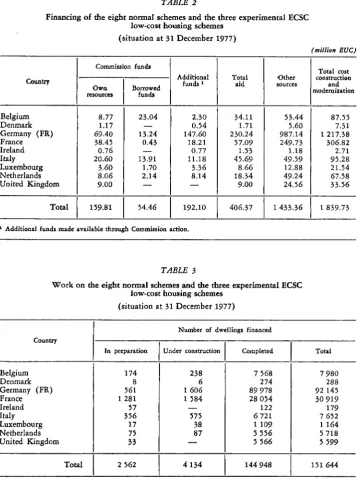
36. The English Scheme for financing construction of low-cost housing for workers in the ECSC industries has continued. For the first instalment (25 million EUC), 9 900 building projects have already been approved for a total of nearly 20 million EUC. For the second instalment (30 million EUC), the Commission has consulted national bodies and trade organizations and has distributed the appropriations among the Member States ECSC industries.
The special programme of 6 million EUC for rebuilding steel workers' dwellings follow-ing the earthquakes in Friuli has been entirely taken up; payment has, however, been delayed because of fresh earth tremors which have forced the local authorities to amplify their reconstruction plans.
l'he Commission has financed two pilot schemes, one on adapting housing to the needs of the handicapped, and the other on coordinating the housing and social services departments dealing with the handicapped.
The findings of the survey of migrant workers' housing conditions have been sent to the Council. On this basis, the Commission has decided to grant financial assistance to pilot schemes for improving these workers' housing.
Finally, the Commission has organized a 'European Habitat Competition' for 1978, with a prize, to be awarded to promoters of urban renewal schemes.
1 Bull. EC 3-1977, point 2.1.47; Bull. EC 5-1977, points 2.1.33 and 2.1.34. 2 Bull. EC 9-1977, point 2.1.31.
s Bull. EC 6-1977, point 1.1.8.
30 B - OUTLINE SURVEY
TABLE 2
Financing of the eight normal schemes and the three experimental ECSC low-cost housing schemes
(situation at 31 December 1977)
Commission funds Country
I
Additional Total Other funds 1 aid sources Own Borrowed
resources funds
Belgium 8.77 23.04 2.30 34.11 53.44
Denmark 1.17 - 0.54 1.71 5.60
Germany (FR) 69.40 13.24 147.60 230.24 987.14
France 38.45 0.43 18.21 57.09 249.73
Ireland 0.76 - 0.77 1.53 1.18
Italy 20.60 13.91 11.18 45.69 49.59
Luxembourg 3.60 1.70 3.36 8.66 12.88
Netherlands 8.06 2.14 8.14 18.34 49.24
United Kingdom 9.00
-
- 9.00 24.56(million EUC)
Total cost
constructien and modernization 87.55 7.31 1 217.38 306.82 2.71 95.28 21.54 67.58 33.56
Total
I
159.81 54.46 192.10 406.37 1 1 433.36 1 1 839.731 Additional funds made available through Commission action.
TABLE 3
Work on the eight normal schemes and the three experimental ECSC low-cost housing schemes
(situation at 31 December 1977)
Number of dwellings financed Country
I
Under constructionI
I
In preparation CompletedBelgium 174 238 7 568
Denmark 8 6 274
Germany (FR) 561 1 606 89 978
France 1 281 1 584 28 054
Ireland 57 - 122
Italy 356 575 6 721
Luxembourg 17 38 1109
Netherlands 75 87 5 556
United Kingdom 33 - 5 566
Total 2 562 4134 144 948
Total 7 980
288 92 145 30 919 179 7 652 1 164 5 718 5 599
151 644
[image:28.449.55.415.77.557.2]Social services and family matters
37. The Commission convened a meeting of 'the Liaison Committee for Social Workers in the European Community to examine current problems in social work in the Member States, particularly those caused by the increase in unemployment. The Commission also took part in the fifteenth Conference of European Ministers concerned with family matters, the central theme of which was the development of departments for helping parents educate their children.
Health and safety
Public health
38. The problem of public health, which directly influences the welfare of the European citizen, was on the agenda of the first meeting of the Ministers of Health, held Qn 13 December.1 The Commission was requested to take coordinated measures in the
field of health education-especially regarding addiction to tobacco, the taking of stimulant drugs, and nutrition-and also in connection with the control of certain trans-missible diseases, and to continue studying the economic aspects of health.
Radiation protection
j9. The Commission has given an Opinion on two regulations (introduced by Belgium and Italy) in application of the Directive on the basic standards for protection of the health against ionizing radiation2 (Article 33 of the Euratom Treaty). A draft
Recom-mendation has been drawn up to ensure protection of the public against the hazards from radioactive substances in consumer products.
The Commission has undertaken a study, as required by Article 3 7 of the Euratom Treaty of five plans for the disposal of radioactive waste from four nuclear reactors (Neckar-westheim, Philippsburg I, Isar and Fessenheim) and one reprocessing plant (HAO, Cap de la Hague).
Particular attention has been paid to radioactive waste produced by the nuclear fuel cycle as a whole. Studies are continuing with the aim of obtaining more efficient retention of certain nuclides (filters and iodine traps), whether for a better understanding of
1 Bull. EC 12-1977, points 1.5.1 to 1.5.4.
2 OJ L 187 of 12.7.1976.
32 B - OUTLINE SURVEY
dispersion in the environment and its effects throughout Europe (tritium in liquid effluent, atmospheric dilution) or, in the case of the Rhine Basin, to assess the radio-logical impact of the increasing use of nuclear energy. The Commission has also continued to cooperate with the national authorities on harmonizing the principles and procedures for authorizing the discharge of radioactive waste. In addition, a seminar was held at Karlsruhe in November on the problem posed by such waste in irradiated fuel reprocess-ing plants.
A number of publications have been issued on radiation protection.1
A measurement programme has been undertaken to chart the natural irradiation in the Community. Studies have also been started, with the cooperation of experts, on the problem of measuring plutonium and uranium uptake in the lungs and on the calibration of dosimeters.
In the training and information field, a seminar was organized for representatives of the European Trade Union Confederation.
Health aspects of the environment
40.
Under the policy on the protection of the environment, further progress has been made with analysis of the dosejeffect relationships (criteria) in respect of the following pollutants: mercury, cadmium, organochlorine compounds, asbestos. These have been submitted to experts with a view to determining health criteria. A seminar was held in April, in conjunction with the World Health Organization and the Environmental Protection Agency, on the collection of biological samples, and an expert panel was set up on mesothelioma (one of the cancerous diseases caused by asbestos), both under the programme for assessment of the toxicity of environmental pollutants. The harmonization of toxicity tests for chemical substances at Community level started with an intercompari-son programme on the lethal dose (LD50 ), and this will continue in 1978.Cooperation has been established with the Italian authorities to assess the hazards arising from the accidents in Seveso and Manfredonia (meeting in July on chloracne and in October on arsenic).
1 Results of environmental radioactivity measurements in the Member States of the European Com-munity; Seminars on the problems posed by the growing use of consumer goods containing radio-active substances; Third Information Seminar on the European Personal Dosimeter Intercomparison Programme (Berlin, 1976); Report on the two seminars on information and training on radiation protection for trade union representatives from the nine Member States of the EEC (7-8 October 1975, Brussels; 16-17 November 1976, Luxembourg); Seminar on High-Efficiency Aerosol Fil-tration; Seminar on Radioactivity in the Waters of the Meuse; First European Symposium on Rad Equivalent.
The Directive on biological screening of the population· for lead was adopted by the Council on 29 March.1
Alcoholism
141.
The Commission, in cooperation with the WHO and the International Council on Alcohol and Addictions (ICAA), organized a seminar which took place in Luxembourg in November on the medical and social risks that consumption of alcohol involves.Safety, hygiene and health protection at work
42.
The Community action programme on health and safety at work· has been sent to the Council, and could already be put into effect in 1978. Meanwhile, several studies have been completed which will serve to direct the activities of the Advisory Committee on Safety, Hygiene and Health Protection at Work, whose first report was put before the Council in August. The Commission also sent the Council, on 1 August, an amended draft proposal for a Directive on the protection of the health of workers exposed to vinyl chloride monomer.2 The Directive on the provision of safety signs at places ofwork was adopted by the Council on 28 June.8
The collective training courses held in 1977 on industrial safety and industrial medicine included seven periods for inspection officials and two for both sides of industry.
ECSC social research policy
43. Social research and research into coal and steel, which are the three components of the action envisaged in Article 55 of the ECSC Treaty, are aimed at improving safety and hygiene in the workplace, promoting medical research and, from an ergonomic point of view, adapting the work to man and to technical progress. Some research is also directed towards reducing pollution (water, air, noise). In June a symposium was held on coking plants, to review the results of research in the field of protection of workers and
improvement of the environment.•· ·
1 OJ L 105 of 28.4.1977; Bull. EC 3-1977, points 2.1.51 and 2.1.59.
2 OJ C 219 of 14.9.1977; Bull. EC 7/8-1977, point 2.1.54. a OJ L 229 of 7.9.1977; Bull. EC 6-1977, point 2.1.59.
~ Bull. EC 6-1977, point 2.1.61.
34 B - OUTLINE SURVEY
Steel Industry Safety and Health Commission
44. At its meeting on 25 January1 the Steel Industry Safety and Health Commission
approved the documents on accident prevention and on equipment for oxygen plant under pressure. It sponsored 'information days' on safety at work and ergonomics, on behalf.of Belgian metalworkers (Melreux, November 1977).2
Mines Safety and Health Commission
45. The Mines Safety and Health Commission held three full meetings. It approved three recommendations--on safety techniques in the production zone, on the installation of water barriers for protection against coal-dust explosions underground, and on strata consolidation by means of roof bolts, wooden plugs or injection. It also approved five reports-on rescue stations, on the neutralization of mine fires by injecting nitrogen, on the procedure for stabilizing ventilation in the event of an underground fire, on fire-damp ignition caused by coal-mining and heading machines, and on filter self-rescuers (maintenance and training).
Now that the Commission's responsibilities have been extended to cover offshore oilwells, the Ekofisk accident has shown that the oil and gas working party has a part to play in setting standards to ensure the safety of workers on platforms. An expert committee has been requested to study the prevention of blowouts. This Commission has also approved its fourteenth Progress Report and it held a conference to commemorate its twentieth anniversary on 22 and 23 November, when the most urgent problems still to be resolved in the coal-mining and other extractive industries were discussed.3 A round-table
discus-sion on 4 and 5 October brought together representatives of the International Organization for the Study of the Endurance of Wire Ropes and the members of the Working Party on Winding Ropes and Shaft Guides.
Handicapped persons
(16. Between 1974 and 1977 the European Social Fund has devoted a total of 62 mil-iion u.a. to the demonstration projects undertaken under the action programme for the vocational rehabilitation of handicapped persons.4 On 28 June 1977 the Council decided
1 Bull. EC 1-1977, point 2.1.29. 2 Bull. EC 11-1977, point 2.1.60. s Bull. EC 11-1977, point 2.1.61.
• OJ C 80 of 9.7.1974; Social Report 1974, point 39.