This is a repository copy of Looking to the Future; a response to the challenges of design
education in the 21st Century using C&IT..
White Rose Research Online URL for this paper:
http://eprints.whiterose.ac.uk/87563/
Version: Accepted Version
Proceedings Paper:
Evans, EL (2010) Looking to the Future; a response to the challenges of design education
in the 21st Century using C&IT. In: Proceedings of DRS 2010 Montreal. DRS 2010
Montreal, 07-09 Jul 2010, Montreal, Canada. Design Research Society , 38 - 38.
[email protected] https://eprints.whiterose.ac.uk/ Reuse
Unless indicated otherwise, fulltext items are protected by copyright with all rights reserved. The copyright exception in section 29 of the Copyright, Designs and Patents Act 1988 allows the making of a single copy solely for the purpose of non-commercial research or private study within the limits of fair dealing. The publisher or other rights-holder may allow further reproduction and re-use of this version - refer to the White Rose Research Online record for this item. Where records identify the publisher as the copyright holder, users can verify any specific terms of use on the publisher’s website.
Takedown
If you consider content in White Rose Research Online to be in breach of UK law, please notify us by
Looking to the future; a response to the challenges of
design education in the 21
stCentury using C&IT
Elaine Evans, University of Leeds, United Kingdom
Abstract
In response to increasing student numbers in practice based subjects, an ongoing project to develop online learning support materials for a BA (Hons) Fashion Design programme is exploring ways in which video based resources, in conjunction with virtual learning
environments, can support practical demonstrations. Intended as complimentary learning support materials, rather than replacing face to face demonstrations in taught sessions, this project investigates the ways in which students respond to the learning materials, and preferences they show for the different methods of learning used within a practice based setting.
Keywords
Pedagogy, Fashion, ICT, Virtual environment, Usability, Experiential knowledge, Learning, Project-grounded research
Today, universities in the UK are experiencing new challenges in the face of increasing student numbers; traditional methods of learning and teaching are being reappraised in a context of higher staff: student ratios and the drive to increase efficiency. Universities UK (online 2009) state that there was an increase in student numbers of 47% between the academic years 1994/95 and 2007/08, and that the average staff: student ratio in UK
universities is now 1:16.8 (online, 2010), and likely to increase. This is not a situation that is exclusive to art and design subjects, but it does raise some interesting challenges in
subjects where traditional methods are undeniably staff intensive. In response to this, there is a necessity to re-evaluate these traditional learning and teaching methods, and to develop the future of design education.
There has been a significant amount of work done concerning the variety of ways that people learn in the broader context, notably seminal texts by Kolb (1984), Honey and Mumford (1982), Entwistle and Ramsden (1983), but there is also a developing field of interest in the pedagogy of art and design subjects in particular; studies discussing and analysing the particularities of the methods used in these disciplines have been conducted by a growing field of researchers, including Davies (2000), Drew (2002), Jackson (1997) and Swann (2002) to name but a few. Indeed, Swann’s article Nellie is Dead, originally
published in 1986, highlights the fact that the challenges facing design education today are not a recent phenomenon, but have been developing over the last few decades.
context of the higher staff: student ratios of contemporary university life, there is a necessity to promote a greater degree of independence from design students than in the past, rather than continuing with the ‘sitting by Nellie’ approach that Swann (2002) questions. It is in this context that a pilot project began, with a view to enhancing the student learning experience within the Fashion Design BA (Hons) programme at the University of Leeds, by developing online resources to support student learning, while addressing the issue of reduced staff contact time per student in a practice based subject.
Rationale
With the ethos of “facilitating learning” rather than ‘teaching’, the idea of this project is to provide supporting information in an accessible environment that the students can use as and when they require it. It was deemed essential that the resources tied in directly with what was being taught in class, but also needed to be more ‘flexible’ than the traditional demonstrations. The emphasis of the project is that the online materials provide additional support material for students in practical modules, and are not intended to replace face-to-face demonstrations in taught sessions. The project also aims to address the need for students to acquire certain skills in order to be competent in their understanding of the design process, but also to promote a degree of independence in their approach to skill acquisition and practice.
Key to understanding the practice of Fashion Design, students on this programme undertake a module (in years one and two) in Garment Technology, which encompasses flat pattern cutting and sample or garment construction. Practical demonstrations form an important part of the learning process in this module, and are the basis of both the pattern cutting and the garment construction work, in conjunction with using worksheets developed for the module and textbooks. As the garment construction demonstrations traditionally take place around a sewing machine, space and visibility can be a problem, so students can fail to benefit from important details because they cannot see or hear clearly. Due to the nature of these demonstrations, they cannot be quickly or easily repeated due to the need for
preparation time. The rationale for change in this project was therefore to improve support for these practical demonstrations by using C&IT to enhance the student learning
experience.
Methodology
Initially a small number of video based learning resources were created to support student learning in studio based modules in Fashion Design, particularly at level 1. Initial experiments with videoing the demonstrations highlighted the need to modify the way that these
The videos are viewed through an “accessible multimedia player” called Webducate AMP. Of particular interest with regards this project was the option for students to see and print a transcript of the audio script, as this provides a good level of support for a variety of learning styles as well as addressing accessibility issues. The videos can be paused, rewound and replayed as many times as each student requires, and can be viewed full screen if the text is not required by the side of the video. Taking into consideration the different learning
preferences of the students on this module, it is intended that the online video
demonstrations provide support for as many of these preferences as possible. VARK (Fleming & Mills: 1992) is an interesting tool which provides users with information on their learning preferences through a series of questions based around learning styles. VARK describes people as having learning preferences under the following headings:
Visual (learning by videos, pictures, diagrams, graphs etc) Aural (listening to information)
Read / Write (list-making, note-taking, essays etc) or
Kinesthetic (trial and error, hands on practice, learning by doing)
Someone with a mixture of some or all of these preferences, is said to be ‘Multimodal’(and 60% of the population are said to fit into this category). In the context of this project, students with Visual learning preferences will be well supported both in the traditional practical demonstrations in this module and also by the additional visual information in the videos (with the added advantage of being able to pause and replay the videos). Those with Aural preferences will benefit from verbal instructions both in class and also with the
carefully planned audio script that accompanies the videos. For the Read / Write students, the online videos will be a real advantage, as there is no written information given with demonstrations in class, but there is a clear transcript of the audio which accompanies the videos. The students with kinesthetic preferences will benefit most from putting their knowledge into practice by making up the samples themselves.
The video demonstrations were made available to students through the University’s Virtual Learning Environment (VLE) alongside other module learning resources, enabling them to become part of a package of online materials to support student learning in this module. Virtual Learning Environments are increasingly being used by universities to make module materials available to students online, as well as allowing tutors to provide materials in a range of electronic formats. An article in the Guardian newspaper (Hoare: 2006) states that
The distinction between distance learning and studying on campus is becoming increasingly artificial. While providers of distance learning such as the Open University are boosting the quantity and quality of face-to-face seminars, traditional bricks-and-mortar institutions are supporting students on and off campus through virtual learning environments (VLEs) based on commercial or open access platforms. Certainly, in the context of higher student
numbers, using C&IT to provide additional support to learners makes sense on a number of levels. Furthermore, in this digital age, these resources may be key to ensuring that
students’ expectations of support are being met.
The questionnaires
questionnaires being completed and returned during a taught session. The questionnaire allowed students to reply anonymously, and 29 students completed and returned the
questionnaire. The questionnaire itself comprised a series of eight short sections, the majority of which required scaled responses rating difference aspects of the online materials, such as how easy the resources are to find, how the different methods of delivery for the module compare with one another, and how useful the different functions on the site were. There were also opportunities for further comments during the questionnaire to encourage students to share their experiences of using the resources, and therefore inform future practice.
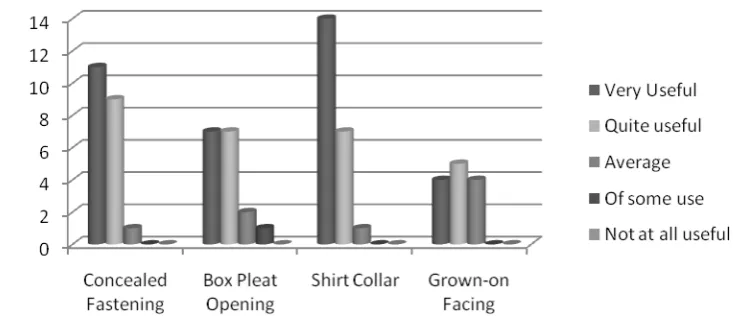
[image:5.595.75.442.369.532.2]Initial feedback from students using the online materials was generally very positive, indicating that students made good use of the online resources. When asked about whether the students had made use of the video demonstrations, 76% said that they had and a further 10% said that they were aware of the online resources but had had difficulty using them. Students’ overall impression of the site where the video resources were accessed was generally good to excellent, with a strong positive trend. Again, there was a strongly positive trend when asked how easy it was to find the resources within the VLE site, with 36% saying that this was ‘very easy’ and a further 44% saying that it was ‘easy’. Students were then asked about how useful they found each of the four video demonstrations available to them. Again, there was a strongly positive trend towards ‘very useful’ and ‘quite useful’, but with distinct preferences towards two of the four videos, as is seen in Figure 1 below.
Figure 1. Student preferences towards the video content available to them
It is thought that this is because these two videos dealt with concepts that student found more difficult to grasp, therefore the opportunity to replay these videos helped them to understand the manufacturing processes involved in these samples. Indeed, when asked to give further
comments in this section of the questionnaire, the following responses were given: ‘Maybe more of the more complex methods could be added’
‘Shirt collar was especially good’ ‘Shirt collar was useful’
different methods of delivery, as can be seen in fig. 2 below, but it appears that there was a slight trend towards students finding the video demonstrations easier to use than the demonstrations in taught classes.
Figure 2. How easy do you find it to learn using the following forms of delivery for this module?
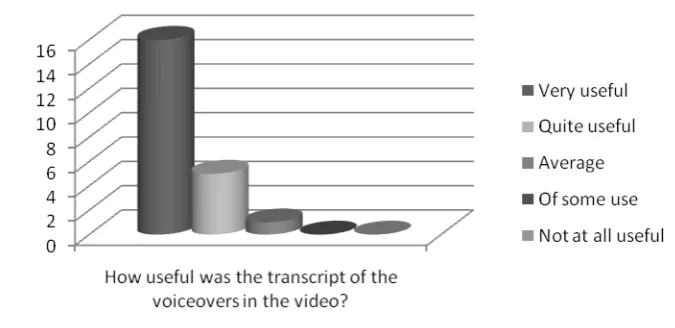
The transcript of the videos was thought to be ‘very useful’, with 73% of students selecting this option. A further 23% thought the transcript was ‘quite useful’ as seen below in Figure 3. However, when asked whether they used the option to be able to print this transcript, only 4% of respondent said that they used this option. This could indicate that written instructions are of most help when accompanied by visual information, but are not deemed to be as useful in isolation.
Figure 3. Students’ views on the written transcript of the audio voiceover.
When asked for comments about how the video demonstrations compared with face to face demonstrations in class, some of the comments given were as follows:
‘Able to go back and listen / watch again, so better in that respect’
[image:6.595.73.411.476.640.2]‘Much easier because during class demonstrations it’s difficult to see an sometimes hear’ ‘Can go at your own pace, can repeat if unsure’
‘It was easier to see what was being done’
‘There was a clear view of what needed to be done. Detailed’ ‘Not as good as face to face but still useful’
‘It was easier to understand as it seemed like a one on one demonstration’ ‘I prefer to watcha real demonstration’
Indeed, when asked for further comments about the advantages or disadvantages or problems that students encountered with the videos, responses were again very positive, with some students stating that they would like there to be more videos, or videos added on pattern cutting as well as the make-up of samples. Within this cohort of students, only one student stated that they had a visual or auditory impairment that might affect their ability to use web based
resources. The student gave no further details about this, but did state that they found the site easy to use. Lastly, students were asked for any final comments about what they would like to see added to the online resources. Examples of the comments received include:
‘more demos of different products’ ‘notes on techniques’
‘larger videos’
‘more written instructions for all’
‘examples of [research] boards and some construction notes’
It is clear from the responses received that students made good use of the additional resources available to them, and that they wished to see the video resource expanded to include further demonstrations, as well as other online resources to support their learning in the garment technology module.
Due to the positive nature of this student feedback, further work was planned on the project. In the second stage of the project Health and Safety training videos were developed to improve Health and Safety provision for practice based modules at all levels of the Fashion Design programme, and with a view to improving students’ understanding of how to safely use the three key pieces of equipment in the practical studio. Using the same format as the previous video demonstrations, three videos were planned, then filmed and edited with professional help. One feature of the VLE where the videos are accessed is that tests can be linked with the video files, to assess students’ understanding of what they had just watched. In order to promote the use of these videos, ‘adaptive releases’ were set on the video files and the tests, so that students would not be able to access all other learning materials for the module (including video
demonstrations which accompanied the garment construction demonstrations in class) until the videos had been viewed, and the tests completed. Students were asked to watch these videos and complete the tests during the first two weeks of the semester, with instructions on how to do so being given verbally in taught sessions.
different cohort of students from the students questioned about the pilot project; they had no previous experience of the resources that pre-date the health and safety videos, tests and adaptive releases. In this cohort of students, only 56% of students stated that they had used the resources, 28% said that they had had difficulty using the resources, and 16% said that they had not used the resources. This is a lower uptake than in the first stage of the project, with significantly more students having difficulty using the resources. It is thought that the ‘hurdles’ put in the students’ way, through the use of adaptive releases for the videos files and tests discouraged the use of the resources in some cases. It is worth noting that the ease of access to the ‘learning support’ files (which related directly to content in class) does seem to have had a significant impact on the percentage of students choosing to use the online resources; this should inform future practice, where more guidance will be given to students when introducing the resources.
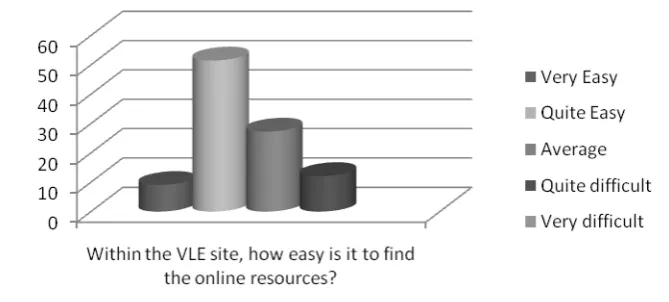
[image:8.595.74.409.339.490.2]Students’ overall impression of the site where the video resources were accessed was generally average to good, with a slightly positive trend. Again, there was a slightly positive trend when asked how easy it was to find the resources within the VLE site, with 9% saying that this was ‘very easy’, 52% saying that it was ‘quite easy’, 27% saying it was ‘average’, 12% saying that it was ‘quite difficult’, and no students saying that it was ‘very difficult’, as seen in Figure 4 below.
Figure 4. Students’ opinions on ease of locating the resources online
Some comments received in this section of the questionnaire are as follows: ‘Should be made easier to access and look for’
‘Clearer layout and clearer instructions onwhere to go to find what you are looking for’ ‘More obvious links to online demonstrations’
Figure 5. Students’ preferences towards the video content available to them (second cohort of students)
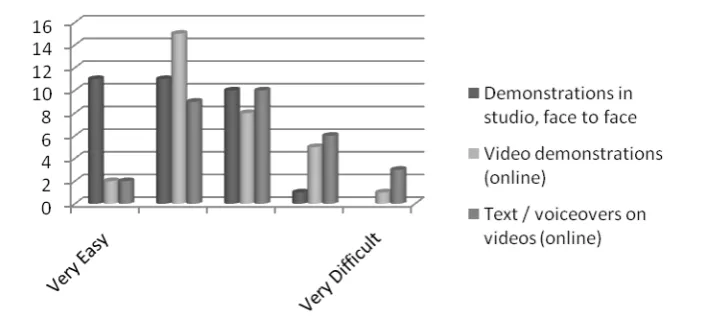
In this second set of feedback, when students were asked how easy they found it to learn using the following forms of delivery: a) demonstrations in studio, face to face; b) video
demonstrations, online; and c) text / voiceovers from the videos online, there was a slight preference for face to face demonstrations, followed by video demonstrations, and lastly text / voiceovers on the videos, as seen in Figure 6 below.
Figure 6. How easy do you find it to learn using the following forms of delivery for this module? (second cohort of students)
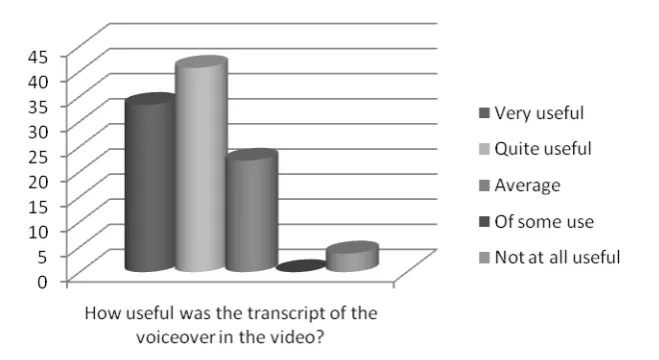
[image:9.595.76.429.389.553.2]Figure 7. Students’ views on the written transcript of the audio voiceover (second cohort).
Comments received from students regarding how the video demonstrations compared with face to face demonstrations in class include:
‘It was good to have the transcript to remind me of the face to face demonstrations, but not as good on its own’
‘Face to face was more applicable –mentioned problems that might occur etc’ ‘Easy to read and recap in case I missed anything during the tutored sessions’ ‘Was only more useful because you can follow it in your own time’
‘I prefer face to face demonstrations as I can ask questions’
‘I preferred the face to face contact however it wasn’t always easy to see as everyone crowds round’
No students in this cohort stated that they had a visual or auditory impairment that might affect their ability to use web based resources. When asked for final comments about what students would like to see added to the online resources, these included:
‘Examples of previous work’
‘The construction of patterns as well as garments’ ‘Need all demonstrations on with writteninstructions’ ‘Access to all without having to complete tests’
as a replacement. The students seem to value the significance of having face to face contact with staff, and the two way discussion that this can and should promote. It is also important to note that there is a balance to be struck with any such web based resource; the materials should support and engage student learning in an independent and active way, rather than encourage passivity towards the learning process. Some students suggested that all of the demonstrations for the module should be made available online to support them, but conversely, by making only selected learning resources available to students, possibly by facilitating learning of the more complex concepts, this may promote a better learning environment, as students will need to make some leaps of understanding for themselves.
Conclusion
Using VLEs to support the learning experience of students in any discipline has clear advantages, but particularly in practice based subjects, where blended learning resources would seem to be particularly applicable. Using C&IT in this way can help to manage the need for additional student support outside of taught sessions, as information is available to students in an accessible and flexible environment, enabling them to take responsibility for their own learning. However; video based learning materials can be costly and time consuming to produce, so careful and strategic planning is needed to produce resources which will be of most use to the target audience. If the correct balance is achieved, then the resource can be of use year after year.
Work on this project is ongoing, with a view to developing a more comprehensive resource to support delivery of practical modules at all levels of the Fashion Design programme, and move towards a more contemporary and innovative approach to teaching practice based modules which are traditionally staff intensive.
References
Davies, A (2000) Exploration of evaluation and research methods for improving student learning in art and design [online]. Accessed on 11/03/09. From:
http://www.arts.ac.uk/dovs/cltad_isl_evaluation.pdf
Davies, A and Reid, A (2000) Uncovering problematics in design education – learning and the design entity [online] Accessed on 11/03/09. From:
http://www.arts.ac.uk/docs/cltad_designeducation.pdf
Drew, L (2002) Fashion Variations: Student Approaches to Learning in Fashion Design
[online]. Accessed on 11/03/09. From:
http://www.arts.ac.uk/docs/cltad_ped_res_pap_drew_bailey_shreeve.doc
Entwistle, N and Ramsden, P (1983) Understanding Student Learning, Croom Helm, London
Fleming, N.D. and Mills, C. (1992), Not Another Inventory, Rather a Catalyst for Reflection,
Gibbs, G (1992), Improving the Quality of Student Learning, TES
Hoare, S (2006), Universitities Adapt to a shrinking world [online]. Accessed on 15/01/10. From:
http://www.guardian.co.uk/education/2006/mar/07/elearning.technology14
Honey, P and Mumford, A (1982) The Manual of Learning Styles, Peter Honey, Maidenhead
Jackson, B (1997) Values and Traditions in Teaching and Learning Art and Design [online]. Accessed on 21/04/04. From:
http://www.city.londonmet.ac.uk/deliberations/subjects/art_design/intro.html
Kolb, D A (1984) Experiential Learning, Prentice-Hall, Englewood Cliffs, New Jersey
Shepherd, J. (2010). Cash-starved universities will have huge classes, says union, The Guardian [online]. 12/01/2010. Accessed on 23/04/2010 at
http://www.guardian.co.uk/education/2010/jan/12/universities-face-huge-classes
Swann, C (2002) Nellie is Dead, Journal of Art, Design and Communication in Higher Education 1-2 (2002-2003) pp. 50-53, first published in Designer (Journal of the Society of Industrial Artists and Designers), March 1986
Universities UK (Summer 2009) Higher Education in Facts and Figures [online]. Accessed on 23/04/2010 at www.universitiesuk.ac.uk/Publications/Pages/FactsandFigures09.aspx
Universities UK, Briefing: Cuts to Higher and Further Education debate in the House of Lords
[online], Date: 25/02/2010, accessed 23/04/2010 at: