0022-538X/96/$04.0010
Copyrightq1996, American Society for Microbiology
Replication and Packaging of Coronavirus Infectious Bronchitis
Virus Defective RNAs Lacking a Long Open Reading Frame
ZOLTA´ N PE´NZES,1† CHRISTINE WROE,2T. DAVID K. BROWN,2PAUL BRITTON,1*
ANDDAVID CAVANAGH1
Division of Molecular Biology, Institute for Animal Health, Compton Laboratory, Compton,1and Division of Virology,
Department of Pathology, University of Cambridge, Cambridge,2United Kingdom
Received 19 June 1996/Accepted 9 September 1996
The construction of a full-length clone of the avian coronavirus infectious bronchitis virus (IBV) defective RNA (D-RNA), CD-91 (9,080 nucleotides [Z. Penzes et al., Virology 203:286–293]), downstream of the bacte-riophage T7 promoter is described. Electroporation of in vitro T7-transcribed CD-91 RNA into IBV helper virus-infected primary chick kidney cells resulted in the production of CD-91 RNA as a replicating D-RNA in subsequent passages. Three CD-91 deletion mutants were constructed—CD-44, CD-58, and CD-61—in which 4,639, 3,236, and 2,953 nucleotides, respectively, were removed from CD-91, resulting in the truncation of the CD-91 long open reading frame (ORF) from 6,465 to 1,311, 1,263, or 2,997 nucleotides in CD-44, CD-58, or CD-61, respectively. Electroporation of in vitro T7-transcribed RNA from the three constructs into IBV helper virus-infected cells resulted in the replication and packaging of CD-58 and CD-61 but not CD-44 RNA. The ORF of CD-61 was further truncated by the insertion of stop codons into the CD-61 sequence by PCR mutagenesis, resulting in constructs CD-61T11 (ORF: nucleotides 996 to 1,058, encoding 20 amino acids), CD-61T22 (ORF: nucleotides 996 to 2,294, encoding 432 amino acids), and CD-61T24 (ORF: nucleotides 996 to 2,450, encoding 484 amino acids), all of which were replicated and packaged to the same levels as observed for either CD-61 or CD-91. Analysis of the D-RNAs showed that the CD-91- or CD-61-specific long ORFs had not been restored. Our data indicate that IBV D-RNAs based on the natural D-RNA, CD-91, do not require a
long ORF for efficient replication. In addition, a 1.4-kb sequence, corresponding to IBV sequence at the 5*end
of the 1b gene, may be involved in the packaging of IBV D-RNAs or form part of acis-acting replication element.
Infectious bronchitis virus (IBV), a member of the Corona-virusgenus of theCoronaviridaefamily, is an enveloped virus with a single-stranded, positive-sense RNA genome of 27,608 nucleotides (1) that is 59 capped and 39 polyadenylated. A 39-coterminal nested set of six subgenomic mRNAs are syn-thesized in IBV-infected cells which possess a 63-nucleotide leader sequence at their 59ends which is also located at the 59 end of the genomic RNA.
Following high-multiplicity passage of RNA viruses, defec-tive RNAs (D-RNAs) may be produced which lack internal parts of the genome, require helper virus for their replication, and may interfere with the replication of the helper virus (6). For coronaviruses D-RNAs have been produced from mouse hepatitis virus (MHV) (17, 25), bovine coronavirus (BCV) (2), IBV (22), and transmissible gastroenteritis virus (20). A char-acteristic of all naturally occurring coronavirus D-RNAs is the presence of a long open reading frame (ORF), corresponding to$70% of the RNA, and usually comprising in-frame fusions between different discontinuous regions of the polymerase gene and varying amounts of the nucleocapsid protein (N) gene (2, 16, 18, 22, 25). Although D-RNA-specific proteins have been detected in MHV D-RNA-replicating cells (4, 8, 16, 18), the requirement for a D-RNA-specific ORF is unclear. Differences in the MHV D-RNA-specific ORF products tend
to rule out a specific cis-acting role for them. However, the product of the N-protein sequence present in the 2.2-kb BCV D-RNA has been demonstrated to have a requirement incis for optimum replication (3).
The study of coronavirus D-RNAs has involved mainly the characterization of three MHV-derived D-RNAs: the 5.5-kb MHV A59 D-RNA, DI-a (4), and two D-RNAs derived from MHV JHM, the 3.4-kb DIssF and the 2.2-kb DIssE (14). Al-though each MHV D-RNA contains a long ORF, expressed in D-RNA-infected cells, their sequences are substantially differ-ent. Truncation of the ORF in DI-a did not prevent replication but did result in a reduced accumulation of the altered D-RNA (4). The replication of a series of mutant DI-a-derived RNAs with in-frame and out-of-frame ORFs showed that those with in-frame ORFs prevailed within three passages compared to their out-of-frame counterparts, indicating that the ORF is required for efficient propagation. This result was supported by the observation that passage of D-RNAs with out-of-frame ORFs resulted in the emergence of RNAs with restored ORFs, indicating that the presence of an ORF had some selective advantage (4). Recent work has demonstrated that it is not the particular encoded sequence but translation of an ORF per se that is required for replication (26). The conclusion that a long ORF in MHV D-RNAs is required for efficient propagation was supported by the observation that replication of a 2.2-kb BCV D-RNA was inhibited following the introduction of frameshift mutations for truncation of the long ORF (2). In contrast, the long ORFs of the MHV JHM D-RNAs DIssE (7) and DIssF (13) did not appear to be required for replication following deletion mutagenesis to study the role of cis-acting sequences in replication. However, a derivative of DIssE, NE-1, containing a single nucleotide deletion resulting in trun-cation of the ORF product from 567 to 57 amino acids, was * Corresponding author. Mailing address: Division of Molecular
Biology, Institute for Animal Health, Compton Laboratory, Compton, Newbury, Berkshire RG20 7NN, United Kingdom. Phone: (44) 1635 578411. Fax: (44) 1635 577263. Electronic mail address: Paul.Britton @bbsrc.ac.uk.
† Present address: Centro Nacional de Biotechnologı´a, Consejo Su-perior de Investigaciones Cientı´ficas, Campus Universidad Auto´noma, Cantoblanco, 28049 Madrid, Spain.
8660
on November 9, 2019 by guest
http://jvi.asm.org/
found to have a restored full-length ORF after one passage (8). This result indicated that, although a full-length long ORF may not be a prerequisite for the replication of DIssE-derived D-RNAs, restoration of the ORF may have a selective advantage. The restoration of the MHV D-RNA ORFs is believed to occur via recombination with helper virus RNA. To overcome this process, Liao and Lai (12) created truncated ORFs or closed the ORF by the insertion of a 12-nucleotide amber mutation linker into the ORF of DIssE. The linker either prevented or delayed recombination, thereby increasing the stability of the mutated D-RNAs to maintain the integrity of the mutations introduced into the ORFs. The D-RNAs with truncated or closed ORFs still replicated, indicating that a cis-acting D-specific protein was not required for D-RNA rep-lication. However, mutation of the initiation codon without insertion of the linker resulted in restoration of the ORF, supporting the previous results (4, 8) that D-RNAs with a long ORF have a competitive advantage. A potential reason why some of the MHV D-RNAs do not appear to require a long ORF may be their small size. The full length of DIssE, the smallest MHV D-RNA found to date, is 2.2 kb with an ORF of 1,704 nucleotides (15, 18).
We have described previously the identification and charac-terization of a naturally occurring 9.1-kb IBV D-RNA, CD-91, produced following repeated high-multiplicity passage of the Beaudette strain in chicken kidney (CK) cells (22). The IBV D-RNA consists of three discontinuous regions of the genome and, consistent with all other naturally occurring coronavirus D-RNAs, a long ORF (nucleotides 996 to 7,463) encoding a potential product of 2,155 amino acids. Sequence analysis of CD-91 identified the loss of nucleotide 749 of the IBV genome resulting in the premature termination of the 1a gene ORF (which initiates at nucleotide 529) at nucleotide 765 and a potential product of 78 amino acids. However, a long ORF, initiating within the 1a gene sequence at nucleotide 996, con-sisting of noncontiguous regions of the IBV polymerase gene
fused together, was identified (22). In this paper we report the construction of a full-length cDNA clone of CD-91, the repli-cation and packaging of CD-91 RNA following electroporation of in vitro-transcribed CD-91 RNA into helper virus-infected cells, and the replication and packaging of CD-91 RNA con-taining interrupted ORFs. Our results indicated that a full-length IBV D-RNA-specific long ORF, initiating at nucleotide 996, was not necessary for replication of IBV D-RNAs based on the naturally occurring IBV D-RNA CD-91.
MATERIALS AND METHODS
Virus and cells.D-RNA-free IBV Beaudette-US, grown in 11-day-old embry-onated domestic fowl eggs at 378C and harvested from allantoic fluid at 18 h postinfection (p.i.), was used as helper virus. The passage and growth of IBV in primary CK cells was as described previously (22).
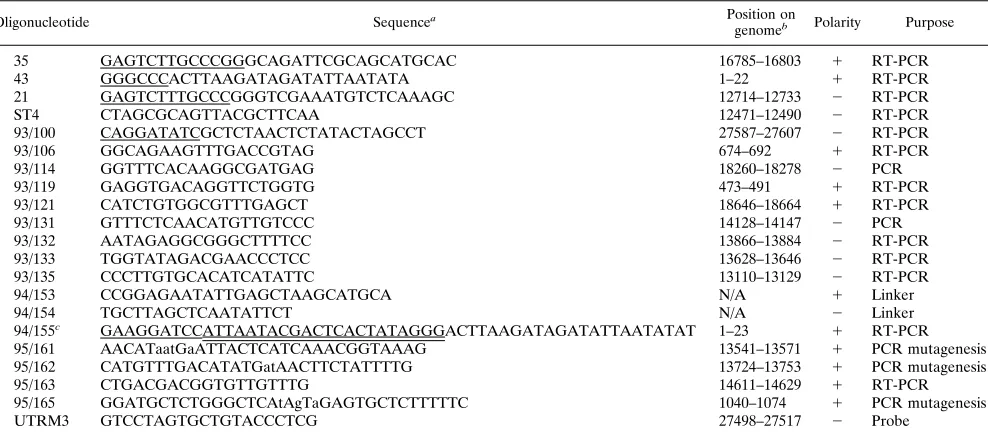
Oligonucleotides.Oligonucleotides were synthesized on an Applied Biosys-tems 392 DNA/RNA synthesizer. The sequences of the oligonucleotides used in this study are listed in Table 1.
Recombinant DNA techniques.Standard procedures were used for recombi-nant DNA techniques (24). Reverse transcriptase PCR (RT-PCR) and PCRs (22) and sequence analyses of plasmid DNA and PCR products (5, 22) were performed as described previously.
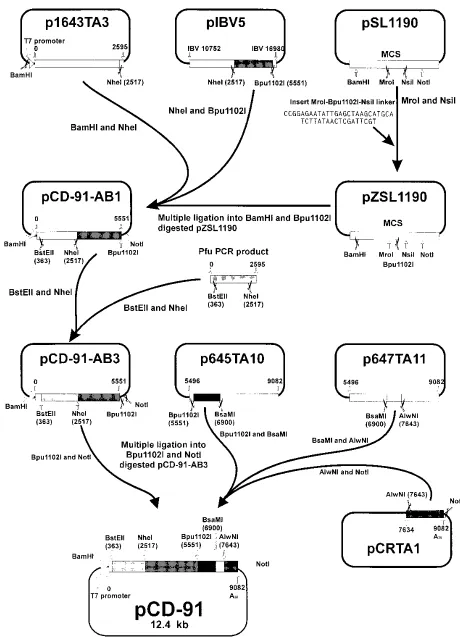
[image:2.612.62.556.82.300.2]Construction of plasmids containing IBV D-RNA. (i) pCD-91.The full-length clone of D-RNA CD-91 (EMBL/GenBank/DDBJ accession number Z30541) was assembled, as shown in Fig. 1, in a modified version of pSL1190 (Pharmacia). Essentially, cDNA sequences were either derived from CD-91 RNA by RT-PCR and cloned into pCR-II (Invitrogen TA cloning vector) to generate plasmids p1643TA3, p645TA10, and p647TA11 or derived from IBV genomic RNA in plasmids pIBV5 (nucleotides 10752 to 16980 of the IBV genome) and pCRTA1 [from nucleotide 26157 at the 39end of the IBV genome including a poly(A) tail of 28 adenine residues followed by aNotI site] (both plasmids were gifts from K. Tibbles, Division of Virology, University of Cambridge). A uniqueBpu1102I site was introduced into pSL1190, by the insertion of aMroI-Bpu1102I-NsiI linker (oligonucleotides 94/153 and 94/154) to generate pZSL1190, for the assembly of CD-91 cDNA. Plasmid p1643TA3 contained the first 2.6 kb of CD-91 joined directly behind the bacteriophage T7 promoter. The 2.6-kb fragment consisting of the T7 promoter and the 59end of the IBV genome was generated by RT-PCR from CD-91 RNA usingTaqDNA polymerase (Promega) and oligonucleotides 94/155 and 21. The T7 promoter was included for the in vitro transcription of RNA. Plasmids p645TA10 and p647TA11 contained a 3.6-kb fragment, corre-sponding to nucleotides 5496 to 9082 of CD-91, generated by RT-PCR usingTaq
TABLE 1. Oligonucleotides for construction and sequencing of IBV D-RNAs
Oligonucleotide Sequencea Position on
genomeb Polarity Purpose
35 GAGTCTTGCCCGGGCAGATTCGCAGCATGCAC 16785–16803 1 RT-PCR
43 GGGCCCACTTAAGATAGATATTAATATA 1–22 1 RT-PCR
21 GAGTCTTTGCCCGGGTCGAAATGTCTCAAAGC 12714–12733 2 RT-PCR
ST4 CTAGCGCAGTTACGCTTCAA 12471–12490 2 RT-PCR
93/100 CAGGATATCGCTCTAACTCTATACTAGCCT 27587–27607 2 RT-PCR
93/106 GGCAGAAGTTTGACCGTAG 674–692 1 RT-PCR
93/114 GGTTTCACAAGGCGATGAG 18260–18278 2 PCR
93/119 GAGGTGACAGGTTCTGGTG 473–491 1 RT-PCR
93/121 CATCTGTGGCGTTTGAGCT 18646–18664 1 RT-PCR
93/131 GTTTCTCAACATGTTGTCCC 14128–14147 2 PCR
93/132 AATAGAGGCGGGCTTTTCC 13866–13884 2 RT-PCR
93/133 TGGTATAGACGAACCCTCC 13628–13646 2 RT-PCR
93/135 CCCTTGTGCACATCATATTC 13110–13129 2 RT-PCR
94/153 CCGGAGAATATTGAGCTAAGCATGCA N/A 1 Linker
94/154 TGCTTAGCTCAATATTCT N/A 2 Linker
94/155c
GAAGGATCCATTAATACGACTCACTATAGGGACTTAAGATAGATATTAATATAT 1–23 1 RT-PCR
95/161 AACATaatGaATTACTCATCAAACGGTAAAG 13541–13571 1 PCR mutagenesis
95/162 CATGTTTGACATATGatAACTTCTATTTTG 13724–13753 1 PCR mutagenesis
95/163 CTGACGACGGTGTTGTTTG 14611–14629 1 RT-PCR
95/165 GGATGCTCTGGGCTCAtAgTaGAGTGCTCTTTTTC 1040–1074 1 PCR mutagenesis
UTRM3 GTCCTAGTGCTGTACCCTCG 27498–27517 2 Probe
aNucleotides not derived from the IBV genome but included to provide particular restriction endonuclease sites are underlined. Point mutations for incorporation of new stop codons into IBV D-RNAs are lowercased.
bN/A not applicable to IBV sequence.
cABamHI restriction site plus 3 nucleotides (underlined), the T7 promoter sequence (doubly underlined), and the first 23 nucleotides of the 59end of the IBV genome.
on November 9, 2019 by guest
http://jvi.asm.org/
FIG. 1. Schematic diagram representing the construction of the full-length cDNA clone of CD-91 RNA. Shaded boxes, IBV sequences removed from various fragments of the IBV genome previously identified in CD-91; thin lines, vector DNA.
on November 9, 2019 by guest
http://jvi.asm.org/
polymerase and oligonucleotides 35 and oligo(dT)18-NotI. Sequence analysis of these plasmids identified various point mutations in the IBV-derived sequences compared to the IBV genomic sequence; therefore, only regions of the IBV sequence that did not contain point mutations were used. A full-length cDNA clone of CD-91 was constructed by the following procedure: the 2.5-kbBam
HI-NheI fragment from p1643TA3 and the 3-kbNheI-Bpu1102I fragment from pIBV5 was ligated into pZSL1190 to yield pCD-91-AB1. Sequence analysis of pCD-91-AB1 revealed four base changes between nucleotides 1630 and 2068 in the IBV cDNA fragment from p1643TA3. To correct these errors, a 2.2-kb
BstEII-NheI fragment containing the point mutations was replaced with a similar fragment derived from an RT-PCR product generated from CD-91 RNA by using oligonucleotides 43 and 93/132 andPfuDNA polymerase (Stratagene), resulting in pCD-91-AB3, which did not contain the point mutations. The 1.4-kb
Bpu1102I-BsaMI fragment from p645TA10, the 700-bpBsaMI-AlwNI fragment from p647TA11 and the 1.4-kbAlwNI-NotI fragment from pCRTA1 were ligated intoBpu1102I- andNotI-digested pCD-91-AB3 in a single step to yield pCD-91. (ii) Construction of pCD-91-derived deletion mutants.Sequence analysis was used to identify convenient restriction sites in pCD-91 that would yield deletion mutants of CD-91 with truncated ORFs. pCD-91 was digested withHpaI orNsiI to release internal fragments of 4,638 or 2,953 nucleotides, generating plasmids pCD-44 and pCD-61, respectively. pCD-61 was digested withHpaI to introduce a deletion of 283 nucleotides generating plasmid pCD-58. The characteristics of the constructs are shown in Fig. 3.
(iii) Construction of pCD-61-derived mutants with truncated ORFs.Stop codons (two in tandem, for each mutated D-RNA) were introduced into CD-61 by PCR mutagenesis by using oligonucleotide 95/165, 95/161, or 95/162, corre-sponding to positions approximately 1.1, 2.2, and 2.4 kb from the 59end of CD-61 (Fig. 5). PCR fragments of 1,181, 1,784, and 1,601 bp, containing the new stop codons, were generated from pCD-61 by using oligonucleotide pair 95/165-93/ 131, 95/161-93/114, or 95/162-93/114 withPfupolymerase. The 1,818-bp PCR product was digested withBanII andNdeI, the resulting 1.4-kb product was ligated with the 7-kbBamHI-NdeI fragment and the 1-kbBamHI-BanII frag-ment derived from pCD-61 to generate pCD-61T11. The 1,784-bp PCR product was digested withNsiI; the resulting 1.7-kb product was ligated into the 7.7-kb
HpaI-NsiI fragment derived from pCD-61 to generate pCD-61T22. The 1,601-bp PCR product was digested withNdeI andNsiI; the resulting 1.5-kb product was used to replace the comparable fragment in pCD-61 to generate pCD-61T24.
In vitro transcription and translation.RNA was synthesized in a total volume of 20ml by using 20 U of T7 RNA polymerase (Promega); 15 nmol each of ATP, UTP, CTP, and GTP; 200 nmol of dithiothreitol; 40 U RNasin (Promega); and 1mg ofNotI-linearized DNA template at 378C for 1 h; followed by addition of another 10 U of T7 RNA polymerase and incubation at 378C for 1 h. For capped transcripts, 10 nmol of cap analog m7
G(59)ppp(59)G (Pharmacia) was included in the reaction mixture. The transcription reactions were stored at2708C and used without further purification. In vitro T7-transcribed RNAs derived from linearized plasmids, based on pCR-II, were translated in the rabbit reticulocyte lysate cell-free system (Promega) at 308C in the presence of 0.75mCi of [35
S]me-thionine per ml. The translation products were analyzed on sodium dodecyl sulfate (SDS)–10% polyacrylamide gels and detected by autoradiography.
Electroporation of primary CK cells.CK cells were grown to 80 to 90% confluence in 25-cm2
tissue culture flasks (Falcon) and infected with 0.5 ml of egg-grown IBV Beaudette helper virus. At 8 h p.i. the cells were washed twice with PBSa (172 mM NaCl, 3 mM KCl, 100 mM Na2HPO4, 2 mM KH2PO4[pH 7.2]), once with trypsin-versene (0.03% trypsin in 0.5 mM EDTA), digested with 1 ml of trypsin-versene for 3 to 5 min at 378C, followed by 0.4 ml of 10% newborn calf serum, cooled on ice, centrifuged at 2,500 rpm for 3 min, and resuspended in 0.3 ml of ice-cold PBSa. The cells (0.3 ml) were transferred to a 0.4-cm electroporation cuvette (Invitrogen), 20 to 40ml of the transcription reaction mixture was added, and the cells were electroporated at 200 V at 500mF by using a Bio-Rad Gene Pulser apparatus (model 1652078) fitted with a Bio-Rad capac-itance extender. The cells were placed on ice for 5 min, diluted 1:10 in CK cell medium (22), transferred onto tissue culture plates, and incubated at 378C for 12 h. Virus (V0) in 1 ml of the supernatants from the infected/electroporated cells was used to infect CK cells, and after 20 to 24 h virus (V1) from the supernatants was passaged on CK cells. This was repeated for at least two more passages, V2and V3. RNA was isolated from cells, P1to P4, infected with each virus passage, V0to V3.
Isolation and analysis of IBV-derived RNA.Total cellular RNA was extracted from the IBV-infected CK cells by using guanidinium isothiocyanate as described previously (22). RNAs were separated in denaturing 1% agarose–2.2 M formal-dehyde gels (24). The gels were semidried by the method of Meinkoth and Wahl (19), and IBV RNAs were detected by autoradiography following hybridization to32
P-labelled oligonucleotide UTRM3.
Nucleotide sequence accession number.The sequence of CD-61 has been deposited in the EMBL/GenBank/DDBJ nucleotide databases under accession number Z69629.
RESULTS
Construction of a full-length cDNA clone of CD-91 RNA.A
full-length cDNA clone of the IBV Beaudette-derived 9.1-kb
D-RNA, CD-91, was assembled under the control of the bac-teriophage T7 promoter in plasmid pCD-91 (Fig. 1). The CD-91 cDNA contains a short poly(A) region of 28 adenosine residues followed by a uniqueNotI site. Several intermediate clones were produced and sequenced prior to assembly of pCD-91 so that any point mutations introduced by the cloning procedures could be repaired. The restriction site junctions used for assembly of the CD-91 cDNA were sequenced to determine the integrity of the full-length clone of the CD-91. pCD-91 was found to contain only one known base change, derived from pCRTA1, consisting of an A3G substitution at nucleotide 8560 that is not within the CD-91-specific long ORF.
Replication and packaging of T7-transcribed CD-91 RNA in
IBV-infected CK cells.IBV Beaudette-infected CK cells were
electroporated with 20 or 40ml of capped or uncapped in vitro T7-transcribed RNA fromNotI-linearized pCD-91. Virus (V0)
present in the supernatant of the infected/electroporated cells, 20 h p.i. with helper virus, was serially passaged on CK cells, generating progeny virus V1 to V3. Total cellular RNA was
extracted from the CK cells (P1to P4) infected with V0to V3
virus, electrophoresed on formaldehyde denaturing agarose gels, and hybridized with 32P-labelled oligonucleotide
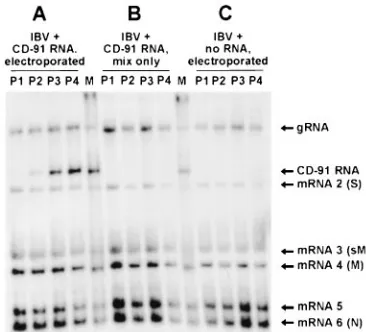
UTRM3. In addition to the IBV genomic and six subgenomic mRNAs an RNA corresponding to the size (9.1 kb) of IBV D-RNA CD-91 was detected in CK cells infected with V0to V3
virus (Fig. 2A). The amount of the 9.1-kb RNA detected in-creased in each subsequent cell extract, P1to P4, indicating that
[image:4.612.342.525.70.236.2]the pCD-91-derived RNA was able to replicate and be pack-aged. No 9.1-kb RNA was detected in RNA extracts from helper virus-infected CK cells either mixed with in vitro T7-transcribed RNA from pCD-91 but without electroporation (Fig. 2B) or electroporated in the absence of RNA (Fig. 2C). FIG. 2. Analysis of IBV-specific RNAs following electroporation of in vitro T7-transcribed CD-91 RNA into IBV-infected CK cells. CK cells were infected with helper IBV and at 8 h p.i. were either electroporated with in vitro T7-transcribed CD-91 RNA (A), mixed with in vitro T7-T7-transcribed CD-91 RNA without electroporation (B), or electroporated but without the addition of in vitro T7-transcribed CD-91 RNA (C). The cells were incubated for 12 h, and virus (V0) in the supernatants was used to infect CK cells. The cells were incubated for 20 to 24 h, and progeny virus (V1) was used to infect CK cells. This was repeated, generating V2and V3virus. Total cellular RNA from the infected cells at each passage (P1to P4) was isolated, electrophoresed in denaturing formaldehyde agarose gels, and hybridized with 32P-labelled oligonucleotide UTRM3. Lanes P1 to P4, RNA samples derived from each passage; lane M, IBV RNA containing wild type CD-91 RNA. The IBV subgenomic mRNAs, genomic RNA (gRNA), and CD-91 RNA are indicated. S, sM, M, and N, IBV mRNAs expressing the virion proteins spike, small membrane, membrane, and nucleo-protein, respectively.
on November 9, 2019 by guest
http://jvi.asm.org/
Electroporation of 20 or 40 ml of uncapped in vitro T7-tran-scribed RNA gave the same results (data not shown) as using capped RNA. Therefore, 20ml of uncapped in vitro T7-tran-scribed RNA was used in subsequent experiments.
To verify that the 9.1-kb RNA corresponded to CD-91, RNA was isolated from CK cells infected with V2virus,
pas-sage P3, and analyzed by RT-PCR using oligonucleotides 93/
106 and ST4 and oligonucleotides 93/121 and 93/100, whose products spanned the junctions of domains I and II and do-mains II and III of CD-91 (22). The PCR products generated were of the expected sizes, 527 and 1723 bp, indicating that the RNA from P3 CK cells corresponded to CD-91. The 527-bp
PCR product was amplified from the 59end of the 9.1-kb RNA to include the region of the adenosine deletion, nucleotide 749, previously identified in CD-91 (22). Sequence analysis showed the absence of this nucleotide (data not shown), confirming that the RNA corresponded to D-RNA CD-91. Our results showed that the T7-transcribed RNA from the full-length cDNA copy of CD-91 in pCD-91 was replicated and packaged in helper IBV-infected CK cells in a manner analogous to the passage of IBV D-RNA CD-91.
Effects of internal deletions on the replication and
packag-ing of CD-91. Previous work using MHV D-RNAs had
indi-cated either that a D-RNA-specific long ORF was required for efficient replication or that D-RNAs with a long ORF had a selective advantage over those either lacking an ORF or pos-sessing a shorter ORF. Analysis of modified D-RNAs based on the MHV D-RNAs DI-a and DIssE has shown that mutations introduced into the RNAs, resulting in premature termination of the D-specific ORF, were repaired, resulting in restoration of the ORF following passage in MHV-infected cells. The IBV D-RNA CD-91 contains a long ORF initiating within the poly-merase 1a gene sequence at nucleotide 996 and terminating at nucleotide 7463. To determine whether the IBV D-RNA-spe-cific ORF was required for efficient replication or if it con-ferred a selective advantage over D-RNAs with smaller ORFs, we introduced several deletions into CD-91 to (i) analyze the effect of truncating the D-RNA-specific ORF and (ii) deter-mine whether smaller IBV D-RNAs could be passaged.
Three CD-91-derivatives—CD-44 (4,443 nucleotides), CD-58 (5,848 nucleotides), and CD-61 (6,129 nucleotides), with long ORFs ranging from nucleotide 996 to 2306 (436 amino acids), to 2261 (421 amino acids), and to 3992 (998 amino acids), respectively, resulting from internal deletions in pCD-91—were prepared by using convenient restriction en-zyme sites (Fig. 3) (see Materials and Methods). The integrity of the CD-91-derivatives was checked by sequence analysis of the junctions created following removal of the restriction frag-ments.
In vitro T7-transcribed RNAs from pCD-61, pCD-58, and pCD-44 were electroporated into IBV Beaudette helper virus-infected CK cells. Virus (V0) released into the supernatants of
the electroporated cells was passaged as described above. Total cellular RNA was extracted from the infected CK cells (P1to
P4) and analyzed for the presence of D-RNAs. This showed
that CD-61 and CD-58 RNAs were observable from passages P2to P4. The amounts of CD-61 (Fig. 4A) and CD-58 (Fig. 4B)
RNA detected in and after P3were similar to those observed
for CD-91 in the same experiment as CD-61. Parallel passage of the helper virus in the CK cells did not result in the detec-tion of any new D-RNA (Fig. 4C), demonstrating that the D-RNAs detected were derived from the electroporated in vitro-synthesized RNAs. There was no propagation of CD-44 RNA (data not shown). The observation that CD-58 was pro-duced to a similar extent as CD-61 indicated that there was no
observable selective advantage of a longer ORF (CD-61) over a shorter ORF (CD-58).
[image:5.612.319.555.72.296.2]To confirm that the RNAs corresponded to the deleted forms of CD-91, RT-PCRs were carried out on total RNA extracted from CK cells at passage P4by using oligonucleotides
FIG. 3. Schematic diagram showing the structure of the modified IBV D-RNAs following the removal of internal sequences. CD-44, CD-58, and CD-61 were derived from CD-91 by internal deletions within domain II (polymerase 1b gene) by using specific restriction enzymes as described in Materials and Meth-ods. The three domains (I, II, and III) of the modified D-RNAs, identified in CD-91, are indicated by different patterns. The regions excised from CD-91 to produce the truncated derivatives are represented by open boxes, with the rel-evant positions and restriction endonucleases used indicated. The positions and lengths of the D-RNA-specific long ORFs are indicated by thick horizontal lines. The oligonucleotides used to amplify the region containing the ORF from the CD-58 D-RNA are indicated. The figure is drawn to scale, although the exact positions of the oligonucleotides are not marked.
FIG. 4. Analysis of IBV-specific RNAs following electroporation of in vitro T7-transcribed CD-61 and CD-58 RNAs into IBV-infected CK cells. CK cells were infected with IBV Beaudette helper virus, and at 8 h p.i. the cells were electroporated with in vitro T7-transcribed RNA from either pCD-61 (A) or pCD-58 (B). Thereafter, the procedure was as described in the legend to Fig. 2. (C) RNA extracts from passage P3and P4of undiluted helper virus in CK cells. No D-RNAs were present in the helper virus inoculum.
on November 9, 2019 by guest
http://jvi.asm.org/
[image:5.612.327.547.500.665.2]93/119 and 93/131 for CD-58 and oligonucleotides 95/163 and 93/114 for CD-61. The 2.1-kb CD-58-derived PCR product which included the CD-58 ORF and the 0.7-kb CD-61 PCR product which spanned the 39 end of the CD-61 ORF were ligated into pCR-II. Sequence analysis of the CD-58-derived PCR product identified two point mutations, T3A (nucleotide 1965) and C3A (nucleotide 1981), neither of which affected the length of the ORF and may have arisen during synthesis of the RNA or as a result of PCR amplification. Sequence anal-ysis of a 400-nucleotide region of the CD-61-derived PCR product, spanning the 39end of the ORF and the junction of theNsiI sites, identified no changes. These results showed that neither the deletions introduced nor the resulting truncation of the D-RNA-specific ORFs affected replication of the modified D-RNAs.
Our results showed that the smaller IBV D-RNAs were stable and that the lengths of the D-RNA-specific ORFs were sufficient for replication, even though the ORF in CD-58 is half the length of that in CD-61. The observation that CD-44 was not produced would indicate that the sequence removed had some essential role in replication. The CD-44 ORF was slightly larger than the ORF in CD-58. However, CD-44 lacked a 1.4-kb region, nucleotides 2535 to 3948, that was present in both CD-58 and -61, implying that sequences within this region are required for either replication or packaging. Whether this involves replication or packaging has yet to be determined.
Effects of internal stop codons within the CD-61 ORF on
replication and packaging. The successful replication and
packaging of CD-61 and CD-58 showed that the sequences removed from CD-91 were not essential and that the reduction in the length of the D-RNA-specific ORF was not detrimental. However, it could be argued that a shorter ORF could be tolerated due to reduction in the length of the D-RNAs. CD-61 and CD-58 RNAs are of similar lengths, but the length of the CD-58 ORF is approximately 50% of that in CD-61. To inves-tigate further the requirement of a long ORF, we introduced internal stop codons into the ORF of CD-61, thereby keeping the length of the D-RNA the same but decreasing the length of the ORF. This method had the advantage that sequences po-tentially involved in replication, i.e.,cis-acting elements, or in packaging of the RNAs would not be inadvertently removed. Stop codons (two in tandem) were introduced into CD-61 cDNA, at nucleotide position 1056, 2256, or 2448 by PCR mutagenesis, resulting in the three 61 derivatives CD-61T11, CD-61T22, and CD-61T24, respectively (Fig. 5). This resulted in D-RNAs with truncated ORFs: CD-61T11 (ORF nucleotides 996 to 1058, encoding 20 amino acids), CD-61T22 (ORF nucleotides 996 to 2294, encoding 432 amino acids), and CD-61T24 (ORF nucleotides 996 to 2450, encoding 484 amino acids) (Fig. 5). Sequence analysis showed that the point muta-tions introduced into the CD-61 sequence in plasmids pCD-61T11 and pCD-61T24 were as expected but that two adeno-sine residues at positions 2252 and 2253 in pCD-61T22 had been deleted from the CD-61 sequence. The deletion of the two nucleotides resulted in an ORF between nucleotides 996 and 2294 in CD-61T22 with a potential product of 432 amino acids, rather than the expected ORF between nucleotides 996 and 2259 with a potential product of 421 amino acids. This change was judged to be acceptable, and pCD-61T22 was used for subsequent experiments.
In vitro T7-transcribed RNAs produced from pCD-61T11, pCD-61T22, and pCD-61T24 were electroporated into IBV Beaudette helper virus-infected CK cells. Virus (V0) released
into the supernatant of the electroporated cells was passaged as described before, and the total cellular RNAs from CK cell extracts P1to P4were analyzed for the presence of D-RNAs.
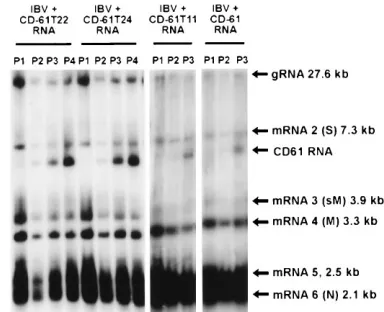
RNAs isolated from CK cell extracts P2to P4were observed to
contain RNAs that were indistinguishable in size relative to CD-61 (Fig. 6). The amounts of CD-61T11, CD-61T22, and CD-61T24 RNAs detected from P3were similar to those
ob-served following replication and packaging of 91 and CD-61. We define efficient replication and packaging of an IBV D-RNA as those occurring when the amount of D-RNA ob-served in P3is similar to that observed for CD-91 or CD-61.
[image:6.612.318.553.74.294.2]Previous work on MHV D-RNAs had shown that truncation FIG. 5. Schematic diagram showing the structure of the C61-derived D-RNAs following insertion of stop codons into the long ORF. 61T11, CD-61T22, and CD-61T24 were all derived from CD-61 by the insertion of double translation stop codons, the positions of which are indicated, into the CD-61-specific ORF. The derivation of CD-61 from CD-91 is shown, and the position of the deletion in CD-61 and its derivatives is indicated (arrowheads). See the legend to Fig. 3 for the explanation of the lines and shading. The figure is drawn to scale, although the exact positions of the oligonucleotides are not marked.
FIG. 6. Analysis of IBV-specific RNAs following electroporation of in vitro T7-transcribed CD-61T22, CD-61T24, and CD-61T11 RNAs into IBV-infected CK cells. CK cells were infected with IBV Beaudette helper virus, and at 8 h p.i. the cells were electroporated with in vitro T7-transcribed RNAs from CD-61T22, CD-61T24, and CD-61T11. The cells were incubated for 12 h, and virus (V0) in the supernatants was passaged three or four times (P1, P2, P3, and P4) on CK cells. Thereafter, the procedure was as described in the legend to Fig. 2.
on November 9, 2019 by guest
http://jvi.asm.org/
[image:6.612.339.531.509.665.2]of the long ORF by the introduction of stop codons resulted in replication and packaging of the RNA, but analysis of the D-RNAs revealed either that the stop codon had been back mutated or that some other change had occurred in the RNA resulting in restoration of the ORF (4, 8). Therefore, the authenticity of the IBV CD-61T11, CD-61T22, and CD-61T24 D-RNAs was checked by sequence analysis of RT-PCR prod-ucts obtained from each D-RNA in P4using various pairs of
oligonucleotides (Fig. 5). The RT-PCR products covered the region of each D-RNA containing the truncated ORF. The RT-PCR products from CD-61T22 and CD-61T24 were cloned into pCR-II and sequenced. Comparison of the sequence de-rived from the CD-61T22 D-RNA to the sequence in pCD-61T22 did not show any differences, indicating that the trun-cated ORF was still preserved following passage of the D-RNA. Comparison of the sequence derived from the CD-61T24 D-RNA to the sequence in pCD-CD-61T24 identified two point mutations at nucleotides 1720 (A3G) and 2176 (G3A), insertion of a T residue at nucleotide 2366, and the deletion of three nucleotides, TAA, at position 2570, compared to pCD-61T24. Neither of the point mutations altered the size of the ORF. The insertion of the T residue potentially shortened the ORF from 1454 to 1394 nucleotides, resulting in an ORF comprising nucleotides 996 to 2390 rather than 996 to 2450. The three deleted nucleotides were downstream of the intro-duced stop codon. The sequence data obtained from the CD-61T24 D-RNA was derived from one clone. Therefore, it is possible that the nucleotide differences observed compared to pCD-61T24 may have resulted from errors introduced by the Taqpolymerase during the PCR amplification. Since none of these mutations indicated that the ORF was repaired, no ad-ditional clones were sequenced. The region containing the truncated ORF in the passaged CD-61T11 D-RNA was am-plified in two independent RT-PCR experiments and was se-quenced directly. No changes were observed following com-parison to pCD-61T11. In addition, the region from the passaged CD-61T11 D-RNA between nucleotides 500 and 1150 was sequenced from five clones derived from one of the RT-PCRs. A point mutation of T3C was detected at nucleo-tide 982 in one clone. However, the sequence obtained from the other four clones corresponded to the pCD-61T11 se-quence. These results showed that the truncated ORF of CD-61T11 RNA was maintained during the four passages following electroporation, indicating that a long ORF is not required for the replication of D-RNAs based on CD-91.
In vitro translation of IBV D-RNA ORFs. In addition to
sequence analysis, in vitro translation of the ORFs in the modified D-RNAs was performed in rabbit reticulocyte lysates using in vitro T7-transcribed RNA to confirm that the ORFs had been truncated. The predicted size of the CD-91 ORF product, Mr5244,000, was considered too large for in vitro
translation; therefore, pCD-91 was restricted by usingNheI to generate a truncated ORF product.NheI cuts CD-91 at nucle-otide 2517, resulting in the generation of T7 transcripts capa-ble of producing a polypeptide with a predictedMrof 58,900.
As can be seen from Fig. 7A, both pCD-91 and pCD-61 re-stricted withNheI resulted in polypeptides with an observedMr
of 56,000, indicating that the predicted ORF was expressed. The authentic CD-61 product, with a predictedMrof 114,800,
was produced following restriction of pCD-61 withNotI (ob-served Mr, 115,000), indicating that the long ORF can be
expressed in vitro. Translation of T7-transcribed RNA from NotI-restricted pCD-58 resulted in a polypeptide with an ob-servedMrof 50,000 (Fig. 7A), compared with a predictedMrof
48,900, confirming that the removal of theHpaI fragment from CD-61 had resulted in a truncated ORF. Translation of the in
vitro T7-transcribed CD-61 derivative RNAs, following intro-duction of the new stop codons, confirmed that they expressed the truncated ORFs (Fig. 7A). Translation of the CD-61T22 and CD-61T24 T7-derived RNAs resulted in polypeptides with observedMrs of 52,000 and 57,000, respectively (Fig. 7),
com-pared with predicted products withMrs of 50,100 and 56,200,
respectively. This indicated that polypeptides of the expected sizes had been produced. The predicted product of CD-61T11, Mr52,100, was too small to detect. However, other
polypep-tides, presumably resulting from translation initiating at down-stream AUG residues, were observed, as was the case with in vitro translation of all the other RNAs. None of the CD-61 derivatives expressed the CD-61-specific polypeptide, Mr 5
114,800, confirming that both the internal deletions and the introduced stop codons were correct.
The pCR-II-derived clones containing the RT-PCR prod-ucts amplified from the CD-58, CD-61T22, and CD-61T11 D-RNAs obtained from passage P4were used to produce T7
transcripts. These were translated in rabbit reticulocyte lysates to determine the sizes of the ORF products, derived from the passaged D-RNAs, to confirm the sequence data that no changes had occurred during passage of the D-RNAs. As can be seen from Fig. 7B, polypeptides expressed from the RT-PCR products amplified from the passaged RNAs were the same size as those expressed from the original constructs. These results confirmed the sequence data which showed that the integrity of the truncated ORFs had been maintained throughout replication and packaging of the modified IBV D-RNAs, indicating that a long ORF is not required for rep-lication of CD-91-derived IBV D-RNAs.
DISCUSSION
This study reports the construction of a full-length cDNA clone of the naturally occurring IBV D-RNA CD-91, its sub-sequent replication and packaging, and the replication and packaging of modified versions in IBV-infected cells. This is the first description of the replication and packaging of D-FIG. 7. Analysis of in vitro-translated T7 transcripts derived from the IBV RNA constructs. In vitro T7-transcribed RNAs derived either from the D-RNA constructs prior to electroporation (A) or from D-RNA from passage P4CK cells (B). The D-RNA constructs were linearized with the indicated enzyme. RT-PCR products derived from the D-RNAs were cloned into pCR-II, and the resulting plasmids were linearized with the indicated enzymes. The linearized plasmids were used for the synthesis of T7 transcripts which were translated in rabbit reticulocyte lysates in the presence of [35
S]methionine, and the products were analyzed by electrophoresis on SDS–10% polyacrylamide gels and identi-fied by autoradiography. Lane M, markers. Arrowheads, positions of the in vitro-synthesized polypeptides derived from the restricted templates. The ob-servedMrs of the polypeptides are as follows: CD-91 and CD-61 NheI, 56,000; CD-61 NotI, 115,000; CD-58 NotI, 50,000; CD-61T24 NotI, 57,000; CD-61T22 NotI, 52,000. The figure is a composite derived from several gels.
on November 9, 2019 by guest
http://jvi.asm.org/
[image:7.612.330.540.68.204.2]RNAs derived from cDNA copies for the coronavirus IBV. Our results showed that removal of 3,236 nucleotides (36%) from CD-91 to produce CD-58, with concomitant reduction of the ORF to 20% of its original size, had no deleterious effect on the replication and subsequent passage of D-RNA CD-58. In the genome of IBV Beaudette, the strain from which CD-91 was derived, the first long ORF, encoding the 1a polyprotein, initiates at nucleotide 529. In CD-91 the 1a ORF has been prematurely terminated by loss of an adenosine res-idue, nucleotide 749 (22). However, CD-91 has another long ORF, comprising in-frame fusions between regions of the poly-merase 1a/1b genes, commencing at nucleotide 996 (Fig. 3). In vitro translation of T7-derived transcripts from CD-91 and CD-61 showed that an IBV D-RNA-specific polypeptide was produced of a size expected from the initiation codon identi-fied at nucleotide 996 (Fig. 7). However, there are a number of potential initiation codons downstream of nucleotide 996 which could lead to the translation of other long in-frame ORFs. The expression of such ORFs from the D-RNAs would require either initiation from downstream AUG codons fol-lowing leaky scanning or reinitiation of the ribosomes (11). The nearest downstream initiation codons, starting at nucleo-tides 1002 and 1038, have more favorable context sequences (GCAAUGC and GUCAUGG, respectively) than the codon starting at 996 (UCUAUGG). The initiation codon starting at nucleotide 1038 has the most favorable context according to Kozak in which the optimal context sequence is (A/G)CCA UGG (9–11). The initiation codon starting at nucleotide 529, corresponding to the start of the polymerase 1a gene, also has a highly favorable context sequence (AACAUGG), indicating that the truncated form of ORF 1a may be translated in cells. Thus, it is possible that the truncated 1a ORF may be the only ORF translated in situ from the IBV D-RNAs, which would indicate that a long ORF is not required. Translation in vitro, initiating at nucleotide 529, would have resulted in a product that was not detectable in our system.
Analysis of the sequences of MHV D-RNAs (16, 18, 25) reveals that, as with CD-91 and CD-61 or their modified forms, there are several long ORFs downstream of the MHV 1a initiation codon that marks the beginning of the MHV D-RNA-specific ORFs. If any ribosomes failed to initiate trans-lation from the 1a initiation codon, one would have expected them to scan the RNA and commence translation at one of the downstream initiation codons. van der Most et al. (26) have demonstrated that it is not the particular sequence of the ORF that is required for replication of the MHV A59 D-RNA MIDI but the presence of an ORF per se. The finding that potential long ORFs downstream of the MHV 1a initiation codon in modified versions of the MHV D-RNAs were not sufficient for efficient replication of the D-RNAs suggests that the majority of ribosomes initiate translation from the 1a initiation codon. Interruption of the MHV D-RNA-specific ORF was observed to be detrimental to the replication of some of the MHV D-RNAs, indicating that potential translation of downstream ORFs in the modified MHV D-RNAs did not appear to lead to successful replication and packaging. It is highly likely, there-fore, that translation in vivo, from the IBV D-RNAs, occurs preferentially from the ORF 1a codon, starting at nucleotide 529, and that translation from downstream ORFs is not re-quired for replication and packaging of the D-RNAs.
In vitro translation of the runoff transcripts, derived from pCD-91 and pCD-61 restricted withNheI, resulted in products with an observedMrof 56,000, indicating that they were
pro-duced from the initiation codons starting at nucleotide 996, 1002, or 1038 but not from the codon at nucleotide 1170, as this would have resulted in a product with an Mr of 52,500. This
observation was also supported by expression of the complete ORF from NotI-restricted CD-61. These observations indi-cated that one or other of the codons starting at nucleotides 996, 1002, and 1038 were capable of initiating translation in vitro, indicating that these codons might be capable of initiat-ing translation in vivo if any of the ribosomes failed to initiate at nucleotide 529. However, it is unlikely that this would occur in vivo with the majority of the ribosomes initiating at nucle-otide 529. If any ribosomes are capable of scanning through the initiation codon at 529, it is unlikely that they would be able to initiate in vivo translation downstream of the codons at nucle-otide 996, 1002, or 1038. Since the ORFs initiating at nucleo-tides 996, 1002, and 1038 were terminated at nucleotide 1058, in addition to the termination of the ORF from nucleotide 529, in CD-61T11, the replication and packaging of CD-61T11 in-dicated that a long ORF is not required for replication of CD-61.
Our results showed that translation of a long D-RNA-spe-cific ORF is not required for replication of IBV D-RNAs based on CD-91 or that the potential expression of the truncated polymerase 1a gene initiating at nucleotide 529 may be suffi-cient. This is in contrast to the results observed for MHV where repair of mutations occurred or where D-RNAs with an intact ORF had a selective advantage.
van der Most et al. (26) have demonstrated that it is not the particular sequence of the ORF that is required for replication of the MHV A59 D-RNA MIDI but the presence of a long ORF per se. They postulated that translation of the D-RNA-specific ORF affected either production or degradation of the D-RNAs, either due to a direct but sequence-independent effect on RNA synthesis or by an increase in the stability or cytoplasmic half-life of the D-RNA. However, if translation does protect RNA from degradation, one would expect the length of the ORF to have some effect. As indicated by van der Most et al. (26), coronavirus genomic and subgenomic RNAs do not contain full-length ORFs and so would not be efficiently protected from degradation. The lengths of the 58, CD-61T22, and CD-61T24 ORFs are half the length of the CD-61 ORF, and there was no difference in the ability of the IBV D-RNAs to be replicated and packaged from passage P3
on-ward, indicating that the length of the IBV D-RNA-specific ORF does not play a role in protection against degradation. The ORF of CD-61T11 was only 20 amino acids, and there was no difference in the amounts of this D-RNA produced follow-ing passage compared to the other D-RNAs. Another expla-nation proposed for the observed advantage of a long ORF in MHV D-RNAs is that translation of the ORF has a direct but sequence-independent effect on RNA synthesis by perturbing RNA secondary structures or by delivering essential replica-tion factors associated with the translareplica-tional machinery (26). This hypothesis is supported by the experimental evidence that the actual sequence of the D-RNA-specific ORF does not matter. All capped RNAs are expected to be scanned by ribo-somes, and therefore longer MHV D-RNA ORFs may result in the ribosomes and translation factors being associated with the RNA longer, giving such RNAs a competitive advantage over those with shorter ORFs. An “mRNA surveillance” sys-tem, which might be a common property among eukaryotes and which may contribute to mRNA stability, for the degra-dation of mRNAs with premature termination codons has been postulated (23). Although aberrant termination codons can occur in cellular mRNAs from errors in transcription, splicing, or processing, it is not clear how these “incorrect” transcripts are recognized. Premature translational termina-tion in yeast has been shown to trigger mRNA decapping followed by degradation of the RNA (21). Sequence analysis of
on November 9, 2019 by guest
http://jvi.asm.org/
CD-91 showed that ORF 1a was prematurely terminated, in contrast to the long ORFs in MHV D-RNAs which initiate at the ORF 1a initiation codon. Therefore, one would anticipate this to be recognized as a premature termination event in IBV D-RNAs, resulting in an increase in degradation. The replica-tion and packaging of the IBV D-RNAs based on CD-91, which contained a prematurely terminated ORF 1a, and of the modified versions of CD-61, which contained other prema-turely terminated potential ORFs, indicated that there was no increase in the degradation of the D-RNAs. It could be argued that the single nucleotide deletion increased the stability of the RNAs by an unknown mechanism. All our data indicates that a long ORF is not required for IBV D-RNAs derived from CD-91 and that perhaps no translation of the D-RNA is re-quired. However, if expression of the small ORF 1a product is required, it is clearly sufficient for efficient replication of IBV D-RNAs, indicating further that a long ORF is not required. Our results are in contrast to those observed for the MHV-A59 D-RNAs, indicating either that there are differences in the biology of the two systems or that the IBV D-RNAs contain other sequences that are able to counteract the effect(s) ob-served for short ORFs on the stability or ability of MHV D-RNAs to be replicated and packaged.
ACKNOWLEDGMENTS
This work was supported by the Ministry of Agriculture, Fisheries and Food, United Kingdom, and a Biotechnology and Biological Sci-ences Research Council Linked Research Group Award. Z. Pe´nzes was on sabbatical from the Veterinary Medical Research Institute of the Hungarian Academy of Sciences, Budapest, Hungary.
We thank Karen Mawditt for synthesizing the oligonucleotides; Kathy Shaw, Kevin Dalton, and Kathy Stirrups for technical support; and Sarah Duggan for preparation of the cells used in this study.
REFERENCES
1.Boursnell, M. E. G., T. D. K. Brown, I. J. Foulds, P. F. Green, F. M. Tomley, and M. M. Binns.1987. Completion of the sequence of the genome of the coronavirus avian infectious bronchitis virus. J. Gen. Virol.68:57–77. 2.Chang, R. Y., M. A. Hofmann, P. B. Sethna, and D. A. Brian.1994. A
cis-acting function for the coronavirus leader in defective interfering RNA replication. J. Virol.68:8223–8231.
3. Chang, R.-Y., and D. A. Brian.1996.cisrequirement for N-specific protein sequence in bovine coronavirus defective interfering RNA replication. J. Vi-rol.70:2201–2207.
4. de Groot, R. J., R. G. van der Most, and W. J. M. Spaan.1992. The fitness of defective interfering murine coronavirus DI-a and its derivatives is de-creased by nonsense and frameshift mutations. J. Virol.66:5898–5905. 5. Hiscox, J. A., K. L. Mawditt, D. Cavanagh, and P. Britton.1995.
Investiga-tion of the control of coronavirus subgenomic mRNA transcripInvestiga-tion using
T7-generated negative-sense RNA transcripts. J. Virol.69:6219–6227. 6. Huang, A. S., and D. Baltimore.1970. Defective viral particles and viral
disease processes. Nature226:325–327.
7. Kim, Y.-N., Y. S. Jeong, and S. Makino.1993. Analysis ofcis-acting se-quences essential for coronavirus defective interfering RNA replication. Virology197:53–63.
8. Kim, Y.-N., M. M. C. Lai, and S. Makino.1993. Generation and selection of coronavirus defective interfering RNA with large open reading frame by RNA recombination and possible editing. Virology194:244–253. 9. Kozak, M.1983. Comparison of initiation of protein synthesis in prokaryotes,
eukaryotes and organelles. Microbiol. Rev.47:1–45.
10. Kozak, M. 1986. Point mutations define a sequence flanking the AUG initiator codon that modulates translation by eukaryotic ribosomes. Cell 44:283–292.
11. Kozak, M.1989. The scanning model for translation: an update. J. Cell Biol. 108:229–241.
12. Liao, C.-L., and M. M. C. Lai.1995. Acis-acting viral protein is not required for the replication of a coronavirus defective-interfering RNA. Virology 209:428–436.
13. Lin, Y. J., and M. M. C. Lai.1993. Deletion mapping of a mouse hepatitis virus defective interfering RNA reveals the requirement of an internal and discontiguous sequence for replication. J. Virol.67:6110–6118.
14. Makino, S., N. Fujioka, and K. Fujiwara.1985. Structure of the intracellular defective viral RNAs of defective interfering particles of mouse hepatitis virus. J. Virol.54:329–336.
15. Makino, S., C. Shieh, J. G. Keck, and M. M. C. Lai.1988. Defective-interfering particles of murine coronavirus: mechanism of synthesis of de-fective viral RNAs. Virology163:104–111.
16. Makino, S., C.-K. Shieh, L. H. Soe, S. C. Baker, and M. M. C. Lai.1988. Primary structure and translation of a defective interfering RNA of murine coronavirus. Virology166:550–560.
17. Makino, S., F. Taguchi, and K. Fujiwara.1984. Defective interfering parti-cles of mouse hepatitis virus. Virology133:9–17.
18. Makino, S., K. Yokomori, and M. M. C. Lai.1990. Analysis of efficiently packaged defective interfering RNAs of murine coronavirus: localization of a possible RNA-packaging signal. J. Virol.64:6045–6053.
19. Meinkoth, J., and G. Wahl.1984. Hybridization of nucleic acids immobilized on solid supports. Anal. Biochem.138:267–284.
20. Me´ndez, A., C. Smerdou, A. Izeta, F. Gebauer, and L. Enjuanes. 1996. Molecular characterization of transmissible gastroenteritis coronavirus de-fective interfering genomes: packaging and heterogeneity. Virology217:495– 507.
21. Muhlrad, D., and R. Parker.1994. Premature translational termination triggers mRNA decapping. Nature370:578–581.
22. Pe´nzes, Z., K. Tibbles, K. Shaw, P. Britton, T. D. K. Brown, and D. Ca-vanagh.1994. Characterization of a replicating and packaged defective RNA of avian coronavirus infectious bronchitis virus. Virology203:286–293. 23. Pulak, R., and P. Anderson.1993. mRNA surveillance byCaenorhabditis
eleganssmg genes. Genes Dev.7:1885–1897.
24. Sambrook, J., E. F. Fritsch, and T. Maniatis.1989. Molecular cloning: a laboratory manual, 2nd ed. Cold Spring Harbor Laboratory, New York. 25. van der Most, R. G., P. J. Bredenbeek, and W. J. M. Spaan.1991. A domain
at the 39end of the polymerase gene is essential for encapsidation of coro-navirus defective interfering RNAs. J. Virol.65:3219–3226.
26. van der Most, R. G., W. Luytjes, S. Rutjes, and W. J. M. Spaan.1995. Translation but not the encoded sequence is essential for the efficient prop-agation of the defective interfering RNAs of the coronavirus mouse hepatitis virus. J. Virol.69:3744–3751.