IN IMPROVING FUNCTIONAL STATUS AMONG ELDERLY
WITH IMPAIRED MOBILITY
A DISSERTATION SUBMITTED TO THE TAMILNADU DR.M.G.R. MEDICAL UNIVERSITY, CHENNAI, IN PARTIAL FULFILMENT
OF THE REQUIREMENTS FOR THE DEGREE OF MASTER OF SCIENCE IN NURSING
EFFECTIVENESS OF SELECTED NURSING INTERVENTION
IN IMPROVING FUNCTIONAL STATUS AMONG ELDERLY
WITH IMPAIRED MOBILITY RESIDING IN SELECTED OLD
AGE HOMES IN MADURAI.
APPROVED BY THE DISSERTATION COMMITTEE ON: PROFESSOR IN NURSING:
RESEARCH Dr. Mrs. Nalini Jeyavanth Santha, M.Sc.(N)., Ph. D Principal
Sacred Heart Nursing College, Madurai
CLINICAL SPECIALITY:
EXPERT Prof.(Mrs).Chandrakala M.Sc.(N)., Ph.D Vice Principal
Sacred Heart Nursing College, Madurai
MEDICAL EXPERT :
Dr.R. Sathish, MBBS, D. (Ortho), Shenbagam hospital,
Anna Nagar, Madurai-20.
A DISSERTATION SUBMITTED TO THE TAMILNADU
DR.M.G.R.MEDICAL UNIVERSITY, CHENNAI,
IN PARTIAL FULFILMENT OF THE REQUIREMENTS FOR THE
DEGREE OF MASTER OF SCIENCE IN NURSING
APRIL 2012
This is the bonafide work of Mr. Earnest Rajasingh. M.Sc., Nursing II year student from Sacred Heart Nursing College, Ultra Trust, Madurai, submitted in partial fulfilment of the Degree of Master of Science in Nursing under The Tamilnadu Dr.M.G.R. Medical University, Chennai.
Dr.Nalini Jeyavanth Santha M.Sc., (N), Ph.D., Principal,
Sacred Heart Nursing College Ultra Trust
Madurai – 625 020.
Place: Date:
First I thank from the deepest of my heart to my lord and give all glory and honour for his never failing love and grace and grace and blessing that enabled me to complete this study successfully.
I would like to extend my sincere thanks to Prof. KR. Arumugam, M.Pharm., Correspondent, Sacred Heart Nursing College, Ultra Trust, Madurai for his support and for providing the required facilities for the successful completion of this study.
I extend my heartfelt and sincere thanks to my Research Guide Prof. Mrs. Nalini Jeyavanthasantha M.Sc.,(N), Ph.D., Principal, Sacred Heart
Nursing College, Madurai for a durable work, interest, Cheerful, always with never ending willingness to provide guidance and suggestions to mould this study to the present form.
I sincerely express my earnest thanks to my clinical specialty guide Mrs.S.Chandrakala M.Sc.,(N), Ph.D. Vice principal, HOD of medical & Surgical Nursing, Sacred Heart Nursing College, Ultra Trust, Madurai, for her expert opinion, guidance, hard work, effort, interest and valuable suggestions and untiring help to mould this study in successful way.
My heartfelt and faithful thanks to Dr. Satheesh, MBBS, D. (Ortho), Shenbagam Hospital, Madurai for his constant interest, special research skill and patience, guidance to make this study success.
their timely suggestions and help in this study.
I am indebted to my uncle and President of zion trust, Mr. David Packianathan for his guidance and suggestions given for me for conducting the study.
I express my gratitude to Mr. Ram Kumar, M.PT, Professor, Trinity Mission and Research Center for his guidance, valuable suggestions and timely help during the study.
I record my sincere thanks to Mr. Senthil Kumar, M.Sc., M.Phil., for his excellent touch in the statistical analysis in this study.
My heartfelt thanks to Mr.N.Rangaraj, M.A, M.Ed, M.Phil., for making this study free from any grammatical mistakes by editing with his expertise.
I am thankful to Mr. Thirunavukarasu, M.Li.Sc., Librarian, Sacred Heart Nursing College for extending helpful support throughout the study.
Chapter Contents Page No
I INTRODUCTION 1-12
Background of the study 1
Significance and need for the study 5
Statement of the problem 7
Objectives 8
Hypotheses 8
Operational definition 9
Assumption 10
Delimitations 10
Projected outcome 11
Conceptual framework 11
II REVIEW OF LITERATURE 13-23
Literature related to old age problems 13 Literature related to exercise 17 Literature review related to functional status 20 Literature review related to improving mobility among elderly.
22
III METHODOLOGY 24-31
Research approach 24
Research design 24
Study setting 25
Study population 25
Chapter Contents Page No
Sample size 26
Sampling technique 26
Criteria for sample selection 26
Description of tool 27
Testing of tools 28
Development of content for therapeutic exercises 28
Pilot study 29
Data collection procedure 29
Plan for data analysis 30
Protection of human subjects 31
Summary 31
IV ANALYSIS AND INTERPRETATION OF DATA 32-58
V DISCUSSION 59-62
VI SUMMARY, CONCLUSION, IMPLICATIONS AND RECOMMENDATIONS
63-70
Summary of the study 63
Major findings of the study 66
Conclusion 66
Implication 67
Limitation 69
Recommendations 69
REFERENCES 71-74
Table No. Title Page No. 1. Distribution of sample according to Demographic
Variables
34
2. Distribution of subjects according to the level of functional activity score before and after administration therapeutic exercises.
37
3. Comparison of Mean Functional activity score of experimental group before and after administration of therapeutic exercises on day 10.
39
4. Comparison of Mean Functional activity score of control group before and after administration of therapeutic exercises on day 10.
41
5. Comparison of Mean Functional activity score of the experimental group before and after administration of therapeutic exercises on 20th day.
42
6. Comparison of Mean Functional activity score of the control group on 20th day.
44
7. Comparison of Mean Functional activity score of the subjects in experimental group after administration of therapeutic exercises on 10th and 20th day.
45
8. Comparison of Mean Functional activity score of the subjects in control group on 10th and 20th day.
Table No. Title Page No.
9. Comparison of mean post test functional activity score of experimental group after the administration of therapeutic exercises with control group post test score.
47
10. Effectiveness of selected nursing intervention in improving functional status among elderly in experimental group on 10th & 20th day.
49
11. Effectiveness of selected nursing intervention in improving functional activity among elderly in control group on 10th & 20th day.
51
12. Association of functional Activity score of the subjects with demographic variables in experimental group.
52
13. Association of functional Activity score of control group with demographic variables.
55
14. Find out the feedback of the elderly people in experimental group through the outcome expectation exercises measure.
Figure No.
Title Page No.
1. Conceptual frame work based on Sister Callista Roy’s Adaptation Model
12
2. Distribution of subjects according to the level of functional activity score before and after administration therapeutic exercises.
38
3. Comparison of Mean Functional activity score of experimental group before and after administration of therapeutic exercises on day 10.
40
4. Comparison of Mean Functional activity score of the experimental group before and after administration of therapeutic exercises on 20th day.
43
5. Comparison of mean post test functional activity score of experimental group after the administration of therapeutic exercises with control group post test score.
48
6. Effectiveness of selected nursing intervention in improving functional activity among elderly in experimental group on 10th & 20th day.
Appendix No.
Title Page No
I Copy of letter seeking permission to conduct the study at selected old age home in Madurai.
i
II Copy of letter seeking experts opinion for content validity
ii
III List of experts- content validity of the intervention of sleep intervention strategies.
iii
IV Demographic Variables iv
V Functional Activity Scale v
VI Outcome Expectation Exercise Measure vi VII Therapeutic Exercises Protocol and Procedure
Photographs
CHAPTER – I
INTRODUCTION
BACKGROUND OF THE STUDY
“I truly believe that age – if you’re healthy – age is just a number”
-Hugh Hefner A man's life is normally divided into five main stages namely infancy, childhood, adolescence, adulthood and old age. In each of these stages an individual has to find himself in different situations and face different problems. The old age is not without problems. In old age physical strength deteriorates, mental stability diminishes; memory power becomes bleak coupled with negligence from the younger generation. There are 81million older people in India-11 lakh in Delhi itself. (Yuman Hussain, 2000)
demineralization, loss of taste and smell, decreased skin integrity, and reduction in sensory input. [accessed from www,Wikipedia.org on 7-8-2011]
It is estimated that up to 8 percent of community-dwelling elders need assistance with one or more ADLs. Among those age 85 and older, the percentage who live at home but need assistance or who live in a nursing home increases significantly to 56 percent of women and 38 percent of men Chronic illness and comorbidities can directly impact functional status in the elderly. Chronic health care conditions that are most prevalent in the elderly include heart disease, hypertension, arthritis, diabetes, and cancer. Acute illness due to chronic disease and chronic comorbidities accounts for a significant number of hospitalizations in the elderly. [accessed from www,Wikipedia.org on 7-8-2011]
The proportion of the elderly in the total population also raised from 5.63 per cent in 1961 to 6.58 per cent in 1991 and to 7.5 per cent in 2001. India has thus joined the rank of “Greying nations” with over seven per cent of its population in the 60-plus years segment. A United Nations report has predicted that India will have 198 million ‘Old' (60+) people in 2030 and 326 million in 2050. Currently, there could be around 100 million ‘senior citizens' in India.( The Hindu, Sep,22.2010)
The number of persons above the age of 60 years is fast growing, especially in India. India as the second most populous country in the world has 76.6 million people at or over the age of 60, constituting above 7.7% of total population. The problems faced by this segment of the population are numerous owing to the social and cultural changes that are taking place within the Indian society. The major area of concern is the health of the elderly with multiple medical and psychological problems. Falls are one of the major problems in the elderly and are considered one of the “Geriatric Giants”. The loss of functional mobility has been shown to be associated with 50 percent mortality rate among nursing home patients within 6 to 12 months. This decline in physical functionality is due only partly to the aging process, and to a large extent, it is due to the decrease in or lack of physical activity. (B. Krishnaswamy, 2010).
Projected increases in both the absolute and relative size of the elderly population in many third world countries is a subject of growing concern for public policy ( Liebig and IrudayaRajan ,2003).
hearing loss, cognitive impairment, urinary incontinence, depression, physical disability, and reduced leg mobility are thought to have many detrimental effects on function as the aging process itself .( Moore,2007)
Two basic levels of functional ability are recognized. The most basic Activities of daily living in the areas of personal care and mobility (e.g., eating, bathing, dressing, using the toilet, and transferring from bed or chair) are distinguished from more complex role activities, such as taking medication, managing money, and grocery shopping, which have come to be known as instrumental Activities of daily living (IADLs). The instrumental Activities of daily living are more heterogeneous than Activities of daily living, and include activities necessary to live independently in the community, such as using a telephone, taking medications, managing money, grocery shopping, meal preparation, shopping, light and heavy housework, doing laundry, using local transportation, and remembering appointments. (Scott Miyake Geron,2010)
functional on any given task can be considerable, ranging from just stand-by assistance for safety to the physical help of two or more people. (Rosalie a. Kane,2000)
Exercise is an accessible form of prevention of physical decline. Several studies have found that adherence to a regular exercise program can improve muscle strength reaction time, balance control and gait velocity significantly. Also some trial evidence has shown that exercise programs may enhance cognitive performance and effective states of the elderly as well , mainly of frail institutionalized elderly, given their lack of exercise and life stimuli [Alessandra, Bastone and Filho,2004]
Peat, Mccarney and Croft (1998) said that nursing assessment requires a holistic approach. Physical, mental, emotional, spiritual, social and economic status must be assessed. The rehabilitation nurse focuses on coping patterns, functional ability assessment is one of the important focus on the self care, feeding, bathing, grooming, dressing, toileting and mobility, functional ability depends on good joint movement muscle strength and an intact neurologic system. Disabilities most likely to produce loss of function are those involving the musculoskeletal disorders. Secondary problem related to the disability, such as muscle atrophy and deconditioning that may affect functional ability. The nurse notes the patient’s ability to move and his co-ordination and endurance.
SIGNIFICANCE AND NEED FOR THE STUDY
changing demographic patterns are also coupled with worries that society may have to struggle with in order to deal with difficult issues such as the financial burden of providing for old age, increasing demands on social and medical care, growing needs for assistance and care in cases of disability. (Kirsten avlund 2004)
The growth in the aged population has been 40% between 1991 and 2001. The population of people above the age of 60 years is expected to grow from 7.6 million in 2001 to 100 million in 2013 and 136 million in 2021. ( The Hindu, Nov 23.2010)
The family is often a cold place for senior citizens in the Capital. A study by the charity HelpAge India has found that the city has the worst record in the country so far as familial abuse of the elderly is concerned. Its report claims that abuse by daughters-in-law, verbal abuse, and financial dependency are common problems faced by octogenarians here. At the same time, community support and healthcare schemes for the elderly are lacking. "Senior citizens are no longer a homogenous group of people over 60 years of age. With growing life expectancy, there is a large chunk of the population that is over 80, which poses different challenges. ( The Times Of India Delhi, October 2, 2011)
In view of the rising aging population, there is now a need to consider special needs of the elderly particularly in the aspect of health care delivery, besides managing the common physical illness that is common among the elderly such as diabetes mellitus, Hypertension, ischemic heart disease and cancers, one must not forget problems pertaining to social environment, which need to be addressed as well. One of the areas, which is absolutely important but yet frequently neglected, is how well the elderly can maintain and take care of themselves. Age should not be a hindrance factor towards physical activities of the elderly (k.y.loh,2006)
Elderly people with high levels of habitual physical activity live longer and have better general health and higher levels of wellbeing than do those who are inactive. Improving activity levels may improve health outcomes. Even small gains in functional status may result in significant benefits in functional performance and quality of life. (Kerse et al., 2008)
As the aging population is increasing and functional inability creates a problem for both the elderly and the society, it is necessary to make them independent as far as possible. To improve their functional status and decreasing their dependent role on others and to decrease the risks of accidents, the researcher had undertaken the study.
STATEMENT OF THE PROBLEM
OBJECTIVES
1. To find out the functional status of the elderly in experimental group before and after implementing selected nursing intervention.
2. To assess the pre and post test functional status of the elderly in control group. 3. To evaluate the effectiveness of selected nursing intervention in improving
functional status among elderly in experimental group.
4. To find out the association between the post test functional status of
experimental group with selected demographic variables (Age, Sex, Education status, Co-morbid diseases, Body mass index and Previous history of fall and fracture.)
5. To find out the association between the post test functional status of control group with selected demographic variables (Age, Sex, Education status, Co-morbid diseases, Body mass index and Previous history of fall and fracture.)
HYPOTHESES
All the hypotheses were tested at 0.05 level of significance.
H1:
The mean post test functional status score of experimental group of elderly who had selected nursing intervention will be significantly higher than mean post test score of control group.
H2:
H3:
There will be a significant association between mean post test functional activity score of experimental group with selected demographic variables. (Age, Sex, Education status, Co morbid diseases, Body mass index and Previous history of fall and fracture.).
H4:
There will be a significant association between mean post test functional activity score of control group with selected demographic variable (Age, Sex, Education status, Co morbid diseases, Body mass index and Previous history of fall and fracture.).
OPERATIONAL DEFINITIONS
Effectiveness
Producing desired or indented result
It refers to the outcome of selected nursing intervention in improving functional ability among the selected elderly group. Functional Activity will be measured by the score obtained by the subject in Functional Activity Scale and Outcome expectation exercise measure.
Selected Nursing Intervention:
Action to take improve medical disorder.
Functional Status:
Affecting the operation rather than the structure of an organ.
Functional status refers to the capacity to engage in activities of daily living and social role activities by the elderly peoples increasingly as measured by Functional Activity Scale.
Elderly with Impaired Mobility
Having disability in specified kind.
Elderly refers to individuals above 60 years of age having functional impairment at the Dependent level and Partial dependent level in Functional Activity Scale residing at selected old age homes.
ASSUMPTIONS
1. Improving the functional status among elderly patient is an important function
for all staff nurses.
2. Selected nursing intervention has no adverse effect on elderly patient. 3. Functional status will differ from one individual to other.
DELIMITATIONS
The following delimitation was set for the study:
• Patients with elderly who were come under the category of dependent and
partial dependent of functional activity score residing in selected old age homes in Madurai.
• Therapeutic exercise were given for 45 minutes for 20 days
PROJECTED OUTCOME
After performing the selected nursing intervention the subjects will be able to perform their ADL with minimal assistance and having improved Quality Of Life.
CONCEPTUAL FRAMEWORK
The conceptual framework for this study is based on Sister Callista Roy’s Adaptation Model (1939) which involves four concepts.
Persons, Nursing, Health, Environment
The adoptive system has four component like input, process, effectiveness & output. For the present study the above mentioned components is modified.
Assessment refers to the assessment of ability to perform self care, mobility, communication pattern, of elderly with the help of Functional Activity Scale & Outcome expectation exercise measure scale.
Input refers to the selected nursing intervention for elderly with functional impairment in experimental group to improve their functional status.
Effectors refer to the regulator & cognator. These are the subsystems of the person as a system. In this the effectors are the adaptive modes of the elderly which are regulated by the neuro, muscular changes gained through the practice of selected nursing intervention.
CHAPTER II
REVIEW OF LITERATURE
According to polit and Hungler (1995), researchers almost never conduct a study in an intellectual vacuum. Their studies are usually undertaken with the context of an existing base of knowledge.
This chapter consists of,
1. Literature related to old age problems. 2. Literature related to exercise
3. Literature review related to functional status
4. Literature review related to improving mobility among elderly.
LITERATURE RELATED TO OLD AGE PROBLEMS
characteristics on non-communicable diseases (NCD) and disability. Hypertension (urban - 68% and tea garden - 81.4%), musculoskeletal diseases (urban - 62.5% and teagarden - 67.5%), COPD and other respiratory problems (urban - 30.4% and tea garden - 32.2%), cataract (urban 40.3% and tea garden - 33%), gastro-intestinal problems (urban - 13% and tea garden - 6.5%) were more commonly observed health problems among community dwellings elderly across both the groups. Infectious morbidities, under nutrition and disability (ADL-IADL disability) were more pronounced among tea garden dwellers. Utilization of health service by tea garden elderly was very low in comparison to the urban elderly. Both tea garden men and women had very high rates of risk factors like use of non-smoked tobacco and consumption of alcohol.
symptoms (76%). For every risk factors added, there was a significant increase in the proportion of respondents who had depressive symptoms. A similar result was found for falls. These results showed that there was a common set of risk factors that increases the risk of two common outcomes in geriatric medicine, falls and depression.
Krishnamachari and Tinku (2008) conducted a study on health related conditions and socio-economic factors influence disability in the elderly. They examined the prevalence of health related disability in community dwelling elderly (>65 yr) residents in a suburb of Bangaluru, Karnataka, India, and assessed the association of disability with various socio-economic variables and current health status. Using the International Classification of Functioning of disability and Health (ICF). Disability was measured in 356 elderly in the Koramangala suburb of Bangaluru city. Various socio-economic and health related factors associated with disability were documented. A total of 85 per cent of the respondents reported current medical problems. Based on a total disability score computed from the participation section of the ICF, 27 per cent of the respondents had mild disability while 37 per cent had higher level of disability. Disablement was significantly associated with age > 75 yr and impairment in cognitive and sensory functions especially hearing. Findings revealed that: In this urban elderly population while majority had current medical conditions, a significant proportion did not experience any difficulties in activities of daily living. Restriction in participation in activities of daily living was more influenced by increasing age and impairment in cognitive functions and not current health status.
to the immobility. More than one cause was identified in half of the patients. Intervention were prescribed in 88% of these patients. Short-term follow-up (median 7 weeks) showed that 21 had an improvement, 35 had the same and 8 had decline in mobility. There was a significant trend towards better outcome when patient presented early during their course of decline in mobility. (p = 0.005, linear by linear association = 0.013). Impaired mobility is a common pathway for many diseases, and is associated with significant functional decline.
LITERATURE RELATED TO EXERCISE
remained unknown. The intervention was found to have had little effect on the cumulative number of falls, the likelihood of participants having at least one fall during the 12-month follow up period or the mean number of falls per person, although it is of interest that all the between-groups differences favoured the intervention group.
Daniel and Rooks (2001) conducted experimental study to assess the effect of functional status among 108 patients scheduled to undergo hip or knee replacement. The patients were divided into two groups: 54 patients participated in water and land based exercises three times a week for the six week period immediately before surgery and 54 controls received educational materials. Prior to surgery all patients were questioned about their level of function and were evaluated in terms of lower extremity strength, balance and mobility. The exercisers participated in strengthen training, aerobics and flexibility exercises that were individually tailored to each person’s fitness level, performed in a group and supervised by a physical therapist. The results showed that patients exercised reduced their odds of discharge to an inpatient rehabilitation facility by 73 percent. The exercisers were also more likely to walk more than 50 feet at the time of hospital discharge. Those who exercised responded differently before surgery and immediately following surgery depending upon the joint replaced.
Brunner and Suddarth (2005) said that “Exercise is the foundation of preparation”. Therapeutic exercise are prescribed and performed with the assistance and guidance of physical therapist or nurse. The patient should have a clear understanding of what the prescribed exercise is to be accomplished. Providing written instructions setting forth the frequency duration and number of repetitions, as well as simple line drawing exercises helps to adherence to the exercise program.
McDermott (2006) explain, "There are four ways to improve physical fitness: aerobic exercise, resistance training, flexibility, and lifestyle modification." All programs should include combinations of these types of activities, and be tailored toward the individual's fitness goals. "For example," McDermott says, "when the goal is to improve functional capacity in activities of daily living, a cross-training program emphasizing the core muscle groups of the back, thighs, and abdomen is preferred." "Only 30 percent of America's senior citizens engage inregular exercise," notes McDermott, "yet there is compelling evidence suggesting that people in all conditions of health and at all fitness levels benefit from regular physical activity. In fact, the most de-conditioned individuals have the greatest and fastest response." Mernitz adds, "Seniors tend to have less access than other demographic groups to physical activity information and programming. In contrast, they have relatively more contact with their health care providers." "Starting an exercise program later in life can significantly modify risk factors, even if a person has been sedentary in prior years," McDermott concludes. "Health care providers can play a major role in offering effective and inexpensive primary or adjunct therapies, encourage appropriate physical activity, and dispel myths that persist as barriers to exercise in the elderly.
LITERATURE REVIEW RELATED TO FUNCTIONAL STATUS
moderate range of effects. Odds ratio of 2.14 (95% CI; 1.42-3.24) was interpreted as an odds of improving in physical functioning more than 2 times greater with a physical activity intervention compared with the odds in a control group without physical activity. These differences were deemed clinically relevant, the paper also points out that the integration of combined strategies such as strength and aerobic exercise can have a larger effect.
Stuck (2002) conducted a meta-analysis to evaluate the effects of home visitation programs on functional status, nursing home admission, and mortality in elderly adults. The analysis examined 1349 abstracts in five languages that reported randomized trials on the effects of preventive in-home treatments in older community-dwelling populations. After exclusions were made, two reviewers independently screened the remaining 17 articles for information on functional status, nursing home admission, and mortality among study populations. The combination of trials using multi-dimensional ADL assessments and follow-up gave a 24% reduction in the risk of functional decline. (RR, 0.78; 95% CI, 0.64-0.94). The group concluded that such home visitation programs “appear to be effective, provided the intervention are based on multidimensional geriatric assessment and include multiple follow-up home visits and target persons at lower risk for death”.
functional status. Multinomial logistic regression was used to predict 1990 status. The functional status of 12% of men and women 70 to 79 years of age who were initially impaired in instrumental activities of daily living improved, and about half of the initially independent people in that age group remained so, Multivariate analyses revealed that age, baseline functioning, self-rated health, and co morbidity predicted 1990 status. Both baseline functioning and functional change were related to hospitalization. This study support others that have shown some long-term functional improvement, but commonly decline, in the elderly. Furthermore, it documents the link between functional decline and increased hospital use.
LITERATURE REVIEW RELATED TO NURSES ROLE IN
IMPROVING MOBILITY AMONG ELDERLY
Micelli (2008) Explained a general safety precaution and fall prevention measures that apply to all patients, especially older adults:
1. Assess the patient care environment routinely for extrinsic risk factors and institute appropriate corrective action.
• Use standardized environmental checklists to screen; document
findings.
• Communicate findings to risk managers, housekeeping, maintenance
department, all staff and hospital administration, if needed. • Re-evaluate environment for safety.
2. On admission, assess/screen older adult patient for multifactorial risk factors
• Use standardized or empirically tested fall-risk tools in conjunction
with other assessment tools to evaluate risk for falling (e.g. Tinetti Performance Oriented Mobility, The Timed Get Up and Go Test) • Document findings in nursing notes, interdisciplinary progress notes,
and the problem list.
• Communicate and discuss findings with interdisciplinary team
members.
• In the interdisciplinary discussion, include review and reduction or
elimination of high-risk medications associated with falling.
• As part of falls protocol in the facility, flag the chart or use graphic or
color display of the patient's risk potential to fall.
• Communicate to the patient and the family caregiver identified risk to
CHAPTER – III
RESEARCH METHODOLOGY
The research methodology indicates the general pattern of organizing the procedure of gathering valid and reliable data for an investigation. This chapter provides brief description of the method adopted by the investigator in this study.
It includes the research approach, research design, the setting, the population, the sample and criteria for the sample selection. It further deals with the development of tool, pilot study and procedure for data collection and plan for data analysis.
RESEARCH APPROACH
An experimental approach method was used to determine the effectiveness of selected nursing intervention in terms of improving the functional status among the elderly patient in selected old age homes in Madurai.
RESEARCH DESIGN
Quasi experimental Pre Test Post Test control group research design was adopted. This design is represented as follows
Group Pre test Intervention
Post test
Day 10 Day 20 Experimental group O1 X O10 O20
Control group O1 O10 O20 Key:
O1 – Pre test assessment offunctional activity X – Intervention (therapeutic exercises)
VARIABLES
Dependent variable
: Functional status.Independent variable:
Selected nursing intervention.SETTING OF THE STUDY
The pilot study was conducted in Christian Seva Sangam, Alakappanagar which is 14km from Sacred Heart Nursing College. It is having elderly population (above 60 years) of 28 with 7 males, 21 females. The main study was conducted in Zion trust, Kudal Nagar for experimental group which is 4km from Sacred heart Nursing College. It is having elderly population (above 60 years) of 68 with 18 males 50 females. And also study was conducted in Poongkodi old age home, Poovanthi for control group which is 27km from Sacred Heart Nursing College. It is having elderly population (above 60 years) of 63 with 26 males, 37 females.
These old age homes were chosen because of the researchers familiarity with the setting.
STUDY POPULATION
The target population of the study were elderly patient from selected old age homes in Madurai.
SAMPLES
SAMPLE SIZE
The total sample size was 60,out of which 30 samples were in the experimental group and 30 samples were in the control group.
SAMPLE TECHNIQUE
Purposive sampling technique used to select subjects.
CRITERIA FOR SAMPLE SELECTION
The sample was selected based on the following inclusion and exclusion criteria.
INCLUSION CRITERIA
- Elderly patient with decreasd mobility who were residing in selected old age
homes at Madurai.
- Elderly patients who can speak and understand Tamil or English.
- Elderly patients who can actively participate in the exercise and activities.
EXCLUSION CRITERIA
- Elderly patients who are critically ill
- Elderly patients who are affected with paralysis.
RESEARCH TOOL AND TECHNIQUE
Part I
It consists of a semi structured interview schedule. It had questions related to the demographic variables, Information about the sample health status.
a. Demographic data
It included information such as Age, Sex, Education status. b. Health status
It included Co morbid diseases, Body mass index, Previous history of fall and fracture.
Part II
The second tool was modified functional status index scale for assessing the functional activities. It is divided in five headings (ie) 1. Walking, 2. Climbing upstairs, 3. Raising from a chair, 4. Reaching into low cupboard, 5. Doing laundry.
Each activities are assessed and scored by using the parameters of assistance, pain and difficulty are experienced by the patient in performing these activities. The score for the scale is for Assistance – one to five, for Pain zero to four, for Difficulty – one to four.
Based on the functional activity scores obtained by the patient. They were orbitarily grouped into 3 groups as follows.
Part III
The third tool was modified outcome expectations for exercise measure. After the continued practice of 20 days exercise program assessed the feedback of samples about physical and mental happiness . The score for the scale had option of Strongly Agree & Disagree.
RELIABILITY OF THE TOOL:
The reliability of tool determined by inter rater method. According to karl Pearsons correlation co-efficient the reliability of the tool was 0.94, which was highly reliable.
VALIDITY OF THE TOOL:
Validity of the tool and procedure established by giving the content and tool to 5 experts in the field of nursing and physiotherapist. Modifications was done according to their recommendations.
DEVELOPMENT OF CONTENT FOR THERAPEUTIC
EXERCISE
PILOT STUDY
In order to test the feasibility, relevance and practicability of the study, Pilot study conducted among 6 patients 3 in experimental and 3 in control group in selected old age homes in Madurai. Data were analyzed to find out the suitability of statistical method. It revealed that the study was feasible.
DATA COLLECTION PROCEDURE
The subjects are told to maintain a dairy to verify whether they are continuing exercises as per instruction. And also instruction was given to consent authority of the old age home. On the 10th day functional activity were assessed by using functional status index. Then they were told to continue the procedure regularly. Post assessment of functional activities of daily living were assessed on the 20th day of intervention.
Sample for control group were selected from Poongkodi old age home, Poovanthi. Level of functional status was assessed using Functional activity index scale and the patient’s who had impaired mobility were selected. The samples were received only the routine care. First day pre test was done and post test was made on 10th and 20th day using functional activity index scale. Samples of the control group were explained about the effectiveness of therapeutic exercises after the post test.
PLAN FOR DATA ANALYSIS
After the data collection, the collected data were organized, tabulated, summarized and analyzed. The data were analyzed. According to objectives of the study by using descriptive and inferential statistics.
1. Analysis of frequencies and percentage used for demographic data.
2. Hypothesis related to the effectiveness of therapeutic exercises improving the functional activities was tested using paired‘t’ test, mean and standard deviation.
PROTECTION OF HUMAN RIGHTS
Research proposal was approved by the dissertation committee, prior to the pilot study and the main study permission was obtained from the Head of the Department of Sacred Heart Nursing College, Madurai. Formal permission obtained from the respective authority of the selected old age home. Assurance was given to
the subjects, that confidentiality would be maintained. Oral consent was obtained
from the study subjects .The subjects were explained at any time they have got the
rights to withdraw from the study.
SUMMARY
CHAPTER IV
ANALYSIS AND INTERPRETATION OF DATA
This chapter deals with the description of the sample, classification, analysis and interpretation of the data collected to evaluate the achievement of the objectives of the study. The data collected is tabulated and presented as follows:
Presentation of the Findings of the study
Section I Demographic profile of the sample
Section II 1. Distribution of participations according to the level of functional activity score before and after administration of therapeutic exercises.
Section II Comparison of Functional activity score of the patient 1. Comparison of mean Functional activity score of
the experimental group before and after therapeutic exercise on day ten.
2. Comparison of mean Functional activity score of the control group before and after therapeutic exercise on day ten.
3. Comparison of mean Functional activity score of the experimental group before and after therapeutic exercise on day twenty.
4. Comparison of mean Functional activity score of
5. Comparison of mean Functional activity score of
the experimental group before and after therapeutic exercise on day ten and twenty. 6. Comparison of mean Functional activity score of
the control group before and after therapeutic exercise on day ten and twenty
Section IV 1. Association between functional activity score of experimental group subjects with demographic variables (age, sex, educational status, co-morbid diseases, BMI, previous history of fracture.)
2. Association between functional activity score of control group subjects with demographic variables (age, sex, educational status, co-morbid diseases, BMI, previous history of fracture.)
SECTION – I
[image:46.612.105.549.212.707.2]Demographic Profile of the Samples
Table 1
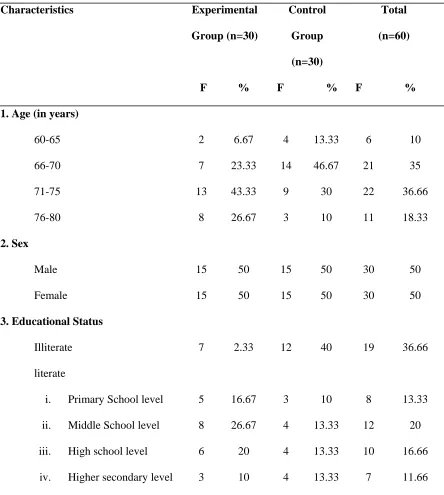
Distribution of sample according to Demographic Variables
N=60 Characteristics Experimental
Group (n=30)
F %
Control Group (n=30) F %
Total (n=60)
F % 1. Age (in years)
60-65 66-70 71-75 76-80 2. Sex Male Female
3. Educational Status Illiterate literate
i. Primary School level ii. Middle School level iii. High school level iv. Higher secondary level
Under graduate Post graduate 4. Co morbid disease
Yes No
5. BMI
Normal weight Over weight
Obese
6. Previous History of fall and fracture Yes No 1 0 21 9 25 4 1 5 25 3.33 0 70 30 80 13.33 3.33 16.66 83.33 3 0 23 7 24 6 0 8 22 10 0 76.67 23.33 80 20 0 26.67 73.33 4 0 44 16 49 10 1 13 47 6.66 0 73.33 26.66 81.66 16.66 1.66 21.66 78.33
The data in the table 1 predicts that most of the sample 13 (43.33%) in experimental group were between 71-75years, where as 14 (46.67%) in the control group were between 66-75 years.
With regard to sex there was equal distribution of male and female sample 15 (50%) in both experimental group and control group.
Regarding co morbid diseases majority of the sample 21 (70%) had disease in the experimental group, where as in control group 23 (76.67%) had co morbid diseases
Regarding BMI majority of the patient 25 (80%) were having normal weight in experimental group, 24 (80%) in control group comes under normal weight category.
SECTION II
Table 2
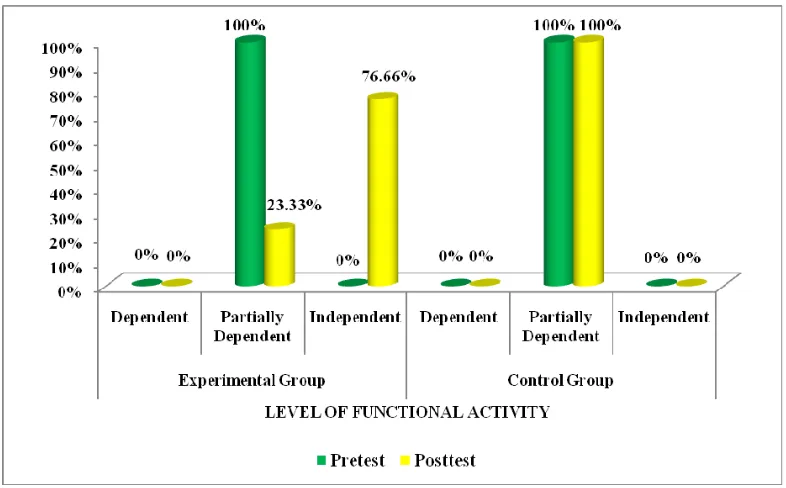
Distribution of subjects according to the level of functional
activity score before and after administration therapeutic exercises.
N=60 Level of Functional
Activity
Experimental Group n=30
Pretest Posttest
Control Group n=30
Pretest Posttest F % F % F % F % Dependent Partially Dependent Independent 0 30 0 0 100 0 0 7 23 0 23.33 76.66 0 30 0 0 100 0 0 30 0 0 100 0
Based on the functional status index, the subjects were classified into three groups as dependent (1-21), partially dependent (22-43), Independent (44-65).
The data on table 2 shows that before administration of therapeutic exercises in experimental group 30 sample (100%) were partially dependent. But after administration of therapeutic exercises 23 sample (76.66%) were become independent and 7 (23.33%) sample belong to partially dependent group.
SECTION III
[image:51.612.121.540.263.333.2]Comparison of Functional Activity Score of the Subjects
Table 3
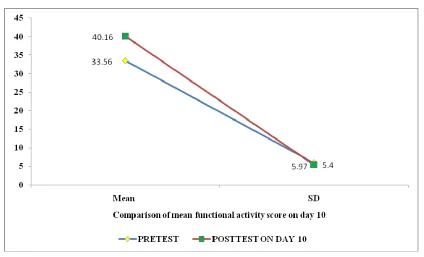
Comparison of Mean Functional activity score of experimental group
before and after administration of therapeutic exercises on day 10.
N=30
Test N Mean SD ‘t’Value
Pretest
Posttest on day 10 30 30
33.56 40.16
5.97 5.40
4.85
*Significant at 0.05 level
In the present study functional activity was measured by functional activity index scale. A higher score indicate good functional activity, where as low score indicate poor functional activity.
Table 4
Comparison of Mean Functional activity score of control group
before and after administration of therapeutic exercises on day 10.
N=30
S.No. Test N Mean SD ‘t’Value
1. 2.
Pretest
Posttest on day 10 30 30
33.66 36.70
5.59 5.05
0.03
In order to find out the significant difference between the mean functional activity score of the control group on day 10,‘t’ value was computed to test the statistical significant.
Table 5
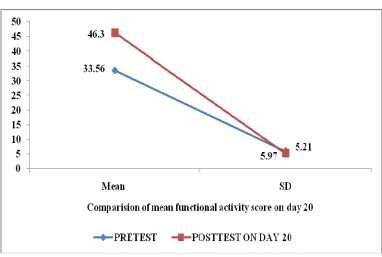
Comparison of Mean Functional activity score of the
experimental group before and after administration of therapeutic
exercises on 20
thday.
N=30
Test N Mean SD ‘t’ bValue
Pretest Posttest
30 30
33.56 46.30
5.97 5.21
*10.19
* Significant at 0.05 level
In order to find out the significant difference between the mean functional activity score before and after administration of therapeutic exercises on day 20, in experimental group. Following null hypothesis was stated.
Ho1 The mean post test functional status score of experimental group who had selected nursing intervention will not be significantly higher than mean pre test score.
Table 6
Comparison of Mean Functional activity score of the control
group on 20
thday.
N=30
S.No. Test N Mean SD ‘t’bValue
1. 2.
Pretest Posttest
30 30
36.66 37.10
5.59 5.13
0.33
* Significant at 0.05 level
Table 7
Comparison of Mean Functional activity score of the subjects
in experimental group after administration of therapeutic exercises
on 10
thand 20
thday.
N=30
S.No. Test N Mean SD ‘t’bValue
1. 2.
Posttest on day 10 Posttest on day 20
30 30
40.16 46.30
5.40 4.32
5.24
* Significant at 0.05 level
Table 8
Comparison of Mean Functional activity score of the subjects in
control group on 10
thand 20
thday.
N=30
S.No. Test N Mean SD ‘t’bValue
1. 2.
Posttest on day 10 Posttest on day 20
30 30
36.70 37.10
5.13 5.05
0.33
* Significant at 0.05 level
Table 9
Comparison of mean post test functional activity score of
experimental group after the administration of therapeutic exercises
with control group post test score.
N=30
Group Test N Mean SD ‘t’Value
Experimental Group Control Group
Posttest on day 20 Posttest on day 20
30 30
46.30 36.70
4.31 5.05
8.57
* Significant at 0.05 level
In order to compare the mean post test functional activity score of experimental group after the administration therapeutic exercises with control group. The null hypothesis was stated as follows:
Ho2 the mean post test functional activity score of experimental group will not be significantly higher than mean post test score of control group.
Figure 5: Comparison of mean post test functional activity score of experimental group after the administration of therapeutic exercises with control group post test
SECTION IV
Table 10
Effectiveness of selected nursing intervention in improving functional
activity among elderly in experimental group on 10
th& 20
thday.
N=30
Group N Experimental
Group
SD ‘t’ value Pretest & Posttest on day 10
Pretest & Posttest on day 20 Posttest 10th & Posttest day 20
30 30 30
2.32 3.33 2.66
15.61 19.58 12.77
Table 11
Effectiveness of selected nursing intervention in improving functional
activity among elderly in control group on 10
th& 20
thday.
Group N Control
Group
SD ‘t’ value Pretest & Posttest on day 10
Pretest & Posttest on day 20 Posttest 10th & Posttest day 20
30 30 30
1.56 1.54 1.74
0.46 0.10 1.70
SECTION VI
Table 12
Association of functional Activity score of the subjects with
demographic variables in experimental group.
N=30 Demographic Variables Functional Activity
Score N χ2 Value Below Mean Above Mean 1. Age in years
a)60-65 b)66-70 c)71-75 d)76-80 2. Sex a) Male b) Female 3. Educational Status
a) Illiterate b) literate
i. Primary School level ii. Middle School level iii. High school level
b) Under graduate c) Post graduate
4. Co morbid disease a) Yes
b) No
5. BMI
Normal weight Over weight
Obese
6. Previous History of fall and fracture Yes No 1 0 8 7 12 2 1 2 13 0 0 13 2 13 2 0 3 12 1 0 21 9 25 4 1 5 25 #3.94 #1.12 #0.24
# Not significant at 0.05 level * Significant at 0.05 level
To find out If there is any association between level of functional activity among the experimental group and selected demographic variables (age, sex, educational status, co morbid diseases, BMI, previous history of fall and fracture.) null hypothesis was stated as follows:
In order to find out the association between the level of functional activity of the subject and selected variables chi-square test was computed. There was no association between level of functional activity of the group and age. The obtained x2 value of 2.87 at df (1) was not significant at 0.05 level.
It was found that there is no relationship between level functional activity of the elderly group and age, sex, educational status, co morbid diseases, BMI, previous history of fall and fracture. The obtained X2 value for sex was 1.2 at df (1), for education status was 12.59 at df (1), for co morbid diseases was 3.94 at df (1), for body mass index was 1.12 at df (1), or previous history ofcc all and fracture was 0.24 at df (1) was significant at0.05 level.
Table 13
Association of functional Activity score of control group with
demographic variables.
N=30 Demographic Variables Functional Activity
Score
N X2 Value
Below Mean
Above Mean 1. Age in years
a)60-65 b)66-70 c)71-75 d)76-80 2. Sex a) Male b) Female 3. Educational Status
a) Illiterate b) literate
i. Primary School level ii. Middle School level iii. High school level
iv. Higher secondary
b) Under graduate c) Post graduate
4. Co morbid disease a) Yes
b) No
5. BMI
Normal weight Over weight
Obese
6. Previous History of fall and fracture Yes No 2 0 16 3 16 4 0 5 14 1 0 7 4 8 2 0 3 8 3 0 23 7 24 6 0 8 22 #1.64 #0 #0
# Not significant at 0.05 level * Significant at 0.05 level
To find out if there is any association between level of functional activity among the control group and selected demographic variables (age, sex, educational status, co morbid diseases, BMI, previous history of fall and fracture.) the null hypothesis was stated as follows:
In order to find out the association between the level of functional activity of the subject and selected variables chi-square test was computed. For the convenient of computation and tabulation the researcher had clubbed the age group as 60-65 years, 66-70 years, 71-75 years, and 76-80 years. There was no association between level of functional activity of the group and age. The obtained x2 value of 2.02at df (1) was not significant at 0.05 level.
It was found that there is no association between level functional activity of the elderly group and age, sex, educational status, co morbid diseases, BMI, previous history of fall and fracture. The obtained X2 value for sex was 0.14 at df (1), for education status was 4.84 at df (1), for co morbid diseases was 1.64 at df (1), for body mass index was 0.003 at df (1), or previous history of all and fracture was 0.003 at df (1) was significant at0.05 level.
There was no association between functional activity score and age, sex, educational status, co morbid diseases, BMI, previous history of fall and fracture for control group. So the researcher accept the null hypothesis and reject the researcher hypothesis.
SECTION V
Table 14
The feedback of the elderly people in experimental group
through the outcome expectation exercises measure.
Characteristics Agree F %
Disagree F % Continues practice of 20 days exercise program
Physical happiness
Improved your endurance in performing daily activity
30 100 0 0
Made you feel better physically 27 90 3 10 Made your muscle stronger 28 93.33 2 6.73 Mental happiness
Changed your mood better in general 30 100 0 0 Helped you to feel less tired 30 100 0 0 Makes you to enjoy doing exercise 30 100 0 0 Gives you a sense of personal
accomplishment
30 100 0 0
Made you become more mentally alert 30 100 0 0
CHAPTER V
DISCUSSION
This study was conducted to evaluate the effect of therapeutic exercises on functional activities among elderly patients from selected old age homes at Madurai. The study findings are discussed in this chapter with reference to the objectives, the framework and hypotheses stated in chapter 1.
1. Demographic Characteristics of the Samples
• With regard to age 43.33% sample were between the age of 71-75 years.
• With regard to sex there was an equal (50%) distribution of male and female.
• With regard to education majority of the subjects 26.67% were studied up to
middle school level
• Regarding Co morbid diseases of the subjects 70% were having diseases.
• About body mass index of the subjects 80% had normal weight.
• It was found that 83.33% of subjects were not having previous history of fall
and fracture.
2.
Distribution of Samples According to their Level of Functional
Activity before and after administration of therapeutic exercise
Present study findings is co-inside with the findings of Maria, Hamid and Mohan (2011), study They conducted a quasiexperimental study aimed to measure the effects of 12-week multicomponent exercise training on physical functioning among institutionalized elderly. Forty-three participants (age = 70.88 ± 7.82 years) were self-assigned to an intervention (݊ = 2 3) and control (݊ = 2 0) group. Before and after
training, cardiorespiratory endurance, armcurlstrength, grip strength, lower limb strength, upper and lower limb flexibility, balance, and mobility were assessed. The training included aerobic, resistance, balance and flexibility exercises, performed 3 times per week. Significant increases (ܲ < 0 . 0 5) were observed in the exercise group
on cardiorespiratory endurance (41.79%), right arm curl strength (25%), left arm curl strength (30.79%), right hand grip strength (13.65%), left hand grip strength (9.93%), lower limb strength (46.19%), balance (49.58%), and mobility (26.37%). Measures of flexibility in the exercise group also showed improvement (right lower limb (63.57%), left lower limb (44.17%), right upper limb (36.67%), and left upper limb (63.1%) but were not statistically significant (all, ܲ > 0 . 0 5). The control group did
not show any significant changes (ܲ > 0 . 0 5) in any variables. The data suggested
that 12-week multicomponent exercise training may improve physical functioning among institutionalized elderly.
3.
Comparison of mean functional activity score before and after
administration therapeutic exercise
than the table value. Therefore it can be inferred that the therapeutic exercise had been effective in improving the functional activity of the elderly people.
Kelly (2009) conducted a meta-analysis to examine the impact of exercise and health related quality of life in older community based adults. The study included 11 randomized clinical trials (RCT) that included 617 men and women. Physical activity intervention arms for the clinical trials included strength training, aerobic training with some of them participated in both types of activities. The SF-36 PCS was the principal outcome in these RCTs. Results indicated that physical activity demonstrated statistically significant increases in physical functioning in the small to moderate range of effects. Odds ratio of 2.14 (95% CI; 1.42-3.24) was interpreted as an odds of improving in physical functioning more than 2 times greater with a physical activity intervention compared with the odds in a control group without physical activity. These differences were deemed clinically relevant, the paper also points out that the integration of combined strategies such as strength and aerobic exercise can have a larger effect.
4.
Association of functional activity score of the subjects and
selected demographic variables (age, sex, educational status, co
morbid diseases, body mass index, previous history of fall and
fracture).
CHAPTER VI
SUMMARY, CONCLUSION, IMPLICATION AND
RECOMMENDATIONS
This chapter deals with the summary of the study and the conclusion drawn. It clarifies the limitation of the study. The implication and recommendation given for different areas of nursing and for the health care delivery system.
SUMMARY OF THE STUDY
This study was undertaken to determine the effectiveness of therapeutic exercises in improving the functional activity among the elderly person.
The following objectives were set for the study:
• To find out the functional status of the elderly in experimental group before
and after implementing selected nursing intervention.
• To assess the pre and post test functional status of the elderly in control group.
• To evaluate the effectiveness of selected nursing intervention in improving
functional status among elderly in experimental group.
• To find out the association between the post test functional status of
experimental group with selected demographic variables (Age, Sex, Education status, Co morbid diseases, Body mass index and Previous history of fall and fracture.)
• To find out the association between the post test functional status of control
The following Hypotheses were tested at 0.05 level of significant:
H1:
The mean post test functional status score of experimental group of elderly who had selected nursing intervention will be significantly higher than mean post test score of control group.
H2:
The mean post test functional status score of experimental group who had selected nursing intervention will be significantly higher than mean pre test score in day 10 and 20.
H3:
There will be a significant association between mean post test functional activity score of experimental group with selected demographic variables. (Age, Sex, Education status, Co morbid diseases, Body mass index and previous history of fall and fracture.) in experimental group.
H4:
Variables studied were
Dependent variable:
Functional status.Independent variable:
Selected nursing intervention (Neck mobility exercise, Manual resistance exercise, Isometric exercise).In this study quasi experimental pretest, posttest control group research design was used and the study was conducted at Zion trust, Christian seva sangam, poongkodi old age homes in Madurai. The population of the study was old age people who were residing in the old age homes. Purposive sampling technique used to select subjects. A total of 60 subjects were selected.
The tool used for data collection was a Functional Activity Scale & outcome expectation exercises measure. The content validity of the tool established by giving to 5 experts in the field of nursing / physiotherapist and orthopedics. Modifications was done according to their recommendations.
Reliability was tested using Karl Pearson’s co-efficient correlation for Functional Activity Scale (r=0.94). the instrument found to be reliable. Pilot study was conducted on 6 samples to find out the feasibility of conducting the study and it was found feasible.
Therapeutic exercises were taught to subjects for 20 days. functional activity was assessed before and after the therapeutic exercises on day 10 and day 20.
The significant findings of the study were
• Comparison of mean post test functional activity score of experimental group
after the administration therapeutic exercises was higher than the control group post test score.
• Comparison of mean functional activity score of therapeutic exercises on day
10 was higher than the mean functional activity score of before administration of therapeutic exercises.
• Comparison mean functional activity score of therapeutic exercises on day 20
is higher than the mean functional activity score of before administration of therapeutic exercises.
• Comparison mean functional activity score of therapeutic exercises on day 20
is higher than the mean functional activity score of day 10.
• There was no association between the level of functional activity in patient
with age, sex, educational status, co-morbid diseases, body mass index, previous history of fall and fracture.
CONCLUSION
The following conclusion were drawn from the study
1. The level of functional activity of the subjects with functional activity was
improved significantly after therapeutic exercises.
2. Continuous administration of therapeutic exercise slowly improved the
subjects functional status to partially dependent to independent status.
3. There was no association between the level of functional activity in patient
IMPLICATIONS
Aging adults going from inactivity to activity, flexibility training may offer a good start towards a healthy lifestyle. This type of training may lack the high profile of cardiovascular exercise and strength training, but it can improve range of motion, decrease pain and soreness after exercise, improve posture, and decrease muscle tension. More importantly, stretching can make the difference in comfort when performing tasks such as putting a shirt or blouse on in the morning or reaching for a cup of tea or coffee. As a result, flexibility can contribute significantly to overall functional fitness, helping older adults safely and effectively accomplish independent activities of daily living. The findings of the present study support that therapeutic exercises are very safer and almost have a nil adverse effect and improving the functional status. The findings of the study have several implications on following fields.
IMPLICATION OF NURSING PRACTICE
• The findings of the study enlighten the fact that therapeutic exercises can be
used to improving functional activities of elderly person.
• The study findings help the nursing personnel to include the therapeutic
exercise as a nursing intervention in the management of elderly person.
• The study signifies the early institution of therapeutic exercises improvement
of functional activity.
• Demonstration can be arranged for elderly regarding therapeutic exercises in
IMPLICATION OF NURSING EDUCATION
• The study proved that the therapeutic exercise has effect in improving
functional activities. To practice this nursing personnel need to have adequate knowledge desirable attitude and skill regarding therapeutic exercises.
• This findings would help nursing faculty to give importance for therapeutic
exercises as a nursing intervention in the management of old age patient and motivate the nursing student to use this intervention in the management of this patient.
• The content should be added to the nursing curriculum so that the nursing
students can come to know about therapeutic exercises and its uses in improving the functional activities of the elderly person.
• Short term courses can be started to train nurses in old age home with
emphasis on therapeutic exercise.
IMPLICATION OF NURSING RESEARCH
There is need for extensive and intensive research in this area.
• One of the aims of nursing research is to expand and broaden the scope of
nursing findings of this study will provide baseline data about the functional activities and therapeutic exercises it can be used for further studies in this area.
• This study also brings about the fact that more studies need to be done at
IMPLICATION OF NURSING ADMINISTRATION
• Nurse administrator should prepare procedure manual protocols regarding
therapeutic exercises and can be used in old age home.
• Clinical nurses and nurse educators should be given an in-service education to
update the knowledge regarding therapeutic exercises.
• Periodic conference, seminar, symposium, can be arranged for nursing
personnel regarding care of old age person.
LIMITATION
The limitation of the study
• The sample size was 60. Each finding should be generalized with cautions.
• The settings of the study were chosen due to the researches familiarity. Due to
this methodological limitation the findings can be generalized only to the selected home.
RECOMMENDATION
• Similar kind of the study can be conducted for a longer group to generalize the
findings.
• A longitudinal study can be conducted to assess the effect of therapeutic
exercise to improve the functional activities.
• The study can be conducted by using other types of exercises.
• Similar kind of study can be conducted for patients who are having orthopedic
• The same study can be conducted by administering the therapeutic exercises in
improving other variables like cardiac parameters, respiratory and musculo skeletal performance.
SUMMARY
REFERENCE
• Avlund. (2004). Healthy aging: health promotion and