1
Partial Discharge Detection Using Low Cost
RTL-SDR Model for Wideband Spectrum Sensing
H Mohamed1, P Lazaridis1, D Upton1, U Khan1, B Saeed1, A Jaber1 , Y Zhang1, P Mather1, M F Q Vieira2, , K W Barlee 3, D S W Atkinson 3 , and I A Glover1
1Department of Engineering & Technology, University of Huddersfield, Huddersfield HD1 3DH, UK 2Department of Electrical Engineering, Universidade Federal de Campina Grande, Campina Grande, Brazil
3Department of Electronic and Electrical Engineering, University of Strathclyde, Glasgow G1 1XW, UK UK E-mail: [email protected]
Abstract - Partial discharge (PD) is one of the predominant factors to be controlled to ensure reliability and undisrupted functions of power generators, motors, Gas Insulated Switchgear (GIS) and grid connected power distribution equipment, especially in the future smart grid. The emergence of wireless technology has provided numerous opportunities to optimise remote monitoring and control facilities that can play a significant role in ensuring swift control and restoration of HV plant equipment. In order to monitor PD, several approaches have been employed, however, the existing schemes do not provide an optimal approach for PD signal analysis, and are very costly. In this paper an RTL-SDR (Software Defined Radio) based spectrum analyser has been proposed in order to provide a potentially low cost solution for PD detection and monitoring. Initially, a portable spectrum analyser has been used for PD detection that was later replaced by an RTL-SDR device. The proposed schemes exhibit promising results for spectral detection within the VHF and UHF band.
Keywords: Partial discharge detection; Spectrum sensing; RTL-SDR; Software Defined Radio.
I. INTRODUCTION
In general, PD events take place within the insulating material between the copper HV conductor and the earthed outer shield, or in a void that could be located between the copper conductor and insulation wall. Generally, these pulses are generated at very high frequencies and are quickly attenuated. PD events cause small arcs in the insulating material, thus deteriorating the insulation over time, which could potentially result in complete failure. In order to provide reliable operation, the detection of PD is of great significance, and the emergence of wireless
technology has provided an alternative to detect and monitor PD events. There are a number of sensing devices available for high frequency signal detection. Some of the solutions, like spectrum analysers, are capable of scanning a wide spectral range, but are not cost effective. A spectrum analyser cannot perform continuous recording for a time period more than a few seconds, and the recorded spectrum requires a higher frequency resolution for better visualization. Furthermore, the unprocessed signal still requires processing to evaluate the energy in a specific band. On the other hand, low-cost SDR spectrum analysers are trimmed for easy and stable recording, but lack flexibility and performance compared to high end commercial types. In order to facilitate distributed spectral or signal sensing, a relatively low-cost sensing platform must be used. Bridging a performance gap between high-end spectrum analysers and the requirement of a low cost spectrum analyser for PD detection, this paper intends to develop a robust sensing platform for PD detection.
Recently, Realtek RTL2832U demodulator based low-cost USB digital TV tuners have attracted radio scientists and researchers to software-defined radio (SDR). SDR can be employed for spectral sensing for wideband signals and hence can be a potential candidate for PD detection. In this paper, a study has been conducted for PD detection using a portable spectrum analyser and RTL-SDR dongles, where the spectrum analyser has provided better sensing efficiency at a higher cost, however; the focus of the research is on RTL-SDR based spectral analysis. The performance obtained for RTL-SDR based spectral sensing exhibited certain limitations towards wider bandwidths.
II. RELATED WORK
2
frequency-based technique that can differentiate multiple PD incidents and other impulsive noise sources in a substation. Similarly, in [2] an online PD localization scheme was proposed in distributed power cables. The authors have obtained the direction of arrival of PD pulses by employing the polarity of detected PD pulses with reference to the polarity of the supply voltage. Suryandi et al. and Meijer et al., [3] introduced a scheme for PD detection in power cable equipment using a wireless communication network. The above mentioned research demonstrates that the implementation of RF techniques can be a potential solution to the PD detection problem. In fact, wideband spectrum sensing is a very intricate issue, [4]. To achieve it, high performance ADCs can provide an alternative but due to high costs and power requirements are not viable solutions at the moment. To alleviate such problems, small scale sensing can be an option by employing multiple narrow bands for sensing a wideband spectrum [4-5]. In [6], cross correlation techniques were used for spectral sensing using low cost SDR receivers, and a phase-domain detection scheme was used for radio detection without any signal feature extraction overheads. In [7], statistical auto-regressive and moving average predictive models for grey-hole spectrum sensing were explored. The authors used SDR with USRP2 and RFX2400 boards for spectral sensing and analysis. Liu et al. [7] proposed substitutes for channel assessment with commercial SDR to provide a seamless spectral sensing over a wide bandwidth. Combining the GNU Radio and USRP in [8] an SDR based wireless systems was developed. Work recently published by a team at the University of Strathclyde [10] has shown how the RTL-SDR can be used to perform automated sweeps of the RF spectrum; opening the possibility of using this device to detect PD signals. No previous research was found regarding PD detection using RTL-SDR devices.
III. REAL TIME SOFTWARE DEFINED RADIO RTL-SDR
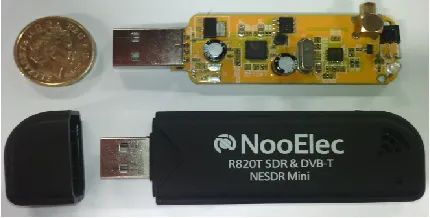
The RTL-SDR is inexpensive and is based on DVB-T TV tuners with RTL2832U ICs. The RTL-SDR can function as a wide band radio scanner. RTL-SDR receivers employ a Realtek RTL2832U quadrature sampling detector and a programmable frequency oscillator. Research tests show that these devices can operate well without any hardware modifications, using additional software. It is normally feasible to tune in to certain frequency bands by a conventional SDR program. The advanced versions of RTL-SDR compatible software can directly access the data stream, facilitating real time multimode reception. Figure 1 shows the main components of the NooElec
[image:2.612.324.539.154.263.2]RTL-SDR. RTL2832U ICs can be employed with any of the three tuner chips available: FC0012 – tuner: 22 MHz to 948.6 MHz; FC0013-tuner: 22 MHz to 1100MHz; Elonics E4000: 52 MHz to 2200 MHz. In this paper, the Rafael Micro R820T tuner has been used which is capable of tuning from 24MHz to 1766 MHz.
Fig-1 Key components of the NooElec NESDR Mini RTL-SDR
The tuner selects a frequency band around a targeted centre frequency and performs demodulation within the selected band into the baseband. In the proposed model, the RTL2832U chip functions as an ADC that samples the baseband signal and outputs to the host computer. The considered dongle is employed to receive and decode the PD signals. The chosen SDR has modes that allow for the capturing and transfer of raw samples to the host computer, thus enabling the system to behave like an inexpensive spectrum analyser. To acquire the spectral information, we rely on RTL-SDR USB dongles and MATLAB code. The selected RTL-SDR dongles are based on RTL2832U demodulator, which can be modified into cheap SDRs since the chipset allows for the transfer of the captured raw I/Q samples to the computer. The RTL2832U has an ADC that samples at 28.8 MHz. The theoretical limitation of USB 2.0 based interfaces is at 3.2 MHz. However, in real time operations, signals sampled below 2.4 MHz can be received without any major losses. Reducing the rate often improves the performance of baseband processing on less powerful computers, whereas setting the sampling rate to 2.4 MHz will lead the RTL2832U to decimate by a factor of 12 when the ADC samples at 28.8MHz, This means that only 1 in every 12 IQ samples is outputted to the computer. Therefore, with reduced sampling rate, the computer receives a signal with a bandwidth of 2.4MHz.
I. PARTIAL DISCHARGE DETECTION USING RTL-SDR
A. Design Objectives
3
Low-Cost- The cost of the proposed sensingmodel must not be in excess of $20.
Portable- The sensing system must be small enough to enable easy deployment.
Wideband- The proposed model must be capable of receiving signals within the bandwidth of radiated PD (50-800 MHz).
COTS Hardware- The sensing system must be built using commercial off-the-shelf (COTS) hardware components.
B. Proposed System
The key feature of the proposed spectral sensing system is a low-cost, portable measurement platform for automatically collecting the PD data. The platform has just two hardware components: a service device, PC/laptop and a portable Realtek Software Defined Radio (RTL-SDR) that connects to the PC via a USB interface. The RTL-SDR performs as a spectrum analyser that collects the raw spectral signal, while the PC/laptop functions as a data processor which converts the raw data into more compact and meaningful measurements. The RTL-SDR DVB-T dongle operates in the frequency range of 24-1750MHz. The device was selected due to low cost, availability, portability, and its frequency coverage in the VHF-UHF bands.
Fig. 2. RTL-SDR dongle connected to the laptop via USB port.
The required software tools have been interfaced with the RTL-SDR modules to allow for real-time control. After retrieving the raw I/Q samples from the RTL-SDR sensor dongle, the host computer performs Fast Fourier Transform (FFT) to produce power spectrum density (PSD) mapping of the received signal to identify active transmissions and spectral data. One key concern is whether the spectral measurements collected by this low-cost hardware can provide the same level of fidelity and accuracy to those obtained from sophisticated equipment such as high performance spectrum analysers. In the proposed system, we deal with the limitations of the existing RTL-SDR system for wideband spectrum sensing.
II. EXPERIMENTAL RESULTS
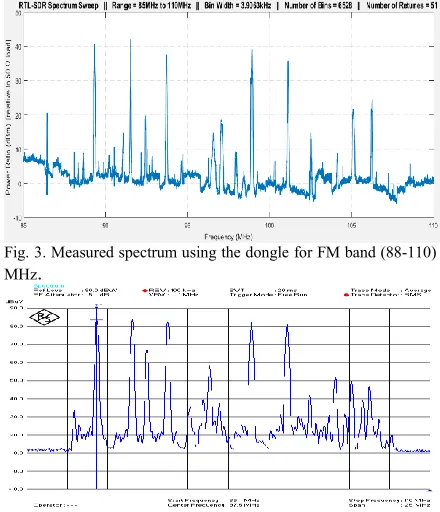
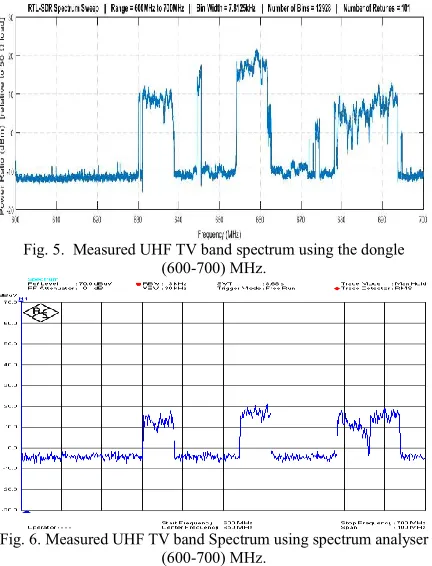
[image:3.612.322.542.235.491.2]The proposed RTL-SDR system has been developed using the RTL2832U IC along with a NooElec NESDR Mini tuner which is supported by open source software. The performance of the proposed RTL-SDR system has been compared with a high-end portable spectrum analyser. Spectral sensing has been analysed at the following bands: 85 110 MHz, 600 MHz-700MHz and 50MHz to 800MHz with both a portable spectrum analyser and the RTL-SDR based spectrum analyser. Fig. 3 shows the data taken using the RTL-SDR sensing system for the FM band of (88-108) MHz, while the data obtained using the spectrum analyser are shown in Fig. 4.
[image:3.612.74.286.396.513.2]Fig. 3. Measured spectrum using the dongle for FM band (88-110) MHz.
Fig. 4. Measured spectrum using the spectrum analyser for FM band (85-108) MHz.
4
[image:4.612.323.540.82.220.2]and without PD using the RTL-SDR dongle is around 19dB, while using the spectrum analyser it is around 21 dB. This yields an error of only 2dB and proves that results obtained by using the SDR device are reliable.
Fig. 5. Measured UHF TV band spectrum using the dongle (600-700) MHz.
[image:4.612.73.289.128.411.2]Fig. 6. Measured UHF TV band Spectrum using spectrum analyser (600-700) MHz.
Fig. 7. Measured spectrum using the dongle in absence of PD
[image:4.612.325.542.254.401.2]Fig. 8 Measured spectrum using the dongle in presence of PD
.
Figure 10 Measured spectrum using the R&S Spectrum analyser in
absence of PD
Figure 10 Measured spectrum using the R&S Spectrum analyzer in presence of PD.
III. CONCLUSION
[image:4.612.72.287.425.565.2] [image:4.612.325.540.436.589.2]5
analysers provide better accuracy for PD detection, however, this solution is expensive. PD detection has been performed using a portable spectrum analyser and RTL-SDR devices. It has been found that the RTL-SDR based PD detection can give accurate spectrum analysis at higher frequencies. The key limitations of the RTL-SDR dongles have been discussed, especially regarding the non-calibrated relative nature of power measurements.
REFERENCES
[1] Baker, P.C.; Judd, M.D.; McArthur, S.D.J., "A frequency-based RF partial discharge detector for low-power wireless sensing," Dielectrics and Electrical Insulation, IEEE Transactions on February 2010, vol.17, no.1, pp.133-140. [2] Shafiq, M.; Lehtonen, M.; Isa, M.; Kutt, L.,
"Online partial discharge diagnostics in medium voltage branched cable networks," Power Engineering, Energy and Electrical Drives (POWERENG), 2013 Fourth International Conference on 13-17 May 2013, pp.246-251. [3] Meijer, S.; Agoris, P.D.; Seitz, P.P.; Hermans,
T.J.W.H., "Condition assessment of power cable accessories using advanced VHF/UHF PD detection," Electrical Insulation, Conference Record of the 2006 IEEE International Symposium on 11-14 June 2006, pp.482-485. [4] T. Yucek and H. Arslan. A survey of spectrum
sensing algorithms for cognitive radio applications. Communications Surveys Tutorials, IEEE, 11(1):116–130, First 2009.
[5] B. Le, T. Rondeau, J. Reed, and C. Bostian. Analog-to-digital converters, Signal Processing Magazine, IEEE, 22(6):69–77, Nov 2005. [6] Tabassam, A.A.; Suleman, M.U.; Khan, S.;
Tirmazi, S.H.R., "Spectrum estimation and spectrum hole opportunities prediction for cognitive radios using higher-order statistics," Wireless Advanced (WiAd) on 20-22 June 2011, pp.213-217.
[7] Wei Liu, Daan Pareit, Eli De Poorter and Ingrid Moerman “Advanced spectrum sensing with parallel processing based on software-defined radio”; EURASIP Journal on Wireless Communications and Networking 2013.
[8] Harada, H., "A Feasibility Study on Software Defined Cognitive Radio Equipment," New Frontiers in Dynamic Spectrum Access Networks,
2008, 3rd IEEE Symposium on 14-17 Oct. 2008, pp.1-12.
[9] Kun, D.; Morgan, N.A., "A new low-cost CFAR detector for spectrum sensing with cognitive radio systems," Aerospace conference on 7-14 March 2009, pp.1-8.
[10] Stewart, R.W.; Barlee, K.W.; Atkinson, D.S.W.; Crockett, L. H. “Software Defined Radio using MATLAB & Simulink and the RTL-SDR’’. 1st