© Global Society of Scientific Research and Researchers
http://ijcjournal.org/
To Improve the Probability of Detection in Spectrum
Sensing by Using Equal Gain Combining Technique
K. Apurva
a*, Mrs P Dhana Lakshmi
baM. Tech Student, Department of ECE,Acharya nagarjuna university, Guntur, India
bAssistant professor, Department of ECE, Acharya nagarjuna university, Guntur, India
a
Email: [email protected]
b
Email: [email protected]
Abstract
Development of smart spectrum sensing techniques is the most important task in the design of a cognitive radio
system, which uses the available spectrum efficiently. The Energy Detection (ED) and covariance absolute
value (CAV) methods do not require any information about the signals, channel, and noise power. So these
techniques are known as blind spectrum sensing techniques. This paper mainly focusing on equal gain
combining technique. This technique was applied on both Energy Detection (ED) and covariance absolute value
(CAV). By using this technique at low Signal to noise ratio (SNR) this system can improve the probability of
detection.
Keywords: Cognitive radio; Spectrum sensing; Probability of detection; Equal gain combining; Energy detection; CAV.
1.Introduction
In present days, the use of radio spectrum has become crowded due to the increasing in the number of
communication services [1]. By contrast, 90 percent of the existing licensed spectrum remains idle and the
usage varies geographically and temporally as reported by the Federal communication commission (FCC) [2].
Permitting unlicensed user to access to the licensed spectrum can greatly increases spectrum utilization
efficiency, but it is essential that the secondary users do not cause harmful interference to licensed users [3, 4].
A cognitive radio is required to achieve this, typically through spectrum sensing and interference management.
The purpose of this cognitive communication changes is to investigate the spectrum utilization issues associated
with primary and secondary user, sharing common spectrum based on throughput performances [5]. The overall
goal is allow the unlicensed user to operate in the absence of the licensed users [6].
---
Energy detection method is one of the simplest methods and it does not need any priori information to sense the
presence or absence of primary user. It takes decision depends on threshold value [14].The main drawback for
the energy detection is sensitivity to noise uncertainty. To overcome this problem, this system proposes new
methods based on the statistical covariance or autocorrelations of the received signal. The statistical covariance
matrices or autocorrelations of signal and noise are generally different. Thus, this difference is used in the
proposed methods to differentiate the signal component from background noise. In practice, there are only a
limited number of signal samples. Hence, the detection methods are based on the sample covariance matrix [14].
These methods do not need any information of the signal, channel, and noise power a priori. In addition, no
synchronization is needed. In a wireless environment, the received signals undergo fading due to the presence of
multipath signals. Spatial diversity is an adequate method of combating multi-path. This system can achieve
diversity through the use of multiple antenna arrays. The multiple copies of signals received through different
diversity paths are appropriately combined at the receiver. Diversity combining techniques are needed to
combine the received signals into one. In this paper equal gain combining was studied and it was applied to the
Energy detection and CAV. The comparative analysis is done for SNR vs. Pd [7]. The Rest of this paper is
organized as follows. Section 2 briefly discuss on cognitive radio. Section 3 describes the System model.
Section 4 describes Average probability of detection with diversity reception. Section 5 presents Simulation
results. Section 6 concludes the paper.
2.Cognitive Radio
Opportunistic Spectrum access is performed by a device that acts as a radio with the ability to acquire, measure,
sense, learn and be aware of its operating environment, which is termed as cognitive radio. Sensing techniques
are based on the detection of primary user independently through continuous spectrum sensing. The presence or
absence of primary user is identified periodically to locate the unused spectrum bands in targeted spectrum pool.
There by, these bands can be used for secondary user transmission optimally without causing harmful
interference to the licensed primary users.
3.System Model
Band pass
filter/LN
Frequency down Converter
IF Amp
Squaring Device Integrator
Decision Device
Energy Detector Sensing process
𝜆𝜆
In this paper equal gain combining method is applied to energy detection and CAV. In figure 1, energy sensing
method is explained. The energy sensing process has two steps [13] as shown in figure1. In the first step a filter
is used to achieve the received signal x[n] in the desired bandwidth (B) so that the nearby signals and band noise
may be rejected. After that an amplifier for low noise is used to down convert the frequency to an intermediate
level. In the next step, sampling and quantization are done using an analog to digital converter [10]. Then, an
integrator having Sensing time interval T and a square law device, measure the signal energy which is received.
At last, the integrator’s output, denoted by Y, is compared with a predefined threshold level¸ so that the absence
(H0) or existence (H1) of a primary user may be determined.
The received signal X[t] can be defined as a binary hypothesis test as in equation (1)
X[t] = �h(t)S(t) + n(t), Hn(t), H0
1 (1)
Where h(t) denotes the complex channel gain between Pus and CRs, s(t) denotes the transmitted signal from
PUs, and n(t) is AWGN [14]. For the evaluation of the detection performance, the probabilities of detection Pd
and false alarm Pf are defined as [12],
𝑃𝑃𝑑𝑑 =𝑃𝑃{𝑑𝑑𝑑𝑑𝑑𝑑𝑑𝑑𝑑𝑑𝑑𝑑𝑑𝑑𝑑𝑑=𝐻𝐻1/𝐻𝐻1} =𝑃𝑃{𝑌𝑌>𝜆𝜆/𝐻𝐻1}
𝑃𝑃𝑃𝑃=𝑃𝑃{𝑑𝑑𝑑𝑑𝑑𝑑𝑑𝑑𝑑𝑑𝑑𝑑𝑑𝑑𝑑𝑑= 𝐻𝐻1/𝐻𝐻0} =𝑃𝑃{𝑌𝑌>𝜆𝜆/𝐻𝐻0} (2)
3.1.CAV Detection
Please Covariance-based blind detection is nothing but covariance absolute value (CAV), and it exploits the
difference between the covariance matrices of primary signals and noise, and it has lower computational
complexity compared with the Eigen value-based detection [16], [20].
Let us consider L consecutive samples and define the following vectors:
𝑋𝑋(𝑑𝑑) = [𝑥𝑥(𝑑𝑑) 𝑥𝑥(𝑑𝑑 −1) … 𝑥𝑥(𝑑𝑑 − 𝐿𝐿+ 1)] 𝑇𝑇 (3)
𝑑𝑑(𝑑𝑑) = [𝑑𝑑(𝑑𝑑) 𝑑𝑑(𝑑𝑑 −1) … 𝑑𝑑(𝑑𝑑 − 𝐿𝐿+ 1)] 𝑇𝑇 (4)
𝜂𝜂(𝑑𝑑) = [𝜂𝜂(𝑑𝑑) 𝜂𝜂(𝑑𝑑 −1) … 𝜂𝜂(𝑑𝑑 − 𝐿𝐿+ 1)] 𝑇𝑇 (5)
Parameter L is called the smoothing factor in the following. Considering the statistical covariance matrices of
the signal and noise defined as
Rx = E [X(n) XT(n)] (6)
Here verify that
𝑅𝑅𝑥𝑥 = 𝑅𝑅𝑠𝑠+ 𝜎𝜎𝜂𝜂2𝐼𝐼𝐿𝐿 (8)
If signal s(n) is not present, Rs = 0. Hence, the off-diagonal elements of Rx are all zeros. If there is a signal and
the signal samples are correlated, Rs is not a diagonal matrix. Hence, some of the off-diagonal elements of Rx
should be non zeros. Denote rnm as the element of matrix Rx at the nth row and mthcolumn, and let
𝑇𝑇1 = 1𝐿𝐿 ∑𝑛𝑛=1𝐿𝐿 ∑𝑛𝑛=1𝐿𝐿 |𝑟𝑟𝑛𝑛𝑛𝑛| (9)
𝑇𝑇2 = 1𝐿𝐿∑𝐿𝐿𝑛𝑛=1|𝑟𝑟𝑛𝑛𝑛𝑛| (10)
Then, if there is no signal, T1/T2 = 1. If the signal is present, T1/T2 > 1. Hence, ratio T1/T2 can be used to
detect the presence of the signal [11].
Statistical covariance matrix Rx can be approximated by the sample covariance matrix defined as
~
𝑅𝑅𝑥𝑥(𝑁𝑁𝑠𝑠) =�
𝜆𝜆(0) 𝜆𝜆(1) ⋯ 𝜆𝜆(𝐿𝐿 −1)
𝜆𝜆(1) 𝜆𝜆(0) … 𝜆𝜆(𝐿𝐿 −2)
⋮
𝜆𝜆(𝐿𝐿 −1) 𝜆𝜆(𝐿𝐿 −⋮ 2) ⋯⋱ 𝜆𝜆(0)⋮
� (11)
4.Average Probability of Detection with Diversity Reception
In case of more than one antenna used at receiver, diversity combining techniques are used. This section
presents the probability of detection for Equal gain combining (EGC) in AWGN channel [7].
4.1.Equal Gain Combining
The Maximal Ratio combining technique provides the maximum performance relative to all other diversity
combining techniques, but at the same time it provides the highest complexity of all the combining techniques
because MRC requires knowledge of the fading amplitude in each signal branch. Whereas in equal gain
combining complexity is very much reduced as it uses equal weights in each branch and so it does not require
estimation of the channel (path) fading amplitudes. The total conditional SNR per symbol at the output is given
by
𝛾𝛾𝐸𝐸𝐸𝐸𝐸𝐸 = (∑ 𝛼𝛼𝛼𝛼 𝐿𝐿 𝑙𝑙=1 )2𝐸𝐸𝑠𝑠
∑𝐿𝐿𝑙𝑙=1𝑁𝑁𝛼𝛼 (12)
Where Es is the energy (in joules) per symbol and Nl is the AWGN power spectral density on the lth path. The
probability of detection at the EGC output for AWGN channel can be calculated by
5.Simulation Results
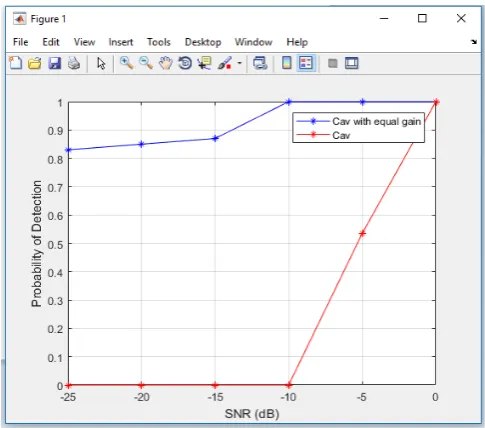
Here, this paper had shown the results for SNR (dB) vs. probability of detection for Equal Gain Combining
(EGC) with ED and CAV. All simulations in this work are executed on MATLAB (Version R2017a). Monte
Carlo (MC) method, which is a stochastic technique (based on the use of random numbers) forms the basis of
these simulations.
5.1.Simulation results for ED and ED with equal gain
Figure 2: SNR (dB) vs. Pd for ED and ED with EGC
5.2.Simulation results for CAV and CAV with equal gain
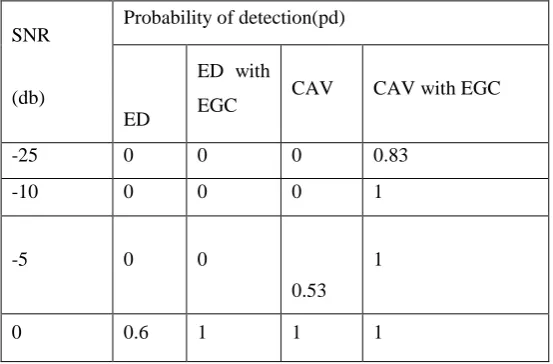
Table 1: Shows the simulation results of ED, ED with EGC, CAV, and CAV with EGC
SNR
(db)
Probability of detection(pd)
ED
ED with
EGC CAV CAV with EGC
-25 0 0 0 0.83
-10 0 0 0 1
-5 0 0
0.53 1
0 0.6 1 1 1
It can be seen from the Table.1. That performance is better in case of Equal Gain combining. So it can be
concluded that the detection performance of energy detector and CAV can be enhanced by using equal gain
combining technique.
6.Conclusion
In this paper, the results shows that the performance of spectrum sensing using energy detection and CAV under
equal gain diversity reception scheme.
By using Equal gain combining technique there is noticeable improved the performance of the energy detector
and CAV. EGC with CAV gives a better detection performance than ED and CAV.
References
[1] M. Ranjeeth, Sipra Behera, Srinivas Nallagonda, S. Anuradha “Optimization of Cooperative Spectrum
Sensing based on Improved Energy Detector with Selection Diversity in AWGN and Rayleigh
fading”.pp.2402-2006.
[2] Rui Wang and Meixia Tao. “Blind Spectrum Sensing by Information Theoretic Criteria for Cognitive
Radios’’2010. pp. 4244-5638.
[3] S. Haykin, “Cognitive Radio: Brain-Empowered Wireless Communications”, IEEE Journal on Selected
Areas in Communications, vol. 23, (2005), pp. 201-220.
[4] A. Alshamrani. X. Shen and L. Xie, “QoS Provisioning for Heterogeneous Services in Cooperative
Cognitive Radio Networks”, in IEEE Journals of Selected Areas in Communication, vol. 29, no. 4,
(2011), pp. 819-830.
[5] H. T. Cheng and W. Zhuang, “Simple Channel Sensing Order in Cognitive Radio Networks”, IEEE
[6] Deepti Kakkar, Arun Khosla, and Moin Uddin “Performance Evaluation of Energy Detection in
Spectrum Sensing for Cascaded Multihop Networks over Nakagami-n fading
cannel’’,Vol.6,No.5,pp.61-70.
[7] Rupali Agarwal, Neelam Srivastava and Himanshu Katiyar. “Energy Detection of Unknown Signals
over Rayleigh Fading Channel for EGC and SSC Diversity Combining Techniques”, International
Conference on Emerging Trends in Electrical, Electronics and Sustainable Energy Systems
(ICETEESES–16), pp.116-119 .
[8] J. Mitola and G. Q. Maguire Jr, “Cognitive radio: making software radios more personal," Personal
Communications, IEEE, vol. 6, (1999) pp. 13-18.
[9] Nabil Giweli, Seyed Shahrestani and Hon Cheung.” Spectrum sensing in cognitive Radio networks”
qos Considerations School of Computing, Engineering and Mathematics, Western Sydney University,
Sydney, Australia, pp.35-75.
[10] Rupali Agarwal, Neelam Srivastava and Himanshu Katiyar. “Energy Detection of Unknown Signals
over Rayleigh Fading Channel for EGC and SSC Diversity Combining Techniques”, International
Conference on Emerging Trends in Electrical, Electronics and Sustainable Energy Systems
(ICETEESES–16), pp.116-119.
[11] Yonghong Zeng.”Spectrum-Sensing Algorithms for Cognitive Radio Based on Statistical Covariances”
Senior Member, IEEE, and Ying-Chang Liang, Senior Member, IEEE. VOL. 58, NO. 4, MAY 2009,
pp.1804-1815.
[12] F. F. Digham, M. S. Alouini, and M. K. Simon, “On the energy detection of unknown signals over
fading channels,” IEEE International Conference on Communications (ICC’03), vol. 5, 2003, pp.
3575–3579.
[13] Omar Altrad1 and Sami Muhaidat. “A new mathematical analysis of the probability of detection in
cognitive radio over fading channels”. EURASIP Journal on Wireless Communications and
Networking 2013, pp. 1–11.
[14] M.Tahir1, H. Mohamad1, N. Ramli 1 and Y. Lee2.”Cooperative Spectrum Sensing using Energy
Detection in Mobile and Static Environment” vol.35 (2012), 2012 International Conference on
Computer Networks and Communication Systems, pp.1-5.
[15] Tu t. Nguyen, tri m. Nguyen, ha v. Nguyen, khoa l. “Hardware implementation of reception diversity
techniques for spectrum sensing efficiency enhancement in cognitive radio network Dang faculty of
electronics and telecommunications”. University of science hcm city, Vietnam, 2013 Third World
Congress on Information and Communication Technologies, pp.69-73.
[16] Y. Zeng, C. L. Koh, and Y. C. Liang, “Maximum eigenvalue detection:Theory and application,”. in
Proc. IEEE Int. Conf. Commun., May 2008, pp. 4160–4164.
[17] Ming Jin, Qinghua Guo, Member Youming Li, Yanguang Yu, and Defeng Huang.”Spectrum Sensing
Using Weighted Covariance Matrix in Rayleigh Fading Channels” IEEE, Jiangtao Xi, Senior Member,
IEEE, Senior Member, IEEE, VOL. 64, NO. 11, NOVEMBER 2015, pp.5137-5148.
[18] Rui Wang and Meixia Tao. “Blind Spectrum Sensing by Information Theoretic Criteria for Cognitive
Radios”, VOL. 59, NO. 8, pp. 4244-5638.
Fading Channels”. Inc., 111 River Street, Hoboken, NJ 07030, second edition, 2005, pp.21-48.
[20] Y. Zeng, Y. C. Liang, E. C. Y. Peh, and A. T. Hoang, “Cooperative covariance and eigenvalue based
detections for robust sensing” in Proc. IEEE Global Telecommun. Conf., Nov. 2009, pp. 1–6.
[21] H. Urkowitz, “Energy detection of unknown deterministic signals”. In Proc. IEEE, volume 55, April
1967, pp. 523–531.
[22] Simon Haykin, (2005), “Cognitive Radio: Brain Empowered Wire-Less Communications", IEEE