Steve Alpern1, Thomas Lidbetter2, Alec Morton3, and Katerina Papadaki2 1Warwick Business School, University of Warwick,
Coventry, CV4 7AL, United Kingdom
2Deparment of Mathematics, London School of Economics, Houghton Street, London, WC2A 2AE, United Kingdom
3Department of Management Science, University of Strathclyde, 199 Cathedral Street, Glasgow, G4 0QU, United Kingdom
{t.r.lidbetter,k.p.papadaki}@lse.ac.uk [email protected]
Abstract. A pipeline network can potentially be attacked at any point and at any time, but such an attack takes a known length of time. To counter this, a Patroller moves around the network at unit speed, hoping to intercept the attack while it is being carried out. This is a zero sum game between the mobile Patroller and the Attacker, which we analyze and solve in certain cases.
Keywords: patrolling, zero-sum game, networks
1
Introduction
A game theoretic model of patrolling a graph was recently introduced in [1], in which an Attacker chooses a node of a graph to attack at a particular time and a Patroller chooses a walk on the nodes of the graph. The game takes place in discrete time and the attack lasts a fixed number of time units. For given mixed strategies of the players, the payoff of the game is the probability that the attack is intercepted by the Patroller: that is, the probability that the Patroller visits the node the Attacker has chosen during the period in which the attack takes place. The Patroller seeks to maximize the payoff and the Attacker to minimize it, so the game is zero-sum.
In [1], several general results of the game are presented along with solutions of the game for some particular graphs. This work is extended in [5], in which line graphs are considered. The game is surprisingly difficult to solve on the line graph, and the optimal policy for the Patroller is not always, as one might ex-pect, the strategy that oscillates to and fro between the terminal nodes. Rather, depending on the length of time required for the attack to take place, it may be optimal for the Patroller to stay around the two ends of the line with some positive probability.
take place at any point of the network (not just at nodes). We also model time as being continuous, rather than discrete. This is a better model for a situation in which a pipeline may be disrupted at any point.
At first glance, this might appear to be a more complicated game to analyze. However, it turns out that continuity simplifies matters, and we are able to solve the game for Eulerian networks (Section 3) and for line networks (Section 4). The solution of the game on the line network is considerably easier to derive than for the discrete analogue, and we also show that the value oOf the latter game converges to that of the former as the number of nodes of the graph approaches infinity.
A game theoretical approach to patrolling problems has been successful in real life settings, for example in [6] and [7]. Other work on game theoretic models of patrolling a network include [2] and [4].
2
Definition of the game
We start by defining a continuous time patrolling game, where the Patroller moves at unit speed along a networkQwith given arc lengths, and the Attacker can attack at any point of the network (not just at nodes). In this section we define the game formally and describe each of the players’ strategy spaces.
The network Qcan be viewed as a metric space, with d(x, y) denoting the arc length distance, so we can talk about ‘the midpoint of an arc’ and other metric notions. We assume that the game has an infinite time horizon and that a Patroller pure strategy is a unit speed (Lipshitz continuous) pathw: [0,∞)→Q, in particular, one satisfying
d(w(t), w(t0))≤ |t−t0|, for allt, t0≥0.
For the Attacker, a pure strategy is a pair [x, I],wherex∈QandI⊂[0,∞) is an interval of lengthr. It is sometimes useful to identifyI with its midpoint
y,whereI=Iy= [y−r/2, y+r/2].Thusy∈[r/2,∞).
The payoff function, taking the Patroller as the maximizer, is given by
P(w,{x, y}) =
1 if w(t) =xfor somet∈Iy,
0 otherwise. (1)
Hence the value, if it exists, is the probability that the attack is intercepted. Note that in this scenario the pure strategies available to both players are un-countably infinite, so the von Neuman minimax theorem no longer applies. Fur-thermore, the payoff function is not continuous (in either variable), so minimax theorems using that property also don’t apply. For example, ifwis the constant functionx, thenP(w,[x, I]) = 1, however an arbitrarily small perturbation of
3
General results
We start by giving upper and lower bounds for the value of the game for general networks. First, we define the uniformattack strategy.
Definition 1. The uniform attack strategy chooses to attack in the time interval [0, r] at a uniformly random point onQ. More precisely, the probability the attack takes place in a region A of the network is proportional to the total length of A.
We use the uniform attack strategy to deduce a simple lower bound on the value of the game. We denote the total length ofQbyµ.
Lemma 1. The uniform attack strategy guarantees that the probability P of interception is no more thanr/µ.
We also define a natural strategy for the Patroller. Recall that a Chinese Postman Tour(CPT) of the networkQis a minimum length tour that contains every point ofQ. We denote the length of a CPT by ¯µ. It is well known [3] that there are polynomial time algorithms (polynomial in the number of nodes of the network) that calculate ¯µ. It is easy to see that ¯µ≤2µ, since doubling each arc of the network results in a new network whose nodes all have even degree and therefore contains an Eulerian tour.
Definition 2. Fix a CPT, w : [0,∞) → Q that repeats with period µ¯. The
uniform CPT strategyw¯ : [0,∞)→Qfor the Patroller is defined by
¯
w(t) =w(t+T),
whereT is chosen uniformly at random from the interval [0,µ¯]. In other words, the Patroller chooses to start the CPT at a random point along it.
This strategy gives an upper bound on the value of the game.
Lemma 2. The uniform CPT strategy guarantees that the probabilityP of in-terception is at leastr/µ¯.
Lemmas 1 and 2 give upper and lower bounds on the value of the game. If the network is Eulerian (that is, the network contains a tour that does not repeat any arcs) then µ= ¯µ and Lemmas 1 and 2 imply that the value of the game is
r/µ=r/µ¯. We sum this up in the theorem below.
Theorem 1. The valueV of the game satisfies
r
¯
µ ≤V ≤ r µ.
WritingP∗for the probability the uniform CPT strategy intercepts the attack, we note that since it is true for any network that ¯µ≤2µ, we have
V ≤ r
µ ≤2
r
¯
µ
= 2P∗.
This shows that the value of the game is no more than twice the interception probability guaranteed by the uniform CPT strategy.
4
Solution on the line network
We now give a complete solution to the game on a line of unit length, that is the closed unit interval [0,1]. The Attacker picks a point x∈[0,1] and an interval
I ⊂ [0,∞) of length r. The Patroller picks a unit speed walk w on the unit interval, w:R+ →[0,1]. The attack is intercepted ifw(t) =x, for some t∈I. We assume 0≤r≤2, otherwise the Patroller can always intercept the attacks by oscillating between the endpoints of the unit interval.
4.1 The Case r >1
We begin by assuming the attack intervalr is relatively large compared to the size of the line, in particular whenr >1. We shall see that the following strategies are optimal.
Definition 3. Let thediametricalAttacker strategy be defined as follows: choose
y uniformly in[0,1]and attack equiprobably at one of the endpoints x= 0or1
during the time interval I= [y, y+r].
For the Patroller, theoscillation strategy is defined as the strategy where the Patroller randomly picks a pointxon the unit interval and a random direc-tion and oscillates from one endpoint to the other.
We note that the oscillation strategy is simply the uniform CPT strategy as defined in Definition 2, and thus ensures a probability P ≥ r/µ¯ = r/2 of interception, by Lemma 2.
We can show that the diametrical strategy ensures the attack will not be intercepted with probability any greater thanr/2.
Lemma 3. If r ≥1 and the Attacker adopts the diametrical strategy then for any pathw the attack is intercepted with probabilityP ≤r/2.
We have the following corollary:
Theorem 2. The diametric Attacker strategy and the oscillation strategy are optimal strategies and give valueV =r/2.
4.2 The Case r≤1
Now we consider the case ofr≤1. In this caseris small compared to 1 (the size of the unit interval), thus the Patroller stays at the end with some probability and oscillates between the endpoints of the unit interval with the remaining probability.
Letqbe the quotient andρthe remainder whenrdivides 1. Thus 1 =rq+ρ, whereqis an integer and 0≤ρ < r. Letk=r+ρ. We first define the Attacker strategies.
Definition 4. Consider the following Attacker strategy, which we callr-attack strategy, that is performed at a random point in time, here we start it at time
0:
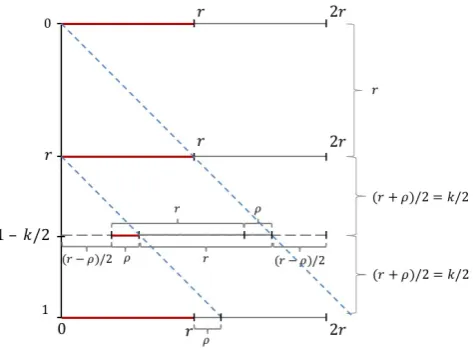
1. Attack at points E = {0, r,2r, . . . ,(q−1)r,1}, starting attacks equiproba-bly between times [0, r], each with total probability 1+rr. We call these the
external attacks.
2. Attack at the midpoint of (q−1)r and 1, which is the point 1− r+ρ
2 =
1−r
2, starting the attack equiprobably between times
r−ρ 2 ,
r+ρ 2
with total probability 1+ρr. We call this theinternal attack.
[image:5.595.191.428.410.585.2]The attacks are shown in Figure 1. The horizontal axis is time and the vertical axis is the unit interval.
Fig. 1.Ther-attack strategy is shown. The starting points of the attacks are shown in red.
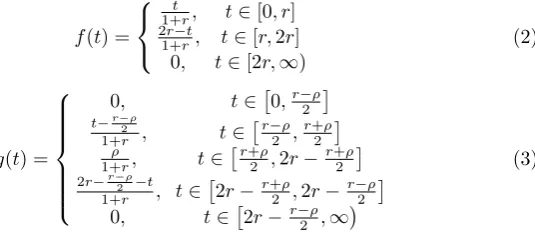
Fig. 2.The probability of interception at each point in timetis shown both for external attacks,f(t), and for internal attacks,g(t), for ther-attack strategy.
attack point. These probability functions for ther-attack strategy are shown in Figure 2.
The functionsf andgare as follows:
f(t) =
t
1+r, t∈[0, r] 2r−t
1+r, t∈[r,2r] 0, t∈[2r,∞)
(2)
g(t) =
0, t∈
0,r−ρ2
t−r−2ρ
1+r , t∈
r−ρ 2 ,
r+ρ 2
ρ
1+r, t∈
r+ρ 2 ,2r−
r+ρ 2
2r−r−2ρ−t 1+r , t∈
2r−r+ρ 2 ,2r−
r−ρ 2
0, t∈
2r−r−ρ2 ,∞
(3)
We now define some Patroller strategies.
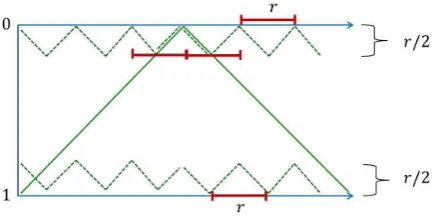
Definition 5. Consider the Patroller strategies where the Patroller plays a mix-ture of oscillations of the interval [0,1] (thebig oscillations) with probability
1
1+r, and oscillations of the intervals
0,r2 and 1−r 2,1
(the small oscil-lations) with probability of 2(1+rr) on each. We call this mixed-oscillation strategy.
The mixed oscillation strategy is shown in Figure 3. Note that the small oscillations have periodrand thus intercept all attacks in the respective intervals. By attacking at 0 or 1 the Attacker secures 2(1+rr)+r2× 1
1+r = r
1+r, since the big oscillation intercepts attacks at the endpoints with probability r2. Any attacks in the open intervals 0,r2and 1−r
2,1
[image:6.595.211.479.396.512.2]
Attacking in r2,1−r 2
secures an interception probability of 22r × 1 1+r =
r 1+r, since at points inr
2,1− r 2
, the big oscillation in each of its period time intervals of length 2, it intercepts attacks that start at two time intervals each of length
[image:7.595.200.418.196.304.2]r. Hence,V ≥ r 1+r.
Fig. 3.The mixed oscillation strategy, where the horizontal axis is time and the vertical axis is the unit interval.
Theorem 3. Ifr≤1, then ther-attack strategy and the mixed-oscillation strat-egy are optimal and the value of the game is V = 1+rr.
4.3 Relation to Discrete Patrolling Game
The discrete analogue of our game, introduced in [1] was solved for line graphs in [5]. It is interesting (and reassuring) to find that the value of the discrete game converges to the value of the continuous game as the number of nodes tends to infinity.
We briefly describe the set-up of the discrete game. The game is played on a line graph with n nodes in a discrete time horizon T = {1,2, . . . , T}. The Attacker chooses an attack node at which to attack and a set ofm successive time periods inT, which is when the attack takes place. The Patroller chooses a walk on the graph. As in the continuous case, the payoff of the game, which the Attacker seeks to minimize and the Patroller to maximize, is the probability that the Patroller visits the attack node while the attack is taking place.
The value of the game depends on the relationship between n and m, and the solution divides into 5 cases (see Theorem 6 of [5]). We are interested in fixing the ratior=m/nand lettingntend to infinity, therefore the solution of two of the cases of the game from [1] are irrelevant: in particular the case when
Theorem 4 (From Theorem 6 of [5]).The valueV of the discrete patrolling game on the line is
1. V =m/(2n−2)if (m+ 1)/2≤n≤m+ 1, and
2. V =m/(n+m−1)if n≥m+ 3, or n=m+ 2 andm≥3 is odd.
We now consider the behaviour of the value of the discrete game asn→ ∞, assuming that the ratio r = m/n is fixed. In the first case of Theorem 4, as
n→ ∞, the condition (m+ 1)/2≤n≤m+ 2 becomes 1≤r≤2 and we have
V = m 2n−2 =
r
2−2/n → r
2,
as n→ ∞. This corresponds to the solution of the continuous game as given in Theorem 2.
In the second case of Theorem 4, as n → ∞, the condition on m becomes
r≤1 and we have
V = m
n+m−1 =
r
1 +r−1/n → r
1 +r,
as n → ∞. Again, this corresponds to the solution of the continuous game as given in Theorem 3.
5
Conclusion
We have introduced a new game theoretic model of patrolling a continuous network in continuous time, analagous to the discrete patrolling game introduced in [1]. We have given general bounds on the value of the game and solved it in the case that the network is Eulerian or if it is a line.
We are optimistic that our results on the line network can be extended to a larger class of networks, such as stars or trees, and we conjecture that the value of the game isr/µ¯ for any tree network with diameterD such thatD≤r≤µ¯, where ¯µis the length of a CPT of the network.
References
1. Alpern, S., Morton, A., Papadaki, K.: Patrolling Games, Oper. Res. 59(5), 1246– 1257 (2011)
2. Basilico, N., Gatti, N., Amigoni, F.: Patrolling security games: Definition and al-gorithms for solving large instances with single patroller and single intruder, Artif. Intell., 184:78–123 (2012)
3. Edmonds J., Johnson E.L.: Matching, Euler tours and the Chinese postman. Math. Program. 5(1), 88–124 (1973)
4. Lin, K.Y., Atkinson, M.P., Chung, T.H., Glazebrook, K.D.: A graph patrol problem with random attack times, Oper. Res. 61(3):694–710 (2013)
6. Pita, J., Jain, M., Marecki, J., Ord´o˜nez, F., Portway, C., Tambe, M., Western, C., Paruchuri, P., Kraus, S.: Deployed ARMOR protection: the application of a game theoretic model for security at the Los Angeles International Airport. In: Proceed-ings of the 7th international joint conference on Autonomous agents and multiagent systems: industrial track, pp.125–132. International Foundation for Autonomous Agents and Multiagent Systems (2008)
7. Yang, R., Ford, B., Tambe, M., Lemieux, A.: Adaptive resource allocation for wildlife protection against illegal poachers. In: Proceedings of the 2014 international con-ference on Autonomous agents and multi-agent systems, pp.453-460. International Foundation for Autonomous Agents and Multiagent Systems (2014)
Appendix: Omitted proofs
Proof of Lemma 1 The attack must be taking place during the time interval [0, r]. LetAbe the set of points that the Patroller intercepts in this time interval. Then clearlyA must have length no greater than r and so the probability the attack takes place at a point inA isr/µ. It follows thatP ≤r/µ. ut
Proof of Lemma 2 Suppose the attack starts at timet0 at some pointx∈Q. Then the attack is certainly intercepted if ¯wis atxat timet0. Lettx∈[0,µ¯] be such thatw(t0+tx) =x, so that the attack is intercepted by ¯wifT =tx. Let
A be the set of timest ∈[0,µ¯] such that tx−r≤t≤tx ort ≥tx+ ¯µ−r, so ifT ∈A, then the attack is intercepted by ¯w. But the measure ofA isr, so the probability thatT is inAisr/µ¯ and henceP≥r/µ¯. ut
Proof of Lemma 3 Take a Patroller pathw. We can assume thatwstarts at an endpoint, otherwise it is weakly dominated by a strategy that does. To see this, suppose the Patroller starts at an interior point before traveling directly to an endpoint, arriving there at timet <1. Now consider the Patroller strategy that is the same but in the time interval [0, t] the Patroller remains at the endpoint. Then clearly the second strategy intercepts the same set of attacks as the first one. Without loss of generalization we assumew starts atx= 0.
We only need to consider the path in the time interval [0,1 +r], after which time the attack has been completed with probability 1. Since r < 2 the walk cannot go between the two ends more than twice, so there are three possibilities. The first is that w stays at x = 0 for the whole time, in which case the probability the attack is intercepted isP = 1/2≤r/2.
The second possibility is that w stays at x = 0 for time t1, then goes to
x = 1 and stays there for time t2. We can assume it takes the Patroller time 1 to go between the endpoints since any path taking longer than that would be dominated, so t1+t2 = r. The attack is intercepted at x = 0 if it starts sometime during [0, t1], which has probability (1/2)t1. It is intercepted atx= 1 if it ends sometimes during [1 +r−t2,1−r], which has probability (1/2)t2. Hence P= (1/2)(t1+t2) =r/2.
we must havet1+t2+t3=r−1. This time the attack is intercepted atx= 0 in the case of either of the two mutually exclusive events that it starts in [0, t1] or ends in [1 +r−t3,1−r], which have total probability (1/2)(t1+t3). If the attack takes place at x = 1, it must be taking place during the whole of the time interval [1, r]. Butwmust reachx= 1 sometime during this time interval, since it must have time to travel fromx= 0 tox= 1 and back again, and hence intercepts the attack with probability 1. So the overall probability the attack is intercepted is (1/2)(t1+t3) + 1/2≤(1/2)(t1+t2+t3) + 1/2 =r/2. ut
Proof of Theorem 3 We already showed that r/(1 +r) is a lower bound for the value and now we show that it is also an upper bound. Now, suppose that the Attacker plays ther-attack strategy. The Patroller could:
1. Stay at any attack point but will not win with probability greater than r 1+r. 2. Travel between consecutive external attacks and if possible try to reach the internal attack: Suppose the Patroller is at point 0 up to timet: If t∈[0, r] and then leaves for pointr, she will reach pointrat times in the range [r,2r]. This gives total interception probabilityf(t) +f(t+r) = t
1+r+
2r−(t+r) 1+r = r
1+r. Note that if the Patroller continues to the next attack along the unit interval, if it is the internal attack she will reach it at times greater than
r+r+2ρ = 2r−r−ρ2 , when the internal attack has been completed, and if it is an external attack she will reach it at time greater than 2r, where all external attacks have been completed. Ift∈[r,2r] then all attacks at point 0 have been intercepted but the Patroller arrives at pointrafter all attacks have been completed, which gives interception probability of 1+rr.
3. Travel between last two external attacks, crossing internal attack in the middle (this is the same as doing a roundtrip from one of the last external attacks to the internal attack and back): Suppose the Patroller leaves point (q−1)r at time t, toward the internal attack point and the last external attack point 1: If t ∈ [0, r−ρ], she will reach the internal attack point at timesr+2ρ, r−ρ+r+2ρ=r+2ρ,2r−r+sρ
, and she will reach the external attack at point 1 at times [r+ρ,2r]. This sums to a probability of f(t) +
g t+r+2ρ+f(t+r+ρ) =1+tr+1+ρr+2r−(1+t+rr+ρ) =1+rr.Ift∈[r−ρ, r], she will reach the internal attack point at times
2r−r+2ρ,2r−r−ρ2
, and the external attack point 1 at times greater than 2r. This sums to a probability
off(t) +g t+r+2ρ= 1+tr+2r−
r−ρ
2 −(t+
r+ρ
2 )
1+r =
r
1+r. Finally, ift ∈[r,2r], the Patroller will intercept all attacks at point (q−1)r and will not make it in time for the internal attack nor the attack at point 1, this gives the desired probability.