S T U D Y P R O T O C O L
Open Access
Thoracic Epidural analgesia versus Rectus Sheath
Catheters for open midline incisions in major
abdominal surgery within an enhanced recovery
programme (TERSC): study protocol for a
randomised controlled trial
Kate M Wilkinson
1, Anton Krige
1*, Sarah G Brearley
2, Steven Lane
3, Michael Scott
4, Anthony C Gordon
5and Gordon L Carlson
6Abstract
Background:Thoracic epidural analgesia (TEA) is recommended for post-operative pain relief in patients undergoing major abdominal surgery via a midline incision. However, the effectiveness of TEA is variable with high failure rates reported post-operatively. Common side effects such as low blood pressure and motor block can reduce mobility and hinder recovery, and a number of rare but serious complications can also occur following their use.
Rectus sheath catheters (RSC) may provide a novel alternative approach to somatic analgesia without the associated adverse effects of TEA. The aim of this study is to compare the efficacy of both techniques in terms of pain relief, patient experience, post-operative functional recovery, safety and cost-effectiveness.
Methods/design:This is a single-centre randomised controlled non-blinded trial, which also includes a nested qualitative study. Over a two-year period, 132 patients undergoing major abdominal surgery via a midline incision will be randomised to receive either TEA or RSC for post-operative analgesia. The primary outcome measures pain scores on moving from a supine to a sitting position at 24 hours post wound closure, and the patient experience between groups evaluated through in-depth interviews. Secondary outcomes include pain scores at rest and on movement at other time points, opiate consumption, functional recovery, morbidity and cost-effectiveness.
Discussion:This will be the first randomised controlled trial comparing thoracic epidurals to ultrasound-guided rectus sheath catheters in adults undergoing elective midline laparotomy. The standardised care provided by an Enhanced Recovery Programme makes this a comparison between two complex pain packages and not simply two analgesic techniques, in order to ascertain if RSC is a viable alternative to TEA.
Trial registration:Current Controlled Trials ISRCTN81223298 (16 January 2014).
Keywords:Rectus sheath catheters, Rectus sheath block, Analgesia, Epidural, Enhanced recovery, Laparotomy
* Correspondence:[email protected] 1
Department of Anaesthesia and Critical Care, Royal Blackburn Hospital, Blackburn BB2 3HH, UK
Full list of author information is available at the end of the article
Background
Background and rationale
Enhanced Recovery Programmes (ERP) consist of a se-ries of protocolised multimodal interventions aimed at reducing complications, thereby expediting recovery [1]. One of the key elements in all ERP is the provision of adequate post-operative analgesia. This reduces the stress response, improves patient wellbeing and allows early mo-bilisation. Early mobilisation itself is important to reduce secondary complications such as chest infection and deep vein thrombosis. Post-operative insulin resistance, which has been linked to increased complications, can be re-duced by muscle activity [1]. Thoracic epidural analgesia (TEA), which facilitates dynamic analgesia and early mo-bilisation, is currently the standard for post-operative an-algesia following major abdominal surgery within ERP [1].
A number of systematic reviews and meta-analyses have demonstrated that TEA is associated with superior post-operative analgesia and fewer adverse events when com-pared to high dose systemic opiate administration [2-8]. High dose systemic opiates are strongly associated with post-operative sedation, ileus [8-11] and nausea and vo-miting, all of which impair post-operative recovery and prolong hospital stay. Ileus is the most common complica-tion following abdominal surgery, and is responsible for significant prolongation of recovery times. TEA may re-duce ileus rates as compared to opiates [12-17].
TEA is occasionally contraindicated and may also lead to rare but significant complications, for example nerve injury, epidural haematoma and epidural abscess [18]. More common adverse effects of TEA include motor blockade of the lower limbs and urinary retention re-quiring catheterisation, both of which can impede post-operative mobilisation and recovery. Additionally, the need to use epidural opioids to prevent the sensory regres-sion associated with the use of local anaesthetics alone may contribute in itself to an increase in post-operative ileus [13-15]. Hypotension, resulting from sympathetic nervous blockade, is common with TEA and may result in iatrogenic fluid overload [19]. Fluid overload is also associ-ated with ileus and other post-operative complications, in-cluding anastomotic dehiscence, and has been shown to independently predict increased length of hospital stay [20]. TEA has also been found to have a high reported fail-ure rate (25 to 30%) [2-8]. These failfail-ures are multifactorial and usually managed either by epidural replacement, sub-stitution with systemic opiate infusion or both [21,22].
Rectus sheath catheters (RSC) are a regional anaes-thetic technique in which the ventral rami of the seventh to twelfth intercostal nerves, which supply the rectus ab-dominis muscle and overlying skin, are blocked [23,24]. This provides midline somatic analgesia, with additional doses of systemic opiate required for visceral analgesia (12 to 36 hours duration) [23,24]. This sensory blockade
is achieved by injecting local anaesthetic into the poten-tial space between the rectus muscle and the posterior rectus sheath. As a single bolus of local anaesthetic has a maximum duration of 12 hours [23,24] it is necessary to insert a catheter into this space to allow either a conti-nuous infusion of local anaesthetic, or repeated boluses of local anaesthetic every 8 to 12 hours for 48 to 72 hours post-operatively. Although this regional block was first described at the turn of the last century [23,24], it was used infrequently until the recent availability of long-acting local anaesthetic agents, small portable ultra-sound machines [25] and small calibre infusion catheters. These developments have resulted in renewed interest in RSC for the management of post-operative pain following midline abdominal incisions [23,24,26-29].
RSC offer several potential advantages over TEA, which may make them ideally suited for use in an ERP. In par-ticular, they avoid hypotension and motor blockade. RSC are also inserted after the induction of general anaesthesia, which patients may prefer to the usual awake insertion of epidurals. No complications or serious adverse events re-lated to RSC have been reported to date [23,24], but local anaesthetic toxicity [30-33] (which applies to all regional anaesthetic techniques including epidurals) and visceral injury during insertion are hypothetical possibilities.
The existing literature relating to the use of RSC is limited, with published studies all utilising surgically inserted RSC to compare local anaesthetic with saline [34-40] or non-randomised trials comparing RSC to epi-durals [38,40]. Despite this, the majority of studies dem-onstrate proof of concept [34-37,39]. This randomised controlled trial will compare ultrasound-guided inser-tion of RSC with TEA for midline laparotomy incisions, in adults undergoing elective major abdominal surgery within an ERP pathway.
Objectives
The aim of the study is to assess the efficacy, safety and acceptability to patients of RSC. To this end, a qualita-tive study has been nested within the primary study de-sign to facilitate understanding of the patient experience.
Trial design
This is a randomised parallel group concealed allocation non-blinded superiority trial with a nested qualitative study of a subset of patients.
Methods: participants, interventions and outcomes
Study setting
catchment population of 530,000 and complex regional services to a population of 2 million.
Eligibility criteria
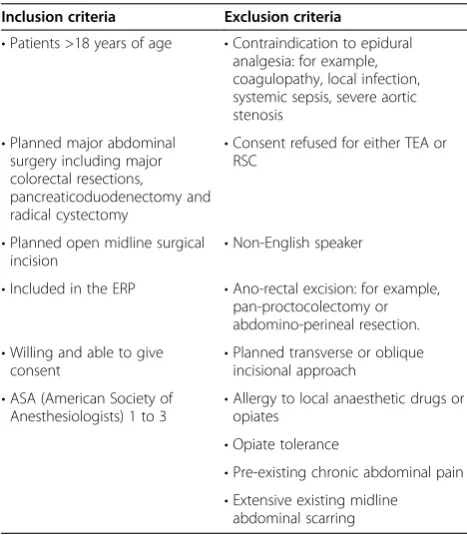
All adult (18 or over) patients who are listed for elective major abdominal surgery via a midline incision, and who meet all inclusion and exclusion criteria (see Table 1), will be eligible for recruitment into the trial.
Interventions
Standard general anaesthetic
All patients in the trial will receive a general anaesthetic as follows: propofol 2 to 4 mg/kg intravenously (IV); remifentanil 1 mcg/kg or target controlled infusion (effect site target-Minto model) or fentanyl 1 to 2 mcg/kg IV; atracurium 0.5 mg/kg or rocuronium 0.5 mg/kg. Anaes-thesia will be maintained as follows: isoflurane, sevoflur-ane or desflursevoflur-ane, initially at 1 MAC (minimum alveolar concentration) then titrated to clinical end points; remi-fentanil (RSC arm only) 0.1 to 0.5 mcg/kg/min or target controlled infusion (effect site target-Minto model) ti-trated to clinical effect; oxygen in air titi-trated to SaO2 > 95%; and multimodal anti-emesis consisting of ondanse-tron 4 to 8 mg, dexamethasone 8 mg and cyclizine 50 mg.
Maintenance fluid will consist of Plasma-Lyte B (Baxter, Compton, Newbury, Berkshire, UK) at 2 to 4 mls/kg/hr, and goal-directed fluid therapy utilising 250 ml fluid
boluses of Plasma-Lyte B until stroke volume is maxi-mised. This will be guided by either oesophageal Doppler or Edwards Flotrac (Edwards Lifesciences, Irvin, California, USA) cardiac output monitoring.
Rectus sheath catheters
The RSC will be inserted bilaterally under ultrasound guidance (see Additional file 1 for description of the technique) [23-27] by the anaesthetist immediately fol-lowing induction of a standard general anaesthetic. Only anaesthetists who have successfully inserted RSC under the supervision of the chief investigator (CI) will under-take the insertion of RSC. An aseptic technique will be used and 20 ml of 0.25% bupivacaine will be injected via each catheter into the potential space between the rec-tus muscle and the posterior recrec-tus sheath, 2 to 4 cm ei-ther side of the midline. The catheters will be tunnelled subcutaneously to a level above the costal margin.
Approximately 45 minutes before the end of surgery a 10-mg bolus of IV morphine will be administered to provide visceral analgesia. A transdermal fentanyl patch (12 mcg if ≥70 years and/or≤65 kg and 25 mcg if <70 years and >65 kg; 72-hour duration of action) will be ap-plied, and if more than 3 hours have passed since the initial RSC bolus, a further 40 ml of 0.2% ropivacaine will be administered via an ambITR (Summit Medical Products Inc, South Sandy, Utah, USA) Preset PCA or ambITR mini infusion pump (split between the 2 RSC via a Y-connector). The pumps will be set to deliver bo-luses of 40 mls 0.2% ropivacaine, with a 4-hour lockout, each time the bolus button is pressed [30-33]. The bolus button may be staff- or patient-activated but will be pressed regularly every 4 hours post-operatively. Each 40 ml bolus takes 24 minutes to deliver; therefore the total time from the start of one bolus to the start of the next will be 4 hours and 24 minutes.
If breakthrough pain is experienced, staff will first en-sure that the RSC have been utilised as per protocol. If more than 4 hours have elapsed since the last bolus of local anaesthetic then 40 mls of 0.2% ropivacaine will be administered via the pump. If inadequate pain re-lief follows the bolus, or if no bolus is due, then 10 mg oral morphine or 5 mg oral oxycodone will be used as required for further breakthrough pain within the first 48 hours.
Thoracic epidural analgesia
[image:3.595.56.290.449.717.2]Epidurals will be sited prior to the induction of general anaesthesia at T7 to T9 for a right-sided colonic resec-tion or upper gastrointestinal (GI) surgery, and T9 to T11 for a left-sided resection or radical cystectomy. Standard aseptic insertion technique will be followed, using loss of resistance to air or saline as per preference. Following a
Table 1 Inclusion and exclusion criteria Inclusion criteria Exclusion criteria
•Patients >18 years of age •Contraindication to epidural analgesia: for example, coagulopathy, local infection, systemic sepsis, severe aortic stenosis
•Planned major abdominal surgery including major colorectal resections,
pancreaticoduodenectomy and radical cystectomy
•Consent refused for either TEA or RSC
•Planned open midline surgical incision
•Non-English speaker
•Included in the ERP •Ano-rectal excision: for example, pan-proctocolectomy or abdomino-perineal resection. •Willing and able to give
consent •
Planned transverse or oblique incisional approach
•ASA (American Society of Anesthesiologists) 1 to 3
•Allergy to local anaesthetic drugs or opiates
•Opiate tolerance
•Pre-existing chronic abdominal pain •Extensive existing midline
abdominal scarring
suitable test dose, a bolus of 10 mls 0.25% bupivacaine with 100 mcg fentanyl will be administered to establish a block.
Following insertion, an epidural infusion of 0.125% bupivacaine and 2 mcg/ml fentanyl will be commenced at 10 mls/hour and then titrated to effect. On the second post-operative night, a fentanyl patch (12 mcg if≥70 years and/or≤65 kg and 25 mcg if <70 years and >65 kg) will be applied after which the epidural will be weaned overnight and removed the following morning as per local clinical protocol.
If breakthrough pain is experienced, the epidural block will first be optimised with an additional bolus of 10 to 20 mls of the maintenance solution. If inadequate pain relief follows the bolus then 10 mg oral morphine or 5 mg oral oxycodone will be used as required for further breakthrough pain within the first 48 hours.
All reasonable attempts will be made to rescue failing study interventions. These may include delivering an additional bolus of local anaesthetic, altering the catheter position, correcting blood pressure to allow continuation of the study intervention, and (in the case of TEA) repo-sitioning the patient. However, if complete failure of the study intervention occurs within the first 48 hours post-operatively, it will be replaced by IV morphine patient controlled analgesia (PCA) following an adequate IV bolus of morphine. Complete failure is defined as complete lack of any sensory blockade and any improvement in the se-verity of pain reported by the patient following an ad-equate bolus injection of local anaesthetic via the TEA or RSC.
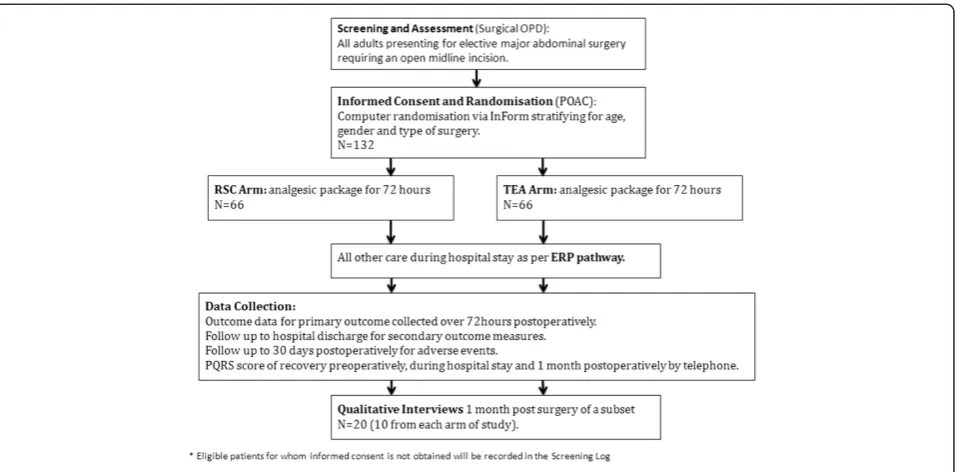
Patients in both arms of the trial will receive all other hospital care according to our institution’s ERP. Pre-operatively, this consists of pre-operative assessment, planning and preparation (including cardiopulmonary exercise testing if aged≥60 years or <60 years with car-diorespiratory comorbidity), ERP information, a patient diary and PreLoad (Vitaflo International Limited, Liver-pool, UK) drinks (sachets of maltodextrin powder for re-constitution in 500 mls water; 2 to be consumed the night before and an additional one 2 to 3 hours prior to surgery). Upper GI and right-sided colonic resections ceive no bowel preparation and left-sided colonic re-sections, rectal resections and radical cystectomies will receive phosphate enemas on the morning of surgery. All patients receive 1 g paracetamol and 300 mg gaba-pentin orally pre-operatively.
Intra-operatively, in addition to the standard general anaesthetic and interventions already described, nasogas-tric tubes are avoided, surgical drains minimised and nor-mothermia is maintained using enFlow® (GE Healthcare, Little Chalford, Buckinghamshire, UK) IV fluid warmers and Bair Hugger™(3 M, St Paul, Minnesota, USA) external warming blankets.
Post-operatively, in addition to the randomised pri-mary analgesia technique all patients receive multimodal oral analgesia, comprising 1 g paracetamol 6-hourly orally or IV if not tolerating oral; 400 mg ibuprofen 8-hourly or-ally once tolerating full oral diet; and 100 mg gabapentin 8-hourly orally (for 72 hours). A transdermal fentanyl patch is applied with dose and timing relevant to the ran-domised intervention as described above. Post-operative nausea and vomiting is minimised with 3 mg Buccastem 8-hourly buccally for 48 hours. Patients will undergo structured mobilisation from day 1 post-operatively. IV fluids are minimised and 2 litres per day of oral fluid is en-couraged with full oral diet enen-couraged from day 1 post-operatively. Urinary catheters will be removed on day 1 in the RSC group and on removal of the epidural in the TEA group.
Qualitative study
A cross-sectional study will achieve the aim to study the patient experience of both interventions. This will util-ise an inductive approach informed by the principles of grounded theory [41]. It uses maximum variety sam-pling to enable a range of experiences to be sought ra-ther than seeking to make generalisations based on population characteristics. The anticipated sample size is 10 per trial arm (20 in total) and interviews will be undertaken by an experienced researcher at a place con-venient to the participant (usually their home). During the qualitative phase all consenting RCT trial partici-pants will be invited to take part in the qualitative study RCT (randomised controlled trial). They will be con-tacted again 2 to 3 weeks after the intervention, invited to participate and re-consented to avoid any issue of co-ercion whereby patients feel that they have to consent to the qualitative study in order to gain entry onto the RCT.
Outcomes
The primary outcome measure of the RCT is the differ-ence in mean pain score on movement from supine to sitting position at 24 hours after extubation between groups, measured using a Visual Analogue Scale (VAS) of 0 to 100 mm with 0 being no pain and 100 mm being the worst pain imaginable [42,43]. VAS is a standard tool to compare analgesic efficacy between interventions in pain studies, and pain control adequate to allow dynamic movement at 24 hours is considered key to successful recovery after major surgery, with full mobilisation thus potentially feasible. An additional primary outcome mea-sure is the difference in patient experience meamea-sured by the nested qualitative study utilising interviews conduc-ted one month after surgery in a subset of patients from the main trial.
Secondary outcomes include further comparisons of analgesic efficacy and effectiveness, functional recovery, safety and cost-effectiveness. Further analgesic quality measurements include mean VAS pain scores at rest and on movement at 2, 6, 12, 24, 48 and 72 hours after extu-bation between intervention groups to compare the effi-cacy of analgesia at different clinically relevant time points and the time-based evolution of analgesic efficacy; the difference in sleep quality measured by VAS scores on the first three mornings post-operatively; the differ-ence in self-assessed functional pain categorising respira-tory function and mobility measured between 4 pm and 5 pm on each of the first 3 post-operative days; time to first rescue opiate; the total opiate consumption (exclud-ing the protocolised fentanyl) over the first 48 hours post-operatively; and an overall score of satisfaction with pain relief on day 3 post-operatively.
Functional recovery will be compared assessing the difference in decrement of the Post-operative Quality Recovery Scale (PQRS) score [44] between groups, from baseline measurement to the measurements obtained on days 4, 7 and 30 post-operatively using a validated ques-tionnaire [44]; time to first mobilisation; the difference in time to return of GI function; achievement of the daily ERP mobilisation goals (for example, 4 × 60 m walks on day 2 post-operatively); adherence to the local ERP pathway; time until patients meet standardised clin-ical discharge criteria as per the hospital ERP [45,46]; and the actual length of hospital stay. Return of GI func-tion is defined as the time to tolerance of full diet, pas-sage of flatus and bowel opening. Tolerance of a full diet will occur when the patient has consumed more than 90% of the planned intake of a meal, and does not feel nauseated or vomit after any meal. If four meals are con-sumed and the fourth vomited, then time to tolerating a full meal will not have been reached.
Safety measurements are differences in fluid balance and the incidence of hypotension over the first 48 hours
post-operatively. Overall fluid balance will be measured using the fluid balance charts and the difference between pre-operative body weight and body weight measured on the first three mornings post-operatively (positive fluid balance is strongly correlated with morbidity in this co-hort and may be linked to side effects of the trial interven-tions, that is hypotension). Any episode of hypotension, defined as a systolic blood pressure less than 90 mmHg, a mean arterial pressure less than 65 mmHg, or a reduction of greater than 20% from the pre-operative blood pressure, will be noted. Vasoconstrictor usage will be measured as a surrogate of haemodynamic stability.
Other measures of morbidity include nausea and vo-miting measured by a VAS score, the incidence of ileus and the POMS (Post-Operative Morbidity Score). Ileus has been defined as new nausea and vomiting, abdominal distension, and abdominal discomfort with loss of bowel sounds [47]. The POMS is a score of post-operative morbidity validated in the UK which applies a binary outcome to each of 9 domains on either day 3, 5 or 7 post-operatively, chosen depending on the type of surgery [48]. Day 5 will be used for this study. Any surgical complications occurring within 30 days post-operatively will be classified for severity using the Clavien-Dindo classification [49].
If a study intervention is deemed to fail, then the tim-ing of the failure, any replacement technique and the reason will be recorded: for example, block failure (pain and no demonstrable block of abdominal dermatomes); catheter disconnection; excessive catheter leakage; pre-mature catheter removal; cessation of infusion due to hypotension; respiratory depression or possible local an-aesthetic toxicity (respiratory rate <8/minute or the need for naloxone, systolic BP <80 or MAP <50; pruritus; cir-cumoral paraesthesia; seizures; obtundation; arrhythmias; and cardiovascular collapse).
A full health economic assessment calculating Quality Adjusted Life Years is beyond the scope of this study. However, short-term cost-effectiveness will be calculated, taking into account the cost of consumables, insertion and management time for the 2 techniques, the respective length of stay both in hospital and critical care, and read-missions or re-operations within 30 days of surgery [50].
Participant timelines
Pre-Operative Assessment Clinic (POAC) within 2 weeks of the decision to operate, and the trial nurse will meet them there to answer any further questions. If willing to participate, they will be consented and randomised, fol-lowing baseline data collection, at that visit. Randomisa-tion at this point will enable workforce planning for the day of surgery, as well as participant education on the ERP and trial data collection. However, some patients may be initially identified and approached at the POAC stage, and may therefore be randomised up to and including the day of admission.
The trial interventions will take place in the anaesthetic room on the day of surgery, with intensive data collection up to the third day post-operatively, and further specific data collection up to 30 days post-operatively.
Sample size
The primary end point is difference in VAS pain scores on movement at 24 hours post-operatively. The Kelly study [51] showed that the minimum clinically signifi-cant VAS pain score when managing severe pain was 10 mm. Standard deviations (SD) varying from 14 mm to 18 mm have been reported [3-7], thus we have esti-mated a standard deviation of 18 mm for our study. To achieve 85% power to detect a 10 mm difference in the primary end point, from a VAS pain score on movement at 24 hours of 40 mm (SD =18 mm) in the TEA group, to 30 mm (SD =18 mm) in the RSC group, at the 5% level (two-sided t-test), will require 60 patients in each arm of the study.
An additional 6 subjects will be recruited in each study arm to cover a maximum of 10% losses (the MASTERS
study [4] had only 3.5% losses), bringing the total sample to 132 subjects recruited over 24 months. This sample size is realistic as we have a recruitment pool of 130 ad-missions per year and expect 70% to be both eligible and willing to participate.
Recruitment
Relevant surgical teams, and in particular the specialist nurses, have been educated on trial eligibility criteria and will communicate clinic dates for potential partici-pants to the trial nurse once a decision to operate is made. Most of these decisions take place at the weekly Multidisciplinary Cancer Meeting, and the trial nurse will therefore attend the colorectal meetings.
In addition, all relevant surgical outpatient clinics have been provided with eligibility posters and trial nurse contact details as further reminders. POAC personnel have also received this material, as have the admissions clerks who are responsible for booking patients into outpatient and operation dates. This will identify any additional patients who may have been missed initially. Clinic dates for benign disease will similarly be commu-nicated to researchers (this only applies to colorectal surgery) for all potentially eligible patients.
[image:6.595.61.539.88.324.2]The trial nurse will then attend the relevant surgical clinic where patients will be offered major surgery (or POAC if identified at this stage). Eligible patients will be asked by the surgical team if they would be willing to be approached about the study by the research team, or have their contact details forwarded to the research team. If they agree, the research nurse will be on hand for an ini-tial meeting where a verbal explanation of the study will
be provided, along with a copy of the Patient Information Sheet.
Some patients may not feel ready to have a further re-search related discussion on the same day, but still be open to the idea of participation. The research nurse will gain their permission to contact them in a few days to discuss the study, and they will be provided with the Pa-tient Information Sheet and contact details. As part of their surgical pathway, patients will be given an appoint-ment at the POAC within 2 weeks. The research nurse will meet them again at this clinic and ascertain if they wish to participate: if so, they will be randomised, fol-lowing consent and collection of baseline data. Patients who are approached for the first time at the POAC may have this second discussion (± randomization) on the day of admission, allowing time for consideration.
Only patients with mental capacity and the ability to consent will be recruited. Patients who are eligible but not randomised, and those who fulfil the inclusion cri-teria but meet one or more of the exclusion cricri-teria, will be recorded in the TERSC Screening Log, irrespective of whether consent is obtained.
All stakeholders, that is anaesthetists, surgeons and specialist nurses, will be updated regularly of recruit-ment to the trial to ensure continued support and en-couragement with positive feedback. The monthly Trial Management Group and the 6-monthly Trial Steering Committee (TSC) will scrutinise the recruitment rate and provide further suggestions and recommendations to increase any failing recruitment.
Methods: assignment of interventions Allocation: sequence generation
Patients will be stratified by operation type and age, with three surgical strata (radical cystectomies, major colonic excisions and major rectal excisions) and two age strata (up to and above forty years of age) by computer gener-ated random numbers. Of the 66 patients recruited into each arm of the study, we expect 50% to be major co-lonic excisions, 30% to be major rectal excisions and 20% to be radical cystectomy cases. Because we expect to see substantially more patients in the over-40 group, a 2:1 inclusion rate between the age groups is expected. It should be noted that the radical cystectomy group will only contain patients over the age of forty, and, there-fore, in total there will only be five strata. The Trial Stat-istician has provided the InForm database designers with lists of the random assignment blocks, without any in-volvement of the CI or trial nurse.
Allocation: concealment mechanism
The allocation is provided electronically by the InForm system as described above and is thus concealed to the research team.
Implementation
The trial nurse will enrol patients, and once eligibility criteria, operation type and demographics are entered, the InForm system will electronically randomise partici-pants and assign the interventions.
Blinding
Only the data analysts (trial statistician) will be blinded to the assigned intervention when assessing the primary outcome measure.
Methods: data collection, management and analysis
Data collection methods
The trial research nurse is responsible for recruitment and data collection and has been trained by the CI. This training included the correct collection of all trial data along with definitions of data items and clinical scoring tools, correct assessment of pain intensity and other VAS as well as the PQRS score.
Baseline data is obtained in the POAC directly from the patient and the case notes. All outcome data is either obtained from the Patient Diaries, case notes, prescrip-tion, fluid balance and observation charts, or directly by the research nurse: for example, timing of intervention insertion, duration of surgery, length of wound, presence and location of drains and stomas, the use of cardiac output monitoring to optimise fluid management and haemodynamic data from monitors.
Patients are educated in the completion of the Patient Diaries by the research nurse at the pre-operative as-sessment visit. The research nurse and clinical staff then prompt patients to self-complete the diaries at specified time points throughout their stay. These diaries capture the outcome measures regarding pain control, nausea, sleep quality, gut function and fitness for discharge.
There are no paper Case Report Forms and all data collected by researchers will be entered directly onto a trial-specific eCRF (electronic Case Report Form) on the InForm database. This system promotes data quality by preventing duplicate data entry, generating queries when-ever data deviates from set ranges, and requiring comple-tion of mandatory fields as defined by the CI. An audit trail is generated for any data queries, which must be re-solved before sign-off of completed data by the CI.
Several validated scoring systems are used for predict-ing risk and for various outcome metrics. Peri-operative risk will be measured using the ASA (American Society of Anesthesiologists) score [52], and the Physiologic and Operative Severity Score for the enUmeration of Mortality and morbidity (p-POSSUM) score (a validated general surgical risk prediction score) [53]. Quality of Recovery will be assessed using the PQRS. This is a rapidly con-ducted instrument allowing assessment of several aspects of recovery over time. Physiological, nociceptive, emo-tional and cognitive domains are assessed, with a baseline (pre-operative) measurement followed by measurements over several time points. A feasibility study demonstrated high face validity with applicability to a wide age range, di-verse languages, cultures, and physical abilities [44].
Details regarding the research interventions, for exam-ple, insertion, maintenance, protocol violations, adverse events, compliance with protocolised adjuvant analgesia and the ERP pathway, and all additional opiate analgesia will be obtained from case notes or directly by the re-search nurse. The hospital electronic administration sys-tem will be interrogated at 30 days for any readmissions to hospital, ensuring full capture of any adverse events in this time. The patients will be contacted at 30 days to ob-tain a final PQRS recovery score by telephone, and this will be deemed the endpoint for the primary study. A sub-set of patients will go on to be interviewed for the nested qualitative study.
Data management
All patient trial data will be entered directly into the se-cure web-based InForm database eCRF using a tablet de-vice. Patient diaries, PQRS paper questionnaires and the medical notes will serve as source data. The CI will be responsible for data collection, quality and recording, however the collection of data will be delegated to the trial research nurse. This has been recorded in the Dele-gation of Trial Duties Log and authorised by the CI.
All data entered into the eCRF will be anonymised with only initials and date of birth entered. A separate and secure log will be kept with consent forms and iden-tifiers to allow patient follow-up to 30 days. This is de-tailed in the Patient Information Sheet and emphasised on the consent form. During the conduct of the trial, all electronic patient data will be encrypted and all trial documents stored securely. On completion of the trial, all patient data (electronic and paper) and other trial documents will be archived securely and retained for 5 years at RBH in the case of paper documents and Im-perial Clinical Trials Unit (CTU) in the case of elec-tronic data.
Imperial CTU is registered under the Data Protec-tion Act 1998 and all Imperial CTU staff have under-gone data protection and International Conference on
Harmonisation (ICH) Good Clinical Practice (GCP) train-ing. The CI and all research staff at the Trial Centre have undergone GCP training.
The InForm database generates automatic alerts for missing data, invalid data, data duplication or data not conforming to the rules established for that data type. Thus, validation is ongoing throughout the data entry process. Final data validation occurs at Imperial CTU. This will ensure all data is complete, accurate and con-sistent. The trial nurse will resolve data queries gener-ated by the database as soon as possible.
TERSC will be managed according to the Medical Re-search Council’s (MRC) Guidelines for Good Research Practice, Guidelines for Good Clinical Practice (GCP) in Clinical Trials, and Procedure for Inquiring into Allega-tions of Scientific Misconduct.
Statistical methods
A full statistical analysis plan will be written, a priori, before the investigators are unblinded to any trial out-comes by the trial statistician. All analyses will be per-formed according to the intention-to-treat principle. An additional per protocol analysis will be performed and reasons for any protocol violations reported. Baseline co-variates will be reported for the two groups and described using summary statistics. To determine if the two groups are balanced, standard hypothesis tests (t-test, Mann-Whitney U-test and Chi-squared test) will be applied. Prior to writing the statistical analysis plan, we will deter-mine if the analyses of the primary or secondary outcomes need to be adjusted for significant clinical or demographic covariates. However, we will only adjust the analysis if sig-nificant differences in these covariates exist between the treatment and control groups. The primary analysis will test the null hypothesis that there is no difference in mean VAS pain scores on movement at 24 hours post-operatively between those receiving TEA and RSC anal-gesia. The independent sample t-test or Mann-Whitney
U-test will be used to assess between group differences unless the preliminary analysis indicates a significant dif-ference in the clinical or demographic covariates thought to have a significant impact on the primary outcome. If so, then analysis of covariance will be used to assess the pri-mary outcome. As there are six follow-up measurements, a repeated measures analysis of variance will also be used to assess differences between groups, and over time.
The secondary outcomes will be analysed in a similar manner to the primary outcomes. Time to event varia-bles, such as time to recovery of gut function and length of hospital stay will be analysed using Mann-Whitney
database lock, we will assess the nature of any missing data and use appropriate imputation methods to estimate missing values.
Methods: monitoring Data monitoring
The DMEC will consist of an independent academic clinician and an independent statistician, and will meet every 6 months. Operating under the DAMOCLES Char-ter [54,55], the DMEC will receive reports on recruitment rates, adverse events, completeness of data collection and protocol violations, and will report in turn to the TSC.
Harms
Adverse events (AE) and serious adverse events (SAE) are defined in this trial according to Directive 2001/20/ EC, 4 April 2001, of the European Parliament (Clinical Trials Directive) and ICH (International Conference on Harmonisation) GCP E6 guidelines. All AE occurring in the 30-day follow-up period will be recorded and evalu-ated for severity and causality. Severity will be graded 1 (mild) through 5 (fatal) and causality will be graded as either none, unlikely, possible, probable or definitely re-lated to the intervention. SAE will also be evaluated for expectedness. SAE will be reported to the Chief Investi-gator (CI) within 24 hours. The CI will assess all SAE to determine the need for expedited reporting to the DMEC, TSC and Research Ethics Committee.
Auditing
The hospital Research and Development Department quality manager will conduct local monitoring of trial quality after the first patients have been enrolled. The trial database provides on-going data quality checking. The DMEC will look at recruitment rate, data quality and adverse event reporting and provide a summary re-port every 6 months.
Ethics and dissemination Research ethics approval
The Greater Manchester East Research Ethics Commit-tee granted ethical approval (REC reference: 13/NW/ 0782 61767) on the 19 November 2013. Informed pa-tient consent will be obtained from all participants be-fore enrolment in the trial.
Protocol amendments
Any significant protocol amendments will be communi-cated to the Research Ethics Committee and tabulated along with the amendment date and updated version number in the protocol. The local research team, the Trial Management Group, Trial Steering Committee and the Data Monitoring and Ethics Committees will all be informed.
The National Institute for Health Research (NIHR) portfolio team and the Controlled Trials Registry where the trial is registered will also be informed.
Consent
Please refer to the‘qualitative study’,‘participant timeline’, and‘recruitment’sections above for details on consent.
Confidentiality
Please refer to the ‘data management’section above for details on confidentiality.
Declaration of interests
None.
Access to data
The trial statistician and the DMEC will have access to the final trial dataset.
End of trial
This will occur when the final patient has completed their 30-day post-operative follow-up and the final qua-litative interview has taken place. At this point, all elec-tronic and paper trial data will be securely archived for a minimum of 5 years in accordance with ICH GCP guidelines. Arrangements for confidential destruction of all documents will then be made. The trial may be stopped early upon recommendation of either the TSC or DMEC. If this occurs, all randomised patients will continue to be followed up as per the trial protocol.
Post-trial care
Due to the short duration of the intervention no post-trial care is required.
Dissemination policy
Following completion of the trial a report will be pro-duced for the NIHR who have funded the trial. Several peer reviewed journal publications will be produced re-porting various aspects of the trial and results will be presented at relevant scientific meetings. A lay version of the results will be available for all trial participants who request a copy, and for all hospital staff.
Discussion
analgesia and easy mobility with RSC [38,40] but the trial is required to provide direct comparison with epidurals.
We considered whether to blind the main study to mi-nimise any potential bias. Unfortunately, blinding of staff would be impossible, as they are responsible for admin-istering the drugs (by very distinct routes, with different pumps and different settings), as well as monitoring for adverse events related to the techniques. Single blinding (patient) was then considered but this was rejected for two reasons. These were the high likelihood of acciden-tal unblinding, and the unacceptability of inserting sham epidurals or RSC. Allocation concealment will avoid selec-tion bias but observer bias remains a risk. Blinding the data analyst to the intervention group will ameliorate this.
As we will be studying three different categories of surgery, with different expected rates of morbidity and hospital stay (secondary outcome measures), we have stratified randomisation to account for this and ensure these categories are balanced. The same applies to age. The vast majority of cancer cases are older-aged, how-ever a younger cohort of patients with inflammatory bowel disease exists, for whom providing pain relief is notoriously difficult and hospital stays are often longer.
VAS pain scores are a necessary primary outcome measure for pain studies as they allow quantitative sta-tistics. They are efficient to collect and easy for patients to understand, but are recognised as subjective in nature with individual variation, error in administration and limited to measuring pain intensity. Therefore, we will also be comparing a host of other measurements of quality of analgesia: for example, time to first rescue opi-ate, the amount of additional opiopi-ate, measurements of functional mobility and breathing, overall satisfaction with pain relief, measures of recovery and patient experi-ence with their intervention. Several important second-ary outcomes will allow further differentiation between the interventions regarding safety, experience and func-tional recovery.
There are several unique pragmatic aspects to the stu-dy design which will help to reduce confounders and improve the generalisability of results. Firstly, patients will have all other aspects of care standardised by inclu-sion in the ERP, with the respective trial interventions the only difference in processes of care. It is important to note that the respective trial interventions are not merely the insertion of an epidural compared to the in-sertion of a RSC, but rather two overall packages of analgesia and the way in which the interventions are managed: for example, the use of transdermal fentanyl patches in both groups at different appropriate time points, the universal use of gabapentin and simple an-algesia, the portable pump system delivering the local anaesthetic via the RSC, robust protocols to optimise inadequate epidural or rectus sheath blocks and any
breakthrough pain, and patient education pre-operatively regarding their allocated intervention, their role in their recovery and diary completion. A clear protocol states when an intervention is considered to have failed and the conversion to rescue analgesia.
Secondly, the use of transdermal fentanyl patches de-serves further mention. These are used routinely in our institution as a step down from epidural analgesia. In order to manage the visceral pain component in the RSC arm, the patches are applied, following a single dose of morphine and a further RSC bolus, in the final 45 minutes of surgery. Visceral pain, although severe, is short-lived (6 to 24 hours) [23] and in our experience is effectively man-aged with a 12 mcg or 25 mcg patch. Previous studies have used morphine PCA in addition to the RSC for this visceral pain. However, there is a danger that the RSC are not optimised in these cases, with morphine being relied upon for any breakthrough pain. This would negate the benefits of a potentially good block, and could result in the side effects of high dose opiates as previously dis-cussed. A morphine PCA would also require an additional pump and would further complicate mobilisation. Instead, we make use of oral morphine for any opiate required in addition to the patch.
Aside from increasing the quality of care provided to all patients participating in this study, further benefits to our institution include acquisition of new clinical skills for anaesthetic and ward staff regarding the insertion and management of RSC, new research skills and devel-opment of a research ethos for all staff involved, and po-tential reduction in morbidity and consequently hospital stay, leading to economic benefit.
Many surgical procedures that have previously been per-formed via midline incision are now being perper-formed lap-aroscopically [56] or via transverse incisions. Neither of these approaches requires the interventions described in this trial. However, emergency laparotomies will continue to require an open midline approach. This group has a mortality rate 5- to 10-fold greater than the elective popu-lation, comprising in excess of 5,000 cases per year due to bowel cancer alone in England [56]. These vulnerable pa-tients are frequently managed with high dose systemic opi-ate as many have contraindications to epidural analgesia. Therefore, if RSC demonstrate benefit, the technique may have widespread application in this surgical cohort.
Trial status
Recruitment began on the 10th February 2014 with planned completion on the 10thFebruary 2016.
Additional file
Abbreviations
AE:adverse event; ASA: American Society of Anesthesiologists score; CI: chief investigator; CTU: Clinical Trials Unit; eCRF: electronic Case Report Form; DMEC: Data Management and Ethics Committee; ERP: Enhanced Recovery Programme; GCP: Good Clinical Practice; GI: gastrointestinal; MAC: minimum alveolar concentration; NHS: National Health Service; NIHR: National Institute for Health Research; PCA: patient controlled analgesia; POAC: Pre-operative Assessment Clinic; POMS: Post-Operative Morbidity Survey; p-POSSUM: Physiologic and Operative Severity Score for the enUmeration of Mortality and morbidity; PQRS: Post-operative Quality Recovery Scale; R&D: research and development; RBH: Royal Blackburn Hospital; RCT: randomised controlled trial; RfPB: Research for Patient Benefit programme; RSC: rectus sheath catheters; SAE: serious adverse event; TEA: thoracic epidural analgesia; TERSC: Thoracic Epidural analgesia versus Rectus Sheath Catheter study; TSC: Trial Steering Committee; VAS: Visual Analogue Scale.
Competing interests
The authors declare that they have no competing interests.
Authors’contributions
AK conceived of the study and led in its design and coordination. KMW drafted the manuscript and revised it following review by AK. SGB is the qualitative lead and is responsible for this section of the protocol. SL is the statistical lead and is responsible for these sections of the protocol. GC reviewed the background section and MS reviewed all sections of the manuscript. ACG reviewed the methodology section of the manuscript. All authors read and approved the final manuscript.
Authors’information
AK is a practicing Consultant in Anaesthesia and Intensive Care Medicine, Clinical Lead for all Enhanced Recovery Programmes for Surgery, Director of Research and Innovation for his institution, and Specialty Lead for Anaesthesia and Perioperative Medicine for the Greater Manchester Clinical Research Network as part of the National Institute for Health Research (NIHR), UK. ACG is Clinical Senior Lecturer in Intensive Care Medicine at Imperial College London and is an NIHR Clinician Scientist award holder. He is also Deputy Director of Research of the Intensive Care Foundation.
SGB is a lecturer with research interests which include patients’experiences of cancer (symptoms, care and services; using qualitative approaches to gather experiential data, and RCTs), physical and practical problems experienced by cancer survivors and the development, validation and use of patient reported outcome measures (PROMs).
Acknowledgements
The direct research costs of this study are being funded by a National Institute for Health Research (NIHR) Research for Patient Benefit Programme (RfPB) grant. As the study has been adopted onto the NIHR Research Portfolio (UKCRN ID 15847) it also benefits from all NHS service support costs. NHS employed researchers will be covered for negligent harm through the NHS CNORIS indemnity scheme.
This article presents independent research funded by the NIHR under its RfPB Programme (Grant Reference Number PB-PG-0212-27122). The views expressed are those of the authors and not necessarily those of the NHS, the NIHR or the Department of Health.
Trial sponsor
East Lancashire Hospitals NHS Trust. R&D Ref: 2013/038.
Author details 1
Department of Anaesthesia and Critical Care, Royal Blackburn Hospital, Blackburn BB2 3HH, UK.2Faculty of Health and Medicine, Division of Health Research, Lancaster University, Lancaster LA1 4YT, UK.3Department of Biostatistics, Duncan Building, University of Liverpool, Liverpool L69 3GA, UK. 4
Department of Anaesthesia and Intensive Care, Royal Surrey County Hospital, University of Surrey, Guildford GU2 7XX, UK.5Section of
Anaesthetics, Pain Medicine and Intensive Care, Department of Surgery and Cancer, Imperial College, London SW7 2AZ, UK.6Department of Surgery, Salford Royal NHS Foundation Trust, Stott Lane, Salford M6 8HD, UK.
Received: 9 June 2014 Accepted: 3 October 2014 Published: 21 October 2014
References
1. Gustafsson UO, Scott MJ, Schwenk W, Demartines N, Roulin D, Francis N, McNaught CE, Macfie J, Liberman AS, Soop M, Hill A, Kennedy RH, Lobo DN, Fearon K, Ljungqvist O:Guidelines for perioperative care in elective colonic surgery: Enhanced Recovery After Surgery (ERAS) Society Recommendations.World J Surg2013,37:259–284.
2. Cook TM, Eaton JM, Goodwin AP:Epidural analgesia following upper abdominal surgery: United Kingdom practice.Acta Anaesthesiol Scand
1997,41:18–24.
3. Wheatley RG, Schug SA, Watson D:Safety and efficacy of postoperative epidural analgesia.Br J Anaesth2001,87:47–61.
4. Rigg JR, Jamrozik K, Myles PS, Silbert BS, Peyton PJ, Parsons RW, Collins KS:
Epidural anaesthesia and analgesia and outcome of major surgery: a randomised trial.Lancet2002,359(9314):1276–1282.
5. Peyton PJ, Myles PS, Silbert BS, Rigg JA, Jamrozik K, Parsons R:Perioperative epidural analgesia and outcome after major abdominal surgery in high-risk patients.Anesth Analg2003,96(2):548.
6. Block BM, Liu SS, Rowlingson AJ, Cowan AR, Cowan JA Jr, Wu CL:Efficacy of postoperative epidural analgesia: a meta-analysis.JAMA2003,
290(18):2455–2463.
7. Werawatganon T, Charuluxananan S:Patient controlled intravenous opioid analgesia versus continuous epidural analgesia for pain after intra-abdominal surgery.Cochrane Database Syst Rev2005. Issue 1. Art. No.: CD004088. doi:10.1002/14651858.CD004088.pub2.
8. Bonnet F, Marret E:Influence of anaesthetic and analgesic techniques on outcome after surgery.Br J Anaesth2005,95(1):52–58.
9. Wood JD, Galligan JJ:Function of opioids in the enteric nervous system.
Neurogastroenterol Motil2004,16(Suppl 2):17–28.
10. Behm B, Stollman N:Postoperative ileus: etiologies and interventions.
Clin Gastroenterol Hepatol2003,1(2):71–80.
11. Wells C, Tinckler L, Rawlinson K, Jones H, Saunders J:Postoperative gastrointestinal motility.Lancet1964,1(7323):4–10.
12. Liu SS, Carpenter RL, Mackey DC, Thirlby RC, Rupp SM, Shine TS, Feinglass NG, Metzger PP, Fulmer JT, Smith SL:Effects of perioperative analgesic technique on rate of recovery after colon surgery.Anesthesiology1995,
83(4):757–765.
13. Steinbrook RA:Epidural anesthesia and gastrointestinal motility.
Anesth Analg1998,86(4):837–844.
14. Jørgensen H, Wetterslev J, Møiniche S, Dahl JB:Epidural local anaesthetics versus opioid-based analgesic regimens for postoperative gastrointestinal paralysis, PONV and pain after abdominal surgery.
Cochrane Database Syst Rev2001. Issue 1. Art. No.: CD001893. doi:10.1002/14651858.CD001893.
15. Nakayoshi T, Kawasaki N, Suzuki Y, Urashima M, Hanyu N, Yanaga K:
Epidural analgesia and gastrointestinal motility after open abdominal surgery - a review.J Smooth Muscle Res2008,44(2):57–64.
16. Morimoto H, Cullen JJ, Messick JM Jr, Kelly KA:Epidural analgesia shortens postoperative ileus after ileal pouch-anal canal anastomosis.Am J Surg
1995,169(1):79–82.
17. Scott AM, Starling JR, Ruscher AE, DeLessio ST, Harms BA:Thoracic versus lumbar epidural anesthesia’s effect on pain control and ileus resolution after restorative proctocolectomy.Surgery1996,120(4):688–695. 18. Cook TM, Counsel D, Wildsmith JAW:Major complications of central
neuraxial block: report on the 3rd National Audit Project of the Royal College of Anaesthetists.Br J Anaesth2009,102:179–190.
19. Gould TH, Grace K, Thorne G, Thomas M:Effect of thoracic epidural anaesthesia on colonic blood flow.Br J Anaesth2002,89:446–451. 20. Ulf O, Gustafsson MD, Hausel J, Thorell A, Ljungqvist O, Soop M, Nygren J,
for the Enhanced Recovery After Surgery Study Group:Adherence to the enhanced recovery after surgery protocol and outcomes after colorectal cancer surgery.Arch Surg2011,146(5):571–577.
21. Motamed C, Farhat F, Remerand F, Stéphanazzi J, Laplanche A, Jayr C:An analysis of postoperative epidural analgesia failure by computed tomography epidurography.Anaesthesia2006,103(4):1026–1032. 22. Krige A, Kelly L, Bannard-Smith J:Epidural failure and a rescue protocol:
influence on hospital stay in colorectal surgery.Anaesthesia2011,
66(Suppl 1):56.
23. Webster K:Ultrasound guided rectus sheath block - analgesia for abdominal surgery.Update Anaesth2010,26:12–17.
25. Marhofer P, Greher M, Kapral S:Ultrasound guidance in regional anaesthesia.Br J Anaesth2005,94:7–17.
26. Willschke H, Bosenberg A, Marhofer P, Johnston S, Kettner SC, Wanzel O, Kapral S:Ultrasonography-guided rectus sheath block in paediatric anaesthesia - a new approach to an old technique.Br J Anaesth2006,
97(2):244–249.
27. Ferguson S, Thomas V, Lewis I:The rectus sheath block in paediatric anaesthesia: new indications for an old technique?Paediatr Anaesth1996,
6(6):463–466.
28. Smith BE, Suchak M, Siggins D, Challands J:Rectus sheath block for diagnostic laparoscopy.Anaesthesia1988,43(11):947–948.
29. Dolan J, Lucie P, Geary T, Smith M, Kenny G:The rectus sheath block for laparoscopic surgery in adults: a comparison between the loss of resistance and ultrasound guided techniques.Anaesthesia2007,62:302. 30. Wada M, Kitayama M, Hashimoto H, Kudo T, Takada N, Hirota K:Plasma
ropivacaine concentrations after ultrasound-guided rectus sheath block in patients undergoing lower abdominal surgery.Anesth Analg2012,
114(1):230–232.
31. Hessian EC, Evans BE, Woods JA, Taylor DJ, Kinkel E, Bjorksten AR:Plasma ropivacaine concentrations during bilateral transversus abdominis plane infusions.Br J Anaesth2013,111(3):488–495.
32. Petersen PL, Hilsted KL, Dahl JB, Mathiesen O:Bilateral transversus abdominis plane (TAP) block with 24 hours ropivacaine infusion via TAP catheters: a randomized trial in healthy volunteers.BMC Anesthesiol2013,
13:30.
33. Gill AM, Scott NB, Abbas M:Ropivacaine plasma levels following local infiltration analgesia for primary total hip arthroplasty.Anaesthesia2014,
69(4):368–373.
34. Watson D, Farquhar XX, Dennison A, Cole J, McAllister S:Postoperative analgesia by infusion of local anaesthetic into the rectus sheath.
Br J Anaesth1991,67:656.
35. Padmanabhan J, Rohatgi A, Niaz A, Chojnowska E, Baig K, Woods WGA:
Does rectus sheath infusion of bupivacaine reduce postoperative opioid requirement?Ann R Coll Surg Engl2007,89:229–232.
36. Cornish P, Deacon A:Rectus sheath catheters for continuous analgesia after upper abdominal surgery.ANZ J Surg2007,77(12):84.
37. Shido A, Imamachi N, Doi K, Sakura S, Saito Y:Continuous local anesthetic infusion through ultrasound-guided rectus sheath catheters.
Can J Anaesth2010,57(11):1046–1047.
38. Parsons B, Aning J, Daugherty M, McGrath JS:The use of rectus sheath catheters for patients undergoing radical cystectomy.BJMSU2011,
4:24–30.
39. Khorgami Z, Shoar S, Hosseini Araghi N, Mollahosseini F, Nasiri S, Ghaffari MH, Aminian A:Randomized clinical trial of subcutaneous versus interfascial bupivacaine for pain control after midline laparotomy.
BJS2013,100(6):743–748.
40. Dutton TJ, McGrath JS, Daugherty MO:Use of rectus sheath catheters for pain relief in patients undergoing major pelvic urological surgery.
BJU Int2014,113:246–253.
41. Morse J, Stern P, Corbin J, Bowers B, Clarke A, Charmaz K:Developing Grounded Theory: The Second Generation (Developing Qualitative Inquiry).
Walnut Creek: Left Coast Press; 2009.
42. McCormack HM, Horne DJ, Sheather S:Clinical applications of visual analogue scales: a critical review.Psychol Med1988,18:1007–1019. 43. Huskisson EC:Measurement of pain.Lancet1974,2:1127–1131. 44. Royse CF, Newman S, Chung F, Stygall J, McKay RE, Boldt J, Servin FS,
Hurtado I, Hannallah R, Yu B, Wilkinson DJ:Development and feasibility of a scale to assess postoperative recovery: the post-operative quality recovery scale.Anaesthesiology2010,113(4):892–905.
45. Fiore J Jr, Browning P, Bialocerkowski A, Gruen RL, Faragher IG, Denehy L:
Hospital discharge criteria following colorectal surgery: a systematic review.Colorectal Dis2012,14(3):270–281.
46. Krige A, Kelly L, Bannard-Smith J:Surgical approach, analgesic techniques and length of stay in colorectal surgery.Anaesth2011,66(Suppl 1):56. 47. Ludwig K, Enker WE, Delaney CP, Wolff BG, Du W, Fort JG, Cherubini M,
Cucinotta J, Techner L:Gastrointestinal tract recovery in patients undergoing bowel surgery.Arch Surg2008,143(11):1098–1105.
48. Grocott M, Browneb J, Van der Meulen J, Matejowsky C, Mutch M, Hamilton MA, Levett DZ, Emberton M, Haddad FS, Mythen MG:The postoperative morbidity survey was validated and used to describe morbidity after major surgery.J Clin Epidemiol2007,60:919–928.
49. Dindo D, Desmartines N, Clavien PA:Classification of surgical complications.Ann Surg2004,240:205–213.
50. Tilleul P, Aissou M, Bocquet F, Thiriat N, le Grelle O, Burke MJ, Hutton J, Beaussier M:Cost-effectiveness analysis comparing epidural, patient-controlled intravenous morphine, and continuous wound infiltration for postoperative pain management after open abdominal surgery.
Br J Anaesth2012,108(6):998–1005.
51. Kelly AM:The minimum clinically significant difference in visual analogue scale pain score does not differ with severity of pain.Emerg Med J2001,
18:205–207.
52. American Society of Anesthesiologists:ASA Physical Status Classification System.[http://www.asahq.org/Home/For-Members/Clinical-Information/ ASA-Physical-Status-Classification-System]
53. Tekkis PP, Kessaris N, Kocher HM, Poloniecki JD, Lyttle J, Windsor AC:
Evaluation of POSSUM and P-POSSUM scoring systems in patients undergoing colorectal surgery.Br J Surg2003,90(3):340–345.
54. Grant AM, Altman DG, Babiker AB, Campbell MK, Clemens FJ, Darbyshire JH, Elbourne DR, McLeer SK, Parmar MK, Pocock SJ, Spiegelhalter DJ, Sydes MR, Walker AE, Wallace SA, for the DAMOCLES study group:Issues in data monitoring and interim analysis of trials.Health Technol Assess2005,
9(7):1–238.
55. DAMOCLES study group:A proposed charter for clinical trial data monitoring committees: helping them to do their job well.Lancet2005,
365:711–722.
56. Scott N, Smith J, Hill J:National Bowel Cancer Audit Annual Report.2013 [http://www.hscic.gov.uk/catalogue/PUB11105/nati-clin-audi-supp-prog-bowe-canc-2013-rep1.pdf]
doi:10.1186/1745-6215-15-400
Cite this article as:Wilkinsonet al.:Thoracic Epidural analgesia versus Rectus Sheath Catheters for open midline incisions in major abdominal surgery within an enhanced recovery programme (TERSC): study protocol for a randomised controlled trial.Trials201415:400.
Submit your next manuscript to BioMed Central and take full advantage of:
• Convenient online submission
• Thorough peer review
• No space constraints or color figure charges
• Immediate publication on acceptance
• Inclusion in PubMed, CAS, Scopus and Google Scholar
• Research which is freely available for redistribution