City, University of London Institutional Repository
Citation
:
Ortega, J. and Verdugo, G. (2015). Assimilation in Multilingual Cities. Journal of Population Economics, 28(3), pp. 785-815. doi: 10.1007/s00148-015-0549-9This is the accepted version of the paper.
This version of the publication may differ from the final published
version.
Permanent repository link:
http://openaccess.city.ac.uk/5908/Link to published version
:
http://dx.doi.org/10.1007/s00148-015-0549-9Copyright and reuse:
City Research Online aims to make research
outputs of City, University of London available to a wider audience.
Copyright and Moral Rights remain with the author(s) and/or copyright
holders. URLs from City Research Online may be freely distributed and
linked to.
Assimilation in multilingual cities
Javier Ortega
City University London, CEP (LSE), CReAM, and IZA
Gregory Verdugo
Banque de France and IZA
January 2015
Abstract
We characterise how the assimilation patterns of minorities into the strong and the weak language differ in a situation of asymmetric bilingualism. Using large variations in language composition in Canadian cities from the 2001 and 2006 Censuses, we show that the differences in the knowledge of English by immigrant allophones (i.e. the immigrants with a mother tongue other than English and French) in English-majority cities are mainly due to sorting across cities. Instead, in French-majority cities, learning plays an important role in explaining differences in knowledge of French. In addition, the presence of large anglophone minorities deters much more the assimilation into French than the presence of francophone minorities deters the assimilation into English. Finally, we find that language distance plays a much more important role in explaining assimilation into French, and that assimilation into French is much more sensitive to individual characteristics than assimi-lation into English. Some of these asymmetric assimiassimi-lation patterns extend to anglophone and francophone immigrants, but no evidence of learning is found in this case.
JEL classification: F22, J15
1
Introduction
Multilingual countries are often characterized by heated debates on the role of existing
lan-guages. This may be, as stressed by sociolinguists, because bilingualism is seldom purely
symmetric (see e.g. Fishman, 1967) or because it is generally unstable in the sense that, over
generations, populations often shift from the weak to the dominant language (Paulston, 2003).1 In addition, in countries such as Canada, Belgium, and Spain, the populations speaking the
minority language are geographically concentrated, and the defense of the minority language
is then a key ingredient in the push towards greater regional autonomy or even secession. As
these countries are also experiencing high immigration rates, an important element of the
de-bate is whether immigrants end up speaking or not the minority language.
While the individual determinants of immigrant assimilation in multilingual countries are
already well documented (see in particular Chiswick and Miller, 1994, 2001 for Canada and
van Tubergen and Wierenga, 2011 for Belgium), the existing empirical literature is still far
from fully understanding whether and how the patterns of assimilation into the weak and the
dominant language actually differ.2
The two key missing elements relate to the impact of the language composition of locations
on immigrant assimilation. Specifically, a first issue is whether the presence of
dominant-language speakers in a location where the weak dominant-language is the majority-dominant-language deters
im-migrant assimilation into the weak language. Second, while a negative correlation between
language assimilation and the presence of co-mother tongue speakers in the location is a
com-mon result in the literature, the mechanism behind this correlation remains unclear and might
vary depending on whether it refers to the dominant or to the weak language. Indeed, a
nega-tive coefficient may reflect that the incennega-tives to learning the location’s majority language may
be milder in the presence of many co-mother tongue speakers or simply that those immigrants
with a lower level of knowledge of the location’s majority language choose to settle in locations
1“The major point about bilingualism (...) is that maintained group bilingualism is unusual. The norm for
groups in prolonged contact with a nation-state is for subordinate group to shift to the language of the dominant group.”(Paulston, 2003, p. 401)
2There is also a theoretical literature explaining why the incentives for learning the weak and the dominant
with many co-mother tongue speakers, but there is noa priorireason for which the mechanism
should be the same for both languages.
Understanding whether learning or sorting dominates is important from a public policy
perspective. If learning dominates, language acquisition depends mostly on local costs and
benefits which can be influenced by public policies promoting language acquisition. If, on
the other hand, sorting dominates, the location choice of immigrants across cities should vary
strongly with language abilities. As a result, language assimilation will be a strong factor
in-fluencing the geographical mobility of immigrants across local labour markets.
In order to disentangle the importance of learning and sorting, we exploit the empirical
liter-ature for unilingual countries, and specifically the strategy initially proposed by Lazear (1999)
for the U.S. and recently used by Dustmann and Van Soest (2004) for the U.K. and Lazear
(2007) and Beckhusen, Florax, Graaff, Poot, and Waldorf (2013) again for the U.S. The basic
idea is simple: if learning is important, we should find a strong and significant effect of the
in-teraction between the number of years spent in the country and the size of the language groups
in the city. In contrast, if only sorting matters, the most important determinant of language
acquisition will be the size of the language groups in the city.3
To study immigrant assimilation under asymmetric biligualism, we choose to focus on
Canada for several reasons. First, immigration is a central phenomenon as “allophone”
im-migrants (i.e. non English- or French mothertongue imim-migrants) accounted for nearly 20% of
the population in 2001. Second, English-French bilingualism is asymmetric, as anglophones
account for a much larger share (59%) of the population than francophones (22.5%)4 and
En-glish is currently the international lingua franca. At the same time, the extent of this
asym-metry is unclear: French remains an international language, both languages have been given
co-official status and the province of Quebec has implemented a very active policy of
promo-tion of French.5 Also, the majority language and the size of the language majority greatly vary
3For other ways of accounting for selection in unilingual countries see in particular Danzer and Yaman (2011)
for Germany, and Bauer, Epstein, and Gang (2005) and Cutler, Glaeser, and Vigdor (2008) for the U.S. 4These data are from the 2006 Census 100% tabulations,www12.statcan.ca.
5The legal history of Canada contains examples of legislation aimed at favoring assimilation of immigrants
across Canadian provinces and cities. Finally, in contrast with other multilingual countries as
Belgium and Spain, the Canadian Census includes rich information on the mother tongue of
individuals and their knowledge of the two official languages (English and French).
Using the Public Use Microdata Files (PUMF) of the 2001 and 2006 Canadian Censuses, we
regress the knowledge of the city-majority language by minority members in the city against the
characteristics of individuals and the language composition of the city. An individual is defined
as being a city language-minority member if he/she does not have the city majority language as
his/her mother tongue. Our sample of individuals thus includes the “official (language)
minori-ties” i.e. the francophones in English-majority cities and the anglophones in French-majority
cities, and the allophones.
Our results provide a characterisation of immigrant assimilation patterns in the presence
of asymetric bilingualism. First, while the individual characteristics of allophone immigrants
matter in both groups of cities with the expected signs, assimilation into French in francophone
cities is much more sensitive to individual characteristics such as the educational level or the
employment status than assimilation into English in anglophone cities.
Second, while the knowledge of the city-majority languages by allophones is in both cases
negatively related to the size of the own mothertongue group just as in Chiswick and Miller
(2001) or van Tubergen and Wierenga (2011), the mechanism behind this is very different for
French and English-majority cities. Specifically, the evidence for learning is limited in the case
of the dominant language (English) but very strong in the case of the weak language (French).
Indeed, at the mean value, living in a city with 10% co-mother tongue speakers lowers –over
a period of ten years- the assimilation rate by only 0.3 p.p in English-majority cities, while
the effect is much bigger (by 7 p.p.) in a French-majority city. This result may stem from the
incentives for the knowledge of English being high anyway at the country level and instead for
the incentives to know French to be more strongly related to the city-level language
tion. This also suggests that public policies promoting assimilation into French in francophone
cities might be more effective that policies to promote English in English-Canada.
We also show that an additional important characteristic of asymmetric bilingualism is that
the presence of English monthertongue speakers in French-majority cities deters to a much
larger extent the knowledge of French by allophones than the presence of francophones in an
English-majority environment deters the knowledge of English. Similarly, having studied in a
francophone province has no negative impact on the knowledge of English, while allophones
living in francophone cities have a lower knowledge of French if they have previously taken
education in an anglophone province.
Another relevant asymmetry for allophones is that language distance matters much more
in explaining differences in the assimilation into the weak language (French) than in the
as-similation into the dominant language (English), which may simply stem from the fact that the
investment in the weak language (French) is not profitable if a big language distance needs to
be overcome, and instead the investment in the dominant language is very profitable and not
very sensitive to language distances.
Finally, we show that some of these asymmetric assimilation patterns extend also to
anglo-phone and francoanglo-phone immigrants. However, sorting is shown now to be the main mechanism
in both English- and French-majority cities. A simple interpretation for this would be as
fol-lows: as francophone and anglophone immigrants can always choose to settle in a location
where their language is the majority language –which constitutes a priori a very good
out-come, those who still choose to settle in a city where their language is a minority-language are
likely to have a good pre-existing knowledge of the city-majority language.
The paper is organised as follows. Section 2 presents the data and some descriptive
statis-tics. Section 3 discusses the empirical model of language knowledge. Section 4 studies the
assimilation of allophone immigrants, section 5 follows with the assimilation of francophone
and anglophone immigrants, and finally section 6 presents some extensions and robustness
2
Data and Descriptive Statistics
We use the Public Use Microdata Files (PUMF) of the 2001 and 2006 Canadian Censuses6
to study the determinants of the assimilation of language minorities into the city-majority
language. The city-majority language is defined as the language with the largest number of
mother-tongue speakers according to the 100% Census tabulations for the question: “What is
the language that this person first learned at home in childhood and still understands? If the
person no longer understands the language learned, indicate the second language learned”.7 Then, an individual is considered to be a city language minority member if he/she does not
have the city-majority language as (one of) his/her mother tongue(s).
Our sample of individuals (see Table 1) includes the 230,000 individuals with a mother
tongue other than French or English living in a CMA, referred to as “allophones”. In
addi-tion, we also consider the assimilation of “official minority” members i.e. the francophones
in English-majority cities and the anglophones in French-majority cities.8 This group includes the nearly 30,000 mother tongue francophones living in one of the 20 English-majority Census
Metropolitan Areas (CMAs)9and the 19,000 mother tongue anglophones living in one of the 3
French-majority CMAs.
[Table 1 about here.]
Interestingly, mother tongue and immigrant status are not perfectly correlated: Table 1
shows that 7.2% of the mother tongue francophones and 18.6% of the mother tongue
anglo-phones in our sample are actually immigrants. Similarly, 15.6% of the alloanglo-phones and 15.3%
of the allophones with a non native American mother tongue are not immigrants.
Canadian cities substantially differ in terms of their mother tongue composition. This
cross-city language heterogeneity in Canada is already apparent when considering the seven most
populated cities in the country (see Table 2). Quebec City is overwhelmingly native
French-6Corresponding to2.7%samples of the Census populations.
7Seehttp://www12.statcan.ca/english/census01andhttp://census2006.ca.
8From our definition of minority, individuals having several mother tongues are not included in the city
minor-ity if one of their mother tongues is the cminor-ity majorminor-ity language.
9We restrict our attention to individuals living in CMAs because the city of residence for individuals living in
speaking, while Toronto, Vancouver, Calgary or Edmonton have less than 2% native
franco-phones and a large proportion of allofranco-phones (ranging between 16% and 36%), and finally cities
as Montreal or Ottawa have significant shares of both official languages.
[Table 2 about here.]
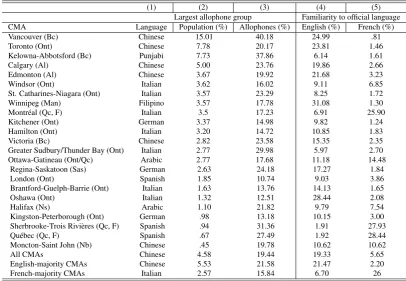
Cities also differ in terms of the size and the identity of the largest allophone group. Indeed,
Table 3 shows that in 2006 the size of the largest allophone group as a share of the total
pop-ulation ranges from 0.45% in Moncton-Saint John to 15% in Vancouver. As a fraction of the
allophone population, the share of the largest group is always quite big, but ranges from 10.7%
in London to 40.2% in Vancouver. In addition, the identity itself of the largest group varies
across the CMAs in the sample, with 7 different languages for 23 CMAs.10
[Table 3 about here.]
Our main measure of assimilation into the city majority language is based on Question 13 in the
Census: “Can this person speak English or French well enough to conduct a conversation?”.
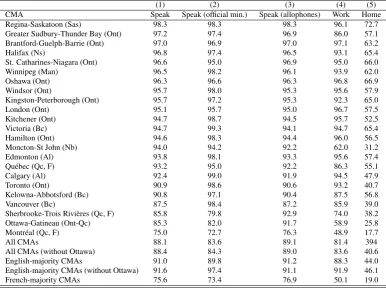
Column 1 in Table 4 reports the city-level proportion of minority members declaring to speak
well enough the city majority language in 2006. This proportion varies widely across cities, as
the assimilation rates range from 98% in Regina-Saskatoon to 75% in Montreal. In addition,
assimilation in French-majority cities is clearly lower than in English-majority cities, reflecting
the lower assimilation rates of both allophones and official minorities (anglophones), as shown
in columns 2 and 3. Also, when one excludes Ottawa, it appears that the relative assimilation
pattern of official minorities versus allophones is different in French- and English-majority
cities. Indeed, in French-majority cities, the anglophones assimilate less than the allophones
(73% versus 77% in 2006) while in English-majority cities, the francophones assimilate more
than the allophones (97% versus 91%).11
We also use as alternative measures of assimilation the language most frequently used by
10The largest allophone group was the same in 2001 in 18 out of the 23 CMAs under consideration. The five
exceptions are Winnipeg (from German in 2001 to Filipino in 2006), London (from Polish to Spanish), Oshawa (from Polish to Italian), Toronto (from Italian to Chinese), and Victoria (from German to Chinese).
11The proportions are not reported for 2001. Overall, assimilation was lower in 2001 than in 2006 for both types
the respondent at work and at home. At the individual level, 85.3% (resp. 42.5%) of the
individuals declaring to speak the city-majority language declare that they use that language
at work (resp. at home), so these two alternative assimilation measures are more stringent
than being able to speak the language. Across cities, the variation for these two alternative
measures is more important, and the gap between assimilation levels in English-majority and
French-majority cities is bigger (see columns 4 and 5 in Table 4).12
[Table 4 about here.]
3
Empirical Model: Disentangling Learning from Sorting
Economic analysis posits that language acquisition depends on its relative costs and benefits.13
In particular, if the benefits associated to learning a specific language stem from the gains of
direct trade with the individuals belonging to that language network, then one should expect
the learning of that language to be increasing in the size of the network, i.e. the number of
speakers. At the same time, the individuals belonging to a larger language group should be in
principle less pressed to investing in another language, given their ability to access a larger set
of traders even in the absence of any investment.
Language acquisition also takes time and for immigrants most existing models assume that
language acquisition is progressive. This leads to a simple regression model where the
assim-ilation of minority members is regressed against a series of individual characteristics of the
respondents and the aggregate language-composition characteristics of the CMAs:
pik =Xiβ+Zkγ+Tiη+uik (1)
wherepikis a measure of language assimilation for individualiin cityk,Xi is a set of individ-ual characteristics which captures differences in learning costs,Zkis the language composition of cityk, andTi is time spent in the host country. Finally, uik is an error term assumed to be 12For some cities, the proportion of individuals declaring to use the language at work is larger than the
propor-tion declaring to speak the language, but this is simply due to the fact that the latter proporpropor-tion is computed only for the individuals who have a job.
orthogonal to other factors.
The vectorXi includes the age and sex of the respondent, its employment and immigration status,14 the age at migration, and dummies establishing whether the individual has ever been
married,15 and whether he/she has children aged 0-5 or 6-14. We also include dummies
indi-cating the highest degree attained (high-school, some college, college, and bachelor or above)
and whether the highest degree of education has been taken in a Canadian province having the
same majority language as the city of residence (see Data Appendix for details). To capture
group specific learning costs, we include a dummy for the mother tongue of the individual.
In turn, city-specific variables Zk account for the language composition of the CMAs by including as regressors the size of the official minority and the proportion of individuals having
the same mother tongue as the respondent.16
The effect of city language composition measured by γin equation (1) can reflect two dif-ferent mechanisms: learning and sorting. If learning is the main mechanism, this parameter
captures the effect of the pool of own mother-tongue and/or minority speakers in the city on
the incentive to learn the majority language. On the other hand, it may be that individuals who
previously know French (resp. English) choose to settle in a French- (resp. English-) majority
city and in that case the correlation mostly reflects sorting.17 If individuals sort across cities depending on their pre-existing knowledge of English and/or French, this parameter will reflect
the correlation between the location choice and the preexisting knowledge of the language.
To get a rough idea of how strong sorting of individuals across cities is likely to be, the last
two columns of Table 3 report for each city the proportion of individuals coming from a country
14Clearly, it might be the case that employment status –or, more generally, labour market status- is partly
determined by language knowledge. In order to reduce this potential reverse causality problem, section 6 presents regressions where the sample is restricted to those individuals employed in occupations where the use of the language is below the median.
15As employment status, marital status could also be –at least partly- determined by language knowledge.
16Individuals who declare to have several mother tongues belong to more than one network, and for this
reason the measure of the total population of the city used to construct these proportions counts bilingual in-dividuals twice. These variables were obtained from the 100% Census tabulations in order to avoid sam-pling errors. This information is available at http://www12.statcan.ca/english/census01 and
http://census2006.ca.
17The 2006 Census allows to identify the immigrants that have been in Canada for four months or less. However,
where English (or French) is used as alingua franca, according to data from the Encyclopædia
Britannica (2003).18 According to this measure, self-selection to francophone vs. anglophone cities is very important, as 21.4% (resp. 6.7%) of the allophones living in English-majority
cities come from a country where English (resp. French) is a familiar language, while 26%
(resp. 2.2%) of the allophones living in French-majority cities come from a country where
French (resp. English) is a familiar language.
In order to disentangle the empirical importance of learning and sorting, we follow a
sim-ple empirical test initially proposed by Lazear (1999) and recently used by Dustmann and
Van Soest (2004), Lazear (2007) and Beckhusen et al (2013). The basic idea is the following:
assuming language acquisition takes time, an interaction term between the language
composi-tion of the city and the length of stay in the city will be significant if there is learning but not
if there is sorting. Thus, a simple test of the sorting hypothesis is to estimate the following
variation of the previous model:
pik =Xiβ+Zkγ+Tiη1+ (Ti ×Zk)η2+uik (2)
whereη2 captures the effect of the interaction between length in country and language
compo-sition. Under learning, we expect this parameter to be statistically significant. If sorting is the
correct model, we should not find a strong effect of this interaction.
The validity of this approach depends on several strong assumptions. First, as in Lazear
(1999), this argument rests on the immigrants not being very mobile across cities once in the
country and on return migration not being too important. Overall, in 2006, 91.0% (resp. 97.6%)
of the language-minority immigrants that had been in the country for more than five (resp. one)
year(s) were living in the same city as five (resp. one) year(s) before. Second, both sorting and
learning are likely to exist in practice. The test is only indicative of the mechanism which is
empirically the most important.
More importantly, the model cannot distinguish more complex but theoretically
plausi-ble forms of sorting. Specifically, ability or willingness to learn the language (instead of the
initial knowledge of the language) might be the key variable determining sorting.19 Indeed, high-ability individuals might self-select to those locations with few co-mother tongue
speak-ers because they know they will learn easily the host-country language (given their type) and
because interacting with many natives will be more profitable than interacting with many
co-mother tongue speakers. Then, in that case, the negative correlation between knowledge of the
language and an interaction term between years in the city and the proportion of co-mother
tongue speakers will result from sorting on the basis of unobserved ability.
Unfortunately, given the cross-sectional nature of our data, measuring the language-learning
ability of individuals is not really possible, nor is it possible to distinguish between sorting
based on ability and sorting based on the initial knowledge of the language. Other approaches
disentangling sorting from learning in unilingual countries have been proposed for example by
Danzer and Yaman (2011) for Germany, but they rely on a natural experiment.
However, language learning ability/willingness is potentially strongly correlated to other
variables included in the regressions. Specifically, an important part of the differences in ability
are likely to be accounted for by variables in the model such as age or education. In particular,
it is not unreasonable to assume a strong positive correlation between the educational level and
language-learning ability/willingness of individuals. At the same time, there is no way with
the available data to check whether these two variables sufficiently account for differences in
language-learning ability/willingness.
4
Assimilation of allophone immigrants
We start by investigating the assimilation of allophone immigrants, that is immigrants with
a mother tongue different from the two official languages, English and French.20 In order to
capture potential variations in assimilation patterns between languages and cities, we study
sep-arately the assimilation in English- and French- majority cities. For all regressions in the paper,
we use the sampling weights available in the PUMF files. All models include specific language
19We are grateful to a referee for pointing out this limitation of our analysis.
20Because of data constraints, the sample includes only the allophones for which the variable “Proportion of
group dummies which account for the fixed differences in assimilation across language groups.
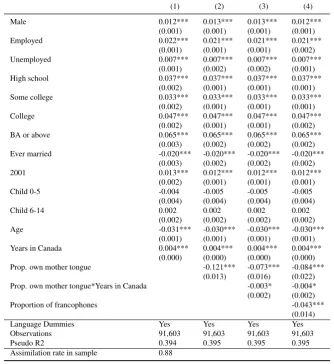
Table 5 investigates the determinants of knowledge of English by allophones in
English-majority cities. Column 1 presents a simple model using only individual characteristics as
regressors. As in previous work, we find assimilation to be higher for individuals that are
employed and more educated. Also, as in Chiswick and Miller (1994, 2001), assimilation is
increasing in the number of years in Canada. Quantitatively, the model predicts that spending
ten additional years in Canada raises the assimilation rate by 4 p.p. Consistent with the human
capital theory which sees language as an investment, assimilation is also strongly decreasing
with age, as older immigrants have less time to recoup the benefits of a language investment.
Columns 2 adds to the model the share of speakers with the same mother tongue in the city
population. As expected, the coefficient is negative and strongly statistically significant which
confirms that a larger share of the minority speakers in the population is associated with lower
assimilation rates. The effect is nonetheless much smaller than in Lazear (1999, 2007) for the
US in 1990, as in our case a 10 p.p. increase in the share of co-mother tongue individuals
lowers the probability to speak English by only 1.3 p.p.
In order to test whether this correlation reflects the presence of learning or sorting, Column 3
adds an interaction term between the share of the group in the population and the number of
years in Canada. The interaction term is negative and statistically significant but its magnitude
is very small. Specifically, at the mean value, the coefficient of the interaction term indicates
that living in a city with 10% co-mother tongue individuals lowers assimilation by an additional
0.3 p.p. over a period of 10 years. Thus, the evidence in favor of learning seems rather limited.
Finally, Column 4 studies whether assimilation is affected by the overall language
composi-tion of the city, namely the presence of a large francophone minority. In principle, assimilacomposi-tion
could be lower in more diverse cities as a result of the presence of a larger minority. The
es-timated effects are consistent with this hypothesis but smaller than the effects of the size of
the own mother tongue group, as a 10 p.p. increase in the share of francophones decreases the
assimilation rate by 0.5 p.p.
We perform a similar analysis for French-majority CMAs in Table 6. Across specifications, the
signs associated to the individual characteristics remain unchanged with the exception of the
positive effect on knowledge of French of having a child aged 0 to 5. However, the effect of
individual characteristics is substantially larger. For example, being a college graduate instead
of a high-school drop out increases by 13 p.p. the probability to speak French in francophone
cities while it increased only by 5 p.p. the probability to speak English in anglophone cities.
Similarly, age at immigration and years in Canada have a much stronger effect on the
probabil-ity to speak French.
Column 2 indicates that the knowledge of French is also negatively correlated with the
pro-portion of own mother tongue speakers but the estimated effects are more than five times larger
than in English-majority cities, as a 10% share of own mother tongue in the population decrease
the assimilation rate by 7 p.p.
Next, column 3 shows there is strong evidence for learning in francophone cities. Indeed, in
constrast with English-majority cities, when introducing the interaction term, the direct effect
through the size of the own mother tongue group becomes insignificant, indicating that sorting
is unlikely to be the main mechanism. In addition, the size of the interaction term is very large
as it predicts that living in a city with 10% co-mother tongue individuals lowers assimilation
by 7 p.p. over a period of 10 years.
Finally, another important difference is that a larger English-speaking minority significantly
deters the learning of French. Specifically, column 4 shows that a 10 p.p. increase in the share
of anglophones lowers the assimilation rate by about 10 p.p.
Overall, a comparison of the language assimilation of allophones in anglophone versus
francophone cities reveals the existence of substantial differences. Specifically, the
assimila-tion rate of allophones in francophone cities is much more sensitive to individual characteristics
such as the educational level and is much more correlated with the size of the individual’s
lan-guage group in the population. The results based on Lazear (1999)’s approach also suggest that
the evidence for learning is much stronger in French-majority cities. In addition, as expected
in a situation of asymmetric bilingualism, assimilation into the countrywide-minority language
assimilation into English is to the size of the francophone minority.
[Table 6 about here.]
5
Assimilation of anglophone and francophone immigrants
While most immigrants are allophones,21 the immigration of official-language mother-tongue speakers could still be an important factor influencing the relative strength of the two official
languages if the patterns of assimilation of francophone and anglophone immigrants into the
other official language were very different.
To this purpose, Table 7 studies the assimilation of francophone immigrants into English in
anglophone cities (columns 1 to 3) and the assimilation of anglophone immigrants into French
in francophone cities (columns 4 to 6). For anglophone cities, the effects of individual
char-acteristics are the expected ones, as knowledge of English is positively correlated to education
and years in Canada. Compared to the assimilation of allophone immigrants, the only
no-ticeable difference is that knowledge of English is here negatively correlated to the presence
of children aged 0 to 5, which might be related to Kuziemko (2014) and Kuziemko and
Fer-rie (2014)’s argument for the U.S. that adults could lean on their children’s knowledge of the
language instead of learning the language themselves. In addition, the estimation results in
Column 2 suggest that the presence of a larger French-speaking group lowers the assimilation
rate of French mother-tongue speakers. Specifically, the estimates indicate that an increase by
10 p.p. of the share of French speakers in the population lowers the probability to speak English
by about 2 p.p. Column 3, which includes the interaction term in order to disentangle sorting
from learning, shows no evidence of learning in anglophone cities.
In francophone cities (columns 4-6), the same qualitative results are found: the assimilation
rate positively depends on education and years in Canada, negatively depends on the presence
of children aged 0-5 and on the size of the own mother tongue, and no evidence of learning
can be found in column 6 –although in contrast with column 3, the coefficient is now positive
but very imprecisely measured. However, the same type of asymmetries between French- and
21French tongue immigrants account for 1% of the immigrants in anglophone cities and English
English-assimilation found for allophones still hold here. Specifically, on the one hand, the
likelihood to speak French is much more sensitive to education, employment status, and years
in Canada than the likelihood to speak English in anglophone cities. On the other, the impact of
the share of anglophones on the likelihood to speak French is four times larger than in
English-majority cities and actually quite important, as a 10 p.p. increase the share of anglophones in
the population decreases the probability to know French by about 40 p.p.
[Table 7 about here.]
6
Some Extensions
In this section, we evaluate the robustness of the previous results to alternative specifications.
We first investigate whether different allophone groups exhibit different assimilation patterns.
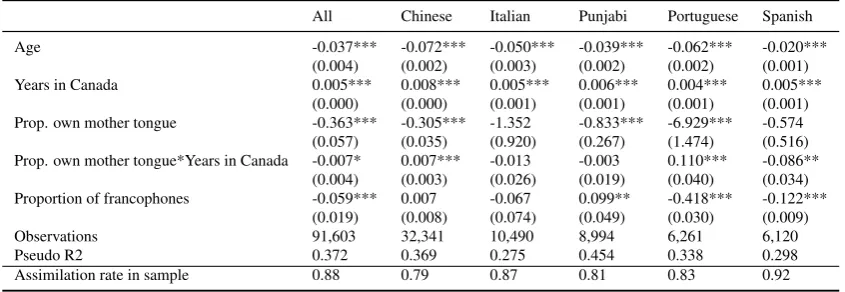
To this purpose, Table 8 reports estimates from separate regressions for the largest allophone
groups in English-majority cities.22 As in Table 5, we find for each specific language group a strong and generally significant negative correlation between assimilation and the share of
co-mother tongue speakers in the city. Another common element with the general analysis of
Table 5 is that the interaction term reveals the absence of learning for all groups but for the
Spanish mother-tongue immigrants.
The results also indicate that, while the effects of the number of years in Canada seem to
be broadly comparable across groups, the negative effect of the entry age is much stronger for
Chinese immigrants than for other immigrants. Also, interestingly, a larger share of
franco-phones in the city negatively affects assimilation into English for those groups of individuals
with a mother tongue close to French (as e.g Spanish or Portuguese) but does not affect it for
Chinese or Punjabi mother tongue speakers.
[Table 8 about here.]
This last result suggests that distance between languages, which captures differences in average
learning costs across groups, may have an influence on assimilation rates.
22We do not estimate these regressions for French cities as the number of observations is insufficient for all
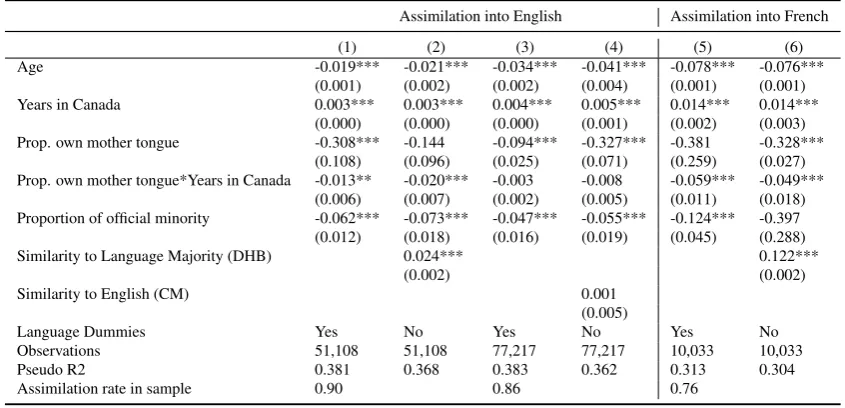
For this reason, Table 9 directly assesses the effect of cross-language similarity on the
assimilation rate by introducing two alternative measures of language distance in the
regres-sions.23 The first measure has been constructed by Dyen et al (1992) for Indoeuropean
lan-guages and is based on the similarity of words across lanlan-guages. In our case, we can thus use
the information on the distance of English and French with respect to the other Indoeuropean
languages available in the sample.24 The second measure, constructed by Chiswick and Miller
(2005), is based on the difficulties a sample of Americans have in learning other languages
and provides us with a measure of distance of English with a different set of languages in the
sample.25 We normalize both measures to have a standard deviation of one in the sample. Regressions (1), (3) and (5) in Table 9 first show that the baseline results in section 4
re-main unchanged when restricting the analysis to the mother tongues in Dyen, Kruskal, and
Black (1992) or Chiswick and Miller (2005). Next, regressions (2) and (6) include as
regres-sors for respectively English- and French-majority cities the measure of similarity of Dyen et al
(1992) instead of the group fixed-effects used in (1) and (5). In both cases, we find a positive
effect of language similarity on knowledge of the city-majority language. At the same time,
the estimated effect is much bigger for the assimilation into French than for the assimilation
into English. Indeed, while in regression (2) an increase by one standard deviation in linguistic
proximity increases by 2 p.p. the assimilation rate into English, the same reduction in distance
raises assimilation into French by 12 p.p. in regression (6). Thus, language distance seems to
matter more for the ’weak’ language, which may simply stem from the fact that the investment
in the weak language (French) is not profitable if a big language distance needs to be overcome,
and instead the investment in the dominant language is very profitable and thus not very
sen-sitive to language distances. Quantitatively, the effect of language distance seems to be quite
large for French: for instance, as there is a 3 standard deviation difference between the
dis-tance Punjabi-French and the disdis-tance Spanish-French, the estimates imply that this factor can
account for a 36 p.p. of the difference in the assimilation rate into French. Finally, regression
(4) in Table 9 includes instead the Chiswick-Miller language distance measure with respect to
23See also Isphording and Otten (2014) for an alternative definition of language distance.
24Dutch, German, Greek, Italian, Portuguese, Punjabi, Russian, Spanish, and Ukrainian
English, but no effect on the assimilation rate is found in this case.
[Table 9 about here.]
Although no direct information on language of instruction is available, the 2006 Census
pro-vides information on the province where the individual received its highest degree –for those
who studied in Canada- and also on whether the individual studied in the U.S.or not (see the
Data Appendix for more details). Given that allophone immigrants in Quebec must attend
by law a school in French and that they generally attend in the rest of Canada (and in the
U.S.) schools in English, this information can be understood as a reasonable approximation to
language of instruction. When including this information as an explanatory variable for the
assimilation rate of allophone immigrants, columns 2 and 4 in Table 10 show that having been
educated in a province with the same language majority raises the probability of knowledge of
the city-majority language with respect to being educated abroad (excluding the U.S.), with a
stronger effect for French than for English. In addition, column 4 shows that having studied in
an English-majority province (or in the U.S) has an negative and significant effect on the
prob-ability of knowing French, and that this effect is actually quantitatively bigger than the positive
effect of having studied in Quebec. Instead, in column 2, education in Quebec does not have a
significant negative impact on assimilation into English in anglophone cities, which constitutes
an additional asymmetry between the two official languages.
[Table 10 about here.]
Table 11 presents several additional extensions and compares them with the baseline estimates
(column 1). As employment status –included as an explanatory variable in our analysis- could
actually be partly determined by language knowledge, we estimate models using a group of
workers in occupations with relatively low language requirements. Specifically, columns 2 and
3 report estimates of regressions excluding the individuals working in occupations where the
"importance" (column 2) or "level" (column 3) of the basic skill "speaking: talking to others
to convey information effectively" as defined by O*NET is above the median.26 The signs of 26To this purpose, the level (resp. the importance) of the skill "speaking" for each of the 25 occupations
the correlations are found to be virtually identical to the benchmark case for assimilation into
English. Instead, for assimilation into French, the evidence on the presence of learning vanishes
which suggests that most evidence of learning is driven through the assimilation into the labor
market in occupations with higher language requirements.
Next, the last two columns of Table 11 report estimates when the dependent variable is
respectively the use of the majority language at work and at home. For English-majority cities,
the only difference between these estimates for language use and the benchmark case of column
1 is that there is no evidence that use of English would be driven by learning. In turn, for
French-majority cities, there is some evidence of learning and, most importantly, the proportion
of anglophones has a very large negative impact on the use of French at work or at home.
[Table 11 about here.]
Finally, while our methodology based on years since migration clearly cannot distinguish
between learning and sorting for official-minority natives, it is still interesting to establish
whether their broad determinants of knowledge of the city-majority language are similar to
those of the immigrants. To this purpose, Table 12 reports the estimates for official-minority
natives of the same regressions previously conducted in Table 7 for official-minority
immi-grants. We find very similar patterns: education and labor force status have a much larger
effect on the assimilation into French than into English. As previously, the negative effect of a
larger anglophone minority on the assimilation rate into French is much larger than the effect
of the size of the francophone community on the assimilation rate into English.
[Table 12 about here.]
7
Conclusion
This paper analyses the language assimilation of immigrants and official minorities in one
im-portant bilingual country, Canada. One strong and consistent result from this paper is that
lan-guage assimilation displays important asymmetries between the strong and the weak lanlan-guage.
particular, employment status and education have a much stronger effect on assimilation when
the majority language is French.
Second, while the assimilation of allophones depends on the local (city) language
distri-bution in both English- and French-majority cities, the effect is much stronger for the latter.
In addition, the observed negative correlation between language knowledge and the number
of co-mothertongue reflects mostly sorting in English-majority cities while there is substantial
evidence of learning in French-majority cities.
Finally, a larger English-speaking minority deters strongly the learning of French in
fran-cophone cities. This suggests that the benefits of learning French are more strongly connected
with its usefulness on a particular labour market, which is likely to reflect the dominant position
of English at the Canadian level.
Overall, our interpretation of these results is that English-learning incentives are so high
across English-majority cities that the specific language composition of cities does not actually
matter much. Instead, French-learning incentives in francophone cities are strongly related to
the local language distribution, and particularly to the share of dominant-language (English)
speakers in the city.
While our paper focuses on Canada, we would expect intuitively our results to extend to a
series of countries characterised by asymmetric bilingualism, and particularly to those
coun-tries in which one of the official languages is –at least to some extent- an international language
and the other language is a relatively small one. This might be the case for instance of Belgium
or Spain. Other countries such as Finland or Switzerland may also share some common
charac-teristics, but are likely to differ because the internationallingua franca(English) -although not
an official language- plays an increasingly important role. A related –but still different- issue
that we leave for future research is the role of English in unilingual small-language countries
(such as Sweden or the Netherlands, in the spirit of Lang and Siniver, 2009, for Israel) or more
Appendix
[Table 13 about here.]
Data Appendix
Level of education: The 2006 Census provides more categories than the 2001 Census for the
highest degree attained by those individuals with education levels above high-school and
be-low a bachelor’s degree. However, using two broad intermediate categories –“some college”
and “college”- renders the information in the two censuses comparable. Specifically, “some
college” corresponds to “Trade certificate or diploma” in 2001 and to both “Other trade
cer-tificate or diploma” and “Registered apprenticeship cercer-tificate” in 2006. Similarly, “college”
corresponds to both “college certificate or diploma” and “university certificate or diploma
be-low bachelor level” in 2001, and to “university certificate or diploma bebe-low bachelor level” and
three college sub-categories depending on the length of college in the 2006 Census.
Location of education: The variable (“locstud”) in the 2006 Census reports (i) for those
indi-viduals who took education in Canada, the Canadian province where the highest degree was
obtained, and (ii) for those individuals who took education abroad, whether the highest degree
was taken in the U.S. or in one of four very broad regions including many countries which are
not homogeneous in terms of language of instruction. With this information, three locations of
education can be distinguished for an individual: education abroad excluding the U.S.,
educa-tion in a province with the same language majority as the province of residence (including the
U.S. for English-majority cities) and education in a province with a language majority different
from that of the province of residence (including the U.S. for French-majority cities).
List of countries where English (or French) is used as a lingua franca:We include countries
where English (or French) are spoken by at least 20% of the population as a lingua franca
or where a creole version of the language is spoken by at least 70% of the population. We
do not include countries where a majority of the population speaks the language as a mother
tongue, as the individuals coming from these countries are likely to declare that English (or
With these criteria, the countries where French is consider to be a familiar language are:
Alge-ria, Belgium, Burkina Faso, Cameroon, Central African Republic, Chad, Republic of Congo,
Democratic Republic of Congo, Comoros, Côte d’Ivoire, Gabon, Haiti, Lebanon, Mauritius,
Morocco, Saint Lucia, Senegal, Switzerland, Togo, and Tunisia. For English, the countries
are: Antigua and Barbuda, Bahamas, Barbados, Belize, Botswana, Brunei, Cameroon, Cook
Islands, Dominica, Fiji, Grenada, Guyana, Hong Kong, Jamaica, Kiribati, Malaysia, Malta,
Marshall Islands, Lesotho, Liberia, Nauru, Nigeria, Palau, Papua New Guinea, Philippines,
Puerto Rico, Saint Kitts and Nevis, Saint Vincent and the Grenadines, Samoa, Sierra Leone,
Singapore, Solomon Islands, South Africa, Suriname, Tonga, Trinidad and Tobago, Vanuatu,
and Zimbabwe.
Acknowledgements
We would like to thank two anonymous referees, the editor (Klaus Zimmermann), Jan Fidrmuc,
Alex Lembcke, Barbara Petrongolo, and seminar participants at the CREAM-TARGET
Confer-ence on Immigration (UCL), Universidad de Oviedo, EEA, CEP (LSE), Brunel, City University
London, and WPEG for interesting comments. Funding from CEPREMAP’sProgramme
Tra-vailis gratefully aknowledged. Addresses for correspondance: [email protected] and
References
Barbaud P (1998) French in quebec. In: Edwards J (ed) Language in Canada, Cambridge
Uni-versity Press
Bauer T, Epstein GS, Gang IN (2005) Enclaves, language, and the location choice of migrants.
J Popul Econ 18(4):649–662
Beckhusen J, Florax RJ, Graaff T, Poot J, Waldorf B (2013) Living and working in ethnic
enclaves: English language proficiency of immigrants in us metropolitan areas. Pap Reg Sci
Britannica (2003) Britannica Book of the Year 2002. Encyclopaedia Britannica
Cattaneo A, Winkelmann R (2005) Earnings differentials between german and french speakers
in switzerland. Swiss J Econ Stat 141(2):191–212
Chiswick BR, Miller PW (1994) Language choice among immigrants in a multi-lingual
desti-nation. J Popul Econ 7(2):119 – 131
Chiswick BR, Miller PW (2001) A model of destination-language acquisition: application to
male immigrants in canada. Demogr 38(3):391 – 409
Chiswick BR, Miller PW (2005) Linguistic distance: A quantitative measure of the distance
between english and other languages. J Multiling Multicul 26(1):1–11
Church J, King I (1993) Bilingualism and network externalities. Can J Econ 26(2):337 – 345
Cutler D, Glaeser E, Vigdor J (2008) When are ghettos bad? lessons from immigrant
segrega-tion in the united states. J Urban Econ 63:759–774
Danzer A, Yaman F (2011) Ethnic Concentration and Language Fluency of Immigrants in
Germany. Discussion Paper 11/09, City University London.
Dustmann C, Van Soest A (2004) An analysis of speaking fluency of immigrants using ordered
response models with classification errors. J Bus Econ Stat 22(3):312–321
Dyen I, Kruskal J, Black P (1992) An indoeuropean classification: A lexicostatistical
experi-ment. T Am Philos Soc 82(5):iii–132
Fishman J (1967) Bilingualism with and without diglossia; diglossia with and without
bilin-gualism. In: Paulston CB, Tucker R (eds) Sociolinguistics, 2003, Blackwell Publishing,
reprinted from J Soc Issues 32,1967
Isphording IE, Otten S (2014) Linguistic barriers in the destination language acquisition of
immigrants. J Econ Behav Organ 105(0):30 – 50
Kraus P (2011) The multilingual city. Nord J Migra Res 1(1):25–36
Kuziemko I (2014) Human capital spillovers in families: Do parents learn from or lean on their
children? J Labor Econ 32(4)
Kuziemko I, Ferrie J (2014) The role of immigrant children in their parents’ assimilation in the
u.s., 1850-2010. In: Boustan L, Frydman C, Margo RA (eds) Human Capital in History: The
American Record, University of Chicago Press
Lang K, Siniver E (2009) The return to english in a non-english speaking country: Russian
immigrants and native israelis in israel. BE J Econ Anal Poli, Top 9(1):Article 50
Lazear EP (1999) Culture and language. J Polit Econ 107(6):S95 – 126
Lazear EP (2007) Mexican assimilation in the united states. In: Mexican immigration to the
United States, University of Chicago Press, pp 107–121
Mougeon R (1998) French outside new brunswick and quebec. In: Edwards J (ed) Language
in Canada, Cambridge University Press
Paulston CB (2003) Linguistic minorities and language policies. In: Paulston CB, Tucker R
(eds) Sociolinguistics, Blackwell Publishing
Rendon S (2007) The catalan premium: language and employment in catalonia. J Popul Econ
20(3):669–686
van Tubergen F, Wierenga M (2011) The language acquisition of male immigrants in a
Table 1: Minority members by mother tongue and immigration status
Mother tongue Total Natives Immigrants
English 19,023 15,482 3,541
French 30,549 28,360 2,189
Allophones 228,671 35,793 192,878
Notes: This table reports by mother tongue and immigration status the number of individuals aged 15 or more living in a CMA and having a mother tongue other than the city-majority language. Source: PUMF 2001 and
Table 2: Mother tongue composition (2006)
Mother tongue(s) Canada Toronto Montreal Vancouver Ottawa Calgary Edmonton Quebec city English 58.79 57.91 11.97 59.69 50.40 76.60 78.66 1.29 French 21.65 1.07 65.13 1.01 31.29 1.36 1.95 95.32 Allophone 16.47 35.75 17.77 35.00 14.04 19.13 16.45 2.08 English & French .76 .32 1.70 .29 2.08 .38 .44 .86 English & Allophone 1.87 4.71 .89 3.84 1.41 2.40 2.37 .02 French & Allophone .26 .08 1.53 .05 .39 .01 .05 .32 English, French & Allophone .20 .16 1.00 .12 .39 .09 .08 .10
Table 3: Characteristics of allophones in the city, 2006, 100% Census Tabulations
(1) (2) (3) (4) (5) Largest allophone group Familiarity to official language CMA Language Population (%) Allophones (%) English (%) French (%) Vancouver (Bc) Chinese 15.01 40.18 24.99 .81 Toronto (Ont) Chinese 7.78 20.17 23.81 1.46 Kelowna-Abbotsford (Bc) Punjabi 7.73 37.86 6.14 1.61 Calgary (Al) Chinese 5.00 23.76 19.86 2.66 Edmonton (Al) Chinese 3.67 19.92 21.68 3.23 Windsor (Ont) Italian 3.62 16.02 9.11 6.85 St. Catharines-Niagara (Ont) Italian 3.57 23.29 8.25 1.72 Winnipeg (Man) Filipino 3.57 17.78 31.08 1.30 Montréal (Qc, F) Italian 3.5 17.23 6.91 25.90 Kitchener (Ont) German 3.37 14.98 9.82 1.24 Hamilton (Ont) Italian 3.20 14.72 10.85 1.83 Victoria (Bc) Chinese 2.82 23.58 15.35 2.35 Greater Sudbury/Thunder Bay (Ont) Italian 2.77 29.98 5.97 2.70 Ottawa-Gatineau (Ont/Qc) Arabic 2.77 17.68 11.18 14.48
Regina-Saskatoon (Sas) German 2.63 24.18 17.27 1.84 London (Ont) Spanish 1.85 10.74 9.03 3.86 Brantford-Guelph-Barrie (Ont) Italian 1.63 13.76 14.13 1.65 Oshawa (Ont) Italian 1.32 12.51 28.44 2.08 Halifax (Ns) Arabic 1.10 21.82 9.79 7.54 Kingston-Peterborough (Ont) German .98 13.18 10.15 3.00 Sherbrooke-Trois Rivières (Qc, F) Spanish .94 31.36 1.91 27.93 Québec (Qc, F) Spanish .67 27.49 1.92 28.44 Moncton-Saint John (Nb) Chinese .45 19.78 10.62 10.62 All CMAs Chinese 4.58 19.44 19.33 5.65 English-majority CMAs Chinese 5.53 21.58 21.47 2.20 French-majority CMAs Italian 2.57 15.84 6.70 26
Table 4: Proportion of city-minority members 15 or over declaring to speak, to use at work, or to use at home the city-majority language (2006 Census)
(1) (2) (3) (4) (5) CMA Speak Speak (official min.) Speak (allophones) Work Home Regina-Saskatoon (Sas) 98.3 98.3 98.3 96.1 72.7 Greater Sudbury-Thunder Bay (Ont) 97.2 97.4 96.9 86.0 57.1 Brantford-Guelph-Barrie (Ont) 97.0 96.9 97.0 97.1 63.2 Halifax (Ns) 96.8 97.4 96.5 93.1 65.4 St. Catharines-Niagara (Ont) 96.6 95.0 96.9 95.0 66.0 Winnipeg (Man) 96.5 98.2 96.1 93.9 62.0 Oshawa (Ont) 96.3 96.6 96.3 96.8 66.9 Windsor (Ont) 95.7 98.0 95.3 95.6 57.9 Kingston-Peterborough (Ont) 95.7 97.2 95.3 92.3 65.0 London (Ont) 95.1 95.7 95.0 96.7 57.5 Kitchener (Ont) 94.7 98.7 94.5 95.7 52.5 Victoria (Bc) 94.7 99.3 94.1 94.7 65.4 Hamilton (Ont) 94.6 98.3 94.4 96.0 56.5 Moncton-St John (Nb) 94.0 94.2 92.2 62.0 31.2 Edmonton (Al) 93.8 98.1 93.3 95.6 57.4 Québec (Qc, F) 93.2 95.0 92.2 86.3 55.1 Calgary (Al) 92.4 99.0 91.9 94.5 47.9 Toronto (Ont) 90.9 98.6 90.6 93.2 40.7 Kelowna-Abbotsford (Bc) 90.8 97.1 90.4 87.5 56.8 Vancouver (Bc) 87.5 98.4 87.2 85.9 39.0 Sherbrooke-Trois Rivières (Qc, F) 85.8 79.8 92.9 74.0 38.2 Ottawa-Gatineau (Ont-Qc) 85.3 82.0 91.7 58.9 25.8 Montréal (Qc, F) 75.0 72.7 76.3 48.9 17.7 All CMAs 88.1 83.6 89.1 81.4 394 All CMAs (without Ottawa) 88.4 84.3 89.0 83.6 40.6 English-majority CMAs 91.0 89.8 91.2 88.3 44.0 English-majority CMAs (without Ottawa) 91.6 97.4 91.1 91.9 46.1 French-majority CMAs 75.6 73.4 76.9 50.1 19.0
Table 5: Assimilation of allophone immigrants in English-majority cities
(1) (2) (3) (4) Male 0.012*** 0.013*** 0.013*** 0.012***
(0.001) (0.001) (0.001) (0.001) Employed 0.022*** 0.021*** 0.021*** 0.021***
(0.001) (0.001) (0.001) (0.002) Unemployed 0.007*** 0.007*** 0.007*** 0.007***
(0.001) (0.002) (0.002) (0.001) High school 0.037*** 0.037*** 0.037*** 0.037***
(0.002) (0.001) (0.001) (0.001) Some college 0.033*** 0.033*** 0.033*** 0.033***
(0.002) (0.001) (0.001) (0.001) College 0.047*** 0.047*** 0.047*** 0.047***
(0.002) (0.001) (0.001) (0.002) BA or above 0.065*** 0.065*** 0.065*** 0.065***
(0.003) (0.002) (0.002) (0.002) Ever married -0.020*** -0.020*** -0.020*** -0.020***
(0.003) (0.002) (0.002) (0.002) 2001 0.013*** 0.012*** 0.012*** 0.012***
(0.002) (0.001) (0.001) (0.001) Child 0-5 -0.004 -0.005 -0.005 -0.005
(0.004) (0.004) (0.004) (0.004) Child 6-14 0.002 0.002 0.002 0.002
(0.002) (0.002) (0.002) (0.002) Age -0.031*** -0.030*** -0.030*** -0.030***
(0.001) (0.001) (0.001) (0.001) Years in Canada 0.004*** 0.004*** 0.004*** 0.004***
(0.000) (0.000) (0.000) (0.000) Prop. own mother tongue -0.121*** -0.073*** -0.084***
(0.013) (0.016) (0.022) Prop. own mother tongue*Years in Canada -0.003* -0.004* (0.002) (0.002) Proportion of francophones -0.043***
(0.014) Language Dummies Yes Yes Yes Yes Observations 91,603 91,603 91,603 91,603 Pseudo R2 0.394 0.395 0.395 0.395 Assimilation rate in sample 0.88
Table 6: Assimilation of allophone immigrants in French-majority cities
(1) (2) (3) (4) Male 0.032*** 0.032*** 0.032*** 0.032***
(0.001) (0.001) (0.001) (0.001) Employed 0.091*** 0.092*** 0.090*** 0.091***
(0.001) (0.003) (0.002) (0.003) Unemployed 0.047*** 0.048*** 0.048*** 0.048***
(0.001) (0.003) (0.003) (0.003) High school 0.074*** 0.073*** 0.073*** 0.074***
(0.002) (0.001) (0.001) (0.002) Some college 0.109*** 0.108*** 0.107*** 0.108***
(0.002) (0.002) (0.000) (0.000) College 0.126*** 0.126*** 0.126*** 0.126***
(0.004) (0.002) (0.001) (0.001) BA or above 0.123*** 0.123*** 0.123*** 0.122***
(0.002) (0.002) (0.001) (0.001) Ever married -0.074*** -0.073*** -0.072*** -0.072***
(0.003) (0.002) (0.001) (0.002) 2001 0.012** -0.01 0.017*** 0.024***
(0.005) (0.008) (0.004) (0.005) Child 0-5 0.010*** 0.009*** 0.009*** 0.009***
(0.002) (0.002) (0.002) (0.002) Child 6-14 0.017*** 0.017*** 0.017*** 0.016***
(0.002) (0.001) (0.001) (0.001) Age -0.082*** -0.082*** -0.082*** -0.082***
(0.003) (0.002) (0.001) (0.001) Years in Canada 0.007*** 0.007*** 0.018*** 0.014***
(0.000) (0.000) (0.001) (0.001) Prop. own mother tongue -0.657* -0.251 -0.126**
(0.371) (0.178) (0.055) Prop. own mother tongue*Years in Canada -0.076*** -0.046***
(0.003) (0.007) Proportion of anglophones -1.065***
(0.236) Language Dummies Yes Yes Yes Yes Observations 15,168 15,168 15,168 15,168 Pseudo R2 0.325 0.327 0.327 0.329 Assimilation rate in sample 0.72
Table 7: Assimilation of official-minority immigrants
Francophone immigrants Anglophone immigrants in English-majority cities in French-majority cities (1) (2) (3) (4) (5) (6) Male 0.003 0.004 0.004 0.020*** 0.019*** 0.018***
(0.006) (0.004) (0.004) (0.005) (0.002) (0.002) Employed 0.025* 0.014** 0.014*** 0.094*** 0.099*** 0.098***
(0.013) (0.006) (0.005) (0.014) (0.007) (0.008) Unemployed -0.024 -0.014 -0.015 0.060** 0.072*** 0.074***
(0.017) (0.011) (0.012) (0.024) (0.007) (0.005) High school 0.034** 0.027*** 0.027*** 0.086*** 0.086*** 0.086***
(0.013) (0.004) (0.004) (0.011) (0.009) (0.009) Some college 0.017 0.013* 0.013* 0.067*** 0.067*** 0.068***
(0.013) (0.008) (0.008) (0.009) (0.009) (0.008) College 0.037*** 0.031*** 0.031*** 0.177*** 0.177*** 0.178***
(0.013) (0.004) (0.004) (0.007) (0.006) (0.007) BA or above 0.054** 0.047*** 0.047*** 0.293*** 0.287*** 0.287***
(0.026) (0.008) (0.008) (0.015) (0.007) (0.007) Ever married 0.025* 0.021 0.021 -0.056*** -0.061*** -0.062***
(0.013) (0.020) (0.019) (0.004) (0.004) (0.004) 2001 -0.009** -0.004 -0.005 0.012 0.036*** 0.041***
(0.004) (0.003) (0.003) (0.014) (0.009) (0.002) Child 0-5 -0.038*** -0.025*** -0.026*** -0.058*** -0.058*** -0.058***
(0.011) (0.008) (0.007) (0.006) (0.004) (0.004) Child 6-14 -0.006 -0.001 -0.001 -0.004 -0.001 0
(0.008) (0.009) (0.009) (0.006) (0.004) (0.005) Age -0.015*** -0.014*** -0.014*** -0.157*** -0.156*** -0.157***
(0.004) (0.002) (0.002) (0.001) (0.002) (0.002) Years in Canada 0.002** 0.001*** 0.002*** 0.013*** 0.013*** -0.003
(0.001) (0.000) (0.000) (0.000) (0.000) (0.014) Proportion of francophones -0.188*** -0.157***
(0.008) (0.025) Proportion of francophones*Years in Canada -0.001
(0.001)
Proportion of anglophones -4.106*** -7.782*** (1.140) (2.760) Proportion of anglophones*Years in Canada 0.107
(0.096) Observations 1,709 1,709 1,709 3,047 3,047 3,047 Pseudo R2 0.126 0.216 0.218 0.155 0.165 0.167 Assimilation rate in sample 0.94 0.49
Table 8: Assimilation of immigrants from specific allophone groups in English-majority cities
All Chinese Italian Punjabi Portuguese Spanish Age -0.037*** -0.072*** -0.050*** -0.039*** -0.062*** -0.020***
(0.004) (0.002) (0.003) (0.002) (0.002) (0.001) Years in Canada 0.005*** 0.008*** 0.005*** 0.006*** 0.004*** 0.005***
(0.000) (0.000) (0.001) (0.001) (0.001) (0.001) Prop. own mother tongue -0.363*** -0.305*** -1.352 -0.833*** -6.929*** -0.574
(0.057) (0.035) (0.920) (0.267) (1.474) (0.516) Prop. own mother tongue*Years in Canada -0.007* 0.007*** -0.013 -0.003 0.110*** -0.086**
(0.004) (0.003) (0.026) (0.019) (0.040) (0.034) Proportion of francophones -0.059*** 0.007 -0.067 0.099** -0.418*** -0.122***
(0.019) (0.008) (0.074) (0.049) (0.030) (0.009) Observations 91,603 32,341 10,490 8,994 6,261 6,120 Pseudo R2 0.372 0.369 0.275 0.454 0.338 0.298 Assimilation rate in sample 0.88 0.79 0.87 0.81 0.83 0.92
Table 9: Effect of linguistic proximity on immigrant assimilation
Assimilation into English Assimilation into French (1) (2) (3) (4) (5) (6) Age -0.019*** -0.021*** -0.034*** -0.041*** -0.078*** -0.076***
(0.001) (0.002) (0.002) (0.004) (0.001) (0.001) Years in Canada 0.003*** 0.003*** 0.004*** 0.005*** 0.014*** 0.014***
(0.000) (0.000) (0.000) (0.001) (0.002) (0.003) Prop. own mother tongue -0.308*** -0.144 -0.094*** -0.327*** -0.381 -0.328***
(0.108) (0.096) (0.025) (0.071) (0.259) (0.027) Prop. own mother tongue*Years in Canada -0.013** -0.020*** -0.003 -0.008 -0.059*** -0.049***
(0.006) (0.007) (0.002) (0.005) (0.011) (0.018) Proportion of official minority -0.062*** -0.073*** -0.047*** -0.055*** -0.124*** -0.397
(0.012) (0.018) (0.016) (0.019) (0.045) (0.288) Similarity to Language Majority (DHB) 0.024*** 0.122***
(0.002) (0.002) Similarity to English (CM) 0.001
(0.005)
Language Dummies Yes No Yes No Yes No Observations 51,108 51,108 77,217 77,217 10,033 10,033 Pseudo R2 0.381 0.368 0.383 0.362 0.313 0.304 Assimilation rate in sample 0.90 0.86 0.76
Table 10: Location of education and immigrant assimilation
English-majority French-majority (1) (2) (3) (4) Age -0.013*** -0.011*** -0.053*** -0.044***
(0.001) (0.001) (0.001) (0.001) Years in Canada 0.002*** 0.001*** 0.010*** 0.010***
(0.000) (0.000) (0.000) (0.001) Prop. own mother tongue -0.101*** -0.083*** -0.783 -0.593
(0.019) (0.015) (0.641) (0.743) Prop. own mother tongue*Years in Canada 0.003*** 0.003*** -0.032*** -0.039***
(0.001) (0.001) (0.003) (0.004) Proportion of official minority -0.016*** -0.013*** 0.225 0.01
(0.004) (0.004) (0.640) (0.758) Education in province with same language majority 0.011*** 0.073***
(0.001) (0.001) Education in province with a different language majority -0.008 -0.133***
(0.006) (0.014) Observations 35,947 35,947 5,720 5,720 Pseudo R2 0.341 0.346 0.331 0.339 Assimilation rate in sample 0.95 0.77
Table 11: Alternative measures of city-majority language proficiency/use for immigrant assim-ilation
(1) (2) (3) (4) (5) Specification Knowledge Knowledge Knowledge Knowledge Knowledge
of Language: of Language: of Language: used used Baseline Level Importance at Work at Home
A. Allophones in English-majority cities
Age -0.030*** -0.029*** -0.022*** -0.036*** -0.104*** (0.001) (0.002) (0.001) (0.001) (0.004) Years in Canada 0.004*** 0.004*** 0.004*** 0.005*** 0.017***
(0.000) (0.000) (0.000) (0.000) (0.001) Prop. own mother tongue -0.084*** -0.138*** -0.141*** -1.055*** -0.470***
(0.022) (0.048) (0.039) (0.075) (0.176) Prop. own mother tongue*Years in Canada -0.004* -0.003** -0.001 0.015*** 0.004
(0.002) (0.001) (0.001) (0.002) (0.009) Proportion of francophones -0.043*** -0.070*** -0.061*** -0.130*** -0.142**
(0.014) (0.016) (0.012) (0.018) (0.062) Observations 91,603 31,529 28,197 58,212 91,603 Pseudo R2 0.395 0.312 0.320 0.231 0.273 Assimilation rate in sample 0.88 0.92 0.93 0.89 0.35
B. Allophones in French-majority cities
Age -0.082*** -0.065*** -0.061*** -0.011*** -0.003*** (0.001) (0.000) (0.000) (0.001) (0.000) Years in Canada 0.014*** -0.001 0.000 0.008 0.006***
(0.001) (0.005) (0.006) (0.009) (0.000) Prop. own Mother Tongue -0.126** -0.421*** -0.505*** -0.045 -0.352
(0.055) (0.118) (0.137) (0.309) (0.240) Prop. own Mother tongue*Years in Canada -0.046*** 0.038 0.035 -0.056 -0.032***
(0.007) (0.030) (0.039) (0.061) (0.003) Proportion of anglophones -1.065*** -3.129*** -2.878*** -1.785* -1.523***
(0.236) (0.908) (1.108) (0.963) (0.300) Observations 15,168 4,828 4,222 8,780 15,168 Pseudo R2 0.328 0.368 0.361 0.328 0.328 Assimilation rate in sample 0.72 0.76 0.76 0.60 0.22
Table 12: Assimilation of official-minority natives
(1) (2) (3) (4) Francophone natives Anglophone natives in English-majority cities in French-majority cities Male 0.032** 0.026*** 0.010*** 0.009***
(0.013) (0.002) (0.003) (0.002) Employed 0.025*** 0.019*** 0.087*** 0.087***
(0.008) (0.003) (0.004) (0.002) Unemployed 0.008* -0.002 -0.001 -0.001
(0.004) (0.004) (0.005) (0.006) High school 0.066** 0.053*** 0.061*** 0.062***
(0.030) (0.007) (0.000) (0.004) Some college 0.024*** 0.018*** 0.065*** 0.063***
(0.009) (0.002) (0.005) (0.005) College 0.067** 0.050*** 0.111*** 0.113***
(0.029) (0.007) (0.004) (0.005) BA or above 0.070** 0.054*** 0.121*** 0.123***
(0.036) (0.010) (0.004) (0.004) Ever married 0.052*** 0.030*** 0.030*** 0.031***
(0.013) (0.004) (0.006) (0.003) 2001 0.015** 0.014*** -0.013*** -0.002
(0.007) (0.003) (0.003) (0.006) Child 0-5 -0.006 -0.001 0.020*** 0.019***
(0.004) (0.003) (0.004) (0.006) Child 6-14 -0.024*** -0.013*** 0.020*** 0.019***
(0.006) (0.002) (0.002) (0.001) Age -0.003 -0.005*** -0.051*** -0.052***
(0.003) (0.001) (0.005) (0.002) Proportion of francophones -0.513***
(0.007)
Proportion of anglophones -1.496** (0.678) Observations 26,930 26,930 14,898 14,898 Pseudo R2 0.046 0.154 0.107 0.113 Assimilation rate in sample 0.90 0.77
Table 13: Knowledge of official languages by immigrant allophones arrived to Canada at most four months before, 2006
Speaks English English at home Speaks French French at home Observations
Toronto 77.61 20.66 3.86 .39 518
Vancouver 73.17 17.68 1.86 .61 164
All English majority 76.22 20.82 3.73 .64 778
Montreal 66.43 12.59 63.64 23.08 143