City, University of London Institutional Repository
Citation
:
Kashefi Pour, Eilnaz (2012). Leverage and Debt Maturity: The Implication of Size and Market Quotation. (Unpublished Doctoral thesis, City University London)This is the unspecified version of the paper.
This version of the publication may differ from the final published
version.
Permanent repository link:
http://openaccess.city.ac.uk/1079/Link to published version
:
Copyright and reuse:
City Research Online aims to make research
outputs of City, University of London available to a wider audience.
Copyright and Moral Rights remain with the author(s) and/or copyright
holders. URLs from City Research Online may be freely distributed and
linked to.
Leverage and Debt Maturity: The
Implication of Size and Market Quotation
Eilnaz Kashefi Pour
Supervisors:
Professor Meziane Lasfer
Dr. Maria Carapeto
A thesis submitted for the degree of Doctor of Philosophy
ii
iii
Table of Contents
CHAPTER 1 - INTRODUCTION AND OVERVIEW OF THE
THESIS ... 1
1.1
I
NTRODUCTION... 1
1.2
G
APS IN THEL
ITERATURE... 7
1.3
M
AINC
ONTRIBUTIONS ANDF
INDINGS... 13
CHAPTER 2 - LITERATURE REVIEW ... 23
2.1
I
NTRODUCTION... 23
2.2
T
HEORETICALB
ACKGROUND... 23
2.2.1 Modigliani and Miller ... 23
2.2.2 Trade-off Theory (TOT) ... 24
2.2.3 Pecking Order Theory (POT) ... 28
2.2.4 Market Timing Theory ... 30
2.3
C
ONTROVERSIES IN THEL
ITERATURE... 33
2.3.1 TOT vs. POT ... 33
2.3.2 TOT, POT, and Debt Maturity ... 36
2.3.3 Controversies in Empirical Studies ... 40
2.3.3.1 Measurement of the Variables ... 40
2.3.3.2 Institutional Settings ... 48
2.3.3.3 Firm Size ... 53
CHAPTER 3 - THE DETERMINANTS OF CAPITAL
STRUCTURE ACROSS FIRMS’ SIZE AND MARKET OF
QUOTATION ... 59
3.1
I
NTRODUCTION... 60
3.2
R
EVIEW OFL
ITERATURE ANDH
YPOTHESES... 65
3.2.1 Empirical Studies of Capital Structure ... 65
3.2.2 Small Firms’ Characteristics and Capital Structure ... 68
iv
3.3
D
ATA ANDM
ETHODOLOGY... 72
3.3.1 Sample ... 72
3.3.2 Variables ... 76
3.3.2.1 Dependent Variables ... 76
3.3.2.2 Independent Variables ... 77
3.3.3 The Model ... 79
3.4
R
ESULTS ANDD
ISCUSSIONS... 82
3.4.1 Descriptive Statistics ... 82
3.4.2 Determinants of Leverage ... 91
3.4.3 Determinants of Leverage across Firms’ Size ... 94
3.4.4 Size Effect on the Speed of Adjustment ... 107
3.5
C
ONCLUSIONS... 116
CHAPTER 4 - SIZE, MARKET QUOTATION, AND DEBT
MATURITY STRUCTURE ... 121
4.1
I
NTRODUCTION... 122
4.2
R
EVIEW OFL
ITERATURE ANDH
YPOTHESES... 127
4.2.1 Empirical Studies of Debt Maturity ... 127
4.2.2 Research Hypotheses ... 133
4.3
D
ATA ANDM
ETHODOLOGY... 137
4.3.1 Sample ... 137
4.3.2 The Model ... 138
4.4
R
ESULTS ANDD
ISCUSSIONS... 143
4.4.1 Descriptive Statistics ... 143
4.4.2 Determinants of Debt Maturity Structure ... 151
4.4.3. Determinants of Debt Maturity Structure across Firms’ Size ... 156
4.4.4 Dynamic Framework of Debt Maturity Structure ... 162
4.4.5 Effects of Macroeconomic Conditions on the Adjustment Speed 168 4.4.6 Post-IPO Changes in Debt Maturity ... 173
4.5
C
ONCLUSIONS... 181
v
5.1
I
NTRODUCTION... 187
5.2
R
EVIEW OFL
ITERATURE ANDH
YPOTHESES... 193
5.2.1 Empirical Studies of Listing/Delisting Decisions ... 193
5.2.2 The Survival and Failure of IPOs ... 198
5.2.3 Delisting Procedures in the US versus the UK ... 200
5.3
D
ATA ANDM
ETHODOLOGY... 201
5.3.1 Sample ... 201
5.3.2 Model ... 205
5.4
R
ESULTS... 212
5.4.1 Descriptive Statistics ... 212
5.4.2 Empirical Analysis ... 224
5.4.2.1 Logit Results ... 224
5.4.2.2. Hazard Regression Results ... 237
5.4.2.3 Analysis of the Ex Post Market Access ... 247
5.2.3. Market Reaction ... 250
5.5
C
ONCLUSIONS... 253
CHAPTER 6 - CONCLUSIONS AND FUTURE
RESEARCH ... 257
vi
vii
List of Figures
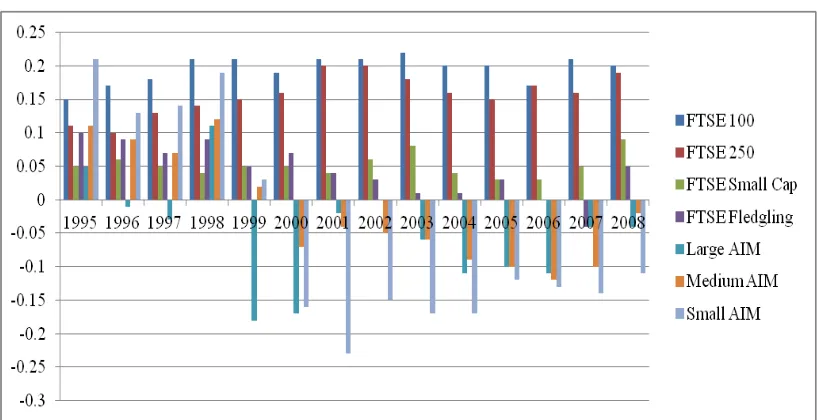
Figure 3-1: Annual Distribution of Different Measures of Leverage ... 89
Figure 4-1: Firms’ Characteristics of the AIM and Main Market ... 177
Figure 5-1: Delisting Reasons (AIM Evidence) ... 202
Figure 5-2: Non-Financial IPOs and Non-Financial Delisted
Companies ... 203
Figure 5-3: Event Study ... 210
viii
ix
List of Tables
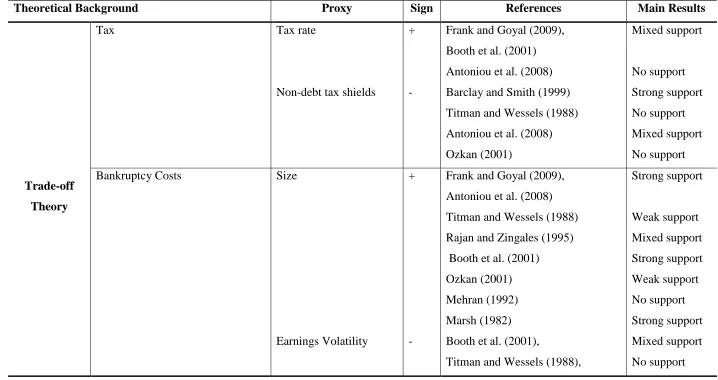
Table 2-1: Summary of the Previous Literature on the Determinants of
Leverage ... 45
Table 2-2: Comparison of the Main Market and the Alternative
Investment Market ... 52
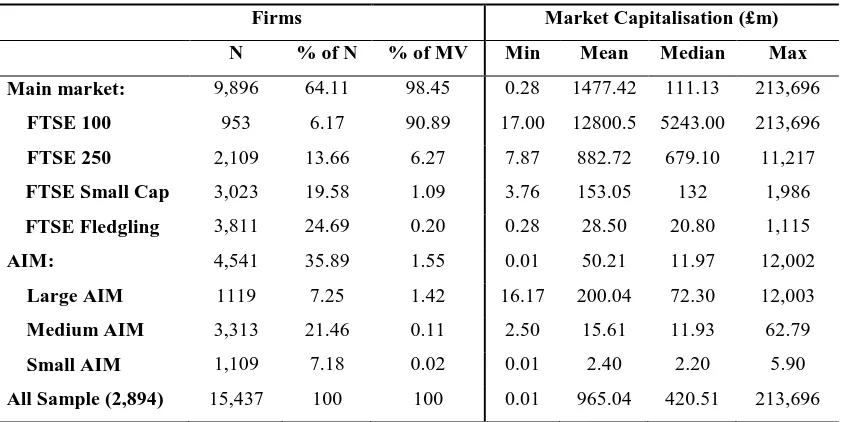
Table 3-1: Market Capitalisation of the AIM and Main Market ... 75
Table 3-2: Annual Distribution of the Number of Companies by Size
Groups ... 75
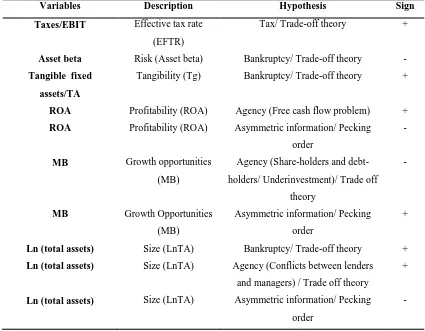
Table 3-3: Proxies for the Determinants of Leverage and Expected Sign
Observed From the Hypotheses ... 76
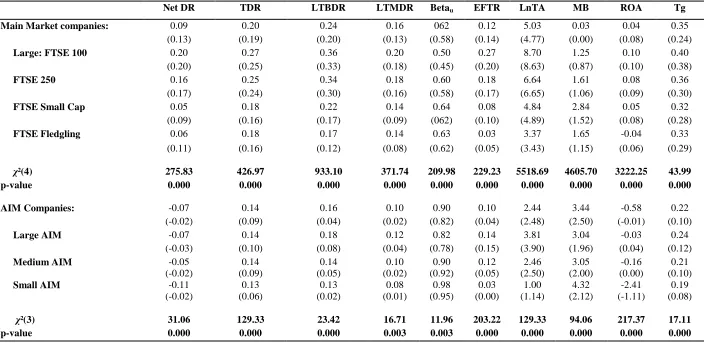
Table 3-4: Descriptive Statistics ... 86
Table 3-5: Least Square Dummy Variable Regression (LSDV) ... 93
Table 3-6: Estimated Fixed Effects Least Squares ... 102
Table 3-7: Regression Results of the Partial Adjustment Model... 111
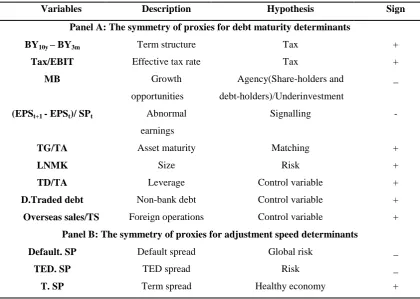
Table 4-1: The Summary of Proxies and Expected Signs ... 136
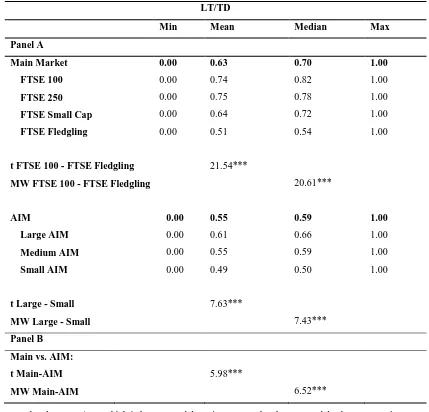
Table 4-2: Descriptive Statistics of LT/TD for Companies Listed on the
AIM and Main Market ... 145
Table 4-3: Univariate Analysis ... 149
x
Table 4-5: Determinants of Debt Maturity Structure across Firms’ Sizes
in the AIM and Main Market ... 160
Table 4-6: The Partial Adjustment Model of Debt Maturity Structure . 165
Table 4-7: Determinants of the Speed of Adjustment in the AIM and
Main Market ... 170
Table 4-8: Firms’ Characteristics at the Time of Going Public (IPO) and
the Post-IPOs ... 175
Table 4-9: The Partial Adjustment Model of Debt Maturity Structure
(IPO Sample) ... 180
Table 5-1: Time Series Distribution of Delisted Companies ... 205
Table 5-2: Proxies for the Determinants of the Delisting Decision and
Expected Sign Observed from the Hypotheses ... 207
Table 5-3: Number of Years that Delisted Firms Were Publicly
Traded ... 212
Table 5-4: The Characteristics of Delisted Firms and Control Firms over
Their Public Life ... 215
Table 5-5: The Characteristics of Delisted Firms and Control Firms .... 218
Table 5-6: Delisted Firms’ Characteristics at the IPO and Delisting
Year ... 223
Table 5-7: Logit Analysis for the Determinants of the Delisting
Decision ... 230
Table 5-8: Cox Proportional Hazard Model for the Delisting
xi
Table 5-9: Leverage and Debt-Equity Financing over the IPO Life
Cycle ... 249
Table 5-10: Market Reaction to the Delisting Announcement ... 252
Table 5-11: Market Reaction to Delisting Announcements Controlling
xii
xiii
Acknowledgments
I would like to offer my deepest appreciation to my first supervisor, Professor Meziane Lasfer, for his persistent support throughout my PhD study, and giving me the opportunity to be a part of his group. I would like to acknowledge his considerable encouragement on the development of this thesis through his constant advice, guidance and support. His collaboration provided me a fantastic opportunity to better comprehend the research’s principles and priorities my research objectives. I am also in debt to my second supervisor, Dr. Maria Carapeto, for transferring her precious and useful comments.
I offer my regards to academic and research staff at Cass Business School, City University London. Many thanks are due to Ph.D Officers, Ms. Malla Pratt and Mr. Abdul Momin for their administrative support. It is a pleasure to thank my friends and especially those in the corporate finance group, Dr. Hafiz Hoque and Dr. Dimitrios Andriosopoulos, who supported me throughout my PhD.
xiv
xv
Declaration
I grant powers of discretion to the university Librarian to allow this thesis to
be copied in whole or in part without further reference to me. This permission covers
only single copies made for study purposes, subject to normal conditions of
xvi
xvii
Abstract
This thesis aims to add empirical evidence to the corporate finance literature
by looking at the financing decisions with a specific application to small companies
in the context of the UK relatively highly regulated Main market, versus the lightly
regulated Alternative Investment Market (AIM). I do this by gathering data on all
quoted dead and alive companies in both markets from 1995 to 2008. I then split my
sample firms in each market into different size groups and test my hypothesis within
and across each group and each market. The thesis consists of six chapters. After an
introductory chapter, I review the existing literature on capital structure and debt
maturity controversies with an emphasis on recent empirical work. The next three
chapters consist of three research papers. The first paper looks at the capital structure
decisions of companies quoted in AIM and Main market across different size groups.
In the second research paper, the maturity structure of debt is investigated in both
markets. The third research paper tests the determinants of the delisting decision,
particularly the effect of leverage using a sample of AIM companies. In the last
chapter, I provide a summary of the main conclusions of the study and highlight
some promising ideas for future research.
The first empirical chapter analyses the drivers of leverage across firms’ sizes
and market of quotation. I find that companies that are listed on the Main market
have higher leverage than those listed on AIM. My results show that AIM companies
are subject to higher business risk and tend to have lower profitability and tangible
assets. In addition, in both markets, small companies are different from large firms in
their level of leverage, tangibility of assets, and profitability, suggesting that the
drivers of the financing choice are size dependent. Interestingly, the impact of
taxation is limited to only large companies in both markets. Similarly, the impact of
the agency conflict is also limited to large companies, as for small firms I find a
positive relationship between leverage and growth opportunities, in contrast to the
predictions of the agency theory. These results suggest that size rather than market of quotation is more likely to explain firms’ leverage. However, I find that the market
of quotation affects their speed of adjustment toward target leverage ratios. Using the
dynamic model of capital structure, I find that in the Main market, small companies
adjust more rapidly than large firms, suggesting that they rely more on bank debt and
xviii
more rapidly than small companies, suggesting that small AIM companies are
subject to the highest costs of adjustment as they have the highest business risk and
the lowest profitability.
The second empirical paper investigates the determinants of the structure of debt maturity across firms’ size groups in both markets. I find that firms quoted in
the Main market use longer maturity of debt in contrast to their AIM counterparts.
However, the structure of debt maturity is different between small and large
companies, as small companies use shorter debt maturity. Moreover, I find that the
determinants of debt maturity are relatively different across the two sets of markets,
suggesting that the market of quotation, are likely to affect the structure of debt
maturity. Particularly, the effect of leverage is mixed in those markets. In the Main
market, companies with higher leverage use more long-term debt in contrast to those
quoted in the AIM. In line with my results in the previous chapter, I find that the
speed of adjustment depends on the market of quotation. Using a dynamic
framework, I find that companies have a target debt maturity, but, while in the AIM
large companies adjust more rapidly than small companies, I find the opposite in the
Main market.
I also contribute to the literature by assessing the impact of firm’s life cycle
on its choice of debt maturity. I use a sample of newly listed firms and assess the
evolution of the maturity structure of their debt four years after their IPO. I find
strong differences across the two markets. In the Main market, my empirical
evidence shows that in contrast with small companies, large companies change the
structure of their debt maturity significantly as they are more likely to use longer
maturity of debt in the post-IPO period. While in the AIM, the structure of debt
maturity is not affected by size as neither large companies nor small companies
change their debt maturity significantly.
In the last empirical chapter, I study the impact of leverage on the delisting
decision. I address the following questions: Do firms delist from the stock market
because they are unable to raise equity capital and redress their balance sheet?
Previous studies state that raising equity capital is one of the main benefits of stock
market quotation. I expect firms that are not likely to take advantage of this benefit to
have higher listing costs and more likely to delist. I use leverage as a proxy variable
and a sample of voluntary delisting from AIM. I find that delisted companies have
xix
suggest that companies with higher leverage are more likely to delist voluntarily.
These results hold even after controlling for agency conflicts, liquidity, and
asymmetric information. I also investigate how the market reacts to the delisting
announcement. I find that on the announcement date, stock prices decrease
significantly. However, this reaction is not consistent with previous studies that
report positive excess returns for companies that go private through different forms
of buyouts. The voluntary delisting does not deliver good news to the market and
hence voluntary delisting leads to a decrease in stock prices. I also find that firms
that increased their leverage in the year prior to the delisting decision generate
significantly lower excess returns than other firms. I compare my results to firms that
delisted from the AIM but moved to the Main market. I find that that these firms
generate statistically higher and positive returns than the remaining firms that
delisted voluntarily. My results highlight the negative impact of leverage and a lack of equity financing on firms’ market valuation.
My results contribute to the literature and to policy making in several ways.
First, I test various controversial and new hypotheses by focussing on differences in
institutional settings between the AIM and the Main market. The former is less
regulated and it is more likely to attract younger, high growth, and riskier companies.
These differences allow me to test various hypotheses developed in previous
literature relating to the financing choices of firms. In addition, I provide a deeper
analysis of the impact of size on the firms’ financing choices. I focus on the
differences in leverages across the two markets, changes in maturity from the IPO
dates, and the drivers of the decision and timing from the IPO date of companies in
the UK. Unlike previous studies, I show that the theoretical determinants of leverage, such as taxation and agency costs, across firms’ size groups are not homogeneous,
independently of the market quotation. However, I find significant differences across
the two markets in terms of dynamic changes in leverage. In addition, my results
highlight the impact of leverage on the decision to delist, and imply that policy
makers need to facilitate the financing of companies when they list on the market, so
that the benefits of listings outweigh the costs, and firms will not rush to voluntary
xx
1
Chapter 1 - Introduction and Overview of the Thesis
1.1 Introduction
More than fifty years ago, Modigliani and Miller (MM, 1958) showed that the value
of the firm is independent of its capital structure. This theoretical finding is based on
a number of critical assumptions, namely, a perfect capital market where there are no
taxes at both corporate and personal levels, no transaction and bankruptcy costs,
managers are rational, thus no agency costs, investors and companies can borrow at
the same rate, and all participants have access to all relevant information. They use
arbitrage argument to show that if firms can change their market value, rational
investors can take actions to offset any changes in the firms’ capital structure. In
particular, investors are able to substitute personal leverage (home-made leverage)
for corporate leverage and therefore, any profit for the firms and the investors would
be eliminated.
One of the main contributions of MM is the identification of the factors that
are expected to affect the choice of leverage and, thus to make capital structure
relevant for firm’s valuation. Subsequently, a large number of studies focus on these
factors and the impact of leverage on firm’s value by assessing how and why each of
the assumptions in the MM model contributes to the determination of the firm’s
capital structure. The relaxation of the MM assumptions has led to what is referred to
as the trade-off theory. This theory is based on the premise that companies are
expected to set up their level of leverage by weighing the costs and the benefits of
debt financing. Firms would benefit from using debt through the interest tax
deduction and mitigating the agency conflict. At the same time, debt is subject to
2
set up their optimal level of leverage by maximising the benefits of debt and
minimising its costs.
An alternative framework is provided by Myers (1984) who developed the
pecking order theory, under which firm’s capital structure is not driven by the MM
assumptions but the preference of firms to use internal funding before recurring to
raise capital in the form of, first, debt, and then equity, to minimise the transaction
and the monitoring costs. This theory suggests that firms with high cash flows are
expected to use less debt because they would prefer to finance their investments
internally, rather than recurring to external financing. In contrast, under the trade-off
theory, profitable firms are more likely to use more debt because they are less likely
to have high expected bankruptcy costs as their probability of going bankrupt is low.
There are also additional fundamental differences between the two theories.
In terms of agency conflicts, the trade-off theory suggests that firms that are likely to
have high agency conflicts should use more debt. Jensen (1986) and Stulz (1990) put
forward alternative debate in favour of using debt as a device to mitigate the free
cash flow problem due to the conflict between managers and shareholders. These
conflicts can include the possibility that the managers may prefer to reinvest funds
even if paying out cash is better for shareholders, to continue with firm’s operation
even if liquidation is preferred by shareholders, or to choose risky projects that will
benefit shareholders at the expense of debt-holders. In this case debt can reduce the
free cash flow, allows bondholders the option to liquidate, and allows shareholders to
gain if financially distressed firms make risky investments. However, Myers (1977)
argues that the conflict between shareholders and debt-holders would result in
underinvestment problem, covenant constraints, and costs of production of
3
Myers (1977) also suggests that the maturity structure of debt will affect the
underinvestment problem as it can be alleviated through shorter debt maturity.
Accordingly, the maturity structure is expected to be affected by the conflicts
between managers, shareholders, and debt-holders, together with other factors such
as the liquidity hypothesis (Diamond, 1991 and 1993) and taxation (Brick and Rivid,
1985). In particular, these theories predict that firms with shorter maturity of debt are
more likely to have low tax benefits, high underinvestment problem, and more
vulnerable to financial distress. As a result, they are expected to prefer lower
leverage. These theories will be discussed in more details in chapter two.
The empirical analysis provided to-date is mixed. First, there are difficulties
in finding good proxy variables for each of the theoretical determinants. For
example, previous studies (e.g., Booth et al., 2001) use the effective tax, the ratio of
corporate tax liability over profit before tax, to assess the tax impact. They find that,
in contrast to the theoretical predictions, a negative and significant coefficient,
suggesting that firms that pay higher taxes have higher leverage. They suggest that
the measure of taxation is likely to reflect profitability rather than tax impact. The
predictions of the proxy variables are also controversial. In particular, while the
trade-off theory predicts a positive relationship between leverage and profitability, as
profitable firms are more likely to have a higher debt capacity because they are less
risky, the pecking order theory predicts a negative relationship as profitable firms
will have internal funds to use first before recurring to debt financing. Similarly, the
relationship between leverage and growth opportunities, as measured by
market-to-book ratio, is expected to be negative under the trade off theory as high growth firms
are more risky and have higher agency conflicts between shareholders and
4
predicts a positive relationship as high growth companies prefer to use debt financing
because they are more likely to have lower internal funds to finance their high
growth potentials.
Previous studies account for the size effect by including in the regressions the
size variable. However, this method misses the specific characteristics of small
companies which are likely to affect the choice of leverage and debt maturity. In
addition the interpretation of the regression coefficient of this variable is likely to be
controversial, as size does not relate to only a single hypothesis. From the trade-off
theory, large companies are less likely to have high growth opportunities and/or less
likely to go bankrupt, thus they have lower risk and lower expected bankruptcy costs,
and as a result, they should have higher leverage. Similarly, large firms are more
likely to have higher agency conflicts between shareholders and managers (Jensen,
1986), thus they are expected to have a higher leverage. However, the pecking order
theory predicts that large firms will have low leverage because of their higher
internal cash flow and lower information asymmetries that will allow them to raise
equity at lower transaction costs.
In this thesis I contribute to the literature for focussing more on the
differences in the determinants of capital structure and the maturity structure of debt
of small and large firms, and on the impact of market quotation. I also expand my
analysis to assess whether leverage contributes to the stock market delisting decision.
I explore further the size effect on leverage and debt maturity. Early studies (e.g.,
Evans, 1987) suggest that small firms have higher growth opportunities. However,
the growth of those firms is constrained by internal and external finance. Small
companies are more likely to have asymmetric information problems, and, thus, they
5
appropriate for those firms with little collateral value. As small firms have lower
tangible assets, they may have difficulties in raising external finance (e.g., Hubbard,
1998; Carpenter and Petersen, 2002; and Beck et al., 2008). Tamari (1980) argues
that small firms have higher variability in their earnings and thus more likely to
experience a greater degree of risk. Therefore, the differences between small and
large companies provide a recent path of research to examine the related factors on
the debt-equity decision and ability to raise external financing.
However, the question whether small firms have different drivers of capital
structure and debt maturity is still controversial. Previous studies provide mixed
evidence on the impact of the trade-off and pecking order theoretical predictions on
leverage and debt maturity of small and medium sized companies. For example,
inconsistent with the trade-off theory, Cassar and Holmes (2003) find that growth
opportunities are positively related to leverage, while and Esperanca et al. (2003)
show no impact of growth opportunities on leverage. Similarly, Jordan et al., (1998),
Michaelas et al., (1999), and Jõeveer, (2005) provide inconsistent results on the
impact of taxes on leverage of small firms. In addition, inconsistent with asymmetric
information and bankruptcy hypotheses, Esperanca et al. (2003) find that size in
negatively related to leverage, but other empirical studies support the positive effect
of size on leverage (e.g., Cassar and Holmes, 2003 and Daskalakis and Psillaki,
2008).
Previous studies also provide mixed results on the determinants of the
maturity structure of debt. For example, Cressy and Olofsson (1997) find that small
companies have high proportion of short-term debt; in particular they use debt in the
form of overdrafts to cover their growth opportunities. Chittenden et al. (1996)
6
companies with lower fixed assets have less collateral, thus they are less able to rely
on long-term debt. In addition, Myers (1977) argues that the underinvestment
problem that happens in the case of the conflict between shareholders and
debt-holders is mitigated if firms with more growth opportunities use shorter maturity of
debt. Therefore, empirical studies expect a negative relationship between the
maturity structure of debt and growth opportunities, but to date, the results are
mixed. Inconsistent with the agency conflict in the form of underinvestment problem,
Hall et al. (2004) find that the effect of growth opportunities is not significant on the
maturity structure of debt. Scherr and Hulburt (2001) also report little empirical
support for the impact of growth opportunities on debt maturity structure. The
literature investigates the impact of asymmetric information on the maturity structure
of debt, yet this literature does not find conclusive evidence. Empirical studies use
size as a proxy for asymmetric information and they argue that larger companies use
longer maturity of debt because they established a reputation and thus they have
lower level of asymmetric information. Hall et al. (2004) and García-Teruel and
Martínez-Solano (2007)find that size is positively related to long-term debt but in
contrast to Scherr and Hulburt (2001), who find that larger firms use short-term debt.
In the IPO literature, the focus is more on whether firms, by accessing the
capital market, raise further capital to rebalance their leverage. For example Pegano
et al. (1998) and Kim and Weisbach (2005) find that companies issue shares to
reduce their leverage after going public. Similarly, Bancel and Mittoo (2008) survey
a number of newly-listed firms in Europe. They find a significant reduction in
leverage after the IPO suggesting that firms raise equity capital to rebalance their
leverage. Using US data, Brau and Fawsett (2006) find that firms go public to raise
7
Therefore, it is expected that companies that are not able to raise equity capital,
either to reduce their leverage or to finance their growth opportunities, are more
likely to delist voluntarily. To my knowledge, there are only two related empirical
studies that investigate the determinants of the delisting decision (Marosi and
Massoud, 2007 and Leuz et al., 2008). However, both these studies mainly look at
the impact of the corporate governance and the regulatory compliance of the
Sarbanes-Oxley Act on July 31, 2002 on the decision to delist. Marosi and Massoud
(2007) find that the Sarbanes-Oxley Act (SOX) and the compliance cost are major
determinants of the delisting decision. Leuz et al. (2008) find a large impact of the
SOX on the delisting decision. In addition, they find that the free cash flow problem
associated with the agency cost is highly significant. These two studies are based on
US institutional setting where, when companies delist voluntarily, they mainly carry
on trading on the Pink Sheets,1 while in the UK they transfer into another market or
they go private, and they relatively ignore the impact of debt-equity financing on
such a decision.
1.2 Gaps in the Literature
With respect to previous empirical studies, various criticisms can be addressed. First,
to-date, the literature provided mixed and controversial evidence on the determinants
of capital and debt maturity structures. For example, firm size is found in many
studies to be positively related to leverage (e.g., Rajan and Zingales, 1995 and Booth
et al., 2001), but Titman and Wessels (1988) find a weaker relationship between
leverage and size, and, more especially, the positive relation is not reported by
Mehran (1992). Similarly, the results for the market-to-book ratio as a proxy for
1
8
growth opportunities are mixed. Using large companies, Rajan and Zingales (1995),
Baker and Wurgler (2003), Booth et al. (2001) and Frank and Goyal (2004, 2009)
show that leverage is inversely related to the market-to-book ratio, while for small
companies, Michaelas et al. (1999) and Jordan et al. (1998) find that growing firms
use more debt in their capital structure. Small growing companies are less likely to
generate sufficient internal financing and less likely to issue equity owing to the
asymmetric information problem. Therefore, they rely more on debt to finance their
growth opportunities. With respect to the maturity structure of debt, consistent with
the agency theory, Barclay and Smith (1995) find that debt maturity is positively
related to firm size. They suggest that larger firms with less growth opportunities are
less likely to suffer from the underinvestment problem associated with the agency
conflict between shareholders and debt-holders, and hence use more long-term debt.
Unlike large firms, small companies rely more on bank debt, which has shorter
maturity than public debt. Therefore, I expect that small companies have lower
leverage and shorter maturity of debt.
The literature on leverage and debt maturity structure predominantly analysed
theoretically and empirically the capital structure decision of large companies.
Relatively, less research is focused on small companies. In particular, the application
to the theoretical determinants of the debt maturity structure to the characteristics of
small firms has not been exhaustive. The specific characteristics of small companies
are likely to highlight a large number of interesting issues relating to the way
companies make this crucial decision. For instance, Chittenden et al. (1996) argue
that small firms are subject to a significant agency problem in the form of
asymmetric information, as insiders have higher information than outside investors.
9
much information and hence monitoring becomes costly and more difficult. Small
firms also encounter difficulties in raising external finance owing to significant costs
of dealing with the asymmetric information and hence the role played by collateral is
more crucial for small firms. Prior literature generally uses size as an explanatory
variable to control for asymmetric information, bankruptcy costs, and agency
conflicts. Other studies highlight the strong differences in fundamental
characteristics between small and large companies. To my knowledge, previous
studies do not provide an in-depth analysis of the impact of the differences in
characteristics between large and small firms on leverage and debt maturity structure.
I attempt to fill this gap by investigating the determinants of leverage and debt
maturity structure of small companies relative to large firms and noting whether the
specific characteristics of small companies would result in different drivers of the
decision. I expect that the determinants of capital and debt maturity structures depend
upon firm size.
Previous studies document the determinants of capital structure and debt
maturity structure in predominantly the US market, but they do not address the
impact of the market of quotation. Fan et al. (Forthcoming in JFQA) argue that the
corporate financing choices are determined by the characteristics of the firm as well
as the institutional environment. They suggest that a firm’s capital structure is likely
to be affected first by the differences in institutional factors and then by firms’
characteristics. They find that firms operating in weaker legal system use less
external equity and shorter maturity of debt. Prior literature addresses the
institutional differences between countries (e.g., Rajan and Zingales, 1995 and Fan et
al., Forthcoming in JFQA), but does not address the institutional differences in the
10
London Stock Exchange includes two distinct markets, the Main or Official List
Market which is relatively highly regulated, and AIM, a market mainly for small and
high growth firms, with relatively lighter regulation. In particular, AIM companies
are subject to a minimum market capitalisation, minimum free float, and no trading
record, compared to IPOs on the Main market which should have a minimum of
three years trading record and at least 25% of shares in public hands (see Jenkinson
and Ramadorai, 2008).2 Thus, I distinguish between these two markets as they are
not previously explored in the literature, and they provide good testing grounds for
the various hypotheses developed in the past literature to explain leverage and debt
maturity.
The literature on debt maturity generally applies firms’ characteristics as
major determinants of the maturity structure of debt, but does not investigate firms’
characteristics in the post-IPO period. A fundamental gap in the literature is the lack
of examination of how firms’ characteristics, in particular debt maturity, have
changed over firms’ life cycle. This thesis attempts to fill this gap with studies of
how the structure of debt maturity may change in both the Main market and AIM. I
aim to answer whether the changes of debt maturity are fairly similar across firm size
and in both markets, after controlling for other IPO fundamental factors that proxy
for information asymmetries, agency costs and risk.
Since its launch in 1995, AIM has attracted a large number of small and high
growth companies that would not be eligible for quotation on the Official List
market. Despite its development, the number of companies choosing to delist from
AIM increased significantly, particularly in the last few years. In 2011, the Financial
Times reports “the first quarter saw 30 delistings, down from 51 in the first quarter of
2 The differences between AIM and the Main market are explained in details in Chapter 2 (Literature
11
2010. But news emerged ahead of the Easter break of two more companies asking
shareholders for permission to leave. Both have been on AIM for several years….”.3
So far, to the best of my knowledge, prior empirical studies have not addressed the
determinants and the consequences of the delisting decision in AIM. The majority of
IPO studies (e.g., Pagano et al., 1998; Kim and Weisbach, 2005; and Bancel and
Mittoo, 2008) suggest that raising equity capital in order to rebalance the level of
leverage is a main benefit of going public as an IPO. They find that companies with
high leverage are more likely to be listed. A major gap in those studies is an
examination of the debt-equity financing and the decision making of companies in
order to opt to delist. However, more recently, Marosi and Massoud (2007) and Leuz
et al. (2008) investigate the determinants of voluntary delisted firms in the US, but
they have not provided evidence on the impact of financing opportunities on the
decision to delist. Those studies mainly look at the impact of the corporate
governance and the regulatory compliance of the Sarbanes-Oxley Act on July 31,
2002 on the going-dark decision using larger companies. Marosi and Massoud
(2007) find that the Sarbanes-Oxley Act (SOX) and the compliance cost are the
major determinant of the delisting decision. Leuz et al. (2008) find a large impact of
the SOX but not all, as the free cash flow problem associated with the agency cost is
reported highly significant. In addition, these two studies include both financial and
non-financial companies. However, previous studies argue that leverage of financial
companies is strongly affected by capital requirements and investor insurance
schemes and hence their level of leverage is not comparable with that of
non-financial companies (e.g., Rajan and Zingales, 1995). Therefore, leverage that
12
Marosi and Massoud (2007) and Leuz et al. (2008) use could have different
interpretations.
There are significant institutional differences between the UK and the US in
terms of the delisting decision. In the US companies that intend to delist have two
options; fist, they need to delist from the exchange (NYSE, AMEX, or NASDAQ),
which may take about 21 days depending on the exchange. In this situation, firms
continue to trade over the counter or on the Pink Sheets. Then they may need to file a
form 15 in order to deregister from SEC and this step takes about 60 days. Once they
deregistered, they are not required to provide public information (e.g., Macey et al.,
2008, and Marosi and Massoud, 2007). In contrast, in the UK, a firm decides to delist
voluntarily either to transfer to another market, or, more importantly, to become a
private company. In this situation, investors have two choices; either sell their shares
before the delisting date, or remain shareholders in the privately owned company.
The delisting process goes through one step. In accordance with Rule 41 of AIM, a
firm should notify the London Stock Exchange to cancel its trading at least 20 days
prior to such date. This should be conditional upon the approval of not less than 75%
of votes cast by shareholders in the general meetings (see AIM publications in
London Stock Exchange).4 Very recently, Espenlaub et al. (Forthcoming in JBFA)
investigate the impact of the regulation on the survival AIM IPOs. They find that if
AIM increases the minimum requirements on the size and the age of the company,
IPOs have greater chance for long-term survival. They compare survivors to
companies that delist due to merger and acquisition and other negative reasons, but
they do not distinguish between voluntary delisting and other forms of delisting, such
4
AIM rules can be downloaded from the London Stock Exchange,
13
as delisting due to market regulations, which is important to the propose of their
study.
1.3 Main Contributions and Findings
The financing decision of small and medium sized companies is still controversial
and the relatively mixed results in the previous literature beg the following questions;
first, what factors determine capital structure decision. Under the capital structure
theory, to maximise its value, a firm needs to decide on the level of its leverage,
whether to raise debt or equity, if it needs external financing, and whether to use long
or short-term debt. My aim in this thesis is to assess the factors that determine small
firms’ debt level and its maturity structure, and whether their limited ability to raise
equity leads them to delist from the stock exchange, as one of the main purpose of
being quoted is to rebalance their leverage. I, therefore, focus on the impact of
leverage on the delisting decision. I contribute to the existing literature by analysing
the effect of size, as small companies have different asset tangibility, asymmetric
information, agency conflicts, and bankruptcy probability. I also investigate the
impact of market of quotation on debt financing, by distinguishing between the AIM
and Main market in the UK to assess further the impact of stock market regulation.
The findings of this thesis can be summarised as follows. The first empirical
paper (Chapter three) assesses the similarities and differences in the determinants of
capital structure across firms’ sizes listed on both the Main market and AIM of the
London Stock Exchange (LSE). I hand-collect data on FTSE index series (FTSE 100,
FTSE 250, FTSE SmallCap, and FTSE Fledgling).5 I investigate 2,894 companies
over the sample period from 1995 to 2008. The empirical evidence has been
5FTSE 100 presents the largest companies while FTSE Fledgling presents the smallest companies in
14
estimated by panel data methodologies, including the fixed effects model and
Generalised Method of Moments (GMM), which allow me to control for unobserved
firm-specific effects as well as the endogeneity problem by using instruments. I find
that the determinants of leverage are likely to be dependent critically on firms’ size
and the regulation inherent in the market in which they are quoted. I show that the
tax effect depends on the size of the firm. While for large firms the effective tax rates
are positively related to leverage, they are not significant for small firms. These
results suggest that, since small firms are likely to have high income volatility, they
are not able to fully set their debt level optimally to take full advantage of the interest
tax shields. In addition, I find that consistent with the trade-off theory, leverage is
positively related to tangibility across firms’ sizes. Unlike previous empirical studies,
I use asset beta as a proxy for bankruptcy costs signifying that all observed
companies are considerably negatively affected by their business risk. However, the
sensitivity of leverage to asset beta is greater for companies that are listed on AIM.
My results also provide strong evidence to support the prediction of the
pecking order theory. All measures of leverage are inversely related to profitability in
line with the empirical studies of Michaelas et al. (1999), Rajan and Zingales (1995)
and Booth et al (2001), but in contrast to Hall et al. (2004). However, the leverage of
small companies listed on AIM and the Main market are less sensitive to
profitability. It is likely that the profitability of those companies is also a proxy for
quality of investment opportunities discussed by Rajan and Zingales (1995) who
argue that profitability for small firms may be a proxy for internal fund as well as
investment opportunities, which have conflicting effects on leverage.
Interestingly, the relationship between leverage and market-to-book is
15
market, while, for large firms, consistent with the trade-off theory, market to book is
negatively related to leverage, the relationship is positive for small firms, in line with
the predictions of the pecking order theory. These results suggest that large firms are
more likely to finance their growth opportunities with equity, while small firms are
more likely to rely on debt financing, even to finance their growth options. The
positive impact of growth opportunities on leverage for small companies is not
consistent with the agency hypothesis in the form of underinvestment problem.
Titman and Wessels (1988) suggest a firm’s value increases with its growth
opportunities, and this would result in an increase in its debt capacity and thus its
leverage. The positive relationship between leverage and growth opportunities are
also reported by Michaelas at al. (1999), Cassar and Holmes (2003), and Hall et al.
(2004) also report similar results based on small companies.
Finally, I find that firms appear to have target debt ratios, but they eliminate
their deviation by different speed of adjustment depending on the capital market in
which they are listed. In the Main market, the findings show that small companies
adjust more rapidly than large ones but in contrast to firms quoted in AIM. These
results suggest that in the Main market, larger companies use more public debt,
which is more expensive than the private debt, and, hence, larger companies adjust
towards their target leverage at relatively slower speed. However, AIM companies
rely more on private debt and it is likely that the financing constraint has a first-order
effect on the speed of adjustment towards target leverage. The smallest AIM
companies appear to be the most financially constrained, and thus they adjust
towards the target least rapidly.
The second empirical paper (Chapter four) focuses on the impact of size and
16
use FTSE index series to control for firms’ size. Like the first paper, my sample
comprises 2,894 companies over the period 1995-2008 and similar methodologies
are used in this paper. The results show that small companies have shorter maturity
of debt relative to large companies. However, I find that companies listed on the
Main market have longer maturity of debt and thus AIM small companies have the
shortest maturity of debt in the UK. Moreover, I find that the determinants of debt
maturity are relatively different across the two sets of markets, suggesting that
market of quotation is likely to affect debt maturity structure. My findings provide
strong support for the signalling hypothesis across firms’ sizes that are listed on the
Main market in contrast to AIM, where the negative effects of abnormal earnings are
not significant. In the Main market, I find a negative and significant relationship
between abnormal earnings as a proxy for firms’ quality and long-term debt.
I also find mixed evidence for the effect of leverage, used as a control
variable and expected to be positively related to debt maturity. In the Main market,
long-term debt is positively related to leverage while in AIM, the relationship is
negative. The results for Main companies are in line with the liquidity argument that
firms with long-term debt have low liquidity risk, thus have high leverage. In
contrast, the results for AIM suggest that the underinvestment problem is highly
significant and hence firms that maintain long-term debt have an incentive reduce
their leverage to mitigate the underinvestment problem. In addition, consistent with
the tax hypothesis, the term structure of interest rate has a positive and significant
effect across firms’ sizes. However, when I use the effective tax rate as an
explanatory variable, the positive and significant relationship is limited to large firms
in both markets. These results are likely to be driven by the level and variability of
17
lower profits margins, resulting in lower tax rates as they operate in less concentrated
markets, and, thus, greater competitive pressures. Consistent with the
underinvestment problem associated with the agency theory, in both the Main market
and AIM, the results indicate that market-to-book ratio has a considerable negative
effect on debt maturity structure across different companies.
I account for the dynamic effect of debt maturity structure by using the GMM
panel data methodology. I find that firms appear to have target debt maturity but they
eliminate their deviation by different speeds of adjustment, depending on the capital
market in which they are listed. In AIM (Main market), the findings suggest that
small companies adjust more rapidly (slowly) than large ones. The empirical
literature on the dynamic framework of debt maturity structure provides mixed
evidence for the speed of adjustment. For the UK data, Ozkan (2000) finds that
companies adjust to the target ratio relatively fast (0.55%). Antoniou et al. (2006)
concludes that the French companies have a higher speed of adjustment than their
UK counterparts. A fundamental gap in those studies is the lack of examination of
how macroeconomic factors would affect the speed of adjustment. I find that in both
markets, the default spread as a proxy for global risk has a positive and significant
effect on the speed of adjustment. This result is generally consistent across firms’
sizes.
I also assess how firms’ characteristics of the newly listed sample evolve over
the IPO period. In particular, I try to add insight as to how debt maturity changes for
the four years following the IPO. I find strong differences across the two markets, as
Main and AIM companies differ substantially in the change of their debt maturity
after the IPO. In the Main market, my empirical evidence shows that, in contrast with
18
because of their higher tax benefits and lower business risk. While in AIM, the
structure of debt maturity is not dependent on size, as both large and small
companies do not change their debt maturity significantly. One possible explanation
for this result has to do with the lack of debt market access for AIM companies.
The last empirical paper (Chapter five) of this thesis tests for the impact of
leverage on the delisting decision from AIM. I hand-collect the sample of 184
companies that decide to delist voluntarily from AIM over the period 1995 to 2009.
The data set at the time of the IPO is unique as it is hand collected from company
prospectuses. I apply two alternative estimation methods (the logit and Cox
proportional hazard model) to test my hypotheses. I find that leverage and growth
opportunities at the time of the IPO contribute significantly to the delisting decision.
The logit analysis reports that leverage has a significant and positive impact of the
delisting decision. This finding is also supported by Cox proportional hazard model,
which controls for the period that the delisted companies were publicly listed on
AIM. I analyse the debt-equity financing over the IPOs’ life cycle. The results
indicate that delisted companies issue debt over their public life in contrast to the
remained public companies that raise significant amount of equity. My results
suggest that firms delist when there is no benefit of being quoted, as measured by
their inability to raise equity capital and to rebalance their leverage. Moreover, I use
the market model as one of the frequent methodologies in event studies to investigate
the reaction of stock returns to the delisting announcement. I find significant negative
abnormal returns upon delisting from AIM, while those companies that move to the
Main market experience positive abnormal returns.
The three empirical papers presented in this thesis contribute to the exiting
19
theoretically and empirically the determinants of leverage, the main drivers of capital
structure decision is still a puzzle. More especially, previous empirical studies
predominantly focus on large public companies and the application to small firms
has not been exhaustive. The specific characteristics of small companies allow me to
highlight a large number of interesting issues relating to the way companies make
this crucial decision.
Second, studies based on the maturity structure of debt do not consider the
UK market quotations as well as firms’ entire IPO life cycle. I contribute to the
extensive literature by assessing maturity structure through the firm’s life cycle. For
this purpose, I study the characteristics of IPOs in both the Main market and AIM,
where those characteristics are relatively different in the post-IPO period. I find that
for the Main market, the mean (median) of maturity is increasing after IPO for large
firms but for small firms maturity is constant. For AIM, the mean (median) of
maturity is relatively constant, decreasing for small firms.
Moreover, by constructing a unique data set on FTSE index series, this
research provides further empirical evidence on characteristics of firms of different
size in order to investigate capital structure as well as debt maturity structure. Whilst
the literature on capital and debt maturity structures is extensive (see reviews of
Harris and Raviv, 1991, Rajan and Zigales, 1995; Booth et al., 2001; Fama and
French, 2002; and Frank and Goyal, 2009), the reported evidence is still puzzling,
and the question as to whether companies with different size and in different
institutional settings have the same financing behaviour is still contentious. I
contribute to previous evidence by focussing on the impact of size and regulations of
the market of quotation which, previous studies have not analysed extensively. In
20
regressions to proxy for the signalling, free cash flow, financial flexibility and
bankruptcy costs hypotheses, I analyse the determinants of leverage and the maturity
structure of debt across and within different size groups to assess whether the firm
specific factors contribute to the significant differences in leverage and debt
maturities between small and large firms. I also assess whether the determinants of
leverage and debt maturity structures tested in previous studies apply also to different
size groups.
Similarly, while previous studies are either market specific, or analyse
leverage across countries with aggregate country-level classifications, I test my
hypotheses by focussing on the regulation and other institutional settings in one
country with two different markets. More specifically, I assess whether the financing
behaviour of firms in the UK depends on whether the firm is quoted in the Main
market, which is relatively more regulated, or on AIM where firms are relatively
younger, riskier, have high growth, and subject to less governance restrictions and
regulations, but they have to maintain a corporate broker, referred to as Nomad
(Nominated Adviser), which underwrites any new equity capital raised by the firm. I
identified the size and market of quotations as significant gaps in the literature which
I tried to fill in my thesis.
I find strong differences across firms’ size groups and market of quotation in
terms of their leverage and debt maturity structures which I relate more the firms’
specific characteristics within each size group, and to the institutional settings of the
specific market in which the firm is quoted. In particular, I show that since large
firms are relatively more mature with low risk and high interest tax deductibility
potentials that results from their high profitability, they can afford to have higher
21
differences across the two markets as, after controlling for size, firms in the Main
market have higher leverage and maturities than firms quoted in AIM. My analysis
also shows that size affects changes in leverage of newly listed firms. I find that in
the post-IPO period, small firms tend to have lower leverage and lower maturity,
while large firms tend to increase their level of debt and the proportion of their
long-term debt. Large firms tend also to become even larger after quotation while small
firms remain relatively the same or decline. These results imply that small firms do
not benefit from market quotation and this is highlighted even more in my last paper
where I show that small firms quoted mainly on AIM are more likely to delist
voluntarily because their leverage remains high after quotation as they are unable to
raise equity capital and to finance their growth options. As far as I am aware, these
results are not documented in previous studies and my contribution implies that size
cannot just be considered as a simple proxy variable in leverage and maturity
regressions as firms in different size groups have different specific characteristics
which impact on their financing decisions.
Finally, I use a unique hand collected data set to define the characteristics of
delisted companies. To the best of my knowledge, the determinants and the
consequences of the delisting decision in AIM has not been fully analysed in the
literature. However, two recent published papers (Marosi and Massoud, 2007; and
Leuz et al., 2008) analyse the determinants of the delisting decision in the US
market. I add to those studies by analysing AIM, as the delisting transaction is
significantly different from the US market.
The rest of this thesis is organised as follows. Chapter 2 provides the
theoretical and empirical review of the related literature. Chapter 3 presents the first
22
Chapter 4 provides the second empirical paper, which examines the impact of size
and market of quotation on the maturity structure of debt. Chapter 5 presents the
third empirical paper, which analyses the impact of leverage on the delisting
decision. Chapter 6 summarises the findings and concludes the study. It also presents
23
Chapter 2 - Literature Review
2.1 Introduction
In this section, I provide a summary of the development of the related literature,
which is vast and controversial, and identify gaps in previous studies. The overall
aim of my thesis is to study the determinants of capital and debt maturity structures,
with particular application to small companies. Therefore, I will cover two main
issues in this chapter. First, I review the prominent theories of capital structure. The
second part reviews the controversies in the literature, providing the theoretical
arguments followed by a review on empirical debates.
2.2 Theoretical Background
2.2.1 Modigliani and Miller
The question as to whether firms can create value by combining securities has been
the subject of many theoretical as well as empirical investigations. Starting with the
proposition of Modigliani and Miller (MM model, 1958) that the capital structure is
irrelevant to firm’s valuation, a number of studies assess the conditions under which
this statement applies. MM (1958) derive their model under a number of critical
assumptions, namely, a perfect capital market in which there are no taxes at either
corporate or personal level, no transaction costs, and no agency costs (because
managers are rational); investors and companies can borrow at the same rate; and all
participants have access to all relevant information. However, this theory does not
reject the possible preference of a firm’s owner for a certain type of financing over
others and, particularly, it provides conditions under which the capital structure of a
24
each of the assumptions in the MM model contributes to the determination of the
firm’s capital structure. Three main theories, the trade-off theory, the pecking order
theory, and the market timing theory, have been developed. I shall discuss the main
theories of capital structure in detail in the following sections.
2.2.2 Trade-off Theory (TOT)
Modigliani and Miller (1963) started by relaxing the assumption of corporation tax,
keeping the remaining assumptions of perfect capital markets with no bankruptcy or
agency costs. They show that firm value becomes an increasing function of debt
because the tax deductibility of interest payments decreases the expected tax liability,
resulting in an increase in the after-tax return to all shareholders. Therefore, using
debt would be preferred to issuing equity, because of the expected reduction in tax
liability. Their main finding is that the value of a levered firm is equal to that of an
unlevered firm plus the present value of tax benefits, equal to the amount of debt
when in perpetuity times the corporate tax rate. Subsequent studies suggest, however,
that the assumption of a fixed corporate tax rate at different levels of debt may be
excessively strong. In particular, as the level of debt increases, the potential
corporation tax rate decreases since the firm may be making losses, and thus may be
unable to pay/claim corporation tax (Brealey et al., 2008). Moreover, the analysis is
limited to corporation tax. In practice, this effect should also include personal taxes.
Miller (1977) introduces such effects into the analysis of leverage. He shows that,
since the income tax on dividend is likely to be zero, the optimal level of debt
becomes irrelevant at the firm’s level as it is determined by the relationship between
personal tax and interest at income level but not at individual firm level.
The introduction of bankruptcy costs could result in a lower preference for