©IJRASET: All Rights are Reserved
324
Sustainability of Brick Kiln Dust as a Partial
Replacement to Cement in Different Grades of
Concrete
Nakul Gupta1,Ujjwal Sharma2
1
Assistant Professor, Dept. of Engineering (Civil), Mathura, Uttar Pradesh
2
Post-Graduate Scholar (Structural-Engg.), Dept. of Engineering (Civil), Mathura, Uttar Pradesh
Abstract: Brick-Dust-Powder, a waste or a left over product at brick manufacturing plant or extracted from segregation of waste from demolished building made of bricks is now of prime use in construction industry.
Purpose of using Brick Dust in concrete construction was came up due to the factors in concern like waste management, cost effectiveness, durability, strength and last but not the least the environmental impact of concrete and its products. Concrete a valuable and a most accepted material in construction is a blended mix of cement with varied size aggregate along with water. Cement due its binding property is admiring in concrete production but its manufacturing leads to development of green house gas named Carbon-di-oxide which is now a major concern to Global Climate Change.
Many of the past researches on cement and concrete had made the idea of using waste products such as Brick Dust to a ground level and concluded that if waste like Brick Dust is used as a replacement to cement it can lead to a cost effective strengthening eco-friendly concrete.
This research is a follow up of previous researches and is done to check the sustainability of Brick Dust on various grades of concrete.
Brick Dust is taken as a replacement to cement in varied proportion of 3%, 6%, 9%, 12%, 15%, 18%, and 21% and grades of concrete in comparison are M-20, M-30, M-40.
Keywords: Bricks-Dust-Powder, Concrete Grade, Sustainability, Strength, Global-Climate Change.
I. INTRODUCTION
Concrete is one of the best suited and prominent material to be used in construction at present time. Concrete production, directly or indirectly have effect on global climate change which is now a major concern of some of the researches.
Production of concrete itself or manufacturing of its mixing product like cement had their contribution in Carbon-di-oxide emmission. 4% of total Carbon-di-oxide responsible for Global Climate Change is due to cement production globally (Rani & Jenifer, 2016).
Taking these factors in concern researchers had developed the idea of using waste from several sectors as a part of concrete so as to reduce cement production as well as to reduce the quantity of waste producing continuously.
There are more than 100,000 of Brick making plant in India which on daily basis produces several tones of waste in form of powder that can be used as a replacement to cement to make concrete eco-friendly and cost-effective (M.Vivek1, kumar, S.Dhileepan, & raj, 2018). Depending upon the chemical composition it is seen that due lesser calcium-oxide content Brick Dust is assumed to pozzolanic rather cementitious.
Therefore in comparison to other waste additive such as class C Fly-ash lesser percentage of Brick Dust is taken as percentage replacement. In the present work we are taking Brick Dust as replacement in different percentages of 3%, 6%, 9%, 12%, 15%, 18%, and 21%.
©IJRASET: All Rights are Reserved
325
II. LITERATURE REVIEW
Cited To Conclusion
(M.Vivek 1, kumar, S.Dhileep an, & raj, 2018)
The author made the conclusion that with the use of Brick Dust Powder cost of concrete reduces. He used Brick-Dust along with Silica-Fumes and remarked that 25% of Brick Dust when used with 15% Silica Fumes in M-40 Grade of concrete increases the strength of concrete to a higher extent. Therefore, optimum percentage of Brick Dust according to author’s investigation is assumed to be 25%.
(Rani &
Jenifer, 2016)
This research investigated the result for M-25 Grade concrete and concluded that with the incorporation of Brick Dust Powder density of concrete increases which results in highly compacted concrete with less pores as specific gravity of Brick-Dust is high in comparison to concrete raw material. Based on his experimental investigation he acknowledged that 20% replacement is the best proportion for gaining strength like compressive, split-tensile and flexural.
(Sharma & Bharosh, 2018)
As per the author investigation when Brick Dust is replaced with sand in different proportion the strength increases for both concrete and mortar. 30% of Brick Dust when taken as replacement to sand showed good hardened properties of concrete. He used Fly-ash along with Brick-dust and stated that compressive strength increases at 70% of Fly-ash and 30% Brick-Dust-Powder. For perfect result of setting time & slump Brick Dust is assumed to be most effective material to be used as replacement in concrete and mortar both.
(A, 2018) The author in his research used M-40 Grade of Concrete with water to cement ratio as 0.50 and
concluded that the best effective result for strength came to be at 20% of Brick Dust Powder Replacement. He after his investigation he put the statement that using Brick Dust makes the Concrete cost effective and eco-friendly.
III. MATERIAL SELECTION:
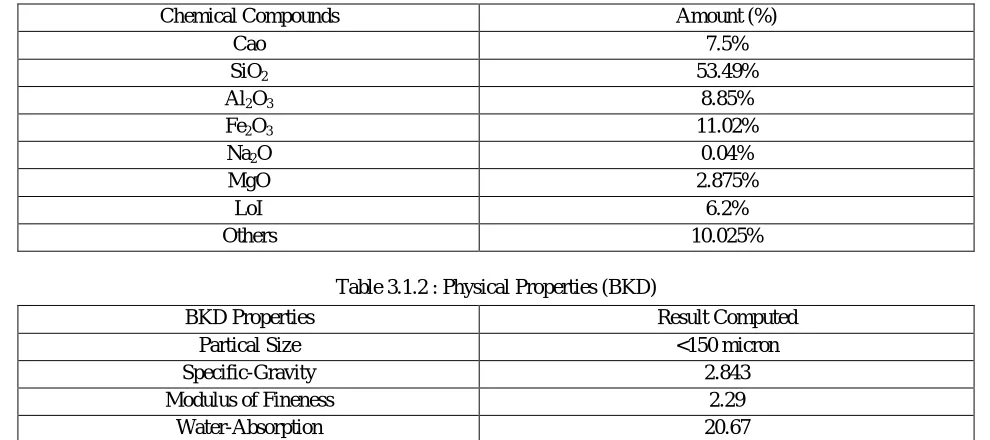
1) Brick Dust Powder: Depending upon the amount of coal used for baking, Brick making plant are the 3rd largest industry (M.Vivek1, kumar, S.Dhileepan, & raj, 2018). It is a material characterized as pozzolanic material based on lime content in it. The material that is extracted when clay bricks are burn in a kiln. Utilizing of Brick Dust in concrete reduces the environmental impact to a greater extent. Brick Dust used in the research was taken from the Brick Dust Plant in Bajna, Mathura, Uttar Pradesh. Brick powder is used after sieving it from 150mm sieve.
[image:2.612.58.553.490.710.2]Table 3.1.1 : Chemical Properties (BKD)
Table 3.1.2 : Physical Properties (BKD)
Chemical Compounds Amount (%)
Cao 7.5%
SiO2 53.49%
Al2O3 8.85%
Fe2O3 11.02%
Na2O 0.04%
MgO 2.875%
LoI 6.2%
Others 10.025%
BKD Properties Result Computed
Partical Size <150 micron
Specific-Gravity 2.843
Modulus of Fineness 2.29
©IJRASET: All Rights are Reserved
326
2) Cement:Conforming to IS 8112:2013 (Ordinary Portland Cement grade-43), cement is a material used as a binder in concrete.Cement blended with aggregate when reacts with water sets and hardened to form concrete. Physical properties shown in Table 3.2.1 were obtained conforming appropriate codes.
Table 3.2.1: Cement physical properties
Table 3.2.2 : Chemical proportioning of cement :
Chemical Compounds Amount (%)
CaO 62.3%
SiO2 22.67%
Al2O3 5.14%
Fe2O3 3.40%
SO3 2.17%
MgO 1.29%
Na2O 0.32%
Other 2.71%
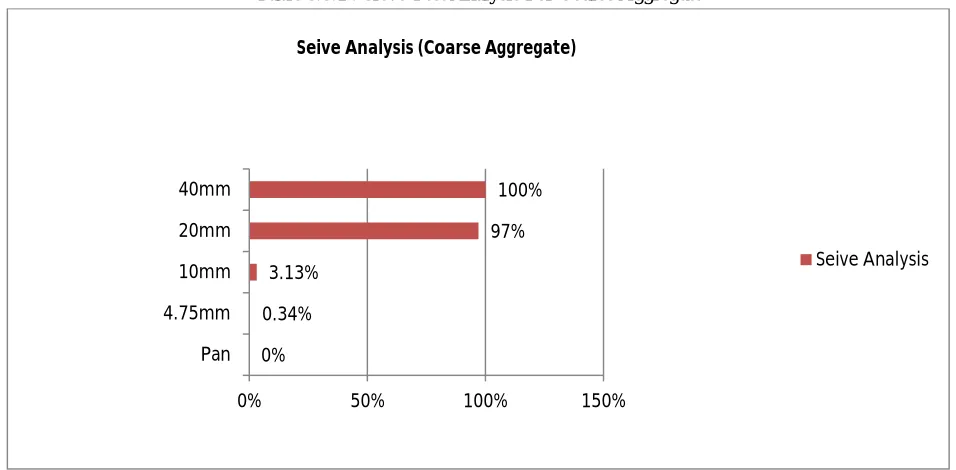
3) Coarse Aggregate: Maximum Size of aggregate used was of size 20mm along with 10mm size aggregate and the aggregate used were crushed angular and after the sieve analysis it was found that they were in the acceptable limit as per Indian Standard
[image:3.612.67.545.477.712.2]Code IS 383:1970 and the detailing are shown in Table 3.3.1.
Table 3.3.1 : Sieve Test Analysis For Coarse Aggregate
0% 0.34%
3.13%
97% 100%
Pan 4.75mm 10mm 20mm 40mm
0% 50% 100% 150%
Seive Analysis (Coarse Aggregate)
Seive Analysis
Cement Properties Result Computed
Fineness-Modulus 3.24
Consistency 30.5
Setting-Time Initial-Time 132 minutes
Final-Time 277 minutes
Specific-Gravity 3.12
Compressive-Strength of cement (avg. of 28 days curing)
©IJRASET: All Rights are Reserved
327
Table 3.3.2 : Sieve Test Analysis For Fine Aggregate4) Fine Aggregate: With accordance with IS 383:1970, after sieve analysis it was found that the sand used for mixing was of zone-3 and the details are show in Tablezone-3.zone-3.2.
5) Water: Water used for mixing as well as for curing purpose was of 1560ppm which clean and potable.
IV. MIX DESIGN
Referring to IS-10262-2009, the mix statement for M-20, M-30 and M-40 Grade of Concrete is prepared as shown in the table given below :
STIPULATION CHART
Type of Cement OPC 43 Grade
Aggregate Size (maximum) 20mm
Grade of Concrete M-20; M-30; M-40
W/C Ratio
Maximum
M-20 0.55
M-30 0.45
M-40 0.40
Adopted
M-20 0.50
M-30 0.40
M-40 0.35
Mix Proportion
(Normal concrete)
M-20
Cement 396 Kg
Water 198 litre
FA 627 Kg
CA 1175 Kg
M-30
Cement 495 Kg
Water 198 litre
FA 564 Kg
CA 1156 Kg
M-40
Cement 591 Kg
Water 207 litre
FA 514 Kg
CA 1100 Kg
0% 50% 100% 150%
Pan 0.300 mic. 1.18 mm 4.75 mm
Percentage Passing
Si
e
ve
S
iz
e
s
(
a
s
p
er
IS
3
8
3-19
70
)
Sieve Analysis (Fine Aggregate)
©IJRASET: All Rights are Reserved
328
V. OUTCOME/RESULT TO THE PERFORMED RESEARCH
A. Result For Comp. Strength
Compressive strength of material designates to its ability to restrict breaking if a load compressive in nature is applied. As mentioned in clause5 of Indian Standard Code: 516: 1989, specimen used for compressive strength testing were of size 150mm x 150mm x 150mm. In the research testing were done on M-20; M-30; M-40 concrete grade keeping in mind their target strength as 26.6Mpa; 38.25Mpa; 48.25Mpa respectively. From the test it was concluded that for M-20 the maximum strength as compared to conventional (0% replacement) is at 9% of Brick-dust inclusion with value of 30.41Mpa which is more than the target strength of M-20 as 26.6Mpa. For M-30 Grade with target strength as 38.25Mpa the best proportion was same as 9% with maximum value of 43.04Mpa. Similarly, M-40 Grade with target strength as 48.25Mpa the maximum value was at 9% equal to 54.29Mpa. The testing were done after curing of specimen for 7, 14 and 28 days.
0% 3% 6.00% 9% 12.00% 15% 18% 21%
7 Days 17.91 18.345 18.78 20.18 18.62 16.52 15.185 13.85
14 Days 25.35 25.975 26.6 28.39 26.87 24.49 22.95 21.41
28 Days 27.52 28.105 28.69 30.41 28.67 26.62 24.92 23.22
17.91 18.345 18.78 20.18 18.62
16.52 15.185
13.85 25.35 25.975 26.6
28.39 26.87
24.49
22.95 21.41
27.52 28.105 28.69 30.41 28.67 26.62
24.92
23.22
0 5 10 15 20 25 30 35
C
o
m
p
.
S
tr
en
gt
h
(
N
/m
m
2)
Brick Dust Powder: M-20 Grade
Pecentage Replacement
0% 3% 6.00% 9% 12.00% 15% 18% 21%
28 Days 39.53 40.3 41.04 43.04 41.01 38.22 35.83 33.38
14 Days 36.45 37.35 38.25 40.66 38.63 35.21 33 30.78
7 Days 25.75 26.38 27 29.01 26.775 23.75 21.84 19.91
25.75 26.38 27 29.01 26.775 23.75
21.84 19.91
36.45 37.35 38.25 40.66 38.63 35.21
33 30.78
39.53 40.3 41.04
43.04
41.01
38.22
35.83
33.38
0 20 40 60 80 100 120
C
o
m
p
.
S
tr
en
gt
h
(
N
/m
m
2)
Brick Dust Powder: M-30 Grade
©IJRASET: All Rights are Reserved
329
B. Result For Split-Tensile Strength0% 3% 6.00% 9% 12.00% 15% 18% 21%
28 Days 49.86 50.83 51.76 54.29 51.73 48.28 45.2 33.38
14 Days 45.98 47.12 48.25 51.29 48.73 44.42 41.63 38.83
7 Days 32.48 33.27 34.06 36.6 33.77 29.96 27.54 25.12
32.48 33.27 34.06 36.6 33.77 29.96 27.54 25.12
45.98 47.12 48.25 51.29 48.73 44.42
41.63 38.83
49.86 50.83 51.76 54.29 51.73 48.28
45.2 33.38 0 20 40 60 80 100 120 140 160 C o m p . S tr en gt h ( N /m m 2)
Brick Dust Powder: M-40 Grade
Pecentage Replacement
0% 3% 6.00% 9% 12.00% 15% 18% 21%
28 Days 3.27 3.342 3.411 3.616 3.408 3.165 2.963 2.761
7 Days 2.149 2.201 2.534 2.422 2.234 1.982 1.822 1.662
2.149 2.201 2.534 2.422 2.234 1.982
1.822 1.662
3.27 3.342 3.411 3.616 3.408
3.165
2.963 2.761
0 1 2 3 4 5 6 7 S p li t-T en si le S tr en gt h ( N /m m 2)
Brick Dust Powder: M-20 Grade
Pecentage Replacement
0% 3% 6.00% 9% 12.00% 15% 18% 21%
28 Days 4.7 4.792 4.879 5.12 4.876 4.544 4.022 3.968
7 Days 3.09 3.165 3.24 3.481 3.213 2.85 2.62 2.389
3.09 3.165 3.24 3.481 3.213 2.85
2.62 2.389
4.7 4.792 4.879
5.12
4.876
4.544
4.022 3.968
0 1 2 3 4 5 6 7 8 9 10 S p li t-T en si le S tr en gt h ( N /m m 2)
Brick Dust Powder: M-30 Grade
©IJRASET: All Rights are Reserved
330
VI. CONCLUSION
Utilization of Brick Powder as a waste from Brick making plant had lead to management of waste. Brick powder being a pozzolanic material with low calcium-oxide content shows long-term effectiveness on strength of concrete. The percentage variation in compressive strength observed after testing cube with no brick dust as compared to cube with best suitable % of brick dust as replacement is as follows :
Grade Of Concrete % Variation in comp. strength of normal
concrete as compared to concrete with 9% of brick dust
% Variation in Split tensile strength of normal concrete as compared to concrete with 9% of brick dust
M-20 9.5% 9.568%
M-30 8.155% 8.203%
M-40 8.159% 8.164%
REFERENCES
[1] A, S. R. (2018). Strength Characteristics by Partial Replacement of Cement with Brick Powder. International Journal of Applied Engineering Research , 6.
[2] Chee Lum Wong, K. H. (2018). Potential use of brick waste as alternate concrete-making materials: A review. Journal of Cleaner Production , 42.
[3] M.Vivek1, kumar, E., S.Dhileepan, & raj, I. A. (2018). Experimental study on strength of concrete containing brick kiln dust and silica fume. International Research Journal of Engineering and Technology.. , 4.
[4] Rani, M. U., & Jenifer, J. M. (2016). Mechanical Properties of Concrete with Partial Replacement of Portland Cement by Clay Brick Powder. International Journal of Engineering Research & Technology , 5.
[5] Sharma, R., & Bharosh, R. (2018). An Experiment of Concrete Partially Replacement of Brick Kiln Dust. International Journal of Advance Research, Ideas and Innovations in Technology , 6.
Author’s Profile
Dr. Nakul Gupta was born in Kanpur City, Uttar Pradesh in 1988. He did his Ph.D. in 2016. Now at present he is
working on GLA University, Mathura as Assistant Professor. He have 8year’s teaching experience.
Ujjwal Sharma was born in Bulandshahr, Uttar Pradesh in 1993. He got a bachelor's degree in civil engineering from Dr. Abdul Kalam Technical University, Lucknow in 2015. At present, he is a final year student of Master's degree in Structural Engineering at GLA University Mathura.
0% 3% 6.00% 9% 12.00% 15% 18% 21%
28 Days 5.928 6.043 6.154 6.455 6.151 5.74 5.374 5.01
7 Days 3.897 3.992 4.087 4.392 4.053 3.595 3.305 3.014
3.897 3.992 4.087 4.392 4.053 3.595
3.305 3.014
5.928 6.043 6.154 6.455 6.151 5.74
5.374
5.01
0 2 4 6 8 10 12
S
p
li
t-T
en
si
le
S
tr
en
gt
h
(
N
/m
m
2)
Brick Dust Powder: M-40 Grade