Globalization and
Inequalities
Complexity and Contested
Modernities
© Sylvia Walby 2009 First published 2009
Apart from any fair dealing for the purposes of research or private study, or criticism or review, as permitted under the Copyright, Designs and Patents Act, 1988, this publication may be reproduced, stored or transmitted in any form, or by any means, only with the prior permission in writing of the publishers, or in the case of reprographic reproduction, in accordance with the terms of licences issued by the Copyright Licensing Agency. Enquiries concerning reproduction outside those terms should be sent to the publishers. SAGE Publications Ltd
1 Oliver’s Yard 55 City Road London EC1Y 1SP SAGE Publications Inc. 2455 Teller Road
Thousand Oaks, California 91320 SAGE Publications India Pvt Ltd
B 1/I 1 Mohan Cooperative Industrial Area Mathura Road
New Delhi 110 044
SAGE Publications Asia-Pacific Pte Ltd 33 Pekin Street #02-01
Far East Square Singapore 048763
Library of Congress Control Number: 2008942804 British Library Cataloguing in Publication data
A catalogue record for this book is available from the British Library
ISBN 978-0-8039-8517-9 ISBN 978-0-8039-8518-6 (pbk)
Acknowledgements viii
List of Tables and Figures ix
1 Introduction: progress and modernities 1
Introduction 1
What is Progress? 3
Multiple Complex Inequalities 18 Modernity? Postmodernity? Not yet Modern? Varieties of Modernity? 24
Globalization 35
Complexity Theory 47
Contents 56
2 Theorizing multiple social systems 58
Introduction 58
Multiple Inequalities and Intersectionality 60 Regimes and Domains 64 System and its Environment: Over-Lapping, Non-Saturating,
Non-Nested Systems 67 Societalization not Societies 69 Emergence and Projects 71 Bodies, Technologies and the Social 75
Path Dependency 79
Coevolution of Complex Adaptive Systems in Changing
Fitness Landscapes 90
Waves 95
Conclusions 99
3 Economies 101
Introduction 101
Redefining the Economy 102
C
o
n
te
n
ts
From Premodern to Modern: The Second Great Transformation 109 Global Processes and Economic Inequalities 115 Varieties of Political Economy 132
Conclusions 152
4 Polities 156
Introduction 156
Reconceptualizing Types of Polities 157 Polities Overlap and do not Politically Saturate a Territory 171
Democracy 178
Conclusions 189
5 Violence 191
Introduction 191
Developing the Ontology of Violence 193 Modernity and Violence 199 Path Dependency in Trajectories of Violence 208
Global 212
Conclusions 216
6 Civil societies 218
Introduction 218
Theorizing Civil Society 218 Modernity and Civil Society 221 Civil Society Projects 228 Global Civil Societies and Waves 233
Conclusions 247
7 Regimes of complex inequality 250
Introduction 250
Beyond Class Regimes 251
Gender Regimes 254
Ethnic Regimes 264
Further Regimes of Complex Inequalities 270 Intersecting Regimes of Complex Inequality 272
Conclusions 275
8 Varieties of modernity 277
Introduction 277
Neoliberal and Social Democratic Varieties of Modernity 278 Path Dependency at the Economy/Polity Nexus 280 Path Dependency at the Violence Nexus 296
Gender Regime 301
Conclusions 309 Appendix: Data Sources 312
9 Measuring progress 314
Introduction 314
Economic Development 315
Equality 319
Human Rights 344
Human Development, Well-Being and Capabilities 346 Key Indicator Sets: What Indicators? What Underlying Concepts
of Progress? 352
Extending the Frameworks and Indicators of Progress: Where do
Environmental Sustainability and Violence Fit? 354 The Achievement of Visions of Progress: Comparing Neoliberalism
and Social Democracy 359
Conclusions 365
10 Comparative paths through modernity: neoliberalism
and social democracy 367
Introduction 367
Political Economy 369
Violence 396
Gender Transformations: The Emergence of Employed Women
as the New Champions of Social Democracy 409 Dampeners and Catalysts of Economic Growth: War and Gender
Regime Transformations 415
Conclusions 417
11 Contested futures 425
Introduction 425
Financial and Economic Crisis 2007–2009 425 Contesting Hegemons and the Future of the World 433
12 Conclusions 443
Introduction 443
The Challenge of Complex Inequalities and Globalization
to Social Theory 444
Bibliography 456
Index 498
C
o
n
te
n
I have been helped by many people in the process of writing this book and I have also been engaged, inspired, debated, intrigued, and questioned. This has involved individuals, groups and networks, in the contexts of colleagues, research projects, research students, visits, seminars, and conferences. It could not have been produced outside of an inspirational challenging supportive intellectual environment, in the UK, Ireland, Sweden, the USA, the EU, and beyond. People have introduced me to their networks and shared them with me; as well as looking after me, engaging, and disagreeing. Many have commented on sections of the book, even if they did not know that this was to be the final location of their opinion, and some have read it all. This myriad of intellectual, competing, and cooperative networks and epistemic communities has been the essential environment for producing this book. I have no funders to thank here.
I would, however, like to thank a great many individuals: Joan Acker, Jo Armstrong, Paul Bagguley, Ulla Björnberg, Lisa Brush, Chris Chase-Dunn, Erika Cudworth, Eileen Drew, Susan Durbin, Ruth Emerek, Myra Marx Ferree, Heidi Gottfried, Karin Gottschall, June Greenwell, Elena Haavio-Manila, Gun Hedlund, Bob Jessop, Anna Jónasdóttir, Danielle Juteau, Liz Kelly, Judith Lorber, Joni Lovenduski, Val Moghadam, Makiko Nishikawa, Pat O’Connor, Mari Osawa, Sue Penna, Diane Perrons, Karen Phillips, Andrew Sayer, Karen Shire, Clare Short, Judith Squires, Sofia Strid, Jenny Tomlinson, John Urry, Janet Veitch, Mieke Verloo, and Linda Woodhead.
I would also like to thank my various networks: Lancaster University Sociology Department, Lancaster Complexity Network, GLOW (Gender, Globalisation and Work Transformation Network), QUING (comparing gender equality in the EU), the European Sociological Association, and the International Sociological Association Research Committee on Economy and Society.
Of course I take sole responsibility for the book’s contents and any flaws.
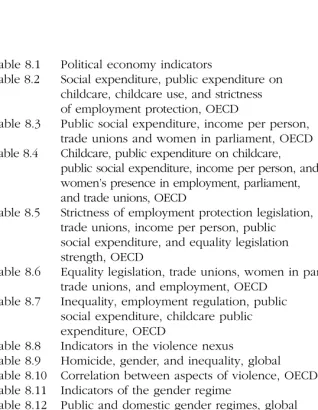
Table 8.1 Political economy indicators 282 Table 8.2 Social expenditure, public expenditure on
childcare, childcare use, and strictness
of employment protection, OECD 284 Table 8.3 Public social expenditure, income per person,
trade unions and women in parliament, OECD 285 Table 8.4 Childcare, public expenditure on childcare,
public social expenditure, income per person, and women’s presence in employment, parliament,
and trade unions, OECD 287 Table 8.5 Strictness of employment protection legislation,
trade unions, income per person, public social expenditure, and equality legislation
strength, OECD 292 Table 8.6 Equality legislation, trade unions, women in parliament,
trade unions, and employment, OECD 293 Table 8.7 Inequality, employment regulation, public
social expenditure, childcare public
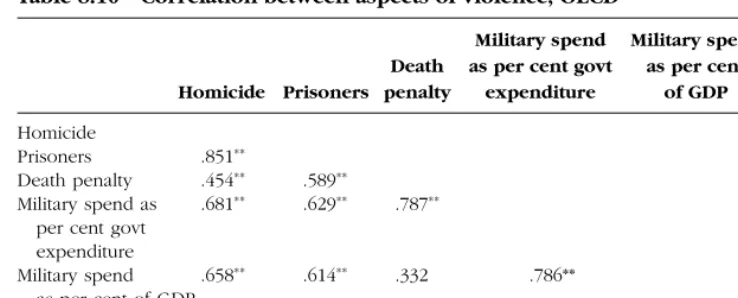
expenditure, OECD 294 Table 8.8 Indicators in the violence nexus 298 Table 8.9 Homicide, gender, and inequality, global 299 Table 8.10 Correlation between aspects of violence, OECD 300 Table 8.11 Indicators of the gender regime 303 Table 8.12 Public and domestic gender regimes, global 304 Table 8.13 Development and public gender regimes, global 305 Table 8.14 Domestic and public gender regimes and
inequality, OECD 306 Table 8.15 Varieties of gender regime, OECD 307 Table 8.16 Gendered polity policies and women’s
political mobilization, OECD 308 Table 8.17 Democracy and polity policies, OECD 309
L
is
t
o
f
T
a
b
le
s
a
n
d
F
ig
u
re
s
[image:10.566.93.411.53.630.2]Table 8.18 Inequality and polity policies, OECD 309
Table 9.1 Income per person in world regions 317 Table 9.2 Economic growth, 1975–2005, world, USA,
EU, Ireland, Sweden, the UK 318 Table 9.3 Poverty and inequality, world regions,
1990, 2004 324
Table 9.4 Inequality and poverty in household incomes, OECD: Gini, mid-1980s to 2000; per cent of households with less than 50 per cent and
60 per cent median income 325 Table 9.5 Wealth in world regions, 2000 326 Table 9.6 Wealth shares within countries, 2000 327 Table 9.7 Women as a percentage of employees
(non-agricultural wage employment) 1990
and 2005, world regions 332 Table 9.8 Labour force, per cent female, OECD, 1980–2006 333 Table 9.9 Gender wage gap EU, USA, 1996, 2006 334 Table 9.10 Gendered economic inequality: ratio of
female to male earned income, 1995, 2005; per cent managers female, OECD, medium
developed countries 335 Table 9.11 Gendered economic inequality, USA, EU 336 Table 9.12 Household forms, sexual and reproductive rights, USA,
Ireland, Sweden, UK 339 Table 9.13 Depth of Democracy: USA, Ireland, Sweden,
UK, EU 343
Table 9.14 Life-expectancy, global regions, USA, EU,
Ireland, Sweden, UK 349 Table 9.15 Child and maternal mortality, obesity, world,
USA, EU, Ireland, Sweden, UK 350 Table 9.16 Primary education completion rates (%), by sex,
1999, 2005, world, developing, and developed
regions 351
Table 9.17 Tertiary education, USA, EU, Ireland, Sweden, UK 351 Table 9.18 Carbon dioxide emissions, world, developing and
developed regions 356 Table 9.19 Carbon dioxide emissions, USA, EU, Sweden, UK, Ireland 356 Table 9.20 Violence, USA, EU, Ireland, Sweden,
UK, world 359
Table 9.21 Life-expectancy and income over time,
world, USA, EU, Ireland, Sweden, UK 363
Table 10.1 Economic inequality: Gini coefficients,
mid-1980s to c.2000: USA, Sweden, UK, Ireland 371 Table 10.2 Public social expenditure as per cent of GDP,
L
is
t
o
f
T
a
b
le
s
a
n
d
F
ig
u
re
s
Table 10.3 Comparative trade union density 1970–2003,
USA, EU, Sweden, UK, Ireland 371 Table 10.4 Trade union membership patterns, 2004,
USA, Sweden, UK, Ireland 371 Table 10.5 Violence: USA, EU, Sweden, UK, Ireland 397 Table 10.6 Female share of employment, trade union
membership, and parliamentary seats, 1960–2005 410 Table 10.7 Economic growth, 1840–2005: USA, UK, Sweden,
Ireland 417
Table 11.1 Economic recession 2008–2009: USA, EU, Eurozone,
Sweden, UK, Ireland 429
Figures
Figure 8.1 Public social expenditure as percentage of
GDP, OECD 285
Figure 9.1 GDP per capita around the world, 2008 317 Figure 9.2 Economic income inequality measured
by the Gini coefficient around the world 323 Figure 9.3 Increase in democracy and decline of
Introduction
The future is contested. What are the implications of the different social models that might come into being? What is progress? Is it being richer, living longer, reduced inequality, or more human rights? What is modernity? Is modernity over, or is the project of
modernity not yet completed? Social theory is challenged to take account of complex inequalities beyond class: how can they be included so that they are central, not marginal? Globalization chal-lenges the notion of separate societies: how do global processes
change social relations? What difference does the inclusion of com-plex inequalities and global processes make to the analysis and to social theory? What difference does the inclusion of complex inequalities make to our view as to what constitutes progress? The
aim of this book is not only to produce better accounts of social change in a global era, but also to rethink core concepts and theo-ries. A key aid here is the development of complexity theory.
‘Progress’ is an essentially contested project. There are vigorous
disputes over what the proper goals of global policy should be, over the priorities for action by governments and international bodies. The meaning of ‘progress’ is far from obvious, ranging from economic development to human well-being, equality and human rights.
Protagonists vigorously disagree about which is more important, with implications for the goals of global as well as national public policy. How are such contestations conducted? Are they so rooted in values that are so deeply held that to debate is a challenge to fundamental
aspects of people and cultures, or are they amenable to rational scien-tific debate over priorities? In practice, even deeply held values are challenged by appeals to internal inconsistency and empirical evidence about their effects when implemented. This book aims to clarify the
1
Introduction:
alternative framings of the notion of progress and to identify their
implications. Does the evidence support or contradict deeply held con-victions as to the best way forward? Which project emerges best, when subjected to social scientific Scrutiny?
Modernity has been a key concept in classic Sociology, used to
address large-scale social transformation. The transition to moder-nity preoccupied many of the major social theorists, from Marx and Weber to Durkheim and Simmel. But is modernity still the best way to understand contemporary social relations? Or are we now living
in a postmodern era? Challenges to the concept of modernity are aimed at its apparent assumption that there was a single unilinear process of development, and that it was good for everyone. Such a notion is clearly untenable, in view of the horrors of the descent
into war and ‘ethnic cleansing’, the diversity of paths of develop-ment, and the uneven position of different social groups in the same country. Are we not yet modern, rather than postmodern, or are there multiple varieties of modernity?
Globalization is a challenge to social theory. It demands a re-thinking of the notion that there are societies constituted as separate bounded entities. It raises questions about the taken-for-granted equation of society and nation-state. Is globalization merely Westernization or
Americanization, or does it hybridize all cultures, creating new com-monalities? Is it eroding differences between cultures producing con-vergence? Globalization requires the analysis of new types of global processes, and the re-framing of many ostensibly local or national
pro-jects within a global landscape.
Social theory is challenged to address the multiplicity of social inequalities, not only that of class. The significance of diverse inequalities for social life is recognized, but building this insight into
the core of social theory rather than remaining in specialist sub-fields has proved more difficult. Traditional social theory addressed class inequality, but had difficulty when trying simultaneously to address gender, ethnicity, age, religion, nation, sexual orientation, and
dis-ability, and even greater difficulty in addressing their mutual consti-tution at points of intersection. Further, these social relations are more complex than class in that they involve not only inequality but also difference, thereby problematizing notions of a single standard
against which to judge inequality. The challenge then is to include intersecting complex inequalities within the core of social theory.
In order to insert globalization and complex inequalities into the heart of social theory it is necessary to develop new concepts and to
rethink how theories are put together. There is a need both to capture the distinctions, differentiations and nuances of complex inequalities that have been part of what has been driving the postmodern turn,
G
lo
b
a
li
z
a
ti
o
n
a
n
d
In
e
q
u
a
li
ti
e
and to simultaneously keep the global horizon in sight. There is also
a need to retain the conception of inter-linkages so as to be able to analyse the global level, while not falling into the mistaken simplici-ties of over-generalization across cultures. Developments in complex-ity theory offer a new vocabulary on which social theory can usefully
draw in developing concepts to meet these new analytic challenges. These offer the opportunity to build a more complex theoretical framework that enables the theorization of both large-scale connec-tions and of sudden ruptures and non-linear processes. Complexity
theory enables the re-thinking of the concept of social system to address, without reductionism, multiple systems of social relations.
This chapter addresses first, the contested issue of what progress might be; second, the challenge of theorizing multiple complex
inequalities simultaneously; third, the conceptualization of plural forms of modernity; fourth, the challenge of theorizing global processes; and fifth, the usefulness of complexity theory in address-ing these challenges in social theory.
What is Progress?
More money or a longer life?
Is it better to have more money or to live longer? People in the
United States of America have more money but die sooner than those in the European Union. Americans have over 40 per cent more income than these Europeans, but live on average for two years less (World Bank 2006c).
Is increasing income a measure of progress? Or is living longer a better indicator? There are different ways of thinking about progress, so how should they be evaluated?
What kind of social arrangements produce progress, however it is
defined? Is it the greater freedom of the market in the USA as com-pared with greater state regulation in Europe? Is it the greater inequal-ity in the USA as compared with Europe? Or the more violent nature of the USA than Europe?
The two divergent goals of money and longevity are associated with two quite different conceptions of progress. The first takes the eco-nomic, especially money, as an effective summary indicator of progress and of what is good and desirable; it is often used by national and
international bodies of financial governance. The second is focused on the outcome for human well-being, of our capacities and capabilities, of which longevity is an indicator. Further, framings of progress include
In
tr
o
d
u
c
ti
o
‘equality’ and ‘human rights’. Indeed many social and political projects
have their own distinctive accounts of what constitutes the best social arrangements to produce the ‘good life’.
Different social systems have different levels of success in con-verting economic resources into human well-being. The EU social
system is more effective in this than the USA. It is the differences in social systems that are crucial to understanding the implications for individuals. The EU and US social systems link economic resources to human well-being in different ways as a result of differences in
how their social systems have developed.
Different cultures prioritize different values. What is meant by progress and what are the preferred goals of public policy? Can there be a single notion of progress in the context of varying
val-ues? What kinds of social arrangements achieve progress?
Progress as a contested project
There is no simple answer to the question of what is progress. Rather,
it is an essentially contested concept. Indeed, so contested that some will give up all hope that it is a useful project to engage with.
There are three main approaches to the concept and project of progress. First, that modernity is progress. For classical sociologists,
analysing the transformation of society that is associated with indus-trialization and urbanism, modernity was progress, but a develop-ment that many saw as double-edged, with a down side as well (as discussed in the next section). A second response is to deny the
use-fulness of the concept and project of progress: it is too simple, falsely universalistic, and ethnocentric. Rather than a universal ‘one size fits all’, there are a potentially infinite number of particular ways of think-ing about what constitutes the ‘good life’ and how to get there that
are rooted in different cultures. A third position sees progress as a contested project: there are alternative conceptions, but not an infinite number; it exists as a notion that is highly contested; it is argued over in politics and policy, philosophy and theory, data, and analysis.
Within this third approach four key alternative goals of progress can be identified – economic development, equality, human rights, and human well-being – though there are others, including a respect for traditional or fundamental practices. The first is that human
wel-fare is best advanced by economic growth and high levels of eco-nomic development. The second prioritizes equality. The third is human rights. The fourth has a focus on human well-being, which is more than just a high standard of living but includes education,
health, and longevity.
G
lo
b
a
li
z
a
ti
o
n
a
n
d
In
e
q
u
a
li
ti
e
In
tr
o
d
u
c
ti
o
n
These goals of progress are embedded in projects that are rooted
in civil society. Sometimes these projects will become the founda-tion of governmental programmes. Finally, they may become embedded in practices in social formations. Today, two major com-peting projects claim in quite different ways to take forward some
of these goals: neoliberalism and social democracy. They claim in varying ways to produce economic development, aspects of equal-ity, human rights, and human well-being.
Economic development
The first framing of progress focuses on economic development and economic growth. Economic development is expected to increase the average income of a person and thereby their standard
of living. While this approach appears to treat economic develop-ment as an end in itself, it usually rests on the implicit assumption that economic development is a means to the delivery of an improved standard of living and a further additional assumption
that this is a popular policy goal. The higher the rate of economic growth, the faster will the standard of living increase. Improved economic performance is assumed to mean a more effective uti-lization of resources to deliver goods and services. The approach
claims to be neutral as to the way in which this income is spent by people and regards this neutrality as positive. Economic growth and development is defended as the best approach to progress, on the basis that this constitutes an indication of the average standard
of living of people in a country and that this is what people want because governments are repeatedly democratically elected on a mandate that prioritizes economic growth.
This approach to progress is embodied in many national finance
ministries and in some parts of the global institutions of financial governance, such as the International Monetary Fund. It underpins the ‘Washington consensus’ on economic policy (Stiglitz 2002).
Within social science there is much debate as to the type of social
arrangements that best deliver economic growth. A major focus of the discussion has been as to whether countries with the markets that are most ‘free’, or where markets are carefully regulated and subor-dinated to other social institutions, actually deliver on this. In
partic-ular, this involves analysing the contrasting nature and implications of different types of production, welfare, and regulatory regimes (Barro 1998; Hall and Soskice 2001; Kenworthy 2004). However, there are several challenges to this conceptualization of progress.
G
lo
b
a
li
z
a
ti
o
n
a
n
d
In
e
q
u
a
li
ti
e
s
that need to be set against the benefits of rapid economic growth,
and whether it leads to happiness (Oswald 1997; Layard 2005). Is human well-being, equality, or human rights more important?
Equality
An alternative approach to progress is viewed through the lens of jus-tice. This approach prioritizes justice, equality, and human rights
rather than material improvements in living conditions and welfare. Various traditions articulate this issue in slightly different ways, includ-ing: justice (Sandel 1998; Rawls 1999); equality (Phillips 1995; Holli 1997); rights (Paine 1984; Kymlicka 1991, 1995); human rights (Peters
and Wolper 1995; Woodiwiss 1998); citizenship (Marshall 1950); equal opportunities and equity (Acker 1989; Shaw and Perrons 1995); free-dom and capabilities (Sen 1999; Nussbaum 2000); democracy, politi-cal rights and civil liberties (Gastil 1982); and recognition (Taylor et al.
1994; Honneth 1996; Fraser 1997). While there are many approaches to the notion of progress that have a justice framing, it is possible to group many of them into two categories – equality and rights.
The framing of progress as equality is a key part of the socialist and
social democratic tradition (Bobbio 1997). This is a more collective and less individualist framing of justice than the others, according less priority to the individual and more to groups and collectivities. There are variations within this frame including: whether equality is
con-ceptualized as an opportunity or an outcome; which domains and practices are included; whether it is limited to ‘excessive’ inequality; and how difference is addressed.
Equality may be understood either as an outcome or as an
oppor-tunity. Equality of outcomes is the stronger programme; equality of opportunities addresses processes and procedures which may possi-bly, but not necessarily, lead to greater equality in outcomes. For example, the attempt to increase equality of opportunity by equal
treatment laws may reduce discrimination but may also be insuffi-cient to produce an equality of outcome in the absence of structural change (Hoskyns 1996). This equality of outcome usually requires the transformation of both social systems and legal processes.
The principle of equality is often selectively applied. This equality may be regarded as a legitimate outcome in matters of longevity, where class and ethnic differences are often considered unjust. It is more commonly discussed in the economic domain (for example, in
In
tr
o
d
u
c
ti
o
n
important (Phillips 1999). Some forms of inequality are regarded as
illegitimate because they are ‘excessive’. For example, social exclu-sion and poverty may be regarded as unjust because they are extreme or ‘excessive’, but not inequality in all its forms; social exclu-sion is a weaker understanding of inequality (Lister 1998).
Inequalities are often complexly entwined with differences. There is a question as to whether equality requires sameness and the use of a single standard, or equal recognition and the valuation of different contributions, or a larger and more profound
transfor-mation (Fraser 1997; Rees 1998). The equal valuation of different contributions is a step away from traditional interpretations of equality that involve a single universal standard. The notion of cos-mopolitanism requires mutual respect for different ways of life
rather than the adoption of a single universal standard as to what is best (Held 2004; Beck 2006).
Equality is potentially the most radical of the framings of progress. In practice, its application as a principle is often hedged with
caveats and limited to specific processes, domains, and practices.
Human rights
In the rights-based approach to justice, every individual is regarded as having inviolable rights, the realization of which constitutes a just society. Each person has an equal entitlement to a specific set of rights.
The tradition is predominantly individualist, with the valuation of the rights of individuals positioned as more important than the average welfare of the society as a whole. It ranges from a relatively narrow focus on civil liberties, such as freedom of speech, and political rights,
such as free elections (Gastil 1982), to a wider concept of citizenship, which involves socio-economic as well as political and civil rights (Marshall 1950). In its privileging of the individual over society, rights can be interpreted as representing a Western, rather than a universal or
global, approach to justice, although this is contested (Woodiwiss 1998). The notion of rights itself has several variants, including human rights and civil rights (Ferree et al. 2002a), though today human rights predominate in political discourse. There are many theoretical and
philosophical interpretations of the longstanding rights-based tradition of justice (Banks 1981; Paine 1984; Wollstonecraft 1992 [1790]). According to Rawls (1999), justice is the overarching framework for all conceptions of progress and the first virtue of social institutions.
G
lo
b
a
li
z
a
ti
o
n
a
n
d
In
e
q
u
a
li
ti
e
s
which the justice of a larger number of people can outweigh the
injus-tice and disadvantage of a few individuals. His approach requires that every individual receives the basics as an underpinning of justice. In this way Rawls’s ‘social contract’ approach to justice prioritizes an equal minimum level for all over the welfare of a whole society.
In the current wave of globalization, the human rights interpreta-tion of justice is becoming increasingly important. This draws on a longstanding rights tradition (Banks 1981; Paine 1984; Wollstonecraft 1992 [1790]; Berkovitch 1999) as well as on some components of the
equality framework (Peters and Wolper 1995; Woodiwiss 1998). The most important current statement on human rights is that issued by the UN after the end of the Second World War, the Universal Declaration of Human Rights (UN 1948). This claim, endorsed by all
governments in the world, states that these rights are in principle uni-versal and not particular. However, this early UN statement on human rights has since been reinterpreted, extending and clarifying its con-tent. The implementation of a rights-based (especially a human rights)
approach to justice and progress is often made via a juridical frame-work. It is through the law, courts and lawyers that human rights are made available to individuals and groups of individuals.
Although there is a component of equality within the human rights
approach, not least equality in accessing these rights since they are regarded as universal, this is a limited conception of equality. It is a minimalist and threshold conception – a relatively low threshold is set and must be passed. Beyond that, the framework has nothing to say.
However, the framing of human rights as universal and measured against a single standard is contested by notions of group rights, the equal valuation of different contributions, and by cosmopolitanism. Rights are not always and only linked to individuals: they may also
be constituted as group rights, or as the right to a way of life, which intrinsically involves a group or community (Kymlicka 1991, 1995). This implicitly recognizes that there are different standards in rela-tion to which rights can be claimed. The example used by Kymlicka
is that of the First Nation, or aboriginal Indians, in Canada, and their collective rights to the use of certain tracts of land that differ from those belonging to the rest of Canada’s citizens. A parallel issue is articulated in theories of equal rights in relation to gender, where the
concern to respect difference leads to such formulations as the equal valuation of different contributions. However, there is a question as to whether such respect implies an acceptance of practices that might be considered harmful to certain minorities. There is a tension
In
tr
o
d
u
c
ti
o
n
Human development, well-being
and capabilities
A further project, variously named human development, well-being or capabilities, challenges a focus solely on economic development and growth, but is equivocal about equality. This approach to progress replaces a focus on income with a broader conception of human
development and well-being. The intellectual inspiration underpin-ning this approach is the work of Amartya Sen (1999), while broader support comes from practitioners in the international development community and more recently from academics. There is an increasing
divergence within this approach between an outcome-oriented project rooted in the international development community and a philosophically-oriented project focused on the concept of capabil-ities which is separated from that of functionings.
When embedded in the United Nations Development Project (1990), this alternative approach to development promoted an approach to human well-being that required more than just income; outcomes of longevity and education were the preferred form of development. This
challenge to the narrowness of the goal of economic growth that had been held up by the institutions of global financial governance such as the International Monetary Fund (IMF) and the World Bank was at least partly successful. The adoption of the UN Millennium
Development Goals, which offer a synthesis of human and economic development, by the IMF, the World Bank and OECD among others, represents a modest global political success on the part of this chal-lenge to neoliberal conceptions of economic growth.
Capabilities are the ‘substantive freedoms’ to ‘choose a life one has reason to value’, while functionings are ‘the various things a person may value doing or being’, according to Sen (1999: 74–5). The dis-tinction between capabilities and functioning parallels the disdis-tinction
between opportunities and outcomes. One of the strengths of the capabilities approach (that it is open to democratic attempts to name and prioritize capabilities) is also a weakness. The flexibility and openness to political pressure in the definition of the list of
capabili-ties mean that a wide range of interpretations of capabilicapabili-ties is pos-sible. The focus on capabilities rather than on functionings deliberately opens the door to choice, but thereby makes possible a choice of inequality as a way to obtain a difference. Opportunities,
G
lo
b
a
li
z
a
ti
o
n
a
n
d
In
e
q
u
a
li
ti
e
s
that is linked to inequality. Choice is prioritized over equality. By
contrast, the UNDP approach to capabilities problematizes choice: ‘Real opportunity is about having real choices – the choices that come with a sufficient income, an education, good health and living in a country that is not governed by tyranny’ (UNDP 2006). In this way,
certain contexts are taken as key to providing capabilities. The focus shifts to outcomes (rather than opportunities) which are easier to measure against a common standard. The interpretation of this school of thought as developed by the UNDP, with its focus on a wide range
of outcomes that are relevant to human development and well-being, is the one preferred here.
Competing projects: neoliberalism
and social democracy
The different conceptions of progress – high personal income,
human well-being, equality, and human rights – do not necessarily contain accounts of the means to reach these goals. Sometimes they are implied, but in many cases the means to reach these ends are contested. Would prioritizing economic growth raise incomes most
effectively, even if at the expense of lesser equality or human rights? Would deepening democracy most effectively promote equality and human well-being, but at the expense of more rapid economic growth? Are there trade-offs between the different goals,
or not? How are these combined in different projects in the world? While there are many projects to reach these goals, neoliberalism and social democracy are the most comprehensive in vision and the most relevant today (Giddens 1998; Held 2004; Harvey 2005). While
neoliberalism and social democracy presume modernity, and disagree over the form that modernity should take, other projects promote some aspects of premodernity, as is often the case in religious funda-mentalisms. Other projects include human rights. Some have partial
rather than comprehensive visions, for example feminism, cos-mopolitanism (Beck 2006) and environmentalism (Yearley 1996; Cudworth 2003). Some are hybrid projects – for example, the US Bush Presidency, 2001–2009, combined neoliberalism with Christian
fundamentalism – while the ‘cosmopolitan universalists’ combine social democracy with human rights (Held 2004), and the anti-globalization movement combines anti-neoliberal capitalism, environmentalism and feminism. This book focuses on the contrast between the two
major projects, neoliberalism and social democracy.
In
tr
o
d
u
c
ti
o
n
to which these visions are institutionalized and implemented varies
significantly. Projects can be primarily located in civil society, or may become embedded in governmental policy programmes or in actually existing social forms, both large and small. A civil society project usually aims to become the dominant state programme in
order to shape actual social relations and institutions, although with varying degrees of success.
Neoliberalism elevates the notion of market effectiveness into a guiding principle for action and attempts to reduce the level of state
intervention into the economy, prioritizing the individual over col-lectivism (Brenner and Theodore 2002; England and Ward 2007). As an intellectual project its current forms draw on the work of Hayek (1960) and Friedman (1962), which argued that freeing the market
from state controls was the best way to ensure economic growth, which in turn was believed to deliver human well-being, freedom, democracy, and civil liberties. The project grew in strength during the 1980s, but has a much longer heritage; here the term neoliberal
is extended back in time. In the 1980s the neoliberal programme was taken forward by the US and UK governments under Reagan and Thatcher and by global financial institutions, becoming known as the ‘Washington consensus’, and then spread globally as a result
of International Monetary Fund (IMF) conditions on loans to poor countries including ‘structural adjustment’. The policies included cutting back state welfare expenditure; the reduction in or deregu-lation of worker protections and benefit payments for those out of
employment; the privatization of publicly owned industries, utilities and services; the expansion of the market into previously non-marketized arenas of the global commons such as the genome; and the substitution of the market as an alternative form of governance
to democracy in specific areas, for example welfare provision (Brenner and Theodore 2002; Harvey 2003, 2005; England and Ward 2007). In practice, the record of neoliberalism on economic growth is contested (Stiglitz 2002). The drive to increase incentives to work
shifts the balance of power, leading to increased inequalities which then compromise human-well-being (Oswald 1997; Wilkinson 2005). Social democracy aspires to govern societies democratically, avoid-ing excessive inequality, promotavoid-ing human as well as economic
development, and enabling minorities as well as majorities to enjoy their human rights. Social democratic projects commit to the provi-sion of education, health and care for those in need, in order to deliver human well-being for all, whether employed or not
G
lo
b
a
li
z
a
ti
o
n
a
n
d
In
e
q
u
a
li
ti
e
s
the running of the economy through regulation not only to prevent
market failure, but also to engage in redistribution; the state legiti-mately taxes and spends in order to deliver its policies.
Social democratic projects vary significantly in the extent to which they promote state or collective ownership as mechanisms to
gov-ern the economy, whether they adopt Keynesian macro economic management to reduce the severity of recessions or merely aim for stability. There has been both a retreat (Callaghan 2000) and a trans-formation (Kitschelt 1994) of social democratic projects into new
forms as a response to the reduction in the traditional base of elec-toral support in male manual workers in manufacturing industries (Przeworski and Sprague 1986), dealignment in class voting prac-tices (Crewe et al. 1977), and changing external circumstances such
as globalization (Held 1995). There has also been a slow transition of the social democratic project towards the full inclusion of the con-cerns of gender and other minorities which is ongoing. Some forms of the project now include full employment for women and an end
to discrimination against women and minorities, though a full engage-ment with ethno-national issues of citizenship and migration is far from complete. Neoliberal critics consider that state intervention compromises economic growth and thereby other goals.
This description of the projects of neoliberalism and social democracy has so far been a summary of ideal types and aspira-tions. The implications of the projects as they enter governmental programmes and become embedded in diverse social formations
can be quite different.
While the self-description of neoliberalism focuses on diminish-ing governmental interventions into the economy in contrast with social democracy, in practice neoliberalism is associated with the
greater expansion of state interventions in other domains than social democracy. In particular, neoliberalism is associated with the greater development and deployment of state violence and associ-ated forms of coercion than is social democracy, for example, in the
propensity to go to war, the build up of military capacity, and the use of prisons to contain criminality and maintain social order. So while neoliberalism appears to laud a small state, this is only in relation to the economy; in practice neoliberal governments
simul-taneously develop a large coercive state to maintain the domestic social order and position in the global state system. In comparing neoliberalism and social democracy, it is important not to confine the analysis to the intersection of the polity with the economy, but
also to include other domains including violence.
In
tr
o
d
u
c
ti
o
n
boundary between neoliberalism and social democracy is contested,
with some arguing that Britain’s New Labour government since 1997 constitutes a new form of social democracy (Giddens 1998) and others arguing that the extent of its use of the market principle means that it is effectively neoliberal (Arestis and Sawyer 2005). The
debate concerns a number of issues regarding the state’s role in secur-ing social justice. These include the shift away from state ownership of industries and services; away from direct provision of public services by the state to being merely guaranteed by the state but delivered by
the market; the development of active labour market policies, such as compulsory counselling and targeted training, to achieve full employ-ment; and away from a goal to reduce inequality to that of reducing social exclusion and the provision of equal opportunities. The move
away from state ownership and the provision of goods and services to their regulation by the state (Majone 1996) is not necessarily inconsis-tent with a social democratic tradition, though the reduction in the role of the state is considered by some to be a move towards
neoliberal-ism. The emphasis on the employment and education of individuals may be interpreted either as a shift to a neoliberal accommodation to global capital (Taylor-Gooby 1997; George 1998; Brine 2006), a shift from a Keynesian welfare state to a Schumpeterian workfare state
(Jessop 1999), or in keeping with a social democratic tradition that pri-oritizes full employment (Giddens 1998, 2001; Crouch 1999), where an appropriate response to globalization is to invest in people’s human capital through state initiated training and education (Reich 1993;
Quadagno 1999; Esping-Andersen 2002). These changes may well be an accommodation to a changing global environment, but full employ-ment under decent conditions for all without coercion and state ensured access for all to education, health and care and a decent
liv-ing standard, are among the hallmarks of social democracy. The shift in the conceptualization of the goal of ‘equality’ to that of ‘social inclu-sion’ (Giddens 1998) potentially softens the core principles of the social democratic project (Lister 1998), as does reduced concern with
increased inequality caused by the growth in high level earnings and wealth from housing capital, and the evasion of taxation and regula-tion by private equity forms of capital (Murphy 2007), although the attention to poverty somewhat mitigates this. On this range of
con-cerns, the UK is best considered to be situated on the boundary between social democracy and neoliberalism.
A similar debate addresses whether the EU is best considered neoliberal (Young 2000) or social democratic, which is complicated
G
lo
b
a
li
z
a
ti
o
n
a
n
d
In
e
q
u
a
li
ti
e
s
major division in the world today is one between a more neoliberal
USA and a more social democratic EU. The contest between the varieties of modernity of these two global hegemons is crucial for the future of global arrangements.
Contesting conceptions of progress
How is it possible to adjudicate between these contesting conceptions
of progress: economic development, human well-being, equality and human rights? Are these issues to be determined by philosophers, or is it a matter of politics, with the strongest forces winning, or a matter of rational argumentation and evidence-based research? Is there a
single universal standard, or will there always be particular standards for different cultures and communities? The tension between univer-salism and particularism runs through all of these framings of progress: between a concept of progress that is universally applicable and one
that always varies by social location. Is universalism merely a disguise for new forms of imperialism, colonialism, or Westernization? The postmodern critique of modernity argues that a universally relevant concept of progress is inherently impossible. However, it can also be
argued that universal standards are needed, since exceptions can be manipulated by the powerful. How, in an emergent global era, might all voices be involved in determining what global standards should be? Is there a philosophical grounding of the decision between either
a universal or community-based grounding? On the one hand, lib-eralism and universalism appear to offer a plea to a free-floating form of reason that is universal, drawing on a Kantian heritage (Rawls 2005). There is a claim to universally valid truth, though this
usually assumes a coherent individual as the seeker/knower. On the other hand, communitarianism appears to offer grounding in the particular standards of a specific community (Taylor 1994; Sandel 1998). The latter implies that truth is always partial and
sit-uated, that we are limited by the communities in which we are located, and that there is always social situatedness and a particu-larity of values and knowledge (Haraway 1988). In place of the Enlightenment tradition that made universal claims to knowledge,
has emerged a postmodern scepticism of the validity and usefulness of the grand ‘metanarratives’ linking the knowledge and progress that constituted its core components (Lyotard 1984).
Of course, both polar extremes are untenable. Many have sought a
In
tr
o
d
u
c
ti
o
n
(Kymlicka 1991, 1995). Habermas (1989, 1991) seeks a resolution by
attempting to establish universally valid procedures by which truth may be established, utilizing the dynamics within an assumed desire to communicate to drive the process, and locating it within an ideal-ized situation of equality of contribution. However, by such a location
Habermas, despite his intentions, situates rather than universalizes the conditions for truth, since the conditions of free and equal contribu-tion are actually socially specific, not least in their presumpcontribu-tion of the implications of democratic involvement. Benhabib’s (1992) attempt at
overcoming the same dualism by demanding a focus on the other has similar strengths and weaknesses to that of Habermas despite her attempt to move further on (Hutchings 1997). Benhabib seeks to avoid commitment to the communitarian stance, by making an appeal to the
ostensibly universally valid criteria of judgement of recognizing the standpoint of the other. But the process of recognizing the standpoint of the other is not natural and automatic, but depends upon socially variable conditions. Thus, Benhabib merely displaces the problem of
universalism onto these new procedures for judgement, which are not sufficiently universal to be adequate to the task demanded of them. The act of ‘recognition’ requires a social process of assessment as to what constitutes the same as or different from oneself. By contrast, Bauman
(1991, 1993) simultaneously rejects both poles and with them the search for certain foundations for contemporary ethics and political projects.
But despite the philosophical angst, there are nonetheless many projects that promote alternative conceptions of progress. How
should they be understood? Are they best understood as predomi-nantly political? There are protestors who oppose the priorities for globalization as proposed by the world’s financial institutions, who are met with organized state and police power, as in the Seattle riots
(Klein 1999). There are political struggles within global institutions, for example, coalitions of poor countries preventing the World Trade Organization from adopting certain types of liberalization of world trade that they consider would adversely affect the poor.
Today, many projects engage simultaneously with both knowledge and power, drawing on and deploying scientific research within and alongside political engagement. This can be understood as the devel-opment of ‘epistemic communities’ (Haas 1992) or ‘public Sociology’
(Burawoy 2005). ‘An epistemic community is a network of profession-als with recognized expertise and competence ... an authoritative claim to policy-relevant knowledge ... a shared set of normative and princi-pled beliefs ... shared causal beliefs ... derived from their analysis of
G
lo
b
a
li
z
a
ti
o
n
a
n
d
In
e
q
u
a
li
ti
e
s
policy Sociology. This is a Sociology that engages with contemporary
issues, researching questions that emerge in civil societal struggles, which draws on the other three Sociologies, not least professional expertise, and is engaged in projects of social transformation, the pur-suit of progress. There are many examples of the intermingled nature
of politics and science, in which findings from research are central to the struggles over the pursuit of competing projects, including the best way to invest for development (Stiglitz 2002) and the dangerousness of emerging genomic technologies (Winickoff et al. 2005). These draw
on the notion that truth is never permanently established even if it tem-porarily appears to be (Latour and Woolgar 1979), but is instead con-stantly subject to challenge and to doubt (Habermas 1987 [1981]).
In global arenas there have been several significant and successful
challenges to the standards against which global progress is to be measured and in more than one direction. A change from economic growth towards a capabilities understanding of progress has been occurring within global institutions as a consequence of this mix of
intellectual and political struggle. In the 1980s the clear goal of the world’s financial institutions was economic growth. By 2000, in the UN Millennium Declaration, the World Bank, IMF and OECD additionally supported a capabilities approach. The eight Millennium Development
Goals were to: eradicate extreme poverty and hunger; achieve univer-sal primary education; promote gender equality and empower women; reduce child mortality; improve maternal health; combat HIV/AIDS, malaria and other diseases; ensure environmental stability; and develop
a global partnership for development (UN 2005). A change in the list of UN-recognized human rights occurred in 1993 as a result of a similar mix of political agitation and research-based evidence (Peters and Wolper 1995). This was to include violence against women as a violation of
women’s human rights. The potent mix of a global feminist coalition and research on the extent of violence against women was crucial to this change in what were ostensibly ‘universal’ human rights.
With globalization, the definition of the good life and the policies
to promote it are increasingly contested at a global level. Global insti-tutions and the political and civil societal spaces they generate con-stitute an increasingly important terrain on which these struggles take place. There are appeals to both scientific evidence and to
democra-tically expressed popular priorities as bases for the legitimacy of argu-ments. Global institutions around the UN have revised their stated goals as a consequence of these processes. There has been a shift in emphasis from a framing of progress as an increase in income to one
In
tr
o
d
u
c
ti
o
n
promoted economic growth, and military force has been deployed by
some polities in pursuit of particularistic goals.
Conclusions
One of the aims of this book is to adjudicate rival claims about progress on the basis of evidence and theory that go beyond phi-losophy. The concept of progress is not outmoded, as alleged by
some postmodern critics. Yet there is no single and universally agreed upon definition of progress, rather there are many com-peting framings of the project. Thus, a search for a foundational basis for a detailed list of the characteristics of the good life would
be in vain. While there is no single foundation for standards of progress, the formulation, encoding and institutionalization of concepts of progress in international conventions and agreements, especially those orchestrated by the UN, proceed apace. This is
not the same as a global or universal agreement. Nevertheless, these activities do have consequences. There are active processes of claims-making about what constitutes progress and the proper goals of public policy. In a global era there is renewed interest in
claims pitched at the level of the universal. In an era of global-ization and increasing valuation and practice of democracy the contestation over the content of the concept of progress is taking new and more global forms. The contested choice of economic
growth, or capabilities and well-being, or justice-based consider-ations of equality or human rights, affects public policy at both global and national levels.
Here, a complex realism is adopted, in which each knowledge
claim is underpinned by a set of theoretical and empirical compo-nents, each of which is part of a network of knowledge claims. It is a knowledge claim rather than a value claim because of this underpinning. This is not a foundationalist claim, since the
theo-retical and empirical underpinning is contestable and challenge-able. The ‘real’ can never be known for certain; not even if the best scientific procedures are followed. The concept of complex real-ism building on critical realreal-ism combines the notion that there are
procedures by which knowledge claims are contested (subject to refutation) and can be improved with that of uncertainty, in that they can never be known absolutely. In complex realism, the test-ing of knowledge claims against a network of theories and
G
lo
b
a
li
z
a
ti
o
n
a
n
d
In
e
q
u
a
li
ti
e
s
claims made about the good life, progress, and human well-being
are testable to a considerable degree by empirical evidence because they are claims about associations and connections between phe-nomena. One of the aims of this book is to assess the processes and types of social system that best realize the good life, according
to different formulations, addressing its framing as economic growth, human development, equality, and human rights. When do they map onto each other? When do they diverge? What forms of social organization and social development, which varieties of
modernity, are associated with each? How general a set of argu-ments can be made, universal or particular? This book provides evidence of the implications of one dimension of social life inequal-ity for another, thereby reducing the speculative element in some
of the debates. Chapter 9 in particular uses comparative data to measure progress in a range of countries according to the different definitions identified here.
Multiple Complex Inequalities
Introduction
Equality matters not only because it is a major contemporary fram-ing of justice and progress, but also because inequalities affect the different forms and speed of economic and human development.
Key issues include: how to theorize multiple and intersecting social inequalities in addition to class; how to theorize the relationship between difference and inequality; and the implications of multiple complex inequalities for the analysis of progress and modernity.
Why multiple inequalities? Class is not the only significant inequality. Inequalities are also associated with gender, ethnicity, racialization, nation, religion, able-bodiedness, sexual orientation, age, generation, linguistic community, and more. These inequalities
affect the differences between forms of modernity as well as the key dynamics of social change.
Why complex inequalities? Unequal social relations involve dif-ference as well as inequality. Some aspects of the different
activi-ties may be positively valued, while others will be regarded as unjust. It is this complicated combination of inequality and differ-ence that the concept of ‘complex inequalities’ is intended to cap-ture. Complex inequalities are here defined as constituted by the
In
tr
o
d
u
c
ti
o
n
Multiple and intersecting inequalities
While class has traditionally been seen as the main axis of social inequality, this is insufficient. Gender and ethnicity are also
impor-tant forms of inequality, as can be the case with disability, religion, age and sexual orientation (it is illegal to discriminate on grounds of gender, ethnicity, disability, faith, age, and sexual orientation in the EU: see the European Commission 2007a). While the diversity
of social inequalities is widely documented, they are infrequently integrated into macro level social theory. Specialist areas of social science have produced extensive descriptions and analysis of spe-cific inequalities, for example, in the sub-disciplines of gender
studies, ethnic and racial studies, and disability studies; however, these have not yet been fully integrated into social theory.
In order to include multiple complex inequalities in addition to class at the centre of social theory, several theoretical developments
are needed. The conceptualization of each of the main institutional domains of economy, polity, violence, and civil society needs to be re-thought so as to include and make visible complex inequalities in addition to class. Each of the complex inequalities needs to be
theorized as a separate system of social relations, as a regime of inequality spelling out the ontological depth of these regimes. Class is not reducible to economics, nor ethnicity to culture; rather each regime of inequality involves the economy, polity, violence, and
civil society. The theorization of multiple regimes of inequality is a further challenge – to go beyond reducing one form of inequality to another, or restricting the account to description.
The concept of the economy, which is often restricted to
marke-tized monemarke-tized activities, needs to be widened to include non-marketized non-monetized work if it is to capture gender and ethnic relations. If it is not broadened in this way, then other forms of economic activity, such as unpaid domestic care-work that is an
important part of the constitution of gender relations (Oakley 1974; Becker 1981; Delphy 1984) and slavery that was an important part of the constitution of ethnic relations (Walvin 1992), will be omitted from the analysis. If the unit within which inequality is considered
is widened from one country to the whole world and inequalities between generations are included, then new forms of inequalities become visible, such as global warming, which has had stronger effects on the poor South rather than the rich North of the world
(Roberts and Parks 2007) and on future generations.
G
lo
b
a
li
z
a
ti
o
n
a
n
d
In
e
q
u
a
li
ti
e
s
people is relatively straightforward, generating accounts of class,
gender and ethnic economic inequality among workers, with mea-sures of the wage spread and the gender and ethnic pay gaps. But how is an unpaid domestic care-worker, often but not always a woman, to be treated in such an approach to economic inequality? Is
she to be ignored since she does not have her own earned income? Such an approach is obviously unsatisfactory but is implied in the quite common practice of comparing the income of households rather than individuals, thereby making invisible any gender inequalities
within the household (as in most of the studies of economic inequal-ity reported in Chapter 3). Is her domestic care-work left out of focus by centring the analysis on her earned income, asking what propor-tion of men’s earnings are earned by women (a measure used by the
UNDP), thereby explicitly treating the lack of income from domestic care-work as a component of gender inequality? Should unpaid domestic care-work be treated as a positively valued activity in its own right? Or is it a key part of gendered economic inequalities?
The conventional concept of the state is too narrow to grasp some key forms of institutionalized politics and governance con-cerning gender and ethnicity. The broader concept of polity includes a wider range of entities, including transnational polities
such as the European Union, and also organized religions, which can be important in the governance of gender and ethnic relations. The conventional operationalization of the concept of democracy focuses on free elections, free political parties, free association,
free speech, and the right to bodily integrity such as the right of
habeas corpus (not to be subject to arbitrary detention). Using these criteria most, though not all, countries can be considered democratic today. However, effective access to power requires a
presence in the key arenas of decision making, such as in parlia-ment. If a presence in parliament were to be added to the opera-tionalization of the concept of democracy, then women and minoritized ethnic groups do not have political equality as yet. If
the right to bodily integrity were to make visible gender issues, such as women’s freedom to control their bodies in sexual and reproductive matters such as abortion and contraception, then there is not yet political equality for women.
Violence needs to be added to the conventional set of institutional domains of economy, polity and civil society, since it is so impor-tant in the structuring of gender, ethnic, national, and religious inequalities. Violence is not merely an instrument of power, but can
In
tr
o
d
u
c
ti
o
n
not only the armies of the state but also domestic violence, sexual
assault, harassment, lynching, ‘ethnic cleansing’, and terrorism. The use of violence by dominant groups against women and minori-tized ethnic, sexual, and religious groups is a further indicator of inequality.
Civil society is a domain of social creativity, where there is a development of new ideas and social practices, including various forms of association, non-governmental organizations, social move-ments, and non-state forms of power struggle (Gramsci 1971) and
intimacy. It includes but is not confined to issues of culture, includ-ing the media, the arts, sport, and knowledge creation. Whether dif-ferent participation in these activities constitutes inequality or a valued difference is again an issue in these areas. Nevertheless, the
imbalance between social groups in decision-making activities in civil society may often be considered an inequality. Who decides what constitutes news, which leisure activities are to be funded and put on prime-time television, and who makes decisions in trade
unions and other associations?
Complex inequalities: difference,
inequality and progress
In deciding what counts as inequality there is a troublesome com-plication: when is something a positively valued difference and when
is it inequality? This issue lies at the heart of many disputes about what constitutes progress; what to some is a reduction of a negatively valued inequality, to others might constitute a reduction in a posi-tively valued practice. Rather than forcing a choice, it is better to
rec-ognize that most social relations contain both inequality and valued differences. The term ‘complex inequality’ is used here to signify this simultaneous presence of inequality and positively valued difference. Complex inequalities potentially constitute a challenge to the
concept of progress insofar as there are multiple standards to evalu-ate what is progress. There are three ways of thinking about equal-ity in this context. First, is to identify a single standard against which inequality is measured. A second position entails equally valuing
dif-ferent contributions. A third approach is that of transformation, whereby the whole system is changed, with all groups and the stan-dards attached to them restructured.
The first position argues that there is or can be a single agreed
G
lo
b
a
li
z
a
ti
o
n
a
n
d
In
e
q
u
a
li
ti
e
s
A single standard of equality is often implied in monetary economic
inequality, where differences in income and wealth are considered to be inequalities. It is implied in the concept of democracy, where the equality of each vote is considered important. Such a conception of equality measured against a single standard is common in the
analysis of class relations, where matters of economic and political equality are often at the forefront of the analysis. The feminist vision of de-gendering (Lorber 2000, 2005) implicitly endorses this position, even though a question remains as to its universal application. In
practice, the legal dimension of the equality strategy of the EU is based on ‘equal treatment’ thereby endorsing agreed standards. Indeed some standards, such as equal pay for women and men, may constitute standards that are already held by women as well as by
men. While the identification of inequality may appear obvious through the lens of class analysis in relation to inequalities in income and wealth, in the case of complex inequalities other than class, such as ethnicity and gender, where inequality and difference are more
obviously present simultaneously, this is not so simple. Some forms of variation are open to alternative interpretations as either difference or equality: for example, a segregated pattern of labour between domestic care-work and waged labour may be a valued difference or
an unwelcome inequality or both.
The second position positively values difference (Spellman 1988; Young 1990) and diversity, and assumes the possibility of equally valuing different practices (Taylor et al. 1994). In the desire to
move beyond the over-simplifying notion of a single standard against which to measure inequality, there has been a move to rec-ognize and value difference (Young 1990; Taylor 1994; Tronto 1994; Calhoun 1995; Hobson 2000). Young (1990) argues for the
recognition of cultural difference – the denial of respect for those who are culturally different and for their ways of life is a problem that needs a political remedy. She argues for the recognition of groups as the bearers of these cultures within the political system,
rather than recognizing only the individual of liberalism. This the-ory of justice ontologically privileges groups over individuals. In contrast to Lorber’s (2005) call for de-gendering, Young argues for the deepening of institutions that promote respect for group
dif-ferences. There are two main problems with this approach. First, in practice, the institutionalization of difference has often entailed inequality in some way. An example here is that of the perfor-mance of unpaid domestic care-work by women. This may be a