Int. J. Electrochem. Sci., 13 (2018) 5061 – 5067, doi: 10.20964/2018.05.88
International Journal of
ELECTROCHEMICAL
SCIENCE
www.electrochemsci.org
Facile Synthesis and Enhanced Intermediate Temperature
Electrical Properties of Novel Sn
0.9Mg
0.1P
2O
7/KSn
2(PO
4)
3Composite Electrolyte
Junlong Liu, Ruifeng Du, Ruijuan Shi*, Hongtao Wang*
School of Chemical and Material Engineering, Fuyang Normal College; Anhui Provincial Key Laboratory for Degradation and Monitoring of Pollution of the Environment, Fuyang 236037, China
*
E-mail: [email protected], [email protected]
Received: 5 December 2017 / Accepted: 7 February 2018 / Published: 10 April 2018
The application of Sn1-xMxP2O7 electrolyte for solid oxide fuel cells is limited due to its poor sintering
abilities. In this study, a new Sn0.9Mg0.1P2O7/KSn2(PO4)3 composite electrolyte was facile synthesized
and the structural and microstructural properties were characterized by XRD and SEM. These results exhibit that the Sn0.9Mg0.1P2O7/KSn2(PO4)3 composite can be obtained by Sn0.9Mg0.1P2O7 in-situ
reacted with inorganic melt salt. The electrical properties were tested using impedance spectroscopy in the range of 300 ~ 700 °C. The highest conductivity of Sn0.9Mg0.1P2O7/KSn2(PO4)3 achieved was
6.3×10⁻² S·cm-1 in a dry nitrogen atmosphere at 700 °C. A H2/O2 fuel cell with a dense
Sn0.9Mg0.1P2O7/KSn2(PO4)3 electrolyte membrane was also constructed and achieved maximum power
output densities of 47.2 mW·cm-2 and 130.9 mW·cm-2 at 600 °C and 700 °C, respectively.
Keywords: Composite electrolyte; Intermediate temperature fuel cell; Ceramics; Conductivity
1. INTRODUCTION
cathode catalysts, and electrolytes [3–10]. As one of the most important factors, the electrolyte material plays a vital role in determining the performance of fuel cells.
In recent years, low-valence metal cations doped tin pyrophosphates, which possess high protonic conductivities at low temperature range (100 °C ~ 300 °C), have been applied in low-temperature solid oxide fuel cells (LT-SOFCs) [11–13]. However, Sn1-xMxP2O7 materials are still far
from practical due to their poor sintering abilities. Composition is regarded as an extensively used and effective pathway to optimize the electrical properties of electrolytes for fuel cells. Hence, it becomes significant to design and synthesize dense and novel SnP2O7-based composite electrolytes [14-17].
Recently, owing to their high ionic conductivity and high chemical stability, (K/Na)M2(PO4)3
(M = Sn, Ti) with a NASICON (Na Super Ionic Conductor) structure have received a great deal of attention as electrode materials for sodium-ion or lithium-ion batteries [18–21]. It is confirmed that chemical and thermal stability is a crucial factor for the application of electrolytes in fuel cells with a long-term performance. In our previous study, we explored the Sn0.95Al0.05P2O7/KSn2(PO4)3 composite
electrolyte and the results indicated that the Sn0.95Al0.05P2O7 and KSn2(PO4)3 are fused together to form
a dense composite [22]. It is necessary to find if KSn2(PO4)3 can serve as a promoter for differnet Rn+
-doped SnP2O7/KSn2(PO4)3 composite electrolytes, and consequently to extend the applied temperature
range to meet the demands of IT-SOFCs (300 °C ~ 700 °C).
In this work, we prepared other different metal ion doped SnP2O7 and a dense
Sn0.9Mg0.1P2O7/KSn2(PO4)3 composite electrolyte was also successfully fabricated in order to find the
composite electrolyte with the best performance. The Sn0.9Mg0.1P2O7/KSn2(PO4)3 composite was
carefully examined by XRD and SEM. The conductivities and the performance in intermediate temperature fuel cells (ITFCs) of the Sn0.9Mg0.1P2O7/KSn2(PO4)3 composite electrolyte were evaluated
in detail.
2. EXPERIMENTAL
The Sn0.9Mg0.1P2O7 was prepared in a similar manner to our previously reported procedure
[23]. In a typical process, 8.1373 g of SnO2 and 0.2418 g of MgO were dispersed into 11.6 mL of
H3PO4 (85 %) and heated at 350 °C for 1 h. Further heat treatment was performed at 600 °C for 2 h.
After that, the resulting Sn0.9Mg0.1P2O7 powder and NaCl/KCl molten salt were fully mixed and
reacted with each other at 650 °C for 1.5 h, giving the Sn0.9Mg0.1P2O7/KSn2(PO4)3 sample. The
obtained composite was milled and pressed at 200 MPa, and re-sintered at 650 °C for 1 h to obtain the Sn0.9Mg0.1P2O7/KSn2(PO4)3 composite electrolyte (1.0 mm in thickness). The pure Sn0.9Mg0.1P2O7
pellet was also synthesized at 600 °C for 2 h as a reference.
X–ray powder diffraction (XRD) measurements of the Sn0.9Mg0.1P2O7 and the
Sn0.9Mg0.1P2O7/KSn2(PO4)3 composite were recorded on a X’ Pert-pro MPD diffractometer using Cu
Kα radiation. Scanning electron microscopy (SEM) images of the Sn0.9Mg0.1P2O7 and the
Sn0.9Mg0.1P2O7/KSn2(PO4)3 composite were observed on a FEI Tecnai G2 F30 electron microscope.
Sn0.9Mg0.1P2O7/KSn2(PO4)3 composite samples were determined by a CHI-660E electrochemical
analyzer over the frequency range from 1 Hz to 106 Hz in a dry nitrogen atmosphere at 300 ~ 700 oC. An oxygen concentration discharge cell was constructed as: air, Pd-Ag∣Sn0.9Mg0.1P2O7/KSn2(PO4)3∣Pd-Ag, O2 and the electromotive force was calculated to study the
oxide ionic conduction under an oxygen-containing atmosphere at 700 oC. To evaluate the performance of Sn0.9Mg0.1P2O7/KSn2(PO4)3 as an electrolyte for ITFCs, a H2/O2 fuel cell was
constructed.
3. RESULTS AND DISCUSSION
20 30 40 50 60 70
KSn
2(PO4)3
▽
▽ ▽
(3
11
)
(2
11
)
(2
10
)
(2
00
)
▽
▽
(1
11
)
▼
▼ ▼
▼ ▼
▼ SnP
2O7
KSn
2(PO4)3 48-1100
[22] Sn
0.9Mg0.1P2O7
2/ o
In
te
ns
ity
/a
.u
[image:3.596.200.437.255.460.2].
[image:3.596.88.515.506.653.2]Figure 1. XRD patterns of Sn0.9Mg0.1P2O7 and Sn0.9Mg0.1P2O7/KSn2(PO4)3 composite.
Figure 2. SEM images of external surfaces of Sn0.9Mg0.1P2O7 (a) and Sn0.9Mg0.1P2O7/KSn2(PO4)3 (b).
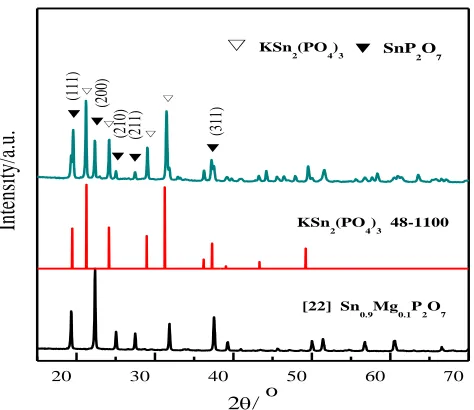
Fig. 1 presents the XRD patterns of the Sn0.9Mg0.1P2O7 and Sn0.9Mg0.1P2O7/KSn2(PO4)3
composite. Bare Sn0.9Mg0.1P2O7 showed typical diffraction peaks of cubic SnP2O7 phase (JCPDS
(111), (200), (210), (211) and (311) crystal planes of SnP2O7, respectively [11,23]. The
Sn0.9Mg0.1P2O7/KSn2(PO4)3 composite exhibited characteristic diffraction peaks of cubic SnP2O7 phase
(JCPDS 29-1352) and KSn2(PO4)3 (JCPDS 48-1100) with a NASICON framework, and the diffraction
angles (2θ) at 21.22°, 24.18°, 29.07° and 31.54° correspond to the (110), (113), (024) and (116) crystal planes of KSn2(PO4)3, respectively. It is worth noting that all these diffraction peaks in
Sn0.9Mg0.1P2O7/KSn2(PO4)3 composite are consistent with SnP2O7 and KSn2(PO4)3, implying that an
in-situ reaction takes place between two closely contacted phases of Sn0.9Mg0.1P2O7 and inorganic melt
salt during the calcination process and no impurities are formed.
Fig. 2 shows the SEM images of the Sn0.9Mg0.1P2O7 and Sn0.9Mg0.1P2O7/KSn2(PO4)3
composite. As seen from Figure 2a, the Sn0.9Mg0.1P2O7 is composed of uniform cubic particles with
particle size of 0.2-0.8 μm and exhibits a relatively dense microstructure. Figure 2b shows the morphology of the Sn0.9Mg0.1P2O7/KSn2(PO4)3 composite. It can be observed that a fully dense and
crack-free structure were formed, indicating that inorganic melt salt can act as a sintering aid and reactant for in situ formation of KSn2(PO4)3 during the calcination procedure. The results demonstrate
that modification of Sn0.9Mg0.1P2O7 with KSn2(PO4)3 has great influence on the morphology of the
Sn0.9Mg0.1P2O7/KSn2(PO4)3 composite thus enhancing the densification, which might be helpful to ion
transport.
1 2 3 4
-6 -4 -2 0 2
1000 T-1 / K-1
L
og
(
T
/ S
cm
-1 K)
[11]
Sn
0.9Mg0.1P2O7 / (K/Na)Sn2(PO4)3
[12]
Sn
0.9Mg0.1P2O7
[24]
[image:4.596.194.434.385.570.2][25]
Figure 3. The log (T) ~ 1000 T-1 plots of Sn0.9Mg0.1P2O7 and Sn0.9Mg0.1P2O7/KSn2(PO4)3 composite
under dry nitrogen atmosphere.
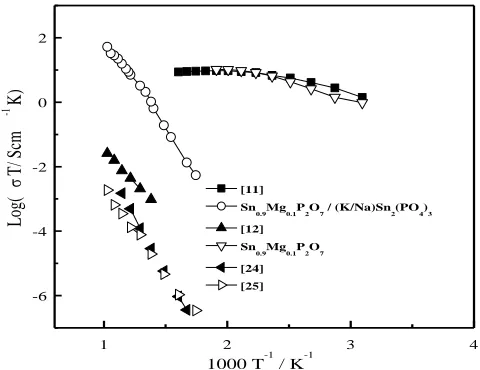
The conductivities curves of the Sn0.9Mg0.1P2O7 electrolyte from 50 °C to 250 °C and the
Sn0.9Mg0.1P2O7/KSn2(PO4)3 composite electrolyte from 300 °C to 700 °C as a function of temperature
under dry nitrogen atmosphere are shown in Fig. 3. The results illustrate that the conductivities of pure Sn0.9Mg0.1P2O7 are similar to the previous experimental results of Tomita [11] under similar
conditions. For the Sn0.9Mg0.1P2O7/KSn2(PO4)3 composite, the conductivities increase with the increase
similar measurements on Rn+-doped Sn1-xRxP2O7 (R = Al3+, In3+ and Mn2+) [12,23-25] are also shown
in Fig.3. Clearly, the Sn0.9Mg0.1P2O7/KSn2(PO4)3 composite exhibits outstanding properties, the values
of Sn0.9Mg0.1P2O7/KSn2(PO4)3 are four to five orders of magnitude higher than those of Sn0.9Mn0.1P2O7
[12], Sn0.9In0.1P2O7 [24] and Sn0.92In0.08P2O7 [25], respectively. From these results, it can be concluded
that the KSn2(PO4)3 with a NASICON structure on the surface of Sn0.9Mg0.1P2O7 can provide
additional transport pathways for protons and results in enhanced conductivities of the Sn0.9Mg0.1P2O7/KSn2(PO4)3 composite, which is consistent with the results of XRD and SEM.
0.000 0.005 0.010 0.015 0.020 0.025 P / (m W c m -2 ) V ol ta ge / m V
Current density / (mA cm-2)
0 10 20 30
[image:5.596.199.425.207.351.2]0.0 0.1 0.2 0.3 0.4
Figure 4. The oxygen concentration discharge cell: air, Pd-Ag∣Sn0.9Mg0.1P2O7/KSn2(PO4)3∣Pd-Ag,
O2 at 700 °C.
0.0 0.2 0.4 0.6 0.8 1.0 1.2
600 oC
700 oC
P / (m W c m -2 ) V ol ta ge / V
Current density / (mA cm-2)
0 50 100 150 200 250 300 0 25 50 75 100 125 150
Figure 5. I-V-P curves of the H2/O2 fuel cell with the Sn0.9Mg0.1P2O7/KSn2(PO4)3 at 600 °C and 700
°C.
To explore the oxide ionic conduction of the Sn0.9Mg0.1P2O7/KSn2(PO4)3 composite in an
oxygen-containing atmosphere, an oxygen concentration discharge cell was constructed at 700 oC and the results are shown in Fig.4. The theoretical electromotive forces (EMFcal) of the oxygen
concentration discharge cell can be calculated from EMFcal =
F RT
4 tO ln[pO2 (A) / pO2 (B)] when tO = 1.
The pure O2 (pO2 (A)) and air (pO2 (B)) were passed into the cathode and anode chambers, respectively.
[image:5.596.187.443.402.576.2]
EMF(32.7 mV). In addition, a stable discharge curve was observed. All the results demonstrate that the Sn0.9Mg0.1P2O7/KSn2(PO4)3 composite has not only oxide ionic conduction but also a certain
degree of electron hole conduction in an oxygen-containing atmosphere [26-27].
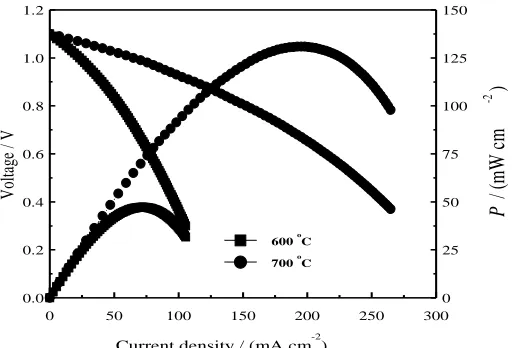
Fig. 5 displays the I-V-P curves of the H2/O2 fuel cell with the Sn0.9Mg0.1P2O7/KSn2(PO4)3
composite electrolyte at 600 °C and 700 °C, respectively. It was found that the open circuit voltages are almost the same as the theoretical values, clearly demonstrating that the KSn2(PO4)3 modified
Sn0.9Mg0.1P2O7 composite electrolyte is sufficiently dense, in accordance with the TEM result. The
maximum power output densities of the H2/O2 fuel cell are 47.2 mW·cm-2 at 600 °C and 130.9
mW·cm-2 and 700 °C, respectively. This good performance of the H2/O2 fuel cell using
Sn0.9Mg0.1P2O7/KSn2(PO4)3 composite electrolyte may relay on the dense composite frame which not
only facilitate high ion transport but also increases the operation temperature range.
4. CONCLUSIONS
In this study, we have successfully synthesized a novel dense Sn0.9Mg0.1P2O7/KSn2(PO4)3
composite electrolyte by using NaCl/KCl molten salt as the reaction medium as well as the reactant. The KSn2(PO4)3 modified Sn0.9Mg0.1P2O7 composite exhibited markedly enhanced conductivities and
the highest conductivity obtained was 6.3×10⁻² S·cm-1 in a dry nitrogen atmosphere at 700 °C. The result of oxygen discharge concentration cell reveals that the composite has not only oxide ionic conduction but also a certain degree of electron hole conduction in an oxygen-containing atmosphere. It also displayed good fuel cell performances and the maximum power output densities were 47.2 mW·cm-2 at 600 °C and 130.9 mW·cm-2 at 700 °C.
ACKNOWLEDGEMENTS
This work was supported by the National Natural Science Foundation (No. 51402052, 21402029) of China. Horizontal cooperation project of Fuyang municipal government and Fuyang Normal College (No. XDHX2016019, XDHX2016002). Anhui Province Foundation (No. 1608085MB34, KJ2013Z266) of China, Excellent Youth Foundation of Anhui Educational Committee (gxyq2018046), and Excellent Youth Foundation of Fuyang Normal College (rcxm201805).
References
1. X.Y. Liu, Z.H. Xu and G.Y. Liang, Mater. Lett., 191 (2017) 108. 2. H. Farnoush and Z. Rezaei, Ceram. Int., 43 (2017) 11885.
3. V. N. Duy and H-M. Kim, Int. J. Electrochem. Sci., 12 (2017) 11833. 4. L. Bi, E.H. Da'as and S.P. Shafi, Electrochem. Commun., 80 (2017) 20. 5. X. Gao, J. Ma, Y. Li and H. Wei, Int. J. Electrochem. Sci., 12 (2017) 11287. 6. K. K. Hansen, Int. J. Electrochem. Sci., 12 (2017) 11540.
8. G. Almutairi1, F. Alenazey,Y. Yousef and B. Alshammari, Int. J. Electrochem. Sci., 12 (2017) 11616.
9. A.M. Abdalla, S. Hossain, A.T. Azad, P.M.I. Petra, F. Begum, S.G. Eriksson and A.K. Azad, Renew. Sust. Energ. Rev., 82 (2018) 353.
10.O. K. Alekseeva, E. K. Lutikova, V. V. Markelov, V. I. Porembsky and V. N. Fateev, Int. J. Electrochem. Sci., 13 (2018) 797.
11.A. Tomita, N. Kajiyama, T. Kamiya, M. Nagao and T. Hibino, J. Electrochem. Soc., 154 (2007) B1265.
12.B. Singh, J.H. Kim, O. Parkash and S.J. Song, Ceram. Int., 42 (2016) 2983.
13.M. Nagao, T. Kamiya, P. Heo, A. Tomita, T. Hibino and M. Sano, J. Electrochem. Soc., 153 (2006) A1604.
14.Y.C. Jin and T. Hibino, Electrochim. Acta, 55 (2010) 8371.
15.Y. Sato, Y.B. Shen, M. Nishida, W. Kanematsu and T. Hibino, J. Meter. Chem., 22 (2012) 3973. 16.P. Heo, Y. Shen, K. Kojima, C. Pak, K.H. Choi and T. Hibino, Electrochim. Acta, 128 (2014) 287. 17.J. Liao, J. Yang, Q. Li, L.N. Cleemann, J.O. Jensen, N.J. Bjerrum, R. He and W. Xing, J. Power
Sources, 238 (2013) 516.
18.J. Han, M. Xu, Y. Niu, M. Jia, T. Liu, C and M. Li, J. Colloid Interf. Sci., 483 (2016) 67. 19.N. Li, Y. Wang, R. Rao, X. Dong, X. Zhang and S. Zhu, Appl. Surf. Sci., 399 (2017) 624. 20.A.I. Mohamed and J.F. Whitacre, Electrochim. Acta, 235 (2017) 730.
21.P. Hu, J. Ma and T. Wang, Chem. Mater., 27 (2015) 6668. 22.J. Liu, R. Du, R. Shi and H. Wang, Ceram. Int., 44 (2018) 5179.
23.H Wang, L Sun, J Chen and C Luo, Acta Phys.-Chim. Sin., 28 (2012) 2893.
24.S.R. Phadke, C.R. Bowers, E.D. Wachsman and J.C. Nino, Solid State Ion., 183 (2011) 26. 25.S. Tao, Solid State Ion., 180 (2009) 148.
26.J. Guan, S.E. Dorris, U. Balachardran and M. Liu, Solid State Ion., 100 (1997) 45. 27.G. Ma, T. Shimura and H. Iwahara, Solid State Ion., 120 (1999) 51.