THESES SIS/LIBRARY TELEPHONE: +61 2 6125 4631
R.G. MENZIES LIBRARY BUILDING NO:2 FACSIMILE: +61 2 6125 4063
THE AUSTRALIAN NATIONAL UNIVERSITY EMAIL: [email protected] CANBERRA ACT 0200 AUSTRALIA
USE OF THESES
This copy is supplied for purposes
of private study and research only.
Passages from the thesis may not be
copied or closely paraphrased without the
J)e.ctr
Ptnvtj
1if+
I
ct
sf-
("''A-""
ve
:::J
"6\A.JV'Ic..ofj :
Y
..
vtk.ot
ve.
r
uv e
d,
~
a·
VI12-f'cc
~II
e-ve-r
V't>IL
I/IJVOdo._ /.ftvvo~
1--._ovt..J-~
..f.
f/l.d
~
VD VJ(' (}\J
l;,e
yo
VLd ,
I
~Vl
k.
yflv\
~
10\A.
r (h\r
VO!_h.,o~
c;l V'O( e_
rr
r~:::
.
VJ:vvt'\N's+
r~tJV.rd ~
Comments on PhD thesis of Katherine J. Reynolds entitled: Beyond the information given: Capacity, context and the categorization process in impression formation
This was an excellent thesis which is without question worthy of being awarded a PhD. The work is admirable on a number of levels, both theoretically and empirically. I was particularlJ: impressed with the theoretical insight and the knowledge and depth of understandmg With respect to the relevant literature. The literature review was very detailed and took nothing for granted. The critical analysis of the previous literature, and of how 1t has often been presented or understood was almost worthy of a PhD in itself, in my view. I hope that this work is not wasted and can be used in some published form, as it would be a shame for such an insightful analysis not to reach a wider audience than the readers of this thesis. My worry is that such a lead up would form too much by way of introduction to the empirical papers when published. Indeed the review/theoretical chapters were so thorough and extensive, that I admit to a bit of impatience in having to wait to get to the empirical rewards waiting at the end as it were (but this is meant more by way of compliment than criticism).
The empirical chapters were well worth waiting for. I was already familiar with some of the data form conferences, but here together they form a very nice series of
integrated studies, flowing logically from the theoretical critique and analysis. The data were generally strong and well interpreted and once again, I can find very little fault here. I detected what might be considered as one slight tendency to over-interpret however. On p. 260 (top) it is stated that "as predicted there was also a significant interaction between identity and dimension ... " That is subjects rated themselves as most different from the target on dimensions inconsistent with the identity manipulation. I could not find this precise prediction in the preceding text (e.g. p.247). Rather, my understanding was for a more complex predicted interaction involving the intragroup (group) versus interpersonal manipulation. Indeed this is made explicit on the following page (261) when we find out that the pattern of differentiation in interpersonal
conditions is consistent with predictions. This is basically the same interaction as the overall two way interaction including the intragroup condition described above (i.e. that is subjects rated themselves as most different from the target on dimensions
inconsistent with the identity manipulation). This is fine, but as the pattern of means from table 9.2, and the absence of a reported significant 3-way interaction make clear, the interaction is basically the same (or not significantly different) in the intragroup condition and as I understand it, this was not predicted. In other words it seems that self-target differences were accentuated (on inconsistent dimensions) in both
interpersonal and intragroup/group conditions, whereas this was only clearly predicted in interpersonal conditions (and in my view that is indeed what the theory would predict). Even if this pattern is still present for the intragroup conditions, surely we would expect it to be significantly less evident here than in the interpersonal conditions (resulting in a three-way interaction)? The fact that the (predicted?) three-way
interaction is not mentioned, and that the two way interaction (excluding the
interpersonal group factor) is described as predicted, rather glosses over this fact in my opinion. I think some attention to this point will be necessary before this research is published.
One additional minor point: In the final study I found the labelling of conditions as interpersonal versus intragroup slightly confusing, given that these terms are sometimes equated within SCT. I though simply referring to group versus interpersonal conditions might have been simpler and clearer in this regard.
ideas for theoretical development and future directions of research. On top of all this the thesis was extremely clear and well written, with first class presentation and minimal typos or other minor errors. All in all then. I have absolutely no hesitation is
recommending that the candidate be awarded PhD for what· is a first class piece of work.
If it is of any help, I list a few minor typos that I picked up through the text below.
p.49, top. Shouldn't Neuberg & Fiske (1990) be Fiske & Neuberg? (or the date changed to 1987?).
p.60, last para. Delete comma after "Research, ... "?
p.lOO, 2nd para, 8th line: devises> devices?
p.l57, 5lines from bottom: a accentuation> an accentuation.
p.l83, end 1st para: Why give p>.lO rather than p<X?
p.l86, 4 lines from bottom: insert comma after manipulated?
p.232 top para: Is warm (also friendly?) not also stereotypic of the female stereotype?
Report of examiner: Dissertation of Katherine J. Reynolds
Beyond the information given: Capacity, context and the categorisation process in impression formation.
For almost two decades, social cognition has constituted one of the major theoretical references for the study of impression formation, person perception, and stereotyping. In this excellent piece of work, Kate
Reynolds provides a critical analysis of the major assumptions underlying the social cognition research endeavours. She questions a view in which categorisation is seen as an unfortunate data reduction and information distortion process. Supposedly, perceivers would be forced to rely on such faulty processes whenever they lack the cognitive resources or the
appropriate motivational set of mind. From the social cognition
perspective, stereotypes and individuating perception, error and truth, are two ends of the same continuum. Kate Reynolds then convincingly sets the stage for an alternative approach in which categorisation would be at work in every aspect of perception. Building upon self-categorisation theory, Kate argues that there is no such thing as one true characterisation of others but that perception always entails a context-dependent accentuation of differences from a relevant target of comparison.
After a well-documented review of the early person perception research, she details the critical aspects of the debate opposing elemental and
configura! models of impression formation. I must say that I was very pleased to read some very interesting comments concerning Anderson's sceptical reactions regarding the contemporary interpretation of his own early research. In Chapter 4, Kate endeavours to present in more detail the major assumption underlying the social cognition approach: people
categorise when cognitive resources are scarce and when they are not motivated to be accurate. This chapter is, in my opinion, slightly weaker than the rest of the dissertation. A series of studies could have been included in the discussion. Also, it seems to me that the text does not provide a thorough analysis of the process of inconsistency resolution and the attributional work that sets on upon encounter of unexpected evidence.
If I were to advise some development of the current text, I would definitely suggest Kate to enrich the discussion by integrating this important facet of social cognition work. In fact, this is a potentially fruitful line of research because I believe that closer examination of what people actually do when they deal with the information about others would provide supportive and hardly questionable evidence for the theoretical perspective defended in the present work. Chapter 5 offers a nice summary of the self-categorisation perspective on impression formation. This
chapter sets the stage for the four following empirical chapters.
distinct impression formation processes but rather stand as two instances of the basic process of categorisation. In my opinion, Kate Reynolds makes a true contribution to the field by unifying two aspects of social
perception under the same umbrella of categorisation and by questioning the traditional dichotomy between accurate individuation and errorful
stereotyping. Given the level of sophistication of Kate's analysis, I have every reason to believe that it will exert a sizeable impact on the way researchers may come to study social perception. For all these good reasons, I consider that the present dissertation is an excellent piece of ;vQrk and that Kate fully deserves to become a colleague.
Comments on Kate Reynolds's PhD Thesis
How do people form impressions of others whose group membership is known? The
question of stereotyping is a pressing issue in multicultural societies like Australia. In the current political and social climate, the importance of this topic could hardly be
overemphasized. And I welcome the emergence of this exceedingly promising researcher, Kate Reynolds, as a bright hope in our quest for understanding the complex issue of social stereotyping. I congratulate both Ms Reynolds and her supervisor on this excellent work, and recommend that Ms Reynolds be unconditionally admitted to the degree of Doctor of Philosophy.
The thesis is at once a metatheoretical critique, a theoretical exposition, and an empirical examination of the impression formation process. Ms Reynolds examines currently popular models of social stereotyping (dual process and continuum models), and brings out the fundamental assumption that there are two distinct processes, group membership based impression and individuated perception. She set out to evaluate this assumption, in
contradistinction with the implications of self-categorization theory. The thesis addresses a major empirical question, why impressions appear to be more or less group membership based depending on the context. The four experiments convincingly show that the comparative context (interpersonal, intragroup or intergroup) plays the most important role in producing stereotyped or individuated impressions. The dual process and continuum models must contend with the results of the experiments, which at most
present some difficulty to the theories, and at least present a major problem in generalizing these currently popular North American models to Australia. The result is a significant contribution to the field of person impression formation.
Impressive the thesis may be, I would like to engage in some constructive discourse in the interest of further development of the field, and perhaps to stimulate further thoughts on the part of the candidate. Some are comments and observations, some are suggestions, and some are friendly criticisms. I hope Ms Reynolds finds them useful.
The use of Jim Bolger's comments in Chapter 1 cleverly sets up the main point of the thesis. It points to the cultural belief in "abstract individual" pervasive in the English speaking part of the world. The notion of"abstract individual" posits that there exists an individual who is equipped with a fixed set of abilities and desires. The individual is then capable of calculating the utility of an action based on his or her own desires. This notion underlies social contract theories of social organization and governance, which roughly takes the following form. A social order is formed as a result of a contract among utility maximizing individuals, so that the individuals can avoid the Hobbesian natural state of"all against all".
Indeed, the notion of abstract individual takes the individual as the building block of sociality; a group is a sheer aggregate of multiple individuals. It follows then that there are significant individual differences within a group; if a characteristic attributed to the grouo is applied to an individual, it is bound to be an overgeneralization. Scientific discou(se by necessity reflects cultural discourse. The structure of the traditional arguments about stereotypes in social psychology echoes this line of reasoning.
In Chapter 3, Ms Reynolds gave an historical sketch of the elemental vs. configura! process debate and the meaning change controversy, and how these themes recur in the current models of person impression formation. I should comment that the whole debate is in a way a specific instantiation of the larger debate about the meaning of meaning (to borrow Ogden and Richards's famous title). On the one hand, the British empiricism (most clearly by Hume) advocated that meaning is basically learned associations among ideas. On the other hand, Kant and his successors such as Gestaltists argued that meaning is not just associations, and that there are possibly innate "categories" in the mind, including such basic ideas as time, space, and causality. The associationist position turned up in the form of elemental process models, and the Kantian-like position was taken by Asch and others who took the configura! perspective.
As Ms Reynolds correctly pointed out, the debate was not settled, and probably could not have been settled within the framework in which the researchers were operating at the time. The researchers often took a simplistic perspective that the entire meaning of an adjective was exhausted by its evaluation, one aspect of connotative meaning. This is at best a rather impoverished conception of "meaning". Surely, the meaning of meaning goes far beyond an evaluative connotation of a concept.
At present in social psychology, the notion of meaning demands serious consideration. As I understand it, a central assumption of self-categorization theory (and indeed the social identity approach in general) is the human propensity for "effort after meaning". I do not call myself a social identity researcher, but I strongly endorses this view, and I too attempt to examine its implications ill social processes. At one !eve~ Ms Reynolds's thesis clearly showed that impressions of a person are dependent on the meaning of the context in which the person is perceived. What is this "meaning" then? The kind of meaning she examined in the thesis is interpersonal and intergroup comparisons. Do they exhaust the meaning of meaning? I suppose not. What other kinds of meaning would affect person perception? I hope Ms Reynolds's future endeavour may be directed at refining the concept of meaning. I was encouraged to see her concern about the notion of consistency in Chapter 1 0 (section 10.4.2), a sign of her interest in a wider conception of meaning.
The experiments were well designed and conducted. However, I wish to make one methodological comment, which generally applies to the experiments reported in the thesis. Ms Reynolds did not report the pretests she conducted when she constructed her experimental materials. She should mention how these pretests were done when she writes them up for publication. I also wonder whether a pretesting of stimuli is possible in
justifY this in the thesis. Most researchers do this anyway. Still, this is something we all need to reflect on. I will return to this point later.
In Chapter 6, Ms Reynolds reports an interesting experiment in which she finds an effect of comparative context, but not an effect of interdependence. Two comments are in order. First, this experiment confounds target type (lateral versus logical style) with comparative context. That is, the target was a lateral problem solver in the interpersonal context, but a logical problem solver in the intergroup conditions. This is rectified in Experiment 2, and therefore it is not a major problem. However, it needs to be acknowledged. From the self-categorization perspective, nonetheless, the subjects' own self-self-categorization should also be important. Therefore, this experiment can be interpreted as controlling for the subjects' self-categorization, and as such, it serves an important purpose despite the confound. My second comment relates to the finding of no effect of interdependence. The implication of this is strengthened by the fact that the manipulation was successful. One more point to consider, however, is the statistical power of this experiment. It is possible to argue that the sample size was too small to detect an effect. To counter this, I suggest Ms Reynolds to conduct a power analysis. If she can show that the power is not too small, and yet she failed to detect an effect of interdependence, this would further strengthen her finding.
Chapter 7 reports what I take to be a strong finding forMs Reynolds's position. One technical point is her use of protected t-tests here and elsewhere in deciphering complex interaction effects. Protected t-tests are perhaps conservative, but simple effects analyses should give more interpretable results in general. This is because the latter uses the same error term as the main analysis. In future, Ms Reynolds may wish to consider the latter option.
In Chapters 8 and 9, Ms Reynolds attempted to show the existence of an accentuation effect in both interpersonal and intergroup contexts. She successfully showed that, and corroborated her earlier findings that a more individuated impression is obtained in the interpersonal context than in the intergroup context. Nonetheless, I think her conclusion is overdrawn when she interprets the result as showing the operation of categorization process in the both contexts. I believe Ms Reynolds is right when she said categorization implies accentuation (proposition p). However, this does not mean that accentuation implies categorization (proposition q). The two propositions are not equivalent. Note that by the standard propositional logic, proposition p implies that the lack of accentuation implies the absence of categorization, but does not imply that accentuation implies categorization. To assert the latter is to commit a logical fallacy.
reflected the difference that Ms Reynolds constructed. However, in the intergroup contexts, the subjects' ratings did not reflect this. Rather, the targets were seen to be equally similar on both female and arts/engineering dimensions in the intra[!fouu context and equally different on both dimensions in the intergroup context. - · '
What is intriguing is this. The female and arts/engineering dimensions behave as if they are highly correlated dimensions in the arts/engineering intergroup context (both intra and inter), but the dimensions appear to behave as separate dimensions in the interpersonal context. I suspect the female dimensions such as communicative and St!nsitive (p. 236) describe a more "arts" than "engineering" type in general. The intergroup context in a way coalesce the two dimensions into one. However, in the interpersonal context, the two dimensions are separated. The individual targets who are created so that the
arts/engineering dimension differentiates them (and therefore the dimension is meaning producing) are in fact perceived to be different on that differentiating dimension, but the targets are perceived not to differ on the female dimension on which the targets were not differentiated. The net result is that the meaning of"female" and "arts/engineering" dimensions changed as a function of their ability to differentiate the targets!
This raises two issues. First, how can Ms Reynolds interpret her pretest results of some statements used for the experiment as stereotypical of"female" or "arts" or "engineering"? The subjects appear to behave as if they are "accurately" reflecting the difference between the target individuals as created in accordance with Ms Reynolds's pretest results. This sounds as if the results can be interpreted in a way consistent with the Fiske-Neuberg model. Yet, I think this interpretation is wrong. A better interpretation is that the subjects
in the interpersonal context made ratings in the manner similar to those in the pretest condition, that is, the pretest condition in fact reflects a kind of interpersonal context. I wonder what this means (remember I suggested before Ms Reynolds should think more about the pretest condition). Would this mean that the subjects' default comparative context is something like the interpersonal context?
Second, what implications would this have on the question of meaning change? I believe first of all Ms Reynolds should try to replicate this finding perhaps using somewhat different dimensions and groups. If she can obtain a conceptual replication, it seems to me the results can be interpreted as strong evidence for a meaning change. Furthermore, the results would imply that at least one central mechanism for the production of meaning is differentiation. This reminds me of de Saussure' s notion of meaning. But, this finding points to a more dynamic notion of meaning, not the meaning fixed in langue but a meaning produced in parole. I think this interpretation is in line with self-categorization theory. I hope Ms Reynolds pursue this line of work further.
In Chapter 9, Ms Reynolds showed some context effects on person perception. She clearly shows that there is some variability in perceptions of an individual, and therefore there is no single fixed and "accurate" perception at the individual level. Her claim that individual perceptions are as variable as group perceptions is well taken. Does this really contradict the assertion made by the currently popular models that the individuated impression
reflects the actual? If they mean that "the actual" is "the fixed", then Ms Reynolds's conclusion holds that her findings contradict their assertion. And I suspect she is right about this. The notion of"abstract individual", which I mentioned earlier, is extremely strong in the current literature of social psychology. I think Fiske and Neuberg implicitly assumed that the actual is the fixed, and the fixed and stable is the actual. However, I am sure those theorists would argue that they didn't really mean it, and that context effects on individual person perception are well known. Ms Reynolds is likely to face some fierce opposition from these theorists when she tries to publish the results. I suggest that she reads up on the literature of assimilation and contrast effects in person perception. She may find it useful in anticipating potential counterarguments.
In the final chapter, Ms Reynolds nicely concludes the thesis by going back to Jim Bolger, and the first question she posed, bringing a satisfactory closure to this narrative.
All in all, this is an excellent thesis. I welcome the arrival of a new colleague in the field!
As a post script, let me make some minor points.
On p. 114, the second paragraph criticizes Neuberg and Fiske's interpretation of their results. Ms Reynolds argue that the mean ratings are not negative, and therefore cannot be taken as evidence of category-based impression formation. I understand her frustration about their perhaps too flexible a style of interpretation. Nonetheless, this is a moot point from their perspective. They claim the category-based and the individuated impressions are two extremes of a continuum. Their claim is only that the mean is more negative in the high motivation/neutral condition relative to the other conditions. It is unfortunately not a strong criticism.
On p. 140, the 3rd line from bottom. "bought" should be "brought".
On p. !80, paragraph!. The F value for the main effect of comparative context is reported as F(1,52), but isn't this F(2,52)?
P. 200, paragraph 3. "Subjects where" should be "Subjects were".
Beyond the information given: Capacity, context and the
categorization process in impression formation
Katherine Jane Reynolds
A thesis submitted for the degree of Doctor of Philosophy
of The Australian National University
DECLARATION
The research reported in this thesis is my own, except where
indicated, and has not been submitted for a higher
TABLE OF CONTENTS
Contents
Declaration of authorship List of tables
List of figures Acknowledgments Abstract
Chapter 1 Introduction and overview of the thesis 1.1 The problem examined in the thesis
1.2 Overview of the thesis
Chapter 2 Early approaches to social perception: "In the character of the beheld"
i vi vii viii ix 1 1 6 11
2.1 Introduction 11
2.2 Differences between object perception and person perception 14 2.3 Early person perception research 19
2.3.1 Recognition of emotion
2.3.2 Our ability to judge others accurately 2.3.3 Cronbach's critique of the early person perception research
2.4 Early approaches to stereotyping
2.4.1 Are stereotypes distorted representations? 2.4.2 Stereotypes as valid representations 2.5 Conclusions
Chapter 3 The focus on process: The configural/ elemental controversy
3.1 Introduction
3.2 Impression formation and the meaning change debate 3.2.1 The confignral model
3.2.2 Information integration theory
3.3.3 The continuum model
3.3.4 Evidence for piecemeal integration in the continuum model
3.4 The elemental process revisited 3.5 Conclusions
Chapter 4 Categorization and the conservation of cognitive resources
4.1 Introduction
4.2 Social cognition and categorization
4.2.1 Use of category labels save time and effort 4.2.2 Use of categories leads to overgeneralization 4.3 When do we stereotype and individuate others?
4.3.1 Motivational factors
4.3.2 Cognitive load and the stereotyping process 4.4 Conclusions
Chapter 5 Social identity, self-categorization and the role
76
79
90 94 9696
98 100 102 105 106 122 128of the group in impression formation and social behaviour 130
5.1 Introduction 130
5.2 The reality of the group 133 5.3 Categorization and accentuation 140 5.3.1 Accentuation effects 141 5.3.2 The minimal group 146 5.4 Social identity theory
5.5 Self-categorization theory
5.5.1 Categorization as a meaning-giving process 5.5.2 The formation of individuated and
148 151 152
stereotypic impressions 155 5.6 Understanding categorization from the cognitive perspective 158
5.7 Conclusions 161
Chapter 6 Interdependence, comparative context and variations in impression formation
6.1 Introduction 6.2 Method
6.2.1 Subjects and design
164
6.2.2 Procedure 6.2.3 Materials 6.3 Results
6.3.1 Manipulation checks 6.3.2 Type of impression 6.3.3 Recall of information
6.3.4 Analysis of other measures 6.4 Discussion
Chapter 7 Accuracy goals, comparative context and variations in impression formation
7.1 Introduction 7.2 Method
7.2.1 Subjects and design 7.2.2 Procedure
7.2.3 Materials 7.3 Results
7.3.1 Manipulation checks 7.3.2 Type of impression 7.3.3 Recall of information 7.3.4 Analysis of other measures 7.4 Discussion
7.5 General discussion of experiments 1 and 2
Chapter 8 Accentuation and impression formation
8.1 Introduction 8.2 Method
8.2.1 Subject and method 8.2.2 Procedure
8.2.3 Materials 8.3 Results
167 171 173 173 175 180 183 185 192 192 195 195 196 198 200 200 201 207 209 212 217 221 221 227 227 228 229 232 8.3.1 Judgement oftargets based on response scale measures 232 8.3.2 Target ratings on specific trait dimensions
8.3.3 Analysis of other measures 8.4 Discussion
Chapter 9 Categorization, accentuation and individuation 244
9.1 Introduction 244
9.2 Method 247
9.2.1 Subjects and design 247
9.2.2 Procedure 248
9.2.3 Materials 250
9.3 Results
9.3.1 Manipulation checks 9.3.2 Type of impression
9.3.3 Impression content and accentuation measures 9.3.4 Analysis of other measures
9.4 Discussion
Chapter 10 Summary and conclusions
10.1 Introduction 10.2 Recapitulation
10.3 Theoretical implications: What contribution has been made in this thesis?
10.4 Future directions
10.4.1 Variability of self-perception
10.4.2 The role of inconsistent information 10.5 Final comments
References
Statistical appendix
253 253 253 255 262 263
267
267
268
279
281 282 284
287
Table 6.1 6.2 6.3 6.4 7.1 7.2 7.3 8.1 8.2 8.3 8.4 9.1 9.2 9.3
LIST OF TABLES
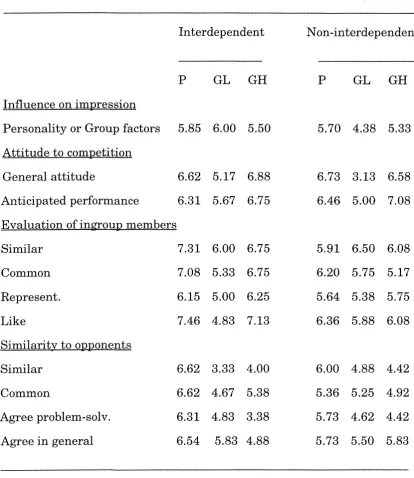
Means for manipulation check measures 17 4
Frequencies and z scores for the relative stereotypicality measure and selection of stereotypic,
counter-stereotypic and neutral information. 176
Frequencies and z scores for the relative recall measure and recall of stereotypic, counter-stereotypic and neutral
information. 181
Means for other response scale measures. 185
Frequencies and z scores for the relative stereotypicality measure and selection of stereotypic,
counter-stereotypic and neutral information. 202
Means for recall measures 208
Means for other response scale measures 211
The type of statement made by each participant and
the order of the contribution 230
Means on measures to assess the relationship between target 1 and target 2 233
Mean scores for target 1 and target 2 on
trait measures 235
Mean difference scores between target 1 and target 2
on combined dimensions 237
The selection of particular traits as most typical of
impressions represented as a percentage. 257
Mean difference scores and standard deviations
on female and science dimensions 259
LIST OF FIGURES
Figure Page
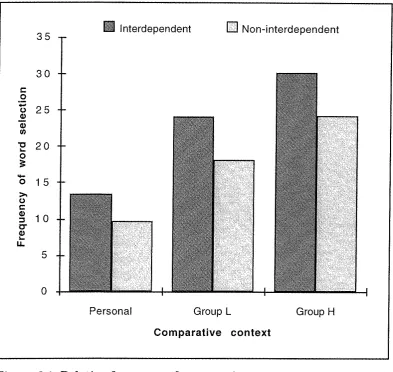
6.1 Relative frequency of stereotypic versus counter-stereotypic word selection in interpersonal (Personal), intergroup low salience (GroupL) and intergroup
high salience (GroupH) conditions. 177
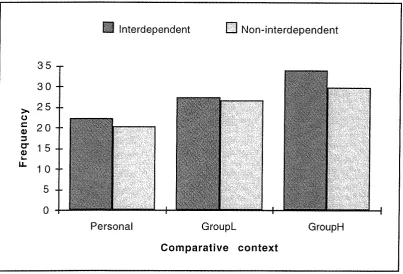
6.2 Frequency of stereotypic word selection 178
6.3 Frequency of counter-stereotypic word selection 179
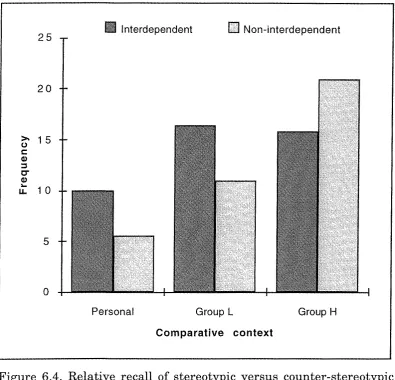
6.4 Relative recall of stereotypic and counter-stereotypic
information. 182
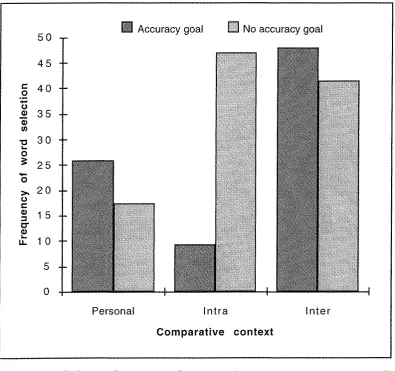
7.1 Relative frequency of stereotypic versus counter-stereotypic word selection in interpersonal (Personal),
intragroup(Intra) and intergroup (Inter) conditions. 203
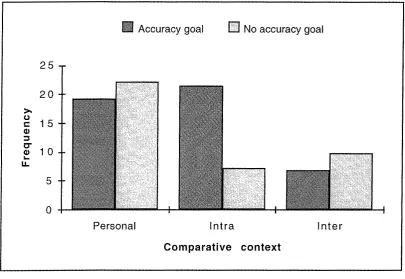
7.2 Frequency of counter-stereotypic word selection 205
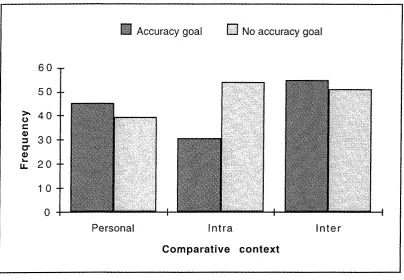
7.3 Frequency of stereotypic word selection 206
8.1 Mean difference scores on combined dimensions 238
9.1 Selection of stereotype consistent and
counter-stereotypic information in interpersonal
and intragroup contexts 254
9.2 Difference scores on female and science dimensions
in the science identity and female identity conditions 260
ACKNOWLEDGMENTS
I would like, first and foremost, to express my thanks and appreciation to my supervisor Dr. Penny Oakes. Penny has excelled as a supervisor and I am grateful for her critical insights as this thesis has progressed and her insistence on ever higher standards of work. If
it wasn't for her encouragement, support, and commitment to providing students with opportunities to become involved in social psychology at an international level, the whole process would not have been as rewarding. My other advisers, Professor John Turner, Dr. Alex Haslam, and Dr. Craig McGarty have also contributed in important ways to my development as a social psychologist and to this project.
I am also indebted to a number of other people who have contributed to the experiments reported in this thesis. Rachael Eggins, Brenda Morrison and Dirk Pisula assisted me in running experiments and Tricia Brown and Rina Onorato were also involved at other stages. I am also grateful for the support of other colleagues in the department; Barbara David, Angie Khoo and Ruth Scott. Thanks also to Chris Black, Diana Grace, Antoinette Harmer, Elinor McKone, Chris Pokarier, and Tony Warren who acted brilliantly as stimulus targets for Experiment 3. Shane Pozzi, the audiovisual officer in the department, was also invaluable in the development of stimulus materials and Lubosh Hanuska ensured that my computer continued to function. I would also like to thank Narrabundah and Dickson colleges and the Canberra Institute of Technology for recognising the educational benefits of research participation.
ABSTRACT
This thesis exammes the impression formation process, with particular reference to the distinction between individuated and stereotypic impression formation. The emphasis is on issues such as: What factors influence our impressions? When are impressions based on a person's individual qualities? When do we form stereotypic impressions of others? What processes underpin the formation of more individuated or stereotypic impressions? Two theoretical perspectives, social cognition and self-categorization theory, offer divergent explanations of the impression formation process and are the theoretical and empirical focus of the thesis. The argument developed in recent impression formation models based on the social coguition approach is that there are two impression formation processes. Categorization is defined as the process used to form stereotypic impressions, and a categorization-free process is thought to underlie individuated impression formation. Whether one process or the other operates is determined by motivational factors which impact on the level of attention allocated to impression formation, such that increased attention is inversely related to stereotyping. Alternatively, self-categorization theory argues that the types of impressions we form of others are the product of the relational, comparative and context-dependent aspects of social perception. The same categorization process, but operating at different levels of abstraction - interpersonal or intergroup - is argued to underlie variations in impression formation. Historical and contemporary developments related to both perspectives are outlined.
best account for variations in impression formation; and 2) whether both stereotypic and individuated impressions are formed through the same categorization process. These issues frame the empirical work of the thesis.
Four experiments are reported. Experiments 1 and 2 (chapters 6 and 7), directly examined whether variability in impression formation is due to different levels of attentional capacity or the defining social comparative context - interpersonal or intergroup. In these studies interdependence (Experiment 1) and accuracy goals (Experiment 2) together with the salient comparative context were manipulated. Overall, there was no systematic evidence that subjects formed more individuated impressions under conditions thought to motivate the allocation of attentional resources (in interdependent and accuracy goal conditions). However, results suggest that more individuated impressions were formed in interpersonal contexts and that stereotyping increased under conditions where ingroup-outgroup categorizations were salient.
Chapter 1
INTRODUCTION AND OVERVIEW
OF THE THESIS
1.1 The problem examined in the thesis
At the end of September 1996, the then Prime Minister of New
Zealand, Mr. Jim Bolger, was interviewed on an Australian current
affairs program. At this time racism was, for several reasons, a front
page issue in Australia and Bolger was asked to comment. He said:
There are certain politicians, I guess, all around the world, your country and mine included who can't handle the race issue. They always go to extremes ... There are people who can't seem to understand that you judge people on who they are, not which country they've come from, what the colour of their skin is or the culture of their origin. (cited in The Australian. 2 October, 1996,
emphasis added)
Bolger's response to the race debate, then, is to repeat this piece
of conventional wisdom - the idea that group affiliations mislead us in
our dealings with others. He shares with many other well-meaning
social commentators the basic premise that we should always treat
terms of their group memberships. This approach to the race issue
certainly has political advantages and popular appeal, but what are
the social psychological implications? Does the political efficacy of this
emphasis on the individual translate straightforwardly to social
psychological processes? Are individuated impressions inherently
more accurate, valid and reality-oriented than group-based
impressions? This is the issue addressed in this thesis.
The impressions we form of others clearly impact on our
attitudes and behaviour and shape social life. Consequently,
impression formation has been and remains a core topic within social
psychology. Research has focused on problems such as: How do we
define what others are actually like - "who they are"? How do we
recognise emotion and other characteristics? What are the qualities of
a "good" judge of others? What is the impact of our impressions? How
do we, as perceivers, integrate the complex information available
about others?
More recent emphasis on the impression formation process has
stimulated interest in the variability of our impressions. Clearly, our
impressions of others fluctuate all the time. During the course of a
conversation the way we perceive others can shift from being based on
their individual, unique characteristics to being shaped by features
they share with other group members and vice versa. Impressions can
also vary within these broad types, such that the specific nature of
perceived personality and perceived stereotypicality change with
context. There has been a recent surge in journal articles which have
(Hamilton & Sherman, 1996), "Category-based versus person-based
perception" (Brewer, 1996), "Forming impressions from stereotypes ... "
(Kunda & Thugard, 1996).
This thesis aims to examine further not only how the impression
formation process is understood but also how variations in the types of
impressions we form of others are explained. What factors influence
our impressions? When are impressions based on a person as an
individual and when are impressions based on their salient group
memberships? What processes underpin the formation of more
individuated or stereotypic impressions? Current theoretical
explanations of why and how our impressions vary contradict each
other in important meta-theoretical, theoretical and empirical ways.
Two main perspectives are investigated in detail in this thesis: the
social cognition perspective, and an analysis derived from
self-categorization theory.
In the social cognition literature, the prevailing view is that
stereotypic and individuated impressions arise from different
impression formation processes. Current and influential embodiments
of this perspective are Brewer's (1988) dual process model and Fiske
and Neuberg's (1990) continuum model. Both these models argue that
stereotypic impressions are formed through categorization, where a
category label or stereotype is used to shape impressions. A
categorization-free process, through which independent traits are
summed in isolation in an attribute-by-attribute way, is proposed to
explain how we form individuated impressions. Thus, we either use
attributes and idiosyncratic information about the person "out there",
to form particular impressions. Both models draw on the influential
work of two prominent impression formation researchers, Solomon
Asch and Norman Anderson, and related research to support the use
of distinct processes in impression formation.
Alternatively, self-categorization theory maintains that one
process - categorization - underlies all impression formation (Oakes,
Haslam & Turner, 1994; Oakes & Turner, 1990; Turner, Hogg, Oakes,
Reicher & Wetherell, 1987; Turner, Oakes, Haslam & McGarty, 1994).
Individuated and stereotypic impressions are differentiated in terms of
the level of abstraction at which the categorization process operates
-either interpersonal or intergroup. Where interpersonal comparisons
are relevant individuated impressions are formed whereas m
intergroup contexts, where we perceive ourselves and others as
interchangeable members of social groups, stereotypic impressions
predominate. Stereotypes are not interpreted as fixed, stable
representations but as dynamic products of the contextual relationship
between groups.
In self-categorization theory the ~ of impressions formed of
others is directly related to self-perception, how we perceive ourselves
in a given situation. All impression formation is, therefore,
comparative. Whether we use conventionally defined attributes (e.g.,
intelligent, arrogant, friendly) or category labels (e.g., French, sexist
male, yuppie) as the basis of our impressions, these judgements are
comparative judgments and comparison is the basis of categorization
Clearly, there are conflicting explanations of the impression
formation process. Are individuated and stereotypic impressions
formed through the same process or different processes? The answer
to this question has direct implications for how variations in our
impressions are explained. In models where two impression formation
processes are advocated it is argued that a person ideally should be
exclusively defined in terms of their idiosyncratic characteristics.
However, it is seen as much easier and cognitively efficient to form
group-based impressions of others because individuation consumes
precious resources. Variations in the type of impressions we form of
others are explained in terms of the amount of cognitive effort
allocated to the impression formation process. Motivational factors,
such as the goals of the perceiver, impact on how much attention
perceivers are willing to invest at any given time.
In self-categorization theory variations in impressions are
explained through the fluid and context-dependent nature of
self-perception. The impressions we form of others are seen as relative to
self-categorization as either a unique, differentiated individual or
interchangeable, group member. Importantly, self-categorization is
argued to vary in a lawful and rational way given variations in the
comparative context and the way these variations are explained.
Consequently, what a person is like, "who they are", is a relative,
rather than an absolute, judgement.
The way the impression formation process and variations in
self-categorization theory offer fundamentally different interpretations of
social perception. This thesis endeavours to both examine and make a
contribution to resolving these divergent accounts.
In summary, the theoretical and empirical substance of this
thesis is expressly defined in terms of the self-categorization theory
and social cognition accounts of impression formation and is framed by
the questions: 1) how is variability in impression formation explained?
and 2) are stereotypic and individuated impressions formed through
use of the same process or different processes? The conclusions
contribute to the ongoing debate in social psychology regarding how
human perceivers process information and make sense of the world
around them.
1.2 Overview of the thesis
Impression formation is social perception. It concerns how
people come to understand and think about others - the manner in
which we judge others. Much of social psychological research could at
some level be related to the issue of impression formation. In the
interests of addressing the aims of the thesis as outlined above,
research related to the self-categorization theory and the social
cognitive analysis of impression formation is the central focus.
Traditionally, impression formation research has been divided
into two main areas. Personalised, individuated impressions have
been the focus of the person perception literature and group-based
impressions have been the focus of work on intergroup relations and
reviewed in Chapter 2. It becomes clear that the separation of this
research into two largely distinct areas has restricted the examination
of important questions regarding the role of the perceiver in social
perception.
The key assumptions of this early research are that: 1) accurate
person perception is defined in terms of the formation of individuated
impressions and 2) stereotypic impressions are inherently "distorted",
"inaccurate" and "contrary to fact". These same assumptions are
reflected in more recent social cognition models of impression
formation (chapters 3 and 4). Only a minority of researchers, Asch
and Sherif included, challenged the view that "we can best achieve a
correct view of a person by ignoring his [sic]l group relations" (Asch,
1952, p. 238). Asch and Sherif explicitly argued that groups are real
and that stereotypes may reflect the relationships between groups in
society. This alternative view of stereotypes offers a group-based
approach which has been further developed in social identity theory
and self-categorization theory (Chapter 5).
Since the 1950s and 1960s the emphasis has been on the
impression formation process. Theoretical developments have meant
that person perception and stereotyping research have increasingly
come together in the models that have evolved. Brewer (1988) and
Fiske and Neuberg (1990) make important contributions by
attempting to integrate both person perception and stereotyping
research in their impression formation models. Ironically, perhaps,
substantive differences in the conception of the person perception
process across the individual and group-based literatures, have been
made more explicit through attempts at integration and have resulted
in the postulation of two different impression formation processes.
Chapter 3 examines in detail not only the arguments developed in
these influential models but also the evidence they draw on to support
the existence of their controversial categorization-free,
attribute-by-attribute, elemental process.
In Chapter 4, the other impression formation process recruited
by these models - categorization- is closely examined. Understanding
categorization from the perspective of these recent models, and the
broader social cognition literature, is the focus. Categorization is seen
to conserve cognitive resources and through this process information
becomes simplified but also overgeneralized. Stereotypic impressions,
which are formed through categorization, are interpreted as being
distorted compared to more accurate, person-based impressions. The
relationship between categorization, use of stereotypes and resource
preservation directly affects the way variations in the impressions we
form of others are explained. When perceivers are motivated to
allocate attention and cognitive resources to the impression formation
process more accurate, individuated impressions are possible.
A fundamental criticism of much of the person perception,
stereotyping and impression formation research is that it is
individualistic. An explicit assumption is that to perceive others as
individuals is inherently real, valid and accurate. In Chapter 5, an
inherent in the social cognition literature is rejected.
The structural and psychological reality of both individuals and
groups are recognised in social identity theory and self-categorization
theory. Rather than emphasising one or the other "the primary reality
of individual and group" are recognised as "the two permanent poles of
all social processes" (Asch, 1952, p. 250-251). Self-categorization
theory endeavours to understand the relationship between individual
behaviour and group behaviour, the self and the group, and a
completely different understanding of the categorization process has
emerged.
Importantly, it becomes clear in Chapter 5 that it is the way
categorization is interpreted in current impression formation models
and self-categorization theory which fundamentally leads to different
interpretations of the impression formation process and to different
explanations of the variability inherent in our impressions. These
different theoretical approaches shape the empirical work of the
thesis.
In chapters 6 to 9 the empirical work is outlined. Experiments 1
and 2 directly investigate different explanations of why the
impressions we form of others vary - why do we sometimes form
impressions of others as individuals and at other times as group
members? Is the variability in impression formation due to different
levels of attentional capacity or to variations in the defining
comparative context - interpersonal or intergroup? Naturally, the
conceptualised from the different perspectives.
In experiments 3 and 4 the focus shifts to examination of the
impression formation process. Is there any evidence that
categorization may underlie the formation of both individuated and
stereotypic impressions? There is general agreement that evidence of
categorization is accentuation of similarities and differences. It is
argued in these chapters that if it can be shown that self-other
similarities and differences are accentuated when both individuated
and stereotypic impressions are formed, then this would provide
evidence of categorization. Therefore, both experiments focus on the
pattern of accentuation when different types of impressions are formed
of others. The results of these studies enable us to draw some
conclusions about the relative accuracy of individuated and stereotypic
impressions and the role of the categorization process in impression
formation.
In Chapter 10, a recapitulation of the argument developed
throughout the thesis is provided. Conclusions from the present
research are integrated and theoretical implications are discussed.
Future directions for research are also outlined. It is possible in the
concluding chapter to make some final comments regarding the social
psychological validity of Jim Bolger's comments on racism. However,
the analysis begins with an assessment of the early social perception
research and the assumptions which have shaped contemporary
Chapter2
EARLY APPROACHES TO SOCIAL PERCEPTION:
"IN THE CHARACTER OF THE BEHELD"
2.1 Introduction
This chapter discusses historical developments in our
understanding of impression formation. How do we form impressions
of others? Are our impressions accurate? Should we always perceive
the same person in the same way? Are those we form impressions of
static and constant? How do we assess impression formation? These
questions are fundamental to understanding impression formation and
many of them have been the focus of past and present research.
Taking an historical perspective we can assess where there has
been progress and inertia in our understanding of the impression
formation process. Traditionally, there has been a dichotomy in the
impression formation literature. Personalised, individuated
impressions have been the focus of the person perception literature and
group-based impressions have been the focus of work on intergroup
relations and stereotyping. Both areas address the question of how
people come to understand and think about others. The separation of
social perception research into these two largely distinct areas has
1ssues. As will be seen in the progression of this thesis, models that
address both person perception and group perception, the formation of
individuated and stereotypic impressions, and the use of attributes or
categories, have recently flourished.
To appreciate the context in which current theoretical and
empirical work is conducted it is necessary to examine early
approaches to person perception and stereotyping. Many of the
assumptions inherent in current work can be traced to historical
developments in the field. For example, the premise that individuated,
person-based impressions are more accurate and less variable than
group-based perceptions has been dominant throughout person
perception and stereotyping research. In this chapter the aim is to
make these assumptions more transparent and to focus on issues of
direct relevance to the thesis (see Tagiuri, 1968 for a detailed review).
The chapter begins with an examination of how person
perception is defined. It is only very recently that person perception
has been considered to have features distinct from object perception.
The way in which person perception has been differentiated from object
perception shaped not only the direction of research but also the
theoretical assumptions on which it is based.
A chronological review of significant developments in person
perception research is then provided. Early person perception research
is divided into three main sections: recognition of emotion, ability to
judge others, and Cronbach's critique. First, researchers were
ability. Evidence that some people were better able to recognise
emotion than others led to the second area of research where more
general questions about the ability to judge others were investigated.
To assess judges' ability to form accurate impressions it was necessary
to measure how the perceiver assessed and evaluated the target.
Techniques also needed to be developed to measure the target of
judgement so a criterion could be established. One of the most
interesting aspects of this research is the way in which the "correct"
answer was defined.
The third area of the person perception literature outlined in
this chapter focuses on Cronbach's 1955 article. Cronbach's impact is
significant because he suggested that aspects of accuracy measurement
rendered most of the early person perception research invalid. An
analysis of Cronbach's work provides clear insights into how the role of
the perceiver was understood in early person perception research. He
argued that individual variability in perception should be measured,
controlled and understood. The aim was to identify those aspects of
the perceiver which led them to make a judgement about the target
that differed from that made by other perceivers. It would then be
possible to understand the reasons why all perceivers did not view the
inherently stable stimulus -the individual person- in the same way.
A large focus of the person perception literature was on the
question of forming accurate impressions of others. A similar theme
develops in the final section of this chapter where the "other half' of
early social perception research, the stereotyping literature, is
also concerned with the extent to which stereotypes were accurate. An
assumption that stereotypes were inherently distorted challenged
researchers to determine the actual extent of their (in)accuracy. The
goal from the outset was to explain potential distortion, and the role of
the perceiver received explicit attention in the theories that developed.
Two directions for research emerged. On the one hand, some
researchers argued that stereotypes were distorted and based on faulty
cognitive processes, whereas others suggested that stereotypes were
valid and reflected the real perceived relationships between groups.
Both theoretical contributions are outlined.
2.2 Differences between object and person perception
This section reviews the definition of person perception, and its
distinction from other forms of perception. Many of the assumptions
which have guided person perception research stem from the way
person perception is differentiated from object perception. Up until the
end of the eighteenth century questions about how we come to know
the characteristics of others were mainly subsumed by philosophical
questions, such as, how we know anything at all? However, the
physiognomy literature, dating back to Aristotle and other Greek
philosophers, is a clear exception. Physiognomy was primarily
concerned with inferences made about character from physical
qualities. For example, it was believed that courage was related to
hair strength throughout the animal kingdom (Sarbin, Taft & Bailey,
1960). With developments towards empiricism, assumptions about the
relationship between cues and character were further explored.
Darwin reported some of the first experiments related to person
mid-nineteenth century. As will be elaborated in the next section, Darwin's
research had a huge impact on person perception research, influencing
the type of questions asked and how they were investigated.
It is not entirely clear why it is only relatively recently that
there has been a keen interest in questions regarding impression
formation. In part, it was not until recently that potential differences
between knowing in general and knowing others were explored, and
this stimulated interest and research in how we understand others.
Sarbin et a!. (1960) identified four main dimensions on which person
perception could be seen as distinct from object perception, and
discussion of this original basis of differentiation provides insight into
the way person perception is defined.
The first distinction concerned complexity and stability. Person
perception has been understood to be more complex than object
perception with more diverse variables that are difficult to isolate.
Objects are perceived as less likely to change across contexts so "it is
much easier to isolate a typical thing-object from its environment than
to isolate a person-object in order to achieve some stability" (Sarbin et
a!., 1960, p. 13). It is widely believed that the variables of interest to
person perception are stable characteristics that are impervious to
environmental changes. As perceivers we "search to perceive the
invariant properties of other people ... we focus not on his behavior,
which is ever-changing, but on more invariant characteristics namely
... intents and purposes" (Hastorf, Schneider & Polefka, 1970, p. 13).
that values are involved in person perception, and there is more
potential for emotional involvement. People and groups can become
positively and negatively valued, although it is recognised that some
non-human objects such as religious symbols and household animals
can be equally valued. Tagiuri (1958) uses the term person perception
in such a way that other non-human entities can be incorporated. The
term person perception is used "whenever the perceiver regards the
object as having the potential of representation and intentionality" (p.
x).
Another aspect believed to be unique to person perception is that
the observer and the object being perceived, form part of the same
context and can influence each other:
Both the perceiver and his "object" have a phenomenal representation of the environment ... Thus through his own presence and behavior in the perceptual situation of the other, the perceiver may alter the perceptual characteristics of the person whose state he is trying to judge. This is, of course, eminently different from the way in which a rock is a source of cues for the perceiver! (Tagiuri, 1958, p. xi)
Observation is seen to change the state of the object being perceived so
attention needs to be given to the role of the perceiver and how this
may influence the normal actions of others (Hastorf et al., 1970).
The final and possibly the most widely researched distinction
between object and person perception is the similarity or assumed
similarity between the perceiver and the object being perceived - the
more extensive than with any other object. The perceiver can draw on
his or her own experience to identify with the object and infer
intentions, feelings and behaviour (Sarbin et al., 1960). The
implication of this is that the "perceiver's repertory of categorising
responses is somehow limited by his own personal or vicarious
experience as a person" (Tagiuri, 1958, p. xi).
Inevitably, the definition of person perception has been closely
related to its distinction from other forms of perception. Indeed the
term "person perception" has been the subject of some debate. While
some prefer "social cognition", others endorse "social perception", which
has come to mean general perception or cognition of social variables
(see also Tajfel, 1968). Person perception as a term typically implies
interpersonal person perception. As stated by Tagiuri (1968, p.
395-396) person perception is:
concerned with how we perceive and know the characteristics of others ... The observations or inferences we make are principally about intentions, attitudes, emotions, ideas, abilities, purposes, traits, thoughts, perceptions, memories - events that are inside the person and strictly psychological.
Stewart, Powell and Chetwynd (1979) identified three significant
points that emerge from this widely used definition. The first was that
perceivers are capable of achieving a significant degree of accuracy in
their impressions of others. Secondly, they noted that there was an
implicit assumption that the perceiver reaches their impression in a
covert way, accessing "events that are inside the person and strictly
extensive and diverse information which is integrated in the person
perception process.
In summary, discussion of person and object perception makes
some assumptions about person perception explicit. The first is that
person-objects do have invariant, stable properties which can be
known. In general the context-specific or "ever-changing" properties of
people are distinguished from more fixed properties. It is the static
features which should most interest perceivers. The second is that
because the perceiver can influence the perceived in person perception
this influence needs to be recognised and understood. These
assumptions have had an impact on early approaches to person
perception.
In the definition of person perception, outlined above, it is
possible to identify a number of research questions which have been
examined in early person perception research. Initially researchers
were interested in "observations and inferences" in terms of recognition
of emotion. Research tried to establish whether the ability to recognise
emotion was generic. The focus then shifted to how "man comes to
know and think about others" (Tagiuri, 1968, p. 395) Questions about
what makes a good judge dominated research from the 1930s to mid
1950s. A brief overview of the recognition of emotion and the ability to
judge others will be presented in this chapter. A third stage in person
perception research followed the critique by Cronbach in the
mid-1950s. The emphasis shifted to an examination of process, which will
2.3 Early person perception research
2.3.1 Recognition of emotion
Interest in recognition of emotion built on Darwin's research and
was the main empirical focus in the area of person perception up until
the 1930s. Darwin kindled empirical interest in person perception by
conducting experiments on the recognition of emotion. At the time the
mainstream view was that emotion was a key factor which
distinguished humans from other animals and the presence of emotion
was used to defend the existence of a human soul. Darwin challenged
these ideas with evidence that expression of emotion could be observed
in primates. He believed that emotion was biologically determined and
evolved because emotion benefited our primate ancestors (Desmond &
Moore, 1991).
In further research, Darwin observed and documented his child's
emotional expression from birth. He also produced photographs which
depicted the expression of different emotions and assessed how adults
recognised emotional expression. These naturalistic but crude
experiments were the first systematic attempts to investigate and
document aspects of person perception.
Darwin's method of asking people to judge a series of
photographs of a person expressing different emotions carries with it
the assumptions that one emotion is always expressed in the same
way, and that all perceivers know which facial features are associated
with which emotions (Hastorf et al., 1970). For example, if someone
smiles this means they are happy and all perceivers will interpret this