THE DEVELOPMENT AND APPLICATION OF COMPUTER
SIMULATION MODELS TO
BIOLOGICAL
SYSTEMS
by
John Stanley Armstrong
This thesis was submitted in partial fulfilment of the
requirements for the degree of
Master
of
Science
in
the
Australian National University
The work recorded in the thesis is my own except for the project concerned with the summer grazing model, where I was a member of a team. Here I acted initially as a consultant for Dr J.L. Davidson and Mr J.R.Donnelly, afterwards taking over the full responsibility for model design and development.
Acknowledgements List of Figures Summary
CONTENTS
Chapter l - Simulation
1.1 Introduction 1.2 A Definition
1.3 Problem Solving - Two Approaches
1.4 Analogue and Digital Computation
1.5 Interactive Computing
Chapter 2 - Comments on the use of Fortran and Simscript as simulation programming languages
2.1 Introduction 2.2 Model Struct ure
2.3 Storage Characteristics 2.4 Flowcharting
2.5 Communication
2.6 Technical Limitations 2.7 The Final Choice
Chapter 3 - Notes on Chapters 4, 5 and 6
Chapter 4 - Summer Grazing and Sheep Management Model
4.1 4.2
4.3
4.44
.
5
4.6
4
.7
4.8
4
.
9
Aim
Introduction and History Structure of the Model Events
Sets, Entities and Attributes Operation of the Model
Program Storage Requirements Output of Results
Future Development
Chapter 5 - Three-Dimensional Light Penetration Model
5.1 Aim
5.2 Introduction
5.3 General Description of
the Model
5.4 Operation of the Program
5.5 Simscript/Fortran Comparison 5.6 Program Storage Requirements
Chapter 6 - Two-Dimensional Light Penetration Model
6.1
6.2
6.3
6.4
6.56.6
6.76.8
6.9
IntroductionLeaf Representation General Model Structure Phase 1
Phase 2
Output Phase
Program St orage Requirements Visual Checks
Timing Considerations
Chapter 7 - Discussion and Conclusion 7.1 Introduction
7.2 General Approach
72 72 72 74 75 94
96
98 98 98 100 103 130 130 130 133 134 135 13513
6
7.3 Interdisciplinary Group Action 138
References
Appendix 1
Appendix 2
7.4 Simulation Models as Research
Tools 140
7.5 Model Verification and
Dimensionality
7.6 Interactive Computing
Interactive Computing Facilit ies at
the Computing Laboratory, Division of Computing Research, CSIRO, ·Canberra
Flowchart for Consumeable Stores Inventory Simulation
142 143
146
150
Appendix 3 Simulation of Summer Grazing Appendix 4 Summer Grazing
Appendix 5 Vegetation-Environment Interactions
In Folder inside Back Cover
-Graph l
Graph 2
Interception of direct radiation. Plotter out put to check the program operation in Phase 1.
Interception of diffuse radiation. Plotter output to check the program operation in Phase 2.
153 163
ACKNOWLEDGEMENTS
I would like to express my thanks to Professor J.D. Ovington, Head of the Forestry Department, School
of General Studies, A.N.U., for permission to carry out this work, and to Dr L.T. Carron, Reader, Forestry
Department, for supervising the project.
The major part of the project involved working with a group in the Grassland Agronomy Section of t he CSIRO Division of Plant Industry, Canberra. In particular, I
have been associated with Dr M. Freer, Dr J.L. Davidson and J.R. Donnelly, and have appreciated their interest and cooperation.
The other part of the project involved members of the CSIRO Division of Land Research, Canberra. Thanks are due here to Dr
C.W.
Rose, Environmental Biology Group, for advice and for supplying many references. Professor R.O. Slatyer, Research School of Biological Sciences, Institute of Advanced Studies, A.N.U., gave considerable help in initiating t he project.Mr R.E. Smart of the Viticultural Research Station, N.S.W. Department of Agriculture, suggested the
development of a two-dimensional model and supplied the
Figure
2.1
2
.
2
4.1
4.2
4.34.4
4.5
4.64.7
4
.
8
4.9
4.10
4
.
11
4
.
12
4
.
13
4.14
4
.
15
4.164.17
4
.
18
4
.
19
4
.
20
4.21
4.22
4.23
4.24
4.25
4.26LIST OF FIGURES
Title
Timing and Space Requirements for GET and PUT Routines (Simscript )
Timing and Space Requirements for Instructions to Access or Restore Variables (Fortran)
Structure of Summer Grazing Model Flowchart showing interdependence of the events in the Summer Grazing Model Correspondence between the FARM and GRAS sets
Hierarchy of events dependent upon exogenous event START
Source listing for routine Source listing for routine Source listing for routine Source listing for rout ine Source listing for routine Source listing for routine Source listing for routine Source listing for routine Source listing for routine Source listing for rout ine Source listing for routine Source listing for routine Source listing for routine Source listing for routine Source list ing for routine Source listing for routine
START LOOK DSTRY AGIN CLEAN GRO EAT DECR GROFAT SAMPL DROUT MOVE SELECT TRMPL RAIN WETHR Graphs of dry mat erial on t he paddocks with time
Graphs of green material on the paddocks with time
Graphs of green material eaten from each paddock with time
Graphs of accumulated digest ible food units eaten with time
Graphs of sheep weight with time
Growth curves based on the equation by von Bert alanffy
Figure 4.27 4.28
5.1
5.2
5.3
5.4
5.5
5.6 5.7 5.85.9
5.10
5.115.12
5.13
5.14
5.15
6
.1
6.2 6.36
.4
6.5 6.66.7
6.8
Title Page
Curves of efficiency of eating with
amount of material available 68 Flowchart showing the general scheme
for interactive computing 71
Flowchart showing the general operation of the three-dimensional light
penetration model 76
Source listing for routine MAIN 77 VISTA Input/Output unit showing
messages on the screen, the light pen
and the keyboard 79
Flowchart for routine SETLUX 80 Source listing for routine SETLUX 81 Source listing for routine STRUCT 83 Display Console showing the file of
leaf values on the screen 85 Flowchart for routine TRACK 86 Source listing for routine TRACK
Source listing for routine ABSORB Source listing for routine ESCAPE Source listing for routine RFLECT Flowchart for routine RESULT
Source listing for routine RESULT Source listing of part of routine TRACK (Simscript )
Individual leaf profile Typical leaf structure
Flowchart showing the overall plan of the program
Typical situation in the model Flowchart of Phase l
Source listing for Phase 1 Flowchart for routine READDATA
Source listing for routine READDATA
Figure Title Page
6.9 Source listing for routine
MAXMIN
1106.10 Source listing for routine PLOTLEAF 111
6.11 Diagram of overlapping by the leaves 112
6.12 Flowchart for routine
LAI
1146.13 Source listing for routine
LAI
116 6.14 Flowchart for routine PDSORT 1176.15 Source listing for routine PDSORT 118
6.16 Flowchart for routine CONTACT 120 6.17 Source listing for rout ine CONTACT 122
6.18 Diagram showing the interception of
diffuse radiation 123
6.19 Flowchart for routine DIFFUSE 125
6.20 Source listing for routine DIFFUSE 126 .21 Source listing for routine
BAMP
1296.22 Flowchart of Phase 2 131
6.23 Source listing for Phase 2 132 In Holder, inside back cover
-Graph l
Graph 2
Interception of direct radiation. Plotter
output to check t he program operation in Phase 1. Interception of diffuse radiation. Plotter
SUMMARY
Biological systems are generally complex and the interrelations which describe the system response are
difficult to determine. Consequently, the construction of a model of such a system usually involves considerable abstraction. The recent advances in the computing field, notably in the speed of operation, storage space and
specialised simulation languages, do relieve some of the difficulty in making models of biological systems. The labour of numerical calculation is removed and a broader approach to the problem is possible. This thesis describes some work that has been done on three particular models.
The first is a model of a rotational sheep grazing system. It is written in Simscript and has been through several development phases. The present model is, to some extent, verified and it has been used for experimental
purposes.
The second and third models are concerned with light penetration into a leaf canopy. The second model considers the problem in terms of three-dimensional leaf
representation, with the energy distribution spectrum of the incident radiation represented by a number of wavebands. This model is in the prototype stage.
The third model is a simpler version of the second model. It uses a two-dimensional leaf representation. The approach and structure for this model are similar to that
initial design are satisfactory. Bot h these models are written in Fortran. Some comments on the two programming languages, Fortran and Simscript, are given.
Part of the work was to consider the use of the
interactive features now available on most medium to large scale computers. Previous engineering experience with analogue computers indicated the benefits that could be obtained by 'direct' manipulation of the model. The
provision of this kind of facility, enlarges the model t o include the experimenter, and the use of graphical output allows the experimenter to quickly get the 'feel' of the system under review.
That simulation methods have a place in the study of
biological systems is, by now, an historical fact. In the thesis, therefore, more emphasis is placed on the 'how' rather than the 'why' of simulation. Interactive computing
should feature prominently in the future application of
1.1 Introduction
l
SIMULATION
1
Agriculturists, engineers, economists and all whose discipline is based on the scientific method are familiar with the concept of a model. Models are on the same footing as hypotheses. They are attempts at description of a real system with an underlying purpose of understanding part, or all, of that system. As most systems are dynamic, models are usually concerned with the changes in system variables with time, due to external causes (i.e. changes which are imposed .on the system) or due to changes naturally occurring within the system.
1.2 A Definition
A good working definition of simulation is given by Shubik (1960). 'A simulation of a system or an organism is the operation of a model or simulator which is a
representation of the system or organisation. The model is amenable to manipulation, which would be impossible, too expensive or impractical to perform on the entity it portrays. The operation of the model can be studied and from it, properties concerning the behaviour of the actual system or its subsystems can be inferred'.
1.3 Problem Solving - Two Approaches
As examples of different approaches to problem solving, the fields of engineering and biology will be briefly
Engineering is, for the most part, the practical
application of simple well established theories in physics.
The difficulties in implementation are not directly due to
2
a lack of knowledge, but generally fall into two areas.
Firstly, there are economic, political, social and,
occasionally, even aesthetic constraint s. Secondly, while the theory may be well established, the application may lead to systems of equations,the solutions of which are beyond
the scope of contemporary methods. This second factor has
been largely removed by the advent of digital computers.
In earlier times, however, it was this difficulty that
induced engineers to develop the use of models. Scale models
of river systems, dam spillways, aerofoil sections and boat
keels are examples of attempts to short-cut the areas of
difficult calculation. A movement towards abst raction in models came with the mechanical differential analyser. On
this, a system of difference equations representing a dynamic
or rate controlled system could be set up. Following the
invention of amplifying valves, there was a natural
progression to electrical and electronic analogue computers.
These are used extensively for the analysis of such complex
systems as electric supply grids, in normal and fault
condition.
In biology the situation seems different While some
areas, such as genetics, are well defined by theory, for
many others no theory has evolved and an experimental
approach is favoured. In fact, the development of
statistical techniques has been strongly connected with the
programming have become the route by which biologists, and
others in the area of the natural sciences, have approached
biological problems. The construction of analytic
mathematical models of systems is common in research, for
example see Waggoner and Reifsnyder (1968), and Anderson and
Denmead (1969), but the use of analogue computers in this
context appears to be small.
3
For the engineer, the concept of a system with
interaction between its components is a familiar one. He is
used to dealing with them and accepts them as normal. He has
learned to predict the stability of systems and, where
necessary, to impose control over a system by the use of
negative feedback.
For the research biologist, the stability of natural
systems, coupled with their general complexity, makes
investigation of a whole system difficult, i f not impossible. Consequently, there is a bias towards looking at small parts of the whole which, when isolated, will not have all the
normal external influences affecting their behaviour.
Thus, the difference between the two disciplines is the
difference between a synthetic and an analytic approach.
It is interesting that the roles are changing over to
some extent. The engineer, physicist and economist are
finding situations where the past history of a system affects
its present response. This situation requires new methods of
analysis. Similarly, using the power of the digital computer,
and new techniques such as simulation, the biologist has the
opportunity to take a new look at the factors which determine
4
1.4 Analogue and Digital ComputationThe main use of the electronic analogue computer is to model a system of linear or non-linear differential equations. It can be run with a one-to-one time correspondence with the actual system as in aircraft simulators, or at a faster or slower rote than real time. By this means, a physical
process which lasts only microseconds con be modelled in slow motion, and a process which lasts for days or years can be
'rushed' in a few seconds.
Practical advantages of the analogue computer ore that by using visual devices, such as cathode ray tubes, the
effects of parameter changes can be viewed immediately. The modular construction of the analogue computer makes it
amenable to quick modification. The main disadvantage is the lack of storage where results can be held and reviewed. In recent years, the basic electronic analogue computer has been extended by the addition of logic function and some storage. The more important development, however, is in the field of hybrid computation where a digital computer is
linked with an analogue computer. Each computer takes over that part of the task for which it is best fitted. In
general, this means the integration procedures are done by the operational amplifiers in the analogue computer (rather than by subroutines such as Runge-Kutta) and the logic, storage and general book-keeping are handled by the digital computer.
The development of special purpose simulation languages for digital computers has led to two distinct types evolving. The first type is designed to model systems in which the
5
variable, usually time. Exampl es are CSMP and COBLOC. The advantages of defining a model in these languages,instead of using an analogue computer directl~ are the elimination of scaling problems and of the necessity to carry out performance tests on each of the model components. A disadvantage isthat the user does not have immediate control over t he
system parameters. A limitation arising nat urally from t he use of a digital computer is that cont inuous variables must be represented by a discrete approximation, and integrat ion procedures will be comparatively slow. Where possible, t he combination of an analogue simulation language used for initial runs, followed by experiment at ion wit h t he model on an electronic analogue computer is a powerful approach.
The other type of simulation language arose in the first instance from work done on the simulation procedures required to process war and business games, invent ory
control, transportation problems and fact ory job scheduling. These processes are essentially discontinuous. The languages which result ed, such as GASP, CSL and SIMSCRIPT (all based on Fortran), SIMULA and ESP (based on Algol) and GPSS, each have areas of best performance, but each contains sufficient
generality to permit it to be applied to a range of problems. One of these languages, Simscript, has been used in
part of the work. In Chapter 2, the structure of this language and some comparisons with Fortran are made.
1.5 Interactive Computing
6
stimulating; in essence, it is the difference bet weendriving a car and being driven. Following the recent advances in the input/output devices which can interface with a digital computer, on-line experimentation is possible in much the same way as with the analogue computer. The general arrangement is as follows:
-INPUT/ INTER- DIGITAL
USER
-
OUTPUT DEVICE-
FACE-
COMPUTERThe input/output device can be a t ypewrit er, or a display console with screen and keyboard (Fig. 5.7), or a television type screen with keyboard and facilit ies for input of information directly via the screen by a light
pen (Fig. 5.3). In order to make the process economic, the digital computer usually operates in time-shared mode, so that the computer is not idle when t he user is viewing the results, or changing system parameters.
Details of the interactive computing facilities which were used in the models are given in Appendix 1.
Kiviat (1967), an aut hority in this field, makes the following comment:
'Graphics and time-sharing also have a large future in simulation experimentation. While it is true that many simulation jobs are well structured and involve little more than substantial computer runs to estimate system
properties, a large number of people have jobs that are unstructured. They are interested in searching for
response surface. Batch-type processing hinders rather
than helps these jobs. A few minutes of console interaction with the right kind of displays can probably displace hours of conventional hit and miss experimentation. Little work
has been done on this aspect of interactive simulation. It seems like a very profitable area. '
2
COMMENTS ON THE USE OF FORTRAN AND SIMSCRIPT AS SIMULATION PROGRAMMING LANGUAGES.
2.1 Introduction
Fortran is a general purpose scientific programming language developed by
I.B.M.
It was introduced in 1958 and since then has been revised and enlarged. The versionconsidered here is Fortran IV.
8
Simscript is a special purpose programming l anguage designed for simulation problems. It was developed at the RAND Corporation and generally released in 1962. Since then, apart from improvements in the compilers, the
available versions are close to the original specifications. A new version called Simscript II, to be released shortly, is considerably more powerful and sophisticated than the version presently available. Details of Simscript II are given in an article by Kiviat (1966).
Whilst it is possible to consider Fortran as a virtual sub-set of Simscript, there are differences in language structure which tend to influence model construction.
Different models for the one problem would bear the peculiar characteristics of the language in which they are written.
2.2 Model Structure
For large programs written in Fortran, the strategy of using subroutines is normally adopted to achieve generality and flexibility. For example, in a forest inventory
called subroutines to read data referring to a sample plot, to check the data for range and other errors, to calculate increment statistics, to calculate volume statistics, to plot resulting curves etc. In subsequent uses of the program various subroutines could be omitted as required.
The transfer of information between the subroutines is normally by parameter lists but can also be done by defined common areas. This aspect will be mentioned again later.
9
Simscript, being initially designed as a special
purpose language, is more readily identified with the structure of the model it is used to define. In simple
terms, any model consists of things which are interconnected to form a system which,when subject to a stimulus, will
exhibit a characteristic response. In the Simscript language 'things' are defined as entities. The stimulus
and the effect it has on the entities is defined by an event
routine, which is broadly similar to the Fortran subroutine. The event routine is triggered not by a call as in Fortran
but by an event which can be initiated in one of two ways.
Either (1) os a statement in an event routine or (2) as an event card in the data. An event arising within an event
routine, which is known as an endogenous event, can refer
to another routine or it can be for the same routine in which it is situated. This is not in fact recursion but does enable an event to re-schedule itself automatically.
This is frequently useful where, for example, one may wish
In the flowcharts this type of event is shown
thus:-The circle, or part circle, implying re-scheduling and the
bar in the top right-hand corner indicating the process is
an endogenous event routine. The coding would look
something like this
-ENDOGENOUS EVENT EXAM
CAUSE EXAM AT TIME +DT
RETURN
END
xx
10
The statement xx will cause re-scheduling. After a time
period defined by DT the event routine will again be entered.
Events can be initiated for event routines other than
the parent routine and this situation is shown in the
flowcharts as below.
A
D
B
S/R
X
11
This would be interpretedas:-Event routine A causes event routines Band D to occur. Event routine B causes event routine C and also calls
the subroutine X.
Internal (i.e. endogenous) events cannot, of course, be self starting so that the other type of event which is
defined in the data deck is considered to be an external, or exogenous, event. There must be at least one exogenous
event to start the simulation and the normal practice is to have a terminating exogenous event set for a particular time. Other exogenous events may or may not be required. Examples
of their use would be for external events such as buyers arriving at a supermarket, rainfall on a pasture system, or thinning in a forest. All of these could, of course, be defined as internal events if distribution functions are available which adequately describe the time and frequency of the events. For many models this kind of data is not available and, in any case, the externally defined events are amenable to change. In this way the user can experiment with 'typical', 'best' and 'worst' sequences for the
exogenous events.
On the flowcharts exogenous event routines are shown
12
2.3 Storage CharacteristicsThe state of a model written in Fortran will be expressed by the values of the various real and integer variables, subscripted or simple& In Simscript use is made of dynamic storage by list-processing and the notion of an array is replaced by a set, or list,which is composed of any number, including zero, of linked members. Thus, the state of the model in Simscript is represented by the state of the sets. In more detail the members of the sets, called entities, in turn hold one or more attribute values. To clarify this concept an analogy with Fortran is helpful, i f not pressed too far. One can think of a set as being comparable to a two-dimensional array, with a row in the array being equivalent to an entity, and a
particular element in the row equivalent to an attribute. To give a specific example - HUMAN could be an entity which might have the attributes WEIGHT, AGE, HEIGHT, COLOUR OF EYES and SEX. The last attribute SEX would be the determining factor for placing the entity into the set MALE or the set FEMALE.
For reasons of generality the creation of global variables by a COMMON statement in Fortran is not always favoured. The use of COMMON storage leads to faster
execution and saving in storage, as the interpretation of the parameter list and the space for the instructions to
perform this interpretation are eliminated. In Simscript, however, a basic feature is the list of the so called
~permanent attributes'. This is a common block and is
13
of an 'initial conditions deck' which in effect updat es the values of the permanent attribut es. One di fference from Fortran is t hat subscripted attributes can have variable dimensions without the necessity for ext ra coding and the use of EQUIVALENCE statements by the user. This is really an indication of the whole difference bet ween t he twolanguages. Much of what can only be called book- keeping is automatically provided by the Simscript system, whereas in Fortran the user must take care of all aspects of the manipulation of the 'events' . For instance, with Simscript the main routine is provided by the system.
This background routine maintains an 'events list' in time order, and updates the list by adding new events or cancelling events as required. When a new entity is created the routine allocates the storage from the 'free' area and links t he new entity into its set. Should the free area become exhausted the program will undertake a 'garbage collection'. This involves the collection, for re-use, of entities which have been previously destroyed. All this is a considerable job and, for models with complex event-timing sequences, the provision of this main routine eases the
burden on the programmer. The light penetration and summer grazing models discussed in later chapters have a very
simple linear event structure, so the benefit is not so noticeable. In other models of industrial systems and in those where stochastic processes are involved, the
14
The use of the attribute-entity-set structure rather than subscripted variables is subject to compromise and the respective advantages depend strongly upon the modelconsidered. The most immediate benefit of Simscript is the close correspondence between the English description of the required action and the source statement . For example, i f the problem is to find the total weight of all men in a particular group over 40 years old, this could be done by two Simscript statements as
below:-LET WT
LET WT
= =
o.
WT+ WEIGHT (HUMAN), FOR ALL HUMAN IN MALE, WITH AGE (HUMAN) GR 40.
Another obvious advantage is with list-processing there is no need to specify beforehand the storage requirements as in the Fortran DIMENSION statement.
The major drawback is that access to an attribute value
in a particular entity is much slower than to an element in an array. This is because it is necessary to ~link along' the entity chain until the correct entity is reached. Thus the access time is variable and can be high when long lists are used. In the summer grazing program the execution time for the simulation from day 1 to day 100 varied between 20 and 45 seconds depending upon the input parameters, the main variation being due to the selection of a one or nine paddock rotation. A similar prugram in Fortran required about ten seconds for the single paddock case. The
15
associated with it 'GET' and 'PUT' routines. These are all part of the book-keeping. The 'GET' routine for instance extracts that part of the entity record which contains the attribute in question. Similarly, the ' PUT' routine
implants the new value of the attribute. These routines can be as small as three or as long as 32 computer words, the range depending upon two factors. The first is the structure of the entity which may be simple, being a one, two, four or eight word record, or complex when there are up to eight sub-records linked to a master record. The second factor is the packing of attributes in a word. There can be one, two, three or four attributes per word. So that, besides the increase in access time already mentioned due to the list structure, there is a further penalty in time which will vary with the entity structure. To confound the picture further, where the attributes are in floating point format and are packed two or three to the word they will also require routines to unpack the exponent and fractional parts before being used in calculation.
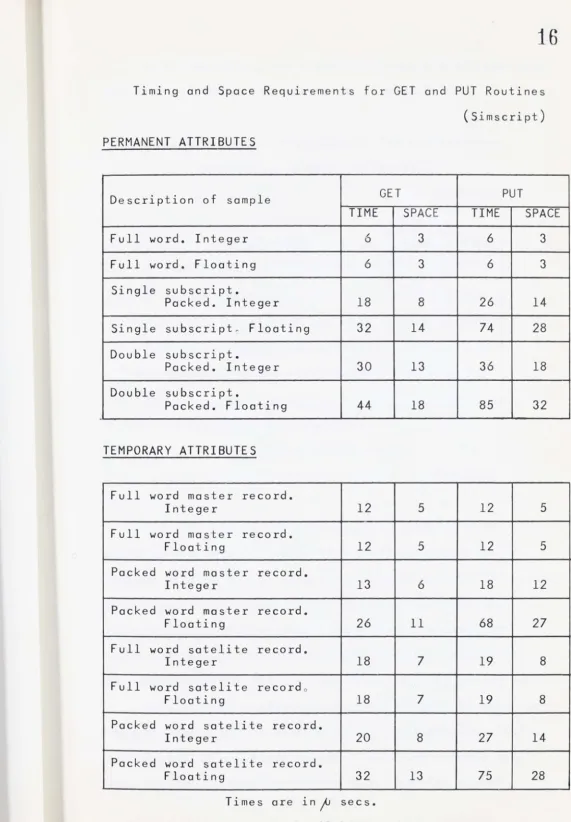
The tables in Fig. 2.1 give some examples of the
average execution time and storage required for a sample of the 'GET' and 'PUT' routines.
16
Timing and Space Requirements for GET and PUT Routines (Simscript) PERMANENT ATTRIBUTES
Description of sample GET
TIME SPACE
Full word. Integer 6 3
Full word. Floating 6 3
Single subscript.
Packed. Integer 18 8
Single subscript~ Floating 32 14 Double subscript.
Packed. Integer 30 13
Double subscript.
Packed. Floating 44 18
TEMPORARY ATTRIBUTES
Full word master record.
Integer 12 5
Full word master record.
Floating 12 5
Packed word master record.
Integer 13 6
Packed word master record.
Floating 26 11
Full word satelite record.
Integer 18 7
Full word satelite recordo
Floating 18 7
Packed word satelite record.
Integer 20 8
Packed word satelite record.
Floating 32 13
Times are in
jJ
secs.Space is in 48 bit words.
PUT
TIME SPACE
6 3
6 3
26 14
74 28
36 18
85 32
12 5
12 5
18 12
68 27
19 8
19 8
27 14
75 28
[image:27.661.35.606.29.850.2]17
As a comparison, the execution times and storage spacerequirements in Fortran are shown in Fig. 2.2.
Timing and Space Requirements for Instructions
to Access or Restore Variables
(Fortran)
DESCRIPTION TIME SPACE
Simple variable
4.0
1.0
Single subscripted variable
6.5
1.5
Double subscripted variable
6
~
5
3
o
5
Triple subscripted variable6.5
4.5
Times are in~ sec.
Space is in 48 bit wordso
The time values are the result of a short test program
in which the array elements were accessed and restored
several million times~ The time equivalence in the single,
double and triple subscripted variables is surprising~
The machine language coding produced by the compiler
indicates the storage area required for the subscript
transformation but does not show the contents of the area.
It should be eriiphasised that the ability to pack more
than one numerical or alphanumerical variable (attribute)
into a word is an option which in terms of storage might
18
With Simscript, or for that matter Fortran or any otherhigh level language, efficient coding demands more than a
superficial knowledge of the language.
2.4 Flowcharting
A general difficulty with the documentation of computer
based models is to give a meaningful flowchart description
for the overall action. Flowcharts of finite programs have
an inbuilt dynamic character since they must show the
progression within the logical bounds which constitute the
solution to the initial problem. Where the problem itself
has a dynamic property, and particularly where stochastic
processes are involved, representation is difficult. The
solution adopted by the author is to present the flowcharts
at two levels, one to show the gross relationships between
the dynamic components of the model and the other to
indicate the detailed structure of each component. This
detailed level of flowcharting within the event routine,
function,or subroutine, is little different from traditional
flowcharting used to describe Fortran programs. Examples
are given in Chapters 4,5 and 6.
At the more abstracted level, the interconnection
between event routines, functions and subroutines is shown
with the dynamic sense implied by arrows on the flow lines.
For an example of such a flowchart see Appendix 2. This was
drawn by the author for a seminar given by Mr I. Ridgway.
It represents the structure of a consumeable stores
inventory simulation.
19
this is sometimes shown explicitly for information purposes, though of course every event has access to all sets in the simulation.In other situations,more emphasis is placed on the sets and they become the main items in the flowchart with the various routines which affect the sets shown linked to them. This also seems to be a worthwhile approach since it is the current membership of the sets and their attribute values which define t he st atus of t he system. A further
advantage is that such flowcharts, designed to the
requirements of the professional programme~ can be re-drawn to convey the basic concepts in the model to a lay audience. This has been done in the flowcharts for the summer grazing
simulation. One of the two papers on this model was
prepared for a conference of computer simulation experts and the other for a congress where the main emphasis was on
application rather than methods and the average member of the audience would not be familiar with flowcharting. See Fig. l of Appendices 3 and 4.
2.5 Communication
As already hinted, Simscript, like Algol, is a better communication language than Fortran and for many of the
smaller routines a flowchart is not necessary. Against this some of the cryptic statements in Simscript can be confusing, for
example:-CREATE DOG CALLED FIDO
may seem reasonable, but
CREATE DOG CALLED DOG
[image:30.653.41.625.23.867.2]after 'CREATE' does not have the same meaning as 'DOG' after 'CALLED'. Then to be told that the phrase 'CALLED DOG' can, in this case, be omitted anyway as redundant is enough to
baffle anyone. The point is computer programs currently require a high order of specificity for efficient compiling, and this in turn demands a level of understanding by the user.
2.6 Technical Limitations
One lesson which is quickly learned is that the
detection and location of errors (debugging) increases in difficulty with the level of the language. Simple
typographical errors are of no concern but with the higher level languages such as Simscript, where there is much more freedom of expression, many errors which are logically
executable pass undetected and require careful analysis to detect. The latest versions of Simscript promise better diagnostic facilities, but the fact remains one is dealing with a powerful weapon and care is required. In Australia few people are fully conversant with Simscript and advice is not readily available. Fortran on the other hand is widely used and expert advice is readily available. Related to this is the fact that not all computers have Simscript compilers, though this situation will change markedly over the next five years.
21
Re-compilation of a subsection of a Simscript program is possible but the complex nature of the compilation process, compared to that for Fortran, means two or three minutes are usually required. Most computer centres schedule incomingjobs in terms of total time required for the job and/or storage requirements. Since the ' t urn-around' time for a
job is a highly non-linear function of the job time, the development stages of a project can be seriously hindered by high compilation times. The availability of fast Fortran compilers, such as
KWICTRAN,
together with on-line editing facilities speeds the development of Fortran based programs. For example, the program for the two-dimensional model took 27 seconds to compile under KWICTRAN and 93 seconds under Fortran. For these practical reasons, the original Simscript version of the three-dimensional model was rewritten inFortran.
2.7 The Final Choice
There is no easy solution to the questi on of choice between the languages. In some cases due to storage considerations, computers available, or a lack of expert advice, there will be no choice anyway. Timing comparisons between similar programs in different languages are difficult
to interpret. It is rather like comparing two different means of transport, say a car and an aeroplane - both may be able to get you from A to B but until you define exactly
and Lubin (1966), Tocher (1965), Brennan and Linebarger
(1964) and Krasnow and Merikallio (1963).
22
To conclude, it is t he author's opinion that for models
where there are no difficulties due to storage limitation,
and the 'cause and effect' mechanisms are reasonably simple,
FORTRAN (or ALGOL) i s the best choice. If the user wishes
to program in 'Simscript style' but remain within Fortran,
the GASP package of Fortran routines is suitable. For the
complex model with storage problems, Simscript is the most
23
3
NOTES ON CHAPTERS 4, 5 AND 6
The three models to be considered
are:-(1) Summer Grazing and Sheep Management.
(2) Penetration of Sunlight into a Canopy considered as a three-dimensional problem.
(3) As (2) but considered as a two-dimensional problem.
They are described in Chapters 4, 5 and 6 with a slightly different approach in each case. For the summer grazing model a full description of the history, model structure,and operation has been given. In this way the power and convenience of the Simscript language will be apparent,and the points made in Chapter 2 can be related. Comments are also made on the program storage requirements and on current development of this model. The application of the model is only mentioned in the chapter but is covered in the two papers, Appendices 3 and 4. These should be read in conjunction with Chapter 4.
The light penetration model for t hree dimensions is used as a vehicle to illustrate the structure of a model which is designed for on-line simulation experiments. In this case the model description and program operation has been
contracted somewhat. As this model is still in the prototype stage there are no results for comparison with field and
24
The third model is also concerned with light penetration and as the model design is very similar to that for the three dimensions model the structure, operation, and programming details are given a full treatment. The value of visual output for checking purposes is shown.
In all three chapters,subprograms in the models are
described by the text, by flowchart, by source listing, or by a combination of these. The text outlines the action of the subprogram. Comments in the source listing define the
infra-structure. Flowcharts are used at various levels of complexity, as appropriate. The source listings have been edited from the originals to exclude all details not directly involved in the model. All FORMAT, COMMON, DIMENSION and non-executable statements of this t ype have been removed together with calls to various checking routines, optional printing statements and timing calculations. Most of the error messages have been replaced by single line comments and some of the input/output statements have been simplified.
The method of producing the source listings is
interesting. Instead of taking photocopies of the direct computer listing, the source deck was translated into paper tape form and this was used to drive a typewriter. The characters are generally clearer than those in the
25
4
SUMMER GRAZING AND SHEEP MANAGEMENT MODEL
4.1 Aim
The aim was to construct a model which in a realistic
and reasonably accurate manner presented the structure and
interactions which occur in a system of sheep management.
4.2 Introduction and History
In normal practice a flock of sheep are rotated between
paddocks where they have access to two types of grass; green
(i.e. living) and dry (dead). Rainfall produces green grass
of a given digestibility. This green material will decrease
in digestibility with time until after a set period it is
considered to be dead and is reclassified as dry material.
Both green and dry grass will be reduced by being eaten by
the sheep and the dry material is also reduced by three
other actions. These are weathering losses following rain,
trampling losses due to the sheep,and a time loss,
presumably due to wind and insects, which is found to occur
in the absence of both rain and animals.
Figure 4.1, taken from the paper 'Simulation of Summer
Grazing' (see Appendix 3), shows the structure of the present
model. For example, the green material is either eaten, is
added to the dry material after aging or remains green.
Having described in general terms the elements in the
model, it will be useful to give a brief history of the
[image:36.666.34.640.67.861.2]26
The initial study was done by two groups in the
Grassland Agronomy Section of the Division of Plant Industry, CSIRO, Canberra, following a course on the simulation
language Simscript which the author gave at the Division of Computing Research, CSIRO. One group used Simscript and the other Fortran and the model was limited to consideration of dry material only. The results from the t rial study were encouraging and it was decided to increase the scope and realism of the model by introducing green material along with other changes. This was done and the model steadily developed. Areas of weakness in the model, mainly in the estimation of dry material losses, and where the data was insufficient, were reviewed and a series of field experiments arranged.
Further development of the model is proposed. This will be discussed after the following description of the present model .
4.3 Structure of the Model
The general structure of the model, indicating the
supply and demand on the green and dry material, is shown in Fig. 4.1, taken from Appendix 3.
In the more detailed Fig. 4.2, from Appendix 4, the connection is shown between the event routines, subroutines and sets of entities. The full lines with the single arrow indicate that an event, or events, are scheduled by the present event. For example, the event
RAIN
will cause the event WETHR to occur subsequently. The full lines with [image:37.667.43.649.24.864.2]Green material
Soil moisture
Evaporation
Dry mat erial
Weathering loss
Rai n
Time l oss
St ructure of Summer Grazing Model.
Trampling
loss
Fig. 4.1
Herbage eaten
START
LOOK
~
SAMPL~
..
L
DROUT
SELECT~
MOVE
I //
I /
'
/I
/
'
'
[:]
/ /.
_
DRY
--
_..
/-
...-
-
,...:
DISTRY
k
I
WETHR
ITRMPL
I
~
EAT
,,
I
RAIN
l
~DECR
-;--;
,,,,, ,,,., I
GRO
I
(
GROFAT
~
--AGIN
r
- ....
-1
GREEN
t
---Flowchart showing the interdependence of the events in the Summer Grazing Model.
Fig. 4.2
29
variables which are altered in one routine will affect t hecalculations in another. This is not unusual but , as
mentioned in Chapter 2, global variables (i.e. the permanent
attributes) and the sets are available to all routines and
an explicit indication of the part i cular connection between
routines is helpful in representing the structure and interactions.
4.4 Events
There are three externally applied or exogenous events,
START, RAIN and SIMEND (not shown in flowchart), and eleven
internal or endogenous events, AGIN, CLEAN (not shown in
flowchart), DROUT, DSTRY, EAT, GRO, LOOK, MOVE, SAMPLE,
TRMPL and WETHR.
4.5 Sets, Entities and Attributes
The emphasis in the model is on the pasture and its
variation during a grazing period of nominally 100 days.
The green material is represented by entities called GREEN
which are members of the set GRAS. This set is subscripted
such that the number of GRAS sets is equal to the number of
paddocks available to the sheep. The attributes of the
REF Paddock Identification l to NP where there
are NP paddocks
AGE Age of the green material in days. This
attribute is used to rank the set
GRE
DIG
SHNO
PRGE
GRUET
GREET
PGRASS
SGRASS
l
Amount of green material
Digestibility of the green material
Number of sheep on this paddock
Proportion of green eaten
Green units eaten
Green eaten
Attributes necessary for the automatic linking
of the member entities to form the set
30
The other entity in the model is not DRY as in the
flowchart but PDK which holds other information besides the
dry material. There is one PDK entity for each paddock and
The attributes of PDK are as
follows:-SFARM
REF
AMT
DIGAV
GRN
Attribute for list linking
Paddock identification l to NP where there
are NP paddocks
Amount of dry material
Average digestibility of the dry material
Total green material on the paddock
31
THDE
THI
PGE
Digestibility per cent of the dry material eaten
THIG
THAE
TTDUE
ADST
DULT
AW
TDUA
DULW
Theoretical intake of dry plus green
Proportion of green in the diet
Theoretical intake of green material
Theoretical intake of dry material
Digestible units of dry eaten
4mount of dry lost by time
Digestible units lost by time
Amount of dry lost by weathering
Amount of digestible dry available
Digestible units lost by weathering
Some of the attributes are common to the two entities.
The correspondence between the two types of set is
Paddock 1 Paddock 2 Paddock 3
,---
- -
-
- -
-
- - --,
FARM f
G;J
~
~
I
I
...L.._- -
- - - -- - - - - _ 1 _, - -
-I
,- ---1
,---
-r
1
~
1
l
~
I
,
~
,
I
I
I
I
I
I
~
~
I
~
I
I
I
I
I
I
I
~
~
I
G;;]
I
I
~ ~
I
~
I
~
8
~
I
l
~AS
(!)
GRAS (2) GRAS (3)-
- - - --Correspondence between the FARM and GRAS sets.
Fig. 4.3
The set FARM will always exist with NP entities where NP is the number of paddocks in the model. The GRAS sets will be zero member sets until the event of RAIN when the growth of grass results in the creation of GREEN entities.
[image:43.670.39.658.25.829.2]33
4.6 Operation of the Model
Whilst the complete structure is shown in Fig. 4.2,
it is too complicated for looking at the program operation.
The operation will be described in the way it occurs in
practice, i.e. each external event, in order of occurrence,
and the internal events dependent on it.
In general, the events and routines have a simple
internal structure and flowcharts are not given. A number
of comments have been placed in the listings to explain the
general purpose and to indicate main points.
The first event is START. Its hierarchy of dependent
events is shown in Fig. 4.4.
is Fig. 4.5.
The source listing for START
As explained in the listing, START reads in the basic
paddock data and schedules further internal events. The
major one of these is LOOK. This routine effectively
controls the simulation as it is responsible for scheduling
the other important events concerned with the growth of new
grass (GRO), the reduction due to eating (EAT), and the
checking event (SAMPL), which manages the movement between
paddocks (MOVE) or into drought yards (DROUT) . The source
listing for LOOK is Fig. 4.6.
Where the scheduling of events is conditional on some
calculated limit, flags are set or reset as appropriate to
skip over sections of the routines. For example, in LOOK
i f there has been no rain, variable A which represents the
potential growth of green material will be zero and so the
event GRO will not be scheduled. Similarly, FLAGG will be
zero if the potential growth has been realised and again
START
LOOK
DSTRY
AGIN
CLEAN
DECR
GRO
EAT
SAMPL
TRMPL
GROFAT
MOVE
DROUT
SELECT
Hierarchy of events dependent upon exogenous event
START
Fig. 4.4
[image:45.669.60.657.21.855.2]FIG.
4
.
5
SOURCE LISTING FOR ROUTINE STARTEXOGENOUS EVENT START
C THIS ROUTINE STARTS THE SIMULATION RUN
C IT INITIALIZES THE PADDOCK DATA FROM DATA CARDS,
C ALLOCATES THE SHEEP TO THE FIRST PADDOCK ANO C SCHEDULES THE EVENTS LOOK, DSTRY, AGIN ANO CLEAN
C
LET ANP
=
NPC MIXED MOOE EXPRESSIONS NOT ALLOWED LET FSIZE
=
FSIZE * ANPC EACH PADDOCK IS NOMINALLY ONE HECTARE. FSIZE IS THE C STOCKING RATE SO THAT THE ACTUAL NUMBER OF SHEEP IS
C DIRECTLY PROPORTIONAL TO THE NUMBER OF PADDOCKS (NP)
DO , FOR J = (
1 )
(NP)CREATE POK CALLEO K
C READ IN THE INITIAL AMOUNT OF DRY MATERIAL C ANO ITS DIGESTIBILITY
READ , AMT(K) , DIGAV(K) LET REF(K)
=
JI F J E Q
1
,
LET SH NO ( K )=
F S I Z EIF J NE
1
,
LET SHNO(K) =0.0
FILE K IN FARM
LOOP
CREATE LOOK
C SCHEDULE EVENT LOOK
CAUSE LOOK AT TIME+
0.1
CREATE DSTRY
C SCHEDULE EVENT DSTRY
CAUSE DSTRY AT TIME+
0.2
CREATE AGINC SCHEDULE EVENT AGIN
CAUSE AGIN AT TIME+
1.0
CREATE CLEAN
C SCHEDULE EVENT CLEAN
CAUSE CLEAN AT TIME+
1.1
RETURN ENO
FIG.
4.
6
SOURCE LISTING FOR ROUTINE LOOKENDOGENOUS EVENT LOOK
C TH IS ROUTINE IS SCHEDULED INITIALLY BY START C ANO SUBSEQUENTLY BY ITSELF
C IT SCHEDULES GRO, EAT, SAMPL ANO TRMPL C C C C C C C C C C C C C C
ER IS THE RATIO OF ACTUAL TO TANK EVAPORAT ION LET ER= GL*(1 .0 - EXPF(- GK*SM))
SM IS THE AVAILABLE SOIL MOISTURE LET SM= SM+ RFALL - ER*EVAP
IF THERE IS NO POTENTIAL GROWTH OR GROWING HAS STOPPED DO NOT SHEOULE GROWTH
IF A EQ 0.0 GO
1
IF FLAGG EQ
O
,
GO 1 CREATE GROCAUSE GROAT TIME
IF DROUGHT EXISTS OMIT EAT SECTION (SHEEP ARE HANO FED IN YARDS IN THIS CASE)
1 IF FLA GO EQ 1 , GO
2
FINO FIRST , FOR ALL KK IN FARM , * WITH SHNO(KK) NE 0.0 , WHERE K FIND WHICH PADDOCK HAS THE SHEEP
DEPENDING ON THE AMOUNT ANO THE PREVIOUS PROPORTION OF GREEN MATERIAL EATEN SHEDULE EITHER 1 OR 10 EATS
FOR THE NEXT DAY TOGETHER WITH A CORRESPONDING NUMBER
OF SAMPLING EVENTS
IF GRN(K) LS GM, GO
4
IF PGE(K) LE PGM , GO4
J
LET FLAGE = 1.0CREATE EAT
CAUSE EAT AT TIME CREATE SAMPL
CAUSE SAMPL AT TIME+ 0.8
GO
5
4
LE T FLA GE = 1 0 • LET TTT = 0.0DO , FOR NE =( 1 ) ( 10) CREATE EAT
CAUSE EAT AT TIME+ TTT CREATE SAMPL
CAUSE SAMPL AT TIME+ TTT LET TTT = TTT + 0.1
LOOP
SCHEDULE THE TRAMPLING EVENT
5
CREATE TRMPLCAUSE TRMPL AT TIME LET TYME = TYME + 1
RE- SCHEDULE LOOK
6
CAUSE LOOK AT TIME+ 1.0CALL RECD
RETURN
2
CREATE SAMPLCAUSE SAMPL AT TIME+ 0.8
GO
6
RETURNENO
[image:47.676.40.659.42.868.2]37
The events DSTRY, AGIN and CLEAN are ini tiated by START and subsequently ore self sustaining.
DSTRY, Fig. 4.7, defines the loss in dry material with time? The loss is assumed to be a function of t he
digestibility of the material, such t hat the digestibility of the material lost is higher than the average
digestibility. This is a similar effect to the selection of dry material by the sheep, considered later, and t he same routine DECR is used to est ablish t he di gestibility of t he dry material lost .
FIG.
4
.
7
SOURCE LISTING FOR ROUTINE DSTRYC
C C
C
C
C C
C C
C
ENDOGENOUS EVENT DSTRY
THIS ROUTINE IS SCHEDULED INITIALLY BY START AND SUBSEQUENTLY BY ITSELF
CALCULATION OF DRY MATERIAL LOST WITH TIME
SET FLAG SO ALL PADDOCKS ARE CONSIDERED IN DECR
LET FLAGS=
0
CALL DECR
AMOUNT LOST IS EQUAL TO THE AMOUNT PRESENT TIMES
THE RATE OF LOSS
LET ADST(K) = AMT(K) *OSK, FOR ALL K IN FARM
DIGESTIBLE UNITS LOST IS THE AMOUNT LOST TIMES THE DIGESTIBILITY SELECTED
LET DULT(K) = ADST(K)*THDE(K), FOR ALL K IN FARM RE- SCHEDULE THE EVENT
CAUSE DSTRY AT TIME+
1.
0
3
8
AGIN, Fig. 4.8, processes the GRAS sets . It updates the
age and digestibility attributes for each entit½ and updates the total green material available attribute which is in the
corresponding paddock. For the purposes of the model green material over a certain age is considered to have died. Any
which meet this criterion are removed from the GRAS set and added to the dry material attribute in the paddock, with a corresponding adjustment to the average digestibility of the dry material.
CLEAN, Fig. 4.9, is a programming convenience. It
happens that when the potential growth has been realised for a paddock,the GREEN entity, which is created to hold the amount of green material grown, has in fact a zero amount of
green. In order to keep the GRAS sets as small os possible and so reduce the time to process them, every three days the
non-useful entities are removed and the storage released.
FIG.
4
.
9
SOURCE LISTING FOR ROUTINE CLEANC C C C C C C
ENDOGENOUS EVENT CLEAN
THIS ROUT INE IS SCHEDULED INITIALLY BY START ANO SUBSEQUENTLY BY ITSELF
ANY ATTRIBUTE WHOSE GREEN ATTRIBUTE IS ZERO
IS REMOVED FROM THE GRAS SET
RE-SCHEDULE THE EVENT
CAUSE CLEAN AT TIME+
J
.
0
DO , FOR J
=
(1)(NP)IF GRAS(J) IS EMPTY, GO 1
00 , FOR ALL G IN GRAS(J)
IF GRE(G) NE
(0.),
GO2
REMOVE G FROM GRAS(J) DESTROY GREEN CALLED G
2
LOOPFIG.
4.8
SOURCE LISTING FOR ROUTINE AGINENDOGENOUS EVENT AGIN
C THIS ROUTINE IS SCHEDULED INITIALLY BY START C AND SUBSEQUENTLY BY ITSELF
C C C C C C C C C C C C C C C C
THE AGE AND DIGESTIBILITY ATTRIBUTES IN THE GREEN ENTITIES ARE UPDATED. ANY DEAD MATERIAL (AGE= AMX)
IS TRANSFERED TO THE POK ENTITY ANO THE NEW VALUE OF DIGAV IS CALCULATED
RE-SCHEDULE THE EVENT
CAUSE AGIN AT TIME+ 1.0 DO , FOR J = (1)(NP) REMOVE FIRST K FROM FARM
IF NO MEMBERS IN THE SET OMIT CALCULATION IF GRAS(J) IS EMPTY, GO
2
INCREASE AGE ATTRIBUTE BY 1 DAY
LET AGE(G) = AGE(G) + 1. , FOR ALL G IN DECREASE DIGESTIBILITY ATTRIBUTE BY AMOUNT LET DIG(G) = DIG(G) - AG, FOR ALL G IN FINO TOTAL AMOUNT OF GREEN IN THE SET ANO TRANSFER RESULT TO THE PADDOCK
GRAS(J) AG
GRAS(J)
LET SGRE(J) = 0.0
LET SGRE(J) = SGRE(J) + GRE(G), FOR ALL G * IN GRAS(J), WITH AGE(G) LS AMX
LET GRN(K) = SGRE(J)
CHECK IF ANY GREEN HAS AGE EQUAL TO AMX
IF SO ADO TO DRY IN PADDOCK ADJUST THE AVERAGE DIGESTIBILITY ANO FREE THE STORAGE TAKEN UP BY THAT GREEN ENTITY
FINO FIRST, FOR ALL G IN GRASS(J), WITH AGE(G) * EQ AMXJ WHERE NJ IF NONE
1 GO
2
LET AMT~K) = AMTlK) + GRE~N)LET DIGAV(K) = (OIGAV(K)*AMT(K) + DIG(N)*GRE(N)) * /(AMT(K) + GRE(N))
REMOVE N FROM GRAS(J) DESTROY GREEN CALLEO N
2
FILE K IN FARMLOOP RETURN ENO
4
0
The event GRO, Fig. 4.10, defines the daily growth of green material for each of the paddocks. A logistics growth curve is used with an initial step response following the first rainfall. This has not been completely satisfactory and further comments are reserved for a later section.It is in GRO that the non-useful GREEN entities can be formed as noted earlier in CLEAN. Only when all paddocks have achieved their potential growth will the growth flag be reset.
The event EAT, Fig. 4.11, is scheduled by LOOK and can occur either once or ten times each day. The requirement to schedule ten EATS only occurs when the amount of green
material is small as in this case the function defining the amount removed by the sheep to the amount available is
convex and the change in gradient is comparatively rapid for small changes in amount available. With the coarse grid, i.e. one EAT per day, it is possible by extrapolation to remove more green than is currently available.
As eating only occurs on one paddock, the subroutine DECR, Fig. 4.12, is called with FLAGS set to unity. This routine establishes the proportion of green in
the diet available on the paddock and the theoretical intake of the total food and similar statistics for the green and dry materials.