BIOACADEMY 2008 – PROCEEDINGS
BIOAKADEMIE 2008 – SBORNÍK
New Developments in Science and Research
on Organic Agriculture
Nové poznatky vědy a výzkumu
v ekologickém zemědělství
3. – 5. 9. 2008
Lednice na Moravě, Czech Republic
Lednice na Moravě, Česká republika
Bioakademie 2008 – sborník
New Developments in Science and Research on Organic Agriculture
Nové poznatky vědy a výzkumu v ekologickém zemědělství
Bořivoj Šarapatka, Pavlína Samsonová (eds.)
Překlad / Translation Ina Leckie, Jim Leckie
Technická redakce / Technical editor Milan Matoušek
Vydal / Published by Bioinstitut, Křížkovského 8, 771 46 Olomouc, CZ, www.bioinstitut.cz Vytiskl / Printed by Trifox Šumperk, CZ
Text neprošel jazykovou úpravou / Text in its original form without correction
1. vydání / 1st Edition
Olomouc, 2008
Dear friends and colleagues,
We are meeting for the 8th year of Bioacademy which, since the year 2000 has been gaining the support
of a wide range of farmers, research and academic institutes, government bodies and many other specialist organisations. Over the years we have focused on many current issues in organic farming relating to the development and support of this agricultural system in the EU, non-chemical protection of plants, growing vegetables, grassland in organic farming, animal welfare, food quality and other topical themes.
With the passing years Bioacademy has not only become a meeting place for those involved directly with production, but also for researchers. This led to a change in the character of this year’s conference and the introduction of a scientifi c part which will deal with current issues of research.
For the whole Bioacademy, we have chosen the broad topic of “New Developments in Science and Research on Organic Agriculture”. Within this topic, the Conference for Practitioners will put emphasis on the transfer of up to date information directly into practice, while the Scientifi c conference will enable scientists of various specialisation to exchange the latest research fi ndings from this agricultural system reaching into the related areas of landscape and the environment.
Nevertheless, we have no intention of dividing Bioacademy into two “camps”– scientifi c and practical. We believe in mutual communication, inspiration, meeting needs and listening to the opinions of individual groups. New scientifi c knowledge should aff ect current organic farming and, on the other hand, researchers should listen to practical needs and problems. In this discussion we can reveal problems limiting the development of organic farming, problems which it will be necessary to solve in the future.
The Proceedings you are now reading consist of several parts according to language. We have placed
the English version at the beginning, as Bioacademy is an international event, as shown in its title – the 8th
European Summer Academy on Organic Farming. Within individual language versions, the contributions are given according to the order of the programme. This refers to the Plenary Meeting, Conference for Practitioners “A” (abstracts from these two parts are published) and Scientifi c Conference “B” (opposed contributions in the form of scientifi c articles are given only in the English section of the Proceedings).
Before you start reading this material and listening to lectures, I would like to thank all the organisations that participated in the preparation of Bioacademy and whose logos are printed on the cover of the Proceedings. I would further like to thank all members of the organisational team and scientifi c committee of the conference.
I also thank all opponents from various countries, whose names remain anonymous, as the opponency of scientifi c articles is anonymous, too. We deeply appreciate their demanding work and we hope that, as with our organisational team, they will continue to work as our colleagues in the future.
I am sure that this new model of practical and scientifi c conference will prove eff ective and will attract an ever-widening range of specialist public. Please, excuse any possible “teething troubles” in the new structure, the preparation of which required a lot of eff ort from the organisers. I hope that, in a pleasant atmosphere in Lednice, we will enjoy three days fi lled not only with a specialist programme, but also numerous accompanying events.
I am already looking forward to meeting you all again in 2009
Prof. Bořivoj Šarapatka
THE MAIN CURRENT TOPICS IN THE DEVELOPMENT OF
ORGANIC FARMING IN THE EU 2008/2009: FROM THE POINT
OF VIEW OF IFOAM
BLAKE, F.1
Key words: regulation, research, climate change, CAP
Abstract
A key topic for the IFOAM EU Group in the last three years has been the revision of the EU organic regulation (2092/91). We have analysed, publicised, consulted, responded to and generally pressurised the authorities to amend and improve the new framework regulation (834/2007) (stage 1) and then the implementing rules (stage 2). We have had some success, but the mandatory EU logo remains a major negative.
We are now well into stage 3 – the new areas of aquaculture, seaweed and wine. We have also started considering stage 4 – picking up all the loose ends and unresolved issues, including poultry standards, review of inputs against the new criteria, review of processing rules against the new principles, etc.
The IFOAM EU Group is planning to publish early next year a dossier that will explain the new regulation in a way that ordinary stakeholders will be able to understand. We are still looking for the fi nal few responses to be partners in this project.
Looking wider, we co-ordinate the organic research technology platform. This is important to ensure a clear direction for organic research in the EU and to infl uence its research agenda.
Looking wider still, we are facing the global challenges of climate change, impending peak oil and increasing food prices. Organic farming can contribute signifi cantly to meeting these challenges, so we need to intensify our lobbying for a reform of the CAP – to ensure it really does encourage the development of a truly sustainable agriculture.
We must also look to ourselves. How should we change to ensure organic will be able to operate optimally in a very diff erent world? From more or less emulating conventional systems, we need to really start applying organic principles. As the paradigm moves in our favour, we must move with the paradigm – if we do that, then there is a bright future ahead.
1 President, IFOAM EU Group, rue Commerce 124, 1000 Brussels, Belgium,
VISION FOR AN ORGANIC FOOD AND FARMING RESEARCH
AGENDA TO 2025: ORGANIC KNOWLEDGE FOR THE FUTURE
NIGGLI, U.1, SLABE, A.2, SCHMID, O.1, HALBERG, N.3, SCHLÜTER M.4
Key words: research agenda, strategy, perspectives
Abstract
Organic farming is a productive low-input agriculture placing special emphasis on sustainability and off ering innovative concepts for global problems such as the degradation of ecosystem services (e.g. soil fertility, biodiversity or clean water), the economic decline of rural areas with migration from the land, the
provision of suffi cient food in climate change scenarios and the fast growing demand for high quality food
in developed and emerging regions of the world. The IFOAM-EU Group and ISOFAR developed a vision for the strategic priorities in future research which was published in August 2008. This vision was supported by many European stakeholders and civil society organisations.
The strategic priorities for research of the organic sector encompass i) viable concepts for the empowerment of rural economies in a regional and global context, ii) securing food and ecosystems by means of eco-functional intensifi cation and iii) high quality foods as a basis for healthy diets and a key for improving quality of life and health.
Deduced from these strategic priorities, an intensifi cation of the research activities at regional, national and European level is outlined in the vision paper. The overall aim of research is the support of a ‘lead market’ of the European food industry and to improve the provision of society benefi ts and the public good of agriculture. Organic food and farming systems off er unique opportunities for a competitive and sustainable future, which can be deployed by R&D eff orts.
The vision paper is the fi rst step towards a continuous research-agenda setting-process driven by stakeholder and society. Hence, the Technology Platform “Organic” will foster these important debates and facilitate the next steps.
1 Research Institute of Organic Agriculture FiBL, Frick, Switzerland 2 Institute for Sustainable Development, Ljubljana, Slovenia,
THE ‘INTERNATIONAL SOCIETY OF ORGANIC AGRICULTURE
RESEARCH’ (ISOFAR)
NEUHOFF, D.1, KÖPKE, U.1
Key words: research, organic agriculture, institutions
Abstract
The International Society of Organic Agriculture Research (ISOFAR) founded in 2003 in Berlin seeks to promote, encourage and support research in all areas of Organic Agriculture by facilitating global co-operation in research, methodological development, education and knowledge exchange, supporting individual researchers through membership services and integrating stakeholders in the research process. Organic Agriculture addresses pivotal issues of the future of our globe in the broad scope of agriculture and food production. Research deserves high priority in the fi elds of sustainable land use, regional rural development, environmental impacts, food security, food quality and health as well as ethical and social aspects of agriculture. Current and future global challenges require joint interdisciplinary and participatory approaches. In this spirit, ISOFAR supports the development of sustainable organic agricultural systems worldwide by:
supporting individual researchers from both generalist organic systems and specialist disciplinary
backgrounds through membership services including events and publications, facilitating global co-operation in research, education and knowledge exchange,
encouraging conceptual, methodological and theoretical development and respecting the ethos of
Organic Agriculture in a systems / interdisciplinary context,
attempting to solve problems on site by fostering regional researcher-farmer group relationships,
improving the scientifi c excellence of organic agricultural research, e.g. by integrating experts from
international agricultural research centres while maintaining the roots of the organic idea.
Check our website: www.isofar.org
Contact ISOFAR
c/o: Institute of Organic Agriculture (IOL), University of Bonn, Katzenburgweg 3, 53115 Bonn, Germany, Tel.: ++49228 / 73 – 5616, E-Mail: [email protected], Internet: www.isofar.org
1 Institute of Organic Agriculture (IOL), University of Bonn, Katzenburgweg 3, 53115 Bonn,
BIO-QUO VADIS
GEIER, B.1
Key words: organic, globalisation, markets, cooperation and vision
Abstract
Asking the question “quo vadis” (where are you going) about the way for organic agriculture raises the related question: “Where do the goods come from?”
The rapid growth and worldwide trade in organic products is a reality. It is true that this off ers opportunities – not only for commercial enterprises, but also for small farmers in developing countries to sell their produce for an appropriate price.
But this worldwide fl ow of goods presents a challenge for the holistic principles of organic agriculture. The presentation will refl ect on how we can organise the economic expansion and globalisation of the organic sector without compromising the values that have identifi ed organic agriculture also as an alternative economic approach.
The presentation will look at the recent development of – especially international – trade. It will also highlight some examples of innovative cooperation and creation of synergy
Finally it will give an outlook on the challenges, but more so the opportunities ahead for the organic movement and its economic sector.
The background to the “visionary” element of the presentation will be the understanding that the popular slogan “think global – act local” falls short. We cannot really leave global “action” just to the World Trade Organisation and multinationals. And how successful can acting locally be if we don’t “think” about it. This
inevitably means that we must think and act locally, regionally and globally.1
1 c/o COLABORA – Let’s work together, Bernward Geier, Alefeld 21, 53804 Much, Germany,
FOOD AND AGROENERGY PRODUCTION IN ORGANIC
FARMING – UNDESIRABLE OR SUSTAINABLE OPTIONS?
SCHÄFER, W.1
Key words: energy crops, renewable energy, effi ciency
Abstract
Crop production is a conversion process of solar energy into biomass. Consequently, both the cultivation area and the insolation intensity of this area limit the agroenergy output of the globe. Cultivation measures support the photosynthetic conversion process. Although organic cultivation measures require less energy
than mainstream agriculture, the overall effi ciency remains below 1%. Nevertheless, agroenergy production
is captivating with many win-win situations: environmentally neutral bio-fuels replace polluting fossil fuels, farmers get better prices for energy crops, and turnover of power industry grows due to increasing energy consumption to process biomass into fuel. Consequently, the state tax income improves too. However, better prices for energy crops may trigger export of environmental pollution because higher conversion
effi ciency in tropical countries favours the intensifi cation of energy crop production at the expense of food
production. The overall effi ciency of fuel from energy crops will never be competitive with solar techniques.
E.g. solar collectors replace fossil fuels for heat production much more effi ciently. Yet, high process effi ciencies of technical processes to convert biomass into fuel justify the production of fuel from organic waste and residues. Thus, organic farming should not focus on energy crop production but produce high quality food in an environment-friendly way. As a measure for sustainability of fuel production from biomass, the energy surplus of energy conversion from insolation to fuel per resident and square meter is proposed.
1 MTT Agrifood Research, Vakolantie 55, 03400 Vihti, Finland E-Mail [email protected] , Internet
HOW ECOLOGICAL ARE DIFFERENT AGRO-ENERGY
CONCEPTS? MIXED CROPS AND ENERGY UTILISATION
PAULSEN, H. M.1
Key words: mixed cropping, oil crops, agro-forestry, resource effi ciency
Abstract
Yield increases, reduction of energy input and the use of renewable energy sources could enhance
low product-bound climate effi ciency values in organic production. Effi ciency of plant production can
be improved by recycling nutrients from bio-energy processes on farms like biogas slurry, the use of straw ash, wood ash and oil cake as well as N-fi xation by the increased integration of leguminous intercrops or undersown legumes for biogas production. Sequences of diff erent crops for biomass production and
breeding progress could increase the resource effi ciency further. Relative yield increases and more eff ective
resource utilisation are found in mixed cropping systems. For the reduction of energy input, cropping concepts guaranteeing eff ective weed suppression and technical perfection in soil treatment and drilling technology are demanded. But reduced tillage concepts are rarely experienced and could anticipate yield security. Agro-energy cropping concepts in organic farms can be the key for the reduction of green house gas emissions from production processes by yield increases and saving of fossil energy. But energy cropping is accompanied by product diversifi cation. Due to increased relative yield mixed cropping concepts have the chance to combine food and energy production. But balances have to be found in economics and in the wish for food security. Agro-forestry systems and mixed cropping with oil crops show interesting options to fulfi l these demands.
1 Institute of Organic Farming in the Johann Heinrich von Thünen-Institute (vTI), Federal Research
ORGANIC FARMING POLICY INSTRUMENTS IN CENTRAL
AND EASTERN EUROPEAN COUNTRIES:
POSSIBILITIES AND BARRIERS
HRABALOVA, A.1, WOLLMUTHOVA, P.2
Key words: organic farming, policy instruments, area payments, Central and Eastern European countries
Abstract
Organic farming (OF) has expanded rapidly in the Central and Eastern European countries (CEECs) due to policy support in the form of area payments which had already been introduced on a national basis before the EU accession in all CEECs. Signifi cant adjustments in OF payments took place in CEECs in 2004, as a consequence of the EU accession, when the average area payment increased to €133/ha compared to €52/ha in 2003. A further signifi cant increase in OF payments, mainly for special crops, was made for the 2007-13 period in SK, LV and CZ. Currently, the highest payment for arable crops and grassland is provided in SI (€298/ha, €228/ha) and for permanent crops and vegetables in CZ (€849/ha, €564/ha).
The research results have shown that OF payments were the most important and, in most cases, the only support for OF in the CEECs until 2004 and that CEECs are lagging behind in developing policy instruments to tackle the imbalance between supply and demand oriented measures. The existing OF policy favouring
instruments focused on supply can not suffi ciently solve the main problem areas such as underdeveloped
processing and marketing, insuffi cient and inappropriate organic production capacity or lack of professional
training and advisory services in such immature and un-transparent markets as they are in CEECs. However, in recent years OF policy in CEECs has been developing towards more integrated approaches and all CEECs have used the opportunity to support OF through a variety of measures within the new rural development programmes such as: specialist training, the use of advisory services, added value to agricultural products or supporting participation in food quality schemes from Axis 1 and diversifi cation of agricultural activities or encouragement of agri-tourism from Axis 3. In addition, most CEECs have recognized the need to integrate these policies into one plan and have implemented national action plans for OF. But it is clear that there is still great potential for the implementation of other policy tools strengthening OF development in all CEECs.
1 Institute of Agricultural Economics and Information, Kotlářská 53, 602 00 Brno, Czech Republic,
E-Mail [email protected], Internet www.vuze.cz
EU REGULATION (EC) 834/2007 AND ITS IMPLEMENTING
RULES FOR ORGANIC PRODUCTION, LABELLING AND
CONTROL – WHAT WILL CHANGE?
FLADL, M.1
Key words: organic production, EU legislation
Abstract
The EU legislation on organic production, labelling and control has undergone a major revision. Council Regulation (EC) 834/2007 replaces Regulation (EEC) 2092/91 and will come into force as of 1. 1. 2009.
The Regulation is supplemented with implementing rules laying down technical details for various production fi elds. A fi rst package of „implementing rules“ was agreed by the Standing Committee of organic farming in July 2008. The text mainly results from transposition of the Annexes of Reg. 2092/91 without changing the substance. It has been re-structured and simplifi ed where possible. A few legal clarifi cations and some new elements, in particular to enforce animal welfare, have been introduced.
A separate package on implementing rules for imports is in the pipeline.
The elaboration of implementing rules for entire new fi elds like organic aquaculture, yeast, seaweed and wine will take more time and therefore come into force at a later date.
The legal revision is a corner stone of the European Organic Action Plan (2004) and will be presented.
1 European Commission, DG AGRI Unit H.3 – organic farming, Rue de la Loi 102, 4/004,
IMPLICATIONS OF THE NEW EU REGULATION (EC) 834/2007
ON ORGANIC PRODUCTION FOR INSPECTION
DIERKES, B.1, NEUENDORFF, J.2
Key words: organic production, control, EU-Regulation, inspection, certifi cation
Abstract
The new EU-Regulation (EC) No. 834/2007 on organic agriculture will come into force on 1/1/2009. The new implementation rules were decided on 2/7/2008.
The inspection system and the inspection procedures for organic products were restructured under both new EU-regulations. They will be implemented in conformity with the requirements of Regulation (EC) No. 882/2004. Both new EU-regulations will bring some important and interesting changes for the inspection and certifi cation of organic operators. At the farmer’s level, a number of derogations will no longer require prior authorization by the inspection bodies.. Other derogations will need to be decided in future by competent authorities. Processing facilities for food and feed will need to implement a concept of “organic critical points (OCP)”. This concept was developed in the framework of a German R&D-project in 2003. OCP will ensure that inspectors look fi rst at risky areas in processing and focus on critical areas during the inspection.
The results of a German Research & Development project in the framework of the Federal Program
for Organic Agriculture will be presented. The project aims to design eff ective and effi cient methods and
instruments for the future control system of organic products, taking into account the requirements of Reg. (EC) No. 882/2004.
1 GfRS Gesellschaft fuer Ressourcenschutz mbH / Resource Protection Ltd., Prinzenstr. 4, D- 37073
Goettingen, Germany, E-Mail [email protected], Internet http://www.gfrs.de
QUALITY ASSURANCE: HOW TO AVOID RESIDUES AT FARM
LEVEL AND IN THE ORGANIC FOOD CHAIN
HEEB, M.1, WYSS, G.2, NOWACK, K.3, SCHMID, O.4
Key words: residue levels, quality assurance, organic food chain
Abstract
Pesticide residues in organic production are a sensitive topic and critical for the image of the sector. Therefore, Inspection bodies, but also operators, need professional tools and concepts to handle cases of suspicion regarding organic products which are not in compliance with Regulation (EEC) No. 2092/91 (Annex III, article.9).
The inspection body is obliged to assess whether further investigations are necessary and is urged to use its expertise and extensive practical experience to generate a rapid explanation for the facts in question. Also operators shall initiate procedures a) for adequate management of sampling in their enterprise, and b) for handling residue cases in their produce. A broad understanding about sources of contamination and critical control points in organic farming and processing is crucial in order to develop appropriate sampling plans, but also for professional interpretation of residue cases and analysis reports. In the event of residue on organic produce, a thorough interpretation of the results, clear decision making structures and division as well as well defi ned communication channels are key aspects for the professional handling of the situation and preserving organic quality assurance and its image.
1 Research Institute of Organic Agriculture FiBL, Ackerstrasse, 5070 Frick, Switzerland,
E-Mail marlene.heeb@fi bl.org, Internet www.fi bl.org
SECURING QUALITY, TRACKING AND TRACING OF ORGANIC
PRODUCE FROM PRODUCTION TO TRADE – FOOD SUPPLY
CHAIN MANGEMENT AND MARKET PERSPECTIVES FOR
ARABLE CROPS
VOLLERTSEN, D.1
Key words: organic products, supply chain management, arable crops, market demand
Abstract
Whereas in Northern America and Western Europe the demand for organic produce is growing strongly, in Asia, South America and in Eastern Europe the demand is still weak. This leads to strong product fl ow on a world-wide scale and to import and export. This is not without risk, as tracking and tracing is often no longer possible.
Besides economic considerations and fulfi lment of the legal minimum requirements, it is important that, over the whole supply chain, failures and risks are identifi ed and named. Transparency of origin is as important as quality of production and maintenance of raw material during transport to traders and storage.
EU Regulation No. 178/2002 is the legal framework but it cannot suffi ce to reduce the risk of false labelling
of organic products and to ensure plausibility-checks in organic operations.
In fact the various participants, producers, processors and traders should use better contract and handling systems, with the support of specifi c electronic data information systems, in order to allow rapid data access in the case of problems.
The cultivation of protein and oil plants will become more important in Europe due to the planned further reduction of conventional feedstuff . Mainly peas, lupines, fi eld (faba) and soya beans will be important. Cultivation is limited and has to be well-integrated in optimal rotation on organic farms. Also the demand for cereals is growing; here the right choice of cereal species is important to satisfy the demand.
1 Bioland e.V , Geschäftsleitung Produkt und Markt, Auf dem Kreuz 58, D-86152 Augsburg, Germany,
THE FUTURE OUTLOOK FOR MARKETING ORGANIC PRODUCTS
IN THE CZECH REPUBLIC; THE ESTABLISHMENT OF THE
MARKETING COMPANY PRODEJ-BIO S.R.O.
CHLAD, F.1 LAČŇÁK, V.1
Key words: marketing organic products, cereals, legumes, PRODEJ-BIO s.r.o., PRO-BIO Association guidelines
Abstract
The PRO-BIO and BIOLAND associations for organic farmers have founded a new joint marketing organization in the CR – PRODEJ-BIO, s.r.o.
In connection with this, representatives from both organizations have agreed on the following common goals:
1. to improve services for PRO-BIO members (sellers and buyers of organic products) – marketing organic products at favorable prices, helping with the storage of organic products, helping to choose crops to be marketed in a given year, purchasing feed and raw materials for producers of organic products and livestock farmers who are PRO-BIO members.
2. to improve the status of the BIOLAND Association and its brand in the CR – improving the opportunities for buying organic products and organic produce in the CR.
3. preferential status for Czech organic product suppliers and buyers – PRO-BIO Association members: a Czech supplier, a Czech buyer or a PRO-BIO member will be given priority over international suppliers and buyers and over non-members of the PRO-BIO Association. PRO-BIO Association members – buyers will have priority over buyers from the BIOLAND Association, or more precisely, from the BIOLAND Association trade organization.
4. trade relationships are governed by trade contracts of specifi ed duration (preference given to long-term relationships.) In order to conduct trade, an appropriate document certifying the organic product or organic produce must always be attached.
5. the goal of the new company is also to promote the association guidelines. The guidelines were updated in January 2008 according to the latest version from Bioland e.V.
6. in addition to lucrative commodities, the new company also incorporates other commodities (e.g.,
organic beef and lamb.)1
CULTIVATION TECHNOLOGY OF WINTER OILSEED RAPE
(
Brassica napus
L.) WITHIN ORGANIC AGRICULTURE
ŠKEŘÍK, J.1, NERAD, D.1, KAZDA, J.2, KUCHTOVÁ, P.2
Key words: winter oilseed rape, organic production, agrotechnology, sowing rates, weeds
Abstract
Small-plot trials with organic winter oilseed rape (OOR) have been conducted since 2002 at the certifi ed experimental station of the ČZU in Prague – Uhrineves. In the beginning, the yields obtained from OOR comprised only about 10% of conventionally grown oilseed rape. According to the results of individual years, the methodology had to be gradually adapted. Variants with higher sowing rates and wider row spacing were added, which facilitated weeding out between rows. Diff erent non-chemical treatments against pests and diseases were tested. Recently, the yield of OOR achieved under optimal conditions in our trials presents a comparable level to the yield from conventional conditions. An eff ort is being made to verify our knowledge in semi-fi eld trial conditions. Moreover, the occurrence of natural enemies (Hymenoptera) was monitored to determine their importance for pest reduction within organic and conventional oilseed rape production technology. Numerous oilseed rape pest parasitoids were found during fl owering. The results show greater diversity in the occurrence of parasitoids, pests and in the level of parasitoid attack on pest larvae in organically grown plots compared to conventional plots. The consequences for organic and
integrated oilseed rape pest management are discussed.1
1 Union of Oilseeds Growers and Processors, Jankovcova 18, Praha 7, 170 37, www.spzo.cz,
email: [email protected]
DEVELOPMENT OF THE MARKET POTENTIAL FOR ORGANIC
VEGETABLES – THE EXAMPLE OF THE “ADAMAH” FARM
IN AUSTRIA
ZOUBEK, G.1
Key words: organic products, supply chain management, arable crops, market demand
Abstract
“Adamah”, which is the Hebrew word for arable soil, living soil but also for human being, leads our work: growing living products on living soil, which serve as living food for humans.
We started in 1997 on our 70 ha of arable land with the following aims: 1. to be more independent through diversity of products; 2. to sell directly in order to better explain the added value; and 3. that our arable farm can also be a working enterprise.
Already during conversion to organic farming many special vegetable rarities were cultivated: 70 diff erent squash types, many diff erent tomatoes and other vegetables. In order to sell these products a vegetable box scheme was started in 2002, as it has proven impossible to sell all these products on weekly markets in the Vienna Region. Every week boxes of vegetables and fruit are delivered. The products have to be seasonal, regional and allow wide variation. The customers sometimes get products they do not buy; recipes give them advice how to use them.
The system allows better planning of production. Today more than 4000 households in the Vienna region get the boxes. 50 % of the products are from our own farm, the other 50 % from organic wholesalers, with whom we have established a good working relationship. The cereals are sold to an organic bakery, which delivers fresh bread and pastries to the farm. Two times a year a farm festival is held. Communication will be even more important in the future. Our presence on 3 markets in Vienna and our own farm shop is another possibility. In the main season ca. 70 people work on our farm, also some seasonal workers. The maximum turn-over in 2007 was 5 million Euros and this fi gure is still growing.
We believe that in the future organic farmers must also take more responsibility for marketing. This does not necessarily mean direct marketing. The key questions are: Who needs what I produce? and What do consumers want? We should avoid the possibility of organic products becoming anonymous and losing their specifi c added value. Our approach is “Organic products with a biography”. This puts the family, humans and the region in the centre. Our experience confi rms that many consumers are searching for factual information and transparency about costs but also about the contribution to the environment. We plan to intensify both communication and the cultivation of locally adapted and tasty farm varieties, where taste is the main criterion and not yield (trial with carrots). If we can convince consumers of the added value, organic agriculture has a great and secure future.
1 G. ZOUBEK VERTRIEBS-KE G, A-2282 Glinzendorf 7, Austria,
SUCCESS FACTORS FOR THE DEVELOPMENT OF ORGANIC
VEGETABLE MARKETS
LICHTENHAHN, M.1
Key words: organic production, vegetables, market development
Abstract
Vegetables and fruit are the driving force for local market development, also in the organic market. As this produce is sold fresh with a very limited shelf life, continuity in the market is a big challenge. Especially when local organic markets start developing the off er from the farms is often very small and the diversity of
produce is not suffi cient to become attractive to customers. Together with freshness and product quality these
are the most important factors to be considered when starting up a local organic market from scratch. If farmers and traders realize that they are mutual partners working towards the same goal and have a well established exchange of relevant information, such as market needs and restrictions to production due to climate, , a big step towards sound market development is taken.
As an outcome of this understanding, joint production-planning will create much more security on both sides.
On the farmer’s side the necessary know-how and, even in organic agriculture, the necessary farm inputs such as organic plant protection, must be available. Market development also requires strong concurrent technical support for farmers, bringing them the necessary expertise in production techniques.
From the marketing side, communication must accompany the produce to the market. Simple and clear messages, which are understandable to everybody, create the necessary attention for organic produce.
1 Research Institute of Organic Agriculture FiBL, Ackerstrasse, 5070 Frick, Switzerland,
INNOVATIVE PLANT-PROTECTION TECHNOLOGY IN ORGANIC
VEGETABLE AND FRUIT GROWING AND IN ORGANIC
VITICULTURE
HLUCHÝ, M.1
Key words: plant protection, innovation in plant protection, organic vegetable growing, organic fruit growing, organic viticulture
Abstract
Successful organic production of special crops such as vegetables, grapevines and fruit depends on the possibility of applying a highly sophisticated plant-protection system, linked with professional advisory services. This contribution compares the protection of organic grapevines, apple trees and some types of vegetables in Switzerland, the Czech Republic, Hungary and Slovakia. The grapevine example explains the inner relationships of such a system and its functioning.
ROOT DISTRIBUTION OF WINTER WHEAT CULTIVARS AS
AFFECTED BY DROUGHT
SCHWEIGER, P.1
Key words: wheat, drought, root distribution, genotypic variation
Abstract
Drought stress is one of the main environmental factors limiting crop yields. Choice of drought-resistant cultivars may minimise yield-losses under water-limited conditions. The development of a deeper root system contributes to increased drought resistance.
Based on this information, the genotypic variation in root system distribution in winter wheat was examined in a fi eld experiment. Four winter wheat cultivars were grown under either natural rainfed conditions or with an induced water defi cit. Foil tunnels with rollable foil were used to withhold rain during rain events. The distribution of roots was quantifi ed at the wax-ripe stage.
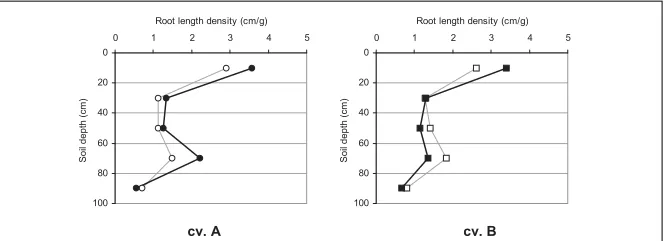
Root length densities were highest in the top 20 cm and decreased down to a soil depth of 60 cm. They increased again in the 60 to 80 cm soil layer, with the lowest values measured in the 80 to 100 cm soil layer. Drought-stressed plants tended to produce less overall root length, and cultivars diff ered signifi cantly in overall root lengths produced. Cultivars seemed to diff er in their reaction to drought stress, but the diff erence was not signifi cant.
In conclusion, data from additional growing seasons will be necessary to confi rm variation in root distribution between cultivars in their response to drought-stress.
Introduction
Cereal grain yields are limited by a number of environmental factors, of which drought is one of the more wide-spread. Knowledge about genotypic variation in drought resistance may contribute to minimise yield-losses under water-limited conditions by choice of suitable cultivars. Drought resistance may besides other factors be conferred by the development of a deeper root system. This may help the crop to use water from deeper soil layers, which has been found to contribute signifi cantly to grain yield (Richards, 2007). Measurements of rooting depth and distribution are however time-consuming and labour-intensive. As a consequence only limited information is available on genotypic variation in these traits.
The aim of the present study was to quantitatively describe the root depth distribution of winter wheat cultivars grown under fi eld conditions with or without an induced water defi cit. Potential links between genotypic diff erences in root depth distribution and yield loss due to drought are subsequently discussed.
Materials and Methods
A fi eld experiment was conducted in 2006 by the ‘Institut für Sortenwesen’ of the Austrian Agency for Health and Food Safety. The experiment was located at Oberweiden (E 16° 49’ N 48° 18’) approximately 40 km NE of Vienna/Austria. The soil at the site is a Tschernosem with a moderate water holding capacity. Average yearly rainfall is 540 mm and average air temperature 9.9° C. Twelve winter wheat genotypes were grown in two adjacent experiments on small plots (3.2–3.3 m2 net area) randomised in three replicate blocks. One experiment was exposed to natural rain-fed conditions throughout the entire growth period. Foil tunnels with rollable foil were raised above the other experiment at a time when the wheat plants were approaching the end of shooting. Wheat plants in this experiment were exposed to ambient conditions during most of the time. Only at approaching rain events, the foil was manually unfolded to cover the wheat plants. In this way, plants in this experiment received 143 mm less rain than uncovered plants until the wax-ripe stage.
Four soil cores of 2.5 cm diameter (Pürckhauer corer) were taken at approximately the wax-ripe stage. Cores were taken between the rows of four selected winter wheat cultivars to a depth of 100 cm. The cores were separated into 20 cm soil layers, and soil layers of the same depth within each plot were pooled. Roots were washed out of the soil and their fresh weight was recorded. Root lengths were determined by a line-intersect method (Newman, 1966).
Data on the absolute and relative root depth distribution were analysed in SPSS 9.0 using the repeated measures procedure in GLM. Univariate tests were conducted after applying Mauchly’s Test of sphericity. In case of signifi cant sphericity, degrees of freedom were adjusted according to Greenhouse-Geisser. Signifi cant treatment or factor eff ects were assumed at p<0.05.
Results
[image:23.420.52.384.385.506.2]Cultivars diff ered in overall root lengths produced. These were in all four cultivars reduced by drought stress. Cultivars did however not respond diff erently in their root production in response to drought stress.
Figure 1. Root length densities of two winter wheat cultivars in cm root g-1 soil in the
Root length densities (RLD) of all cultivars ranged from 2.5 to 4.5 cm g-1 soil in the top 20 cm (examples given in Figure 1). RLD decreased to 1 to 1.5 cm g-1 in 20 to 60 cm soil depth but increased again in the 60 to 80 cm soil layer. The lowest RLD of <1 cm g-1 were measured for the 80 to 100 cm soil layer. Cultivars diff ered in RLD produced which also was aff ected by water supply. The general reaction of altered root distribution in response to drought was however quite consistent for all genotypes (p>0.3). Minor diff erences are exemplifi ed by two examples given in Figure 1. RLD of cultivar A (left graph) were reduced under drought stress in all but the deepest soil layer examined. Contrary to that, cultivar B (right graph) produced higher RLD in the 40 to 80 cm soil layer under drought stress than when exposed to natural rain-fed conditions.
The relative distribution of roots in the soil profi le was signifi cantly aff ected by water supply. Cultivars did however not diff er in the relative distribution of their roots (p>0.3) and reacted in this character similarly to drought stress (p>0.3).
Discussion and Conclusions
The RLD measured in the present study are comparable to previously reported values (Ford et al., 2006). The observed increase in RLD at 60 to 80 cm soil depth may be due to a relative to the above-lying layers higher water content of the 60 to 80 cm soil layer which may have stimulated root growth (Xue et al., 2003).
Especially one cultivar (cv. B in Figure 1) was under drought stress observed to distribute a greater proportion of its roots in deeper soil horizons. The yield of this cultivar was also much less depressed by drought than yield of for example cultivar A. This cultivar reacted in its root distribution very diff erently to drought stress. However, the diff erences were not signifi cant.
Data for root production and distribution presented here are from only one growing season. Additional data will be necessary to determine whether the examined cultivars diff er in the distribution of their roots in the soil profi le in response to drought stress. Especially the ability to produce roots in deeper soil layers could markedly improve cultivar drought tolerance (Manschadi et al., 2006).
Acknowledgments
I wish to thank my colleagues at Bio Forschung Austria for their assistance in sampling, measuring root lengths and data analysis. The ‘Institut für Sortenwesen’ of the Austrian Agency for Health and Food Safety planned, set up and conducted the experiments. All work was funded by the Austrian Federal Ministry for Agriculture, Forestry, Environment and Water Management (project Nr. 1315).
References
Ford, K. E., Gregory, P. J., Gooding, M. J., Pepler, S. (2006): Genotype and fungicide eff ects on
late-
season growth of winter wheat. Plant Soil 284: 33-44.
Manschadi, A. M., Christopher, J., deVoil, P., Hammer G. L. (2006): The role of root architectural traits
Newman, E. I. (1966): A method of estimating the total length of root in a sample. J. Appl. Ecol. 3:
139-145.
Xue, Q., Zhu, Z., Musick, J. T., Stewart, B. A., Dusek, D. A. (2003): Root growth and water uptake in
EFFECTS OF ORGANIC WHEAT CULTIVATION IN WIDER ROWS
ON GRAIN YIELD AND QUALITY
CAPOUCHOVA, I.1, BICANOVA, E.1, PETR, J.1, KREJCIROVA, L.1
Key words: winter wheat, organic cultivation, wide row spacing, grain yield, grain quality
Abstract
Exact fi eld small-plot trials with winter wheat varieties Ludwig and Sulamit (both the quality groups E–elite) in organic farming in the sugar-beet growing region of Central Bohemia were conducted in the years 2005–2007 to test the possibility of increasing in the crude protein content in grain and thereby improving of baking quality (row spacing 125, 250 and 370 mm, sowing rates 200, 300 and 400 germinating grains per m2) under the change of the wheat stand structure. Statistically signifi cant increase of crude protein content in wheat grain dry matter by approximately 0.7 % was found at widening of row spacing from 125 to 250 mm and by about 1.5 % by widening of row spacing from 125 to 375 mm. So, the treatments cultivated in wider row spacings fulfi lled the requirement for crude protein content in grain dry matter of food, baking wheat for minimum 11.5 %. Increase of sedimentation test Zeleny values was found at widening of row spacing from 125 to 375 mm, too. Wheat cultivation in wider rows had no negative impact on the grain yield.
Introduction
It is now clearly established that wheat grain quality is a function of grain composition, principally in proteins (Triboi et al., 2000). Also, according to Pan et al. (2006) grain nitrogen concentration is one of the main quality parameters of wheat grains.
Organic techniques of cultivation can have an adverse eff ect on the technological quality, especially when protein content is an important factor. Lower protein content in the wheat grain limit the possibilities of food and baking processing (Moudry&Prugar, 2002). For wheat under the system of organic farming not using mineral nitrogen fertilizers, it is necessary to fi nd another way that should have allowed increase of protein content and hence, improvement of baking quality. Protein production in grains, particularly of gliadins and glutenins, is also aff ected by duration and intensity of irradiation of plants in the stand (Petr et al., 1987). Therefore, diff erent type of wheat stand structure (wider row spacings, lower sowing rates) than in conventional farming, where it is seeded into narrow rows, could be one of the options, how to improve baking quality of organic wheat.
Materials and Methods
Exact small-plot fi eld trials with two varieties of winter wheat Ludwig and Sulamit (both quality class E – elite) were conducted in the years 2005–2007 on the experimental station of
1 Czech University of Life Sciences Prague, 165 21 Prague 6 – Suchdol, Czech Republic,
the Department of Plant Production of CULS Prague in Uhrineves (sugar beet growing region, 295 m above sea level, average annual temperature 8.4°C, average annual sum of precipitation 575 mm). Clay-loam cambisol has a topsoil deep 250–300 mm, with neutral pH; humus content 1.74–2.12 %. Experimental station Uhrineves is certifi ed organic for conductance of experiments in organic agriculture. Experiments were carried out by the method of randomised blocks in four replications; average size of experimental plot was 10 m2. Three row spacings were used in the trial: 125, 250 and 375 mm and three sowing rates – 200, 300 and 400 germinating kernels per m2. Pea was the preceding crop. Hoeing at wider row spacings was used two times during the spring vegetation; narrow rows were two times harrowed. After harvest of the trials the yield was assessed, crude protein content in grain dry matter (Czech Standard ČSN ISO 1871) and Zeleny´s sedimentation test (ČSN ISO 5529) were determined, too. Yield results and results of the quality evaluation were statistically assessed by analysis of variance of multiple classifi cation (ANOVA) in the SAS system, signifi cance of diff erences between means of varieties, years, sowing rates and row spacings was verifi ed by LSD test, α = 0.05.
Results
In all evaluated years increase of crude protein content in grain dry matter was found with increasing row spacing. At the row spacing 250 mm higher content of crude protein by 0.7 % was recorded, whereas at the row spacing of 375 mm this value was higher by 1.54 % compared to variant with traditional narrow row spacing of 125 mm (Tab. 1). On the contrary, sowing rate was not aff ected statistically signifi cantly by the crude protein content.
Tab. 1: LSD test for the wheat grain yield, crude protein content in grain dry matter and Zeleny test – signifi cance of diff erences among averages of varieties, row spacings, sowing rates and experimental years (LSD, α=0.05)
Grain yield (t.ha-1)
Sign. Crude protein
content (%)
Sign. Zeleny test
(ml)
Sign.
Variety Ludwig 5.54 a 11.30 a 39.56 a
Sulamit 5.28 b 11.70 b 43.97 b
dmin 0.22 0.28 2.19
Row spacing (mm)
125 5.35 ab 10.76 a 38.63 a
250 5.28 a 11.45 b 41.35 a
375 5.59 b 12.30 c 45.33 b
dmin 0.24 0.42 2.76
Sowing rate (germinating grains . m-2)
200 4.85 a 11.50 a 42.11 a
300 5.57 b 11.52 a 41.17 a
400 5.80 b 11.49 a 42.04 a
dmin 0.30 0.37 2.48
Year 2005 5.59 a 11.35 a 41,80 a
2006 5.54 a 11.44 a 41,74 a
2007 5.09 b 11.72 b 41.78 a
dmin 0.24 0.36 2.05
Baking quality not only depends of protein quantity but also of quality. The quality of protein complex in view of baking utilisation is very well characterised by Zeleny´s sedimentation test. The Czech standard gives 30 ml as a bottom limit of Zeleny´s test for baking wheat. It is evident from our results (Tab. 1), that both evaluated varieties Ludwig and Sulamit exceeded this value. With an increase of row spacing also in the case of Zeleny´s test increased the values of this analysis, but the minimum amount of Zeleny´s test for baking wheat was reached even in the variants cultivated in traditional narrow rows.
Apart from the quality of production in cultivation of organic wheat in wider row spacings, it is necessary to pay attention to the grain yields. It is evident from our results that the grain yield was aff ected by all evaluated factors – variety, row spacing, sowing rate and experimental year, but it is possible to say, that the eff ect of row spacing was the least. In addition, the highest average yield was reached in variants cultivated at the widest rows 375 mm; stand density varied between 355–427 ears per m2, number of grain per ear between 28–36, grain weight per ear between 1.1–1.5 g and 1000 grains weight between 44–45 g (Sulamit) and 46–48 g (Ludwig). Yield components structure of variants cultivated in narrower rows was not too diff erent, so that the yield diff erences between individual row distances were not high.
The highest yield was recorded at the highest sowing rate (400 germinating grains per m2); the diff erence between sowing rates 300 and 400 germinating grains per m2, however, was statistically not signifi cant (Tab. 1).
Discussion
It follows from our results that protein content in wheat grain dry matter and values of Zeleny´s test increased with increasing row spacing; the best results were achieved in the widest tested rows 375 mm.
The above mentioned results are in congruency with the conclusions made by Förster et al. (2004) where it had been proved that at wide row spacings not only increases the protein content but also the values of sedimentation test. The results of the tests showed globally that high baking quality in wheat can be achieved using this system.
Hiltbrunner et al. (2005) performed similar research. They reported in their study a statistically signifi cant increase in crude protein content in grain dry matter (by about 1%) at widening of row spacing from 187.5 to 375 mm. At the same time they add that no decrease in grain yield was found with increasing row spacing.
According to Petr et al. (1987), by diff erent structure of winter wheat stand that should allow as best as possible irradiation benefi t, it is possible to support the protein synthesis in grain. In addition, diff erent stand organisation in wheat cultivation in wider rows could lead to better stand aeration and reducing of moist microclimate, suitable for plant diseases spread.
cultivated in traditional narrow rows. These results giving evidence of prevailing genotype dependence of Zeleny´s test are in accordance with e.g. conclusion made by Matuz (1998) and Kadar & Moldovan (2003).
In cultivation in wider row spacing, particularly 375 mm, a strong competition between plants and reduction of the cumber of plants during vegetation are manifested. So, it can be said that in congruency with conclusions made by Förster et al. (2004), in wheat cultivation in wider row spacings lower sowing rates can be applied (approximately 300 germinating grains per m2) than are usually applied in wheat cultivation in traditional narrow row spacings, without signifi cant impact of this reduction of sowing rate on the grain yield.
Conclusions
Our results confi rmed the possibility to increase the crude protein content in grain and improvement of baking quality of winter wheat in organic farming system under the change of the stand structure – cultivation of wheat in wider row spacings. Variants cultivated in wider row spacings fulfi lled the requirement for crude protein content in grain dry matter of baking wheat for minimum 11.5 % (Czech standard). Wheat cultivation in wider rows had no negative impact on the grain yield.
Acknowledgments
Financial support by the Research Project of the CULS in Prague No.6046070901 and Grant Project NAZV QG 50034.
References :
Förster Ch., Wilmersdorf G., Lutz C., Müller E (2004): Praxiseinführung des Anbaukonzeptes Weite
Reihe für eine umweltgerechte Getreideproduktion unter besonderer Berücksichtigung des Qualitätsaspektes bei Backweizen. Final report of research project of Institut für Pfl anzenbau und Pfl anzenzüchtung, Universität Giessen, http: //www.agranet.de/6222.php
Hiltbrunner J., Liedgens M., Stamp P., Streit B. (2005): Eff ects of row spacing and liquid manure on
directly drilled winter wheat in organic farming. Europ. J. Agron., 22: 441–447
Kadar R., Moldovan V. (2003): Achievement by breeding of winter wheat varieties with improved
bread-making quality. Cereal Res. Commun., 31: 89–95
Matuz J. (1998): Inheritance of SDS sedimentation volume of fl our in crosses of winter wheat. Cereal
Res. Commun., 26: 203–210
Moudrý J., Prugar J. (2002): Bioproducts – quality evaluation, processing and marketing. Handbook
of organic farmer, 1, Mze (ÚZPI) Prague, 34 pp. (in Czech)
Pan J., Zhu Y., Jiang D., ai T., Li Y., Cao W. (2006): Modeling plant nitrogen uptake and grain nitrogen
accumulation in wheat. Field Crops Res., 97: 322–336 Petr J.
et al. (1987): Weather and yields. SZN Prague 1987, 368 pp. (In Czech)
Petr J. sen., Petr J. jun., Škeřík J., Horčička P. (1998): Quality of wheat from diff erent growing systems.
Scientia Agriculturae Bohemica, 29: 161–182
Triboi E., Abad A., Michelena A., lloveras J., Ollier J.L., Daniel C. (2000): Environmental eff ects on
EFFECT OF THREE PRECEEDING CROPS ON YIELDS AND
QUALITATIVE CHARACTERS OF WINTER WHEAT IN ORGANIC
FARMING SYSTEM IN THE YEARS 2006–2007
KLIMEKOVÁ, M.1, LEHOCKÁ, Z.2
Key words: winter wheat, preceeding crops, grain yields, qualitative parameters
Abstract
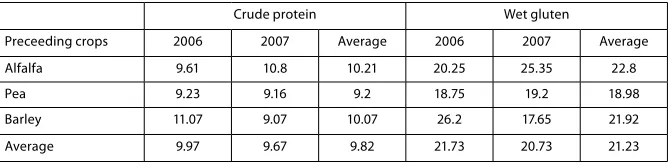
The aim of the study was to evaluate yields and selected qualitative parameters of winter wheat cultivated after three diff erent preceeding crops in the years 2006–2007. Stationary fi eld experiment was established on a loamy luvi-haplic chernozem in a maize –barley growing region in South – Western Slovakia. The tested variety Bardotka has a know good content of gluten and high values of sedimentation test. Average grain yield was 5.36 t/ha. The diff erences among winter wheat after diff erent preceeding crops were statistically signifi cant. The average yield after alfalfa was 5.93 t/ha and 5.20 t/ha after spring barley (winter wheat was amended by farm manure) and winter wheat yield after pea was 4.97 t/ha. Crude protein content was the highest after preceeding crop alfalfa (10.21 %). The lowest values of crude protein content and Zeleny sedimentation test as well as wet gluten content were determined after pea. In the years 2006–2007 the most suitable quantitative as well as qualitative parameters of winter wheat were obtained after alfalfa.
Introduction
The popularity of organic food and the farming area managed according to organic agriculture practices have been increasing during the last years. It is not clear, whether foods from organic and conventional agriculture are equal with respect to nutritional quality. Wheat (Triticum aestivum L.) as one of the most important crops off er a wide range of substances relevant for human nutrition (Langenkämper, G.; Zörb, C.; Seifert, M.; Mäder, P.; Fretzdorff , B. and Betsche, T. (2006). In organic farming winter wheat is typically grown after good pre-crops, as it pays well for this in terms of yield and quality. Wheat is valuable crop in organic farming, and much eff ort has been put into optimising yields and quality of organically grown wheat. A good pre-crop is typically one that leaves much available N in the soil that ideally is not released in higher amounts before winter to avoid nitrate leaching. (Pedersen, L.; Thorup-Kristensen, K. and Loges, R., 2006).
The aim of the paper is to evaluate the eff ect of three preceeding crops on grain yields and selected qualitative parameters of winter wheat in the years 2006–2007.
Materials and Methods
The stationary fi eld experiment was established in the year 1990 at Borovce near Piešťany town (western part of the Slovak Republic) on a loamy luvi-haplic chernozem. The territory has
1 SCPV – VURV Piestany, Bratislavska cesta 122, 921 68 Piestany, Slovakia,
continental character of climate with a mean annual precipitation of 593 mm per year (358 mm during the vegetation period) and with an annual temperature average of 9.20C (15.50C during the vegetation period). The area is classifi ed as maize – barley growing region. The experimental design consists in a split plot arrangement with two replications. There were two six strips of fi eld tested in the experiment: a1) alfalfa – alfalfa – winter wheat – sugar beet – spring barley – maize for grain, a2) maize for grain – spring barley – winter wheat – spring barley – pea – winter wheat. Farm yard manure at the rate of 40 t/ha was applied after spring barley. The harvested area of one plot represented 75 m2 (3x25 m). The agro technical operations were realized in accordance with the Law NR SR No. 421/2004 about organic farming. The model variety of winter wheat was variety Bardotka with the quality standard E, the sowing rate was 500 viable kernels per square meter at a row distance of 125 mm. Experimental plots were harvested at full maturity. Crude protein content was determined by the Dumas method (% N x 5.7) in according to the Slovak Technical Standard STN 46 1011. Selected indicators of baking quality included: test weight of grain according to the Slovak Technical Standard STN 46 1011-5, sedimentation index according to Zeleny (STN – ISO 5529), fall number according to the STN – ISO 3093, wet gluten content according to the STN 461011-9.
Obtained results were evaluated by variance analysis, diff erences testing by Tukey test.
Results and Discussion
Weather conditions are listed in the table 1a and 1b. During the two year trial period it was recorded that variability of winter wheat grain yield was not signifi cantly aff ected by years. Grain quality indicators were signifi cantly infl uenced by years or by interaction between years and preceeding crop. Grain yields of winter wheat were signifi cantly infl uenced by the preceeding crop (table 2).
Table 1a: Weather conditions in the year 2006 (Borovce)
[image:31.420.55.384.337.531.2]Table 1b: Weather conditions in the year 2007 (Borovce)
Table 2a: Grain yield (t/ha) and test weight of grain (g/l) of winter wheat, variety Bardotka in the years 2006 and 2007 after three preceeding crops
Preceeding crops
2006 2007 Average 2006 2007 Average
Grain yields Test weight of grain
Alfalfa 5.96 5.91 5.93a 772 757 765a
Pea 5.09 4.85 4.97b 763 755 759a
Barley 5.47 4.92 5.20ab 724 739 731b
Average 5.51 5.22 5.36 753 750 752
The lowest yields of winter wheat were after pea (4.97 t/ha), higher yields were after spring barley (5.20 t/ha) and signifi cantly higher yields were after alfalfa (5.93 t/ha, ** P<0.05). In the tables 2b and 2c the selected qualitative parameters of winter wheat as infl uenced by the preceeding crop and year conditions are presented. In line with Muchova (2001) the year was a factor which signifi cantly infl uenced selected qualitative parameters and also our results confi rmed the strong impact of weather conditions on almost all characters of quality of winter wheat mainly in the ripening stage.
Table 2b: Crude protein content (%) and wet gluten content (%) after three preceeding crops in the years 2006–2007
Crude protein Wet gluten
Preceeding crops 2006 2007 Average 2006 2007 Average
Alfalfa 9.61 10.8 10.21 20.25 25.35 22.8
Pea 9.23 9.16 9.2 18.75 19.2 18.98
Barley 11.07 9.07 10.07 26.2 17.65 21.92
Average 9.97 9.67 9.82 21.73 20.73 21.23
The average test weight of grain (table 2a) corresponded with the quality grade B (752 g/l) according to the Slovak Technical Standard STN 46 1100-2. Statistically signifi cantly higher (** P<0.05) test weight of grain was obtained after both alfalfa (765 g/l) and pea (759 g/l) then after spring barley (731 g/l). The highest crude protein was after alfalfa (10.21 %), statistically signifi cant diff erences were only with interaction year x preceeding crop (** P<0.05). According to the average content of proteins, the grain of winter wheat in our experiment was classifi ed into the category P.
The physiology studies have showed that winter wheat has high nitrogen consumption mainly in the second part of the vegetation period, in the period of intensive grain production and fi lling (Michalík, 1992). In the year 2006 (Table 1a) the temperatures and precipitation were divided uniformly during the whole vegetation period and therefore the optimal nutrient mode was obtained in the period where the quality parameters of winter wheat were formed. Nitrogen releases from farm yard manure and subsequent uptake probably caused higher content of
Table 2c Falling number (s) and Sedimentation test (ml) after three preceeding crops in the years 2006–2007
Fall number Sedimentation test
Forecrops 2006 2007 Average 2006 2007 Average
Alfalfa 337.0 422.0 379.5a 44.0 43.0 43.5ab
Pea 328.0 401.0 364.5a 40.5 34.0 37.3a
Barley 381.5 400.5 391.0a 58.0 31.5 44.7b
Average 348.8a 407.8b 378.3 47.5a 36.2b 41.8
protein as well as wet gluten in the grain of winter wheat after spring barley compared with the other two treatments. On the contrary in the year 2007 the defi cit of rainfalls in the months March and May or the defi cit of rainfalls in the month April may have caused a decreased nitrogen mineralization from farm yard manure resulting in a lower content of crude protein and wet gluten.
The average fall number was 378.3 s, statistically signifi cantly higher was fall number in the year 2007 (407.8 s) in comparison with the year 2006 (348.8 s, ** P<0.01). The average content of sedimentation test according to Zeleny was 41.83 ml and the content was suitable for the standard quality of winter wheat (STN 4601100-2). Statistically (** P<0.05) lower content of sedimentation test was after pea (37.3 ml) in comparison with alfalfa (43.5 ml) and spring barley (44.7 ml). Weather conditions signifi cantly infl uenced (** P<0.01) the level of the sedimentation test, in the year 2006 the average value was 47.5 ml and in the year 2007 only 36.17 ml.
Conclusions
Conditions of analysed years statistically modifi ed qualitative parameters of winter wheat grain (fall number ** P<0.01, sedimentation test ** P<0.01).
Interaction year x preceeding crops modifi ed the selected qualitative parameters of winter wheat.
Preceeding crops signifi cantly infl uenced grain yields and test weight of grain in the years 2006–2007.
The most suitable quantitative and qualitative parameters of winter wheat grain were obtained after alfalfa in the organic farming system.
Qualitative parameters of winter wheat were more favourable in the year 2006 than in the year 2007.
Acknowledgments
The results were obtained within the frame of the Project 2003 SP 27/028 OD 01/028
References
Langenkämper, G.; Zörb, C.; Seifert, M.; Mäder, P.; Fretzdorff , B. and Betsche, T. (2006) Nutritional
quality of organic and conventional wheat. In: Journal of Applied Botany and Food Quality (80): pp. 150–154.
Michalík I.: Vplyv agroekologických podmienok na tvorbu bielkovinového komplexu zrna pšenice.
Rostl. Výroba 38, 1992.8 s. 643–649
Muchová, Z.: Faktory ovplyvňujúce technologickú kvalitu pšenice a jej potravinárske využitie. SPU
v Nitre, 2001, ISBN 80-7137-923-9 Slovak Technical Standard – STN 46 1100-2
Pedersen, L.: Thorup-Kristensen, K. and Loges, R.: Wheat baking quality: The eff ect of catch crop
THE ABILITY OF VARIOUS WINTER WHEAT GENOTYPES
TO SUPPRESS WEEDS IN CONSIDERATION OF THEIR
DEVELOPMENTAL DYNAMICS AND MORPHOLOGICAL TRAITS
IN AN ORGANICALLY MANAGED FIELD
PETRASEK, R.1
Key words: organic farming, winter wheat, weed, competitive ability
Abstract
In organic farming choice of suitable crop cultivars with the ability to suppress weeds eff ectively is a benefi cial cultural technique for weed control. In this context a study was conducted with winter wheat to determine the infl uence of growth dynamics and shoot morphology on competitive ability against weeds. A further intention was to identify parameters that contribute to this characteristic that may be considered in future breeding eff orts.
From 2004–2007 three fi eld experiments with various winter wheat genotypes were conducted. Aboveground wheat and weed biomass was destructively harvested at diff erent wheat developmental stages. Wheat leaf area was measured and biomass data were used to calculate growth rates. Wheat height development, leaf orientation and wheat as well as weed cover were assessed throughout the growth periods.
A high number of shoots in combination either with many or big leaves in spring and a rapid height growth at shooting were important. The development of a rather horizontal leaf structure in combination with a constant biomass development until fl owering proved advantageous. During wheat ear emergence a considerable genotypic variation in the eff ect on weed growth was observed.
In conclusion, our work identifi ed characteristics with a genotypic variation that may be used for the breeding of winter wheat varieties that are generally strong competitors.
Introduction
Due to the abandonment of herbicides weed control in organic farming is achieved by a combination of mechanical (e.g. mulching, thermal and biological treatments) and cultural practices (such as tillage, crop rotation, cultivation method). The latter include choice of suitable crop cultivars with the ability to eff ectively suppress weeds. In this context a study was conducted with winter wheat (Triticum aestivum L.) to determine the infl uence of growth dynamics and shoot morphology on competitive ability against weeds. Weed suppression proved to be a useful parameter in contrast to weed tolerance, because the ranking of the genotypes regarding weed suppression was detected as nearly stable throughout all examination years (e.g. Verschwele, 1994). Interspecifi c competition is a dynamic process that lasts the whole vegetation period.
1 BioForschungAustria, Rinnböckstrasse 15, 1150 Vienna, Austria,

![Table 1: Seed yields [t ha-1systems and in sole cropping, (means resp. maximum values of four sites and two years in dry matter] of the components in diff erent mixed cropping Germany, 2004 and 2005)](https://thumb-us.123doks.com/thumbv2/123dok_us/8446464.335462/40.420.37.180.396.544/table-systems-cropping-maximum-matter-components-cropping-germany.webp)