Effect of nose ringing and stocking rate of pregnant and lactating
outdoor sows on exploratory behaviour, grass cover and
nutrient loss potential
J. Eriksen
a,*, M. Studnitz
b, K. Strudsholm
a, A.G. Kongsted
a, J.E. Hermansen
aaDepartment of Agroecology, Research Centre Foulum, Danish Institute of Agricultural Sciences, PO Box 50, 8830 Tjele, Denmark bDepartment of Animal Health, Welfare and Nutrition, Danish Institute of Agricultural Sciences, PO Box 50, 8830 Tjele, Denmark
Received 6 December 2005; received in revised form 3 March 2006; accepted 13 March 2006
Abstract
Nose ringing of outdoor sows is practiced to reduce grass sward damage for environmental reasons but conflicts with natural behaviour considerations. We investigated effects of ringing pregnant and lactating outdoor sows on foraging and explorative behaviour, grass cover and nutrient deposition. The experiment included both ringed and unringed sows. For unringed sows the paddocks were either used continuously throughout the experiment or divided into two and sows were moved half way through the experimental period leaving the first used paddock for regrowth. Ringing did not prevent the sow’s rooting, but rooting was less pronounced, when sows were ringed. On average, ringing increased grass cover from 14% to 38% and from 64% to 81% in paddocks with pregnant and lactating sows, respectively. In paddocks with unringed sows kept at a double density and followed by a resting period, the grass cover in autumn was restored to a high degree in paddocks with pregnant sows. In lactating sow paddocks the level of inorganic N was high but with no significant relation to extent of grass cover. In pregnant sow paddocks the soil inorganic N content was significantly reduced by increased grass cover and at 60% grass cover soil inorganic N content was at a low level. From the experiment it was evident that although ringing did have a positive environmental effect, it was not the main factor influencing potential losses. Management choices in terms of feeding, animal density and nutrient distribution are considered to be at least as important.
D2006 Elsevier B.V. All rights reserved.
Keywords:Outdoor pigs; Nose ringing; Rooting behaviour; Pasture damage; Environmental impact
1. Introduction
An increasing number of pigs are being kept outdoors in Europe in response to consumers’ demand
for dnaturallyT raised pigs (Watson and Edwards,
1997). Outdoor pig production has benefits in terms
1871-1413/$ - see front matterD2006 Elsevier B.V. All rights reserved. doi:10.1016/j.livsci.2006.03.008
* Corresponding author. Tel.: +45 89 99 18 70; fax: +45 89 99 17 19.
E-mail address:[email protected](J. Eriksen).
www.elsevier.com/locate/livsci
Archived
at
of animal welfare, e.g. possibility to perform natural behaviour, and low costs of buildings and equipment (Deering and Shepherd, 1985) but there may be environmental costs resulting from high feed
con-sumption (Larsen and Kongsted, 2000), losses of
nitrate to aquifers (Eriksen, 2001), ammonia volatil-ization (Sommer et al., 2001) and atmospheric nitrous
oxide emission (Petersen et al., 2001). These losses
contribute to global warming, acid rain and the eutrophication of natural environments.
Outdoor pig units are most often based on freely draining sandy soil presenting a great risk of nitrate loss especially since pigs are outdoor all year around and the rooting and trampling during the stocking period typically leaves the soil surface compacted and without
vegetative cover. Williams et al. (2000) showed that
nitrate leaching can be greatly reduced by using a management system that stocks pigs on established grassland compared to arable stubbles. After 6-month stocking, the vegetative cover on the grass system had been destroyed so in the following winter nitrate losses were similar from both systems. Although it may be possible to maintain grass cover by reduction of the
stocking density (Larsen and Kongsted, 2000, 2001)
this conflicts with the farmers need to maximise fodder production and thus minimise land use for pigs.
A methodical use of pasture as a feed source in outdoor sow units is relatively sparsely documented in the scientific literature. All though there are large differences between the daily intake of fibre-rich food for individual sows (Kongsted et al., 2000), especially, the pregnant sows have a general high capacity to obtain and utilize energy from grass (Sehested et al., 2004).
In Denmark it is common practice to nose ring outdoor sows. In the UK and the Netherlands this is prohibited in organic farming. The purpose of the ring is to reduce rooting, which damages the grass sward. A well-maintained grass sward is important for environmental reasons as it absorbs and preserves nutrients excreted during grazing. Although the
ringing of sows may not cause frustration (Studnitz
et al., 2003), it conflicts with the organic ideals that natural behaviour and positive experiences should be taken into consideration. In natural environments sows spend about 30% of their waking hours rooting (Stolba and Wood-Gush, 1989) and it has been demonstrated that rooting is the preferred explorative
behaviour of pigs (Studnitz et al., 2003). Therefore the ringing is a compromise of the organic principles and it is relevant to ask whether the environmental gain of the ringing justifies this compromise and if grass cover can be maintained in other ways.
The objectives of this study were to examine concomitantly the effects of nose ringing and animal density on: (1) foraging and exploration behaviour, (2) grass cover, (3) nutrient deposition, and interactions between these observations. To the knowledge of the authors similar studies have not been published before. It was our aim to provide information needed to develop integrated management practices to reduce the environmental impact of outdoor sow production systems without compromising the natural behaviour of the animals.
2. Materials and methods
2.1. Experimental design, feeds, feeding and record-ings of animal production
The investigation was carried out on a commercial organic outdoor pig-producing farm in southwest Denmark on a coarse sand soil. In this herd the pregnant sows were kept indoors at winter and outdoor in the grazing season, while the farrowing/ lactating sows were kept outdoors the year around. Each lactating sow had a 9-week residence in individual paddocks; while the pregnant sows were kept in paddocks with 5 sows in a 10-week period after a service period in indoor facilities.
In the experiment were three treatments for both lactating and pregnant sows (Table 1). The treatments were replicated two and three times for pregnant and lactating sows, respectively. Thus, in the field were
established six paddocks of 4045.5 m for pregnant
sows and nine paddocks of 3011 m for lactating
sows. The experiment was carried out from May to September 2002 and with two sequential rounds of introductions in farrowing and pregnancy paddocks in
the period. All sows were multiparous Landrace
Large White sows.
nose sling. None of the sows had nose ring previously. In treatments 1 and 2 the same paddock was used throughout the experimental period for two successive groups of sows at each treatment. In treatment 3 sows used half the paddock until July 3rd. After July sows used the second half of the paddock in the remaining period. Before introduction to the second half of the paddock a grass cutting took place 2 weeks before. The
stocking rate (Table 1) was calculated to cause a
nitrogen deposition of 280 kg N ha 1 based on the
national definition of a livestock unit and the national guidelines allowing pastures to be used for grazing pigs
only every other year (European Commission, 2000;
Ministry of Environment, 2002). The stocking rate was
18.2 m2per sow per residence week in all paddocks.
The split residence period in treatment resulted in a
double animal density in each half of the experimental periods.
Pregnant sows were fed once daily with 1.75 kg rolled barley and 30 g pure mineral supplement per
sow (Table 2). This was assumed to cover 70% of
their daily energy requirement. The remaining nutrient requirement was assumed to be covered by grazing or intake of grass silage. Grass silage was allotted weekly. A ready-mixed feed with 16% protein and 80% organic origin of the dry matter was fed to the lactating sows: 2.5 and 9 kg daily before and after farrowing, respectively (Table 2).
[image:3.544.43.499.117.199.2]The huts and troughs were moved in a routine every month, while the wallow areas were stationary during the period. Paddocks for pregnant sows were used from May 1st to September 25th and paddocks
Table 2
Complementary feed allowance and performance of pregnant and lactating sows with or without nose ring (ns: no significant difference between treatments,PN0.05)
Ringed Unringed Unringed, double density P-value
(A) Paddocks with pregnant sows (#sows) 2 (34) 2 (29) 2 (37)
Feed, supplement, kg/sow/daya
Crushed barley 1.75 1.75 1.75 –
Clover–grass silage 2.1 2.1 2.1 –
Mineral mixtureb 0.03 0.03 0.03 –
Daily live weight gain, g (S.E.M.) 17 (18) 36 (21) 34 (18) ns
(B) Paddocks with farrowing sows (#sows) 3 (6) 3 (6) 3 (6)
Feed, supplement kg/sow/daya
Concentrate mixcbefore farrowing 2.2 2.2 2.2 –
Concentrate mixcafter farrowing 9.0 9.0 9.0 –
Average consumption in period 6.7 6.6 6.9 –
Change of live weight, kg/sow (S.E.M.)d 13.8 (4.5) 6.0 (5.0) 17.3 (5.0) ns
Weaned piglets per litter, kg (S.E.M.) 157 (6.9) 152 (6.9) 154 (6.9) ns
Weaned piglets per litter, # piglets 9.0 8.0 8.8 –
a
Fixed amounts by design.
b
Monocalcium phosphate (54%), CaCO3(31%), NaCl (15%) = (120 g P/kg). c
Per kg feed: 160 g crude protein; 66 g crude fat; 8.3 g lysine; 2.6 g methionine; 6 g P.
d
[image:3.544.54.497.460.628.2]From introduction (before farrowing) to at weaning. Table 1
Experimental treatments in sow paddocks
Treatment Pregnant sows Lactating sows
Sows per ha
Sows per paddock
Area (m2)
Duration of stay (days)
Sows per ha
Sows per paddock
Area (m2)
Duration of stay (days)
(1) Ringed 27.5 5 1820 146 30.5 1 328 133
(2) Unringed 27.5 5 1820 146 30.5 1 328 133
(3) Unringed, double densitya 1st 55 5 910 67 61 1 164 64
2nd 55 5 910 79 61 1 164 69
a
for lactating sows from May 1st to September 11th in 2002. The live weight was measured individually when the sows were introduced to and removed from the paddocks, while the piglets were weighted collectively at weaning.
2.2. Behavioural observations
Behavioural elements were observed 1 day each week during the experimental period. Every other week paddocks with lactating sows were observed four times during 9–10 am, 11–12 am and 5–6 pm and paddocks with pregnant sows were observed four times during 10–11 am and 4–5 pm. The next week vice versa starting with pregnant sows. In total, all paddocks were observed for 45 h during the 21 weeks the experiment was running. The paddocks were divided into sub
zones. For pregnant sows the zones werehut(the hut
and one sow length from the hut),straw(the initial hut
allocation), fence (within one sow length from the
fence), wallow (the areas for wallowing), trough
(within one sow length from the trough),water(within
one sow length from the water trough) and field (all
other places in the paddock). For lactating sows the
zones were: hut, wallow, trough, water and field.
The observer walked along the fields and stopped by each field for 2 min when observing pregnant sows and 1 min when observing lactating sows in each zone. The following behavioural elements were recorded as scan samples in each zone: Inhut,lying,standing,walking,
rooting and grazing. The first four were recorded
mutually exclusive. Furthermore throwing soil and
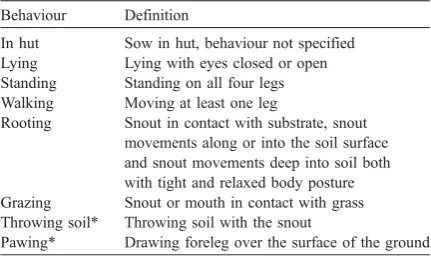
pawingwere recorded as all occurrences. Definitions of behaviour are given inTable 3.
2.3. Determination of grass cover
Grass cover was estimated by determining spectral reflectance in the sow paddocks. This technique has been widely used and accepted for determination of
crop growth in many agricultural crops (Petersen,
1992), but is a new method for estimation of grass
cover. We consider it a huge improvement compared to a visual inspection as the data seems very reliable, more precise and the subjective and individual nature of visual determination is overcome.
The handheld equipment consisted of two sensor
units, one unit measured the red (650F10 nm) and
the near infrared (800F10 nm) reflection from the
canopy and another similar unit measured the incoming radiation. The sensor units of type
SKR1800 with a 158view were connected to an A/
D converter of type SDL2500 (Skye Instruments Ltd, UK) and data were recorded on a computer. All observations were taken at a height of 1.8 m, thus
representing 0.5 m2 ground area. The spectral
reflectance measurements were converted to a mean value of the ratio vegetation index (RVI). At two dates, July 5 and September 25, spectral reflectance was determined in 36 and 24 points, respectively, in paddocks with pregnant sows and similarly in 8 points in paddock with lactating sows. In treatment 3 the points were split between 3a and 3b. The points were evenly distributed in a grid to obtain internal distance between points of 5.5 to 10 m, the exact distance depending on sow group and sampling time. At each date RVI was determined for bare soil and for 100% grass cover as a reference and the grass cover at each point was determined from interpolation between these.
2.4. Soil sampling and analysis
For soil sampling at the end of the experiment (September 25) each of the pregnant sow paddocks
were divided into four quadrants of 2022.75 m and
each of the lactating sow paddocks into two halves of
1115 m. In each of the divisions eight soil cores
[image:4.544.286.502.136.265.2]were sampled to 40 cm depth and bulked. Soil samples were stored frozen until processing. The Table 3
Definitions of behavioural elements observed by scan sampling except for the elements marked with asterisk (*) which were registered by all occurrence sampling
Behaviour Definition
In hut Sow in hut, behaviour not specified Lying Lying with eyes closed or open Standing Standing on all four legs Walking Moving at least one leg
Rooting Snout in contact with substrate, snout movements along or into the soil surface and snout movements deep into soil both with tight and relaxed body posture Grazing Snout or mouth in contact with grass Throwing soil* Throwing soil with the snout
contents of ammonia and nitrate were determined spectrophotometrically on the bulked samples after extraction with 1 M KCl (1:2 w/v).
2.5. Nitrogen balance
Nitrogen balances were calculated as input in feed and pigs minus the output in pigs. All feed and pigs entering and leaving the individual paddocks were weighed. Nitrogen in pigs was estimated to 25 g/kg
live weight according to Poulsen et al. (2001). The
nutrient content of feeds was estimated based on the feed manufacturer’s production report on the feed mixtures and on literature values. These were (g/kg feed): feed mixture 25.5; barley 15.5; clover–grass silage 8.7; and straw for bedding 5.4.
2.6. Climatic conditions
A soil water balance was calculated using the
Evacrop model (Olesen and Heidmann, 1990), for
which inputs were daily meteorological measure-ments (precipitation, temperature and evaporation),
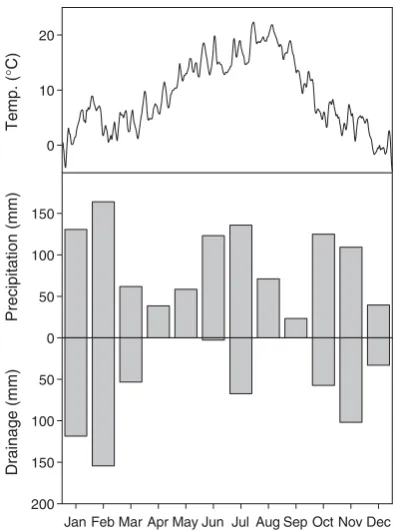
crop type and soil physical parameters.Fig. 1 shows
temperature, precipitation and estimated drainage from the root zone during the experimental year. High summer precipitation caused drainage from the root zone of 67 mm in July, which is not unusual for this soil type. However, it does lead to downward transport of nitrate from the upper soil layers. The experiment finished before onset of autumn drainage.
2.7. Statistical analysis
For nutrient balances, grass cover and soil inor-ganic N content, analysis of variance was carried out using the General Linear Model (GLM) procedure of SAS (SAS Institute Inc, 1999) to estimate differences between treatments. For behavioural elements a Kruskal–Wallis test was carried out using the
Npar1-way procedure of SAS (SAS Institute Inc, 1999) to
estimate differences between treatments.
3. Results
3.1. Production and nitrogen balance
Pregnant sows tended to lose weight during the period although the weight change did not differ significantly from zero and not differing significantly among treatments. This illustrates that the comple-mentary feeding was in the lower range of what is
necessary (Table 2). Also lactating sows lost weight
during the period, not differing significantly among treatments. However, it should be noticed that the weight change included the live weight loss due to farrowing. Taken a normal weight loss during farrowing into account (approximately 20 kg) it appears that the feeding fully supported the sow in maintaining or even gaining live weight during the suckling period.
Since the same stocking rate in terms of m2 per
sow was applied in the experiment, the N surplus was approximately 3 times as high in paddock with lactating sows compared with pregnant sows due to a much higher feed input in farrowing paddocks which could not be counteracted by the N removed with piglets (Table 4). No significant differences in N surplus were observed between treatments within pregnant sows or lactating sows.
Jan Feb Mar Apr May Jun Jul Aug Sep Oct Nov Dec
Drainage (mm)
200 150 100 50 0 50 100 150
Temp. (
°
C)
0 10 20
[image:5.544.51.249.376.642.2]Precipitation (mm)
3.2. Behaviour
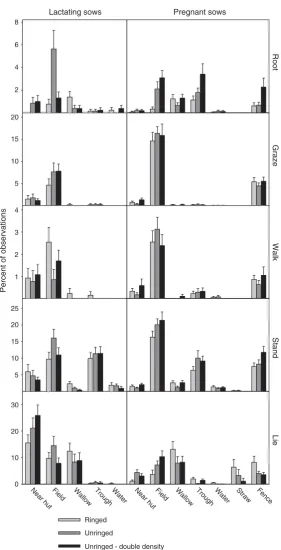
Figs. 2 and 4 show the distribution of behaviour
between treatments andFig. 3 shows the distribution
of behaviour related to the location in the paddock. The rooting behaviour of both the pregnant and the lactating sows was significantly influenced by the treatments.
For the pregnant sows, the unringed sows at double density rooted significantly more than other
sows (Fig. 2). The rooting was mainly performed in
the field, at the trough and at the fence (Fig. 3).
Across location, unringed sows did not root
signifi-cantly more than ringed sows (Fig 2), however, when
divided into location, unringed sows (including those at double density) spend significant more time
rooting in the field than ringed sows (Fig. 3). The
ringed sows were the only ones pawing (Fig. 4) and
they mainly did this in the wallowing area (results not shown). Pregnant sows at double density spend more time than the other sows throwing soil in the field and near the trough (results not shown). Treatments had no effect on time spend in hut, lying, standing, walking or grazing, however, there was a tendency
(Pb0.07) that unringed sows at double density was
standing more (Fig. 2). Related to location in the
paddock, no significant differences were observed between treatments regarding lying, standing, walk-ing or grazwalk-ing showwalk-ing that the sows from all
treatments spread these behaviours in a similar way in the paddocks (Fig. 3).
For lactating sows, the unringed rooted (Fig. 2) and threw soil (Fig. 4) significantly more than the ringed sows. Both rooting and throwing soil was mainly
carried out in the field (Fig. 3). Like for pregnant
sows, the ringed sows were the only ones pawing (Fig. 4) and this was primarily performed in the wallowing area (results not shown). The ringed sows walked significantly more than the other sows but no significant effect of treatment on time spend in hut,
lying, standing or grazing was observed (Fig. 2).
Related to location in the paddock, no significant differences were found between treatments regarding lying, standing or grazing (Fig. 3).
3.2.1. Grass cover
Despite variations due to uneven distribution of grass cover in the paddocks some clear differences Table 4
Nitrogen balance in paddocks with pregnant and lactating sows (kg N ha 1FS.E.) (ns: no significant difference between treatments, PN0.05)
Ringed Unringed Unringed, double density
P-value
Pregnant sows Input
Feed 177 (14) 177 (14) 177 (10) ns
Straw 2.7 2.7 5.4 –
Output
Meat 6 (8) 11 (8) 13 (6) ns
Surplus 186 (15) 191 (15) 195 (10) ns Farrowing sows
Input
Feed 754 (24) 748 (24) 780 (17) ns
Straw 27 27 27 –
Output
Meat 209 (9) 213 (9) 199 (7) ns
Surplus 572 (24) 562 (24) 608 (17) ns
10 20 30 40 50 60
Percent of observations
0 10 20 30 40 50 60
Ringed Unringed
Unringed - double density Lactating sows
Pregnant sows
In hut Lie Stand Walk Graze Root
Near hut Field Wallow Trough Water Straw Fence
Ringed
Unringed
Unringed - double density
Pregnant sows
Lie
Walk
Root
Graze
Stand
5 10 15 20
Percent of observations
2 4 6 8
Near hut Field Wallow Trough Water 0
10 20 30 5 10 15 20 25 1 2 3 4
[image:7.544.130.412.90.641.2]Lactating sows
appeared (Fig. 5). Generally, the grass cover was best preserved where sows were ringed. As there was always less grass in paddocks with pregnant sows compared to lactating sows (not statistically tested) the effect of ringing was relatively more pronounced here. On average, ringing increased grass cover from 14% to 38% and from 64% to 81% in paddocks with pregnant and lactating sows, respectively. The strategy behind treatment 3, where paddocks were used only by one sow or group of sows before abandonment, gave different results for different types of sows. With lactating sows it caused a much reduced grass cover especially at the autumn measurement where intensive use reduced grass cover from 64% to 28%. For pregnant sows there were no effect of grazing intensity at the summer measurement. However, in the autumn the re-growth of the grass in treatment 3a, that was used in the first half of the experiment only, made these paddocks the
most grass-covered; even more than those with ringed sows.
3.3. Nutrient excretion
The soil inorganic N content was very variable (Fig. 6) probably as a consequence of nutrient dhot spotsTcreated by the excretory behaviour of the pigs. There were no treatment effects of nose ringing (the difference between treatments 1 and 2). In the intensively used pregnant sow paddocks (treatment 0.05
0.10 0.15 0.20
Frequency of behavior (number per observation)
0.00 0.05 0.10 0.15
Ringed Unringed
Unringed - double density Lactating sows
Pregnant sows
[image:8.544.60.254.85.384.2]Throwing Pawing
Fig. 4. Occurrence of throwing and pawing in paddocks with lactating and pregnant sows (observed 1 and 2 min, respectively, per observation). Error bars: S.E.
Lactating sows Pregnant sows summer autumn summer autumn
Grass cover (%)
0 20 40 60 80 100
1 (ringed) 2 (unringed)
3a (unringed, double density, paddock 1) 3b (unringed, double density, paddock 2) a
a
a a
a
c c b a
b b
c b
[image:8.544.290.497.93.288.2]c a
Fig. 5. Grass cover in sow paddocks determined in summer and autumn (end of experiment). Bars with the same letter within each combination of sow type and date are not significantly different (Pb0.05). Error bars: S.E.
1 2 3a 3b
Inorganic N (mg kg
-1 soil)
0 10 20 30 40 50
Ammonium Nitrate a
a
a a
a
b ab a
Lactating sows Pregnant sows 1 2 3a 3b
[image:8.544.296.493.489.631.2]3) there were significantly higher N content in the one most recently used (3b) compared to the abandoned paddock (3a). There were indications of a similar effect in lactating sow paddocks. The explanation may be that more N was assimilated by plants due to better
grass cover in the abandoned paddocks (Fig. 5) but
some leaching of nitrate to deeper soil layers during the July drainage incident cannot be excluded.
Fig. 7shows the relationship between grass cover and soil inorganic N content in localised areas in the paddocks. Soil inorganic N may be seen as the net difference between N deposition in excreta and N taken up by the grass. In lactating sow paddocks no significant relationship was found and high soil N content was observed even at high grass coverage. In pregnant sow paddocks the soil inorganic N content was significantly reduced by increased grass cover and at 60% grass cover soil inorganic N content was down to low levels. This relationship explained 35% of the variation in soil inorganic N and was probably caused by (1) lower N inputs as indicated by the N balance (Table 4) and (2) more uniform distribution of excreta (Fig. 7), both conditions leading to a higher proportion of excreted N being absorbed by the grass.
4. Discussion
4.1. Behaviour
It has been demonstrated that rooting is the
preferred explorative behaviour of pigs (Studnitz et
al., 2003) and it is often referred to as a behavioural need (Horrell et al., 2001). However, it has also been found that when ringed gilts were unable to root, they substituted their rooting behaviour with grazing, chewing, sniffing and eating without showing signs of frustration or abnormal behaviour (Studnitz et al.,
2003). On the basis of this it was concluded that
ringing of pigs did not cause suffering during grazing, but it may still compromise the welfare of the pigs because positive experiences, such as rooting, are an important concern as regards welfare. Whether root-ing may or may not be a behavioural need, the rroot-ing reduces the possibility for the sows to behave naturally, which must be taken into consideration, especially in organic production systems. The impor-tance of ringing was also confirmed by our results as unringed sows rooted more than other sows, which is
in accordance with previous studies (Edwards et al.,
1996; Horrell et al., 2000, 2001;Studnitz et al., 2003). Rooting was always accompanied by soil throw-ing, but never by pawing. In agreement with Horrell et al. (2001) it was only the ringed sows that pawed. It therefore seems reasonable to assume that the sows pawed instead of rooting. This may be seen as a confirmation that the sows prefer to root and if this is difficult due to ringing, they try in alternative ways. When the ringed sows paw in the wallow, it is presumably as an alternative todcomfort rootingT(see below) with the purpose to cool down. If the purpose
is to dremove earthT pawing may actually be a
functional–although much less efficient–alternative to rooting (Horrell et al., 2001). Lactating ringed sows walked more than other sows, but beside this, nose ringing did not affect other behavioural elements than rooting, throwing and pawing.
Rooting behaviour in free-ranging sows has been
studied by, e.g. Stolba and Wood-Gush (1989) and
Buckner et al. (1998). In general these studies reported higher frequencies of rooting behaviour compared to what observed in this investigation— even in the unringed sows. However, our investigation was only carried out during summer where the topsoil 100
200 300 400
Grass cover (%)
0 20 40 60 80 100
Soil inorganic N (kg N ha
-1)
0 100 200 300
r2=0,35 P<0.001
Pregnant sows Lactating sows
[image:9.544.56.248.391.630.2]is presumed to be less soft and as pigs prefer to root in
lose and wet soils (Andresen and Redbo, 1999) this
probably reduced rooting behaviour.
4.2. Grass cover
This experiment confirmed that grass cover is best preserved where sows are ringed, in accordance with Edwards et al. (1996) and Horrell et al. (2001). Especially unringed pregnant sows were able to seriously reduce the grass cover probably because they are more engaged in foraging behaviour due to
more restricted feeding, as also observed byBuckner
et al. (1998). The effect of ringing may have been even more pronounced if the experimental period had covered the entire year as it is especially difficult to maintain grass cover during autumn and winter (Eriksen et al., in press). One way of improving the overall grass cover in outdoor systems containing unringed sows could be time-restricted access to grassland, e.g. strip-grazing. Treatment 3 in this experiment represents the simplest version of such a system since initially sows had access to only one half of the paddock area and were transferred to the other half of the paddock halfway through the experiment. The potential of such strategies is clearly demonstrat-ed in paddocks with pregnant sows as the re-growth of grass in the half-paddock used first was considerable and in the end made them even more grass-covered than those with ringed sows. This was possible even that the paddocks were grazed to the soil surface, so no grass was visible, because obviously the sward was not destroyed. The spectral reflectance technique used for evaluating grass cover does not distinguish between these two situations, as the relative vegeta-tion index is proporvegeta-tional to green plant biomass (Petersen, 1992). In a practical farming situation we can imagine continuous introduction of sows to new land, e.g. gradual expansion of the paddocks through-out the year would improve grass cover and this would also be advantageous from a nutrient distribu-tion point of view (see below). Furthermore, it would allow for silage production before paddock expansion. Others have tried to reduce pasture damage by providing sows with fibrous feed and/or designated rooting areas. Thus, allocation of high-fibre diets (Braund et al., 1998; Edge et al., 2004), provision of sacrificial rooting areas (Bornett et al., 2003)
sepa-rately or in combination (Edge et al., 2005) reduced
the frequency of rooting behaviour but did not reduce paddock damage to an acceptable level. However, provision of a cool lying place and wallowing opportunities in a designated area during summer months decreased paddock damage significantly whereas a designated area with foraging possibilities
but without a cool lying area did not (van der Mheen
and Spoolder, 2005). The latter demonstrate that pigs not only performdforaging rootingTbut also dcomfort
rootingTas previously reported by, e.g.Andresen and
Redbo (1999). It is therefore important to address both aspects when the aim is to reduce paddock damage without ringing of sows.
Alternatively, advantage could be taken of the
rooting activities of the pigs. Andresen et al. (2001)
showed that pigs could be used for mechanical tillage that even resulted in increased crop yield the following year. However, this requires a considerably higher stocking rate than in this experiment, as sward destruction is the point of such a treatment.
4.3. Nutrient excretion
The skewness in nutrient excretion is a feature
found in most outdoor pig studies (e.g. Zihlmann et
considerably higher than what is typical in indoor systems (Lauritsen, 1998). There is a need to evaluate if this will allow for feeding with lower protein concentrations in the feed. Another obvious option is to reduce the nutrient surplus per hectare by increas-ing the area to which the sows have access. However, for this to work it is important that excreted nutrients are evenly distributed on the land.
5. Conclusions
From the experiment it was evident that although ringing did have a positive environmental effect, it was not the main factor influencing potential losses. Management choices in terms of feeding, animal density and nutrient distribution are likely to be at least as important. Nose ringing may be considered one method of trying to maintain grass cover but without guaranteeing low environmental load. On the other hand, if outdoor sows without nose rings are the preferred option, this may be environmentally accept-able if sward damage is dealt with by, e.g. gradual expansion of the paddocks (strip-grazing) and a general increase in the area of grassland used for the sows.
References
Andresen, N., Redbo, I., 1999. Foraging behaviour of growing pigs on grassland in relation to stocking rate and feed crude protein level. Appl. Anim. Behav. Sci. 62, 183 – 197.
Andresen, N., Ciszuk, P., Ohlander, L., 2001. Pigs on grassland: animal growth rate, tillage work and effects in the following winter wheat crop. Biol. Agric. Hortic. 18, 327 – 343. Bornett, H.L.I., Edge, H.L., Edwards, S.A., 2003. Alternatives to
nose-ringing in outdoor sows: 1. The provision of a sacrificial rooting area. Appl. Anim. Behav. Sci. 83, 267 – 276.
Braund, J.P., Edwards, S.A., Riddoch, I., Buckner, L.J., 1998. Modification of foraging behaviour and pasture damage by dietary manipulation in outdoor sows. Appl. Anim. Behav. Sci. 56, 173 – 186.
Buckner, L.J., Edwards, S.A., Bruce, J.M., 1998. Behaviour and shelter use by outdoor sows. Appl. Anim. Behav. Sci. 57, 69 – 80.
Deering, J., Shepherd, C.M., 1985. Outdoor pig production in England. Pig News Inf. 6, 445 – 447.
Edge, H.L., Bornett, H.L.I., Newton, E., Edwards, S.A., 2004. Alternatives to nose-ringing in outdoor sows: 2. The provision of edible or inedible overground enrichment. Anim. Welf. 13, 233 – 237.
Edge, H.L., Bulman, C.A., Edwards, S.A., 2005. Alternatives to nose-ringing in outdoor sows: the provision of root crops. Appl. Anim. Behav. Sci. 92, 15 – 26.
Edwards, S.A., Anssems, E., Horrell, R.I., A’Ness, P., Eddison, J., 1996. The effect of nose ringing of outdoor sows on foraging behaviour and pasture damage. Anim. Sci. 62, 674.
Eriksen, J., 2001. Implications of grazing by sows for nitrate leaching from grassland and the succeeding cereal crop. Grass Forage Sci. 56, 317 – 322.
Eriksen, J., Kristensen, K., 2001. Nutrient excretion by outdoor pigs: a case study of distribution, utilisation and potential for environmental impact. Soil Use Manage. 17, 21 – 29. Eriksen, J., Petersen, S.O., Sommer, S.G., 2002. The fate of
nitrogen in outdoor pig production. Agronomie 22, 863 – 867. Eriksen, J., Hermansen, J.E., Strudsholm, K., Kristensen, K., in
press. Nutrient loss potential of different rearing strategies for fattening pigs on pasture. Soil Use Manage.
European Commission, 2000. Nitrates Directive (91/676/EEC). Status and Trends of Aquatic Environment and Agricultural Practice—Development Guide for Member States’ Reports. Office for Official Publications of the European Communities, Luxembourg, pp. 1 – 42.
Horrel, I., A’Ness, P., Edwards, S.A., Eddison, J., 2001. The use of nose-ringing in pigs: consequences for rooting, other functional activities, and welfare. Anim. Welf. 10, 3 – 22.
Horrell, I., A’Ness, P., Edwards, S.A., Riddoch, I., 2000. Nose-rings influence feeding efficiency in pigs. Anim. Sci. 71, 259 – 264. Kongsted, A.G., Larchen, J., Larsen, V.A., 2000. Silage outdoor
lactating sows. Ecological Animal Husbandry in the Nordic Countries. Proceedings from NJF-seminar No 3003 Horsens, Denmark 16–17 September 1999, Darcof Report, vol. 2. Larsen, V.A., Kongsted, A.G., 2000. Sows on pasture. In:
Hermansen, J.E., Lund, V., Thuen, E. (Eds.), Ecological Animal Husbandry in the Nordic Countries, DARCOF Report, vol. 2, pp. 99 – 106.
Larsen, V.A., Kongsted, A.G., 2001. Frilandssohold. Produktion, foderforbrug, udsætningsa˚rsager og græsdække. DJF rapport nr. 30- husdyrbrug. Juli 2001. Pp. 46.
Lauritsen, H.B., 1998. Feeding of free-ranging sows—feed waste (in Danish). Message no. 386. The National Committee for Pig Production. 6 pp.
Ministry of Environment, 2002. Executive order on commercial livestock farming, manure, silage etc. (in Danish). BEK. no. 604 of 15/07/2002, chapters 1–14.
Olesen, J.E., Heidmann, T., 1990. Evacrop. A program for calculating actual evaporation and drainage from the root zone, version 1.01 (in Danish). Research note no. 9. Department of Agrometeorology, Danish Institute of Agricultural Sciences, Tjele.
Petersen, C.T., 1992. A spectral vegetation index as indicator for crop growth and development. Dan. J. Plant Soil Sci. Rep. S2207, 19 – 28.
Petersen, S.O., Kristensen, K., Eriksen, J., 2001. Denitrification losses from outdoor piglet production: spatial and temporal variability. J. Environ. Qual. 30, 1051 – 1058.
from Danish Institute Agricultural Sciences, vol. 36 (in Danish) 150 pp.
SAS Institute Inc 1999. SAS/STATRUser’s Guide, Version 8. SAS Institute Inc. Cary, NC. 3884 pp.
Sehested, J., Soegaard, K., Danielsen, V., Roepstorff, A., Monrad, J., 2004. Mixed grazing with heifers and sows: herbage quality, sward structure and animal weight gain. Livest. Prod. Sci. 88, 223 – 238.
Sommer, S.G., Søgaard, H.T., Møller, H.B., Morsing, S., 2001. Ammonia volatilization from pigs on grassland. Atmos. Environ. 35, 2023 – 2032.
Stauffer, W., Menzi, H., Trachsel, P., 1999. Gefa¨hrden Freilandssch-weine das grundwasser? Agrarforschung 6, 257 – 260. Stolba, A., Wood-Gush, D.G.M., 1989. The behaviour of pigs in
semi-natural environment. Anim. Prod. 48, 419 – 425. Studnitz, M., Jensen, K.H., Jørgensen, E., 2003. The effect of nose
rings on the exploratory behaviour of outdoor gilts exposed to different tests. Appl. Anim. Behav. 84, 41 – 57.
van der Mheen, H.W., Spoolder, H.A.M., 2005. Designated rooting areas to reduce pasture damage by pregnant sows. Appl. Anim. Behav. Sci. 95, 133 – 142.
Watson, C.A., Edwards, S.A., 1997. Outdoor pig production: what are the environmental costs? Environmental and Food Sciences, Research ReportScottish Agricultural College, pp. 12 – 14. Watson, C.A., Atkins, T., Bento, S., Edwards, A.C., Edwards, S.A.,
2003. Appropriateness of nutrient budgets for environmental risk assessment: a case study of outdoor pig production. Eur. J. Agr. 20, 117 – 126.
Williams, J.R., Chambers, B.J., Hartley, A.R., Ellis, S., Guise, H.J., 2000. Nitrogen losses from outdoor pig farming systems. Soil Use Manage. 16, 237 – 243.