Asynchronous consensus for optimal power flow control in smart
grid with zero power mismatch
Benjamin S. MILLAR1 , Danchi JIANG1
Abstract The heterogeneous nature of smart grid compo-nents and the desire for smart grids to be scalable, stable and respect customer privacy have led to the need for more distributed control paradigms. In this paper we pro-vide a distributed optimal power flow solution for a smart distribution network with separable global costs, separable non-convex constraints, and inseparable linear constraints, while considering important aspects of network operation such as distributed generation and load mismatch, and nodal voltage constraints. An asynchronous averaging consensus protocol is developed to estimate the values of inseparable global information. The consensus protocol is then combined with a fully distributed primal dual opti-mization utilizing an augmented Lagrange function to ensure convergence to a feasible solution with respect to power flow and power mismatch constraints. The presented algorithm uses only local and neighbourhood communi-cation to simultaneously find the mismatch between power generation, line loss and loads, to calculate nodal voltages, and to minimize distributed costs, leading to a completely distributed solution of the global problem. An IEEE test feeder system with a reasonable number of nodes is used to illustrate the proposed method and efficiency.
Keywords Consensus protocol, Cooperative system, Distributed algorithm, Distributed control, Optimization, Smart grid
1 Introduction
The rapid increase in smart distribution technologies such as dispatchable distributed generators (DG), storage and curtailable loads offer greater levels of controllability and observability over traditional distribution networks, which may allow for greater system stability and optimality if properly harnessed. These new opportunities come with new challenges which require new problem formulations and methods. Traditional, centralized solutions meet limi-tations in this regard, with new control and monitoring capabilities leading to the potential for excessive data volumes, increased computational requirements, data syn-chronization, latency, and privacy issues. These concerns motivate the need for improved optimization approaches, and in particular intelligent, decentralized methods which are capable of reducing centralized communication bot-tlenecks, distributing the processing of data, and protecting privacy, while still being capable of maintaining globally optimal or near-optimal operation.
In a report from Pacific Northwest National Laboratory (PNNL) describing a grid architecture [1], it is suggested that the existing whole grid coordination has gaps and a transition from centralized control to a hybrid central/dis-tributed control is necessary. Furthermore, it provides insight into the need for future distribution networks to have excellent observability. Distributed approaches have been presented in the literature and often utilize features of network structure to make approximations, for example through decomposition of the network sensitivity matrix in
CrossCheck date: 2 November 2017
Received: 7 January 2017 / Accepted: 2 November 2017 / Published online: 8 March 2018
ÓThe Author(s) 2018. This article is an open access publication
& Benjamin S. MILLAR [email protected]
Danchi JIANG
1 School of Engineering and ICT, University of Tasmania,
Hobart, Australia
order to form independent regions [2]. The disadvantage of utilizing completely independent regions in such approa-ches is that solutions are reached without considering full network state and they are prone to oscillations due to competition between controllers [3]. Hierarchical solutions, where a central coordinator takes on a leadership role, can overcome these problems by forming a multi-agent system (MAS). For example parallel optimization is performed by agents in [4–6], while global information updates such as Lagrange multipliers and aggregated load profiles are updated by a central coordinator. And in [7–10] global information is aggregated by a central entity and then communicated to agents who then apply a game theoretic approach to solving the optimization. These leader-fol-lower multi-agent systems often succeed in distributing optimization computations, but local processing is still required to perform a full optimization at each iteration, and the leader agent can still be a communication bottleneck.
It is often possible to greatly reduce the central com-munication burden by allowing agents to communicate with each other in a non-hierarchical manner. In such systems, the leader agent becomes less relevant or even entirely redundant. Examples that utilize a leader include [11] where an auctioneer agent manages bids in the day-ahead market, and [12] where a leader agent is utilized to drive the follower agents’ solutions toward a global opti-mum. Removing the need for a leader agent may be preferable since it removes the central point of failure. Examples of leaderless MAS are presented in [13, 14] where voltages are regulated by distributed generators acting as cooperative agents, in [15,16] where decentral-ized methods of optimal reactive power control are pre-sented, in [17] where a distributed fair load shedding algorithm is presented, and in [18] where consumer agents cooperate to perform optimal load scheduling.
A popular approach to implementing a fully distributed MAS is through the developments of a consensus protocol. Consensus protocols allow agents to reach global agree-ment with respect to some quantity of interest through communication only with their immediate neighbours. Agents update their estimate of the quantity of interest based only on neighbour agent values, allowing iterative estimation improvements without agents requiring knowl-edge of the network beyond their neighbour set. Consensus protocols have been extensively researched and more recently have gained attention for their applicability to distributed smart grid applications. A review of consensus protocols and their applications can be found in [19]. In [20], a continuous-time consensus protocol is developed for the regulation of voltage through droop control and reactive power sharing. In [21], frequency synchronisation of microgrids is achieved through a consesus-based
algorithm. In [22], wind turbine operation in a microgrid is optimized in a distributed manner with the power imbal-ance in the network discovered through a consensus pro-tocol. In [14], a consensus protocol is developed for the fair curtailment of generation in an overvoltage situation, and in [23] an average consensus algorithm is developed for load shedding in a microgrid. In [24], consensus approa-ches to optimal power flow (OPF), econnomic dispatch, and state estimation in the smart grid are reviewed.
A common application of consensus-based methods is the incremental cost consensus (ICC) algorithm applied to the economic dispatch problem, where local objectives are optimized while being constrained by the power mismatch within the network. In [25], distributed generator power is dispatched according to an ICC protocol. In [26], an incremental welfare consensus protocol is developed for the optimal scheduling of DG and loads. In [27], energy storage is optimally controlled through ICC. In [28], a primal-dual perturbed sub-gradient method is applied locally while averaging consensus is applied to estimate the global cost functions and constaints.
OPF problem based on linearization of constraints and convexity assumptions is solved without central coordina-tion. In [36] a consensus-based approach is taken to the OPF problem by commissioning each agent to perform a full optimization across both its own state variables and its neighbours also. While these approaches solve, or approximately solve, the central OPF problem, they are unable to deal with inseparable components of system state such as network power mismatch. Addressing these prob-lems is the objective of this paper.
In this paper, we combine consensus-based approaches to handle inseparable components of the smart grid model with distributed power flow methods to produce a fully distributed (no central coordination or control), asyn-chronous smart grid optimization algorithm. The presented asynchronous, averaging consensus protocol is simple to implement without communication constraints such as blocking, and shares many of the benefits of synchronous consensus protocols. And the distributed, asynchronous power flow analysis allows for the discovery of line losses and voltages, ensuring the solution is feasible and optimal.
The remainder of the paper is organized as follows: In Sect.2, we introduce the smart grid optimization problem in terms of separable distributed generation costs, power flow and power mismatch constraints, and generation and nodal voltage limits. Section3 presents an iterative solu-tion based on an augmented Lagrange funcsolu-tion, and Sect.4
then develops a fully distributed approach based on an asynchronous consensus protocol and distributed power flow calculations. Then in Sect.5, a simulation based case study is presented which demonstrates the operation of the asynchronous, distributed algorithm. Finally, the presen-tation concludes with a summary of findings and a dis-cussion of future directions in Sect.6.
2 Problem formulation
A distribution network modelled as a connected graph (N,Y) is considered, with buses defined by the node setN and edges defined by the bus admittance matrix Y. The network has a single slack bus at 02N and features con-trollable DG at buses in NGN and loads at buses in NLN. For convenience, it is assumed that NL¼NnNG without loss of generality. For the sake of a simpler pre-sentation of the algorithms in this paper only a balanced network is considered, and it is assumed that each bus has all required measurements available. Application of the presented algorithms to an unbalanced distribution network is left for future study.
The goal of the smart grid optimization problem is to optimally control DG such that network operating
constraints are maintained and power mismatch between generation, demand and loss is constrained to zero. The dispatchable generator operational costs are dependent on network state x, assumed continuous and convex, and are collectively given by:
cðxÞ ¼X i2NG
ciðpi;qiÞ ð1Þ
wherepi;qixifori2NGare the active and reactive nodal powers respectively, and are constrained according to the DG capacity limitations defined by:
pi2 ½pi ;pþi
qi2 ½qi ;q þ i 8 i2NG 8
> < >
: ð2Þ
Loads, which are defined by the set fpi;qi:i2NLg, are measurable components of state. We denote by the vectors p¼ ½p0;p1;. . .;pjNjT andq¼ ½q0;q1;. . .;qjNjT the full set of real and reactive nodal powers. Slack bus real and reactive powers are denoted by p0 and q0, which ensure zero net power flow within the network.
We denote by e¼ ½e0;e1;. . .;ejNjT and f ¼ ½f0;f1;. . .;fjNjT the real and imaginary components of bus voltages. Note that the real and imaginary components of voltage are used throughout the paper rather than the more common magnitude/angle representation due to the sim-plification it provides to derivatives [37]. Slack bus real and imaginary voltages are denoted by e0 and f0 respec-tively, and are modelled as constant with e0¼1 and f0 ¼0. All other bus voltage magnitudes are constrained according to
ðe2i þfi2Þ122 ½v;vþ 8i2Nnf0g
(
ð3Þ
Power flow constraints are defined in their rectangular form in terms of the real and imaginary components of voltage: gðxÞ ¼ ½gp1ðxÞ;gp2ðxÞ;. . .;gpjNjðxÞ;gq1ðxÞ;gq2ðxÞ;. . .;gqjNjðxÞ
T
gpiðxÞ ¼ P j2N
ðeiejGijþfifjGijþfiejBijeifjBijÞ pi
gqiðxÞ ¼ P j2N
ðfiejGijeifjGijeiejBijfifjBijÞ qi
8i2N
8 > > > > > > < > > > > > > :
ð4Þ
whereBandGare the real and imaginary components of the admittance matrix, Y, respectively.
hðxÞ ¼ ½hpðxÞ;hqðxÞT
hpðxÞ ¼ P i2Nnf0g
piþ 1 2
X
i2N X
j2Ni
pijðxÞ
hqðxÞ ¼ P i2Nnf0g
qiþ 1 2
X
i2N X
j2Ni
qijðxÞ
pijðxÞ ¼GijððeiejÞ 2
þ ðfifjÞ 2
Þ
qijðxÞ ¼BijððeiejÞ2þ ðfifjÞ2Þ 8
> > > > > > > > > > > > < > > > > > > > > > > > > :
ð5Þ
where pijðxÞ and qijðxÞ are the active and reactive line losses respectively between nodes i and j. DG power is modelled as positive and loads as negative so that nodal powers sum to zero when the distribution network is operating in isolated mode (i.e. no power is imported/ex-ported into/from the network).
The problem is formally defined as follows: min cðxÞ
s. t. gðxÞ ¼0
hðxÞ ¼0
x2X
8 > > < > > :
ð6Þ
whereX is the set of admissible states and is defined by power generation capacity constraints (2) and voltage magnitude constraints (3). The objective of this paper is to develop methods for calculating the power mismatch and solving (6) in an asynchronous, distributed manner, without a central node.
3 Augmented Lagrangian optimization
Previously, Millar and Jiang [32] have applied aug-mented Lagrange optimization to solving the OPF problem. However the formulation did not account for the case of constraints that could not be directly calculated from local and neighbourhood values. As such, in this section we both summarize the important points and extend the approach. Amendments to the formulation are provided to handle inseparable constraints that cannot be dealt with through local and neighbour values alone, but rather require global information. Such problems require estimation approaches since only neighbour communication is available. There-fore, the following extends the algorithm to include power mismatch in preparation for the consensus algorithm in Sect.4.1that will be developed for its discovery.
The augmented Lagrange function associated with the problem of (6) is defined as follows:
Lðx;k;lÞ ¼cðxÞ þkTgðxÞ þlThðxÞ
þa ðkÞ
2 kgðxÞk 2
þ khðxÞk2
ð7Þ
where k¼ ½kp;kqT is the vector of Lagrange multipliers for the active and reactive power flow constraints, andl¼ ½lp;lq
T
is the vector of Lagrange multipliers for the active and reactive power mismatch constraints. The penalty terms, with increasing multiplier sequenceaðkÞ, penalize for non-zero equality constraints and assist in driving the solution towards feasibility in terms of (4) and (5).
The method of multipliers is applied to (7) in order to search for a solution to (6). Given sequences fkðkÞg and flðkÞg, the iterative procedure produces the sequencefxðkÞg according to
xðkþ1Þ¼arg min
x2XLðx;k ðkÞ;
lðkÞÞ ð8Þ
We denote by Xo the open set containing all points of X excluding its boundary. Then we can say that forxðkþ1Þ2 Xo calculated by (8) the gradient satisfies:
krxLðxðkþ1Þ;kðkÞ;lðkÞÞk ¼0 ð9Þ
To simplify the calculation of the minimum in (8) the preceding condition can be slackened while xðkþ1Þ2Xo such that:
krxLðxðkþ1Þ;kðkÞ;lðkÞÞk ðkþ1Þ ð10Þ
for a sequence fðkÞg that satisfies ðkÞ0 for all k and ðkÞ!0 [38]. For points xðkþ1Þ62Xo that cannot satisfy (10), the minimization of (8) must instead be solved such that a further reduction toLðÞcan’t be made.
To achieve the minimization with respect tox, for any xðkþ1Þ2X, the gradient projection method [39] is taken over iterationskas follows:
xðkþ1Þ¼PX xðkÞCðkÞrxLðxðkÞ;kðkÞ;lðkÞÞ
n o
ð11Þ
wherePXfg is projection onX, andC¼diagð½ciÞis the step direction and is chosen to maximize the reduction in LðÞ. Iterations (11) are repeated until condition (10) is met, or until a reduction in LðÞcan’t be made in the case that
xðkþ1Þ62Xo.
Under the condition thatfkðkÞgandflðkÞgare bounded, the iterations (8) are known to converge to a solution of (6) as aðkÞ! 1 [38]. The method of multipliers improves upon this result by estimating the optimal Lagrange mul-tipliers, which we denote by k and l , such that under appropriate conditions, kðkÞ!k andlðkÞ!l . As such we employ the projected updates:
kðkþ1Þ¼PK kðkÞþaðkÞgðxðkþ1ÞÞ
n o
ð12Þ
lðkþ1Þ¼PM lðkÞþaðkÞhðxðkþ1ÞÞ
n o
ð13Þ
where PKfg is projection on K¼ fk:jkj kþg and
PMfgis projection on M¼ fl:jlj lþg given positive constants kþ and lþ. The projection ensures that the sequences fkðkÞg and flðkÞg are bounded, which is suffi-cient for convergence ifaðkÞ! 1and does not impact the optimality of the solution [38]. However, if jk j kþ, jl j lþ,x 2Xo, andr2
xxLðx ;k Þ[0, then the updates (12) and (13) ensure that kðkÞ!k and lðkÞ!l when aðkÞ is large enough ([38] Proposition 2.4).
Appropriate values for kþ and lþ can be chosen by analysing condition (9) assuming x 2Xo, and through simulation of a representative set of network scenarios otherwise. For the case thatx 2Xo, we can say that:
k l
" #
2 gðxÞTgðxÞ1gðxÞTrxcðxÞ:x2Xo
gðxÞ ¼ r½ xgðxÞ;rxhðxÞ
ð14Þ
assuming thatgðxÞhas rank 2|N| [32].
4 Asynchronous, distributed solution
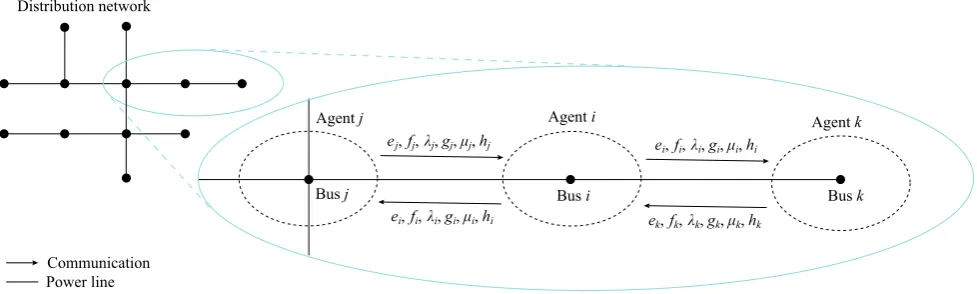
In the following, a distributed approach to finding a solution to (6) is presented. An iterative algorithm is developed that applies the minimization steps of (11) and multiplier estimate updates of (12) and (13) with an asynchronous consensus protocol for finding the values of the coupled power mismatchhðxÞand its associated mul-tiplierl. All updates are performed asynchronously, with agents exchanging information with their immediate neighbours, an illustrations of which is presented in Fig. 1. Each agent represents a single bus within the
distribution network and communicates only with its neighbours while preserving the privacy of local power production and demand.
First an asynchronous averaging consensus protocol is presented, followed by a fully distributed implementation of (11). The two algorithms are then combined to provide a unified solution to the problem of (6).
4.1 Asynchronous consensus protocol
[image:5.595.54.543.538.685.2]Consider the undirected graph (N,A) with node set N, and weighted adjacency matrixA¼ ½aij. The objective of the consensus protocol is to find the average of the |N |-dimensional vectorh. Each nodeiholds an estimate of the average denoted byh~i, which is updated iteratively through communication only with neighbours Ni¼ fj2N:aij6¼0g. The basic iterative, synchronous con-sensus protocol can be defined as follows over iterationsk:
~
hiðkþ1Þ¼h~ðikÞþnX j2Ni
~
hðjkÞh~ðikÞ
ð15Þ
wheren is the step size. Given a step sizen2 ð0;1=Dfor D¼maxi P
j6¼i aij
!
and given initial estimatesh~ði0Þ¼hi, the synchronous consensus protocol will converge such that
~
hðikÞ¼1 N
P j
hj; 8i2N ask! 1[19].
Averaging consensus relies on maintaining the average value across the network after each iterationk. Specifically:
X
i2N
~
hðikÞ¼X i2N
hi 8k ð16Þ
If (15) is performed asynchronously, for example if not all nodes are updated at each iteration, then the consensus result will not give the average of the initial condition and (16) will not be maintained [29]. Asynchronous, averaging
Distribution network
Communication Power line
Agent j
Agent i and its neighbor set Ni={j, k}
Bus j Bus i Bus k
ej, fj, λj, gj, μj, hj
ei, fi, λi, gi, μi, hi
ei, fi, λi, gi, μi, hi
ek, fk, λk, gk, μk, hk
Agent i Agent k
consensus protocols have been presented in the literature and typically employ a symmetric gossip strategy (a description of which is presented in [40]). However exist-ing implementations of this strategy require some form of local synchronization [31], explicit pairing (agreement between neighbours as to who controls communication) [41] or blocking [30]. Next we present a simple asyn-chronous averaging consensus protocol that avoids the need for these mechanisms and possesses the following properties:
1) Distributed: No central controller or leader agent 2) Asynchronous: No inter-agent synchronization 3) Implicit pairing: No blocking or explicit pairing 4) Averaging: Average consensus is reached
5) Tracking: Average is tracked as network state changes If protocol (15) is applied for a single update, for example when a single nodeiperforms an update at iterationk, then after the update is complete the sum of value estimates in (16) will be incorrect by a factor ofnP
j2Ni
~
hðjkÞh~ðikÞ
. To maintain the average an amount can be subtracted from each neighbour’s estimate. This amount does not have to be subtracted immediately and can be queued by each neighbour and subtracted when it next performs an update. We specify the consensus correction variable wi to store this value and the resulting protocol is presented in Algorithm 1.
Algorithm 1Asynchronous consensus protocol
Initializeh˜(0)i =hi, w(0)i = 0,∀i∈N. Fork= 1,2, . . .:
1. Choose the set of nodesS(k)⊆Nto update. 2. For eachi∈S(k):
2.1 Update average estimate:
˜
h(k+1)
i =h˜(ik)+ξ j∈Ni
(h˜(jk)− ˜hi(k))−wi(k). (17)
2.2 For eachj ∈Ni:
w(k+1)
j =w(jk)+ξ(h˜(jk)− ˜h(ik)). (18)
2.3 Resetw(ik+1)= 0.
Algorithm 1 maintains the average: X
i2N ðh~ðkÞ
i þw ðkÞ i Þ ¼
X
i2N
hi 8k ð19Þ
even though the asynchronous nature of the algorithm, defined by the update setSðkÞ, implies some nodes may not be updated at iterationk.
In practice, we can’t assume that updates forwiwill not occur in parallel. Therefore all such requests should be queued. Additionally, since a single failure to update wi will cause the average to be shifted and condition (19) to be breached, it is important that these updates require an acknowledge message from each neighbour.
Given non-empty update setSðkÞ, and ignoring constraint (19) such thatwðikÞ¼0; 8i;k, the update (17) can be syn-chronously defined in matrix form as follows:
~
hðkÞ¼ Y k
l¼0
PðlÞ
!
h ð20Þ
wherePis the Perron matrix and is defined as:
PðkÞ¼InDðkÞ
DðijkÞ¼
jNij j¼iandi2SðkÞ 1 j2Niandi2SðkÞ
0 otherwise 8
> < > : 8
> > > < > > > :
ð21Þ
whereIis the identity matrix, andjNijis the cardinality of the neighbour set of node i.
Theorem 1 Assume there exists a positive constant m such that for the sequencefk;kþ1;. . .;kþmg the graph associated with the matrix Q
kþm
l¼k
PðlÞis fully connected for all k. Then under the iterations specified by algorithm 1, and given step size 0\n\1=Dfor D=maxijNij, all local esti-matesh~i converge to the average of the initial valueshias k! 1, such that:
~
hðikÞ! 1 jNj
X
i2N
hi ð22Þ
Remark The assumption on the connectivity of the product of Peron matrices can be understood intuitively as there being a uniform upper bound on the number of iterations required before information from one agent can propagate through the network to any other agent.
The following proof is adapted for the asynchronous case from the synchronous convergence analysis provided by [19].
Proof From the updates in (20), a consensus is reached if the limit lim
k!1 Q kþm
l¼k
PðlÞ exists. Having 0\n\1=D gives Dii\1, and 0\Pii\1; 8i, and also 0\Pij;i6¼j. It then follows that the matrix Q
kþm
l¼k
PðlÞ has the following properties:
3) The digraph associated with the matrix is strongly connected
Therefore, the matrix is primitive and according to Lemma 4 from [19] lim
k!1 Q kþm
l¼k
PðlÞ exists. It then follows thath~ðkÞ i ¼
~
hðjkÞ; 8i;j2N ask! 1.
The average conservation variablewican be considered a bias in the updates of (17), which does not affect the stability analysis of the algorithm [19]. Given the consen-sus of the variables h~ðikÞ and since each node is updated such that wðikÞ¼0 at least every m iterations, it follows from (18) that wðikÞ!0 as k! 1. Then (19) gives P
i2N
~
hðikÞ¼P i2N
hi and from consensus
~
hðikÞ!1 N
P i2N
hi; 8i2N. h
The preceding proof states that a bias does not affect the stability analysis. This can be seen by following the pro-gression of the average condition with biases added:
X
i2N
~
hðikÞ¼X i2N
hiþ Xk1
j¼0 bðijÞ
!
ð23Þ
Therefore, adding a bias is equivalent to modifying the initial state in terms of (16). It follows that the average condition will converge if P
i2N P k1
j¼0
bðijÞ!C, for some C2 ð1;1Þ.
For an analysis of the optimal choice of tuning param-etern the reader is referred to [42] where an eigenvalue analysis of the Laplacian provides both admissible and optimal values. This applies to the synchronous case, but extends to the asynchronous case by replacing the Lapla-cian with its expectation.
4.2 Asynchronous distributed algorithm
The update of (13) requires knowledge of all elements of global statexsince it relies on the value ofhðxÞ. As such, the exact calculation of (13) can only be made centrally. To convert the centralised method of Sect.3 to a distributed form the inseparable power mismatch constraint,hðxÞ, is calculated through the asynchronous consensus protocol of algorithm 1. The local estimate of power mismatch is
~
hðikÞ¼ h~ðpkÞ
i ;
~
hðqkÞ
i
h iT
for node i at iteration k. The power mismatch estimate update is then given by:
~
hðikþ1Þ¼h~ðikÞþnhP j2Ni
ðh~ðjkÞh~ðikÞÞ wi
þsðikþ1ÞsðikÞþP j2Ni
ðsijðxðkþ1ÞÞ sijðxðkÞÞÞ
wjðkþ1Þ¼wjðkÞþnhðh~ðkÞ
j h~ ðkÞ
i Þ 8j2Ni
wðikþ1Þ¼0 8 > > > > > > > > < > > > > > > > > : ð24Þ
where nodal complex power is defined assi¼ ½pi;qi T
and line loss as sijðxÞ ¼ ½pijðxÞ;qijðxÞT.
A similar approach is taken for the approximation of the power mismatch multiplier l, however since average consensus is not required a standard asynchronous con-sensus protocol is used without the average maintaining terms wi:
~
lðikþ1Þ¼l~ ðkÞ i þnl
X
j2Ni
~
lðjkÞl~ ðkÞ i
þah~ðikþ1Þ ð25Þ
The bias terms present in (24) and (25), are sðikþ1ÞsðikÞ
þP j2Ni
sðijkþ1ÞsðijkÞ
and ah~ðikþ1Þ respectively. These terms shift the global average according to the change in state at iteration k, but they do not impact the stability of algorithm 1 and therefore they ensure that the estimates h~ and l~ track the global values. Therefore, so long as the bias terms’ sums converge, the estimates will converge to the true global values, that is h~ðikÞ!1
Nhðx
ðkÞÞ andl~ðkÞ
i !l for all i2N, wherelis the global estimate of the optimal multiplierl . In this way an approximation can be made for the gradient descent steps of (11):
xðikþ1Þ¼PX xð kÞ i c
ðkÞ
i rxiciðx
ðkÞ i Þ
n
þ rxihðx
ðkÞÞðl~ðkÞ i þah~
ðkÞ i Þ
þ rxigðx
ðkÞÞð
kðkÞþagðxðkÞÞÞo
ð26Þ
whererxihðx
ðkÞÞandrx
igðx
ðkÞÞare calculable locally and are non-zero only for elements corresponding to nodeiand its neighbours [32]. This modification makes a fully dis-tributed solution possible. The asynchronous, disdis-tributed algorithm for finding a solution to (6) is presented in algorithm 2, where hiðxÞ ¼siþ12P
j2Ni
Algorithm 2Asynchronous distributed algorithm
Initialize
Power mismatch:h˜(0)i =hi(xi(0)),μ˜(0)i = 0,∀i∈N. Generator power: [pi,qi] = arg min{ci(xi(0))},∀i∈NG.
Voltages:ei(0)= 1, fi(0)= 0,∀i∈N.
Fork= 1,2, . . .:
1. Choose the set of nodesS(k)⊆Nto update. 2. For eachi∈S(k):
2.1 Update primal variablex(ik)(26). 2.2 Update multiplierλ(ik)(12).
2.3 Update power mismatch estimateh˜(ik)(24).
2.4 Update multiplier estimateμ˜(ik)(25). 2.5 Increase penalty multiplier:αi(k+1)=βα(ik).
5 Simulation results
We consider the case of a distribution network featuring numerous DG capable of operating in an isolated mode; that is, operating such that power generated within the network is able to match all loads and losses within the network. Furthermore, each bus in the network is equipped with an agent that has knowledge of nodal DG or load power, and has a communication interface with neigh-bouring agents. The test network is a balanced three phase implementation of a 35 bus subnetwork of the IEEE 123 node test feeder system [43]; the 35 bus subset has been chosen for the sake of simpler presentation of results, however convergence analysis of larger subsets of this network is included below. Only buses 1 to 34 were included in the test network along with bus 149 configured as a slack bus. Dispatchable generators, each with a 500 kW capacity, were attached to buses 1, 3, 8, 14, 18, 26 and 29, and their associated agents were equipped with cost functionsciðpi;qiÞ ¼0:5p2i þ0:5q2i. The base voltage was set to 1 p.u.=120 V, voltage magnitudes were constrained according to (3) with½v;vþ ¼ ½0:95;1:05p.u, and base power was set to 1 p.u.=10 kVA.
Algorithm 2 was applied to the test network, initialized with a random feasible state with cost of 512.5, and resulted in the convergence of the Lagrange and cost functions to the cost of a centralized OPF solution as presented in Fig. 2. L denotes the value of a centralised solution to the OPF problem. This convergence also implies that gðxðkÞÞ !0 and hðxðkÞÞ!0 which is further evident in Fig.3which shows the norm of the power flow constraints converging to zero.
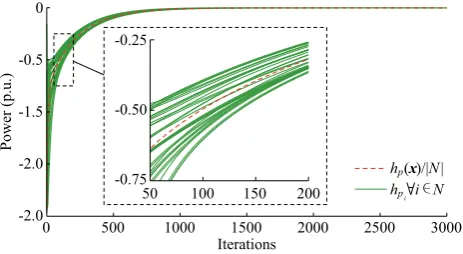
Figure 4 shows the estimate of the power mismatch calculated through consensus by each agent (solid green lines), and the average of the true power mismatch (broken red line). It can be seen that the asynchronous consensus protocol of 1 successfully converges on and tracks the true
power mismatch hpðxÞ without drifting (similar results were found for hqðxÞ). Furthermore, algorithm 2 success-fully reduces the power mismatch, including line loss, to zero. As such all equality constraints are satisfied.
Figure5presents the final voltages of the network which are clearly within voltage magnitude limits. The voltage at bus 24 has been constrained according to (3) (refer to the marker on the 0.95 p.u. lower bound) indicating that the
300
200
0 500 1000 1500 2000 2500 3000
350
250 400 450 500
Cost
L*
c(x) L(x, λ, μ)
Iterations
Fig. 2 Convergence of Lagrange function and cost function to solution of centralized OPF over iterations of the distributed Algorithm 2
Iterations
2500
0 500 1000 1500 2000 3000
12
10 16
14
8
4 6
2
Power (p.u.)
gp(x)
gq(x)
Fig. 3 Convergence of power flow constraints, g(x) to zero over iterations of Algorithm 2
-1.5
-2.0
-2.0 -0.5
-0.25
-0.75
50 100 150 200
-0.50 0
Power (p.u.)
0 500 1000 1500 2000 2500 3000
Iterations
hp(x)/|N| hpi i∈N
[image:8.595.312.543.57.193.2] [image:8.595.309.540.246.381.2] [image:8.595.310.542.427.554.2]solution lies on the boundary ofX. Figure 6 presents the estimates of optimal generated power as iterations of algorithm 2 progress, and are within DG capacities according to (2). Therefore, the arrived at solution is fea-sible; that is,x2X,gðxÞ ¼0,hðxÞ ¼0.
Finally, Fig.7 presents the normalized gradients of the Lagrange function. As described above, the voltage at bus 24 lies on the boundary of X and due to the projection operation of (11) the gradient with respect to e24 andf24 cannot satisfy (10) asðkÞ!0. As such, these elements of the gradient have been neglected in the presentation of Fig. 7. Clearly, all other gradients successfully approach zero in accordance with (10) such that a local optimum is reached. It should be noted that in many tested scenarios, including the one presented here, the sequencefðkÞgcould be chosen such that only a single gradient descent step was required at each iteration.
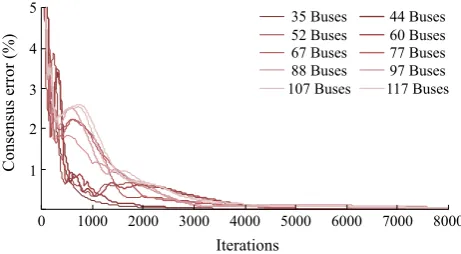
To assess the algorithm’s scalability, numerous subsets of the IEEE 123 node test feeder system were considered. As a metric for the convergence of the consensus algorithm the average absolute errors of the power mismatch estimate
were taken as a percentage of network power. As a metric of the distributed OPF convergence the state’s deviation from final converged values was taken. Figures 8 and 9
presents the metrics measured against each test network over iterations of algorithm 2. The consensus algorithm shows good convergence with all test cases reaching a neighbourhood of the true value early on, and the larger networks taking progressively longer to fully converge. The distributed OPF algorithm presents similar conver-gence properties, with a rapid, early decrease in error and
0.025
-0.025
-0.050
Imaginary component of voltage
f
(p.u.)
Real component of voltage e (p.u.)
-0.075
0.90 0.95 1.00 1.05
0
Fig. 5 Nodal voltages after convergence of Algorithm 2
Iterations
2500
0 500 1000 1500 2000 3000
Iterations
2500
0 500 1000 1500 2000 3000
12 8 4
6 4 2
Power (p.u.)
Power (p.u.)
(a)
(b)
Active DG power (p(k))
Active DG power (q(k))
Fig. 6 Convergence of optimal DG power estimates for each agent over iterations of Algorithm 2
0.25
0.20
0.15
0.10
0.05
Iterations
Normalized gradient
2500
0 500 1000 1500 2000 3000
Fig. 7 Convergence of normalized Lagrange gradients to zero over iterations of Algorithm 2
8000 7000 6000 5000 4000 3000 2000 1000 0 1 2 3 4 5
Consensus error (%)
Iterations
35 Buses 44 Buses
52 Buses 60 Buses
67 Buses 77 Buses
88 Buses 97 Buses
107 Buses 117 Buses
Fig. 8 Comparison of convergence of algorithm 1 for networks of varying sizes
1 2 3 4 5
Consensus error (%)
8000 6000
4000 16000
0 0 0
2 10000 12000 14000
0
Iterations
35 Buses 44 Buses
52 Buses 60 Buses
67 Buses 77 Buses
88 Buses 97 Buses
107 Buses 117 Buses
[image:9.595.55.290.57.216.2] [image:9.595.309.540.60.186.2] [image:9.595.309.540.239.366.2] [image:9.595.54.286.539.689.2] [image:9.595.309.540.561.687.2]full convergence taking an increasing number of iterations in approximate proportion to the network size.
6 Conclusion
We have presented an asynchronous, distributed algo-rithm for optimal DG control in the Smart Grid, which enforces zero power mismatch between generation, load and line loss, and enforces nodal voltage constraints. An asynchronous averaging consensus protocol was developed and applied to the discovery of power mismatch within the network which is otherwise not calculable by agents since they only possess local and neighbourhood information. The protocol was able to maintain a system average without any synchronization between agents, and was able to drive each agent to converge on the average power mismatch value. The asynchronous, distributed optimiza-tion algorithm was combined with the asynchronous con-sensus protocol to deliver a feasible and locally optimal solution requiring no central coordination or control. Finally, the application of the combined asynchronous, distributed algorithms was presented through a case study, demonstrating its ability to converge to a feasible solution in terms of power flow, power mismatch, and nodal voltage constraints, and to reach a locally optimal solution. Open Access This article is distributed under the terms of the Creative Commons Attribution 4.0 International License (http:// creativecommons.org/licenses/by/4.0/), which permits unrestricted use, distribution, and reproduction in any medium, provided you give appropriate credit to the original author(s) and the source, provide a link to the Creative Commons license, and indicate if changes were made.
References
[1] Taft J, Becker-Dippmann A (2015) Grid architecture. Pacific Northwest National Laboratory, Tech Rep.http://gridarchitecture. pnnl.gov/media/white-papers/Grid%20Architecture%20%20-% 20DOE%20QER.pdf
[2] Yu L, Czarkowski D, de Leon F (2012) Optimal distributed voltage regulation for secondary networks with DGs. IEEE Trans Smart Grid 3(2):959–967
[3] Millar B, Jiang D, Haque ME (2014) Constrained coordinated distributed control of a smart grid with asynchronous informa-tion exchange. J Mod Power Syst Clean Energy 3(4):512–525 [4] Shi W, Xie X, Chu C, Gadh R (2015) Distributed optimal
energy management in microgrids. IEEE Trans Smart Grid 6(3):1137–1146
[5] Zhang Y, Gatsis N, Giannakis G (2013) Robust energy man-agement for microgrids with high-penetration renewables. IEEE Trans Sustain Energy 4(4):944–953
[6] Yang P, Chavali P, Gilboa E et al (2013) Parallel load schedule optimization with renewable distributed generators in smart grids. IEEE Trans Smart Grid 4(3):1431–1441
[7] Tushar W, Zhang J, Smith D et al (2014) Prioritizing consumers in smart grid: a game theoretic approach. IEEE Trans Smart Grid 5(3):1429–1438
[8] Atzeni I, Ordonez L, Scutari G et al (2014) Noncooperative day-ahead bidding strategies for demand-side expected cost mini-mization with real-time adjustments: a gnep approach. IEEE Trans Signal Process 62(9):2397–2412
[9] Atzeni I, Ordonez L, Scutari G et al (2013) Noncooperative and cooperative optimization of distributed energy generation and storage in the demand-side of the smart grid. IEEE Trans Signal Process 61(10):2454–2472
[10] Atzeni I, Ordonez L, Scutari G et al(2013) Demand-side man-agement via distributed energy generation and storage opti-mization. IEEE Trans Smart Grid 4(2):866–876
[11] Ramachandran B, Srivastava S, Edrington C et al (2011) An intelligent auction scheme for smart grid market using a hybrid immune algorithm. IEEE Trans Ind Electron 58(10):4603–4612 [12] Zhang Z, Chow M-Y (2012) Convergence analysis of the incremental cost consensus algorithm under different commu-nication network topologies in a smart grid. IEEE Trans Power Syst 27(4):1761–1768
[13] Vaccaro A, Velotto G, Zobaa A (2011) A decentralized and cooperative architecture for optimal voltage regulation in smart grids. IEEE Trans Ind Electron 58(10):4593–4602
[14] Alyami S, Wang Y, Wang C et al (2014) Adaptive real power capping method for fair overvoltage regulation of distribution networks with high penetration of PV systems. IEEE Trans Smart Grid 5(6):2729–2738
[15] Ansari J, Gholami A, Kazemi A (2016) Multi-agent systems for reactive power control in smart grids. Int J Electr Power Energy Syst 83:411–425
[16] Khan I, Li Z, Xu Y et al (2016) Distributed control algorithm for optimal reactive power control in power grids. Int J Electr Power Energy Syst 83:505–513
[17] Shi B, Liu J (2015) Decentralized control and fair load-shedding compensations to prevent cascading failures in a smart grid. Int J Electr Power Energy Syst 67:582–590
[18] Chen H, Li Y, Louie R et al (2014) Autonomous demand side management based on energy consumption scheduling and instantaneous load billing: an aggregative game approach. IEEE Trans Smart Grid 5(4):1744–1754
[19] Olfati-Saber R, Fax J, Murray R (2007) Consensus and coop-eration in networked multi-agent systems. Proc IEEE 95(1):215–233
[20] He D, Shi D, Sharma R (2014) Consensus-based distributed cooperative control for microgrid voltage regulation and reac-tive power sharing. In: Proceedings of 2014 IEEE PES inno-vative smart grid technologies conference europe (ISGT-Europe), Istanbul, Turkey, 12–15 October 2014, 6 pp [21] Giraldo J, Mojica-Nava E, Quijano N (2014) Synchronization of
isolated microgrids with a communication infrastructure using energy storage systems. Int J Electr Power Energy Syst 63:71–82
[22] Zhang W, Xu Y, Liu W et al (2013) Fully distributed coordi-nation of multiple dfigs in a microgrid for load sharing. IEEE Trans Smart Grid 4(2):806–815
[23] Liu W, Gu W, Xu Y et al (2015) Improved average consensus algorithm based distributed cost optimization for loading shed-ding of autonomous microgrids. Int J Electr Power Energy Syst 73:89–96
[25] Yang S, Tan S, Xu JX (2013) Consensus based approach for economic dispatch problem in a smart grid. IEEE Trans Power Syst 28(4):4416–4426
[26] Rahbari-Asr N, Ojha U, Zhang Z et al (2014) Incremental welfare consensus algorithm for cooperative distributed gener-ation/demand response in smart grid. IEEE Trans Smart Grid 5(6):2836–2845
[27] Xu Y, Zhang W, Hug G et al (2015) Cooperative control of distributed energy storage systems in a microgrid. IEEE Trans Smart Grid 6(1):238–248
[28] Chang T-H, Nedic A, Scaglione A (2014) Distributed con-strained optimization by consensus-based primal-dual pertur-bation method. IEEE Trans Autom Control 59(6):1524–1538 [29] Fang L, Antsaklis PJ, Tzimas A (2005) Asynchronous
consen-sus protocols: preliminary results, simulations and open ques-tions. In: Proceedings of 44th IEEE conference on decision and control, 2005 and 2005 European control conference CDC-ECC ’05, Seville, Spain, 15 December 2005, pp 2194–2199 [30] Mehyar M, Spanos D, Pongsajapan J, Low S, Murray R (2005)
Distributed averaging on asynchronous communication net-works. In: Proceedings of 44th IEEE conference on decision and control, 2005 and 2005 European control conference CDC-ECC ’05, Seville, Spain, 15 December 2005, pp 7446–7451 [31] Salehkaleybar S, Golestani SJ (2013) Averaging consensus over
erasure channels via local synchronization. In: Proceedings of 2013 IEEE international symposium on information theory proceedings (ISIT), Istanbul, Turkey, 7–12 July 2013, pp 1092–1096
[32] Millar B, Jiang D (2016) Smart grid optimization through asynchronous, distributed primal dual iterations. IEEE Trans Smart Grid 8(5):2324–2331
[33] Madani R, Kalbat A, Lavaei J (2015) Admm for sparse semidefinite programming with applications to optimal power flow problem. In: Proceedings of 2015 54th IEEE conference on decision and control (CDC), Osaka, Japan, 15–18 December 2015, pp 5932–5939
[34] Baldick R, Kim BH, Chase C(1999) A fast distributed imple-mentation of optimal power flow. IEEE Trans Power Syst 14(3):858–864
[35] Erseghe T (2014) Distributed optimal power flow using admm. IEEE Trans Power Syst 29(5):2370–2380
[36] Liu J, Benosman M, Raghunathan AU (2015) Consensus-based distributed optimal power flow algorithm. In: Proceedings of 2015 IEEE power energy society innovative smart grid
technologies conference (ISGT), Washington, DC, USA, 18–20 February 2015, 5 pp
[37] Frank S, Steponavice I, Rebennack S (2012) Optimal power flow: a bibliographic survey i. Energy Syst 3(3):221–258 [38] Bertsekas DP (1982) Constraint optimization and lagrange
multiplier methods. Academic press Inc, Cambridge
[39] Bertsekas DP (2015) Convex optimization algorithms. Athena Scientific, Belmont
[40] Garin F, Schenato L (2010) A survey on distributed estimation and control applications using linear consensus algorithms net-worked control systems. Netnet-worked control systems, Springer, London
[41] Kriegleder M, Oung R, D’Andrea R (2013) Asynchronous implementation of a distributed average consensus algorithm. In: Proceedings of 2013 IEEE/RSJ international conference on intelligent robots and systems, Tokyo, Japan, 3–7 November 2013, pp 1836–1841
[42] Xiao L, Boyd S (2004) Fast linear iterations for distributed averaging. Syst Control Lett 53(1):65–78
[43] Kersting WH (2001) Radial distribution test feeders. In: Pro-ceedings of power engineering society winter meeting, Columbus, USA, 28 January–1 February 2001, pp 908–912
Benjamin S. MILLARobtained his Bachelor degree in Engineering, and is currently a postgraduate student in the School of Engineering and ICT at the University of Tasmania, Australia. His research interests include distributed smart grid control, multi-agent systems, smart buildings and home automation.