Grouped Goodness-of-Fit Tests
for Binary Regression Models
by
Jana Dorthea Canary
BS (Mathematics), MS (Forest Ecology)
Submitted in fulfilment of the requirements for the degree of Doctor of Philosophy (Biostatistics)
University of Tasmania, December 2013
Supervisors Doctor Stephen Quinn
Associate Professor Leigh Blizzard Professor David Hosmer
Dedication
Declaration of Originality
This thesis contains no material which has been accepted for a degree or diploma by the
University or any other institution, except by way of background information and duly
acknowledged in the thesis, and to the best of my knowledge and belief no material previously
published or written by another person except where due acknowledgement is made in the text
of the thesis, nor does the thesis contain any material that infringes copyright.
Statement of Authorship
This thesis can be made available for loan. Copying of any part of this thesis is
prohibited for two years from the date this statement was signed; after that time limited
copying is permitted in accordance with the
Copyright Act 1968.
Acknowledgements
I would like to first thank my primary supervisor, Dr. Stephen Quinn, for his support. I feel
fortunate to have had Steve as a supervisor. He was always willing to take time to work with
me, to give carefully thought out comments on my work, and to deal with the challenges of
working with someone on the other side of the globe. I am very appreciative of his efforts in
guiding me through the thesis process.
I would also like to thank my other supervisors. First, thank you to Dr. Leigh Blizzard, who
made it possible for me to come to Menzies and helped me to navigate through the steps of
setting up a Ph.D. candidature remotely from Alaska. He also provided useful comments on my
work and provided financial support through an NHMRC grant that, along with an Australian
Postgraduate Award, made my research possible. I also would like to thank Dr. Ron Barry of
the University of Alaska, who was kind enough to meet with me to discuss my work while I was
in Alaska, particularly during the early stages of my candidature. Lastly, I would like to thank
Dr. David Hosmer, who is an emeritus professor and an expert in the field of biostatistics. He
kindly offered his time and advice, and I very much appreciate his help.
I would also like to thank several fellow students and staff (in no particular order) at Menzies
whose support both in person and electronically made the process so much easier: Kara, Laura,
Dawn, Peta, Oliver, Kathy, Karen, Petr, Barbara, Tracey, Steve, David, and Ben. Thank you for
your advice, support, encouragement, and friendship. Also my friends in Alaska and Hobart
who provided childcare when I needed it, chats, and support: Petra, John, Gordon, Nancy, Jay,
Donie, Peter, Margaret, Trusten, William, Leslie, and Sharon.
Also, I would like to thank the two anonymous examiners of my thesis. Their thorough review
and thoughtful comments were very helpful and encouraging.
Lastly I would like to thank my husband Mark Conde and daughter Jacqueline. I cannot thank
Mark enough for his financial and emotional support, and for lively discussions about
mathematics. And thank you to Jacqueline, for the backrubs, hugs, and understanding when I
Abstract
How well a proposed regression model fits the observed outcome data is a critical question. The
answer may influence model selection, and the conclusions drawn. Summary goodness-of-fit
(GOF) statistics are used to assess model fit. Pearson’s chi-squared GOF statistic
X2 is usedto evaluate the fit of logistic regression models, but X2 isn’t appropriate when the model contains continuous covariates. Other GOF statistics are applicable, including the
Hosmer-Lemeshow
HL , Pigeon-Heyse
J2 , and Tsiatis
T statistics. All have similarities to X2and group data artificially.
Simulation studies assessing new GOF statistics for logistic models with continuous covariates
often include HL for comparison. We know of no study that compares HL, J2, and T. We did so here, applying the same grouping method (deciles-of-risk) to all. Our results indicated that
HL and T followed their reported distributions, but J2 did not. Its distribution was closer to
2 2
~ 2
J G , where G=groups, rather than the reported 2
G1
. Assuming
2 2
~ 2
J G , T maintained the Type I error rate twice as often as HL and J2. The rates of
HL and J2 were often lower than expected when dichotomous, quadratic, or interaction terms were included. The statistics had similar power to detect departures from a true
underlying model.
The logistic model is the canonical generalized linear model (GLM) for binomial outcomes.
Although many GOF statistics have been developed for logistic models, there are fewer for
non-canonical GLM with binomial outcomes. The properties of the logistic model make the
development of GOF statistics relatively straightforward, but it can be more difficult for
non-canonical GLMs.
We considered whether HL, J2, and T could be applied to non-canonical GLM with Bernoulli outcomes and continuous covariates. Our investigation found that HL and 2
generalised T , (TG ). We showed that under non-canonical links, TG ~2
G . In a second simulation study, HL, J2, and TG were used to evaluate the fit of probit, log-log,complementary log-log and log binomial models. The deciles-of-risk method was applied. Type
I error rates were consistently maintained by TG , while those of HL and J2 were often lower than expected if the model included dichotomous, quadratic, or interaction terms. Because the
distributions of HL and 2
J varied, it was unclear how their degrees-of-freedom could be adjusted. The statistics had similar power to detect an incorrect model in most situations. An
exception occurred when a log model was incorrectly fit to data generated from a logistic
Table of Contents
Grouped Goodness-of-Fit Tests ... 1
for Binary Regression Models ... 1
Declaration of Originality ... 3
Statement of Authorship ... 4
Acknowledgements ... 5
Abstract ... 6
Table of Contents ... 8
List of Tables ... 12
List of Figures ... 14
Chapter 1 Introduction ... 15
1.1 Background ... 15
1.2 Research Questions ... 20
1.3 Organization of Thesis ... 21
Chapter 2 Notation and Basic Concepts ... 22
2.1 Notation... 22
2.2 Generalized Linear Models ... 22
2.3 Exponential Family ... 23
2.4 GLM for Binary Data ... 27
2.5 Canonical GLM for Bernoulli Outcomes (Binary Logistic Regression) ... 30
2.6 Non-Canonical Link Functions for Binary Outcomes ... 31
2.6.1 Probit ... 31
2.6.2 Log-log and Complementary Log-log ... 32
2.6.3 Log Binomial ... 34
2.7 Basic Concepts of Score Tests ... 35
Chapter 3 Literature Review ... 38
3.1 Goodness-of-Fit Statistics for Binary Logistic Regression Models ... 38
3.1.1 Deviance ... 38
3.2 Goodness-of-Fit Statistics for Binary Logistic Regression Models with Continuous
Covariates ... 40
3.2.1 Hosmer-Lemeshow Goodness-of-Fit Statistic ... 41
3.2.2 Tsiatis Goodness-of-Fit Score Statistic ... 44
3.2.3 Pigeon-Heyse Goodness-of-Fit Test Statistic ... 47
3.3 Other GOF Statistics for Logistic Models with Continuous Covariates ... 50
3.3.1 Goodness-of-Fit Statistics with Grouping Methods Based on Clustering ... 50
3.3.2 Smoothing Methods for Testing the Fit of Logistic Regression ... 51
3.3.3 Goodness-of-Fit Statistics for Logistic Models with Discrete Covariates ... 52
3.3.4 Score Tests for Assessing the Fit of Logistic Regression Models ... 54
3.4 Studies Comparing the Performance of GOF Statistics for Binary Logistic Regression Models ... 57
3.5 Goodness-of-Fit Statistics for Non-Canonical GLM ... 59
3.5.1 Statistics to Assess the Fit of Non-Canonical GLM with Discrete Covariates .... 59
3.5.2 Goodness-of-Fit Statistics for Assessing the Fit of Probit Models with Continuous Covariates ... 61
3.5.3 Assessing the Fit of Log Binomial Models ... 62
Chapter 4 Comparison of HL, J2, and T when Assessing the Fit of Logistic Models ... 63
4.1 Introduction ... 63
4.2 Algebraic Comparison ... 64
4.2.1 Hosmer-Lemeshow Goodness-of-fit Statistic ... 64
4.2.2 Pigeon-Heyse Goodness-of-fit Statistic ... 65
4.2.3 Tsiatis Goodness-of-Fit Statistic ... 65
4.3 HL ≤ J2 ... 67
4.4 J2 Can Be Much Larger Than HL ... 69
4.5 Simulation Study Comparing HL, J2 and T ... 70
4.5.1 Simulation Methods ... 71
4.5.1.1 General Simulation Methods ... 71
4.5.1.2 Methods to Investigate the Null Distributions of HL, J2, and T ... 72
4.5.1.4 Methods for Comparing the Power of HL, J2, and T ... 76
4.5.2 Simulation Results ... 77
4.5.2.1 Distribution of J2 ... 77
4.5.2.2 Empirical Rejection Percentage Under the Null Hypothesis ... 80
4.5.2.3 Power - Rejection Percentage Under the Alternative Hypothesis ... 83
4.6 Examples ... 86
4.7 Discussion ... 88
Chapter 5 Proposed Goodness-of-Fit Statistic for Binary GLM with Non-Canonical Links ... 91
5.1 Expanded Tsiatis model ... 91
5.2 Generalized Tsiatis GOF Statistic ... 93
5.3 Forms of TG Under Several Common Link Functions ... 96
5.4 Distribution and Degrees of Freedom of TG ... 97
5.5 Grouping Method ... 101
5.6 Examples of Alternative Tsiatis and Generalized Tsiatis Models ... 102
5.7 HL and J2 for Binary GLM with Non-Canonical Links ... 103
5.8 Simulation Study Comparing HL,J2, and TG Under Non-Canonical Links ... 104
5.8.1 Simulation Methods ... 104
5.8.1.1 General Simulation Methods ... 104
5.8.1.2 Investigation of Null Distribution of HL, J2, and TG ... 105
5.8.1.3 Empirical Rejection Percentage Under the Null Hypothesis ... 106
5.8.1.4 Power ... 113
5.8.2 Simulation Results ... 114
5.8.2.1 Distribution of HL, J2, and TG Under Non-Canonical Link Functions ... 114
5.8.2.2 Empirical Rejection Percentage Under the Null Hypothesis ... 118
5.8.2.2.a Probit ... 127
5.8.2.2.b Log-log ... 127
5.8.2.2.c Complementary Log-log ... 128
5.8.2.2.d Log ... 129
5.8.2.3.a Probit ... 134
5.8.2.3.b Log-log ... 134
5.8.2.3.c Complementary Log-log ... 135
5.8.2.3.d Log ... 136
5.9 Examples ... 136
5.10 Discussion ... 139
Chapter 6 Overall Discussion ... 142
6.1 Overview of the Chapter ... 142
6.2 Broad View of Research ... 143
6.3 Need For This Research ... 144
6.4 Contribution and Significance of This Research ... 145
6.5 Limitations of This Research ... 147
6.6 Future Research ... 148
Appendix A Derivation of Terms for the Calculation of TG ... 150
A1 Canonical Logit Link ... 150
A2 Non-Canonical Links ... 150
A2.1 Probit Link (TPr) ... 150
A2.2 Log-log Link (TLL) ... 152
A2.3 Complementary Log-log Link (TCll) ... 154
A2.4 Log Link (TLB) ... 156
List of Tables
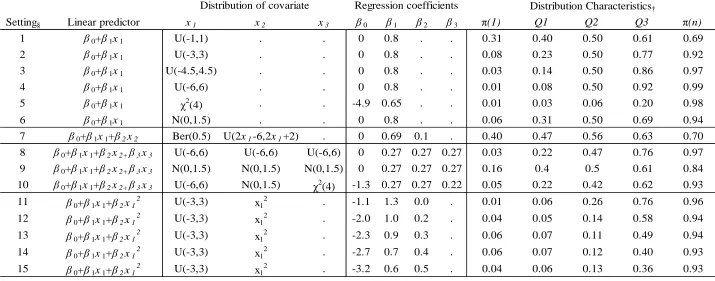
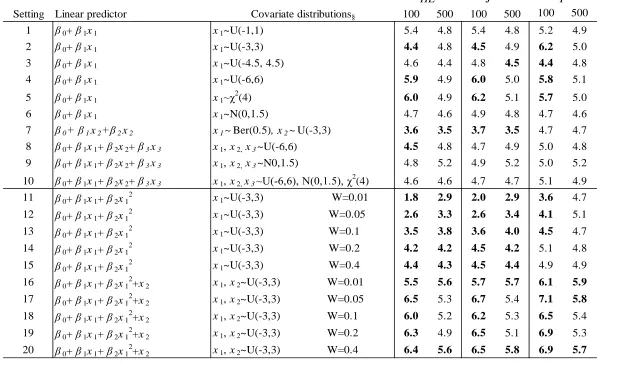
Table 4.1 Settings used to examine the null distributions and the power of HL, J2, and T. ... 73 Table 4.2 The linear predictors and distributional characteristics of the Stukel models used in
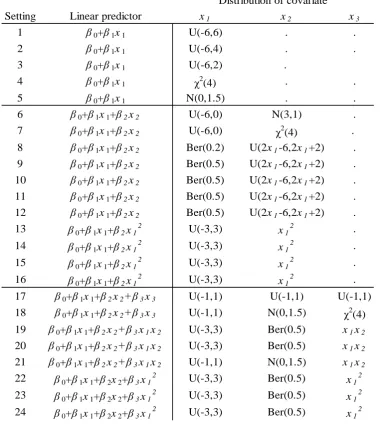
the power simulations. ... 74
Table 4.3 Summary statistics, rejection percentages, and Kolmogorov-Smirnov test results for
HL, J2 and T ... 80 Table 4.4 Simulated null rejection per cent† (n=100 and 500, r=10,000, α=0.05) for settings
1-24. ... 81
Table 4.5 Power of HL, J2 and T to detect a logistic model with an incorrectly specified linear predictor. ... 85
Table 4.6 Power of HL, J2 and T to detect a Stukel generalized model with an incorrectly specified logistic link function. ... 85
Table 5.1 General elements of the covariance matrix V, used in the calculation of TG, under the
logit, probit, log-log, complementary log-log, and log links. ... 98
Table 5.2 (a-e) Settings for simulations used to investigate the null distributions of HL, J2 , and
TG , and to evaluate the power of each statistic to detect an incorrectly specified link function. ... 109
Table 5.3 The distributional characteristics of the covariates and the linear predictors of the
settings used to examine the power of HL, J2, and T, to detect an incorrectly specified link function. ... 115
Table 5.4 Summary statistics, rejection per cent, and Kolmogorov-Smirnov test results for HL,
J2, and TG. ... 125 Table 5.5(a-d) Simulated null rejection per cent (n=500, r=100,000, α=0.05). ... 130
Table 5.6 Empirical rejection per cent (α=0.05) when a model with a term omitted from the
linear predictor was fitted to data generated from a model with all terms. ... 137
Table 5.7 Empirical rejection per cent (α=0.05) when a model with an incorrectly specified link
List of Figures
Figure 2.1 Graph of the probabilities produced by the inverse of the logit link function as a
function of x, where x~U(-6,6) and η=0.5x. ... 31
Figure 2.2 A graph of the probabilities produced by the inverse of five link functions as a function of x. (x~U(-6,6) and η=0.5x) ... 35
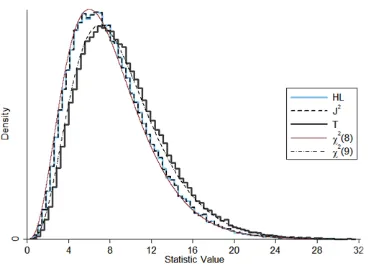
Figure 4.1 Histogram of 100,000 replications of setting 1. ... 79
Figure 4.2 Histogram of 100,000 replications of setting 5. ... 79
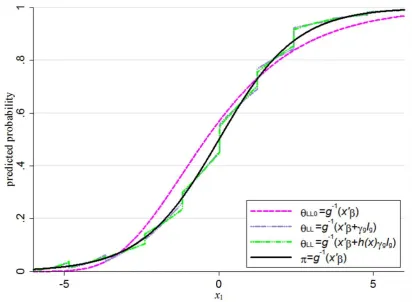
Figure 5.1 Graph of the predicted probabilities of a null log-log model (pink), an original Tsiatis log-log model (purple), a generalized Tsiatis log-log model (green), and the true logistic model (black) as a function of x. ... 103
Figure 5.2 Histogram of 100,000 replications of setting 3 using the probit link. ... 119
Figure 5.3 Histogram of 100,000 replications of setting 3 using the log-log link. ... 119
Figure 5.4 Histogram of 100,000 replications of setting 3 using the complementary log-log link. ... 120
Figure 5.5 Histogram of 100,000 replications of setting 3 using the log link. ... 120
Figure 5.6 Histogram of 100,000 replications of setting 10 using the probit link. ... 121
Figure 5.7 Histogram of 100,000 replications of setting 10 using the log-log link. ... 121
Figure 5.8 Histogram of 100,000 replications of setting 10 using the complementary log- log link. ... 122
Figure 5.9 Histogram of 100,000 replications of setting 10 using the log link. ... 122
Figure 5.10 Histogram of 100,000 replications of setting 21 using the probit link. ... 123
Figure 5.11 Histogram of 100,000 replications of setting 21 using the log-log link. ... 123
Figure 5.12 Histogram of 100,000 replications of setting 21 using the complementary log- log link. ... 124
Chapter 1
Introduction
“The oldest, shortest words – ‘yes’ and ‘no’ – are those which require the most thought.”
– Pythagoras
Yes or no, success or failure, life or death - these are all examples of binary responses. Critical
research questions can have answers that take this form. Once a scientist identifies such a
research question, designs a study, toils for hours collecting data, and then builds a regression
model appropriate for binary outcomes – after all of that, but before they can answer their
research question, they must first answer another binary question: ‘Does my model fit the data
that I observed?’ Their answer to this question will affect the conclusions they draw from all of
their hard work. It is critical. Checking the fit of binary regression models is central to this
thesis, and we began by giving a brief overview of the topic. Note that a more rigorous
explanation of the material in this overview will be given in Chapters two and three. We
conclude this introductory chapter with a list of the research questions that will be addressed in
the thesis, and give a synopsis of the thesis presentation.
1.1
Background
So how can the researcher decide whether or not to keep their model? One way is to calculate a
goodness-of-fit statistic that summarizes how well the outcomes predicted by their model fit the
outcomes they observed. This was the basic idea behind Karl Pearson’s well-known
goodness-of-fit test (Pearson 1900). Pearson is considered to be the “nucleus of the movement of
systematic statistical thinking”(Mukhopadhyay 2000). He was one of the first to introduce the
concept of goodness-of-fit. Originally he considered a multinomial variate with a fully specified
distribution function, whose range can be divided into some finite number of mutually exclusive
classes. Then, since the distribution function is specified, the probability of any observation
falling into a particular class can be calculated (Kendall, Stuart, Ord and Arnold 1999). One way
number of cells in a contingency table. Under the null hypothesis, the theoretical multinomial
probability of a being placed into a cell is equal to the probability derived from the observed
data and the parameters specified under the null hypothesis. The alternative is that they are
significantly different. Fisher extended Pearson’s work by considering the case when the
parameters are not fully specified (Kendall, et al. 1999). Later, Pearson’s test was applied to
regression models that can be fitted to obtain estimates of the parameters. This includes the
logistic regression model, which is used in many fields to relate a categorical outcome variable
to a set of predictor variables. It is a member of the class of models called generalized linear models (GLM), and can be used when the outcome data is assumed to come from a binomial distribution (McCullagh and Nelder 1989). If the outcome is binary, then it comes from the
Bernoulli distribution, which is a special case of the binomial distribution. In regression models,
the characteristics that correspond to the cells in the contingency table are the “covariate
patterns”. These are the unique combinations of the possible categories created by the covariates
in the model. For instance, if there were two covariates, say gender and smoking status, the
covariate patterns would be: male smoker, female smoker, male non-smoker, female
non-smoker.
Pearson’s test is usually called Pearson’s chi-squared test, and the test statistic often represented
by X2. The name describes the distribution of the statistic. Pearson proved that, given a single
variate with some fixed number of exclusive classes, the asymptotic distribution of the statistic
is chi-squared, with degrees of freedom equal to the number of classes, minus one. In the case
when there is more than one variate, then the degrees of freedom are calculated by determining
the number of classes for each variate, subtracting one from each, and then taking the product.
Pearson only considered the case when all parameters are specified. R.A. Fisher extended X2 to
situations where parameters are unspecified. He proved that, in the case of a single variate, the
distribution then is asymptotically chi-squared with degrees of freedom equal to the number of
possible response types, minus the number of estimated parameters, minus one.
In order for the distributional properties of X2 to hold, there must be enough data in each cell
of the contingency table, or likewise with every particular covariate pattern. If there are too few
observations of this type recorded, then there is not enough information to estimate the binomial
probability for that particular pattern. In this case, the theory behind the asymptotic distribution
of X2 is not valid. For example, this happens when continuous data are included in a logistic
regression model. In such cases, the number of covariate patterns may be as large as the number
of observations. Using 2
X in this situation is not appropriate (Kendall, et al. 1999, Hosmer and Lemeshow 2000).
A solution to this problem is to create artificial groups and apply a statistic similar to X2. That is, to form groups via a method that is based on more than just the natural groups formed by the
covariate patterns. Hosmer and Lemeshow (1980) were among the first to offer this type of
solution. Their statistic, denoted here as HL, uses a method that is based on ordering and placing into groups the predicted probabilities produced from the model. These are the
estimated probabilities that the outcome will occur, given the observed covariate data. The
number of groups will be denoted here as G. As a practical matter, they recommended creating ten groups and called the method “deciles-of-risk”. In practice though, other numbers of groups
can be used. Because these groups are created using the estimated parameters that reference all
of the data, which are random, the group boundaries are also random (Moore and Spruill 1975,
Kendall, et al. 1999). That is, the “cut-points” of the groups vary. This affects the distribution of
their statistic. Building on the work of others (Moore 1971, Moore, et al. 1975, Durst 1979),
Hosmer and Lemeshow determined that the approximate distribution of HL is 2
G2
. Although the Hosmer-Lemeshow test is popular, and widely cited in the literature, there havebeen some difficulties reported. The value of HL calculated using a particular set of data can vary depending on the group boundaries chosen. Also, if tied values of the estimated
probabilities are not placed in the same group, different results can be obtained simply by
changing the order of the tied observations (Hosmer, Hosmer, Le Cessie and Lemeshow 1997,
the distributional assumptions may not be valid (Pigeon, et al. 1999a). Further, there are
typically multiple covariates in a model, and so observations are located in a multidimensional
coordinate system. The range of possible locations that any observation can take is within a
multidimensional volume. Because predicted probabilities are calculated as a single number, the
covariate vector corresponding to each observation in the covariate space is mapped onto a
single dimension, sometimes referred to as the “y-space”. This can cause problems (Kuss 2002).
Points that were far from each other in the volume of the multidimensional covariate space may
now be considered close in the single dimensional y-space. By reducing the multidimensional
information to a single dimension, the information about how the observations are related in
space will likely change, and some information about their original locations in the covariate
space will be lost.
A different solution proposed by Tsiatis (1980) involves a statistic, T, that is a quadratic form with a known asymptotic distribution (Halteman 1980, Tsiatis 1980). Rao (2002) defines a
quadratic form in n variables, x x1, 2,...,xn, as the homogeneous quadratic function of the variables
1 1
n n ij i j i j
a x x
x Ax (1.1)
where x
x x1, 2,...,xn
is an n1 column vector and A is an nn symmetric matrix. Pearson’s statistic is a special case of the Tsiatis quadratic form.Tsiatis approaches grouping differently than Hosmer and Lemeshow. His solution was to
partition the covariate space, thus retaining the original information about which observations
are “close” to one another. But there are also problems with this artificial grouping method.
There is no free lunch. One obvious problem is that there are many ways to partition the
covariate space, and choosing which to use is subjective. Different choices can give different
results (Su and Wei 1991). Here is another problem: consider a model containing many
covariates, say five. If the partition is performed so that each of these covariates is broken into
if the partitioning is any finer, the number of groups would increase rapidly. There are already a
relatively large number of groups, 25 32, created by the coarse partitioning. In order for these
groups to be populated sufficiently, for example with five observations each, at least 160
observations must exist. But that assumes that the distribution of observations among groups is
even. Since the data are sampled after partitioning and an even distribution cannot necessarily
be assumed, large amounts of data sufficient to populate these groups must be collected. This is
not ideal. An interesting side note about the Tsiatis test is that it was discovered simultaneously
by Halteman (1980), but Tsiatis published first. In his PhD thesis, Halteman gave a more
detailed analysis of the problem. He proved that T has a distribution that is 2
G1
, and that its distribution is unaffected when the group boundaries are created with a method thatreferences the data. He performed simulations to verify that the distribution of T was still approximately 2
G1
for finite data samples when the deciles-of-risk grouping method was used. He found that even though the grouping method referenced the data, the distribution wasessentially the same. His work, however, was not published.
Another statistic, one that combines properties of both HL and T, is one that was proposed by Pigeon and Heyse (1999b), and which they refer to as J2. This statistic is similar to HL, but multiplied by a “correction factor”. This results in a common numerator but differing
denominators between the two statistics. By multiplying by this factor, Pigeon and Heyse
account for variations between the predicted probabilities within the groups. They state that
many grouping methods can be used with their statistic, presumably without changing its
approximate 2
G1
distribution. They do not discuss how using grouping methods that reference the data, such as the deciles-of-risk, might affect the distribution of J2, though they apparently apply this method to J2 in an example where they compare HL and J2.When a new statistic is proposed, it is important to perform simulation studies to assess its
calibration and performance. Specifically, it is important to investigate whether the statistic
maintains the expected Type I error rate when a correctly specified model is applied to data, and
goodness-of-fit tests for logistic regression with continuous covariates, HL can be considered to be a kind of industry standard (Kuss 2002). When a new goodness-of-fit statistic for logistic
regression with continuous covariates is proposed in the literature, HL is often included in simulation studies to provide a comparison to the new statistic. However, to our knowledge, no
simulations studies have been published in the literature that compare HL, J2, and T. This leads to the first set of research questions addressed in this thesis.
1.2
Research Questions
The first set of research questions that are addressed in this thesis are:
If the deciles-of-risk grouping method is applied to J and to T , are their reported 2 distributions unaffected?
If the same grouping method (deciles-of-risk) is applied to HL , 2
J , and T , are there any differences in their performances? Specifically, do they all maintain the expected Type I error rate, and do they have similar power to detect incorrectly specified models?
A second set of research questions addressed in this thesis regards the application of HL, J2, and T to GLMs with binary outcomes other than the logistic regression model. The logistic model is the canonical GLM when the outcomes are assumed to come from a Bernoulli
distribution (McCullagh, et al. 1989). There are other models that can also be fit to Bernoulli
data, including the probit, the log-log, the complementary log-log, and the log binomial models.
These are all non-canonical GLMs (McCullagh, et al. 1989, Hardin and Hilbe 2007). These will
be described in more detail in Chapter 2. If any of these models are chosen to relate the outcome
and the covariates, the question still remains, “Does this model fit the data well?” Few
goodness-of-fit test statistics have been studied for these non-canonical GLMs. Some work has
been done, including a study by Blizzard and Hosmer (2006). They applied HL to the binary log binomial model. They wondered whether the distributional assumptions that apply when
that it could be applied, they concluded that more research was needed. This leads to the other
research questions addressed in this thesis. They are
Can HL , J , and T be used as goodness-of-fit test statistics for non-canonical GLMs 2 with Bernoulli outcomes? If so, what are their distributions under these models? If HL , J , and T are used as goodness-of-fit statistics for non-canonical GLMs with 2 Bernoulli outcomes and continuous covariates, are there differences in their
performances?
1.3
Organization of Thesis
This thesis is organized as follows: In Chapter two, necessary notation is introduced and
background concepts are discussed. Chapter three contains a review of the literature on
goodness-of-fit statistics for Bernoulli GLMs. Chapter four includes an analytical treatment and
a simulation study comparing the HL, 2
J , and T goodness-of-fit statistics in the logistic model setting when the deciles-of-risk grouping method is applied. An example comparing the
statistics in the logistic model setting is also presented. A new goodness-of-fit statistic for all
GLM with Bernoulli outcomes, based on T, is introduced in Chapter five, along with
corresponding forms of HL and T . In addition, a simulation study comparing the distributional characteristics and performance of the new statistic under the probit, log-log, complementary
log-log, and log binomial models is performed. Chapter five concludes with a real-world
example that illustrates the use of the three statistics under the four non-canonical link functions
studied. Finally, Chapter six contains an overall discussion of the research, including its
Chapter 2
Notation and Basic Concepts
2.1
Notation
First, we will set some notation to be used in the following chapters. Let Y
Y1,...,Yn
represent a column vector of n outcome random variables, and y
y1,...,yn
represent the column vector of observed outcomes, which are realizations of Y. Assume further that the mean values of the components of Y, μ
1,...,n
, can be modelled with a function that depends on the values of K covariates and a constant. Consider n independent observations of the pairs
xi,yi
, i1,...,n, where, for the ithobservation, yi is the observed outcome of the random variable Yi, and xi (xi0,xi1,...,xiK) is a column vector of the observed covariate values, plus xi01 to allow for the estimation of a regression constant. Let an n
K1
matrix X represent a design matrix, where each row contains the covariate data, xi, for each ofthe n observations. Finally, let β
0, 1,...,K
represent a column vector of regression coefficients. Other notation will be introduced within the text.2.2
Generalized Linear Models
During the 20th century, several regression models were developed for the analysis of a variety
of data types, each requiring a different maximum likelihood algorithm for the estimation of
model coefficients and standard errors (Hardin, et al. 2007). Examples include the Gaussian or
normal model, the Poisson model, the probit model, and the logit model. The methods required
to estimate the parameters of some of these models are mathematically intensive. However, the
methods required to estimate the parameters of the Gaussian linear model, the Ordinary Least
Squares (OLS) method which has less restrictive assumptions than the maximum likelihood
methods, are relatively straightforward. Nelder and Wedderburn (1972) introduced the GLM
the relatively simple OLS methods for the estimation of model coefficients are extended to all
members of this class. The basic strategy of the GLM is to choose a link function that relates μ to a set of linear predictors, η
1,...,n
Xβ (McCullagh, et al. 1989). The following are assumed under GLM theory:1) the components of Y are independently distributed, have means μ
1,...,n
, and each has a distribution in the exponential family;2) there is a systematic component, η
1,...,n
Xβ, which is a column vector of linear predictors, with the ith element expressed as ix βi ; and3) there is a monotonic, differentiable link function, g
, that relates μ and η, such that, for the thi observation, g
i i(McCullagh, et al. 1989).
2.3
Exponential Family
The outcomes modelled by GLMs are assumed to have distributions in the exponential family.
Some examples of exponential family distributions are the Gaussian, binomial, and Poisson. For
a distribution to be an exponential family member, it must be possible to express the probability
function of the outcome random variable, Y, in the form
; , exp ,
Y
y b
f y c y
a
(2.1)
where is the canonical parameter, b
is the cumulant function, is the dispersionof the GLM is the same function as the canonical parameter , then , and the link
function is referred to as the canonical link.
The exponential family of distributions have been historically popular partly because of their
many useful algebraic properties. One result of these properties is that the first derivative of the
log-likelihood function of each exponential family distributions results in an “observed minus
expected” form. Goodness-of-fit test statistics for regression models typically are based on the
comparison of the observed outcomes and the expected outcomes produced by the model, and
so GOF statistics can be developed that are based on the derivatives of the log-likelihood
functions of the exponential family distributions. We describe the general form of the likelihood
function for GLM here, as well as some identities that will be used later when discussing
GOF statistics.
The joint density function of an exponential family distribution for a set of outcomes y, given the canonical parameter and dispersion parameter, is expressed as
1
| , exp ,
n
i i i
i i
y b
f c y
a
y (2.2)
since the observations are considered to be independent. The likelihood function is equal to the
probability density function, and has the same form as (2.2), but differs in that it conditions on
the observed data rather than on the parameters. That is, it indicates how likely it would be to
observe the sampled outcomes as a function of possible values of the canonical parameter, ,
and . For n independent and identically distributed (i.i.d.) observations, the likelihood function is expressed as
1
, |
n
i i
L f y
(2.3)The log of the likelihood function, l, is often easier to work with mathematically. Assuming that the observations are i.i.d., the joint log likelihood for members of the exponential family is
1
,
n
i i i
i i
y b
l c y
a
(2.4)Next we present some of the identities that will be used later in the thesis. Their derivations can
be found in Kendall, et al. (1999) (section 17.14) and in Hardin, et al. (2007).
The mean or expected value of the first partial derivative of the log likelihood is
0 l E
(2.5)
and 2 2 2 0 l l E (2.6)
Assuming that the likelihood function is twice differentiable, differentiating both sides of (2.5)
and using (2.6), gives
2 2
2
var l E l l
2 2 l E
(2.7)
and 2 2 2 l l E E (2.8)
The left hand side of (2.8) is sometimes called the Fisher Information ((Kendall, et al. 1999)
Section 17.15).
Using (2.4), it can be shown (McCullagh, et al. 1989) that
i
i i b E y (2.9)
2
var
i
b y
a
(2.10)
McCullagh, et al. (1989) note that because the term 2b
i depends only on the canonical parameter, and thus the mean, it is sometimes called the variance function and theyexpress (2.10) as var
.The chain rule can be applied to l to obtain the resulting score vector,
l 0, l 1,..., l K
. Hardin, et al. (2007) show in detail that, for the kth regression coefficient, the score is
1 var
n
i i i
ik i
k i i
l y
x a
(2.11)They also show that if the link function chosen is the canonical link function, where ,
then (2.11) simplifies to
1 n
i i
ik i
k
l y
x a
(2.12)Setting (2.11) to zero for each of the scores, results in K1 estimating equations. The roots of the K1 estimating equations can be used to estimate the values that maximize the log
likelihood function, and thus determine the maxima of the likelihood (Kendall, et al. 1999). The
maximum likelihood estimate of kare expressed here as ˆk.
There are two main methods used to estimate the regression coefficients of GLM. We give a
brief overview here, but a more detailed discussion can be found in Hardin, et al. (2007). The
first is an iterative numeric search method called Newton-Raphson. When estimating the
regression coefficients, this method uses the Observed Information Matrix (OIM). The OIM is
the negative of the observed Hessian matrix. For the exponential family, the OIM has elements
2 2 1 ' 2 2 2 2 ' 1 1 var var 1 1 var var n i ik k i i
i i i
i i
i i i i k k
i l a y
(2.13)The covariance matrix of the model parameters is the inverse of the OIM. (Searle 2006, Hardin,
et al. 2007).
A second iterative numeric method for estimating the regression coefficients, due to Fisher, is
called “the method of scoring” or the iteratively reweighted least squares (IRLS) method
(Kendall, et al. 1999, Hardin, et al. 2007). In this case, instead of the OIM, the IRLS method
uses the expected information matrix (EIM), or Fisher information in (2.8). The EIM has
elements expressed generally as
2 2 1 ' ' 1 1 var n ik k i i k k
l E a
(2.14)When the link of the GLM is the canonical link function, that is when , the matrices
(2.13) and (2.14) are equal, but this is not the case under non-canonical GLM.
Some test statistics, such as Rao’s efficient score test (Rao 2002), are based on the identities
(2.5) and (2.7). Goodness-of-fit statistics for canonical GLM can be developed from score tests
when the selected link function for the GLM is canonical, since then the estimating equations
reduce to the form (2.12). (McCullagh, et al. 1989, Kendall, et al. 1999). This is not the case
when the link function of the GLM is non-canonical.
2.4
GLM for Binary Data
Some of the most commonly used GLMs are those whose random components have binomial
distributions (Hardin, et al. 2007). We are primarily concerned with GLMs for binary outcome
data, and so first present here the properties of the binomial likelihood function that were
The probability mass function of the binomial distribution can be expressed as
| ,
n y
1
n yf y n p p p
p
(2.15)
where p is the probability of a successful outcome of an experiment and n is the number of times the experiment was performed. Because the binomial distribution is an exponential family
member, its distribution can be rewritten in the form of (2.1) as
| ,
exp ln ln 1
ln 1n p
f y n p y n p
p p
(2.16)
In the case of the binomial distribution, the canonical parameter is
ln 1
p p
(2.17)
the cumulant function is b
nln 1
p
, the dispersion parameter is 1, and the normalizing term is c y
,
0(McCullagh, et al. 1989). A special case of the binomial distribution, when n1, is the Bernoulli distribution.The link function chosen, which relates a binomial random variable Y to a linear predictor , may be any suitable function that is monotonic and differentiable (McCullagh, et al. 1989).
However, if the canonical parameter of the exponential family is chosen as the link function it
leads to several desirable statistical properties, including relatively straightforward methods for
parameter estimation and methods for evaluating model fit. When Y comes from a Bernoulli distribution the canonical link function is the binary logit function,
ln 1p p
g (2.18)
(McCullagh, et al. 1989). In this case, as with all canonical link functions, g
.The mean and variance of y for GLM with Bernoulli outcomes can be obtained regardless of link function used, (Hardin, et al. 2007) by taking the first and second derivatives of the
b p (2.19) and
2 1 b p p (2.20)
Thus, as noted by Hardin, et al. (2007), unlike the linear model, when the random outcomes are
binomially distributed, the variance is related to the mean and thus is not constant, but varies
with the mean.
The Bernoulli probability density function expressed in canonical exponential form is
| ,
exp ln ln 1
1p
f y y p
p
(2.21)
and the joint log likelihood in canonical form, is
1
; ln ln 1
1 n i i i i i p
l p y y p
p
(2.22)By (2.11), (2.19), and (2.20), the kth element of the score vector is
1 1
n
i i i
ki i
k i i i
l y p p
x p p
(2.23)For Bernoulli outcomes, the general terms of the OIM, (2.13), are
2 2 1 ' 2 2 2 2 ' 1 1 1 1 1 2 1 1 n i ik k i i i
i i
i i i
i i i i k k
i i
l p
p p
p p
y p p
p p p p
(2.24)and the terms of the EIM, (2.14), are
2 2 1 ' ' 1 1 n i ik k i i i k k
l p E p p
2.5
Canonical GLM for Bernoulli Outcomes (Binary Logistic
Regression)
Generalized linear models with Bernoulli outcomes and a canonical logit link function are
referred to as logit or logistic models. These are arguably the most commonly used models for
relating a binary outcome to a set of predictor variables (Hardin, et al. 2007). This model is
central to the discussion in Chapter 4 and Chapter 5, and we present the expressions necessary
for our discussion here.
Denoting the E Y
|x
for the logistic model as
x , the canonical logit link function is then
ln
1
x x
x
g (2.26)
The inverse of the logit link function produces the mean, and is expressed as
1 exp
1 exp
x
g (2.27)
The canonical parameter, when the canonical logit link is chosen, is
ln1
x
x (2.28)
and its derivative with respect to is
1
(2.29)
In the univariate case, when
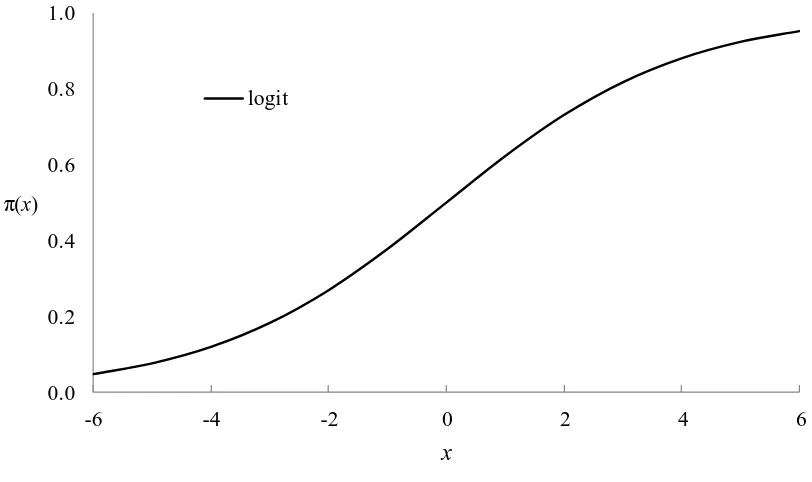
x is graphed as a function of x, a sigmoidal curve is produced that is symmetric about 0.5 . An example is shown in Figure 2.1. In the binary case, thisproperty allows for the code designation of one of the outcomes as a success and the other as a
0.0 0.2 0.4 0.6 0.8 1.0
-6 -4 -2 0 2 4 6
π(x)
x
[image:31.595.122.528.69.310.2]logit
Figure 2.1 Graph of the probabilities produced by the inverse of the logit link function
as a function of
x
, where
x
~
U
(-6,6) and
η
=0.5
x
.
2.6
Non-Canonical Link Functions for Binary Outcomes
Generalized linear models with non-canonical link functions can also be used to relate outcomes
with Bernoulli distributions to a set of explanatory variables. We introduce several of these
models here, and the expressions necessary for the development of a goodness-of-fit test
statistic for non-canonical binary GLM presented in Chapter 5. In the previous section, the
|
E Y x under the canonical logistic model was expressed as
x . When the link function is non-canonical, we will instead designate E Y
|x
generally as G
x . When referring to the specific non-canonical probit, log-log, complementary log-log, and log models, we will replacethe subscript and denote the probabilities as Pr
x , LL
x , Cll
x , and LB
x respectively.2.6.1
Probit
The probit model is a GLM with the non-canonical link function
1
Pr Pr Pr
x x
where is the cumulative normal distribution, expressed as
21 1
exp 2 2
v dv v dv
(2.31)Here, 3.1415..., and
is the probability density function of the standard normaldistribution (Hardin, et al. 2007).
The inverse of the link function giving E Y
|x
is
1
Pr Pr
x
g (2.32)
The canonical parameter under the probit model is
Pr Pr
ln 1 ln 1
x x (2.33)
and its derivative with respect to is
ln 1
(2.34)
Like the logistic model, the probit model is symmetrical around a mean probability of 0.5, and
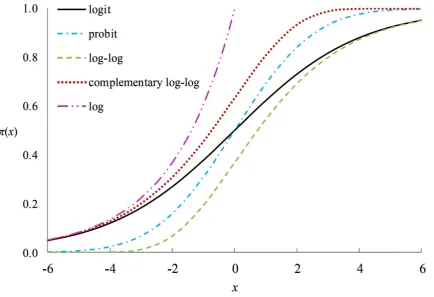
has a similar sigmoidal shape. An example when the inverse of the probit link for a univariate
model, E Y x
|
, is plotted against x is shown in Figure 2.2.2.6.2
Log-log and Complementary Log-log
If the binary data to be analysed are unbalanced, that is, the number of 0s and 1s are unequal,
then either the log-log model or the complementary log-log model may be a better fit. If there
are many more 0s than 1s, then the log-log model may be the more appropriate model, whereas
if there are many more 1s than 0s, then the complementary log-log model may give a better fit
to the data. The E Y
|x
for these models is denoted here as LL
x and Cll
x respectively. The link functions for the log-log and complementary log-log models are
LL ln
ln
LL
x
g (2.35)
Cll ln
ln 1
Cll
x
g (2.36)
respectively. The corresponding inverses of these link functions are
1
exp exp LL
LL x g (2.37) and
1 1 exp exp
Cll Cll x g (2.38)
The canonical parameters under the log-log and complementary log-log models are
ln 1 LL LL x x (2.39)and
ln 1 Cll Cll x x (2.40)respectively. Their derivatives with respect to are
ln LL 1 LL x x
ln 1 LL LL x x (2.41) and
ln Cll 1 Cll x x
ln 1 CllCll
x
x (2.42)
respectively.
These models produce asymmetric sigmoidal curves. The log-log curve has an elongated lower
the inverse of the log-log and the complementary log-log links for a univariate model, E Y x
|
, as a function of x are shown in Figure 2.2.Because of the inherent asymmetry of these models, the coding of the model is not symmetric.
That is, the assignment of “success” and “failure” cannot be simply reversed (with just a sign
change). However the log-log and the complementary log-log make a complementary pair. That
is, the log-log model applied to outcomes y will give the same result as the complementary log-log model applied to 1y. Similarly, if the log-log is applied to 1 y, then the same result is obtained when the complementary log-log is applied to y.
2.6.3
Log Binomial
Another non-canonical GLM for binary data is the log model, also known as the log binomial
model. The E Y
|x
for the log binomial model will be denoted here as LB
x . The link function for the log binomial model is the natural log function, and is expressed as,
LB
ln
LB
LB
x x
g (2.43)
The inverse of the link function is
1
exp LB
LB
x
g (2.44)
The canonical parameter under the log binomial model is
ln LB 1 LB x x (2.45)
and its derivative with respect to is
ln LB 1 LB
x x
1 1 LB
x (2.46)
greater than 1. An example of the graph of the inverse of the log link for a univariate model as a
[image:35.595.118.553.119.416.2]function of x is shown in Figure 2.2.
Figure 2.2 A graph of the probabilities produced by the inverse of five link functions as
a function of
x
. (
x
~
U
(-6,6) and
η
=0.5
x
)
2.7
Basic Concepts of Score Tests
Some goodness-of-fit tests are formed as score tests. The score test statistic was introduced by
Rao (1948), and is based on the identities (2.5) and (2.6) (Smyth 2003). Suppose that the
likelihood function of a GLM, (2.4), depends on two vectors of parameters, and express this as
, |
l β γ y . The null hypothesis being tested is that γ 0, against the alternative hypothesis that γ is unrestricted. Here, the β are considered nuisance parameters, while the γ are considered the parameters of interest. The column vector of scores can be partitioned as
,
β γ
S S S (2.46)
l
β
S
β (2.46)
and
l
γ
S
γ (2.46)
The covariance matrix of the score vector (2.46) is the expected information matrix, I, with general elements as in (2.14). It can be partitioned to conform with (2.46) and (2.46), and
expressed as
ββ βγ
γβ γγ
I I
I
I I (2.47)
(Graybill 1976, McCullagh, et al. 1989). If the values of the nuisance parameters, β, are known, then the score test statistic, evaluated under the null hypothesis, is
1
γ γγ γ
γ 0
S I S (2.47)
(Smyth 2003). In this case, the score test statistic has a chi-squared distribution with degrees of
freedom equal to the rank of Iγγ(Rao 2002).
If the nuisance parameters are not known, then the maximum likelihood estimates under the null
hypothesis, ˆβ, are substituted. Using the multivariate theory on inverses (Graybill 1976, McCullagh, et al. 1989), the covariance matrix, conditional on β = βˆ0, is
1 ˆ
|
γγ γβ ββ βγ γ β
I I I I I (2.48)
(McCullagh, et al. 1989, Smyth 2003).
The score test statistic in this case is calculated as
1 ˆ| ˆ
,
γ γ β γ
γ 0 β β
where all of the terms of the statistic are evaluated under the null hypothesis γ 0 , and under ˆ
β β. Here, the score test statistic has a distribution that is asymptotically chi-squared with degrees of freedom equal to the rank of Iγ β|ˆ(Rao 2002) . If Iβγ 0, then β and γ are
Chapter 3
Literature Review
3.1
Goodness-of-Fit Statistics for Binary Logistic Regression
Models
After selecting the explanatory variables to include in a binary logistic regression model and
determining an appropriate mathematical function that best describes an “average” value of the
outcome variable for the given covariate values, a critical next step in model development is to
examine whether the predicted probabilities calculated from the chosen model and covariates
are significantly different from the observed outcome values. That is, does the model fit the
observed outcome data well? Goodness-of-fit statistics are used to test the hypothesis that the
distribution function of the observed outcome variable is the same as the distribution function of
the hypothesized model (Kendall, et al. 1999). Two types of goodness-of-fit tests, specific and
global, are used to test this null hypothesis (Kuss 2002). The specific test is used to test the null
against the alternative that that another specific model would fit the data better. The global test
does not evaluate a specific alternative, but rather tests against the alternative that the model
does not fit, without specifying in what way the fit may be poor. The focus of this thesis is on
global GOF tests. Two well-known global test statistics used to assess the fit of binary logistic
regression models are the deviance and the Pearson’s chi-square.
3.1.1
Deviance
The deviance is a likelihood ratio test that compares the fits of two models to the observed data;
the first is the null model which is under consideration, and the second is a saturated model in
which the null model is nested. The saturated model includes a parameter for each of the J
covariate patterns. The hypothesis being tested is that all parameters of the saturated model that
are not in the working model are equal to zero. In this section we will refer generally to the
estimated probabilities of the binary model as ˆ , for ease of notation. The deviance residual