
Facial Makeup Detection Using HSV Color Space and
Texture Analysis
Shiva Varshovi
A Thesis
In
The Department
Of
Computer Science and Software Engineering
Presented is Partial Fulfillment of the Requirements
For the Degree of Master of Computer Science at
Concordia University
Montreal, Quebec, Canada
September 2012
Concordia University
School of Graduate Studies
This is to certify that the thesis prepared
By: Shiva Varshovi
Entitled: Facial Makeup Detection Using HSV Color Space and Texture Analysis
and submitted in partial fulfillment of the requirements for the degree of
Masters of Computer Science
complies with the regulations of the University and meets the accepted standards with respect to originality and quality.
Signed by the final examining committee:
______________________________________________________________Chair Dr. Nikolaos Tsantalis __________________________________________________________Examiner Dr. Olga Ormandjieva __________________________________________________________Examiner Dr. Leila Kosseim _________________________________________________________Supervisor Dr. Ching Y. Suen Approved by __________________________________________________________________ Chair of Department or Graduate Program Director
__________________________________________________________________ Dr. Robin A.L. Drew, Dean
Faculty of Engineering and Computer Science
III
ABSTRACT
Facial Makeup Detection Using HSV Color Space and Texture Analysis
Shiva Varshovi
In recent decades, 2D and 3D face analyses in digital systems have become increasingly important because of their vast applications in security systems or any digital systems that interact with humans. In fact the human face expresses many of the individual’s characteristics such as gender, ethnicity, emotion, age, beauty and health. Makeup is one of the common techniques used by people to alter the appearance of their faces. Analyzing face beauty by computer is essential to aestheticians and computer scientists. The objective of this research is to detect makeup on images of human faces by image processing and pattern recognition techniques. Detecting changes of face, caused by cosmetics such as eye-shadow, lipstick and liquid foundation, are the targets of this study. Having a proper facial database that consists of the information related to makeup is necessary. Collecting the first facial makeup database was a valuable achievement for this research. This database consists of almost 1290 frontal pictures from 21 individuals before and after makeup. Along with the images, meta data such as ethnicity, country of origin, smoking habits, drinking habits, age, and job is provided. The uniqueness of this database stems from, first being the only database that has images of women both before and after makeup, and second because of having light-source from different angles as well as its meta data collected during the process.
Selecting the best features that lead to the best classification result is a challenging issue, since any variation in the head pose, lighting conditions and face orientation can add complexity to a proper evaluation of whether any makeup has been applied or not. In addition, the similarity of cosmetic’s color to the skin color adds another level of difficulty. In this effort, by choosing the best possible features, related to edge information, color specification and texture characteristics this problem was addressed.
IV
Because hue and saturation and intensity can be studied separately in HSV (Hue, Saturation, and Value) color space, it is selected for this application.
The proposed technique is tested on 120 selected images from our new database. A supervised learning model called SVM (Support Vector Machine) classifier is used and the accuracy obtained is 90.62% for eye-shadow detection, 93.33% for lip-stick and 52.5% for liquid foundation detection respectively. A main highlight of this technique is to specify where makeup has been applied on the face, which can be used to identify the proper makeup style for the individual. This application will be a great improvement in the aesthetic field, through which aestheticians can facilitate their work by identifying the type of makeup appropriate for each person and giving the proper suggestions to the person involved by reducing the number of trials.
V
ACKNOWLEDGMENTS
Completing my master’s thesis was a unique opportunity in my life that perhaps will never repeat again. However the achievements in these two years will affect definitely my whole life. This acknowledgment is the least possible way I can thank the many people who made this thesis possible.
Foremost, I would like to express my sincere gratitude to my supervisor Prof. Ching Y. Suen for the continuous support of my master’s study and research, for his patience, motivation, enthusiasm, and immense knowledge. He supported me to follow my passion in a wonderful university. His guidance helped me in all the time of research and writing of this thesis. I could not have imagined having a better advisor and mentor for my studies.
Special thanks to my committee, for their encouragement, insightful comments, and hard questions.
Besides my supervisor, I would like to thank Mr. Nicola Nobile who was a great help through the long and tedious process of photo shooting, preparing the forms and collecting all the 2700 images from the participants. Without his time and effort gathering this big database was impossible.
VI
DEDICATION
This thesis is dedicated to:
My father, who taught me how to be strong against hardships… My mother, who taught me how to follow my dreams…
VII
Contents
Concordia University ... 2 ABSTRACT ... III ACKNOWLEDGMENTS ... V DEDICATION ... VI List of Figures ... XI List of Tables ... XV 1. Introduction ... 1 1.1. Preface ... 1 1.2. Problem Statement ... 3 1.3. Applications ... 4 1.4. Thesis Organization... 52. Definitions and Related Works... 6
2.1. Human Face... 6
2.2. Beauty... 14
2.2.1. History of beauty... 15
2.2.2. Mathematical Rules of Beauty ... 17
2.2.2.1. Vitruvian Man ... 17
2.2.2.2. Golden Proportions ... 18
2.2.3. Computer-based beauty analysis... 20
2.2.3.1. Symmetry ... 22
2.2.3.2. Averageness ... 23
2.3. Make-up ... 25
2.3.1. Makeup Techniques ... 26
VIII
3. Facial Makeup Database ... 32
3.1. Published Facial Databases ... 33
3.2. Collected New Facial Makeup Database ... 35
3.2.1. Participants ... 39 3.2.2. Meta Data ... 40 3.2.3. Makeup ... 40 3.2.3.1. Eye Makeup ... 40 3.2.3.2. Lip Makeup ... 45 3.2.3.3. Face-Skin Cover up ... 46
4. Facial Feature Extraction ... 48
4.1. Preparing inputs... 50
4.2. Landmark Detection ... 50
4.2.1. Previous Works ... 51
4.2.2. Suitable Landmarks ... 52
4.2.3. Active shape model ... 53
4.2.4. Shapes ... 54
4.2.5. Aligning shapes ... 55
4.2.6. Profile Model ... 56
4.2.7. ASM search algorithm ... 57
4.2.8. Fitting a Model to New Points ... 59
4.2.9. Results ... 60 4.3. Pre-processing ... 60 4.3.1. Face Alignment ... 61 4.3.2. Color Enhancement ... 61 4.4. Color Identification ... 62 4.4.1. Definition of Color ... 63
IX
4.4.2. Color Spaces ... 65
4.4.2.1. RGB Color Space ... 65
4.4.2.2. HSV Color Model ... 67
4.4.2.3. The CMY and CMYK color models ... 68
4.4.2.4. Computing HSV from RGB ... 69 4.4.3. Color features ... 69 4.4.3.1. Color histogram ... 70 4.4.3.2. Color distance ... 72 4.4.3.3. Non-skin colors ... 74 4.5. Texture Analysis ... 76 4.5.1. Wrinkle Density ... 76 4.5.2. Wrinkle Depth ... 76 4.5.3. Gabor Wavelet ... 77
5. Implementation and Results ... 80
5.1. Landmark detection subsystem ... 83
5.2. Eye-shadow detection subsystem ... 87
5.2.1. Feature Selection ... 87
5.2.1.1. Color adjustment ... 88
5.2.1.2. Invalid eye skin color ratio ... 88
5.2.1.3. Eye’s sclera detection ... 92
5.2.1.4. Edge density and edge depth ... 94
5.2.2. Classification... 97
5.2.3. Results ... 98
5.3. Lipstick detection subsystem ... 100
5.3.1. Feature Selection ... 100
5.3.1.1. Edge density and edge depth ... 100
5.3.1.2. Lip Color Distance ... 101
X
5.3.3. Results ... 102
5.4. Face-foundation Detection Subsystem ... 103
5.4.1. Classification... 104
5.4.2. Results ... 104
6. Conclusions and Future Work ... 106
6.1. Database ... 107
6.2. Methodology ... 108
6.3. Summary of Results ... 109
6.4. Future work ... 110
XI
List of Figures
Figure 2-1 Age progression from childhood to adulthood [5] ... 7
Figure 2-2 The effect of life style on identical twins ... 9
Figure 2-3 Sample pictures used for age estimation survey from FG-NET database ... 10
Figure 2-4 Sample images from MIT facial expression ... 12
Figure 2-5 Skull of male and female ... 14
Figure 2-6 Leonardo da Vinci’s male head in profile with proportions, c. 1490 ... 17
Figure 2-7 Human head proportions ... 18
Figure 2-8 Marquardt Beauty Mask ... 18
Figure 2-9 Stephen Marquardt’s beauty mask applied to attractive women from different nations ... 20
Figure 2-10 Effects of symmetry: Right) the original; Middle) right symmetry and Left) left symmetry[1]... 22
Figure 2-11 Averaging faces [1] ... 23
Figure 2-12 Comparing attractiveness in average faces ... 24
Figure 2-13 A lady wiping her face, Relief of unknown provenance; 11th Dynasty ... 25
Figure 2-14 Japanese traditional make-up ... 26
Figure 2-15 Fashion Makeup ... 27
Figure 2-16 Theatrical makeup, before and after... 28
Figure 2-17 Example-based cosmetic transfer. A and A* are the “before-and-after” makeup images of an woman of Asian descent. B is an image of a woman of European descent. B* is our result, after transferring the cosmetic style depicted in A*. ... 30
Figure 2-18 Alcohol consumption: (a) original image (b) synthesized image (c) real image after alcohol consumption ... 30
Figure 3-1 Sample images from the database of before and after makeup ... 35
Figure 3-2 Images of one participant before makeup and with indoor lighting from different spot light directions ... 35
Figure 3-3 Photos of one participant before makeup and without indoor lighting from different spot light directions ... 37
XII
Figure 3-5 Wide set eyes and the appropriate makeup [39] ... 41
Figure 3-6 Close set eyes and the appropriate makeup [39] ... 42
Figure 3-7 Deep set eyes and the appropriate makeup [39]... 43
Figure 3-8 Hooded set eyes and the appropriate makeup [39] ... 43
Figure 3-9 Asian eyes ... 44
Figure 3-10 Small eyes and the appropriate makeup [39] ... 44
Figure 3-11 Prominent eyes and the appropriate makeup [39] ... 45
Figure 3-12 Covering face skin defects by liquid foundation and powder (before and after) ... 46
Figure 4-1 Common targets of makeup ... 49
Figure 4-2 Facial landmarks ... 51
Figure 4-3 Putting shape coordinates in a vector; Left) a simple shape and Right) the points’ coordination in a vector ... 53
Figure 4-4 An example of one-dimensional profile ... 57
Figure 4-5 Searching for best profile with +/- 2pixel offset ... 58
Figure 4-6 Histogram Equalization: Left)Source imag and Right) Result after histogram equalization ... 61
Figure 4-7 Energy Spectrum ... 63
Figure 4-8 Additive and subtractive color mixing ... 64
Figure 4-9 RGB Cube ... 65
Figure 4-10 RGB Color Cube Model... 66
Figure 4-11 HSV Color Model ... 67
Figure 4-12 The different representation of colors: (a) RGB image, (b) hue; (c): saturation and (d) intensity [52] ... 68
Figure 4-13 Sample of skin patch ... 70
Figure 4-14 Histogram of R, G and B component of an image ... 71
Figure 4-15 Histogram of hue component in HSV model ... 72
Figure 4-16 Effect of shadow on skin color: Left) One spot light and Right) Indoor light and one spot light ... 74
XIII
Figure 4-18 Results of Sobel edge detector on face, before and after makeup: a)the image without makeup; b) the image with makeup c) Result of Sobel on image (a) and d) Result
of Sobel on image (b) ... 77
Figure 5-1 Land mark detection: a) Face with landmarks and b) Face with landmarks and their numbers ... 81
Figure 5-2 Starting Search ... 86
Figure 5-3 Result of landmark detection on images with and without makeup ... 86
Figure 5-4 Eye's Features ... 87
Figure 5-5 Two samples of eye area: (a) with makeup and (b) without makeup ... 87
Figure 5-6 histogram equalization on eyes: Left) the source image and Right) the result of applying the histogram equalization ... 88
Figure 5-7 Skin Sample ... 89
Figure 5-8- Classifying skin-color and non skin-color on image without makeup: a) original image; b) detecting non-skin color and c) detecting non skin-color with threshold ... 90
Figure 5-9 Classifying skin-color and non skin-color on image: a) original image; b) Detecting non-skin color and c) detecting non skin-color with threshold ... 91
Figure 5-10 Detecting non-skin color ... 91
Figure 5-11 Two samples from the result of contouring ... 93
Figure 5-12 contour detection for sclera: (a) source image b) landmarks detected on image (a); c) image (a) covered by landmarks; d) founded contours on (c) and e) contour filled on image (d) ... 94
Figure 5-13 Edge density on face: a) photo with no makeup; b) applying edge detector on image (a); c) photo with makeup and d) applying edge detector on image (c) ... 95
Figure 5-14 Applying Sobel Edge detection on contrasted image: a) the source and b) the result of applying Sobel edge detector on (a) ... 96
Figure 5-15 Edge density: left) Original image; middle) Contrast added to original image and right) result of edge detector on middle image ... 97
Figure 5-16 Two samples of closed eyes from the database that cause wrong detection . 99 Figure 5-17 Edge density on lips: a) photo with no makeup; b) applying edge detector on image (a); c) photo (a) with makeup and d) applying edge detector on image (c) ... 100
XIV
XV
List of Tables
Table 2-1 Comparison of the MAE for Each Survey Participant ... 11
Table 2-2 Error Rate for Each Photo (Error Rate: Difference between Average of Estimated Ages and real age for each image) ... 11
Table 3-1 Public facial databases [38] ... 33
Table 3-2 Participant's information from Makeup database ... 39
Table 5-1 Alignment of landmarks: a) the initial data without any modification; b) the translated images to the center of gravity; c) shapes rotated and scaled to unit size and d) training set aligned to the second mean shape ... 82
Table 5-2 Different shape models obtained in the training phase ... 85
Table 5-3 Comparing edge depth and edge desnity obtained from Sobel edge detector .. 95
Table 5-4 Results of Eye-shadow detection with SVM classifier ... 98
Table 5-5 Result of eliminating features in eye-shadow detection ... 99
Table 5-6 Euclidean Distance between lip color and skin color ... 101
Table 5-7 Results of Lip-stick detection with SVM classifier ... 102
Table 5-8 Result of eliminating features in lip-stick detection ... 103
1
Chapter 1
1.
Introduction
1.1.
Preface
2D and 3D human face images have been under intense study in the past these decades, moreover it is a main research area in pattern analysis and computer vision. Human face expresses vast information about the person such as: identity, gender, ethnicity, emotional status, skin color, and age and health state. Retrieving such information is helpful in computer systems and medical software. Related research covers these main topics: analyzing human expression and human attractiveness. Simulating human expression for animation characters, inferring human expression are some of the applications of human face expression analysis. The latter challenging issue has been controversial for many centuries, since there is not a defined rule and measure for beauty. Discovering beauty
2
standards can improve many scientific areas such as: human science, plastic surgery and orthodontics[1].
Aside from the importance of defining beauty, today’s modern world demands beauty in digital world. This encourages producers or conversely consumers require producers to create more visually attractive products. We love our Operating System to be fancy with a lot of nice animations, websites are also getting more beautiful with creative styles, and online community websites are another example of products that needs to be attractive to catch the attention of users. This is an unending competition which not only comprises the objects and products but also our own body. Superstars would be ignored if they are not beautiful anymore or if they are not according to beauty standards. Journals, TVs and internets are full of retouched photos of superstars; usually their faces wear heavy makeup but beside that many enhancement techniques would be applied on the photo to improve them, such as smoothing skin, removing acne and spots, lengthening the neck, changing the eye size and so on.
With all these changes to human face in digital images and videos it has become necessary to identify them for security reasons. Criminals apply some extent of makeup to hide their real faces, if computers can distinguish and recognize such changes it would be easier for police to arrest them.
For women it would be so exciting to know whether the type of makeup they have would propel to beauty standards or not. This application would be so helpful for aesthetic specialists in order to facilitate their work. Moreover by identifying the type of makeup, the proper suggestions could be given to the person involved.
The aim of this thesis is to find whether the person has makeup or not and also the locations of makeup. Since there is no public facial makeup database it is essential to create a facial database of women before and after makeup. Collecting a database was the most time consuming part in this research because of the difficulties of finding people eager to participate, moreover the variation of face type and nationalities makes the makeup part a little complicated. After collecting the database, the face landmarks should
3
be detected. This is an important step in face analysis, since any misrecognition of landmarks can deteriorate the result dramatically.
In methodology suitable features and techniques will be introduced in order to use them in the appropriate classifier. There are only two classes for the classifier it is whether zero or one, which means no-makeup and with makeup respectively. In the last chapter of this thesis the results and future works will be discussed.
1.2.
Problem Statement
In face analysis area all the researches (although not many) about the makeup on face, focus on applying makeup on face photos. For instance, Brand and Pletscher[2] worked on retouching an image and removing flaws, moles and ance from face. Other related research is to transfer makeup from one image to another image. Tong et al, developed Example-Based Cosmetic Transfer that learns how the face changes before and after makeup,[3]. But none of these researches specify whether the facial image has makeup or not. The need for detecting makeup and locating it in order to benefit in many applications was the motivation to do this research.
The main issues that are addressed in this thesis: 1. Detecting makeup on different areas of the face:
Since the makeup can be applied on different parts of the face, each part of the face such as eyes, lips and skin are studied separately.
2. Lack of facial makeup database:
It is important to create an appropriate database for any classification technique. In digital makeup detection, this is the first step in this research, because there is no other database or result available to compare with. Although many published facial databases are for public use, none of them is specifically designed for makeup detection purposes. The collected database for this technique consists of
4
digital photos before and after makeup of 21 women. It is also provided with some meta data about the participants.
3. Detecting landmarks on the new database:
Most of the public facial databases are provided with landmarks of face. This was also an issue for the new database. The Active Shape Models (ASM) methodology was used to detect the critical points of the face. Finally, it was necessary to validate the landmarks and store them in a CSV file format for future use.
1.3.
Applications
Detecting makeup of digital faces has the following applications:
- It helps makeup artists to find the best type of makeup for the person. A main highlight of this technique is to specify where makeup has been applied on the face, which can be used to identify the proper makeup style for the individual. This application will be a great improvement in the aesthetic field, through which aestheticians can facilitate their work by identifying the type of makeup appropriate for each person and giving the proper suggestions to the person involved by reducing the number of trials.
- It can be used for identification in security systems. Criminals apply some extent of makeup to hide their real faces, if computers can distinguish and recognize such changes it would be easier for police to arrest them. This can be used in airports along with their identification system.
Moreover for conducting this research a face database is collected that can be used in other areas of research such as, age estimation, age-makeup relations and effect and race detection.
5
1.4.
Thesis Organization
This thesis is organized as follows:- Chapter 2 describes the definitions of beauty and the history of applying makeup. It also describes the different parts of the human face and their related definitions. The makeup techniques that are used when creating database, is also explained. Finally, the related computer-based works both in beauty and makeup for digital photos is described.
- Chapter 3 introduces the new collected facial makeup database. It compares the different public facial database available to use as well.
- Chapter 4 discusses the methodology to extract features from the face. Pre-processing and landmark detection is described first and then explains two categories of features, color and texture used for classification.
- Chapter 5 is about the implementation and the results of the three subsystems (eyes, lips and skin). The weaknesses and the strengths of each part are discussed as well.
- Chapter 6 gives the conclusions about the methodology. The future works are the final part of this thesis.
6
Chapter 2
2.
Definitions and Related Works
2.1.
Human Face
Human face conveys a great deal of information about the person’s emotions, life style and background. For humans, face perception is an autonomous complex process done by the brain, however for machines to be able to process the face and extract information, complicated algorithms are needed. In this section some of the face characteristics will be discussed.
Identity
As of today, it is estimated 7.025 billion people live on earth and surprisingly their face is almost unique, even the twin brothers and sisters are not completely identical.
7
Nevertheless for many security systems having only identical face is not good enough, at the present time other information are necessary for identification such as iris and finger print. However still face photo is an indispensible part in identification documents such as passport and driving license.
Face identification is an important and challenging topic in machine vision area. It has many applications but the most critical is identifying criminals and terrorists in public places. In 2010 Margarita et al introduced a secure system for computation of face identification. Their approach, by saving the confidentially of both the client and the database of photos, searches the clients’ photo among stored photos of available photos. The obtained result reveals that face identification can be efficient even in real-time processing [4].
Age
Aging is a natural and gradual process that never stops. This undesirable process causes different alteration on the human face, Figure 2-1.
Figure 2-1 Age progression from childhood to adulthood [5]
As it can be seen from the Figure 2-1 human face age-progression has two main changes: from childhood to pre-adulthood and from adulthood to end. Therefore for people with ages ranging from 1 to 25 the following changes could be seen [6]:
- At the age of 1 the head is very rounded, the bridge of the nose is flattened, the eyes look large and rounded and the hair is soft and fine.
- Gradually the cranium expands, the eyes elongate and become less rounded - The bridge of the nose continues to grow up, its lower cartilages becomes
8
- The face continues to elongate as the nose length and the chin length increase - The pattern of the hair becomes established, it is less fine and the color
darkens.
- The forehead becomes less prominent
- The mouth grows to accommodate the permanent teeth - The squarish form of the chin becomes obvious
- The cheek bones become prominent - The ears will no longer be oversized
- The teeth do not seem so oversized for the face
- The mandible continues to square and form and looks more masculine and mature
And for people older than 30 the following effect are observed: - Deepening traverse lines across the forehead
- Deepening glabellar vertical lines
- Formation of nasal lines across the top of the nose - The jaw lines become less firm
- Formation of neck lines
- Jowls and a double chin may appear - The tissues under the neck sag
- The ears get larger and wrinkles appear in front of the tragus
- The lips continue to thin (especially in people with thin lips in youth) - The dental changes may become apparent , increasing lines accordingly To estimate the age exactly the machine must completely classify the changes in each age although some might appear sooner and some later because of many factors such as race and gender. Usually females of the same race look older than the males.
9
Figure 2-2 The effect of life style on identical twins1
Although aging is a natural process on our body, some habits can expedite and some can delay the process. Figure 2-2 shows the effect of different life style, the person on right averaged a pack and a half of cigarettes every day for sixteen years; she has also been exposed to sunlight very often, however the woman on left never smoked and avoided sunlight. Many parameters are involved in this complicated process such as [6]:
- genetics (Asians, Europeans) - exposure to sunlight
- smoking
- consumption of alcoholic drinks - nutrition
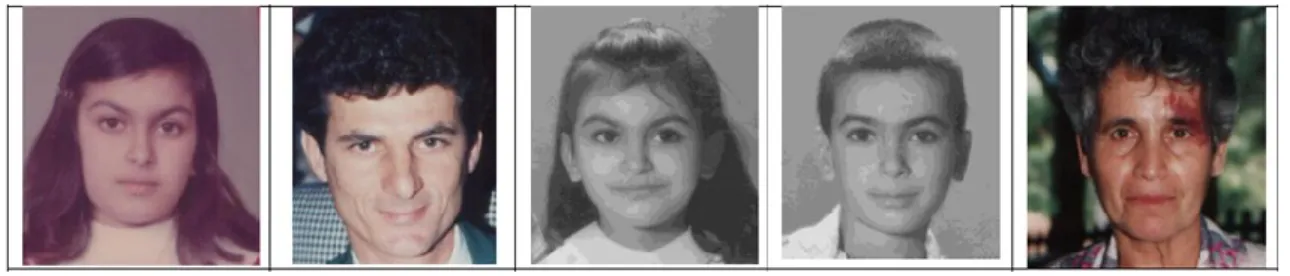
Computer scientists are now researching on how to estimate people’s age. For this report a survey is done to see how accurate people can guess the age of others. Thirty participants were asked to guess the age of the people in each image. This survey consists
10
of 25 images (different ages, nationalities, colour and greyscale) from FG-NET database [7]. Some of those images were for one individual at different ages, Figure 2-3.
Figure 2-3 Sample pictures used for age estimation survey from FG-NET database
Table 2-1 and Table 2-2 reveal important information about the human’s ability in estimating the age of others only by one photo. The following conclusions are obtained from this survey.
11
Table 2-1 Comparison of the MAE for Each Survey Participant
Table 2-2 Error Rate for Each Photo (Error Rate: Difference between Average of Estimated Ages and real age for each image)
- Computers are better than humans at estimating ages and Higher quality images yield better results (fewer errors).
12
- A 35-year-old male yielded the best result (MAE) - Error rates differed for color versus gray scale images
- Images of people in age ranging 20-40 and 60+ yielded more errors
- Extra details such as a bride’s dress and a baseball cap yielded fewer errors - Overall MAE was higher than MAE by 4.37 years on FG-NET database
Nationality
Human face reveals much information about the race of the humans. Johann Friedrich Blumenbach, naturalist, physician and anthropologist categorized human races into five categories [8]:
- the Caucasian race or white race - the Mongolian or yellow race (Asian)
- the Malayan or brown race (Pacific Islander) - the Negroid race, or black race
- the American or red race
Expression
Figure 2-4 Sample images from MIT facial expression
Expressions and emotions play an important role in our daily life, Figure 2-4. Human’s social behaviour is strongly affected by perception, interpretation and response to these signals. Peterson and Deffenbacher et al have found that individuals from the same race
13
are more accurate in interpreting the expressions and emotions. Although individuals recognise human’s expressions with no delay, reliable human-machine interface that can recognise expressions is still a challenge. Automatic expression recognition can be so beneficial while interacting with humans [9].
Gender
Gender is the behavioural, cultural, or psychological traits typically associated with one sex which can be identified from the facial features such as the width of the eyebrows, skull structure, nose size and so on. Figure 2-5 shows the skull of female and male from frontal and lateral view. Some of the differences of male face with female face are as follows:
- prominent supra-orbital (brow) , ridges (frontal bossing) resulting in deep set appearing eyes
- flatter and narrower eyebrows - slightly narrower eyes
- eyes less "wide open" (eye lids slightly closed) - slightly longer and/or wider nose
- slightly thinner lips (especially upper lip)
14
Figure 2-5 Skull of male and female
2.2.
Beauty
It is nearly impossible to clearly define beauty but it may be defined as a combination of qualities that give pleasure to the senses or to the mind. In Oxford dictionary beauty is defined as: “A combination of qualities, such as shape, color, or form, which pleases the aesthetic senses, especially the sight.” and the Renaissance artist Leon Battista Alberti defined it as: “The summation of the parts working together in such a way that nothing need to be added, taken away or altered.”[10]. The Beauty Myth, Naomi Wolf states that there is no such thing as quality called beauty that objectively and universally exists [11]. However, we cannot deny the obvious universal concern of beauty among Americans according to the existing extremely profitable industries: cosmetics and weight loss or the fact that women earn more in two professions like modeling, indicating the importance of face and body harmony. Lack of this harmony can result in losing self-esteem and isolation from society.
To define attractiveness we have to answer a few questions. Is the perception of beauty culturally independent or it is the cultural convention? The relationship between culture and human behaviour has been studied. As Cosmides, Tooby and Barkow quote: “Culture
15
is not causeless and disembodied. It is generated in rich and intricate ways by information-processing mechanisms situated in human minds. These mechanisms are, in turn, the elaborately sculpted product of the evolutionary process. Therefore, to understand the relationship between biology and culture one must first understand the architecture of our evolved psychology.”[12]. Now scientists believe that there is universality for facial movements to express emotion among nations. Likewise there is a consensus among linguists that there is a universal grammar behind all the languages. Similarly, although there are many cultural and ethnical differences in human judgment of beauty, yet there are general geometric features of face that seem pleasing to many people, therefore the hypothesis that beauty is an arbitrary cultural convention may not be true.
However many researchers who are working on human attractiveness have categorized the type of faces that are considered to be more beautiful: neonate features such as a small nose and high forehead, or mature features such as prominent cheekbones, or expressive features such as arched eyebrows [13]. We will discuss more in detail in future sections.
2.2.1. History of beauty
Human beauty is an old topic in many areas such as physiology, neuroscience and biology, but analyzing human beauty via computer is a very new topic in pattern recognition. Beauty is a controversial topic in human science. Is there any canon1 to define it? Or beauty is in the eye of the beholder? Every year people spend lots of money on enhancing their beauty by either temporary ways such as makeup or permanent ways like surgery and orthodontics. In order to have a prosperous social life they tend to have face and body harmony. According to the publications of Darwin’s Descents of Man, 1878 [14], Standards of beauty are gradually learned by children by exposing to media and culture in which they live and beauty standards are culturally specific.
1 A canon in the sphere of visual arts and aesthetics, or an aesthetic canon, is a rule for proportions, so as to
16
Many researchers like Bernstein and Mclelian [15], suggest that diverse nations have their own distinct and similar structural features that appear to be attractive despite the racial and cultural background of the viewer. Samuels & Ewy, [16], showed that babies apart from their cultures and ethnicity as young as three/six months can distinguish pictures of adult-judged attractive and unattractive faces. They prefer attractive ones. According to these two significant findings, there must be a universal stimulus dimension of faces that people of every age range cross-culturally view as attractive.
Artists, since the introduction of art, have been trying to apply some rules to have more beautiful paintings or sculptures. They look at beauty as an objective and measurable property. Defining some proportions and rules by Greek sculptor Polycleitus in the early 4th century, was the first mathematical measurement of beauty. He wrote a treatise (kanon) and designed a male nude presenting his aesthetic theories of the mathematical bases of artistic perfection. The roman architect is known for describing the facial trisection (Vitruvius trisection). His ideas were based on the classical Greek sculptors [17]. He defined the concept of symmetry (symmetria). He believed that there is a kind of symmetrical harmony and so it is with perfect building. Vitruvius also defined the proportion of head and face height to standing height, emphasizing that the ideal face can be divided vertically into three distinct facial thirds.
Renaissance artists like Leonardo da Vinci developed further theories and canons of facial proportional relationships after Vitruvius works.
In beauty there is no limitation. With every face there are a lot of challenges to improve beauty with updated techniques. Although use of makeup has a history of over 4000 years, only in last decade we see different and bizarre techniques not only to make people beautiful but also to make them different from others, techniques such as piercing, tattoos, extremely fashioned hairdressing and permanent makeup caused by surgery are examples of our modern world makeup. In fact the norms of beauty canon may vary over time due to evolution of physical decoration techniques.
17
2.2.2. Mathematical Rules of Beauty
Although the definition of beauty is controversial and it is in the eye of the beholder, for centuries, scientists and artists have tried to discover some beauty rules. In order to quantify beauty, scientists need to come up with a scientific measure of attractiveness. These measurements could be universal; characteristics that are appealing among different nations.
2.2.2.1. Vitruvian Man
“Vitruvian Man” is the world famous drawing of Leonardo da Vinci, 1487, in his treatise De Architectura[18], which is accompanied by description of ideal human body proportions with geometry described by the ancient Roman architect Vitruvius Pollio. This canon also has some description of ideal human face proportions, Figure 2-6:
- the distance from the bottom of the chin to the nose is one-third of the length of the head
- the distance from the hairline to the eyebrows is one-third of the length of the face - the length of the ear is one-third of the length of the face
18
meaning that If we take the height of the face, the distance from the bottom of the chin to the underside of the nostrils is one third of it; the nose from the underside of the nostrils to a line between the eyebrows is the same; from there to the lowest roots of the hair is also a third, comprising the forehead, Figure 2-7, [19].
Figure 2-7 Human head proportions
Some scientists believe that being in proportion and symmetry increases the attraction of people both to body and face, moreover they are considered as healthier and more beautiful.
Figure 2-8 Marquardt Beauty Mask
2.2.2.2. Golden Proportions
The Golden ratio, a number in mathematics and science, is based on Fibonacci sequence and is a geometrical proportion widely used for human form. The Golden ratio is an
19
irrational number approximately = 1.6180339887..., which is obtained by dividing a segment in two parts, a and b such that . This number is based on Fibonacci Numbers, where every number in the sequence is the sum of the previous numbers. Apart from the face, many proportions in nature are compliant with the golden ratio. The famous mathematician Luca Pacioli renamed it to ‘Divine Proportions’ [17]. Marquardt, American beauty researcher, has developed a “Beauty Mask” based on the golden proportions [20], Figure 2-8.
He believes that although nobody fits this ratio perfectly, women, especially the most attractive one, fit it the best. Surgeons found this mask credible and it fits properly on Asian and white women, but among the black skin people for non-European populations such as sub-Saharan Africans and East Asians the mask does not match well.
There have also been attempts to correlate ideal facial proportions with the Golden proportion. However, the faces of professional models have not been found always to fit the golden Proportion, and a study looking at the aesthetic improvement of patients undergoing orthogenetic surgery found that, while most subjects were considered more aesthetic after treatment than before, the proportions were equally likely to move away from, or toward, the olden Proportion.
20
Figure 2-9 Stephen Marquardt’s beauty mask applied to attractive women from different nations1
2.2.3. Computer-based beauty analysis
Most approaches for analyzing beauty are either holistic or feature based. The aim of holistic approaches like PCA (Principal Component Analysis), LDA (Linear Discriminant Analysis) and SVM (Support Vector Machines) is to perform an automatic classification algorithm that matches the human subjective ratings which is based on the number of face samples. In feature based approach, features like size and location of face elements are important. Shape, texture, symmetry and averageness are some of the features that have been used in many studies. In the following we explain some methodologies of computer-based beauty analysis.
21
In artificial intelligence and computer vision it is important to design a machine that can behave and decide like humans in recognizing and analyzing visual concepts such as object recognition, text reading, geometric feature learning, and beauty and so on. One of the most recent concepts in computer vision is beauty even though it is not a new topic in social sciences and it goes back to late 1980s, [21].
In 1990, Langlois and Roggman,[14], tried to find the answer to the question: What makes a face beautiful? Their approach to this problem was to create composite faces from digitized images of male and female faces, average them mathematically and ask people to evaluate them. This revealed that the average faces of males and females were chosen to be the most attractive picture from all, moreover, by providing more samples the average face becomes more attractive. Winkielman and Halberstadt believe that it benefits from familiarity effect [22]. They believe average faces are easier for the brain to process. When our eyes are exposed to a new face, our brain stores the picture for later use. While perceiving more faces the brain attempts to categorize them and find similarities among them, which is the basis of face prototyping. Accordingly beauty would depend on what kind of faces we see [14]. In 1991 Alley et al showed that average faces are not ideal for beauty analysis since the skin quality of averaged face is different and flaws would disappear while averaging, furthermore it is very symmetrical and the symmetry causes beauty (for more details read Symmetry on chapter 2.2.3). They stated that the most average facial appearance is not the most attractive and the aesthetic perspectives are different for men and women, males prefer juvenile facial characteristics for their female mate (Alley, 1988) and females have a preference for remarkable characteristics such as large eyes, cheekbones and chins (Cunningham et al. 1990) [23]. Facial symmetry is another concept discussed in 1994 by Grammer and Thornhill (more details about Symmetry on chapter 2.2.3) [24].
Geometric features are mostly the basis of computer science approaches, in which the exact location of landmarks is critical in the feature selection phase. The distance and ratio between these points are used with a classifier to define beauty [25]. In 2001, Arabi et al used a vector of 8 ratios between facial features b. A variant k-nearest neighbor
22
algorithm is used to relate the ratios vector to the beauty vector and the photos were rated by a panel of judges with the scores rating from zero to three (3 most beautiful and 0 least beautiful) [26]. In 2006, Eisenthal et al used other facial features such as symmetry, skin smoothness and hair color; they assessed their method on two datasets of 92 images with rating of 1-7[25].
Recently computer scientists are focusing on automatic makeup applications. The first research done is by Guo et al in 2009. In their study they apply a selected style of makeup from various examples upon a face image. In this automatic makeup application the two images are decomposed into three layers: skin structure, color and detail layer. The advantage of this approach lies in requirement for only one example image and also preserving the face structure while applying the makeup [27].
2.2.3.1. Symmetry
Figure 2-10 Effects of symmetry:
Right) the original; Middle) right symmetry and Left) left symmetry[1]
It is almost unbelievable that symmetry has influence on facial beauty. Many beautiful people have symmetrical face and vice versa. Figure 2-10 displays the effect of symmetry in a face by mirroring picture from left and right. As a result by applying image processing techniques on digital facial images, measuring asymmetry and performing artificial symmetrical on face we would have much more pleasant faces. The effect of symmetry has been studied by many researchers but the result for images with low degrees of asymmetry is controversial. New research in School of Biological Science
23
University of Liverpool links between athletic ability and look (beauty)[28]. The base of this research is to analyze the symmetry in runner’s face. They are trying to find out whether runner champions have symmetrical faces or not. In biology people with more symmetrical body are considered to be healthier1.
2.2.3.2. Averageness 2
Figure 2-11 Averaging faces [1]
There is some evidence that the more average a face looks, the more attractive it is perceived to be. Donald Symons, an anthropologist, describesthe beauty as averageness (the average values of the features of faces in a human population)[29]. Figure 2-11
describes the result of averaging two facial images. The average face obtained with this method was selected as the most beautiful picture among them. His claims are based on evolutionary biology. During periods people with the average physical properties have the most chance to survive. Langlois and Roggman in 1990[14] computerized the process of achieving the average of many human faces. They used the technique developed by Galton3 a century earlier which was done in an effort to visualize the facial characteristics
1
A video about their research in school of Biological Science University of Liverpool:
http://www.youtube.com/watch?v=laIv4Kbcz-Q&feature=related
2 Averageness is one of the characteristics of physical beauty in attractiveness studies.
3 Galton devoted many years of study on “Composite Portraits”, in which photographs of different subjects
24
that were common to a particular group of people. The composite faces obtained by the computer graphic techniques are perceived to be more attractive. One explanation for ‘Averageness Hypothesis’ is that average faces resemble more to mental representation of a typical face, therefore it is easier for the brain to process it. The same thing happens for symmetrical faces. This explanation defines a possible link between attractiveness and the ease with which faces can be processed.
(a)
Composite of 60 Faces
(b) Composite of 15 Most Attractive Faces
(c)
Hyper-Attractive Composite
Figure 2-12 Comparing attractiveness in average faces1
Prerrett et al. (1994),[30], in a classic study of facial attractiveness tested the Averageness Hypothesis. First they collected 60 frontal faces of women in similar conditions. Then the photographs were to be rated from 1 (very unattractive) to 7 (very attractive). Next, they used computer graphic methods to build composite face from the whole sample (60 samples) and a second composite face with the 15 top rated beautiful faces. Finally they created a hyper-attractive average face by exaggerating the differences of the two constructed composite faces, Figure 2-12.
statistical tools of comparing different population groups like common features among people convicted of crimes of violence.
When he showed the results to people they agreed that these composite faces tended to be more attractive than the individual faces.
25
Interesting results are obtained after asking people to rate the resulting three faces in Figure 2-12. Participants rated the hyper-attractive face as the most attractive one which is mathematically far from averageness. This finding implies that attractive faces are not necessarily average,[30].
2.3.
Make-up
Use of cosmetics and old art has a very long history that is documented almost from 10000 BC on earth. The archaeological evidences show that ancient Egypt was using cosmetics in 4000 BC. Personal appearance and cleanliness was highly regarded by the ancient Egyptians, [31]. Around 1400 BC, in the burials found with three ladies along with costly royal funerary equipment, some cleansing cream was also found. Make-up utensils usage was very popular among Egyptians, Figure 2-13, [32].
Figure 2-13 A lady wiping her face, Relief of unknown provenance; 11th Dynasty Kohl made up of lead, copper, burned almonds, soot, and other ingredients was used for thickening the eye’s outline so that they could move away the evil spirit. In Egypt everyone, males and females were free to use any kind of cosmetics, dye or cut their hair, paint their body or wear skirt. Around 3000 BC in China people painted their fingernails
26
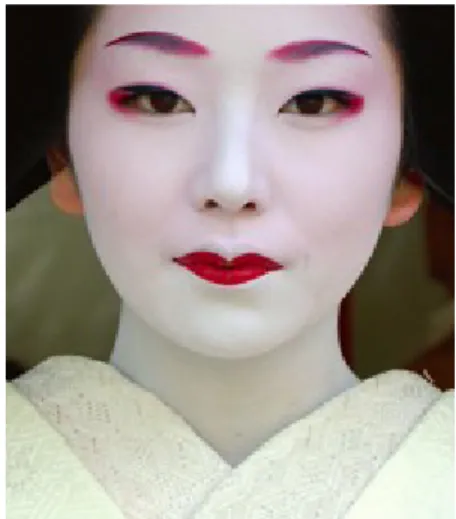
with gum Arabic, gelatine, beeswax and egg. Colors were a tool to show the social level of people. Gold and silver were colors used by Chou dynasty and dark colors such as black and red became common for loyal families. In Japan, rice powder was used by the geishas to whiten the face and the safflower powder to color the lips, eyebrows and the corner of eyes, Figure 2-14 [32]. In Europe during the middle age (5th to the 15th century) wearing makeup was believed to be immoral by Church leaders. Besides, most wealthy people did not have to work outside the houses they had white skin. Therefore, having pale skin was considered more beautiful so whitening skin by white powders
Figure 2-14 Japanese traditional make-up1
2.3.1. Makeup Techniques
Cosmetics or makeup are substances used to improve the appearance or odour of the human body. Cosmetics include skin-care creams, lotions, powders, perfumes, lipsticks, fingernail and toe nail polish, eye and facial makeup, permanent waves, colored contact lenses, hair colors, hair sprays, gels and so on. A makeup artist is the person, applying makeup and prosthetics for theatrical, television, film, fashion, magazines and other similar productions including all facets of the modeling industry. Makeup artists use various techniques depending on the application. In the following some makeup techniques will be discussed, [33].
1 Photo from :
27
Fashion Makeup
Figure 2-15 Fashion Makeup
Fashion makeup is the type of makeup required for special purposes such as magazines, video promotions and fashion runaways which are specially designed to promote a product, model or special fashion design. Since the viewer for this type of occasions are not far from the model which are exposed to many lights, delicate and careful type of makeup is needed. For this type of makeup usually a professional hair-dresser is needed,
Figure 2-15, [34].
Theatrical Makeup
Theatrical makeup or Stage makeup is a special type of makeup for dancers or actors that are on the scene. Special makeup is required for these people because of the stage light. On the stage it is important that spectators feel and see the actors facial expressions, therefore by emphasising more on the eye and lip’s colors and adding more highlights and lowlights to face more feeling could be perceived by actor’s face, Figure 2-16.
28
Figure 2-16 Theatrical makeup, before and after1
Special Effects Makeup (FX Makeup)
Special Effects Makeup is the use of special effect techniques enhancing physical features to exhibit metaphysical characteristics as well as fantasy makeup. The use of prosthetics and plaster casting are also required for projects that entail non-human appearances. Accents such as theatrical blood and ooze are also techniques applicable to this type of makeup.
Airbrushing
Airbrushing is the use of an airbrush which is a small air-operated device that sprays various media including alcohol and water-based makeup by a process of nebulization. The earliest record of this type of cosmetic application dates back to the 1925 film version of Ben-Hur, it has recently been re-popularized by the advent of HDTV and Digital Photography, wherein the camera focuses on higher depths of detail. Liquid Foundations that are high in coverage but thin in texture are applied with the airbrush for full coverage without a heavy build-up of product.
29
High Definition
This is an art which involves the use of light reflectors and ingredients such as minerals to give the skin a flawless finish. This was developed due to the further development of High Definition media and the cost implications of airbrush makeup.
Prosthetic makeup
Prosthetic makeup also called FX prosthesis is the process of using prosthetic sculpting, molding and casting techniques to create advanced cosmetic effects.
Permanent make-up
The idea of permanent makeup sounds appealing... never having to apply eyeliner, lip liner, or other penciled makeup techniques again sounds good, [35].Permanent makeup is a form of tattooing and there are dangers and consequences from tattoos that must be considered. Additionally, ‘permanent’ makeup means just that: permanent.
2.3.2. Computer-based Makeup analysis
There is not much work addressing digital face makeup. In 2007 Tong et al developed Example-Based Cosmetic Transfer that learns how the face changes before and after makeup [3]. In Figure 2-17 only the cosmetic style from the Asian woman is transferred to European woman. Skin tone and personal features such as eyebrows and eyelashes in B are preserved after the transfer. Therefore the photo before makeup and the photo of the person with the professional makeup are required to train the system. Their approach can be used to transfer the makeup from one image to another with the need for any physical makeup. This approach contains of 4 steps: 1) pre-processing, 2) cosmetic mapping, 3) appearance correction, and 4) eye transfer. In the second phase, the quotient matrix obtained by where and are the respective intensity before and after makeup. After computing the collection of all s it will be applied to the target face with the formula: where is the target face pixel. The complex part is to transfer the makeup of the eye to the target face because of the eyebrows and eyelashes.
30
Their proposed method for transferring makeup, preserves the skin tone, skin texture, facial hair color and hair density.
Figure 2-17 Example-based cosmetic transfer. A and A* are the “before-and-after” makeup images of an woman of Asian descent. B is an image of a woman of European descent. B* is
our result, after transferring the cosmetic style depicted in A*
Another approach for transferring makeup is proposed by Ojima et al. [36]. This method basically needs two images before and after makeup. They extract the haemoglobin and melanin information of the skin which they use them to apply on the new images to show the effect of tanning and alcohol consumption, see Figure 2-18. It is possible to apply the technique to convert back the skin of a 50 year-old woman to 20 year-old.
Figure 2-18 Alcohol consumption: (a) original image, (b) synthesized image and (c) real image after alcohol consumption
Guo et al. [37] introduced a method to apply digital face makeup to a picture just by having an example picture. In contrast to other approaches a “before” image is not required. The workflow consists of four main steps. First the face alignment should be done for both the example and the source image. Followed is a layer decomposition, which decomposes the faces into three layers: face structure layer, skin detain layer, and the color layer. The face structure of both source and the image will be transferred by gradient editing. The skin detail of both images is transferred in an additive way and the
31
color will be transferred by alpha blending. Finally, three resultant layers are composed together.
In Conclusion, many approaches have been proposed to identify beauty (described in section 2.2.3) and few to transfer makeup to a new picture but none of them recognizes if the individual has makeup or not. In this thesis, besides recognising the existence of makeup it detects the locations of makeup as well. The similarity of all the approaches introduced here is that they decompose the information of face to two parts: skin and texture. In the following chapter, the new collected facial makeup database will be introduced. A comparison of the available public databases will be introduced as well.
32
Chapter 3
3.
Facial Makeup Database
Appropriate database plays an essential role in classification of any machine learning or data mining task. It is needed in all the steps of image processing such as feature extraction, training and testing. Therefore it is critical to choose a database that is suitable for the application. In face recognition and face analysis applications, it is critical to have a database which covers all possible variations of the target environment, for example if the aim of an application is to recognize human faces in videos, the database should contain videos of people in different lighting (with partial of complete shadow), distances and objects in the frame.
Validation of a technique for a specific problem furthermore depends on the chosen database. Therefore while comparing the results obtained from different methods, the same database should be used. In digital makeup detection, this is the first step in this
33
research, because there is no other database or result available to compare with. Although many published facial databases are for public use, none of them is specifically designed for makeup detection purposes. In the following section some of them will be discussed.
3.1.
Published Facial Databases
Since facial analysis is of high interest in pattern recognition and machine intelligence topics, a lot of time and effort have been spent on providing facial databases. Facial databases are application-specific but sometimes the collectors of databases include more information in case in the future it is helpful for other purposes as well. Many face databases are available for public but none of them is for makeup purposes. Face recognition, gesture recognition, age estimation and age progression are some applications of such face databases. In this section some famous facial databases are introduced and finally the database collected for this research will be discussed.
Table 3-1 Public facial databases [38]
Name Color Size No.
Participants
View Description
AR Face Yes 576x768 116 frontal Different facial expressions,
illumination conditions and occlusions. No restriction on wearing makeup, scarf, sunglasses… Richard's MIT Yes 480 x 640 154 frontal profile, 3/4
CVL Yes 640 x 480 114 Frontal... profile left/right, 45
degrees left/right, frontal, frontal smile, frontal smile with teeth
Labeled Faces in the Wild
Yes 150 x 150 13,233 Un-posed Un-posed but mainly frontal
34
MUCT Yes 480 x 640 276 frontal
3-quarter
different lighting sets, manual landmarks
Yale B No 640x480 10 9 poses 9 poses x 64 illumination
conditions
Yale No 320 x 243 15 frontal center-light, w/glasses,
happy, left-light, w/no glasses, normal, right-light, sad, sleepy, surprised, wink
PIE Yes 640 x 486 68 13 poses 43 different illumination
conditions, and with 4 different expressions. UMIST No 220 x 220 20 Various angles Olivetti - Att - ORL No 92 x 112 40 frontal Japanese Female Facial Expression (JAFFE)
No 256 x 256 10 frontal 7 different emotional facial expressions
Human Scan
No 384 x 286 23 Mainly
frontal
random different photos of different people
University of Oulu Physics-Based
Yes 428 x 569 125 frontal 16 different camera calibration and illuminations
Since human face has a complex 3D structure and non-rigidity property, it would be influenced by many factors such as age, facial expression, illumination, face pose... However the algorithms are robust to such changes in photos, databases should be carefully collected under controlled conditions. Table 3-1gives an overview of published databases with the controlling factors.
35
Figure 3-1 Sample images from the database of before and after makeup
3.2.
Collected New Facial Makeup Database
In this research for the purpose of makeup detection in women’s face images, a facial database is collected from women before and after applying makeup. In a four month period looking for participants, 21 women participated. The faces are all frontal faces with white background. The images are all 2D colourful and are taken by a Canon T2i, 18MP camera. The camera was set to RAW and White balance was manual for each subject. Images were all taken under the same controlled indoor environment.
From each participant, 2 sets of images are taken, the first set is without makeup and the second set is with makeup (Figure 3-1). In each set we have two types of lighting; one type with indoor lighting and one spot light (Figure 3-2) and in the other type without indoor lighting but only a single spot light (Figure 3-2).
From each participant, 60 images before makeup (Figure 3-2 and Figure 3-3) and 60 images after makeup are captured. In order to have pictures with open eyes and not with blinking or closed eyes, two shots were taken from each situation. The dimension and the size of original image are 2074x1382 and 1.87 MB respectively. But for the research the dimension 380x480 pixels and the size 91.0 KB are used.
Figure 3-2 Images of one participant before makeup and with indoor lighting from different spot light directions
36
P0021_000_CC-MD-O-NF-N-00 P0021_002_CC-MD-O-WF-N-00
P0021_004_LL-BT-O-SL-N-00 P0021_006_LL-MD-O-SL-N-00 P0021_008_LL-TP-O-SL-N-00
P0021_010_L4-BT-O-SL-N-00 P0021_012_L4-MD-O-SL-N-00 P0021_014_L4-TP-O-SL-N-00
P0021_016_CC-BT-O-SL-N-00 P0021_018_CC-TP-O-SL-N-00
37
P0021_026_RR-BT-O-SL-N-00 P0021_028_RR-MD-O-SL-N-00 P0021_030_RR-TP-O-SL-N-00
Figure 3-3 Photos of one participant before makeup and without indoor lighting from different spot light directions
P0021_032_LL-BT-F-SL-N-00 P0021_034_LL-MD-F-SL-N-00 P0021_036_LL-TP-F-SL-N-00
P0021_038_L4-BT-F-SL-N-00 P0021_040_L4-MD-F-SL-N-00 P0021_042_L4-TP-F-SL-N-00
38
P0021_048_R4-BT-F-SL-N-00 P0021_050_R4-MD-F-SL-N-00 P0021_052_R4-TP-F-SL-N-00
P0021_054_RR-BT-F-SL-N-00 P0021_056_RR-MD-F-SL-N-00 P0021_058_RR-TP-F-SL-N-00
To facilitate the process of extracting information from the photos such as lighting direction, with/without makeup, with/without flash and with/without indoor light a convention is used to name the photos.
Naming convention for the images of makeup database:
- CC=Centre, LL=Left 90 Degrees, L4=Left 45 Degrees, R4=Right 45 Degrees, RR=Right 90 Degrees
- MD=Middle, BT=Bottom, TP=Top - O=Main Lights On, F-Main Lights Off
- NF=No Flash, WF=With Flash, SL=Spotlight - N=No Makeup, Y=With Makeup
- 00-First Shot, 01=Second Shot
Figure 3-4 represents sample images from the makeup database after makeup. The name under each image explains how the naming convention is defined for them.
P0021_076_CC-BT-O-SL-Y-00 P0021_061_CC-MD-O-NF-Y-01 P0021_098_L4-BT-F-SL-Y-00
39
3.2.1. Participants
Participants mostly consisted of students and staff at Concordia University. The respondents were recruited through e-mail and posters at Concordia University. In total 21 women participated in the research.
Table 3-2 Participant's information from Makeup database
Participant Ethnicity Country Age Smoking Drinking
#0 Iranian Iran 30 No No
#1 African Ghanaian 26 No Occasionally
#2 Iranian Iran 31 No Rarely
#3 Latin American Elsalvador 31 No Socially
#4 Polish Poland 60 No Socially
#5 Iranian Iran 41 No No
#6 Iranian Iran 38 No No
#7 Latin Colombia 31 No Socially
#8 Iranian Iran 34 Occasionally Socially
#9 Iranian Iran 39 Occasionally Rarely
#10 Iranian Iran 38 No Socially
#11 Iranian Iran 60 No Rarely
#12 Iranian Iran 64 No No
#13 Iranian Iran 25 No Rarely
#14 Colombian Colombia 41 Occasionally Socially
#15 Moldovian Moldova 29 No Rarely
#16 Iranian Iran 24 No Rarely
#17 Iranian Iran 24 No Rarely
#18 Asian Chinese 23 No Rarely
#19 Asian Chinese 26 No Socially
40
As can be seen from Table 3-2 most of the participants’ ages are 20 to 40 and most of them are Iranian and Chinese.
3.2.2. Meta Data
In order to make the database useful for other applications as well, some meta data is provided along with the makeup information. This information consists of ethnicity, country, smoking habits, drinking habits, age, and job. Some information like smoking and drinking habits may be helpful for age estimation.
3.2.3. Makeup
Applying the best type of makeup for the participants was of major concern when collecting the makeup database. The type of makeup applied on the participants’ face were chosen to suite two different goals first to apply changes on the face in order to be able to study the face from the pattern recognition point of view and second to make them beautiful for study from aesthetician purposes. Although human faces share the same face features (such as eyes, eyebrows, nose and lips), the size, shape and distance of each plays an important role in beauty perceived by them. Makeup is a powerful art in covering the face defects and showing youthful and more appealing face but not every type of makeup will be pleasing in every face. Professional makeup artists are experts in choosing the best makeup style that reveals the person’s beauty. Color of cosmetics is another important factor in makeup since individuals have different colors for their skin, hair and eye. Choosing the proper color for the cosmetic highly depends on the knowledge and experience of the makeup specialist. In this section the methods and techniques to apply makeup for participants’ face will be discussed.
3.2.3.1. Eye Makeup
Eye is the most prominent feature in the face. The best makeup artists know how to make eyes more beautiful so that the whole face looks more interesting. To have beautiful eyes cosmetics like eye-liner, eye-shadow, eyebrow-shadow, mascara and curling eyelashes



![Figure 5-14 displays the result of the Sobel Edge detection on contrasted image with threshold range [60, 90]](https://thumb-us.123doks.com/thumbv2/123dok_us/9832284.2475841/111.918.168.806.109.207/figure-displays-result-sobel-edge-detection-contrasted-threshold.webp)


