COMMISSION OF THE EUROPEAN COMMUNITIES
£ ’. ' . 7 .’I'S B U R P ' C0M ^ 524 f i n a l vo1* 111 Brussels, 27 October 1976
UNIVERSITY OF PITTSBURGH
LIBRARIES
FEB 251977
SERIALS UNIT
if?
REPORT CONCERNING THE DEVELOPMENTS
IN THE DATA-PROCESSING SECTOR IN THE COMMUNITY IN RELATION TO THb WORLD SITUATION
VOLUME III
AN
COIYTMUNITIES
fis)
Szq fl:na:../z.
Yol.
rrr
t
.
COMMISSION OF
THE
EUROP
,
1i+
l\
.
il
s
coRRTcEHsr'M
REponT
cqvcgnrnvc
mE
DgyEIfpMEl['IsIT
illfE
DAT*-PRffESSII{C SMTORIS
lgE
CCN,{MT'fiIrY. Ifi
NELATIS$ EO THE WORIDSrruATItr
VOtUMg
III
uNlY'':nsrrYBol*l,tJ]t***
JUN
?
?'€?7
SSRIAL$ UNIT
HIilLIt{AN
Brrsaele
,
l.at
Febrrre*V
L977',srl?rll,
EXCHAA,oE_...^,r LTBRARU
coi,l:irssT0N
UT 'I NTJ
EI-]ROPEAN COili{UNIf INS
Brussels
,
26.1.191i
to
CORRIGENDUI'I
document
COM(76)124
final vol. III
[nglish
Ed'ition
Page
65 Par:e 105i'ii.ge IOI
r'age
121laqe
129Page
112Page
ll)
Page
118Page 1{0
Tabl.e
2.1
Table b)
'-
able
6. 2Table
d)
Tab1e
6. 19Table
?.1
Table
7.4
Table
7,7
Tabl.e 7.IO
TABLE OF CONTENTS
Page
INTRODUCTION ... ... 1
Members of the group of experts ... . 4
I. GENERAL 1. Plan of the study in terms of the structure of the sector ... .... 5
2. Increase in the applications of data-processing, impact on the economy ... ... ... 7
3. Volume of the world market ... 8
4. Growth rate ... 9
5. The position of IBM ... 10
II. HARDWARE INDUSTRY (large and medium-sized computers) 1. Sources of information ... 11
2. The major computer manufacturers ... 11
3. Economic and financial situation of the main world companies ... ... 12
4. Position regarding agreements concluded in the Community 14 5. Financing methods ... . 16
III. THE SOFTWARE AND SERVICE INDUSTRY 1. Classification ... 17
2. The world market for data processing services ... 19
3. The European market for software and services ... 22
4. The problem of legal protection for software .. ... 24
IV. THE "PERI-INFORMATIC" SUB-SECTOR 1. Definition ... 26
2. World market ... ... 27
3. The European industry, strength and weaknesses ... 28
4. Development forecasts ... 30
Page
V. IMPACT OF THE PRODUCTION OF INTEGRATED CIRCUITS ON THE DATA PROCESSING INDUSTRY
5 • Situation ... ... 33
2. Main world producers ... ... ... 34
3. IBM as a producer of semi conductors ... ... 35
4. European producers ... ... 36
5. Government aids ... ... 37
VI. NATIONAL POLICIES AND PUBLIC EXPENDITURE ON DATA-PROCESSING ! to 5, National aid ... ... 39
6. Overall estimate at Community level of the aid granted 40 7. The situation in the United’ States .... ... ... 41
8. The support policy in Japan ... ... 41
9. Public procurement and data processing ... ... 43
10. Policies in relation to competition ... ... 44
VII. THE PROBLEMS RAISED BY DATA PROCESSING IN THE SOCIAL SECTOR ! * Effects of data processing on employment ... ... 45
2. University education and vocational training ... ... 46
3. Data security and confidentiality ... ... 47
CONCLUSION ... ... 50
ANNEX
INTRODUCTION
This study was originally intended as a response to the Council's invi tation to the Commission^ in its Resolution of 15 July 197^ on a Community policy on data processing, to submit by the end of
1975
a report on deve lopments in the data processing sector in the Community in relation to the world situation.To organize the collection of information from member countries, an ad hoc expert working party (the composition is given below) was set up in March 1975* These experts, nominated by the national delegations to the Working Party of Senior Officials on Data Processing set up by the Com mission to help it in defining a sectoral policy, were requested to centralize for their own countries all the data required to provide a homogeneous consolidated basis for assessment of the present situation and the foreseeable evolution of the Community data processing industry and market.
Without going into detail (more precision will be given in the conclusions to the study), it was found that :
(a) where the information existed, it was collected and classified in different ways from one country to another, so that the compilation of data on identical bases would have involved a volume of work out of all proportion to the working party's facilities (e.g., number of computers installed in the Community);
(b) for one of the fundamental aspects of the computer industry (major computer manufacturers), bai£ic data on some of these manufacturers, European-based or otherwise, was not available for a variety of reasons
* that can easily be imagined ;
2
-c) for other aspects (e.g. software industries and services, peri-informatic sector comprising peripherals, minicomputers, terminals and other intelli gent devices), the difficulty mentioned in (a) was complicated by the fact that some Member States had no information on their own industry;
d) the data from studies of various origins in the Commission's possession often differed very greatly - if indeed they were comparable.
In view of this situation, further complicated by the reluctance of the member countries to supply certain data, the Commission staff considered it inadvisable to produce without comment a report that would be of doubtful value and at best an updating of numerous studies produced by specialist firms; they felt it more efficient to define the problem of collecting the missing data while setting out the information available.
One of the results of this study, therefore, is to demonstrate the main shortcomings in the way of information at Community level on the data processing sector; a joint effort must be made to remedy these if it is to be possible to follow the effects of a sectoral policy and review this policy as necessary.
It is striking to note, for example, that on the American market, informa tion on which is incomparably better than that on the European market, financial analysts consider that they are poorly informed by the firms,
*
especially IBM . Estimates are not sufficiently well founded and do not encourage financial circles to introduce investment plans; this situation, which also discourages companies from entering the sector or from consoli dating, is even more true for Europe.
It must therefore be stressed at once that to be viable a Commuaity programme, whether it relates to the profitability of the industry, the promotion of applications or the circulation of data throughout Europe, calls for a concerted effort to define, collect and process consolidated data giving a realistic and reliable picture of conditions on the internal and external market and their evolution with time on equivalent bases.
3
-This means that this study, reporting on the shortcomings, should not be a one-off effort, but the very first stage in a continuous project, accompanied by the necessary means to ensure that its annual updating will gradually provide an increasingly clear Community and world picture of the industrial situation in the data processing sector.
At the present time, at Commission level, only two sources are regularly produced and form a starting point :
- Statistics on Community exports and imports published each year by the SOEC and based on the NIMEXE classification^ which itself shows
inaccuracies as regards data processing (see Annex I, Table® 7)»
- The study, updated annually by the CREST Subcommittee on Statistics, on public R&D funding in the Community countries, which up to 197^-g»r« only very general information that is almost unusable as data processing appears under a single code heading together with auto mation (see Annex, Tables 6.15 a and b). Since 1975) a new classifi cation has been in use and this will allow hardware and software
costs to be separated up to a certain point.
- With regard to the Commu n i t y ’s internal production statistics, a study group has started work under the auspices of the SOEC to redefine a more suitable coding system than those currently in use (ECT, NIMEXE).
An attempt will be made to outline in conclusion the additional efforts that should be initiated in order to establish a number of economic,
tech-i
4
-MEMBERS. OF THE GROUP OF EXPERTS Germany
Mr.Bernd MURCHNER
Gesellschaft fur Mathematik und Datenverarbeitung mbH., Bonn
Belgium
Mr.DESTRAIT
Service du Premier Ministre, Fonction Publique, Bruxelles
Denmark
Mr.Holger ERIKSEN
France
Mr.GARRIGUES and Mr. PARE
Ministere de 1'Industrie, Paris
United Kingdom
Mr. STARK and Mr. McKINLAY Department of Industry, London
Ireland
Mr. James FEEHILY
Department of Industry and Commerce, Dublin
Italy
Mr. Angelo REGA
Ministero Industria, Roma
Netherlands
M roOES and M rDESSING
Ministerie van Economische Zaken, Den Haag
COMMISSION
M A. RIOTTE, DG III/D-1
M COMBET, Head of Electronic Division - JRC Ispra M PECCI-BORIANI (SOEC)
CHAPTER I
General
1. Plan of the study in terms of the structure of the sector<>
To meet the requirements of the study, the following subsectors have been distinguished despite the overlapping of activities :
- Computer manufacturers (large and medium-sized computers), Chapter II
- Software and data processing services, Chapter III
- Peri-inforaatic sector (peripherals and terminals, data preparation equipment, minicomputers), Chapter IV
- The impact of the industry producing advanced components and more particularly integrated circuits on the sector as a whole, Chapter V. - Chapter VI gives information on aid granted to the seeter in Europe
and the rest of the world.
- Chapter VII outlines the main social problems arising from the development of data processing.
The remaining work necessary to complete and update annually the present study is described in the conclusion.
- Finally, the Annex gives the main statistics that have been collected and compared.
In the field of large computers, the recent agreements setting up the CII - Honeywell Bull Group have led to the disappearance of Unidata'
(see Chapter II). The European-based manufacturers of central processors therefore comprise the firm ICL (UK), the Computer Department of Siemens (Germany) and the CII-HB Group, as Philips has transferred its large computer activities to Siemens.
The placing of peri-inforaiatic equipment in a separate subsector is justified by the growing importance of distributed data processing which will play a leading role in the future use of EDP.
5
- 6 - I
The distribution of intelligence in terminals and minicomputers will necessi tate the development of network information systems, the spread of data
preparation on the spot and the shared use of data bases.
As for software, the need to make users more independent of hardware sup pliers and to increase trade calls for effort to secure product portability whenever possible.
In the interests of users, too, the desirability of increasing efficiency iri: the use of installations, which in many cases are operated at well below
.their theoretical capacity, makes it necessary to re-examine methods of programming and data base management. *
- 7 - I
2. Increase in the applications of data processing, impact on the economy
Data processing is continuing to penetrate almost all industrial, commer cial and social activities in the industrialized countries with a market economy and all the forecasts agree that this phenomenon will continue orer the next fire years and most probably for the next decade. This trend is even more marked in Europe than in the United States as a result of the technological and industrial advance of the latter; according to some estimates /**1.?. 7 * total data processing expenditure referred to the gross national product will more than treble in the Community countries between 1970 and 1980 whereas in the United States the expected ratio is
2
.
6
.
However, the percentages themselves (from 1.5 to 3*2 % of the GNP depending on the country considered) appear to be grossly overestimated. Figures supplied by the French delegation from recent sources ** are 1.71 % in 1975 for the United States (or 1.77 % including terminals) against 3.2 % (Euroeconomics study) and 1.*f % in 1975 for France against 2.^5 %
(Euroeconomics study).
There are no precise data available on the relative position of data pro cessing compared to other sectors in the industralized countries. In
1973-7^ / I . 16 - 1.177 approximate figures put the European computer industry between aerospace and the iron and steel industry. However,judging from the estimated growth rates of the computer industry, it could draw close to the steel industry by the end of the decade and possibly even catch it up in the United States. A recent DAFSA study *** pictures the state of chaos in our countries if all computers were put out of service :
disruption of air, rail and urban transport, of banks, stock exchanges
and social security, serious disturbances in industry (automated production lines), commerce (management), postal and telecommunications services and, even more ominous, the impossibility of controlling offensive and defensive nuclear weapons.
* The figures between square brackets in the body of the text refer to the tables and information with the same reference number in the Annex. ** IDC estimates published in 01 Hebdoi Informatique of 31 May 197fc>*
*** L ’industrie de 1 ' informatique dans le monde - DAFSA study.
Collection Analyses de Secteurs Paris 2nd quarter of 1976
- 8 - I
3. Volume of the world market
To assess the volume of the data processing market, it is not enough to consider purchases from the industry, which in the United States and in Europe represent only 46-^7
%
of total expenditure by users; the remaining expenditure consists of internal costs (payroll and payroll costs,including internal software) estimated at
k0-k6 %
and purchases from other industries /""1 »3• !*
A study by Euroeconomics evaluated the world market (total expenditure) at $ 57 000 million in 1973? 55%
in the United States, 26.b %
in Europe and 7.7%
in Japan / 1.1. 7* However, if other studies are examined, this appears to be an overestimate. A recent study gives the figure of 5 500 m u.a. for Europe in 197^+ (purchases from the- 9 - I
4. Growth rate
In the Community, the average annual growth rate for the next five years is estimated at 13
°
/
°
/ ” 1«8 7 i with a maximum in France (13%)
* and substan tially greater growth in the peri-informatic (minicomputers17
peripherals
15
»5%)
and software (16 %) sectors than for computers and systems (10.5 %)• *It is true that the methods of using data processing are continuing to develop and that a real nervous system for information is becoming
established; this necessitates the development of data transmission net works and the connection of numerous users by way of terminals which come under the peri-inforaatic sector. Distributed systems could account
for up to 40
%
of the systems installed by 1985 / 1*10^71 with intelligent systems showing the highest growth rate at about 22%
per annum.In the United States, the Department of Commerce puts the annual growth rate of the sector up to
1980
at 10%
and forecasts annual deliveries totalling $ 17,100 million at that date. However, from 1974 to 1975, this rate was still estimated at 14 # ($ 11 million in 1975 against $ 9.6 million in 1974).* In the SOBEMAP study (see note p. 16) from which these percentages are drawn, the term "system*' (integrated or not but sold as a package) means a complete installation, comprising a central processing unit and all the peripherals necessary for its use;
10
-I
5* The position of IBM
In 197^, IBM was established or represented in 126 countries. It employed throughout the world
27
^000
people, 122000
of whom for the World Trade Corporation (more thankk
%). Its turnover per employee was$ kj
M o in the United States and as high as $ 70 770 in France and $7k
870
in* Federal Germany .
* *
Even in 1973, according to a study for the IMF , for each dollar of net profit after tax which the work of one American employee yielded for IBM, the company received $ 1.^7 from the work of a foreign employee.
Its world turnover in 197^, which was $ 12 700 million, was higher than that of its five main rivals taken together /~
3
*3
_7
, and its net profit outside the United States in 1975 accounted for 55,6%
of its world profits, whereas its turnover outside the United States for the sameyear was' only
5 0
,^%
of its total turnover. ***This situation may be attributed to the remarkable efficiency with which IBM has adapted its methods of management, production and marketing to all the countries outside the United States. It can also be maintained
that a freerrein is given to competition in the United States than in Europe where users are less organized and less powerful.
IBM has activities in all the branches of data processing described below. In areas such as data transmission networks, including telecommunications and satellite systems, systems development, the growing importance of the main aspects of "periinformatic equipment (IBM 32), the design and distri -bution of programs or the development of advanced electronic circuits, IBM plays a leading role in design and manufacture.
*, Source : Annual Reports.
11
-II CHAPTER II
HARDWARE INDUSTRY
(Large and medium-sized computers)
1. Sources of information
A survey carried out in 1975 by the study group responsible for collecting data in support of this report produced no useful results.
Of the fifteen companies questioned in Europe, in spite of the argu ments put forward by the experts of the group and the Commission, six did not reply and four gave very brief answers.
The Commission therefore used the companies' annual reports to prepare data given in Annex . It will be seen / 3.1, 3-2
_7
that better informa tion is available on the American industry than on the European industry, on which some global basic data is missing.2. The major .computer manufacturers
The world computer industry is still dominated by American firms; about
78
%
by value of the computers installed in the world at the end of 197^ were of American origin /~2.1_7
, while the products of European manufacturers accounted for only 5*8
%
against ^.7%
for Japanese companies. The share of IBM alone was56
followed by Honeywell with8
%
and Univac with6.5
%.
Considering that the turnover of these companies outside the United States is almost as high as that on American territory and that the proportion of declared profit is greater / ”3»3_7» it is obvious that their international activities contribute towards their success.- 12 - II
Then come the Japanese producers (in particular FUJITSU), and the British firm ICL, whose share of the world pa^k in 1974 (3.14
%)
was greater than NCR's/_
2.1J
in spite o £ a much lower turn-over / ”"3-2 7*IBM's share remains unchanged as does that of Control Data; the latter's substantial increase in "peripheral" activities has made up for a certain decline in central processors.
Honeywell regressed slightly in 1973 while Univac has declined more steadily apart from the abrupt change with the take-over of RCA.
NCR has remained steady since 1970. Only Burroughs has shown regular progress.
3. Economic and financial situation of the main world companies
*
A study now being published makes an economic analysis of twenty-one of the main world companies having a total turnover in 1974 of
$ 33
600
million; this is based on the annual reports of the companies concerned.* *
The sample does not include several .European-based companies in the sector, in particular the computer departments of the multinational companies Siemens and Philips, which limits its scope in the Community.
The analysis is based on a group of indicators (costs and charges, mana gement, growth, financing, R&D) some of which should be viewed with caution. Assuming that the values and ratios given are valid, some comments are called for :
* L'industrie de 1 ' informatique dans le monde Chapter 8 -DAFSA
** Constitution of the sample :
United States : IBM,HIS,NCR,Burroughs,Univac,CDC,DEC,Hewlett-Packard Europe : Honeywell-Bull,CII,ICL,Nixdorf,IBM-F,IBM-D,IBM-UK,
IBM-NL,IBM-I
13
-II
- Moat of the indicators * supplied give IBM a more favourable
position than its American rivals and its European rivals compared to its European subsidiaries.
- For most aspects, disregarding size, the best-placed American rival of IBM is Burroughs and the worst-placed in the sample is CDC. The favourable position of Burroughs for the future is confirmed by a number of specialized studies in the United States.
- The average growth and R&D figures for the European companies included in the sample are higher than or equal to those of the American companies; it is f the management and financing
indicators that are less favourable. It is clear in
particular that CII's current problems are reflected in this. As for IGL (like CII), the figures given do not take into account government subsidies which would reduce the indicators to very much lower values.
* The indicators used are defined in the
- 14 - II
4. Position regarding agreements concluded in the Community ,
The agreements between the companies Philips, Siemens and CII in July-1973 on the foundation of Unidata were of short duration. In 1975,
the French Government negotiated an agreement with Honeywell on the merging of the data-proceasing activities of CII and
Honeywell-Bull.
The merger covers Honeywell-Bull*s assets . . and a part of Oil's assets and does not include the Toulouse and Andelys factories, nor the peri;- informattic activities of CII which will form a separate group.
The information note from the French Ministry for Industry and Research indicates that the aims of the agreement are to give France a major and competitive computer industry by reorganizing French potential in order to establish the leading group in Europe on the basis of an international alliance that will open up the American market to it.
’i
The agreement is described as a French take-over of Honeywell-Bull and then its merger with CII. 53
%
of the capital will be held by French shareholders (against 3^%
previously for Honeywell-Bull). The new group CII-Honeywell-Bull will represent (197*0 a turnover of FF 3 500 million (32%
of the total turnover of the French computer industry) and27
%
of the installed computers, with a staff of 20 000. The X-4, X-5 program of CII will be continued, the aim being to define a line of unique compatible products.The new company will decide on its products. The budgets for the studies will be equally divided between HIS and CII-HB. The data-processing
15
-II
The financial commitment by the Trench Government is substantial : - purchase of HB shares F.F 13° million
- subsidies up to 1979 FF 1,200 million - possible capital increases
- target ->f public sector orders to a net value of
IT'
4,050 million up to 1979.If actual orders are lower than this, a proportional increase in the support could be made.
These measures are planned with a view to all government support ceasing in
1980
.A direct consequence of the new CII-HB agreement is the dissolution of Unidata. Philips has decided to leave Unidata and to transfer its large-scale computer activities to Siemens, which will result in i-edun-duncies of 2 000 to 2
500
people.The directors of Siemens have stated that the new group is not a possible partner but a massive rival and that Siemens will henceforth go it alone, but without trying to cover the full range of requirements. Its aim is to make its data-processing activities profitable by
1980
.It should be noted that Siemens recently decided not to buy the X 4 and X 5 computers of the CII series now in preparation, which means a loss of outlets for the new French group and competition at European level between similar systems, since Siemens' future computers can benefit
5. Financing methods
Three financing methods are available to users : purchase, a contract with a leasing company or rental.
For the Community countries taken together, the breakdown is as follows :
Computers
Mini and micro computers (purchase value
less than
k2
000 ua. )Peripherals
Rental 71
%
5%
7%
Purchase 22
%
60%
70%
Leasing 7
%
35%
23%
N»B» Software is almost always sold.
The rental system was of course imposed by IBM and has had to be adopted by its competitors in view of its advantages for customers. Today, it represents 75 to 80
%
of deliveries depending on the Member State concer ned, except in the United Kingdom where purchase and leasing are more developed, in particular in government departments.Purchase is the most widely developed system in American government
departments; it accounts for almost
70
%
by value of hardware procurement and the same percentage of central processors /~6.19 7*Even in the private sector, the proportion of rentals in America was
%
(in value) at the beginning of 197^ compared with 55%
in 1970. This indicates on the one hand that the American user is better able toestimate his future requirements and consequently tends to keep his hardware longer, making it more advantageous to purchase, and on the other that the leasing functionha® been taken over by independent companies, whose rented installations appear :&s purchases at manufacturer -level.
In the peri- informatic sector, there is a growing trend towards leasing at the expense of purchase. However, the leader in the mini computer field (DEC) encourages purchase.
17
-III
CHAPTER III
THE SOFTWARE AND SERVICE INDUSTRY
1. Classification
Before embarking on an analysis of the situation of the world and Community industry in these subsectors, it is essential to stress the need for a classification of these activities. They are extremely varied and the studies on them do not organize them in a uniform fashion; moreover they are not all found in all cases. The following provisional classification is proposed as a basis for discussion with a view to establishing a clas sification that will if possible be accepted at Community level so that later statistics will be more readily comparable.
It appears artificial to draw a sharp line between services and software projects which are often complementary activities of the companies. It would be better to distinguish between data processing services proper and 'environmental" services, which could be classified as follows :
A - Data processing services
- Data processing . batch processing by service bureaux
- Software systems engineering - systems and
program products (basic and
utility) applications and program products
-
18
- IIIB - Data processing environmental services - Consultancy, assistance, studies - Hardware and product maintenance
- Leasing and sale of second-hand machines - Training
- Security of installations - Performance checks
- 19 - III
2. The world market for data-processing services
The United States has the leading world industry for data processing ser-* vices, its turnover in 197^ excluding manufacturers being $ 4 000 million It is followed by Japan with
$
600 million, -France with$
530 million, Germany with $380
million and the United Kingdom with $ 270 million. Public demand in the United States accounts forkO. %
of the turnover. It has thus contributed to both the development and the evolution of this sector : the rapid growth in facilities management is due to the systematic use of this formula by Federal agencies (NASA, Department of Defense, etc.) the same may be said of remote processing, use of which by large government departments has helped to finance the appropriate basic software. This policy has been followed by the large firms in the private sector, which has helped to strengthen these trends.For this reason the large American service bureaux tend to seek a global approach involving the s e t t i n g u p of data banks, basic and applications software and communications media for the marketing of distributed data
In the short term. . ... .
processing. this trend is favourable to IBM as it has activities m all the areas mentioned. However, it remains a potential element of compe tition which could be supported and developed, particularly in Europe.
\ ' _
As for the Japanese service industry, after a difficult start owing to the shortage of qualified personnel, the absence of major national pro grammes and the supremacy of manufacturers, it has been growing very rapidly in the last three years
(60
%
per annum since 1972) thanks to the support policy adopted by the government.Under the current data processing plan (1976- 80), the Japanese Government had granted a subidy of 7 500 million-yen to the service industry. Three months after the measures to protect hardware were abolished, Japan ceased to protect software (1 April 1976), thus opening the way to completely free competition on the Japanese data processing market. This was the date of. the formation of a software company in which 17 Japanese companies participate; it will benefit from the above-mentioned subsidy to enable it to design a large-scale data base module and its program generator.
- 20 - III
One phenomenon peculiar to this industry in the countries mentioned is the existence of a captive market owing not only to the activities of the major manufacturers but also to the proportion of turnover accounted for by service bureaux with their parent company or the body which
controls them.
According to some estimates, this captive market represents 24
%
of the total market in the United States and an even higher percentage in Europe. One fact illustrates this situation well : the complaint filed under the anti-trust law by ADAPSO, the association of American service bureaux, against the banks which are said to control one quarter of the market for data processing services.At European and world level, therefore, one of the main structural problems of the services market is that it is supplied by three sources, only one of which is independent :
- the large computer manufacturers, especially IBM, which controls more than half the market for program products and remote processing, and the conditions are ripe for it to strengthen this position in the future;
- the main users (companies or bodies) which develop their own services and software and then market them either directly or through a subsi diary;
- the independents who c a n ' only strengthen their position between these two categories by advanced specialization and/or by acquiring a sufficiently large dimension.
The influence of the public sector in the main countries of the world is shown in Figure 1.15 which indicates the overwhelming role of the American Government considering the size and homogeneity of the market in the
United States. It may be observed that in Europe the public authorities in France and Britain control comparable proportions of the market
21
-III
Statistics on this sector must be regarded with caution, for the reasons that have just been outlined (uncertain definitions, captive market, activities of manufacturers and users) to which should be added, with certain exceptions, a superficial or non-existent knowledge of national activities at government level. Considerable information work must be done in the Community in order to obtain a clearer picture. *
22
-III
3. The European market for software and services
Statistics based on purchases by industry /"*1.4 7 do not give a precise idea of the market for services if account is taken of expenditure by
*
users. A very recent study gives for the main Community countries in 1975 an expenditure exceeding $ 1 800 m / ~1 . 1 2 7 and forecasts that the market will represent more than two and a half times this figure in 1980.
* *
The growth of this sector is estimated at 30 % per annum. It is expected that the proportion of batch processing by service bureaux will decline as more and more clients make use of distributed data-processing services while others procure minicomputers, which could bring the growth in these services to 40 % per annum.
The success of small machines, typical of which is the IBM 32, will be combined with the development of data-processing networks; it is predicted
(Chapter IV) that there will be a great expansion in intelligent terminals which the user can program and use in interactive mode or for remote batch processing; this type of use will be operated by the service industry.
Facilities management (turnkey services) which currently account for only a modest proportion of the market in Europe ($ 64 m in 1975 for Western Europe £l.l4)) is experiencing spectacular growth in the US / 1 . 11 7 and it is expected that the economic climate will encourage European clients to make increasing use of this type of service which is easier to control.
The development of services based on remote processing is at present restricted in Europe by the high cost and low availability of networks, together with the compartmentalization of the market caused by national frontiers.
*, Scandinavian Computer Services industries analysis 1975 - Quantum Sciences. annual
23
-III
Projections for software development /~1«14 7 predict growth equal to that of data processing services as a whole, with services having some advantage over products. As standardization is less advanced in Europe than in the United States because of the special features of national markets that are relatively small in size, the production of "tailormade1' software will probably remain one of the main activities.
However, systems engineering should gain in significance in view of the rapid growth of the market for small "turnkey" systems and the substantial
-
2b
-ill
4. The problem of legal protection for software
The studies on this subject conducted by the Commission are not recent, *
but it seems that no significant progress has been made since . The question has been under study for more than ten years in both the United States and Europe. The only real conclusion at the present time is that neither the conventional patent nor the copyright can be adapted to protect computer programs.
In the United States, after programs had been ruled to be unpatentable in 1968, the Patent Office reversed this decision the following year, but without defining the form to be used to register programs^. The Copyright Office accepts such programs for registration but as yet there has been no court decision to clarify whether they are effectively protected by the copyright law.
In the Community, only France has specifically ruled that programs are not patentable (patent law of 1968). In the other countries, programs are not patentable in principle but the granting of a patent depends largely on the way in which the application is drafted.
At international level, neither the Strasbourg ^Convention nor the
European Patent Convention provide for the patenting of programs. Apart from private contract law, the only existing protection is legislation on trade secrets and unfair competition.
In fact, the problem appears to be limited to applications programs, the operating system (monitors, supervisors, service.routines) benefits from relative automatic protection due, for certain elements, to a close depen dence on the hardware, and if precautions are taken compilers can be protected up to a certain point.
On the other hand, without legal protection application programs can easily be recopied and there is in fact constant piracy which obliges the designers of such programs to seek rapid profits; the capital cost (which can be
* Source : Internal Commission studies (DG XIII), 1972.
25
-III
very high) must be paid off in two to three years. Action is therefore necessary in this regard.
WIPO (World Intellectual Property Organization) is studying the problem; a committee of experts set up recently will study all possible forms of protection
- against unauthorized use
- against translation into another language
and will examine the questions of registration, ownership and ways of uncovering fraud. *
Even if this work has a successful outcome, the problem of the establish ment and Community harmonization of national laws would remain.
* Cf. the report of the non-governmental experts consultation group which met at Geneva in June 1974, published in the WIPO review
CHAPTER IV 26
-IV
THE "PERI-INF.ORMATIC" SUB-SECTOR
1* Definition
Given the extension of distributed computing and the fact that the industrial subsector that has recently been named "peri-informatique"
in French-speaking circles can up io a certain point
be considered distinct from the large computer industry, it seems appropriate to study it separately. A first difficulty arises in defining it. It includes :
-manufacturers of large systems, who supply complete systems including cenventd&l near-in peripherals (magnetic tape -units, discs, printers)
some of which are bought in from the OEM (Original Equipment Manu facturer^ market ;
the more specialized industry involved in the manufacture of - mini and microcomputers
- "compatible" peripherals, competing with the units incorporated in their systems by the manufacturers
- interactive terminals (keyboard and printer, keyboard and screen) or batch terminals (simple, multi-function or heavy)
- data acquisition equipment ( punches, magnetic or optical readers, industrial or banking data collection, etc.) ;
service companies who supply specialized software or who use
the above products "turnkey*1 installations (facilities management), lities management).
This section considers in particular the activities covered by (b), the other activities being commented upon as appropriate in the corresponding Chapters (Chapters II and III).
that is to say the manufacturer acquires from specialized firms complete units (for example peripherals) which he incorporates into his system when he markets it.
( a)
- 27
IV
2* World market
If the captive market is excluded, that is to say equipment sold by db
the large-computer manufactured as part of their systems , the worldwide turnover of the subsector in 1973 was, according to an
estimate of the French Ministry of Industry, 5,000 million
u,a. , and it is forecast that this figure will be quadrupled by 1980
The same source forecasts for 1978 /~4«2m j a higher percentage for Europe and Japan than in 1973*
Estimates of the growth rate vary according to different sources from 16 to 23 fo per annum in the next few yearsj it remains in any event greater than the average rate of growth estimated for the total data processing sector#
A9b
A study recently carried out for the Commission indicated that this rate will be greater for the "intelligent" systems, some 22 % per annum, and that amongst these the systems with the most rapid growth will be :
- point-of-sale terminals
- intelligent terminals based on micro-processors - multi-processor minicomputers*
Although it is difficult to evaluate this captive market some idea of it can be gained from the peripherals (tape transports, disc units) "compatible" with the IBM 360 and 370 series, for which IBM maintained 76*4 % and 78*7 1« respectively of the United States market at the end of 1972 (source : Report by the French Ambassy
-
28
-IV
The average rate of growth for "non-intelligent" systems will be around 15 fo p.a., with a more rapid growth for
- floppy discs - printers - badge readers - mass memories
Unlike large scale data processing, no marked domination of one firm can be found in the peri-informatic sub-sector taken as a whole. It appears on the contrary that the big companies haw some difficulty in mastering the situation created by the broad spectrum of products.
In each of its constituent segments, however, one or several leaders can be found tending to dominate that particular segment,such as Digital Equipment for mini^computers, Memorex and Control Data for memories, MDS and CMC for data acquisition*
Manufacturers of large systems are also important supplies of peri-informatic equipment (notably near-in peripherals and general purpose terminals); IBM is still the 3eade r but all the others together supply about 7 % of the market.
At the world level, the market is still dominated by American firms,witha shasre of more than 70 %• The recent entry of IBM into this markst and the
Company's interest in it constitute, an essential factor in the evolution of the sector; since
' 1973
it has been endeavouring to acquire a substantialshare ,notably in data acquisition on magnetic media (launching of floppy discs), in terminals and minicomputers (IBM 32).
3. The European industry< strengths and weaknesses
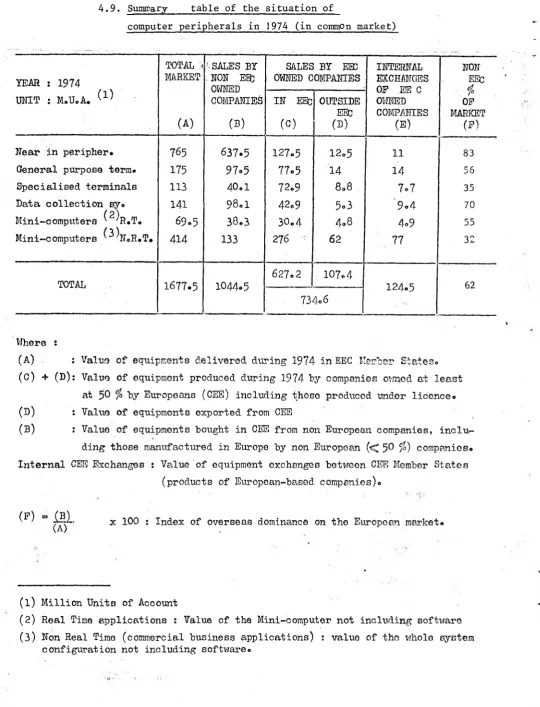
Only of total demand on the Community peri-informatic market was met by the European-based industy in 1974 /"4*9«_7« However, it is necessary to
consider the various segments of the market, in which the position fcf this industry varies considerably.
29
-IV
also note that many European products, particularly discs, are manufactured tinder licence
European industry is therefore in a very weak position in relation to demand; local computer peripherals have a growing importance by value in systems, and the competitive position of a system manufacturer who depends on a single non-European supplier for M s peripherals is more easily threatened*
0 0 Almost
50
% of the requirements for universal terminals is met by European manufacturers Z""4»4»_7 5-here the position gives less 'cause for %^o(l ^ 1’somln work under American licence, and certain componentparts of the terminals, such aa the keyboards, are American. Mention--should be made of the extensive.requirements resulting from the
development of networks, and the important part played by orders from public and semi-public bodies for their own systems, which could'help to redress the situation', ' as ther is no danger of a notable-lag in Europe in'the designing ..of . systems which use a large number of universal terminals.
(c) in specialised terminals (banks, point-of-sale, factory*etc.), the Community covers almost
70
% of its requirements /~4«5*This is due to the fact that close cooperation with users is essential for their development and certain applications, such as banking terminals, are not very highly developed in the United States*
The weak point of the European industry is in the point-of-sale terminal , where a large part of the market, after its abandonment by Olivetti, is now likely tobe divided up between NCfi, and probably IBM if the ' latter decides to exert its weight in this sector*
Finally, it is clear that the position on domestic markets is
good but the specific nature of the applications limits intra -Community trading*
(d) In data acquisition the European industry's contribution only amounts to 34 $ and is therefore small^~4»6*_7* In particular the share of
the market held by American producers in multi-keyboard data acquisition units (IJTFOEEX, CMC, MBS) is 77 % and if licences are included, it rises
30
-IV
9 8 * . Furthermore, the appearance of the floppy disc will still further reinforce the advantage of the American manufacturers*
•) About.
50%
of ..Mini computers for industrial and-scientific use are supplied by European manufacturers, taking central units as a basis onlyft,7j,
This is a favourable situation as all. the European1
manufacturers also operate as suppliers of systems (and there are practically no American licences ‘w o r k e d ' in Europe) whilst the Americans sell principally as OEM* However, intra-Community trading still remains small*
f) Small business systems form the segment of the peri-informatic sub sectorwhere Europe has the strongest position* West Germany in. particular is the only Member State where peri-infotfmatic exports are larger than imports
[k.e.]
The French industry was the least well placed in 1974, but a definite improvement has been observed since*
The United Kingdom market was comparatively weak in 1974 (70 m u.a. against 144 for West Germany) and the Community share limited; the
success of the ICL 2903 computer should improve this share. The Netherlands (Philips) and Italy (Olivetti) are also active in this sector*
4* Development forecasts
Given the extension of the use of data processing, tending to become widely-used and commonplace tool, the preponderant role of
peri-informatic equipment in this development is clear from the Knowing trends : - at the general level, intelligence will be distributed
within the systems;
- the acquisition of data will be effected at the place of origin; data will be centralized (by virtue of the integration of distributed .sub-systems in one system)
- concurrently, access to data will be by teleprocessing networks to be set up or developed.
31
-IV
The following can be foreseen for hardware : - the eventual abandonment of card systems
- the use of new. storage techniques (floppy discs, car t r i b e s ) - the development of new types of terminals, particularly
conversational terminals
- a standardization of hardware, made possible by the use of micro programming and the massive usage of micro-processors*
Equipment will then be separated into "intelligent" units having a processing capacity which will allow them either to relieve
the central unit of certain'tasks or to operate on a stand-alone basis), and non-intelligent, the latter comprising mainly memory units.,
universal terminals, printers,etc...
5* Policies of support for peri-informatic sector in the Community
Undei* their national policies (as set out in Chapter VII) two Member States have a declared plan of action for the peri-informatic sector.
France has announced a peri-informatic plan which should come into force in 1976 »' "the broad lines of which are as follows :
supply policy : the government measures will not be on a preferential ■basis but will "be concerned with :
(a) an information effort, aiming to improve the image of the industry and to disseminate systematically the requirements of public purchasers to French--based manufacturers*
(b) separate tenders for central processors on the one hand and peripherals and terminals on the other at the
level of public purchases*
(
c ) encouragement of purchase or rental at this leveloResearch
&
developmenta) work on components (integrated circuits, memories, special!z9d circuit^
32
-IV
(c) development of standards and standard interfaces.
Financing
(a) support for the creation of leasing bodies
(b) direct support : grants to firms which adopt growth aims, and development aid in the form of loans repayable in the event of success on a shared-risk basis (50
%
maximum of the total investment).Finally, IDI (Institute of Industrial Development) takes temporary holdings in small- and medium-sized firms, as in other sectors.
Under its hird computer programme, the Federal Republic of Germany has also made provision for the support of industrial R & D, several
sections of which relate to tb© peri-informatic sub-sector /6.1
J
an amount of DM63
million is earmarked for subsidies for remote peripherals, the annual figure increasing from DM 10 million in 1976 to DM 20 million in 1979* Small systems (including process control computers) will receive an overall subsidy of DM 1^9 million,increasing from DM 30 million in 1976 to DM ^9 million in 1979*
Near-in peripherals are not omitted from the subsidies to large-scale data processing.
There are also plans to encourage companies to cooperate closely in development by launching a selection of applications projects based on integrated systems, so as to promote the development of hardware for distributed computing.
It will also be remembered that Germany's component plan takes account of the requirements for the future development of small systems.
In short, it is fair to say that despite the support for peri-, informatic equipment given or planned by two member states, near-in peripherals and data preparation systems are at present the two weakest points in the European industry.
Mention should also be made of the low level of intra-Community trade, even in segments of the market where the European industry is
- 33 - V
IMPACT OF THE PRODUCTION OF INTEGRATED CIRCUITS ON THE DATA PROCESSING INDUSTRY
1 # Situation
Active components, and in particular integrated circuits, constitute one of the stumbling blocks in the development of computer technology.
The pace of technological progress on circuits and on memories is very fast; in large scale integration (LSI), the number of transits per chip increases tenfolde'veiy timsejeans-, and total memory capacity doubles every two to three years „ Core memories are rapidly succumbing to semi conductor memories and, according to some forecasts, will be superseded
* * completely by 1977
The world market for active components was more or less equally divided between discrete and integrated components in 1974 • The EEC only
r>ro-h.alf
duced only about one of its requirements of integrated circuits /~5*4, 5*6 7 of which.in turnone half was consumed
by the data processing industry, compared with two- thirds in the United States /"5»13_7»
Whereas the situation in the European industry is therefore reasonable for passive components, with variable degrees of profitability, the same is not true for integrated circuits* In spite of a competent technology (the lag behind American companies is estimated at two to three years) and considerable R 8c D, the turnover is well below requirements which will continue to grow.
CHAPTER V
Programm Elektronische Bauelemente der Bundesrepublik Deutschland
1974
-
1978
.
- 3 * f -
v
In this field, which is one of the keys to the future of the com puter industry, American companies are in a very favourable . position. As with discrete semiconductors, they use very cheap labour in the developing countries (in particular in the Far East) for the assembly of integrated circuits and the production
capacity of these companies, together with very low customs tariffs, have enabled them to flockd Europe with their products at extremely low pri:ces. \ This further restricts the production (at a loss) of European manufacturers.
There are two main reasons for the low prices: on the one hand in 1970 the American Government drastically reduced its orders for the space and defence programmes, releasing a very large production ca pacity in American industry which has since then conducted an aggres sive sales policy; on the other hand, the rapid increase in the
efficiency'of circuits, which permits the advanced integration of highly complex components, has coincided with a marked reduction in the price-performance ratio (in five years, the cost of a logic element has been has been reduced one hundred fold).
This situation is reflected in the E E C ’s trade balance for integrated circuits, which showed a large deficit in 197^» almost entirely to the advantage of the USA / 7*7»_7* A more rapid growth of integrated
circuit consumption is predicted in Europe then in the United States, while the reverse is expected for production and this will aggravate the deficit. It is clear that the data processing industry is not. the only user of advanced components and the disturbing fact of E u r o p e ’s 'technological dependence will have consequences in other sectors
(e.g. consumer goods, telecommunications).
2. Main world producers
Semiconductors are produced either by companies whose main activity it is, such
Vas Texas Instruments or Motorola (US), or by firms which have major interests in other sectors but are also involved in data processing, such as Siemens Gsrmaay,) Philips (Netherlands) , Hitachi (Japan),
- 35 - V
The importance of the role of advanced components for the future of computers and micro-processors is illustrated by the fact that manufacturers such as Texas or Fairchild have gone into data proces sing, whereas computer firms, such as Hewlett-Packard, have formed semi conductor divisions. The case of IBM which has become a major p r o ducer of advanced components, but solely for its own needs, will be dealt with separately. Other American industries, such as the ATT Group, whose main market is telecommunications, are following the same path .
3. IBM as a producer of semiconductors
Having lagged behind the technical development of advanced compo nents in its successive generations of computers, IBM has now made up the leeway with the 370 series - it has used an enormous part of its R & D budget, estimated at US £ 70 million, for the develop ment of new components and circuits and is now considered as one of the most advanced producers. It is making advances, for example, in its semiconductor memory techniques (charge-coupled device or CCD) and, like the Bell Telephone Company, is preparing for a major breakthrough in the field of magnetic bubbles which will replace mass memories.
- 36
-V
4* European producers
The following European-based producers operate within the Community s
- The first is Philips (Netherlands) and its subsidiaries (turnover 1973s 325 million u*a*), which engages in integrated circuit R&D in the Netherlands (Nijmegen), Germany, United Kingdom, France and
Switzerland and has an assembly factory in Formosa*
In 1975» Philips took over Sj.gn.et ics 133 in order to have aecess to the American market and’maintains contacts with General Electric.
- Siemens (FRG), the second European producer (turnover® 1973 s
115 million u*a*), had signed licensing and know-how agreements with Philips in 1974» but the situation has been altered by Signetics entering the scene*
- AEG (FRG) (turnover® 1973 • 80 million u<>a®) specializing in
mioro-prooessors, has signed a know-how agreement with Rockwell and will be responsible for manufacturing some of the micro-processors*
- T h e production of SGS(I) (turnover -1973 85 million u.-a.)
which is active 3n Italy, the United Kingdom, Germany, France and Singapore, consists 50
%
of discrete components and 50% of integrated components(equally divided between linear and digital circuits).
- T h e Thomson Group (France) (turnover* 1973 s 70 million u»a®]
- Ferranti, GEC, Plessey (United Kingdom)
- Other companies have lower turnovers in semiconductors or passive components*
Then there are the European subsidiaries of American companies, naaely Texas, Fairchild, Motorola and ITT which have, in general, established production and design facilities in several member countries.*