promoting access to White Rose research papers
Universities of Leeds, Sheffield and York
http://eprints.whiterose.ac.uk/
This is an author produced version of a paper published in International Journal of Medical Informatics.
White Rose Research Online URL for this paper:
Published paper
Oroviogoicoechea, C., Watson, R. (2009) A quantitative analysis of the impact of a computerised information system on nurses' clinical practice using a realistic evaluation framework, International Journal of Medical Informatics, 78 (12), pp. 839-849
A quantitative analysis of the impact of a computerized information system on nurses' clinical practice using a Realistic Evaluation framework
Cristina Oroviogoicoechea
PhD MSc RGN
Director of the Nursing Research and Innovation Unit Clinica Universitaria
Universidad de Navarra 31080 Pamplona Spain
e.mail: [email protected]
(address for correspondence and proofs)
Roger Watson
PhD RN FAAN
Editor-in-Chief, Journal of Clinical Nursing Professor of Nursing
Centre for Health & Social Care Studies and Service Development School of Nursing and Midwifery
University of Sheffield Sheffield S5 7AU UK
Tel: +44114 226 9624
ABSTRACT
A quantitative analysis of the impact of a computerized information system on
nurses' clinical practice using a Realistic Evaluation framework
Objective. To explore nurses’ perceptions of the impact on clinical practice of the use
of a computerised hospital information system.
Design. A realistic evaluation design based on Pawson and Tilley’s work has been used
across all the phases of the study. This is a theory driven approach and focuses
evaluation on the study of what works, for whom and in what circumstances. These
relationships are constructed as context-mechanisms-outcomes configurations (CMO).
Measurements. A questionnaire was distributed to all nurses working in in-patient
units of a university hospital in Spain (n= 227). Quantitative data were analysed using
SPSS 13.0. Descriptive statistics were used for an overall overview of nurses’
perception. Inferential analysis, including both bivariate and multivariate methods (path
analysis), were used for cross-tabulation of variables searching for CMO relationships.
Results. Nurses (n=179) participated in the study (78.8% response rate). Overall
satisfaction with the IT system was positive. Comparisons with context variables show
how nursing units’ context had greater influence on perceptions than users’
characteristics. Path analysis illustrated that the influence of unit context variables are
on outcomes and not on mechanisms.
Conclusion. Results from the study looking at subtle variations in users and units
provide insight into how important professional culture and working practices could be
in IT (information technology) implementation. The socio-technical approach on IT
theoretical underpinning for IT evaluation research. Realistic evaluation has proven to
be an adequate method for IT evaluation.
Key words: computers; information systems; information technology; patient records;
nurses; nursing; realistic evaluation; socio-technical approach; evaluation studies.
INTRODUCTION
The evaluation of information technology (IT) in nursing is relevant due to the rapid
implementation of IT systems in healthcare. Nevertheless, such evaluation can be
considered to be in its early stages. Limited insight has been developed and many
relevant questions for effective design and implementation remain unanswered [1].
Investment in IT is significant and, to guarantee effectiveness, evaluation is crucial.
One of the main problems identified in the literature in relation to the utility of IT
systems is the lack of adaptation to workflow and, therefore, IT systems not being
clinically relevant, but being designed for legal or management purposes [2]. Patient
care should be the main aim of an IT system, it has to be clinically relevant and adapted
to workflow. Healthcare organisations should consider clinicians’ input to IT
development or adaptation [3]. This approach resembles the paradigm change in
evaluation of IT systems from a technical to a socio-technical approach, where users
and context become key aspects in evaluation [4].
Kaplan and Shaw [5], in a literature review of evaluation research of IT systems,
recognise the lack of frameworks that help to develop theories to guide further research
and implementation. More empirical data, based on theoretical frameworks, both from
settings. Integration of results from different studies using a theoretical framework
could help the accumulation and theory development of IT implementation in
healthcare.
The complexity of IT evaluation research and the recommendations made from previous
studies, such as the importance of taking into account context variables and the use of
multiple methods for a wider approach [4, 6, 7, 8], make realistic evaluation a
promising approach to IT evaluation research [9]. Grounded on theory-based evaluation
research, realistic evaluation understands causality in terms of generative mechanisms;
causal relationships are not straightforward, as context factors can modify outcomes:
mechanisms should be in the right context to produce the expected outcomes [10].
Furthermore, the aim of the evaluation is not to demonstrate simply that the
intervention, in this case the IT system, works but to understand how it works and what
the links are between context, mechanisms and outcomes. Kaplan and Shaw’s [5]
recommendations for IT evaluation highlight the following: “Thus evaluation needs to
address more than how well a system works. Evaluation also needs to address how well
a system works with particular users in a particular setting, and further, why it works
that way there, and what works itself means” (p. 220).
Critical realism opens up a new approach within social science research.
“Reconceptionalising social and human sciences from a realist philosophical standpoint
offers the possibility of understanding and, to some extent, explaining the regularities of
the social world while avoiding the dead ends of positivism” [11] (pp 935). Critical
realism has informed the work carried out in different fields: economics, housing
widely recognised in organisational studies [13, 14], although it still has few empirical
applications. In IT system evaluation research it is still, largely, absent but could be
applied to overcome some of the problems with traditional approaches [1, 9].
The present study was designed to provide an insight into nurses’ experiences using a
computerised hospital information system in clinical practice in a teaching hospital in
northern Spain. Discussion of the study with the hospital board was conducted to obtain
permission to carry out the study and the hospital ethics committee approved the study.
A realistic evaluation design was used to make sense of the complex relationships
between variables included in the evaluation of IT systems and provide a wider view of
the long-term impact. Being an under-used method in this area of research, the study
provides insight into the utility of realistic evaluation for IT system evaluation research.
The study involved both quantitative and qualitative data and this paper presents results
from the quantitative analysis.
Description of the setting
The setting is a 400 bed highly specialised teaching hospital situated in northern Spain
providing services in every medical speciality and has approximately 14,500 hospital
admissions with an average stay of 6 days. In 1998 the hospital decided to develop and
implement an integrated computerised hospital information system to manage clinical,
administrative and financial aspects of the hospital. In January 2000 the system went
live, initially with what was already computerised in the old system; since then the
remaining functions have been introduced. The nursing documentation was fully
The system was self-developed whereby IT developers, who were hospital staff, worked
closely with clinicians and were aware of hospital workflow and context when
developing the system. The patient is the centre of the system, which provides a
bi-directional communication across the whole organisation, accessing and entering data
wherever it is required and generated. The system is integrated with a common way of
documenting and accessing information across the hospital by all members of the
clinical team.
The system incorporates different functionalities to enhance effectiveness of healthcare
professionals such as alerts and reminders. The entire system is password driven to
ensure the security and integrity of records. Nursing functionality includes mainly:
access to previous patient information; nursing record: assessment, care plan,
evaluation, fluid balance, clinical variables, etc.; medication administration;
co-ordination and management of patient orders and tests; access to medical record and
access to test results.
AIMS
The aims of the study are:
• to provide a comprehensive evaluation of the nurses’ perspective on the use of
an integrated electronic patient record and variations between different wards,
units and nurses
• to evaluate the impact of the IT system on nurses’ clinical practice
• to analyse the system characteristics that positively and negatively influence
clinical practice
• to analyse the appropriateness of realistic evaluation for IT systems evaluation
research
DESIGN AND METHODS
Within the theory-driven approaches to evaluation, realistic evaluation was developed
from the philosophical perspective of critical realism [10, 15]. In realistic evaluation,
“The main aspect is that of generative mechanisms based on causality being, not
external, but an internal potential of the programme or intervention that is activated in
the right conditions” [1] (pp 572). Evaluation tries to uncover causal relationships
between context, mechanisms and outcomes: what works for whom in what
circumstances [10]. Theory is constructed as different configurations of
context-mechanism-outcomes that explain the phenomena under study. In this study, realistic
evaluation provides not just the methodology but also the theoretical framework. From
this perspective, an IT system has to provide the reasons and resources to enable users
to obtain the outcomes and it is the action of the different stakeholders that makes the IT
system works [9].
Due to the lack of sound research to guide initial development of hypotheses based on
context-mechanism-outcomes (CMO) configurations, a theory formulation and
development design is used [10]. “Even in circumstances where the relevant
mechanisms affecting the programme outcomes are not yet identified, the realist
inquirer may strive to analyse the available data in the search for explanations, and to
pave the way for the identification of the relevant mechanisms in the future” [16] (p.
22).Based on a literature review [1], the study looks at the specification of the different
in clinical practice and brings about a possible model based on CMO configurations that
could guide further research. A realistic approach is used across all data analysis and the
study combines different methods to understand nurses’ perspectives and underlying
mechanisms.
The study took place in the following phases:
• Specification of contexts, mechanisms and outcomes was achieved through an
extensive questionnaire specifically developed for the study and distributed to
all nurses working in the in-patient nursing units. The questionnaire included
most of the aspects related to the implementation of IT systems in clinical
practice from the system, the user and the organisation perspective. Details
about questionnaire development and validation have been published
elsewhere [17].
• Results from the questionnaire were analysed looking for regularities;
apparent associations that explain possible CMO configuration.
• Cross-case analysis of the results from the perspective of different units and
nurses’ characteristics was carried out to design a possible model. This model
was based on cases with demonstrable varying differences in user and
organisational factors.
Data analysis
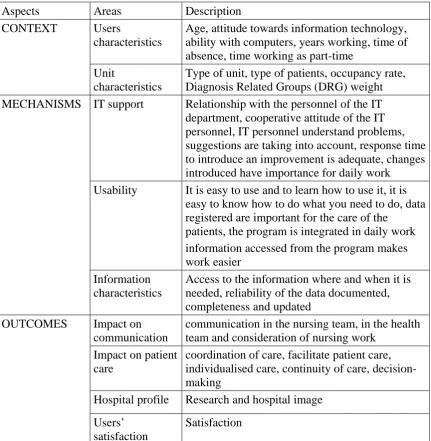
Data were entered and analysed (bivariate and multivariate) using SPSS 13.0. Variables
were classified as context, mechanisms and outcomes (Table 1) and compared for
correlations among variables were carried out to test possible context, mechanisms and
[image:10.595.87.519.178.620.2]outcomes relationships that could guide further development of CMO configurations.
Table 1. Classification of variables into context, mechanisms and outcomes
Aspects Areas Description
CONTEXT Users
characteristics
Age, attitude towards information technology, ability with computers, years working, time of absence, time working as part-time
Unit
characteristics
Type of unit, type of patients, occupancy rate, Diagnosis Related Groups (DRG) weight
MECHANISMS IT support Relationship with the personnel of the IT
department, cooperative attitude of the IT personnel, IT personnel understand problems, suggestions are taking into account, response time to introduce an improvement is adequate, changes introduced have importance for daily work
Usability It is easy to use and to learn how to use it, it is
easy to know how to do what you need to do, data registered are important for the care of the
patients, the program is integrated in daily work information accessed from the program makes work easier
Information characteristics
Access to the information where and when it is needed, reliability of the data documented, completeness and updated
OUTCOMES Impact on
communication
communication in the nursing team, in the health team and consideration of nursing work
Impact on patient care
coordination of care, facilitate patient care, individualised care, continuity of care, decision-making
Hospital profile Research and hospital image
Users’ satisfaction
Satisfaction
Initial mechanisms and outcomes items were tested and modified by factor analysis
before being used in the quantitative analysis. Mechanisms items generated a 3 factor
each factor range from 0.77 to 0.66. Outcomes generated also a 3 factor solution: impact
on patient care, communication and hospital profile. Cronbach’s value for each factor
range from 0.85 to 0.64 [17].
Mechanisms and outcomes were considered the dependent variables and only those
considered ordinal and interval were used for analysis. Data include multiple item
Likert scales to measure them. Multiple item scales, strictly speaking, are ordinal but
can be considered interval and most researchers currently treat them as such [18].
Scores of the items included in the different scales were summed and a total mean
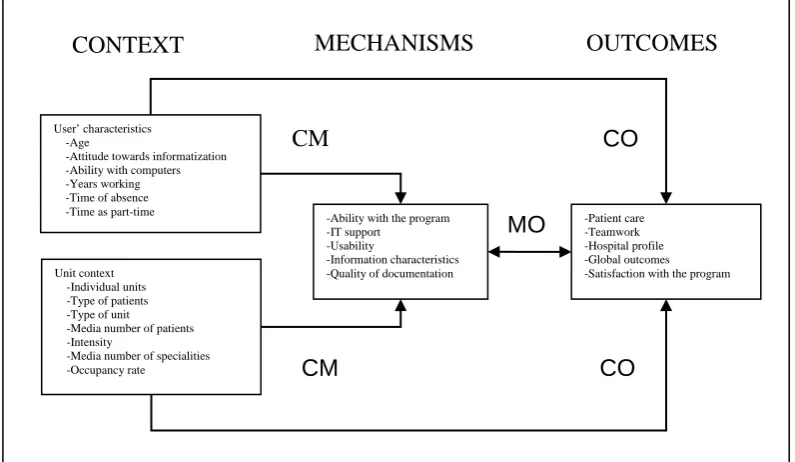
calculated for each of the scales and used for the analysis. Context variables, both unit
and users, were the independent variables. Figure I shows the variables included in the
[image:11.595.84.482.448.679.2]analysis and the directions of the analysis.
Figure I. Variables and directions of the statistical analysis
Non-parametric tests (Kruskal-Wallis and Mann-Whitney) were used for ordinal data
User’ characteristics -Age
-Attitude towards informatization -Ability with computers -Years working -Time of absence -Time as part-time
Unit context -Individual units -Type of patients -Type of unit -Media number of patients -Intensity
-Media number of specialities -Occupancy rate
-Ability with the program -IT support
-Usability
-Information characteristics -Quality of documentation
-Patient care -Teamwork -Hospital profile -Global outcomes -Satisfaction with the program
CO
CM
CM CO
MO
(ANOVA and t-test) for interval data (scales of the different factors for mechanisms and
outcomes). For the comparison of two means, Levene’s test was used to choose the
appropriate p value depending on whether the variances were equal or not. Post-hoc
Bonferroni testing was carried out with the ANOVA to identify where the statistically
significant difference in variances were. For correlation between ordinal and interval
level independent variables Pearson’s correlation was used.
Statistical significance of 0.05 and the Bonferroni test were used to minimise Type I
error, and Type II error was controlled using Cohen’s power analysis that establishes
the sample size in relation to significance criterion, the statistical power and the effect
size [15]. The sample size of the study was adequate for the different tests used for
alpha= 0.01, power= 0.80 and a medium effect size.
Subsequent to the bivariate inferential analysis, multivariate analysis was used to assess
the simultaneous relationship among variables. Path analysis, an extension of the
regression model, was conducted. According to Bryman and Cramer [14] “Path
analysis entails the use of multiple regression in relation to explicitly formulated causal
models” (p. 313). A hypothetical model is constructed based on statistical results or a
theoretical approach and the model is represented in a path diagram that makes explicit
the likely connections between variables. The observed variables are linked by causal
paths represented by causal arrows and, as Loehlin [20] notes, cause is understood in
general terms.
“The aim of path analysis is to provide quantitative estimates of the causal connections
between sets of variables” [18] (p. 314). A straightforward approach to performing a
numerical values that indicate the relative strength of the causal influence and are
standardised regression coefficients. The unexplained variance for the dependent
variables is calculated by subtracting the R2 of the regression model from 1. This
approach to path analysis does not provide an index of fit of a model, but R2 gives a
measure of how well the model is likely to fit in the population. Values higher than 0.3
can be considered as moderate or strong fit [22].
RESULTS
Nurses working in the in-patient area of the hospital (n=227) were invited to complete
the questionnaire and 179 questionnaires were returned (78.8%). Nurses in the study
were relatively young with 68.8% below 36 years. The mean number of years working
was 10.1 (SD 7.5). In relation to nurses’ experience with computers, they considered
their ability with computers as good with a mean of 6.5 (SD 1.39) on a scale from 1
(low) - 10 (high). Most of them had a computer at home (76.9%) and their attitude
towards information technology, not just in nursing but in society, was positive for the
majority (96.5%). Because of the low responses for indifferent and negative attitudes
both were unified as “negative” for analysis.
Support from the information system department was positively perceived by nurses,
mean = 1.82 (SD 0.49) in a Likert scale from 1 (strongly agree) - 5 (strongly disagree).
Nurses feel confident in the use of the program, ranking their ability with the program a
mean value of 7.45 (SD 1.06).on a scale from 1 (low) - 10 (high). Usability includes
aspects related to the easy-to-use characteristics of the program and how it is integrated
in daily work. Nurses agreed that it is easy to use the program in their daily work. The
1.74 (SD 0.47). Information characteristics encompassed quality of the content and
aspects related to accessibility of data and information. Information characteristics had a
mean value of 2.1 (SD 0.5) on a Likert scale from 1 (strongly agree) - 5 (strongly
disagree). While being positive, it is the least valued factor compared with the rest of
the areas.
Nurses were satisfied with the program, with a mean value of 7.37 (SD 1.13) on a scale
from 1 (low) - 10 (high). Outcomes in relation to the impact of the program on aspects
of their job were also positively valued with a mean of 2.05 (SD 0.46) for general
outcomes on a Likert scale from 1 (very positive) - 5 (very negative). Impact on hospital
profile, that is in the use of the program for research and in the image of the hospital,
was the most positively valued aspect (mean=1.88; SD 0.63), followed by impact on
patient care (mean=2.05; SD 0.51) and teamwork (mean= 2.18; SD=0.62). When asked
the key question for satisfaction: if they would go back to paper records or reintroduce
paper records, 79.8% responded ’no’ and only 7.5% wanted to go back to paper. From
the 12.7% of nurses who ‘did ‘not know’ most of them were nurses with no experience
of the paper record.
Inferential analysis
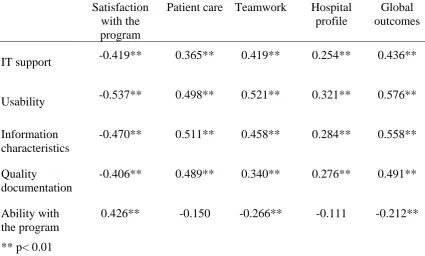
Bivariate correlations were carried out to verify the relationship between the
mechanisms, system characteristics and the outcomes. Highly significant results were
shown for all the variables except for ability with computers which had no significant
correlation with patient care and hospital profile (Table 2). There is a close relationship
between mechanisms and outcomes, therefore, outcomes can be considered as possibly
Table 2. Pearson’s correlation coefficients for mechanisms and outcomes
Satisfaction with the program
Patient care Teamwork Hospital
profile
Global outcomes
IT support -0.419** 0.365** 0.419** 0.254** 0.436**
Usability -0.537** 0.498** 0.521** 0.321** 0.576**
Information characteristics
-0.470** 0.511** 0.458** 0.284** 0.558**
Quality
documentation
-0.406** 0.489** 0.340** 0.276** 0.491**
Ability with the program
0.426** -0.150 -0.266** -0.111 -0.212**
** p< 0.01
Relationships between nurses’ characteristics and mechanisms and outcomes
Results from comparison between mechanisms and nurses’ characteristics did not
produce significant results, except for ability with the program, that was highly
significant for most of the nurses’ characteristics variables. Comparison within age
categories were significant (X2=26.241, df= 6, p<0.001); mean value for ability with the
program tended to be more positive in younger nurses (Appendix A). In the same way,
years working and ability with the program had a negative correlation (r= -0.238,
p<0.001): the more experience as a nurse, the less ability. As expected, nurses who
consider themselves good with computers feel confident in the use of the program (r=
0.524, p<0.001).
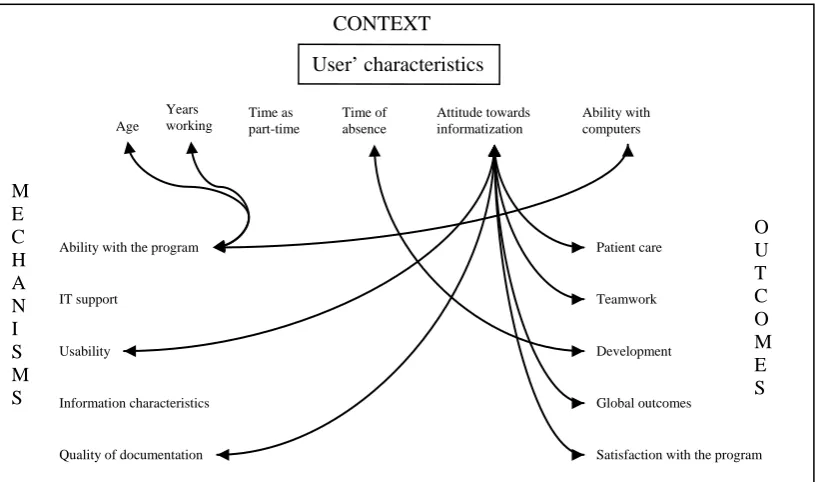
Attitude towards introduction of information technology is the only users’ characteristic
had lower mean values and, therefore, more positive perception of all the mechanisms
variables, especially for usability and quality of documentation (Appendix B).
Attitudes towards the introduction of technology is also the only user characteristic with
significant results related to outcomes, both for satisfaction with the program (Z=
-3.085, p=0.002) and all the factors included in the outcome analysis (patient care,
teamwork, hospital profile and general outcomes). It was highly significant for all
variables, except for hospital profile, where significance is only p< 0.05. Nurses with a
positive attitude towards the introduction of technology have a better perception of the
impact of electronic system in their daily work (Appendix C). Figure II summarises
results of the analysis of CMO looking at users’ characteristics as context. Lines
[image:16.595.89.497.452.693.2]represent comparisons and relationships with significant values p< 0.01.
Figure II. Representation of the significant relationships between users’ characteristics,
mechanisms and outcomes
User’ characteristics CONTEXT O U T C O M E S M E C H A N I S M S Age Attitude towards informatization Ability with computers Years working Time of absence Time as part-time
Ability with the program
IT support
Usability
Information characteristics
Quality of documentation
Patient care
Teamwork
Development
Global outcomes
Relationships between units’ characteristics and mechanisms and outcomes
Support from the information technology department is the mechanism most related to
unit characteristics. Mean values of IT support are more negatively perceived in ICU
than general wards (t= 4.770, df= 167, p<0.001). On the basis of individual units,
ANOVA demonstrated significant differences (F= 4.717, df= 11, p<0.001). Bonferroni
testing showed that this difference lay only between ICU and most non-ICU units.
Testing on the basis of type of patient, ANOVA showed significant differences (F=
7.990, df= 3, p<0.001); Bonferroni testing showed a difference between ICU and other
types of patient. Therefore, the difference in support from IT on the basis of unit
characteristics seems mainly to be accounted for by differences between ICU and other
areas. Similar results can be observed for information characteristics, although
significance when comparing within individual units is only p< 0.05. Context variables
more related to workload, such as occupancy rate and intensity of patients, had no
influence in assessment of mechanisms.
As with mechanisms, unit characteristics seem to have more influence than users’
characteristics on outcomes, but results point out that differences are explained not just
by the distinction between general wards and ICU and, therefore, type of patients and
individual units have also some impact on outcomes. Differences between general
wards and ICU are only highly significant for teamwork (t= 3.792, df= 169, p<0.001).
Type of patients has significant differences in patient care (F= 4.676, df= 3, p=0.004),
teamwork (F= 7.987, df= 3, p<0.001) and mean score for outcomes (F= 6.018, df= 3,
for patient care (F= 2.646, df= 11, p=0.004), teamwork (F= 3.115, df= 11, p=0.001) and
mean score for outcomes (F= 3.083, df= 11, p=0.001).
Unit characteristics in relation to workload have less impact although some significant
values (p< 0.05) were found (Table 3). It is interesting that the negative correlation
between the number of specialities, a reference to the diversity of patients in the unit,
and satisfaction with the program, show that the more specialities involved, the lower
the satisfaction with the program. On the other hand, occupancy rate has a significant
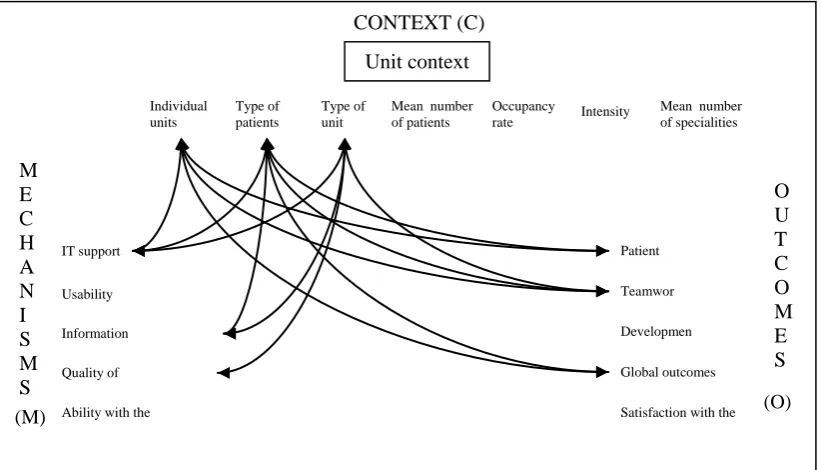
positive correlation: more busy units are more satisfied with IT. Figure III summarises
results of the analysis of CMO looking at units’ characteristics as context. Lines
represent comparisons and relationships with significant values p< 0.01.
Table 3. Pearson’s correlation coefficients for mechanisms and nursing units activity
variables
Satisfaction with the program
Patient care
Teamwork Hospital
profile
General outcomes
Mean number of patients
-0.126 0.109 0.064 0.019 0.094
Intensity patients (GRD)
-0.067 0.012 0.063 0.104 0.050
Mean number of specialities
-0.199* 0.171* 0.138 0.028 0.164
Occupancy rate 0.205* -0.084 -0.210* -0.026 -0.144
[image:18.595.85.504.439.650.2]Figure III Representation of the significant relationships between units’ characteristics,
mechanisms and outcomes
Results from path analysis
Context variables included in the path analysis are those with significant results in the
bivariate analysis. Because of the high correlation among factors included in
mechanism related to the IT system (IT support, usability and information
characteristics), to simplify the analysis a mean value (IT environment) for the factors
has been used; ability with the program has been considered separately because of the
theoretically developed causal paths in the model. Also, outcomes variables have been
represented in one item by calculating a mean value for the outcomes factors and
satisfaction with the program. Despite differences in the measure of the variables, a high
correlation among them justifies the calculation of a mean value for all of them.
CONTEXT (C) O U T C O M E S M E C H A N I S M S
Ability with the IT support Usability Information Quality of Patient Teamwor Developmen Global outcomes
Satisfaction with the Unit context Individual units Type of patients Type of unit
Mean number
of patients Intensity
Mean number of specialities Occupancy
rate
Satisfaction with the program variable was recoded to have the same direction from
positive to negative values as the outcomes scores.
A hypothesised model was constructed based on significant relationships from the
bivariate analysis and following the CMO configuration pattern. Unit variables with a
significant relationship in the bivariate analysis are type of unit and type of patients, but
only type of patients has been included in the analysis as it already includes a category
for critical care patients. Type of patients was transformed into a dummy-coded variable
before being included in the analysis. Medical/surgical patients was considered the
reference category as it is the least specific category, having both medical and surgical
patients.
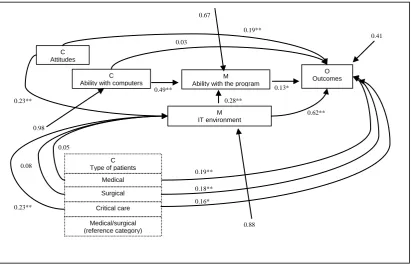
Multiple linear regression analysis was carried out for each of the equations shown in
Box 1). The significance level of p< 0.05 was used for the standardised beta regression
coefficients and for the adjusted R2 which indicates the explained variance for each of
the dependent variables. Results are represented in Figure IV. The total unexplained
variance for outcomes as a dependent variable is E= 0.41. There is a significant impact
of both mechanisms and context variables on outcomes. The biggest influence is made
by IT environment (β= 0.62, p< 0.01). In the same way, when IT environment is
removed from the model, the unexplained variance increases significantly (E= 0.70) if
Box 1. The structural equations designed for the analysis are:
• Ability with computers = (B) attitudes + E4
• IT environment = (B) attitudes + (B) Medical + (B) Surgical + (B)
Critical care + E3
• Ability with the program = (B) attitudes + (B) ability with computers +
(B) IT environment + E1
• Outcomes = (B) attitudes + (B) ability with computers + (B) ability with
the program + (B) IT environment + (B) Medical + (B) Surgical + (B)
Critical care + E2
[image:21.595.86.498.448.713.2](B corresponds to the path coefficient and E to the unexplained variance)
Figure IV. Path analysis of significant relationships between context, mechanisms and
outcomes
*p≤ 0.05; ** p≤ 0.01
M Ability with the program 0.49** 0.28** 0.13* 0.98 0.88 C Attitudes M IT environment C
Ability with computers
O Outcomes 0.19** 0.23** 0.03 0.05 0.62** 0.67 0.41 Medical/surgical (reference category) Critical care Surgical Medical C Type of patients 0.08
0.23**
0.19**
Attitudes have both a direct effect on outcomes (β= 0.19, p= 0.001) and an indirect
effect through IT environment (β= 0.23, p= 0.002). Ability with computers has only an
indirect effect on outcomes through ability with the program (β= 0.49, p< 0.01). Unit
characteristics have only a direct effect on outcomes and they do not have a significant
influence on mechanisms, except for critical care patients.
It is interesting to note that some differences can be found when the path diagram is
applied separately for satisfaction with the program and outcome factors. The total
unexplained variance increases to E= 0.55 for satisfaction, and to E= 0.49 for outcome
factors. Although still being highly significant, changes in the influence of IT
environment can be observed. Satisfaction is less influence by IT environment (β= 0.48,
p< 0.01) than outcome factors (β= 0.63, p< 0.01). On the other hand, unit characteristics
do not have a direct effect on satisfaction but have a direct effect on outcome factors.
Lastly, ability with the program has a direct effect on satisfaction (β= 0.27, p< 0.01) but
not on outcome factors.
DISCUSSION
The main aim of the study was to provide a comprehensive evaluation of using an IT
system in clinical practice from the nurses’ perspective. This was achieved using
realistic evaluation as a method and as a theoretical framework. From this perspective it
appears that IT systems have to provide the reasons and resources to enable users to
obtain the outcomes and it is the action of the different stakeholders that makes them
work [9]. The study has, therefore, been an exploratory first step for further research on
IT implementation. Results show a positive perception of nurses in relation to the
high and only 7.5% of the nurses wanted to return to paper records. There are very
slight differences in the perception of the different mechanisms and outcome factors, all
of them are positive and teamwork as an outcome is considered the least benefit from
the IT system.
Comparisons of results to look at possible differences between the different contexts
variables provide interesting conclusions. Individual characteristics appear not to have
an impact on mechanisms and outcomes, except attitudes towards the introduction of
technology. The unit context has an influence on both in bivariate analysis, but
multivariate analysis show that the influence is on outcomes and not on mechanisms.
Most recent frameworks for IT evaluation focus on social relationships and the
socio-technical approach. Therefore, this approach, as described by Berg, is considered as a
strong theoretical foundation [23]. It addresses context, users and functionality and
considers the mutual influence of the system and the context, being an iterative process.
Realistic evaluation in this study has proved to be, from the evaluation research
perspective, an adequate method to acknowledge these issues. Context and functionality
have been examined and the mutual influence between context and the IT system
became apparent in data analysis.
Clear-cut CMO configurations were not developed as a result of the study.
Nevertheless, results acknowledge the multidimensional nature of IT systems and the
influence of contextual factors. Venkatesh et al [24], in the development of the Unified
Theory of Accepatnce and Use of Technology, suggest the importance of contextual
perceived as successful from an IT adoption perspective (i.e., those that are likely and
highly used by users) are considered a success from an organizational perspective” (pp.
470). IT systems implementation can be considered as an open system where how the
IT system works interact with mechanisms in place; realistic evaluation seems to be a
method that could help to uncover underlying mechanisms that help to explain how and
why an IT systems works. Nursing units with clear-cut differences - for example, ICU
with the most negative perception of outcomes compared with medical and surgical
units with differences in the impact of the IT system on communication within the
health team - could provide the context for in-depth case analysis to understand
underlying mechanisms further that bring about these differences. As Kazi [16] says:
“The gold standard for the realist evaluator is not just ‘what works’, but ‘what works,
for whom and in what contexts’, recognising that an explanation at any one time
requires further investigation and further explanation” (p. 160).
One of the criticisms of evaluation studies is that they tend to be undertheorised [5]. The
use of frameworks has been recommended as a way forward to contribute to theory
development [25]. Classification of items into the context, mechanisms and outcomes
structure of realistic evaluation has helped to clarify how variables are understood and
used for analysis. It gives a comprehensive evaluation of how variables predict
outcomes or influence them. Realistic evaluation approaches to theory development
based on realistic cumulation provides the foundation for integration of findings from
different studies and contributes to generate theory across studies where “individual
studies can build into cumulative bodies of generalizable and transferable knowledge”
have in: “(1) IS (information systems) evaluation research, (2) artefact construction and
design science, and (3) studies on IS discourses” (p. 334).
Limitations
Success could be explained by context variables different from those at user and unit
level. Organisational variables (technology culture, innovation, leadership) and other
variables (user involvement in IT design and implementation, type of IT system) are
common to all the units in the study so comparison to acknowledge their impact has not
been feasible.
Discrimination of users’ characteristics in relation to their impact on IT system
implementation could have been influenced by the homogeneity of the sample. Despite
being all the population of in-patient nurses in the hospital, almost 70% was less than 36
years old, good ability with computers and a positive attitude towards the introduction
of technology. Other studies have similar results but, because of sample characteristics
in this study, results in relation to users’ characteristics should be taken cautiously.
The study has intended to provide a wider picture on IT implementation and within
realistic evaluation we have chosen a more extensive research design. As Kazi [16]
points out, a more extensive approach is required to “address research questions
regarding the regularities, patterns and distinguishing features of a population” (p. 32)
but it could lack explanatory depth. Interesting issues have been raised during data
analysis and discussion but further research is needed for in-depth understanding of
Finally, this was a cross-sectional study and therefore limited in providing insight into
changes during the process of IT implementation. In addition, being a single case study,
generation of robust theory about relationships between context, mechanisms and
outcomes is not possible; “generating robust theory is normally a lengthy procedure”
[11] (p.415).
Contributions to practice
This study contributes to fill in a gap on IT evaluation research because of inadequate
research into the reality of workplaces, and, therefore, to highlight “key features of the
work which appear relevant to the participants and which have consequences for any
future deployment of technology” [27] (p. 322). Results from the study looking at subtle
variations in users and units provide a grasp of how important professional culture and
working practices could be in IT implementation.
This study demonstrates the potential of realistic evaluation as an adequate approach for
IT system evaluation. Results acknowledge the multidimensional entity of IT systems
and the influence of contextual factors. IT systems implementation can be considered as
an open system where how the IT system works interact with mechanisms in place;
realistic evaluation seems to be an adequate method to uncover underlying mechanisms
that help to explain how and why an IT systems works.
Generalisation of results is not possible but the use of a framework to guide the
evaluation process improves reliability and increases rigor in research [23]. The study
provides the first step in realistic accumulation and makes it possible to consider
that facilitates decision-making about how to adapt this experience to specific
circumstances [9].
CONCLUSIONS
The study has provided a wider picture of the impact of IT systems in clinical practice.
It can be considered a successful story of IT implementation that has demonstrated not
just a positive outcome but has also provided explanations through cross-tabulation of
outcomes variables against other variables, those related to how the IT system works
and the context where it is implemented. Although variables related to culture, norms,
values and work patterns have not been explicitly included, the influence of the work
environment became apparent as a result of the analysis. Activity variables have no
influence on nurses’ perception whereas differences in individual units or more
conceptual grouping of units are significant. These aspects need to be explored more
systematically to understand their role on IT implementation.
The novelty of the socio-technical approach on IT systems evaluation suggested in the
recent literature appears to be an adequate theoretical underpinning on IT evaluation
research. It acknowledges the relevance of the user perspective and context as essential
aspects on IT implementation.
Realistic evaluation has proven to be an adequate method for IT evaluation.
Effectiveness of IT implementation cannot be reduced to outcome variables as context
and user factors could determine implementation. Understanding how and why an IT
system works has a greater impact on future design and implementation than simply
context, mechanisms and outcomes and exploring possible relationships has provided a
comprehensive approach to disentangle the complexity of IT evaluation research.
What was already known in the topic:
• IT system implementation in healthcare needs to be clinically relevant and
adapted to workflow
• The socio-technical approach suggests that there is a mutual influence between
the context and the IT system
• Theoretical frameworks could help to move forward evaluation research on IT
implementation
What this study added:
• The unit context has an influence on nurses’ perception of the impact of IT
implementation
• The use of a theoretical framework helps to clarify the complexity of IT
evaluation research
• Realistic evaluation is a useful theoretical framework for IT evaluation research
from the socio-technical perspective
Authors contribution: Design (CO, RW), data collection (CO), data analysis and
interpretation (CO, RW), writing and revision of the manuscript (CO, RW).
REFERENCES
[1] Oroviogoicoechea C, Elliott B, Watson R, Review: evaluating information
systems in nursing, J. Clin. Nurs. 17(5) (2008) 567-75.
[2] Urquhart C, Currell R, Reviewing the evidence on nursing record systems,
Health Informatics J. 11(1) (2005) 33-44.
[3] Bostrom AC, Schaffer P, Dontje K, Pohl JM, Nagelkerk J, Cavanagh SJ,
Electronic health record. Implementation across the Michigan Academic
Consortium, Comput. Inform. Nurs. 24 (2006) 44-52.
[4] Berg M, Implementing information systems in health care organisations: myths
and challenges, Int. J. Med. Inform. 64 (2001) 143-56.
[5] Kaplan B, Shaw NT, Future directions in evaluation research: people,
organizational and social issues Methods Inf. Med. 43 (2004) 215-31.
[6] Ammenwerth E, Graber S, Herrmann G, Burkle T, Konig J, Evaluation of health
information systems- problems and challenges, Int. J. Med. Inform. 71 (2003)
125-35.
[7] Van der Meijden MJ, Tange HJ, Hasman A, Determinants of success of inpatient
clinical information systems: a literature review, J. Am. Med. Inform. Assoc. 10
(2003) 235-43.
[8] Heathfield HA, Evaluating clinical systems: the social programme perspective.
[9] Carlsson, SA. Advancing information systems evaluation (research): a critical
realist approach. Electronic Journal of Information Systems Evaluation 6(2)
(2003) 11-20.
[10] Pawson R, Tilley N. Realistic Evaluation. London: Sage Publications Ltd, 1997.
[11] Connelly JB, Evaluating complex public health interventions: theory, methods
and scope of realist enquiry, J. Eval. Clin. Pract.13 (2007) 935-941.
[12] Clarke A. Evaluation research. An Introduction to Principles, Methods and
Practice. London: Sage Publications Ltd, 1999.
[13] Leca B, Naccache PA, critical realist approach to institutional entrepreneurship.
Organization 13(5) (2006) 627-651.
[14] Reed M, Reflections on the “realist turn” in organisation and management
studies, J. Manage. Stud.42(8) (2005) 1621-1644.
[15] McEvoy P, Richards D, Critical realism: a way forward for evaluation research
in nursing? J. Adv. Nurs. 43 (2003) 411-20.
[16] Kazi M. Realist Evaluation in Practice Health and Social Work. London: Sage
Publications, 2003
[17] Oroviogoicoechea C. A realistic evaluation of the impact of a computerised
information system on clinical practice: The nurses’ perspective. PhD thesis.
University of Sheffield, UK. 2008
[18] Bryman A, Cramer D. Quantitative Data Analysis with SPSS 12 and 13. Hove,
East Sussex: Routledge, 2005.
[20] Loehlin JC. Latent Variable Models: An Introduction to Factor, Path, and
Structural Equation Analysis 4rd edn. Mahwah, New Jersey: Lawrence Erlbaum
Associates, 2004.
[21] Cramer D. Advanced Quantitative Data Analysis. Philadelphia: McGraw-Hill
Education, 2003.
[22] Muijs D. Doing Quantitative Research in Education with SPSS. London: Sage
Publications, 2004.
[23] Currie LM, Evaluation frameworks for nursing informatics, Int. J. Med. Inform.
74 (2005) 908-16.
[24] Venkatesh V, Morris MG, Davis GB, Davis FD, User acceptance of information
technology: toward a unified view, MIS Quart. 27 (2003) (3) 425–478
[25] Chiasson M, Reddy M, Kaplan B, Davidson E, Expanding multi-disciplinary
approaches to healthcare information technologies: What does information
systems offer medical informatics? Int. J. Med. Inform. 76S (2007) S89-S97.
[26] Carlsson SA. Using Critical Realism in IS Research. In: Whitman ME and
Woszczynski AB (eds). The Handbook of Information Systems Research.
Hershey PA: Idea Group Publishing Ltd, 2004.
[27] Jenkings KN. Problems encountered in integrated care records research. Health