Design and Analysis of Mobile
Operating System Security
Architecture using Formal Methods
Hendra Gunadi
A thesis submitted for the degree of
Doctor of Philosophy
The Australian National University
to my mother, Hennywati Surya
Acknowledgments
First of all, I want to thank God for blessing me with such a great privilege that I may finish this thesis. That even though I always forget about Him (especially in the hectic times doing this thesis), He still loves me and care for me. I thank God for putting these people around me who helped me through the whole time of my Ph.D. I also want to thank my family for their support throughout my degree. Es-pecially to my mom, Hennywati Surya who has sacrificed so much to support me going to study here. And I want to thank my brothers, Julius and Himawan, as well, because even though we are far apart, they still accompany me (online).
One big thanks to my supervisor Alwen Tiu for helping me by directing me through this thesis. I really appreciate all the help and support that you have given me. I know that the whole situation is not really conducive since we have to do long distance correspondence, while you are also really busy with your own responsibil-ity. You still patiently help me to work through this thesis (especially all the proof readings!).
Not also forgetting to thank my lovely wife, Maria Kristiyanti Tjandradjaja. Your involvement in my life has brought about significant changes. Thanks for all the happy and hard times together, and also for your support, making sure that I am motivated to finish this thesis.
I also want to say thanks to Rajeev Goré and Dirk Pattinson for their eagerness to help even though you are busy. Thanks Raj for helping me in administrative area and making sure that I progress throughout my Ph.D. Also thanks Dirk for your pointer and discussion in finishing the formalization in Coq.
I want to say thanks as well to all the people I know who have been involved in my life here during these 6 years in Canberra. For my Indonesian (in Indonesia) friends who keep on “annoy”- ing me, for my office mate and fellow Ph.D student Gary, for Micaiah and Elysia, and for my housemates John, Jing, and Kuangda. I also want to thanks to Simon and Annabel for catching up with me regularly, dinner gang that regularly meets every Friday, also for James for all the regularly catching up after church for quite a while.
Finally, I also want to thank the reviewers for their valuable feedback.
This research is supported by an Australian Research Training Program (RTP) Scholarship.
Abstract
The Android operating system (OS) is now used in the majority of mobile devices. Hence, Android security is an important issue to handle. In this work, we tackle the problem using two separate approaches: directly modifying Android OS and developed a framework to provide a guarantee of non-interference.
Firstly, we present a design and an implementation of a security policy specifi-cation language based on metric linear-time temporal logic (MTL) to specify timing-dependent security policies. The design of the language is driven by the problem of runtime monitoring of applications in mobile devices. A main case of the study is the privilege escalation attack in the Android OS, where an unprivileged app gains ac-cess to privileged resource or functionalities through indirect flow. To capture these attacks, we extend MTL with recursive definitions to express call chains between apps. We then show how our language design can be used to specify policies to detect privilege escalation under various fine-grained constraints. We present a new algorithm for monitoring safety policies written in our specification language. The monitor does not need to store the entire history of events generated by the apps. We modified the Android OS kernel to allow us to insert our generated monitors mod-ularly. We have tested the modified OS (LogicDroid) on an actual device, and show that it is effective in detecting policy violations. Furthermore, LogicDroid is able to prevent a previously unknown exploit to breach Android security which allows an unprivileged application to access certain critical and privileged functionalities of an Android phone, such as making phone calls, terminating phone calls, and sending SMS, without having to ask any permissions to do so.
Subsequently, we provided a framework to ensure non-interference properties of DEX bytecode. Each application in Android runs in an instance of the Dalvik virtual machine, which is a register-based virtual machine (VM). Most applications for Android are developed using Java, compiled to Java bytecode and further into DEX bytecode. Following a methodology that has been developed for Java byte-code certification by Barthe et al., we developed a type-based method for certifying non-interference property of a DEX program. To this end, we develop a formal oper-ational semantics of the Dalvik VM, a type system for DEX bytecode, and prove the soundness of the type system with respect to a notion of non-interference. We have also formalized the proof of a subset of DEX in Coq for an additional guarantee that our proof is correct.
We then study the translation process from Java bytecode to DEX bytecode, as implemented in the dx tool in the Android SDK. We show that an abstracted version of the translation from Java bytecode to DEX bytecode preserves the non-interference property. More precisely, we show that if the Java bytecode is typable in Barthe et al.’s type system, then its translation is typable in our type system. This result
Contents
Acknowledgments vii
Abstract ix
1 Introduction 1
1.1 Introduction . . . 1
1.2 Research Motivation and Direction . . . 2
1.3 Thesis Outline . . . 5
2 Efficient Runtime Monitoring with Metric Temporal Logic 7 2.1 Related Work . . . 10
2.2 Background . . . 11
2.3 The policy specification language RMTL . . . 13
2.4 Trace-length independent monitoring . . . 19
2.5 Examples . . . 24
2.6 Implementation . . . 25
2.6.1 Monitor Generator . . . 26
2.6.2 LogicDroid Architecture . . . 26
2.6.3 Performance . . . 30
2.6.4 Vulnerabilities in com.android.phone component . . . 32
3 Design of Android Bytecode Certification 37 3.1 Related Work . . . 38
3.2 Proof-Carrying Code . . . 40
3.3 Non-Interferent Type System for JVM . . . 41
3.3.1 Overview of JVM Bytecode . . . 41
3.3.2 Operational Semantics . . . 42
3.3.3 Type System . . . 47
3.4 Infrastructure for Android Bytecode Certification . . . 55
4 Non-Interferent Type System for Android Bytecode 59 4.1 Syntax, Semantics, and Type System for Android Bytecode . . . 60
4.1.1 Overview of DEX Bytecode . . . 60
4.1.2 Operational Semantics . . . 60
4.1.3 Type System . . . 67
4.1.4 Examples . . . 73
4.2 Typable DEX Program Implies Non-Interference . . . 77
4.2.1 Auxilliary Lemmas . . . 80
4.2.2 Typable DEXI Implies Non-interference . . . 82
4.2.3 Typable DEXO Implies Non-interference . . . 83
4.2.4 Typable DEXC Implies Security . . . 86
4.2.5 Typable DEXG Implies Security . . . 89
5 Formalization of DEXI and DEXO 101 5.1 The Semantics of DVM . . . 102
5.1.1 Infrastructure . . . 102
5.1.2 Instructions . . . 107
5.1.3 The Operational Semantic of DEXI and DEXO Instructions . . . 108
5.1.4 Successor Relation and CDR . . . 117
5.2 Formalization of DEXI . . . 120
5.2.1 Transfer Rules . . . 120
5.2.2 Indistinguishability Relations . . . 123
5.2.3 Non-Interference Proof for DEXI . . . 127
5.3 Formalization of DEXO . . . 132
5.3.1 Transfer Rules . . . 133
5.3.2 Indistinguishability Relations . . . 134
5.3.3 Non-Interference Proof for DEXO . . . 137
6 Type-Preserving Compilation of Android Bytecode 141 6.1 Translation Phase . . . 141
6.1.1 Starting Instruction of a Block (StartBlock) . . . 143
6.1.2 Resolving Parents-Successors Relationship (TraceParentChild) 145 6.1.3 Reading Java Bytecodes (Translate) . . . 149
6.1.4 Ordering Blocks (PickOrder) . . . 151
6.1.5 Output DEX Instructions (Output) . . . 152
6.2 Proof that Translation Preserves Typability . . . 155
6.2.1 Compilation of CDR and Security Environments . . . 155
6.2.2 Compilation Preserves Typability . . . 163
6.3 Implementation for Type-Preserving Compilation . . . 175
6.3.1 Component Details . . . 181
6.3.1.1 Certificate Structure . . . 181
6.3.1.2 Naive JVM Type Inference . . . 187
6.3.1.3 Non-Optimizing Certificate Translation . . . 189
6.3.1.4 DEX Type Checker . . . 191
6.3.2 Compact Certificate . . . 192
Contents xiii
A Intermediate Type System 201
List of Figures
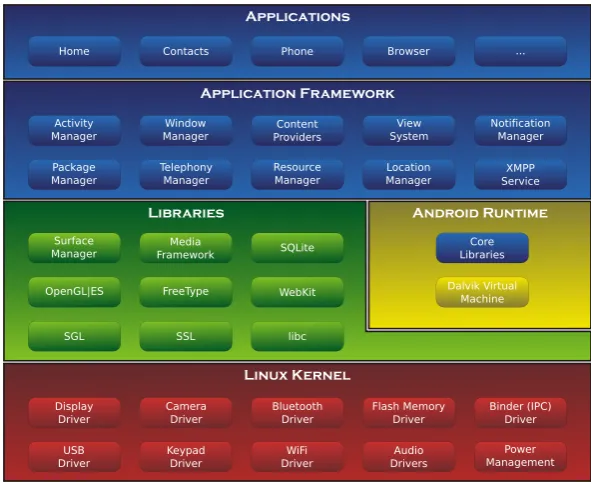
1.1 Android OS architecture. Image source: Wikipedia. . . 2
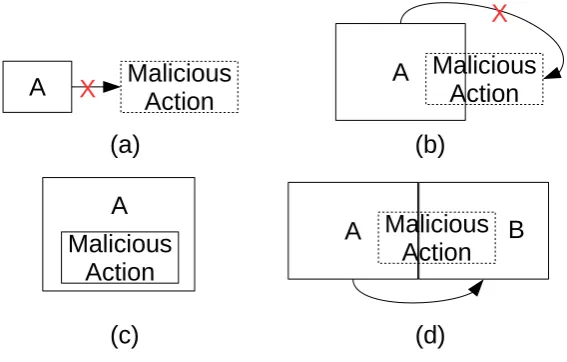
1.2 App and permissions required to do a malicious activity: (a) App is not granted any permission which can lead to a malicious activity (b) App is granted a subset of the permissions (c) App has a superset of the permissions (d) App is gaining more privilege . . . 3
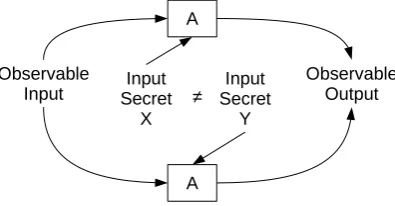
1.3 Non-Interferent Program . . . 5
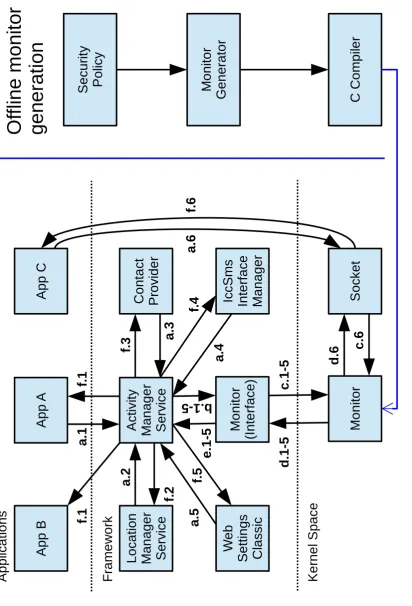
2.1 The architecture of LogicDroid . . . 27
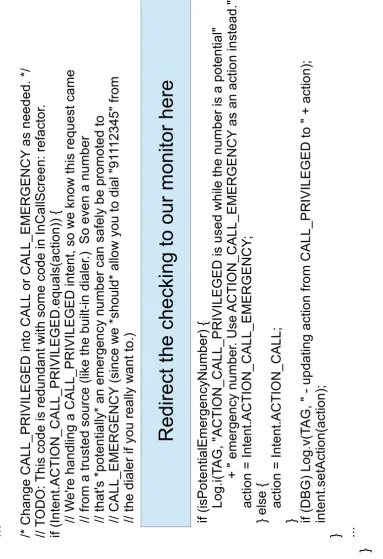
2.2 A hook in the Android framework to intercept phone calls . . . 29
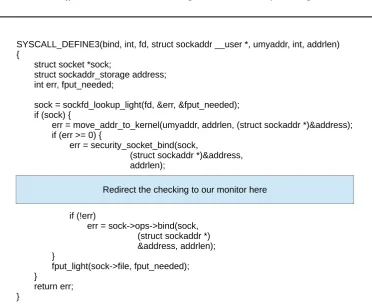
2.3 A hook placed in the Linux kernel to intercept calls to network sockets 30 2.4 Timing of Calls . . . 35
2.5 Vulnerabilities in the android.com.phone component. . . 36
3.1 PCC structure . . . 42
3.2 JVM Instruction List . . . 43
3.3 Full JVM Operational Semantic . . . 46
3.4 JVM Transfer Rule . . . 52
3.5 PCC structure for Android Bytecode . . . 56
4.1 DEX Instruction List . . . 61
4.2 DEX Operational Semantic . . . 63
4.3 DEX Transfer Rule . . . 71
4.4 Base Case for Type System Soundness . . . 77
4.5 Induction Case for Type System Soundness . . . 77
4.6 Junction Point Indistinguishability in JVM . . . 80
6.1 Overall architecture . . . 176
6.2 Certificate Structure . . . 177
6.3 Content of the Methods for the Sample Application . . . 178
6.4 Certificate for the Sample Application . . . 180
6.5 Sample Certificate . . . 188
6.6 Sample Compact Certificate . . . 195
A.1 DEX Intermediate Transfer Rule . . . 206
List of Tables
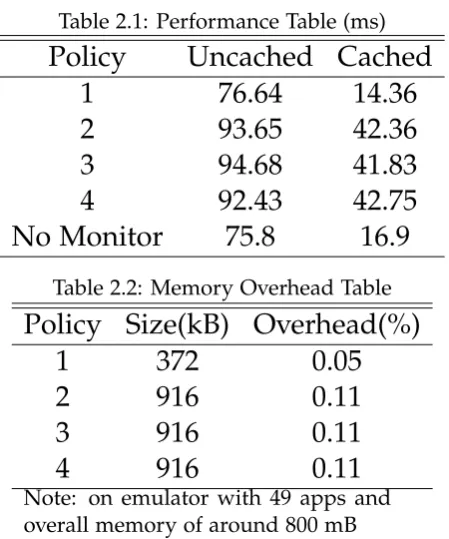
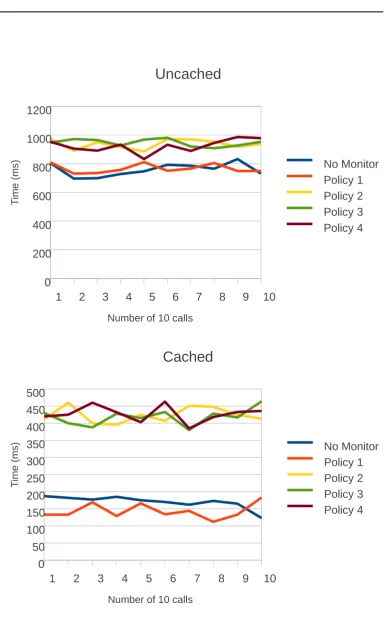
2.1 Performance Table (ms) . . . 31
2.2 Memory Overhead Table . . . 31
6.1 Instruction Translation Table . . . 150
6.2 Translation Table . . . 159
Chapter 1
Introduction
1.1
Introduction
Android is a popular mobile operating system (OS) that has been used in a range of mobile devices such as smartphones and tablet computers. According to Sta [2017], Android has the most significant market share for mobile devices, making it an at-tractive target for malwares, so verification of the security properties of Android apps is crucial. It uses Linux as the kernel, which is extended with an application frame-work (middleware). Most applications of Android are written to run on top of this middleware, and most of the Android-specific security mechanisms are enforced at this level.
The Android OS is built on top of the Linux kernel, so at the most basic level, it inherits most of the security architecture of Unix/Linux. Figure 1.1 shows Android’s architecture. Android treats each application as a distinct user with a unique user ID. At the kernel level, the standard Unix permission mechanism enforces access control based based on the user id (and group id) of the app. Since Android 4.3, Android also uses SELinux (McCarty [2004]) to enforce other security policies on top of standard Unix security.
To install an application, users can download applications from Google Play or third-party app stores in the form of an Android Application Package (APK). An-droid’s applications, however, do not run directly on Linux. Rather they run inside a virtual machine called the Dalvik Virtual Machine (DVM), that are insulated from the rest of the system. This method of sandboxing an application is similar to the sandboxing implemented in the Java virtual machine but does not include certain se-curity features, such as the Sese-curity Manager. All Android applications are running in their own instance of the Dalvik virtual machine, and communication and sharing between apps are allowed only through an inter-process communication (IPC) mech-anism. Android middleware provides a list of resources and API to access specific functionalities of the device, such as making phone calls, sending an SMS, query-ing some GPS location information, or queryquery-ing unique device ID (such as the IMEI number), etc. Inter-component communication (ICC) uses the same communication mechanism within the same application, so we shall use ICC to refer to both ICC and IPC.
Android enforces access control to device’s functionalities via its permission
Figure 1.1: Android OS architecture. Image source: Wikipedia.
anism: each service/resource is associated with a certain unique permission tag, and each app must request permissions to the services it needs at installation time. For example, to be able to connect to the internet, an app in Android needs to have the INTERNET permission. Similarly, to access fine location information (such as that ob-tained through a GPS device), an app needs to have the ACCESS_FINE_LOCATION permission. For a list of permissions in Android, the reader is referred to the Android developer website.1. Every time app requests access to a specific service/resource, the Android’s runtime security monitor checks whether the app has the required permission tags for that particular service/resource. This permission mechanism and the Linux security features Android inherits address the traditional operating system security issues. However, most of the interesting problems arise on the level of applications, and a separate security mechanism is required to deal with those. A more detailed discussion of the Android’s security architecture can be found in Enck et al. [2009b].
1.2
Research Motivation and Direction
Most of the time, a permission on its own does not lead to a security concern. That said, security issues may arise the moment access to several sensitive resources are obtained. For example, if an app only has the capability of accessing SMS then users do not have to be worried about the loss of their privacy, but when it also has the capability of accessing the Internet, then users might be worried that the app leaks
§1.2 Research Motivation and Direction 3
A
Malicious
Action
Malicious
Action
A Malicious
Action
A
A Malicious
Action
B
X
X
(a)
(b)
[image:21.595.167.451.123.304.2](c)
(d)
Figure 1.2: App and permissions required to do a malicious activity: (a) App is not granted any permission which can lead to a malicious activity (b) App is granted a subset of the permissions (c) App has a superset of the permissions (d) App is
gaining more privilege
the content of their SMS online. Adding to the mix, an app may also gain access to sensitive resources even though it does not have permission to do so through other apps. In Android where reusability of a component is encouraged, an app (in particular its components) may expose its functionalities. It is expected that the app will make use of the Android’s permission system to impose a guard on the functionalities it exposed. The problem is, this assumption does not always hold. Some apps do not impose permission checking on the caller, either intentionally (collusion attack) or unintentionally (confused deputy). This problem is known as privilege escalation, where an app gains more privilege than its granted permission. See Figure 1.2. Ideally, Android should be able to prevent apps from doing any malicious activity, e.g., by only allowing an app to have a subset of permissions which can be misused to do a malicious activity (b), or deny the permissions al-together (a). In practice, developers generally request more permissions than what the app actually need (c), and end users have to grant such request in order to use the app. Furthermore, even when an app does not have a full set of permissions to do a malicious activity, it can gain more privilege than its granted permission (Privilege Escalation) through colluding with other apps or by exploiting unguarded functionalities of other apps (confused deputy).
malicious actions:
(a) The app does not have both read SMS and access Internet permissions, and it does not try to gain the restricted access, so it is not possible for the app to do the malicious activity.
(b) The app only has either read SMS permission or access the Internet permission. The app also does not try to gain access to the other permission. So, in this case, the app is safe in that it does not have the capability of executing the malicious activity.
(c) The app has some permissions including both permissions to read SMS and access the Internet. In this case, although it may not always be the case, there is a possibility for the app to perform the malicious activity.
(d) The app only has either read SMS permission or access the Internet permission. But in this particular case, the app is trying to gain access to the other resource that it does not have. In this case, the app may make use of the resource it obtained to do the malicious activity.
In both scenario (c) and (d), Android cannot prevent the app to do the malicious activity due to the nature of the permission mechanism. In (c), the app is allowed to access both resources and Android’s permission is not fine grained enough to say that only one permission may be activated at a time, e.g., if an app already read the SMS, then it should not access the Internet for some period. Android also depends on the app to secure its own interface, so in scenario (d) where another app is exposing access to a sensitive resource, Android will only check that the other app has the permission to access it, not the app that takes advantage of this exposed functionalities.
A study by Enck [2011] reveals some of these problems, e.g., leaking of phone identifiers (which can be tied to personal identification information) to advertisement and analytics servers, leaking of location information to advertisement servers, leak-ing of private information via IPC and logs, and applications can unsafely delegate actions. We also note that there are times when developers expose functionalities without a proper guard, e.g., a vulnerability in the Android system which allows apps without proper permission to make a call (see Section 2.6.4).
§1.3 Thesis Outline 5
A
A Observable
Input SecretInput ObservableOutput X
Input Secret
[image:23.595.220.418.119.222.2]Y ≠
Figure 1.3: Non-Interferent Program
It is appealing to continue along the same vein to deal with the issue of apps leaking sensitive data, but we realize that there are many problems associated with centralized monitoring. To begin with, end users will not be able to adopt the central-ized monitoring approach easily as it requires a modification to the OS. We also note that the modification has to be done for each version of Android, which is evolving rapidly. Hence it requires substantial effort to keep up with the latest version. Fur-thermore, a centralized approach to prevent leakage of data would require an active taint tracking, such as TaintDroid (Enck et al. [2014]), which incurs a heavy overhead. Considering the shortcomings of the centralized approach, we switch our focus on the apps instead. In particular, we design a type system to ensure non-interference property for Android bytecode (DEX). A program is non-interferent when a se-cret / private input is not affecting (interfering with) its observable output, or to put it another way, a program is non-interferent when observable output only de-pends on observable inputs (See Figure 1.3). One clear advantage of this approach is that we target DEX bytecode directly, which is considerably constant through An-droid’s evolution. Even with the introduction of the new runtime environment in Android (ART), our solution is still applicable since ART still uses DEX bytecode. The main bulk of this dissertation will be on this latter approach. We also provide implementations for both as proof of concepts.
The focus of this thesis, then, is to improve Android security using formal method approaches. The first approach is centralized monitoring using modified Metric Tem-poral Logic (MTL) as the policy language. The second approach is designing type system which enforces non-interference (inspired by the non-interferent type system for JVM bytecode described in Section 3.3) and proves that typable JVM bytecode is compiled (using non-optimizing dx compiler) into typable DEX bytecode. The two approaches are complementary and work together to improve the overall security of Android.
1.3
Thesis Outline
lan-guage RMTL, an extension (restriction) to Metric Temporal Logic (MTL). In Sec-tion 2.4, We present the monitoring algorithm for RMTL and state its correctness. Section 2.5 describes some example policies. Section 2.6 discusses our implementa-tion of the monitors for RMTL, and the required modificaimplementa-tion of Android OS kernel to integrate our monitor into the OS. Details of the implementation of the monitor generator and the binaries of the modified Android OS, which constitutes Logic-Droid, are available online. 2 We also give details of the exploit in the Android component com.android.phone that leads to privilege escalation, and how Logic-Droid mitigates this exploit in Section 2.6.4.
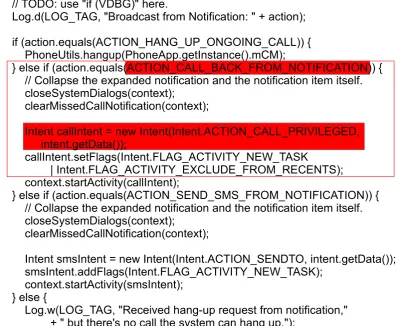
The rest of the thesis outlines our attempt to tackle Android information flow security from the perspective of securing the apps. It is organized as follows: we start by providing the background of this approach in Chapter 3 which contains Barthe et al.’s non-interferent type system for JVM bytecode (Section 3.3). The following chapter outlines the non-interferent type system for DEX (Chapter 4) and shows in Section 4.2 that the DEX type system we proposed enforce non-interference, i.e., if a DEX program is typable then it is non-interferent. We formalize the proof of the type system soundness for a subset of DEX in Coq, and we give more detail on the formalization in Chapter 5
Chapter 6 describes the non-optimized compilation of the dx tool (Section 6.1) and the proof of typability preserving compilation of non-optimized dx tool (Sec-tion 6.2). We also give examples to demonstrate how our methodology is able to detect interference by the failure of typability in Section 4.1.4.
The next section (Section 6.3) provides an overview of the certification frame-work while Section 6.3.1 details each component in the architecture: JVM naive type inference, DEX type checker, certificate translation and certificate structure.
The dissertation chapters are based upon the following published / under sub-mission papers:
• Gunadi, H and Tiu, A. Efficient Runtime Monitoring with Metric Temporal Logic: A Case Study in the Android Operating System. In International Sym-posium on Formal Methods, pp. 296-311. Springer International Publishing, 2014.
• Gunadi, H; Tiu, A; and Gore, R. . Formal certification of android bytecode. arXiv preprint arXiv:1504.01842.
A note about the centralized monitoring is that the initial part of LogicDroid imple-mentation was done in my Master’s thesis. Since then it has been improved in many ways. For example, we streamlined the theory, give correctness proof of the moni-toring algorithm, and we significantly revise the design and the implementation of the monitoring framework due to the problem of implementing hook of the socket, which must be done at the Linux kernel level. As a result of this design improvement, LogicDroid becomes practically usable.
Chapter 2
Efficient Runtime Monitoring with
Metric Temporal Logic
Despite all the security mechanisms mentioned in the introduction, Android is still vulnerable to various attacks. We shall focus mostly on attacks that target the per-mission mechanism at the application level. A weakness in the Android perper-mission mechanism lies in the so-calledpermission leakage problem described in Grace et al. [2012]. In Android, an app can provide a “service” to another app. Through this provision of services, an app can “leak” certain capabilities to an unprivileged app. For example, an app which has access to the ability to make phone calls could act as a proxy for another app. This leads to the problem ofprivilege escalation, i.e., an app obtains a permission it was not granted by exploiting other apps.
Obviously privilege escalation is a common problem of every OS, e.g., when a kernel bug is exploited to gain root access. However, in Android, privilege escalation is possible even when apps are running in the confines of Android sandboxes (see Lineberry et al. [2010]; Davi et al. [2011]; Bugiel et al. [2012]). According to Bugiel et al. [2012], there are two types of attacks that can lead to privilege escalation: the
confused deputy attackand thecollusion attack. In the confused deputy attack, a legit-imate app (the deputy) has permissions to certain services, e.g., sending SMS, and exposes an interface to this functionality without any guards. This interface can then be exploited by a malicious app to send SMS, even though the malicious app does not have the permission. Recent studies, e.g., Lineberry et al. [2010]; Grace et al. [2012]; Chan et al. [2012], show some system and consumer apps expose critical functional-ities that can be exploited to launch confused deputy attacks. The collusion attack requires two or more malicious apps to collaborate. We have yet to encounter such malware, either in the Google Play market or the third party markets, although a proof-of-concept malware with such properties, called SoundComber (Schlegel et al. [2011]), has been constructed.
A recent study by Grace et al. [2012] on major brands of Android phones shows that there are some built-in apps that ship with the phones that expose critical inter-faces without any permission enforcements that can be exploited to perform privilege escalation attack. Even assuming that the app manages to guard all these interface adequately, there still exist simple exploits that cannot be easily fixed, simply because
it will affect users experience significantly. For example, by default, in Android any app can launch the default browser without requiring any permission. With some work, a malicious app can be developed to launch a browser undetected (e.g., when the device screen is off) to leak sensitive data, as demonstrated in Lineberry et al. [2010].
Several security extensions to Android have been proposed to deal with privi-lege escalation attacks (see Dietz et al. [2011]; Felt et al. [2011]; Bugiel et al. [2012]). Unlike these works, we aim at designing a high-level policy language that is expres-sive enough to capture privilege escalation attacks but is also able to express more refined policies (see Section 2.5). Moreover, we aim at designing a lightweight mon-itoring framework, where policy specifications can be modified easily and enforced efficiently. Thus we aim to automate the generation of security monitors from a given policy that can efficiently enforce input policies written in our specification language. On the specific problem of detecting privilege escalation, it is essentially a prob-lem of tracking (runtime) control flow, which is, in general, a difficult probprob-lem and would require a certain amount of static analysis, e.g., Denning and Denning [1977]; Enck et al. [2010]. So we adopt a ‘lightweight’ heuristic to ascertain causal depen-dency between ICC calls: we consider two successive calls, say from A to B, followed by a call from B to C, as causally dependent if they happen within a certain reason-ably short time frame. This heuristic can be easily circumvented if B is a colluding app. So the assumption that we make here is that B is honest, i.e., the confused deputy. For example, a privilege escalation attack mentioned in Lineberry et al. [2010] involves a malicious app, with no permission to access the internet, using the built-in browser (the deputy) to communicate with a server. In our model, the actual connection (i.e., the network socket) is treated as a virtual app, so the browser here acts as a deputy that calls (opens) the network socket on behalf of the malicious app. In such a scenario, it is reasonable to expect that the honest deputy would not inten-tionally delay the opening of sockets. So our heuristic seems sensible in the presence of confused deputy attacks but can be of course circumvented by colluding apps (col-lusion attacks). There is probably no general solution to detect col(col-lusion attacks that can be effective in all cases, e.g., when covert channels are involved (Schlegel et al. [2011]), so we shall restrict to addressing the confused deputy attacks.
The core of our policy language, called RMTL, is essentially a past-fragment of metric linear temporal logic (MTL) (see Alur and Henzinger [1990]; Thati and Rosu [2005]; Basin et al. [2008]). We consider only the fragment of MTL with past-time operators, as this is sufficient for our purpose to enforce history-sensitive access control. This also means that we can only enforce some, but not all, safety properties specified in Lichtenstein et al. [1985], e.g., policies capturing obligations as in, e.g., Basin et al. [2008], cannot be enforced in our framework. Temporal operators are useful in this setting to enforce access control on apps based on histories of their executions; see Section 2.5. Such a history-dependent policy cannot be expressed in the policy languages used in Dietz et al. [2011]; Felt et al. [2011]; Bugiel et al. [2012].
9
with this, we extend MTL with recursive definitions, e.g., one would be able to write a definition such as:
trans(x,y) ∶=call(x,y) ∨ ∃z.⟐ntrans(x,z) ∧call(z,y), (2.1)
where calldenotes the ICC event, and x,y,zdenote the apps. This equation defines
trans as the transitive closure of call. The metric operator ⟐nφ means intuitively φ holds within n time units in the past; we shall see a more precise definition of
the operators in Section 2.3. Readers familiar with modal µ-calculus Bradfield and
Stirling [2007] will note that this is but a syntactic sugar for µ-expressions for (least)
fixed points.
To be practically enforceable in Android, the RMTL monitoring algorithm must satisfy an important constraint, i.e., the algorithm must be trace-length independent
(Bauer et al. [2013]). This is because the number of events generated by Android can range in the thousands per hour, so if the monitor must keep all the events generated by Android, its performance will degrade significantly over time. Another practi-cal consideration also motivates a restriction to metric operators that we adopt in RMTL. More specifically, MTL allows a metric version of the ‘since’ operator of the form φ1 S[m,n) φ2, where [m,n) specifies a half-closed (discrete) time interval from m to n. The monitoring algorithm for MTL in Thati and Rosu [2005] works by first expanding this formula into formulas of the form φ1 S[m′,n′) φ2 where [m′,n′) is a
moving window of the interval (with the minimum value of 0). A similar expansion is also used implicitly in monitoring for first-order MTL in Basin et al. [2008], i.e., in their incremental automatic structure extension in their first-order logic encoding for the ‘since’ and ‘until’ operators. In general, if we have k nested occurrences of metric operators, each with interval [m,n), the number of formulas produced by this expansion is bounded by O(nk) In Android, event timestamps are in millisec-onds, so this kind of expansion is not practically feasible. For example, suppose we have a policy that monitors three successive ICC calls that happen within 10 seconds between successive calls. This requires two nested metric operators with intervals
[0, 104) to specify. The above naive expansion would produce around 108 formulas, and assuming the truth value of each formula is represented with 1 bit, this would require around 100 MB of storage to store all their truth values, something which is not preferable in the setting of smartphones where storage is limited.
An improvement to the expansion mentioned above is proposed in Basin et al. [2012]; Reinbacher et al. [2013], where one keeps a sequence of timestamps for each metric temporal operator occurring in the policy. This solution, although avoids the exponential expansion, is strictly speaking not trace-length independent. This solution seems optimal, so it is hard to improve it without further restriction to the policy language. We show that, if one restricts the intervals of metric operators to the form [0,n), one only needs to keep one timestamp for each metric operator in monitoring; see Section 2.4.
To summarise, our contributions are as follows:
a new logic-based policy language that extends MTL with recursive defini-tions, that avoids exponential expansion of metric operators, and for which the policy enforcement is trace-length independent. In Bauer et al. [2013], a pol-icy language based on first-order LTL and a general monitoring algorithm are given, but they do not allow recursive definitions nor metric operators. Such definitions and operators could perhaps be encoded using first-order constructs (e.g., encoding recursion via Horn clauses, and define timestamps explicitly as a predicate), but the resulting monitoring procedure is not guaranteed to be trace-length independent.
2. Regarding the application domain, ours is the first implementation of a logic-based runtime security monitor for Android that can enforce history-logic-based ac-cess control policies, including those that concern privilege escalations. Our monitoring framework can express temporal and metric-based policies not pos-sible in existing works Dietz et al. [2011]; Felt et al. [2011]; Bugiel et al. [2012].
2.1
Related Work
There is a large body of works in this area, more than what we can reasonably survey here, so we shall focus on the most relevant ones to our work, i.e., those that deal with privilege escalation. For a more comprehensive survey on other security extensions or analysis, the interested reader can consult Backes et al. [2014]. QUIRE, by Dietz et al. [2011], is an application-centric approach to privilege escalation, done by tagging the intent objects with the caller’s UID. Thus, the recipient application can check the permission of the source of the call chain. Felt et al. [2011] propose IPC Inspection, another application-centric solution that works by reducing the privilege of the recipient application when it receives a communication from a less privileged application.
At the time of the development of our solution, the closest work to our solution is XManDroid Bugiel et al. [2012], which is also a system-centric solution just like ours. Its security monitor maintains a call graph between apps. The difference in our solution lies in that we are using temporal logic to specify a policy, and our policy can be modified modularly. This way, a system administrator can have flexibility in designing a policy that is suited to the system in question. Moreover, should an attacker find a way to circumvent the current monitor, we can easily modify the monitor to enforce a different policy that addresses the security hole.
§2.2 Background 11
the connection to the internet only after contact was actually accessed.
TaintDroid Enck et al. [2010] is another system-centric solution, but it is designed to track data flow, rather than control flow, via taint analysis. In this case, we can infer privilege escalation happened from leakage of data.
Since then, there are many solutions developed such as Scippa (Backes et al. [2014]) and IacDroid (Zhang et al. [2016]) which deal with the problem of privilege escalation by maintaining call chain through an extension of the binder mechanism. IEM is also an interesting solution (Yagemann and Du [2016]) although it is not dealing with the problem of privilege escalation directly. Instead, they propose a framework to intercept intents and allows a user space application to specify their own policy, which can be geared toward handling privilege escalation.
Apart from work on monitoring M(FO)TL by Thati and Rosu [2005]; Basin et al. [2008, 2012]; Reinbacher et al. [2013] mentioned in the introduction, it is also worth mentioning prècis (a work by Chowdhury et al. [2014]). In their work, they are con-sidering both past and future fragment of the MFOTL. They first analyze buildable formulas (B formulas) and then incrementally build the summary structures for B formulas. In the case where the formula is not a B formula, it then recursively calls on the sub-formulas and computes the substitutions brute force. Even though this means that prècis has a great capability, we do not really benefit much since we are only considering past fragment of the MTL. Moreover, by considering both intervals for building a summary structure, it is not necessarily trace-length independent, one of the main criteria that we require.
2.2
Background
Linear Temporal Logic
LTL (Blackburn et al. [2007]) is a logic defined in Kripke semantics where each event corresponds to a world. We first need to define LTL formally because we want to use its interpretation of infinite event traces. LTL extends propositional logic with temporal operators. Since we are only interested in the past call events, we only consider the fragment of LTL with past operators. The set of LTL formulas is defined as follows as follows :
φ = ⊺ ∣ ∣ p∈P∣ ¬φ∣φ1∧φ2 ∣φ1∨φ2∣ ●φ∣ ◇−1φ∣φ1Sφ2∣ ⟐−1φ
We do not have◻−1φhere as◻−1φ= ¬ ◇−1¬φ
We view history of calls a sequence of worlds in Kripke semantics. We denote that the 1st world corresponds to the 1st event in the history, 2nd world corresponds to the 2ndevent, and so on. We denote this world as a pair(h,i)wherehis the whole history of the events, and iis the index of an event from the history. For simplicity, we can denote this pair(h,i)in a shorter notation ashi. Index 1 (h1) is used to denote
the initial world where the history is empty.
where we define an event predicate as a predicate whose interpretation may differ for each world, and we define a static predicate as a predicate whose interpretation is fixed. We need this static predicate to express predicates that persists in all the worlds, for example, a predicate that indicates whether an application is a system application.
The semantics of the operators are the following :
- (h,i) ⊧trueis always true
- (h,i) ⊧ f alseis always false
- (h,i) ⊧ p, where p∈P, iff p∈hi
- (h,i) ⊧s, wheres∈S, iffsis true
- (h,i) ⊧ ¬φiff(h,i) ⊭φ
- (h,i) ⊧φ1∧φ2 iff(h,i) ⊧φ1 and(h,i) ⊧φ2
- (h,i) ⊧φ1∨φ2 iff(h,i) ⊧φ1 or(h,i) ⊧φ2
- (h,i) ⊧ ●φiff fori>1,(h,i−1) ⊧φotherwise false
- (h,i) ⊧ ◇−1φiff∃j≤i(h,j) ⊧φ
- (h,i) ⊧ ⟐−1φiff (h,i) ⊧ ● ◇−1φ
- (h,i) ⊧φ1Sφ2 iff∃j≤i(h,j) ⊧φ2, and(h,k) ⊧φ1 for all j<k≤i
The problem of monitoring in our case is essentially a word problem, where we want to check whether a given word contains a “bad” prefix. Here, word corresponds to the history of events. We adopt the approach where we incrementally process the event as they come. More formally, we define the word problem as checking whether for any history (h,i) and an LTL formula Φ, (h,i) ⊧ Φ. Once a “bad” prefix is detected, no matter how the events unfold the property will always be violated. Hence, once an action which causes “bad” prefix is detected, we preempt the execution of such action.
First-Order ExtensionThis extends the LTL described before with first-order quanti-fiers and predicates (see Bauer et al. [2009]; Basin et al. [2010]). In this case, we have a domainD(in this case a list of all applications), list of constantsC, list of predicates
Rwith its arity list A, and variableV, and the universal and existential operators. A constant can be seen as a predicate with zero arity. This extension enables us to state a policy where it applies to all the applications. The semantics of this extension is as follows :
- (h,i) ⊧ p(c1, ...,cn) ∈Piff c1, ...,cn∈Dandp(c1, ...,cn) ∈hi
- (h,i) ⊧ ∀x1,...,xnφiff for allc1, ...,cn∈D,(h,i) ⊧φ[x1∶=c1, ...,xn∶=cn]
§2.3 The policy specification language RMTL 13
Note that the notation φ[x1 ∶= c1, ...,xn ∶= cn] means that for every occurrence of variablex1, ...,xn, they were replaced with the corresponding objectc1, ...,cn∈D
Since we assume that the domain is finite, we can enumerate the quantifiers. That is, we instantiate the variable as the ground truth and treat the formula as a propositional logic formula. Then we will have the existential quantifier as a big disjunction, while the universal quantifier as a big conjunction, over the subformula where every occurrence of the variable is replaced with the object from the domain. Metric ExtensionThe extension of MTL over LTL is that we give each world a time stamp (τi = time stamp at world i) of when it occurred, and add the notation of interval accompanying the temporal operators. The time stamp related to each of the worlds has the property of τi ≤ τj whenever i ≤ j (events in history are sorted according to the time it happened). The form of the interval is [m,n) where m,n
are natural numbers with m < n. m is the lower bound, and n is the upper bound of a formula to be still included in the evaluation (the difference between the time stamp of the worlds). The original LTL is a special case of MTL where the temporal operators havem=0 andn= ∞.
More formally, the semantics of this metric extension are the followings :
- (h,i) ⊧ ●[m,n)φiff fori≥1,(h,i−1) ⊧φandm≤τi−τi−1<n, otherwise false
- (h,i) ⊧ ◇−1[m,n)φiff∃j≤i(h,j) ⊧φandm≤τi−τj <n
- (h,i) ⊧ ⟐[−m1,n)φiff∃j<i(h,j) ⊧φandm≤τi−τj<n
- (h,i) ⊧ φ1S[m,n)φ2 iff ∃j≤i(h,j) ⊧ φ2 and m ≤ τi−τj < n, and (h,k) ⊧ φ1 for all j<k≤i
Note that we explicitly say there are metric operators◇and⟐because they have a subtle difference compared to that of the original LTL one, and we cannot recon-cile the definition by using ⟐ ⇔ ●◇ either. The main difference is due to the time difference to the reference world. Let’s say that we have(h,i) ⊧φ, then we will have
(h,j) ⊧ ●[0,10]◇[0,10]φbut(h,j) ⊭ ⟐[0,10]φfor j>i,τi=0, andτj=10.
In the following, we will discuss the modifications to the logic so that we can accommodate the requirements to track transitivities and be able to do so efficiently. Then, we will describe the decision procedure to process the incoming events. We will extend the approach to dynamic programming in Thati and Rosu [2004] for this monitoring process. We will do this inductively, where the base case is when the first world (h1) is created before receiving any input. In the case of handling recursive
definition, since it is "guarded" and is processed for every incoming event, we can treat it as a normal predicate within the temporal operator.
2.3
The policy specification language RMTL
of LTL (Pnueli [1977] ) is defined in terms of models which are sequences of states (or worlds). In our case, we restrict to finite sequences of states. MTL extends LTL models by adding timestamps to each state and adding temporal operators that incorporate timing constraints. For example, MTL features temporal operators such as◇[0,3)φwhich expresses thatφholds in some state in the future, and the timestamp
of that world is within 0 to 3-time units from the current timestamp. We restrict to a model of MTL that uses discrete time, i.e., timestamps, in this case, are non-negative integers. We shall also restrict to the past-time fragment of MTL.
We extend MTL with two additional features: first-order quantifiers and recursive definitions. Our first-order language is a multi-sorted one. We consider only two sorts, which we call prop(for ‘properties’) andapp(for denoting applications). Sorts are ranged over by α. We first fix a signature Σ for our first-order language, which
is used to express terms and predicates of the language. We consider only constant symbols and predicate symbols, but no function symbols. We distinguish two types of predicate symbols: defined predicates and undefined ones. The defined predicate symbols are used to write recursive definitions, and to each of such symbols, we associate a formula as its definition.
Constant symbols are ranged over bya,b, andc, undefined predicate symbols are ranged over by p, q, and r, and defined predicate symbols are ranged over by P, Q, and R. We assume an infinite set of sorted variablesV, whose elements are ranged over byx, y, and z. We sometimes write xα to say that α is the sort of variable x. A Σ-termis either a constant symbolc∈Σor a variablex∈ V. We uses,t, anduto range over terms. To each symbol inΣ, we associate a sort information. We shall writec∶α
whencis a constant symbol of sort α. A predicate symbol of arity nhas sort of the
formα1× ⋯ ×αn, and such a predicate can only be applied to terms of sortsα1, . . . ,αn.
Constant symbols are used to express permissions in the Android OS, e.g., read-ing contacts, sendread-ing SMS, etc., and user ids of apps. Predicate symbols are used to express events such as ICC calls between apps, and properties of an app, such as whether it is a system app, a trusted app (as determined by the user). As standard in first-order logic (see e.g., Fitting [1996]), the semantics of terms and predicates are given in terms of a first-order structure, i.e., a set Dα, called a domain, for each
sortα, and an interpretation function I assigning each constant symbol c∶α∈Σ an
element of cI ∈ Dα and each predicate symbol p ∶ α1× ⋯ ×αn ∈ Σ an n-ary relation
pI ⊆ Dα1× ⋯ × Dαn. We shall assume constant domains in our model, i.e., every world
has the same domain.
We define the formulas of RMTL via the following grammar:
F∶= ∣ p(t1, . . . ,tm) ∣P(t1, . . . ,tn) ∣F∨F∣ ¬F∣ ●F∣FSF∣ ⧫F∣ ⟐F∣
●nF∣FSnF∣ ⧫nF∣ ⟐nF∣ ∃αx.F
where m and n are natural numbers. The existential quantifier is annotated with a sort information α. For most of our examples and applications, we only quantify
§2.3 The policy specification language RMTL 15
general MTL operators in Thati and Rosu [2004], where intervals can take the form
[m,n), forn≥m≥0. We useφ,ϕandψto range over formulas. We assume that unary
operators bind stronger than the binary operators, so●φ∨ψmeans(●φ)∨ψ. We write φ(x1, . . . ,xn) to denote a formula whose free variables are among x1, . . . ,xn. Given such a formula, we writeφ(t1, . . . ,tn)to denote the formula obtained by replacingxi withti for everyi∈ {1, . . . ,n}.
To each defined predicate symbolP∶α1×⋯×αn, we associate a formulaφP, which we call the definition of P. Notationally, we write P(x1, . . . ,xn) ∶= φp(x1, . . . ,xn). We require that φP isguarded, i.e., every occurrence of any recursive predicate Q in φP is prefixed by either ●, ●m, ⟐ or ⟐n. This guardedness condition is important to guarantee termination of recursion in model checking.
Given the above logical operators, we can define additional operators via their negation, e.g.,⊺is defined as¬,φ∧ψis defined as¬(¬φ∨ ¬ψ), φ→ψis defined as
¬φ∨ψ, and∀αx.φis defined as¬(∃αx.¬φ), etc.
Before proceeding to the semantics of RMTL, we first define a well-founded or-dering on formulae of RMTL, which will be used later.
Definition 2.3.1. We define a relation≺Son the set RMTL formulae as the smallest relation
satisfying the following conditions:
1. For any formulaφof the form p(⃗t),,●ψ,●nψ,⟐ψand⟐nψ, there is noφ′such that φ′≺Sφ.
2. For every recursive definition P(⃗x) ∶=φP(⃗x), we haveφP(⃗t) ≺SP(⃗t)for every terms⃗t.
3. ψ≺Sψ∨ψ′,ψ≺Sψ′∨ψ,ψ≺S¬ψ, andψ≺S∃x.ψ.
4. ψi≺Sψ1Sψ2, andψi≺Sψ1Snψ2, for i∈ {1, 2}
We denote with≺the reflexive and transitive closure of≺S.
Lemma 2.3.1. The relation≺on RMTL formulas is a well-founded partial order.
Proof. We first show that ≺ is well-founded. Suppose otherwise: then there is an infinite descending chain of formulas:
⋯ ≺Sφn≺Sφn−1≺S⋯ ≺Sφ2≺Sφ1.
Obviously, none of theφi’s can be a bottom element (i.e., those that take the form as
specified in clause (1) of Definition 2.3.1). Furthermore, there must be anisuch that
φi=P(⃗t)andφi+1=φP(⃗t)wherePis a recursive predicate defined byP(⃗x) ∶=φP(⃗x). If no suchiexists then all the instances of the relation≺Sin the chain must be instances of clause (3) and (4) in Definition 2.3.1, and the chain would be finite as those two clauses relate only strict subformulas. So without loss of generality, let us assume that φ1 = P(⃗t). We claim that for every j > 1, every occurrence of any recursive
predicate in φj is guarded. We prove this by induction on j. If j= 2 then we have
hypothesis, all recursive predicates in φj−1 are guarded. In this case, the relation
φj≺Sφj−1must be an instance of either clause (3) or clause (4) of Definition 2.3.1, and
thereforeφj also satisfies the guardedness condition.
So now we have that none of φi’s is recursive predicates. This means that all instances of≺Sin the chain must be instances of clause (3) and (4) in Definition 2.3.1, and consequently, the size of the formulas in the chain must be strictly decreasing. Thus the chain cannot be infinite, contrary to the assumption.
Anti-symmetry follows immediately from well-foundedness. Suppose ≺ is not anti-symmetric. Then we have a chain
φ=φ1≺Sφ2≺Sφ3≺S⋯ ≺Sφn=φ
where n >1. We can repeat this chain to form an infinite descending chain, which contradicts the well-foundedness of≺.
For our application, we shall restrict to finite domains. Moreover, we shall restrict to an interpretation I which is injective, i.e., mapping every constant c to a unique element ofDα. In effect we shall be working in the term model, so elements ofDαare
just constant symbols fromΣ. So we shall use a constant symbol, say c∶α, to mean
bothc∈ΣandcI ∈ Dα. With this fix interpretation, the definition of the semantics (i.e.,
the satisfiability relation) can be much simplified, e.g., we do not need to consider valuations of variables. A state is a set of undefined atomic formulas of the form
p(c1, . . . ,cn). Given a sequence σ, we write ∣σ∣to denote its length, and we write σi to denote the i-th element of σ when it is defined, i.e., when 1≤i≤ ∣σ∣. Amodel is a
pair(π,τ) of a sequence ofstatesπ and a sequence oftimestamps, which are natural
numbers, such that∣π∣ = ∣τ∣andτi ≤τj wheneveri≤j.
The restriction to the application domain is good enough for our purpose since we assume that during a monitor run, the applications will be relatively constant. In the case where there is an update, i.e., there an app installed / uninstalled, then the monitor is reloaded to accommodate the change in the domain.
Let < denote the total order on natural numbers. Then we can define a well-order on pairs(i,φ) of natural numbers and formulas by taking the lexicographical
ordering (<,≺). The satisfiability relation between a model ρ = (π,τ), a world i ≥ 1
(which is a natural number) and aclosedformulaφ(i.e.,φcontains no free variables),
written(ρ,i) ⊧φ, is defined by induction on the pair(i,φ)as follows, where we write
(ρ,i) /⊧φwhen(ρ,i) ⊧φis false.
• (ρ,i) /⊧
• (ρ,i) ⊧ ¬φiff(ρ,i) /⊧φ.
• (ρ,i) ⊧ p(c1, . . . ,cn)iff p(c1, . . . ,cn) ∈πi.
• (ρ,i) ⊧P(c1, . . . ,cn)iff(ρ,i) ⊧φ(c1, . . . ,cn) whereP(⃗x) ∶=φ(⃗x).
§2.3 The policy specification language RMTL 17
• (ρ,i) ⊧ ●φiff i>1 and(ρ,i−1) ⊧φ.
• (ρ,i) ⊧ ⧫φiff there exists j≤is.t. (ρ,j) ⊧φ.
• (ρ,i) ⊧ ⟐φiffi>1 and there exists j<is.t. (ρ,j) ⊧φ.
• (ρ,i) ⊧φ1Sφ2 iff there exists j≤isuch that(ρ,j) ⊧φ2 and(ρ,k) ⊧φ1 for every
k s.t. j<k≤i.
• (ρ,i) ⊧ ●nφiffi>1,(ρ,i−1) ⊧φandτi−τi−1<n.
• (ρ,i) ⊧ ⧫nφiff there existsj≤is.t. (ρ,j) ⊧φandτi−τj<n.
• (ρ,i) ⊧ ⟐nφiffi>1 and there exists j<is.t. (ρ,j) ⊧φandτi−τj<n.
• (ρ,i) ⊧ φ1 Snφ2 iff there exists j≤isuch that (ρ,j) ⊧φ2, (ρ,k) ⊧φ1 for everyk
s.t. j<k≤i, andτi−τj<n.
• (ρ,i) ⊧ ∃αx.φ(x)iff there existsc∈ Dα s.t. (ρ,i) ⊧φ(c).
Note that due to the guardedness condition in recursive definitions, our semantics for recursive predicates is much simpler than the usual definition as in µ-calculus,
which typically involves the construction of a (semantic) fixed point operator. Note also that some operators are redundant, e.g.,⧫φcan be defined as⊺Sφ, and⟐φcan
be defined as ●⧫φ. This holds for some metric operators, e.g., ⧫nφ and⟐nφcan be
defined as, respectively,⊺Snφand
⟐nφ= ⋁
i+j=n●i⧫j
φ (2.2)
This operator will be used to specify an active call chain, as we shall see later, so it is convenient to include it in our policy language.
In the next section, we shall assume that ⧫, ⟐, ⧫n are derived connectives. Since we consider only finite domains,∃αx.φ(x)can be reduced to a big disjunction⋁c∈Dαφ(c), so we shall not treat the∃-quantifier explicitly. This can be problematic if the domain of quantification is big, as it suffers the same kind of exponential explosion as with the expansion of metric operators in MTL Thati and Rosu [2005]. We shall defer the explicit treatment of quantifiers to future work.
model of RMTL can be presented as follows:
E2 E3 E4 E5
E1 E6 …………..
System generated events
t2 t3 t4 t5
t1 t6
Timestamps of events
Each dot represents a time point in the timeline. At each time point, we keep two kinds of information: the event that takes place at that particular time point, and the timestamp of that event. Given such a model, we can then specify certain relations between events in the timeline, from the perspective of a particular time point (e.g., the present time). The operators of RMTL provides the building blocks to specify a rich collection of patterns of relations one can specify. We give a couple of examples next.
For the first example, consider the formula⟐50D. Intuitively, this formula states
that event Dwas observed sometime in the past within 50-time units from the pres-ence. Graphically, this is illustrated as follows:
Temporal Operators
A B D C C
B must happen sometime, within 50 seconds, in the
future.
Current time point (the present)
C
10:30 10:35 11:00 11:05 11:30 11:35
§2.4 Trace-length independent monitoring 19
calls, as represented in the following model:
Recursive Patterns
call(a,b) E F G
10:30 10:35 10:38 10:47 11:30 11:35
call(b,c) call(c,d)
How do we express the pattern that there is a chain of IPC
calls from a to d, and each call happened within 10 seconds?
The policy language needs to support
recursion
.
In this case, there is a call chain, starting with a and ending in d, such that each successive call happened within 10-time units. One can imagine a generalization of this case to an arbitrary number of successive calls that are chained together. To deal with such a possibility, we introduce a notion of recursive definition. In this case, we create a new predicate, called trans, that effectively defines the transitive closure of thecallevents. This can be expressed in RMTL as follows:
trans(x,y) ∶=call(x,y) ∨ ∃z.⟐ntrans(x,z) ∧call(z,y)
where nis a time interval. Intuitively, this definition of trans(x,y) says that there is a call chain from x toy if and only if either xcalls ydirectly, or there is a call chain fromx to somez, and there is a direct call fromztoy.
2.4
Trace-length independent monitoring
The problem of monitoring is essentially a problem of model checking, i.e., to decide whether (ρ,i) ⊧ φ, for any given ρ = (π,τ), i and φ. In the context of Android
runtime monitoring, a state in π can be any events of interest that one would like
to capture, e.g., ICC call events, queries related to location information or contacts, etc. To simplify discussions, and because our main interest is in privilege escalation through ICC, the only type of event we consider in π is the ICC event, which we
model with the predicatecall∶app×app.
Given a policy specification φ, a naive monitoring algorithm that enforces this
policy would store the entire event historyπ and every time a new event arrives at
timet, it would check(([π;e],[τ;t]),∣ρ∣ +1) ⊧φ. where ; denotes concatenation. This
is easily shown decidable but is of course rather inefficient. In general, the model checking problem for RMTL (with finite domains) can be shown to be PSPACE-hard following the same argument as in Bauer et al. [2009]. One of the design criteria of RMTL is that enforcement of policies does not depend on the length of history of events, i.e., at any time the monitor only needs to keep track of a fixed number of states. Following Bauer et al. [2013], we call a monitoring algorithm that satisfies this propertytrace-length independent.
algo-rithm by Havelund and Rosu [2002], which depends only on two states in a his-tory. That is, satisfiability of (ρ,i+1) ⊧ φ is a boolean function of satisfiability of
(ρ,i+1) ⊧ ψ, for every strict subformula ψof φ, and satisfiability of (ρ,i) ⊧ ψ′, for
every subformula ψ′ of φ. This works for PTLTL because the semantics of
tempo-ral operators in PTLTL can be expressed in a recursive form, e.g., the semantics of
S can be equally expressed as Havelund and Rosu [2002]: (ρ,i+1) ⊧ φ1 S φ2 iff
(ρ,i+1) ⊧φ2, or(ρ,i+1) ⊧φ1 and(ρ,i) ⊧φ1Sφ2. This is not the case for MTL. For
example, satisfiability of the unrestricted ‘since’ operator S[m,n) can be equivalently expressed as:
(ρ,i+1) ⊧φ1S[m,n)φ2iff m=0,n>1, and(ρ,i+1) ⊧φ2, or
(ρ,i+1) ⊧φ1 and(ρ,i) ⊧φ1S[m′,n′)φ2
(2.3)
where m′ =min(0,m−τi+1+τi) and n′ =min(0,n−τi+1+τi). Since τi+1 can vary, the value ofm′ andn′ can vary, depending on the historyρ. We avoid the expansion of
metric operators in monitoring by restricting the intervals in the metric operators to the form[0,n). We show that clause (2.3) can be brought back to a purely recursive form. The key to this is the following lemma:
Lemma 2.4.1(Minimality). If(ρ,i) ⊧φ1Sn φ2[(ρ,i) ⊧ ⟐nφ] then there exists an m ≤n
such that(ρ,i) ⊧φ1Sm φ2[resp.(ρ,i) ⊧ ⟐mφ] and such that for every k such that0<k<m,
we have(ρ,i) /⊧φ1Skφ2 [resp.,(ρ,i) /⊧ ⟐kφ].
Proof. We show a case for (ρ,i) ⊧ φ1 Sn φ2; the other case is straightforward. We
prove this by induction oni.
• Base case:i=1. Since(ρ,i) ⊧φ1Snφ2, it must be the case that(ρ,i) ⊧φ2. In this
case, letm=1. Obviously(ρ,i) ⊧φ1Smφ2andmis minimal.
• Inductive case: i > 1. We have (ρ,i) ⊧ φ1 Sn φ2. By the definition of ⊧, there
exists j ≤ i such that (ρ,j) ⊧ φ2 and (ρ,k) ⊧ φ1 for every k s.t. j < k ≤ i and
τi−τj <n. If (ρ,i) ⊧φ2, then we have (ρ,i) ⊧φ1 S1 φ2. In this case, let m=1. If
(ρ,i) /⊧φ2, then it must be the case thatj<i. It is not difficult to see that in this
case, we must have
(ρ,i−1) ⊧φ1Sn−(τi−τi−1)φ2.
By the induction hypothesis, we have there is anm′ such that
(ρ,i−1) ⊧φ1Sm′ φ2
and for every l s.t. l < m′, we have (ρ,i−1) /⊧ φ1 Sl φ2. In this case, we let m=m′+τi−τi−1. It is straightforward to check that(ρ,i) ⊧φ1Sm φ2.
Now, we claim that thismis minimal. Suppose otherwise, i.e., there existsk<m
s.t. (ρ,i) ⊧φ1Sk φ2. Since(ρ,i) /⊧φ2, we must have(ρ,i−1) ⊧φ1Sk−(τi−τi−1) φ2.
§2.4 Trace-length independent monitoring 21
Lemma 2.4.2 (Monotonicity). If (ρ,i) ⊧ φ1 Sn φ2 [resp.,(ρ,i) ⊧ ●nφand(ρ,i) ⊧ ⟐nφ]
then for every m≥n, we have(ρ,i) ⊧φ1Sm φ2[resp.,(ρ,i) ⊧ ●mφand(ρ,i) ⊧ ⟐mφ].
Proof. Straightforward from the definition of⊧.
Given ρ,iandφ, we define a functionmas follows:
m(ρ,i,φ) = { m, ifφis eitherφ1Snφ2 or⟐nφ
′and(ρ,i) ⊧φ,
0, otherwise.
where m is as given in Lemma 2.4.1; we shall see how its value is calculated in Algorithm 3. The following theorem follows from Lemma 2.4.1.
Theorem 2.4.1(Recursive forms). For every modelρ, every n≥1,φ,φ1andφ2, and every
1<i≤ ∣ρ∣, the following hold:
1. (ρ,i) ⊧ φ1 Sn φ2 iff(ρ,i) ⊧ φ2, or(ρ,i) ⊧φ1 and(ρ,i−1) ⊧φ1Snφ2 and n− (τi−
τi−1) ≥m(ρ,i−1,φ1Snφ2).
2. (ρ,i) ⊧ ⟐nφiff(ρ,i−1) ⊧φandτi−τi−1<n, or(ρ,i−1) ⊧ ⟐nφand n− (τi−τi−1) ≥
m(ρ,i−1,⟐nφ).
Proof. We show the case forSn; the other case is similar.
Suppose(ρ,i) ⊧φ1Snφ2. By definition, there exists j≤isuch that
(ρ,j) ⊧φ2, (2.4)
τi−τj≤n, (2.5)
and for everyks.t. j<k≤iwe have
(ρ,k) ⊧φ1, (2.6)
Suppose that the right-hand side of iff doesn’t hold, i.e., we have(ρ,i) /⊧φ2, and that
one of the following hold:
• (ρ,i) /⊧φ1,
• (ρ,i−1) /⊧φ1Snφ2, or
• n− (τi−τi−1) <m(ρ,i−1,φ1Snφ2).
The first case contradicts our assumption in (2.6), so it cannot hold. Note that since
(ρ,i) /⊧ φ2, it must be the case that j≤i−1, so (2.4), (2.5), and (2.6) above entail that
(ρ,i−1) ⊧φ1Snφ2, so the second case can’t hold either. For the third case: from (2.5)
we haveτi−τj= (τi−τi−1) + (τi−1−τj) ≤nso
Algorithm 1 Monitor(ρ,i,φ)
Init(ρ,φ,prev,cur,mprev,mcur)
for j=1 to ido
Iter(ρ,j,φ,prev,cur,mprev,mcur);
return cur[idx(φ)];
This, together with (2.4) and (2.5), implies that(ρ,i−1) ⊧φ1Sn−(τi−τi−1)φ2. Ifn− (τi−
τi−1) <m(ρ,i−1,φ1Snφ2)holds, then it would contradict the fact thatm(ρ,i−1,φ1Sn
φ2)is the minimal index as guaranteed by Lemma 2.4.1. Hence the third case cannot
hold either.
For the other direction, suppose that either of the following holds:
• (ρ,i) ⊧φ2, or
• (ρ,i) ⊧φ1 and(ρ,i−1) ⊧φ1Snφ2 andn− (τi−τi−1) ≥m(ρ,i−1,φ1Snφ2).
If it is the first case, i.e.,(ρ,i) ⊧φ2, then trivially(ρ,i) ⊧φ1Snφ2. So suppose it is the
second case. By Lemma 2.4.1, we have(ρ,i−1) ⊧φ1Smφ2, wherem=m(ρ,i−1,φ1Sn
φ2). Since n− (τi−τi−1) ≥ m, by Lemma 2.4.2, we have (ρ,i−1) ⊧ φ1 Sn−(τi−τi−1) φ2.
This means there existsj≤i−1 such that
• (ρ,j) ⊧φ2,
• (τi−1−τj) ≤n− (τi−τi−1), and
• (ρ,k) ⊧φ1, for everyks.t. j<k≤i−1.
The second item implies that(τi−τj) ≤ n. These and the fact that (ρ,i) ⊧φ1 entail
that(ρ,i) ⊧φ1Snφ2.
Given Theorem 2.4.1, we can adapt the monitoring algorithm for PTLTL in Havelund and Rosu [2002], but with an added data structure to keep track of the functionm. In the following, given a formula φ, we assume that ∃, ⧫ and⟐have been replaced
with its equivalent form as mentioned in Section 2.3.
Given a formulaφ, letSub(φ)be the set of subformulas ofφ. We define a closure
setS∗(φ)ofφas follows: LetSub0(φ) =Sub(φ), and let
Subn+1(φ) =Subn(φ) ∪ {Sub(φP(⃗c)) ∣P(⃗c) ∈Subn(φ), andP(⃗x) ∶=φP(⃗x)}
and define Sub∗(φ) = ⋃n≥0Subn(φ). Since Dα is finite, Sub∗(φ)is finite, although its
size is exponential in the arities of recursive predicates. For our specific applications, the predicates used in our sample policies have at most arity of two (for tracking transitive calls), so this is still tractable. In future work, we plan to investigate ways of avoiding this explicit expansion of recursive predicates.
We now describe how monitoring can be done for φ, given ρ and 1≤ i≤ ∣ρ∣. We
assume implicitly a preprocessing step where we compute Sub∗(φ); we do not