
promoting access to White Rose research papers
White Rose Research Online
[email protected]
Universities of Leeds, Sheffield and York
http://eprints.whiterose.ac.uk/
This is a final published version of a paper accepted for publication in Statistics
& Probability Letters.
White Rose Research Online URL for this paper:
http://eprints.whiterose.ac.uk/42948/
Paper:
Di Marzio, M, Panzera, A and Taylor, CC (2009)
Local polynomial regression for
circular predictors.
Statistics & Probability Letters, 79 (19). 2066 – 2075.
Local polynomial regression for circular predictors
Marco Di Marzioa, Agnese Panzeraa, Charles C. Taylorb,1
aDMQTE, Universit`a di Chieti-Pescara, Viale Pindaro 42, 65127 Pescara, Italy.
bDepartement of Statistics, University of Leeds, Leeds LS2 9JT, UK.
Abstract
We consider local smoothing of datasets where the design space is the d-dimensional (d≥1) torus and the response
variable is real-valued. Our purpose is to extend least squares local polynomial fitting to this situation. We give both theoretical and empirical results.
Key words: Circular data, circular kernels, von Mises weight function, weighted least squares. 2000 MSC: 62G07 - 62G08 - 62G20
1. Introduction
A circular observation can be regarded as a point on the unit circle, or a direction in the plane. Once an initial direction and an orientation of the unit circle have been chosen, any circular observation may be represented by an
angleθ∈ [0,2π). Typical examples include flight direction of birds from a point of release, wind and ocean current
direction, energy demand over a period of 24 hours when the measurements are taken over a time interval much longer
than the day and when the times of the day are recorded. A circular observation is periodic, i.e.,θ =θ+2mπfor
m∈Z. This periodicity sets apart circular statistical analysis from standard real-line methods. Recent accounts are
given by Jammalamadaka & SenGupta (2001) and Mardia & Jupp (1999).
A much less studied subject is local regression in the case of circular predictors and real-valued responses. Its practical relevance is easily seen when considering the analysis of meteorological data, or more generally in earth
and environmental sciences. Silverman (1986, sec. 2.10) suggests fitting data replicated along the interval [−2π,4π),
with a smoothing degree depending on the original sample size. The only alternative approach appears to be periodic smoothing splines, introduced by Cogburn & Davis (1974). Nothing specific and reasonably simple appears to exist for the high-dimensional case, although this seems needed in many applications. For example, it could be of interest to predict ozone concentration given the wind directions at 6am and at noon. In this example, the number of angles
is d = 2, but this could easily be extended by considering more locations or time points for the explanatory wind
directions; see Mardia & Jupp (1999, pp. 1–12) for further examples.
In this paper we extend least squares local polynomial fitting (Ruppert & Wand 1994, for example) to the case
when a design pointθis a vector of angles (θ1,· · ·, θd)T∈[0,2π)d, and the response is real-valued. Geometrically,θ
identifies a point of a d-dimensional torus made of the cartesian product of d unit circles. Our strategy is twofold. We
i) introduce a class of circular weight functions (or kernels), and ii) locally approximate the design density and the
regression function by the pth degree polynomial
β0+ d
X
j=1 p
X
t=1
βjtsint(· −θj). (1)
Point ii) is motivated by the fact that the difference between two angular observations needs to be minimal at 2mπ,m∈
Z. Moreover, because sin(θ)⋍θasθtends to 0, the polynomial (1) satisfies a Taylor series interpretation.
Email addresses:[email protected](Marco Di Marzio),[email protected](Agnese Panzera),
[email protected](Charles C. Taylor)
1Corresponding author
In Section 2 we define the kernels suitable for our polynomial fitting, and explore their efficiency properties. In
Section 3 we consider the local linear (p=1) regression estimator, along with conditional mean squared error and
optimal smoothing. We also extend the analysis, for univariate predictors, to general p. Finally, Section 4 contains a small simulation study to illustrate the finite sample behaviour of the results.
2. Circular kernels
2.1. Definitions
We introduce our kernels in the one-dimensional setting. Such an approach seems adequate in that we will use as weight functions products of univariate kernels, as the torus geometry allows for.
Definition 1. (Circular kernels of order r) A circular kernel, of order r and concentration (smoothing) parameter
κ >0, is a function Kκ: [0,2π)→Rsuch that
i) it admits, atθ∈[0,2π), a convergent Fourier series representation 1/(2π){1+2P∞
j=1γj(κ) cos( jθ)};
ii) denotingηj(Kκ) :=
R2π
0 sin j(θ)K
κ(θ)dθ, then
η0(Kκ)=1, ηj(Kκ)=0 for 0< j<r, and ηr(Kκ),0 ;
iii) asκincreasesR−ǫǫKκ(θ)dθtends to 1 forǫ∈(0, π) .
Condition i) specifies that the kernel is symmetric around the null mean direction. The quantityηj(Kκ) in ii) plays
a similar rˆole as the jth moment of a symmetric kernel in the linear theory, being zero if j is odd.
Remark 1. Most of the usual circular densities, which are symmetric about the null mean direction, are included in
Definition 1 as second-order kernels – this includes the kernel uniform on [−π/{κ+1}, π/{κ+1}). Dirichlet and Fej´er
kernels
Dκ(θ) :=
sin({κ+1/2}θ)
2πsin(θ/2) , Fκ(θ) :=
1
2π(κ+1)
"
sin({κ+1}θ/2)
sin(θ/2)
#2
, κ∈N
are both circular kernels. In particular, Dκhas orderκ+1 ifκis odd, andκ+2 otherwise, while Fκhas order 2.
Remark 2. Our order definition is consistent with the techniques used for obtaining higher order kernels starting
from second-order ones. As an instance, we apply a technique of Lejeune&Sarda (1992), to get a result useful in Theorem 4. Given a second-order circular kernel Kκ, let Eℓ be a matrix of orderℓ+1 with (i,j) entry given by
ηi+j−2(Kκ), and Uℓbe the same as Eℓwith the first column replaced by{1,sin(θ),· · ·,sinℓ(θ)}T. Then
K(ℓ)(θ) :=
|Uℓ| |Eℓ|Kκ(θ),
is a circular kernel of orderℓ+1 whenℓis odd, and of orderℓ+2 otherwise.
Remark 3. The univariate setting allows for a comparison with previous work. Our kernels include kernels on the
sphere which are functions ofκ{1−cos(θ)}studied by Beran (1979), Hall et al. (1987), Bai et al. (1988) and Klemel¨a (2000). However, the kernels Dκ, Fκand the wrapped Cauchy are not of this latter form, yet fulfil the conditions of
Definition 1.
2.2. Kernel efficiency
We discuss the efficiency of our kernels in the density estimation setting to allow easy comparisons with the
standard theory.
Definition 2. (Kernel circular density estimator) LetΘ1,· · ·,Θn be a random sample from a bounded, continuous
circular density f . Given a circular kernel Kκ, the kernel estimator of f atθ∈[0,2π) is defined as
ˆ
f (θ;κ) :=1
n
n
X
i=1
Kκ(θ−Θi). (2)
The efficiency theory of euclidean kernels (p. 42 Silverman 1986, for example) is based on the fact that the
bandwidth and the kernel have separable contributions to the mean integrated squared errorMISE[ ˆg] :=R E[( ˆg−g)2]≡
R
(E[ ˆg]−g)2+R Var[ ˆg], where ˆg gives the kernel estimate of the curve g at a point of the domain. Unfortunately, this
is not the case for theMISEof (2). In fact, we have
Theorem 1. Given a random sampleΘ1,· · ·,Θn drawn from a density f , let ˆf (· ;κ) be the kernel circular density
estimator equipped with the second-order kernel Kκ, if
i) limn→∞γj(κ)=1, for each j∈Z
+
;
ii) limn→∞n−1P∞j=1γ2j(κ)=0;
iii) f′′is continuous and square-integrable;
then
MISEhf (·ˆ ;κ)i= 1
16{1−γ2(κ)}
2
Z 2π
0
f′′
(θ)2dθ+
1+2P∞
i=1γ2j(κ)
2nπ +o(1),
Proof. See Appendix.
Remark 4. The MISEof Hall et al. (1987) is very similar to that above. For example, consider the von Mises
kernel, for whichγj(κ) :=Ij(κ)/I0(κ),Ij(·) being the modified Bessel function of the first kind and order j. Using
the notation of (3.7) in Hall et al. (1987), we have: c20(κ)c2(κ)=I0(2κ)/[2π{I0(κ)}2]={1+2P∞i=1γ 2
j(κ)}/(2π) and
1−c0(κ)c1(κ)=1− I1(κ)/I0(κ)=1−γ1(κ), consequently their asymptoticMISEdiffers from the leading terms in
the aboveMISEof an order of O(κ−4) .
In our efficiency analysis we need
Result 1. LetΘ1,· · ·,Θn be a random sample from a circular density f having Fourier series expansion f (θ) =
1/(2π)[1+2P∞
j=1{αjcos( jθ)+δjsin( jθ)}] for θ∈[0,2π). Then
MISEhf (·ˆ ;κ)i= 1 π
∞
X
j=1
{γj(κ)−1}2(α2j+δ 2
j)+
1
nπ
∞
X
j=1
γ2j(κ)(1−α2j−δ2j).
Without loss of generality we can suppose that the mean direction is 0, and we consider only densities and kernels
which are fully specified by their concentration parameters, respectively denoted asρandκ. For the above
decom-position, when considering the (relative) efficiency of two circular kernels, the smoothing parameters do not “cancel”
and so their equivalence needs first to be established as follows. For fixedρand n, we can obtainκto minimizeMISE
for a given kernel function. The efficiency of one kernel relative to another may then be measured by taking the ratio
of the minimizedMISEs.
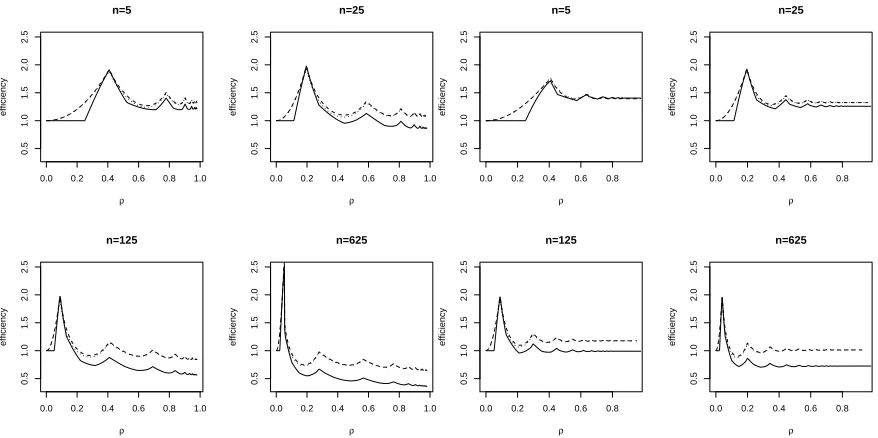
As the Dirichlet kernel (γj(κ)=1{j≤κ}) is of higher order forκ >1 — and so expected to be asymptotically more
efficient — we have measured the efficiency of other kernels relative to this one. In Figure 1 we show the relative
efficiency of the von Miseswrapped normal (γj(κ) = κj
2
), and Fej´er (γj(κ) = 1{j≤κ}(κ+1− j)/(κ+1)) kernels for
n = 5,25,125,625 for the von Mises and wrapped Cauchy (αj = ρj;δj = 0) distributions. Not surprisingly, the
wrapped Normal and von Mises kernels are very similar, and both are better than the Fej´er kernel. For small n, the
von Mises kernel is more efficient that the Dirichlet kernel; markedly so for the Cauchy distribution, or for data with
low concentration.
3. Local polynomial regression
3.1. Linear fitting with von Mises based kernels
Consider the dataset{(Θi,Yi),i = 1,· · ·,n}, whereΘi := (Θi1,· · ·,Θid)T, and Yi ∈ Rare both observable,
ab-solutely continuous, random variables taking values respectively in [0,2π)dand
R. ¿From now on we will assume
that
Yi=m(Θi)+σ(Θi)εi, i=1,· · ·,n
0.0 0.2 0.4 0.6 0.8 1.0 0.5 1.0 1.5 2.0 2.5 n=5 ρ efficiency
0.0 0.2 0.4 0.6 0.8 1.0
0.5 1.0 1.5 2.0 2.5 n=25 ρ efficiency
0.0 0.2 0.4 0.6 0.8 1.0
0.5 1.0 1.5 2.0 2.5 n=125 ρ efficiency
0.0 0.2 0.4 0.6 0.8 1.0
0.5 1.0 1.5 2.0 2.5 n=625 ρ efficiency
0.0 0.2 0.4 0.6 0.8
0.5 1.0 1.5 2.0 2.5 n=5 ρ efficiency
0.0 0.2 0.4 0.6 0.8
0.5 1.0 1.5 2.0 2.5 n=25 ρ efficiency
0.0 0.2 0.4 0.6 0.8
0.5 1.0 1.5 2.0 2.5 n=125 ρ efficiency
0.0 0.2 0.4 0.6 0.8
[image:5.595.80.519.108.327.2]0.5 1.0 1.5 2.0 2.5 n=625 ρ efficiency
Figure 1: Relative efficiency of Fej´er (——), wrapped normal (- - - - -), and von Mises (· · ·) kernels to the Dirchlet kernel, for various values of n. With respect to the underlying true density, the left group corresponds to the von Mises distribution withρ=I1(ν)/I0(ν), while the right group
corresponds to the wrapped Cauchy distribution.
whereσ2(·) is the conditional variance of Y andε
is are real-valued random variables with zero mean and unit variance.
Our objective is to construct an estimator of m(θ) as a function of the dataset when bothΘis andεis are i.i.d..
LetPθ(·;β) :=β0+Pdj=1βjsin(· −θj), and suppose that m(ψ) ≃ Pθ(ψ;β) forψin a neighborhood ofθ. Here
Pθ(θ;β)=β0, which motivates estimating m(θ) by ˆβ0. Recalling that for very small values ofθwe have sin(θ)≃θ,
then a Taylor series expansion justifies both ˆβ0and the values ˆβj, j=1,· · ·,d, as estimates of the partial derivatives
βj =∂m(θ)/∂θj. Viewed as local least squares estimators, ˆβ0,· · ·,βˆd minimizePin=1{Yi− Pθ(Θi;β)}2w(Θi,θ) where
w(Θi,θ) is the weight function, (a symmetric, continuous function integrating to 1) which, if strictly positive, decreases
with some distance betweenΘiandθ. Now we provide an explicit expression for ˆβ0together with its L2properties.
Let y :=(Y1,· · ·,Yn)Tbe the response vector,
Θ:=
1 sin(Θ11−θ1) · · · sin(Θ1d−θd)
..
. ... ... ...
1 sin(Θn1−θ1) · · · sin(Θnd−θd)
the design matrix, and
W :=diag{KC(Θ1−θ),· · ·,KC(Θn−θ)}
the weight matrix, where C :=κI, I denoting the identity matrix of order d, and
KC(Θi−θ) :=
d
Y
j=1
Kκ(Θi j−θj), i=1,· · ·,n. (3)
The local linear kernel estimator of m(θ) is given by the first entry of the vector
ˆ
β:=arg min
β
n
X
i=1
(Yi−βTΘ)2KC(Θi−θ),
whereβ:=(β0, β1,· · · , βd)T.Assuming the non-singularity ofΘTWΘ, standard weighted least squares theory yields
ˆ
β=(ΘTWΘ)−1ΘTW y,and
ˆ
m(θ; C)=eT
j(Θ
TWΘ)−1ΘTW y, (4)
where ejis a (d+1)×1 vector having 1 as the jth entry and 0 elsewhere.
Given its efficiency, as well as its prevalence in kernel smoothing of circular data, we firstly give results when the
von Mises kernel Vκ(·) :=exp{κcos(·)}/{2πI0(κ)}is used to define the d-dimensional weight function.
Theorem 2. Given the dataset{(Θi,Yi),i = 1,· · ·,n}, where Θis are i.i.d. observations from the circular design
density f , and Yis are i.i.d. real-valued random variables , take the local linear kernel regression estimator ˆm(·; C)
equipped with the weight function VC(Θi−θ) :=Qd
j=1Vκ(Θi j−θj). Assume that
i) limn→∞κ−1=0;
ii) limn→∞n−1κd/2=0;
iii) the conditional varianceσ2is continuous, and the density f is continuously differentiable;
iv) all second-order derivatives of the regression function m are continuous.
Then atθ∈[0,2π)dthe conditional mean squared error of ˆm(θ; C) is given by
E[{m(·ˆ ; C)−m(θ)}2|Θ1,· · ·,Θn]=1
4
(I
1(κ)
κI0(κ)
)2
tr2{Hm(θ)} +
" I
0(2κ)
2π{I0(κ)}2
#d
σ2(θ)
n f (θ) +op
κ−2+n−1κd/2, (5)
where Hm(θ) denotes the Hessian matrix of m atθ.
Proof. See Appendix.
Once more, in the proof of the above theorem a major technical issue is that the concentration parameterκcannot
be “separated” from the kernel.
Remark 5. Sinceκ corresponds to the inverse of the squared bandwidth of the euclidean smoother, the remainder
term in (5) is consistent with that obtained by Ruppert&Wand (1994).
Finally, the optimal smoothing degree is given by
Corollary 1. The concentration parameter which minimizes the asymptotic mean squared error, i.e. the first two
summands in RHS of formula (5), is
"
tr4{Hm(θ)}{n f (θ)}222dπd
d2σ4(θ)
#1/(4+d)
.
Proof. See Appendix.
3.2. Generalizations and extensions
The results of Theorem 2 can be generalized to the class of second-order circular kernels Kκ. Given the
square-integrable function g, define R(g) :=R g2, then
Theorem 3. Given the dataset{(Θi,Yi),i = 1,· · ·,n}, where Θis are i.i.d. observations from the circular design
density f , and Yis are i.i.d. real-valued random variables, take the local linear kernel regression estimator ˆm(·; C)
equipped with the weight function in (3) with Kκ being a second-order circular kernel. Assume conditions i) of
Theorem 1, and iii) of Theorem 2, together with
i) limn→∞n−1R(KC)=0.
Then, atθ∈[0,2π)d,
E[{m(·ˆ ; C)−m(θ)}2|Θ1,· · ·,Θn]= 1
16{1−γ2(κ)}
2tr2{H m(θ)}+
R(KC)σ2(θ)
n f (θ) +op(1).
Proof. See Appendix.
It would be of interest to determine the optimal smoothing degree in this case, but since the coefficientsγjs
depend onκin a specific way for each kernel, the result in Corollary 1 is hard to generalize. Concerning the extension
Theorem 4. Given the dataset {(Θi,Yi),i = 1,· · ·,n}, where Θis are i.i.d. observations from the circular
one-dimensional density f , and Yis are i.i.d. real-valued random variables, take the local pth degree polynomial regression
estimator ˆm(·;κ) equipped with a second-order circular kernel Kκ. Assume conditions i) of Theorem 1, iii) and iv) of
Theorem 2. Moreover, assume that
i) for the kernelK(p)in Remark 2,limn→∞n−1R(K(p))=0;
ii) m(p+2)is continuous in a neighborhood ofθ.
Then, for anyθ∈[0,2π),
E[ ˆm(θ;κ)−m(θ)|Θ1,· · ·,Θn]=
ηp+1(K(p))m
(p+1)(θ)
(p+1)! +op(1), if p is odd;
ηp+2(K(p))
m(p+1)(θ) f′(θ)
f (θ)(p+1)! + m(p+2)(θ)
(p+2)!
+op(1), otherwise;
and
Var[ ˆm(θ:κ)|Θ1,· · ·,Θn]=R(K(p))
σ2(θ)
n f (θ){1+op(1)}.
Proof. See Appendix.
4. Simulation results
We briefly explore the asymptotic result given by Theorem 2 in a simulation study. We first investigate the
dependence of the mean squared error onθ,n andκwhen d=1 and choose a sharp-peaked response
m(θ)=2+sin (θ−1.2π)+3 exp
−10 15(θ−π)
2π
!2
,
withεi∼N(0,1),σ2(Θi)=1/2, andΘi, i=1,· · ·,n coming from a von Mises density with meanπand concentration
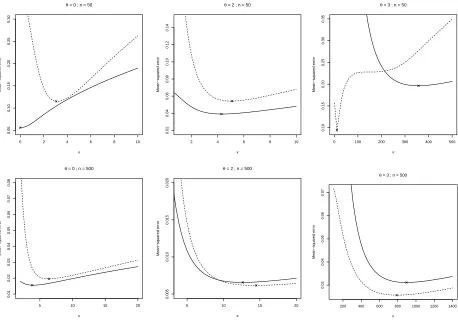
parameter 1. We estimate m(θ) at θ = 0,2,3 and compare the average squared error of (4) with the asymptotic
mean squared error given in Theorem 2 overκ for n = 50 and n = 500. The results are displayed in Figure 2,
and the asymptotic nature of the result is clear. Note that the values of the second derivative of m atθ= 0,2,3 are
−0.59,0.98,140.89, respectively, which explains the poorer performance atθ=3.
Secondly, we explore the dependence on d. In this case we use the model
m(θ)=1
d
d
X
i=1
sinθi+
1
d(d−1) X
i,j
cosθicosθj (d≥2)
whereθ =(θ1,· · ·, θd)T,σ2(Θi) =1/2, i =1,· · ·,n, and f is a product of (independent) von Mises densities with
mean zero and concentration parameter 1. We estimate m(θ) atθ=(0,· · ·,0)Tand (π/2,· · ·, π/2)Tfor a range ofκ,
for n=500. Figure 3 shows good agreement for d =2 between the average squared error and the asymptotic mean
squared error. However, we note increasingly poor behaviour as d increases, indicating that the asymptotic nature of the result also depends on d, and again illustrating the well-known phenomenon of the curse of dimensionality.
Appendix
Proof of Theorem 1. Express Kκ(θ) in terms of a Fourier series, and, recalling that for very small values of u
sin(u)≃u, use the expansion f (u+θ)= f (θ)+sin(u) f′(θ)+1/2 sin2(u) f′′(θ)+O{sin3(u)}. Then, starting from (2),
make a change of variable and use assumption i) to get
E[ ˆf (θ;κ)]=
Z 2π
0
Kκ(ψ−θ) f (ψ)dψ
=
Z 2π
0
Kκ(u) f (u+θ)du
=f (θ)+1
4{1−γ2(κ)}f
′′
(θ)+o(1).
0 2 4 6 8 10
0.05
0.10
0.15
0.20
0.25
0.30
θ = 0 ; n = 50
κ
Mean−squared error
2 4 6 8 10
0.02
0.04
0.06
0.08
0.10
0.12
0.14
θ = 2 ; n = 50
κ
Mean−squared error
0 100 200 300 400 500
0.10
0.15
0.20
0.25
0.30
0.35
θ = 3 ; n = 50
κ
Mean−squared error
5 10 15 20
0.01
0.02
0.03
0.04
0.05
0.06
0.07
0.08
θ = 0 ; n = 500
κ
Mean−squared error
5 10 15 20
0.005
0.010
0.015
0.020
θ = 2 ; n = 500
κ
Mean−squared error
200 400 600 800 1000 1200 1400
0.03
0.04
0.05
0.06
0.07
θ = 3 ; n = 500
κ
[image:8.595.66.524.122.443.2]Mean−squared error
Figure 2: Comparison of averaged squared error as a function ofκover 200 simulations (dashed line), and asymptotic mean squared error given by Theorem 2 (continuous line) with locations of minima. Top row: n=50; lower row: n=500, with m estimated atθ=0 (left),θ=2 (middle) and θ=3 (right).
0 5 10 15 20
0.00
0.02
0.04
0.06
0.08
0.10
θ = 0 ; n = 500
κ
Mean−squared error
4
4
3 3
2 2
0 5 10 15 20
0.0
0.1
0.2
0.3
0.4
0.5
0.6
θ = π2 ; n = 500
κ
Mean−squared error
4
4 3
3 2
2
Figure 3: Comparison of averaged squared error as a function ofκover 200 simulations (dashed line), and asymptotic mean squared error given by Theorem 2 (continuous line) with locations of minima shown by the integers 2, 3, 4 which corresponds to the dimension of the data. m is estimated atθ=(0,· · ·,0)T(left) andθ=(π/2,· · ·, π/2)T(right).
[image:8.595.100.488.495.683.2]Now, recalling assumptions i) and ii), we have
Var[ ˆf (θ;κ)]= 1
n
Z 2π
0
{Kκ(ψ−θ)}2f (ψ)dψ−
1
n
n
E[ ˆf (θ;κ)]o2
=1
n
Z 2π
0
{Kκ(u)}2{f (θ)+o(1)}du−
1
n{f (θ)
+o(1)}2
= 1
2nπ
1+2
∞
X
j=1
γ2j(κ)
f (θ)+o(1).
Proof of Theorem 2. Put
SΘi−θ:={sin(Θi1−θ1),· · ·,sin(Θid−θd)}T, i=1,· · ·,n
and use Dg(θ) to denote the first-order partial derivatives vector of the function g atθ. To derive the conditional bias,
we firstly note that (4) yields
E[ ˆm(θ; C)|Θ1,· · ·,Θn]=eT
1(Θ
T
WΘ)−1ΘTW m, (6)
where m :={m(Θ1),· · ·,m(Θn)}T,and W :=diag{V
C(Θ1−θ),· · ·,VC(Θn−θ)}. Using the expansion
m=Θ "
m(θ)
Dm(θ)
# +1 2 ST
Θ1−θHm(θ)SΘ1−θ .. .
ST
Θn−θHm(θ)SΘn−θ
+Rm(θ),
where Rm(θ) denotes the remainder, we have that the first term in the expansion of (6) is m(θ). Thus
E[ ˆm(θ; C)−m(θ)|Θ1,· · ·,Θn]= 1
2e
T
1(Θ
T
WΘ)−1ΘTW ST
Θ1−θHm(θ)SΘ1−θ .. .
ST
Θn−θHm(θ)SΘn−θ
+Rm(θ)
. Observe that
ΘTWΘ=
" Pn
i=1VC(Θi−θ) Pni=1VC(Θi−θ)STΘi−θ
Pn
i=1VC(Θi−θ)SΘi−θ Pni=1VC(Θi−θ)SΘi−θSTΘi−θ
#
(7)
and
ΘTW
ST
Θ1−θHm(θ)SΘ1−θ .. .
ST
Θn−θHm(θ)SΘn−θ = Pn
i=1VC(Θi−θ)STΘi−θHm(θ)SΘi−θ
Pn
i=1VC(Θi−θ)
n
ST
Θi−θHm(θ)SΘi−θ o
SΘi−θ
, (8)
then, using the expansion
f (u+θ)= f (θ)+ST
uDf(θ)+O(STuSu),
and recalling assumption i), a change of variables leads to these approximations
1
n
n
X
i=1
VC(Θi−θ)=
Z
[0,2π)d
VC(α−θ) f (α)dα+op(1)
=f (θ)+op(1);
1
n
n
X
i=1
VC(Θi−θ)SΘi−θ=
Z
[0,2π)d
VC(α−θ)Sα−θf (α)dα+op(1)
=I1(κ)
I0(κ)
C−1Df(θ)+op(C−11) ;
1
n
n
X
i=1
VC(Θi−θ)SΘi−θSTΘi−θ=
Z
[0,2π)d
VC(α−θ)Sα−θSTα−θf (α)dα+op(I)
= I1(κ)
I0(κ)
C−1f (θ)+op(C−1);
1
n
n
X
i=1
VC(Θi−θ)STΘi−θHm(θ)SΘi−θ=
Z
[0,2π)d
VC(α−θ)STα−θHm(θ)Sα−θf (α)dα+op(1)
= I1(κ) κI0(κ)
tr{Hm(θ)}f (θ)+op
κ−1;
1
n
n
X
i=1
VC(Θi−θ)nSTΘi−θHm(θ)SΘi−θ
o
SΘi−θ=
Z
[0,2π)d
VC(α−θ)nSTα−θHm(θ)Sα−θ
o
Sα−θf (α)dα+op(1)
=Op(C−21) ;
where 1 is the unit vector of length d. Hence, recalling assumption i) we have
eT1n−1ΘTWΘ−1⋍h {f (θ)}−1+o
p(1) −Df(θ)T{f (θ)}−2+op(1)
i
, (9)
thus
E[ ˆm(θ; C)−m(θ)|Θ1,· · ·,Θn]=1
2
I1(κ)
κI0(κ)
tr{Hm(θ)}+op(κ−1).
For the conditional variance, according to multivariate local linear regression theory
Var[ ˆm(θ; C)|Θ1,· · ·,Θn]=eT
1(Θ
T
WΘ)−1ΘTWΣWΘ(ΘTWΘ)−1e1,
whereΣ:=diag{σ2(Θ
1),· · ·, σ2(Θn)}. Consider that
n−1ΘTWΣWΘ=
" n−1Pn
i=1{VC(Θi−θ)}2σ2(Θi) n−1Pni=1{VC(Θi−θ)}2STΘi−θσ
2(Θ i)
n−1Pni=1{VC(Θi−θ)}2SΘi−θσ2(Θi) n−1Pni=1{VC(Θi−θ)}2SΘi−θSTΘi−θσ
2(Θ i)
#
, (10)
and approximate the components of the above matrix using the following relationships
1
n
n
X
i=1
{VC(Θi−θ)}2σ2(Θi)=
Z
[0,2π)d
{VC(Θi−θ)}2σ2(α) f (α)dα+op(1)
=
" I
0(2κ)
2π{I0(κ)}2
#d
σ2(θ) f (θ){1+op(1)};
1
n
n
X
i=1
{VC(Θi−θ)}2STΘi−θσ
2(Θ i)=
Z
[0,2π)d
{VC(αi−θ)}2STα−θσ
2(
α) f (α)dα+op(1)
=op(1) ;
1
n
n
X
i=1
{VC(Θi−θ)}2SΘi−θSTΘi−θσ
2
(Θi)=
Z
[0,2π)d
{VC(αi−θ)}2Sα−θSTα−θσ
2
(α) f (α)dα+op(I)
= Fe(2, κ
2)
4π{I0(κ)}2
"
I0(2κ)
2π{I0(κ)}2
#d−1
σ2(θ) f (θ){I+op(I)},
whereFe(2, κ2) := {I
0(k)}2+{I1(k)}2+2P∞j=2Ij(κ){Ij(κ)− Ij−2(κ)}is the regularized confluent hypergeometric
function of the first kind. Combining the previous results with the approximations in (9), and recalling assumption ii), we finally obtain
Var[ ˆm(θ; C)|Θ1,· · ·,Θn]=
"
I0(2κ)
2π{I0(κ)}2
#d
σ2(θ)
n f (θ)+op(n
−1κd/2).
Proof of Corollary 1. ReplaceI1(κ)/I0(κ) by 1 with an error of magnitude O(κ−1), and use
lim
κ→∞
" I
0(2κ)
2π{I0(κ)}2
#d
=
κ
4π
d/2
,
then minimize the asymptotic MSE.
Proof of Theorem 3. Follow the proof of Theorem 2, with KC(Θi−θ) as ith entry of the weight matrix, i=1,· · ·,n.
In particular, to derive the conditional bias firstly note that
n−1ΘTWΘ⋍ "
f (θ)+op(1) 1/2{1−γ2(κ)}DT
f(θ)+op(1)
1/2{1−γ2(κ)}Df(θ)+op(1) 1/2{1−γ2(κ)}f (θ)I+op(I)
#
,
and, in virtue of assumption i) of Theorem 1,
eT1(n−1ΘTWΘ)−1⋍h {f (θ)}−1+op(1) −DT
f(θ){f (θ)} −2+o
p(1)
i
.
Moreover, observe that
n−1ΘTW
ST
Θ1−θHm(θ)SΘ1−θ
.. .
ST
Θn−θHm(θ)SΘn−θ
≃
"
1/2{1−γ2(κ)}tr{Hm(θ)}f (θ)+op(1)
Op(1)
#
,
to get
E[ ˆm(θ; C)−m(θ)|Θ1,· · ·,Θn]=1
4{1−γ2(κ)}tr{Hm(θ)}+op(1).
To derive the conditional variance, observe that the upper-left entry of the matrix (10) generalizes as
1
n
n
X
i=1
{KC(Θi−θ)}2σ2(Θi)⋍R(KC)σ2(θ) f (θ){1+op(1)},
where R(KC)={R(Kκ)}d={(2π)−1(1+2P∞j=1γ
2 j(κ))}
d, the diagonal blocks are o
p(1), whereas letting
A(KC) :=[γ
2 0(κ)+γ
2 1(κ)+2
P∞
j=2γj(κ){γj(κ)−γj−2(κ)}]{R(Kκ)}d−1
4π ,
whereγ0(κ) :=
R2π
0 Kκ(θ) cos(0)dθ=1, the lower-right entry is
1
n
n
X
i=1
{KC(Θi−θ)}2SΘi−θSTΘi−θσ
2(Θ
i)⋍A(KC)σ2(θ) f (θ){I+op(I)}.
Hence, it finally results
Var[ ˆm(θ; C)|Θ1,· · ·,Θn]=R(KC)σ
2(θ)
n f (θ) {1+op(1)}.
Proof of Theorem 4. Follow the proof of Theorem 4.1 of Ruppert & Wand (1994) with these two recommendations:
in the design matrix replace (Xi−x)j, with sinj(Θi−θ), and use the expansion f (u+θ)= f (θ)+sin(u) f′(θ)+O{sin2(u)}.
In particular, to derive the conditional bias, let Qp be the matrix of order p+1 having as (i,j) entryηi+j−1(Kκ), and
observe that, in virtue of assumption i) of Theorem 1, n−1ΘTWΘ = f (θ)E
p+ f′(θ)Qp +op(1),with Ep being the
matrix defined in Remark 2, to get
rT1(n−1ΘTWΘ)−1=f (θ)−1{rT
1E −1 p −f
′(θ) f (θ)−1rT
1E −1
p QpE−1p }+op(1),
where r1 is a (p+1)×1 vector having 1 as first entry and 0 elsewhere. For the conditional variance, denoting as
Tpthe matrix of order p+1 having
R
sini+j−2(u){Kκ(u)}2du as (i,j) entry, and recalling condition i), it follows that
n−1ΘTW2Θ=f (θ)T
p+op(I).
Aknowledgements
The authors are grateful to two anonymous referees for their valuable comments which led to improvements in this article.
References
Bai, Z. D., Rao, R. C. & Zhao, L. C. (1988), ‘Kernel estimators of density function of directional data’, Journal of Multivariate Analysis 27, 24–39. Beran, R. (1979), ‘Exponential models for directional data’, The Annals of Statistics 7, 1162–1178.
Cogburn, I. & Davis, H. T. (1974), ‘Periodic splines and spectral estimation’, The Annals of Statistics 2, 1108–1126. Hall, P., Watson, G. & Cabrera, J. (1987), ‘Kernel density estimation with spherical data’, Biometrika 74, 751–762. Jammalamadaka, S. R. & SenGupta, A. (2001), Topics in Circular Statistics, World Scientific, Singapore.
Klemel¨a, J. (2000), ‘Estimation of densities and derivatives of densities with directional data’, Journal of Multivariate Analysis 73, 18–40. Lejeune, M. & Sarda, P. (1992), ‘Smooth estimators of distribution and density functions’, Computational Statistics&Data Analysis 14, 457–471.
Mardia, K. V. & Jupp, P. E. (1999), Directional Statistics, John Wiley, New York.
Ruppert, D. & Wand, M. P. (1994), ‘Multivariate locally weighted least squares regression’, The Annals of Statistics 22, 1346–1370. Silverman, B. W. (1986), Density Estimation for Statistics and Data Analysis, Chapman and Hall, London.
![trans Dichloridobis{tris[4 (trifluoromethyl)phenyl]phosphane κP}palladium(II) dichloromethane monosolvate](data:image/gif;base64,R0lGODlhAQABAIAAAP///wAAACH5BAEAAAAALAAAAAABAAEAAAICRAEAOw==)