Cite this:New J. Chem.,2016, 40, 1655
Effect of fluorination pattern and extent on the
properties of PCDTBT derivatives
†
Luke Cartwright, Hunan Yi and Ahmed Iraqi*
Herein, we report the synthesis of a series of fluorinated dithienyl carbazole-alt-benzothiadiazoles (PCDTBT analogues) and the characterisation of their optical, electrochemical, thermal and molecular organisation in the solid state. The polymers were decorated with fluorine on either the benzothiadiazole unit, carbazole unit or both to yieldPCDTffBT,PCffDTBTandPCffDTffBT, respectively. The copolymers displayed decomposition temperatures in excess of 3501C.PCDTffBT,PCffDTBTand PCffDTffBT displayed optical band gaps of 1.86, 1.82 and 1.88 eV, respectively. It was speculated this was a consequence of the higher molecular weight of PCffDTBT relative to the other polymers. PCffDTBT andPCffDTffBT displayed shallower HOMO levels relative to PCDTffBT; a consequence of fluorinating the carbazole-donor moiety. XRD studies confirmed that fluorinating the benzothiadiazole-acceptor moiety improves molecular ordering by promotingp–pstacking of polymer backbones in solid state. Interestingly, fluorinating the carbazole-donor unit does not improve p–p stacking of polymer backbones.
Introduction
Carbazole, is an appealing building-block for the development of conjugated copolymers.1 Carbazole is structurally analogous to fluorene, which has also found widespread use in optoelectronic devices. However, the presence of an electron-donating nitrogen atom in its central fused pyrrole ring renders carbazole fully aromatic, unlike fluorene.1Replacing the 9H-carbon with nitrogen
in the fluorene skeleton bestows further desirable properties upon the resulting unit including: (1) increased oxidative stability owing to the propensity for the 9H-position of fluorene to undergo oxidation to the ketone product, which results in adverse physical properties.2 (2) The nitrogen in the central pyrrole ring can be functionalised to improve the physical properties of the resulting polymer.3–5 Consequently, carbazole-based conjugated polymers are easy to synthesise, display excellent photochemical and thermal stabilities and possess high charge carrier mobilities.1 Thus, carbazole-based conjugated polymers and their derivatives have found extensive use in organic light emitting diodes (OLEDs), organic thermal electronic devices, organic field-effect transistors (OFETs) and organic photovoltaics (OPV).6–11
It could be argued that poly[N-90 -heptadecanyl-2,7-carbazole-alt-5,5-(40,70-di-2-thienyl-20,10,30-benzothiadiazole)] (PCDTBT) and
its derivatives are the most studied carbazole-based donor– acceptor (D–p–A) conjugated polymers. PCDTBT has found widespread use in organic photovoltaic (OPV) devices and efficiencies in excess of 7% have been achieved when blended with the fullerene derivative PC70BM.10This is by no means the
highest efficiency recorded in OPV devices.12–14However, the thermal and oxidative stability, deep HOMO level and ease of processability have allowed PCDTBT to remain an attractive conjugated polymer for optoelectronic applications.15,16
The body of literature concerning the incorporation of fluorine as a substituent and the effect it has on the resulting polymer system is expanding rapidly.17–20However, fluorination of PCDTBT has received little attention, which is surprising considering the promise PCDTBT and its derivatives have displayed in optoelectronic devices.21–24Imahori and co-workers investigated the effects of fluorine substitution onPCDTBTby copolymerising a fluorinated benzothiadiazole-acceptor with a carbazole-donor to yieldPCDTBT-F.24The introduction of two fluorine atoms on the 5,6-positions of benzothiadiazole decreased the HOMO energy level ofPCDTBT-F, relative to that of PCDTBT. However, PCDTBT-F displayed a significantly reduced molecular weight, poor solubility, blue-shifted absorption maxima and a larger optical band-gap, relative to
PCDTBT.24 In contrast, Bo et al. reported the polymerisation of a fluorinated-carbazole donor with a dialkoxy-substituted benzothiadiazole acceptor to yieldPDFCDTBT.21The introduction of fluorine atoms at the 3,6-positions of carbazole yielded a moderate molecular weight polymer with deeper frontier energy levels, red-shifted absorption maxima and a smaller
Department of Chemistry, University of Sheffield, Sheffield, S3 7HF, UK. E-mail: a.iraqi@sheffield.ac.uk.ac.uk; Fax:+44 (0)114 222 9303; Tel:+44 (0)114 222 9566
†Electronic supplementary information (ESI) available:1H-NMR spectra of the
final monomers and the polymers. See DOI: 10.1039/c5nj02394g Received (in Montpellier, France)
7th September 2015, Accepted 8th December 2015
DOI: 10.1039/c5nj02394g
www.rsc.org/njc
PAPER
Open Access Article. Published on 11 December 2015. Downloaded on 28/06/2016 17:00:19.
This article is licensed under a
Creative Commons Attribution 3.0 Unported Licence.
optical band gap, relative to its non-fluorinated counterpart. Furthermore,PDFCDTBTdisplayed more organised packing in solid state.21
With this is mind, we report the synthesis of three fluorinated carbazole-alt-benzothiadiazole conjugated polymers. Fluorine was attached to either the benzothiadiazole unit, carbazole unit or both units to yield PCDTffBT, PCffDTBT and PCffDTffBT, respectively (Fig. 1). Imahori reported that the fluorinated
PCDTBT analogue they synthesised forms a low molecular weight polymer with poor solubility. Thus, the polymers in this work were designed to bear larger solubilising chains on the carbazole moiety in the hope that higher molecular weight polymers could be obtained. The optical, electrochemical, thermal and structural properties of the polymers in the solid state are probed in order to ascertain the effects fluorination has on the resulting polymer.
Results and discussion
Polymer synthesis
The synthetic route for the preparation of 2,7-dibromo-3,6-difluoro-9-(pentacosan-13-yl)-9H-carbazole (M1) is outlined in Scheme 1.
M1was synthesised starting from the commercially available 1,4-dibromo-2-fluorobenzene. 2,7-Dibromo-9-(pentacosan-13-yl)-9H-carbazole (M2) was synthesised according to a modified literature procedure.25 4,7-Bis(5-(trimethylstannyl)thiophene-2-yl)benzo[c][1,2,5]thiadiazole (M3) and 5,6-difluoro-4,7-bis(5-(tri-methylstannyl)thiophene-2-yl)benzo[c][1,2,5]thiadiazole (M4) were synthesised from 4,7-di(thiophen-2-yl)benzo[c][1,2,5]thiadiazole and 5,6-difluoro-4,7-di(thiophene-2-yl)benzo[c][1,2,5]thiadiazole, respectively. Deprotonation of the starting material with lithium 2,2,6,6-tetramethylpiperidine (LTMP) and subsequent treatment with trimethyltin chloride afforded M3 and M4 (Scheme 1). Stille polycondensation ofM2withM4,M1withM3andM1with
M4yielded PCDTffBT,PCffDTBT andPCffDTffBT, respectively (Scheme 1). Pd(OAc)2and tri(o-tolyl)phosphine (P(o-tol)3) were used
as the catalyst and toluene as the solvent. All polymerisations were left for 48 hours. The polymers were cleanedviaSoxhlet extraction using in turn methanol, acetone, hexane and toluene. The toluene fractions were collected, reducedin vacuoand precipitated in methanol. Subsequent studies were conducted on the toluene fractions only. 1H-NMR and elemental analysis were used to
verify the structure of PCDTffBT, PCffDTBT and PCffDTffBT. Gel permeation chromatography (GPC) using 1,2,4-trichloro-benzene as the eluent, at 140 1C was used to determine the
number-average molecular weight (Mn) and weight-average mole-cular weight (Mw) of the polymers synthesised.PCffDTBTdisplayed the highestMnandMwof all polymers synthesised with values of 11 400 and 20 600 Da, respectively. BothPCDTffBTandPCffDTffBT
displayed significantly reduced molecular weights relative to
PCffDTBT with values of 11 900 and 8900 Da, respectively (Table 1). Previous literature has speculated that fluorination of the benzothiadiazole unit moiety promotes p–p stacking and aggregation of polymer chains, which impedes the solubility of the polymer and its attainable molecular weight.26 The results
obtained here support this hypothesis.
PCDTBT-F synthesised by Imahori and co-workers is an analogous polymer to PCDTffBT.24 PCDTBT-F has C17-branched substituents rather than C25-C17-branched substituents forPCDTffBT. It was reported that PCDTBT-Fdisplayed poor solubility which limited the molecular weight of the resulting polymer (Mw= 6000 Da). Thus,PCDTffBTwas designed to bear larger solubilising chains on the carbazole moiety in the hope that a higher molecular weight polymer could be obtained.
PCDTffBT does possess a higher Mw (11 900 Da), relative to PCDTBT-F. PCffDTffBT in which both the carbazole and benzothiadiazole repeat units have fluorine substituents, has the most reduced processability in this series of polymers. Both the yield of the soluble toluene fraction and the molecular weight of this polymer are lower compared to the other two polymers presented in this work.
Optical properties
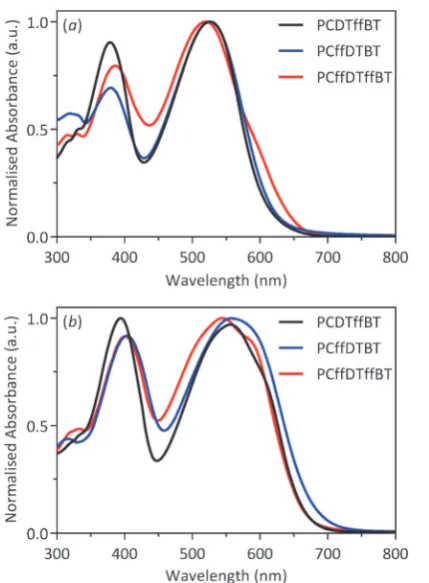
The optical properties of all polymers were investigated by UV-vis absorption spectroscopy on dilute chloroform solutions and drop-cast films on quartz substrates (Fig. 2). The optical properties of the polymers are summarised in Table 1. All polymers exhibit two absorption peaks in both solution and film states. The absorption band at shorter wavelengths can be ascribed to thep–p* transition. In contrast, the absorp-tion band at longer wavelengths can be attributed to intra-molecular charge transfer between the dithienyl-carbazole donor moieties and the benzothiadiazole acceptor units. All polymers undergo a bathochromic shift when cast into a thin-film, relative to their solution absorption. This can be ascribed to strongerp–pinterchain stacking and a more coplanar structure in solid state. The lmax of PCDTffBT,PCffDTBT and
PCffDTffBTare located at 556, 558 and 545 nm in film states. The optical band gaps ofPCDTffBT,PCffDTBTandPCffDTffBT, as determined from the onset of absorption, were estimated to be 1.86, 1.82 and 1.88 eV, respectively. Furthermore, PCffDTffBT
displayed improved resolution in the solid-state with the presence
Fig. 1 Structures ofPCDTffBT,PCffDTBTandPCffDTffBT.
Scheme 1 Synthetic routes to the final monomer products:M1,M3and M4.M2was synthesised using previously established literature procedures.
Open Access Article. Published on 11 December 2015. Downloaded on 28/06/2016 17:00:19.
This article is licensed under a
[image:2.595.46.290.567.691.2]of shoulder peak atB580 nm, which we attribute to a higher tendency of aggregation of polymer chains for this polymer compared to the other two polymers in the series; a conse-quence of improved molecular arrangement in solid state. The higherMwofPCffDTBTdid not translate into significantly higherlmaxvalue. However, the optical band gap ofPCffDTBT
was lower thanPCDTffBTandPCffDTffBT. It would appear that in this series of polymers, fluorination of the carbazole moiety affords a polymer with the lowest optical band gap allowing the resulting polymer to harvest a larger portion of the solar spectrum. It is also worth noting that the optical band gap of non-fluorinated PCDTBT (1.88 eV)11 is similar to those of
PCDTffBTandPCffDTffBT.
The fluorescence spectra of the polymers in solution and solid films are illustrated in Fig. 3. All fluorescence spectra were recorded upon exciting the polymers at their absorption
maxima. In solution PCDTffBT, PCffDTBT and PCffDTffBT
exhibited emission maxima at 618, 637 and 600 nm, respectively. The emission maxima are red-shifted to 710, 712 and 712 nm for PCDTffBT, PCffDTBT and PCffDTffBT, respectively. It is suspected that the large difference in the solution emission maxima is due to interactions between the local solvent environment and the fluorophore. Solvent molecules stabilise and lower the energy of the excited state ofPCffDTBT; resulting in a red-shift in the solution fluorescence emission. Once the polymers have been cast into films, the effects of solvent relaxation no longer apply, and the polymers exhibit a fluores-cence emission at similar wavelengths. The large Stokes shifts of 154, 154 and 167 nm for PCDTffBT, PCffDTBT and
[image:3.595.41.555.63.134.2]PCffDTffBT, respectively, suggests there is a significant energy difference between the ground state and excited state of the polymers.
Table 1 A summary of the GPC, UV-vis absorption and fluorescence data forPCDTffBT,PCffDTBTandPCffDTffBT
Polymer Mna Mwa PDI
UV-vis absorption Fluorescence
lmax solution (nm)
eb
(M1cm1) lmax film (nm)
Eoptg filmc(eV)
lmax solution (nm)
lmax film (nm)
Stokes shiftd (nm)
PCDTffBT 7700 11 900 1.55 379, 526 49 900 395, 556 1.86 618 710 154
PCffDTBT 11 400 20 600 1.81 381, 526 40 600 404, 558 1.82 637 712 154
PCffDTffBT 6100 8900 1.46 387, 520 43 000 401, 545 1.88 600 712 167
aMeasurements conducted on the toluene fraction of the polymer using differential refractive index (DRI) detection.bAbsorption coefficient
measured atlmaxin chloroform solution.cOptical energy gap determined from the onset of the absorption band in thin film.dStokes shift determined from film studies.
Fig. 2 Normalised UV-vis absorption spectra ofPCDTffBT,PCffDTBTand PCffDTffBTin: (a) chloroform solution; and (b) thin films.
Fig. 3 Normalised fluorescence spectra of PCDTffBT, PCffDTBT and PCffDTffBTin: (a) chloroform solution; and (b) thin films.
Open Access Article. Published on 11 December 2015. Downloaded on 28/06/2016 17:00:19.
This article is licensed under a
[image:3.595.318.536.186.483.2] [image:3.595.64.279.189.481.2]Electrochemical properties
Cyclic voltammetry was used to determine the HOMO and LUMO energy levels (vs. vacuum) of drop-cast polymer films in acetonitrile with tetrabutylammonium perchlorate as the electrolyte (Fig. 4 and Table 2).PCDTffBTdisplayed the deepest HOMO level of all polymers synthesised with a value of
5.44 eV, which is deeper than its non-fluorinated analogue,
PCDTBT.11The LUMO level of PCDTffBTwas measured to be
3.45 eV, which is slightly lower than PCDTBT.11 This is consistent with previous literature concerning the effects of fluorine substitution and the effects it has the resulting polymers HOMO levels.27–31
The HOMO level ofPCffDTBTwas calculated to be5.23 eV. This is similar to the HOMO of level ofPDFCDTBTreported by Bo and co-workers.21 However, it is significantly shallower than
PCDTBT.11The electrochemistry results suggest that fluorination of the carbazole-moiety results in it becoming a significantly stronger donor unit. Generally, fluorine is considered to be a deactivating substituent, thus, this result may seem erroneous. However, it is known that fluorine as a substituent on an aromatic benzene is considered to be boths-electron withdrawing andp-electron donating.32Thep-donating ability of fluorine is reflected in the anomalously high para-position reactivity.33 Fluorobenzene displays a higher proton affinity than benzene, another example of the anomalously high reactivity of fluoroben-zene relative to benfluoroben-zene.34,35We speculate that fluorination of the carbazole moiety increases the p-electron density of the
resulting monomer unit. Consequently, the fluorinated carbazole moiety is a stronger donor resulting in a shallower HOMO level. It is possible that this will negatively impact the oxidative stability of thePCffDTBT.
Thermal properties
Thermogravimetric analysis of PCDTffBT, PCffDTBT and
PCffDTffBT revealed that all polymers possess good thermal stability with degradation temperatures in excess of 350 1C
(Fig. 5). The onset of degradation (5% weight loss) for
PCDTffBT, PCffDTBT and PCffDTffBT were estimated to be 367, 390 and 351 1C (Table 2). We tentatively speculate that
the degradation temperature of these polymers is dependent upon the molecular weight. We hypothesise that the lower molecular weights of PCDTffBT and PCffDTffBT have two effects on the polymer properties. Firstly, PCDTffBT and
PCffDTffBTpossess a higher concentration of polymer chain ends, which can undergo chain-end scission. Secondly, degradation mechanisms involve molecular mobility which is inversely related to molecular weight. An increased molecular weight should reduce the amount of labile end-groups facilitating chain entanglement. Thus, the molecular mobility of the polymer, which controls the kinetics of decomposition, is reduced.
X-Ray diffraction (XRD) studies
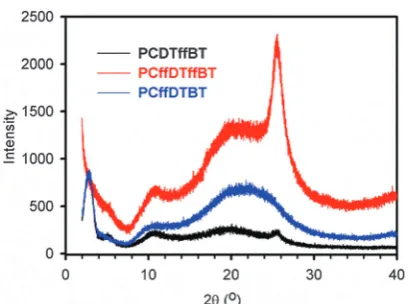
Powder X-ray diffraction (XRD) patterns of polymersPCDTffBT,
PCffDTBT and PCffDTffBT were obtained to investigate the molecular organisation of polymers in the solid state (Fig. 6). All polymers display peaks in the low angle region, which suggests the polymers possess some long-range translational order. An indication the polymers adopt a more crystalline structure in the solid state. The low-angle peak in the XRD pattern is frequently observed in p-conjugated polymers with long alkyl or alkoxy side-chains.36–38 Previous literature has shown that this peak is attributed to the distance between
p-conjugated backbones which are separated by the solubilising alkyl chains.39,40
Interestingly,PCDTffBTandPCffDTffBTdisplay additional wide angle peaks at 2y = 25.61, which corresponds to a Fig. 4 Cyclic voltammograms ofPCDTffBT,PCffDTBTandPCffDTffBT
[image:4.595.66.274.46.198.2]on platinum disc electrodes (area 0.031 cm2) at a scan rate of 100 mV s1 in acetonitrile/tetrabutyl ammonium perchlorate (0.1 mol dm3).
Table 2 A summary of the TGA and electrochemical data forPCDTffBT,
PCffDTBTandPCffDTffBT
Polymer Tda(1C) HOMOb(eV) LUMOc(eV) Eelecg d(eV)
PCDTffBT 367 5.44 3.45 1.99
PCffDTBT 390 5.23 3.12 2.11
PCffDTffBT 351 5.24 3.11 2.13
aOnset of degradation as determinedviathermogravimetric analysis
(TGA) with a heating rate of 101C min1under an inert atmosphere of nitrogen.bHOMO position (vs.vacuum) determined from the onset of
oxidation.cLUMO position (vs. vacuum) determined from the onset of reduction.dElectrochemical energy gap.
Fig. 5 Thermogravimetric analysis of PCDTffBT, PCffDTBT and PCffDTffBTwith a heating rate of 101C min1under an inert nitrogen
atmosphere.
Open Access Article. Published on 11 December 2015. Downloaded on 28/06/2016 17:00:19.
This article is licensed under a
[image:4.595.308.551.530.683.2] [image:4.595.42.291.618.667.2]p–pstacking distance of 3.48 Å. It is speculated that fluorinating the benzothiadiazole acceptor unit improves molecular ordering by promoting interactions with components on adjacent aromatics. This improves the planarity of the resulting back-bone, resulting in strong interchain interactions and a more pronounced packing order. A result consistent with the reduced inhomogeneous broadening observed in the solid state spectra ofPCffDTffBT.PCffDTBTdoes not display an additional peak in this area suggesting that fluorination of the carbazole moiety does have the same impact. Interestingly, Boet al.found that
PDFCDTBT, an analogous polymer to PCffDTBT, displayed a
p–pstacking distance of 3.7 Å.21However, the carbazole moiety inPDFCDTBTwas substituted with a significantly smaller alkyl chain (C8 linear chainvs.C25 branched chain). It is hypothe-sised that the larger alkyl chain in PCffDTBT disrupts the formation ofp–pstacking in solid state.
Conclusions
In summary, three fluorinated carbazole-alt-benzothiadiazole D–p–A alternating copolymers PCDTffBT, PCffDTBT and
PCffDTffBT were synthesised via Stille polymerisation using toluene as the solvent. The optical, thermal, electrochemical and structural properties of these polymers were analysed and contrasted in relation to the degree of fluorination and their fluorination pattern. The optical band gaps of PCDTffBT,
PCDTffBT and PCffDTffBT were estimated to be 1.86, 1.82 and 1.88 eV, respectively. It is hypothesised that the lower optical band gap ofPCffDTBTwas a consequence of its higher molecular weight. The HOMO levels ofPCffDTBT (5.23 eV) andPCffDTffBT(5.24 eV) were significantly shallower relative to that of PCDTffBT (5.44 eV). It is hypothesised that the introduction of fluorine at the 3,6-positions of the carbazole unit increases its donating ability resulting in a shallower HOMO level. Thermogravimetric analysis revealed that the onset of decomposition is strongly dependent upon the mole-cular weight of the resulting polymer with PCffDTBT and
PCffDTffBT displaying the highest and lowest decomposition temperatures, respectively. Powder X-ray diffraction revealed
that all polymers possess peaks in the low angle region suggesting all polymers have some long range translational order.PCDTffBT
andPCffDTffBTboth displayed sharp peaks at 2yvalues of 25.61.
These peaks are indicative ofp–pstacking suggesting fluorination of the benzothiadiazole moiety improves the planarity of the polymer backbone, leading to a more pronounced packing order in the solid state. PCffDTBT did not display a shark peak at this angle.
Experimental
Experimental
All materials were purchased from commercial suppliers and used as received, unless otherwise stated. Toluene was dried and distilled over sodium under an inert argon atmosphere. Acetonitrile was dried and distilled over phosphorous pentoxide under an inert argon atmosphere, then stored over molecular sieves (3 Å).
Measurements
1H and 13C nuclear magnetic resonance (NMR) spectra were
recorded on a Bruker AV 400 (400 MHz) using chloroform-d (CDCl3) or acetone-d as the solvent.1H-NMR of the polymers
were recorded on Bruker Avance III HD 500 (500 MHz) spectro-meter at 100 1C using 1,2-dideutrotetrachloroethance as the
solvent. Coupling constants are given in Hertz (Hz). Carbon, hydrogen, nitrogen and sulphur elemental analysis was performed on a Perkin Elmer 2400 series 11 CHNS/O analyser. Analysis of halides was undertaken using the Scho¨niger flask combustion method. GPC analysis was conducted on polymer solutions using 1,2,4-trichlorobenzene at 1401C as the eluent.
Polymer samples were spiked with toluene as a reference. GPC curves were obtained using a Viscotek GPCmax VE2001 GPC solvent/sample module and a Waters 410 Differential Refrac-tometer, which was calibrated using a series of narrow poly-styrene standards (Polymer Laboratories). TGA’s were obtained using a Perkin Elmer TGA-1 Thermogravimetric Analyser at a scan rate of 101C min1under an inert nitrogen atmosphere.
Powder X-ray diffraction samples were recorded on a Bruker D8 advance diffractometer with a CuKaradiation source (1.5418 Å, rated as 1.6 kW). The scanning angle was conducted over the range 2–401. UV-visible absorption spectra were recorded using
a Hitachi U-2010 Double Bean UV/Visible Spectrophotometer. Polymer solutions were made using chloroform and measured using quartz cuvettes (path length = 1102m). Thin films, used for absorption spectra were prepared by drop-casting solutions onto quartz plates using 1 mg cm3 polymer solu-tions that were prepared with chloroform. Fluorescence spectra were recorded on a Horiba FluoroMax 4 spectrometer. Polymer solutions were made using chloroform and measured using quartz cuvettes (path length = 1 102 m). Thin films, were prepared by drop-casting solutions onto quartz plates using 5 mg cm3 polymer solutions that were prepared with chlorobenzene. Cyclic voltammograms were recorded using a Princeton Applied Research Model 263A Potentiostat/Galvanostat.
Fig. 6 Powder X-ray diffraction (XRD) patterns ofPCDTffBT,PCffDTBT andPCffDTffBT.
Open Access Article. Published on 11 December 2015. Downloaded on 28/06/2016 17:00:19.
This article is licensed under a
[image:5.595.65.275.46.198.2]A three electrode system was employed comprising a Pt disc, platinum wire and Ag/Ag+ as the working electrode, counter electrode and reference electrode, respectively. Measurements were conducted in a tetrabutylammonium perchlorate aceto-nitrile solution (0.1 mol dm3) on polymer films that were prepared by drop casting polymer solution. Ferrocene was employed as the reference redox system; in accordance with IUPAC’s recommendations.41 The energy level of Fc/Fc+ was assumed at 4.8 eV to vacuum. The half-wave potential of Fc/Fc+redox couple was found to be 0.08 Vvs.Ag/Ag+reference electrode. The HOMO energy levels of polymers were estimated by equation:EHOMO =(4.8 E1/2,Fc,Fc++Eox,onset) = (4.72 + Eox,onset) eV, where Eox,onset is the onset oxidation potential relative to the Ag/Ag+ reference electrode. The LUMO energy levels of polymers were calculated using the equation:ELUMO=
(4.8 E1/2,Fc,Fc+ +Ered,onset) = (4.72 + Ered,onset) eV, where Ered,onsetis the onset reduction potential relative to the Ag/Ag+ reference electrode.
3,6-Difluoro-2,7-dibromo-9-(pentacosan-13-yl)-9H-carbazole (M1).2,7-Dibromo-3,6-difluoro-9H-carbazole42(3.0 g, 15.4 mmol)
and powdered KOH (4.31 g, 41.8 mmol) were dissolved in anhydrous DMSO (100 cm3). The mixture was heated to 401C
and pentacosan-13-yl 4-methylbenzene (10.41 g, 19.9 mmol) in dry THF (10 cm3) was added dropwise over 2 hours. The reaction was allowed to stir overnight. Upon completion, the reaction was poured on H2O (300 cm3) and the product extracted with hexane
(4 300 cm3). The organic fractions were combined, dried (MgSO4) and the solvent removed in vacuo. The product was
purifiedviasilica gel column chromatography using hexane as the eluent to yield an off-white solid (2.43 g, 3.41 mmol, 22%).
1H NMR (400 MHz, CDCl
3)d(ppm): 7.74 (br, 3H), 7.58 (br, 1H),
4.39 (sep,J= 5.09 Hz, 1H), 2.19 (m, 2H), 1.92 (m, 2H), 1.36–1.08 (m, 38H), 0.97 (m, 2H), 0.89 (t, J = 6.94 Hz, 6H). 13C NMR (250 MHz, CDCl3) d (ppm): 154.29, 151.92, 139.54, 135.89,
115.62, 113.40, 106.88, 57.35, 33.57, 31.75, 29.49, 29.37, 29.28, 29.12,, 26.73, 22.62, 14.07.19F NMR (250 MHz, CDCl
3)d(ppm):
118.54,119.06. EI-MS (m/z): [M]+calculated for C37H55Br2F2N,
711.2710; found, 711.2685. Anal. calculated for C37H55Br2F2N: C,
62.45; H, 7.71; N, 1.97; Br, 22.46; found: C, 62.08; H, 7.92; N, 1.95; Br, 23.22.
2,7-Dibromo-9-(pentacosan-13-yl)-9H-carbazole (M2). 2,7-Dibromo-9H-carbazole (5.00 g, 15.4 mmol) and powdered KOH (4.31 g, 76.9 mmol) were dissolved in anhydrous DMSO (100 cm3). The mixture was heated to 401C and
pentacosan-13-yl 4-methpentacosan-13-ylbenzene (12.06 g, 23.08 mmol) in dry THF (20 cm3) was added dropwise over 2 hours. The reaction was allowed to stir overnight. Upon completion, the reaction was poured on H2O (300 cm3) and the product extracted with hexane (4300 cm3).
The organic fractions were combined, dried (MgSO4) and the
solvent removedin vacuo. The product was purifiedviasilica gel column chromatography using hexane as the eluent to yield an off-white solid (4.83 g, 7.15 mmol, 46%) 1H NMR (400 MHz, CDCl3) d (ppm): 7.92 (dd, J = 4.51 andJ = 8.42 Hz, 2H), 7.73
(s, 1H), 7.57 (s, 1H), 7.35 (t,J= 7.11 Hz, 2H), 4.44 (sep,J= 2.51 Hz, 1H), 2.21 (m, 2H), 1.93 (m, 2H), 1.36–1.09 (m, 38H), 0.99 (m, 2H), 0.90 (t,J = 6.94 Hz, 6H).13C NMR (250 MHz, CDCl3) d(ppm):
122.34, 121.47, 121.22, 114.54, 112.17, 56.98, 33.51, 31.94, 29.63, 29.56, 29.49, 29.37, 29.33, 26.76, 22.72, 14.16 EI-MS (m/z): [M]+ calculated for C39H57Br2NNa, 696.2755; found, 696.2730. Anal.
calculated for C37H57Br2N: C, 65.72; H, 8.50; N, 2.07; Br, 23.65;
found: C, 64.37; H, 8.39; N, 1.94; Br, 27.61.
4,7-Bis(5-(trimethylstannyl)thiophene-2-yl)benzo[c ][1,2,5]-thiadiazole (M3). Under an inert argon atmosphere, 2,2,6,6-tetramethylpiperdine (1.46 cm3, 8.66 mmol) was dissolved in anhydrous THF (20 cm3). The solution was cooled to781C
andn-butyl lithium (3.46 cm3, 8.66 mmol, 2.5 M solution in hexane) was added dropwise. The resulting solution was allowed to stir at 78 1C. The reaction was then warmed to
room temperature and stirred for 10 minutes. The solution was then cooled to781C and 4,7-di(thiophen-2-yl)benzo[c
][1,2,5]-thiadiazole (1.0 g, 3.33 mmol) in THF (15 cm3) was added dropwise. Upon complete addition, the solution was stirred at
781C for 1 hour. Trimethyltin chloride (8.32 cm3, 8.33 mmol,
1.0 M solution in THF) was added dropwise at 78 1C. The
reaction was warmed to room temperature and left to stir overnight. Upon completion, saturated brine was added to quench the reaction. The product was extracted with DCM (3100 cm3), washed with brine (3100 cm3), dried (MgSO4)
and the solvent removed in vacuo. The crude material was recrystallised from ethanol to afford (M3) as orange needle-like crystals (1.42 g, 2.27 mmol, 68%). 1H NMR (400 MHz, CDCl3) d(ppm): 8.21 (d, J = 3.42 Hz, 2H), 7.88 (s, 2H), 7.32
(d,J= 3.67 Hz, 2H), 0.48 (s, 18H).13C NMR (400 MHz, CDCl3) d(ppm): 152.66, 154.07, 140.23, 136.26, 136.12, 135.99, 128.60, 128.40, 128.21, 125.80,6.25. EI-MS (m/z): [M]+calculated for C20H24N2S3Sn2Na, 650.9043; found, 650.9025. Anal. calculated
for C20H24N2S3Sn2: C, 38.37; H, 3.86; N, 4.47; S, 15.36; found: C,
38.62; H, 3.87; N, 4.50; S, 15.38.
5,6-Difluoro-4,7-bis(5-(trimethylstannyl)thiophene-2-yl)benzo-[c][1,2,5]thiadiazole (M4). Under an inert argon atmosphere, 2,2,6,6-tetramethylpiperdine (0.73 cm3, 4.33 mmol) was
dis-solved in anhydrous THF (10 cm3). The solution was cooled
to 78 1C and n-butyl lithium (1.73 cm3, 4.33 mmol, 2.5 M
solution in hexane) was added dropwise. The resulting solution was allowed to stir at781C. The reaction was then warmed
to room temperature and stirred for 10 minutes. The solution was then cooled to781C and
5,6-difluoro-4,7-di(thiophen-2-yl)benzo[c][1,2,5]thiadiazole (0.56 g, 1.67 mmol) in THF (15 cm3) was added dropwise. Upon complete addition, the solution was stirred at781C for 1 hour. Trimethyltin chloride
(8.32 cm3, 8.33 mmol, 1.0 M solution in THF) was added dropwise at781C. The reaction was warmed to room
tem-perature and left to stir overnight. Upon completion, saturated brine was added to quench the reaction. The product was extracted with DCM (5 100 cm3), washed with brine (3
100 cm3), dried (MgSO
4) and the solvent removedin vacuo. The
crude material was recrystallised from ethanol to afford (M4) as orange powder (0.274 g, 0.414 mmol, 25%).1H NMR (400 MHz, CDCl3)d(ppm): 8.36 (d,J= 3.67 Hz, 2H), 7.37 (d,J= 3.42 Hz,
2H), 0.49 (s, 18H). 13C NMR (250 MHz, CDCl3) d (ppm):
150.91, 150.71, 149.04, 148.33, 148.13, 142.61, 137.06, 135.52, 135.39, 135.26, 131.72, 131.55, 1.01, 6.29, 8.15. 19F NMR
Open Access Article. Published on 11 December 2015. Downloaded on 28/06/2016 17:00:19.
This article is licensed under a
(250 MHz, CDCl3)d (ppm): 127.95. EI-MS (m/z): [M]+
calcu-lated for C20H22F2N2S3Sn2Na2, 686.8855; found, 686.8879. Anal.
calculated for C20H22N2S3F2Sn2: C, 36.29; H, 3.35; N, 5.74; S,
14.53; found: C, 36.84; H, 3.36; N, 4.20; S, 13.87.
Poly[N-90-pentacosanyl-2,7-carbazole-alt-5,5-(40,70 -di-2-thienyl-5,6-difluoro-benzo[c][1,2,5]-thiadiazole)] (PCDTffBT). M2(138 mg, 0.204 mmol),M4 (135 mg, 0.204 mmol), Pd(OAc)2 (3.30 mg,
14.8mmol) and tri(o-tolyl)phosphine (9.00 mg, 29.6mmol) were added to a 100 cm3round bottom flask. The flask was placed under an inert atmosphere of argon using standard Schlenk line techniques. Anhydrous toluene (10 cm3) was added, the system degassed and heated to 90 1C for 48 hours.
Upon completion, the reaction was cooled to room temperature and 2-(tributylstannyl)thiophene (0.30 cm3, 0.945 mmol) was added. The mixture was degassed and heated at 901C for
1.5 hours. The mixture was cooled to room temperature and 2-bromothiophene (0.30 cm3, 3.10 mmol) was added, the system degassed and heated at 90 1C for 2 hours.
The reaction was cooled to room temperature and poured into methanol and left to stir overnight. The mixture was filtered through a membrane and the solids were cleaned using Soxhlet extraction with solvents in the order; methanol, acetone, hexane and toluene. The toluene fraction was concentrated
in vacuoand precipitated in methanol. The resulting mixture was stirred overnight and the polymers collectviafiltration as a deep purple powder (107 mg, 62%) GPC toluene fraction,
Mn= 7700 g mol1,Mw= 11 900 g mol1, PDI = 1.55.1H NMR (500 MHz, C2D2Cl4, 1001C) (dH/ppm) 8.37 (m, 2H), 8.11 (m, 2H),
7.61 (m, 2H), 7.56 (m, 2H), 4.68 (br, 1H), 2.39 (br, 2H), 2.09 (br, 2H) 1.39–1.04 (br, 40), 0.84 (m, 6H). Anal. calculated for C51H61F2N3S3: C, 72.03; H, 7.23; N, 4.94; S, 11.31; found: C, 71.16;
H, 7.33; N, 4.72; S, 10.47.
Poly[N-90-pentacosanyl-3,6-difluoro-2,7-carbazole-alt-5,5-(40,70 -di-2-thienyl-benzo[c][1,2,5]-thiadiazole)] (PCffDTBT). PCffDTBT
was synthesized according to the procedure outlined in
PCDTffBT.M1(145 mg, 0.204 mmol),M3(128 mg, 0.204 mmol), Pd(OAc)2(3.30 mg, 14.8mmol) and tri(o-tolyl)phosphine (9.00 mg,
29.6 mmol) were added to a 100 cm3 round bottom flask. The flask was placed under an inert atmosphere of argon using standard Schlenk line techniques. Anhydrous toluene (10 cm3) was added, the system degassed and heated to 901C for 48 hours.
The polymer was obtained as a deep purple solid (112 mg, 65%) GPC toluene fraction,Mn= 11 400 g mol1,Mw= 20 600 g mol1, PDI = 1.81.1H NMR (500 MHz, C2D2Cl4, 1001C) (dH/ppm) 8.21
(br, 2H), 7.95 (br, 2H), 7.72 (4H, br), 7.63 (br, 2H), 4.59 (br, 2H), 2.35 (br, 2H), 2.07 (br, 2H), 1.39–1.12 (br, 40H), 0.84 (m, 6H). Anal. calculated for C51H61F2N3S3: C, 72.03; H, 7.23; N, 4.94;
S, 11.31; found: C, 70.03; H, 6.23; N, 5.36; S, 12.35.
Poly[N-90-pentacosanyl-3,6-difluoro-2,7-carbazole-alt-5,5-(40,70 -di-2-thienyl-5,6-difluoro-benzo[c][1,2,5]-thiadiazole)] (PCffDTffBT). PCffDTffBTwas synthesized according to the procedure outlined inPCDTffBT.M1(145 mg, 0.204 mmol),M4(135 mg, 0.204 mmol), Pd(OAc)2(3.30 mg, 14.8mmol) and tri(o-tolyl)phosphine (9.00 mg,
29.6mmol) were added to a 100 cm3round bottom flask. The flask was placed under an inert atmosphere of argon using standard Schlenk line techniques. Anhydrous toluene (10 cm3) was added,
the system degassed and heated to 901C for 48 hours. The polymer
was obtained as a deep purple solid (40.8 mg, 23%) GPC toluene fraction, Mn = 6100 g mol1, Mw = 8900 g mol1, PDI = 1.46. 1H NMR (500 MHz, C
2D2Cl4, 1001C) (dH/ppm) 8.38 (m, 2H), 7.82–
7.59 (br, 6H), 4.60 (br, 1H), 2.34 (br, 2H), 2.07 (br, 2H), 1.39–1.03 (br, 40H), 0.83 (m, 6H). Anal. calculated for C51H59F4N3S3: C, 69.12;
H, 6.71; N, 4.74; S, 10.85. Found: C, 63.88; H, 5.27; N, 5.26; S, 13.14.
Acknowledgements
We would like to thank the University of Sheffield for the award of a scholarship (L. C.) and EPSRC for financial support of this workviaresearch grant EP/I028641/1.
References
1 Y. Cheng, S. Yang and C. Hsu, Chem. Rev., 2009, 109, 5868–5923.
2 V. N. Bliznyuk, S. A. Carter, J. C. Scott, G. Kla, R. D. Miller and D. C. Miller,Macromolecules, 1999,32, 361–369. 3 W. Yue, Y. Zhao, S. Shao, H. Tian, Z. Xie and F. Wang,
J. Mater. Chem., 2009,19, 2199–2206.
4 A. Iraqi and I. Wataru,Chem. Mater., 2004,42, 442–448. 5 K. Zhang, Y. Tao, C. Yang, H. You, Y. Zou, J. Qin and D. Ma,
Chem. Mater., 2008,20, 7324–7331.
6 N. Agarwal, P. K. Nayak, F. Ali, M. P. Patankar, K. L. Narasimhan and N. Periasamy, Synth. Met., 2011, 161, 466–473.
7 P. T. Boudreault, S. Wakim, L. Tang, Y. Tao, Z. Bao and M. Leclerc,J. Mater. Chem., 2009,19, 2921–2928.
8 A. Van Dijken, J. J. A. M. Bastiaansen, N. M. M. Kiggen, B. M. W. Langeveld, C. Rothe, A. Monkman, I. Bach, P. Sto¨ssel and K. Brunner, J. Am. Chem. Soc., 2004, 126, 7718–7727.
9 B. N. Drolet, J. F. Morin, N. Leclerc, S. Wakim, Y. Tao and M. Leclerc,Adv. Funct. Mater., 2005,15, 1671–1682. 10 Y. Sun, J. H. Seo, C. J. Takacs, J. Seifter and A. J. Heeger,Adv.
Mater., 2011,23, 1679–1683.
11 H. Yi, S. Al-Faifi, A. Iraqi, D. C. Watters, J. Kingsley and D. G. Lidzey,J. Mater. Chem., 2011,21, 13649–13656. 12 Z. He, C. Zhong, X. Huang, W. Wong, H. Wu, L. Chen, S. Su
and Y. Cao,Adv. Mater., 2011,23, 4636–4643.
13 C. Gu, Y. Chen, Z. Zhang, S. Xue, S. Sun, C. Zhong, H. Zhang, Y. Lv, F. Li, F. Huang and Y. Ma, Adv. Energy Mater., 2014,4, 1–5.
14 Y. Liu, J. Zhao, Z. Li, C. Mu, W. Ma, H. Hu, K. Jiang, H. Lin, H. Ade and H. Yan,Nat. Commun., 2014,5, 1–8.
15 S. Beaupre´ and M. Leclerc, J. Mater. Chem. A, 2013, 1, 11097–11105.
16 J. W. Kingsley, P. P. Marchisio, H. Yi, A. Iraqi, C. J. Kinane, S. Langridge, R. L. Thompson, A. J. Cadby, A. J. Pearson, D. G. Lidzey, R. A. L. Jones and A. J. Parnell,Sci. Rep., 2014, 5286.
17 A. Casey, Y. Han, Z. Fei, A. J. P. White, T. D. Anthopoulos and M. Heeney,J. Mater. Chem. C, 2015,3, 265–275.
Open Access Article. Published on 11 December 2015. Downloaded on 28/06/2016 17:00:19.
This article is licensed under a
18 J. W. Jo, J. W. Jung, E. H. Jung, H. Ahn, T. J. Shin and W. H. Jo,Energy Environ. Sci., 2015,8, 2427–2434.
19 G. Li, C. Kang, X. Gong, J. Zhang, W. Li, C. Li, H. Dong, W. Hu and Z. Bo,J. Mater. Chem. C, 2014,2, 5116–5123. 20 N. Wang, Z. Chen, W. Wei and Z. Jiang,J. Am. Chem. Soc.,
2013,135, 17060–17068.
21 C. Du, W. Li, Y. Duan, C. Li, H. Dong, J. Zhu, W. Hu and Z. Bo,Polym. Chem., 2013,4, 2773–2782.
22 J. Kim, M. H. Yun, G. Kim, J. Lee, S. M. Lee, S. Ko, Y. Kim, G. K. Dutta, M. Moon, S. Y. Park, D. S. Kim, J. Y. Kim and C. Yang,ACS Appl. Mater. Interfaces, 2014,6, 7523–7534. 23 H. Wei, Y. Chao, C. Kang, C. Li, H. Lu, X. Gong, H. Dong,
W. Hu, C. Hsu and Z. Bo,Macromol. Rapid Commun., 2015,
36, 84–89.
24 T. Umeyama, Y. Watanabe, E. Douvogianni and H. Imahori,
J. Phys. Chem. C, 2013,117, 21148–21157.
25 B. N. Blouin, A. Michaud and M. Leclerc,Adv. Mater., 2007,
19, 2295–2300.
26 L. Cartwright, A. Iraqi, Y. Zhang, T. Wang and D. G. Lidzey,
RSC Adv., 2015,5, 46386–46394.
27 Y. Zhang, S. C. Chien, K. S. Chen, H. L. Yip, Y. Sun, J. A. Davies, F. C. Chen and A. K. Y. Jen,Chem. Commun., 2011,47, 11026–11028.
28 Z. Li, J. Lu, S.-C. Tse, J. Zhou, X. Du, Y. Tao and J. Ding,
J. Mater. Chem., 2011,21, 3226–3233.
29 S. Albrecht, S. Janietz, W. Schindler, J. Frisch, J. Kurpiers, J. Kniepert, S. Inal, P. Pingel, K. Fostiropoulos, N. Koch and D. Neher,J. Am. Chem. Soc., 2012,134, 14932–14944.
30 H. Zhou, L. Yang, A. C. Stuart, S. C. Price, S. Liu and W. You,
Angew. Chem., Int. Ed., 2011,50, 2995–2998.
31 A. Iyer, J. Bjorgaard, T. Anderson and M. E. Ko¨se, Macro-molecules, 2012,45, 6380–6389.
32 T. X. Carroll, T. D. Thomas, H. Bergersen, K. J. Børve and L. J. Sæthre,J. Org. Chem., 2006,71, 1961–1968.
33 J. Rosenthal and D. I. Schuster, J. Chem. Educ., 2003,80, 679–690.
34 R. Yamdagni and P. Kebarle,J. Am. Chem. Soc., 1976,98, 1320–1324.
35 Z. B. Maksic´, B. Kovacˇevic´ and D. Kovacˇek,J. Phys. Chem. A, 1997,101, 7446–7453.
36 H. Fang, J. W. Lin, I. H. Chiang, C. W. Chu, K. H. Wei and H. Lin, J. Polym. Sci., Part A: Polym. Chem., 2012, 50, 5011–5022.
37 H. Fukumoto and T. Yamamoto,J. Polym. Sci., Part A: Polym. Chem., 2008,5, 2975–2982.
38 H. Li, P. Tang, Y. Zhao, S. X. Liu, Y. Aeschi, L. Deng, J. Braun, B. Zhao, Y. Liu, S. Tan, W. Meier and S. Decurtins,J. Polym. Sci., Part A: Polym. Chem., 2012,50, 2935–2943.
39 T. Yamamoto, Q. Fang and T. Morikita, Macromolecules, 2003,36, 4262–4267.
40 T. Yamamoto, Macromol. Rapid Commun., 2002, 23, 583–606.
41 G. Gritzner,Pure Appl. Chem., 1990,62, 1839–1858. 42 H. Kun, H. Yi, R. G. Johnson and A. Iraqi, Polym. Adv.
Technol., 2008,19, 299–307.
Open Access Article. Published on 11 December 2015. Downloaded on 28/06/2016 17:00:19.
This article is licensed under a