This is a repository copy of Using Conversation Analysis in the Lab.
White Rose Research Online URL for this paper:
http://eprints.whiterose.ac.uk/112377/
Version: Accepted Version
Article:
Kendrick, Kobin H orcid.org/0000-0002-6656-1439 (2017) Using Conversation Analysis in
the Lab. Research on Language and Social Interaction. ISSN 0835-1813
https://doi.org/10.1080/08351813.2017.1267911
[email protected] https://eprints.whiterose.ac.uk/
Reuse
Items deposited in White Rose Research Online are protected by copyright, with all rights reserved unless indicated otherwise. They may be downloaded and/or printed for private study, or other acts as permitted by national copyright laws. The publisher or other rights holders may allow further reproduction and re-use of the full text version. This is indicated by the licence information on the White Rose Research Online record for the item.
Takedown
If you consider content in White Rose Research Online to be in breach of UK law, please notify us by
Using Conversation Analysis in the Lab
Kobin H. Kendrick University of York
In this introduction to the Special Issue of Research on Language and Social Interaction
on “Experimental and Laboratory Approaches to Conversation Analysis” I make the case that while naturalistic observation should take precedence over other methods,
Conversation Analysis as a field should embrace a methodological pluralism that includes not only quantification but also experimentation and laboratory observation. Before I introduce the contributions to the Special Issue, I discuss the prohibition against such methods in the field, situate naturalistic and laboratory research on a methodological continuum, and develop a series arguments in favor of experimental and laboratory studies of interaction.
Naturalistic observation is the engine of discovery that has propelled Conversation Analysis (CA) for over four decades, generating countless insights into the organization of language, action, and interaction. It has led to the identification and description of a multitude of fundamental phenomena and the development of theoretical models firmly grounded in observational data. This has been done, quite remarkably, without the use of two of the most powerful and widespread tools of the natural sciences: quantification and experimentation. These methods are indeed so ubiquitous in the sciences that one may (misguidedly) question whether a field that shuns them should be considered a science at all.1 Yet the natural sciences, whose methodological rigor social sciences such as psychology have worked so hard to
emulate, did not begin with models, theories, and hypotheses about the natural world. They began with intense interest in naturalism, close observation, and rigorous descriptions of the structures and properties of natural phenomena (Rozin, 2001). Conversation analysts have long insisted on this approach, arguing that the identification and description of interactional
phenomena through naturalistic observation should precede efforts to quantify them (Schegloff, 1993) and warning that without sufficient understanding of the phenomena in question
laboratory experiments can manipulate them into unnatural forms (Schegloff, 1991). In the natural sciences, studies whose aim is to understand and describe natural phenomena fruitfully coexist with experimental and laboratory research designed to test hypotheses and build theoretical models (Rozin, 2001), an approach seldom taken in CA. After more than four decades of rigorous empirical research on fundamental interactional phenomena, has the time come for CA as a field to expand its methodological toolkit, to include not only quantification (Robinson, 2007; Stivers, 2015) but also other methods from the natural sciences, such as experimentation and laboratory observation? This is the question the articles in this Special Issue collectively ask. To be clear, the question is not whether such methods should or could replace naturalistic observation as the engine that drives the field forward, but whether experimental and laboratory methods might fruitfully and productively come to complement traditional conversation analytic ones.
A surge in experimental and laboratory research on language and social interaction in the last five years suggests that such an arrangement is indeed possible. Experimentalists have begun to investigate fundamental interactional phenomena (such as transition relevance places, adjacency pairs, and dispreferred responses) first discovered and described by conversation analysts. For practical and historical reasons, much of this research has come from direct and indirect collaborations between conversation analysts and psycholinguists and has therefore
1
aimed to uncover the private-cognitive processes that “underpin” the public-social ones
documented by conversation analysts. It is perhaps no surprise that the most attention has been paid to the CA model of turn-taking (Sacks, Schegloff, and Jefferson, 1974). As Bögles and Levinson (2017/this issue) report, experiments in this domain have investigated the projection and recognition of transition relevance places (De Ruiter, Mitterer, & Enfield, 2006; Magyari & de Ruiter, 2012; Bögels & Torreira, 2015; Zellers, 2016), the cognitive processes that enable gap minimization (Magyari, Bastiaansen, de Ruiter, & Levinson, 2014; Bögels, Magyari, & Levinson, 2015), and the sensitivity of eye movements to the organization of turn-taking (Hirvenkari et al., 2013; Holler & Kendrick, 2015). The collaborative co-construction of turn-constructional units, a phenomenon described by Lerner (1991, 1996), has also been subjected to experimental scrutiny (Howes, Healey, Purver, & Eshghi, 2012; Howes, Purver, Healey, Mills, & Gregoromichelaki, 2011).
While the CA model of turn-taking has attracted by far the most attention, experiments have also investigated phenomena in the domain of preference organization (Pomerantz, 1984; Pomerantz & Heritage, 2013; Kendrick & Torreira, 2015). This research has examined the significance of delay before conditionally relevance responses (Roberts, Francis, & Morgan, 2006; Roberts, Margutti, & Takano, 2011; Roberts & Francis, 2013) and the ability of
participants to use such delays to predict whether a response will be preferred or dispreferred (Bögles, Kendrick, & Levinson, 2015). In the area of doctor-patient interaction, experimental research has also demonstrated the real-world consequences of preference organization, examining the outcome of questions designed to prefer “yes” over “no” (Heritage et al., 2007; see also Robinson & Heritage, 2014, for a review of conversation analytic interventions in medicine). Still other experiments have examined the psychophysiological correlates of affect and affiliation in storytelling (Voutilainen et al., 2014; Peräkylä et al., 2015), the neural
signatures of action recognition (Gisladottir, Chwilla, & Levinson, 2015), and the psychological implications of collectivities in conversation (Eshghi & Healey, 2015).
The question of whether CA as a field should welcome experimental and laboratory studies of interaction and embrace or permit their methods may strike some as heretical. Even so, it is not a question we should leave unanswered. As fields such as cognitive science (De Jaegher et al., 2010, 2016), social neuroscience (Schilbach et al., 2013), and psycholinguistics (Pickering & Garrod, 2004; Levinson, 2016) all come to recognize the centrality of social interaction, the pace and volume of experimental and laboratory research in this area will only increase. Should conversation analysts participate in this new wave of interaction research, as indeed some have begun to do? Or should we stand on methodological principle against it? If experiments on conversation are to be conducted, who better than conversation analysts to design them? If laboratory environments twist interactional phenomena into unnatural forms, who better than conversation analysts to recognize this? And if a new wave of interaction research sweeps across the sciences, who better than conversation analysts to help chart its course?
In this introduction to the Special Issue, I set myself a formidable task: to make the case that the field should embrace a diversity of methods that includes not only quantification but also experimentation and laboratory observation. In what follows, I review the prohibition against such methods in CA, situate naturalistic and laboratory research on a methodological
continuum, and develop a series of arguments in favor of experimental and laboratory studies of interaction. I conclude with an overview of the articles in the Special Issue, which collectively testify to the merits of the approach.
The prohibition against experimental and laboratory studies in CA
opposition to standard (positivist) scientific methods. Rather than divine a hypothesis and devise an experiment to test it (see De Ruiter & Albert, 2017/this issue), the so-called hypothetico-deductive method, conversation analysts begin with close observation and careful description of single cases and then methodically and inductively produce valid generalizations (see
Schegloff, 1996a; Clayman & Gill, 2004; Sidnell, 2013; Drew, 2014; Hoey & Kendrick, in press). Thus by definition CA is a method that favors close observation over testable hypotheses and inductive generalization over experimental confirmation. As Mondada (2013, p. 34) puts it, “CA aims to discover the natural living order of social activities as they are endogenously organized in ordinary life, without the exogenous intervention of researchers imposing topics and tasks or displacing the context of action”. So defined, experimental and laboratory studies, which undoubtedly constitute exogenous interventions, have no place in CA research.
The prohibition is not, however, based on convention alone. A substantive reason for it concerns the effect that an artificial laboratory environment and task can have on the conduct of the participants, the very object of conversation analytic investigation. Schegloff (1996b, p. 28) notes that he is “not optimistic about the use of experiments which compromise the naturally occurring constitution of talk-in-interaction.” However, his “is not a principled objection to experimentalism per se, but to the at present non-calculable effects of imposed artifice on the conduct of interaction” (p. 28). In a critical discussion of a psycholinguistic experiment by Levelt (1983) on self-repair, Schegloff (1991, p. 55) provides a case in point. The design of the
experiment, Schegloff observes, altered the normal organization of turn-taking for conversation, removing the possibility of other-initiation of repair. Because initiation by self and other
constitute two systematically available alternatives within an interactional organization (Schegloff, Jefferson, & Sacks, 1977), without the option of one, experimental results on the other have “an equivocal status” (Schegloff, 1991, p. 55). The experiment interfered with “the natural living order of social activities as they are endogenously organized in ordinary life” (Mondada, 2013, p. 34) — in this case the organizations of turn-taking and repair.
In the social sciences, such concerns appear as questions of ecological validity, that is, the extent to which the results of a study generalize to circumstances outside the lab, including everyday life. While questions of ecological validity are legitimate, they do not automatically warrant a categorical prohibition against laboratory research. The pertinent issue is not whether an interaction takes place in a lab, but the extent to which the circumstances of the interaction are representative of everyday experience. An experiment in which the participants perform an unfamiliar task with unfamiliar people would be less representative of their everyday experience than one in which they perform a familiar task with familiar people. Ultimately what matters, Schegloff (1991) has argued, is whether the context is “procedurally consequential for the particular phenomena being studied” (p. 56, his emphasis). CA methods prioritize naturally occurring interaction because precisely which features of the context may be relevant for a particular phenomenon cannot be known a priori (Mondada, personal communication). The more a researcher intervenes or interferes in the natural order, the more likely he or she is to alter or damage a potential object of study, and because data in CA are not collected to test specific hypotheses, conversation analysts endeavor to collect the most natural and hence the most generally usable data possible. I return to the question of ecological validity below.
From a false dichotomy to a methodological continuum
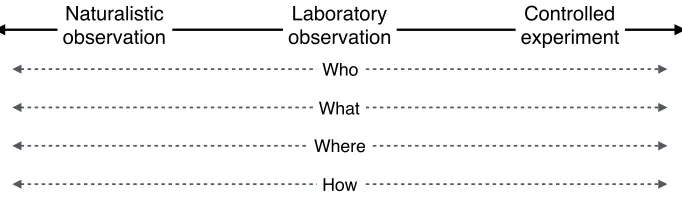
controlled experimentation on the other.2 Just as no experiment can control for all possible extraneous variables, no observational study can achieve absolute naturalism.3 The far ends of the continuum represent methodological ideals, which researchers strive to achieve but may not always obtain in practice. To problematize the dichotomy even further, the continuum can be decomposed into a number of independent dimensions: who the participants in the study are, what the participants do, where the interaction takes place, and how the researcher records the interaction — the who, what, where, and how of interaction research, if you will (see Figure 1).
Figure 1: A methodological continuum from naturalistic observation to controlled experimentation.
In the ideal conversation analytic study, the participants form a natural group to which the researcher has or gains access; the researcher does not determine who participates in any way. The participants do whatever they normally would if the researcher’s camera were not present, and they do so where this would normally be done, wherever that may be. The researcher strives to “maximally minimize” the effects of the recording on the interaction (Mondada, personal communication) and therefore avoids obtrusive research equipment. Generally speaking, this represents best practice in CA research (see Mondada, 2006, 2008, 2013 for details).
In actual practice, however, not all CA research perfectly achieves this ideal. In subtle ways, the particular method that a researcher employs for data collection may fall somewhere to the right of the far left pole. This is especially so for studies of ordinary conversation, which I address here, rather than institutional or workplace interaction. Researchers may, for practical reasons, prefer small groups of participants over large ones, so while the groups themselves may be endogenous, a selectional bias can operate at a higher level. Although conversation analysts do not give participants tasks to perform, the participants may know that the research concerns “conversation” (e.g., from the research ethics protocol) and may therefore understand that the researcher expects them to “have a conversation”, even without instruction. The
recording can also impose an exogenous temporal structure on the interaction (e.g., if the participants understand that the researcher wants a recording of a certain duration), so that even if the activities per se are free from outside influence, their boundaries may not be (cf. Schegloff, 1991, p. 56, fn. 6). While the participants and not the researcher determine where the interaction takes place, either the researcher or the participants themselves can, for practical reasons, modify the local ecology to accommodate the camera (e.g., by arranging chairs and
2
Although I came to this idea independently, when I arrived I found I was not alone. Lorenza Mondada has taught this at workshops on multimodal interaction for many years. Bavelas (1995) has argued that the distinction between artificial and natural data is a false dichotomy, as has Speer (2002). And De Ruiter (2013) has observed that an inherent tradeoff exists between internal and ecological validity in interaction research, depicting these as two continuous dimensions.
3
At least not ethically. The use of third-party video (Jones & Raymond, 2012), where the recordings are made for purposes other than scientific research, may be an exception.
Naturalistic observation
Controlled experiment Laboratory
observation
Who
What
Where
bodies so that all participants are visible, by turning on lights that would otherwise be off, or by turning off music that would otherwise be on). A selectional bias can operate here as well: many recordings exist in which participants sit around a table in a quiet room, the domestic equivalent of a research lab. And while conversation analysts have persuasively argued that concerns over the so-called Observer’s Paradox (Labov, 1972) fail to recognize “the very entanglement of the camera and of the action and the very fact that the camera can indeed reinforce and reveal structural elements of the situation and activity” (Mondada, 2006, p. 12), field recordings nonetheless contain orientations to the camera and research context that surely would not otherwise occur (see Speer & Hutchby, 2003; Laurier & Philo, 2006; and Hazel, 2015).
Such admissions should not be mistaken for criticism. My goal is not to question the validity of CA methods for data collection—far from it. It is to uncover the threads of continuity that exist between CA and less naturalistic methods for the study of conversation, no matter how thin they may be. While we should, I argue, openly admit that the research process can influence the interactions under investigation in subtle ways and work to determine whether and how such effects might be procedurally consequential for particular phenomena, the fact that CA occupies a position on the far left of the continuum is undeniable.
At the other end of the continuum lies the true experiment. In a typical psycholinguistic experiment, for example, the researcher recruits participants as individuals and randomly assigns them to experimental conditions. The participants generally perform an unfamiliar task carefully constructed by the researcher to reveal behavioral or physiological evidence of some unseen cognitive process. The experiment takes place in a research laboratory for convenience and in order to control for extraneous variables (e.g., distractions), and the researcher makes no effort to minimize the effect of the research equipment: the participants may be recorded by multiple cameras, wired up to computers, or inserted into machines (see De Ruiter, 2013, for a review of experimental paradigms in interaction research).
This picture of experimentation, though not inaccurate, does not reflect the full diversity of the approach. Laboratory and experimental studies of conversation can incorporate elements of naturalism into their designs. Rather than recruit participants as individuals, the researcher can recruit naturally occurring groups of participants (see Holler & Kendrick, 2015; Kendrick & Holler, 2017/this issue). This removes an element of artifice found in many experimental and laboratory studies of interaction, namely that participants are asked to interact with strangers in ways and circumstances that strangers do not ordinarily interact. For non-experimental
laboratory research on conversation, there is no need to give the participants an unfamiliar task to perform or a topic to discuss. Because conversation is a ubiquitous activity in our everyday lives, we need no instruction to engage in one, merely a minimal prompt to do so (see Holler & Kendrick, 2015; Kendrick & Holler, 2017/this issue; Hömke, Holler, & Levinson, 2017/this issue). Experimentalists, however, require greater control. Elements of naturally occurring interaction can nonetheless be introduced into experiments through the use of stimuli from conversational corpora (see Bögels, Kendrick, & Levinson, 2015; Bögels & Levinson, 2017/this issue). And while laboratory research by definition takes place in a lab, experiments need not. Field experiments have an important place in psycholinguistic research (Speed, Wnuk, & Majid, in press), though to my knowledge this approach has not been used to study conversation.
Cameras, for example, can be small, placed far from the participants, and even (with informed consent) hidden from view.
To return to the continuum, interaction researchers who use experimental and laboratory methods have made deliberate efforts to increase the ecological validity of their studies, moving from a position on the extreme right towards the methodological center. Methodological
pluralism of this sort is common in many fields but has only begun to be embraced by
conversation analysts (see, e.g., the recent debate over quantification, Stivers, 2015). Whatever the reasons for this situation may be, there are reasons to look beyond it and to welcome a diversity of approaches that includes laboratory and experimental research.
Arguments for laboratory and experimental studies of language and social interaction
Let me begin by dismissing in short order three arguments that are unlikely to resonate with conversation analysts. First, one should not assume a priori that the conduct of participants does not differ in and out of the lab. In my experience, the circumstances in which the
participants find themselves can influence their conduct whether those circumstances are more naturalistic, arranged by the participants themselves with minimal interference by the
researcher, or less so, constructed in some way by the researcher. It is demonstrably the case, however, that numerous basic interactional practices are robust to the imposed artifice of a research lab (e.g., orientations to transition relevance places [Holler & Kendrick, 2015] and the preference organization of responses to polar questions [Kendrick & Holler, 2017/this issue], to cite two examples from my own research). Second, while a psycholinguistic experiment may demand the quiet consistency of a research lab to control for extraneous variables, the CA method of data analysis by design exploits the inherent variability of naturally occurring
interaction, using deviant and boundary cases to support its claims (Hoey & Kendrick, in press). Homogeneity of data is a liability, not an asset. Third, if one assumes that the ultimate goal of research on language and social interaction is to produce causal theories that explain
observable phenomena (see De Ruiter & Albert, 2017/this issue), then experimentation is a necessary tool (see Bögels & Levinson, 2017/this issue). From a positivist perspective, only a true experiment can establish causation; observational studies, whether in the field or the lab, can only reveal correlations. But for most conversation analysts, the ultimate goal is not to produce causal theories, but rather to reveal and describe socially normative orders of interaction, for which experimentation is understood to be unnecessary.
These arguments aside, there are nonetheless good reasons to conduct experimental and laboratory studies of language and social interaction.
1. Laboratory and experimental studies can further specify and refine previous empirical observations and can generate convergent evidence for conversation analytic models. A defining feature of science, whether or not one subscribes to all tenets of positivism, is the ability to replicate the results of previous investigations. If a researcher questions whether the Sacks et al. (1974) model of turn-taking is valid, for example, he or she can record a set of conversations and set out to reproduce their results (as, e.g., Stivers et al., 2009, did for a specific feature of the model). Such replications can and should be done with standard CA methods, but to be able to demonstrate the operation of an interactional practice or
intonational phrases (Bögles & Torreira, 2015) and segmental duration (Zellers, 2016), which has without question enriched our understanding of the relationship between prosody and turn-taking.
2. Laboratory and experimental studies can take advantage of cutting-edge technologies not yet available in the field. The birth of CA in the 1960s came not long after the introduction of the first commercial tape recorders, which allowed researchers for the first time to record and replay actual conversations, subjecting them to previously unobtainable levels of analytic scrutiny (see Sacks, 1984). CA began in the vanguard of technology and there it should remain. Normal science progresses through the development of scientific
instruments that allow for increasingly precise empirical observations (Kuhn, 1962). As the pace of technological advancement increases, conversation analysts should continue to explore novel methods for data collection. While many advanced technologies can be deployed in the field (e.g., multiple cameras, camera glasses, fisheye and 360 degree lenses; see Mondada, 2013; Davidsen & McIlvenny, 2016), some cutting-edge technologies cannot (or cannot practically) yet be used outside of a research lab. The articles in this Special Issue take advantage of a number of such technologies: motion capture cameras and body suits (Stevanovic et al., 2017/this issue); video analysis software that
automatically identifies eye blinks (Hömke, Holler, and Levinson, 2017/this issue); eye-tracking glasses that provide exact measurements of gaze direction (Kendrick & Holler, 2017/this issue); and electro-encephalography (EEG) which measures neuronal activity in the brain (Bögels & Levinson, 2017/this issue). Such technologies produce rich streams of data for each participant individually and thus allow for the systematic analysis of
phenomena such as gaze direction, manual gesture, phonetic and prosodic production, overlap and timing, and so on, for all participants, which may not possible with standard field recordings. And as the technologies mature, becoming more portable and less obtrusive, they will no doubt find their way out of the lab and into the wild, as it were.
3. Questions of ecological validity, where relevant, can be addressed. The primary objection to studies that displace the context of action from its natural environment to a research lab is that the results, lacking ecological validity, will have an “equivocal status” (Schegloff, 1991, p. 55). This is a legitimate concern that experimental and laboratory studies can and should address (see also De Ruiter, 2013). But note that the question of ecological validity does not apply invariably to all such studies: those whose results corroborate previous conversation analytic findings can quite reasonably claim to generalize beyond the confines of the lab. In an experimental study of the timing of preferred and dispreferred responses, for example, Bögels et al. (2015) found evidence in the brain activation of participants that dispreferred responses were less expected after short gaps than long ones (see Bögels & Levinson, 2017/this issue). Because this result converges with results from studies of naturally occurring interaction (e.g., Pomerantz, 1984; Kendrick & Torreira, 2015), the question of ecological validity simply does not arise. However, for those experimental and laboratory studies that discover new phenomena or new relationships between known phenomena, it does. The researcher must then consider whether and how the context in which the conduct was produced may have been procedurally consequential for its production. Schegloff (1991) proposes one possible solution, namely to “[do] a parallel analysis on talk from ordinary interaction” and “[see] whether the findings … come out the same way or not” (p. 56). If indeed laboratory research finds a place within CA, Schegloff’s call for convergent evidence should be held as the gold standard. Kendrick and Holler (2017/this issue) take an initial step in this direction, reporting a parallel analysis of gaze direction in ordinary
imposed by the position of the chairs in the lab, may have had on the conduct of the participants.
4. Finally, experimental and laboratory studies can effectively communicate conversation analytic knowledge to the general scientific community. The sciences are in the midst of an interactive turn. The centrality of social interaction is now being recognized not only in psycholinguistics (Pickering & Garrod, 2004; Levinson, 2016) but also cognitive science (De Jaegher et al., 2010, 2016), social neuroscience (Schilbach et al., 2013), and ethology (Fröhlich et al., 2016). The genie is out of the bottle. The question now is whether researchers in these fields will build on and contribute to the body of knowledge
accumulated in CA. To ensure that they do, conversation analysts must communicate their most important results to the general scientific community, where quantitative and
experimental methods predominate. This does not entail an abandonment of proven CA methods, which are necessary to discover the very phenomena that quantitative and experimental studies might investigate further. It is also vital that conversation analysts continue to collaborate with researchers in other fields, especially those with relevant expertise in quantitative, experimental, and laboratory methods. As research on interaction enters the scientific mainstream, conversation analysts stand ready, with deep reserves of empirical results at their disposal, to ensure that this new wave of interaction research turns its attention to the right phenomena and asks the right questions about them.
Articles in the Special Issue
This Special Issue contains five articles: three novel empirical studies, a comprehensive review of neuroimaging studies on interaction, and a theoretical appeal for an integration of
conversation analytic and experimental methods. The articles are all decidedly interdisciplinary, engaging deeply with research in CA as well as research in the psychological sciences. The empirical studies examine phenomena and domains first discovered and described by conversation analysts: continuers (Schegloff, 1982), action sequences (Schegloff & Sacks, 1972), and preference organization (Pomerantz, 1984). In each case, the studies consider these not only as practices or organizations of talk-in-interaction but as embodied and multimodal phenomena, exploiting the information-rich laboratory recordings and instrumental
measurements to analyze subtle movements of the eyes and body with extreme precision. In the first article in this Special Issue, Kendrick and Holler (2017/this issue) investigate the relationship between gaze direction and response preference in a corpus of conversations recorded in a research lab in which the participants wore eye-tracking glasses to obtain systematic and precise measurements of eye movements. Their study, which combines quantitative and conversation analytic methods, provides convincing evidence that the gaze direction of respondents to polar questions signals the preference status of the response, with gaze aversion at the beginning of a response indicating that the response will likely be
technologies such as motion capture can be combined with conversation analytic methods of sequential analysis to address questions in this domain.
The third article, by Hömke et al. (2017/this issue), examines a phenomenon that while ubiquitous has received little attention from conversation analysts, namely eye blinks. Standard field recordings generally lack the necessary camera angles and resolution to analyze eye blinks systematically. For this reason, the authors built a corpus of conversations recorded under optimal conditions in a research lab. The authors pursue the hypothesis that eye blinks in conversation can serve as continuers (Schegloff, 1982). The article demonstrates that
recipients’ blinks are not randomly distributed throughout the current speaker’s turn but most frequently occur at points of possible completion. Furthermore, an analysis that distinguishes long and short blinks reveals that while short blinks occur in many different sequential
environments, long blinks tend to occur in relatively few, such as after a speaker’s same-turn self-initiated self-repair. The fourth article, by Bögels and Levinson (2017/this issue), provides a systematic review of recent neuroimaging studies of conversation. The authors organize the review around an opposition between two plausible models of the cognitive processes involved in conversational turn-taking. In the Early Planning model, a next speaker begins to plan his or her turn as soon as the current turn’s action is sufficiently recognizable to do so. In contrast, in the Late Planning model, the next speaker waits until the current turn nears completion to plan the next turn. The article details current evidence for and against each model and thus
illustrates how experimentalists use theoretical models to motivate empirical research on interaction.
In the fifth and final article, De Ruiter and Albert (2017/this issue) make a powerful appeal for an integration of methods from CA and experimental psychology. The authors reflect on major developments in the philosophy of science, such as Karl Popper’s falsificationism, and argue that psychologists who subscribe to this tenet permit a disassociation of the context of discovery and the context of justification, to the detriment of the field. Under falsificationism, so long as a hypothesis is testable it need not be grounded in or motivated by observation. The authors warn that this disassociation allows psychologists to construct theories that are less robust and less relevant to everyday interaction than the body of knowledge in CA. For this reason, conversation analytic studies of interactional phenomena, the authors argue, should precede controlled experiments designed to establish causal explanations, one answer to the question of ecological validity.
As a collection, the articles in this Special Issue, which transcend (or perhaps transgress) traditional disciplinary boundaries, clearly demonstrate that experimental and laboratory research can lead to novel insights into language and social interaction. While the studies do not employ CA methods for data collection and employ its methods for data analysis in different ways and to different extents, they nonetheless show how laboratory studies can build on, engage with, and contribute to CA research. CA has a pivotal role to play in the future of experimental research on interaction. Whether the field will seize this opportunity, expand its methodological toolkit, and lift the prohibition on experimental and laboratory research remains to be seen. But what is already clear is that experimental and laboratory methods can fruitfully and productively complement naturalistic observation, the engine of discovery that drives our field ever forward.
References
Bavelas, J. B. (1995). Quantitative versus Qualitative. In W. Leeds-Hurwitz (Ed.), Social Approaches to Communication (pp. 49–62). New York: The Gullford Press.
Bögels, S., Kendrick, K. H., & Levinson, S. C. (2015). Never Say No … How the Brain Interprets the Pregnant Pause in Conversation. PLoS ONE, 10(12), e0145474.
Bögels, S., Magyari, L., & Levinson, S. C. (2015). Neural signatures of response planning occur midway through an incoming question in conversation. Scientific Reports, 5, 12881. https://doi.org/10.1038/srep12881
Bögels, S., & Torreira, F. (2015). Listeners use intonational phrase boundaries to project turn ends in spoken interaction. Journal of Phonetics, 52, 46–57.
https://doi.org/10.1016/j.wocn.2015.04.004
Bögels, S., & Levinson, S. C. (2017). The brain behind the response - insights into turn-taking in conversation from neuroimaging. Research on Language and Social Interaction, 50(1). Clayman, S. E., & Gill, V. T. (2004). Conversation Analysis. In M. Hardy & A. Bryman (Eds.),
Handbook of Data Analysis (pp. 589–606). London: SAGE Publications.
Davidsen, J., & McIlvenny, P. (2016). Jacob Davidsen and Paul McIlvenny on Experiments with Big Video. Retrieved from https://rolsi.net/2016/10/17/guest-blog-jacob-davidsen-and-paul-mcilvenny-on-experiments-with-big-video/
De Ruiter, J. P., Mitterer, H., & Enfield, N. J. (2006). Projecting the end of a speaker’s turn: A cognitive cornerstone of conversation. Language, 82(3), 515–535.
De Ruiter, J., Wachsmuth, I., De Ruiter, J., Jaecks, P., & Kopp, S. (2013). Methodological paradigms in interaction research. In Alignment in Communication. Towards a new theory of communication (pp. 11–31). Amsterdam: John Benjamins Publishing Company.
De Ruiter, J. P., & Albert, S. (2017). An Appeal for a Methodological Fusion of Conversation Analysis and Experimental Psychology. Research on Language and Social Interaction, 50(1).
Drew, P. (2014). Conversation Analysis in Sociolinguistics. In J. Holmes & K. Hazen (Eds.),
Research Methods in Sociolinguistics: A Practical Guide (pp. 230–245). Chichester: John Wiley & Sons.
Eshghi, A., & Healey, P. G. T. (2016). Collective Contexts in Conversation: Grounding by Proxy.
Cognitive Science, 40(2), 299–324. https://doi.org/10.1111/cogs.12225 Ford, C. E., & Thompson, S. A. (1996). Interactional units in conversation: Syntactic,
intonational, and pragmatic resources for the management of turns. In E. Ochs, E. A. Schegloff, & S. A. Thompson (Eds.), Interaction and Grammar (pp. 134–184).
Cambridge: Cambridge University Press.
Fröhlich, M., Kuchenbuch, P., Müller, G., Fruth, B., Furuichi, T., Wittig, R. M., & Pika, S. (2016). Unpeeling the layers of language: Bonobos and chimpanzees engage in cooperative turn-taking sequences. Scientific Reports, 6. https://doi.org/10.1038/srep25887 Gisladottir, R. S., Chwilla, D. J., & Levinson, S. C. (2015). Conversation Electrified: ERP
Correlates of Speech Act Recognition in Underspecified Utterances. PLoS ONE, 10(3), e0120068. https://doi.org/10.1371/journal.pone.0120068
Hazel, S. (2015). The paradox from within: research participants doing-being-observed.
Qualitative Research, 1468794115596216. https://doi.org/10.1177/1468794115596216 Heritage, J., Robinson, J. D., Elliott, M. N., Beckett, M., & Wilkes, M. (2007). Reducing Patients’
Unmet Concerns in Primary Care: the Difference One Word Can Make. Journal of General Internal Medicine, 22(10), 1429–1433. https://doi.org/10.1007/s11606-007-0279-0
Hirvenkari, L., Ruusuvuori, J., Saarinen, V.-M., Kivioja, M., Peräkylä, A., & Hari, R. (2013). Influence of Turn-Taking in a Two-Person Conversation on the Gaze of a Viewer. PLoS ONE, 8(8), e71569. https://doi.org/10.1371/journal.pone.0071569
Holler, J., & Kendrick, K. H. (2015). Unaddressed participants’ gaze in multi-person interaction: optimizing recipiency. Frontiers in Psychology, 6, 98.
https://doi.org/10.3389/fpsyg.2015.00098
Hömke, P., Holler, J., & Levinson S. C. (2017). Eye blinking as addressee feedback in face-to-face conversation. Research on Language and Social Interaction, 50(1).
Howes, C., Healey, P. G. T., Purver, M., & Eshghi, A. (2012). Finishing each other’s . . . Responding to incomplete contributions in dialogue. In Proceedings of the 34th Annual Meeting of the Cognitive Science Society.
Howes, C., Purver, M., Healey, P. G. T., Mills, G., & Gregoromichelaki, E. (2011). On Incrementality in Dialogue: Evidence from Compound Contributions. Dialogue & Discourse, 2(1), 279–311. https://doi.org/10.5087/d&d.v2i1.362
Jaegher, H. D., Paolo, E. D., & Gallagher, S. (2010). Can social interaction constitute social cognition? Trends in Cognitive Sciences, 14(10), 441–447.
https://doi.org/10.1016/j.tics.2010.06.009
Jaegher, H. D., Peräkylä, A., & Stevanovic, M. (2016). The co-creation of meaningful action: bridging enaction and interactional sociology. Phil. Trans. R. Soc. B, 371(1693), 20150378. https://doi.org/10.1098/rstb.2015.0378
Jones, N., & Raymond, G. (2012). “The Camera Rolls” Using Third-Party Video in Field Research. The ANNALS of the American Academy of Political and Social Science,
642(1), 109–123. https://doi.org/10.1177/0002716212438205
Kendrick, K. H., & Torreira, F. (2015). The Timing and Construction of Preference: A Quantitative Study. Discourse Processes, 52(4), 255–289.
https://doi.org/10.1080/0163853X.2014.955997
Kendrick, K. H., & Holler, J. (2017). Gaze direction signals response preference in conversation.
Research on Language and Social Interaction, 50(1).
Kuhn, T. S. (1962). The Structure of Scientific Revolutions. Chicago: University of Chicago Press.
Labov, W. (1972). Sociolinguistic Patterns (Highlighting edition). University of Pennsylvania. Laurier, E., & Philo, C. (2006). Natural problems of naturalistic video data. In H. Knoblauch, J.
Raab, H.-G. Soeffner, & B. Schnettler (Eds.), Video-Analysis Methodology and Methods, Qualitative Audiovisual Data Analysis in Sociology (pp. 183-192). Bern: Lang.
Lerner, G. H. (1991). On the Syntax of Sentences-in-Progress. Language in Society, 20(03), 441–458. https://doi.org/10.1017/S0047404500016572
Lerner, G. H. (1996). On the “semi-permeable” character of grammatical units in conversation: Conditional entry into the turn space of another speaker. In E. Ochs, E. A. Schegloff, & S. A. Thompson (Eds.), Interaction and Grammar (pp. 238–276).
Levelt, W. J. M. (1983). Monitoring and self-repair in speech. Cognition, 14(1), 41–104. https://doi.org/10.1016/0010-0277(83)90026-4
Levinson, S. C. (2016). Turn-taking in Human Communication – Origins and Implications for Language Processing. Trends in Cognitive Sciences, 20(1), 6–14.
https://doi.org/10.1016/j.tics.2015.10.010
Magyari, L., Bastiaansen, M. C. M., de Ruiter, J. P., & Levinson, S. C. (2014). Early Anticipation Lies behind the Speed of Response in Conversation. Journal of Cognitive Neuroscience, 1–10. https://doi.org/10.1162/jocn_a_00673
Magyari, L., & de Ruiter, J. P. (2012). Prediction of Turn-Ends Based on Anticipation of
Upcoming Words. Frontiers in Psychology, 3. https://doi.org/10.3389/fpsyg.2012.00376 Mondada, L. (2006). Video recording as the reflexive preservation-configuration of phenomenal
features for analysis. In Knoblauch, H., Raab, J., Soeffner, HG, Schnettler, B.(eds.). Lang. Retrieved from http://www.ispla.su.se/iis/Dokument/Mondada_Video5diff.pdf Mondada, L. (2008). Using Video for a Sequential and Multimodal Analysis of Social Interaction:
Qualitative Social Research, 9(3). Retrieved from http://www.qualitative-research.net/index.php/fqs/article/view/1161
Mondada, L. (2013). The Conversation Analytic Approach to Data Collection. In J. Sidnell & T. Stivers (Eds.), The Handbook of Conversation Analysis (pp. 32–56). Malden: Blackwell Publishing Ltd.
Peräkylä, A., Henttonen, P., Voutilainen, L., Kahri, M., Stevanovic, M., Sams, M., & Ravaja, N. (2015). Sharing the Emotional Load: Recipient Affiliation Calms Down the Storyteller.
Social Psychology Quarterly, 78(4), 301–323. https://doi.org/10.1177/0190272515611054
Pickering, M. J., & Garrod, S. (2004). Toward a Mechanistic Psychology of Dialogue. Behavioral and Brain Sciences, 27(02), 169–190. https://doi.org/10.1017/S0140525X04000056 Pomerantz, A. (1984). Agreeing and disagreeing with assessments: Some features of
preferred/dispreferred turn shapes. In J. M. Atkinson & J. Heritage (Eds.), Structures of Social Action: Studies in Conversation Analysis (pp. 57–101). Cambridge: Cambridge University Press.
Pomerantz, A., & Heritage, J. (2013). Preference. In J. Sidnell & T. Stivers (Eds.), The Handbook of Conversation Analysis (pp. 210–228). Malden: Blackwell Publishing Ltd. Roberts, F., & Francis, A. L. (2013). Identifying a temporal threshold of tolerance for silent gaps
after requests. The Journal of the Acoustical Society of America, 133(6), EL471. https://doi.org/10.1121/1.4802900
Roberts, F., Francis, A. L., & Morgan, M. (2006). The interaction of inter-turn silence with prosodic cues in listener perceptions of “trouble” in conversation. Speech
Communication, 48(9), 1079–1093. https://doi.org/10.1016/j.specom.2006.02.001 Roberts, F., Margutti, P., & Takano, S. (2011). Judgments Concerning the Valence of Inter-Turn
Silence Across Speakers of American English, Italian, and Japanese. Discourse Processes, 48(5), 331–354. https://doi.org/10.1080/0163853X.2011.558002 Robinson, J. D. (2007). The Role of Numbers and Statistics within Conversation Analysis.
Communication Methods and Measures, 1(1), 65–75. https://doi.org/10.1080/19312450709336663
Robinson, J. D., & Heritage, J. (2014). Intervening With Conversation Analysis: The Case of Medicine. Research on Language and Social Interaction, 47(3), 201–218.
https://doi.org/10.1080/08351813.2014.925658
Rozin, P. (2001). Social Psychology and Science: Some Lessons From Solomon Asch.
Personality and Social Psychology Review, 5(1), 2–14. https://doi.org/10.1207/S15327957PSPR0501_1
Sacks, H. (1984). Notes on methodology. In J. M. Atkinson & J. Heritage (Eds.), Structures of Social Action: Studies in Conversation Analysis (pp. 57–101). Cambridge: Cambridge University Press.
Sacks, H., Schegloff, E. A., & Jefferson, G. (1974). A Simplest Systematics for the Organization of Turn-Taking for Conversation. Language, 50(4), 696–735.
Schegloff, E. A. (1991). Reflections on Talk and Social Structure. In D. Boden & D. H. Zimmerman (Eds.), Talk and Social Structure (pp. 44–70). Cambridge: Polity Press. Schegloff, E. A. (1993). Reflections on Quantification in the Study of Conversation. Research on
Language & Social Interaction, 26, 99–128. https://doi.org/10.1207/s15327973rlsi2601_5 Schegloff, E. A. (1996a). Confirming Allusions: Toward an Empirical Account of Action.
American Journal of Sociology, 102(1), 161–216.
Schegloff, E. A. (1996b). Issues of Relevance for Discourse Analysis: Contingency in Action, Interaction and Co-Participant Context. In E. H. Hovy & D. R. Scott (Eds.),
Schegloff, E. A. (1998). Reflections on Studying Prosody in Talk-in-Interaction. Language and Speech, 41(3–4), 235–263. https://doi.org/10.1177/002383099804100402
Schegloff, E. A., Jefferson, G., & Sacks, H. (1977). The Preference for Self-Correction in the Organization of Repair in Conversation. Language, 53(2), 361–382.
Schilbach, L., Timmermans, B., Reddy, V., Costall, A., Bente, G., Schlicht, T., & Vogeley, K. (2013). Toward a second-person neuroscience. Behavioral and Brain Sciences, 36(04), 393–414. https://doi.org/10.1017/S0140525X12000660
Sidnell, J. (2013). Basic Conversation Analytic Methods. In J. Sidnell & T. Stivers (Eds.), The Handbook of Conversation Analysis (pp. 77–99). Malden: Blackwell Publishing Ltd. Sidnell, J., & Stivers, T. (Eds.). (2013). The Handbook of Conversation Analysis. Malden:
Blackwell Publishing Ltd.
Speed, L. J., Wnuk, E., & Majid, A. (in press). Studying Psycholinguistics out of the Lab. In P. Hagoort & A. M. B. De Groot (Eds.), Research Methods in Psycholinguistics and the Neurobiology of Language. Chichester: Wiley-Blackwell.
Speer, S. A. (2002). `Natural’ and `contrived’ data: a sustainable distinction? Discourse Studies,
4(4), 511–525. https://doi.org/10.1177/14614456020040040601
Speer, S. A., & Hutchby, I. (2003). From Ethics to Analytics: Aspects of Participants’
Orientations to the Presence and Relevance of Recording Devices. Sociology, 37(2), 315–337. https://doi.org/10.1177/0038038503037002006
Stevanovic, M., Himberg, T., Niinisalo, M., Kahri, M., Peräkylä, A., Sams, M., & Hari, R. (2017). Sequentiality, mutual visibility, and behavioral matching: Body sway and pitch register during joint decision-making. Research on Language and Social Interaction, 50(1). Stivers, T. (2015). Coding Social Interaction: A Heretical Approach in Conversation Analysis?
Research on Language and Social Interaction, 48(1), 1–19. https://doi.org/10.1080/08351813.2015.993837
Stivers, T., Enfield, N. J., Brown, P., Englert, C., Hayashi, M., Heinemann, T., … Levinson, S. C. (2009). Universals and cultural variation in turn-taking in conversation. Proceedings of the National Academy of Sciences, 106(26), 10587.
Voutilainen, L., Henttonen, P., Kahri, M., Kivioja, M., Ravaja, N., Sams, M., & Peräkylä, A. (2014). Affective stance, ambivalence, and psychophysiological responses during conversational storytelling. Journal of Pragmatics, 68, 1–24.
https://doi.org/10.1016/j.pragma.2014.04.006
Zellers, M. (2016). Prosodic Variation and Segmental Reduction and Their Roles in Cuing Turn Transition in Swedish. Language and Speech, 0023830916658680.