R E S E A R C H A R T I C L E
Open Access
The perceived effectiveness of MERS-CoV
educational programs and knowledge
transfer among primary healthcare workers:
a cross-sectional survey
Meshal Aldohyan
1, Nedal Al-Rawashdeh
2,3, Farouk M. Sakr
4, Saeed Rahman
5, Ali I. Alfarhan
5and Mahmoud Salam
6*Abstract
Background:Knowledge transfer of Middle East respiratory syndrome coronavirus (MERS-CoV) involves the
dissemination of created/acquired information on MERS-CoV in hospitals, making this information accessible to all healthcare workers (HCWs). This study evaluated the perceived effectiveness of MERS-CoV educational programs and knowledge transfer among primary care HCWs at a hospital in Saudi Arabia that witnessed the largest outbreak of confirmed MERS-CoV cases in this country.
Methods:A survey was distributed among primary care HCWs at five clinics in Saudi Arabia in 2016. Those with non-direct patient care responsibilities were excluded. Their knowledge was evaluated against facts published by Mayo Clinic Foundation, and its percentage mean score (PMS) ± standard deviation was calculated. HCWs’perceived effectiveness of educational programs and knowledge transfer was classified as negative or positive.
Results:Sample comprised of 404 HCWs, of which 64% were females and 36% were males. Almost 26% were≤30
years old, and 42% had > 10 years of work experience. Almost 46.5% were nurses, 23.0% physicians, 18.1% were pharmacists, and 12.4% were technical staff. PMS for knowledge was 71.1 ± 19.4. The prevalence of negative perceptions towards educational programs was 22.5% and of knowledge transfer was 20.8%. Older(> 40 years of age) and more experienced(> 10 years) HCWs had the highest PMS for knowledge(73.4 ± 18.9,P= 0.005 and 76.9 ± 15.7,P< 0.001 respectively). Negative perceptions of educational programs (49.4 ± 20.7;P< 0.001) and knowledge transfer (46.0 ± 19.7;P= 0.001) were associated with a lower knowledge PMS. Males were 2.4[95% confidence interval 1.4–4.2] times and 2.0[1.1–3.5] times more likely to have negative perceptions of educational programs and knowledge transfer (adjusted (adj.)P= 0.001 and adj.P= 0.023, respectively). Physicians/pharmacists were 1.8[1.03–3.11] and 2.8[1.6–5.0] times more likely to have negative perceptions of both outcomes (adj.P= 0.038 and adj.P= 0.001, respectively). Less experienced HCWs were 2.1[1.3–3.5] times and 4.9[2.6–9.2] times more likely to exhibit negative perceptions of the two outcomes (adj.P< 0.001 each).
Conclusions:A negative perception of the effectiveness of MERS-CoV knowledge transfer was associated with poorer knowledge and was more prevalent among male HCWs, physicians/pharmacists and less experienced HCWs. Hospitals should always refer to efficient knowledge sharing and educational strategies that render beneficial outcomes to patients, HCWs, and the public community.
Keywords: MERS, Coronavirus, Knowledge transfer, Education, Primary health
© The Author(s). 2019Open AccessThis article is distributed under the terms of the Creative Commons Attribution 4.0 International License (http://creativecommons.org/licenses/by/4.0/), which permits unrestricted use, distribution, and reproduction in any medium, provided you give appropriate credit to the original author(s) and the source, provide a link to the Creative Commons license, and indicate if changes were made. The Creative Commons Public Domain Dedication waiver (http://creativecommons.org/publicdomain/zero/1.0/) applies to the data made available in this article, unless otherwise stated.
* Correspondence:[email protected];[email protected]
6Science and technology unit, King Abdullah International Medical Research
Background
Middle East respiratory syndrome coronavirus (MERS-CoV) has created an epidemiological and clinical crisis within 27 countries in North Africa, Europe, Asia and the USA but mainly in the Middle East (Kingdom of Saudi Arabia) [1]. It is a viral respiratory illness, initially discovered in 2012 and speculated to have originated from camels or bats in Saudi Arabia, with subsequent spread to humans and across borders [2]. Since 2012, a minimum of 1415 laboratory-confirmed cases have been reported in Saudi Arabia, of which 610 patients have died, 833 have recovered and two were under treatment [3]. High-risk groups were those in close contact with camels, geriatric persons, pregnant women, healthcare workers (HCWs) and those with pre-existing comorbidi-ties [1]. MERS-CoV infection ranged from asymptomatic or mild respiratory symptoms to severe acute respiratory disease and even death, which was reported in three to four out of every 10 reported MERS-CoV cases [4]. Biologic samples of subjects with a suspected MERS-CoV infection (based on clinical symptoms) and of those exposed to re-ported MERS-CoV cases are tested using real-time reverse transcription polymerase chain reaction (rRT-PCR) assays. Serology, such as an enzyme-linked immunosorbent assay and immunofluorescence assay, is also used to confirm MERS-CoV by the presence of antibodies [5].
In Saudi Arabia, a series of modifications was applied to the patient pathways while visiting the emergency de-partments or admitted as in-patients. This included seg-regating patients during triage based on prioritizing the inflow of patients by their chief complaints, bed availability and screening of flu symptoms/history of ex-posure. The infrastructure of the medical facility, par-ticularly the ventilation system and isolation capacity of rooms, was subject to changes. Some hospital wards and staff (especially nurses) were dedicated specifically to confirmed MERS-CoV cases to limit the chance of cross-contamination across wards and HCWs. The In-fection Prevention and Control Department (IPCD) at SMNG-HA, in particular, was on high alert for such MERS-CoV outbreaks, especially with the evident trans-mission of viral infections between patients and HCWs at SMNG-HA. Crisis management required a rapid im-plementation of adequate infection prevention, control procedures and case isolation, in addition to collabor-ation and coordincollabor-ation with local and interncollabor-ational consultations.
Exceptional efforts have been made by the IPCD to apply the latest and most effective means of universal standard precautions throughout the MERS-CoV crisis. Rules and regulations pertinent to infection control and prevention have been revisited and environmental sur-veillance has been carried out regularly to ensure that all wards are equipped with suitable protection and
precautionary gear. Numerous seminars, workshops and awareness campaigns have been launched for HCWs of all disciplines to boost their knowledge on MERS-CoV, as well as their morale, to maintain a high-quality, safe and dedicated service for the pa-tients. The latest updates issued on MERS-CoV from the World Health Organization (WHO), the Centers for Disease Control and Prevention (CDC), collabora-tive task forces (local and regional) and researchers have been circulated regularly among all HCWs and across all managerial levels.
Numerous research studies have been conducted and published on the perception, knowledge and attitude of HCWs towards MERS-CoV. It is rare to find a HCW who has not attended an educational program on MERS-CoV in Saudi Arabia. Dissemination of MERS-CoV information/updates or knowledge transfer within a health-care organization is a process in which this information is created, generated or acquired, and then organized and dis-tributed within the system to ensure it is accessible to all HCWs. One of the mechanisms of knowledge transfer is personalization whereby knowledge is transferred from one individual to another, while the other is codification where knowledge is converted into products such as documents, images and videos [6]. The need to transfer efficiently the precautionary regulations and updates about MERS-CoV to large numbers of HCWs necessitates the mechanism of codification [7]. In addition, knowledge transfer or informa-tion sharing was found to be positively associated with job satisfaction [8].
Authors hypothesized that although the dissemination of knowledge and updates on MERS-CoV among HCWs has been given full consideration, these HCWs might have reservations on the effectiveness and quality of MERS-CoV related educational offerings. Therefore, there was an emerging need to evaluate the perceived ef-fectiveness of MERS-CoV educational programs and knowledge transfer from the HCW’s perspective, in a setting that witnessed the largest outbreak of confirmed MERS-CoV cases in Saudi Arabia.
Methods
registrants, with a rate of four visits per registrant annu-ally. Eligible primary care HCWs were targeted as being in frontline contact with potential confirmed cases of MERS-CoV. Those occupying positions of management, education or non-direct patient care were excluded. Med-ical and nursing students were also excluded. This study was ethically approved by the Institutional Review Board at King Abdullah International Medical Research Center, King Saud bin Abdul-Aziz University for Health Sciences, SP-16/191.
The provisioned sample size in this study was calcu-lated based on a reported level of knowledge between 43.3 and 57.4% by Alkot et al. among HCWs in the Western region of Saudi Arabia. Assuming an expected level of knowledge of 57%, with a 95% confidence limit (z = 1.96), and a margin of error 5%, the estimated sam-ple size for this study was 376. For convenience, all eli-gible HCWs at the targeted setting were invited to participate in this survey, to overcome a 25% non-response rate. The survey was provided in a sealed enve-lope with a cover letter that described the objectives of the study. The survey was in English language, as the targeted study participants were English literate and the educational offerings provided at the targeted setting were also in English. Participants who agreed to enroll in this study hand-signed an agreement statement at the end of an informed consent, with no need for any per-sonal identifier. The data collection tool comprised the characteristics of the HCW, principally gender, age cat-egory (years), job position and experience (years) [10]. The knowledge of HCWs was measured using 16 state-ments based on undisputed facts published in the litera-ture and issued by the Mayo Foundation for Medical Education and Research in 2018 [11]. Correct answers were scored “1”, while wrong/don’t know answers were scored“0”. The percentage mean score (PMS) of know-ledge was calculated by adding the correct responses of the 16 statements, dividing the score by 16 and multiply-ing it by 100 (range of score 0 to 100). The perceived ef-fectiveness of the MERS-CoV educational programs was measured using one statement: “Prevalence of MERS can be reduced by active participation of healthcare workers in the hospital infection control program”, while the perception of knowledge transfer was measured by one statement: “Any related information about MERS should be disseminated among healthcare workers”. Both statements were rated on a four-point Likert scale (strongly disagree, disagree, agree and strongly agree). Those who responded by disagree or strongly disagree were classified as having a negative perception, while those who responded agree or strongly agree were classi-fied as having a positive perception. The negative per-ception rate was calculated by dividing the number of participants who had negative responses over the total
number of respondents. In addition, participants were asked about the source of MERS-CoV information. The survey was piloted on a group of five HCWs, and their subjective comments were considered. The internal consistency or reliability (Cronbach’s alpha) of the know-ledge domain measured 0.67 (Additional file1).
Data were analyzed using the Statistical Package for Social Studies (SPSS 25; IBM Corp., New York, NY, USA). HCW characteristics, perceptions (negative vs positive) and incorrect knowledge response statements were presented in terms of frequencies and percentages, while the PMS of knowledge was presented as the mean ± standard deviation. Missing data were replaced by the average of the total, and outliers were dropped out. Pearson’s chi-square test was used to test categorical outcomes across HCW characteristics, while a Mann– Whitney test and a Kruskal–Wallis test were used to test the non-normally distributed PMS of knowledge scores. Two binary logistic regression models were constructed to determine the factors significantly associated with negatively perceived effectiveness of MERS-CoV edu-cational programs and knowledge transfer. Due to the small subgroup size of job positions, nurses were grouped with technicians, while pharmacists were grouped with physicians. These two subgroups had job positions comparable in terms of the educational levels, scope of practice and nature of patient care. The adjusted odds ratios [95% confidence interval] were calculated, and statistical significance was set at a value of P< 0.05.
Results
Sample and outcome characteristics
Initially, 600 surveys were distributed among HCWs; 404 participants agreed to enroll and completed the sur-vey (response rate 67.3%). Those who did not participate were mainly either off duty or busy with their workload. Females constituted 64.1% of the sample, while males comprised 35.9%. Almost 26% were≤30 years old, 29% were 30–40 years old and 45% were > 40 years old. The majority (46.5%) were nurses, followed by physicians (23.0%), pharmacists (18.1%) and technical staff (12.4%). Most HCWs (42.1%) had accumulated > 10 years of work experience, with 29.2% having < 5 years of experi-ence and 28.7% having 5–10 years (Table 1). Overall, 36.1% of respondents claimed that their main source of information was the internet, while 47.8% reported more than one source, including research studies, books, media and others.
management of MERS-CoV”. Other incorrect re-sponses to statements are listed in chronological order in Table 2. Overall, 22.5% of participants re-ported a negative perceived effectiveness of MERS-CoV educational programs, while 20.8% had a negative percep-tion of knowledge transfer.
Factors associated with outcomes
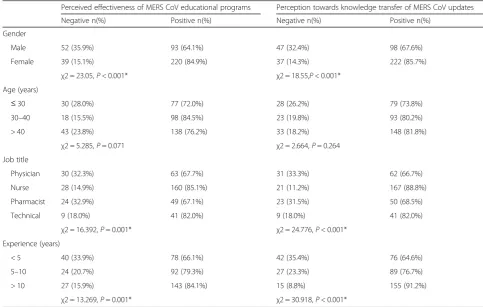
With regard to the perceived effectiveness of MERS-CoV educational programs, male HCWs had signifi-cantly a more negative perception than female HCWs (n= 52, 35.9%, vs n= 39, 15.1%, respectively; P< 0.001). Pharmacists (n= 24, 32.9%) and physicians (n= 30, 32.3%) reported more negative perceptions than tech-nical staff (n= 9, 18.0%) and nurses (n= 28, 14.9%) (P= 0.001). HCWs with work experience of < 5 years had the most negative perceptions in comparison with the other groups (P= 0.001). A number of factors were associated with a negative perception of knowledge transfer of MERS-CoV information. Male HCWs had a greater negative perception than females (n= 47, 32.4%, vs n= 37, 14.3%, respectively; P< 0.001). Physicians (n= 31,
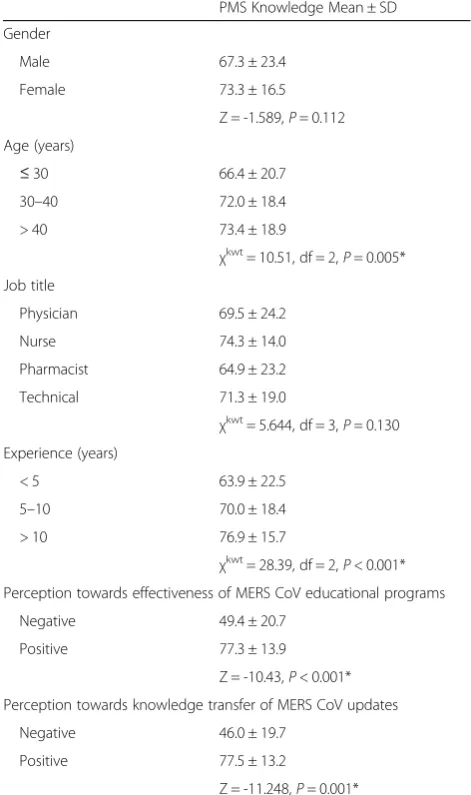
33.3%) and pharmacists (n= 23, 31.5%) had more nega-tive perceptions of knowledge transfer in comparison with technical staff (n= 9, 18.0%) and nurses (n= 21, 11.2%) (P< 0.001). Junior HCWs with work experience of < 5 years (35.4%) had the highest rate of negative per-ception of knowledge transfer (P< 0.001) (Table 3). HCWs > 40 years old (PMS 73.4 ± 18.9) had the highest knowledge scores in comparison with the other age groups (P= 0.005). More experienced HCWs (> 10 years) also had the highest knowledge scores (PMS 76.9 ± 15.7; P< 0.001). Those who had a negative perception of the effectiveness of MERS-CoV educational programs (PMS 49.4 ± 20.7) and of knowledge transfer of MERS-CoV updates (PMS 46.0 ± 19.7) both had lower knowledge scores in comparison with the positive-perception group (P< 0.001 andP= 0.001, respectively), Table4.
Logistic regression analyses showed that male HCWs were 2.4 [1.4–4.2] times and 2.0 [1.1–3.5] times more likely to have negative perceptions of the effectiveness of MERS-CoV educational programs and knowledge trans-fer in comparison with female HCWs (adj.P= 0.001 and adj. P= 0.023, respectively). Physicians and pharmacists combined were also 1.8 [1.03–3.11] and 2.8 [1.6–5.0] more likely to have negative perceptions of the effective-ness of MERS-CoV educational programs and know-ledge transfer, respectively, than nurses/technical staff (adj.P= 0.038 and adj.P= 0.001, respectively). Less expe-rienced HCWs with ≤10 years of work experience were 2.1 [1.3–3.5] times and 4.9 [2.6–9.2] times more likely to exhibit negative perceptions of the two outcomes in com-parison with more experienced HCWs with > 10 years of experience (adj.P< 0.001 each), Table5.
Discussion
[image:4.595.56.290.100.450.2]MERS-CoV educational programs at healthcare institu-tions are a formal and reliable channel to deliver essen-tial knowledge to HCWs. For the sake of personal safety, job satisfaction and work morale, HCWs should not pass up any opportunity to increase their theoretical know-ledge and practical skills. Hospital administrators do not necessarily face the challenge of producing new informa-tion, as an immense amount of valuable information already exists in the literature. The problem arises from the fact that current knowledge is either poorly struc-tured or inaccessible to HCWs [12]. For example, ad-vanced practice nurses are observed to be “knowledge brokers” in a sense that they act as disseminators of knowledge among the nursing body. Furthermore, health educators retrieve different types of evidence, synthesize it in different forms, translate it by evaluation, interpret it and then distribute it among nurses [13]. Health edu-cation can improve levels of awareness and perception among HCWs towards MERS-CoV infections [14], and these higher levels of knowledge can aid in the control Table 1Health care workers’and outcomes’characteristics
n(%)
Gender
Male 145 (35.9%)
Female 259 (64.1%)
Age (years)
≤30 107 (26.5%)
30–40 116 (28.7%)
> 40 181 (44.8%)
Job title
Physician 93 (23.0%)
Nurse 188 (46.5%)
Pharmacist 73 (18.1%)
Technical 50 (12.4%)
Experience (years)
< 5 118 (29.2%)
5–10 116 (28.7%)
> 10 170 (42.1%)
Percentage Mean Score of Knowledge
(Mean ± SD) 71.1 ± 19.4
Perception towards effectiveness of MERS CoV educational programs
Negative 91 (22.5%)
Positive 313 (77.5%)
Perception towards knowledge transfer of MERS CoV updates
Negative 84 (20.8%)
Positive 320 (79.2%)
Table 3Perceived effectiveness of MERS-CoV educational programs and its knowledge transfer across particpant characteristics
Perceived effectiveness of MERS CoV educational programs Perception towards knowledge transfer of MERS CoV updates
Negative n(%) Positive n(%) Negative n(%) Positive n(%)
Gender
Male 52 (35.9%) 93 (64.1%) 47 (32.4%) 98 (67.6%)
Female 39 (15.1%) 220 (84.9%) 37 (14.3%) 222 (85.7%)
χ2 = 23.05,P< 0.001* χ2 = 18.55,P< 0.001*
Age (years)
≤30 30 (28.0%) 77 (72.0%) 28 (26.2%) 79 (73.8%)
30–40 18 (15.5%) 98 (84.5%) 23 (19.8%) 93 (80.2%)
> 40 43 (23.8%) 138 (76.2%) 33 (18.2%) 148 (81.8%)
χ2 = 5.285,P= 0.071 χ2 = 2.664,P= 0.264
Job title
Physician 30 (32.3%) 63 (67.7%) 31 (33.3%) 62 (66.7%)
Nurse 28 (14.9%) 160 (85.1%) 21 (11.2%) 167 (88.8%)
Pharmacist 24 (32.9%) 49 (67.1%) 23 (31.5%) 50 (68.5%)
Technical 9 (18.0%) 41 (82.0%) 9 (18.0%) 41 (82.0%)
χ2 = 16.392,P= 0.001* χ2 = 24.776,P< 0.001*
Experience (years)
< 5 40 (33.9%) 78 (66.1%) 42 (35.4%) 76 (64.6%)
5–10 24 (20.7%) 92 (79.3%) 27 (23.3%) 89 (76.7%)
> 10 27 (15.9%) 143 (84.1%) 15 (8.8%) 155 (91.2%)
χ2 = 13.269,P= 0.001* χ2 = 30.918,P< 0.001*
[image:5.595.54.538.416.723.2]nfrequency,%percentage,χ2Chi-square,P P-value, *: significance at < 0.05
Table 2Frequency of wrong responses to individual knowledge statements
n(%)
1 Incubation time for virus is 14–28 days 337 (83.4%)
2 Antibiotics are the first line treatment for the management of MERS-CoV 176 (43.6%)
3 Polymerase chain reaction can be used to diagnose MERS-CoV 163 (40.3%)
4 Washing hands vigorously (soap/water) for 20 s helps in prevention/transmission of disease 130 (32.2%)
5 Vaccination of MERS-CoV is available in market 98 (24.3%)
6 MERS-CoV is caused by alpha coronavirus 95 (23.5%)
7 The main source of MERS virus is plant 86 (21.3%)
8 Transmission of MERS-CoV infection can be prevented by using universal precautions. 82 (20.3%)
9 MERS patients should be kept in isolation 78 (19.3%)
10 Gowns, gloves, mask and goggles must be used when dealing with MERS patients 75 (18.6%)
11 People with co-morbidities are more likely to be infected 73 (18.1%)
12 Special caution must be taken if a person presents with MERS symptoms from the Arabian Peninsula 72 (17.8%)
13 MERS-CoV patients develop severe acute respiratory illness 61 (15.1%)
14 MERS-CoV spreads through close contact like caring and/or living with infected persons 54 (13.4%)
15 Fever, cough and shortage of breath are hallmark symptoms of MERS-CoV 47 (11.6%)
16 MERS-CoV can be fatal 47 (11.6%)
of disease outbreaks [15]. However, published evidence in Saudi Arabia has shown that there is limited know-ledge on MERS-CoV (both microbiological and viro-logical aspects) among HCWs in southern Saudi Arabia [16]. Another study also claimed that knowledge about emerging infectious diseases was poor, and that infection control practices were suboptimal and also seemed to be overestimated [17]. The association between younger age and less experience on one hand and lower know-ledge scores on the other was a reasonable finding. Simi-lar to literature findings, the knowledge of HCWs in this setting was suboptimal and gaps remain that should dir-ect the focus towards the mechanisms and quality of knowledge transfer.
Dissemination of MERS-CoV updates using e-mail, the internet, institutional announcements, employee meetings, the media and even personal communications are all methods of knowledge transfer. HCWs can ex-perience knowledge transfer both passively, absorbing information unconsciously, and actively. Investigators in this study were curious to know how HCWs perceived the transfer of knowledge about MERS-CoV and why this would be of concern to hospital administrators. For instance, knowledge transfer has been adopted with re-gard to smoking as a health hazard, HIV transmission as a sexual risk and seat belts in motor vehicles as a safety measure. People are exposed almost daily to precaution-ary advice by a variety of methods but unfortunately still undertake high-risk activities and are exposed to these hazards. This occurs regardless of the duration, fre-quency and quality of awareness campaigns. Therefore, it is an aggravating concern that the repetitive exposure of HCWs to MERS-CoV campaigns might have created some sort of “tolerance”. HCWs might disremember or take lightly the acquisition of current or new updates about MERS-CoV precautions due to routine attendance of educational programs or repetitive circulation of e-mails.
[image:6.595.55.291.102.500.2]Knowledge and skills must be passed on in a systematic way from expert to novice employees in a way that makes Table 4Knowledge scores across various sample characteristics
PMS Knowledge Mean ± SD
Gender
Male 67.3 ± 23.4
Female 73.3 ± 16.5
Z = -1.589,P= 0.112
Age (years)
≤30 66.4 ± 20.7
30–40 72.0 ± 18.4
> 40 73.4 ± 18.9
χkwt
= 10.51, df = 2,P= 0.005*
Job title
Physician 69.5 ± 24.2
Nurse 74.3 ± 14.0
Pharmacist 64.9 ± 23.2
Technical 71.3 ± 19.0
χkwt
= 5.644, df = 3,P= 0.130
Experience (years)
< 5 63.9 ± 22.5
5–10 70.0 ± 18.4
> 10 76.9 ± 15.7
χkwt
= 28.39, df = 2,P< 0.001*
Perception towards effectiveness of MERS CoV educational programs
Negative 49.4 ± 20.7
Positive 77.3 ± 13.9
Z = -10.43,P< 0.001*
Perception towards knowledge transfer of MERS CoV updates
Negative 46.0 ± 19.7
Positive 77.5 ± 13.2
Z = -11.248,P= 0.001*
nfrequency,%percentage,ZMann Whitney test,χkwtKruskal–Wallis test, dfdegree of freedom,P P-value, *: significance at < 0.05
Table 5Significantly associated factors with negative perceptions towards MERS CoV educational programs and knowledge transfer
Negative perception towards effectiveness of MERS CoV educational programs
Negative perception towards knowledge transfer of Mers CoV updates
β(S.E.) Adj.P-value Adj.OR[95% CI] β(S.E.) Adj.P-value Adj.OR[95% CI]
Sex
Female = 0; Male = 1
0.89 (0.28) 0.001* 2.4 [1.4–4.2] 0.67 (0.29) 0.023* 2.0 [1.1–3.5]
Specialty of physician Nurse/Technicians = 0 Physicians/pharmacists = 1
0.58 (0.28) 0.038* 1.8 [1.03–3.11] 1.02 (0.30) 0.001* 2.8 [1.6–5.0]
Experience (years) > 10 = 0;≤10 = 1
0.74 (0.27) 0.005* 2.1 [1.3–3.5] 1.6 (0.32) < 0.001* 4.9 [2.6–9.2]
Constant −2.36 (0.27) < 0.001* 0.094 −3.22 (0.35) < 0.001* 0.040
[image:6.595.57.539.596.724.2]sense [18]. Managers who support work-empowering en-vironments are actually boosting the engagement of par-ticipations in terms of knowledge transfer [19]. In fact, one of the key elements in seeking accreditation or man-aging crises such as MERS-CoV is knowledge communi-cation, in the sense that effective communication ensures a purposeful exchange of information, thus allowing a more thorough understanding of the outbreak [20, 21]. Interactive workshops remain highly recommended for the sharing and transferring of knowledge among HCWs. However, one study noted that, although those who attended such workshops valued the expert input and dis-cussions, after few months their sustainability of attend-ance was lost [22]. Some barriers to MERS-CoV knowledge transfer could be the inability of HCWs to recognize and articulate the instructions, personal oppos-ition or resistance to change, the quality of the communi-cation technologies, the absence of visual representations, language and cultural differences, deficiency in expertise, the work environment, a lack of job incentive/motivation, the organizational culture and others [23,24].
Current efforts to manage the MERS-CoV crisis are di-rected towards developing educational programs that target both the community and HCWs [25]. A negative perception of MERS-CoV educational programs in this setting might result in outdated knowledge among HCWs, which jeopardizes their compliance with disease precautionary and control measures. A MERS-CoV task force committee pointed out that the Saudi Arabian Ministry of Health has posted updates on MERS-CoV through videos, posters, handouts, posters and an official website. Resilience against MERS-CoV increases with enriched education and awareness [25]. A Saudi Arabian study reported that HCWs were unaware of the avail-ability of MERS-CoV information at their work areas; they did not feel they had sufficient training and were not confident about infection control guidelines. These factors may also contribute to having a negative percep-tion of MERS-CoV-related educapercep-tional programs [26]. One study reported that the interest in following disease updates among HCWs improved significantly after the implementation of a MERS-CoV educational program [14]. These programs improved the attitude of the HCWs towards governmental measures taken regarding the crisis [14]. HCWs often grasp their MERS-CoV educational in-formation primarily from watching TV reports, or from the internet. A negative perception of knowledge transfer might be due to a pre-existing lack of trust in the media or in websites that might, to some degree, lack scientific credibility in comparison with educational programs pro-vided in healthcare centers [27].
Knowledge itself is complex, and its transfer process within healthcare institutions carries many challenges [28]. One way to overcome these challenges is to
determine the characteristics of HCWs who might be more likely to exhibit negative perceptions of knowledge transfer for significant MERS-CoV updates. In the litera-ture, knowledge transfer has been investigated more fre-quently in manufacturing industries and firms, or among the public community. It has been seldom evaluated among HCWS [29], and never in a Middle Eastern set-ting or related to a MERS-CoV outbreak. A cross-national study suggested that organizational culture was a significant influence on the capacity of HCWs to en-gage in knowledge transfer [30]. A systematic review paper study stated that knowledge transfer could stream-line productivity and coordinate the use of resources more efficiently [29]. This review paper claimed to be the first to review published research focused on the perceptions of HCWs about knowledge management [29]. Knowledge management was defined as having an efficient idea or new practice accepted and adopted by an individual or a group through communication chan-nels (successful diffusion of ideas) [31]. This definition also applies to the dissemination of updated regulations on the outbreak of MERS-CoV. This information, once absorbed by people, should be sustained for as long as it is useful, and not decay over time [32]. Accordingly, a negative perception of the importance of knowledge transfer could be a warning sign of an interruption in this sustainability of retained information about MERS-CoV. Signs of information decay were evident among HCWs in this study, as those who had negative perceptions had lower knowledge scores about MERS-CoV in comparison with those who had positive perceptions.
One of the key goals of knowledge transfer is to edu-cate and train the less experienced and/or the newly hired HCWs [33]. This phase of staff development is crucial yet stressful for novice HCWs, who are expected to acquire skills and competencies rapidly to ensure that a safe and quality service flow is maintained at the insti-tution. This explains why HCWs with less work experi-ence (< 5 years) had significantly more negative perceptions of knowledge transfer and the perceived ef-fectiveness of MERS-CoV educational programs. As they gain more work experience, this perception improves as they realize the importance of education not only for their patients but also for their career advancement.
Conclusions
on MERS-CoV was moderately low. A negative percep-tion of the knowledge transfer of MERS-CoV informa-tion and educainforma-tional programs was associated with poorer knowledge. This negative perception was more prevalent among male HCWs, physicians/pharmacists and less experienced HCWs.
This study has been conducted at one setting, yet the struggle against MERS-CoV has not ended and will con-tinue against future emerging strains of viruses and bac-teria causing communicable diseases in other settings too. Knowledge is a valuable asset, and its holders within any healthcare institution should be retained and moti-vated so that they continue to spread their benefit among other HCWs. All healthcare institutions should always identify and refer to reliable sources of know-ledge. For instance, the center for disease control and prevention is a leading national public health institute and accountable for disseminating up-to-dates on vari-ous infectivari-ous topics. In Saudi Arabia, the ministry for public health has designated communication channels to release updates on MERS-CoV on their websites, through scientific arenas, memorandums and helpdesks.
Knowledge sharing and management strategies in the healthcare sector can render beneficial outcomes to pa-tients, HCWs, the organization and the public commu-nity [29]. In addition to the attendance of seminars or workshops, other methods of knowledge dissemination might involve launching of journal clubs among HCWs to discuss updates on MERS CoV. Audiovisuals at hospi-tals, such as educational videos on TV screens in lobbies or corridors, constantly enlighten HCWs. Deeper un-derstanding of the negativity in the perception to-wards the quality or method of knowledge transfer necessitates a qualitative methodological approach, as face to face interviews with HCWs aid in determining the underlying reasons and at a more personal level. Furthermore, the execution of these strategies needs to be routinely monitored and evaluated so that the transfer of knowledge is time efficient and effective. Optimal theoretical knowledge and practical compe-tence are two main indicators of successful knowledge transfer among HCWs. Last but not least, a number of key points can be noted:
– Middle East respiratory syndrome coronavirus
(MERS-CoV) has created an epidemiological and clinical crisis within 27 countries around the globe.
– Exceptional efforts have been made by the Infection
Prevention and Control Departments to apply the latest and most effective means of universal standard precautions.
– Numerous seminars, workshops and awareness
campaigns have been launched to boost the knowledge on MERS-CoV among health workers,
as well as their morale, to maintain a high-quality, safe and dedicated service for patients.
– The perceived effectiveness of MERS-CoV educational
programs and knowledge transfer among health workers in this high risk setting was evaluated.
– Primary health workers were expected to be aware
of the most recent updates on MERS-CoV, yet younger and less experienced HCWs had moderate knowledge.
– A negative perception of the effectiveness of
MERS-CoV knowledge transfer was associated with poorer knowledge, and was more prevalent among male HCWs, physicians/pharmacists and less experienced HCWs.
Additional file
Additional file 1:Questionnaire. (DOCX 136 kb)
Abbreviations
adj.:Adjusted; CDC: Centers for Disease Control and Prevention; HCWs: Healthcare workers; IPCD: Infection Prevention and Control Department; MERS-CoV: Middle East respiratory syndrome coronavirus; PMS: Percentage mean score; rRT-PCR: Real-time reverse transcription polymerase chain reaction; SMNG-HA: Saudi Ministry of the National Guard Health Affairs; SPSS: Statistical Package for Social Studies; WHO: World Health Organization
Acknowledgements
This study was approved and monitored by King Abdullah International Medical Research Center, King Saud bin Abdulaziz University for Health Sciences, Riyadh, Saudi Arabia. The authors would like to thank the Research Office and the Institutional Review Board for their tremendous support.
Funding
None to declare.
Availability of data and materials
The datasets used and/or analyzed during the current study are available from the corresponding author on reasonable request.
Authors’contributions
All authors conceptualized and designed the study. MD, FS, SMR and AAF supervised the conduct of the study and data collection. MD, SMR and AAF undertook the recruitment of subjects and managed the data. FS, SMR and AAF were accounted for the quality control. NAR and MS provided statistical advice on study design, data analysis and responded to reviewers’comments. All authors drafted the manuscript, and contributed substantially to its revision as submitted and agree to be accountable for all aspects of the work.
Authors’information
– Dr. Meshal Aldohyan: has a Pharm D, MSc in clinical pharmacy at the
Pharmaceutical care department at the Ministry of National Guard Health Affairs. Riyadh, Kingdom of Saudi Arabia
– Mr. Nedal Al Rawashdeh: is a manager at the office of Scientific Affairs and Research at King Hussein Cancer Center, Amman, Jordan.
– Dr. Farouk M. Sakr: is professor of pharmacy and pharmaceutical
sciences at the Riyadh Colleges of Dentistry and Pharmacy, Riyadh, Kingdom of Saudi Arabia
– Dr. Saeed Rahman: is a medical consultant at the Department of
Family Medicine & PHC-Ministry of National Guard Health Affairs. Riyadh, Kingdom of Saudi Arabia
Guard Health Affairs, Riyadh, Kingdom of Saudi Arabia and an assistant professor at King Saud Bin Abdulaziz University for Health Sciences.
– Mr. Mahmoud Salam: is a senior clinical research coordinator at the Ministry of National Guard Health Affairs. Riyadh, Kingdom of Saudi Arabia.
Ethics approval and consent to participate
A self-explanatory letter of invitation to participate was presented to each of the participants. All participants had given written informed consents for their participation in the research presented in this manuscript with full knowledge of the possible risks and benefits of participation. Participants consented by ticking“agree”, indicating their agreement to provide their feedback for this research study. Study was approved by the Institutional Review Board of the Saudi Ministry of National Guard Health Affairs, Riyadh, Saudi Arabia (Protocol # SP16/191). This study followed the recommenda-tions of the International Conference on Harmonization for Good Clinical Practice (ICH-GCP).
Consent for publication
Not applicable.
Competing interests
The authors declare that they have no competing interests.
Publisher’s Note
Springer Nature remains neutral with regard to jurisdictional claims in published maps and institutional affiliations.
Author details
1Pharmaceutical care department -Ministry of National Guard Health Affairs,
King Abdullah International Medical Research Center, King Saud bin Abdulaziz University for Health Sciences, Riyadh, Kingdom of Saudi Arabia.
2
Research office, King Abdullah International Medical Research Center, King Saud bin Abdulaziz University for Health Sciences, Ministry of National Guard Health Affairs, Riyadh, Kingdom of Saudi Arabia.3Office of Scientific Affairs
and Research, King Hussein Cancer Center, Amman, Jordan.4Riyadh Colleges
of Dentistry and Pharmacy, Riyadh, Kingdom of Saudi Arabia.5Department of Family Medicine & PHC-Ministry of National Guard Health Affairs, King Abdullah International Medical Research Center, King Saud bin Abdulaziz University for Health Sciences, Riyadh, Kingdom of Saudi Arabia.6Science
and technology unit, King Abdullah International Medical Research Center, King Saud bin Abdulaziz University for Health Sciences, Ministry of National Guard Health Affairs, Riyadh, Kingdom of Saudi Arabia.
Received: 16 July 2018 Accepted: 12 March 2019
References
1. WHO. WHO MERS-CoV Global Summary and risk assessment. 2016. [cited
2018 July05]. Available from: http://www.who.int/emergencies/mers-cov/mers-summary-2016.pdf?ua=1.
2. CDC. Middle East Respiratory Syndrome 2016. [cited 2018 July05]. Available from:https://www.cdc.gov/coronavirus/mers.
3. Manal M, Madeha M. Effects of educational program on MERS- CoronaVirus
among nurses students at Jazan University 1439-2017. International Journal Of Advance Research, Ideas And Innovations In Technology. 2017;4(1):618–25.
4. Drosten C, Muth D, Corman VM, Hussain R, Al Masri M, HajOmar W, et al. An
observational, laboratory-based study of outbreaks of middle East respiratory syndrome coronavirus in Jeddah and Riyadh, kingdom of Saudi Arabia, 2014. Clin Infect Dis. 2015 Feb 1;60(3):369–77.
5. CDC. CDC Laboratory Testing for Middle East Respiratory Syndrome Coronavirus (MERS-CoV). CDC; 2018 [updated June 26, 2018; cited 2018 July 04]; Available from:https://www.cdc.gov/coronavirus/mers/lab/lab-testing.html.
6. Hansen MT, Nohria N, Tierney T. What's your strategy for managing knowledge? Harv Bus Rev. 1999;77(2):106–16 87.
7. Sudhindra S, Ganesh LS, Arshinder K. Knowledge transfer: an information theory perspective. Knowledge Management Research & Practice. journal article. 2017;15(3):400–12.
8. Deepanjana V, Hind D. Does perception of knowledge sharing ,transfer and recognition have an impact on job satisfaction? An empirical study in saudi arabia. International Journal of Advanced Research in Management and Social Sciences. 2013;2:64–81.
9. AlAteeq M, Alrashoud AM, Khair M, Salam M. Smoking cessation advice: the self-reported attitudes and practice of primary health care physicians in a military community, Central Saudi Arabia. Patient Prefer Adherence. 2016;10:651–8.
10. Yun EK. Predictors of attitude and intention to use knowledge management
system among Korean nurses. Nurse Educ Today. 2013;33(12):1477–81. 11. James S. What is MERS-CoV, and what should I do? : Mayo Clinic; 2015 [cited 2018 July 05]; Available from: https://www.mayoclinic.org/diseases-conditions/sars/expert-answers/what-is-mers-cov/faq-20094747.
12. Sanchez-Polo MT, Cegarra-Navarro JG. Implementing knowledge
management practices in hospital-in-the-home units. J Nurs Care Qual. 2008;23(1):18–22.
13. Gerrish K, McDonnell A, Nolan M, Guillaume L, Kirshbaum M, Tod A. The role of advanced practice nurses in knowledge brokering as a means of promoting evidence-based practice among clinical nurses. J Adv Nurs. 2011;67(9):2004–14.
14. Mohammad A, Mohammed A, Mahmoud S, Mohanna S. Knowledge, attitude,
and practice toward MERS-CoV among primary health-care workers in Makkah Al-Mukarramah: an intervention study. International Journal of Medical Science and Public Health. 2016;5(5):952–959.
15. Alshammari F. Knowledge and perception of health practitioners towards MERS-CoV in hail region, Kingdom of Saudi Arabia. American Journal of Nursing Research. 2018;6(1):12–7.
16. Abbag HF, El-Mekki AA, Al Bshabshe AAA, Mahfouz AA, Al-Dosry AA, Mirdad RT, et al. Knowledge and attitude towards the Middle East respiratory syndrome coronavirus among healthcare personnel in the southern region of Saudi Arabia. Journal of infection and public health. 2018;11(5):720–722.
17. Alsahafi AJ, Cheng AC. Knowledge, attitudes and Behaviours of healthcare Workers in the Kingdom of Saudi Arabia to MERS coronavirus and other emerging infectious diseases. Int J Environ Res Public Health. 2016;13(12):1214.
18. Linderman A, Pesut D, Disch J. Sense making and knowledge transfer:
capturing the knowledge and wisdom of nursing leaders. J Prof Nurs. 2015;31(4):290–297.
19. Davies A, Wong CA, Laschinger H. Nurses' participation in personal knowledge transfer: the role of leader-member exchange (LMX) and structural
empowerment. J Nurs Manag. 2011;19(5):632–43.
20. Johansson A, Harenstam M. Knowledge communication: a key to successful
crisis management. Biosecur Bioterror. 2013;11(Suppl 1):S260–3.
21. Klein J-P, editor. L’accréditation, source de connaissance et d’enrichissement. Ann Biol Clin; 2014;72(2):252–254.
22. Rushmer RK, Hunter DJ, Steven A. Using interactive workshops to prompt knowledge exchange: a realist evaluation of a knowledge to action initiative. Public Health. 2014;128(6):552–60.
23. Martin S, Kaushik P. Culture as an issue in knowledge sharing: a means of competitive advantage academic conferences limited 2003:206–226.
24. D’Ortenzio C, Uo C. Understanding change and change management
processes: a case study. Australia: University of Canberra; 2012. 25. Stirling BV, Harmston J, Alsobayel H. An educational programme for nursing
college staff and students during a MERS- coronavirus outbreak in Saudi Arabia. BMC Nurs. 2015;14:20.
26. Rabaan AA, Alhani HM, Bazzi AM, Al-Ahmed SH. Questionnaire-based
analysis of infection prevention and control in healthcare facilities in Saudi Arabia in regards to Middle East respiratory syndrome. J. Infect. Public Health. 2017;10(5):548–63.
27. Kim JS, Choi JS. Middle East respiratory syndrome-related knowledge,
preventive behaviours and risk perception among nursing students during outbreak. J Clin Nurs. 2016;25(17–18):2542–9.
28. Alexandra M, Denitsa Z. Intra-firm knowledge transfer-a qualitative case study of knowledge transfer and its implications in a soft service firm. Sweden: Uppsala University; 2014.
29. Karamitri I, Talias MA, Bellali T. Knowledge management practices in healthcare settings: a systematic review. Int J Health Plann Manag. 2017 Jan;32(1):4–18.
30. Kumpers S, Mur I, Hardy B, Maarse H, van Raak A. The importance of
knowledge transfer between specialist and generic services in improving health care: a cross-national study of dementia care in England and the Netherlands. Int J Health Plann Manag. 2006;21(2):151–67.
31. Rogers EM. Diffusion of Innovations. 4th ed. New York: Simon and Schuster; 2010. 32. Buchanan TW, Tranel D, Adolphs R. Impaired memory retrieval correlates
with individual differences in cortisol response but not autonomic response. Learn Mem. 2006;13(3):382–387.