© 2014, IJCSMC All Rights Reserved
413
Available Online at www.ijcsmc.com
International Journal of Computer Science and Mobile Computing
A Monthly Journal of Computer Science and Information Technology
ISSN 2320–088X
IJCSMC, Vol. 3, Issue. 9, September 2014, pg.413 – 420
RESEARCH ARTICLE
AN INTELLIGENT APPROACH TO
DETECT INTRUSION OVER WIRELESS
ABSTRACT: We use computers for banking and investing to shopping and communicating with others through email or
chat programs. Computer and network of computer become the very important part of companies, organization and
government sector. A lot of important information is stored in computers and transferred across networks and the
internet. Unauthorized users may try to break into systems to have access to private information. This brings the need of
a system that can detect and prevent those harmful activities. Intrusion detection systems (IDSs) monitor networks and/or
systems to detect malicious activities. That helps us to re-act and stop intruders. There are two types of IDSs,
network-based IDSs and host-network-based IDSs. A network-network-based IDS monitor’s network traffic and activities to find attacks, and a
host-based IDS monitors activities in a computer system to detect malicious actions. This thesis is a research on using
Bayesian techniques in implementing a network-based IDS that can tell us a computer process is normal (harmless) or
abnormal (harmful). We combine three techniques to build a IDS. In our system k2 algorithm is applied which main
purpose is to incrementally add a node to a network, it means start with a single node than add another node to complete
a network. Bayesian methods utilize a search-and-source procedure to search the space of DAGs, and use the posterior
density as a scoring function and finally to construct a data structure called a junction tree which can be used to
calculate any query through message passing on the tree. In a past a lot of research is done on a IDS but for a wireless
network is little. We have combine three techniques to make sure that network is safe from unauthorized access and
attacks.
Sonia
Department of Computer
Science & Engineering
R.N College of
Engineering & Management,
Rohtak
[email protected]
Vikram Nandal
Department of Computer
Science & Engineering
R.N College of Engineering &
Management,
© 2014, IJCSMC All Rights Reserved
414
1.
INTRODUCTION
If there are attacks on a system, we would like to detect them as soon as possible and take appropriate action. This is
essentially what an Intrusion Detection System (IDS) does. An IDS is a reactive rather than pro – active agent. Wireless
network has a variety of threats; security issues are ranging from DOS to remote to local and local to root attacks. As we
know that wireless network provides less security mechanisms then a wired network. So we need a wireless IDS which
ensure us our network is protected from any kind of attacks.
2.
TYPES OF IDS
2.1
Model Based Intrusion Detection:
The model based scheme consists of three important modules. The anticipator uses the active models and the scenario
models to try to predict the next step in the scenario that is expected to occur. A scenario model is a knowledge base with
specifications of intrusion scenarios. The planner than translates this hypothesis into a format that shows the behavior, as it
would occur in the audit trail. It uses the predicted information to plan what to search for next. The interpreter then searches
for this data in the audit trail. The system proceeds this way, accumulating more and more evidence for an intrusion attempt
until a threshold is crossed; at this point, it signals an intrusion attempt.
2.2 Network Based Intrusion Detection:
The most obvious location for an intrusion detection system is right on the segment being monitored. Network-based
intrusion detectors insert themselves in the network just like any other device, except they promiscuously examine every
packet.
2.3 Host Based Intrusion Detection:
Host based IDs exploit vulnerabilities particular to specific operating systems and applications suites. Only host-based
intrusion detection systems (The ones running as an application on a network-connected host) can correlate the complex
array of system-specific parameters that make up the signature of a well- orchestrated attack.
3.
CONTROL STRATEGY
Control strategy describes how the elements of an IDS is controlled, and furthermore, how the input and output of the IDS is
managed.
3.1 Centralized:
Under centralized control strategies, or monitoring, detection and reporting is controlled directly from a central location
© 2014, IJCSMC All Rights Reserved
415
3.2 Partially Distributed:
Monitoring an detection is controlled from a a local control node, with hierarchical reporting to one or more central
location(s) (Fig 1.2).
3.3 Fully Distributed:
Monitoring and detection is done using an agent-based approach, where response decisions are made at the point if analysis
(Fig 1.3).
© 2014, IJCSMC All Rights Reserved
416
© 2014, IJCSMC All Rights Reserved
417
Fig.1.3 Fully Control
4.
METHODOLOGY
4.1 K2 Algorithm:
In this thesis we are dealing with incomplete records in the database so we optedfor the Bayesian approach and particularly
for the Algorithm K2 used in learning step needs:
1. A given order between variables
2. The number of parents, u of the node.
K2 algorithm proceeds by starting with a single node showed high performance in many research works. (the first variable
in the defined order) and then incrementally adds connection with other nodes which can increase the whole probability of
network structure, calculated using the g.
4.2 Bayesian Recognition
These are probabilistic models very helpful when facing problems that require predicting the outcome of a system consisting
© 2014, IJCSMC All Rights Reserved
418
Score-And-Search-Based Approach:
It starts from initial structure generated randomly and then move to the neighbor with a maximum score in structure space or
until local maximum criteria is selected. Score and search based approach for Bayesian network has three issues
Search space: The search space in Bayesian network structure learning is all the possible structures of directed acyclic
graphs (DAGs) given the number of variables in the domain.
Model selection criterion: We focus on the Bayesian approach to model selection by which a model M is chosen according
to the maximum posteriori probability given the observed data D:P(M|D P(M,D) = P(M)P(D|M) = P(M
P(D|M P M)d parameters.
4.3 Junction Tree Inference:
Junction tree used to calculate any query through message passing on the tree. Junction tree inference will create a network
through which we can easily determine the unauthorized users or applications.
Building Junction Trees:
• To build a junction tree:
1. Choose an ordering of the nodes and use Node Elimination to obtain a set of elimination cliques.
2. Build a complete cluster graph over the maximal elimination cliques.
3. Weight each edge {B,C} by |B \ C| and compute a maximum-weight spanning tree.
This spanning tree is a junction tree for G.
• Different junction trees are obtained with different elimination orders and different maximum-weight spanning trees. • Finding the junction tree with the smallest clusters is an NP-hard problem.
5.
RESULTS AND DISCUSSION
5.1 K2 Learning:
A window will appear once we start intrusion detection system. It contain multiple buttons. Two browse button for selecting
training and testing datasets. Firstly we have to click on the browse a dialogue box will appear on the screen so that we can
select a training dataset which contain computer connection in a network. After selecting training dataset we have to select
testing dataset IDS is ready to perform k2 learning process. After a click on k2 learning process what we get a different
features of computer connection in a dataset, it shows the output in a record. Our system use only 9 features to detect
intrusion in a network. It provides information in the form of records.
Bayesian recognition classify the systems behavior into two types:
Normal
Anomaly
Normal indicate that system is protected from any kind of attacks, and anomaly means that something happen wrong with
system, it means some kind of attack is made by intruder. It also provide some parametric values for all features that are
present in intrusion dataset, these values are very helpful in determining to which extent attack is made. The result of
© 2014, IJCSMC All Rights Reserved
419
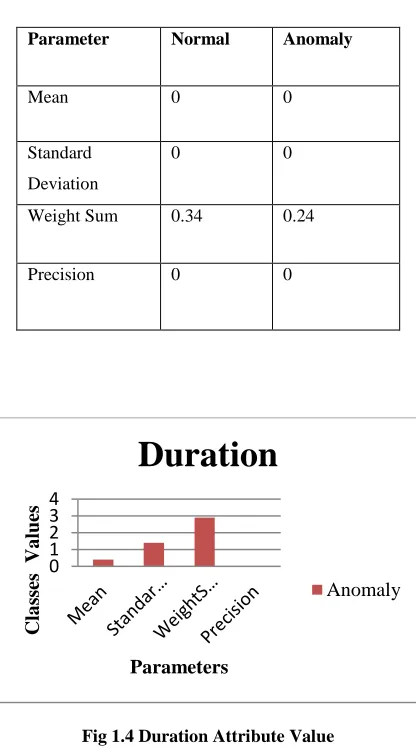
Table 1.1 Duration Attribute Value
Fig 1.4 Duration Attribute Value
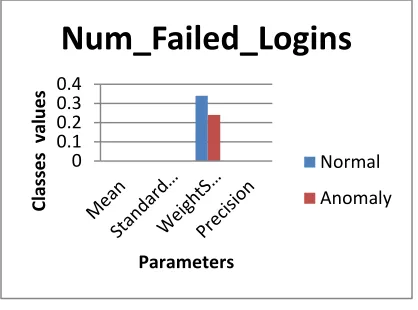
Table 1.2 Num Failed Attribute Value
Num_Failed_Login Attribute provides the information about the number of field logins with their corresponding values.
0 1 2 3 4
Cla
ss
es
Va
lues
Parameters
Duration
Anomaly
Parameter Normal Anomaly
Mean 0 0
Standard
Deviation
0 0
Weight Sum 0.34 0.24
Precision 0 0
Parameter Normal Anomaly
Mean 0.2 0.4
Standard
Deviation
0.4 1.4
Weight Sum 3.4 2.9
© 2014, IJCSMC All Rights Reserved
420
Fig 1.5 Num_Failed_Logins Attribute Values
5.3 Junction Tree:
Junction tree produce a final outcome which contain the information about all the connection or nodes respective with their
Id no and it list the difference between actual and predicted class help us in ensuring whether the prediction was made
correct or incorrect. By this means
we can able to determine that attack is made or not. It is the last module of our system which start working by constructing a
network from DAG i.e. created by k2 learning process can also get the result of Bayesian recognition to determine the
unauthorized access or application.
6.
CONCLUSION
We have used probabilistic approach i.e. Bayesian network in detecting intrusion in network which seems to be very
effective comparing with past IDS. It is a combination of three approaches: K2 Learning provides information in the form of
records. The result of Bayesian recognition is a input to construct a junction tree and indicates about the system behavior
either it is normal or anomaly. If system behaves normal it means system is protected from any kind of attacks and if
behaves anomaly it means that something happens wrong. Junction Tree is the final outcome which is used to calculate
query through message passing by this means we can able to determine that attack is made or not.
REFERENCES:
[1] D.M. Chickering, “Learning Equivalence Classes of Bayesian Network Structure”, Proceedings of the Twelfth
Annual Conference on Uncertainty in Artificial Intelligence, Morgan Kaufmann, Reed College, Portland, Oregon,
USA, pp. 150-157, 1996.
[2] G.F. Cooper, “An overview of the representation and discovery of causal relationships using Bayesian networks”,
AAAI Press and MIT Press, pp. 3-62, 1999.
[3] J. Pearl, “Probabilistic Reasoning in Intelligent Systems: Network of Plausible Inference”. Morgan Kaufmann, 1997.
[4] P. Spirtes, C. Glymour, R. Scheines, “Causation, Prediction and Search (Second Edition)”, MIT Press, Cambridge, MA,
USA, 2000.
[5] N. Friedman, D. Koller, “Being Bayesian About Network Structure: A Bayesian Approach to Structure Discovery in Bayesian Networks”, Machine Learning 50 (1-2), pp. 95-125, 2000.