Chapter 31
Decolonizing Ways of Knowing: Communion, Conversion and Conscientization
Jon Austin
Introduction
The struggle to know and name the world is a central aspect of any decolonizing project, and Freire’s notion of conscientização (conscientization) refers to a form of critical engagement with the realities of the lived experience of the colonized world. It is not enough to know the world; knowledge must be brought to bear on changing the world. This chapter looks to draw together three key ideas from decolonial activists to anchor an exploration of the experiences of the (white) author with indigenous) scholars engaged in research work where indigenous ways of knowing have been, in effect, quarantined by those scholars Outside the academy. The inability/refusal of these scholars to see and acknowledge the legitimacy of their culturally familiar ways of knowing (Du Bois’s [1903] double consciousness) can be seen to be a manifestation of the cultural amputation Fanon (1967) so vehemently resisted. The central concern of this chapter is to draw from the experience of deliberately engaging a process approaching that of conscientization, where shadows of vanguardism and neo-colonial maneuvers were (possibly) cast unwittingly across an intent to expose and disrupt colonized ways of knowing, to consider the implications of Freire’s (1970/1972 b) idea of communion for collaborative decolonial praxis.
The primary aim of the decolonial project is the positive reconstruction of the relationship between the colonized and the colonizer. This, as Paulo Freire explained, is a project of humanizing through liberation, and should be seen as lying at the crux of what he saw as a pedagogy of the oppressed. This chapter looks to explore Freire’s view of the colonized-colonizer nexus from three perspectives: one, that of the philosophical and political antecedents, primarily those of Du Bois and Fanon, that locate Freirean thinking clearly within what has come to be seen as decolonial theorizing; the second, that of Freire’s notion of communion and conversion and what they have to offer by way of explanatories and guidance; and the third, that of the concrete, lived experience of a member of the colonizer class (in Freirean language) looking to disavow and make amends for the effect of colonization; in effect, to engage in decolonial praxis.
My own professional life began as Freire’s ideas were becoming available in and to the West, and one of the advantages of having four decades in which to (irregularly) return to these ideas is that for each of the various stages of my personal-professional development over that time, there was always something in Freirean and related works to provoke, perplex and advise. I first encountered Freire’s Pedagogy of the Oppressed during my initial teacher education days in early 1970s Australia. It was a part of a slew of what were then—and probably are seen as more so today—radical but not hopelessly outrageous or overly utopian alternatives for education. We were, after all, still in the slipstream of the Woodstock era and the alternative and countercultural aspirations that had arisen during the late 1960s. In addition to Pedagogy of the Oppressed (Freire, 1970/1972b), Cultural Action for Freedom (Freire, 1970/1972a) and Education for Critical Consciousness (Freire, 1973) formed a compendium of sometimes mysterious but usually inspirational pieces that seem to have impacted my teaching and educative work ever since.
and people, Freire’s focus on colonized societies and cultures didn’t have particular resonance or relevance for me at that time. As I moved into university teacher education in the late 1980s, the idea of teacher activism and the political nature of schooling drove the work I did there, most frequently with undergraduate students, but increasingly with a growing number of graduate students for whom the prevailing images and assertions of the political neutrality of teaching were perplexing and nonsensical.
As I became more conscious of the multiple forms and expressions of the various privileges I had unthinkingly benefited from and continued to enjoy, and of the consequences for those not so privileged, Freire’s work on the project of humanization and the attendant imperative of the simultaneous eradication of both the oppressor and the oppressed classes assumed a greater cogency for me. From my anti-racist curriculum and pedagogy focus in the 1990s to my doctoral project that explored the development of white racial identities in the Australian context to a wider engagement with the implications of adopting a position of mutlilogicality (Kincheloe & Steinberg, 2008), I returned to Freire’s central theme: that genuine humanization requires the collaborative and communal development of and commitment to a pedagogy of the oppressed.
Having now moved from teacher education into work with and for Australian Aboriginal people, the concrete realities of this task confront me on an almost daily basis and throw up questions of legitimacy, authority and neo-colonialism: How might I contribute to the enactment of such a pedagogy? What limits or constraints are there upon those on the “colonizer” side of the relationship working to dissolve the binary of oppression? Is it possible for the “colonizer” to want change more than the “colonized”?
Talking back to the oppressor: three moments of bafflement
My lived experience tells me that white Western middle-class males are not somehow universally quarantined from the constraining and dehumanizing effects of economic and political systems of social ordering and alienation. As someone who displays that particular constellation of characteristics, I can be certain that my life has been very much more comfortable, secure and valued than most of those who don’t share these features. However, under systems and circuits of ever-morphing avenues and expressions of exploitation and dominance—a “matrix of oppression”, as Patricia Hill Collins (1990) describes this; a “simultaneity” of core social locations (Brewer, 1993, p. 27); or a “multiplex of oppression”, in Dei’s (2003, p. 222) words—we must keep confronting and challenging the “simple hierarchies that routinely label affluent White men as global oppressors, poor Black women as powerless victims, with other groups arrayed in between” (Collins, 1990, p. 245). That is, while we are all subjected to the vagaries of global economic exploitation, social stratification and ascribed identity location, we are not equally oppressed, but neither are we equally privileged. As such, as a member of the oppressor or colonizer class in Freirean terms, my life experiences do not preclude an empathetic connection to the oppressions enacted upon those who more visibly constitute the colonized class. It is from within this space of connection—perhaps of communion—that my attempts to generate authentic alliances in the struggle for social justice and the re-humanizing of the species is rooted.
positioned me on the side of Justice and of the Good. In telling these stories previously, I have referred to these events as personal “shudder moments”—moments that went beyond bafflement, and caused an almost-immediate physically unsettling response.
The first tale: “Why have you taken so long?”
In 2009, I was visiting a university in Aotearoa New Zealand and spent an unplanned session with a class of mature, female, Pasifika early childhood teacher education students. The conversations and discussions ranged across topics such as bell hooks’s work (the focus of that week’s tutorial), the importance to these students of returning to home and family upon graduation to give back to and work within their communities, and my personal involvement in anti-racist work. This latter topic seemed to be of considerable interest to the group, particularly my doctoral work on white racial identities. After a period of discussion about the unfamiliar situation (to these students) of whites investigating their whiteness and skin privilege, one of the students who had not spoken at all during the session indicated her desire to speak. As the rest of the group sat in silence, the speaker stood in her place and fixed me with a look of what, in hindsight, was almost desperation. She pointed her extended fingers at me and asked one question: “Why have you taken so long?” This wasn’t an accusatory comment, but one I took to be a plea for urgency. She then resumed her seat and her silence.
The second tale: “I don’t trust you”
In September last year, the Centre at which I work was visited by a delegation of Native Americans, members of the Cherokee Nation. The delegation included a professor of nursing at a U.S. university (John) and the Chief of his tribe (Jim). During the course of the visit (and during a heavy hail storm), a conversation developed between five non-indigenous staff of the Centre and the four members of the Cherokee delegation. In this conversation, I asked a question of John with regard to the role that non-indigenous academics might play in the struggle of non-indigenous peoples for recognition, reparations and reconciliation. He didn’t find a response easy to come by, and turned to Jim for his wisdom. Sitting to one side of the group, Jim waited a while and then spoke. What follows is a verbatim transcript of what Jim said, the conversation having been recorded for future teaching purposes and with the knowledge and consent of all involved.
Jon: What role do you folks see that we [non-indigenous activist-academics] could or should play? How do we contribute to the justice mission? What role could or might I play that is not re-colonizing or re-embedding white Western ways of knowing? How can I contribute my skills without re-colonizing?
[very long pause]
Jim: We have our own strengths, we have our own strengths [pause] to take care of ourselves. We’ve been doing that for eons of years. We didn’t have to have you guys come in and help us, we didn’t have to have your help, but you came in and said, ‘Hey, I’m here to help you’, and you wound up taking our lands and [pause] taking our culture [pause] and that’s how you help us [pause] and today, we don’t understand the Western philosophy of help. [pause] We’ve been prodded, we’ve been poked. We’ve been loaded on trains and hauled away from our indigenous lands in the name of ‘helping you’. So there’s a trust factor. I don’t trust you. [long pause] I don’t care how much you say ‘I’ve come to help you’, I don’t trust you. [emphasis added] (Courtyard Conversation series, Centre for Australian Indigenous Knowledges, September 26, 2012)
The third tale: “It’s not proper research though, is it?”
would be one of reciprocity: I would explain what I knew about Western approaches to research, particularly in the collection and use of visual (observation) and oral (interview, conversational) research approaches and other participants would do likewise with their personal (Australian Aboriginal) cultural experiences of coming to know—yarning and the like. The reciprocal or two-way learning did not eventuate. The focus remained exclusively on the development of facility with Western ways of knowing. One of the participants, Veronica—a septuagenarian Australian Aboriginal woman—was in the final stages of preparing her doctoral dissertation for examination.
Some months later, after she had had her doctoral award conferred, we met to talk about her methodology, which I knew from conversations with her had involved an extensive use of yarning. She explained in great detail some of the forms, uses and protocols that attached to yarning (some I could not be permitted to know). She knew this particular way of coming to know was culturally familiar to the Australian Aboriginal participants in her doctoral study. She knew that she had been able to elicit far more authentic insights from the use of this technique than had she worked the non-indigenous vein of research method. She was aware of the power of drawing in and on the silences and the seeming irrelevances that were introduced into the yarns, and of reading the positioning of the body in various ways. She knew yarning was a research method(ology) that had helped her come to understand the focus of her dissertation.
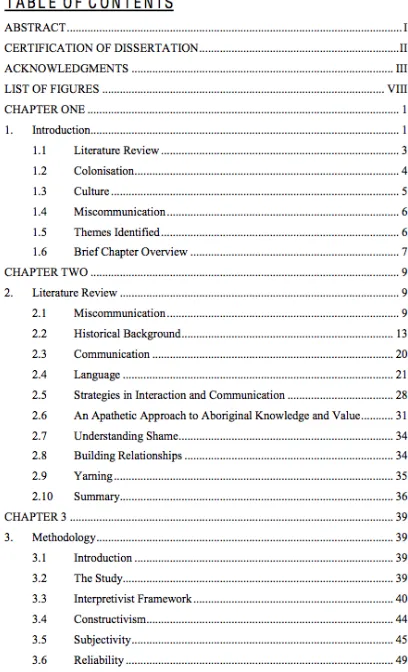
So why, I asked, did she not foreground yarning in the methodology chapter of her dissertation? Why had she (very) briefly discussed yarning in her literature review chapter but fail to mention it in her methodology chapter (see Figure 1)?
Her response was to the effect that yarning probably wasn’t “real research”, it wasn’t what “real researchers” did. She appeared quite content to submerge her culturality and the actual ways she had gone about her task as a researcher because of a belief in the inferiority of her people’s ways of knowing. How does one respond to a situation such as this? Was this a moment for the provocation of conscientização to emerge?
[image:4.612.127.331.361.697.2]long?) while on the other there is a distrust and suspicion that would seem to work against anything approaching a collaborative or joint front in the struggle against the dehumanization that attends the ongoing colonial project (I don’t trust you). I did not wish to re-centre the angst of the white Western male in the midst of widespread physical, cultural, emotional and economic alienation and exploitation suffered by millions around the colonized world, but this is the space wherein I reside, and it is only from this space—this place of my concrete lived experience—that I can launch and continue my contribution to the re-humanizing task. The question became, How do I resolve the decolonial dilemma described in the first two tales in order to see my way clear in approaching the third?
Further, how might I move to reconcile my particular personal characteristics, experiences and locations to genuinely respond to the concerns raised by almost daily challenges to my “right” to be involved in such struggles in the first place?
By way of illustration, as I was in the process of writing this piece, an indigenous Australian academic colleague at the university at which I work widely distributed a caution in an e-mail (some perceived it as a direct threat or, at the very least, an admonition to stay clear) regarding the terms of reference for the establishment of an Elders and Valued Persons Advisory Board. The board’s function is to provide a link between Aboriginal and Torres Strait Islander peoples and their communities and the university. In so doing, the board would be a point of advice to indigenous and non-indigenous researchers and activists looking to work in, with and for indigenous communities in their multifaceted struggles. The board would also provide entrée to such communities by approving, recommending and advising individuals and projects. Accordingly, the terms of reference stipulate the composition of the board as being exclusively Aboriginal and Torres Strait Islander peoples. In response to a call for comment on these terms of reference, my Australian Aboriginal academic colleague wrote: “I just hope this committee will have a First Nations voice in its decision making processes and not be overrun by people ‘speaking on behalf of’ Aboriginal peoples and Torres Strait Islander peoples” (personal communication, November 4, 2012). This particular staff member’s indigeneity has only fairly recently become known to her, and there is no clear community acceptance of her claim to belong to a particular mob, but nevertheless, her admonition and warning away of non-indigenous academic-activists presents other layers of complexity. Are there hierarchies of authenticity in the struggle against oppression and for re-humanization? Does the possession of certain characteristics of the oppressed privilege some in the struggle while the lack of some such characteristics excludes or disqualifies others? Should my participation in the struggle be downgraded, made suspect or shunned entirely because of the fact of my non-indigeneity?
Decolonial praxis: Freire, Fanon and Du Bois
In looking to come to understand something of the importance of the Veronica episode, Freire’s contribution to the field of decolonial theory/praxis is apparent. I’d like to use a couple of key ideas developed by two other decolonial workers—W. E. B. Du Bois and Franz Fanon—to unravel Veronica’s seemingly deliberate and, to her, necessary submersion of her personal cultural ways of knowing in the pursuit of her doctorate. Following this, I return to Freire’s ideas of conversion and communion in addressing the question of the ways in which oppressor-class comrades might contribute to as opposed to taking over the struggle for rehumanization.
the operation of the senses—indeed, even of what the range of the human senses might be—could contribute to the enhancement of the research repertoire of all researchers, and particularly allow indigenous researchers to find cultural comfort and familiarity within the more complex array of ways of knowing. For example, while research theorists such as Sarah Pink exhort researchers to consider ways in which they might draw upon the fuller range of the sensorium to make their ethnographic work more layered and “thick” (Pink, 2009), and arts-based research theorists are impacting on the ways in which researchers are making the presentation of their work more evocative of the human experience (Knowles & Cole, 2008), much of this contemporary work takes a certain sensory, experiential and epistemological universe for granted.
Other perspectives (typically, the perspectives of the Other) might have us look at a much wider range of sensory possibilities available to both inform our research work and our working with communities to use extant wisdom in pursuit of social betterment ends. As one example, the role of trance in many cultures around the world is well documented (see, for example, Jacobs, 1998), but would typically fall outside “standard” research texts and courses as a means of coming to know in any verifiable, “scientific” way.
Ways of engaging orally through things such as speaking or healing circles (features of many North American indigenous cultures) or the use of yarning in Australian Aboriginal and Torres Strait Islander cultures (Bessarab & Ng’andu, 2010; Carrello, 2009; Power, 2004) present ways similar to but distinctively different from the Western research focus on interviews, focus groups and even learning conversations as ways of eliciting information or data through oral engagement. Veronica, as an Australian Aboriginal woman, drew upon the cultural familiarity, the knowledge of appropriate protocols held by both her and the Australian Aboriginal participants in her study, and on her faith that such an approach would best elicit the type of insights, opinions and experiences she needed for her doctoral work. And yet, she declined to accord such a data-gathering approach the status of a research method. How might this peculiarity (to me) be explained and understood, and how might Veronica’s legitimatization of the illegitimacy of her cultural ways of knowing be made sense of?
W. E. B. Du Bois, Franz Fanon and Paulo Freire each offer their own theoretical positions on this type of phenomenon, but all essentially proffer a similar explanation. Du Bois’s notions of the double bind of consciousness and the Veil are the result of some of the earliest Western explorations of what Du Bois saw as the processes at play that led to a racialized society within which both black and white (these were the essentialized racial categories with which he worked, despite warning about the “homogenizing” of the African race) suffered from a loss of completeness. For Du Bois, dominant white ideological practices led to the division and compartmentalization of society along what he termed a (metaphoric) color line: Whites on one side, Blacks on the other. Marking this line was the Veil, through which inter-racial communication and knowledge of the Other was blurred. Dominant (white) society saw only the Black lifeworld in a grossly distorted form that was replicated by the Black view of the White world. The difference that hegemonic power makes, though, is that the inhabitants of the Black side of the line came to see themselves as they were seen by the White world: as inferior and unworthy of full civic and cultural membership of the community and society.
Racial oppression, racial exploitation, and racial violence, first, racially divide and socially separate (the color-line); second, distort cultural communications and human relations between those they racially divide along the color-line (the Veil); and, third, as a result of these aforementioned, cause blacks to suffer from a severe inferiority complex that insidiously induces them to constantly view themselves from whites’ supposed “superior” points of view (double consciousness). (Rabaka, 2010, pp. 134–135)
Du Bois emphasized the psychic impact of this life of no true self-consciousness:
It is a peculiar sensation, this double-consciousness, this sense of always looking at one’s self through the eyes of others, of measuring one’s soul by the tape of a world that looks on in amused contempt and pity. One ever feels this twoness—an American, a Negro; two souls, two thoughts, two unreconciled strivings; two warring ideals in one dark body, whose dogged strength alone keeps it from being torn asunder. The history of the American Negro is the history of this strife . . . this longing to attain self-conscious manhood, to merge his double self into a better and truer self. (Du Bois, 1903, p. 3)
From a Du Boisian perspective, Veronica’s refusal to accord tp ways from her side of the Veil the legitimacy she accords to those from the Other side would appear to be a result of the internalization of a sense of Self mired deeply in the mud of self-deprecation, a self-loathing that is almost a by-product of the power of hypervisible whiteness to embed its ways as superior. Through the process of the development of a double-consciousness, Veronica’s position is explicable as one where, while she knows how people like herself use culturally sound ways of knowing, these ways do not accord with what she sees as the superior—and appropriate, proper and correct—ways of the West.
This is the false consciousness that can only, in Freire’s view, be addressed through the development of a critical consciousness, of conscientização. The genesis of such false consciousness can be explained through Franz Fanon’s notion of cultural amputation. Here, the colonized-oppressed must effectively cut themselves adrift from their cultural identities if they are to achieve any sense of (faux) self-worth. By constructing Blackness as inferior, shameful and despicable, the non-White colonized-oppressed have little choice but to eschew any connection with traits of that identity, in much the same way as Black attempts at passing as White require the erasure of memory, familial and cultural relationships and sense of (historical) self. It was the development of a resistance to such amputation that drove Fanon’s anti-colonial work.
In resonance with Freire, Fanon argued that the colonizer worked most effectively when operating on the psyche or consciousness of the colonized. In a way not dissimilar to Althusser’s (2001) distinction between repressive and ideological State apparatuses, Fanon saw the inability or refusal of colonized cultures to acknowledge the veracity of their own ways of knowing as part of the price to be paid to live as imitation colonizers. Fanon saw that “structures of colonialism were designed to amputate the colonized subjects from their history, culture, values, and worldviews till they believe the colonizer is their savior and only source of hope” (Adjei, 2010, pp. 90–91). Such a notion is similar to Freire’s idea of adhesion wherein “one pole [the oppressed] aspires not to liberation, but to identification with its opposite pole [the oppressor]” (Freire, 2000, pp. 45–46). With a somewhat broader brush and working through Malcolm X’s idea of “psychic conversion”, bell hooks exposes the dilemma facing the colonized:
Assimilation comes with a price, for the dominant culture is also dominator culture. This means that in order to attain material success beyond the boundaries of economic necessity . . . they usually must collude in supporting the thinking and practice of white supremacy. (hooks, 2012, p. 24)
Both Du Bois and Fanon speak to this core aspect of colonization—and therefore, a prime site for decolonial struggle—that might be seen as a form of cultural and epistemological transvestitism: the adopting of the psychic as well as the material adornments of the dominant/dominator culture by the colonized. Veronica’s episode here presents as a likely instance of what Peter McLaren terms “epistemicide” (McLaren, 2012). In this instance, the erasure or destruction of the legitimacy of a culture’s way of knowing occurs with the complicity of the carriers and constructors of that culture.
(Freire, 2000, p. 44) through what becomes a pedagogy of the oppressed. On the role or contribution of the colonizer/oppressor, however, Freire provides far less guidance and greater ambiguity. For Freire, “The oppressor, who is himself dehumanized because he dehumanizes others, is unable to lead this struggle” (2000, p. 47); a pedagogy of the oppressed “cannot be developed or practiced by the oppressors” (p. 54). But while members of the oppressor class cannot lead or practice the humanizing project that is the aim of a pedagogy of the oppressed, “[t]heirs is a fundamental role, and has been throughout the history of this struggle” (p. 60).
The ideas of conversion and communion are important here, as much for the caveats they carry as for their illuminative potential. The conversion process involves members of the colonizer-oppressor class moving to the side of the colonized-oppressed in the pursuit of a just and humane social order. For Freire, such allies, as indicated above, are crucial to the decolonization task, but suffer the effects of psychic colonization as well: “as they cease to be exploiters and move to the side of the exploited, they almost always bring with them the marks of their origin: their prejudices and their deformations, which include a lack of confidence in the people’s ability to think, to want, and to know” (Freire, 2000, p. 60). As such, ‘false charity’ and ‘malefic generosity’ are the hallmarks of such attempts to soften the exploitative colonial relationship without actually addressing the structural framework of this relationship.
To effect genuine collaboration, the convert needs, in a Freirean sense, to develop a genuine communion with the colonized-oppressed. Using Che Guevara’s experiences in Sierra Maestra as examples, Freire asserts the importance of communion with the oppressed:
In dialogical theory, at no stage can revolutionary action forgo communion with the people. Communion in turn elicits cooperation, which brings leaders and people to the fusion described by Guevara. This fusion can exist only if revolutionary action is really human, empathetic, loving, communicative, and humble, in order to be liberating. (Freire, 2000, p. 171)
In the problematic situation in which I found (and continue to find) myself—Veronica’s story—and at the same time conscious of also being caught between the twin pincers of urgency and mistrust, I am left wondering about the complexities surrounding the convert colonizer-oppressor’s relationship with the colonized-oppressed. Is it possible to desire a new relationship more than those most likely to gain from the reconstruction of the relations of inequity? Is patience an essential quality of the convert? How does one provoke conscientização without engaging in either vanguardism or neo-colonial activities? Freire warns of the dangers of the latter: “to consider oneself the proprietor of revolutionary wisdom—which must then be given to (or imposed on) the people—is to retain the old ways” (Freire, 2000, pp. 60–61). And, of course, the wisdom of Chief Jim and his comments about the centrality of trust is evident throughout Freire’s work here: “They talk about the people, but they do not trust them; and trusting the people is the indispensible precondition for revolutionary change” (p. 60).
Freire has centred the importance of developing trust through truly dialogic engagement across the colonizer-colonized divide, but the central and continuing question for me, as a (hopeful) convert or ally in the liberatory struggle remains: Can the oppressor only work on her or his side of the dichotomy in the re-humanizing project? At present, I am left to wonder at the probability of engaging with the colonized in anything approaching a liberatory relationship born of, in Freire’s terms, a genuine communion with the oppressed. There is clearly a need not only for the oppressed, but also for members of the oppressor class to seek the solace, wisdom and inspiration of allies in the pursuit of a genuinely decolonial praxis and world.
Adjei, P. (2010). Resistance to amputation: Discomforting truth about colonial education in Ghana. In G. J. S. Dei & M. Simmons (Eds.), Fanan & education: Thinking through pedagogical possibilities (pp. 78–104). New York, NY: Peter Lang. Althusser, L. (2001). Lenin and philosophy and other essays (B. Brewster, Trans.). New York, NY: Monthly Review Press. Bessarab, D., & Ng’andu, B. (2010). Yarning about yarning as a legitimate method in indigenous research. International Journal
of Critical Indigenous Studies, 3(1), 37–50.
Brewer, R. M. (1993). Theorizing race, class and gender: The new scholarship of black feminist intellectuals and black women’s labor. In A. P. A. Busia & S. M. James (Eds.), Theorizing black feminisms: The visionary pragmatism of black women
(pp. 13–30). London, England: Routledge.
Carrello, C. (2009). Yarning—Aboriginal people’s way of doing business. The Journal of Aboriginal Health, 4, 3.
Collins, P. H. (1990). Black feminist thought: Knowledge, consciousness, and the politics of empowerment. London, England: Unwin Hyman.
Dei, G. S. (2003). Why write black? Reclaiming African culture resource knowledges in diasporic contexts. In J. L. Conyers (Ed.), Afrocentricity and the academy: Essays on theory and practice (pp. 221–230). Jefferson, NC: McFarland. Du Bois, W. E. B. (1903). The souls of black folk: Essays and sketches. Chicago, IL: A.C. McClurg.
Fanon, F. (1967). Black skin, white masks. New York: Grove Weidenfeld.
Freire, P. (1970/1972a). Cultural action for freedom. Harmondsworth, Middlesex, England: Penguin.
Freire, P. (1970/1972b). Pedagogy of the oppressed (M. B. Ramos, Trans.). Harmondsworth, Middlesex, England: Penguin. Freire, P. (1973). Education for critical consciousness. New York, NY: Seabury.
Freire, P. (2000). Pedagogy of the oppressed. New York, NY: Continuum.
hooks, b. (2012). Writing beyond race: Living theory and practice. London, England: Routledge. Jacobs, D. T. (1998). Primal awareness. Rochester, VT: Inner Traditions International.
Kincheloe, J., & Steinberg, S. (2008). Indigenous knowledges in education: Complexities, dangers, and profound benefits. In N. K. Denzin, Y. S. Lincoln, & L. T. Smith (Eds.), Handbook of critical and indigenous methodologies (pp. 135–156). Los Angeles, CA: Sage.
Knowles, J. G., & Cole, A. L. (Eds.). (2008). Handbook of the arts in qualitative research: Perspectives, methodologies, examples, and issues. Los Angeles, CA: Sage.
McLaren, P. (2012). Occupying critical pedagogy: Reclaiming the legacy of Freire. Paper presented at Paulo Freire: The Global Legacy conference, Hamilton, Aotearoa/New Zealand.
Pink, S. (2009). Doing sensory ethnography. London, England: Sage.
Power, K. M. (2004). Yarning: A responsive research methodology. Journal of Australian Research in Early Childhood Education, 11(1), 37–46.
Rabaka, R. (2010). Against epistemic apartheid: W. E. B. Du Bois and the disciplinary decadence of sociology. Lanham, MD: Lexington Books.