City, University of London Institutional Repository
Citation
:
Tian, S. and Tran, A. ORCID: 0000-0001-7090-8063 (2019). Cross-border Buyout Performance. City, University of London.This is the draft version of the paper.
This version of the publication may differ from the final published
version.
Permanent repository link: http://openaccess.city.ac.uk/21982/
Link to published version
:
Copyright and reuse:
City Research Online aims to make research
outputs of City, University of London available to a wider audience.
Copyright and Moral Rights remain with the author(s) and/or copyright
holders. URLs from City Research Online may be freely distributed and
linked to.
Cross-border buyout performance
Siyang Tian and Anh Tran *
Using a novel dataset of 2,639 cross-border buyout investments during 1998-2007 in 38 countries, we find that the institutional quality of the portfolio company country, as measured by the ranking in the composite index of political, economic and financial risk, is an important determinant of cross-border buyout performance in terms of exit success. The higher the institutional quality of the portfolio company country, the higher the probability of a successful exit via IPO or M&A. PE firms’ international experience, industrial experience, and reputation based on deal experience help to improve buyout exit success and their industrial experience could mitigate the adverse influence of institutional distance between the portfolio company and the PE firm countries.
Keywords: LBOs, private equity, cross-border, law and finance
“[We] had poor performance in Spain, Italy, and Asian countries for three reasons: unfamiliarity with those markets, fierce local market competition, and investment discipline/regulation.” Simon Borrows, Chief Executive, 3i Plc. 1. Introduction
A leveraged buyout (LBO), an important part of private equity (PE) investments, is the
acquisition of a company financed with a substantial portion of borrowed funds. During a
typical buyout investment, PE firms (1) improve the portfolio company’s value by conducting
financial, governance, and operational engineering (Kaplan and Strömberg, 2008), (2) exit
portfolio companies as PE funds have a limited contractual lifetime, and (3) return capital to
their investors. Cross-border PE investments have become a phenomenon since the late 1990s
and eventual exit success has always been of highest importance not only for the portfolio
companies but also for the PE firms investing in a foreign country. In this paper, we examine the determinants of cross-border buyout performance based on the framework of institution.
Uncertainty and information asymmetry could create transaction obstacles for PE
investments. Formal institutions are a set of political, economics and contract rules which guide
the human behavior and interaction (North, 1990). When making their investment in countries
of higher institution quality, which offers stronger investor protection and contract enforcement
and has less political, economic and financial uncertainty and lower transaction costs, PE firms
could facilitate the divestment process and are more likely to exit the portfolio company
successfully. Further, when PE firms invest abroad, such transaction problems could be more
severe because of the significant intrinsic risks arising from the institutional, cultural and
geographic distance of a foreign country which could jeopardize the exit success (Li, Vertinsky,
and Li, 2014; Buchner, Espenlaub, Khurshed, and Mohamed, 2017). However, PE firms could
accumulate local business, institutional and cultural knowledge and increase international
practice in their ongoing activities. Also, PE firms tend to circumscribe investment activities
by focusing on specific industries and develop their industry expertise, thereby reducing
information asymmetry and uncertainty (Cressy, Munari, and Mallipiero, 2007; Gompers,
The previous literature on cross-border investment performance mainly either focuses
on early-stage venture capital (VC)’s cross-border performance (Dai, Jo, and Kassicieh, 2012;
Li et al., 2014; Nahata, Hazarika, and Tandon, 2014; Buchner et al., 2017) or compares PE’s
buyout performance in domestic markets within different countries (Strömberg, 2008; Hammer,
Knauer, Pflücke, and Schwetzler, 2017). To our knowledge, no study has focused on country-specific factors predicting a PE cross-border buyout’s eventual exit success. In this paper, we
attempt to fill this gap by examining the determinants of cross-border buyout performance with
a focus on the differences in institutional quality across countries and the role of PE firm’s
experience in these markets.
Our study is the first using a novel dataset of portfolio companies’ details of PE firms around the world to offer important insights into the determinants of buyout success in both developed and developing countries. We adopt a sample of 2,639 cross-border buyout investments in 38 countries between 1998 and 2007. To proxy for the country’s institution
quality, we use the country risk index from the International Country Risk Guide (ICRG)
database. ICRG has recorded the country composite risk index for more than 140 countries and
regions since 1984 by taking the political, economic, and financial risks into account. A country
is of low risk and of high institution quality if the country risk index is higher than 80 points.
We measure the institutional distance between two countries based on the absolute country risk
index differences between the portfolio company country and PE firm country. To proxy for
cultural distance, we adopt the Hofstede’s cultural dimensions which include power distance,
uncertainty avoidance, individualism, and masculinity. We create four learning variables:
country-specific, multinational, and industrial experience, and reputation based on deal
experience.
cultural, and learning factors at the portfolio company-PE firm country-pair level. We then examine the probability of a successful exit in a Cox Hazard model. In additional analyses, we study the impact of the above factors on the choice between IPO and mergers and acquisitions (M&A) as exit routes.
This paper demonstrates that the exit success increases when the quality of the portfolio
company country’s institutional environment is higher. The institutional differences between
PE firm and portfolio company countries raise an obstacle to cross-border investment and are
detrimental to the exit success. However, the cultural distance between the countries of PE
firms and their portfolio companies has no significant impact on cross-border buyout
performance. Further, PE firm’s deal experience is positively related to the likelihood of the
exit success. Our findings on PE’s performance are consistent with those in Li et al. (2014)
who report insignificant and marginally significant mitigating effects of country-specific and
multinational experience on institutional distance for VC’s cross-border performance.
However, we find that PE firms’ industrial experience helps them to reduce the institutional
barriers. PE firms with more industrial experience learn more and gain deeper knowledge of
companies in that industry. Cressey et al. (2007) and Gompers et al. (2008) show that VC firms
with the most industrial experience are most responsive to public signals of investment
opportunities. Consequently, being an industry expert could also alleviate the burden of being
a foreigner for PE firms.
In terms of exit strategies, compared with choosing M&A as the exit route, PE firms
are more likely to exit via IPO when PE firms are in an investment club and when the initial
buyout value is larger. In contrast to unsuccessful exits, the probability of going IPO increases
when PE firms have more experience and form an investment club and when the deal size is
larger. Similarly, the probability of choosing M&A increases when the quality of the
institutional environment is higher and when PE firms are more experienced.
The results are robust to the self-selection issue in which the performance of PE firms
We adopt a variation of Heckman’s (1979) correction procedure. In the first stage, we estimate
the experienced PE firms’ likelihood of investing in a portfolio company. In the second stage,
we include the inverse Mills ratio received from the first-step probit model as an additional
control variable to estimate the buyout performance. The results are also robust when we adopt
the multiple imputation method to compensate for the missing records of deal value.
This study contributes to the literature in several ways. Previous PE literature either
focuses on the investments of cross-border VC firms or compares buyout performance in
domestic markets with different countries. Nahata et al. (2014) examine the influence of
institutional differences on global VC success. Both VC and buyout investments are alternative
investments and illiquid. However, buyouts, as a new form of company structure (Jensen, 1989)
and important part of M&A activities (financial bidders), acquire mature companies and are
different from VC investments which enter start-ups and adopt stage-financing. How
institutional differences affect cross-border buyout investments is not well answered yet.
Holloway, Lee, and Shen (2016) shed lights on cross-border LBO activities by examining
issues at the stage of entry. Our paper investigates the buyout performance at the stage of exit
which completes the investment process. Consequently, it helps us to deepen the understanding
and expands the literature of internationalization of PE.
Also, this paper complements a number of studies examining the role of institutions in
cross-border M&A (Rossi and Volpin, 2004; Bris and Cabolis, 2008; Ferreira, Massa, and
Matos, 2010; Erel, Liao, and Weisbach, 2012). They do not incorporate LBO in the sample and
examine M&A performance measured by offer premium and deal announcement return. The
acquirer’s performance in LBO could not be easily examined because PE firms usually are in
limited partnership and not listed in stock exchanges. Our findings offer direct evidence of the
influence of institutional differences across countries and between portfolio company country
and PE firm country on buyout performance.
Moreover, this paper is related to the literature on PE experience and reputation (Cressy
Meuleman and Wright, 2011) and investigates the importance of experience in the cross-border
setting. Lastly, to alleviate common data limitations in previous deal-level studies, we construct
a dataset by extracting portfolio companies’ details of 1,008 PE firms around the world and
shed light on the determinants of buyout success in both developed and developing markets.
The rest of the paper is structured as follows. Section 2 provides a review of the literature and the framework of institution and develops the hypotheses. Section 3 presents the data and the variables construction. Section 4 discusses the empirical analyses. Section 5 concludes.
2. Literature review and hypothesis development
2.1 Literature review
The literature on PE performance can be categorized into two groups: fund-level studies and deal-level studies. Metrick and Yasuda (2011) outline both advantages and limitations of these studies. The net of fund fees and carry could be calculated at the fund level. However, there is missing information about timing and exits of individual projects. Also, investment write-offs which incur losses are not observed at the fund level. In contrast, deal-level data could alleviate the selection bias problem as the outcome of unsuccessful investments could be tracked. Nevertheless, deal-level studies suffer from data incompleteness (Kaplan, Sensoy, and Strömberg, 2002) and a novel data set or a model which could overcome the data problem is thus required.
There is emerging literature focusing on the cross-border PE investment performance. Papers in the international VC field analyze the determinants of VC exit performance: legal system and economic/market activities across countries (Nahata et al., 2014), legal, institutional, cultural distance between the country of VC firm and that of entrepreneurial firm (Li et al., 2014; Nahata et al., 2014; Buchner et al., 2017), and syndication with local VC and joint venture (Dai et al., 2012). Few papers study cross-border buyout investment performance. In a contemporaneous study, Chemmanur, Hull, and Krishnan (2014) examines the exit performance of US buyout specialists and exploits the exogenous shock to the effective
proximity of US PE investors to other countries.
2.2 Hypothesis development
Gompers and Lerner (2004) state that there is little theoretical attention being paid to
the divestment aspect of PE and therefore established theories are limited in their ability to
explain the sale of portfolio companies. In previous cross-border investment studies, the
influence of law and institution (see e.g. Rossi and Volpin, 2004) and national distance (see e.g.
Nahata et al., 2014) on investments are well documented. The framework of institution could
also be adopted to develop the hypotheses in the cross-border buyout setting. North (1990)
defines the institution as the “rule of the game in a society” and “humanly devised constraints
that shape human interaction”. The institution emphasizes the role of information asymmetry
and transaction cost in economic activities and the key function of the institution is to reduce
the uncertainty by establishing a stable structure to facilitate interaction among people.
Williamsons (2000) establishes four hierarchies of the institution and the first two levels are
country-specific and vary across different countries. The first level is the informal institution
which comes from socially transmitted information and is part of the culture (North, 1990).
The second level is the formal constraints, including constitutions, contract laws and
enforcement of property rights. Differences in formal and informal rules result in different
2.2.1 Formal institutions
Formal rules contain political and legal rules, economics rules, and contracts. The purpose of these rules is to facilitate political or economic exchange (North, 1990). There are two contrasting views on effects of law and institution on financial transactions. Under the “Coasian” view, institutional differences do not matter as sophisticated investors could privately negotiate and optimize the contract to mitigate the impediments (Bergman and Nicolaievsky, 2007). For instance, Allen, Qian, and Qian (2005) state that, in the emerging economy China, neither its legal or financial system is well developed. However, the institutional impediments do not prohibit China’s fast growth. Kaplan, Martel, and Strömberg (2007) show that legal regime does not matter, and more experienced VC investors adopt US style sophisticated contracts.
Under the “law matters” view, La Porta, Lopez-De-Silanes, Shleifer, and Vishny (1997, 1998) show that the legal system exerts a positive influence on investor protection and capital market development. Glaeser, Johnson, and Shleifer (2001) state that appropriate laws and regulations and high enforcement of shareholder and creditor rights are instrumental in building up the market confidence and attracting investments. The law and institution could affect the PE exit in two ways: institutional differences across countries and between the PE firm country and portfolio company country.
structure and contract design they adopt in their home countries (Tykvová and Scherlter, 2014). Consequently, institutional differences between two countries could be the obstacle to cross-border investments.
Hypothesis 1a null: In line with the “Coasian” view, institutional quality of the portfolio company country is not associated with the likelihood of a successful exit.
Hypothesis 1a alternative: In line with the “law matters” view, higher institutional quality of
the portfolio company country is associated with a higher likelihood of a successful exit. Hypothesis 1b: Larger institutional differences are associated with a lower likelihood of a successful exit.
2.2.2 Informal institutions
The informal institution is referred to the culture. Culture could exert influences on
economic activities as it shapes economic individuals’ choices and perceptions (Hofstede and
Bond, 1988). The influence of cultural differences on cross-border investments has been
examined in recent studies but the results are mixed. Ahern, Daminelli, and Fracassi (2015)
report that the cultural distance adversely affects the cross-border mergers volume and
combined announced returns. They argue that different cultural values could lead to
impediments such as mistrust, misunderstanding or mismatched goals in cooperation. Li et al.
(2014) and Buchner et al. (2017) find similar results in studying cross-border VC performance.
However, Nahata et al. (2014) find that cultural distance increases the VC success. They argue
the cultural disparity between VC firms and their portfolio companies leads to more rigorous
due diligence and deal selection, and hence improves the performance.
The influence of cultural distance on the outcome of buyout investments has not been
seriously examined. Li et al. (2014) state that cultural distance between VC firms and their
portfolio companies could adversely affect the VC performance in three ways: communication
problems, value and beliefs conflicts, and liability of outsidership. In the buyout context,
negotiation, corporate policy design, and working relationship development and thus increase
information and transaction costs, leading to conflicts and investment failures.
On the other hand, in an LBO, PE firms usually fully acquire the portfolio company
and PE firms’ targets are mature companies in the late development stage which could generate
a stable cash flow to meet the debt repayment requirement (Jensen, 1989). Also, buyout investors are sophisticated. To add firm value, they restructure the portfolio company’s capital
structure, replace the management team with industrial experts, and guide the operational
change. In comparison, VC firms invest in early-stage and start-up companies. Understanding
of business ideas and know-how of founder team characteristics are essential to VC
investments (Kaplan and Strömberg, 2004; Gompers, Gornall, Kaplan, and Strebulaev, 2016). Consequently, buyout investors might not suffer from the adverse influence of cultural
differences because they rely more on the hard information while VC investors could be subject
to cultural differences as they rely more on the soft information.
Hypothesis 2 null: Cultural differences will not influence the cross-border buyout performance.
Hypothesis 2 alternative: Cultural differences adversely influence the cross-border buyout
performance.
2.2.3 Learning
investments can be considered as part of the internationalization process, multinational experience of a rich array of environments with a broad range of institutional and cultural characteristics also plays a vital role in the cross-border investment process (Li et al., 2014). In addition, PE firms with substantial industrial experience could identify better investment opportunities in a certain industry and obtain the know-how to manage and add value to these investments (Gompers et al., 2008). PE firms’ learning could mitigate the information asymmetry created by intuitional barriers, lower the transaction cost, and hence facilitate the exit process. Further, as PE firms approach the buyout market repeatedly, building reputation is necessary because such a reputation can serve as certification and help to mitigate the information asymmetry between PE firms and potential buyers (Gompers, 1996).
Various empirical studies provide insights into PE learning and experience and confirm the positive role of experience in investment activities. Cressy et al. (2007) find that industrial specialized PE firms are more likely to have higher post-buyout profitability. Demiroglu and James (2010) argue that reputable PE firms have persistent performance, and this confirms PE firms’ skills in selecting, monitoring, and restructuring. Reputation based on deal experience will help PE firms to deliver the impression of being less risky to investors and banks, resulting in better lending terms.
Hypothesis 3a: More experienced PE firms are more likely to perform better in the cross-border buyout.
Hypothesis 3b: PE firms’ deal experience helps to mitigate the adverse influence of distance.
3. Data and variable construction
3.1 Data and sample
Our sample of global LBOs comes from Mergermarket, a data provider for M&A
transactions. Mergermarket tracks investment records for 1,008 worldwide PE firms (as of 31st
December 2015). Unlike other databases such as Capital IQ M&A and SDC Platinum M&A,
exit portfolios and holding portfolios at the PE firm level. It provides information on holding
periods, buyout/exit types, transaction value, deal description, and financial characteristics.
We obtain the sample as follows. Firstly, we select the investment of which the deal
type “buyout” is specified. We keep the investment with the leading PE in club deals where
more than one PE firm participates in the transaction.1 Since our aim is to study cross-border
buyout performance, we select deals if the dominant country of the portfolio company is
different from the country in which the PE firm is headquartered. In addition, we keep deals
for which transaction dates and holding periods are non-missing. Although Mergermarket
tracks the deal history back to 1997, it has provided more reliable information since 1998.
Consequently, following Nahata et al. (2014), we include buyout transactions from 1st January
1998 and exclude all countries with less than ten observations to avoid the adverse effects of
outliers. We also exclude the overseas territories such as the Channel Islands, Bermuda, and
Puerto Rico to avoid “shell” operation. We stop the sample at the end of 2007 to be able to
track the outcome of all buyout transactions during an eight-year window until the end of 2015.2
The final sample has 2,639 deals from 38 countries from 1998 to 2007.
To supplement other deal characteristics such as deal value and management
participation, we match the sample with two other buyout databases: SDC Platinum M&A and
Zephyr. Zephyr has better coverage for European deals and smaller deals. We match these
databases using the PE firm’s name, the portfolio company’s name, and the transaction date.3
Since some PE firms have changed their names (for example, HSBC PE is renamed as Montagu
PE), we extensively check the company website, confirm the change, and carefully match
1The leading PE is defined as the one which invests the largest stake or the oldest firm in the club deals if stake information is missing (Nahata et al. 2014). To confirm the correctness of leading PE firms, we also go through the deal description and check if the PE firm is leading the consortium/group. As Mergermarket keeps records at the PE firm level, same transaction will be recorded several times for club deals. We check the deal ID and target name and delete duplicates. Only transactions with leading PE firms are kept.
2 Strömberg (2008) investigates a sample of 21,000 LBO transactions 1970-2007 and documents that the median duration is 9
years. Kaplan and Strömberg (2008) document that percentage of exits within seven years is about 55% for deals after 2000. In line with their findings, this paper leaves a window which is at least 8 years for PE firms to exit their portfolios.
different databases. In addition, we carefully check the industry based on the sub-industry
description in Mergermarket and reclassify it into one of the 11 SIC industries, as defined by
the US Securities and Exchange Commission (SEC) SIC Code List.
Finally, we obtain institutional data from the ICRG database and cultural distance data
from Taras, Steel, and Kirkman (2011). The market development data comes from SDC
Platinum M&A database. Other country and country-pair controls are from the Central
Intelligence Agency (CIA) World Factbook, World Bank, the Foreign Law Guide database,
and the CEPII website.
3.2 Variable construction
3.2.1 Dependent variables
Mergermarket identifies the following four exit types: IPO, secondary buyout, trade
sale, and other exits. Other exits are exit routes excluding IPO, secondary buyout and trade sale
as well as routes for which Mergermarket could not track details. We follow the previous
literature (Hochberg et al., 2007; Nahata et al., 2014) and code exits as being successful if PE
firms were able to exit portfolio companies either via IPO or M&A (trade sales and secondary
buyout).
In the aggregate country pair level analysis, we calculate the successful exit ratio as the
number of successful exits to the number of investments for each portfolio company-PE firm
country pair. For the deal-level analysis, to take the time-to-successful exit and right-censored
data characteristics into account, we adopt the survival analysis. The hazard rate is the
conditional probability that the PE firm divests the portfolio company successfully. The
time-to-successful exit is the number of months between the buyout date and the successful exit date.
For portfolio companies with unsuccessful exits, the holding time is the number of months
3.2.2 Explanatory variables
The explanatory variables can be categorized into four sets of variables. The first set
pertains to the institution. The second set consists of learning factors from different
perspectives. We also control for deal characteristics including management participation, club
size (the number of PE firms) and deal value. Country and country-pair controls include local
LBO market development, common religion, common language, and geographic distance.
Appendix 2 provides detailed description of all deal characteristics and country and
country-pair control variables.
3.2.2.1 Factors related to institutions
Firstly, we obtain the country risk index from International Country Risk Guide
database. This database has been intensively used in the law and intuition studies (La Porta et
al., 1998; Rossi and Volpin, 2004; Lerner and Schoar, 2005; Bris and Cabolis, 2008; Ferreira
et al., 2010; Nahata et al., 2014). The country risk index is a composite index: political risk
components account for 50% and the rest consists of economic and financial risk components.
Political risk components include government stability, socioeconomic conditions, investment
profile, internal conflict, external conflict, corruption, military in politics, religious tensions,
law and order, ethnic tensions, democratic accountability, and bureaucracy quality. Economic
risk rating aims to provide a measure of a country’s current economic strengths and weakness.
It includes following components: GDP per head, real GDP growth, annual inflation rate,
budget balance as a percentage of GDP, and current account as a percentage of GDP. Financial
risk rating measures a country’s ability to finance its official, commercial, and trade debt
obligations. It includes the following components: foreign debt as a percentage of GDP, foreign
debt services as a percentage of exports of goods and services, current age account as a
percentage of exports of goods and services, net international liquidity as months of import
cover, and exchange rate stability. The composite index calculation method is developed and
aspect of using a single composite index is to alleviate the influence of multicollinearity when
all individual variables are included.
Bhagwat, Brogaard, and Julio (2017) classify countries into three groups based the
political risk components: medium risk country (political risk score is between 60 and 80), high
risk country (political risk score is below 60), and the rest group (political risk score is higher
than 80). In line with their measurement, to proxy institution quality of the portfolio company
country, we create a dummy variable Low_Risk_Country which is defined as the one with
composite rating score higher than 80 points in the ICRG database. Low risk countries have
lower political, economic and financial risk and thus have higher institution quality. The
variable Institutional_Distance is defined as the logarithm of the absolute differences between
the country risk indices of PE firm country and portfolio company country.
To proxy for the cultural distance, we adopt the Hofstede measure. There are four
dimensions in his cultural evaluation: power distance, uncertainty avoidance, individualism,
and masculinity. We compute the multidimensional cultural distance between the country of
the PE firms and the country of the portfolio company as follows:
Cultural Distance ∑ C , C ,
/
4
where C , is the portfolio company’s national culture measured on element and C , is the
leading PE firm’s national culture measured on element . To capture changes in the cultural
distance, we use culture scores from Teras et al. (2011). These data are country-specific and
time-varying over three periods: 1980s, 1990s, and 2000s. If the buyout year is between 1998
and 1999, the 1990s data will be used; if the buyout year is between 2000 and 2007, the 2000s
data will be used. Following Nahata et al. (2014), if the data are missing for the 1990s, we will
use 2000s score as the proxy. If the data are missing for both 1990s and 2000s, the 1980s score
will be used as the proxy.4
4 There are two countries where we could not obtain culture information from Teras et al. (2011): Iceland and Luxemburg.
3.2.2.2 Factors related to learning
We construct four variables to measure different aspects of experience. Strömberg
(2008) shows that the experience of PE firms consistently explains the global exit behavior and
the variation in holding periods. The first learning variable is the Country_Experience. We
construct this variable as the number of buyouts which the PE firm completed in the country
of the portfolio company from 1990 to the year prior to the initial buyout. The second variable
Multinational_Experience is constructed as the number of foreign countries in which the PE
firm invested from1990 to the year prior to the initial buyout (Barkema and Vermeulen, 1998).
The next variable Industrial_Experience aims to capture the industrial specialization as each
PE firm has its own industrial focus. For example, in Mergermarket records, the UK PE group
3i focuses more on service industries. Industry experience is calculated as the number of
buyouts which the PE firm completed in the industry of the portfolio company from 1990 to
the year prior to the initial buyout. Further, as argued by Demiroglu and James (2010),
experience will accumulate over time, but this will not be able to distinguish between funds.
Following Demiroglu and James (2010), we construct another variable Reputation based on
recent experience, i.e. the total number of buyout transactions completed by the PE firm in the
three years prior to the initial buyout. As there is a time gap between the initial buyout date and
the final exit date, all measures link PE firms’ experience to their future performance and thus
avoid the reverse causality.
3.3 Summary statistics
Table 1 provides descriptive statistics for the sample of cross-border buyouts. Panel A
reports the incidence of buyout based on the buyout year. We classify the exit outcome types
based on the Mergermarket records as of 31st December 2015: successful exits and
unsuccessful exits. Successful exits represent 65% of the sample and portfolio companies are
divested via IPO (4%) or M&A (60%).5 The sample suggests that PE firms prefer M&A as the
way to divest their portfolios. Unsuccessful exits include other exits (7%) and non-exit ones
(29%). Other exits are portfolio companies for which Mergermarket loses tracking information
and non-exit portfolios are still privately held by PE firms. The sample is comparable to that
used by Strömberg (2008) who reports one-third of portfolio companies are still private until
2008 and M&A earns its popularity as the divestment alternative to IPO. In terms of the
distribution of the sample, most buyout portfolios taking place in early years are exited
successfully. For the buyout portfolios that took place in 2007, 47% of them are still private
until 2015. The holding time is thus right censored.
[Insert Table 1 about here]
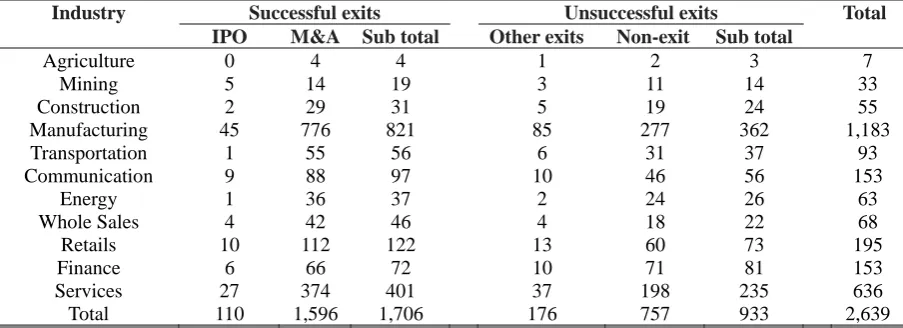
In Panel B of Table 1, we show the incidence of buyout portfolios based on industry.
Most portfolio companies operate in the manufacturing industry, amounting to 45% of the deals.
Service industry and retail industry account for 24% and 7% of the buyouts, respectively. The
successful exit ratios are higher in manufacturing (69%) and service (66%) industries. To
control for the industry heterogeneity, we include industry fixed effects in our empirical tests.
Panel C of Table 1 shows the clustering of buyouts across countries of portfolio
companies. Cross-border buyouts in Germany constitute 12% of the deals and the UK accounts
for 10%. Our sample is comprehensive as we include deals in both developed and developing
markets. Further, emerging Asian countries have attracted foreign investors’ attention in recent
years, especially China and India, as there are rapid macroeconomic growth, demographic
change, and legal and financial reforms (Dai et al., 2012). India and China account for 5% and
4% of the deals, respectively. We find that in these countries, the successful exit ratios are
lower than 50%. This result is consistent with Lerner, Sørensen, and Strömberg (2009) who
find a low exit ratio in emerging Asian countries. We list the countries of PE firms in panel D
of Table 1 the US and the UK markets are generally believed to be the most developed LBO
markets, and PE specialists from these two countries contribute to 67% of the buyouts. Table
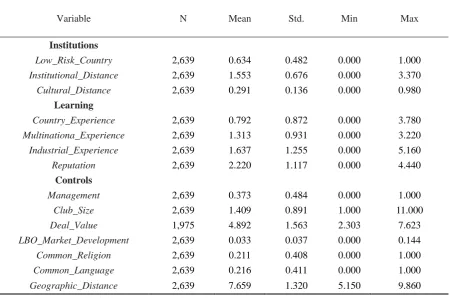
2 reports the descriptive statistics for main explanatory variables.
[Insert Table 2 about here]
4. Empirical results
4.1 Aggregate cross-border buyout successful exit ratio
In this section, we test the relationship between cross-border buyout exit success and
institutional and cultural factors at the country-pair level. Following Ferreira et al. (2010) and
Erel et al. (2012), we perform both cross-sectional and panel tests. We construct the dependent
variables as follows: (1) for cross-sectional tests, the outcome variable is the number of
successful exits of all portfolio companies which the PE firms invested in over the entire period
in country pair i over the total number of portfolio companies which the PE firms invested in
over the entire period in country pair i ; (2) for panel tests, the outcome variable is the number
of successful exits of all portfolio companies which the PE firms invested in in year t in country
pair i over the total number of portfolio companies which the PE firms invested in in year t in
country pair i. We cluster standard errors at the country pair level and include year fixed effects
in the panel tests.
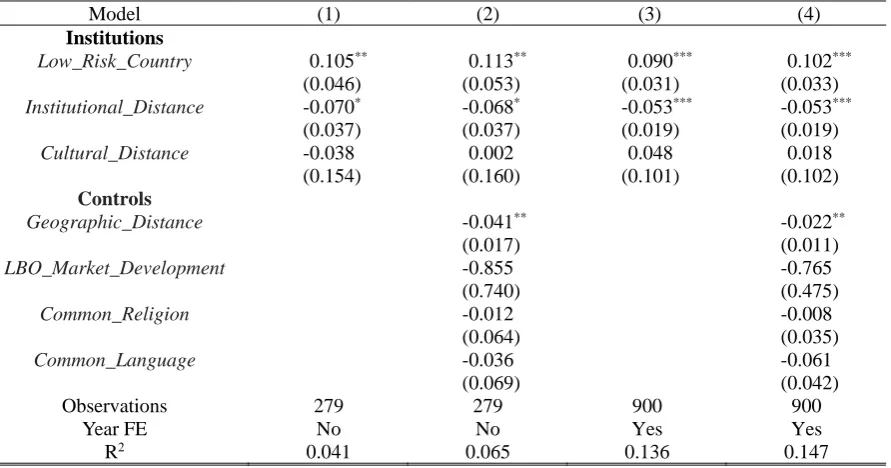
[Insert Table 3 about here]
The results in Table 3 show that the successful exit ratio is positively related to the
institution quality of the portfolio company country and negatively related to the institutional
distance between portfolio company country and PE firm country across all specifications.
However, cultural distance has no significant influence on the exit success. The results are
robust and qualitatively similar when we take the maturity of local LBO market and other
country and country-pair characteristics into account in models 2 and 4. Overall, the results in
Table 3 support hypotheses 1a the “law matters” view and 1b (La Porta et al., 1998; Nahata et
al., 2014). In the country of well-developed institution system, information asymmetry and
to IPO or M&A. However, if PE firms are unfamiliar with local institutional rules, information
asymmetry and transaction cost are higher, and it is more difficult for them to successfully exit
portfolio companies.
4.2 Likelihood of a successful exit – hazard rate of a successful exit
We apply the survival analysis to analyze the impact of the chosen explanatory
variables on the time-to-successful exit. After the initial buyout, a portfolio company can be
privately held, unidentified as tracking details are missing, or divested via IPO or M&A. The
right-censored observations in the dataset are those portfolio companies that are either privately
held as of the cut-off date 31st December 2015 or lost. We use a dichotomous variable
describing the status of a portfolio company as either successful exits (IPO and M&A) or
unsuccessful exits (other exits and non-exit ones). In survival models, we interpret the
probability of a failure event for a buyout portfolio as the probability of its exit success. We
adopt both non-parametric and semi-parametric approaches of survival analysis to assess the
influence of chosen explanatory variables on the failure and hazard functions. The
non-parametric analysis provides insights into the difference between groups. The semi-non-parametric
approach could be used for the multivariate analysis.
4.2.1 Non-parametric analysis
In the non-parametric analysis, we categorize the sample based on institution quality,
institutional distance, cultural distance, and reputation. We create three new dummy variables.
The first one is Familiar_Institution which equals one if the institutional distance belongs to
the lowest quartile, and zero otherwise. The second dummy variable is Familiar_Culture which
equals one if the cultural distance belongs to the lowest quartile and zero otherwise. Further,
the variable Reputable_PE is an indicator variable denoting whether the PE firm belongs to the
top quartile of reputable PE firm group based on the reputation measurement in the year prior
to the initial buyout. In Kaplan-Meier estimations, the failure function is the cumulative
[Insert Figure 1-4 about here]
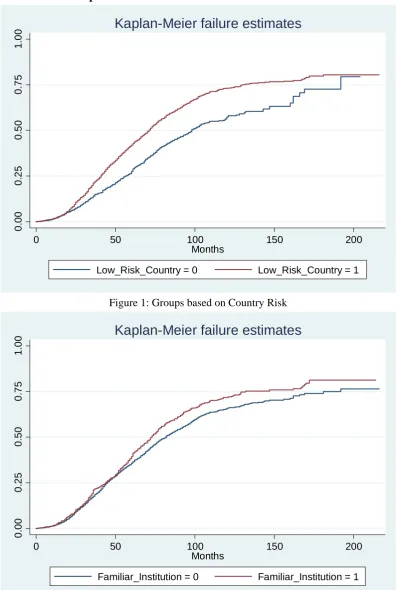
In Figures 1-4, we plot the Kaplan-Meier failure functions based on the institutional
quality, institutional distance, cultural distance, and reputation, respectively. As plotted in
Figure 1, the probability of a successful exit at any given time is always higher for the low risk
country group. In the unreported log-rank test, the difference between these two failure
functions is significant at 1% level (χ 70.23). The result suggests that in the low risk
country (i.e. higher institutional environment quality), PE firms have higher likelihoods of
bringing portfolio companies to successful exits. Figure 2 shows the plot of Kaplan-Meier
functions based on institutional distance. The failure function of Familiar Institution group is
always higher than that of the rest of the sample, suggesting a negative relationship between
institutional distance and probability of a successful exit. The difference is significant at 1%
level (χ 8.86). In Figure 3, the curves of failure functions are parallel to each other to a
large degree, and one could therefore expect that there is no significant difference between
familiar culture group and the rest. The difference in their failure functions is not statistically
significant (χ 1.56 , indicating that PE firms are not influenced by cultural distance. Finally,
as shown in Figure 4, the Kaplan-Meier failure function plot of the reputable PE firm is
consistently above that of the non-reputable PE firm. The difference of these failure functions
is significant at the 1% level (χ 9.35 . This result suggests that reputable PE firms have
better performance in cross-border buyout investments.
Overall, the results of the non-parametric analyses suggest the institutional environment
quality and reputation are positively associated with the buyout performance and institutional
distance is negatively related to the buyout performance, supporting hypotheses 1a the “law
matters” view, 1b and 3a. In addition, we find insignificant influences of cultural differences
4.2.2 Semi-parametric analysis
In this section, we perform the Cox Proportional Hazard estimation. In the survival
model, the hazard rate can be referred to as the probability of a successful exit during one unit
of time, conditional on unsuccessful exit up to time t. A positive and significant coefficient
would imply a higher hazard rate and a shorter expected holding duration. A negative and
significant coefficient would imply a lower hazard rate and a longer expected holding duration.
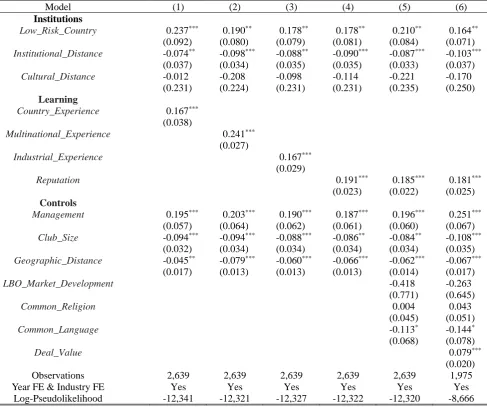
[Insert Table 4 about here]
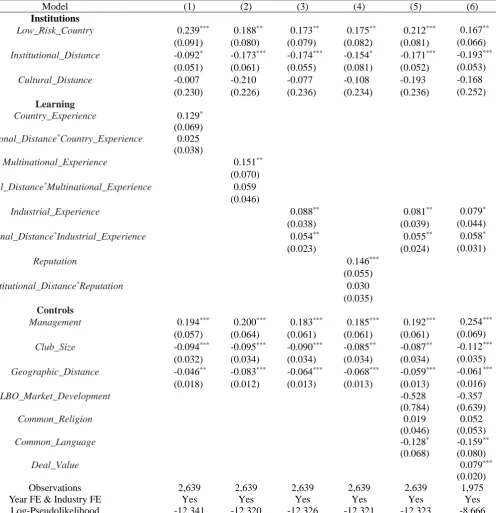
Across models 1-4 in Table 4, we relate institutional and cultural factors, deal characteristics and geographic distance between two countries to the likelihood of a successful exit. To avoid multicollinearity, we include measures of experience variables separately. As reported in models 1-4 of Table 4, the hazard rate of a successful exit increases when (1) PE
firms invest in low risk countries, (2) PE firms are more experienced, and (3) management
participates in the deal. The hazard rate of a successful exit decreases when the institutional
distance is larger, when the club size is larger, and when the PE firm is geographically far away
from the portfolio company.
Firstly, coefficients of the variable Low_Risk_Country are positive and statistically significant. In low risk countries, the likelihood of a successful exit is higher, and the expected holding time is shorter. In model 1, the coefficient of 0.237 on Low_Risk_Country indicates that the estimated hazard ratio of the group based on the dummy Low_Risk_Country is 1.267
(e0.237). Therefore, the hazard of successful exit when PE firms invest in low risk countries is
1.267 times higher than that when PE firms invest in other countries. This evidence is in line
with Nahata et al. (2014) who reports a positive role of legal institution in global VC success
and provides support to the “law matters” view.
Secondly, the coefficients on Institutional_Distance is negative and statistically significant at least at the 5% level. If PE firms are unfamiliar with the institutional environment and institutional distance is larger, the probability of successful exit is lower, and it takes longer
which is consistent with the previous cross-border studies (Li et al., 2014; Buchner et al., 2017).
This finding supports hypothesis 1b.
The coefficients of the variable Culture_Distance are insignificant across all models and this paper fails to reject the null hypothesis that cultural differences will not influence the performance. This result implies that PE firms which are sophisticated investors suffer from minimal adverse influences of cultural differences. This is different from the findings on VC by Nahata et al. (2014) who show a positive influence of cultural differences on VC exit performance and Li et al. (2014) and Buchner et al., (2017) who document a negative relationship. Compared to VC firms, buyout firms conduct the LBO to acquire the late-stage and mature firms which could generate enough operating cash flow to repay the debt (Jensen, 1989). Consequently, the sophisticated buyout specialist relies on hard information and thus overcomes the barrier of cultural differences.
In line with Cressey et al. (2007), Gompers et al. (2008), PE firms’ experience and reputation have positive impacts on investment performance. Specifically, country experience
which offers local insights, multinational experience which brings in the knowledge of different
institutions, industrial experience which offers deep industrial insights, and reputation based
on deal experience which serves as the certification to resolve asymmetric information
problems, all help PE firms achieve higher likelihoods of a successful exit in the cross-border
buyout. The findings support hypothesis 3a.
large PE club improves the cross-border buyout performance in a modest way as it increases the probability of bringing the portfolio company to the market through an IPO. When the geographic distance is taken into consideration, we provide consistent evidence to support the geographic proximity argument (Chen, Gompers, Kovner, and Lerner, 2010). PE firms are less likely to exit successfully if they are far away from their portfolio companies. In model 5, we control for other country and country pair characteristics and the adopt the reputation as the learning measurement.6 The results are similar to those in models 1-4. In model 6, we include deal value to control for the size effect and we find that the larger the size, the higher the
probability of successful divestment.
To examine the mitigation effects of a PE firms’ deal experience on institutional
distance, we construct interaction terms of institutional distance and four deal experience
variables and include them in the models separately. The results are reported in Table 5.
[Insert Table 5 about here]
The coefficients of interaction terms institutional distance and country-specific
experience, multinational experience, and reputation based on recent deal experience are
statistically insignificant. The results suggest that only having the knowledge about the local
institution, business and international practice might not be enough for PE firms to overcome
the intuitional barriers. The findings are consistent with Li et al. (2014). However, the
coefficient of the interaction term of institutional distance and industrial experience are positive
and significant at the 5% level. In cross-border activities, PE firms could effectively transfer
the governance structure and enforce the contract design if they have substantial experience in
the portfolio company’s industry. As PE firms tend to specialize in certain industries, compared
to other experience, the industrial experience is more important in their investment activities.
The findings are consistent with Cressy et al. (2007) and Gompers et al. (2008).
6 We also re-run the regressions with other learning variables and take maturity of local market, religion difference, language
Overall, the results of the Cox Proportional Hazard analysis suggest that the hazard rate
of a successful exit has a positive relationship with the quality of the institutional environment,
PE firms’ experience and management participation, and has a negative relationship with
institutional distance and geographic distance, providing supporting evidence to hypotheses 1a
“law matters” view, 1b and 3a. Moreover, this paper documents that PE firms’ industrial
experience could help to overcome the adverse influence of institutional distance, which
supports hypothesis 3b.
4.3 Exit strategies: IPO versus M&A
4.3.1 Multinomial analysis on the status
To test whether the chosen factors have different impacts on the choice between IPO and M&A as exit strategies, we first perform the multinomial logit analysis and then relate the choice of IPO relative to M&A as exit strategy. The base category for the multinomial analysis is the group of portfolio companies with unsuccessful exits (other exits and non-exit ones).
[Insert Table 6 about here]
As shown in model 5 of Table 6, the choice of IPO as exit strategy over M&A mainly depends on deal characteristics. With management participation, the PE firm prefers the M&A over IPO as the exit strategy. The larger the PE club size, the higher the likelihood of PE firms bringing the portfolio company to the market through an IPO. The deal value matters for the exit strategy as there are certain threshold limits on the IPO requirement (Brau, Francis, and Kohers, 2003). The larger the deal value, the higher the probability of going IPO.
Overall, the results of the above tests show that the probability of bringing the portfolio company to the market through an IPO increases when PE firms are more experienced, the PE club size is larger and deal value is higher. The probability of divesting the portfolio company via M&A rises when the quality of the institutional environment is higher, when the PE firms are more experienced, and when the management participates in the buyout.
4.3.2 Holding time for IPO and M&A
We also perform the survival analysis on the choice between IPO and M&A as exit strategies and report the results in Table 7. The specifications used for this test are the same as those in Table 5.
[Insert Table 7 about here]
As shown in Table 7, the hazard rate of choosing IPO as the exit strategy is related to
PE firm’s experience and the deal characteristics: it increases when PE firms are more
experienced, when the PE club size is larger, and when the initial buyout value is larger. Like
the findings in Table 6, coefficients of all institutional variables are insignificant for the choice
of going IPO but remain positive. In terms of the hazard rate of choosing M&A as the exit
strategy, we find that it is positively related to the institutional environment quality and PE
firms’ experience. Also, management participation increases the hazard rate of choosing M&A.
Finally, PE club size is positively related to the choice of IPO as the exit route and negatively
4.4 Robustness tests
4.4.1 Selection bias
The results of the analyses of successful exit can be biased if we ignore the fact that the performance is not due to the experience of PE firms, but to the selection of high quality portfolio companies. Sørensen (2007) argues that such endogeneity originates from two effects: selection effect and monitoring effect. Selection effect means that more experienced PE firms select companies of higher quality while monitoring effects mean that PE activities after the acquisition add value to the target company. To address concerns of endogeneity, we follow
Bottazzi, Da Rin, and Hellmann (2008), and use the Heckman’s (1979) correction procedure.
The dependent variable Experienced_PE in the selection stage is an indicator variable denoting
whether the PE firm belongs to the top quartile of experienced PE firm group based on the
industrial experience measurement in the year prior to the initial buyout. We adopt the deal
value which captures the company quality to a certain degree. Sørensen (2007) and Bottazzi et
al. (2008) argue that aggregate market characteristics are good candidates for exogenous
variables because the distribution of companies and investors in various markets is exogenous.
As shown in Panel D of Table 1, the US and the UK PE firms are the most active cross-border
buyout investors. These two markets are the most two developed markets for PE investments
and buyout specialists from these two markets tend to accumulate more experience. We use
two PE firms’ country origins the US and the UK to create two dummy variables as exogenous
company. We then add the inverse Mills ratio from the first step into the second step regression to estimate the performance. The specifications thus are:
First step (selection):
_ Probit K , where K α β _
β β _ _ β _
Second step:
(Cox Hazard): Hazard_Rate = λ t|X λ t ∗ e _ _
(Logit): IPO vs M&A = Logit y , where y α x β β _ _
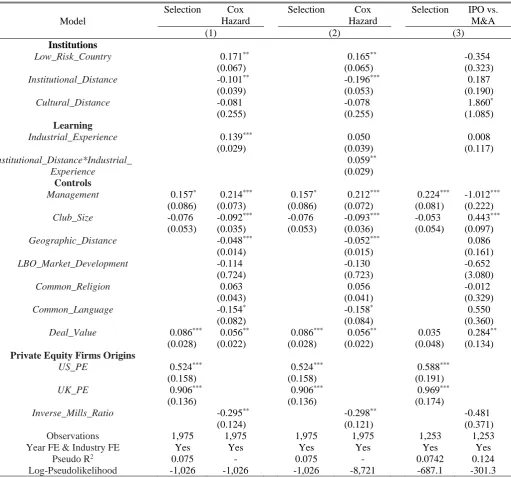
[Insert Table 8 about here]
As shown in Table 8, in the selection stage, the likelihood of the experienced PE firm investing in the portfolio company is higher when the initial buyout value is larger and when the PE firm is from the US or the UK. In the second step, we find that after controlling for the selection bias, the probability and the hazard rate of successful exits increase when the institutional environment quality is higher, when PE firms are more experienced, and when the management team participates in the deal. We also find consistent evidence of the mitigation effect of industrial experience on institutional distance. In terms of the choice between IPO and M&A as exit strategies, deal characteristics are important in the decision-making process.
4.4.2 Imputed deal value
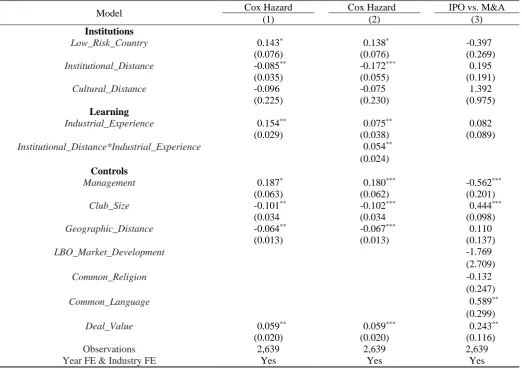
Our sample includes 2,639 cross-border buyout deals but the sample size decreases to 1,975 if we require deal value to be available. The sample reduction through missing deal value might result in biased estimation. To alleviate the concern of missing value, we follow Strömberg (2008) and adopt the multiple imputation to create a complete case dataset.
[Insert Table 9 about here]
In Table 9, we present re-estimations of the main models with deal value imputed based
on the multiple imputation. The main results remain consistent with previous tests. Institution
while institutional distance has the opposite effect. Moreover, industrial experience could
mitigate the adverse effects of institutional distance.
5. Conclusion
This study examines the determinants of the cross-border buyout performance based on the framework of institution. We use the Mergermarket database and obtain a sample of 2,639 cross-border buyout transactions in 38 countries from 1998 to 2007. Firstly, we test the relationship between sucessful exit ratio and the factors mentioned above at the country-pair level. To study the likelihood of a successful exit ath the deal level, we use the survival analysis to examine the determinants of exit success.
We find that the institutional environment quality is positively related to the likelihood of successful exits while such likelihood decreases when the institutional differences between PE firm country and portfolio company country are larger. The result is in line with previous cross-border VC studies (Nahata et al., 2014) and consistent with the “law matters” view (La porta et al., 1997, 1998). Further, cultural distance does not play a role in determining cross-border buyout performance. We measure PE firms’ learning from four aspects: country-specific experience, multinational experience, industry experience and reputation. Consistent with previous studies (Cressey et al. 2007; Gompers et al., 2008), we find that more experienced PE firms perform better and their industrial experience has a mitigation effect. In the additional analyses examining the choice of exit routes, PE experience, PE club size, and initial buyout value are positively associated with the likelihood of going IPO. As the most frequently used exit strategy, M&A is more likely to be adopted when the institutional environment quality is higher and when PE firms learn more from their past activities. This study is the first using a novel dataset of portfolio companies’ details of PE firms around the world to offer important insights into the determinants of buyout success in both developed and developing countries.
References
Allen, F., Qian, J., and Qian, M. (2005). Law, finance and economic growth in China. Journal of Financial Economics, 77 (1), 57-116.
Ahern, K.R., Daminelli, D., and Fracassi, C. (2015). Lost in translation? The effect of cultural values on mergers around the world. Journal of Financial Economics, 117 (1), 165-189.
Alperovych, Y., Amess, K., and Wright, M. (2013). Private equity firm experience and buyout vendor source: What is their impact on efficiency? European Journal of Operational Research, 228 (3), 601-611.
Arcot, S., Fluck, Z., Gaspar, J.M., and Hege, U. (2015). Fund managers under pressure: Rationale and determinants of secondary buyouts. Journal of Financial Economics, 115 (1), 102-135.
Barkema, H.G. and Vermeulen, F. (1998). International expansion through start-up or acquisition: a learning perspective. Academy of Management Journal, 41 (1), 7-26.
Bergman, N. and Nicolaievsky, D. (2007). Investor protection and the Coasian view. Journal of Financial Economics, 84 (3), 738-771.
Bottazzi, L., Da Rin, M., and Hellmann, T. (2008). Who are the active investors? Evidence from venture capital. Journal of Financial Economics, 89 (3), 488-512.
Brau, J.C., Francis, B., and Kohers, N. (2003). The choice of IPO versus takeover: Empirical evidence. Journal of Business, 76 (4), 584-612.
Buchner, A., Espenlaub, S., Khurshed, A., and Mohamed, A. (2017). Cross-border venture capital investments: The impact of foreignness on returns. Journal of International Business Studies, 49 (5), 575-604.
Chemmanur, T.J., Hull, T.J., and Krishnan, K. (2014). Expertise or proximity in international private equity? Evidence from a natural experiment. Working paper.
Chen, H, Gompers, P., Kovener, A., and Lerner, J. (2010). Buy local? The geography of venture capital. Journal of Urban Economics, 67 (1), 90-102.
Cressy, R., Munari, F., and Mallipiero, A. (2007). Playing to their strength? Evidence that specialization in the private equity industry confers competitive advantage. Journal of Corporate Finance, 13 (4), 647-669.
Dai, N., Jo, H., and Kassicieh, S. (2012) Cross-border venture capital investments in Asia: Selection and exit performance. Journal of Business Venturing, 27 (6), 666-684.
De Clercq, D. and Dimov, D.P. (2007). Internal knowledge development and external knowledge access in venture capital investment performance. Journal of Management Studies, 45 (3), 585-612.
Driessen, J., Lin, T.C., and Phalippou, L. (2012). A new method to estimate risk and return of nontraded assets from cash flows: the case of private equity funds. Journal of Financial and Quantitative Analysis, 47 (3), 511-535.
Erel, I., Liao, R.C., and Weisbach, M.S. (2012). Determinants of cross-border mergers and acquisitions. Journal of Finance, 67 (3), 1045-1082.
Ferreira, M.A., Massa, M., and Matos, P. (2010). Shareholders at the gate? Institutional investors and cross-border mergers and acquisitions. Review of Financial Studies, 23, 601-644.
Glaeser, E., Johnson, S., and Shleifer, A. (2001). Coase versus the Coasians. Quarterly Journal of Economics, 116 (3), 853-899.
Gompers, P. (1996). Grandstanding in the venture capital industry. Journal of Financial Economics, 42 (1), 133-156.
Gompers, P.A., Gornall., W., Kaplan., S.N., and Strebulaev, I.A. (2016). How do venture capitalist make decisions? NBER working paper.
Gompers, P., Kovner, A., Lerner, J., and Scharfstein, D. (2008). Venture capital investment cycles: The impact of public markets. Journal of Financial Economics, 87 (1), 1-23.
Gompers, P. and Lerner, J. (2004). The Venture Capital Cycle, 2nd edition. Cambridge: MIT Press.
Groh, A.P. and Gottschalg, O., 2008. The opportunity cost of capital of US buyouts. NBER working paper.
Guiso, L., Sapienza, P., and Zingales, L. (2003). People’s opium? Religion and economic attitudes.
Journal of Monetary Economics, 50 (1), 225-282.
Hammer, B., Knauer, A., Pflücke, M., and Schwetzler, B. (2017). Inorganic growth strategies and the evolution of the private equity business model. Journal of Corporate Finance, 45, 31-63.
Heckman, J.J. (1979). Sample selection bias as a specification error. Econometrica, 47 (1), 153-162
Hochberg, Y., Ljungqvist, A., and Lu, Y. (2007). Venture capital networks and investment performance. Journal of Finance, 62 (1), 251-301.
Hofstede, G. and Bond, M.H. (1988). The Confucius connection: From cultural roots to economic growth. Organizational Dynamics, 16 (4), 5-21.
Holloway, I., Lee, H., and Shen, T. (2016). Private equity firm hetereogeneity and cross-border acquisitions. International Review of Economics and Finance, 44 (C), 118-141.
Ivashina, V. and Kovner, A. (2011). The private equity advantage: Leveraged buyout firms and relationship banking. Review of Financial Studies, 24 (7), 2462-2498.
Kaplan, S.N. and Schoar, A. (2005). Private equity returns: Persistence and capital flows. Journal of Finance, 60 (4), 1791-1823.
Kaplan, S. N., Sensoy, B. A., and Strömberg, P. (2002). How well do venture capital databases reflect actual investments? Working Paper.
Kaplan S.N., Martel, F., and Strömberg, P. (2007) How do legal institutions and experience affect financial contracts? Journal of Financial Intermediation, 16 (3), 273-311.
Kaplan, S.N. and Strömberg, P. (2004). Characteristics, contracts, and actions: Evidence from venture capital analyses. Journal of Finance, 59 (5), 2177-2210.
Kaplan, S.N. and Strömberg, P. (2008). Leveraged buyouts and private equity. Journal of Economic Perspectives, 23 (1), 121-146.
La Porta, R., Lopez-de-Silanes, F., Shleifer, A., and Vishny, R. (1997). Legal determinants of external finance. Journal of Finance, 52 (3), 1131-1150.
La Porta, R., Lopez-de-Silanes, F., Shleifer, A., and Vishny, R. (1998). Law and finance. Journal of Political Economy, 106 (6), 1113-1155.
Lerner, J. and Schoar, A. (2005). Does legal enforcement affect financial transactions? The contractual channel in private equity. Quarterly Journal of Economics, 120 (1), 223-246.
Lerner, J., Sørensen, M., and Strömberg, P. (2009). What drives private equity activity and success globally? in A. Gurung and J. Lerner, ed.: Globalization of Alternative Investments Working Papers Volume 2: The Global Economic Impact of Private Equity.
Li, Y., Vertinsky, I., and Li, J. (2014). National distances, international experience, and venture capital investment performance. Journal of Business Venturing, 29 (4), 471-489.
Lopez-de-Silanes, F., Phalippou, L., and Gottschalg, O. (2015). Giants at the gate: Investment returns and diseconomies of scale in private equity. Journal of Financial and Quantitative Analysis, 50 (3), 377-411.
Nahata, R., Hazarika, S., and Tandon, K. (2014). Success in global venture capital investing: Do institutional and cultural differences matter? Journal of Financial and Quantitative Analysis, 49 (4), 1039-1070.
North, D.C. (1990). Institutions, Institutional Change and Economic Performance. Cambridge: Cambridge University Press.
Metrick, A. and Yasuda, A. (2011). Venture capital and other private equity: A survey. European Financial Management, 17 (4), 619-654.
Meuleman, M. and Wright, M. (2011). Cross-border private equity syndication: Institutional context and learning. Journal of Business Venturing, 26 (1), 35–48.
Sørensen, M. (2007). How smart is smart money? A two-sided matching model of venture capital.
Journal of Finance, 62 (6), 2725-2762.
Strömberg, P. (2008). The new demography of private equity, in Gurung, A. and Lerner, J. ed.: Globalization of Alternative Investments Working Papers Volume 1: Global Economic Impact of Private Equity 2008, New York: World Economic Forum USA, 3-26.
Taras, V., Steel, P., and Kirkman, B.L. (2011). Improving national cultural indices using a longitudinal meta-analysis of Hofstede's dimensions. Journal of World Business, 47 (3), 329-341.
Tykvová, T. and Schertler, A. (2014). Does syndication with local venture capitalists moderate the effects of geographical and institutional distance? Journal of International Management, 20 (4), 406-420.
Appendix 1: Variable definition
Variables Definition and Source Dependent variables
Successful_Exit_Ratio
(1) For cross-sectional test, the outcome variable is the number of successful exits of all portfolio companies which the PE firms invested in over the entire period in country pair i over the total number of portfolio companies which the PE firms invested in over the entire period in country pair i ; (2) For the panel test, the outcome variable is the number of successful exits of all portfolio companies which the PE firms invested in in year t in country pair i over the total number of portfolio companies which the PE firms invested in in year t in country pair i. Hazard_Rate Conditional probability that the PE firm could exit the portfolio company successfully.
Exit_Types Exit types include three categories: IPO, M&A (Secondary buyout and trade sales), and
unsuccessful exits (other exits and non-exit ones). (Source: Mergermarket)
Institutions
Low_Risk_Country
Dummy variable which equals one if the country risk index of the portfolio company’s country is higher than 80. The country risk index consists of political risk components with 50% weight, economic risk components with 25% weight and financial risk components with 25% weight. (Source: International Country Risk Guide)
Institutional_Distance
Logarithm of one plus the absolute value of the country risk index differences between the country of portfolio company and the country of the PE firm. (Source: International Country Risk Guide)
Cultural_Distance
The cultural distance between the country of the leading PE firm and country of the portfolio company. It is measured as the distance between Hofstede's four-dimensional cultural factors on time-varying meta-analytic scores: power distance, uncertainty avoidance, individualism, and masculinity. (Source: Taras et al., 2011)
Learning
Country_Experience
Logarithm of one plus the number of buyouts which the PE firm completed in the country of the portfolio company from 1990 to the year prior to the initial buyout. (Source: Mergermarket and SDC Platinum M&A)
Multinational_Experience Logarithm of one plus the number of foreign countries in which the PE firm invested from1990
to the year prior to the initial buyout. (Source: Mergermarket and SDC Platinum M&A)
Industrial_Experience
Logarithm of one plus as the number of buyouts which the PE firm completed in the industry of the portfolio company from 1990 to the year prior to the initial buyout. (Source: Mergermarket and SDC Platinum M&A)
Reputation Logarithm of one plus the number of buyouts completed by the PE firm three years prior to the
initial buyout. (Source: Mergermarket and SDC Platinum M&A)
Deal Characteristics
Management Dummy variable which equals one if the management participates in the initial buyout
transaction and zero otherwise. (Source: Mergermarket, SDC Platinum M&A, and Zephyr)
Club_Size The number of PE firms in the club deal. (Source: Mergermarket, SDC Platinum M&A, and
Zephyr)
Deal_Value Logarithm of buyout deal value. (Source: Mergermarket, SDC Platinum M&A, and Zephyr)
PE Characteristics
US_PE Dummy variable which equals one if the PE firm headquarters in the US and zero otherwise.
(Source: Mergermarket)
UK_PE Dummy variable which equals one if the PE firm headquarters in the UK and zero otherwise.
(Source: Mergermarket)
Country and Country-pair Controls
LBO_Market_ Development
The number of buyouts in the country of the portfolio company from 1990 to the year prior to the initial buyout. The number is then normalized by the country’s GDP in year t-1. (Source: SDC Platinum M&A and World Bank)
Common_Religion Dummy variable which equals one if the country of the PE firm and the country of the portfolio
company have the same primary religion and zero otherwise. (Source: CIA World Factbook)
Common_Language
Dummy variable which equals one if the country of the PE firm and the country of the portfolio company have the same first official language and zero otherwise. (Source: CIA World Factbook)
Geographic_Distance Logarithm of geographic distance between the most populated city of the country of the PE