0022-538X/86/040185-07$02.00/0
Copyright © 1986, American Society forMicrobiology
Synthesis and Processing of the Envelope
gp55-116
Complex of
Human
Cytomegalovirus
WILLIAM J. BRITT* ANDDENISE AUGER
The University of Alabama atBirmingham, Departmentof Pediatrics, Children's Hospital Tower, University Station, Birmingham, Alabama 35294
Received 19July 1985/Accepted 18 December 1985
Theenvelope of human cytomegalovirus has been reportedtocontain between three and eight glycoproteins. Major constituents of the envelope includetwo abundant glycoproteins with estimated molecular weights of 55,000(gp55) and 116,000 (gpll6). These two glycoproteins have been shown to exist as a disulfide-linked complex (gp55-116) within the envelope ofmaturevirions. Utilizingapanel of monoclonal antibodies reactive with the gp55-116 complex,wecharacterized thesynthesis and processing of thesetwovirion proteins. Infected cellswereshowntocontaintwoglycosylated proteins of 160,000 and 150,000 daltonsaswellasthematuregp55 andgpll6. Pulse-chase analysis indicated thatgpl50was aprecursorprotein of gp160. Thematuregp55and gpll6weregenerated, inturn,bycleavage of gp160. Antigenic and structural analysis revealed thatgp55and gpll6 shared little structural homology andnodetectableantigenic cross-reactivity. The results of this study arediscussedinrelation tothe synthesis of envelope proteinsof otherherpesviruses.
Cytomegalovirus (CMV) representsanimportantcauseof morbidity and mortality inimmunocompromised hosts (12). Inaddition,congenital CMV infectionsaccountfora signif-icant number of developmentally disabled children every
yearinthe UnitedStates(1). Although inprevious studiesa variety of specific immune responses to CMV in infected patients has been documented (2, 18, 23-25), it remains unclear whichresponses are critical for limiting infectionin vivo. Furthermore, little is known about the immune
re-sponsetospecific CMV-encoded proteins. Results ofrecent
studies have suggested that the envelope glycoproteins are immunogenic in humans and may be important targets for theimmuneresponse. Sera frompatients convalescing from CMV infections can neutralize infectious virus in vitro and have been showntocontain antibodies thatarereactive with these glycoproteins (3, 20). This finding suggests that anti-bodiesagainst these glycoproteins mayalso be activein the
in vivo clearance of CMV. Additional evidence has also suggested that these same envelope glycoproteins are ex-pressedon thesurface of infected cells (20). Recognition of these cell surface viral antigens by immunological effector functions such as cytotoxic T lymphocytes or
antibody-dependent cellular cytotoxicity or both could result in the elimination of virus-infected cells. Thus, a further under-standing of the role of the immuneresponseinthe control of
CMV infections willnecessarily require athorough charac-terization of the CMVglycoproteins.
In earlier studiesthe existence of between three andeight electrophoretically distinct glycoproteins within the enve-lope of CMV has been demonstrated (3, 7, 8, 10, 14, 17, 26, 27). Becausemanyof these investigationsweredone without the aid ofimmunological techniques, the actual number of antigenically and structurally unique proteins in the CMV envelope is unclear. In fact, more recent studies have suggested that the envelope of CMVmay contain a limited number of polymorphic glycoproteins (21). In a previous study, we utilized CMV-specific monoclonal antibodies to
defineadisulfide-linkedenvelope protein complex consisting of three glycoproteins with estimated molecularweights of
*Correspondingauthor.
185
160,000 (gpl60), 116,000 (gp116), and 55,000 (gp55) (3). Theseproteinswereinitially detectedinvirus from extracel-lular supernatantsprepared bycentrifugation ofsupernatant
fluid from infected cells. Subsequent studies, in which an
additional purification step of sedimentation ofthis virus-enriched material through sorbitol density gradients was
included, revealed that infectious virions contained only gp55and gp116(4; W. J. Britt, manuscript in preparation).
In this report we describethe results ofour studies on the
synthesis of this envelope protein complex and its various
intracellular forms. Our findings indicated that the mature
gp55-116 complexwasgenerated by cleavage ofa
glycosyl-ated 160-kilodalton (kDa) precursor protein. This gpl60
precursor protein was synthesized from a glycosylated
150-kDa precursorprotein.Antigenicandstructuralanalysis
indicated that gp55 and gpll6 were dissimilar,
suggesting
potentially different structural roles for these envelope pro-teins.
MATERIALS ANDMETHODS
Cells and virus. The propagation of human foreskin
fibroblasts has been described previously (3). CMV strain AD169 was originally obtained from Barry Hanshaw, University of Massachusetts, Worcester, Mass. The
purifi-cation ofthis virusfromextracellular supernatants has been described in an earlier report(3).
Monoclonal antibody productions. The production and
characterization of the antibodies used in this study have beendescribed previously(3). All antibodies wereclassified
asCMV specificin that they were nonreactive inan
immu-nofluorescence assay (3) with either herpes simplex or varicella-zoster virus-infected human fibroblasts as well as noninfected fibroblasts. All hybrid cell lines were cloned
through two successive cycles of limiting dilution cloning
before use. Monoclonal antibody 7-17 has been shown to reactwith the gp55-116complex ingradient-purified virions aswell asgp160, gpll6, andgp55 in extracellular, partially purifiedvirus (3).This antibodyneutralizes infectious virus in vitro (3). Antibodies 27-11, 27-83, 27-160, 27-180, and 27-283 were produced in an identical fashion as antibody
7-17. Of this group, only antibody 27-283 neutralized
on November 10, 2019 by guest
http://jvi.asm.org/
tious virus.Antibody 48, amurine monoclonal antibodythat
isreactive with Friend murineleukemia virus gp70 (5), was used as acontrol fornonspecific reactivity.
Radiolabeling of infected-cell proteins.Confluent
monolay-ers of human fibroblasts in 60-mm-diameter tissue culture disheswereinfected withAD169 at amultiplicity ofinfection
of1. Four dayspostinfection thecells showed evidence of early cytopathic effect and were labeled overnight with [35S]methionine and [3H]glucosamine as described previ-ously(3). Thecellswereharvested24hlaterby first washing the monolayers three times with Dulbecco modified phos-phate-buffered saline (DPBS; pH 7.3) followedbythe addi-tion of1.5 mlof extraction buffer which was composed of 0.1% sodium dodecyl sulfate (SDS), 1.0% NonidetP-40,and 1.0% deoxycholate in tris-buffered saline (TBS;0.05 MTris,
0.15 M NaCl; pH 7.3). The detergent-containing solution
wasallowed to incubate on the monolayers for 15minat 4°C,
andthedetergent-solubilizedcelllysateswere then stored at
-70°C. In all experiments 0.1 mM phenylmethylsulfonyl
fluoride (SigmaChemical Co., St. Louis, Mo.) was added to the extraction buffer as well as to the wash bufferused in
immuneprecipitation procedures.
Immuneprecipitation and SDS-polyacrylamide gel electro-phoresis. The radiolabeled lysates wereprecleared by incu-bation with normalmouse serumand Formalin-fixed Staph-ylococcus aureus (Bethesda Research Laboratories, Gaithersburg, Md.) at 4°C for 2 h. The lysates were then clarified by centrifugation at 75,000 x g for 45 min. The
precleared lysates were incubated overnight at 4°C with
tissue culturesupernatant containing monoclonal antibodies,
and the immune complexes were collected by adding S. aureus. After four washes with cold extraction buffer, the
pellets were eluted in 50 mM TBScontaining 2% SDS and
5% 2-mercaptoethanol(2-ME), or an identicalbuffer except
without 2-ME, and heated to 100°C for 3 min. The samples were applied to 10 or 7.5% acrylamide gels as described
previously (3). Molecular weights were estimated by
com-parison with the migration of standard molecular weight markers (Sigma).
Pulse-chaseanalysis of infected-cell proteins.
Briefly,
CMV-infectedmonolayers in 60-mm-diameter tissue culture disheswere deprived of methionine by incubation in DPBS for30 min.Themonolayerswerethenpulse labeled for10minwith
50 ,uCi of [35S]methionine per ml. The radioactive medium wasremoved, and normal maintenance mediumwasadded.
The cells were then incubated for various times, and the chase period was terminated by first washing the dish in DPBS and then rapidly freezing the entire dish at -70°C.
The monolayers were then thawed, and the infected cell
proteinswere extracted asdescribed above.
Westernimmunoblotting. Thedetails ofWestern
immuno-blottinghave beendescribedpreviously (5).
Briefly,
infected monolayers of cellswereremoved fromtissue culture disheswith a rubber policeman. The cells were pelleted,
SDS-polyacrylamide gel electrophoresis
(PAGE)
elution buffer wasadded, andthe mixture was heated to100°C for 3 min. Virus obtained by centrifugation through sorbitoldensity
gradientswas solubilizedin an identical manner. The virus orcell lysate was then subjected to SDS-PAGE. The sepa-rated proteinswere then transferred to nitrocellulose (NC)
membranes with a trans blot apparatus(Bio-Rad
Laborato-ries, Richmond, Calif.). The transfer buffer and length of
transfer were carried out as described previously (5). The membrane was blocked in 2% bovine serum albumin-TBS
for2 hat37°C, cutinto strips,and then reacted with tissue culture supernatantcontaining monoclonal antibodies
over-night at 4°C. The strips were washed in 0.05% Tween 20
(Sigma)-TBS
several times, and approximately 106 cpm of'25I-rabbit anti-mouse immunoglobulin (Pel-Freeze, Ft.
Smith, Ark.) per mlwas added. Aftera45-min incubation,
thestrips wereagain washed, dried, andexposedtofilm. Proteolytic peptide mapping. Theproteolytic peptide
map-ping procedurewas anadaptationof that of Cleveland et al.
(6). Briefly,
[1251]-iodine
labeled virus was prepared by reacting approximately20 ,ug ofgradient-purifiedvirions in DPBS with 1.0mCi of['251]iodinein thepresence of 20 ,ug ofchloramine T(Sigma). Following a 2-minute incubation at
25°C,40p.g ofsodiummetabisulfiteinDPBSwasadded. The
mixture was then dialyzed extensively overnight at4°C in
DPBS. Intact labeledvirionswerelysed by makingthe final mixture 1.0% SDSbytheaddition of 20% SDS.The solubil-ized proteins were precleared as described previously and reacted with monoclonal
antibody
7-17. Following separa-tion by SDS-PAGE, gp55 and gpll6 were visualized by autoradiography, and the appropriate bands were cut from the gel. The gel slices were washed three times in 100%methanol, dried, and then placed in the wells ofa second 15%acrylamide gel. Various concentrations of staphylococ-calV8 protease(SV8; Miles
Laboratories, Naperville, Ill.),
or
trypsin (Sigma)
in TBS were added. The gel slices and enzymes were electrophoresed until the residual tracking dye fromthegel slicesreachedtheinterface ofthestacking
and
resolving gel.
The power was then turnedoff,
anddigestion
wasallowedtoprogressfor45 min. Electrophore-sis wasthen resumed.Proteolytic peptide mapping
of intra-cellular forms ofthe gpS5-116complex
was carriedoutinasimilar
fashion,
except that the infected cellproteins
were labeled with 100 FCiof[35S]methionine
per ml asdescribed above.Following
solubilization in extractionbuffer,
the infected cell proteins were precipitated with antibody 7-17 andseparated bySDS-PAGE. Molecularweightswereesti-mated by theposition ofthe radiolabeled peptides as
com-pared with the migration of known standards to which
cytochrome
c(Sigma)
wasadded.RESULTS
Thegp55-116 envelope protein complexof CMVis
synthe-sized from a 150-kDa precursor protein. The intracellular forms oftheCMV
gpS5-116
envelope complex
were studiedby
using
agroupofCMV-specific
murine monoclonalanti-bodies reactive with this
protein complex.
Detergent-solubilized
proteins
from[35S]methionine
pulse-labeled,
CMV-infectedhuman fibroblastswere
precipitated
withan-tibody
7-17 andanalyzed by
SDS-PAGE underreducing
conditions.
Antibody
7-17precipitated
threebroadly
migrat-ing
proteins
with estimatedmolecularmassesof55, 116,
and 160kDaaswellas amorediscretely
migrating
protein
of150 kDa(Fig. 1, +2-ME).
The 160-kDaprotein migrated
as adiffuse band between 150 and 160 kDa andwas not
readily
resolved from the discrete 150-kDaprotein
in thisgel
system(Fig.
1). Human immune sera WBprecipitated
alarger
number ofproteins,someof whichcomigrated
withproteins
precipitated by antibody
7-17(Fig. 1).
Nonimmune control seraKF,aswellasantibody
7-17 and seraWB,
nonspecifi-cally
precipitated proteins
of68, 49,
and 30 kDa(Fig. 1).
Antibody 7-17 also
precipitated
threeproteins
of55, 116,
150, and 160 kDa from
[3H]glucosamine-labeled
CMV-infected cells
(Fig.
1,+2-ME),
although
thegpS5
incorpo-rated much less[3H]glucosamine
than the116-,
150-,
or160-kDa
proteins
and wasnoteasily
seen in this reproduc-tion of theoriginal fluorogram
(Fig. 1).
It should be notedon November 10, 2019 by guest
http://jvi.asm.org/
-2-me
35S-met
3H
LL3 ,
a
+2-i
i-gin
3H-gin
al_.
X-coU 'U
-N
FIG. 1. SDS-PAGE analysis of immune from [35S]methionine- ("S5-met) and [3H1
me and 55 kDa were demonstrable (Fig. 2). In chase periods
Is
S-met
after 80 min, the 160-, 116-, and 55-kDa proteins accumu-lated, whereas the amount of the 150-kDa protein decreased Msrk , slightly (Fig. 2). This processing pathway appeared to occur relatively slowly, as evidenced by the detection of
gp55
andgpll6some 80 min after the initial pulse and by the contin-uedpresence of the 150-kDa precursor 24 h after the pulse (Fig. 2). These results suggest that thegp55-116 complexof - - 200 CMV is synthesized as a 150-kDa precursor which is then
presumably
furtherglycosylated
toa 160-kDa form.Shortly
t £ - 150
thereafter, or possibly concurrently,gpl60
is cleaved intomature
gp55
andgpll6
envelope proteins.
{-11
6
Although
the results of thepulse-chase
experiment
- 92.5 strongly suggest that the mature gp55-116 complex is acleavage
product
of thegpl60
precursorprotein,
we further - 68 investigated the structural relationship of theprecursorand * - mature proteins by proteolytic peptide mapping.Infected-cell proteins were radiolabeled with [35S]methionine, im-muneprecipitated withmonoclonalantibody 7-17, and
sep--45 arated by SDS-PAGE. Following identification of gpl60, gp150, gpll6, and gp55 by autoradiography, the gel slices
containingtheseradiolabeledproteins were excised from the
gel and digested with SV8asdescribedpreviously by
Cleve-land et al. (6). The resulting peptide fragments were then -29 separated by SDS-PAGE. When the two forms of the -
25
precursor protein,gpl60
andgplS0,
were digested withvarious amounts of SV8, the resulting peptide profiles ap-precipitated proteins pearedindistinguishable, indicating that these two proteins
glucosamine- (3H-gln) are very similar structurally (Fig. 3). Comparison of the radiolabeled, CMV-infected human fibroblasts. Monoclonal
anti-body 7-17, convalescent immune human sera WB, and control nonimmune humanseraKF were used as the sourceofprecipitating antibodies. Precipitated proteinswereeluted in thepresence(+)or
absence (-)of2-MEandanalyzed in 7.5%acrylamide gels. Molec-ularweights (in kilodaltons)areshownontheright.
that the 116-kDa protein exhibited very broad
migration
ranging from 105 to 116 kDa but was arbitrarily assigned a
molecularweight of 116kDa. These findings document the presence of previously described 160-, 116-, and 55-kDa glycoproteins(3)within infected cells andidentifya150-kDa
glycosylated protein not found in partially purified virion preparations. When identically prepared immune
precipi-tates from either
[3H]glucosamine-
or[35S]methionine-labeled infectedcellproteinswereelutedin SDScontaining buffer intheabsenceofthereducingagent2-ME,anumber oflarger proteins, ranging in size from 160to 180kDa and >200 kDa wereobserved (Fig.1, -2-ME). Inaddition,
gp55
andgpll6werenolonger detectablein theabsence of2-ME, indicating that these envelope glycoproteins exhibited exten-sivedisulfidebonding aspreviously reported (3).
To delineate the precursor-product relationship ofthese
envelope glycoproteins, we used pulse-chase analysis of infected-cell proteins. After a 10-min pulse with
[35S]meth-ionine inmethionine-deficient medium, infected cells were incubated in medium containing normal concentrations of
nonradiolabeled methioninefor various times.Antibody7-17 and a control antibody, 48, were used to precipitate
deter-gent-solubilized proteins fromtheseinfectedcells. Antibody 7-17 precipitated a 150-kDa protein which incorporated
radiolabeled methionine during the initial pulse labeling
period (Fig. 2). The amountofthe 150-kDaproteinincreased
during the chaseperiod, and 40 min after the initial pulse, a morediffusely migrating 160-kDaprotein was detectable. In thefollowing chase period (80 min), the diffusely migrating 160-kDaproteinbecame more apparent, and proteins of 116
0 1O' 20' 30' 40' 80' 100' 360' 24hr.
0 . 0X0v1 . 0 X co 00 co
-e s ¢ia vz.1 PL -- st-r v IL v rK e~r rs et P
1--l - - r--I f-Il I Ir--M
--- # 160
g
*
-116^*~~~.=68
-.. _m _4 ,, _ <
_ _> ,*. _i
FIG. 2. Pulse-chase analysis of CMV-infected human fibro-blasts. CMV-infected cells wereradiolabeledwith [35S]methionine
as described the text and precipitated with monoclonal antibody 7-17 or control antibody 48, and the immune precipitates were
analyzed by SDS-PAGE. The chase periodsare listed above the gels,and the molecularweights (in kilodaltons) ofthe precipitated proteinsareshownontheright.
on November 10, 2019 by guest
http://jvi.asm.org/
[image:3.612.48.297.69.334.2] [image:3.612.312.551.382.657.2]gpl
60
gplOp
gpl16
gP55-AA
~ ~ ~ ~ ~ .
-it
FiG. 3. Proteolyticreptide mappingof intracellularformsofthe
gpS5-116 complex. Infected-cell proteins were radiolabeled with
[35S]methionine, solubilized, andimmune precipitated with
mono-clonalantibody 7-17. Following separation by SDS-PAGE, the gel
slices containing gpl60, gplS0, gpll6, and gpS5 were excised and
digestedwith 1, 0.1, and 0.001,ug(in each ofthelanes fromleft to
right,respectively) ofSV8 protease in the wells ofa second, 15%
acrylamidegel. Thepeptidefragmentswerethenelectrophoretically separated.Symbols: *, peptidefragmentsof gpll6which werealso
foundin gpl60 (gplS0); 0,fragmentsfound in bothgp55andgpl6. (gplSOu; *, fragments in gpS5 and gpll6 with similar rates of
migration.
profile of peptidefragments generated by digestion of mature
gpll6 and gpl6O (gplS0) precursor protein revealed that all
of the peptides found ingpll6are also found ingplS0(Fig.
3), suggesting that gpll6 is generated from gp160 (gplS0).
Similarly, the peptide profile of precursor protein gp160
(gpl50) also contained the peptide fragments generated by proteolytic digestion of gp55, suggesting that this mature
protein is also derived from this precursor protein (Fig. 3).
Finally, in addition to the several unique peptides which
were not shared between gpll6 and gp55 (Fig. 3), several smallerpeptides generated bydigestion of these proteins had similar, but not identical, rates ofmigration (Fig. 3). These results support the findings gathered from the pulse-chase experiment and indicate that mature gpll6 and gp55 are generated by cleavage of the larger gpl60 precursor
pro-tein.
gpll6 andgp55envelopeproteins ofCMVareantigenically
distinct. Previously, otherinvestigators have suggested that CMV envelope proteins exhibit extensive antigenic poly-morphism (20, 21). Because ourearlierresults suggested an
alternative explanation forthis presumed polymorphism, we
examined the reactivity ofa panel of CMV-specific
mono-clonal antibodies against the gp55-116 envelope protein complex of CMV. Using the Western immunoblotting tech-nique, we studied the reactivity of these antibodies against
denatured and reduced proteins, thereby eliminating any polymorphism which may have arisen as the result of complex formation between individual proteins. After
sepa-rationbySDS-PAGEandtransfertoNCmembranes, infect-ed-cell proteins were reacted with monoclonal antibodies
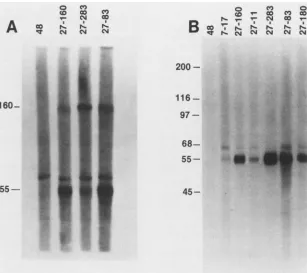
showntobespecific for the gpll6-gp55 complex. Antibodies
27-160, 27-283, and 27-83 were reactive against a 55-kDa
protein andaprotein(s) withanestimated molecularweight
of between 150 and 160 kDa(Fig. 4). Nonspecific reactivity
of theseantibodies, aswellascontrolantibody 48, wasseen
against aprotein ofapproximately68 kDa (Fig. 4). Thus, it appears that these antibodiesarereactive with maturegp55
and the 150- and 160-kDa precursor butnotwith themature
gpll6. In Fig.4 only gplS0canbereadily seen,possibly as a result of reduced amounts of gpl60 as compared with gp150 in infected cells (Fig. 1, +2-ME). In addition, itwas difficult to identify small amounts of the diffusely migrating
gp160 inthe presence ofthe more abundant gp150because the gel system used in these experiments did not allow
complete separation of these two proteins (Fig. 1, +2-ME).
Thesefindings demonstrate the antigenic similarity between the precursor gp150 protein and mature gp55, providing
additional evidence for their product-precursorrelationship. In addition, the lack of reactivity of these antibodies for gpll6 indicates that gp55 and gpll6 are not antigenically identical. We next used the immunoblotting technique to characterize the antigenic relatedness of these envelope proteins within mature virions obtained by centrifugation of extracellular virusthrough density gradients. Virion proteins were solubilized, separated bySDS-PAGE, and transferred to NC. Whenan expanded panel of monoclonal antibodies was then used to probe the NC membranes, specific reac-tivity for gp55 was again seen in the absence of reacreac-tivity against gpll6 (Fig. 4). In agreement with previous results (4), the precursor forms of the complex, gplS0 and gpl60, were not detected in thispreparation of mature virions (Fig. 4).Nonspecific reactivity fora68-kDa protein was alsoseen with control antibody 48 as well as the antibodies reactive with gp55 (Fig. 4). Theseresultsdemonstrate that a number of monoclonal antibodies could distinguish antigenic heter-ogeneity between the gpll6 and gp55 envelope proteins of CMV, suggesting that components of the gp55-116 envelope complex are antigenically distinct, even though they were derived from a common precursor.
The gpll6 and gp55 envelope proteins exhibit little struc-tural homology. The lack of shared antigenicity between gpll6 and gp55 suggests that these proteins are also struc-turally different. In addition, although proteolytic peptide mapping revealed some apparently common peptide frag-ments in gp116 and gp55, the finding of several unique peptidefragments in each protein suggests thatmajor struc-turalheterogeneityexistsbetween theseproteins.To further explore this possibility we again used proteolytic peptide mapping as a method to compare these two envelope pro-teins.However, in thefollowingexperimentsweused extra-cellular, gradient-purified virions as a source ofgpll6 and gp55. This source of envelope proteins offered important advantages over the use of infected-cell proteins. First, because gp150 was not present in the mature virion, there waslittle chance ofcontaminating gpll6 with smallamounts ofcomigrating gp150 (Fig. 2). In addition, it allowed us to study the relationship between the mature forms of gp116 and gp55and the notincompletelyprocessed forms of these proteins or precursor proteins or both which may have comigrated with either gpll6 or gp55. Extracellular CMV virions were purified by centrifugation through a density gradient and radiolabeled with
[1251]iodine.
Following dis-ruption in detergent-containing buffer, the gpll6 and gp55 wereimmuneprecipitated withantibody7-17 andseparatedby SDS-PAGE. The radiolabeled proteins were then sub-jected to proteolytic peptide mapping as described above. Digestion of gp55 withincreasingamountsof SV8 resulted in
on November 10, 2019 by guest
http://jvi.asm.org/
a co
co co c
A
X
c cm
160-
55-0 co
B
W tf-.c'NIPC'I) 0
1- Go C') Co C
X-_- CM CO
_r-N N N N
200
-I
116-97- A
68-
55-
45-FIG. 4. Westernblotanalysis of CMV-infected cellproteinsandsorbitolgradient-purifiedextracellular virions. CMV-infectedcells and purified virions were disrupted as described in the text, subjected toSDS-PAGE, and transferredtoNC membranes. Theseparatedproteins were then reactedwith control antibody 48 andCMV-specific monoclonal antibodies 7-17, 27-11, 27-83, 27-160, 27-180,and27-283.Reactivity wasdetected by1251-labeledrabbit anti-mouse immunoglobulin(Fab2).Reactivity againstinfected-cellproteins (A) and virions (B) is shown. Molecularweights (in kilodaltons) are shown on the left margin of each panel.
theappearanceofa30-kDa fragment andtwofragments with estimated molecular masses of10 and 15 kDa (Fig. 5). In contrast to these findings, only a diffusely migrating
frag-mentwithanestimated molecularmassof40kDa andthree morerapidly migratingfragments were observed when gpll6 wasdigested with SV8 (Fig. 5). Digestionof gp55 and
gpll6
with trypsin resulted in the generation of an increasednumberoffragments ascompared withtreatmentwith SV8
A
-0
-0 -0
-o90o 9
"-*w~~~1
i's . .
(Fig. 5). Noneof thefragmentsgenerated by SV8ortrypsin
treatmentofgp55andgpll6 comigratedin the15%gels used
for these analyses (Fig. 5). In addition, the patterns of
sequential
proteolytic digestion
were clearly different for gpll6andgp55(Fig. 5). These resultsindicate thatgp55and gpll6 share little, if any, sequence homology. Thus, itappears thatgp55 and gpll6 notonly differin their antige-nicitybutalso in theirstructure.
_
~
~~
B
0-~~~
00-
~~~~00-
0 00 0
O°
90-
oj 9o 0o 9 o 9s
s
tt
I
;s~~~~~~~~~~9
iq:' 'II
"|
-116
-55
aL. 0
FIG. 5. Proteolytic peptide mapping ofgp55andgpll6ofextracellular virus. Radiolabeled virions were disrupted and immune precipitated with antibody 7-17, and theprecipitatedgp55andgpll6wereseparated by SDS-PAGE. The gel slices containing gp55 andgp116 were then placed inasecondgel, andvariousconcentrations (in micrograms; indicated above thegels) of either SV8 (A) or trypsin (B) were added. Following digestion,theradiolabeled peptides wereelectrophoretically separated in 15% acrylamide gels.
'm 1'.
on November 10, 2019 by guest
http://jvi.asm.org/
[image:5.612.147.454.68.341.2] [image:5.612.125.484.508.681.2]DISCUSSION
Inthis report we have describedthe synthesis and
proc-essingof twomajorenvelopeglycoproteins ofhuman CMV. Analysis with monoclonal antibodies specific for one of
these envelope proteins revealed the presence of four
dis-tinct glycoproteinswithestimated molecularmasses of160, 150, 116, and 55 kDa within CMV-infected cells. Previous studies have also shown that CMV-specific monoclonal
antibodies recognize multiple proteins withininfectedcells (20, 21). This apparent polymorphism was thought to be
secondarytomultipleforms ofindividualenvelope proteins withininfectedcells. However, our results indicate that the
multiple reactivities exhibitedby themonoclonalantibodies used in this study can be explained, in part, by disulfide bonding between these envelope proteins. Inthe absenceof reducingagents, such as 2-ME, only more slowly migrating
species with equivalentorhigher molecular weightsthan the mostslowlymigratingprecursor were
observed.
Inaddition,none of the mature forms of the gp55-116 complex were
detectable in the absence of 2-ME. These findings are
consistent with those ofrecent reports in which disulfide-linked envelope glycoprotein complexes have been
de-scribed in bovineherpes virus (16), pseudorabiesvirus (11),
andvaricella-zoster virus (9).
Using a group of monoclonal antibodies and proteolytic peptide mapping, we identified two related glycosylated
precursorproteins inthesynthetic pathway ofthegp55-116
complex. Severalfindings indicate that gplS0andgpl60are precursorsofthemature gp55-116 complex.First,
gpl50
and gpl60appeared tobe precursorsfoundininfected cells and notin virions becauseneither of these formswasdetectedinvirions prepared by sedimentation of extracellular virions
through sorbitol density gradients. This result was also in agreementwith those of recent reports in which have been describedanumber ofenvelope glycoproteins of CMV,none
of which hadan estimated molecular massof between 140 and 170 kDa (7, 17). Second, the sequential synthesis of gpl50andgp160 followed bytheappearanceofmaturegp55 andgpll6 indicates that there is a temporalrelationship in
thesynthesis of the matureproteins from thegpl60 precur-sor. Furthermore, proteolytic peptide mapping revealed
structural homology between gpl60 and gpl50 and also indicated thatthe peptide fragments generated bydigestion ofgpll6and
gp55
are asubset ofpeptide
fragments foundingp160
andgp150.
Finally, the common antigenicdetermi-nants shared among
gp150, gp160,
and gp55 indicates the structural relatedness of these proteins. Taken together, theseresultsstronglysuggest that the maturegp55
andgpll6 virionenvelope protein arises froma commonglycosylatedprecursorof 150kDawhich is further modifiedby glycosyla-tioninto a160-kDaglycoprotein (Britt, manuscript in
prep-aration) and
then
cleaved into themature forms.The final processing step in the synthesis of mature
gp55-116
appeared to be cleavage of thegp160
precursor. The simultaneous generation oftwoelectrophoreticallydis-tinct glycoproteins with a combined molecular weight
ap-proximatingthatofthefully glycosylated precursor is con-sistent with this processing pathway. Several examples of
cleavage steps in theprocessing ofviralglycoproteinshave been described(9,11, 13, 15, 16).Recently, Hampletal.(11)
have shown that one group of disulfide-linked envelope glycoproteinsof pseudorabies virus issynthesizedby cleav-age of a
higher-molecular-weight
polyprotein precursor.Similarly,
Little-Van den Hurk et al. (16) have providedextensive information on an envelope protein complex of
bovine
herpesvirus
which was producedby
cleavage ofa common precursorprotein. Finally, proteolytic cleavageof an infected-cellprotein
ofvaricella-zoster virus was also shown to be involved in thesynthesis
ofa virionenvelope
glycoprotein (9). Itwasinterestingthatproteolytic
cleavage
of a
larger polyprotein
into a disulfide-linkedcomplex
ofvirion envelope glycoproteins is a common synthetic
path-way for at least four members of the herpesvirus family (pseudorabiesvirus,
bovine herpesvirus,varicella-zoster
virus,andCMV).Thisfeature of herpesvirusesmay suggest aconserved structuralpropertyof thevirionenvelopein this
family of viruses. Definition of such common structural properties ofthe virion envelopemay provide some
insight
intocommonfunctionsofthese virionproteins in thisgroup
of viruseswhich have verydifferent biological characteris-tics.
Although
ourresultsareconsistentwith thefact that there isaprocessingstepinvolving
theproteolytic cleavage ofthe gp160into thematuregp55-116complex,otherexplanationssuch as in vitro
cleavage by
cellular protease which isreleasedduringcelllysismustbeconsidered. Recent reports have detailed such apparent in vitro artifactual cleavage of
herpes simplex virus glycoproteins (19, 28). Although we cannot completely exclude the possibility that release of
cellular proteases is responsible for the cleavage ofgpl60 into thegp55-116 complex, several results are inconsistent with such an explanation. All steps involving cell lysis, immune precipitation, andwashing of immune precipitates
were carried out at4°C and in the presence of the protease
inhibitor phenylmethylsulfonyl fluoride. In addition,
pub-lished reports detailing herpes simplex virus glycoprotein cleavage indicate thatcellular proteaseactivityisextremely
cell line specific (28), and similar protease activity has not been demonstratedin human fibroblasts. Perhaps the most
convincing evidence of the intracellular cleavage ofgpl60
were the nearly identical results obtained when either con-ventional immuneprecipitation and SDS-PAGE or Western
immunoblotting was used toanalyze infected-cell proteins.
It can be argued that the prolonged incubation of antibody and cell lysate required for immune precipitation reactions can be predisposed to in vitro proteolysis. However, the preparation of infected-cell proteins for Western
immuno-blotting, which involved extraction with 5% 2-ME and 2% SDS containing buffer and immediate heating to 100°C,
would be expected to destroy most, if not all, proteolytic activity in the cell extracts. Because at least one of thefully
processedforms, gp55, was detectable by Western
immuno-blotting, it was unlikely that in vitro cleavage was responsi-ble for the processing of the gp160 precursor into the mature gp55-116 complex.
Thelack of sharedantigenicity between gp55 and gpll6 of the mature envelope protein complex was somewhat unex-pected, as otherinvestigators havesuggested thatextensive antigenic polymorphism exists among the envelope proteins ofother herpesviruses (11, 16), including CMV (17, 20, 21). In fact, a recent report suggests that a single CMV glyco-protein, gA, exists in at least six antigenicallyrelated forms in infected cells (21). Because these investigators have not identified the virion forms of these infected-cellproteins,itis difficult to compare their results with our findings which indicate that mature virion gp55 and gpll6 do not share
antigenic determinants. The failure to detect shared
antigenicity may be related to the destruction of antigenic sitesduring the Western immunoblotting procedure, the use of an insufficient number of monoclonalantibodies to define crossreactivity, or both. However, our results obtained by
on November 10, 2019 by guest
http://jvi.asm.org/
using one-dimensional proteolytic peptide mapping of the maturevirion forms of these proteins also indicate that gp55 and gpll6arestructurally different. One could speculate that these twodisulfide-linked proteins may have verydifferent roles in maintaining the structural integrity of the envelope of CMV, in a manner similar to that of the two envelope
components of retroviruses (22). Finally, the structural heterogeneity between gp55 and gpll6 may also suggest
different interactions of thesetwoproteins with the immune responseof the host. In thisreport,aswellasinaprevious report(3), wehaveshown that antibodies reactive with gp55 could mediate neutralization of virus in vitro. In addition, antibodies specific for gp55 also detected this proteinonthe
surface ofinfected cells (Britt, manuscript in preparation). These resultssuggestthat gp55is expressedonthe surface of both infectious virions and infected cells. Thus, a host immune response against gp55 could possibly neutralize
infectious virus and eliminate infected cells. Whether gpll6 is also expressed on the surface of infectious virions or infected cells remains tobe determined.
Insummary, wehave definedasynthetic pathway fortwo
major envelope glycoproteins of human CMV. These two
disulfide-linkedglycoproteins, gp55 and gpll6,were
synthe-sized as aglycosylated 150-kDaprecursor protein which in turnwasmodifiedbyglycosylation intoa160-kDaprecursor
polyprotein.gpl60wasthen cleaved, generating themature
gp55-116 envelope complex. These two mature envelope proteins appeartobe antigenically and structurally unique.
ACKNOWLEDGMENTS
Weacknowledge the help of Dana Pinson in the preparation of this manuscript.
This study was supported by Public Health Service grants HD 10699 and HD 00641 from the National Institute of Child Health and HumanDevelopment.
LITERATURE CITED
1. Alford, C. A., S. Stagno, and R. F. Pass. 1980. Natural history of perinatal cytomegalovirus infection, p. 125-147. In Perinatal infections, vol. 77. Elsevier/North-Holland Publishing Co., New York.
2. Andersen, H. K. 1970. Complement-fixing and virus-neutralizing antibodies in cytomegalovirus infection as measured against homologous and heterologous antigen. Acta. Pathol. Microbiol. Scand. 78:504-508.
3. Britt, W. J. 1984. Neutralizing antibodies detect a disulfide-linked glycoprotein complex within the envelope of human
cytomegalovirus. Virology 135:369-378.
4. Britt, W. J. 1984. Neutralizing antibodiesreactwithacomplex ofcytomegalovirus envelope glycoproteins, p. 217-226. In F. Rapp (ed.), Herpesvirus, University of California, Los Angeles, Symposia. Alan R. Liss, New York.
5. Chesebro, B.,W.J. Britt,L.Evans, K. Wehrly, J. Nishio, and
M. Cloyd. 1983. Characterization of monoclonal antibodies reactive with murineleukemia viruses:useinanalysis of strains
ofFriend MCF and Friend ecotropic murine leukemia virus. Virology 127:134.
6. Cleveland, D. W., S. G. Fischer, M. W. Kirschner, and U.
Laemmli. 1977. Peptide mapping by limited proteolysis in so-diumdodecyl sulfate and analysis in gel electrophoresis. J. Biol.
Chem. 252:1102-1106.
7. Farrar, G. H., and J. D. Oram. 1984. Characterization of the humancytomegalovirus envelope glycoproteins. J. Gen. Virol. 65:1991-2001.
8. Gibson, W. 1983. Protein counterparts of human and simian cytomegaloviruses. Virology 128:391-406.
9. Grose, C.,D. P.Edwards, K. A.Weigle, W. E. Friedrichs, and
W. L. McGuire. 1984. Varicella-zostervirus-specific gpl40: a highly immunogenic and disulfide-linked structural glycopro-teins. Virology 132:138-146.
10. Guze, L. B. 1976. Cytomegalovirus proteins. I. Polypeptides and virions and dense bodies.J. Virol. 19:243-254.
11. Hampl, H., T. En-Porat, L. Ehrlicher, K.0. Habermehl, and A. S. Kaplan.1984.Characterizationoftheenvelopeproteins of pseudorabiesvirus. J. Virol. 52:583-590.
12. Ho, M. 1982. Cytomegalovirus: biology and infection. Plenum Publishing Corp.,NewYork.
13. Hubbard,S.C.,and R.J. Ivatt. 1981.Synthesis andprocessing of asparagine-linked oligosaccharides. Annu. Rev. Biochem. 50:555-583.
14. Kim,K.S.,V.J.Sapienza,R.I. Carp,and H. M. Moon.1976. Analysis of structural polypeptides of purified human cyto-megalovirus.J. Virol.20:604-611.
15. Klemenz, R.,and H. Diggelmann. 1979.Extracellular cleavage of theglycoprotein precursor ofRous sarcomavirus. J. Virol. 29:285-292.
16. Littel-Van den Hurk, S. V. D., J.V. Van den Hurk, J.E. Gilchrist, V. Misra, and L. A. Babiuk. 1984. Interactions of monoclonal antibodies andbovine herpesvirus type1 (BHV-1) glycoproteins: characterization of their biochemical and immu-nologicalproperties. Virology135:466-479.
17. Nowak,B.,C.Sullivan,P.Sirnow,R.Thomas,F.Bircont, J.C. Nicolas, B.Fleckenstein, and A.J.Levine. 1984. Characteriza-tion of monoclonal antibodies and polyclonal immune sera directedagainsthumancytomegalovirus virion proteins. Virol-ogy132:325-338.
18. Pass, R. F., S. Stagno, W.J. Britt, and C.A. Alford. 1983. Specific cell mediated immunity and the natural history of congenital infection with cytomegalovirus. J. Infect. Dis. 148: 953-961.
19. Pereira, L.,D.Dondero,and B.Roizman. 1982.Herpessimplex virus glycoprotein gA/B: evidence that the infected Vero cell products comap and arisebyproteolysis. J. Virol.44:88-97. 20. Pereira, L., M. Hoffman, D. Gallo, and N. Cremer. 1982.
Monoclonal antibodies to human cytomegalovirus: three sur-face membrane proteins with unique immunological and elec-trophoretic properties specify cross-reactive determinants. In-fect.Immun. 36:924-932.
21. Pereira, L., M. Hoffman, M. Tatsuno, and D. Dondero. 1984.
Polymorphismofhumancytomegalovirus glycoproteins charac-terizedby monoclonal antibodies. Virology 139:73-86. 22. Pinter, A., J. Lieman-Hurwitz, and E. Fleissner. 1978. The
nature of the association between the murine leukemia virus envelope proteins. Virology 91:345-351.
23. Quinnan, G. V., Jr., N. Kirmani, E. Esber, R. Saral, J. R. Manischewitz, J.L. Rogers, A. H. Rook, G. W. Santos, and W.H. Burns.1981.HLA-restrictedcytotoxicTlymphocyteand nonthymic cytotoxiclymphocyteresponsestocytomegalovirus infection ofbone marrow transplant recipients. J. Immunol. 126:2036-2041.
24. Quinnan,G.V.,Jr.,N.Kirmani,A. H.Rook, J.F. Manischew-itz,L.Jackson, G. Moreschi,G. W.Santos,R.Saral,and W. B. Burns.1982. HLA-restrictedT-lymphocytecytotoxic responses correlate with recovery fromcytomegalovirus infection in bone-marrow-transplantrecipients.N.Engl. J. Med.307:7-13.
25. Rasmussen, L.,D.Keisall,R.Nelson,W.Carney,M.Hirsch,D. Winston, J.Preiksaitis,and T. C.Merigan. 1982.Virus-specific IgG and IgM antibodies in normal and immunocoinpromised subjectsinfectedwithcytomegalovirus.J. Infect. Dis. 145:191-199.
26. Sarov, I., and I. Abady. 1975. The morphogenesis of human cytomegalovirus. Isolationandpolypeptide characterization of cytomegalovirus and densebodies. Virology 66:464-473. 27. Stinski, M. 1976. Humancytomegalovirus:glycoproteins
asso-ciated with virionsanddense bodies. J. Virol. 19:594-609. 28. Zezulak,K.M., and P.G. Spear. 1984. Limited proteolysis of
herpes simplex virus glycoproteins that occurs during their extractionfrom Vero cells. J.Virol. 50:258-262.
![FIG.1.fromradiolabeled, SDS-PAGE analysis of immune [35S]methionine- ("S5-met) and CMV-infected human fibroblasts.](https://thumb-us.123doks.com/thumbv2/123dok_us/1384947.91681/3.612.312.551.382.657/fromradiolabeled-page-analysis-immune-methionine-infected-human-fibroblasts.webp)