City, University of London Institutional Repository
Citation
:
Jennings, D., Alonso, E., Mondragon, E. ORCID: 0000-0003-4180-1261, Franssen, M. and Bonardi, C. (2013). The Effect of Stimulus Distribution Form on the Acquisition and Rate of Conditioned Responding: Implications for Theory. Journal of Experimental Psychology: Animal Behavior Processes, 39(3), pp. 233-248. doi: 10.1037/a0032151This is the accepted version of the paper.
This version of the publication may differ from the final published
version.
Permanent repository link:
http://openaccess.city.ac.uk/5186/Link to published version
:
http://dx.doi.org/10.1037/a0032151Copyright and reuse:
City Research Online aims to make research
outputs of City, University of London available to a wider audience.
Copyright and Moral Rights remain with the author(s) and/or copyright
holders. URLs from City Research Online may be freely distributed and
linked to.
City Research Online: http://openaccess.city.ac.uk/ [email protected]
The effect of stimulus distribution form on the acquisition and rate of conditioned
responding: Implications for theory.
Dómhnall J. Jennings1, Eduardo Alonso2, Esther Mondragón3, Mathijs Franssen4 and Charlotte
Bonardi 4
1
Institute of Neuroscience, Newcastle University
2
City University
3Centre for Computational and Animal Learning Research
4
School of Psychology, University of Nottingham
Correspondence:
Charlotte Bonardi, School of Psychology, University of Nottingham, University Park,
Nottingham, NG7 2RD, email: [email protected]
Dómhnall Jennings, Institute of Neuroscience, Newcastle University, Henry Wellcome Building,
Framlington Place, Newcastle upon Tyne, NE2 4HH, email:
Abstract
In four experiments rats were conditioned to an auditory conditioned stimulus (CS) that was
paired with food, and learning about the CS was compared across two conditions in which the
mean duration of the CS was equated. In one the CS was of a single, fixed duration on every
trial, while in the other the CS duration was drawn from an exponential distribution, and hence
changed from trial to trial. Higher rates of conditioned responding to the fixed than to the
variable stimulus were observed, in both between- (Experiment 1) and within-subject designs
(Experiments 2 and 3). Moreover, this difference was maintained when stimuli trained with
fixed or variable durations were tested under identical conditions (i.e. with equal numbers of
fixed and variable duration trials) - suggesting that the difference could not be attributed to
performance effects (Experiment 3). In order to estimate the speed of acquisition of
conditioned responding, the scaled cumulative distribution of a Weibull function was fitted to
the trial-by-trial response rates for each rat. In the within-subject experiments specific
differences in the pattern of acquisition to fixed and variable CS were shown; a somewhat
different pattern was found when ITI was manipulated (Experiment 4). The implications of
these findings for theories of conditioning and timing are discussed.
Key words: fixed and variable stimulus duration, CR acquisition, Pavlovian conditioning,
Introduction
It has been argued that Pavlovian conditioning involves encoding the relationship
between events that are temporally contiguous, and the interaction of temporal factors with the
learning process has been a focus of conditioning research since Pavlov's initial reports (e.g.
1927). Such work has established that both acquisition and rate of conditioned responding are
superior when the duration of the CS is short, and the intertrial interval (ITI) duration long. The
ratio of the CS duration (T) and ITI duration (I) – the so called I/T ratio - is considered to be the
best determinant of the number of trials needed to acquire the conditioned response (CR),
even when the absolute values of T and I vary dramatically (Gibbon, Baldock, Locurto and
Terrace, 19771). Moreover, Perkins et al. (1975) reported that the rate of autoshaped pecking
increased with increasing ITI duration but decreased with increasing CS duration (see also
Lattal, 1999; Holland, 2000; Terrace, Gibbon, Farrell & Baldock, 1977).
Observations of this type have prompted the development of models that seek to
account for conditioning in terms of temporal factors (e.g. Gibbon & Balsam, 1981; Gallistel &
Gibbon, 2000, 2002; Jenkins, Barnes & Barrera, 1981). These models primarily explain timing
- the animals' ability to show a gradual increase in responding over the course of a fixed
duration CS that peaks at the point of US delivery – but can be extended to explain the
acquisition of conditioned responding. For example, according to one of the earlier models of
this type, Gibbon & Balsam’s Scalar Expectancy Theory (SET; 1981 - cf. Gibbon, 1977), the
degree to which the rate of reinforcement during the CS exceeds the overall rate in the
background determines the "strength of associative responding" (Gibbon & Balsam, 1981
p.225). As reinforcement rate during an interval is inversely related to its duration, SET can
explain the observed relationship between the strength of the CR and the I/T ratio - a
1Some models substitute cycle time (C) for I, where C is the intertrial interval between
prediction that is shared by other models (e.g. Kirkpatrick & Church, 1998; Kirkpatrick, 2002;
see also Machado, 1997). Some authors, however, place greater emphasis on explaining the
effect of I/T ratio on the rate of CR acquisition, rather than CR strength. For example,
according to Rate Estimation Theory (RET: Gallistel and Gibbon, 2000; 2002), the relative rate
of reinforcement during the CS and the background - the I/T ratio - determine the point in
training at which the CR is acquired. A recent development of this type of model is that
proposed by Balsam and Gallistel (2009), who interpret the conditioning procedure as one
which reduces the uncertainty of when a US will occur, using a mathematical definition of
information (Shannon, 1948). They argue that the rate of acquisition is determined by the
degree to which the onset of the CS reduces the expected time to reinforcement - defined as
the "informativeness" of the CS; the longer the ITI relative to the CS, the more informative the
CS becomes and the faster is the acquisition of the CR. Because such theories seek to explain
how two different aspects of behaviour can be accounted for within a single model, they can be
referred to as hybrid models of learning, in order to distinguish them from models that address
only conditioning or timing.
In contrast, theories specifically developed to explain conditioning have been slow to
accommodate the effects of temporal factors on conditioned behaviour (e.g. Pearce & Hall,
1980; Mackintosh, 1975; Rescorla & Wagner, 1972; Wagner, 1981 but see Sutton & Barto
1987, 1990; Vogel, Brandon & Wagner, 2003). These accounts rely on association formation
to explain acquisition of the conditioned response, and have no principled or quantitative
account of the effects of I/T ratio on either the emergence or the final level of conditioned
responding, or timing of US occurrence. In view of this failure of associative models to explain
timing effects (although see e.g. Sutton & Barto 1987; Vogel, Brandon & Wagner, 2003), some
have argued that it would be more parsimonious to adopt a hybrid theory to provide a unified
account of conditioning and timing (e.g., Church & Broadbent, 1990). But from an associative
most have difficulty explaining cue competition phenomena, which mediate the ability to
selectively associate events that are truly correlated (e.g. Kirkpatrick, 2002). Moreover, the
explanations they do offer rely on the assumption that effects such as overshadowing and
blocking are complete (e.g. Balsam & Gallistel, 2009; Gallistel & Gibbon 2000, 2002), and as a
result are forced to attribute the observation that cue competition effects appear to be graded
in magnitude to an artefact created by averaging over a number of subjects (e.g. Balsam &
Gallistel, 2009). In summary, weaknesses in both classes of theory suggest a need to identify
principled reasons for adopting one or other of these two theoretical perspectives.
One clear point of difference that might help distinguish these approaches stems from
the way in which they assume that information about the environment is extracted. Hybrid
accounts often appear to require that information about environmental events is integrated
over a number of trials, in order to obtain accurate estimates of (for example) rates of
reinforcement, which are then used to compute parameters reflecting the global properties of
the environment that can be used to guide behaviour. In essence such models gather
information about the environment, and use it to make a decision about when to respond - and
in this sense may be termed decision models. For example, both SET and RET assume that
animals obtain information about the I/T ratio by tracking the accumulated durations of the CS
and the ITI as training proceeds, and use them to compute the rates of reinforcement in these
two intervals. Similarly, in order to compute the informativeness of the CS (cf. Balsam &
Gallistel, 2009), estimates of the reinforcement rate during the CS and the background are
required. Thus it is a summary measure of, or cumulative CS duration across trials that
determines behaviour according to these models - and although the time window that is
required to make these estimates is not specified, the strong implication is that the
characteristics of individual CS/US pairings – such as the CS duration on a particular trial – are
not necessarily critical (see e.g. Bouton & Sunsay, 2003).
information is in fact critical, by examining both speed of acquisition and level of conditioned
responding with CSs that varied in their temporal characteristics. More specifically, we
compared learning about a CS that was of a fixed duration with learning about one whose
duration varied from trial to trial, but whose mean duration matched that in the fixed duration
condition. Thus, whereas the fixed CS gives precise information as to when the US will occur,
by comparison the variable CS does not, as its onset does not help the animal predict when
the US will occur. The fact that the mean duration was the same means that hybrid models of
the type discussed above will not, as a rule, discriminate between these two conditions
(although see discussion of Balsam and Gallistel (2009) below). As a result, models predicting
that the I/T ratio determines the rate of conditioned responding predict that fixed and variable
CSs will produce similar response rates, (Gibbon & Balsam, 1981; Kirkpatrick & Church, 1998;
Kirkpatrick, 2002; see also Machado, 1997), while models which assert that the I/T metric
determines the rate of acquisition of the CR (e.g. Balsam and Gallistel 2009; Gallistel &
Gibbon, 2000) also predict acquisition will be identical in the two conditions. To the best of our
knowledge the sole potential exception is a recent model proposed by Balsam and Gallistel
(2009); as mentioned above, these authors argue that acquisition rate increases with the
"informativeness" of CS onset - where informativeness is proportional to the C/T ratio.
Nonetheless, these authors note that although informativeness determines one component of
the Shannon information provided by CS onset about the time of food delivery, arranging for
the CS to have a fixed rather than a variable duration adds further to the information provided
by CS onset. Accordingly they suggest that it is also in the spirit of their approach to ask
whether a fixed duration CS will be learned about more quickly than one of variable duration
(Ward et al., 2012).
In contrast, associative accounts assume that learning occurs on a trial-by-trial basis;
thus differences in CS duration on each trial may have a profound influence on what is
one adapts the standard associative model slightly, and assumes that each CS is composed of
smaller elements that are presented in sequence, then it is possible to intuit how conditioning
to fixed and variable duration CSs might differ. Let us assume that the mean duration of both
fixed and variable CSs is 2 units; but while the fixed CS is 2 units on every trial, the variable is
either 1, 2 or 3 units in duration. In addition, for the sake of simplicity let us assume that only
the final unit, that is contingent with US delivery, acquires associative strength. In the fixed
case, as unit 2 is the only unit contingent with US delivery, it is the only unit to acquire
associative strength; as it maintains the same temporal relation to the US on every trial, it will
eventually reach asymptote. In contrast, units 1, 2 and 3 of the variable CS are all adjacent to
the US on some trials but not on others; unit 1 will be reinforced on 33% of trials and
nonreinforced on 66%; unit 2 will be reinforced on 33% and nonreinforced on 33%, and unit 3
will be reinforced on 33% of trials, and is never nonreinforced. Such effects could produce
differences in both the rate at which acquisition to fixed and variable CSs occurs, and also the
level of responding; a more detailed discussion of the precise predictions made by associative
models will be taken up in the general discussion.
Intuitions notwithstanding, empirical studies examining these issues have not provided
evidence for a consistent difference in either the rate of responding or the speed of acquisition
to fixed and variable CSs. With respect to rate of conditioned responding, Kirkpatrick and
Church (1998) reported a "subtle" (and statistically significant) superiority in conditioned
responding to a fixed CS (Kirkpatrick & Church 1998; see also Jennings, Alonso, Mondragón &
Bonardi 2006, 2011) while others have reported no difference (Kamin,1960; Low & Low, 1962;
Patterson, 1970), and the results of a series of studies by Libby & Church (1975) were
inconclusive. With respect to rate of acquisition of the CR, to our knowledge only one study
has compared learning about these different distribution forms (Ward et al., 2012 Experiments
1 and 3); no difference in acquisition to fixed and variable CSs was found (although I/T ratio
extend this work. First, we attempt to replicate the higher levels of responding to the fixed
duration CS reported by Kirkpatrick and Church, and rule out potential artefacts. We also
examine the issue of whether there are differences in speed of CR acquisition to fixed and
variable CSs, in order to examine the relationship between the temporal form of the CS and
the way in which the CR is acquired.
Experiment 1
Two groups of rats were conditioned to a clicker which signalled a food pellet. For one
(Group F) the CS had a mean duration of 60s, whereas for the other we followed the
procedure employed by Kirkpatrick and Church (1998), and arranged for it to have a variable
duration drawn from an exponential distribution with an arithmetic mean2 of 60s (Group V).
Since the cumulative duration of the CS within each pair of groups was equated, hybrid timing
models making predictions about the rate of conditioned responding assert that it should be
identical in the two conditions, while those dealing primarily with the rate of acquisition would
either predict no difference (e.g. Balsam & Gallistel, 2009; RET; Gallistel & Gibbon, 2000) or,
with added assumptions, faster acquisition in the fixed condition (Balsam & Gallistel, 2009).
We assessed differences in the level of conditioned responding by examining response rates
throughout the course of training. We also examined differences in acquisition speed, by fitting
the scaled cumulative distribution of a Weibull function to the trial-by-trial response rates for
each rat. This method has been argued to be theoretically unbiased (cf. Gallistel, Fairhurst &
Balsam, 2004; Harris, 2011), and yields optimal fit parameters which allow interpretation of
different features of the acquisition function. It also gives other estimates of the speed of
2Use of either the geometric or harmonic mean yields average durations for the variable CS
that are lower than that of the fixed, leading SET, for example, to predict less responding on
acquisition, such as the number of trials it takes for responding to reach 10% (onset latency -
which can be seen as the start of acquisition), and the dynamic interval - the number of trials
required to go from 10% to 90% of the individual's asymptotic rate of responding.
Method
Subjects:
Subjects were 32 male Lister hooded rats (Harlan UK) with a mean free-feeding weight
of 321g (range: 275-355 g); the experiment was run in two replications, with 16 rats in each
replication. They were deprived to 85% of their ad lib weight before the start of the experiment,
and maintained at this level (with adjustments for natural growth rate) by being fed a restricted
amount of food at the end of each session; they were housed in pairs in plastic tub cages with
sawdust bedding. Water was freely available in the home cages. They were maintained on a
12-hour light/dark cycle, the light period starting at 7am; the temperature was maintained at
21OC (±1O), and the humidity at 60% (±10%).
Apparatus:
The apparatus comprised eight identical chambers (20 x 24 x 30 cm), each situated in a
ventilated, noise-attenuating box (74 x 38 x 60 cm,MED Associates). Each chamber was
equipped with a houselight, a food cup, and a speaker, located on the right side of the wall
opposite to the food cup, which could deliver a 75-dB 10-Hz clicker, a 75-dB 4-kHz tone and a
75-dB white noise. A pellet dispenser (Model ENV-203) delivered 45-mg Testdiet pellets
(MLab Rodent Tablets) into the food cup. Each head entry into the food cup was detected by
an LED-photocell, and recorded as a single response. Med-PC for Windows (Tatham & Zurn,
time across experimental chambers. The time of occurrence of each stimulus onset, stimulus
termination, food delivery, and head entry response was recorded with a resolution of 10 ms.
Procedure:
In each replication subjects were semi-randomly assigned to one of two different groups
(n = 8). The rats received four training sessions of 30 trials, each comprising the presentation
of the clicker followed immediately by a single food pellet. In addition there were 30
nonreinforced trials with a tone. The trials were arranged in three, 20-trial blocks each
comprising 10 trials with the clicker and 10 with the tone. The click was of a fixed 30s duration
in Group F, and a variable duration with a mean of 30s in Group V; of the tone trials, five were
fixed 30s and 5 of variable duration with a mean of 30s. The ITI comprised a fixed 45s plus a
variable 45 seconds. Following Kirkpatrick and Church (1998) these variable CS durations
were drawn from an exponential distribution with the same arithmetic mean as that of the CS in
the fixed condition (Evans, Hastings & Peacock, 1993). No upper or lower limit was set for the
range of potential distributions drawn by Med-PC. Animals were run in squads of eight
subjects. Thus subjects in the variable group, although receiving a stimulus that varied in
duration from trial to trial, had the same overall mean exposure to the CS per session as those
in the fixed condition (cf. Kirkpatrick & Church 2000). In addition each trial was preceded by a
30s pre-CS period, giving a session length of approximately three hours. Both the sequence of
the two types of trial (reinforced and nonreinforced) and the duration of each successive trial
was identical in the two replications.
Data analysis:
Conditioned responding. Mean response rates during each type of trial were obtained by
dividing by the total CS duration. Conditioned responding in each session was indexed by a
difference score - the mean response rate during the reinforced CS after subtraction of the
corresponding rate during the nonreinforced stimulus. All response rates are reported in
responses per minute (rpm).
Acquisition speed. The rate of responding (number of responses per trial/trial duration) was
calculated for each individual training trial for each rat, and corrected for background
responding by subtracting the response rate from the corresponding pre-CS period. These
data were then smoothed by calculating response rates over a 5-trial moving average (i.e.
trials 1-5, 2-6, 3-7 etc), to avoid trial-by-trial variability in responding obscuring meaningful
differences (Harris, 2011). A scaled Weibull cumulative function (Equation 1) was then fitted to
these data. Weibull functions have been employed to study acquisition patterns in various
conditioning preparations because the large trial-by-trial variability in animals' responding
makes estimation of CR acquisition from the actual data difficult; thus the optimal-fit
parameters of the Weibull function are instead used to interpret different aspects of the
acquisition function (Gallistel et al., 2004; Harris, 2011).
R = λ (1 - e – (t/ β)^s) (Eq. 1)
Interpreting these parameters in the context of an acquisition function, responding (R) is
expressed as a function of the number of trials (t) that have occurred, using three parameters:
slope (s), a measure of the change in response rate; latency (β), the mean number of the trial
at which R reaches 63% of its asymptotic value; and asymptote (λ), the asymptotic level of R
(Gallistel et al., 2004). Fitting was performed using the L-BFGS-B matrix method (Byrd, Lu,
Nocedal & Zhu, 1995) in the scipy library (http://www.scipy.org) for Python
parameters, a bootstrap procedure was applied to generate 5000 resampled datasets for each
individual. For each of these, the curve was fitted again, using an identical procedure, and the
parameter values stored. The standard deviation of the parameter values fitted to the
resamples approximates the standard error of the mean for the respective parameter for each
individual (Efron & Tibshirani, 1994). The maximum meaningful value for slope was set at 200.
Relationships between the three Weibull parameters were evaluated with partial correlations
that controlled for whether the data were derived from fixed or variable trials. Model fit was
given by R2.
We computed two measures of acquisition - onset latency, the trial number at which
animals reached 10% of asymptote, and the dynamic interval, the number of trials required to
progress from 10% to 90% of asymptote. For one animal (in the 60s condition of Experiment 2)
the asymptote parameter was negative, and the dynamic interval could not meaningfully be
calculated; this animal was omitted from analyses of these two acquisition measures.
A significance level of p< .05 was adopted in all analyses. Significant two-way
interactions were examined with simple main effects analysis, using the pooled error term for
all between-subject comparisons. Mean trials to 10% of asymptote, and the number of trials
between 10% and 90% of asymptote, were subjected to log transformation to correct violations
from normality.
Timing: To examine the degree to which timing occurred, the number of responses occurring in
successive 1-s time bins during the CS in each session was determined, and the rate of
responding in each bin for each rat calculated. These response rate functions were then
normalized so that each rat would contribute equally to the shape of the functions regardless of
its overall response rate. Thus the response rate in each time bin was divided by the total
number of responses and multiplied by 100, giving the percentage of total responses in each
function, and the slope determined from the best-fitting linear curve for each rat (linear fits
provide a good characterization of the response rate function: Jennings et al. 2007; cf.
Kirkpatrick & Church 2000). We will refer to this slope parameter as temporal slope in the
present article, to discriminate it from the slope parameter of the Weibull function. The
temporal slopes were compared against a mean of zero using one-sample t-tests on each
session, applying the Bonferroni correction.
Results
Conditioned responding: Figure 1 (panel a) shows that animals in Group F responded at a
higher rate than those in Group V, and this difference was reliable; although ANOVA revealed
no effect of group, F(1,30)=2.83 p=.10, there was a main effect of block, F(11,30)=39.29
p<.001, and a significant interaction between these two factors, F(11,330)=2.51 p=.005; simple
main effects revealed that the groups differed on blocks 7 and 8, F(1,360)=13.87 and 4.14,
p=.002 and .043 respectively; they also marginally differed on block 10, F(1,360)=3.22 p=.074.
Neither responding during the control stimulus or during the preCS periods differed between
the two groups; ANOVAs revealed only main effects of block, F(11,330)=32.27 and 47.42,
ps<.001; nothing else was significant, largest F(11,330)=1.43 p=.156. The significant effects of
block reflected, for the control CS, a rise from 2.2 rpm in block 1 to a peak of 6.5 rpm in block
4, and then a gradual decline to 0.7 rpm in the final block; the corresponding values for the
preCS were 3.7 rpm on block 1, rising to a high of 6.4 rpm on block 3, and then to 0.7 rpm on
the final block.
Figure 1 about here
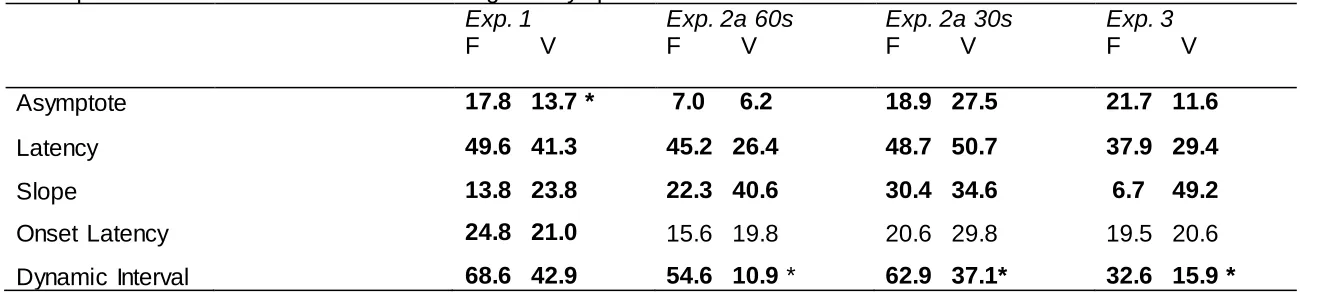
Group F, F(1,31)=4.34 p=.046 MSE=31.3 (see Table 1). Latency was numerically greater in
the fixed group, and slope greater in the variable group, but these values did not differ, Fs<1.
Asymptote was positively correlated with latency, r=.56 p=.001; the relationship between
asymptote and slope was negative but not significant, r=-.33 p=.07; nor were latency and slope
related, r=-.25 p=.18. The mean value of R2 was .65 and .51 for Groups F and V respectively,
F(1,31)=4.24, p=.048 MSE=.04, indicating a better fit for the fixed group.
Table 1 about here
Both the onset latency and the dynamic interval were numerically greater in Group F
(see Table 1), but these values did not differ, Fs<1. The data from the rat with the best fitting
function in each group, and the actual response rates per trial are shown in Figure 1 (panel b).
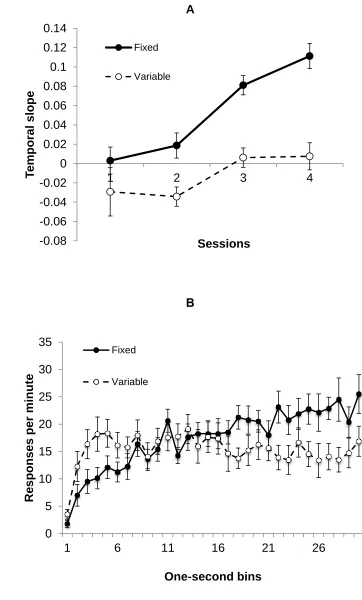
Timing: The temporal slopes are shown in Figure 2 (panel a). It is clear that a marked
difference emerged between the two groups, with the temporal slope for Group F ending
markedly higher than that for Group V. ANOVA revealed significant main effects of group and
session, F(1,30)=28.60 and (3,90)=15.51, ps<.001, and a significant interaction between these
two factors, F(3,90)=2.75 p=.047; Group F had a higher temporal slope than Group V from
session 2, F(1,120)=2.55, 6.85, 13.75 and 26.38, ps=.11 and .01 for sessions 1-2 respectively
and ps<.001 for sessions 3-4. The temporal slopes were greater than zero in Group F on
sessions 3 and 4, p<.001, and less than zero on session 2 in Group V, p=.032 (all after
Bonferroni correction). Panel b of Figure 2 shows the pattern of responding over the course of
the CS in the final training session.
Discussion
The results of Experiment 1 showed higher levels of conditioned responding in Group F
than in Group V, thus providing evidence against a subset of the hybrid-type theories (e.g.
Kirkpatrick & Church, 1998; Kirkpatrick, 2002; see also Machado, 1997). There was, however,
little indication of a difference in the pattern or speed of acquisition of conditioned responding
between the two groups in either experiment; no differences in onset latency or dynamic
interval were obtained. Nor were there any differences in the Weibull function parameters,
apart from asymptote, which was significantly higher in Group F. These results are consistent
with the class of hybrid theories that make predictions about speed of acquisition.
Nonetheless, inconsistent with an information processing perspective was the relationship
between asymptote and latency parameters; the fact that asymptote was not independent of
the latency parameter determining how fast it was attained does not accord with the type of
decision-making process envisaged by many hybrid models (Gallistel et al., 2004; Harris,
2011). This, Gallistel and colleagues argue (Gallistel et al., 2004), is because these two
measures are confounded in learning curves averaged over a number of subjects (because
many subjects starting to respond early with a lower asymptote would produce a similar
function to a few subjects beginning to respond early with a high asymptote).
Our measure of conditioning in these studies was based on the overall response rate, in
line with that routinely used in the associative literature - despite the fact that this measure
necessarily ignores the possibility that the distribution of responding might differ across the
course of the CS. We justify our choice on the basis of precedent and practical considerations.
First, the overall response rate measure is not only used throughout the associative learning
literature, but has also been used in timing studies by those attempting to evaluate the ability
of hybrid models to explain conditioning and timing within the same theoretical framework (e.g.
Kirkpatrick & Church, 1998; Kirkpatrick, 2002; Ward et al., 2012). Second, there is no a priori
strength may be obtained; using the entire CS avoids adopting an arbitrary criterion. Finally,
the most complete account of the principles governing acquisition of associative strength has
been developed in the conditioning literature in which, as noted above, such measures are
commonplace. Thus it seems the natural choice to make contact with the conditioning
literature, and enable theoretically meaningful conclusions to be drawn about levels of
associative strength.
However, before we may draw any firm theoretical conclusions from these results, there
are alternative explanations appealing to differences in performance engendered by the
different schedules employed that must be ruled out. For example, the unpredictability of food
reinforcement on variable trials might have a nonspecific and detrimental effect on
performance in Group V, which could in principle result in lower levels of the CR. Such an
account would predict no difference in responding to fixed and variable cues if both fixed and
variable trials were delivered unpredictably to the same animal in the same session, as any
hypothetical effect on performance produced by variable trials would affect both types of trial
equally. The second experiment aimed to explore this prediction.
Experiment 2
Experiment 2 employed a within-subject design, in which all animals received training
with three cues, one nonreinforced stimulus (C) and two further reinforced cues, one (F) that
was always of the same fixed duration and the other (V) of a variable duration. If the difference
in response rate observed in Experiment 1 were due to a nonspecific effect of the
reinforcement schedule on conditioned responding, then no difference between responding on
fixed and variable trials should be observed here. The experiment was conducted in two parts,
one employing CSs of a mean 30s duration, and the other CSs of a mean 60s duration, which
Method
Subjects and Apparatus:
Subjects were 32 male Lister hooded rats (Charles River UK) with a mean free-feeding weight
of 322g (range: 295-360 g; 60s CS range: 295-360 g; 30s CS range: 295-340 g). The rats
were maintained exactly as in the previous experiment. The apparatus was identical to that of
the previous experiment.
Method
Procedure:
Training: For both sub-experiments there were five sessions of training, each comprising 54
trials, 18 with the clicker, 18 with the noise, and 18 with the tone which served as a
nonreinforced control stimulus; these three trial types were intermixed in a semi-random order,
with the constraint that every successive 18 trials comprised six of each type. Half the animals
trained with each CS duration experienced a fixed duration click and a variable duration noise,
and the remainder the converse arrangement; each presentation of clicker and noise was
followed by the delivery of a food pellet. Half the presentations of the tone were fixed and the
remainder were variable, and tone presentations were always nonreinforced. In one study all
CS presentations were on average 60s in duration, and the ITI comprised a fixed interval of
30s plus a variable interval of 60s; there was also an additional 60-s preCS period. In the other
study all CS presentations were on average 30s in duration, and the ITI comprised a fixed
interval of 30s plus a variable interval of 30s; there was also an additional 30-s preCS period.
The inclusion of a fixed interval in the ITI was to ensure that the preCS period always occurred
some time after delivery of the previous food pellet, so that responding during the preCS would
were identical to those of the previous experiment.
Data analysis:
The data analysis procedure was identical to that of the previous experiment except that the
measure of conditioning during the various kinds of trial was a difference score derived from
the rate of responding during the CS minus the response rate in the corresponding preCS
period.
Results
Conditioned Responding: The group mean (CS-preCS) response rates during the different
types of trial are shown in Figure 3 (panel a). Animals in both CS duration conditions
responded more on reinforced trials than on nonreinforced control trials; there was also more
responding to the 30s than to the 60s CS. More importantly, responding also appeared to be
slightly but consistently higher on F than on V trials. This impression was confirmed by ANOVA
with CS duration (30/60s), trial type (F/V) and sessions as factors, which revealed a significant
main effect of trial type F(1,30)=4.98, p=.03 MSE=14.13; none of the interactions involving trial
type were significant, largest F(4,120)=1.37 p=.25 MSE=4.56. Thus animals responded
significantly more on fixed than on variable trials, and this difference was present at both CS
durations. There was also a significant main effect of CS duration, F(1,30)=20.32 p<.001
MSE=76.43, of session, F(4,120)=64.51 p<.001 MSE=31.59, and a significant interaction
between CS duration and session, F(4,120)=11.66 p<.001 MSE=31.59; simple main effects
indicated that responding was higher in the animals trained with a 30s CS on sessions 3, 4 and
5, smallest F(1,150)=11.45 p<.001 MSE=40.56. The mean rates of preCS responding were
also higher in the 30s condition; the mean rates for the 60s group were 3.6, 40.7, 2.4, 1.3 and
9.2, 5.5, 3.9 and 2.9 rpm. ANOVA revealed a significant interaction between CS duration and
session, F(4,120)=6.49 p<.001 MSE=2.17; simple main effects revealed that the groups
trained at the two CS durations differed on every session, smallest F(1,150)=8.60 p=.004
MSE=3.1.
Figure 3 about here
Acquisition speed: All ANOVAs had trial type (fixed or variable) and CS duration as factors.
The mean asymptote of the fitted functions did not differ between the two trial types, F<1;
however asymptotes were significantly higher in the 30s group, F(1,30)=10.03 p<.004
MSE=442.7; there was no interaction between these two factors, F<1 (see Table 1). Slope was
numerically lower on fixed trials than on variable trials at both CS durations; latency was
numerically higher for fixed trials at the 60s CS, but around the same for the 30s CS ; however
ANOVAs revealed no significant effects or interactions, largest F(1,30)=2.32 p=.14
MSE=1322.3. As in the previous study, there was a positive correlation between asymptote
and latency, r=.54 p<.001; the correlations between asymptote and slope, r=-.21 p=.09, and
between latency and slope, r=-.17 p=.18, were not significant. The mean values of R2 were .49
and .46 respectively for the fixed and variable conditions of the 60s group, and 0.66 and 0.59
for the 30s group. ANOVA revealed only a main effect of CS duration, F(1,30)=6.30 p=.018
MSE=.06, indicating better fit in the 30s group; the effect of trial type and the interaction were
not significant, largest F(1,30)=1.83 p=.19 MSE=.03, indicating comparable fit for the two trial
types regardless of condition.
The onset latencies were similar for fixed and variable CSs, but larger for the 30s CS
(see Table 1); ANOVA with CS duration and trial type as factors revealed a significant main
F(1,29)=3.24 p=.082 MSE=.08. The dynamic interval was, as in Experiment 1, numerically
higher in the fixed condition in both groups, an effect which was statistically significant. ANOVA
with CS duration and trial type as factors revealed a significant main effect of trial type,
F(1,29)=5.98 p=.021 MSE=.33; nothing else was significant, largest F(1,29)=2.42 p=.13
MSE=.48. The data for the rat with the best fitting functions for both trial types, and the actual
response rates per trial for that animal, are shown in panels b and c of Figure 3, for animals
trained with a 60s and 30s CS respectively.
Timing: As Figure 4 (panel a) shows, there appeared to be evidence for the development of
timing in this experiment; at both CS durations temporal slopes for fixed trials increased more
than those for the variable trials. In addition, by the end of training slopes were higher for the
30s CS, which is consistent with the sharper timing function that would be expected for the
shorter duration. These impressions were confirmed by ANOVA with CS duration (30/60), trial
type (F/V) and sessions as factors, which revealed a significant main effect of session,
F(4,120)=8.16 p<.001 MSE=.002. The interactions between CS duration and session, and trial
type and session, were also significant, F(4,120)=6.26 p<.001 MSE=.002 and F(4,120)=2.88
p<.026 MSE=.002 respectively; nothing else was significant, largest F(1,30)=2.33 p=.14
MSE=.003. The temporal slopes were significantly higher in the 30s group than in the 60s
group on session 5, F(1,150)=9.38 p=.003 MSE=.003, on which there was also a significant
effect of trial type, F(1,15)=6.84 p<.01 MSE=.002; the temporal slopes differed from zero for
the fixed 60s CS on sessions 4 and 5, and for the fixed 30s CS on session 5 ps<.002 (after
Bonferroni correction). The distribution of responding over the course of the two types of CS in
the two CS duration conditions during the last training session is shown in panel b of Figure 4.
Discussion
The results of Experiment 2 replicate those of Experiment 1: animals displayed higher
levels of conditioned responding to a cue trained with a fixed duration that to one whose
duration was drawn from an exponential distribution. Moreover, in the present study this
difference was evident in a within-subject procedure. These observations do not support the
view that the difference between conditioning to fixed and variable stimuli observed in
Experiment 1 was due to a nonspecific effect of the different distributions on conditioned
responding. Nonetheless, there is a second, related possibility that could provide an alternative
explanation of these results - namely that it might be more difficult to respond at a high rate on
variable than on fixed duration trials. For example, on some variable trials the CS might be too
short for the animal to arrive at the foodcup before CS offset, while on others it might be so
long that the animals are physically unable to sustain a high rate of conditioned responding3.
Such factors could selectively reduce response rate on variable trials - even without any
difference in underlying learning. This interpretation predicts that if, after training on either a
fixed or a variable CS, the animals were then tested under identical conditions, any difference
in response rate would be eliminated. Experiment 3 addressed this possibility.
In Experiment 2 there was also an indication that the pattern of acquisition of the CR
differed: the dynamic interval was significantly higher for the fixed duration stimulus -
suggesting slower acquisition for the fixed cue. This result is intriguing, as it is the opposite of
what one would expect in terms of the information given by CS onset about the point of US
delivery - which if anything would predict quicker acquisition in the fixed condition. Thus an
important purpose of Experiment 3 was to replicate this finding. Finally, as in the previous
experiment there was a clear positive correlation between the Weibull parameters
3
corresponding to the latency and asymptote of the CR, suggesting that higher asymptotic
levels of CR tend to be accompanied by later emergence of the CR.
Experiment 3
Animals in Experiment 3 received identical training to those in the 60s group of
Experiment 2, with a stimulus F trained with a constant 60s duration, and a further stimulus V
trained with a variable duration with a mean of 60s. Training was then followed by a test in
which F and V were tested under identical conditions: half the presentations of F were fixed
and the remainder variable, and the same was true of V presentations. We anticipated that, as
in the previous two experiments, we would see higher levels of conditioned responding to F
during training. If this were due to an effect on performance, because fixed stimuli are
somehow easier to respond to, then at test the difference in responding to F and V should
disappear, and be replaced by an advantage of responding on fixed duration trials regardless
of whether F or V is being presented. But if the difference in responding to F and V reflects a
difference in learning, it should be maintained at test. The experiment also aimed to replicate
the difference in the dynamic intervals associated with F and V that was observed in
Experiment 2.
Method
Subjects and Apparatus:
Subjects were 16 male Lister hooded rats (Charles River UK) with a mean free-feeding weight
of 308g (range: 290-325 g). The rats were maintained exactly as in the previous experiment.
Procedure:
sessions of training.
Test: Training was followed by the test session, which was identical to the training phase
except that half of the trials in each block with stimulus F were, as before, of a fixed 60s
duration (F - trained fixed and tested fixed), and the remainder variable (with a mean duration
of 60s; Fv - trained fixed and tested variable); likewise, half of the V trials in each block were
presented with variable duration as before (V - trained variable and tested variable) and the
remainder with a fixed 60s duration (Vf - trained variable and tested fixed); in each block there
were three of each of these four trial types in an 18-trial block; one of each type was
nonreinforced. In this way responding to F and V could be compared under identical
conditions.
Data analysis: The data analysis procedure was identical to that in the previous experiment.
Results
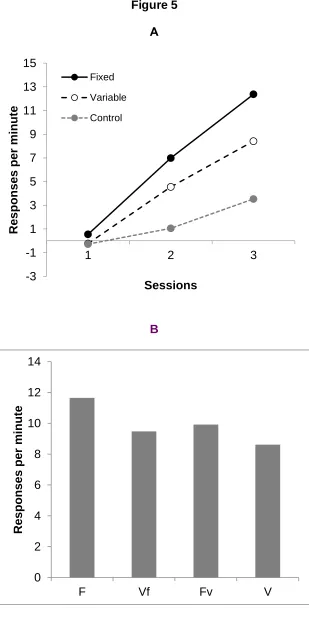
Conditioned Responding: The group mean response rates (CS-preCS) during the different
types of trial are shown in Figure 5 (panel a); higher responding to F than to V was again
clearly evident. ANOVA revealed a significant main effect of trial type F(1,15)=19.12, <.001
MSE=7.18, and also of sessions, F(2,30)=80.07 p<.001 MSE=10.49, as well as a significant
interaction between these two factors, F(2,30)=8.88 p<.001 MSE=2.28; responding was
significantly higher to F than to V on sessions 2 and 3, F(1,15)=6.36 p=.021 and F(1,15)=17.46
p<.001 respectively, MSE=7.18.
Conditioning Test Phase: Figure 5 (panel b) shows responding in the test session; here it may
on trials with stimulus V (V and Vf); in addition there was a clear effect of the mode of
presentation at test - trials with a variable duration at test (V and Fv) commanded lower
response rates than those with a fixed duration (F and Vf). These impressions were confirmed
by ANOVA with training condition (F and Fv versus V and Vf) and testing condition (F and Vf
versus V and Fv); this revealed main effects of both training and testing condition,
F(1,15)=8.09 p=.01 MSE=5.99 and 19.43 p<.001 MSE= 1.38 respectively; there was no
interaction between these two factors, F<1. Thus there was a highly significant effect of the
temporal properties of the CS that were extant during training. In addition the testing
distribution had an independent effect on responding at test, with higher rates of responding on
fixed duration trials. However, it should be noted that the effect of test stimulus distribution on
responding will have been exaggerated over that present under normal training conditions.
This is because before the test the animals had only experienced F presented at the training
duration - so that presenting F with variable durations at test was thus likely to produce a
detrimental effect on performance. For V, in contrast, the animals are unlikely to have noticed
the difference between the training and testing conditions, so far less difference in responding
between training and test would be expected.
Figure 5 about here
Acquisition speed: The mean asymptote of the fitted functions was numerically higher for
stimulus F, but this difference only approached conventional levels of significance,
F(1,15)=4.19 p=.059 MSE=194.34. Latency was again numerically greater on fixed trials, and
slope greater in the variable condition; the latter difference was significant, F(1,15)=1.88 p=.19
MSE=305.92 and F(1,15)=5.58 p=.032 MSE=2590 respectively (see Table 1). As in the
previous studies, asymptote was strongly positively correlated with latency, r=.67 p<.001; the
and r=-.01 p=.83. The mean value of R2 was .82 and .62 for the fixed and variable conditions
respectively, and these values differed, F(1,15)=34.47 p=.<.001 MSE=.009.
The onset latencies were similar in the two conditions, F<1; but, just as in the previous
experiment, the dynamic interval was significantly greater in the fixed condition, F(1,15)=6.40
p=.023 MSE=.293 (see Table 1). The data for the rat with the best fitting functions for both trial
types, and the actual response rates per trial for that animal, are shown in Figure 6 (panel a).
Timing: As Figure 6 (panel b) shows, there was not strong evidence of timing in this
experiment. ANOVA on the temporal slopes revealed no significant effects or interactions,
largest F(1,15)=2.43 p=.14 MSE=.00. The temporal slopes did not differ from zero on any
session, smallest p=.19 (after Bonferroni correction). The distribution of responding over the
course of the two types of CS during the last training session is shown in Figure 6 (panel c).
Figure 6 about here
Discussion
The results of Experiment 3 confirmed the results of the previous experiment: there
were higher levels of conditioned responding during stimulus F, trained with a fixed duration
than during V trained with a variable duration. Moreover, the difference in responding to F and
V was maintained during the test phase when both were both tested under identical conditions.
Although the stimulus being fixed or variable at test had an effect on responding, there was a
clear, independent effect of greater responding to stimulus F that had been conditioned with a
fixed duration - a difference which cannot be explained in terms of differential ease of
One feature of the data from Experiment 3 that deserves mention was that no timing
seemed to be manifest - there was no difference in the distribution of conditioned responding
over the course of the CS, or significant difference in temporal slopes despite strong evidence
of conditioned responding. This observation is consistent with the results of Experiment 2 in
which, for the 30s, CS timing only emerged on session 5 - but does not fit well with the
underlying principle of hybrid theories, that the development of timing essentially underlies that
of conditioned responding. Nonetheless, the true extent of timing could conceivably be
obscured by levels of background responding. For example to the extent that the animals learn
to predict the occurrence of the next trial, responding might gradually increase with time since
the end of the previous trial, even in the absence of CS presentation. As timing differences
were not the core reason for this work we did not examine such possibilities - but simply note
that the timing differences that we did observe could conceivably be obscured by such factors.
There was again evidence of a strong positive correlation between the optimal fit
parameters of the Weibull function corresponding to asymptote and latency, just as in
Experiments 1 and 2. Interestingly, the experiment also confirmed the observation made in
Experiment 2, that the dynamic interval was lower for the variable CS, suggesting faster
acquisition to this stimulus; conversely, there was no difference in onset latency for the two
stimuli. The suggestion that there might be differences in speed of acquisition to fixed and
variable CSs is ostensibly inconsistent with results recently reported by Ward et al. (2012), in
which they examined a similar question in mice. As noted above, they used change point
analysis to determine acquisition speed (e.g. Gallistel, Fairhurst & Balsam, 2004), a technique
which detects the rapid increases in the rate of responding that are said to occur as the CR is
acquired. Using this method they established that the higher the I/T ratio, the earlier the
change point; however, they found no effect of whether the CS was fixed or variable on this
change point measure (Experiments 2 and 3). One possible reason for the apparent
acquisition, and the definition of what constitutes rapid acquisition. Change point analysis is
designed to detect the trial on which an abrupt increase in responding occurs. If acquisition is
abrupt and occurs in a handful of trials, then such a measure will be the only relevant measure
of acquisition, and presumably closely related to onset latency; the dynamic interval is
effectively redundant as acquisition is assumed to be uniformly rapid. But if acquisition is not
uniformly abrupt, but gradual in some animals, then there could be a dissociation between
onset latency or dynamic interval. Thus, if onset latency may be taken as equivalent to the
change point, then our results are perfectly consistent with those reported by Ward et al.
(2012); but if acquisition is not abrupt, then differences in the dynamic interval measure could
still be present - as they appeared to be in our studies. This interpretation would be greatly
strengthened if we could demonstrate that the curve-fitting measure of acquisition used in the
present studies can yield a difference in acquisition corresponding to that reported by Ward et
al. (2012) in animals trained with different I/T ratios. To produce such a demonstration was the
purpose of the final experiment.
Experiment 4
Two groups of animals were conditioned with a single CS of a fixed, 10-s duration; for
Group 60 the ITI was on average of 60s duration, and for Group 480 it was on average 480s in
duration. This ITI manipulation results in greatly differing I/T ratios that should, according to
the results of Ward et al. (2012), produce significantly faster acquisition in the latter group.
The aim was to replicate this effect of I/T ratio with our measure of acquisition speed.
Method
Subjects were 16 male Lister hooded rats (Charles River UK) with a mean free-feeding weight
of 309g (range: 285-330 g). The rats were maintained exactly as in the previous experiment. A
set of eight standard Skinner Boxes (supplied by Campden Instruments Ltd.) was used; these
were fitted with Med Associates food cups and pellet dispensers identical to those used in the
previous experiments. Each box had three walls of sheet aluminum, a transparent plastic door
as the fourth wall, a grid floor and an aluminum ceiling. Each box was housed in a sound- and
light-attenuating shell. The auditory stimulus was a white noise identical to that used in the
previous experiments. The boxes were controlled by a MED Associates operating system
identical to that of the previous experiment.
Procedure
Training: All animals received six sessions of training, each comprising 24 presentations of a
10-s white noise, each of which was followed by delivery of a food pellet. Each CS
presentation was preceded by a 10-s preCS period. In both groups the ITI was of a variable
duration drawn from an exponential distribution. For Group 60 the ITI had a mean of 50s (with
the preCS giving a mean of 60s) and for Group 480 the ITI had a mean of 470s (with the
preCS giving a mean of 480s), yielding I/T ratios of 6 and 48 respectively.
Data analysis: The data analysis procedure was identical to that of the previous experiment.
Results
Conditioned responding: The course of conditioning can be seen in Figure 7 (panel a); it is
clear that there was a substantial effect of ITI on conditioning, with faster acquisition of the CR
F(5,70)=8.87 p<.001; the groups differed on sessions 2, 3, 4 and 5, smallest F(1,84)=15.08
p<.001; by the last session, however, the groups were responding at similar rates, F<1. The
mean rates of preCS responding were 3.9, 2.3, 1.2, 0.4, 0.1 and 0.4 rpm for sessions 1-6
respectively in Group 480, and 7.5, 11.4, 11.2, 6.6, 4.5 and 3.1 for Group 60. Again ANOVA
revealed a significant interaction between these two factors, F(5,70)=9.15 p<.001, and the
groups differed on every session, smallest F(1,84)=6.78 p=.01 for session 6. Nonetheless,
although it is likely to have had an influence, it is unlikely that this modest difference in preCS
response rate could wholly account for the substantial difference between the two groups in
their difference scores (which exceeded 20 rpm on the second session).
Figure 7 about here
Acquisition speed: The mean asymptote of the fitted functions did not differ between the two
groups, being 21.1 for Group 480 and 24.2 for Group 60, F<1. Latency was 78.1 for Group 60
and 31.2 for Group 480, and these values differed, F(1,15)=35.03 p<.01 MSE=251.81; slope
was numerically higher for Group 60, the means being 54.5 and 6.2 for Groups 60 and 480
respectively, but these values did not quite differ significantly, F(1,15)=4.48 p=.053
MSE=2083.89. As in the previous studies, asymptote was strongly positively correlated with
latency, r=.67 p<.006; in this experiment it was also negatively correlated with slope, r=-.551
p=.033; finally latency and slope were negatively correlated, r=-.637 p<.011 The mean values
of R2 were .71 and .70 for Groups 60 and 480 respectively, F<1, indicating comparable fit in
the two groups.
The onset latency was 62.3 in Group 60 and 16.3 in Group 480, and these values
differed significantly, F(1,15)=191.24 p<.001 MSE=.007; however the dynamic interval was
very similar in the two groups, at 24.5 and 25.5 for Groups 60 and 480 respectively, and these
the actual response rates per trial for that animal, are shown in Figure 7 (panel b).
Discussion
Animals in Group 480 were trained with a longer ITI than those in Group 60, and
required fewer trials to reach 10% of asymptotic responding, suggesting faster acquisition in
the former group. Thus, if this onset latency measure may be regarded as equivalent to the
change point, the results of this experiment confirm the findings of Ward et al. (2012) using an
alternative means of measuring acquisition. However, in terms of dynamic interval, no
difference was observed between the two groups. These findings may resolve the apparent
inconsistency between the results reported by Ward et al. (2012) and those from our
experiments, as they suggest that the two measures of acquisition may be dissociable. We
found that differences in ITI produced significant effects on onset latency, but no effect on the
dynamic interval, while differences in the temporal distribution of the CS produced the opposite
pattern.
Figure 8 about here
General Discussion
In each of Experiments 1-3 there was evidence that the rate of conditioned responding
was higher to CSs trained with a fixed duration than to those whose duration varied from trial
to trial. Furthermore, these effects were demonstrated in both between and within-subjects
procedures, and were maintained when animals were tested under identical conditions. These
observations suggest that the higher responding on fixed trials reflects a true difference in
performance. Such a difference in the level of conditioned responding to these two types of
stimulus is not consistent with those hybrid or decision theories that make predictions about
rates of conditioned responding (e.g. Gibbon & Balsam, 1981; Kirkpatrick & Church, 1998;
Kirkpatrick, 2002; see also Machado, 1997). As outlined in the introduction, although some
studies had previously examined differences in learning about fixed and variable duration CSs,
their results were generally inconsistent. Nonetheless, some of these studies showed higher
asymptotic rates to fixed duration stimuli (Jennings et al, 2006; 2011; Kirkpatrick & Church,
1998; but see Kamin, 1960); the present results confirm these findings, while at the same time
ruling out several potentially artefactual explanations.
For example, one could argue that if higher responding on fixed duration trials were an
unconditioned effect on performance, and increased the likelihood that the US was collected
promptly at the end of the stimulus, then this could indirectly boost the level of conditioning to
the fixed duration CS. Although there was no sign of such a difference in responding at the
start of training in any of the experiments, as such an account would predict, we examined the
latency between the end of the CS and the first response as a function of CS type. In none of
the experiments was there evidence that the animals collected pellets more quickly at the end
of the fixed CS; in fact the difference in latency to respond after fixed and variable duration
CSs was not significant in any of the experiments (Fs<1) - although in Experiment 1 there was
a tendency for animals to be slower to respond after the offset of the fixed duration CS which
approached statistical significance, F(1,30)=4.12 p=.051 (the mean latencies being 9.6s and
6.6s for Groups F and V respectively) - the opposite of what such an alternative account would
need to assume. We, therefore, found no evidence that our results are a by-product of an
unconditioned effect of stimulus distribution on performance.
But although finding a difference in conditioned responding to fixed and variable
duration stimuli is inconsistent with some hybrid theories, many others make predictions not
acquired (e.g. RET; Gallistel & Gibbon, 2000; Balsam & Gallistel, 2009). Our data are not
consistent with this class of model either, as in Experiments 2 and 3 we found a significantly
shorter dynamic interval for variable than for fixed trials. (It has been argued that within-subject
procedures are more sensitive for detecting acquisition differences (cf. Gottlieb & Rescorla,
2010), which may explain why we did not observe the same effect in our between-subject
Experiment 1). As noted above, the majority of hybrid theories do not predict a difference in
speed of acquisition for fixed and variable CSs; the only potential exception is the recent model
of Balsam and Gallistel (2009), where it is argued that informativeness forms the basis of
acquisition of the CR. Given the additional assumption that the extra information given by a
fixed duration CS can contribute to the speed of CS acquisition, then it is in the spirit of their
model to predict a difference (cf. Ward et al., 2012) - but the opposite to that reported here.
At face value these effects contradict the results reported by Ward et al. (2012), who
found no difference in acquisition speed between fixed and variable duration CSs, although a
substantial difference when I/T ratio was manipulated. We argued that the root of this apparent
discrepancy might lie in the indices used to measure acquisition - we used dynamic interval,
whereas Ward et al., used change point, which we argued was equivalent to our onset latency
measure. We suggested that if acquisition is abrupt, then dynamic interval will be minimal, and
onset latency the primary measure of acquisition speed - but if acquisition is gradual, then
dynamic interval could be considered an additional and independent measure of acquisition
speed. Consistent with this analysis, in Experiment 4 we demonstrated that I/T ratio had a
profound effect on onset latency, but none on dynamic interval - the opposite effect to that
seen in the preceding experiments.
This argument relies on the assumption that acquisition is gradual - which is contrary to
what is supposed by many information processing models incorporating a decision process
(e.g., Church & Broadbent, 1990; Gallistel & Gibbon 2000; Gallistel, Fairhurst & Balsam 2004).
artefact - the ability of individual animals to determine reinforcement rate varies, and so
responding starts on different trials (Gallistel et al., 2004 Figure 2), and pooling over subjects
will yield an apparently gradual increase in the CR. In contrast, associative models employ an
error correction term to describe learning, such that conditioned responding is proportional to
the difference between the maximum associative strength that a US will support, and any
strength that has been acquired to that point. Thus acquisition of the CR will be gradual within
an individual, occurring most rapidly at the start of training and at a negatively accelerating rate
thereafter, as the difference between the current associative strength and the asymptote
declines (e.g. Hull 1943; Rescorla & Wagner 1972). Moreover, although these models are
constrained to predict that learning is gradual, the expression of learning can depend on other
factors that lie outside the scope of the theory. Thus, despite the rules governing the way in
which associative strength is translated into performance not being specified, these models
could accommodate the variability in acquisition speed that was actually observed. Finally
Harris (2011), using a simulated dataset, has shown that an abrupt increase in responding
could be generated by an underlying sensitivity in the data to random variation in responding,
and therefore that an abrupt pattern of responding is possible even when there is in fact an
incremental increase in learning.
Recent attempts to explore whether acquisition is abrupt or not have been inconclusive,
some reporting abrupt acquisition, more consistent with decision-type models (Gallistel et al.,
2004; Morris & Bouton 2006) and others gradual learning, consistent with associative accounts
of acquisition (e.g. Kehoe, Ludvig, Dudeney, Neufield & Sutton 2008; Harris, 2011). To
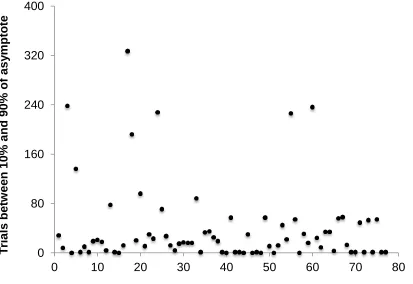
establish the abruptness of acquisition in the present experiments we examined responding by
subjects from all four experiments, only considering the data from fixed CSs for consistency
with other studies. In addition, in order to avoid the possibility that the smoothing technique
used in our acquisition measures might mask a tendency to abrupt acquisition, no smoothing