City, University of London Institutional Repository
Citation
: de Rooij, A. and Jones, S. (2013). Motor expressions as creativity support:
Exploring the potential for physical interaction. Paper presented at the 27th International
BCS Human Computer Interaction Conference (HCI 2013), 9 - 13 September 2013, Brunel
University, London.
This is the unspecified version of the paper.
This version of the publication may differ from the final published
version.
Permanent repository link:
http://openaccess.city.ac.uk/2945/
Link to published version
:
Copyright and reuse:
City Research Online aims to make research
outputs of City, University of London available to a wider audience.
Copyright and Moral Rights remain with the author(s) and/or copyright
holders. URLs from City Research Online may be freely distributed and
linked to.
City Research Online:
http://openaccess.city.ac.uk/
[email protected]
© The Authors. Published by BCS
1
Motor Expressions as Creativity Support:
Exploring the Potential for Physical Interaction
Alwin de Rooij and Sara Jones Centre for Creativity in Professional Practice
City University London
Northampton Square, London EC1V 0HB, UK
This research explores the effects of physical interactions designed on the basis of motor expressions to support creative ideation in creativity support technologies. The presented research looks into the effects on creative ideation of incompatibility between motor expressions and problem situations, and appraisals of (un)pleasantness. We report the results of a preliminary study which suggests that affective incompatibility between a problem situation and a motor expression benefits creative ideation, and that pleasantness motor expressions enhance task enjoyment, which in turn leads to a beneficial effect on the originality of ideas generated. Based on these results, we conclude with two new directions for the design of physical interactions with novel creativity support technologies.
Affective Computing, Cognitive Appraisal Theory, Creativity Support, Ideation, Embodied Interaction
1. INTRODUCTION
Affect is known to exert a strong influence on creative performance (Baas et al. 2008). This provides an opportunity for the development of interactive technologies that support creativity using affect as a mediator. However, to utilize this link between affect and creativity, we need to develop an interactive technology that can influence affect. We argue that this technology can be developed from the use of motor expressions to design physical interactions for creativity support technologies. It is this opportunity that will be explored in this paper.
Motor expressions are the physical actions that are elicited by an affective process, such as facial expressions, postures, and gestures (Ellgring &
Scherer 2007a, 2007b). Performing motor
expressions has been shown to influence affect (Price et al. 2012). This could in turn influence creative performance (cf. Friedman & Förster 2002). Interactive technologies increasingly rely on physical interactions, such as gestures and postures, as a direct and natural way to facilitate interaction between man and machine (cf. Isbister 2011). Considering these two observations, motor expressions are an interesting option for the design of physical interactions for novel affective creativity support technologies.
We envision that the integration of motor expressions into physical interactions can offer HCI
designers novel tools to develop technologies that can exert an influence on creative performance. For instance, creativity enhancing gestures could be used as a means to record ideas during an idea generation session. This would then benefit creative performance during that idea generation session.
However, before we can move towards such applications it is important to investigate how motor expressions influence creative performance. We have identified two relevant lines of research from the psychological sciences, which link creative performance to the incompatibility between a motor expression and the affective nature of a situation, and to the effects of specific appraisals related to
pleasantness. The work reported here
experimentally explores these two lines of research with a focus on creative ideation.
Motor Expression as Creativity Support Alwin de Rooij ● Sara Jones
2 2. MOTOR EXPRESSIONS AND AFFECT
We smile when we are happy, and slump our posture when we are sad. Cognitive appraisal processes, i.e. the processes from which emotions emerge, often elicit motor expressions (Ellgring &
Scherer 2007a, 2007b). However, motor
[image:3.595.52.279.241.334.2]expressions themselves provide a context in which new events can be interpreted (for reviews, see Price et al. 2012, Reimann e al. 2012). In other words, motor expressions influence how events are interpreted by eliciting a tendency to appraise events in the same way as the appraisal that elicited (or typically elicits) that motor expression.
Figure 1: A. Affective coherence, the expressions elicited by an appraisal also help elicit that appraisal. B.
Affective incoherence, motor expressions incompatible with the appraisal do not do this.
This reciprocal relationship implies that motor expressions help stabilize an appraisal tendency over time by providing positive feedback to the appraisal that elicited that motor expression (figure 1A). For example, smiling occurs when something pleasant happens, but smiling in turn also positively influences the way we appraise other events. This helps to sustain a pleasant outlook on subsequent events. There is also some empirical evidence to support this. Neumann and Strack (2000) found that pulling a lever towards you increases the speed with which people evaluate positive information, and pushing a lever away from you
increases evaluation speed for negative
information. However, where there is
incompatibility, for example, if you push a lever away from you while evaluating positive information, the speed at which you can evaluate that information is reduced. Centerbar et al. (2008) evidenced that the compatibility, as opposed to the incompatibility, between the affective nature of a story and posed motor expressions (including smiling, frowning, arm flexion and arm extension) benefits recall from short-term memory for affectively congruent information present in that story. Soussignan (2002) found that when people produce a smile while looking at pleasant scenes or funny cartoons, they rate the scenes and cartoons as more pleasant and funnier than when they keep their lips pressed down. The motor expressions in these exemplary works are all typically elicited by appraising an event as pleasant (cf. Ellgring & Scherer 2007a, 2007b) and the evidence provided
by these studies shows how motor expressions bias processing towards congruent information. If stabilization occurs and sustains, this is what we typically call affect, and when multiple appraisals stabilize in response to an event, this is what we typically call an emotion (Lewis 1996).
3. MOTOR EXPRESSIONS AND CREATIVITY
Affect has been linked to creative performance in diverse ways (Baas et al. 2008). However, little research is available on the relationship between motor expressions and creativity, as mediated by affect. We have identified two potential lines of research that can help explain this relationship concerning: 1) affective incompatibility, and 2) affective compatibility for specific creativity-relevant appraisals, such as pleasantness.
3.1 Affective incompatibility
If a motor expression is incompatible with an appraisal process, e.g. when we are made to frown while we appraise an event as pleasant, this breaks the positive feedback loop and overall tendency to appraise new events in a congruent way (Figure 1B). This limits the speed with which affective information is processed (Neumann & Strack 2000), and impairs memory recall for affective events (Centerbar et al. 2008). However, this also removes the bias towards an appraisal that is needed to stabilize a particular appraisal (cf. figure 1A), which essentially broadens people’s thought processes (cf. figure 1B). In line with this assumption, Huang and Galinsky (2011) found that incompatibility between motor expressions and a variety of affective concepts increase the unusualness of associations in a categorization task. We suspect that this may benefit performance on creative ideation, which typically benefits from the generation of many, and diverse ideas (Isaksen et al. 2011). This leads to our first hypothesis.
Hypothesis 1: Incompatibility between a motor expression and the affective nature of a creative situation benefits performance on creative ideation.
3.2 Pleasantness expressions
creative ideation (Baas et al. 2008). These processes are often subsumed under the general appraisal of pleasantness (cf. Scherer 2009). Tendencies to appraise events as pleasant are associated with a more extensive memory search with the adaptive goal to incorporate information. These effects are known to carry over into increased creativity (Fernández-Abascal & Martín Diaz 2013) through increased originality (Friedman & Förster 2002), and under specific embodied conditions into increased cognitive flexibility (Price & Harmon-Jones 2010), the latter two being classic indicators of performance in creative ideation (Guilford 1967). This leads to our second hypothesis.
Hypothesis 2: Motor expressions associated with appraisals of pleasantness benefit performance on creative ideation.
4. EXPERIMENTAL STUDY OF MOTOR EXPRESSIONS AND CREATIVITY
To test the two hypotheses above, we conducted a small experiment. We used a 2 (motor expression: pleasant vs. unpleasant) × 2 (problem situation: pleasant vs. unpleasant) between subjects full factorial design. Dependent variables were fluency, flexibility, and originality as indicators of creative ideation (Guilford 1967), task enjoyment (Akhbari Chermahini & Hommel 2011) and activation (Baas et al. 2008) as potential affective mediators of creative performance, expression effort as a potential external source of variation (cf. Friedman & Förster 2002), and a check for the (un)pleasantness associated with the given problem situations. The experimenter was blind to the conditions.
4.1 Participants
A total of 32 participants (18 females, 14 males) responded to an advertisement offering a bar of chocolate and an interesting learning experience in exchange of 20 minutes of their time. Participants’ ages ranged from 23 to 51 with a mean of 32, and a standard deviation of 7.2; the majority of participants were students and employees of [removed for anonymity]. Participants were randomly assigned to the conditions. Two participants were excluded from the sample for failing to execute the experiment’s instructions.
4.2 Procedure
On arrival, participants were seated, handed an overview of the experiment’s procedure, and subsequently signed informed consent. Instructions were given for poses that were characteristic of motor expression responses to unpleasant or pleasant events. Unpleasantness was expressed by lowered eye brows, arm extension, and a
slightly shrunken and tense posture, and pleasantness was expressed by smiling, arm flexion, and a relaxed and open posture. Participants were asked to keep this pose throughout the experiment. Expressions were modelled after the findings by Ellgring & Scherer (2007a, 2007b) and Friedman & Förster (2002).
Next, participants were handed instructions for an idea generation session. Participants were asked to imagine themselves in an (un)pleasant problem situation. They were either asked to imagine themselves in a situation where they encountered someone they found attractive, and their goal was to attract that person, or in a situation where they encountered someone they found repulsive, and their goal was to get rid to that person. After the imagination procedure, participants were asked to come up with, and write down, as many ideas as they could in response to the given problem situation within 5 minutes (timed).
Directly following the idea generation session the
participants were handed a survey. The
(un)pleasantness of the problem situation was rated on a scale of 1, very unpleasant, to 8, very pleasant (“How (un)pleasant do you find the imagined problem situation?”). The effort required to pose the instructed motor expressions was rated on a scale of 1, no effort, to 8, very effortful (“How effortful was it for you to keep your body in the instructed pose?”). Task enjoyment was rated from 1, very unpleasant, to 8, very pleasant (“Did you
experience the idea generation task as
(un)pleasant?”). Activation level was rated from 1, tired, to 8, lively (“How do you feel right now?”). Following completion of this survey, participants were debriefed and sent on their way.
4.3 Indicators of creative performance
We used three classic indicators of performance on creative ideation tasks, i.e., fluency, flexibility, and originality. Fluency was assessed by counting the amount of non-redundant ideas generated by an individual participant (in some cases duplicates were removed). Flexibility was assessed by counting the different semantic categories used by each participant. Originality was assessed by counting the amount of ideas generated by an individual participant that were unique in relation to the sample as a whole (after Guilford 1967).
5. EXPERIMENTAL STUDY RESULTS
Motor Expression as Creativity Support Alwin de Rooij ● Sara Jones
4
relationship. Indicators of creative performance did not correlate with activation.
In our setup we assumed that the problem situations people were asked to imagine themselves in would be seen as pleasant or unpleasant. A t-test confirmed this assumption, with the unpleasant situation rated less pleasant (M = 3.5, SD = 1.65) than the pleasant problem situation (M = 5.5, SD = 2.00), t(28) = 3.00, p = 0.006. We also suspected that the two expressions differ in effort, e.g. unpleasantness expressions require a slight increase muscle tension, whereas the pleasantness expression requires taking a comfortable posture. This was confirmed in a t-test, with posing pleasantness expressions (M = 4.06, SD = 1.57) being less effortful than unpleasantness expressions (M = 5.57, SD = 0.76), t(28) = -3.28, p = 0.003. To account for this additional source of variation we included expression effort ratings as a statistical covariant in further analysis.
5.1 Affective incompatibility
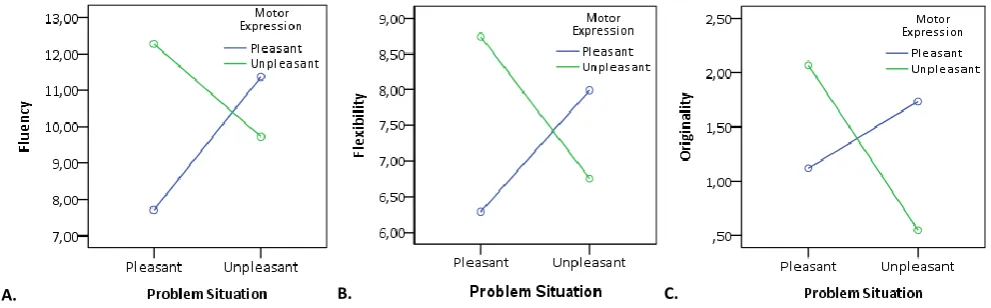
We submitted the fluency, flexibility, and originality scores individually to a 2 (motor expression) × 2 (problem situation) ANCOVA. The results show a significant motor expression × problem situation interaction effect for fluency (F(1, 25) = 7.60, p = 0.011, ƞp
2
= 0.23) and originality (F(1, 24) = 7.08, p = 0.014, ƞp
2
= 0.23). For flexibility the effect was not significant (F(1, 25) = 4.01, p = 0.056, ƞp
2
= 0.14) but was large. The interaction effect shows higher means for all indicators of creative performance for
experimental conditions where the affective nature of the posed motor expression response was incompatible with the affective nature of the problem situation (figure 1). This supports hypothesis 1.
As expected, the problem situation itself did not significantly impact fluency (F(1, 25) = 0.23, p = 0.635, ƞp
2
= 0.01), flexibility (Fluency (F(1, 25) = 0.02, p = 0.882, ƞp
2
= 0.00), or originality (Fluency (F(1, 24) = 1.19, p = 0.286, ƞp
2
= 0.05). More unexpectedly, motor expression did not directly account for any of the variables indicative of creative performance, fluency (F(1, 25) = 1.23, p = 0.277, ƞp
2
= 0.05), flexibility (F(1, 25) = 0.32, p = 0.576, ƞp
2
= 0.01), and originality (F(1, 24) = 0.61,
p = 0.807, ƞp
2
= 0.00). The latter does not support hypothesis 2 as a main effect.
5.2 Pleasantness expressions: Mediation of task enjoyment
The descriptive statistics do show a correlation between task enjoyment and originality, and activation and task enjoyment (table 1). This may point towards a more complex relationship between affective processes, motor expression, and creative ideation.
We submitted ratings of task enjoyment and activation level individually to a 2 (motor expression) × 2 (problem situation) ANCOVA. Motor expressions influenced activation level, with unpleasantness expressions (M = 4.29, SD = 1.14) resulting in more self-reported activation than
[image:5.595.49.544.99.202.2]A. B. C.
[image:5.595.50.546.605.759.2]Figure 1: Marginal means for motor expression × problem situation on A) Fluency, B) Flexibility, and C) Originality Table 1: Descriptive statistics of creativity related dependent variables including means, standard deviations, and Pearson
correlations. * p < 0.05, ** p < 0.01
Mean SD 1 2 3 4 5
1 Originality 1.38 1.15 —
2 Flexibility 7.37 2.51 .632** —
3 Fluency 10.10 3.56 .531** .714** —
4 Enjoyment 4.90 1.60 .418* .360 .177 —
pleasantness expressions (M = 3.06, SD = 1.00),
F(1, 27) = 7.39, p = 0.011, ƞp2 = 0.22. Motor
expressions influenced task enjoyment, with pleasantness expressions (M = 5.44, SD = 1.63)
resulting in more task enjoyment than
unpleasantness expressions (M = 4.29, SD = 1.38),
F(1, 25) = 4.34, p = 0.048, ƞp
2
= 0.15.
To see whether task enjoyment mediated an effect of pleasantness motor expressions on originality, we did a multiple linear regression analysis on originality, with motor expression × problem situation recoded as one variable reflecting (in)compatibility, activation level, and task enjoyment as predictors. The results were fed into a Sobel test to find out whether there was a significant mediation effect. The results show a significant contribution of both affective incompatibility (β = 0.39, t(28) = 2.41, p = 0.024) and task enjoyment (β = 0.55, t(28) = 3.27, p = 0.003) to originality. No significant contribution was found for activation level (β = 0.27, t(28) = 1.50, p = 0.146). The test showed that mediation of task enjoyment of motor expressions’ effects on originality is significant (Z = -1.77, p = 0.037). This supports hypothesis 2.
6. DISCUSSION AND FUTURE WORK
6.1 Motor expressions and creative ideation
These results show, for the first time, preliminary evidence that introducing an incompatibility between motor expressions and appraisals of the pleasantness of a problem situation can enhance performance in idea generation. This builds on the work by Huang & Galinsky (2011). The results also show that motor expressions that typically result from a response to something pleasant can help improve originality during creative ideation. This essentially reproduces the results from Friedman & Förster (2002) in a context of varying affective problem situations.
The results also imply that the relationship between motor expressions and creative performance is complex, which highlights an important challenge for the development of motor expressions as creativity support. This is marked by the mediation of task enjoyment for the effects of pleasantness expressions on originality. This mediation cannot be explained in terms of the coherence between a pleasantness expression and a pleasant problem situation. Instead, this mediation was found in both pleasant and unpleasant problem situations. Pleasantness is typically elicited by appraising an event as intrinsically pleasant, or congruent with one’s goals. The generation of an idea brings one a step closer to the goals of ideation, i.e., generating many and diverse ideas. Therefore, creative ideation itself typically elicits pleasantness, as long as it is not obstructed in any way (Akhbari
Chermahini & Hommel 2011). This introduces compatibility between the affective nature of creative ideation itself and the pleasantness motor expression.
6.2 Directions for the design of physical interactions to support creative ideation
The results point towards two new directions for the design of physical interactions with novel affective creativity support technologies.
If we want to benefit performance in creative ideation through affective incompatibility of motor expressions and problem situations, we can either adapt the physical interaction according to the affective nature of the problem situation, or attempt to influence the interpretation of the problem situation to oppose the physical interaction. The first is problematic from a usability perspective because it would lead to inconsistency in interaction. The second requires an additional system that targets the cognitive process of appraisal directly. For instance, systems that offer a representation of a creative activity that is accessible to the user can be adapted to emphasize the aspects of an activity that match the appraisal process that is targeted. If we want to emphasize pleasantness in this representation, there must be an emphasis on those aspects of the activity that are congruent to the goals set by the creative activity.
A perhaps more immediately promising route to use motor expressions as creativity support is implied by the finding that the process of creative ideation itself is likely to be compatible with pleasantness expressions. This helps stabilize the appraisal processes associated with pleasantness, which is shown to support the originality of responses during creative ideation. Furthermore, we have seen that this result holds under varying conditions of different problem situations. The focus on one set of motor expressions can be used to design physical interactions that are consistent, which benefits usability.
Motor Expression as Creativity Support Alwin de Rooij ● Sara Jones
6 8. REFERENCES
Akbari Chermahini, S. and Hommel, B. (2011)
Creative mood swings: Divergent and
convergent thinking affect mood in opposite ways. Psychological Research, 76(5), 634-640.
Baas, M., De Dreu, C.K.W., and Nijstad, B.A. (2008) A meta-analysis of 25 years of mood-creativity research: Hedonic tone, activation, or regulatory focus?. Psychological Bulletin, 134(6), 779-806.
Centerbar, D.B., Clore, G.L., Schnall, S., and Garvin, E. (2008) Affective incoherence: When affective concepts and embodied reactions clash. Journal of Personality and Social Psychology, 94, 560-578.
De Rooij, A. and Jones, S. (2013) Mood and creativity: An appraisal tendency perspective. 9th ACM Conference on Creativity and Cognition, Sydney, Australia, 17-20 June 2013. ACM, New York, NY, USA.
Ellgring, H. and Scherer, K.R. (2007a) Are facial expressions of emotion produced by categorical affect programs or dynamically driven by appraisal?. Emotion. 7(1), 113-130.
Ellgring, H. and Scherer, K.R. (2007b) Multimodal expression of emotion: Affect programs or componential appraisal patterns?. Emotion. 7(1), 158-171.
Fernández-Abascal, E.G. and Martín Diaz, M.D. (2013) Affective induction and creative thinking. Creativity Research Journal, 25(2), 213-221.
Friedman, R.S. and Förster, J. (2002) The influence of approach and avoidance motor actions on creative cognition. Journal of Experimental Social Psychology, 38, 41-55.
Guilford, J.P. (1967) The nature of human intelligence. McGraw-Hill, New York, NY, USA.
Huang, L. and Galinsky, A.D. (2011) Mind-body dissonance: Conflict between the senses
expands the mind’s horizons. Social
Psychological and Personality Science, 2(4), 351-359.
Isaksen, S.G., Dorval, K.B., Treffinger, D.J. (2011) Creative approaches to problem solving: A framework for innovation and change. Sage Publications Inc, Thousand Oaks, CA, USA.
Isbister, K. (2011) Emotion and motion: games as inspiration for shaping the future of interface. Interactions, 18(5), 24-27.
Lewis, M.D. (1996) Self-organising cognitive appraisals. Cognition & Emotion, 10(1), 1-26.
Neumann, R. and Strack, F. (2000) Approach and avoidance: The influence of proprioceptive and exteroceptive cues on oncoding of affective
information. Journal of Personality and Social Psychology, 79, 39-48.
Price, T.F. and Harmon-Jones, E. (2010) The effect of embodied emotive states on cognitive categorization. Emotion, 10(6), 934-938.
Price, T.F., Peterson, C.K., and Harmon-Jones, E.
(2012) The emotive neuroscience of
embodiment. Motivation and Emotion, 36, 27-37.
Reimann, M. et al. (2012) Embodiment in judgment
and choice. Journal of Neuroscience,
Psychology, and Economics, 5(2), 104-123.
Scherer, K.R. (2009) The dynamic architecture of emotion: Evidence for the component process model. Cognition & Emotion, 23(7), 1307-1351.