City, University of London Institutional Repository
Citation
: Kotlarsky, J., Scarbrough, H. and Oshri, I. (2014). Coordinating Expertise Across
Knowledge Boundaries in Offshore-Outsourcing Projects: The Role of Codification. MIS
Quarterly, 38(2), pp. 607-627.
This is the published version of the paper.
This version of the publication may differ from the final published
version.
Permanent repository link:
http://openaccess.city.ac.uk/4375/
Link to published version
:
Copyright and reuse:
City Research Online aims to make research
outputs of City, University of London available to a wider audience.
Copyright and Moral Rights remain with the author(s) and/or copyright
holders. URLs from City Research Online may be freely distributed and
linked to.
City Research Online:
http://openaccess.city.ac.uk/
[email protected]
C
OORDINATING
E
XPERTISE
A
CROSS
K
NOWLEDGE
B
OUNDARIES IN
O
FFSHORE
-O
UTSOURCING
P
ROJECTS
:
T
HE
R
OLE OF
C
ODIFICATION
Julia Kotlarsky
Aston Business School, Aston University, Aston Triangle, Birmingham, B4 7ET, UNITED KINGDOM {[email protected]}
Harry Scarbrough
Keele Management School, Keele University,
Staffordshire, ST5 5BG, UNITED KINGDOM {[email protected]}
Ilan Oshri
Centre for Global Sourcing and Services, Loughborough School of Business and Economics, Loughborugh, Leicestershire, LE22 3TU, UNITED KINGDOM {[email protected]}
Appendix A
Interview Participants
Amsterdam: Interviewees
Mumbai: Interviewees
ABN AMRO executives and managers Global level TCS executives
Managing Director, Group Shared Services IT VS and Global Head – Banking Practice Global Head of IT Strategy & Architecture Head of Global Learning & Development (L&D)
Executive Director, Global ADM Transition Manager Head of Global Continuous Learning Program (part of Global L&D) European level TCS executives Global level TCS – ABN AMRO relationship
CEO Europe/Steering Committee for ABN AMRO Global Business Relationship Head TCS-ABN AMRO Relationship HR Head Benelux Global Delivery Head
Onsite team members Global Head Operations for ABN AMRO Relationship
Business Relationship Manager Global Head of Infrastructure and Security for ABN AMRO Relationship Transition Head Offshore team members
Program Manager/onsite Delivery Manager Two Program Managers/Offshore Delivery Managers Program Manager/offshore Delivery Manager (visiting
onsite team)
Offshore Quality Leader
Quality Leader Four Portfolio managers Cross-functional manager/interactions with vendors for
ABN AMRO
Five Project Leaders
Kotlarsky et al./Coordinating Expertise Across Knowledge Boundaries
Amsterdam: Interviewees
Mumbai: Interviewees
Two Project Leaders Support functions
Module Leader Member of Global Program Management Office on ABN AMRO Relationship Two team members HR Assistant Manager Mumbai GDC
Relationship Portal Manager Two members of Quality team Member of Corporate Program Office
Head CoE of India West geography & Oracle E-Business Suite & member of Technology Change Management Group
Member of CoE of India West geography & member of Technology Change Management group
Appendix B
Interview Protocol Provided to TCS Staff
1The interviews will revolve around knowledge and expertise management processes related to the TCS – ABN AMRO relationship, as well
as to generic knowledge management processes and activities at TCS organization-wise. We will focus on the following topics in our
interviews:
ABN AMRO – TCS-Specific Questions
1.
Describe the organization structure involved in the work that TCS does with ABN AMRO.
2.
How is the work divided between onsite and offshore locations?
3.
How does TCS manage the knowledge involved in the system development and maintenance between onsite and offshore locations?
4.
What are the advantages and disadvantages in managing knowledge in such a manner?
5.
What kind of IT-infrastructure is needed to ensure knowledge management across the onsite and offshore location?
More generic questions, related to the ABN AMRO – TCS contract and beyond (TCS organization-wide):
6.
Please describe the knowledge that client and supplier bring to bear for optimizing performance, and the people, processes, structure,
work-based mechanisms and technology that enable this.
7.
How is knowledge managed across various outsourcing relationships arrangements and with what outcomes?
8.
Describe the unanticipated knowledge problems that arise and how these are resolved.
9.
Describe the innovative and effective knowledge approaches and practices.
1This initial interview protocol was adjusted to target specific aspects of expertise coordination as we have learned more about the offshore-outsourcing project.
Appendix C
Data Analysis Approach
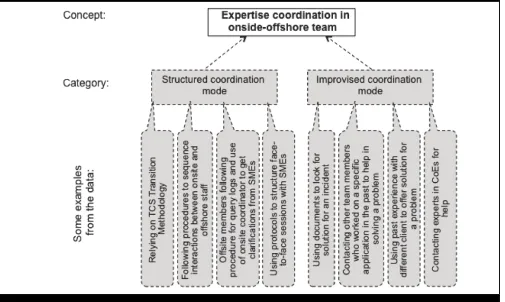
Figures C1 and C2 provide rich description of the concepts of codification and expertise coordination in the onsite-offshore team. They include
categories and subcategories, some of which were predefined, based on the literature (thus following a deductive approach) and those that
emerged from the data (following an inductive approach to associate codes with a particular category, subcategory, and concept). We also
include a table that presents evidence in support of the two expertise coordination modes. (Detailed evidence of codification, supported by
quotes is included in the “Findings and Analysis” section of the article).
Kotlarsky et al./Coordinating Expertise Across Knowledge Boundaries
Figure C2. Expertise Coordination in Onsite–Offshore Team
Table C1. Evidence of Expertise Coordination Modes (exemplary quotes)
Structured Coordination
Improvised Coordination
We have a global relationship, people for an ABN AMRO
account, so who cater to both in the Netherlands, Brazil, and
private clients in other geographies. Similarly, ABN AMRO
also has got a global body that actually makes sure that
everywhere common methodologies are used, and all those
things. So when we use our transition methodology for the
Netherlands, we’d use our transition methodology for Brazil
.
(Sukanya, onsite Delivery Manager)
Sometimes we need to look for other ways to get on with
Transition. Not everything can be done by the book, in
particular when we are dealing with incidents that need to
be resolved very quickly.
(Ajit, Business Relationship
Manager)
Well, before starting this transition, there is a standard thesis,
a methodology I can follow, the plan based on which we
divide our duties regarding how we are going to do the
transition. We start with this methodology, and in the new
environment we make adjustments in it and tailor it to suit the
particular relationship.
(Amit, Project Lead)
We are able to solve the problems, and when we are
solving the problems or incidents, we are learning more.…
On the technical front, there are some technologies on
which I had not worked before, so with the help of other
people in TCS, I was able to find out how to work on these
incidents.
(Shilpa, Application Lead)
Within TCS methodology, the activities would be the same
whether I’m working in the Netherlands, or I would be doing it
from Mumbai. We use same procedures in one area, as in
the other. So that at the end of the day when I look at my
organization from a high level, we would not find differences
in the approach used anywhere else, so hence the overall
organization picture is such that a single framework helps us
achieve what we want to achieve.
(Kamal, Transition Head)
Global level
Module leader Project leader
Programme manager / offshore delivery mngr Quality manager
Geography level
Business Unit The Netherlands (BUNL)
Global Head Operations Global Head
TCS- ABN AMRO Relationship
Global Head Infrastr. & Security
Business Relationship Manager
Delivery Manager / Transition Head
Programme manager / onsite delivery mngr
Application
development manager Portfolio manager
Module leader Project leader
Portfolio manager Application development manager
Module leader Project leader Global Delivery
Head
Customer site (“onsite” – The Netherlands for BUNL)
TCS global delivery site
(“offshore” – India) Client or TCS site Location: