City, University of London Institutional Repository
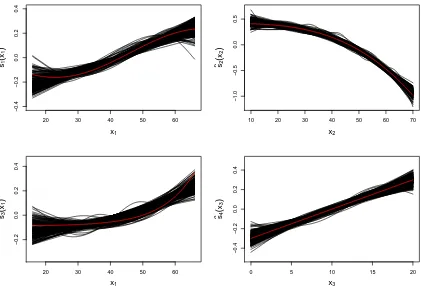
Citation
:
Radice, R. ORCID: 0000-0002-6316-3961, Marra, G. and Wojtys, M. (2016). Copula regression spline models for binary outcomes. Statistics and Computing, 26(5), pp. 981-995. doi: 10.1007/s11222-015-9581-6This is the accepted version of the paper.
This version of the publication may differ from the final published
version.
Permanent repository link: http://openaccess.city.ac.uk/20927/
Link to published version
:
http://dx.doi.org/10.1007/s11222-015-9581-6Copyright and reuse:
City Research Online aims to make research
outputs of City, University of London available to a wider audience.
Copyright and Moral Rights remain with the author(s) and/or copyright
holders. URLs from City Research Online may be freely distributed and
linked to.
Copula regression spline models for binary outcomes
Rosalba Radice
∗Department of Economics, Mathematics and Statistics
Birkbeck, London, U.K.
Malet Street, London WC1E 7HX, U.K.
Giampiero Marra
Department of Statistical ScienceUniversity College London
Gower Street, London WC1E 6BT, U.K.
Małgorzata Wojty´s
School of Computing and MathematicsUniversity of Plymouth
Drake Circus, Plymouth PL4 8AA, U.K.
Abstract
We introduce a framework for estimating the effect that a binary treatment has on a binary
outcome in the presence of unobserved confounding. The methodology is applied to a case
study which uses data from the Medical Expenditure Panel Survey and whose aim is to
esti-mate the effect of private health insurance on health care utilization. Unobserved confounding
arises when variables which are associated with both treatment and outcome are not
avail-able (in economics this issue is known as endogeneity). Also, treatment and outcome may
exhibit a dependence which cannot be modeled using a linear measure of association, and
observed confounders may have a non-linear impact on the treatment and outcome variables.
The problem of unobserved confounding is addressed using a two-equation structural latent
variable framework, where one equation essentially describes a binary outcome as a function
of a binary treatment whereas the other equation determines whether the treatment is received.
Non-linear dependence between treatment and outcome is dealt with by using copula
func-tions, whereas covariate-response relationships are flexibly modeled using a spline approach.
Related model fitting and inferential procedures are developed, and asymptotic arguments
presented.
Key Words: Bivariate binary outcomes; Copula; Endogeneity; Penalized regression spline;
Simultaneous equation estimation; Unobserved confounding.
1
Introduction
Quantifying the effect of a non-randomly assigned treatment on an outcome is a challenging task in observational studies. An approach to calculate such an effect is to match subjects on the
basis of observed features or the so-called propensity score, and then compute the treatment effect
as the difference between the observed responses of the matched subjects corresponding to the
levels of the treatment (e.g., Heckman et al., 1997; Rosenbaum & Rubin, 1983). However, this
method is only valid when the unobserved variables that influence the treatment are independent
of the outcome, conditional on the covariates in the model. We consider the situation in which the
researcher is interested in estimating the effect of a binary treatment on a binary outcome in the
presence of unobserved confounders (i.e., unknown or not readily quantifiable variables associated
with both treatment and outcome). In economics, this problem is commonly framed in terms of
a regression model from which important regressors have been omitted and hence become a part
of the model’s error term. In this context, the treatment is termed exogenous if it is not associated with the error term after conditioning on the observed confounders, and endogenous otherwise. We
address this issue by specifying a simultaneous model for treatment and outcome; this route has
been previously taken by several scholars (e.g., Chib & Hamilton, 2002; Greene, 2012; Heckman,
1978; Maddala, 1983; Marra & Radice, 2011a). Other approaches are available to account for
unobserved confounding; see the detailed review of Clarke & Windmeijer (2012).
To fix ideas, let us consider a case study which uses data from the Medical Expenditure Panel
Survey (MEPS) and whose goal is to estimate the effect of having private health insurance on
the probability of using health care services. Private health insurance status, which is an important
determinant of the use of health care services, is a potentially endogenous variable. This is because unobserved variables, such as allergy and risk aversiveness, are likely to influence both health
service utilization and private insurance decision. Sometimes the effect of private health insurance
can be interpreted as adverse selection or moral hazard (e.g., Buchmueller et al., 2005). Adverse
selection occurs when individuals with a greater demand for medical care, because of poor health
for instance, are expected to have a greater demand for insurance. Moral hazard refers to the
tendency of people to be more inclined to seek health services, and doctors to be more inclined
to refer them when all costs are covered. The matter is further complicated by the fact that the
effects of observed confounders, such as age and education, may be complex since they embody
productivity and life-cycle effects that are likely to influence private health insurance and health care utilization non-linearly. If these relationships are mismodeled then the effect of insurance
on the probability of using health care services may be biased (e.g., Marra & Radice, 2011a).
Moreover, insurance status and health care utilization may exhibit a non-Gaussian association
(Winkelmann, 2012).
Unobserved confounding can be controlled for by using the recursive bivariate probit model
(Heckman, 1978). This model controls for unobserved confounding by using a two-equation
struc-tural latent variable framework, where one equation essentially describes a binary outcome (e.g.,
health care utilization) as a function of a binary treatment (e.g., insurance coverage) whereas the
other equation determines whether the treatment is received. The model is completed by assum-ing that the latent errors of the two equations follow a standard bivariate Gaussian distribution
with correlationθ;θ 6= 0suggests that unobserved confounding is present, hence joint estimation
of the two equations is required. Some applications in economics and bio-statistics are provided
(2009) and Li & Jensen (2011). The limitations of this model are, however, the inability to deal
ef-fectively with non-linear covariate effects and non-Gaussian dependencies between the treatment
and outcome equations. To model flexibly covariate-response relationships, Chib & Greenberg
(2007) and Marra & Radice (2011a) introduced Bayesian and likelihood estimation methods based
on penalized splines, respectively. To deal with the problem of non-Gaussian dependence between
treatment and outcome, Winkelmann (2012) discussed a modification of the recursive bivariate
probit that maintains the Gaussian assumption for the marginal distributions of the two equations
while introducing non-Gaussian dependence between them using the Frank and Clayton copulas.
The contribution of this article is twofold, one methodological and the other practical. First, we extend the procedures discussed in Marra & Radice (2011a) and Winkelmann (2012) to make
it possible to deal simultaneously with unobserved confounding, non-linear covariate effects and
non-Gaussian dependencies between treatment and outcome. In particular, we generalize the
pe-nalized likelihood estimation approach based on the assumption of bivariate normality presented
in Marra & Radice (2011a) by allowing for non-Gaussian dependencies between the two model
equations; this is achieved by employing some classic copulas, such as Clayton, Frank, Gumbel
and Joe, and the rotated versions of Clayton, Gumbel and Joe. We also provide some theoretical
ar-gumentation related to the asymptotic behavior of the proposed estimator and the ensuing formula
to calculate the treatment effect. Second, we implement the methods discussed in this article in theRpackageSemiParBIVProbit(Marra & Radice, 2015). This can be particularly attractive
to practitioners who wish to fit such models. Swihart et al. (2014) and Genest et al. (2013) have
also adopted the copula paradigm to model multiple binary outcomes. One of the main
contribu-tions of the former article is to establish the connection between existing marginalized multilevel
models and copulas. The work by Genest et al. (2013) discusses models for vectors of binary
out-comes in the which the marginal distributions depend on covariates through logistic regressions
and the dependence structure is modeled through meta-elliptical copulas. Our approach does not
deal with multivariate binary outcomes, although it can be extended to this context. However, as
opposed to Swihart et al. (2014) and Genest et al. (2013), the proposed methodology can account for non-linear covariate effects, and more importantly can mitigate the issue of endogeneity.
The rest of the paper is organized as follows. Section 2 mainly discusses the model structure,
parameter estimation, confidence intervals and variable selection. Section 3 applies the proposed
methodology to the MEPS data mentioned above, whereas Section 4 discusses the limitations of
the proposed framework and concludes with some future extensions. The online supplementary
material includes some of the details required to calculate the asymptotic variance of the
treat-ment effect, details on the structure of the score vector and Hessian matrix used in the algorithm,
asymptotic considerations related to the proposed estimator and the ensuing formula to calculate
2
Methods
2.1
Model definition
The focus is on a pair of random variables(y1i, y2i), fori = 1, . . . , n, whereyvi ∈ {0,1}, v can
take values 1 and 2, and n represents the sample size. Variable y1i refers to the treatment and
y2i to the outcome. The observed yvi is determined by a latent continuous variable yvi∗ such that
yvi =1(yvi∗ >0), where 1 is the classic indicator function. We assume thaty
∗
vi∼ N(ηvi,1)where
ηvi ∈ Ris a linear predictor defined in the next section for v = 1,2. The probability of event
(y1i = 1, y2i = 1)can be defined by using the copula representation (Sklar, 1959, 1973)
P(y1i = 1, y2i = 1) =C(P(y1i = 1),P(y2i = 1);θ),
where P(yvi = 1) = Φ(ηvi), Φ(·) is the cumulative distribution function (cdf) of the standard
univariate Gaussian distribution,C is a two-place copula function andθis an association parameter
measuring the dependence between the two marginalsP(y1i = 1)andP(y2i = 1). In other words,
the joint distribution is expressed in terms of marginal distributions and a function C that binds
them together. A substantial advantage of the copula approach is that the marginal distributions
may come from different families. Note that the marginal cdfs are conditioned on covariates (see the definition ofηvi in the next section), but for notational convenience we have suppressed this
when expressing the marginal distributions. Some of the copulas considered are Clayton, Frank,
Gaussian, Gumbel, and Joe as well as the rotated versions of Clayton, Gumbel and Joe. Rotation
by 180 degrees leads to the survival copula (C180), while rotation by 90 (C90) and 270 degrees (C270)
allows for negative dependence which is not possible with the non-rotated and survival versions.
The copulas considered here are displayed in Figure 1. The counter-clockwise rotated versions
can be obtained using (e.g., Brechmann & Schepsmeier, 2013)
C90(ui, vi) = vi− C(1−ui, vi),
C180(ui, vi) = ui+vi−1 +C(1−ui,1−vi),
C270(ui, vi) = ui− C(ui,1−vi),
whereui = P(y1i = 1)andvi = P(y2i = 1). The ranges of θ for the copulas rotated by 90 and
270 degrees are on a negative scale; e.g., for Gumbel rotated by 90 and 270 degreesθ has to be
smaller than−1. For full details on copulas and their properties see, for instance, Nelsen (2006).
The log-likelihood function for the recursive bivariate probit model can be expressed as
`=
n
X
i=1
{y1iy2ilogp11i+y1i(1−y2i) logp10i+ (1−y1i)y2ilogp01i+ (1−y1i)(1−y2i) logp00i},
wherep11 =P(y1i = 1, y2i = 1),p10i =P(y1i = 1, y2i = 0) = P(y1i = 1)−P(y1i = 1, y2i = 1),
p01i =P(y1i = 0, y2i = 1) = P(y2i = 1)−P(y1i = 1, y2i = 1)andp00i =P(y1i = 0, y2i = 0) =
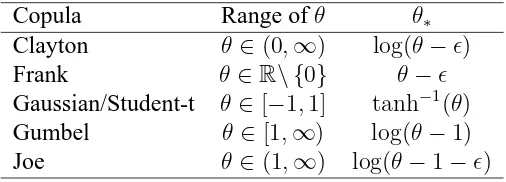
As it can be seen from Table 1, θ may be difficult to interpret in some cases. To this end,
the well known Kendall’s τ ∈ [−1,1]can be utilized. Alternatively, Tajar et al. (2001) suggest
using the odds ratio and gamma measure proposed by Goodman & Kruskal (1954). These can be
defined as ζ = p00p11/p10p01 and γ = ζ −1/ζ + 1, respectively. The odds ratio has range R
whereasγ ∈[−1,1].
Clayton 0.01 0.05 0.1 0.15 0.2
−3 −2 −1 0 1 2 3
−3 −2 −1 0 1 2 3 Frank 0.01 0.05 0.1 0.15 0.2
−3 −2 −1 0 1 2 3
−3 −2 −1 0 1 2 3 Gaussian 0.01 0.05 0.1 0.15 0.2
−3 −2 −1 0 1 2 3
−3 −2 −1 0 1 2 3 Gumbel 0.01 0.05 0.1 0.15 0.2
−3 −2 −1 0 1 2 3
−3 −2 −1 0 1 2 3 Joe 0.01 0.05 0.1 0.15 0.2
−3 −2 −1 0 1 2 3
−3 −2 −1 0 1 2 3 Student−t 0.01 0.05 0.1 0.15 0.2
−3 −2 −1 0 1 2 3
−3 −2 −1 0 1 2 3
Figure 1: Contour plots of some classic copula functions with standard normal margins for data simulated using association parameters2, 5.74, 0.71, 2, 2.86, and 0.71, respectively (these values are consistent with a medium positive correlation). The Gaussian, Student-t (here with three degrees of freedom) and Frank copulas allow for equal degrees of positive and negative dependence. Gaussian and Frank show a weaker tail dependence as compared to Student-t, and Frank exhibits a slightly stronger dependence in the middle of the distribution. Clayton is asymmetric with a strong lower tail dependence but a weaker upper tail dependence. Vice versa for the Gumbel and Joe copulas.
2.1.1 Linear predictor specification
The linear predictor for the treatment equation can be written as
η1i =uT1iα1+
K1
X
k1=1
s1k1(z1k1i), (1)
whereas that for the outcome as
η2i =ψy1i+uT2iα2+
K2
X
k2=1
Copula Range ofθ θ∗
Clayton θ∈(0,∞) log(θ−)
Frank θ ∈R\ {0} θ−
Gaussian/Student-t θ ∈[−1,1] tanh−1(θ)
Gumbel θ∈[1,∞) log(θ−1)
[image:7.595.176.429.50.141.2]Joe θ∈(1,∞) log(θ−1−)
Table 1: Parameter range of dependence coefficientθfor some classic copula functions and transformations,θ∗, ofθ
used in optimization. Quantityis set to the machine smallest positive floating-point number multiplied by106
and is used in some cases to ensure that the dependence parameters lie in their respective ranges.
whereψ is the effect of the treatment on the outcome on the scale of the linear predictor, uT1i = (1, u12i, . . . , u1P1i) is thei
th row of U
1 = (u11, . . . ,u1n)T, the n×P1 model matrix containing
P1 parametric terms (e.g., intercept, dummy and categorical variables), α1 is a coefficient
vec-tor, and the s1k1 are unknown smooth functions of the K1 continuous covariates z1k1i. Varying
coefficient models can be obtained by multiplying one or more smooth terms by some
predic-tor(s) (Hastie & Tibshirani, 1993), and smooth functions of two or more covariates can also be
considered (Wood, 2006). Similarly, uT
2i = (1, u22i, . . . , u2P2i)is thei
throw vector of then×P
2
model matrix U2 = (u21, . . . ,u2n)T, α2 is a parameter vector, and thes2k2 are unknown smooth
terms of the K2 continuous regressors z2k2i. The smooth functions are subject to the centering
(identifiability) constraintPn
i=1svkv(zvkvi) = 0forv = 1,2,kv = 1, . . . , Kv(Wood, 2006).
The smooth functions are represented using the regression spline approach (e.g., Ruppert et al., 2003). Specifically, svkv(zvkvi) is approximated by a linear combination of known spline basis
functions,bvkvj(zvkvi), and regression parameters,βvkvj, i.e.svkv(zvkvi) =
PJvkv
j=1 βvkvjbvkvj(zvkvi) =
βT
vkvBvkv(zvkvi), whereJvkv is the number of spline bases used to representsvkv(·), Bvkv(zvkvi)is
theithvector of dimensionJ
vkv containing the basis functions evaluated at the observationzvkvi,
i.e. Bvkv(zvkvi) =
bvkv1(zvkvi), bvkv2(zvkvi), . . . , bvkvJvkv(zvkvi)
T
, and βvkv is the
correspond-ing parameter vector. Evaluatcorrespond-ing Bvkv(zvkvi) for eachiyields Jvkv curves with different degrees
of complexity which multiplied by some value of βvkv and then summed will give a (linear or
non-linear) estimate forsvkv(zvkv); see Ruppert et al. (2003) for a detailed overview. Basis
func-tions should be chosen to have convenient mathematical and numerical properties. We employ
low rank thin plate regression splines (Wood, 2003), although many spline definitions (includ-ing B-splines and cubic regression splines) are supported in our implementation. Note that for
one-dimensional smooth functions, the choice of spline definition does not play a crucial role
in determining the shape of ˆsvkv(zvkvi)(Wood, 2006). The cases of smooth terms multiplied by
some covariate(s) and of smooths of more than one variable follow a similar construction; see
Wood (2006, Chapter 4) for full details. Linear predictors (1) and (2) can, therefore, be written as η1i =uT1iα1+BT1iβ1andη2i =ψy1i+uT2iα2+BT2iβ2, where BTvi =
Bv1(zv1i)T, . . . ,BvKv(zvKvi)
T
andβT
v = (βvT1, . . . ,βvKT v). After defining X1i = (u
T
1i,BT1i)Tand X2i = (y1i,uT2i,BT2i)T, we have
η1i =XT1iδ1 andη2i =XT2iδ2 whereδ1T= (αT1,β1T)andδ2T= (ψ,αT2,β2T). Note that the presence
of a binary endogenous variable inη2i does not alter the log-likelihood function presented in the
η2iincludesy1i.
To identify the parameters in η2i, it is typically assumed that an exclusion restriction on the
exogenous variables holds: the regressors in the treatment equation should contain at least one or
more covariates (usually referred to as instruments) not included in the outcome equation.
How-ever, as shown for instance in Han & Vytlacil (2014), Marra & Radice (2011a) and Wilde (2000),
the presence of this restriction may not be necessary.
2.2
Sample average treatment effect
The effect ofy1i on the probability that y2i = 1 is of primary interest. In other words, the aim
is to investigate how the treatment changes the expected outcome. Thus, the treatment effect is
given by the difference between the expected outcome with treatment and the expected outcome
without treatment. Different measures of treatment effect have been proposed in the literature.
Here, we focus on the average treatment effect in the specific sample at hand, rather than that in
the population (SATE; Abadie et al., 2004). In our case, this can be defined as
SATE(δ,X) = 1
n
n
X
i=1
P(y2i = 1|y1i = 1)−P(y2i = 1|y1i = 0),
where
P(y2i = 1|y1i = 1) = C
Φ(η1i),Φ(η2(yi1i=1));θ
Φ(η1i)
,
P(y2i = 1|y1i = 0) = Φ(η
(y1i=0)
2i )− C
Φ(η1i),Φ(η2(yi1i=0));θ
1−Φ(η1i)
,
the linear predictors are defined in the previous section, η(y1i=r)
2i represents the linear predictor
evaluated at y1i = r for r equal to 1 or 0, δT = (δT1,δ2T, θ), and X = (x1|. . .|xn)T where xi is
defined as(XT1i,XT2i)T. SATE(δ,X) can be estimated usingSATE( ˆδ,X), whereas a confidence
interval for it can be obtained employing the delta method. Specifically, the appropriate estimator
of the asymptotic variance ofSATE( ˆδ,X)is
∂SATE(δ,X)
∂δ
T
δ
=ˆδ
Vδ
∂SATE(δ,X)
∂δ
δ
=ˆδ
, (3)
where Vδis the covariance matrix ofδ defined in Section 2.4 and
∂SATE(δ,X)
∂δ =
"
∂SATE(δ,X)
∂δ1
T
,∂SATE(δ,X) ∂δ2
T
,∂SATE(δ,X) ∂θ
#T
,
with elements defined in Section S.1 of the online supplementary material. Alternatively, Bayesian
2.3
Parameter estimation
Since the range of θ is bounded in most cases, we use a proper transformation of it, θ∗, and
define δT
∗ = (δT1,δ2T, θ∗), to ensure that in optimization δ∗ ∈ Rp, where p is the total number
of parameters; see Table 1 for ranges ofθ and the transformations employed. Let us denote the
log-likelihood for a given copula function as `(δ∗). Given the flexible linear predictor structure
considered here, unpenalized estimation can result in smooth term estimates that are too rough to
produce practically useful results (e.g., Ruppert et al., 2003). This issue is dealt with by using a
penalty term, such asP2
v=1 PKv
kv=1λvkv
R
s00
vkv(zvkv)
2
dzvkvfor the one-dimensional case, which
measures the second-order roughness of the smooth terms in the model. Theλvkv are smoothing
parameters controlling the trade-off between fit and smoothness and can take values in [0,∞). Since regression splines are linear in their model parameters, the overall penalty can be written as
βTS
λβwhereβT = (βT1,βT2), Sλ=
P2
v=1 PKv
kv=1λvkvSvkv and the Svkvare positive semi-definite
symmetric known square matrices expanded with zeros everywhere except for the elements which
correspond to the coefficients of thevkth
v smooth term. The expressions for thebvkvj(zvkvi) and
Svkv depend on the type of spline employed and we refer the reader to Ruppert et al. (2003) and
Wood (2003, 2006) for these details. The function to maximize is
`p(δ∗) =`(δ∗)−
1 2β
TS
λβ, (4)
where the penalty term can be written asδT
∗˜Sλδ∗/2whereS˜λis an overall penalty matrix defined
asdiag(0TP1, λ1k1S1k1, . . . , λ1K1S1K1,0 T
P2, λ2k2S2k2, . . . , λ2K2S2K2,0)with 0 T
Pv = (0v1, . . . ,0vPv).
2.3.1 Estimatingδ∗ given smoothing parameters
Given λˆT = (ˆλ
1k1, . . . ,λˆ1K1,λˆ2k2, . . . ,ˆλ2K2), we seek to maximize (4). To this end, we use a
trust region approach which is generally more stable and faster than its line-search counterparts,
particularly for functions that are, for example, non-concave and/or exhibit regions that are close
to flat (Nocedal & Wright, 2006, Chapter 4). Leta be an iteration index. Intuitively speaking,
line search methods choose a direction to move frommatoma+1and find the distance along that
direction which gives the best improvement in the objective function. If the function is non-convex or has long plateaus then the optimizer may search far away frommabut still choose anma+1that
is close toma(hence offering a marginal improvement in the objective function). In some cases,
the function will be evaluated so far away frommathat it will not be finite and the algorithm will
fail. Trust region methods choose a maximum distance for the move fromma toma+1 based on
a “trust region” around ma that has a radius of that maximum distance, and then let a candidate
for ma+1 be the minimum of a quadratic approximation of the objective function. Since points
outside of the trust region are not considered, the algorithm never runs too far and/or too fast from
the current iteration. The trust region is shrunken if the proposed point in the region is worse/not
better than the current point; the new problem with smaller region is then solved. If a point which is close to the boundary of the trust region is accepted and it gives a large enough improvement in the
objective function to be undefined or indeterminate, most implementations of line search methods
will fail and user intervention is required. In the trust region approach, the search for ma+1 is
always a solution to the trust region problem; if the function atma+1 is not finite or not better
than the value atma then the proposal is rejected and the trust region shrunken. Finally, a line
search approach requires repeated estimation of the objective function, while trust region methods
evaluate the objective function only after solving the trust region problem. Hence, trust region
methods can be considerably faster when the objective function is expensive to compute. Full
details can be found in (Nocedal & Wright, 2006, Chapter 4).
Let us define the penalized gradient and Hessian at iteration a as g[pa] = g[a] −S˜λˆδ
[a]
∗ and
H[a]
p = H[a]−˜Sλˆ, where g[a] is made up of g
[a]
1 = ∂`(δ∗)/∂δ1|δ1=δ[a]
1
, g[2a] = ∂`(δ∗)/∂δ2|δ2=δ[a]
2
and g3[a] = ∂`(δ∗)/∂θ∗|
θ∗=θ [a] ∗
, and the Hessian matrix has a 3× 3 matrix block structure with
(r, h)thelementH[a]
r,h =∂2`(δ∗)/∂δr∂δhT|δr=δ[ra],δh=δ[a]
h
,r, h= 1, . . . ,3, whereδ3 =θ∗; details on
the structure of g andHcan be found in Section S.2 of the online supplementary material. Each
iteration of the trust region algorithm solves the problem
min
p
˘
`p(δ∗[a])
def
=−
`p(δ[∗a]) +pTg[pa]+
1 2p
TH[a]
p p
so that kpk ≤r[a],
δ[∗a+1]= arg min
p
˘
`p(δ∗[a]) +δ∗[a],
wherek · kdenotes the Euclidean norm andr[a]represents the radius of the trust region. At each
iteration of the algorithm, `˘p(δ∗[a]) is minimized subject to the constraint that the solution falls
within a trust region with radiusr[a]. The proposed solution is then accepted or rejected and the
trust region expanded or shrunken based on the ratio between the improvement in the objective
function when going from δ∗[a] toδ[∗a+1] and that predicted by the quadratic approximation. The
exact details of the implementation used here can be found in Geyer (2013) who also discusses
numerical stability and termination criteria. Note that, near the solution, the trust region algorithm
typically behaves as a classic unconstrained algorithm.
2.3.2 Estimatingλgivenδ∗
If the model has more than one smooth term per equation, then estimation ofλby direct grid search
optimization of, for instance, a prediction error criterion can be computationally burdensome. It
is therefore pivotal for practical modeling to estimate λ in an automatic way. There are many techniques for automatic multiple smoothing parameter estimation within the penalized likelihood
framework; see Ruppert et al. (2003) and Wood (2006) for detailed overviews. (Note that joint
estimation ofδ∗andλvia maximization of (4) would clearly lead to over-fitting since the highest
value of`p(δ∗)would be obtained whenλˆ =0.)
Let us defineX˜ =X˜1|. . .|X˜n
T
, whereX˜i =diag
XT1i,XT2i,1 with X1i and X2i defined in
Section 2.1.1, W[a]as a block diagonal matrix made up of3×3matrices Wi[a]with(r, h)thelement
given by−∂2`(δ
∗)i/∂ηri∂ηhi|η
ri=ηri[a],ηhi=ηhi[a]
withithelement given by d[a]
i =
n
∂`(δ∗)i/∂η1i|
η1i=η[1ai], ∂`(δ∗)i/∂η2i|η2i=η2[ai], ∂`(δ∗)i/∂η3i|η3i=η[3ai]
oT
.
We then have that g[pa] = ˜X
T
d[a]−S˜λˆδ
[a]
∗ and H[pa] = −X˜
T
W[a]X˜ −˜Sλˆ. Let us use the fact that
close to convergence the trust region algorithm behaves as a classic unconstrained algorithm and
assume thatδ[∗a+1]is a new updated guess. Applying a first order Taylor expansion to g[pa+1]around
δ∗[a], setting the resulting expression to zero, and using the expressions above for gp[a]andH[pa], we
find that
δ∗[a+1]= ( ˜X
T
W[a]X˜ + ˜Sλˆ)
−1X˜TW[a]z[a],
wherez[a] =
W[a]
−1
d[a]+ ˜Xδ∗[a]. Thusδ∗[a+1]is clearly the solution to the penalized iteratively
re-weighted least squares problem
arg min
δ∗ k
z+,[a]−X˜+,[a]δ∗k2 +δT∗˜Sˆ
λδ∗,
wherez+,[a] =√W[a]z[a]andX˜+,[a] =√W[a]X. In the derivation above, W˜ [a]can also be taken to
be the expectation of minus the second derivatives of the log-likelihood with respect to the linear
predictors.
From standard likelihood theory,= √WW−1d has mean 0 and covariance (identity) matrix I, and z+ = E(z+) + , where E(z+) = µz+ =
√
WX˜δ0
∗, δ∗0 is the true parameter vector
and V(z+) = V() = I. The predicted vector value for z+ is given by µˆ
z+ = Aλˆz+, where
Aλ =
√
WX˜( ˜XTWX˜ + ˜Sλˆ)
−1˜
XT√W (known as influence matrix). Following the argumentation
in Wood (2006, Chapter 4),z+ will be normally distributed in the large sample limit. Now, the
smoothing parameters have to be estimated and since the estimated smooth functions should be as close as possible to the respective true functions, it makes sense to estimateλso thatµˆz+ is as
close as possible toµz+. To this end, we employ the expected mean squared error of the model,
which in this case is
E kµz+ −µˆz+k2/nˇ=E kz+−Aλz+−k2
/nˇ
=E kz+−Aλz+k2/nˇ+E −T−2Tµ
z+ + 2TAλµz++ 2TAλ
/nˇ
=E kz+−Aλz+k2/nˇ−1 + 2tr(Aλ)/n,ˇ
wherenˇ = 3nand tr(Aλ)represents the effective degrees of freedom (edf) of the penalized model.
The smoothing parameter vector can be estimated by minimizing an estimate of the expectation
above, that is
V(λ) =kz+−Aλz+k2/nˇ−1 + 2tr(Aλ)/ˇn. (5)
This is equivalent to the expression of the Un-Biased Risk Estimator reported, for instance, in Wood (2006, Chapter 4) as well as to the Akaike information criterion (AIC) after dropping irrelevant constant. The latter equivalence can essentially be seen by noticing that the first term on
In practice, givenδ∗[a+1], we solve the problem
λ[a+1] = arg min
λ V
(λ)def=kz+,[a+1]−A[λa+1]z+,[a+1]k2/nˇ−1 + 2tr(A[λa+1])/nˇ (6)
using the automatic approach by Wood (2004), which is based on Newton’s method and can
eval-uate in an efficient and stable way the components inV(λ)and their first and second derivatives
with respect to log(λ) (since the smoothing parameters can only take positive values). Broadly
speaking, this is achieved using a series of pivoted QR and singular value decompositions which
make the evaluation of the quantities involving A[λa+1], for new trial values ofλ, cheap and
deriva-tive calculations efficient and stable; see Wood (2004) for full details.
2.3.3 Sketch of algorithm
The two steps, detailed in Sections 2.3.1 and 2.3.2, are iterated in a “performance iteration” fashion
(Gu, 2002) until the algorithm satisfies the stopping criterionmax δ∗
[a]
−δ∗[a+1]
< 10
−6. The
steps can be summarized as follows:
step 1 For a given parameter vector valueδ∗[a]and holding the smoothing parameter vector fixed at
λ[a], find an estimate ofδ∗:
δ[∗a+1]= arg min
p
˘
`p(δ[∗a]) +δ
[a]
∗ .
step 2 Construct the working linear model quantities needed in (6) usingδ[∗a+1]and find an estimate
ofλ:
λ[a+1]= arg min
λ V
(λ).
A slight modification ofV(λ)is worth mentioning. If the estimated smoothing parameters yield
curve estimates that are deemed to be too rough and smoother functions are desired then the trace
of the influence matrix can be increased by a factor> 1. Kim & Gu (2004) found, in a different
context, that using as inflation factor of1.4corrects the tendency to over-fitting of prediction error
criteria.
The asymptotic behavior of the proposed estimator and the ensuing formula to calculate the
treatment effect is detailed in Section S.3 of the online supplementary material.
2.4
Confidence intervals and variable selection
At convergence, the covariance matrix ofδˆ∗can be written as Vδˆ∗ =−H
−1
p HH
−1
p . However, the
alternative Bayesian result Vδ∗ =−H −1
p can be employed as well. For smooth functions, at finite
sample sizes Vδ∗ can produce intervals with close to nominal ‘across-the-function’ frequentist
coverage probabilities (Marra & Wood, 2012). This is because the Bayesian covariance matrix
in (3) Vδ rather than Vδ∗ is needed. This can be easily obtained by using θ in place ofθ∗ when
constructing the covariance matrix.
Point-wise confidence intervals forˆsvkv(zvkvi)can be obtained using
N(svkv(zvkvi),Bvkv(zvkvi)TVδ∗vkvBvkv(zvkvi)), where Vδ∗vkv is the sub-matrix of Vδ∗ that
corre-sponds to the regression spline parameters associated with sˆvkv(zvkvi). Intervals for non-linear
functions of the model coefficients (e.g.,θ,γ and SATE) can be conveniently obtained by
simula-tion from the posterior distribusimula-tion ofδ∗as follows:
step 1 Drawnsim random vectors fromN( ˆδ∗,Vˆδ∗).
step 2 Calculatensimsimulated realizations of the function of interest. For instance, for a Gaussian
copulaθ = tanh(θ∗), henceθsim = (θ1sim, θsim2 , . . . , θnsim
sim)where θ
sim
i = tanh(θ∗sim,i ),i =
1, . . . , nsim.
step 3 Usingθsimcalculate the lower, (ς/2), and upper,1−ς/2, quantiles.
Small values fornsimare typically tolerable. Parameterς is usually set to0.05.
Strictly speaking, point-wise confidence intervals for smooth components are not adequate
for variable selection purposes, although they are often used in practice (e.g., Ruppert et al.,
2003). To test smooth components for equality to zero we use the results by Wood (2013). Let
us define ˆsvkv = Bvkv(zvkv) ˆβvkv, where Bvkv(zvkv) denotes a full column rank matrix, zvkv =
(zvkv1, zvkv2, . . . , zvkvn)
T and V
svkv = Bvkv(zvkv)Vδ∗vkvBvkv(zvkv)
T. It is then possible to obtain
approximate p-values for testing smooth components for equality to zero based on
Trvkv = ˆsTvkvV
rvkv−
svkv ˆsvkvv˙χ
2
rvkv,
where Vrvkv−
svkv is the rankrvkv Moore-Penrose pseudo-inverse of Vsvkv, which is employed to deal
with possible rank deficiencies. Parameter rvkv is selected using the notion of edf used in (6).
Becauseedf is not an integer, it can be rounded as follows (Wood, 2013)
rvkv =
(
floor(edfvkv) if edfvkv <floor(edfvkv) + 0.05
floor(edfvkv) + 1 otherwise
,
which proved effective in semiparametric bivariate probit models (Marra, 2013). Alternatively,
variable selection can be achieved by adopting a single penalty shrinkage approach as described
in Marra & Radice (2011a) and Marra & Wood (2011).
3
Analysis of health care utilization data
The analysis presented in this section was performed in theRenvironment (R Development Core Team,
2015) using the packageSemiParBIVProbit(Marra & Radice, 2015) which implements the
Variable Definition
Outcome
visits.hosp =1 at least one visit to hospital outpatient departments
Treatment
private =1 private health insurance
Demographic-socioeconomic
age age in years
gender =1 male
race =1 white, =2 black, =3 native American, =4 others
education years of education
income income (000’s)
region =1 northeast, =2 mid-west, =3 south, =4 west
Health-related
health =1 excellent, =2 very good, =3 good, =4 fair,=5 poor
bmi body mass index
diabetes =1 diabetic
hypertension =1 hypertensive on
hyperlipidemia =1 hyperlipidemic
[image:14.595.114.495.56.318.2]limitation =1 health limits physical activity
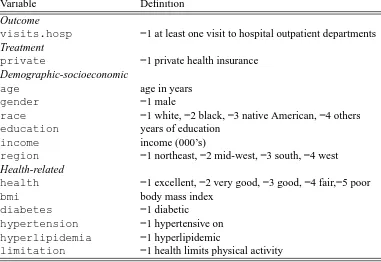
Table 2: Description of the outcome and treatment variables, and observed confounders.
3.1
Data
We used a data-set from the 2012 MEPS (http://www.meps.ahrq.gov/) which includes
information on demographics, individual health status, health care utilization and private health
insurance coverage. We excluded individuals younger than 18 years old given their different
overall health profiles and expected usage patterns as compared to those of older individuals.
Individuals who were older than 64 years old were also excluded since the availability of Medicare
obviates the primary insurance decision for almost all US citizens. Individuals that did not have a
complete set of socioeconomic and demographic control variables were excluded from the sample (e.g., missing values for education or income). After exclusions, the final data-set contains 10950
observations. Table 2 summarizes the variables used in the analysis. The choice of these variables
was motivated largely by the findings reported in previous related studies (e.g., Shane & Trivedi,
2012, and references therein).
3.2
Models
Following previous work on the subject (e.g., Holly et al., 1998; Shane & Trivedi, 2012), the equa-tions for private health insurance and health care utilization were specified, inRnotation, as
treat.eq <- private ~ as.factor(health) + as.factor(race) +
as.factor(region) + limitation + gender + diabetes +
hypertension + hyperlipidemia + s(bmi) + s(income) +
s(age) + s(education)
as.factor(region) + limitation + gender + diabetes +
hypertension + hyperlipidemia + s(bmi) + s(income) +
s(age) + s(education)
whereas.factorcoerces its argument to a factor and thes()symbols refer to the unknown
smooth functions described in Section 2.1.1. The smooth components were represented using pe-nalized thin plate regression splines with basis dimensions equal to 20 and penalties based on
second order derivatives (Wood, 2006). In cross-sectional studies, 20 bases typically suffice to
represent well smooth functions, although sensitivity analysis using more spline bases is
advis-able when the effective degrees of freedom of the smooth components are close to the number
of bases used. We also used two alternative spline definitions (i.e., B-splines with second order
difference penalties and cubic regression splines with second order penalties); the resulting
esti-mated curves did not change significantly as compared to those obtained using thin plate splines.
The non-linear specification forbmi, income, age andeducation arises from the fact that
these covariate embody productivity and life-cycle effects that are likely to affect the treatment and outcome non-linearly. In fact, in related studies, Holly et al. (1998) considered a model for health
care utilization that contains linear and quadratic terms inbmi,income,ageandeducation
whereas Marra & Radice (2011b) specified a model containing smooth functions of them.
Consid-ering all copulas discussed in Section 2.1, and including the case in which the outcome equation
is estimated alone (this will be referred to as Independent), we fitted 19 copula models. Based
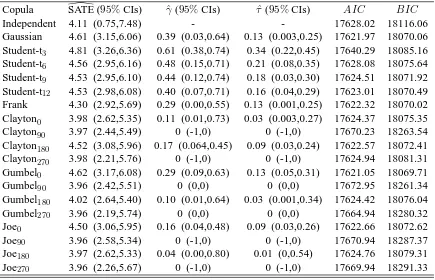
on theAIC and Bayesian information criterion (BIC) reported in Table 3 the preferred models
are the Gaussian, Gumbel0, Clayton180 and Joe0. After applying the Vuong (Vuong, 1989) and
Clarke (Clarke & Windmeijer, 2012) tests to the four models, it emerged that the Vuong test can
not discriminate among the models whereas the Clarke test favors Gumbel0over the others.
3.3
Empirical results
3.3.1 Measure of dependence
We start off by commenting on the results for the dependence measures of all models fitted (see
Table 3). These represent the association between the unobserved confounders after controlling
for observed confounders. Overall, the models without AIC/BIC support, which account for
a negative dependence, indicate absence of association between the two equations with intervals
which either span all plausible (negative) values forγ/τ or collapse to their point estimates. This
behavior is typically observed when the data are inconsistent with the restrictions on the range
of the dependence parameter, case in which model misspecification should be strongly suspected (e.g., Trivedi & Zimmer, 2005). The models withAIC/BIC support, which account for a
posi-tive dependence, do not exhibit such a behavior and suggest a low association. Interestingly, the
small yet significant dependence parameters obtained for Gumbel0indicates that there exists some
positive association between the unstructured terms of the model equations for private health
insur-ance and hospital utilization which is most likely due to the presence of unobserved confounders.
use health care services as compared to those without coverage.
3.3.2 SATE of private health insurance
The estimated SATE (in%) and confidence interval (CI) for all fitted copula models are reported in Table 3. The Table also reports the estimated SATE for the case in which the unobserved
confounding issue is not taken into account (Independent). Several points are worth noting.
• The chosen models (Gaussian, Gumbel0, Clayton180 and Joe0, which account for a positive
dependence) show similar point estimates with overlapping CIs. The models that account
for a negative dependence (which have no AIC/BIC support) exhibit estimates that are
systematically smaller than those produced by the preferred models (and that produced by
the Independent model). As pointed out in the previous section, the negative dependence
models have estimated dependence parameters that are on the boundary of their parameter spaces, hence suggesting that these models are not supported by the data.
• If the presence of unobserved confounders is not accounted for then the estimated SATE is smaller (4.11%) than that obtained using the chosen models which can control for this issue
(around4.56%). Based on these estimates the direction of the bias appears to be downward.
This result seems counter-intuitive in the sense that if we assume that possible confounders
are allergy and risk aversiveness, then an upward bias should be expected (individuals with
a greater demand for medical care are expected to have a greater demand for insurance).
The explanation behind this apparent contradiction is that employer-provided insurance is
generally limited to full-time workers and is positively related to the worker’s income. The empirical evidence indicates that workers who are in poorer health are less likely to obtain
employer-sponsored coverage (e.g., Buchmueller et al., 2005).
• Using the Gaussian copula the estimated SATE is4.61%, which does not really differ from those obtained using the other supported copula models. This is most likely due to the low
association observed. When γ/τ → 0the copula models converge to the normal product
distribution, case in which all copulas entail very similar distributions. As shown in
simula-tion (see Secsimula-tion S.4 of the online supplementary material), larger differences are likely to
be observed when the association between the treatment and outcome equations is stronger.
In such a scenario, different copulas would entail different distributions (as shown in Figure
1), hence the use of the appropriate copula model can make a difference.
3.3.3 Parametric components
We report the estimated effects for the Gumbel0 copula model. Similar results where obtained
using the other preferred models (these are available upon request).
Most of these effects have the expected signs. Regardinggender, females are slightly more
likely of being hospitalized than males. This may be explained by a higher demand for medical
services among women during their reproductive years (e.g., Sindelar, 1982). As forrace, there
Copula \SATE (95%CIs) γˆ(95%CIs) τˆ(95%CIs) AIC BIC
Independent 4.11 (0.75,7.48) - - 17628.02 18116.06
Gaussian 4.61 (3.15,6.06) 0.39 (0.03,0.64) 0.13 (0.003,0.25) 17621.97 18070.06 Student-t3 4.81 (3.26,6.36) 0.61 (0.38,0.74) 0.34 (0.22,0.45) 17640.29 18085.16
Student-t6 4.56 (2.95,6.16) 0.48 (0.15,0.71) 0.21 (0.08,0.35) 17628.08 18075.64
Student-t9 4.53 (2.95,6.10) 0.44 (0.12,0.74) 0.18 (0.03,0.30) 17624.51 18071.92
Student-t12 4.53 (2.98,6.08) 0.40 (0.07,0.71) 0.16 (0.04,0.29) 17623.01 18070.49
Frank 4.30 (2.92,5.69) 0.29 (0.00,0.55) 0.13 (0.001,0.25) 17622.32 18070.02 Clayton0 3.98 (2.62,5.35) 0.11 (0.01,0.73) 0.03 (0.003,0.27) 17624.37 18075.35 Clayton90 3.97 (2.44,5.49) 0 (-1,0) 0 (-1,0) 17670.23 18263.54 Clayton180 4.52 (3.08,5.96) 0.17 (0.064,0.45) 0.09 (0.03,0.24) 17622.57 18072.41 Clayton270 3.98 (2.21,5.76) 0 (-1,0) 0 (-1,0) 17624.94 18081.31 Gumbel0 4.62 (3.17,6.08) 0.29 (0.09,0.63) 0.13 (0.05,0.31) 17621.05 18069.71
Gumbel90 3.96 (2.42,5.51) 0 (0,0) 0 (0,0) 17672.95 18261.34
Gumbel180 4.02 (2.64,5.40) 0.10 (0.01,0.64) 0.03 (0.001,0.34) 17624.42 18076.04
Gumbel270 3.96 (2.19,5.74) 0 (0,0) 0 (0,0) 17664.94 18280.32
Joe0 4.50 (3.06,5.95) 0.16 (0.04,0.48) 0.09 (0.03,0.26) 17622.66 18072.62
Joe90 3.96 (2.58,5.34) 0 (-1,0) 0 (-1,0) 17670.94 18287.37
Joe180 3.97 (2.62,5.33) 0.04 (0.00,0.80) 0.01 (0,0.54) 17624.76 18079.31
[image:17.595.87.522.52.332.2]Joe270 3.96 (2.26,5.67) 0 (-1,0) 0 (-1,0) 17669.94 18291.33
Table 3: Estimated SATE (in%), gamma measureγ, Kendall’sτ,AIC andBIC obtained using different copula models for the 2012 MEPS data. 95% confidence intervals for the SATE have been obtained using the delta method detailed in Section 2.2, and those forγandτusing Bayesian posterior simulation as described in Section 2.4. For the Independent model the information criteria have been calculated assuming that the treatment and outcome equations are not associated.
insurance but there is some difference in terms of being hospitalized; black individuals seem to be
less likely to use health care services as compared to whites. This is consistent with the findings
by Shane & Trivedi (2012). Regarding region, residents of the Midwest are more likely to
have a private insurance and to use health care services as compared to those of the Northeast. Individuals’ evaluation of theirhealthstates is a potential predictor of health care utilization.
Those who are in good health are less likely to access health care services. In the same vein,
those who expect themselves to be in good health have little to gain from insurance while those
who are in poor health are more likely to purchase health insurance. The results for the hospital
utilization equation support this hypothesis indicating that the less healthy individuals are, the
more likely they are to be admitted into hospitals. The positive relationship between self-assessed
health and insurance purchase is counter-intuitive to the hypothesis of moral hazard and adverse
selection. However, such finding is not unusual and has been obtained in several previous studies
(see Srivastava & Zhao, 2008, and references therein). The more objective measures of health
status (i.e., diabetes, hypertension and hyperlipidemia) suggest that medical need
is an important determinant of hospital utilization and insurance purchase.
3.3.4 Non-parametric components
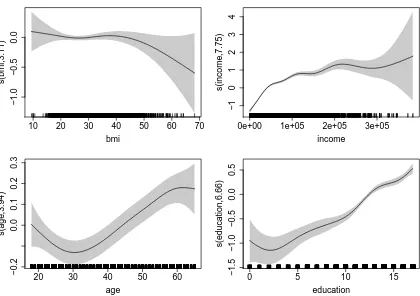
Figures 2 and 3 report the smooth function estimates for the treatment and outcome equations (and
Treatment Eq. Outcome Eq.
Variable Parameter estimate Std. error Parameter estimate Std. error
gender -0.02 0.03 -0.37 0.03
race=2 -0.00 0.04 -0.08 0.04
race=3 0.04 0.15 0.35 0.16
race=4 -0.04 0.05 -0.17 0.07
region=2 0.24 0.05 0.16 0.06
region=3 0.06 0.04 -0.22 0.05
region=4 0.01 0.04 -0.37 0.06
health=2 0.04 0.04 0.10 0.05
health=3 -0.11 0.04 0.33 0.05
health=4 -0.27 0.06 0.48 0.07
health=5 -0.39 0.09 0.67 0.10
diabetes 0.12 0.06 0.06 0.06
hypertension 0.09 0.04 0.09 0.04
hyperlipidemia 0.17 0.04 0.9 0.04
[image:18.595.103.504.69.307.2]limitation 0.05 0.06 -0.49 0.06
Table 4: Estimated coefficients and standard errors of the parametric components of the Gumbel0model.
10 20 30 40 50 60 70
−1.0
−0.5
0.0
bmi
s(bmi,3.11)
0e+00 1e+05 2e+05 3e+05
−1
0
1
2
3
4
income
s(income
,7.75)
20 30 40 50 60
−0.2
0.0
0.1
0.2
0.3
age
s(age
,3.94)
0 5 10 15
−1.5
−1.0
−0.5
0.0
0.5
education
s(education,6.66)
Figure 2: Smooth function estimates and associated95%point-wise confidence intervals in the treatment equation obtained by applying the Gumbel0regression spline model on the 2012 MEPS data. Results are plotted on the scale
[image:18.595.88.508.394.690.2]10 20 30 40 50 60 70
−0.2
0.0
0.1
0.2
bmi
s(bmi,1)
0e+00 1e+05 2e+05 3e+05
−0.2
0.0
0.2
0.4
0.6
income
s(income
,1.86)
20 30 40 50 60
−0.3
−0.1
0.1
0.3
age
s(age
,2.13)
0 5 10 15
−0.8
−0.4
0.0
education
s(education,1)
Figure 3: Smooth function estimates and associated 95% point-wise confidence intervals in the outcome equation obtained by applying the Gumbel0regression spline model on the 2012 MEPS data. Results are plotted on the scale
of the linear predictor. P-values for the smooth terms ofbmi,income, ageandeducationare 0.849,0.01,
<0.000and<0.000, respectively.
functions obtained using the other copula models (not reported here but available upon request)
were similar.
The effects ofbmi,income, ageandeducationin the treatment and outcome equations
show different degrees of non-linearity. The point-wise confidence intervals of the smooth
func-tions forbmi in the treatment and outcome equations contain the zero line for the whole range
of the covariate values. The intervals of the smooth forincomein the outcome equation contain the zero line for most of the covariate value range. This suggests thatbmi is a weak predictor of
private health insurance and health care utilization, and thatincomemight not be an important
determinant of hospital utilization. Similar conclusions can be drawn by looking at the p-values
reported in the captions of Figures 2 and 3. As for the remaining variables, the estimated effects
have the expected patterns. For example,ageis a significant determinant in both equations. The
probability of purchasing a private health insurance is found to increase withage. This is
sug-gestive of a higher probability of private health insurance purchase as individuals become older
and less likely to stay healthy (e.g., Hopkins & Kiddi, 1996). The probability of using health care
services also increases withage. Insurance decision as well as health care utilization appear to be highly associated witheducation. Education is likely to increase individuals’ awareness of
health care services and the benefits of purchasing a private health insurance. Higher household
income is associated with an increased probability of purchasing a private health insurance.
equation reported here should be interpreted in a qualitative way only. The actual effects can be
calculated by using simulation or by adapting the formulas of Greene (2012) to the current context.
This would account for the fact that the confounders appearing in the treatment equation have an
indirect effect (through the endogenous variable) on the outcome and a direct effect because they
also appear in the outcome equation.
4
Discussion
We have introduced a framework which can allow researchers to estimate the effect that a binary
treatment has on a binary variable in the presence of unobserved confounding, non-linear covariate
effects and non-Gaussian dependencies between the treatment and outcome equations. We have
provided inferential tools for this framework and presented some argumentation related to the
asymptotic behavior of the proposed penalized maximum likelihood estimator and the ensuing
sample average treatment effect. We have also developed the necessary computational procedures
which are incorporated in theRpackageSemiParBIVProbit(Marra & Radice, 2015).
Using the proposed approach, we have examined the effect of private health insurance on
health care utilization using the 2012 MEPS data-set. There is a generally accepted notion that private health coverage is affected by endogeneity as it is not randomly assigned as in a controlled
trial but rather is the result of individual preferences and health status, such as allergy and risk
aversiveness. Also, the impacts of continuous confounders such as age and education are likely
to be complex since they embody productivity and life-cycle effects that are likely to influence
non-linearly private health insurance and health care utilization. Finally, insurance and health care
utilization may exhibit a non-Gaussian dependence. To our knowledge, no studies have
exam-ined the impact of private health coverage accounting for endogeneity, non-linear contributions of
observed confounders and non-Gaussian dependence between insurance and health care
utiliza-tion, partly due to the lack of appropriate analytical and computational tools. By applying the introduced statistical framework to the 2012 MEPS data we found that not accounting for the
en-dogeneity issue underestimates the effect of private health insurance and that some of the observed
confounder effects are non-linear. We also found that the Gaussian, Gumbel0, Clayton180and Joe0
models were equally supported. This was due to the low yet significant association observed
be-tween the treatment and outcome equations, case in which the copula models entail very similar
distributions. However, as shown in simulation, the use of the appropriate copula model may make
a difference when the association between the two equations is strong.
Since marginal distributions other than Gaussian may be plausible in applications, we explored
the possibility of modeling the margins using skew probit links derived from the standard
skew-normal distribution by Azzalini (1985) as well as the power probit and reciprocal power probit links discussed by Bazan et al. (2010). We opted for these links as they include the probit link
as special case and have desirable mathematical properties. The use of these approaches did not
lead to SATE results different from those reported in Table 3. Moreover, the convergence of the
pointed out by Azzalini & Arellano-Valle (2013), in the simpler context of continuous outcome
variables, having a parameter which regulates the distribution’s skewness enjoys attractive formal
properties from the probability point of view. However, a practical problem in applications is the
possibility that the maximum likelihood estimate of the skewness parameter diverges. That is,
the profile log-likelihood for the skewness coefficient may be flat in a non-negligible portion of
situations. This issue has vanishing probability for increasing sample size, but for finite samples it
occurs with non-negligible probability.
A limitation of the copulas employed in this article is that they are exchangeable (Durante,
2009; Frees & Valdez, 1998; Nelsen, 2007). In the context of our case study, this means that the probability of (not) having private health insurance conditionally to the usage (or not) of health
care services is equal to the probability of using (or not) health care services knowing that a
private health insurance can (not) be used. Following the approach detailed in Frees & Valdez
(1998), we employed the copulaCκ1,κ2(u, v) =u
1−κ1
v1−κ2
C(uκ1, vκ2), 0< κ
1, κ2 <1, which has
the property of includingC as a limiting case. We encountered the same issues mentioned above,
even when using a model with a small number of covariates and without smooth functions.
An interesting avenue for future research includes the use of semi- and non-parametric copula
approaches. These would allow the margins and/or the copula to be estimated non-parametrically
using, for instance, smoothing methods such as kernels, wavelets and orthogonal polynomials. Broadly speaking, if the specification of the model for the margins and copula is correct, then the
parametric approach will outperform semi- and non-parametric methods; however, the reverse will
be true under misspecification. Without any valuable prior information, semi- and non-parametric
techniques should be favored as they will be more flexible in determining the shape of the
under-lying distribution. However, in practice, such techniques are typically limited with regard to the
inclusion of a large set of covariates, may require the imposition of restrictions on the functions
ap-proximating the underlying distribution and may be computationally demanding (e.g., Deheuvels,
1981a,b; Genest et al., 1995; Tutz & Petry, 2013). While a fully parametric copula approach is
less flexible than semi- and non-parametric approaches, it is computationally more feasible and it still allows the user to assess the sensitivity of results to different modeling assumptions.
Another interesting extension would be to consider trivariate system models, controlling for
the endogeneity of the treatment and for non-random sample selection in the outcome (e.g.,
Srivastava & Zhao, 2008). Finally, a future release ofSemiParBIVProbitwill allow the user
to model the copula parameter as a function of a linear predictor to allow for different degrees of
endogeneity across observations; the theoretical and computational framework remains essentially
unchanged.
Acknowledgement
We would like to thank two anonymous reviewers and the Associate Editor for many suggestions
which helped to clarify the contribution of the paper and improved considerably the presentation
References
Abadie, A., Drukker, D., Herr, J. L., & Imbens, G. W. (2004). Implementing matching estimators
for average treatment effects in Stata. Stata Journal, 4, 290–311.
Azzalini, A. (1985). A class of distributions which includes the normal one. Scandinavian Journal of Statistics, 12, 171–178.
Azzalini, A. & Arellano-Valle, R. B. (2013). Maximum penalized likelihood estimation for
skew-normal and skew-t distributions. Journal of Statistical Planning and Inference, 143, 419–433.
Barndorff-Nielsen, O. & Cox, D. (1989). Asymptotic Techniques for Use in Statistics. London:
Chapman and Hall.
Bazan, J. L., H.Bolfarinez, & Branco, M. B. (2010). A framework for skew-probit links in binary
regression. Communications in Statistics: Theory and Methods, 39, 678–697.
Brechmann, E. C. & Schepsmeier, U. (2013). Modeling dependence with c- and d-vine copulas:
The R package CDVine. Journal of Statistical Software, 52(3), 1–27.
Buchmueller, T. C., Grumbach, K., Kronick, R., & Kahn, J. G. (2005). Book review: The effect of
health insurance on medical care utilization and implications for insurance expansion: A review
of the literature. Medical Care Research and Review, 62, 3–30.
Chib, S. & Greenberg, E. (2007). Semiparametric modeling and estimation of instrumental
vari-able models. Journal of Computational and Graphical Statistics, 16, 86–114.
Chib, S. & Hamilton, B. H. (2002). Semiparametric Bayes analysis of longitudinal data treatment models. Journal of Econometrics, 110, 67–89.
Clarke, P. S. & Windmeijer, F. (2012). Instrumental variable estimators for binary outcomes.
Journal of the American Statistical Association, 107, 1638–1652.
Deheuvels, P. (1981a). A kolmogorov-smirnov type test for independence and multivariate
sam-ples. Romanian Journal of Pure and Applied Mathematics, 26, 213–226.
Deheuvels, P. (1981b). A nonparametric test for independence. Pub. Inst. Stat. Univ. Paris, 26,
29–50.
Durante, F. (2009). Construction of non-exchangeable bivariate distribution functions. Statistical
Papers, 50, 383–391.
Frees, E. W. & Valdez, E. A. (1998). Understanding relationships using copulas. North American
Actuarial Journal, 2, 1–25.
Genest, C., Ghoudi, K., & Rivest, L. P. (1995). A semiparametric estimation procedure of
Genest, C., Nikoloulopoulos, A. K., Rivest, L.-P., & Fortin, M. (2013). Predicting dependent
binary outcomes through logistic regressions and meta-elliptical copulas. Brazilian Journal of
Probability and Statistics, 27, 265–284.
Geyer, C. J. (2013). Trust regions.http://cran.r-project.org/web/packages/trust/vignettes/trust.pdf
Gitto, L., Santoro, D., & Sobbrio, G. (2006). Choice of dialysis treatment and type of medical unit
(private vs public), application of a recursive bivariate probit. Health Economics, 15, 1251–
1256.
Goldman, D. P., Bhattacharya, J., McCaffrey, D. F., Duan, N., Leibowitz, A. A., Joyce, G. F., &
Morton, S. C. (2001). Effect of insurance on mortality in an HIV-positive population in care.
Journal of the American Statistical Association, 96, 883–894.
Goodman, L. A. & Kruskal, W. H. (1954). Measures of association for cross classification. Journal
of the American Statistical Association, 49, 732–764.
Greene, W. H. (2012). Econometric Analysis. Prentice Hall, New York.
Gu, C. (2002). Smoothing Spline ANOVA Models. Springer-Verlag, London.
Han, S. & Vytlacil, E. J. (2014). Identification in a generalization of bivariate probit models with
endogenous regressors. Revise and Resubmit, The Journal of Econometrics.
Hastie, T. & Tibshirani, R. (1993). Varying-coefficient models. Journal of the Royal Statistical
Society Series B, 55, 757–796.
Heckman, J. J. (1978). Dummy endogenous variables in a simultaneous equation system.
Econo-metrica, 46, 931–959.
Heckman, J. J., Ichimura, H., & Todd, P. (1997). Matching as an econometric evaluation estimator:
Evidence from evaluating a job training programme. Review of Economic Studies, 64, 605–654.
Holly, A., Gardiol, L., Domenighetti, G., & Brigitte, B. (1998). An econometric model of health
care utilization and health insurance in Switzerland. European Economic Review, 42(3-5), 513–
522.
Hopkins, S. & Kiddi, M. P. (1996). The determinants of the demand for private health insurance
under medicare. Applied Economics, 28, 1623–1632.
Jones, A. M., Koolman, X., & Doorslaer, E. V. (2006). The impact of having supplementary private
health insurance on the uses of specialists. Annales d’Economie et de Statistique, (83/84), 251–
275.
Kauermann, G. (2005). Penalized spline smoothing in multivariable survival models with varying
Kauermann, G., Krivobokova, T., & Fahrmeir, L. (2009). Some asymptotics results on generalized
penalized spline smoothing. Journal of Royal Statistical Society Series B, 71, 487–503.
Kawatkar, A. A. & Nichol, M. B. (2009). Estimation of causal effects of physical activity on
obesity by a recursive bivariate probit model. Value in Health, 12, A131–A132.
Kim, Y. J. & Gu, C. (2004). Smoothing spline gaussian regression: More scalable computation
via efficient approximation. Journal of the Royal Statistical Society Series B, 66, 337–356.
Latif, E. (2009). The impact of diabetes on employment in Canada. Health Economics, 18, 577–
589.
Li, Y. & Jensen, G. A. (2011). The impact of private long-term care insurance on the use of
long-term care. Inquiry, 48(1), 34–50.
Maddala, G. S. (1983). Limited Dependent and Qualitative Variables in Econometrics. Cambridge
University Press, Cambridge.
Marra, G. (2013). On p-values for semiparametric bivariate probit models. Statistical
Methodol-ogy, 10, 23–28.
Marra, G. & Radice, R. (2011a). Estimation of a semiparametric recursive bivariate probit model
in the presence of endogeneity. Canadian Journal of Statistics, 39, 259–279.
Marra, G. & Radice, R. (2011b). A flexible instrumental variable approach. Statistical Modelling,
11, 581–603.
Marra, G. & Radice, R. (2015). SemiParBIVProbit: Semiparametric Bivariate Probit Modelling.
R package version 3.3.
Marra, G. & Wood, S. (2012). Coverage properties of confidence intervals for generalized additive
model components. Scandinavian Journal of Statistics, 39, 53–74.
Marra, G. & Wood, S. N. (2011). Practical variable selection for generalized additive models.
Computational Statistics and Data Analysis, 55, 2372–2387.
McCullagh, P. (1987). Tensor Methods in Statistics. London: Chapman and Hall.
Nelsen, R. (2006). An Introduction to Copulas. New York: Springer.
Nelsen, R. B. (2007). Extremes of nonexchangeability. Statistical Papers, 48, 329–336.
Nocedal, J. & Wright, S. J. (2006). Numerical Optimization. New York: Springer-Verlag.
R Development Core Team (2015). R: A Language and Environment for Statistical Computing. R
Foundation for Statistical Computing, Vienna, Austria. ISBN 3-900051-07-0.
Rosenbaum, P. R. & Rubin, D. B. (1983). The central role of the propensity score in observational